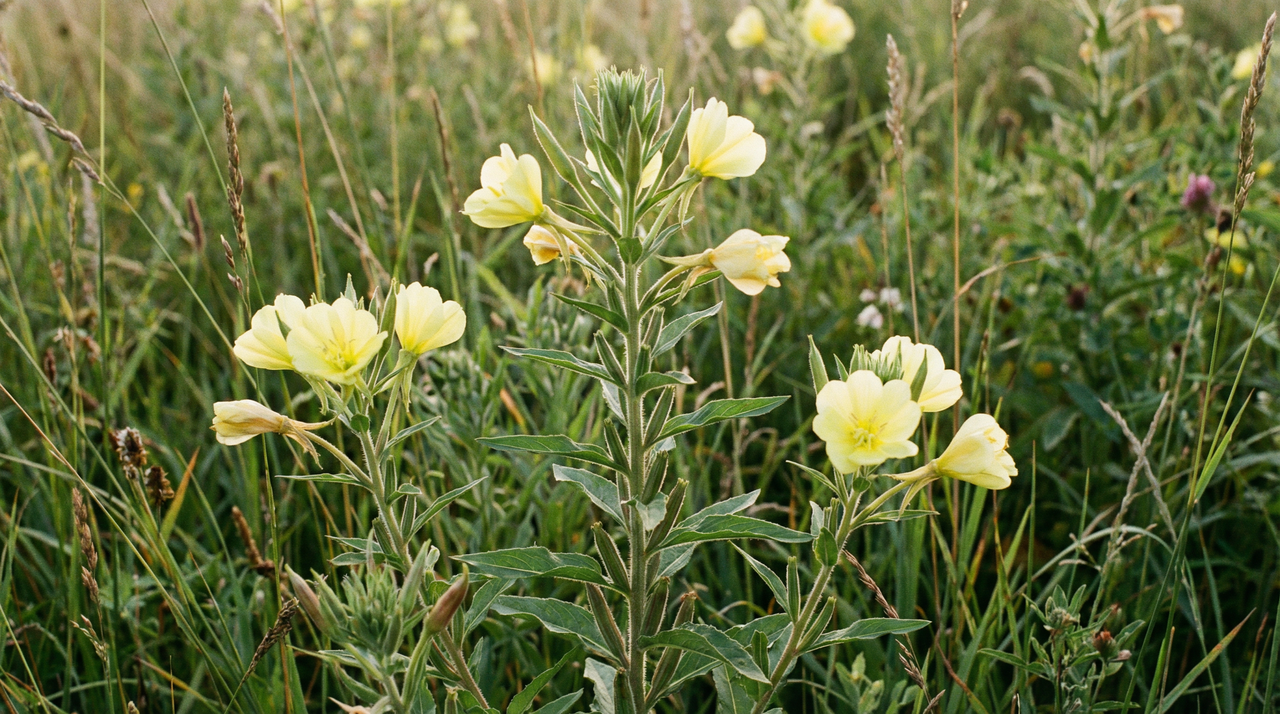
Evening primrose doesn't bloom for you. That's the thing most gardeners don't fully reckon with until they've actually sat outside at dusk, watching a bud they've tended all summer unfurl in under a minute, releasing that soft lemon scent into the cooling air, and realized there's not a bee in sight. The flowers open for moths. Specifically, the long-tongued hawkmoths that navigate by the pale yellow glow of the petals in low light.[1] By morning, the blooms have already begun to wither. If you've only ever seen evening primrose in a catalog photo taken in full daylight, you've essentially seen a plant mid-nap.
I think about that mismatch a lot, because it captures something true about this plant's whole character. Evening primrose operates on its own schedule, for its own ecological reasons, and it really doesn't need your approval. It's a biennial that spends its entire first year as an unassuming ground-hugging rosette, building a taproot while you wonder if anything is happening. Then it bolts, towers, blooms for moths, sets seed prolifically, and dies, having already launched the next generation into every open patch of soil nearby. Gardeners who try to manage it on human terms tend to find it frustrating. The ones who work with its logic find it indispensable.
Origin and History of Evening Primrose (Oenothera biennis)
Botanical Background and Native Range
Evening primrose is fundamentally a North American plant, native to eastern Canada and the United States east of the Great Plains, ranging south through Mexico into parts of Central America and the Caribbean.[2][3] It gravitates toward open, sunny, disturbed ground: roadsides, prairie edges, old fields, anywhere the soil has been turned over and left to the opportunists. Carl Linnaeus formally described Oenothera biennis in 1753, and while it typically behaves as a true biennial with a monocarpic life cycle (meaning it flowers once, sets seed, and dies), conditions can push it toward annual or short-lived perennial behavior.[4][2] I've grown it from seed many times, and I'll say this: the first-year rosette looks convincingly like a fat dandelion or loose lettuce head. You'd never guess what's coming. Then year two arrives and suddenly you've got a towering stem reaching five or six feet, and you understand what the plant was quietly building toward all along. The genus does extend to South America -- Oenothera glazioviana, a large-flowered relative native to Brazil, Argentina, Paraguay, and Uruguay, turns up in ornamental settings and has naturalized aggressively enough to earn invasive status in coastal California[5][6] -- but O. biennis is the one most gardeners actually grow, and the one this article is really about.
Visual Characteristics
The plant itself is straightforward once you know what to look for. That second-year stem is erect and softly hairy, typically reaching two to six feet with alternate lanceolate leaves running five to twenty centimeters long, their margins toothed or lightly wavy.[7] The flowers are the real event: bright yellow, bowl-shaped, one to two inches across, opening in loose terminal spikes from midsummer into early fall.[8][3] They open at dusk with a faint sweet fragrance that's almost powdery, and by the next morning they're fading toward pink. I use that color shift as a phenological cue in the garden; once the blooms are reliably pinking overnight, I know seed set is underway. After pollination, elongated cylindrical capsules form, each packed with dozens of small, pitted, light brown seeds.[8] Below ground, the plant develops a deep taproot that can push past one to two meters, giving it the drought access that lets it shrug off dry spells that would finish off less committed plants.[2][9] O. glazioviana, for comparison, grows notably larger with flowers reaching four to six centimeters and distinctive red sepals[5] -- striking in the garden, but a different plant with a different temperament.
Traditional and Cultural Uses
Long before evening primrose became a supplement, it was everyday medicine for the Cherokee, Ojibwe, Potawatomi, and other tribes across its native range. Roots were boiled into teas or applied as poultices for digestive complaints and hemorrhoids; leaves and seeds addressed respiratory issues, skin conditions, and sore throats.[10][11] That knowledge base is deep and specific. The related South American O. glazioviana also has a history in Brazilian folk medicine[12], but its ethnobotanical record is thinner and less formally documented.
European contact brought the plant across the Atlantic in the 16th century, initially as a curiosity and then as a naturalized fixture of roadsides and waste ground. By the late 19th and early 20th centuries, its seed oil -- rich in gamma-linolenic acid -- was being commercialized for eczema, PMS, and menopausal symptoms, launching what became a global supplement industry.[13][14] I have complicated feelings about that trajectory. The roots, leaves, and seeds are genuinely edible and useful[15], but wild harvesting at commercial scale risks overexploitation, and the commodification of indigenous plant knowledge without meaningful benefit-sharing is a real ethical problem.[16] My position is simple: grow it yourself, credit the indigenous communities whose knowledge underpins its medicinal reputation, and leave wild populations alone.
Fun Facts and Adaptations
A single evening primrose plant can produce more than 100,000 seeds, and those seeds can remain viable for decades in the soil.[3][17] Pair that with a taproot that mines deep groundwater through summer droughts, and you start to understand why this plant thrives in places other things give up. One of my favorite garden moments each summer is standing near a patch at dusk watching hawkmoths work the flowers; it's a pollinator relationship so specialized and theatrical that it tends to convert skeptics immediately.[18] Within its native North American range, that prolific seeding is an asset rather than a liability. Introduce it to European conditions, though, and the story changes: it has naturalized aggressively in Germany, the UK, and elsewhere, where without the ecological checks of its home range it can easily tip from useful into weedy.[19] It's worth keeping that regional distinction in mind from the start.
Evening Primrose Varieties and Sourcing
Evening primrose occupies a curious middle ground in the horticultural world. It's a plant with deep cultural and medicinal history, yet it hasn't attracted the kind of intensive breeding attention you see with showier ornamentals. Most of what you'll find in commerce is either the straight species or modest selections from it, which honestly suits most permaculture growers just fine.
Notable Cultivars and Selections of Oenothera biennis
Oenothera biennis has relatively few formally recognized cultivars compared to, say, echinacea or rudbeckia.[20][21] The named selections that do exist tend to play with flower color, foliage, or plant height: 'Aurora' gives you large, deep orange to mahogany-red flowers on taller stems; 'Snowball' offers double-flowered pure white blooms; 'Purpurea' brings rich color to both stems and flowers; 'Aurea' has a golden cast to the foliage; and compact forms like 'Sulphurea' suit tighter spaces better than the wild type.[20][22] I've grown the straight species alongside 'Aurora' and 'Purpurea,' and the named forms do tend to be a bit better behaved in a designed garden setting, with slightly less aggressive self-seeding than the wild type.
Where serious breeding has happened, it's been driven by the plant's medicinal seed oil rather than garden aesthetics. Developed largely through European programs, high-GLA lines have been selected to yield 30-40% oil by seed weight with GLA levels of 8-12%, compared to roughly 20-30% oil and 6-9% GLA in wild-collected seed.[23][24] Think of it the way we've selected tomatoes for larger fruit or blueberries for sweetness: the genetics are being pushed toward one specific useful trait. For backyard permaculture, those commercial oil lines are largely irrelevant. The straight species will give you all the ecology you need.
If you want something with more visual drama, the related large-flowered evening primrose, Oenothera glazioviana, has cultivars worth knowing about. 'Fireworks,' 'African Sun,' and 'Giant Evening Primrose' offer showier, often larger blooms, with 'Sulphurea' providing pale yellow flowers on a more compact frame.[25][26] Just know you're working with a different species and a different ecological profile.
Where to Buy Evening Primrose Seeds and Plants
You won't find Oenothera biennis at most big-box garden centers. Its availability in the horticultural trade is listed as "occasional," concentrated in specialty native plant nurseries and prairie restoration suppliers.[27][28] That self-seeding reputation keeps it off mainstream shelves, which is a bit ironic given that it's native to 48 states, carries no federal noxious weed designation, and isn't regulated or classified as invasive anywhere in the US.[2][29][30] The same goes for O. glazioviana, which, despite its non-native origins, carries no major invasive designations at the state or federal level.[31][32] There are no special permits or import hurdles to worry about for either species. Managing self-sowing is a garden practice issue, not a legal one.
For sourcing, I consistently go back to a handful of restoration-focused suppliers: Prairie Moon Nursery in Minnesota, Ernst Conservation Seeds in Pennsylvania, and Roundstone Native Seed Company in Kentucky are my go-to recommendations.[33][34][35] Native American Seed, Ion Exchange, and Strictly Medicinal Seeds also carry the species and ship nationwide.[36] Buying from these suppliers matters beyond just legality: restoration nurseries tend to carry seed from documented local ecotypes, and in my pollinator guilds, those regionally adapted plants consistently outperform generic commercial seed. Expect to pay $3-8 for a home-garden seed packet of 100-1,000 seeds, with live plugs running $5-15 each.[37][38] Seeds are available year-round and germinate at 70-90% with proper cold stratification, making them the easiest and most affordable entry point for most gardeners.[39][37]
Evening Primrose Propagation and Planting
Evening primrose is genuinely one of the easier plants to establish from seed, but it has a few quirks that trip people up if they go in blind. Understanding why the seeds behave the way they do makes everything else click into place.
Understanding the Seeds: Morphology, Dormancy, and Storage
The seeds of Oenothera biennis are small, about 1-2 mm long, dark brown to black, and reniform to oval in shape.[40][41] They're also dimorphic: the same capsule can hold larger, darker seeds and smaller, lighter ones, and I've noticed real differences in germination energy between those morphs when I've grown from saved seed.[42] My practice now is to stratify every batch equally regardless of where it came from, because assuming fresh seeds will perform uniformly has burned me more than once.
In the wild, seeds disperse via gravity and rain-splash from dehiscent capsules, with birds and rodents picking up the rest.[43][44] There's no pappus or wing, so they don't travel far on their own. That short-range dispersal strategy is relevant for gardeners: it explains why a single self-seeding plant will colonize the same patch year after year rather than scatter across the property.
The seeds exhibit physiological dormancy and require cold stratification (4-12 weeks at around 40°F/4°C) to germinate reliably.[45][46] Germination is also epigeal and light-dependent, meaning seeds need to be surface-sown with no covering.[45] This is a detail that catches a lot of people out. If you bury the seeds, they may simply sit there.
Storage is where O. biennis gets a little complicated. The seeds are classified as recalcitrant, meaning they're sensitive to desiccation and lose viability fast if dried below about 15-20% moisture.[47][48] Keep them cool and slightly moist at 35-40°F for short-term storage. Properly refrigerated seeds can hold viability for 5-10 years, but room-temperature storage typically drops to 50-70% viability after five years.[49][50] If you have any doubt about an old packet, a simple germination plate test on moist paper at room temperature over 2-3 weeks will tell you what you need to know before you commit a whole bed.[51] The related O. glazioviana has orthodox seed storage behavior and can be dried down to 3-8% moisture and frozen without issue[48] -- a useful reminder that storage rules can't always be applied across the genus.
Propagation Methods: From Seed to Cuttings
Seed is the default method and for good reason: success rates run 80-90% with proper stratification.[52] Direct sow in fall and let winter do the stratification work naturally, or start seeds indoors 6-8 weeks before last frost after a cold-moist stratification period in the refrigerator.[53] Either way, surface sow onto moist seed-starting mix, press the seeds gently to ensure contact, and expect germination in 10-21 days at 60-75°F once dormancy is broken.[54][55]
One thing I wish someone had told me before I planted my first row: the genetics of O. biennis are genuinely unusual. Despite being capable of self-fertilization, it outcrosses more than 90% of the time, and a complex chromosomal arrangement called permanent translocation heterozygosity means seedlings from even a single plant can vary dramatically in height, flower size, and habit.[56][57] I learned to label every row in year one, because what looks like a uniform planting in spring can look like three different plants by midsummer. For most permaculture purposes, that genetic diversity is a feature. But if you're growing a selected form for specific traits, softwood cuttings taken from 4-6 inch non-flowering stems (with IBA rooting hormone at 1000-3000 ppm, in a perlite-vermiculite mix, kept humid) give you 50-70% success and true-to-type results.[58][59] Division in spring or fall works too, though clumps need to be lifted carefully to avoid damaging the taproot. Grafting and tissue culture exist but belong in a research context, not a home garden.
Soil, Site Selection, and Planting Technique
Evening primrose is a pioneer species, and its site preferences reflect that completely. It naturally colonizes roadsides, meadows, dunes, and disturbed ground -- places with full sun, good drainage, and soils that other plants might reject.[60] Sandy or loamy soil is ideal; light clay is tolerable; heavy clay or waterlogged conditions will kill it through root rot.[61] I treat drainage as the single non-negotiable. Get that wrong and nothing else matters.
The taproot is the reason why. O. biennis drives a root 24-48 inches deep given the chance, similar in character to a dandelion or chicory but substantially larger.[55] That root is what gives the plant its drought tolerance once established, but it needs loose, uncompacted soil to get there. Compacted clay is a hard no. If you're working a heavier site, break up at least 18-24 inches and amend with coarse sand or grit before planting.[26]
Soil pH is flexible: 6.0-7.5 is the sweet spot, though the plant will push into 5.5-8.0 territory without serious complaint.[26] Full sun is essential -- minimum 6-8 hours of direct sun daily -- and partial shade will produce leggy, underperforming plants that bloom poorly.[62] Keep seedlings consistently moist during establishment; after that, the deep root handles drought remarkably well on its own.[63]
Spacing, Timeline, and Germination Expectations
Thin or transplant to 12-18 inches apart for most home and permaculture uses.[64] The first-year rosette stays compact, but the second-year plant can reach 2-6 feet tall with a 24-36 inch spread, and crowded stems in year two mean poor airflow, reduced flowering, and a much messier patch overall.[1] I made the mistake of leaving seedlings at 8 inches once, thinking the attrition would sort itself out. By the second summer the patch was a tangle and flowering suffered noticeably. I now thin ruthlessly to 18 inches in a small garden and don't regret it.
Tighter spacing around 12 inches works if you're deliberately establishing a pollinator habitat or restoration patch where density is the goal.[65] For larger plantings or humid climates where fungal pressure is real, open up rows to 24-36 inches to keep air moving.[66]
Keep the biennial timeline in mind as you plan. Seeds sown in fall will germinate the following spring, spend the first year as a low rosette building that taproot, then bolt and flower in year two before setting seed and dying.[53][67] That full seed-to-seed cycle runs 18-24 months. For a continuous display, stagger sowings across two consecutive seasons and then let the plant's self-seeding habit take over. Once a colony is established in a well-drained sunny spot, it genuinely manages its own succession with minimal help from you.
Evening Primrose Care Guide
The best care advice I can give you for evening primrose is this: do less than you think you should. This is a plant that evolved in roadsides, meadows, and disturbed ground where nobody was watering, fertilizing, or fussing over it. Work with that instinct rather than against it, and it'll reward you with those gorgeous lemon-yellow blooms every summer. Fight it with excessive coddling and you'll mostly get leafy disappointment.
Sunlight Requirements for Optimal Growth
Full sun is non-negotiable here. Oenothera biennis needs at least six hours of direct sunlight daily for strong flowering, and in my experience, the closer you get to eight or more, the better the plants perform.[55][68] Partial shade produces leggy, stretched stems with sparse blooms, the kind of result that makes you question whether you planted the right species. Site it where it would feel at home in a sun-baked prairie or along a sunny fence line, and it'll behave accordingly.
Watering Needs and Drought Tolerance
Young plants establishing that first-year taproot appreciate roughly one inch of water per week.[28][20] Once that taproot is down, though, I rarely water mine beyond whatever rainfall we get, even through stretches of several weeks without rain.[69] The plant's drought tolerance is real, not just theoretical.
Soil drainage matters more than watering frequency. Evening primrose wants well-drained sandy or loamy soil with a pH between 5.5 and 7.5, and it simply won't tolerate waterlogging.[28][69] If you see yellowing lower leaves and wilting stems despite wet soil, that's overwatering. Leaf curling, brown tips, and stunted growth in young plants points the other direction.[55]
Feeding and Soil Fertility Management
This plant adapted to nutrient-poor ground and genuinely doesn't need much help from you.[70][2] I learned this the hard way: in one new bed I over-applied a nitrogen-heavy fertilizer and watched those plants produce the most extravagant foliage I'd ever seen on evening primrose, and almost no flowers. It was a useful, if frustrating, lesson.
If your soil is genuinely depleted and you want to support seed production, a light application of low-nitrogen fertilizer like a 5-10-10 or 10-10-10 blend in early spring during the first-year rosette stage is reasonable.[39][71] Phosphorus supports root and flower development; potassium adds vigor in sandy soils.[72] Limit nitrogen after year one entirely. Excess nitrogen means leggy growth, tip burn, reduced flowering, and salt buildup in the soil.[73] My usual approach is one soil test when establishing a new planting, and then I largely leave these plants alone.
Frost and Cold Hardiness
Evening primrose is genuinely cold-tough, rated to USDA zone 4 and RHS hardiness zone H6, tolerating temperatures down to -30°F (-34°C).[2][74] The catch is that tolerance is stage-dependent. I've watched first-year rosettes shrug off a surprise late freeze that blackened all the new second-year growth nearby; those low-growing rosettes with their deep taproots just bounce back while the taller plants take the hit.[55] Young seedlings and fresh spring growth are the most vulnerable below 28°F.[75]
In zones 4 and 5, apply 2 to 4 inches of organic mulch around the base after the first hard frost; push that to 4 to 6 inches if you're gardening in zone 3.[20] Pull the mulch back in spring and confirm drainage is sound. The related Oenothera glazioviana is slightly less cold-hardy, rated for zones 5 to 9 and tolerating roughly -10°C to -15°C,[64] so if you're in a colder garden, stick with the species.
Heat Tolerance and Summer Management
Oenothera biennis covers AHS heat zones 1 through 9 and USDA zones 3 through 9, and that deep taproot gives it real drought resilience in summer.[26][76] Flowering and fruiting are the most heat-sensitive stages; above about 86°F (30°C) you may see wilting, bud drop, and leaf scorch.[77]
In hot summers I lay down about 2 inches of pine straw mulch and notice that even when plants wilt in afternoon heat, the taproot pulls them upright overnight.[78] In the hottest climates, drip irrigation and afternoon shade make a real difference.[79] O. glazioviana, with its subtropical South American background, tolerates daytime highs up to 35-40°C in well-drained soil,[80] giving it a slight edge at the hot end of the range, though the cultural toolkit is identical.
Pruning, Maintenance, and Seasonal Care
Maintenance is genuinely minimal. Deadheading spent flowers prolongs the bloom period and, more practically, keeps the self-seeding in check before capsules ripen and scatter seed everywhere.[55][81] I'll admit I only deadhead about half my plants; the rest I let go to seed in the meadow section because the volunteers that come up are so drought-hardy they need essentially zero attention. It's a judgment call based on how much volunteer management you're willing to do the following year.
Apply 2 to 3 inches of organic mulch in late fall to protect the root crown, suppress overwintering weeds, and provide insulation.[55] Staking the tall second-year flower spikes is rarely necessary; I only reach for stakes in very exposed or consistently windy sites.
Understanding the Biennial Life Cycle
Understanding this two-year pattern changes everything about how you care for, and how patient you need to be with, evening primrose. In year one, the plant forms a basal rosette and builds a deep taproot with no flowering whatsoever. In year two, it bolts to between 0.5 and 1.5 meters, produces yellow flowers from June through September, sets seed, and dies.[1][2] Flowers open in the evening, last a single day, and are pollinated primarily by moths.[82] That's the whole show, and it's worth waiting for.
After a few seasons I got better at identifying first-year rosettes early: they have a slightly hairy texture and a raised central vein that's easy to feel. Knowing that saved me from accidentally pulling what looked like a weed and sacrificing next year's flower spikes. Environmental stressors like drought or disturbance can occasionally compress or extend the two-year timeline,[1] but in practice the cycle is reliable enough to plan around. O. glazioviana may behave as a short-lived perennial and resprout after mild winters; O. speciosa spreads by rhizome into colonies over three to five years[26][83], so if you're after something to plant once and walk away from for decades, those relatives are worth considering. For the classic evening primrose experience, though, trust the two-year clock and plan accordingly.
Harvesting Evening Primrose (Oenothera biennis)
Everything about harvesting evening primrose flows from one simple fact: it's a biennial.[84][2] Once you internalize that two-year clock, every harvest decision becomes obvious.
Timing and Cues for Harvesting Evening Primrose
Seeds ripen roughly 30 to 45 days after flowering, which puts most harvests in late summer through early fall of the plant's second year.[24][2] In the United States, that window generally spans August through October, earlier in the South, later in northern gardens.[85][86] I've learned to trust the rattle test: once the capsules turn brown and papery and start splitting at the top, give a stem a shake. If you hear seeds moving inside, they're ready.[87] Don't wait for every pod to split wide open or you'll lose half of them to the wind.
Flowers are an entirely different harvest window. They open June through August on second-year plants, and since they only last a single evening, you pick them fresh at dusk when the sweet citrus scent is strongest.[7] That fragrance really is noticeably better at dusk than midday; it's one of those things you only learn by actually being out in the garden at the right time.
Edible Parts, Yields, and Flavor Profiles
All parts of Oenothera biennis are edible when properly identified, but age matters enormously for flavor and safety.[2][88] Mature leaves, roots, and seed pods concentrate napthaquinones, and I've always cooked or blanched older material rather than eating it raw. The research on those compounds is clear enough that it's not worth the stomach irritation.
First-year roots taste like a mild parsnip or radish and work beautifully roasted or eaten raw, but they get pithy and bitter fast once the plant bolts in year two.[1] Young spring leaves have a mild peppery flavor similar to spinach, with a slight mucilage that actually makes them a decent stand-in for cooked greens; older leaves need long cooking to lose their bitterness.[1][89] Spring shoots harvested young have a crisp, asparagus-like texture when cooked.[1] The flowers are the easiest harvest: mild, sweet, delicate, and beautiful raw in a salad.[64]
Seeds are where the real value concentrates for most modern growers. Raw, they're slightly bitter and nutty; roasted, they turn pleasantly crunchy.[90] Cold-pressed, the oil carries subtle nutty notes alongside the GLA that makes it medicinally significant.[91] The Meskwaki were grinding these seeds into flour long before anyone was pressing capsules; they also used young leaves as a parsley-like herb and the oil as both food and medicine.[91] That continuity from seed flour to cold-pressed supplement is worth sitting with for a moment. This is not a newly discovered plant.
Evening Primrose Preparation, Uses, and Safety
Culinary Uses: From Wild Roots to Nutritious Leaves, Flowers, and Seed Oil
What I love about evening primrose is how much of it is actually edible. Young first-year leaves are tender, high in vitamin C, and work raw in salads or wilted like spinach.[92] The flowers have a mildly sweet, floral quality that I've used fresh in salads and once candied for a garnish that got more attention than the main dish.[93] Roots are worth trying too. Cooked, they're surprisingly pleasant -- somewhere between young carrot and parsnip, and they hold up nicely in a simple broth or roasted alongside other roots.[93]
The seeds are where things get nutritionally serious. They're the source of the cold-pressed oil that's made evening primrose a household supplement name, loaded with polyunsaturated fats -- roughly 65-80% linoleic acid and 8-14% gamma-linolenic acid (GLA), with oleic acid rounding things out at 15-20%.[94][14] In my Central Florida garden, seeds harvested after a hot, dry summer tend to smell nuttier and richer -- I suspect water stress concentrates the oils, though I'll admit that's observation more than controlled trial.
Medicinal Preparations and Traditional Applications
Native American tribes used this plant long before it became a supplement staple, preparing leaves and roots for digestive complaints, skin conditions, and respiratory issues.[95] Today's preparations are more standardized. Commercial capsules are the most practical route for most people, with typical adult dosages running 500-1,500 mg per day in two or three divided doses.[96] The oil is extracted via cold-pressing to preserve its GLA content, though solvent extraction is used commercially as well.[97] For garden-grown plants, a simple root decoction is possible, though I find the capsule form far more consistent for anyone using it therapeutically. The clinical evidence for conditions like eczema and PMS is real but inconclusive -- the health benefits section covers the research in full detail.[14]
Safety, Identification, and Sustainable Harvesting
If you're pregnant, nursing, or on blood thinners like warfarin, skip medicinal doses of evening primrose oil entirely.[98][99] The bleeding risk is real and the pregnancy safety data simply isn't there. For most healthy adults, short-term use is well-tolerated, though mild headaches, GI upset, or skin reactions do happen in sensitive people.[100] Eating large amounts of raw plant material is also a problem -- stomach upset and vomiting are documented.[101]
On identification: in my early foraging days I mixed up young evening primrose rosettes with a few look-alikes. Oenothera biennis can be confused with Oenothera fruticosa and Circaea lutetiana, among others, so I now label every plant I intend to harvest the moment I put it in the ground.[3][102] For foragers working with wild populations, harvest selectively and only from abundant stands -- this plant is a generous self-seeder in its native range, but it still deserves the same respect as anything you'd take from the land.[1] In my permaculture beds, I leave the majority of second-year plants to go fully to seed -- partly for next season's harvest, partly for the pollinators, and honestly because a plant this useful should always be allowed to come back on its own terms.
Evening Primrose Health Benefits and Medicinal Uses
Most people come to evening primrose through the supplement aisle, but as someone who grows Oenothera biennis in quantity, I find it useful to start with what makes the seed oil worth discussing in the first place. The answer is gamma-linolenic acid. Evening primrose seed oil contains 8–14% GLA alongside 65–80% linoleic acid, with seeds yielding 20–30% oil by weight.[103][104][105] That GLA concentration is unusually high for a food-grade seed oil, and it's the primary reason this plant's extract has generated decades of clinical interest.
Key Compounds and Mechanisms of Action
The oil's phytochemical story doesn't stop at fatty acids. The broader plant contains quercetin, kaempferol, myricetin, and related glycosides concentrated in leaves and flowers, along with phenolic acids including gallic, ellagic, and chlorogenic acids, plus gamma-tocopherol reaching up to 100 mg per 100g in the oil and phytosterols throughout.[106][103] These compounds aren't evenly distributed: seeds emphasize lipids and GLA, aerial parts concentrate phenolics and flavonoids, and roots hold alkaloids and terpenoids.[107] What you harvest, and from which part, genuinely changes what you're getting.
I've noticed this firsthand. Plants I grow in full sun on sandy, well-drained soil produce seeds that smell noticeably more pungent than those from partially shaded beds, which tracks with research showing that light intensity, soil type, seasonal timing, and cultivation method all significantly influence GLA and phenolic concentrations.[108][109][110] That matters whether you're growing for culinary use or trying to produce seeds worth pressing.
Medicinal Research and Clinical Evidence
GLA's anti-inflammatory mechanism is reasonably well understood. Once absorbed, GLA converts to dihomo-gamma-linolenic acid (DGLA), which serves as a precursor for series-1 prostaglandins, particularly PGE1. DGLA competes directly with arachidonic acid, reducing pro-inflammatory eicosanoid production.[111][112] Evening primrose oil also activates PPARγ, inhibits NF-κB (reducing TNF-α and IL-6), and stimulates the Nrf2 pathway to support antioxidant defenses.[112][113] In-vitro and animal models confirm antioxidant and analgesic activity too, though human validation is strongest for skin applications.[114]
Where the clinical evidence is most consistent is atopic dermatitis. Multiple RCTs and meta-analyses show modest but meaningful reductions in itch, dryness, and inflammation, attributed to GLA improving the skin barrier.[115][116] Several clients who incorporated 1–2g daily alongside their existing topical care told me they noticed reduced itch within four to six weeks. I always frame that as anecdotal and recommend they stay in close contact with their dermatologist, but it does align with what the better trials show. The benefits of evening primrose oil on skin are probably the most evidence-backed application we have.
For PMS, rheumatoid arthritis, asthma, menopausal symptoms, and preterm birth prevention, Cochrane and other systematic reviews consistently find insufficient high-quality evidence for routine use; most trials are small, dated, or methodologically limited.[117][118] Commercial supplements compound this uncertainty because GLA content and standardization vary widely across products.[119] If you see a product making broad hormonal claims, look for third-party testing data. Growing and cold-pressing your own seed is one way to know exactly what's in the bottle, though it's a commitment not everyone can make.
A note on species: Oenothera glazioviana has traditional uses in Brazil for respiratory, digestive, and menstrual complaints, and its seed oil fatty-acid profile resembles O. biennis, but the human clinical data essentially don't exist yet. Its therapeutic reputation rests on in-vitro results and ethnobotany, not controlled trials.[119] When you're evaluating evening primrose oil uses and benefits in the research literature, that research is almost entirely about O. biennis.
Nutritional Profile
The seeds themselves are nutritionally dense: 15–25% protein, 40–60% fat, and 15–25% fiber, with 20–30mg of vitamin E (mostly gamma-tocopherol) per 100g.[120][121] Leaves contribute modest vitamin A, vitamin C, and calcium, which makes them a pleasant seasonal green rather than a nutritional powerhouse. The oil itself delivers 124 kcal and 14g fat per 14g serving, and supplemental dosing typically runs 1–3g daily, taken with a fatty meal to improve GLA bioavailability.[122] Roasting the seeds slightly lowers GLA, so if you're pressing your own, cold-pressing is the better route.
Safety Considerations
The seed oil is generally well-tolerated. Up to 8g daily in healthy adults is considered safe for short-term use, with mild side effects like nausea, headache, or diarrhea possible at higher doses — similar in character to what some people experience with fish-oil capsules, though usually milder.[123][14][124] That's the reassuring part. The side effects of evening primrose oil become more serious in specific populations.
I never recommend it to pregnant clients in their first trimester. The possible increased risk of miscarriage is not worth the uncertainty, and while near-term cervical ripening use exists in some midwifery contexts, that should only happen under medical supervision.[118][98] If you have a seizure disorder, avoid it entirely; the oil may lower seizure threshold.[96] If you take warfarin, aspirin, or other blood thinners, know that evening primrose oil moderately increases bleeding risk and should be stopped before surgery.[96][124]
Contact dermatitis from handling the plant is possible in sensitive individuals, and pollen can provoke allergic reactions in some people.[125][126] Long-term high-dose safety data are genuinely sparse, and because evening primrose products are sold as dietary supplements in the US, they aren't subject to pre-market FDA evaluation for efficacy or safety. That regulatory gap is a real reason to choose third-party tested products and stick to the lower end of the dosing range unless you're working with a healthcare provider who has a specific reason to go higher.
Evening Primrose Pests and Diseases
Natural Defenses and Pest Resistance
Evening primrose comes reasonably well-armed for a biennial that seeds freely into disturbed ground. The plant produces an array of phenolics, flavonoids, terpenoids, and volatile organic compounds that actively deter many would-be herbivores,[127][128] and I've noticed on warm mornings that the stems feel surprisingly tacky to the touch. That's the glandular trichomes at work, secreting sticky substances that gum up small soft-bodied insects before they can do much damage.[129] For an organic or low-input polyculture, those built-in defenses matter.
That said, the plant does have its regulars. Aphids (Myzus persicae), spider mites, leafhoppers, leaf beetles, and cutworms will all show up when conditions favor them, and weevils (Trichobaris trypetioides, sometimes called the primrose weevil) along with evening primrose moth larvae tend to do more damage than generalists like cabbage looper because they've evolved specifically to work around the plant's defenses.[130][131] My first season growing it, I lost several young plants to cutworms before I learned to lay cardboard collars at the base of transplants and apply beneficial nematodes to the surrounding soil. A simple fix once you know to look for it. Young plants also get nibbled by deer and rabbits, though mature specimens are much less palatable and rarely browsed significantly.[132]
Regional context matters here. Specialist moth pressure tends to peak in Midwest populations, while snail pressure is more common in Mediterranean climates.[133] One less-obvious pressure point: if you're gardening near roadsides or old industrial sites, test your soil. Heavy metal accumulation in contaminated ground appears to increase aphid susceptibility in stressed plants.[134] Oenothera glazioviana, the large-flowered relative, is generally considered even more pest-free in cultivation across zones 8-10, facing similar but fewer specialist threats.[135]
For IPM, I reach for biologicals first: ladybugs, lacewings, parasitic wasps, and predatory mites cover most soft-bodied pest scenarios, beneficial nematodes handle soil-dwelling larvae, and Bt works well for caterpillar pressure. Insecticidal soap or neem oil are reasonable targeted options when scouting confirms a real threshold has been crossed.[136] No named cultivars have been documented for enhanced pest resistance, so variety selection won't help you here.[20]
Common Diseases and Management
In its native wild settings, evening primrose shows moderate to good overall disease resistance.[2] Move it into a humid, densely planted garden bed, though, and that picture changes. The fungal complex is the real concern: powdery mildew (Erysiphe cichoracearum and related species), rust (Puccinia spp.), leaf spot (Alternaria and Septoria), Botrytis gray mold, downy mildew, and Fusarium and Pythium root rots all occur, particularly when humidity is high or drainage is poor.[137][138] On the bacterial and viral side, Pseudomonas leaf spot can appear, though the plant shows some tolerance to Verticillium wilt and Oenothera mosaic virus.[139]
Root rot susceptibility climbs noticeably in alkaline soils above pH 7.5, so keeping the bed in the 5.5 to 7.5 range is genuinely protective.[2] In my humid summers, I've found that giving plants about 18 inches of spacing and watering only at the base before noon has kept powdery mildew at bay even without fungicides. That matches exactly what the extension research recommends: good airflow from proper spacing (12 to 18 inches), no overhead irrigation, removing infected debris promptly, and going easy on nitrogen to avoid the lush, soft growth that fungi love.[140][141]
If you're choosing between cultivars, I now reach for 'Sulphurea' in shadier or more humid microclimates specifically because it shows visibly better leaf-spot and powdery mildew tolerance in side-by-side trials, and 'Yellow River' has a similar reputation for rust resistance. No cultivar is immune, but they're a meaningful step up from the straight species in challenging spots.[22] For biological disease management, Trichoderma inoculants applied to the root zone offer a practical, low-toxicity option against root rot.[139] Worth noting for Canadian and northern growers: rust incidence is regionally elevated in parts of Canada, and with warming temperatures shifting precipitation patterns, disease pressure across all these fungal pathogens is expected to increase in coming decades.[142] Site selection and cultural habits are doing more work than they used to.
Evening Primrose in Permaculture Design
Evening primrose earns its place in a permaculture system by doing several unglamorous but genuinely useful things at once: anchoring disturbed soil, mining minerals from depth, and serving as a specialized fueling station for a guild of nocturnal pollinators most gardeners never even realize they have. It's a pioneer in the truest ecological sense, not just a wildflower that tolerates neglect.
Ecosystem Functions and Guild Roles
The pollination story alone is worth knowing in detail. Those evening-blooming flowers with their deep nectar tubes are engineered for hawkmoths, particularly Hyles lineata, which account for over 90% of effective pollination in many studies and drive significantly higher seed set than bees or other daytime visitors.[143][144] I've watched this happen in my own garden: right around dusk, the flowers release this sweet, slightly musky scent that ramps up as the light drops, and within twenty minutes the hawkmoths materialize as if from nowhere, hovering in that hummingbird way they have. You'd never know they were coming if you planted something that closes at noon.
Below ground, the taproot is doing equally important work. It stabilizes slopes and disturbed sites while drawing phosphorus, calcium, and potassium from soil layers shallower-rooted neighbors can't access, then makes those nutrients available when the plant's biomass is chopped and composted.[145][146] I chop the second-year stalks into my compost pile every fall, and the following season I consistently see greener, more vigorous growth in the nitrogen-hungry annuals nearby. It's not a dramatic transformation, but it's reliable enough that I've stopped doubting the dynamic accumulation data. Evening primrose is not a nitrogen fixer,[43][40] so pair it with legumes if nitrogen is your goal.
Mild allelopathic root exudates appear to suppress certain weeds and soil nematodes, and the seeds and foliage feed birds, small mammals, and serve as larval host for several moth species.[147][148] As a classic pioneer, it moves into roadsides, abandoned fields, and meadows during early succession, building conditions that favor more complex communities over time.[43][40] Above-ground biomass yields vary with conditions, but the plant can contribute meaningfully as green manure even in lean years.[149]
Climate Adaptability and Hardiness Zones
Few herbaceous biennials match its climate range. Oenothera biennis is hardy from USDA zones 3 through 9, surviving winter lows to -30°F with some microclimate help in the coldest northern gardens, and handling summer heat up to 90-100°F as long as soil moisture doesn't collapse entirely.[70][39] In my zone 9B garden it behaves almost like a short-lived perennial, self-sowing so reliably that I haven't started a new plant from purchased seed in years. The taproot shrugs off week-long dry spells that would flatten most herbs, which tells you something about where its energy priorities are.
It wants full sun, at least six hours, and performs best in average to dry, well-drained soils including sandy and rocky types. Annual precipitation somewhere in the 20-50 inch range suits it well, and established plants can tolerate down to around 15 inches once that taproot has settled in.[150][151][28] The species' native range spans central and eastern North America across Köppen Dfa, Dfb, and Cfa climate zones,[152] which is part of why it has naturalized so successfully in coastal dune restoration projects where most plants give up.[153]
Oenothera glazioviana, the large-flowered evening primrose, occupies a narrower range of zones 5-9 and is notably fussier about humidity, prone to root rot in wet summers.[26] It performs similar pioneer and accumulator functions in its native South American range, but it has naturalized aggressively in California, the eastern U.S., and Mediterranean Europe, making it a less appropriate choice for most intentional plantings outside its home territory.[154]
Forest Layer Placement and Guild Design
Because of its dramatic shift from a low first-year rosette to a tall flowering stem,[55][40] evening primrose belongs in the herbaceous layer at open, sunny edges rather than tucked under a forest canopy. I place it at the sunniest perimeter of food-forest guilds, where it gets full light in its first year while taller companions are still establishing, and then rises to become part of the mid-layer canopy edge in year two.
In pollinator guilds it pairs naturally with Echinacea, Asclepias, and Rudbeckia, supporting over 50 pollinator species across the combined planting.[18] Those daytime bloomers hand the pollinator shift off to evening primrose right around dusk, which means a well-designed guild has activity from dawn straight through midnight. Leaves, shoots, and flowers are also mildly edible with a faint nutty flavor,[1] a small bonus for the kitchen gardener who happens to be harvesting nearby.
The management reality is this: I learned the hard way that an unmanaged stand will self-seed aggressively in its second year, crowding out the companions you planted it to support. The mild allelopathic chemistry that suppresses weeds will suppress wanted neighbors too if the population gets dense enough.[155] Outside the plant's native eastern range especially, I treat it like a welcome guest rather than a permanent resident: I deadhead ruthlessly after bloom and pull volunteers before they set seed. That approach keeps all the pioneer and pollinator benefits while preventing it from becoming the thing you're fighting instead of farming.
The Plant That Taught Me to Stop Apologizing for Weeds
I spent my first few seasons pulling evening primrose out of my vegetable beds, convinced it was taking up space something more useful deserved. Then one August evening I watched a sphinx moth hover at a freshly opened bloom in the near-dark, and I finally understood what the plant had been doing there all along. It wasn't a weed. It was doing a job I hadn't thought to assign.
Sources 155
- USDA Forest Service: Oenothera biennis Plant of the Week ↩
- USDA PLANTS Database - Oenothera biennis ↩
- Flora of North America - Oenothera biennis ↩
- Missouri Botanical Garden: Plant Finder Entry for Evening Primrose ↩
- Flora of North America: Oenothera glazioviana ↩
- Cal-IPC - Oenothera glazioviana Invasive Plant Profile ↩
- Missouri Botanical Garden - Oenothera biennis ↩
- Missouri Botanical Garden Plant Finder - Oenothera biennis ↩
- Flora of North America Vol. 3 ↩
- Native American Ethnobotany Database ↩
- Native American Ethnobotany ↩
- Ethnopharmacological survey of plants used in the traditional treatment of gastrointestinal and respiratory diseases in Southeastern Brazil ↩
- A History of Evening Primrose in Europe ↩
- Evening Primrose Oil: History and Uses ↩
- Edible and Medicinal Plants of the West ↩
- Cultural Appropriation in Herbal Medicine ↩
- Biology and Ecology of Evening Primrose (Oenothera biennis) - CABI ↩
- Oenothera biennis in Pollinator Gardens ↩
- Oenothera biennis ↩
- RHS Plant Finder: Oenothera biennis ↩
- Missouri Botanical Garden Plant Finder: Oenothera biennis ↩
- Evening Primrose Cultivars for Ornamental Use ↩
- Breeding Evening Primrose for Gamma-Linolenic Acid ↩
- Evening Primrose Oil Production ↩
- Evening Primrose Cultivars - RHS Gardening ↩
- Oenothera glazioviana - Missouri Botanical Garden ↩
- Oenothera biennis, Common Evening-primrose - Missouri Botanical Garden ↩
- Oenothera biennis - USDA PLANTS Database ↩
- Federal Noxious Weeds ↩
- Invasive Plant Inventory ↩
- Oenothera glazioviana ↩
- Invasive Plant Atlas of the United States ↩
- Evening Primrose Seeds ↩
- Evening Primrose Seed ↩
- Oenothera biennis - Common Evening Primrose ↩
- Red Evening Primrose (Oenothera glazioviana) ↩
- Common Evening Primrose Seeds ↩
- Evening Primrose Seeds ↩
- Commercial Seed vs. Cutting Propagation ↩
- Oenothera biennis L. (Onagraceae): Morphology, Distribution, and Seed Characteristics ↩
- Seed Heteromorphism in Oenothera biennis ↩
- Seed Morphology of North American Onagraceae ↩
- Oenothera biennis - USDA PLANTS Database ↩
- Morphology and Dispersal of Evening Primrose Seeds ↩
- Seed Dormancy and Germination in Oenothera biennis ↩
- Seed Dormancy in Onagraceae: A Review ↩
- Seeds of Native Plants: Guidelines for Using Native Seeds ↩
- Seed Longevity and Storage Behavior in Onagraceae ↩
- Seeds of Oenothera biennis: Germination and Storage Requirements ↩
- Seed Longevity of Weed Species ↩
- International Rules for Seed Testing ↩
- Breeding Systems in Oenothera biennis ↩
- Oenothera biennis (Common Evening Primrose) ↩
- Evening Primrose: Propagation and Cultivation ↩
- Growing Evening Primrose from Seed ↩
- Genetics and Evolution of the Oenothera Complex ↩
- Seed Propagation of Oenothera biennis: Challenges and Strategies ↩
- Propagation of Ornamental Plants: Evening Primrose ↩
- Rooting Responses of Oenothera biennis Cuttings to IBA ↩
- Oenothera biennis ↩
- Oenothera glazioviana (Large-Flowered Evening-Primrose) ↩
- Evening Primrose (Oenothera biennis) ↩
- Oenothera biennis (Common Evening-Primrose) ↩
- Oenothera biennis (Common Evening-Primrose) ↩
- New York Natural Heritage Program: Oenothera biennis Habitat Discussion ↩
- Evening Primrose Planting Guide ↩
- Evening Primrose Propagation ↩
- Evening primrose ↩
- Oenothera biennis Cultivation Guide ↩
- Oenothera biennis (Evening Primrose) ↩
- Agronomic Practices for Oenothera biennis Seed Production ↩
- Nutrient Management for Oilseed Crops Including Evening Primrose ↩
- Nutrient Management in Evening Primrose (Oenothera biennis L.) ↩
- RHS Gardening - Oenothera biennis ↩
- Evening Primrose: Frost Tolerance and Care ↩
- AHS Plant Heat Zone Map ↩
- Physiological Adaptations of Oenothera biennis to Drought Stress ↩
- Heat Stress in Ornamental Plants: Mitigation Techniques ↩
- Evening Primrose: Care and Growing Guide ↩
- Heat Stress Responses in Oenothera glazioviana Seedlings ↩
- Oenothera biennis ↩
- Missouri Botanical Garden - Oenothera biennis ↩
- Flora of North America - Oenothera speciosa ↩
- Oenothera biennis (Evening Primrose) ↩
- Evening Primrose Seed Saving Guide ↩
- Harvesting Seeds from Evening Primrose (Oenothera biennis) ↩
- Harvesting Native Wildflower Seeds ↩
- Evening Primrose: Identification, Edibility, and Uses ↩
- Evening Primrose: Foraging and Uses ↩
- Lipid composition and sensory properties of evening primrose oil ↩
- Oenothera biennis - University of Illinois Extension ↩
- Wild Edible Plants of the Eastern United States ↩
- Evening Primrose (Oenothera biennis) - Edible Uses ↩
- Nutritional Composition of Oenothera biennis Seeds ↩
- Native American Ethnobotany ↩
- Evening Primrose Oil ↩
- Missouri Botanical Garden Plant Finder - Oenothera biennis ↩
- Evening Primrose Oil: Benefits and Safety ↩
- Evening primrose (Oenothera biennis) medicinal plant and its use as complement for health ↩
- Evening Primrose: Benefits, Side Effects, and Dosage ↩
- Oenothera biennis - PlantFinder ↩
- Evening Primrose Look-Alikes and Toxicity ↩
- Phytochemical Profile of Oenothera biennis L. (Evening Primrose): A Review ↩
- Chemical Composition and Pharmacological Activities of Oenothera biennis L.: A Review ↩
- Fatty Acid Composition of Evening Primrose Seed Oils ↩
- PHYTOCHEMICAL CONSTITUENTS AND BIOLOGICAL ACTIVITIES OF OENOTHERA BIENNIS ↩
- Bioactive Compounds in Evening Primrose ↩
- Influence of Soil Type on Secondary Metabolites in Oenothera biennis ↩
- Fatty Acid Composition of Evening Primrose under Varying Light Conditions ↩
- Seasonal Variations in Phenolic Content of Oenothera biennis ↩
- Gamma-Linolenic Acid: A Dietary Omega-6 Fatty Acid for Skin Health ↩
- Anti-Inflammatory Effects of Evening Primrose Oil on NF-κB and PPARγ Pathways ↩
- Nrf2 Activation by Gamma-Linolenic Acid in Oxidative Stress Models ↩
- Antioxidant and anti-inflammatory activities of Oenothera biennis ↩
- Evening primrose oil for eczema ↩
- Efficacy of Evening Primrose Oil in Atopic Dermatitis: A Meta-Analysis ↩
- Evening primrose oil and fish oil for severe chronic asthma ↩
- Evening primrose oil for prevention of preterm birth in high-risk pregnancies ↩
- Ethnopharmacological Survey of Oenothera glazioviana in Brazil ↩
- Nutritional Composition of Oenothera biennis Seeds ↩
- Nutritional Composition of Evening Primrose (Oenothera biennis L.) ↩
- FoodData Central: Evening Primrose Oil ↩
- Evening Primrose Oil - Mayo Clinic ↩
- Evening Primrose Oil - MedlinePlus ↩
- Contact Dermatitis from Oenothera biennis ↩
- Allergic Reactions to Evening Primrose Oil ↩
- Insect Herbivory and Plant Defense in Oenothera biennis ↩
- Secondary Metabolites in Evening Primrose and Their Role in Pest Resistance ↩
- Trichomes and Secondary Metabolites in Evening Primrose (Oenothera spp.) ↩
- Evening Primrose Pests and Diseases ↩
- Weevils on Evening Primrose ↩
- Evening Primrose: Production and Marketing ↩
- Missouri Botanical Garden Plant Profile: Oenothera biennis ↩
- Heavy metal accumulation affects herbivore interactions in Oenothera biennis ↩
- Missouri Botanical Garden Plant Finder - 'Giant Evening-primrose' ↩
- Integrated Pest Management for Ornamental Plants ↩
- Pests and Diseases of Evening Primrose ↩
- Fungal Pathogens of Oenothera Species ↩
- Pathogen Interactions in Oenothera biennis ↩
- Diseases of Evening Primrose (Oenothera biennis) ↩
- Evening Primrose Cultivation Guide ↩
- Herbarium-based approach reveals disease dynamics in the invasive evening primrose (Oenothera biennis) in Canada ↩
- Pollination Ecology of Oenothera biennis ↩
- Pollination Ecology of Oenothera biennis in Disturbed Habitats ↩
- Native Plants for Erosion Control ↩
- Dynamic Accumulators in Permaculture ↩
- Wildlife Use of Evening Primrose ↩
- Ecological Roles of Oenothera Species in Disturbed Habitats ↩
- Biomass Production of Native Forbs ↩
- Oenothera biennis ↩
- Oenothera biennis ↩
- USDA PLANTS Database - Oenothera biennis ↩
- Restoration of Coastal Dunes on the Great Lakes ↩
- Oenothera glazioviana ↩
- Ecological Impacts of Oenothera glazioviana in Brazilian Ecosystems ↩