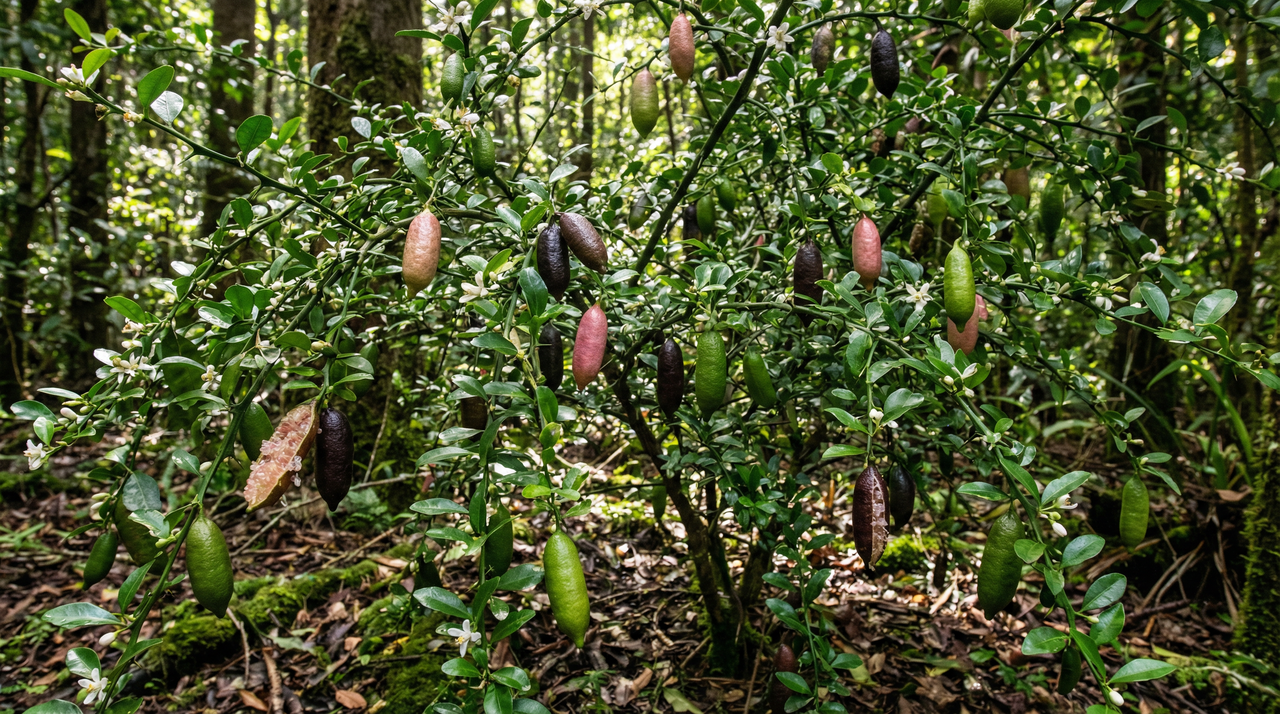
Cut a finger lime open and you'll understand why chefs started calling it "caviar lime." The fruit doesn't juice like a normal citrus; it doesn't even look like one on the inside. Instead, hundreds of tiny pearl-shaped vesicles spill out, each one a self-contained bead of intensely tart, floral, lime-bright liquid that bursts the moment it hits your tongue. I've served these to people who've been growing citrus for decades and watched them go completely quiet for a second. That pause is the plant doing something no other citrus on earth does quite the same way.
What gets me, though, isn't the culinary theater. It's that Aboriginal Australians have known about this fruit for thousands of years, eating it fresh, using the leaves medicinally, fashioning tools from its wood, while the rest of the world spent most of that time completely ignoring it.[1] The plant was formally described by Western botanists in 1875, then largely dismissed as a weedy rainforest shrub until a handful of Australian chefs in the 1990s put it on a plate and everything changed. That's a long time to overlook something extraordinary growing right in your backyard.
Finger Lime Origin, History, and Botanical Background
The finger lime has one of those backstories that makes you appreciate a plant on a whole new level. Native to the subtropical rainforests along Australia's east coast, primarily in Queensland and northern New South Wales, Microcitrus australasica evolved as an understory shrub growing in dappled light from sea level up to roughly 800 meters elevation.[2][3] That native range tells you almost everything you need to know about how to grow it: humid, warm, acidic, and sheltered.
Botanical Background and Visual Characteristics of Microcitrus australasica
In the wild, finger lime grows on volcanic soils and alluvial flats near rivers, tucked under a canopy that buffers it from drying winds.[3] It's a perennial evergreen in the Rutaceae family, reaching 2-7 meters with a thorny, multi-stemmed habit, and it carries a lignotuber that lets it resprout after disturbance.[4] Having grown several Rutaceae relatives in my own designs, I find the thorny stems and that lignotuber really characteristic of the family's tougher members. It's built to survive, which is part of why it translates reasonably well to home cultivation once you get the drainage right.
Wild populations, though, are struggling. Fewer than 10,000 mature individuals remain, classified as vulnerable to endangered due to habitat loss and invasive species.[5] That conservation context matters to me as a grower. Every cultivated finger lime in a well-managed garden or food forest takes some pressure off a species that doesn't have a lot of wild buffer left. The plant lives 20-50+ years in cultivation, though frost below -2°C and poor drainage can cut that short significantly.[4]
The fruit itself is what stops people in their tracks. Each finger-shaped cylinder, typically 5-10 cm long with a smooth waxy rind in colors ranging from green to deep purple depending on cultivar, pops open to reveal translucent pearl-like juice vesicles that burst with tart citrus flavor under the gentlest pressure.[4][6] I've handed ripe fruit to clients who'd never heard of finger lime before, and the reaction is always the same: genuine surprise. Nothing else in the citrus world delivers that texture.
Traditional and Cultural Uses by Indigenous Australians
European botanical science caught up to this plant in 1875, when Ferdinand von Mueller formally described it as Microcitrus australasica, though collections had been made decades earlier in the 1840s.[7] But Indigenous Australians, including the Bundjalung people, had been using it for a very long time before that. The fruit was eaten fresh as bush tucker, and used as a souring agent in food.[8] Medicinally, leaves and fruit were applied to skin conditions like ringworm and boils, and used for respiratory complaints including sore throats and colds.[8]
Learning those traditional applications genuinely deepens how I experience the fruit when I'm harvesting it. That sharp, antiseptic-bright tang makes a lot more sense knowing it reflected real therapeutic utility. Contemporary Indigenous chefs and entrepreneurs are actively reviving these uses in native food tourism and modern Australian cuisine, keeping the knowledge alive rather than archiving it.[8]
Modern Revival and Fun Facts About Finger Limes
The nickname "caviar lime" comes directly from those spherical juice vesicles, and it stuck because it's accurate.[2][9] Chefs like Neil Perry and Maggie Beer helped bring the fruit to international attention through the Australian bush food movement starting in the late 1980s and gaining momentum through the 1990s and 2000s, with commercial cultivation expanding meaningfully around 2010.[10][8] For growers in the United States, it's reassuring to know the USDA has no noxious weed listing for it; it's simply classified as an introduced species with no invasive tendency outside its native range.[11] All of that history, from ancient rainforest understory to Michelin-starred menus, is packed into a fruit roughly the size of your thumb.
Finger Lime Varieties and Where to Buy Them
The Australian finger lime we know today as a gourmet ingredient looks very different from what was growing wild in Queensland and New South Wales rainforests just a few decades ago. Serious breeding didn't begin until the late 1990s, when growers started selecting from wild collections of Microcitrus australasica with clear goals: better yields, more consistent flavor, and disease resistance worth betting a commercial crop on.[12] What came out of that work is a cultivar palette that genuinely surprised me the first time I ordered fresh fruit to evaluate.
Notable Finger Lime Cultivars
The color range alone is worth talking about. 'Jali Red' delivers deep ruby-red vesicles that look almost jewel-like against raw oysters or a piece of sashimi. 'Pink Ice' is softer and more delicate, a blush-pink pulp that I'd reach for in desserts or sparkling cocktails. 'Jaffas' goes the opposite direction entirely: green skin with yellow-gold pearls, tart and bright. Rounding out the named selections available to home growers are 'Byron Sunrise', 'Ridgeback', 'Cristina', 'Barramundi', 'KNeed Hill', and 'Faulkner Ridge', all varying in fruit size, skin color, and flavor intensity.[4][13] If you're choosing by kitchen use, think red and pink for visual drama, yellow-green for sharper acid punch.
Sourcing Finger Lime Plants, Seeds, and Fruit
I've ordered finger lime plants from Four Winds Growers and One Green World more than once, and the difference between grafted trees and seed-grown plants is not subtle. My grafted specimens set fruit in their second year in the ground. The seedlings I started early on took much longer and came up variable in ways that made me question what I was actually growing. Seeds run $10–$20 a packet and grafted young plants typically land in the $20–$100 range, with mature trees pushing $150 or more depending on size and vendor.[14] For most home gardeners, paying for a grafted plant is the obvious call. Just Fruits and Exotics and Madison Citrus Nursery are also worth bookmarking.
Most of what's available domestically comes from propagation trials in California and Florida, which has simplified things considerably for zone 9–11 growers.[14] Importing directly from Australia requires USDA APHIS permits, phytosanitary certification, and often cold treatment to guard against citrus canker and huanglongbing; no CITES permit is needed since Microcitrus australasica isn't on the list,[15][16][17][18] but California, Florida, and Texas each layer on their own citrus rules, and navigating all of that for a single tree is rarely worth the effort when domestic nurseries are increasingly stocking healthy, true-to-type grafted stock. For fresh fruit rather than plants, Melissa's Produce, Baldor Specialty Foods, Whole Foods in coastal markets, and farmers' markets are your best bets. Verify availability before you count on it; supply is still building.
Finger Lime Propagation and Planting
Finger lime sits in an interesting middle ground as a plant to establish. It's not difficult, exactly, but it rewards growers who understand what it actually is: a rainforest understory survivor that evolved under very specific conditions and hasn't entirely forgotten them. Get the propagation method and site right from the start, and you're working with the plant. Get either wrong, and you're fighting an uphill battle against waterlogged roots, chlorosis, or a seedling that takes a decade to fruit.
Propagation Methods for Finger Limes
Seeds are where most curious gardeners start, and they're genuinely interesting to work with. Finger lime seeds are polyembryonic, meaning a single seed can produce multiple embryos, some of which are nucellar (genetically identical clones of the parent).[19][20][21] So there is some potential for true-to-type plants from seed. That said, variability still happens, and the bigger issue is time. Seedlings typically take 4 to 7 years to first fruit, and under suboptimal conditions that can stretch to 10.[22][23] Seed propagation makes sense for breeders and very patient home growers, but most people want fruit in a reasonable timeframe.
If you do go the seed route, know that these are recalcitrant seeds: small (3 to 7 mm), ovate, with a hard glossy testa, and highly sensitive to desiccation.[24][25] I learned this the hard way. I once cleaned a batch of seeds after harvest, set them aside to dry properly, and lost most of them to fungal rot within a few weeks of less-than-ideal storage. Now I clean and plant immediately after extraction, keeping seeds moist until they go into the medium. Fresh seed can hit 60 to 80% germination, but stored seed drops off fast: around 70 to 80% viability after 6 months of careful moist storage, and below 50% after 12 months.[24][26] Germination itself is reasonably quick once you get conditions right: 2 to 8 weeks at 21 to 29°C (optimal around 24 to 27°C) with consistent moisture.[27][28] Scarification sometimes helps if germination rates are sluggish.
Cuttings are an option, though not a particularly easy one. The success rate sits at 30 to 50%,[29] and a big reason for that lower ceiling is finger lime's hollow pith, which makes water and nutrient uptake through the cutting base unreliable. If you try it, take 10 to 15 cm semi-hardwood sections in late spring or early summer with 2 to 3 nodes, dip in 1000 to 3000 ppm IBA, and root in a sterile, well-draining medium under bottom heat (24 to 27°C) with 80 to 90% humidity. Roots typically form in 4 to 8 weeks.[30] It works, but you'll lose more than you'd like.
Grafting is what changed my success rate completely. It consistently delivers take rates above 80%[30] and produces true-to-type trees that fruit in 2 to 4 years rather than most of a decade.[23] Trifoliate orange (Poncirus trifoliata) is my preferred rootstock: good disease resistance including Phytophthora, a mild dwarfing effect that keeps container specimens manageable on my patio, and solid compatibility with finger lime.[31][32] Carrizo citrange is another solid option. I do cleft grafting in late winter to early spring and regularly see 70 to 85% takes; veneer grafting can push that closer to 90%.[33] The visual cue I watch for is the scion pushing new growth, usually within 3 to 4 weeks of a successful union. Before that first flush, I resist the urge to unwrap and check.
Air layering is worth knowing about for propagating a specific specimen with minimal transplant stress. During active spring or early summer growth, wound a branch, apply 3000 to 8000 ppm IBA, wrap with moist sphagnum and plastic, and wait for roots to fill the moss.[34][35] It sidesteps the hollow-pith issue entirely and produces a rooted layer with no transplant shock.
Soil, Site Selection, and Light Requirements
Understanding where finger lime comes from makes every soil and site decision obvious. In nature this is a low-elevation rainforest understory plant growing on light-textured, sandy loam or alluvial soils derived from sandstone or granite, with annual rainfall of 1000 to 2000 mm and a pH naturally sitting around 5.5 to 6.5.[36][37] Those origins explain why the plant is so unforgiving of heavy, waterlogged conditions in cultivation.
Drainage is the non-negotiable. Phytophthora root rot is the most common reason new growers lose trees, and it's almost always a drainage failure.[38] Aim for organic matter at 3 to 5% and low compaction, with a target pH of 5.5 to 6.5 and tolerance between 5.0 and 7.0.[39] Go above 7.0 and you'll start seeing interveinal chlorosis from iron and zinc lockout; I had a young tree in slightly alkaline soil that came in yellowing between the leaf veins, looking miserable by midsummer. A targeted sulfur amendment and a heavy layer of acidic mulch pulled it back to healthy green within one growing season. Drop much below 5.5 and aluminum toxicity becomes a risk.[40] Test your soil before planting, not after problems appear.
For containers or heavy native soils, a mix of 50% quality potting soil, 30% perlite or coarse sand, and 20% pine bark gives you the drainage and slight acidity these trees want.[41] Wherever you plant, apply 5 to 10 cm of organic mulch to buffer moisture and temperature, but keep it well clear of the trunk.[35]
Light is the other half of the site equation. Finger lime evolved under a forest canopy, and it shows. It prefers filtered or dappled light, roughly 4 to 6 hours of sunlight with morning sun and afternoon shade, particularly in hotter inland locations within USDA zones 9 to 11.[42][43] Full sun scorches the leaves; too little and you get leggy growth with poor fruit set. I grow kumquats in full sun without much complaint, but the finger lime just a few meters away in dappled shade of a Leucaena canopy looks far healthier through July and August. Cooler maritime climates can handle more direct sun, but in my zone 9B-style conditions the afternoon shade is genuinely protective.[44]
Spacing, Planting Technique, and Timeline to Fruit
Finger lime grows at a moderate rate, around 30 to 60 cm per year, eventually reaching 3 to 7 m tall with a canopy spread of 2 to 5 m if left unpruned.[45] In commercial orchards, trees are typically managed to 2 to 3 m to keep harvesting practical; I do the same in my own setup because reaching into a thorny finger lime over head height is an experience you only repeat by accident. Commercial spacing runs 3 to 6 m between plants and 4 to 8 m between rows, supporting 300 to 600 trees per hectare depending on soil fertility.[46] That spacing isn't arbitrary: adequate airflow through the canopy directly reduces fungal disease pressure. I planted a small block too close together once, and the humid subtropical summers turned into a recurring anthracnose problem that took two seasons of corrective pruning to sort out. Give them room.
Home gardeners can plant closer if regular pruning is part of the plan, and container culture with frequent root pruning is genuinely viable for zone 8b or colder gardeners who need to overwinter trees under cover.
On timeline: grafted trees fruit in 2 to 4 years, seedlings in 4 to 7 (sometimes longer).[22][47] Full commercial production from grafted trees comes around years 5 to 7.[23] That wait feels long until you're standing next to a productive tree rolling a harvest of translucent citrus pearls between your fingers. Choose your propagation method with that timeline in mind, get the soil and site right from day one, and this plant will more than justify the patience.
Finger Lime Care and Growing Guide
Caring for finger lime gets a lot easier once you stop thinking of it as a standard citrus tree and start thinking of it as a rainforest understory plant that happens to make fruit. That shift in mental model explains almost every care decision you'll need to make.
Sunlight Requirements for Finger Lime
In my food forest designs, I tuck finger limes where they receive morning sun filtered through taller canopy trees, with good protection from the brutal afternoon glare. That placement isn't just aesthetic; it mirrors exactly how this plant grows in the wild. Finger limes prefer 4-6 hours of filtered or morning sunlight daily and generally need 30-50% shade cloth protection in hotter inland areas to prevent leaf scorch.[27][48][4] Coastal gardens with consistent moisture can push toward more sun, but inland? Afternoon protection is non-negotiable. Too much sun shows up as browning leaf edges, bleaching, and wilting; too little gives you chlorosis, leggy growth, and almost no fruit.[49][50] The sweet spot for most home gardens is filtered morning sun plus a canopy neighbor or shade structure handling the afternoon heat.
Watering Needs for Finger Lime
The core rule is moist but never waterlogged. During the growing season, finger limes need roughly 25-50 mm of water per week, dropping to around 10-20 mm every two weeks in winter.[51][4][52] Deep, infrequent watering encourages roots to reach 30-60 cm down, which builds drought resilience over time. I use a finger-test in the pot or soil and let the top inch or two dry before watering again.
From what I've seen, overwatering kills far more finger limes than drought does, especially in clay-heavy or container soils. Yellowing leaves, wilting despite wet soil, and leaf drop are the early warnings; Phytophthora root rot is where it ends if you ignore them.[53][54] Underwatering shows differently: leaf curling, wilting, and fruit dropping before it's ready. A 5-10 cm layer of organic mulch over the root zone does real work here, retaining moisture and keeping soil temperatures from spiking.[55][56] Drip irrigation is my strong preference over overhead watering, partly for efficiency and partly because keeping foliage dry reduces disease pressure.
Feeding and Fertilization for Finger Lime
Finger lime is a moderate feeder. Nitrogen drives the leafy growth, phosphorus supports roots and fruit initiation, and potassium shores up disease resistance and fruit quality; iron, zinc, manganese, and boron are the micronutrients to watch.[57][58] For mature plants, 100-200 g of a balanced slow-release fertilizer (something in the 3-1-2 or 8-3-9 range) applied in 3-4 split doses from spring through autumn keeps things on track without risking root burn.[59][60] Container plants get half-strength every 4-6 weeks. I learned the hard way in my first season that granular fast-release products around the root zone cause damage that can set a young tree back months; slow-release has been my standard ever since.
I run a soil test each spring because micronutrient lockout is sneaky, especially if soil pH drifts above 6.5. Iron chlorosis shows up first on the newest growth as interveinal yellowing; nitrogen deficiency hits older leaves uniformly; potassium deficiency burns the margins of older leaves.[61][62] A foliar spray corrects micronutrient problems faster than soil applications, so I keep a dilute chelated iron product on hand once the spring flush starts.
Frost Tolerance and Protection for Finger Lime
Finger lime sits comfortably in USDA zones 9-11. Mature plants can handle brief dips to around -4°C to -1°C (25-30°F), but young plants take damage below -2°C (28°F) and should be treated as frost-tender until they're established and well-mulched.[63][64][65] Frost damage ranges from leaf scorch and bud death to stem splitting and, in the worst cases, frozen vesicles and root damage in cold wet soil.[4][66][67]
Growing young trees in large movable pots has been a genuine game-changer for me in zone 9B-adjacent conditions. On the rare nights when a hard frost threatens, I wheel them into the garage or under the eave of the house. It sounds fussier than it is, and honestly it's saved my plants multiple times. For trees in the ground, a sheltered planting site, thick mulch over the root zone, and a frost blanket on cold nights are your main tools.
Heat Tolerance and Management for Finger Lime
The optimal growing range is 15-30°C (59-86°F). Finger lime can push through 35-40°C (95-104°F) with support, but above 30°C flowering and fruit set suffer, and above 35°C you'll see fruit deformities and drop, especially when humidity drops along with it.[48][68] Wilting, leaf scorch, curling, and cracked fruit are the signs that heat stress has crossed a line.[69][70]
In hot humid summers I bump shade cloth to 50% for any tree under two years old and rely heavily on mulch to keep root-zone temperatures down, the same approach I use for passionfruit and other subtropicals in my garden. Deep drip irrigation (20-40 L per week during heat events) keeps roots from drying out when surface temperatures spike. Some cultivars like 'Jali Red' show marginally better heat resilience, but honest site management matters more than variety selection here.
Pruning and Maintenance for Finger Lime
Finger lime needs only light pruning, which suits its naturally compact, thorny habit. In the first 2-3 years, focus on developing a strong central leader and an open canopy; after that, the annual task is removing suckers, dead or diseased wood, and any crossing branches after harvest in late winter to early spring.[71][72] I learned the hard way not to make heavy cuts: I lost a young tree to sunburn on exposed wood after an overly enthusiastic pruning session, and since then I've kept it light each year. The result has been healthier, more open canopies with better airflow, which also keeps fungal pressure down in humid conditions. In a permaculture guild, a well-shaped finger lime also doubles as a low hedge that discourages browsing animals through those thorns.
Seasonal Rhythm of Finger Lime
Flowering happens late winter through spring, triggered by warming temperatures and lengthening days.[4][73] There's something I love about those small white blossoms showing up while the garden is still waking up. What follows is a long game: fruit develops over 6-9 months, ripening from late spring through autumn. That extended development window is exactly why consistent moisture during fruit swell matters so much, since irregular watering is a leading cause of splitting. Through winter the plant slows down noticeably, and that's the right cue to back off on both water and fertilizer. The whole calendar, from first flower to ripe fruit, is really just the earlier care decisions playing out: get the light, water, and feeding right during the growing season, and the harvest follows as a predictable result rather than a lucky one.
Harvesting Finger Limes: Timing, Technique, and Flavor at Peak
Patience is the defining skill for finger lime growers. From bloom to ripe fruit takes approximately 180 to 240 days, with spring flowers eventually delivering a harvest that runs late summer through winter depending on where you are.[74][75] Florida growers typically pick August through December; California runs September to January.[76][77] And that's assuming you've got a mature tree. If you've grown yours from seed, you may be waiting four to seven years for the first fruit. Grafted stock is a much kinder choice for the impatient.
When to Pick: Ripeness Cues and Seasonal Windows
Finger lime doesn't give you a single obvious signal the way a Meyer lemon does when it turns bright yellow. Ripe fruits, typically 5 to 10 cm long, transition from bright green toward yellow or yellow-gold, though some green-toned varieties hold their color even at full maturity, which trips up first-time growers who keep waiting for a color change that isn't coming.[78][79] My more reliable cue is the squeeze test: ripe fruit yields slightly to gentle pressure, like a ripe avocado, but still holds its shape.[80] Acidity drops and sweetness rises as the fruit matures, which you'll taste as the difference between a puckering, astringent bite and something genuinely bright and complex.[81] Plan on checking the tree every few days, because ripening is asynchronous and fruits don't wait for each other.
How to Harvest and Store Finger Limes
The harvest itself is simple: a gentle twist and pull is all you need.[81] What's less obvious is the urgency. Finger limes are dehiscent capsules, meaning fully ripe fruit will split open lengthwise on its own if you leave it too long, so you want to catch it just before that point.[82] Once picked, keep them refrigerated between 5 and 10°C with high humidity; stored well, they'll hold for two to four weeks.[82] I learned early on not to leave them on the counter: the vesicles lose their signature pop within a day or two at room temperature. Freezing is also off the table if you want that caviar texture intact.
Yield, Texture, Flavor, and Nutritional Rewards
Cut a ripe finger lime crosswise and squeeze, and out rolls a cascade of small, translucent, juice-filled vesicles that burst against your tongue with a sharp citrus zing.[83] The whole fruit is edible, skin included, though the skin tends toward bitterness and is better used as zest or in preserves than eaten raw.[84] The flavor is predominantly sour and acidic, with less of the harsh bitterness you get from true limes thanks to lower limonin levels, and depending on cultivar and ripeness, you might catch hints of green mango, floral notes, or even something faintly eucalyptus-like.[85][86] That aroma is driven primarily by limonene, with citral, γ-terpinene, and linalool rounding out the profile.[87] Cultivars shift that experience considerably: 'Jali Red' leans toward berry-like notes with high anthocyanin content, while others read as straightforwardly lime-forward.[88] Nutritionally, the fruit delivers up to 132 mg of vitamin C per 100 g alongside a solid antioxidant and polyphenol load, which in my kitchen peaks right in the middle of winter when the harvest comes in and I want every dose of citrus brightness I can get.[89] A mature tree yields roughly 10 to 30 kg per season, and that kind of production only improves with age and good pollination.[81][90] Fruiting starts at three to five years from planting, sooner with grafted stock, and the wait really does pay off.
Finger Lime Preparation and Uses
Culinary Uses and Flavor Profile of Finger Lime
Cut a ripe finger lime in half crosswise, give it a gentle squeeze, and watch tiny spheres tumble out like a pile of jewels. Those caviar-like vesicles are the star of the show.[4][91] I use them in cooking demos for clients exploring native edibles, and the moment guests pop one between their teeth, the conversation stops. That textural burst never gets old. Preparation couldn't be simpler: wash the fruit, slice it, and coax the vesicles out by squeezing from the base. You can eat them raw, pickle them, juice them, or ferment them.[92][93]
The flavor hits sharper than a lemon, with a pronounced floral undertone that varies by cultivar. I've noticed the deeper purple fruits off my own tree carry a slightly sweeter, more fragrant note than the green ones, and that difference matters when you're pairing with delicate proteins. Because the acidity is so concentrated, a little genuinely goes a long way; the vesicles function best as a bright accent rather than a base ingredient.[94][95] Chefs prize them exactly this way: scattered over oysters, folded into salad dressings, dropped onto desserts, floated in cocktails.[96][97] That dense vitamin C content means the nutritional payoff is real, even in small quantities.[98][99] Aboriginal communities across Queensland and New South Wales ate them fresh as bush tucker for exactly these qualities long before any chef caught on.[100][8]
On safety: normal culinary use is fine for most people. Discard the seeds and go easy on large amounts of zest; both concentrate furanocoumarins and limonoids that can cause photosensitivity or digestive upset in quantity.[101][102] The furanocoumarin question also means anyone on medications affected by grapefruit — statins, blood pressure drugs, certain anticoagulants — should check with their doctor before eating large amounts or using concentrated extracts, since the CYP3A4 interaction pathway applies here too.[102] A handful of vesicles on your oysters? No concern. A daily medicinal extract? Worth a conversation first.
Traditional and Modern Medicinal Preparations
The leaves make a surprisingly pleasant tea. I use finger lime leaves much the way I use kaffir lime leaves in cooking — same aromatic family, but with a brighter, sharper acidity that I actually prefer for cold-season infusions. Traditionally, Indigenous Australians brewed leaf teas to soothe colds and made fruit decoctions for digestive complaints, drawing on the same high vitamin C and phenolic compounds that the health research now investigates.[100] General guidance suggests one to two teaspoons of fresh fruit juice daily as a practical starting point, though the clinical human evidence base is still thin. Think of it as a complementary practice grounded in long tradition, not a replacement for medical care.
Non-Food Uses for Finger Lime
Every pruning session on my finger lime becomes a garden input. The clippings break down into excellent mulch, and I've watched soil structure improve noticeably in the beds where I've layered them consistently over a full season. The fruit residue and fallen leaves compost well, cycling organic matter back into the system rather than out to the bin.
The plant also earns its keep ornamentally. That compact, thorny form with its glossy foliage and extraordinary fruit makes it a genuine feature specimen in subtropical native gardens, equally at home as a hedge or a standalone shrub.[103][104] I've also deliberately positioned thorny prunings along guild boundaries as a low-maintenance deterrent, which feels appropriate given that Aboriginal Australians used those same hard spines as fish hooks and needles, and shaped the wood into small tools.[8] A plant that feeds you, builds your soil, and guards your garden while connecting you to tens of thousands of years of human ingenuity — that's the permaculture ideal right there.
Finger Lime Health Benefits and Medicinal Uses
There's a reason the Bundjalung people of eastern Australia have reached for finger lime for generations. Long before any laboratory measured a phenolic compound, this thorny rainforest shrub was doing real work: fruit and leaf teas taken for colds, sore throats, and respiratory complaints; pulp applied directly to wounds and skin infections; the vitamin C-rich fruit eaten to ward off scurvy.[105][106] That's centuries of observational evidence, and modern research is only beginning to catch up with it.
Traditional Indigenous Uses and Modern Medicinal Research
The contemporary science on finger lime (Microcitrus australasica) is genuinely exciting, but it comes with a caveat you deserve to hear upfront: we're still largely in the territory of in-vitro assays and rodent models, with no registered human clinical trials to speak of.[107][108] While I tell clients that the traditional knowledge and the lab data are both worth taking seriously, I always add: start small, observe your own response, and don't extrapolate a petri dish result into a treatment plan.
In vitro studies find strong antioxidant activity, with DPPH radical scavenging inhibition rates reaching 80 to 90% and IC50 values in the 20 to 50 μg/mL range, driven primarily by the fruit's dense phenolic and flavonoid load.[109][110] Extracts also demonstrate meaningful antimicrobial activity against both E. coli and Staphylococcus aureus, with inhibition zones of 10 to 20 mm and MIC values of 0.5 to 2 mg/mL, effects attributed largely to limonene, citral, and phenolic acids.[111][112] Animal studies add an anti-inflammatory picture: rat paw edema models showed 40 to 60% reduction in swelling, with mechanisms involving NF-κB inhibition and Nrf2 pathway activation.[89][113] These are promising signals that give real weight to what the Bundjalung people have known empirically, but they're not yet proof of effect in humans.
Key Phytochemicals: Flavonoids, Limonoids, Phenolics, and Essential Oils
Finger lime's bioactivity starts to make sense when you look at its phytochemical complexity. The fruit delivers flavonoids including naringin, hesperidin, quercetin, kaempferol, luteolin glycosides, and rutin; limonoids like limonin and nomilin; phenolic acids including ferulic, caffeic, and chlorogenic acid; plus a monoterpene-rich essential oil where limonene accounts for 30 to 50% of the profile alongside γ-terpinene, β-pinene, and citronellal.[114][115] That's a lot of compounds pulling in the same direction.
The peel and leaves concentrate the heaviest loads, with total phenolics reaching 1,500 to 3,000 mg GAE per 100g dry weight in peel and 20 to 40 mg GAE per gram in leaves.[114][116] The pulp vesicles, for their part, are where the limonoid and volatile content shines. Overall antioxidant capacity clocks in above 10,000 μmol TE per 100g (ORAC), comparable to or better than many familiar superfruits.[117] In my own experience sourcing fruit from different regions, the pungency and aftertaste shift noticeably with seasonal heat and soil conditions, which makes sense given that phenolic concentrations peak during summer fruit maturation and organic cultivation practices consistently enhance both phenolics and limonoids.[118][116] Those same limonoids that function as natural defenses in the wild are exactly what give fresh finger lime its distinctive, slightly bitter finish in the kitchen.
Nutritional Profile of Finger Lime Pulp
The vesicles that make up 70 to 80% of the fruit by weight are surprisingly light on calories: around 24 to 43 kcal per 100g, with modest protein, minimal fat, and about 5.9 to 10.5g of carbohydrates including 1.5 to 2.5g of fiber.[119] The macronutrient numbers are unremarkable. The micronutrients are not.
Vitamin C is the standout, ranging from 32 to 150 mg per 100g depending on cultivar and growing conditions, which at the high end can be 8 to 16 times the concentration found in oranges.[120][121] Think about that relative to a fruit this small: you're getting a meaningful daily vitamin C contribution from something you'd squeeze over an oyster. Potassium runs 102 to 140 mg per 100g, calcium 20 to 30 mg, and sodium stays low at around 2 mg.[121] The pulp also delivers carotenoids including beta-carotene and lutein at roughly 1 to 2 mg per 100g, alongside citric acid concentrations up to 8.5% by weight.[122][123] Eating the fruit fresh and storing it refrigerated are the best ways to hold onto those vitamin C levels and antioxidants; the chemistry starts degrading once you break the vesicles.
Safety Considerations and Potential Side Effects
The pulp vesicles are safe for most people at normal dietary amounts, with no acute toxicity reported.[124][125] The seeds contain only negligible levels of cyanogenic compounds and don't pose a real risk in ordinary consumption, and the thin skin is edible when the fruit is properly ripened and washed.[126] That said, there are a few specific situations that deserve honest attention.
The peel contains furocoumarins, including bergapten and xanthotoxin, that can cause phytophotodermatitis if you handle it and then spend time in the sun.[127][128] In my workshops and tasting sessions, I've noticed that participants with mild citrus sensitivity often tolerate the pulp vesicles without any issue but react to direct peel contact, which is consistent with what the chemistry would predict. Wash your hands after handling peel, especially if you're heading outside afterward.
Those same furocoumarins can mildly inhibit CYP3A4, the enzyme that metabolizes a range of medications including certain statins and blood thinners.[129] The effect is less pronounced than grapefruit, but if you take CYP3A4-metabolized medications, talk with your doctor before using concentrated finger lime extracts or oils rather than the occasional squeeze of fresh pulp. People with citrus allergies should approach carefully given the cross-reactivity risk, which in severe cases can involve anaphylaxis.[130] The high citric acid content can also contribute to dental erosion with very frequent use, which is worth noting if finger lime becomes a daily habit rather than a garnish. Pregnant individuals can generally eat the fruit safely but should avoid overconsumption that might trigger heartburn.[131]
One thing I always mention for foragers: finger lime is occasionally confused with unrelated species like certain Cassine (olive laurel) that share similarly glossy leaves. The distinguishing test is straightforward; crush a leaf and if there's no citrus aroma, put it down.[132] The nose knows.
Finger Lime Pests and Diseases
Finger lime sits in an interesting position among citrus: it's genuinely tougher than most of its commercial relatives, but that toughness can lull growers into complacency. The key is understanding where its defenses are real and where they have limits.
Natural Pest Resistance in Finger Lime
Growing up in subtropical Australian rainforests gave Microcitrus australasica a serious defensive toolkit. The plant produces limonoids, alkaloids, and volatile oils that repel and deter insects like aphids, while physical barriers including thorny branches, glandular trichomes that literally trap small insects, and a thick waxy cuticle that discourages egg-laying all work together.[133][134][135] In my subtropical garden I've noticed far less scale and mite buildup on finger limes than on the Meyer lemon growing ten feet away. That waxy, glandular foliage seems to make a real difference. Aphids and soft scale in particular show limited outbreaks in cultivation, with better performance than sweet orange.[136][137] Still, no cultivar is bulletproof.[81][138]
Common Pests of Finger Lime and How to Manage Them
Citrus leafminer (Phyllocnistis citrella) is the pest I see most consistently on new flushes, mining silvery tunnels through tender young leaves.[136] Stressed plants get hit harder, which I learned the hard way early on by overwatering young trees in poorly draining containers. Once I fixed the drainage and the plants pushed healthy new growth, the leafminer damage resolved quickly without any intervention. The Asian citrus psyllid (Diaphorina citri), a vector for the devastating huanglongbing disease, requires vigilant scouting regardless of how tough your tree looks.[139][140] Queensland fruit fly (Bactrocera tryoni) can also target ripening fruit, often making bagging or exclusion netting worth the effort.[141] If you're selecting a cultivar with psyllid pressure in mind, 'Rap Chu' has shown better tolerance than others I've trialed, and 'BMS Blood' has performed well against leafminer larvae specifically.[142] For broader protection, lean on biological controls and monitoring rather than broad-spectrum sprays; the beneficial wasps that naturally patrol these plantings are worth keeping around.[136]
Disease Resistance and Major Threats to Finger Lime
The native adaptation that helps with pests carries over to diseases: finger lime generally shows moderate to high resistance compared to commercial citrus, but it's not immune.[143][144] Phytophthora root and crown rot is the one that should keep growers honest, especially in wet conditions or heavy soils.[144][145] Anthracnose and fungal leaf spots can also appear when plants are stressed. Citrus canker shows up in humid environments, though finger lime handles it better than commercial varieties, and HLB resistance is partial rather than complete.[144][146] Native populations often tolerate Citrus tristeza virus without symptoms, though grafted trees can show decline.[144][147] Twig dieback, when it appears, usually traces back to fungal pathogens like Fusarium compounded by environmental stress.[144] If your finger lime tree is dying back from the tips with no obvious pest cause, look hard at your drainage and watering practices before reaching for a fungicide.
Integrated Management Strategies for Finger Lime
In humid climates, raised beds and coarse mulch pulled back from the trunk are non-negotiable in my experience. The research on Phytophthora and root rot matches exactly what I've seen in the field: soggy soil is the fastest way to turn a thriving finger lime into a struggling one. Grafting onto resistant rootstocks, consistent monitoring, and targeted fungicide use only when warranted round out the approach.[143][136][141] Skip the broad-spectrum sprays whenever possible; the parasitic wasps and predatory insects working your planting are free pest management that chemical applications will destroy. Treat finger lime's natural resilience as a starting point, not a safety net, and these challenges stay manageable.
Finger Lime in Permaculture Design
What I find compelling about designing with finger lime is how clearly the plant tells you what it needs, if you're willing to read its origin story. This is a species shaped by the subtropical rainforests of eastern Australia, where annual rainfall runs between 800 and 1500 mm and humidity sits at a near-constant 50-80%.[85][148] Translate those conditions into design decisions, and a lot of the guesswork disappears.
Climate and Hardiness Zones for Finger Lime
Finger lime sits comfortably outdoors in USDA zones 9a through 11, which is where commercial production in California and Florida is concentrated.[149][150] Its sweet spot temperature-wise is 18-28°C (64-82°F), and mature plants can briefly tolerate dips to -4°C (25°F), but prolonged freezes or anything below -1°C for young plants will cause real damage.[4][149] That distinction matters. I've seen first-year plants in the ground get knocked back hard by a single sharp frost that an established specimen a few meters away shrugged off.
For zone 8 and cooler climates, the RHS rates it H2 and recommends greenhouse or protected cultivation.[151] In my design practice, the most reliable workaround I've used is container growing with a south-facing wall microclimate, which reliably adds 4-6°F of buffer on cold nights. When a genuine cold snap threatens, those pots come in. It's less elegant than a permanent guild planting, but it keeps the plant alive while the gardener waits to see whether their site can carry it long-term. The soil situation is equally non-negotiable: well-drained, acidic (pH 5.5-6.5), organic-matter-rich ground is essential, and despite all that rainfall in its native habitat, it is acutely sensitive to waterlogging.[152][153] The forest floor it evolved on drains fast. Replicate that, and you're most of the way there.
Forest Layer, Guilds, and Ecosystem Functions
In its native range, finger lime grows as a thorny shrub or small tree reaching 2-8 m in the rainforest understory, from coastal lowlands up to around 800 m elevation in Queensland and northern New South Wales.[154][4] That 2-8 m envelope slots it cleanly into the shrub or small tree layer of a food forest, sitting beneath taller canopy species and above groundcovers. I've found it works beautifully in the same position I'd give a feijoa or a dwarf citrus: close enough to a canopy gap to get real sun for several hours, but sheltered enough that summer scorching isn't a constant threat. Around 30-50% canopy cover is a practical target.
The guild partnerships are where the design really pays off. Finger lime forms symbiotic mycorrhizal relationships that help it access phosphorus in lower-fertility soils,[155] and on a sloped project I worked on, plants inoculated with a local mycorrhizal mix were noticeably more vigorous than uninoculated neighbors within a single growing season. Pair it with nitrogen-fixers, acacias, pigeon pea, Leucaena, or Desmodium, and you can cut fertilizer inputs by 20-30%.[156][157] Add flowering natives like Grevillea or Callistemon nearby, along with lavender or culinary herbs at the ground layer, and you're building genuine pollinator habitat rather than just planting a fruit tree.[158] The thorny habit is a bonus: it doubles as a wildlife shelter and, in the right placement, a living barrier that doesn't need maintenance the way a fence does.[159]
Pollination Ecology and Strategies in Permaculture
Finger lime flowers are small (5-10 mm), white, fragrant, and protandrous, meaning they shed pollen before the female parts are receptive.[160] That timing is adapted for the native stingless bees, Trigona and Austroplebeia species, hoverflies, and small solitary bees that evolved alongside it.[161][162] Optimal flowering happens between 20-30°C with humidity around 50-70%, mostly in spring.[163] I had a client ask me once why her lone finger lime produced so little fruit in its first few years, and the answer was obvious once I saw the site: nothing was blooming nearby to anchor a pollinator population. The following season we added Grevillea and a patch of lavender within a few meters, and I watched native bees working both plants simultaneously during peak flower. Fruit set the following year was dramatically better.
The plant is self-compatible and can fruit parthenocarpically in some cases, but cross-pollination reliably improves set, size, and quality.[160][164] In greenhouse or indoor settings, hand-pollination is worth the small effort. Beyond fruit set, the plant contributes to system health in ways that aren't always visible. Its fibrous roots stabilize soil on slopes and along waterways, which I've seen firsthand as a genuine erosion check in a terraced food forest planting.[165][166] Leaf litter and prunings feed soil biology and make excellent chop-and-drop mulch, those thorny branches break down slowly and create habitat at ground level while they do. The brightly colored, dehiscent fruit draws bowerbirds and figbirds, which handle seed dispersal in its native range.[167][168] Species-specific ecological research on finger lime is thinner than I'd like; much of what we apply in permaculture design is reasonably inferred from its rainforest habitat and general citrus ecology. But the pattern of observations from Australian restoration projects, and my own experience watching how the plant performs in layered plantings, gives me real confidence in these principles as practical design guidance.
The First Time I Cut One Open in My Own Garden
I'd grown citrus for years before I finally had a finger lime of my own fruiting, and honestly nothing prepared me for that first slice. The vesicles just tumbled out, catching the light like something that had no business growing on a thorny little shrub in my backyard. I still stop at that tree on my way to the compost pile, most mornings, just to check on it. Some plants earn their space through usefulness; this one earned it by making me feel like I was seeing citrus for the first time.
Sources 168
- Finger lime (Microcitrus australasica) – CSIRO Botanical Research ↩
- Australian finger lime - Wikipedia ↩
- Plants of the World Online - Kew Science: Microcitrus australasica ↩
- Australian Native Plants Society: Microcitrus australasica ↩
- Conservation Status of Microcitrus australasica ↩
- The Australian Finger Lime: A Citrus Caviar ↩
- New South Wales Flora Online - Microcitrus australasica ↩
- Finger Limes: The Caviar of the Bush ↩
- Kew: Caviar Lime ↩
- Finger Limes in California ↩
- USDA PLANTS Database - Microcitrus australasica ↩
- Australian Native Plants Society - Microcitrus Breeding ↩
- Citrus Australia - Finger Lime Production Guide ↩
- Microcitrus australasica Cultivation ↩
- CITES Species Database ↩
- Fruits and Vegetables Import Requirements (FAVIR) ↩
- Citrus Import Regulations ↩
- Importing Plants and Plant Products to the US ↩
- Polyembryony in Citrus and Its Relatives ↩
- Seed Biology of Microcitrus australasica ↩
- Finger Lime: Cultivation and Seed Characteristics ↩
- Finger Lime Production in Florida ↩
- Australian Finger Lime Production Guide ↩
- Seed Biology of Australian Finger Lime (Microcitrus australasica) ↩
- Morphology of Microcitrus australasica Seeds ↩
- Conservation of Microcitrus Species: Seed Banking Challenges ↩
- Microcitrus australasica ↩
- Propagation of Australian Finger Lime ↩
- Propagation of Australian Finger Limes ↩
- Propagation Techniques for Australian Native Citrus ↩
- Grafting and Propagation of Finger Limes ↩
- Rootstock Compatibility in Microcitrus Species ↩
- Grafting Techniques for Australian Native Citrus ↩
- Propagation of Australian Native Plants ↩
- Finger Lime Cultivation Manual ↩
- Flora of Australia: Microcitrus australasica ↩
- Finger Lime (Citrus australasica) Production Guide ↩
- Finger Lime Cultivation Guide ↩
- Growing Australian Native Finger Limes ↩
- Soil pH and Nutrient Management for Citrus ↩
- Best Potting Mix for Citrus Trees in Pots ↩
- Finger Limes: Cultivation and Production ↩
- Educational Articles: Finger Lime - University of Florida IFAS Extension ↩
- Australian Finger Lime (Microcitrus australasica) ↩
- Finger Lime Production Guide ↩
- Commercial Cultivation of Australian Native Finger Limes ↩
- Growing Finger Limes ↩
- University of Florida IFAS Extension - Growing Finger Limes ↩
- Finger Lime – Production and Marketing ↩
- University of Florida IFAS Extension - Citrus Light Requirements ↩
- Queensland Department of Agriculture and Fisheries - Growing Finger Limes ↩
- University of California - Growing Finger Limes ↩
- Royal Botanic Gardens Sydney - Australian Finger Lime Care Guide ↩
- University of Florida IFAS Extension - Root Rot in Citrus ↩
- New South Wales DPI - Growing Finger Limes ↩
- Australian Government - Native Food Plants: Finger Lime ↩
- Queensland DPI - Nutrition and Micronutrient Management of Finger Limes ↩
- New South Wales DPI - Growing Finger Limes: Soil and Nutrition Guide ↩
- Finger Lime Cultivation Guide ↩
- University of Florida IFAS Extension - Growing Finger Limes ↩
- University of Florida IFAS Extension - Nutrient Deficiencies and Toxicities in Citrus ↩
- University of Florida IFAS Extension - Citrus Nutrient Deficiency Guide ↩
- Missouri Botanical Garden - Microcitrus australasica ↩
- Royal Horticultural Society - Microcitrus australasica ↩
- University of Florida IFAS Extension - Growing Finger Limes ↩
- New South Wales DPI - Frost Damage in Citrus ↩
- University of Georgia Extension - Citrus Frost Damage ↩
- CSIRO - Climate Data for Native Habitats ↩
- Australian Native Food Industry Limited - Finger Lime Production Guide ↩
- University of Queensland - Heat Stress Management in Citrus ↩
- Queensland DAF - Australian Native Finger Limes: Cultivation and Management ↩
- University of Queensland - Citrus Pruning Guide ↩
- CSIRO - Phenology of Native Australian Citrus Species ↩
- Australian Native Food Industry Limited - Finger Lime Cultivation Guide ↩
- Citrus Fruit Development and Maturity in Subtropical Regions ↩
- Growing Finger Limes in Florida ↩
- Finger Lime Production in California ↩
- Finger Lime, Microcitrus australasica ↩
- Burdekin Irrigation and Growers Association: Finger Lime Guidelines ↩
- How to Grow Finger Lime (Citrus australasica) - Commercially ↩
- Australian Finger Lime Production Guide ↩
- Harvesting and Post-Harvest Handling of Finger Limes ↩
- Australian Finger Lime - Microcitrus australasica ↩
- Australian Native Food Industry Ltd - Finger Lime ↩
- Finger Lime - Wikipedia ↩
- Volatile Compounds in Microcitrus australasica ↩
- Chemical Composition and Antioxidant Properties of Essential Oils from Citrus australasica ↩
- Flavor Profile Analysis of Finger Lime Cultivars ↩
- Nutritional Composition of Microcitrus australasica ↩
- Microcitrus australasica Cultivation and Yield ↩
- Edible Australian Natives: Finger Lime ↩
- Edible Native Australian Plants ↩
- Finger Limes: The Caviar of Citrus ↩
- Finger Lime (Citrus australasica) - Royal Horticultural Society ↩
- Finger Lime Plant of the Week - AgriLife ↩
- Botanic Gardens of Sydney - Citrus australasica (Finger Lime) Plant Facts ↩
- Cassowary Coast Regional Council - Gardening Guide: Finger Lime ↩
- USDA FoodData Central ↩
- Phytochemical Analysis of Microcitrus australasica ↩
- Ethnobotany of Australian Native Citrus ↩
- University of California - Citrus Variety Collection ↩
- PubMed - Citrus terpenoids and phenolics as modulators of drug-metabolizing enzymes and transporters ↩
- Australian Native Plants: Finger Lime ↩
- Microcitrus australasica ↩
- Traditional Medicinal Uses of Finger Lime by Indigenous Australians ↩
- Ethnobotanical Uses of Australian Native Citrus ↩
- Royal Botanic Gardens Victoria ↩
- Kew Science - Plants of the World Online ↩
- Antioxidant activity of Australian native fruits including finger lime ↩
- Phenolic content and bioactivity of finger lime extracts ↩
- Antimicrobial properties of essential oils from Microcitrus species ↩
- Antimicrobial Activity of Finger Lime Essential Oils ↩
- Analgesic Effects of Finger Lime Essential Oil in Mice ↩
- Phytochemical Composition of Finger Lime (Microcitrus australasica) ↩
- Essential Oil Composition of Australian Native Citrus Species ↩
- Bioactive Compounds in Leaves of Microcitrus australasica ↩
- Antioxidant Capacity and Phenolic Composition of Finger Lime (Microcitrus australasica) Fruits ↩
- Seasonal Variation in Phenolic Content of Australian Native Fruits ↩
- Australian Food Composition Database (NUTTAB) - Finger Lime ↩
- Bioactive Components and Stability of Finger Lime ↩
- Nutritional composition of Australian finger lime (Microcitrus australasica) ↩
- Phytochemical Profiling of Finger Lime (Citrus australasica) Cultivars ↩
- Limonoids and Carotenoids in Citrus australasica ↩
- Australian Native Food Industry Limited - Finger Lime ↩
- Microcitrus australasica ↩
- The Safety of Finger Limes as Food ↩
- Phytochemical Analysis of Australian Finger Lime (Microcitrus australasica) ↩
- Furocoumarins in Citrus Species: Toxicity and Biosynthesis ↩
- Furanocoumarins in Citrus: Implications for Drug Interactions ↩
- Citrus Allergy: Symptoms, Foods to Avoid, and More ↩
- Citrus Fruit Consumption During Pregnancy ↩
- FloraBase - Cassine leichhardtii ↩
- Chemical Defenses in Australian Native Citrus: Microcitrus Species ↩
- Insect Resistance Mechanisms in Finger Limes ↩
- Trichomes and Cuticle in Citrus Pest Defense ↩
- Pest Management for Australian Native Citrus ↩
- Insect Resistance in Microcitrus Species ↩
- Genetic Diversity and Pest Resistance in Microcitrus ↩
- Pests and Diseases of Australian Native Plants ↩
- Asian Citrus Psyllid and HLB ↩
- Finger Lime Production Guide ↩
- Finger Lime Cultivars Plant Profile ↩
- Australian Native Citrus: Finger Limes ↩
- Diseases and Pests of Finger Lime ↩
- Phytophthora Root Rot of Citrus and Other Species ↩
- Citrus Diseases - Greening (HLB) Response in Native Australian Citrus ↩
- Citrus Tristeza Virus (CTV) ↩
- Australian Finger Limes: Cultivation Guide - AgriFutures Australia ↩
- University of Florida IFAS Extension - Australian Finger Lime ↩
- Finger Limes: A New Specialty Citrus Crop for Florida ↩
- Royal Horticultural Society - Citrus australasica ↩
- Microcitrus australasica - Useful Tropical Plants Database ↩
- Australian Finger Lime Cultivation Guide ↩
- Microcitrus australasica - Wikipedia ↩
- Mycorrhizal Symbiosis in Citrus Species ↩
- Intercropping Systems for Subtropical Fruits ↩
- Agroforestry with Native Australian Plants ↩
- Companion Planting for Pollinator Attraction in Subtropical Orchards ↩
- Kew Gardens - Microcitrus australasica ↩
- Pollination Biology of Australian Finger Lime (Microcitrus australasica) ↩
- Pollination Ecology of Australian Native Citrus ↩
- Insect Pollinators of Native Citrus in Australia ↩
- Australian Finger Lime Cultivation Guide ↩
- Breeding Systems in Microcitrus Species ↩
- Finger Lime - Fruits of the Forest ↩
- Microcitrus australasica: Ecology and Conservation ↩
- Microcitrus australasica - Atlas of Living Australia ↩
- The Biology of Australian Native Citrus ↩