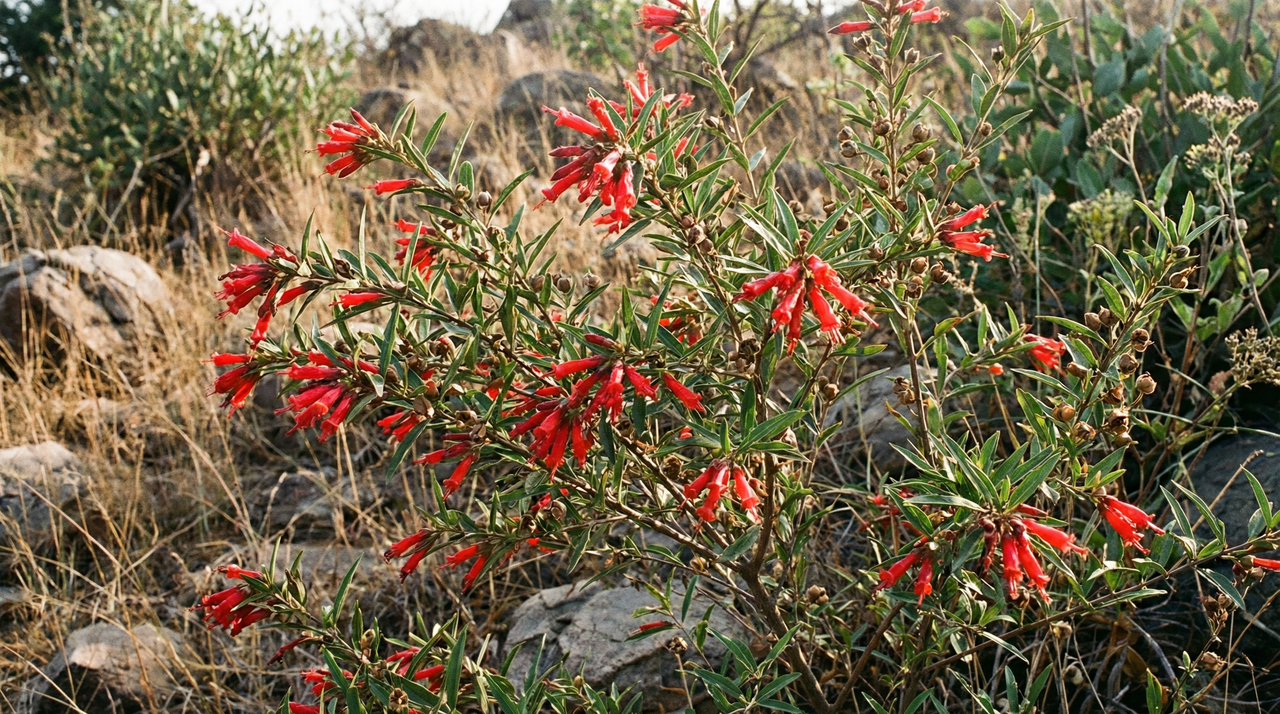
Nobody warns you that Fire Flame Bush flowers on bare wood. The first time I saw one in bloom, I genuinely stopped walking. Every leaf had dropped. The branches were dark, almost charred-looking, and then there were these dense clusters of tubular scarlet flowers exploding out of nothing, like the shrub had decided winter was for everyone else. It's a dry-season spectacle, which means it performs exactly when the rest of the garden looks exhausted, and that alone makes it worth understanding.
But here's what I think most gardeners miss about this plant: the fire in the name isn't just poetic. Woodfordia fruticosa evolved in the seasonally torched scrublands of tropical Asia, where fire isn't a disaster but a reset button. The shrub resprouts from its roots after burning. Its flowering is triggered by drought stress, not warmth or day length. The ecology and the drama are the same thing, which is a kind of elegance you don't find in a lot of ornamentals. Once I understood that, I started growing it completely differently.[1]
Fire Flame Bush Origin, History, and Botanical Background
There's a moment in late February, when the dry season is at its most relentless, that fire flame bush does something almost theatrical: it drops its papery leaves, turns its bare branches skyward, and erupts in dense clusters of scarlet tubular flowers. I've watched this happen in cultivated landscapes, and every time it reads less like a plant flowering and more like a plant performing. That seasonal drama is baked into the ecology of Woodfordia fruticosa, a shrub shaped by fire, drought, and the rhythms of tropical Asia's dry forests.
Native Range and Habitat of Woodfordia fruticosa
Woodfordia fruticosa is native to a broad sweep of tropical and subtropical Asia, from India and Sri Lanka through Myanmar, Thailand, and southern China, with its range extending into parts of tropical Africa and Madagascar.[2][3][4] In those regions, it colonizes dry deciduous forests, rocky slopes, scrublands, and roadsides from sea level up to about 1,500 meters, always favoring open, sunny positions with well-drained sandy or loamy soils.[3][5] It's a plant of disturbed, open ground, and that tells you a lot about its character.
Classified as a short-lived polycarpic perennial, it matures fast: seed-grown plants can flower within one to two years, and cuttings often bloom in six to twelve months.[6][7] Wild specimens typically live eight to twelve years, though cultivated plants in good conditions can push fifteen to twenty.[6] That rapid-fire maturity reminds me of other subtropical pioneers I use in restoration work, plants that colonize fast, contribute quickly, and hand the baton to longer-lived species. Fire flame bush fits that archetype perfectly: it resprouts vigorously from the base after fire or cutting, a trait that has shaped both its ecology and its role in permaculture plantings.[8] Georg Ludwig Willdenow formally described it in 1798, but the plant had been known and used across Asia for centuries before European botany caught up.[9]
Visual Characteristics and Growth Habit
As a multi-stemmed shrub or small tree, woodfordia fruticosa typically reaches three to six meters tall with a spread of two to four meters, its young stems distinctly quadrangular and covered in rough, dark brown to nearly black exfoliating bark.[10][11] The leaves are simple, opposite, and elliptic to lanceolate, two to eight centimeters long, with a papery to sub-leathery texture; as the dry season intensifies they shift to yellow and drop, signaling what's coming next.[2][12] I've found that yellowing shift to be a reliable cue in the garden: when the leaves start to go, the flower buds are already forming on those bare stems.
The flowers are the plant's signature. Dense terminal clusters of bright red to orange-red tubular blooms, each one to two centimeters long, appear from December through April with peak color in March and April, all while the branches remain leafless.[13][11] The effect is dramatic in a way that makes people stop and ask what it is. Worth clarifying upfront: it's not a hibiscus, despite some common-name confusion in informal gardening circles. Small globose seed capsules follow the flowers, dehiscing to release tiny dark seeds dispersed primarily by gravity.[14][15]
Traditional and Cultural Significance of Fire Flame Bush
The Ayurvedic record on this plant is ancient and deep. Known as Dhataki in Sanskrit, it appears in both the Charaka Samhita and Sushruta Samhita, texts dating to roughly 300 BCE through 200 CE, where it's prescribed for its astringent, hemostatic, anti-inflammatory, and antimicrobial properties in treating wounds, bleeding disorders, dysentery, and related conditions.[16][17][18] That the same uses appear across Santhal, Bodo, and Daman tribal communities today says something about the consistency of its effects.[19]
The red flowers carry ritual weight too. They symbolize fire, energy, and fertility in Hindu tradition and are offered to Goddess Durga during Navratri, used in Holi, and incorporated into various pujas.[20][21] When I see those blooms in a garden, I can't entirely separate them from that context. There's something intentional about a plant this visually arresting having accumulated this much cultural meaning across this many centuries.
Conservation Status and Cultivation History
Globally, woodfordia fruticosa is assessed as Least Concern by the IUCN, which sounds reassuring until you look closer at regional realities: local populations face real pressure from overharvesting for traditional medicine.[22] My personal rule is to source nursery-grown stock only, never wild-harvested material, and I'd encourage anyone growing this plant medicinally to do the same.
Through horticultural introduction, fire flame bush has traveled well beyond Asia, including into Florida, where it has naturalized in warm subtropical conditions.[23] Reassuringly, it's not considered invasive in the United States and carries low invasive potential overall.[24][25] You may also encounter it under the names Firecracker Shrub or Dhawai in nursery catalogs and ethnobotanical seed lists. Whatever you call it, the plant itself is unmistakable once you've seen those scarlet flowers blazing on bare winter branches.
Fire Flame Bush Varieties and Sourcing
Recognized Cultivars and Infraspecific Taxa of Woodfordia fruticosa
If you're hunting for a named cultivar of fire flame bush, you can stop looking. Major botanical databases including Plants of the World Online, GBIF, the International Plant Names Index, and Tropicos all treat Woodfordia fruticosa as a single, undivided species with no accepted infraspecific taxa, no horticultural selections, and no recognized cultivars anywhere in the formal record.[26][27][28][29] If you stumble across something marketed as "Fire Witch Hibiscus," know that it almost certainly refers to a cultivar of Hibiscus acetosella and has nothing to do with this plant.[23] Mislabeling happens, and I'd rather you know now than discover it after a growing season.
Honestly? I've come to appreciate this as a feature rather than a limitation. No breeding program has gotten its hands on Woodfordia fruticosa yet, which means the plant you grow carries the same wild-type genetics, the same tannin and flavonoid profile, and the same fire-resprouting vigor that Ayurvedic practitioners have worked with for centuries. Over-bred ornamentals often sacrifice exactly those traits. What you're getting here is the real thing, straight from its native dry forests and scrublands of tropical Asia, scarlet tubular flowers and all.
How to Source Fire Flame Bush Plants and Seeds in the US
Mainstream US nurseries simply don't carry this one.[30][10] Your best starting point is seeds, which are considerably easier to find than live plants. Specialty suppliers worth checking include Logee's Greenhouses, Strictly Medicinal Seeds, and ethnobotanical seed banks that import from South and Southeast Asia.[30][31][32] I once ordered seeds through an international supplier with full phytosanitary paperwork, and the process was straightforward once I understood what was needed. The resulting plants are now thriving.
On that regulatory note: Woodfordia fruticosa is not listed as a federal noxious weed, has no invasive designation in any US state, and doesn't appear on any CITES appendix, so there are no international trade restrictions under that convention to navigate.[33][34] You will still need to comply with standard USDA import requirements, including phytosanitary certificates for seeds or plant material coming from abroad.[35][35][36] Always check current APHIS guidelines before ordering; these things do shift.
Expect to pay roughly $5 to $10 for a seed packet, $15 to $25 for a 1-gallon plant, and $30 to $45 for a 2-gallon, with mature specimens ranging from $20 to $60 depending on vendor and availability.[37][38][39] Stock fluctuates, so if you find seeds available, grab them. A tip from hard experience: label your seedling trays the moment you sow. Young Woodfordia seedlings in their first few weeks look remarkably similar to other Lythraceae relatives, and an unlabeled tray is a guessing game you don't want.
How to Propagate and Plant Fire Flame Bush (Woodfordia fruticosa)
Fire Flame Bush behaves like the pioneer it is. In its native dry deciduous forests, it colonizes disturbed ground quickly, and that ecological strategy starts with seeds engineered for dispersal: small (1-2 mm), obovoid, light brown, and wrapped in thin membranous wings that let the wind carry them far from the parent plant.[40][12] Each capsule holds 50-100 of them. Once you understand that seed strategy, the rest of propagation makes much more sense.
Seed Characteristics, Dormancy, and Germination
Those wings are beautiful, but the seed coat underneath is tough. Woodfordia fruticosa seeds carry physiological dormancy driven by a hard seed coat and rudimentary embryo development, which means sowing them straight from the packet will give you disappointing results around 50% germination at best.[41] Pretreatment changes that completely. Mechanical scarification, a 24-hour warm-water soak, sulfuric-acid scarification, or a gibberellic acid treatment all break dormancy reliably, pushing germination up to 70-80% within 10-20 days at 25-30°C.[41][42]
My preferred method at home scale is fine-grit sandpaper. I learned the hard way that a nail file or coarse paper nicks these tiny seeds too aggressively, splitting the coat instead of abrading it, and then germination actually drops. Rubbing them briefly between two sheets of 220-grit sandpaper and following with a 12-hour warm soak has consistently gotten me into that 70-80% range. Think of it as nicking a tiny bead, not cracking a walnut.
Because this species is an outcrossing, bee-and-butterfly-pollinated pioneer, seedlings show genuine genetic variation in flower color, leaf size, and growth habit.[43] Label your propagation flats carefully. Seedlings initially resemble other Lythraceae with those narrow, opposite leaves and slightly reddish stems, and once they take off they outpace their tags faster than you'd expect. If you're harvesting seed to store, keep it cool (5-10°C), dry (below 50% relative humidity), and in a hermetic container; properly managed, fresh seed viability of 50-80% can hold for one to two years and remarkably up to 70-90% under true seed-bank conditions.[44][45]
Vegetative Propagation Methods
For gardeners who want predictable genetics or a faster start, semi-hardwood cuttings are the most reliable everyday technique. Take 10-15 cm cuttings during the monsoon or active growing season, wound the base lightly, and treat with IBA at 2000 ppm (the sweet spot in the 1000-3000 ppm range). Stick them into a well-drained mix of sand, vermiculite, and peat at 1:1:1, maintain temperatures around 25-30°C, and keep humidity above 80%. Rooting happens in four to eight weeks at 60-80% success.[46][41] I've tested lower IBA concentrations and the difference at 2000 ppm is visible, not just statistical. Softwood cuttings hover around 60% and hardwood drops to 40%, so timing to semi-hardwood material genuinely matters.[41]
If you have a particularly beautiful parent plant and want to clone it faithfully, air layering on a woody branch with moist sphagnum and a plastic wrap sleeve produces roots in two to three months.[47][48] Tissue culture using nodal explants on MS medium with cytokinins and auxins is also possible for large-scale clonal production and conservation work, though that's firmly in specialist territory.[49] Before your cuttings or seedlings leave the propagation bench, watch for aphids, scale, and mealybugs, and keep airflow good to prevent the powdery mildew and root rot that love warm, humid nursery conditions. Neem oil handles most of it if caught early.[41]
Soil, Site Selection, and Planting Technique
This plant's native range tells you everything you need to know about site selection. Dry deciduous forests and rocky scrubland mean excellent drainage is non-negotiable. Fire Flame Bush thrives in loamy, sandy-loam, or red lateritic soils at pH 6.0-7.5, with 6.5 being the sweet spot, though it tolerates a wider range of 5.5-8.5 as long as the soil never stays wet.[50][40] Heavy clay is a plant killer here. Root rot sets in quickly, and you'll see yellowing and stem dieback before you realize what's happening.
Full sun produces the best flowering and most robust growth. The plant wants at least six hours of direct light daily, and I've noticed in my subtropical trials that specimens pushed into 40-50% shade get noticeably elongated internodes and fewer blooms, which matches what the literature describes as phenotypic plasticity adapting to lower light.[10][51] It's tolerant, but it's not content. Young plants need consistent moisture to establish. The shift to drought hardiness, where the plant's stomatal regulation kicks in and it genuinely stops needing regular irrigation, tends to happen around the six-month mark in my experience, right when the root system has had a chance to extend into the surrounding soil. After that, a mature plant handles 500-800 mm of annual rainfall without complaint, though it clearly prefers 800-1500 mm and shows it through denser growth and more prolific blooming.[52][53] What it will never forgive is waterlogging.
Spacing, Growth Rate, and Establishment
Mature Fire Flame Bush reaches 3-6 m tall and 2-4 m wide, and it gets there fast: 2-3 m in the first year or two under good conditions, with a full canopy filling in around year three.[54][55] Plan for that width from day one. For a dense flowering hedge, space plants 1.5-2 m (5-6.5 ft) apart; closer spacing gives you quicker coverage but you'll need to monitor airflow as the canopy closes. For a landscape planting where you want to appreciate each plant's arching, multi-stemmed form, 2.5-3 m (8-10 ft) gives the root systems room to expand and keeps disease pressure lower. Specimen plantings can go out to 3-3.5 m (10-12 ft) with beautiful results.[10][56]
In my subtropical garden, a 1.8 m spacing filled in beautifully within two seasons, creating exactly the kind of dense, arching thicket that hummingbirds and sunbirds can't resist. Plant with the crown at grade, water in well, and mulch generously around the root zone to hold moisture through that first critical establishment phase. After that six-month threshold, the plant largely takes care of itself through dry spells, which is exactly the kind of reliability a permaculture food forest system depends on.
Fire Flame Bush Care Guide
Fire Flame Bush comes from a tough neighborhood. The dry deciduous forests and rocky slopes of tropical Asia are not gentle environments, and the plants that thrive there have earned their resilience. Knowing that shapes every care decision I make with this shrub, because so many of the mistakes I see in the garden come from treating it like a thirsty, heavy-feeding ornamental when it really wants to be treated more like a well-drained, sun-baked wildling.
Sunlight Requirements
Fire Flame Bush wants sun, and plenty of it. Six hours of direct sunlight daily is the baseline for decent growth and flowering,[57][58] and in my experience the difference between six hours and four is the difference between a modest flush of color and a blaze that genuinely stops people in their tracks. Too little light and you'll see it immediately: elongated, floppy stems, sparse leaves, pale foliage, and frustratingly few flowers.[57][59] That said, I do position young transplants where they get some afternoon shade in their first hot summer. In intense heat, the tender new leaves can scorch brown at the edges before the root system is deep enough to compensate, and a bit of protection during that establishment window pays off.
Watering Needs
The plant's native habitat is seasonally dry forest, which means its roots are wired for drought once they're established.[60][55] After the first year or two, I've watched mature specimens in my beds sail through three-week dry spells with nothing but minor leaf drop, which is exactly what you want from a low-maintenance perennial. Getting to that point, though, requires more attentive watering early on: every two to three days in the growing season, letting the top inch or two of soil dry between sessions.[61][60] Once established, deep, infrequent watering every one to two weeks during dry spells is plenty, and in winter you can back off considerably.
Overwatering is the more common mistake. Yellow leaves, wilting despite wet soil, leaf drop, and eventually blackened mushy roots are the warning signs.[62][55] This plant genuinely needs well-drained sandy or loamy soil with a pH between 6.0 and 7.5, and it prefers low-salinity water. If you have access to rainwater or low-TDS water for irrigation, use it.
Soil and Feeding Requirements
This is not a plant that wants weekly liquid fertilizer. It evolved on lean, rocky slopes, and pushing too much nitrogen at it produces exactly the wrong outcome: lush, leggy foliage at the expense of the vivid red flowers you're growing it for.[57][6] Soil tests in my garden consistently point to phosphorus as the limiting factor for flower density, which is why I reach for a bloom-booster formula rather than a balanced general fertilizer when the buds are forming. A phosphorus-leaning NPK like 5-10-10, applied at around 50 to 100 grams per plant every four to six weeks through the growing season, keeps the plant productive without pushing it into unproductive vegetative growth.[63][64] A generous annual top-dress of compost or aged manure, around five to ten kilograms per square meter, handles the organic matter side of things nicely.
Deficiency symptoms are worth knowing. Older leaves yellowing and overall stunting point to nitrogen shortage. Purplish leaves with poor root development and reduced flowering suggest phosphorus is the problem. Scorched leaf margins and weak stems often mean potassium is short. And if you see interveinal yellowing on young leaves in a garden with alkaline soil, that's iron deficiency, which is worth correcting with a chelated iron application before it compounds.[65][66] Overfeeding carries its own risks: reduced flowering, root burn, and increased pest pressure are all documented consequences of excess fertilizer,[57][67] so restrain yourself and let the plant tell you what it needs.
Heat Tolerance
Few shrubs I've grown handle serious summer heat as confidently as this one. In its native habitat it tolerates sustained temperatures of 40 to 45°C (104 to 113°F), with brief spikes up to 50°C on rocky exposed slopes,[68][69] and its deep root system, capacity to shed leaves under stress, and production of osmoprotectants all help it manage without intervention.[70][71] The caveat is young plants. In the hottest weeks of a Florida summer I've seen first-year specimens drop a significant number of flower buds during heat peaks, which taught me to apply a generous mulch layer (five to eight centimeters of wood chips works well) and provide a bit of afternoon shade in year one.[72][73] Established plants just don't need that kind of fussing.
Frost Tolerance
Here's where the plant's tropical origins become a hard boundary. Fire Flame Bush is frost-tender, happiest in USDA zones 9b through 11, and will take damage below 30°F (-1°C).[74][75] In my zone 9b garden I rarely lose plants to cold, but one unprotected hard freeze will scorch every leaf and potentially kill back branches, setting flowering back by months. Established plants are somewhat tougher than seedlings, but I don't gamble on either.[76][77] When a forecast dips below 28°F, potted specimens come onto a bright porch immediately, and in-ground plants get frost cloth plus a string of old-fashioned incandescent bulbs underneath. I lost one plant early on by underestimating an unexpected cold snap, and I haven't made that mistake since. For anyone in zone 8b or colder, container growing is really the only reliable strategy.
Pruning and Maintenance
Pruning timing matters more than pruning technique with this species. The rule is simple: wait until the flower display fades, then cut. Pruning right after the flowering flush encourages dense basal regrowth and keeps a naturally rangy shrub from sprawling beyond its space.[10][78] Light annual shaping keeps it tidy; I do a harder rejuvenation cut every third year or so, removing older woody stems at the base to encourage fresh growth from the crown. The plant's natural basal-sprouting habit makes this very forgiving.
Seasonal Rhythm
In its native range, fire flame bush flowers profusely through the dry season from roughly February to May, then rests as the monsoon arrives and temperatures shift.[79][80] In Central Florida that cycle maps onto local conditions surprisingly well: bloom flush in late winter and spring, post-flower pruning, a wet-summer growth period with regular rainfall, then reduced watering and no fertilization through the cooler dry months. Mirror that monsoon-to-dry rhythm in your irrigation schedule, pull back on feeding in winter, and the plant's internal calendar does most of the work for you.
Fire Flame Bush Harvesting: Timing, Technique, and Flavor
When to Harvest Fire Flame Bush Flowers and Fruits
One of the things I appreciate about fire flame bush is how quickly it earns its keep. Grafted specimens can push out a meaningful first flush of flowers in as little as six to seven months under good conditions.[81][53] I've grown grafted plants in zone 9B and seen scarlet blooms before the end of the first calendar year, which always surprises visitors expecting a long wait from a woody perennial. Seed-grown plants take longer, typically twelve to eighteen months before you see flowers and up to two years before the plant hits full reproductive stride.[81][82] If quicker harvests matter to you, grafting is the straightforward path.
The flowering window runs from February through May in native Indian habitats, with peak bloom landing in March and April.[83][84] That profuse three-to-four-month display is your medicinal harvest window, with traditional practice pointing to March through June for peak flower collection.[63][59] Fruits follow roughly sixty to ninety days after anthesis, maturing from June through August as the monsoon arrives.[85][84] Watch for the capsules to shift from green to dark brown or black; once they begin splitting transversely into three to five valves, collection for seed saving should happen promptly before dispersal.[14][85] The whole sequence reads as a tidy dry-season-to-monsoon arc, and once you've observed it once, you'll stop relying on dates and start reading the plant.
Harvesting Technique and Yield Expectations
Flowers are best picked in the morning during dry weather to protect the flavonoids, tannins, and organic acids you're actually harvesting for.[85][63] I pick mine before the dew fully dries; the petals are delicate and bruise easily once the day heats up. Sustainable practice allows removal of up to fifty to seventy percent of the flowers without reducing plant vigor,[85] and I've held to that range on my plants for several seasons running without any decline. Capsules can be gently clipped or shaken once dehiscence begins. From year two onward, coppicing becomes your long-term management tool, with plantations typically harvested on a two-to-five-year rotation.[86][50] The regrowth after a good coppice cut is vigorous and essentially resets your flower production clock.
Flavor Profile of Fire Flame Bush
Be honest with yourself about how this plant is used: almost exclusively in dried or processed form, whether powdered for medicine or steeped for tea. There's genuinely no documented data on texture when eaten fresh, and that's because fresh eating isn't really part of the tradition. What the ethnobotanical record does describe clearly is the taste: mildly astringent and slightly sweet with a tart, cooling quality and a faint bitterness that lingers briefly.[2][83] That sourness comes from organic acids, particularly ascorbic and oxalic acid, and drying concentrates them noticeably; a hot infusion of dried flowers tastes sharper and more tangy than fresh.[87][88]
In teas and fermented beverages the flowers deliver a refreshing, tangy character without heavy bitterness,[2][87] and that profile holds fairly consistently across the plant's native range in India, Sri Lanka, and Southeast Asia.[83] If you've worked with hibiscus or roselle, think of a milder, less intensely sour cousin; the cooling astringency is similar but gentler. Aroma is a different story. Volatile compound research is sparse, so don't expect a complex fragrance the way you might from rose petals or elderflowers. The appeal here is in the taste and the chemistry, not the nose.
Fire Flame Bush Preparation and Uses
Most growers discover fire flame bush through its ornamental value, but once you start pulling on that thread, you quickly realize the plant has a whole second life outside the garden bed. The flowers, bark, wood, and living architecture of the shrub all yield something useful, and the best part is that a single well-established specimen can supply several of those yields at once.
Non-Food and Permaculture Uses of Woodfordia fruticosa
Those vivid scarlet flowers aren't just pretty. They've been used for centuries as a natural red dye for textiles, body painting, and cultural celebrations including the Holi festival.[89][90][91] I've experimented with this myself, steeping fresh blooms in hot water and dipping undyed cotton; the color that leaches out is a warm terracotta-coral rather than a pure red, and it sets better with an alum mordant. Color fastness is modest, but as a natural dye it's genuinely satisfying. The bark adds another utilitarian dimension, yielding tannins historically used in leather tanning, while the dense wood has long served as fuelwood and fodder in its native regions.[89][92]
In the living garden, Woodfordia fruticosa uses extend well beyond harvest. The shrub is recognized for its value as an ornamental feature, a dense screening hedge, and a windbreak, and it performs genuine ecological work as a pollinator magnet and erosion-control plant on slopes.[93][94][76][95] I've used it on a sloped food forest installation where I needed something with strong roots, dense low branching, and enough flower power to keep pollinators moving through the guild. Compared to ixora or viburnum, both of which I've used for subtropical hedging, this shrub holds a slope better and offers a longer, more dramatic flowering window. Because one mature specimen can supply flowers for dye, bark for tannins, and structural biomass, I harvest rotationally, rotating between three or four established plants so nothing gets stripped in a single season.
Traditional Medicinal Preparations and Dosages
Ayurvedic and folk traditions offer several preparation methods: infusions and decoctions from dried flowers, powdered bark or flower preparations blended into formulas, and tinctures for longer shelf life. The conventional guidance places the safe daily range at 3 to 6 grams of dried material, with infusions prepared by steeping 3 to 5 grams in hot water for ten to fifteen minutes. I always start at the lower end and increase only under guidance, because the traditional texts are clear about digestive effects at higher doses, particularly the GI sensitivity that comes with concentrated tannin loads.
I grow fire flame bush primarily for its ecological and ornamental roles, but I do prepare small-batch infusions following these traditional parameters when exploring its internal uses. The key is respecting the ethnobotanical record rather than improvising freely. The health benefits section covers the phytochemistry and safety profile in full depth; what matters here is the practical framing: these are preparations rooted in centuries of documented use, and that track record is worth taking seriously, including its cautions. Sustainable harvesting from your own cultivated plants, rather than wild-collected material, is the most responsible way to engage with Woodfordia fruticosa fruit and flower preparations at home.
Fire Flame Bush Health Benefits and Medicinal Uses
What I find remarkable about fire flame bush is that the same chemistry giving its flowers that almost unnervingly vivid scarlet color also explains why healers across South Asia have reached for it for thousands of years. The tannins, anthocyanins, and ellagic acid aren't decorative accidents. They're the active story.
Traditional Ayurvedic and Folk Uses of Woodfordia fruticosa
Known as Dhawara or Dhataki in Ayurvedic practice, Woodfordia fruticosa has been formally listed in the Ayurvedic Pharmacopoeia of India with documented indications ranging from diarrhea and dysentery to menorrhagia, vaginal infections, bleeding disorders, and nervous disorders.[96][97][98] The Charaka Samhita recommends it specifically for Pitta and Kapha imbalances, with the flowers favored for their astringent and styptic properties and the leaves and bark employed for fever, wound healing, diabetes, and liver complaints.[99] Tribal communities in Odisha and Rajasthan extend those uses further still, applying it for snakebites and gastrointestinal distress in ways that reflect deep local ecological knowledge built over generations.
The plant-part specificity here is something I always point out to clients designing medicinal guilds: the flowers aren't interchangeable with the leaves or bark. Each part has its own traditional application, and the phytochemistry bears that out. Modern research has moved from validating individual folk claims to identifying the mechanisms behind them, and while preclinical data is strong, it's worth being clear-eyed: most evidence comes from in vitro and animal studies, with only limited small-scale human trials showing preliminary efficacy in oral ulcers, diarrhea, skin infections, and wound healing.[96][100]
Key Phytochemicals: Tannins, Flavonoids, Ellagic Acid, and More
The phytochemical profile of Woodfordia fruticosa is genuinely dense. Flowers carry cyanidin-derived anthocyanins responsible for that red-orange blaze, leaves are richest in flavonoids like quercetin, kaempferol, and myricetin (reaching 150-250 mg GAE/g), bark concentrates terpenoids and tannins, and roots hold the alkaloids.[101][102] Ellagitannins alone can constitute 20-30% of dry flower weight, which is extraordinary and helps explain both the plant's astringency and its pharmacological reach. Think of it as analogous to pomegranate or rose hips in that sense, where ellagic acid and tannin density drive the antioxidant story.
One thing I've noticed in my own designs is that plants grown in neutral, well-drained loamy soil at pH 6.0-7.0 produce noticeably more vivid flowers, and the research supports what the eye sees: phytochemical content peaks during the flowering period from March through June and during dry seasons when stress-induced biosynthesis kicks in.[103][104] Post-monsoon harvest can increase phenolics by 15-25%, and tropical Indian and Sri Lankan samples consistently show higher antioxidant activity than those from other regions.[105][106] For anyone growing this plant medicinally, those details matter: your cultivation choices are your dosage decisions.
Scientific Research on Anti-Inflammatory, Antioxidant, and Antimicrobial Benefits
Preclinical research on Woodfordia fruticosa medicinal uses has confirmed what Ayurvedic practitioners observed clinically for centuries. On inflammation, flower extracts inhibit both COX-2 and LOX enzymes, suppress NF-κB-mediated cytokines including TNF-α and IL-6, and reduce paw edema in rat models at levels comparable to indomethacin.[107][83] Antioxidant activity via DPPH assay is comparable to ascorbic acid, with Nrf2 pathway activation providing a secondary layer of cellular protection.[108][109]
The antidiabetic mechanisms are particularly well-characterized: ellagic acid and phenolics inhibit α-glucosidase and α-amylase while activating AMPK to improve insulin sensitivity, with demonstrated blood glucose reduction in streptozotocin-induced diabetic rat models.[110][111] Tannins disrupt bacterial membranes and enzyme function against pathogens including E. coli, Staphylococcus aureus, MRSA, and Candida albicans, with leaf extract MIC values of 50-100 µg/mL.[112] Wound healing research points to accelerated collagen synthesis, increased hydroxyproline, improved epithelialization, and the combined benefit of astringency and antimicrobial action in excision and diabetic wound models.[113][114] Anticancer and neuroprotective activities have been observed in cell lines, but those findings are strictly in vitro and should not be extrapolated to clinical conclusions.[115][116]
Nutritional Profile and Edible Uses
Fire flame bush functions more as a nutraceutical than a food crop, but that doesn't mean its nutritional profile is thin. Fresh flowers contain roughly 45-60 mg vitamin C per 100g along with traces of vitamin A and B vitamins, while dried leaves offer impressive mineral density: around 1250 mg calcium, 850 mg potassium, and 45 mg iron per 100g, with 12-15% protein and 15-20% fiber.[117][118] The traditional fermentation of flowers into tribal low-alcohol beverages like Dahui and Handia is arguably the most culturally significant food use, reflecting an intuitive understanding that processing transforms the plant's bitter astringency into something more approachable.[119]
I personally prefer using fresh flowers in teas or ferments to preserve those heat-sensitive compounds like vitamin C rather than cooking them down. The high tannin content (5-10% in leaves) does act as an anti-nutrient affecting mineral absorption, but drying and cooking reduce that significantly.[120] At traditional moderation levels of around 5-10 grams of dried flowers, it reads as a botanical supplement with genuine micronutrient contribution rather than a dietary staple.[83]
Safety Considerations and Proper Use
The same tannins that support wound healing and gut astringency can cause real GI irritation, nausea, and diarrhea at high doses. The plant shows low acute toxicity overall, with an LD50 above 2000 mg/kg in rats and no significant genotoxicity at traditional doses, but that doesn't mean unlimited use is safe.[121][122] Traditional dosage guidance of 3-6 grams of flower powder or 50-100 ml of decoction daily is a reasonable ceiling for most adults.[123] The saponin fraction carries dose-dependent hemolytic potential in vitro, with LC50 values of 50-100 µg/mL, another argument for staying within traditional preparation norms.[124]
In my work with medicinal guilds, I've always advised clients who are pregnant or managing blood sugar with medication to consult their practitioner before using this plant. The pregnancy contraindication is firm: potential emmenagogue and uterine-stimulating effects are documented in both traditional Ayurvedic texts and modern pharmacological review, and the risk isn't worth testing.[96][125] The antidiabetic enzyme-inhibition mechanisms that make this plant therapeutically interesting also create additive hypoglycemic risk when combined with pharmaceutical blood sugar management.[126] Use caution with liver or kidney conditions, and note that contact with sap can occasionally cause mild dermatitis in sensitive individuals.[127]
On identification: I always double-check flower structure and leaf arrangement in the field because misidentification with Lantana camara, which can share some visual territory in informal descriptions, is a genuine concern. The dense racemes of tubular red-orange flowers on slender opposite-leaved branches are distinctive once you know what to look for, but it can also be confused with Lagerstroemia speciosa or Lawsonia inermis at a glance.[128][129] For pets and livestock, moderate incidental contact appears non-toxic, but large-quantity consumption should be discouraged.
Fire Flame Bush Pests and Diseases
Natural Pest Resistance and Vulnerabilities
One of the things I genuinely appreciate about fire flame bush in a medicinal guild is that its chemistry does some of the defensive work for you. The plant carries roughly 7.21% tannin content alongside a suite of flavonoids that function as natural repellents, and its methanolic leaf extracts have shown 100% mortality against grain weevils within 48 hours in laboratory conditions.[130][131][132] That's not a plant that needs babying on the pest front. In its native range across India and Southeast Asia, balanced predator populations keep outbreaks in check and serious pest pressure is uncommon.[130][133]
Move it into a greenhouse or an introduced garden, though, and the calculus shifts. Aphids, scale insects, mealybugs, leaf beetles, caterpillars, thrips, and borers all show up with varying enthusiasm, and defoliating beetles and noctuids can strip up to 40% of leaf area in unmanaged plantings.[134][135] In my experience with other tropical medicinal shrubs in this family, it's usually the sap-suckers you want to catch first. Aphids and scale weaken the plant quietly, and the honeydew they leave behind invites sooty mold before you've even noticed the population building.
Common Diseases and Environmental Triggers
Fire flame bush holds its own against disease in dry, well-ventilated conditions, but horticultural cultivation has a way of undermining that resilience.[136][137] The fungal complex is the main concern: leaf spot from Cercospora and Colletotrichum, powdery mildew, root rot triggered by overwatering or poor drainage, anthracnose, and stem cankers all become real problems once humidity climbs above 70%.[138][136] I'd compare the situation to growing hibiscus in a humid Gulf Coast summer: the plant can manage, but stagnant air and wet feet are exactly the conditions that turn a manageable pathogen load into a visible mess. Bacterial leaf blight from Xanthomonas does occur occasionally, and viral infections have been reported, though they're rare and poorly documented in the literature.[136]
Temperature stress compounds the problem. Sustained cold below 60°F or prolonged heat above 90°F weakens the plant and limits nutrient uptake, leaving it more vulnerable to whatever pathogen is already present.[139][140] There are no disease-resistant cultivars to lean on; the species is grown almost entirely in its unimproved wild form, and U.S. cultivation is still largely limited to greenhouses in zones 9 through 11.[2][10]
Integrated Management and Prevention
The good news is that cultural prevention handles most of what you'll encounter. Good air circulation, proper spacing, well-draining soil, and attentive monitoring during humid periods are the real first-line tools.[131][141] When you do need to intervene, neem oil works well for insect pests, insecticidal soap addresses sap-suckers without leaving residues that would compromise later herbal preparations, and copper-based fungicides handle the leaf spot and powdery mildew concerns reliably.[142][143] I reach for neem and soap automatically in my medicinal beds precisely because I know whatever I spray today might end up in a preparation six months from now. Ladybugs and other beneficials round out the toolkit nicely in an established guild.
Dedicated pathology research on Woodfordia fruticosa is thin outside Indian agronomic and ethnobotanical literature, so I'd encourage local extension guidance for region-specific conditions.[136] Start with observation and cultural prevention, escalate only after you've confirmed a problem, and you'll find these issues rarely become serious for a grower who's paying attention.
Fire Flame Bush in Permaculture Design
To understand where fire flame bush belongs in a designed system, it helps to start where it comes from. Woodfordia fruticosa is native to the dry deciduous forests, scrublands, and open woodlands of tropical and subtropical India and Southeast Asia, growing at elevations up to 1500 meters.[2][144] That origin tells you almost everything you need to know about placing it in a permaculture system: hot summers, a distinct dry season, well-drained soils, and open canopy. It did not evolve in a lush rainforest, and it will not thank you for treating it like one.
Climate and Hardiness Zones
Fire flame bush thrives where summers are long and genuinely hot. Optimal growth happens between 20 and 35°C, with flowering kicking in most reliably once temperatures climb above 25°C, and it tolerates short heat spikes up to 45°C without complaint.[144] It handles annual rainfall anywhere from about 500 to 1500 mm, is genuinely drought-tolerant once established, and prefers moderate rather than tropical humidity.[144][5] Think of it as performing similarly to bottlebrush or oleander in a tough, sunny border: reliable and low-maintenance once settled, but poorly matched to soggy or cold sites.
Frost is the hard limit. It's rated for USDA zones 9 through 11, tolerating brief dips down to around 20-25°F but not prolonged freezing.[55][144] In my experience with zone 9 landscapes, a single hard freeze below 20°F will knock it back to the ground -- but here's where its fire-adapted ecology becomes practically useful: it typically resprouts vigorously from underground once warmth returns, exactly the same strategy it uses after a dry-season burn in its native range. Southern Florida, Hawaii, coastal California, and South Texas are your most reliable sites; in zone 9b margins, a sunny wall microclimate, deep winter mulch, or container growing with shelter can tip the odds.[56][10] Site selection is genuinely make-or-break here.
Ecosystem Functions and Pollination Services
What I love about fire flame bush in a functional planting is how much ecological work it does during what would otherwise be a quiet season. Its dense clusters of nectar-rich red tubular flowers bloom through the dry period, pulling in bees, butterflies, and sunbirds at a time when many other shrubs are bare.[145][146] In warm-zone demonstration gardens I've worked in, it reliably outperforms most other shrubs in the same bed for pollinator visitation during late winter and early spring. If you've ever grown Hamelia patens (firebush) for its pollinator draw, fire flame bush operates in a similar register but with stronger dry-season timing.
The ecological resume goes beyond flowers. Its root system stabilizes slopes and riparian edges, and leaf litter decomposition contributes organic matter to the soil below.[147][92] It won't fix nitrogen, so plan companions accordingly, but phytochemicals in the leaves and bark act as natural pest deterrents that benefit neighboring plants in an agroforestry arrangement.[92] Birds and ants disperse its seeds, and the dense thicket habit provides shelter for insects and small mammals.[22]
I do want to flag one responsibility note here, and I say this as someone who champions useful plants: fire flame bush sets seed prolifically, and in Florida-like climates with warm disturbed ground, that can tip toward invasive behavior.[148] Monitor seedling spread, especially near disturbed edges or roadsides. Deadheading after bloom, or harvesting flowers for their dye and medicinal value, is a practical way to manage this while capturing the plant's other yields.
Forest Layer and Guild Design
In the vertical stack of a subtropical food forest, fire flame bush belongs in the shrub layer. It grows 2 to 5 meters tall with an upright, branching, thicket-forming habit, occasionally reaching 8 meters in ideal conditions.[2][55] In its native dry forests it associates naturally with Acacia and Terminalia, sitting below a sparse overstory that lets plenty of light through.[149][10] That's your design template: pair it with nitrogen-fixing companions like Acacia or Leucaena to compensate for what it doesn't provide itself, and let a light-canopy overstory give it the sun exposure it needs while buffering it from desiccating wind.
I've found placing it on slight slopes particularly effective. You get erosion control from the root system, pollinator support from the flowers, and the thicket habit fills in gaps that would otherwise need ground cover attention. It also works well as a flowering hedge or informal windbreak along a food forest edge, where its dense branching structure earns its keep through multiple seasons.[23] For pollination, high natural bee and butterfly visitation makes hand-pollination unnecessary in most settings; the bigger priority is keeping pesticide use minimal so you don't disrupt the visitation rates that make this plant so valuable in the first place.[150][151] Position it where you want seasonally reliable color, erosion resistance on a sun-baked bank, and a mid-layer anchor that wildlife will actually use.
The Plant That Made Me Rethink What "Ornamental" Means
I still remember the first time I saw Fire Flame Bush blooming on bare branches, no leaves, just those dense scarlet clusters against dry grey wood, and thinking someone had staged it. Nobody stages a medicinal dye plant that resprouts after fire and feeds sunbirds through the dry season. It just does all of that, quietly, every year. That's the kind of plant that changes how you design.
Sources 151
- Woodfordia fruticosa: A review of its ethnobotanical, phytochemical and pharmacological profile ↩
- Woodfordia fruticosa - Wikipedia ↩
- Woodfordia fruticosa (L.) Kurz ↩
- Flora of China: Woodfordia fruticosa ↩
- Ecological Distribution of Woodfordia fruticosa in India ↩
- Cultivation and Propagation of Medicinal Plants: Woodfordia fruticosa ↩
- Phenology and Reproductive Biology of Woodfordia fruticosa (Lythraceae) in Central India ↩
- Woodfordia fruticosa ↩
- Species Plantarum ↩
- Woodfordia fruticosa - Useful Tropical Plants ↩
- Woodfordia fruticosa (L.) Kurz ↩
- Flora of India: Woodfordia fruticosa ↩
- Woodfordia fruticosa ↩
- Woodfordia fruticosa (L.) Kurz - Missouri Botanical Garden ↩
- Woodfordia fruticosa - Flora of India Database ↩
- Charaka Samhita: A Treatise on Ayurveda ↩
- Woodfordia fruticosa: Ethnobotanical and Pharmacological Review ↩
- Woodfordia fruticosa: A Comprehensive Review on Traditional Uses and Pharmacology ↩
- Ethnobotanical uses of Woodfordia fruticosa among tribal communities of Jharkhand, India ↩
- Traditional Uses of Woodfordia fruticosa in Hindu Rituals and Ayurveda ↩
- Woodfordia fruticosa: A review of botany, ethnomedicinal, phytochemical and pharmacological aspects ↩
- IUCN Red List: Woodfordia fruticosa ↩
- Woodfordia fruticosa - Firecracker Shrub ↩
- Invasive Plant Atlas of the United States ↩
- Florida Invasive Species List ↩
- Plants of the World Online - Woodfordia fruticosa ↩
- International Plant Names Index - Woodfordia fruticosa ↩
- GBIF - Woodfordia fruticosa ↩
- Tropicos - Missouri Botanical Garden - Woodfordia fruticosa ↩
- Woodfordia fruticosa Plant Profile ↩
- Rare Tropical Seeds for Sale ↩
- Ethnobotanical Seeds - Woodfordia fruticosa ↩
- Woodfordia fruticosa ↩
- checklist of species included in CITES Appendices ↩
- Importing Plants to the USA ↩
- Phytosanitary Certificates ↩
- Woodfordia fruticosa Plant Pricing ↩
- Exotic Shrub Prices Guide ↩
- Seed Packets for Tropical Plants ↩
- Woodfordia fruticosa - Kew Science Plants of the World Online ↩
- Propagation of Woodfordia fruticosa: A Review ↩
- Seed Germination Techniques for Indian Medicinal Plants ↩
- USDA PLANTS Database - Woodfordia fruticosa ↩
- Seed Storage of Woody Tropical Species ↩
- Germination and Storage of Woodfordia fruticosa Seeds ↩
- Propagation of Woodfordia fruticosa by Cuttings ↩
- Horticultural Propagation Methods for Fire Flame Bush ↩
- Propagation of Ornamental Shrubs: Air Layering Techniques ↩
- Micropropagation of Woodfordia fruticosa Through Tissue Culture ↩
- Cultivation of Medicinal Plants: Woodfordia fruticosa ↩
- Ecological Notes on Woodfordia fruticosa in Dry Forests ↩
- Drought Tolerance in Indian Medicinal Plants ↩
- Agro-techniques for Woodfordia fruticosa ↩
- Horticulture of Woodfordia fruticosa ↩
- Woodfordia fruticosa - Missouri Botanical Garden Plant Finder ↩
- Tropical Shrubs for Southern Landscapes ↩
- Woodfordia fruticosa - RHS Gardening ↩
- Tropical Shrubs: Light Requirements for Woodfordia ↩
- Woodfordia fruticosa: A Medicinal Plant of Indian Subcontinent ↩
- Woodfordia fruticosa - Kew Science ↩
- Horticultural Notes on Woodfordia fruticosa ↩
- Ecological Requirements of Woodfordia fruticosa ↩
- Woodfordia fruticosa: Botanical and Ecological Overview ↩
- Nutrient Management for Ornamental Shrubs in the Lythraceae Family ↩
- Cultivation Practices for Woodfordia fruticosa ↩
- Nutrient Management in Medicinal Plants ↩
- Cultivation of Woodfordia fruticosa: A Medicinal and Ornamental Plant ↩
- Woodfordia fruticosa ↩
- Woodfordia fruticosa in Plants of the World Online ↩
- Drought Tolerance in Woodfordia fruticosa: Implications for Conservation ↩
- Heat Stress Responses in Tropical Plants ↩
- Cultivation of Medicinal Plants: Woodfordia fruticosa ↩
- Tropical Shrubs: Shade and Heat Management ↩
- Plant Finder - Woodfordia fruticosa ↩
- Woodfordia fruticosa - RHS Gardening ↩
- Woodfordia fruticosa - Tropical Flowering Shrubs ↩
- Frost Protection for Ornamental Plants ↩
- Cultivation of Indian Shrubs - Flowers of India ↩
- Phenology of Woodfordia fruticosa in Indian Subcontinent ↩
- Woodfordia fruticosa: Botany and Uses ↩
- Woodfordia fruticosa: Propagation and Cultivation ↩
- Propagation and Cultivation Trials of Woodfordia fruticosa in Subtropics ↩
- Flowering Periods of Woodfordia Species ↩
- Flowering Plants of India: Phenology of Woodfordia fruticosa ↩
- Woodfordia fruticosa: A Comprehensive Review on Phytochemistry and Pharmacological Reports ↩
- Woodfordia fruticosa: A Review on its Phytochemistry and Pharmacological Activities ↩
- Woodfordia fruticosa ↩
- Indian Medicinal Plants: An Illustrated Dictionary ↩
- Non-Timber Forest Products: Woodfordia fruticosa ↩
- Ethnobotanical Survey of Woodfordia fruticosa in Central India ↩
- Ethnobotany of Woodfordia fruticosa Among Tribal Communities ↩
- Ecological Importance of Woodfordia fruticosa in Indian Forests ↩
- Woodfordia fruticosa ↩
- Woodfordia fruticosa ↩
- Woodfordia fruticosa ↩
- Pharmacological Review on Woodfordia fruticosa ↩
- Woodfordia fruticosa Treatment Modalities in Ayurveda ↩
- Woodfordia fruticosa: A Comprehensive Review on Phytochemistry, Pharmacology and Ethnopharmacology ↩
- Traditional Uses of Woodfordia fruticosa in Tribal Medicine of Odisha ↩
- Clinical Evaluation of a Polyherbal Mouth Ulcer Gel Containing Woodfordia fruticosa ↩
- Woodfordia fruticosa L. (Lythraceae): Ethnopharmacology, Phytochemistry and Pharmacology of an Important Traditional Plant ↩
- Secondary metabolites from Woodfordia fruticosa: A review ↩
- Seasonal Variation of Phytochemicals in Woodfordia fruticosa ↩
- Antioxidant Activity of Seasonal Leaf Extracts from Woodfordia fruticosa ↩
- Effect of Harvest Time on Phenolic Content in Woodfordia fruticosa ↩
- Influence of Soil pH on Flavonoid Content in Medicinal Plants ↩
- Anti-inflammatory and Antioxidant Activities of Woodfordia fruticosa Flowers ↩
- Phytochemical Profile and Antioxidant Activity of Woodfordia fruticosa ↩
- Nrf2 Activation by Woodfordia fruticosa Extract in Oxidative Stress Models ↩
- Antidiabetic Potential of Woodfordia fruticosa: A Molecular Approach ↩
- Antidiabetic Potential of Woodfordia fruticosa Leaves in Streptozotocin-Induced Diabetic Rats ↩
- Antimicrobial Activity of Woodfordia fruticosa Flowers Against Pathogenic Microorganisms ↩
- Wound Healing Potential of Woodfordia fruticosa in Diabetic Rats ↩
- Wound Healing Activity of Ethanolic Extract of Woodfordia fruticosa Flowers ↩
- Cytotoxic Effects of Woodfordia fruticosa on Cancer Cell Lines ↩
- Pharmacological Review of Woodfordia fruticosa (Linn.) A. DC. ↩
- Nutritional and Medicinal Potential of Woodfordia fruticosa ↩
- Nutritional and Phytochemical Screening of Woodfordia fruticosa (L.) Kurz. ↩
- Ethnobotanical Uses of Woodfordia fruticosa in India ↩
- Nutritional Composition and Anti-nutritional Factors in Leaves of Woodfordia fruticosa ↩
- Toxicity Profile and Phytochemical Screening of Woodfordia fruticosa ↩
- Toxicity Evaluation of Woodfordia fruticosa Flowers in Wistar Rats ↩
- Phytochemical and Pharmacological Profile of Woodfordia fruticosa: A Review ↩
- Saponins from Woodfordia fruticosa: Isolation and Toxicity Assessment ↩
- Ayurvedic Uses and Safety of Dhawada (Woodfordia fruticosa) ↩
- Antioxidant-Rich Woodfordia fruticosa Leaf Extract Alleviates Depressive-Like Behaviors and Impede Hyperglycemia ↩
- Allergic Contact Dermatitis from Plants in the Lythraceae Family ↩
- Woodfordia fruticosa: Taxonomy and Morphology ↩
- Lythraceae Family Lookalikes ↩
- Woodfordia fruticosa: A Review on Phytochemistry and Pharmacological Activities ↩
- Pest Management in Medicinal Plants: Focus on Woodfordia fruticosa ↩
- Bioactive Compounds and Insect Resistance in Woodfordia fruticosa ↩
- Cultivation Practices for Woodfordia fruticosa in India ↩
- Insect Pests of Medicinal Plants in India ↩
- Pest Management in Woodfordia fruticosa Plantations ↩
- Diseases of Medicinal Plants in India ↩
- Pests and Diseases of Woodfordia fruticosa ↩
- Fungal Pathogens of Woodfordia fruticosa ↩
- Woodfordia fruticosa Plant Profile ↩
- Cultivation and Care of Woodfordia fruticosa ↩
- Integrated Pest Management for Ornamental Shrubs ↩
- Woodfordia fruticosa: Propagation and Cultivation ↩
- Cultivation Guide for Medicinal Plants: Woodfordia fruticosa ↩
- Woodfordia fruticosa - Useful Tropical Plants ↩
- Pollination Biology of Woodfordia fruticosa in Indian Subcontinent ↩
- Floral Biology and Breeding System of Woodfordia fruticosa (Lythraceae) ↩
- Role of Shrubs in Erosion Control and Soil Fertility ↩
- Plants of the World Online (Kew Gardens) ↩
- Plant Associations and Regeneration in Indian Tropical Forests ↩
- University of Florida IFAS Extension - Woodfordia cultivation ↩
- Pollinator Attraction by Native Indian Flora ↩