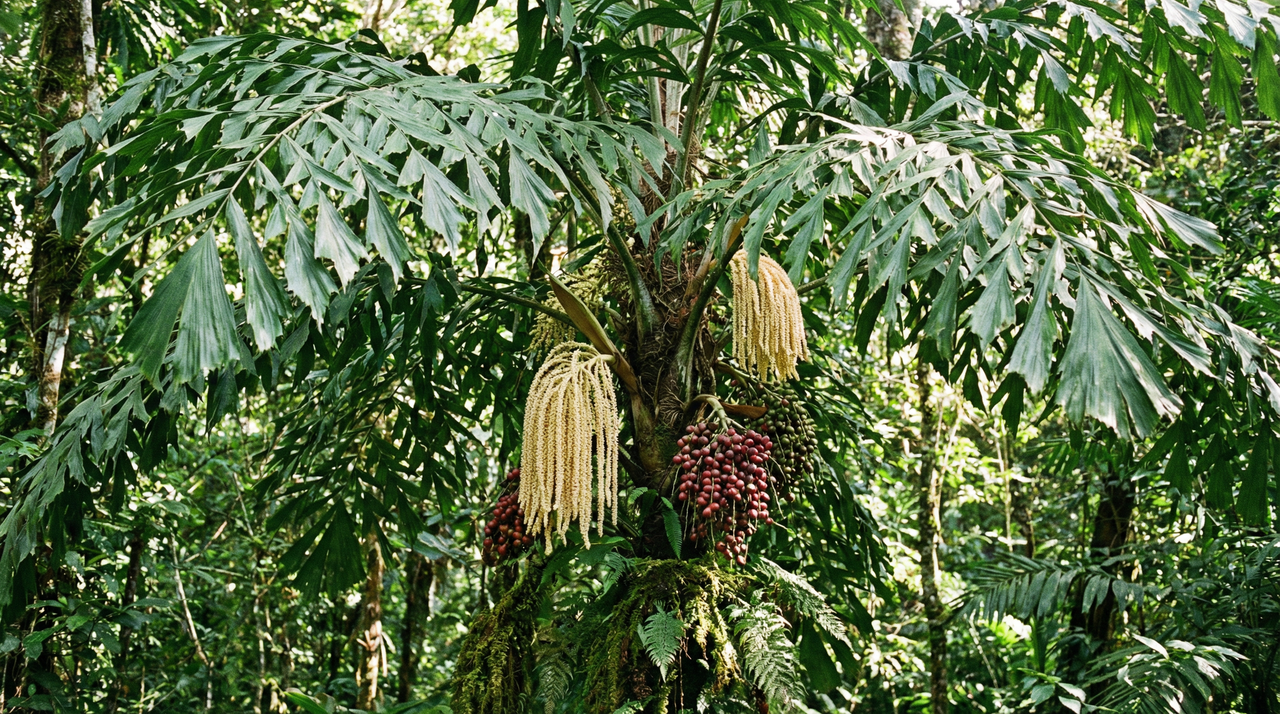
The first time I watched a fishtail palm flower, I knew I was watching it die. That's not a metaphor. Caryota urens spends anywhere from fifteen to forty years building itself into a 60-foot tower of those wild, ragged, fish-fin leaves, and then it blooms once, from the crown downward, inflorescence by inflorescence, until it runs out of stem and simply stops.[1] The whole thing takes years. It's the slowest, most spectacular exit in the plant world, and if you're not paying attention, you can miss what's actually happening.
Most people who plant one don't know this going in. They see those extraordinary bipinnate leaves, nothing else in the palm family looks quite like them, and they want one in their garden. Reasonable. But fishtail palm isn't just a dramatic specimen you plant and forget; it's a commitment to a single, unrepeatable arc. The sap it produces during that final flowering is genuinely extraordinary, sweet and floral in ways that get refined into jaggery and toddy across South and Southeast Asia, and there are real questions about how you harvest it, how much you take, and what you owe a plant that only gets one shot at reproduction. That tension between generosity and finality is what makes this species so worth understanding properly.
Fishtail Palm Origin, History, and Botanical Background
There's a category of plant that stops people mid-sentence when they see it for the first time, and the fishtail palm is firmly in that group. Its scientific name is Caryota urens, it belongs to the family Arecaceae, and the common name tells you exactly what to look for: leaves with jagged, drooping leaflets that really do look like the tail of a fish. I've watched clients walk past a dozen palms in a garden and stop dead in front of this one. That reaction makes sense once you understand where it comes from and what it's built to do.
Botanical Background and Ecology of Caryota urens
Caryota urens is native to tropical South and Southeast Asia, with its range spanning India, Sri Lanka, Bangladesh, Myanmar, Thailand, Malaysia, Indonesia, the Philippines, and southern China.[2][3][4] It grows in humid lowland rainforests, monsoon forests, and along riverbanks, typically at elevations up to 1,500 meters, in climates with annual rainfall of 1,500 to 2,500 mm or more and warm temperatures between 20 and 35°C.[4][5] In the wild it behaves as a pioneer species, colonizing disturbed areas and canopy gaps, stabilizing soil, and providing resources for wildlife; seeds move via gravity, mammals, and birds, with seedlings establishing quietly in shaded understories before growing fast once light increases.[4][6]
What makes C. urens genuinely dramatic, though, is its monocarpic lifecycle. It's a solitary palm, growing as a single unbranched trunk with a fibrous, non-invasive root system,[7][8] and after 15 to 30 years or more of vegetative growth, it flowers once in a massive terminal event, sets fruit, and dies.[9][10] I think of it as the palm that puts everything into one spectacular show, then bows out completely. Its clustering relative Caryota mitis (the Caryota mitis scientific name referring to the clustering fishtail palm) handles this differently: individual stems still die after fruiting, but the clump keeps going through basal suckers.[8] I've grown both side by side, and that persistence makes C. mitis a more forgiving long-term choice for clients who want lasting structure without the lifecycle grief.
Visual Characteristics That Define the Fishtail Palm
The bipinnate leaves are what make identification instant. Each frond reaches 6 to 12 meters long, lined with glossy, leathery, wedge-shaped leaflets 15 to 40 cm long that are deeply notched at the tips in a way that looks genuinely tail-like, especially when they droop slightly in the breeze.[10][11] Young leaves emerge a reddish-brown before maturing to dark green, and that flush of new growth is one of the most genuinely beautiful moments in a tropical garden. The trunk itself is 20 to 50 cm in diameter, clothed in persistent leaf bases and conspicuous dark brown conical spines, with brownish woolly sheaths that give it a rough, textured look up close.[12] At flowering, massive pendulous inflorescences 3 to 6 meters long carry countless small cream to pale yellow flowers, followed by pendulous clusters of orange to red drupes that ripen sequentially from the bottom up.[13] The non-invasive root system, typical of palms, is actually one of the design advantages I always mention to clients considering it near structures or paving.
Traditional and Cultural Uses Across Asia
Across its native range, this palm has been a livelihood plant for centuries. The sap tapped from inflorescences is fermented into toddy (palm wine) or boiled down into kitul jaggery, a distinctive palm sugar central to Sri Lankan cuisine and trade.[14][15] The problem is that tapping typically kills the monocarpic tree before it can fruit and reproduce. I always advise clients against tapping landscape specimens and recommend sourcing commercial kitul from sustainable producers instead; the ethical weight of the practice matters. Beyond sap, the large leaves are used for thatch, mats, and baskets; trunk fibers yield strong ropes; and the apical bud serves as an edible palm heart, sometimes as famine food.[16][17] Various plant parts are also used in Ayurvedic and folk medicine for conditions ranging from rheumatism and asthma to snake bites and diabetes, and the palm carries ritual significance in both Hindu and Buddhist traditions.[18][19]
Indigenous communities including the Vedda of Sri Lanka, the Orang Asli of Malaysia, and the Dayak of Borneo each hold distinct traditional knowledge systems around this species.[20] Carl Linnaeus formally described it in 1753.[21] Globally, the IUCN lists Caryota urens as Least Concern, but local threats from habitat loss and unsustainable sap tapping are real, and agroforestry integration and selective harvesting are the approaches most likely to keep traditional knowledge and the palm itself viable together.[22][23]
Fun Facts About the Monocarpic Jaggery Palm
Under optimal tropical conditions, C. urens can reach 12 to 25 meters tall, with wild specimens often outpacing cultivated ones considerably.[24][25] That entire tower of growth is essentially a slow-burning fuse aimed at one extraordinary reproductive event. The fishtail leaflets, spiny trunk, and pendulous clusters of orange-red drupes make it unmistakable, but those fruits come with a real warning: both the raw fruit and unprocessed sap contain calcium oxalate crystals that cause immediate irritation to skin and mucous membranes.[10] In my early designs I once brushed against a ripening cluster without gloves and regretted it for days. That experience stays with you, and it changed how I brief clients before I install one of these. In zones 10 and 11, where it's truly at home, the palm rewards patience with decades of architectural foliage, and then that single flush of reddish-brown new growth unfurling in the canopy before the final flowering event is something I've never gotten tired of watching.
Fishtail Palm Varieties and Sourcing
Natural Variation Instead of Named Cultivars
Unlike more commercially cultivated palms, Caryota urens has no widely recognized named cultivars. Every plant you'll find is grown from seed, and the species stays that way intentionally in a sense, because natural genetic variation is where all the interesting differences live.[26] Trunk girth, overall vigor, and the fine details of that signature ragged leaflet shape all shift depending on seed source and growing conditions. I treat this the way I treat open-pollinated tomatoes: when I'm sourcing for a client project, I pull seed from two or three reputable suppliers specifically to increase the odds of getting individuals with the most dramatic fishtail leaf form. The absence of cultivars isn't a limitation so much as an invitation to select thoughtfully. The traits that matter most, that distinctive bipinnate silhouette and the monocarpic life cycle, are consistent across the species regardless of source.
Where to Buy Fishtail Palm and What It Costs
Domestic sourcing is genuinely straightforward for zone 10-11 growers. Specialized suppliers like RarePalmSeeds.com, Palmco, and Logan Creek Nursery carry seed and young plants, and the American Palm Society's growers directory is an underused resource that connects you directly to nurseries with experience in Caryota.[27][28] Pricing runs roughly $5-15 for a seed packet, $20-50 for seedlings, $25-75 for one-to-five-gallon container plants, and $300-600 for a ten-foot specimen; larger trees at twelve feet or more can run $500-1,000 or higher depending on the nursery.[8] These are approximate ranges and shift with availability, so treat them as a starting point rather than a fixed market rate.
Regulatory-wise, Caryota urens is not listed under CITES, not flagged by California's Invasive Plant Council, and not on Florida's prohibited plant lists.[29][30][31][32][33] If you're importing live plant material or seeds from abroad rather than buying domestically, a USDA APHIS PPQ Form 525 permit is still required, so don't skip that step. Buying from established domestic nurseries sidesteps the paperwork entirely, which is usually the smarter route anyway for a species this available stateside.
The palm itself is hardy in USDA Zones 10a to 11 and can briefly tolerate temperatures down to around 28°F, though it's not a plant you'd call frost-tolerant by any stretch.[8][4][34] Growth is fast for the 15-25 years it lives, rewarding you with striking fishtail foliage right up until its single flowering event closes out its lifecycle.[8][4] One thing I always flag for clients: the sap is genuinely irritating to skin. In every installation I've done with this palm, even incidental contact has caused real discomfort, so I treat it with the same respect I give Dieffenbachia. Gloves are non-negotiable, not optional. If you're buying seed rather than a nursery plant, order fresh and sow immediately; viability drops off sharply after one to six months, and seeds need warm, moist conditions around 80-85°F to germinate reliably.[35] The propagation section covers the full germination protocol in detail.
Fishtail Palm Propagation and Planting
Because this palm flowers once and dies, collecting viable seed from it is a genuinely rare event. Understanding that reality shapes every decision that follows, from how quickly you handle the fruit to where you eventually put the seedling in the ground.
Seed Morphology, Collection, and the Recalcitrant Challenge
The fruit is a small, globose drupe, roughly 1-2 cm across, that ripens from green to a vivid orange-red.[2][36] Inside that fleshy mesocarp sits a single ovoid seed, 1-3 cm long, encased in a hard, woody endocarp with a dark brown to black outer coat.[2][37] The seeds are polyembryonic, with embryos primarily of nucellar origin, but because the species is self-incompatible and obligately outcrossing, seedlings rarely match the parent closely.[38][39] Plan for variation.
The bigger issue is urgency. These are recalcitrant seeds with an initial moisture content of 40-50%, and they are extraordinarily sensitive to drying out.[40][41] At ambient conditions, viability can drop to nothing within a few months. I learned this the hard way: I once set aside a batch of fresh seeds to clean up "later that afternoon" and ended up sowing them two days later. Germination was dismal. Sow the same day you collect if at all possible, or store briefly at 15-20°C in moist vermiculite inside a breathable container if you need a few extra weeks.[42]
Before sowing, remove all of that fleshy sarcotesta immediately after harvest. Left on, it invites fungal rot fast.[43] A 24-48 hour soak in warm water (40-50°C), or a gibberellic acid soak at 100-500 ppm, can meaningfully improve germination rates.[44] Cuttings, offsets, and grafting are simply not options here: this is a solitary, monocarpic species with no vascular cambium, so seed is the only realistic route for home growers.[45][46] Tissue culture works at 70-90% success, but that means a lab.[47] Expect moderate difficulty even in a greenhouse setup, and higher stakes if you're working without sterile technique.[48]
Germination Timeline and Techniques
Before you sow a single seed, absorb this: the palm you're growing will take 4-10 years, sometimes up to 15, to reach its first flowering.[49][50] Knowing your palm will flower only once changes how you approach the entire process. I treat every fishtail from the moment of germination as a permanent resident that deserves thoughtful handling from the start.
The germination window itself is 2-6 months, often closer to 1-3 months under ideal conditions.[51][37] You want a sterile, well-aerated medium, a sand-compost or sand-peat mix works well, kept consistently moist at 25-32°C (77-90°F) with steady humidity.[51][52] Success rates range from 30-80% and that spread is almost entirely explained by seed freshness and provenance.[37] Rich soil and tropical lowland conditions speed up the journey to flowering; temperate or nutrient-poor sites push it toward that 15-year end of the range.[9] The window for catching that single harvest is real, and you want every advantage working for you from germination day one.
Soil, Site Selection, and Planting Requirements
Fishtail Palm wants soil that holds moisture without ever holding water. Loamy or sandy-loam at pH 5.5-7.5, rich in organic matter, well-drained, and consistently moist — that's the native humid-forest understory translated into a planting bed.[53][54] Waterlogging is not just undesirable; it's rapidly fatal to the roots.[53] For containers, I use 50% potting soil, 30% coarse sand or perlite, and 20% organic matter in pots of at least 5-10 gallons.[54] It's a reliable baseline that prevents the two most common early failures.
Young seedlings scorch easily. They need partial shade or dappled light, roughly 10-30% of full sun, mimicking the filtered canopy they'd experience as understory plants.[55][56] The first time I moved young plants out from under 50% shade cloth into a Florida summer afternoon, they bleached within days. Keep them in bright indirect light until they've established some size. Mature specimens can handle 4-6 hours of direct sun if humidity stays high, but intense midday exposure causes bleaching, wilting, and necrosis even in adults.[56]
If you see older fronds yellowing progressively despite moist soil, with premature leaf drop and wilting that doesn't track moisture levels, that's a drainage problem, not a watering problem.[57] The fibrous root system is relatively shallow, typically 1-2 meters deep with wide lateral spread, and it depends entirely on loose, well-aerated conditions to function.[57] Compacted or soggy soil doesn't give those roots room to breathe.
Spacing, Technique, and Establishment
This palm grows to 12-18 meters (40-60 ft) tall with a canopy spread of 3-6 meters (10-20 ft).[53] Commercial plantings space trees 7-8 meters within rows and 8-9 meters between rows; ornamental and landscape plantings use 3-6 meter centers to allow crown development, air circulation, and root expansion.[58][59] I give every fishtail at least 15 feet of clear radius if I can manage it, because I've watched how quickly their surface roots outcompete nearby plants for nutrients once the crown starts filling in.
Transplant seedlings when they reach 6-12 inches tall, stake temporarily in any site with regular wind, and leave clearance below the canopy for falling fruit clusters.[60] Those first few years before canopy closure are a good opportunity to run short-term intercrops in the gaps, making productive use of otherwise empty space while the palm establishes.[58] Wider spacing also reduces leaf-spot pressure in humid climates, which is a meaningful benefit in zones 10-11 where high moisture and heat combine to favor fungal problems.
Site it right the first time. This palm will occupy its spot for a decade or more before its single flowering window arrives, and moving a mature specimen is not a realistic option.
Fishtail Palm Care Guide
Every care decision you make with a fishtail palm should be viewed through one lens: this is a tropical giant on a single long sprint toward a single reproductive event. It grows fast, it eats heavily, it hates cold, and once it flowers, the show is over. That reality shapes everything from how often you water to why you protect it from frost with almost embarrassing care. Get the basics right and it rewards you with decades of extraordinary foliage. Let things slide and you'll see the decline written clearly on the fronds.
Water Requirements
The golden rule is consistently moist soil that never stays waterlogged.[61][25] For young seedlings, keep the top inch barely dry between waterings; mature plants in active growth want a deep soak every five to seven days, pulling back to every ten to fourteen days in cooler months.[62][54] I always check moisture at six to eight inches down before watering a mature specimen, because in humid subtropical climates the surface can feel dry while the root zone is still quite wet. That's where root rot starts.
Both overwatering and underwatering announce themselves on the leaves. Overwatering produces yellowing or browning from the tips inward, wilting despite wet soil, and opens the door to Phytophthora infections. Underwatering shows as wilting fronds, tip browning, and drooping on the lower leaves first.[63][64] The symptoms overlap enough to be confusing, which is exactly why checking soil depth beats guessing. Aim for soil with a pH of 6.0 to 7.5, good organic matter, and low salt content; this palm has very low salinity tolerance and will show it.[54][65]
Sunlight Needs
Fishtail palms want at least six hours of direct sun daily but can handle partial shade in hotter climates where afternoon exposure causes leaf scorch.[8][66] This reflects the palm's native range, where young plants establish under partial canopy before pushing into full light as they grow. I site young specimens with afternoon shade their first season, then gradually expose them as they gain size and root mass. Indoors, a south-facing window is the minimum; anything less and you'll see slow growth and pale, unhappy fronds.
Feeding and Fertilization
This is a hungry palm. The fast growth rate demands moderate to heavy fertilization using palm-specific NPK ratios like 8-2-12, 12-4-12, or 10-5-20, applied three to four times per year from March through October.[67][68] I run a soil test before the first application of every season because palms in variable soils move through magnesium and potassium reserves faster than you'd expect, and older fronds are usually where I see it first: orange-brown margins on the lower leaves almost always point to potassium deficiency in my client gardens.[54][69]
Micronutrient deficiencies each have a signature. Nitrogen deficiency shows as uniform yellowing on older fronds; phosphorus causes dark green or purplish discoloration; potassium produces marginal chlorosis progressing to necrosis; magnesium creates interveinal yellowing on older leaves; iron shows interveinal chlorosis on the youngest growth instead.[70][71] Over-fertilizing causes salt buildup, leaf scorch, and dieback, so stay within the recommended one to one-and-a-half pounds per mature tree annually and keep soil pH between 5.5 and 7.0.[72]
Frost Tolerance and Cold Protection
Fishtail palm cold hardiness is limited. Caryota urens is reliably hardy in USDA zones 10a through 11, with some tolerance down to 30°F (-1°C) and, in mature established specimens, a brief dip to 28°F (-2°C).[73][74] Below that threshold, expect wilting, yellowing, frond necrosis, and possible trunk damage. Young plants are far more vulnerable than mature ones.
If you're in a marginal zone, site selection is your first line of defense: a south- or west-facing wall with wind protection makes a real difference.[60] Two to four inches of mulch over the root zone, frost cloth over the crown on cold nights, and a container that can be moved indoors are practical strategies.[75] My honest recommendation: if you're outside zones 10a to 11, grow this palm in a large container or redirect that space to a species better suited to your winters.
Heat Tolerance and Summer Care
Native to tropical Asia, the fishtail palm is most comfortable between 68 and 95°F and can push through brief periods up to 110°F when kept humid and well-watered.[25][76] Dry heat above 95°F is the real problem; that's when you see leaf scorch, curling fronds, and wilting even in moist soil. I use 40% shade cloth on young palms through Florida's peak summer months and find they stay lush even when temperatures hit the upper 90s, as long as deep weekly watering and mulch are holding up their end of the deal.
Practically: deep, infrequent irrigation of roughly 20 to 30 liters per mature plant weekly, two to three inches of organic mulch kept away from the stem, and spacing of at least four to six meters for airflow all reduce heat stress.[4][77] Windbreaks help too, since desiccating winds compound heat damage fast.
Pruning and Maintenance
Prune only dead or dying fronds, and do it during the growing season with sterilized tools.[54] Because the sap is deeply irritating to skin and mucous membranes, wearing dedicated heavy gloves and long sleeves is a non-negotiable safety measure during pruning. Because fishtail palms carry relatively few fronds compared to many palms, every cut matters; removing green fronds stresses the plant and can slow growth during the one vegetative phase it gets.
If you're tapping for sap, limit tapping to one inflorescence per tree.[78] This is a monocarpic palm with a single reproductive budget, and spreading that stress across multiple inflorescences shortens the window you have with a tree you've waited years for.
Seasonal Rhythm and Life Cycle
Here's what sets this palm apart from almost everything else in the garden: it grows without true dormancy in tropical conditions, accelerating through wet and monsoon seasons, for seven to fifteen years before flowering is triggered, often at the end of the rainy season or during a dry period.[79][80] Then it produces one massive terminal inflorescence, sets seed, and dies. The entire vegetative life spans eight to forty years and the palm reaches twelve to twenty-five meters before that moment arrives.[81][6]
This is where Caryota mitis behaves very differently: individual stems of that clustering species die after fruiting, but the clump itself persists through basal suckers, making it a much safer bet for anyone who wants permanence. Caryota urens gives you one spectacular, unrepeatable run. In my design work, I pair young fishtail palms with longer-lived understory species so the guild keeps producing and evolving after the palm's decline. That way its final act, dramatic as it is, becomes part of the system's story rather than a hole in the canopy you weren't prepared for.
Fishtail Palm Harvesting: Timing, Technique, and Sap Transformation
Every palm you grow will flower and fruit repeatedly over its lifetime. Fishtail palm doesn't work that way. Caryota urens is monocarpic, which means it spends 4-10 years building toward one single reproductive event, then flowers, fruits, and begins its decline.[80][82] I've designed long-term guild plantings around Caryota species, and nothing teaches patience quite like watching a palm take seven years to reach that moment. When it finally comes, you treat every single liter of sap like it matters. Because it does.
When and How to Tap Fishtail Palm Sap
The inflorescence development process runs 4-6 months total, moving through initiation, elongation, and a pre-anthesis stage where everything changes.[82][83] Your tapping window opens roughly 2-4 weeks after emergence, ideally on male inflorescences during or just after the wet season.[84] I learned the hard way that missing the exact spathe color-change by even a few days noticeably reduces sap flow. The cues you're watching for: the spathe shifts from green to yellowish-brown or reddish-brown, the tissue softens slightly, the inflorescence develops a gentle droop, and there's a distinct sweet smell that wasn't there before.[78][80] When those four signals converge, you're on the clock. Get daily observation built into your routine the moment you see that inflorescence swelling, because this isn't a harvest that forgives a long weekend away.
Sap Yields, Flavor Profiles, and Processing Effects
Once tapping begins, you can expect 2-3 liters per day initially, tapering over a productive window of roughly 2-3 months per inflorescence.[78][85] Sustainable practice means tapping only one inflorescence per palm, honoring the single reproductive cycle this tree will ever complete.[86] Fresh sap runs 10-15% sucrose with a floral, honey-like aroma that reminds me of fresh-pressed sugarcane juice, sweet but with a subtle nuttiness and mild astringency underneath.[78]
Sap is the harvest here, not the fruit. I always tell clients clearly: the orange to dark purple-black fishtail palm berries contain calcium oxalate crystals that will irritate your mouth immediately, and the same goes for unprocessed pith.[87][13] Raw fishtail palm fruit is not something you taste twice. Thorough processing is non-negotiable for any part other than the sap.
What you do with that sap after collection determines everything about flavor. A few hours of natural fermentation gives a lightly yeasty, mildly sweet drink; letting it go 24-48 hours produces toddy at 3-6% alcohol, tangy and effervescent with tropical fruit notes, banana and pineapple coming through as pH drops to around 4-5.[88][89] Boiling takes it somewhere else entirely. I experiment with every batch, because an extra ten minutes over the fire is the difference between a light amber syrup and a deeply caramelized jaggery with toffee, molasses, and vanilla notes developing through Maillard reactions.[90][91] Related Caryota mitis produces comparable sap for tapping and fermentation, though its sucrose content runs slightly higher at 15-20%, and its raw fruits carry the same astringency problem from tannins and glucosides.[92][87] For kitul jaggery specifically, Caryota urens remains the traditional standard, and after working with both species I understand why.
Fishtail Palm Preparation and Uses
Culinary and Edible Uses of Caryota urens
Because this palm flowers and fruits only once before dying,[10] every harvest decision carries real weight. Sap tapping is the heart of it. The sweet, sucrose-rich sap drawn from the inflorescence travels two paths: fermentation into toddy, a palm wine that ranges from mildly effervescent to genuinely potent, or prolonged boiling into kitul jaggery, the caramel-toffee palm sugar that anchors traditional sweets like payasam, halwa, and laddoos across South Asia.[10][93][94] In Kerala, toddy also seasons fish curries and ferments the batter for appam.[95][96]
Beyond the sap, other parts are edible but come with caveats. The palm heart is usable raw or cooked in curries and salads,[10][97] though harvesting it kills the tree outright. Young, unopened inflorescences can be cooked as a vegetable in stir-fries or curries; heat removes the mild irritants present in raw material.[98][99] The trunk pith can be processed into a sago-like flour, and immature kernels yield a starch substitute once oxalates are properly neutralized.[20][100]
The fruit question deserves plain language. Mature fruits are loaded with needle-like calcium oxalate raphides that cause severe mouth and throat irritation if eaten raw.[10][101] I think of it like taro: the same class of crystals, the same non-negotiable requirement for thorough cooking or fermentation before anything goes near your mouth. Sloppy prep is not a minor inconvenience. It's genuinely painful, and traditional communities refined these processing steps over generations precisely because the raw fruit is unforgiving.[100]
Traditional Medicinal Preparations
Leaves are prepared as poultices and applied topically for wounds and skin conditions. Root and bark decoctions, typically prepared at around 10 to 20 grams per liter of water and taken once or twice daily, appear in Ayurvedic and related traditional systems for rheumatism, asthma, urinary disorders, and snakebite.[102][103] These are preparations with centuries of documented use, and I have enormous respect for that lineage. That said, modern clinical validation remains limited, and the oxalate and glycoside content in various parts of this plant is not something to experiment with casually. I always tell clients to work with a qualified Ayurvedic or herbal medicine practitioner before attempting any internal preparations from Caryota urens.
Non-Food and Material Uses
The timber is hard, durable, and traditionally put to work in construction, furniture, and walking sticks.[104] Leaves go up as roof thatch and get woven into mats and hats, while the leaf sheaths and petioles yield fibers strong enough for rope, fishing nets, brushes, and baskets.[10][105][106] I've handled sheath-fiber cordage in traditional craft contexts and the tensile strength genuinely surprises people accustomed to softer natural fibers.
In modern landscapes, fishtail palm earns its place through sheer visual drama: those distinctive bipinnate, fishtail-shaped leaflets stop people in their tracks.[100] I watched a mature specimen flower and slowly decline in a client's garden, and it reshaped how I think about succession planting. Now I keep replacement palms or complementary canopy species ready before a flowering Caryota urens reaches its final act. The caustic fruit sap that makes those bright berries so hazardous to skin and eyes is worth remembering too, especially in a garden where children or pets are present. The plant gives generously, but it asks you to stay alert.
Fishtail Palm Health Benefits and Medicinal Uses
The fishtail palm is one of those plants that makes you think carefully before you reach for it. There's genuine pharmacological promise here, documented across centuries of traditional use and increasingly supported by laboratory research. But the same plant that delivers anti-inflammatory compounds in an extract can cause immediate, searing pain if you handle the wrong part carelessly. I've seen that contrast play out in educational settings with tropical palms, and it never stops being instructive.
Traditional Medicinal Uses in Ayurveda and Folk Medicine
Caryota urens has a long documented role in Ayurvedic and Sri Lankan ethnobotanical practice, where roots, sap, leaves, bark, and seeds have each been applied to specific conditions including rheumatism, asthma, wounds, urinary disorders, and diabetes.[107][108][109][110] Roots were the go-to for diuretic applications, while the sap served as a general tonic and leaf preparations addressed skin conditions and joint pain. That specificity matters. Traditional practitioners weren't using the whole plant interchangeably; they were working with particular parts for particular purposes, a sophistication that modern research is only beginning to catch up with.
Scientific Research on Anti-inflammatory, Antioxidant, and Other Activities
Preclinical studies have largely validated what traditional medicine long suspected. Leaf and fruit extracts show significant anti-inflammatory activity in animal models, and leaf extracts in particular deliver dose-dependent analgesic effects comparable to aspirin.[111][112] Methanolic extracts demonstrate antioxidant activity via DPPH radical scavenging and show antimicrobial effects against Staphylococcus aureus, Escherichia coli, and Candida albicans.[113][112] Root extracts increase urine output in rats, supporting the traditional diuretic application.[114] Extracts also inhibit alpha-amylase and alpha-glucosidase, which suggests anti-diabetic potential, and show cytotoxic effects on MCF-7 breast cancer cell lines through apoptosis induction.[115][116] That said, nearly all of this research is preclinical: in vitro or animal-model work, with very few human clinical trials available. The animal-model data for anti-inflammatory effects is genuinely compelling, but I always tell people to work with a qualified herbalist or physician before using any palm-derived preparation medicinally. Promising is not the same as proven.
Key Phytochemicals: Flavonoids, Phenolics, Alkaloids, and More
The chemistry here is rich and part-specific. Leaves carry the highest concentrations of flavonoids, including quercetin, rutin, and kaempferol derivatives, along with phenolic compounds that drive most of the antioxidant activity.[117][118] Stem bark is extraordinarily tannic, running 20-30% tannin by dry weight, while fruits contain phenolic acids like gallic, ferulic, and ellagic acid, plus anthocyanins.[119] The plant also contains the following secondary metabolites:
- saponins
- alkaloids
- steroids
- terpenoids
- cyanogenic glycosides capable of releasing hydrogen cyanide
Nutrition from Sap, Jaggery, and Palm Heart
The sap is where the safe, practical nutrition lives. Fresh sap contains 10-15% sugars and is processed into kitul jaggery or fermented into toddy; jaggery delivers 380-400 kcal per 100g alongside impressive mineral content: roughly 1050 mg potassium, 50-100 mg calcium, 70-90 mg magnesium, and 5-10 mg iron, with a lower glycemic index than refined cane sugar.[126][127] Palm heart, when thoroughly cooked to reduce acrid compounds, contributes potassium, calcium, and magnesium in more modest amounts.[128][129] The fruits are a different story entirely: they're not edible, full stop. High calcium oxalate crystal loads and cytotoxic lectins like saporin make them hazardous without very specialized processing.[130][131] I use this contrast when educating clients on multi-use palms: the sap is genuinely garden-to-table once processed; the fruit is strictly hands-off.
Safety Considerations and Toxicity
This is the part I want every reader to sit with. The fruits, seeds, and many raw parts of Caryota urens contain needle-like calcium oxalate raphides that cause immediate burning, oral swelling, excessive salivation, and difficulty swallowing on contact.[132][133] If you've ever handled a Dieffenbachia or Colocasia carelessly and felt that instant oral sting, you have some idea of what raphides do; the fishtail palm's fruit takes that sensation and amplifies it significantly. Skin contact can trigger contact dermatitis, so gloves are non-negotiable whenever you're working near the fruiting structures.[134][135]
The sap, cooked young shoots, and properly prepared palm heart are safe after thorough processing, and leaf hydroalcoholic extracts show low acute toxicity with an LD50 above 2000 mg/kg in rats.[136][137] Raw plant parts are another matter, and the plant is toxic to dogs, cats, and horses, causing oral irritation, hypersalivation, vomiting, and diarrhea.[101] Pregnant or nursing women, anyone with kidney issues or oxalate sensitivity, and households with free-roaming pets should approach this plant with real caution. There's also a misidentification risk worth flagging: the fishtail palm is sometimes confused with the sago palm (Cycas revoluta), which carries a completely different and far more severe toxicity profile.[138] Caryota urens typically has a solitary stem, which helps distinguish it from the clustering C. mitis, but confident identification before any medicinal or culinary use is non-negotiable.
Fishtail Palm Pests and Diseases
Caryota urens sits somewhere in the middle of the palm world's disease-resistance spectrum, not especially tough, not especially fragile, but with a few genuine vulnerabilities that can turn a thriving specimen into a serious problem fast.[139] There are no disease-resistant cultivars to lean on here, no breeding program that's solved these problems genetically, so management is entirely a cultural game.[140] In my landscape design work, I've learned to treat site selection as the first line of defense: if you put this palm somewhere with sluggish drainage or poor air movement, you're essentially setting a timer on a disease outbreak.
Common Diseases of Fishtail Palm
The most serious fishtail palm diseases tend to start where you can't see them. Bud rot caused by Phytophthora palmivora and Fusarium species is the threat I take most seriously, because by the time the spear leaf collapses and the crown goes soft, it's often too late.[139][141] Ganoderma root and butt rot, caused by Ganoderma zonatum, is similarly grim: once those bracket-shaped conks appear on the trunk base, the internal decay is already advanced and there's no cure, just removal and prevention of spread to nearby palms.[142][143]
Phytophthora root rot is the slower-moving cousin of bud rot, showing up as yellowing fronds, wilting, and stunted growth in waterlogged soil, especially when temperatures push above 25°C.[144][145] Leaf spot diseases from Bipolaris, Pestalotiopsis, Phyllosticta, and Fusarium species are less dramatic but genuinely common in humid tropical settings, producing brown spots and leaf necrosis that chip away at photosynthetic capacity over time.[146][147] Prolonged leaf wetness is the trigger, which is why overhead irrigation is something I'd avoid entirely with this species.
Humidity above 80%, temperatures in the 25-35°C range, and soggy soil create conditions where nearly every one of these pathogens thrives simultaneously.[148] Keeping soil moisture around 60-70% and humidity closer to 50-70% with good air circulation genuinely shifts the odds. Practical management combines well-drained planting sites, prompt removal of infected fronds, and biological options like Trichoderma inoculants applied to the root zone. When fungicides are necessary, copper-based products work for leaf spot, phosphonates for Phytophthora, and propiconazole for Ganoderma situations where intervention is still possible.[149]
Major Insect Pests and Management
Red palm weevil (Rhynchophorus ferrugineus) is the pest that keeps me most alert when specifying fishtail palms for collections in zones 10-11. This beetle bores into the crown and trunk, and by the time you notice the characteristic frass and the wilting, leaning spear leaf, the structural damage inside can already be catastrophic.[150][151] It's a major threat in India and a regulated quarantine pest in parts of the southern United States and California, so regional guidance matters here.[152] I now recommend pheromone traps as a proactive monitoring tool for any palm collection rather than waiting for symptoms to appear.
Below that headline threat, there's a whole cast of sap-feeding insects to watch for: the following can all establish on fishtail palms:
- scale species (including Aspidiotus and Aulacaspis yasumatsui)
- mealybugs
- spider mites
- aphids
- caterpillars like Opisina arenosella
While the palm produces phenolic compounds, tannins, flavonoids, and saponins that offer some moderate natural deterrence, and its fibrous trunk structure slows certain wood-borers relative to softer palms, but none of that stops a serious weevil infestation or a mite flare-up in dry conditions.[156] With no pest-resistant selections available commercially, the grower's toolkit is built entirely from cultural and biological practice.[157] Adequate spacing, good drainage, consistent monitoring, and early intervention are what actually move the needle.[158][159] I've found that regular frond inspections catch scale and mealybug crawlers before the sooty mold stage, which keeps interventions simple, typically insecticidal soap or horticultural oil rather than anything systemic. Pheromone trapping for weevils, beneficial nematodes for soil pests, and targeted chemical inputs only when cultural methods fall short: that's the IPM framework that makes sense for this species.[159][154] Because pest pressure varies significantly by region, your local extension service is worth consulting before fishtail palm problems escalate.
Fishtail Palm in Permaculture Design
There's a particular design tension that comes with Caryota urens, and I think about it every time I place one in a food forest plan. This palm grows fast, looks extraordinary, and delivers real ecosystem services for decades. Then it flowers once and dies. That monocarpic clock is the central fact around which every permaculture decision has to orbit.
Ecological Role and Guild Placement
Caryota urens typically reaches 12 to 30 meters tall with a canopy spread of 6 to 9 meters, lives 20 to 30 years, flowers in one massive terminal event, and then senesces.[8][160] Some plants produce basal offsets that help maintain the population, but don't count on it as a substitute for real succession planning. I've made a habit of labeling potential successor species in my design drawings the day I plant a fishtail, because once the canopy fills in and the foliage is doing its dramatic thing, that 20-year timer becomes very easy to forget.
The reproductive display itself is genuinely spectacular. The pendulous inflorescences can reach 3 to 5 meters long, with creamy to pale-yellow flowers that attract bees, beetles, flies, and other pollinators through what appears to be a mix of fragrant lures and protogynous flowering that promotes outcrossing.[8][161] The pollination science is actually still being debated: some research emphasizes wind dispersal of the lightweight pollen, while other studies point to Curculionidae and Nitidulidae beetles as primary vectors, drawn in by fruity odors.[162][163] In my own designs, I've watched beetles work those blooms actively, so I plant extra flowering companions nearby to support insect numbers rather than assuming the wind will handle it. Given the protogynous strategy, manual pollination is worth attempting in cultivation if you're counting on seed set.
The reddish drupes that follow are valuable wildlife food, attracting frugivorous birds and mammals for seed dispersal.[8][164] Handling them is another matter. The caustic sap requires careful cleanup to avoid skin irritation.
Beyond the dramatic flowering cycle, this palm contributes meaningfully to its ecosystem. It stabilizes soil, supports biodiversity across birds, bats, and insects, and sequesters carbon over its long vegetative life.[165][166] The leaves are potassium-rich, and in favorable conditions a single plant can produce substantial dry biomass annually. I chop the spent fronds into my compost bins and have noticed genuine soil improvement over subsequent seasons; it's one of those quiet yields people overlook when they're focused on the sap harvest.
Forest Layer and Companion Guilds
In its native South and Southeast Asian habitats, Caryota urens occupies the understory to subcanopy of moist lowland and foothill rainforests, often along riverbanks, at elevations from sea level to around 1000 meters.[4][167] Young plants handle moderate shade, and that juvenile shade tolerance is actually useful in a food forest context; you can establish them under a light canopy and let them grow into their eventual subcanopy role as the system matures.
At full stature it functions as a single-stemmed tree layer element, engaging in light competition and mycorrhizal nutrient uptake while its fruits cycle back into the system through bird-mediated dispersal, particularly by hornbills.[167][168][169] I think of it as a tall pioneer or structural accent rather than a permanent canopy anchor, partly because of its eventual height and partly because of that monocarpic lifecycle. It earns its space for two decades, then hands the light back to whatever you've planted to succeed it.
Companion planting under or around it follows naturally from its native context: shade-tolerant, moisture-loving tropicals like gingers, heliconias, and other understory perennials work well in the humid micro-environment the palm creates.[8] The bipinnate fishtail foliage is genuinely unlike anything else in the guild; it gives the design a vertical drama that I find hard to replicate with other large-leafed tropicals, and it earns those companion plantings a certain amount of windbreak and humidity retention as a side benefit.
Climate Requirements and Hardiness Zones
Caryota urens is a tropical monsoon specialist, native to South and Southeast Asia and evolved for annual rainfall of 1500 to 3000 mm, temperatures in the 21 to 29°C range, and relative humidity between 60 and 80%.[2][8][56] It handles heat well; when moisture is adequate it can tolerate temperatures above 38°C without major stress. The cold end of that equation is where the hard limits sit.
Reliably hardy only in USDA zones 10a through 11, this palm can sometimes survive a brief dip to around -1 or -2°C, but sustained freezing causes severe foliar damage or kills the plant outright.[170][60][56] Zone 9b is possible with heavy protection, south-facing microclimates, windbreaks, and frost cloth, but I'd describe it the same way I describe overwintering a tender banana in that zone: achievable, but you're working against the plant's nature rather than with it. Container growing is the more honest solution for cooler regions, since it lets you move the palm to shelter when temperatures drop.
The related Caryota mitis stretches a bit further, tolerating zone 9b with more reliability, though it still needs shelter from dry cold and low humidity.[56][8] For Caryota urens specifically, the reality is that it performs superbly only in genuinely tropical settings with high humidity and consistent moisture. Given that this palm has one shot at reproduction over its 20-to-30-year life, getting the climate fit right from the start isn't just good horticulture; it's the whole design premise.
The Palm That Only Gets One Chance (And Makes It Count)
I've watched a lot of plants come and go in food forests, but there's something that stops me every time I stand under a Fishtail Palm close to flowering. It's spent years building toward a single, unrepeatable moment, and it has no backup plan. I find that kind of commitment quietly humbling. Most of us hedge; this palm doesn't.
Sources 170
- Palmpedia: Caryota urens ↩
- Caryota urens - Plants of the World Online ↩
- Flora of China: Caryota urens ↩
- Caryota urens - Kew ↩
- Tropical Palms for Sustainable Forestry ↩
- Reproductive Biology of Caryota urens ↩
- The Genus Caryota ↩
- Caryota urens - Missouri Botanical Garden ↩
- Kitul palm (Caryota urens): Cultivation and Uses ↩
- Caryota urens - Wikipedia ↩
- Flora of China: Caryota urens ↩
- Caryota urens - Missouri Botanical Garden ↩
- Caryota urens PlantFinder ↩
- Ethnobotanical Uses of Caryota urens in India ↩
- Kitul Palm: Traditional Uses and Cultural Significance in Sri Lanka ↩
- Traditional Uses of Palms in Sri Lanka ↩
- Orang Asli Ethnobotany: Palm Resources in Malaysia ↩
- Ethnobotany of Palms in Southern India ↩
- Medicinal Plants of Kerala ↩
- Traditional Uses of Kitul Palm in Sri Lanka ↩
- Species Plantarum ↩
- IUCN Red List: Caryota urens ↩
- Kitul Palm (Caryota urens): Traditional Uses and Sustainability in Sri Lanka ↩
- Caryota urens ↩
- Caryota urens - Missouri Botanical Garden ↩
- Palmpedia: Caryota urens ↩
- Growers and Suppliers Directory ↩
- Caryota urens Availability ↩
- Plant Protection and Quarantine (PPQ) Permits ↩
- Caryota urens Profile ↩
- CITES Species Database ↩
- Invasive Plant Inventory ↩
- Prohibited Aquatic Plants ↩
- Caryota urens L. ↩
- Seed Germination Guide for Palms ↩
- Caryota urens L. ↩
- Seed Development in Caryota urens ↩
- Embryology and Polyembryony in Palms of the Genus Caryota ↩
- Seed Development and Germination in Caryota urens ↩
- Recalcitrant Seeds: Biology and Storage ↩
- Seed Storage Behaviour of Palm Species ↩
- Recalcitrant Seeds in Tropical Palms ↩
- Seed Germination in Arecaceae ↩
- Germination of Palm Seeds ↩
- Propagation of Palms ↩
- Propagation of Palms ↩
- Micropropagation of Caryota urens ↩
- Fishtail Palm (Caryota urens) Care Guide ↩
- Caryota urens - PROSEA ↩
- Caryota urens (Solitary Fishtail Palm) - Plant Profile ↩
- Palm Seed Germination Guide ↩
- Germination of Fishtail Palm (Caryota mitis) ↩
- Caryota urens - Fishtail Palm ↩
- Soil Requirements for Palms - University of Florida IFAS Extension ↩
- Caryota urens ↩
- University of Florida IFAS Extension - Fishtail Palm ↩
- Root Diseases of Palms ↩
- Cultivation of Jaggery Palm (Caryota urens) ↩
- Kitul Palm Cultivation Guidelines ↩
- Caryota urens - Fishtail Palm ↩
- Caryota urens Plant Care and Growing Guide ↩
- Growing Fishtail Palms: Watering and Care ↩
- Caryota urens Care Guide ↩
- Palm Plant Watering Tips ↩
- Tropical Palms: Cultivation Guide - FAO ↩
- Caryota urens ↩
- Fertilization of Palms in Florida ↩
- Nutrient Requirements for Tropical Palms ↩
- Palms: Micronutrient Deficiencies ↩
- UF/IFAS EDIS - Palms and Their Nutrient Requirements ↩
- Palm Nutrient Deficiencies and Toxicities ↩
- Caryota urens - University of Florida IFAS Extension ↩
- Caryota urens ↩
- Caryota urens ↩
- Cold Hardiness of Palms ↩
- Heat Stress in Palm Trees ↩
- Irrigation and Mulching Practices for Palms in Arid Tropics ↩
- The Kitul Palm: Caryota urens in Sri Lankan Traditional Practices ↩
- Caryota urens - Plants of the World Online ↩
- The Fishtail Palm (Caryota urens): Cultivation and Tapping ↩
- The genus Caryota (Palmae) ↩
- Inflorescence Development in Caryota urens ↩
- Palms of the World: Caryota urens ↩
- Biology of Caryota urens Flowering and Sap Yield ↩
- Kitul Palm Syrup: Production and Quality ↩
- Kitul Palm: Harvesting and Processing ↩
- Toxicity of Palm Fruits: Caryota Species ↩
- Palm Wine and Jaggery Production from Caryota urens ↩
- Palm Wine Production from Fishtail Palm - FAO Document ↩
- Palm Sugar Production from Caryota urens ↩
- Traditional Kitul Processing in Sri Lanka ↩
- Palm Sugar Production from Caryota mitis - Journal of Agricultural Science ↩
- Fishtail Palm (Caryota urens) ↩
- Edible Palms and Their Uses ↩
- Traditional Palm Jaggery Recipes from India ↩
- Fishtail Palm: Caryota urens Uses in Food and Beverage ↩
- Palms: Edible and Useful Species - Purdue University ↩
- Edible Uses of Jaggery Palm in Traditional Diets ↩
- Ethnobotanical Uses of Caryota Species in Southeast Asia - Journal of Ethnobiology ↩
- Useful Tropical Plants: Caryota urens ↩
- Toxic and Non-Toxic Plants: Fishtail Palm ↩
- Ayurvedic Pharmacopoeia of India ↩
- Ethnobotanical Uses of Caryota urens in India ↩
- Ethnobotanical Uses of Caryota urens in India ↩
- Culinary and Construction Uses of Caryota urens ↩
- Palm Fiber Production from Caryota urens ↩
- Traditional Medicinal Uses and Phytochemical Constituents of Caryota urens in Indian Medicine ↩
- Ethnobotanical Survey of Caryota urens in Sri Lanka ↩
- Medicinal Plants of India ↩
- Traditional Uses of Palms in Southeast Asia ↩
- Pharmacological Evaluation of Caryota urens Leaf Extract for Anti-inflammatory and Analgesic Activities ↩
- Antioxidant and Anti-inflammatory Activities of Caryota urens Extracts ↩
- Antioxidant and Antimicrobial Properties of Caryota urens Fruit Extract ↩
- Phytochemical Screening and Diuretic Activity of Caryota urens Root ↩
- Anti-diabetic Potential of Caryota urens: Enzyme Inhibition Studies ↩
- Cytotoxic and Toxicological Profile of Caryota urens ↩
- Phytochemical Screening and Antioxidant Activity of Caryota urens L. Leaf Extracts ↩
- LC-MS Analysis of Secondary Metabolites in Caryota urens Fruit ↩
- Secondary Metabolites in Stem Bark of Fishtail Palm (Caryota urens) ↩
- Cyanogenesis in Caryota urens - Poisonous Plants of Pakistan ↩
- Phytochemistry and Toxicological Profiles of Caryota Species ↩
- Anti-inflammatory and Analgesic Activities of Caryota urens ↩
- Cytotoxic Potential of Caryota urens Against Cancer Cell Lines ↩
- Phytochemical Analysis of Caryota urens Leaves and Their Antioxidant Activity ↩
- Plants of the World Online (Kew Science) ↩
- Nutritional Composition of Palm Sap and Jaggery ↩
- Caryota urens: value addition, nutritional and medicinal values ↩
- Nutritional Composition of Caryota urens Palm Heart ↩
- Edible Palms and Their Uses ↩
- Toxicity of Caryota Fruits ↩
- Toxic Components of Caryota species ↩
- Plant Poisonings: Fishtail Palm ↩
- Calcium Oxalate Raphides in Tropical Palms ↩
- Caryota urens - Missouri Botanical Garden ↩
- Palm Identification Guide: Caryota Genus ↩
- Acute and subacute toxicity evaluation of hydroalcoholic extract of Caryota urens leaves in Wistar rats ↩
- Fishtail Palm (Caryota urens) - Useful Tropical Plants Database ↩
- Toxic Plants: Sago Palm ↩
- Diseases of Palms and Their Management ↩
- Diseases of Palms and How to Manage Them ↩
- Phytophthora Bud Rot of Palms ↩
- Ganoderma Root and Butt Rot of Palms ↩
- Ganoderma Butt Rot of Palms ↩
- Phytophthora Palm Decline ↩
- Phytophthora Palm Pathogens ↩
- Fungal Leaf Spots on Fishtail Palm ↩
- Pests and Diseases of Palms ↩
- Fishtail Palm (Caryota urens) Care and Pests ↩
- Diseases and Pests of Palms ↩
- Rhynchophorus ferrugineus on Caryota urens ↩
- Red Palm Weevil ↩
- Red Palm Weevil Management ↩
- Insect Pests of Palm Trees ↩
- Pest Management in Kitul Palm (Caryota urens) ↩
- Integrated Pest Management for Palms ↩
- Pest and Disease Issues in Caryota Species ↩
- Palms: Caryota urens ↩
- Pests and Diseases of Palms ↩
- Integrated Pest Management for Palms ↩
- Caryota urens - Plants of the World Online | Kew Science ↩
- Pollination Biology of Caryota urens ↩
- Insect Pollinators of Caryota urens in India ↩
- Pollination Biology of Palms ↩
- Seed Dispersal by Vertebrates in Tropical Forests ↩
- Ecological roles of palms in tropical forests ↩
- Ecological Role of Palms in Tropical Forests - FAO ↩
- Ecology of Caryota urens in Indian Rainforests ↩
- Mycorrhizal Symbioses in Palms ↩
- Fruit Dispersal Mechanisms in Tropical Palms ↩
- Missouri Botanical Garden Plant Finder ↩