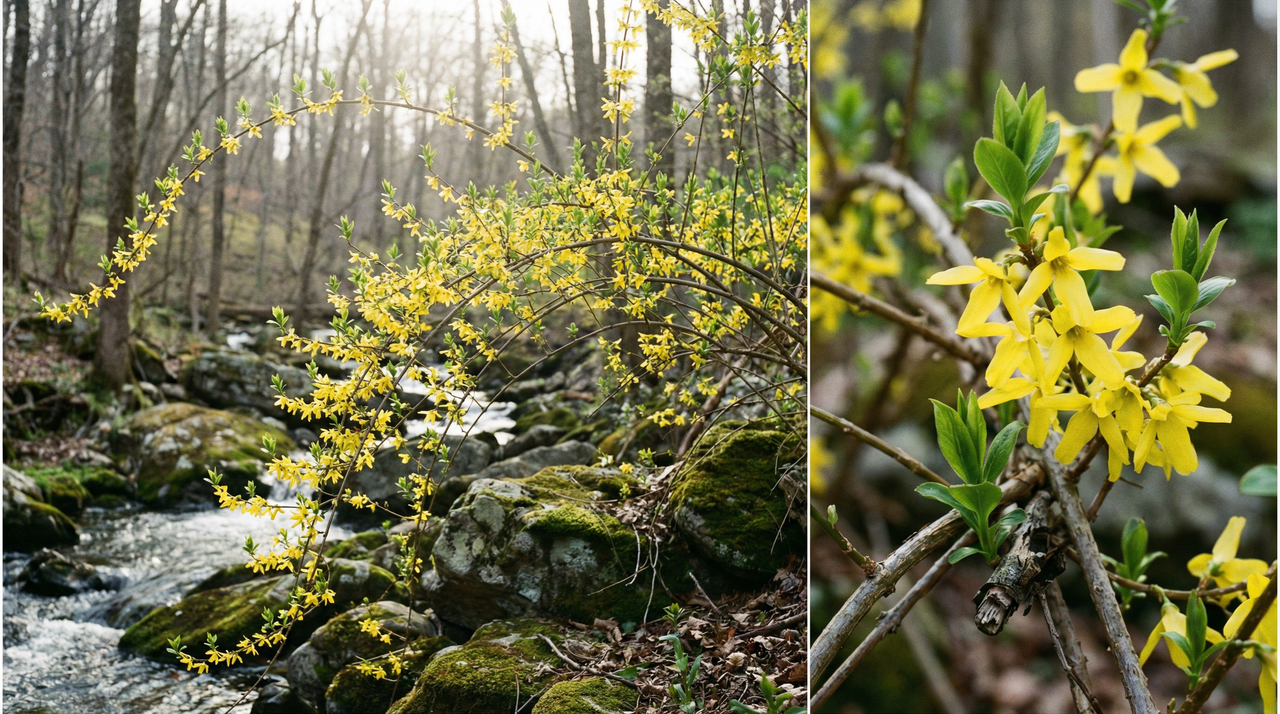
Every spring, forsythia does something I find quietly remarkable: it blooms before it has a single leaf. The whole shrub just ignites, bare branches and all, in this unhinged explosion of yellow that half the neighborhood probably drives past without really seeing. We've gotten so used to it as the default "first thing to bloom" shrub that we've stopped asking why it blooms that way, or where it actually came from, or what those capsules that form later in the season are actually for. And that last part is where it gets interesting. Most Western gardeners grow forsythia as pure ornament and have no idea they're looking at a plant with a two-thousand-year medicinal history in China, where the dried fruit, not the flower, is the whole point.[1]
I've grown Forsythia suspensa in both ornamental borders and as part of a guild designed around early pollinator support, and the gap between what most people think this plant is and what it actually does keeps widening the more I work with it. There's a version of this shrub that feeds emerging bees in March when almost nothing else does, a version that anchors centuries of Chinese herbal formulas for fever and infection, and yes, a version that can absolutely take over a hedgerow if you're not paying attention. All of those are the same plant.
Forsythia Origin, History, and Cultural Significance
Most gardeners know forsythia as that shrub exploding with yellow in March before anything else has the nerve to leaf out. What fewer people realize is that the species behind so many of those spring displays, Forsythia suspensa, carries a history stretching back through Han Dynasty medicine cabinets long before it ever graced a European garden border.
Botanical Background and Native Range of Forsythia suspensa
Weeping forsythia is native to central and eastern China, where it grows across a surprising range of provinces, from Sichuan and Hubei in the heart of the country to Shaanxi, Anhui, Gansu, and Liaoning farther north, reaching into subtropical and temperate zones alike.[2][3] It thrives in shrublands, forest edges, and on slopes, sometimes climbing above 2,800 meters in the mountains.[2] That's a remarkably varied native habitat, and it goes a long way toward explaining why the plant adapts so readily once you get it into a well-drained garden site.
As a polycarpic woody perennial, it follows a rhythm I've come to rely on in landscape design: dormant through winter, flowering on the previous year's wood in early spring, putting on vegetative growth through summer, fruiting in fall, then dropping its leaves and resting again. A well-sited plant can hold that rhythm for 20 to 50 years or more.[4][5] That kind of longevity makes a serious case for planting it right the first time.
The species reached Europe around 1818 to 1830 through botanical exchanges and arrived in North America around 1880, with collectors like Ernest Henry Wilson helping cement its place in Western horticulture by the early 20th century.[6][7] For North American gardeners still uncertain about it: F. suspensa is not considered invasive in the United States and does not appear on any USDA invasive species lists,[8][9] which is reassuring given how vigorously it can spread in some settings.
Visual Characteristics That Define Weeping Forsythia
The common name says it well. Young stems emerge upright, then arc outward and downward as the plant matures, producing that cascading silhouette that can reach 10 to 20 feet tall and equally wide.[4][10] I've found that in my landscape designs, the pendulous branches of a mature specimen have a softening effect on hardscaping that almost no other early-season shrub can replicate. Planted at a corner or along a wall, it drapes rather than crowds.
The flowers themselves are what stop traffic: bright yellow, trumpet-shaped, four petals each, roughly an inch to an inch and a half long, clustered along those bare arching stems from February through April depending on your region.[4][11] They appear before a single leaf unfurls, triggered by mild winter thaws and soil temperatures nudging 4 to 10°C.[4] The foliage that follows is dark green above, lighter below, with finely serrated margins, and it turns a quiet gold in autumn.[4][12]
One thing I've learned to look for when trying to distinguish the true species from the hybrid forms commonly sold at big-box nurseries: check the bark. On F. suspensa, young stems are greenish-yellow to amber and the bark stays smooth without cracking as it matures.[13] The internodes are short, the leaf bases are cordate, and there are no petal spurs, all of which separate it from the more upright F. × intermedia hybrids.[14] The roots are rhizomatous and can throw suckers to form dense thickets in established plantings,[14] something worth planning around before you put it somewhere it can't spread.
Traditional and Medicinal Uses Across East Asia
Here is where the real depth of this plant's story lives. In China, F. suspensa has been used medicinally under the name Lian Qiao for more than 2,000 years. Its earliest recorded appearance is in the Shennong Bencao Jing, the foundational Han Dynasty herbal text compiled in the 1st to 2nd century AD, where it is classified as a cooling herb that clears heat, detoxifies, and treats fever, sore throat, boils, and infections.[15][16]
Cultivation for medicinal use spread across East Asia through the Tang and Ming Dynasties, and the dried fruit became a cornerstone ingredient in formulas like Yin Qiao San, still used today for upper respiratory infections and early febrile illness.[17][18] The tradition moved into Japanese Kampo and Korean Hanbang medicine as well, applied there for similar respiratory, skin, and inflammatory conditions.[19][20]
My own work is in ornamental and ecological landscape design rather than herbalism, but I find it genuinely fascinating that the same plant I'm placing for its spring color show has been a trusted fever remedy in East Asian medicine since before Europe had any record of it at all. When this species crossed into Western gardens in the 19th century, that entire therapeutic legacy came along for the ride, largely unacknowledged. Western horticulture adopted it almost exclusively for its ornamental appeal.[15]
Fun Facts and Ornamental Legacy
Part of the reason so many popular forsythias exist today traces back to Korean forsythia (F. koreana), a related species collected around 1910 from mixed forests and rocky slopes in Korea.[21][22] It contributed to the hybridizing programs that produced many of the vigorous F. × intermedia selections now lining suburban driveways across the temperate world.
What has always secured forsythia's place in the garden, though, is simpler than any breeding program. Those flowers on bare stems, arriving before the leaves, before most perennials stir, before the early daffodils in a cold spring, provide real nectar for emerging pollinators at a moment when the landscape has almost nothing else to offer.[4] One good March bloom wins gardeners over for decades. There's a reason this plant keeps showing up in foundation plantings from zone 5 to zone 8: it delivers, reliably, year after year, and it has been doing so for a very long time.
Forsythia Varieties and Where to Buy Them
The Forsythia genus is far more varied than the familiar roadside blur of yellow spring flowers suggests. Weeping forsythia (Forsythia suspensa) is the anchor species, and understanding it first makes everything else fall into place.
Notable Cultivars of Weeping Forsythia (Forsythia suspensa)
Forsythia suspensa is a Chinese native with long, arching canes that weep naturally and produce bright yellow, four-petaled flowers up to two inches across before a single leaf appears in early spring.[4][23] The flowers are unscented, which surprises people, but the visual impact more than compensates. Those flexible canes are genuinely useful: I've trained first-year 'Pendula' stems horizontally along a cedar fence rail, and by year two the plant read as a living screen rather than a shrub. That kind of trainability is rare and worth choosing for intentionally.
The cultivar range covers a lot of ground. 'Pendula' gives you a true weeping form reaching eight to ten feet tall with a six to eight foot spread; 'Gold Tide' stays dwarf at one to two feet and works well as groundcover; 'Nana' is compact; 'Gold' runs vigorous with deep golden flowers; and 'Sieboldii' adds variegated foliage for a different texture entirely.[23][24] Most selections tolerate USDA zone 5 and will push into zone 4 with mulching and some wind shelter.[25]
Contrasting Korean Forsythia (Forsythia koreana)
Korean forsythia (F. koreana) is a different experience entirely. It's smaller, more upright, and its flowers carry a light, honey-like fragrance that F. suspensa simply doesn't offer.[22] On a warm March morning, that scent is genuinely surprising. The species also shows better disease resistance than many other forsythias; in humid springs I've noticed far less twig blight on Korean selections than on the standard intermedia hybrids.[4] What I find most exciting are the color-break cultivars: 'Angel Frost' forms a compact one to two foot mound covered in pure white flowers, like a dogwood in miniature, while 'Korean Pink' spreads low and wide with pale pink-tinged blooms and burgundy centers.[26][27][28] One important note: F. koreana has no documented medicinal use, so don't confuse it with F. suspensa if Lian Qiao is your goal.[4]
Popular Forsythia × intermedia Hybrids
The plants most homeowners already have in their yards are almost certainly Forsythia × intermedia hybrids, crosses between F. suspensa and F. viridissima that combine larger flowers with vigorous growth.[23][29] 'Lynwood Gold' (also sold as 'Lynwood'), 'Spring Glory', and 'Spectabilis' are the workhorses of this group. They're widely available, reliably floriferous, and considerably easier to find at big-box retailers than the true species. If you're after the medicinal fruit of F. suspensa specifically, buying a named intermedia cultivar by mistake is a real possibility, so read the label carefully.
Sourcing Forsythia Plants, Seeds, and Herbal Material
Forsythia suspensa grows in USDA zones 5 through 8 and is not listed as invasive by major databases in the United States, which should reassure anyone hesitating over planting it near a natural area.[9][30] Container plants, including the weeping 'Pendula' form, run $15 to $40 at one to two feet tall from nurseries like Nature Hills and Monrovia, and from Home Depot and Lowe's when stock is available.[31][32] I'd strongly recommend buying grafted 'Pendula' stock rather than seedlings if weeping habit matters to you; seedlings from this species don't always express the form reliably.
Seeds are available from Sheffield's and similar suppliers for $5 to $20 per packet, and germplasm accessions exist through the USDA National Plant Germplasm System for anyone doing serious breeding or conservation work.[33][34] For dried Lian Qiao fruit, I always buy from suppliers like Mountain Rose Herbs who emphasize third-party testing, because quality in the medicinal herb market varies more than most people expect.[35]
Forsythia Propagation and Planting
Forsythia suspensa gives you more ways into propagation than almost any other shrub I work with. You can start it from softwood cuttings in early summer, semi-hardwood cuttings in late summer, hardwood cuttings in winter, layering, grafting, or seed.[36][37][38] That's a generous list. In practice, most gardeners -- and most of my clients -- end up using exactly two of those methods, because the others either require more infrastructure or more patience than the results justify.
Propagation Methods for Forsythia suspensa
Semi-hardwood cuttings taken in late summer are the standout. Under the right conditions (68-77°F with 80-90% humidity, rooting hormone applied to the cut end), they root at 80-90%.[38][37] I take 4-6 inch sections from wood that's firm but not yet fully lignified, strip the lower leaves, dip in hormone powder, and stick them in a perlite-heavy mix under a humidity dome. The semi-hardwood stage is more forgiving than the soft spring growth, which wilts fast if your humidity setup isn't dialed in.[36][37]
Layering is the method I reach for when I want guaranteed plants with zero fuss. Forsythia suspensa naturally roots wherever its arching branches make prolonged contact with soil, so you're just accelerating what the plant already wants to do. Bend a low branch, nick the underside where it touches the ground, bury that section under a few inches of moist soil, and wait. Success rates run 70-85%.[36][38] I layer a few branches every spring on established plants in client gardens; by autumn I've got rooted divisions ready to move or share, and I haven't spent a penny. It's the kind of propagation that makes other horticulturists ask if you're cheating somehow.
Grafting is effective but belongs in the advanced category. Whip-and-tongue or cleft grafts performed in late winter onto Forsythia x intermedia or F. viridissima rootstock succeed over 70% of the time when cambium alignment is precise and cuts are sealed immediately.[37][39][40] I always sterilize my grafting knife between cuts and seal with grafting wax immediately -- skipping either step invites bacterial problems I've seen derail otherwise clean grafts.
Germination Timeline and Seed Handling
Seed propagation is where Forsythia gets complicated. The seeds require 60-120 days of cold stratification at 34-41°F in moist sand or peat before they'll break dormancy.[29][41][38] Most references I trust settle on 60-90 days as the practical target. After stratification, germination takes 4-8 weeks at 59-77°F. Then you wait 2-4 years for first flowering, sometimes longer if conditions aren't optimal.[36][29]
The seeds themselves are worth knowing: small (3-5 mm), flattened, light brown with winged margins for wind dispersal, and often polyembryonic, meaning a single seed can carry 1-4 embryos.[42][9][43] If you're saving seed, they store well under cool, dry conditions -- viability can hold 5-15 years in hermetic containers at low moisture content and near-freezing temperatures, though ambient storage drops viability to just 1-3 years.[44][45] The bigger issue is that seedlings won't reliably replicate cultivar traits -- I've grown seedlings for medicinal use and seen real variation in flower density and weeping habit from plant to plant.[46][47] Seed is genuinely interesting as a genetics exercise. For predictable performance, though, cuttings win every time.
Soil, Site Selection, and Planting Technique
Forsythia suspensa performs best in well-drained loamy soil with 3-5% organic matter and a pH between 6.0 and 7.5.[4][48] It will adapt to sandy, clay, or even chalky soils, but the non-negotiable is drainage -- this plant is genuinely susceptible to root rot in waterlogged conditions, and I've watched nice specimens decline slowly in heavy clay that wasn't properly amended at planting. Adding coarse sand, perlite, or generous compost before planting is effort that pays back for decades. In sandy soils, lean harder on the compost to build moisture retention. Skip the peat and go easy on nitrogen; too much of it pushes leafy growth at the expense of flowers.[29][49]
The root system is shallow and fibrous, typically only 12-24 inches deep, which makes it sensitive to surface compaction.[29][9] A minimum soil depth of 18-24 inches gives roots room to establish, and the crown should sit at or just slightly above soil level -- burying it invites rot at the base. After watching new Forsythia struggle in a client's pathway-adjacent border where foot traffic compacted the soil within the first season, I started mulching all new plantings heavily for the first two years. It's a simple habit that protects those shallow roots while they establish. For light, aim for at least 6 hours of direct sun daily; partial shade is tolerated, especially in warmer regions, but insufficient light produces leggy growth and a noticeably thinner bloom display.[4][50]
Spacing and Establishment
Mature weeping forsythia reaches 4-8 feet tall with a spread of 6-10 feet, and those arching branches want room to do their thing.[4][48] For a hedge, space plants 4-6 feet apart; for specimens where you want the full weeping form on display, 8-10 feet gives each plant room to arch without tangling into its neighbors. I always go wider than clients initially want, because at 0.5-1 meter of growth per year, an undersized spacing decision becomes an overcrowded pruning problem faster than people expect.[51][52] The suckering habit compounds this: if you plant closer than 3 feet for a tight hedge, plan on thinning or rejuvenation pruning every 5-8 years to keep the planting vigorous and flowering well.
Plant during the dormant season, from late fall through early spring, in a hole twice as wide as the root ball with the crown set at soil level.[4][48] Plants started from cuttings or layers and properly sited will typically begin their signature early-spring display within two to three seasons -- which, compared to the seed path, feels like no wait at all.
Forsythia Care Guide: Growing Weeping Forsythia Successfully
Caring for forsythia is genuinely one of the lower-maintenance commitments you can make in a temperate garden. That said, "low maintenance" doesn't mean "no thought required." Get the basics right from the start and this shrub will reward you with decades of that unmistakable early-spring gold. Get a few things wrong consistently and you'll end up with a leggy, non-blooming tangle that frustrates you every March.
Sunlight Requirements for Optimal Flowering
Full sun is where forsythia earns its keep. Plants in open, unobstructed sites produce that dense curtain of yellow flowers; plants tucked into partial shade often survive just fine but bloom sparsely, with longer internodes and a looser, more open habit that tells you immediately something's off. Forsythia suspensa tolerates up to four hours of direct sun daily and will get by, but if you want the full display, aim for six or more.[36][53] In hotter climates, afternoon shade becomes genuinely useful rather than a compromise. I've watched forsythia planted on west-facing exposures in hot summers develop real marginal leaf scorch by August, while the same cultivar in a spot with morning sun and afternoon dappled shade came through looking clean and set noticeably better buds for the following spring.
Watering Needs and Drought Tolerance
New plantings need about an inch of water per week through the growing season while roots are establishing.[54][29] Once established after one to two seasons, forsythia becomes genuinely drought tolerant, needing supplemental water only during extended dry stretches, roughly every one to two weeks in summer.[55] I've found that reading the plant matters more than following a calendar. Yellowing leaves creeping up from the base with wet soil signals overwatering and possible root rot; browning at leaf margins with dry soil tells you it's thirsty.[56][57] A two-to-three inch layer of organic mulch pulled back from the stem does a lot of the work for you, retaining moisture, moderating soil temperature, and cutting down how often you need to intervene.[58][59] During bloom I also try to keep moisture consistent without waterlogging the root zone; in my experience, a steady supply through those February-to-April weeks can extend the display noticeably compared to plants that go dry mid-show.
Soil and Feeding Requirements
Forsythia is a light feeder, and that's worth taking seriously rather than treating as permission to ignore nutrition entirely.[60][61] Early in my design career I made the classic mistake of hitting a client's forsythia hedge with a high-nitrogen lawn fertilizer in spring. The result was spectacular vegetative growth, long whippy stems that flopped in wind, and almost no flowers the following year. Now I either top-dress with compost or, if soil tests indicate a real need, use a balanced 10-10-10 or slightly phosphorus-forward 5-10-10 applied in early spring before growth breaks.[62][29] Phosphorus supports bud formation, potassium builds cold hardiness and stress resistance, and excess nitrogen just makes leaves at the expense of flowers.[63] Target pH of 6.0 to 7.5 keeps nutrients available; outside that range you may see interveinal chlorosis on young leaves (iron deficiency on high-pH soils) or marginal scorch suggesting potassium shortfall.[64][65] A soil test every two to three years is genuinely more useful than guessing.[66]
Frost Tolerance and Winter Protection
Forsythia suspensa is hardy through USDA zones 5 to 8, handling winter lows down to around -20°F without significant structural damage.[4][9] The vulnerability isn't the plant's survival; it's the flower buds. Once temperatures dip below 28°F, those buds can blacken and drop before they ever open, the same phenomenon you see with early azaleas.[67][29] If late frosts are common in your area, siting the plant where it gets some shelter from north and west winds, maintaining that mulch layer through winter, and avoiding any heavy fall pruning (which stimulates tender growth before cold sets in) are the practical answers.[68] For extreme cold below -10°F, a breathable fabric cover over the crown on the worst nights can protect bud wood that would otherwise take the hit.[29]
Heat Tolerance and Summer Stress Management
Its origins in cooler mountainous terrain in China mean forsythia handles heat best when temperatures stay under about 95°F. Prolonged stretches above 104°F cause real stress: leaf scorch starting at the margins, wilting, chlorosis, and reduced flowering the following spring from bud damage.[69][70] In my hotter summers, the scorch shows up first on the most exposed outer leaves, and it appears earlier in plants already under drought stress. The fix is layered: afternoon shade, deep watering every seven to ten days rather than frequent shallow irrigation, and consistent mulch.[36][71] If you're gardening at the warmer edge of zone 8, cultivars like 'Sieboldii' and 'Nana' show better heat tolerance than the straight species.[72]
Pruning, Maintenance, and Seasonal Care
I don't prune forsythia in fall anymore. I learned that the hard way on a client's hedge after two disappointing springs with nearly no bloom, finally tracing it back to a tidy autumn trim that removed the flower buds set on old wood. The rule is simple: prune immediately after flowering, as the yellow fades and before summer growth takes off.[4][14] That timing shapes the arching habit, improves airflow through the center of the plant, and gives the new wood all summer to mature and set buds for next year. Spacing plants four to six feet apart from the start, keeping mulch off the stem collar, and maintaining good drainage are what actually determine whether a forsythia reaches its 20-to-50-year potential rather than declining after a decade.[73]
Understanding Forsythia's Seasonal Rhythm
What makes forsythia such a reliable performer is how legible its seasons are once you've watched one full cycle. It needs six to eight weeks of temperatures below 45°F (vernalization) to set flower buds properly, which is why it opens so dramatically in February through April before a single leaf appears.[36][74] After bloom the arching branches push out leaves and extend through summer; by late summer and fall, small winged seed capsules develop along those same stems, and then the plant drops its leaves and slips into dormancy.[29] When you sync your care to that rhythm (consistent moisture through bloom, post-bloom pruning, reduced water in winter, soil amendments timed to early spring), the plant practically tells you what it needs next. That golden burst before the rest of the garden wakes up is the payoff for a whole year of straightforward tending.
Harvesting Forsythia Fruits for Medicine
If you're growing Forsythia suspensa for its medicinal capsules rather than just the spring color show, the first thing to make peace with is the timeline. Seed-grown plants typically need 3-5 years before you can expect reliable fruit set, with the first flowers sometimes appearing as early as year two or three but not reliably setting capsules until the plant is more established.[29][48][75] Grafted plants can get you to harvestable fruit in 2-4 years, which is worth considering if you're planting specifically for Lian Qiao rather than ornamental value. I don't bother harvesting fruit from anything younger than 2-3 years regardless of method; the yields are too low and the chemistry isn't fully developed.[25] Think of it like elderberry but with an extra year or two of patience built in.
Timing and Maturity Cues for Forsythia suspensa Fruits
Once your shrub is mature, the phenological arc from bloom to harvest is surprisingly predictable: flowers open in March or April, and the capsules that follow spend roughly 150-180 days developing before they're ready, landing you squarely in September and October for harvest in most temperate climates.[76][77] I actually appreciate how that window fits into a forest garden's autumn rhythm, giving you a clear harvest task between summer fruiting and the first hard frosts.
The maturity cues are multi-sensory once you know what you're looking for. The capsules shift from green to yellow-brown, begin to split open (dehisce) along their seams, and reveal hard, dark seeds inside.[78][79] That color change and the beginning of dehiscence signal peak accumulation of forsythin and the other active compounds that make these capsules medicinally significant.[79] After growing weeping forsythia from both seed and cuttings, I've found the yellow-brown color shift is the most reliable visual cue in practice. Harvesting even a week early noticeably reduces the pungent, bitter quality that signals good potency. When the seeds feel firm and resist compression between your fingers, you're in the right window. Don't wait for every capsule to fully split open; partial dehiscence across the plant is your signal to move.
Forsythia Preparation and Uses
Edible Flowers and Limited Culinary Applications
Every spring, when those bright yellow flowers open, someone in my client groups asks whether they can eat them. The honest answer is yes, in moderation, but with some important boundaries. The flowers of Forsythia suspensa are edible raw and appear as garnishes in East Asian cuisine, scattered over salads or used to dress a plate.[80][81][82] That's essentially where the conventional culinary story ends. Leaves, stems, and fruits don't have a documented history of safe consumption as foods,[83] and forsythia is not classified as GRAS by the FDA, so even the flowers sit in "proceed thoughtfully" territory rather than "toss freely into your summer salad bowl."[84]
I usually compare this to how I explain calendula or nasturtium to new gardeners: familiar edible flowers you can use freely versus something you use sparingly because the plant has a medicinal identity. Forsythia sits firmly in that second category. The "culinary" applications you'll encounter in traditional references are really mild therapeutic ones: steeping 5-10 grams of dried flowers as an herbal tea, stirring them into light broths, or pairing with cooling foods like mung beans in porridge.[85] These are functional preparations, not flavor-forward cooking.
The fruits are a different matter entirely. Raw, they're firm and leathery with a tough outer casing around winged seeds; dried, they become hard, brittle, and fibrous with a subtle herbaceous and faintly earthy aroma.[86] Their taste is primarily bitter with a slight sweetness and an astringent, cooling quality.[87][88] That bitterness isn't incidental; in TCM energetics it signals the heat-clearing action that makes these fruits medicinally valuable, not something to snack on.
Medicinal Preparation of Lian Qiao in Traditional Chinese Medicine
For medicinal use, timing the harvest matters more than most gardeners expect. Flower buds collected in spring before full bloom and dried autumn fruits, known as Lian Qiao, are the two standard medicinal materials. The dried fruits are decocted in water, with the standard adult dosage running 9-15 grams per day yielding roughly 200-300 ml of liquid consumed once or twice daily.[89][90][91][92] I've experimented with small-batch teas from home-dried material and found the subtle earthy-floral notes develop best around a 10-minute steep, but I'd keep that clearly in the "exploratory" column rather than self-prescribing at therapeutic doses.
Traditional applications include fevers, infections, sore throats, inflammation, and skin conditions, with the strongest material historically associated with plants from Liaoning and Hebei provinces.[93][94] Related species like Forsythia koreana extend this tradition across the genus, with their flowers, leaves, fruits, stems, and a seed oil rich in unsaturated fatty acids all used for parallel antimicrobial purposes in East Asian systems.[95][96] The antiviral and antibacterial properties behind those traditions are discussed in depth in the health benefits section; what matters here is how that potency shapes responsible preparation.
Because forsythia carries specific contraindications, including pregnancy, and isn't GRAS-listed, I always recommend working with a qualified practitioner for any therapeutic use beyond the occasional flower garnish.[84] Up to 10 grams daily is generally considered safe for short-term use when properly sourced, but "generally considered" does real work in that sentence. This is a plant that bridges ornamental garden joy and serious herbal medicine, and I think honoring both identities means being honest about where the boundaries are.
Forsythia Health Benefits and Medicinal Uses
Beneath forsythia's cheerful ornamental reputation sits one of the oldest, most rigorously documented medicinal plants in East Asian herbalism. I've grown Forsythia suspensa for years, and the spring bloom has always felt like two stories happening at once: the one pollinators see, and the one written in the Han dynasty materia medica.
Traditional Use in Chinese Medicine as Lian Qiao
In Traditional Chinese Medicine, Forsythia suspensa is known as Lian Qiao and ranks among the 50 fundamental herbs of the entire system. It's classified as bitter and slightly cold, entering the heart, lung, and gallbladder meridians to clear heat and resolve toxins.[97][98] That classical language maps onto concrete clinical targets: sore throats, tonsillitis, acute respiratory infections, urinary tract infections, boils, and inflammatory skin conditions like erysipelas.[97][99] It appears most famously in Yin Qiao San, a classical wind-heat formula that's still prescribed today for the early stages of respiratory illness.[98]
Modern pharmacology is finally giving that centuries-old confidence some hard numbers. Research on F. suspensa confirms broad-spectrum antibacterial and antiviral activity, anti-inflammatory effects mediated through NF-κB and MAPK pathway inhibition, antioxidant capacity, and even preliminary apoptosis-inducing effects in cancer cell lines.[100][101] A 2015 randomized controlled trial found meaningful symptom reduction in acute upper respiratory infections using a Lian Qiao-containing combination formula.[102] I've seen the herb's reliability in TCM formulas for respiratory bugs, yet as a designer I still want the clinical data to catch up before recommending medicinal doses broadly. Most of the compelling research remains preclinical, and claims around adaptogenic, sedative, or diuretic effects have very thin evidentiary support.[100]
Korean medicine has long used Forsythia koreana (Gaenari) for respiratory infections, fevers, and skin conditions, and the phytochemical overlap between the two species is substantial enough that researchers see them as reinforcing the same therapeutic picture.[103][95]
Key Phytochemicals Driving Forsythia's Activity
The dried fruits of F. suspensa are dense with secondary metabolites. The headliners are phenylethanoid glycosides, particularly forsythoside A and forsythiaside A and B, which can reach up to 10% of dry fruit weight. Alongside those sit lignans including phillyrin and pinoresinol, flavonoids like quercetin, rutin, and kaempferol, and phenolic acids such as caffeic and chlorogenic acid.[101][104] Each class contributes to the antimicrobial, antioxidant, and anti-inflammatory activity documented in the research, and they also serve the plant's own ecological defense against pathogens and herbivores.[105]
Composition shifts meaningfully depending on which part of the plant you're working with and when you harvest. Fruits concentrate phenylethanoids and lignans; leaves lean toward flavonoids; seeds are lignan-rich; roots and bark carry glycosides. Phenolics peak in spring, which aligns directly with traditional harvesting cues I've observed in my own plants.[106][107] In practice, spring-harvested material tends to smell more pungent and resinous, which I associate with high-quality Lian Qiao. Geography, drainage, and shade levels all influence final concentrations, so where and how you grow this plant genuinely matters for medicinal quality, not just ornamental performance.[108]
Nutritional Profile and Edible Uses
Forsythia suspensa is a medicinal plant first. Its dried fruits show up occasionally in teas or preserves, and young leaves of related species appear sparingly in traditional East Asian cuisine, but nobody is growing this shrub as a food crop.[109][110] Standardized nutritional data simply doesn't exist for it in major databases like USDA FoodData Central. Small studies on dried fruit estimate roughly 250 to 350 kcal per 100g, with meaningful fiber and minerals (potassium, calcium, magnesium), modest protein, and trace vitamin C.[109][111] Those numbers should be treated as preliminary. The more relevant nutritional story is that the same forsythiaside A and antioxidant flavonoids driving the medicinal activity are present in the fruit tissue. Conventional drying degrades vitamin C by 30 to 50% and flavonoids by 20 to 40%. Steaming before drying, as some TCM preparations specify, better preserves heat-labile compounds.[112][20] Any culinary exploration should still sit within the safety guidance below.
Safety Considerations and Contraindications
For ornamental purposes, forsythia is genuinely low-risk. Both F. suspensa and F. koreana are classified as non-toxic to humans, pets, and livestock by the ASPCA and USDA.[113][7] Eating large quantities of leaves, flowers, or fruit in one sitting may cause nausea, vomiting, or diarrhea from saponins and phenolic glycosides, but the plant sits in the same low-toxicity category as many common garden herbs.[114][115]
Medicinal use is a different conversation. The European Medicines Agency flags F. suspensa as contraindicated during pregnancy and lactation due to insufficient safety data and theoretical uterine-stimulating effects.[116] Unlike chamomile, forsythia carries that flag clearly enough that I always defer to the EMA guidance and tell clients to consult a qualified practitioner before use. People on anticoagulants should also exercise caution given theoretical coumarin-related interactions, and prolonged or excessive use raises dose-dependent hepatotoxicity concerns.[117] Pollen carries low-to-moderate allergenic potential for those sensitive to the Oleaceae family, and sap contact can trigger dermatitis in sensitive individuals.[118] Young forsythia leaves used as tea have a 17-plus-year safety record in Japan with no reported adverse events at normal consumption levels, which is reassuring, but stems and ornamental material are not generally considered food.[119]
One identification habit I developed early: always double-check against Laburnum before harvesting anything. The yellow blooms can look similar at a distance, and Laburnum is seriously toxic. Opposite leaves and hollow stems are my reliable field markers for forsythia.[120] For any medicinal use, the Chinese Pharmacopoeia sets strict quality standards for Lian Qiao including moisture, ash content, and HPLC testing, which underscores that therapeutic-grade material is a different thing from what you might pick off a landscape shrub without testing.[90] Professional guidance isn't optional here; most of the human clinical evidence comes from combination formulas rather than isolated extracts, and the preclinical data, however promising, doesn't translate directly into safe home dosing.[100]
Forsythia Pests and Diseases
Forsythia is genuinely one of the easier shrubs to keep healthy, and I say that after years of working with early-blooming deciduous species that can be real headaches. Weeping forsythia carries moderate to high disease resistance compared to other shrubs in its flowering window,[4][121] and when the siting is right, you're mostly just watching it thrive. The problems I have seen almost always trace back to a cultural misstep: too much shade, cramped spacing, or a soggy corner that nobody addressed before planting.
Common Forsythia Diseases and Disease Resistance
The fungal issues are the most predictable. Forsythia is susceptible to leaf spot (caused by Cercospora, Phyllosticta, or Septoria species depending on your region), powdery mildew, anthracnose, and canker and dieback from Botryosphaeria or Diaporthe species.[122][29] None of these are unusual if you've worked with lilacs or viburnums. The more serious threats are bacterial blight (Xanthomonas campestris) and soil-borne problems including Verticillium wilt and Phytophthora root rot.[122] Verticillium is worth taking seriously: if a bed has a history of tomatoes, peppers, or other solanaceous crops, I'd choose a different spot, because wilt from that pathogen can be fatal and lingers in soil for years. The good news on Phytophthora is that forsythia demonstrates at least moderate resistance to Phytophthora cinnamomi,[123] though that resistance evaporates if drainage is consistently poor.
Disease pressure climbs sharply with high humidity, temperatures above 80°F, waterlogged soil, and pH below 6.0.[124][125] In my early guild designs, I made the mistake of planting shrubs too close together, and the humidity trapped between them was basically an invitation for powdery mildew. Full sun, well-drained soil, and maintaining good airflow between plants handles about 90% of the fungal risk before it starts.[126][127] Skip overhead irrigation; direct watering at the root zone keeps the foliage dry. When you do need to intervene, sulfur or neem oil work for powdery mildew, copper-based sprays address leaf spot, and severe Phytophthora cases may call for a soil drench with mefenoxam, though I treat that as a genuine last resort. If you're selecting new plants, the cultivar 'Zhong Y' shows notably strong resistance to both leaf spot and powdery mildew.[128]
Common Forsythia Pests and Pest Resistance
On the pest side, forsythia has a quiet but real advantage: it produces phenylethanoid glycosides and flavonoids, including forsythoside A, that act as natural feeding deterrents and are mildly toxic to many insects.[129][96] Think of it like how lavender and rosemary use aromatic compounds to keep browsers at bay -- forsythia is doing something chemically similar, just less fragrant about it. Combined with its dense branching and thick cuticles, a well-grown specimen in appropriate conditions within zones 5 through 9 is genuinely trouble-free most seasons.[9][130]
When pests do show up, aphids are usually first, followed by spider mites, scale insects, and occasionally Japanese beetles, weevils, or leafminers.[131][132] Spider mites in particular ramp up under drought stress, so if you're in a dry stretch and forsythia is already under-watered, check the leaf undersides. A strong blast from the hose is often all you need, and catching it early beats anything else I've tried. Scale can lead to sooty mold, but it rarely gets that far in a plant that isn't already stressed by compacted soil, extreme pH, or overcrowding.[133][29]
No cultivars have been specifically bred for enhanced pest resistance,[134][135] so site conditions and monitoring are the whole game. In my designs, I lean on biological allies first: ladybugs for aphids, parasitic wasps where I can encourage them. That approach has kept my forsythia specimens virtually pest-free for multiple seasons running, with no sprays involved.
Forsythia in Permaculture Design
There's a reason Forsythia suspensa has colonized temperate gardens from Beijing to Boston: its native climate is remarkably similar to large swaths of North America and Europe, which means it doesn't just survive in those landscapes, it thrives with very little convincing. In China, it grows across Köppen climate zones ranging from humid subtropical to cool continental, with cold dry winters, hot humid summers, and annual rainfall typically between 600 and 1200 mm concentrated in summer monsoons.[2][136][137] That profile maps almost directly onto the mid-Atlantic, Midwest, and temperate Europe, which is why it naturalizes so readily outside its home range.
Climate Adaptability and Hardiness Zones
Forsythia suspensa performs best where mean annual temperatures fall between 8 and 18°C with meaningful seasonal swings, and where winter cold reliably dips below 7°C to trigger the chilling requirement that produces a floriferous spring display.[2][137][138] That tight-temperature bloom trigger is something I keep front of mind when consulting on food forest designs: a forsythia planted in a frost pocket will actually bloom more reliably than one on a warm south-facing slope that never quite satisfies its chilling hours. In terms of cold hardiness, it's rated for USDA zones 5 through 8, tolerating lows down to around −29°C (−20°F), with the RHS classifying it as H6 (hardy to −20°C).[9][25][139] Some cultivars can be pushed to zone 4 with siting in a sheltered microclimate, though I'd lean on the care guide for those specifics.
For site selection, the practical rainfall sweet spot is 635 to 1015 mm annually, with a hard floor around 500 mm; established plants show decent drought tolerance, but young ones want consistent moisture while they're getting their roots down.[55][54][140] Drainage matters far more than rainfall total. I've seen forsythias look genuinely miserable in heavy clay where water sits, and then watched the same species absolutely take off on a slightly raised, well-amended berm. The plant performs well in urban settings and tolerates coastal exposure with some protection from the worst salt winds.[141][142][143] All of this climate adaptability is also exactly why it has naturalized in parts of the Great Lakes region, northeastern United States, Great Britain, and France, and that ease of naturalization is something every designer needs to hold in mind before putting it in the ground.[7][144]
Forest Layer, Guilds, and Ecological Functions
In a temperate food forest, forsythia belongs at the shrub layer edge. It's a deciduous multi-stemmed shrub that typically reaches 2 to 3 meters in cultivation (occasionally 4 meters in ideal conditions), and in the wild it occupies forest edges, rocky hillsides, and stream banks in exactly the kind of transitional habitat that permaculture design loves to mimic.[4][145][146] The design logic for including it comes down to one thing: timing. Its yellow tubular flowers open before the canopy leafs out, sometimes in late February or early March, delivering nectar and pollen to bees, hoverflies, and other emerging pollinators at the precise moment when almost nothing else is available.[25][48][147] I think of it the way I think about using a single well-placed comfrey plant: it's not feeding you directly, but it's doing systems work that makes everything around it more productive.
The flowers are edible in small quantities, with a mild, slightly bitter flavor, and I occasionally scatter a few petals over early-spring salads for clients who want to taste their food forest as it wakes up. But I'm always clear: this is a garnish, not a yield crop, and other plant parts shouldn't be eaten casually since leaves, stems, and seeds can cause mild gastrointestinal upset in larger amounts.[25][48][147] For food production, there are far more productive shrub-layer candidates. Forsythia earns its place through pollinator support, slope erosion control, and as a companion to nitrogen-fixers like comfrey that can help feed the whole guild.[7]
On a northeastern consultation years ago, I watched escaped forsythia form dense thickets along a woodland edge where spring ephemerals, trout lilies and bloodroot, had simply vanished underneath it. The plant can spread through both prolific seeding and root sprouting, and once it establishes in a compatible climate it will crowd out native understory vegetation and reduce local plant diversity with impressive efficiency.[148][149] The question of whether forsythia is invasive doesn't have a single answer; it's highly site- and region-dependent. In many temperate gardens it stays put and does its job beautifully. In others, especially near natural areas, it becomes a problem. If you're designing near a woodland edge or a riparian corridor in the northeastern US or temperate Europe, consider whether a forsythia hedge is really the right structural choice, or whether a native shrub can fill the same early-spring pollinator role without the containment burden. If you do plant it, building a forsythia hedge against a structure or in a clearly bounded space is smarter than letting it free-range at the forest margin. One useful note for deer-pressured gardens: forsythia is generally considered deer resistant, which makes it practical as a protective outer-edge planting in landscapes where browsers are a constant challenge.
Forsythia suspensa is pollinated almost entirely by insects, with bees doing the bulk of the work: honey bees, bumblebees, mason bees, and solitary bees are the primary visitors, with hoverflies playing a supporting role.[150][151] The flowers themselves are bright yellow, 1 to 2 cm tubular blooms with four petals that appear in axillary clusters before the leaves, offering both nectar and pollen rewards.[25][152][12] To me, watching mason bees zero in on those yellow blooms in early March is one of those moments that makes designing for phenological timing feel genuinely meaningful. The species is self-fertile but cross-pollination improves seed set and genetic diversity, so growing two or more plants in proximity is worth doing even when you're not focused on fruit production.[150][153]
Pollination success is genuinely weather-dependent this early in the season. A late frost can damage buds before bees even find them, and heavy rain washes pollen and dilutes nectar; Botrytis infections can reduce flower viability and attractiveness to pollinators when conditions stay wet.[154][155][156] To amplify the service forsythia provides, I usually recommend pairing it with other early bloomers like crocus and snowdrops in the understory, and installing a bee hotel nearby to give mason bees overwintering habitat within easy foraging distance.[157][158] In sites with very low pollinator populations, hand-pollination with a soft brush is entirely feasible if you're growing for fruit. The design takeaway is this: forsythia offers a genuine ecological service, but it needs to be sited and managed with eyes open, not planted and forgotten.
The Plant That Taught Me to Look Twice at the "Common" Ones
I used to skip right past forsythia in design conversations, the way you do with something so familiar it stops registering. Then I started growing F. suspensa for fruit, actually waiting on it, learning its October window, and something shifted. A plant I'd installed a dozen times without thinking became one I finally understood. That's the thing about paying attention; it tends to change what you see.
Sources 158
- Forsythia suspensa: A Review of Its Traditional Uses, Phytochemistry, and Pharmacology ↩
- Flora of China - Forsythia suspensa ↩
- Forsythia suspensa - Kew Science ↩
- Forsythia suspensa | Missouri Botanical Garden ↩
- How Long Do Forsythia Bushes Live? ↩
- Journal of the Arnold Arboretum ↩
- USDA PLANTS Database ↩
- Invasive Plant Atlas of the United States ↩
- USDA Plants Database: Forsythia suspensa ↩
- Royal Horticultural Society: Forsythia suspensa ↩
- Flora of China - Forsythia suspensa ↩
- Forsythia suspensa - Kew Royal Botanic Gardens ↩
- Flora of China - Forsythia suspensa ↩
- Royal Horticultural Society: Forsythia suspensa ↩
- History of Chinese Medicine ↩
- Lian Qiao (Forsythia Fruit) in Chinese Medicine ↩
- Traditional Uses and Pharmacological Activities of Forsythia Fruits ↩
- Lian Qiao (Forsythia suspensa) in Traditional Chinese Medicine - Memorial Sloan Kettering Cancer Center ↩
- Kampo Medicine: Forsythiae Fructus (Lian Qiao) Uses ↩
- Medicinal Uses of Forsythia in Traditional Korean Medicine ↩
- Forsythia koreana - Kew Gardens ↩
- Forsythia koreana - Kew Science Plants of the World Online ↩
- Forsythia suspensa ↩
- Forsythia suspensa 'Lutescens' ↩
- Forsythia suspensa ↩
- Forsythia koreana - North Carolina Extension Gardener ↩
- Royal Horticultural Society - Forsythia koreana 'Korean Pink' ↩
- Missouri Botanical Garden Plant Finder - Forsythia koreana 'Angel Frost' ↩
- Forsythia Hybrids ↩
- Invasive Species in North America ↩
- Forsythia suspensa - Weeping Forsythia ↩
- Forsythia suspensa ↩
- Forsythia suspensa (Weeping Forsythia) ↩
- Taxon: Forsythia suspensa ↩
- Lian Qiao (Forsythia Fruit) Herbal Supplement ↩
- Forsythia suspensa (Weeping Forsythia) ↩
- Propagation of Forsythia ↩
- Forsythia suspensa: Propagation Guide ↩
- Grafting Techniques for Woody Plants ↩
- Forsythia: Propagation by Grafting ↩
- Seed Germination of Ornamental Shrubs ↩
- Flora of China - Forsythia suspensa ↩
- Morphology of Forsythia Seeds ↩
- Seed Storage of Temperate Tree Species ↩
- Germination and Storage of Forsythia Seeds ↩
- Forsythia suspensa Fact Sheet ↩
- Forsythia - Genus Overview ↩
- Forsythia suspensa - North Carolina Extension Gardener Plant Toolbox ↩
- Forsythia suspensa ↩
- Forsythia Care Guide ↩
- Forsythia suspensa ↩
- Plant Profile: Forsythia suspensa ↩
- Royal Horticultural Society - Forsythia suspensa ↩
- Missouri Botanical Garden - Forsythia suspensa Profile ↩
- USDA PLANTS Database - Forsythia suspensa ↩
- Gardening Know How - Forsythia Wilting ↩
- University of Minnesota Extension - Root Rot in Shrubs ↩
- The Spruce - Forsythia Plant Care ↩
- University of Maryland Extension ↩
- Royal Horticultural Society ↩
- University of Minnesota Extension - Growing Forsythia ↩
- University of Missouri Extension - Forsythia Overview ↩
- University of Minnesota Extension - Fertilizing Shrubs ↩
- University of Minnesota Extension - Nutrient Deficiencies ↩
- Clemson Cooperative Extension - Chlorosis in Woody Ornamentals ↩
- University of Minnesota Extension - Fertilizer Burn ↩
- University of Minnesota Extension - Frost Injury on Woody Plants ↩
- Missouri Botanical Garden ↩
- University of Maryland Extension - Heat and Drought Stress ↩
- Scientia Horticulturae - Heat Stress on Forsythia suspensa ↩
- American Horticultural Society - Heat Zone Map ↩
- USDA Plants Database ↩
- Gardenia.net - Forsythia koreana ↩
- USDA ARS - Vernalization Requirements ↩
- Propagation Techniques for Medicinal Plants: Forsythia suspensa ↩
- Forsythia: Production and Marketing ↩
- Phenology of Forsythia suspensa ↩
- Pharmacopoeia of the People's Republic of China ↩
- Forsythia suspensa: A Review of Its Medicinal Uses and Phytochemistry ↩
- Forsythia suspensa ↩
- Edible plants in landscaping ↩
- Potential use of Forsythia suspensa extracts as functional food ingredients ↩
- Edibility and Toxicity of Forsythia ↩
- FDA GRAS Substances Search ↩
- Traditional Chinese Medicine Recipes with Lian Qiao ↩
- Forsythiae Fructus - American Botanical Council ↩
- Forsythia suspensa fruits in traditional Chinese medicine ↩
- Lian Qiao (Forsythia Fruit) in Chinese Medicine ↩
- Phytochemical Review - Forsythia suspensa (2020) ↩
- Chinese Pharmacopoeia 2020 Edition, Volume I ↩
- Chinese Herbal Medicine: Materia Medica ↩
- A Comprehensive Guide to Chinese Herbal Medicine ↩
- Forsythia suspensa - An Eternal Folkloric Medicine ↩
- Medicinal Uses of Forsythia suspensa ↩
- Phytochemical and Pharmacological Review of Forsythia suspensa and Forsythia koreana ↩
- Chemical Composition and Bioactivity of Forsythia koreana Seed Oil ↩
- Chinese Pharmacopoeia (English Edition) ↩
- Traditional Chinese Medicine: A Comprehensive Guide ↩
- Ethnopharmacology of Forsythia suspensa ↩
- Pharmacological Research: Forsythia suspensa review ↩
- Forsythia suspensa: A review of its traditional uses, phytochemistry and pharmacology ↩
- Efficacy and Safety of Forsythia suspensa Extract in Acute Upper Respiratory Tract Infection: A Randomized Controlled Trial ↩
- Forsythia koreana: Traditional Uses and Pharmacological Properties ↩
- Phytochemical and Pharmacological Progress on the Genus Forsythia ↩
- Phytochemical and Pharmacological Progress on the Genus Forsythia ↩
- Seasonal Variation of Phenolic Compounds in Forsythia koreana ↩
- Forsythiaside Content in Forsythia koreana: Geographic and Cultivation Effects ↩
- Secondary Metabolites from Roots and Stem Bark of Forsythia koreana ↩
- Nutritional and Phytochemical Evaluation of Forsythia suspensa Fruits ↩
- Edible Wild Plants of Korea ↩
- Chemical Composition and Health Benefits of Forsythia suspensa: A Review ↩
- Food Chemistry - Drying effects on Forsythia suspensa ↩
- ASPCA Animal Poison Control - Forsythia ↩
- Forsythia suspensa fruit: pharmacological effects and chemical composition review ↩
- WebMD - Forsythia: Overview, Uses, Side Effects ↩
- EMA Herbal Medicinal Products Report on Forsythia suspensa ↩
- Updates on Clinical Evidenced Herb-Warfarin Interactions - PMC ↩
- Missouri Botanical Garden - Forsythia pollen allergies ↩
- Chemical compounds and toxicological evaluation of Forsythia suspensa leaves tea - PMC ↩
- Laburnum: Toxic Tree with Beautiful Blooms - RHS ↩
- Forsythia suspensa ↩
- Diseases of Forsythia ↩
- Resistance of Forsythia species to Phytophthora root rot ↩
- Forsythia: Selection, Care and Management ↩
- Diseases of Forsythia ↩
- Forsythia suspensa - Plant Finder ↩
- Forsythia - Pest Management Guidelines ↩
- Evaluation of Powdery Mildew Resistance in Forsythia Varieties ↩
- Phytochemicals from Forsythia suspensa and Their Insecticidal Activities ↩
- Forsythia suspensa ↩
- Forsythia Pests and Problems ↩
- Insect Pests of Woody Ornamentals ↩
- University of Missouri Extension - Forsythia cultural practices ↩
- Integrated Pest Management for Landscape Plants ↩
- Forsythia: Pests and Problems ↩
- Koppen-Geiger Climate Classification Map for China ↩
- Global Distribution and Climate Preferences of Forsythia suspensa ↩
- Missouri Botanical Garden - Forsythia suspensa ↩
- Royal Horticultural Society - Forsythia suspensa ↩
- University of Illinois Extension - Forsythia Care Guide ↩
- Flora of China ↩
- Missouri Botanical Garden Plant Finder ↩
- Royal Horticultural Society - Forsythia Care Sheet ↩
- Tropicos ↩
- Royal Horticultural Society - Forsythia suspensa ↩
- Flora of China - Forsythia suspensa ↩
- Royal Horticultural Society - Forsythia suspensa ↩
- USDA PLANTS Database ↩
- EDIS - Dwarf and Weeping Forsythia Invasive Species Factsheet ↩
- Flora of China ↩
- Missouri Botanical Garden Plant Finder ↩
- Royal Horticultural Society - Forsythia suspensa ↩
- Pollination Biology of Forsythia ↩
- Rainfall effects on pollination of early-flowering shrubs ↩
- Botrytis blight on forsythia ↩
- Frost Damage in Ornamental Plants ↩
- Companion Planting for Early Spring Pollinators - Missouri Botanical Garden ↩
- Hand Pollination Techniques for Ornamental Shrubs - University of Florida IFAS Extension ↩