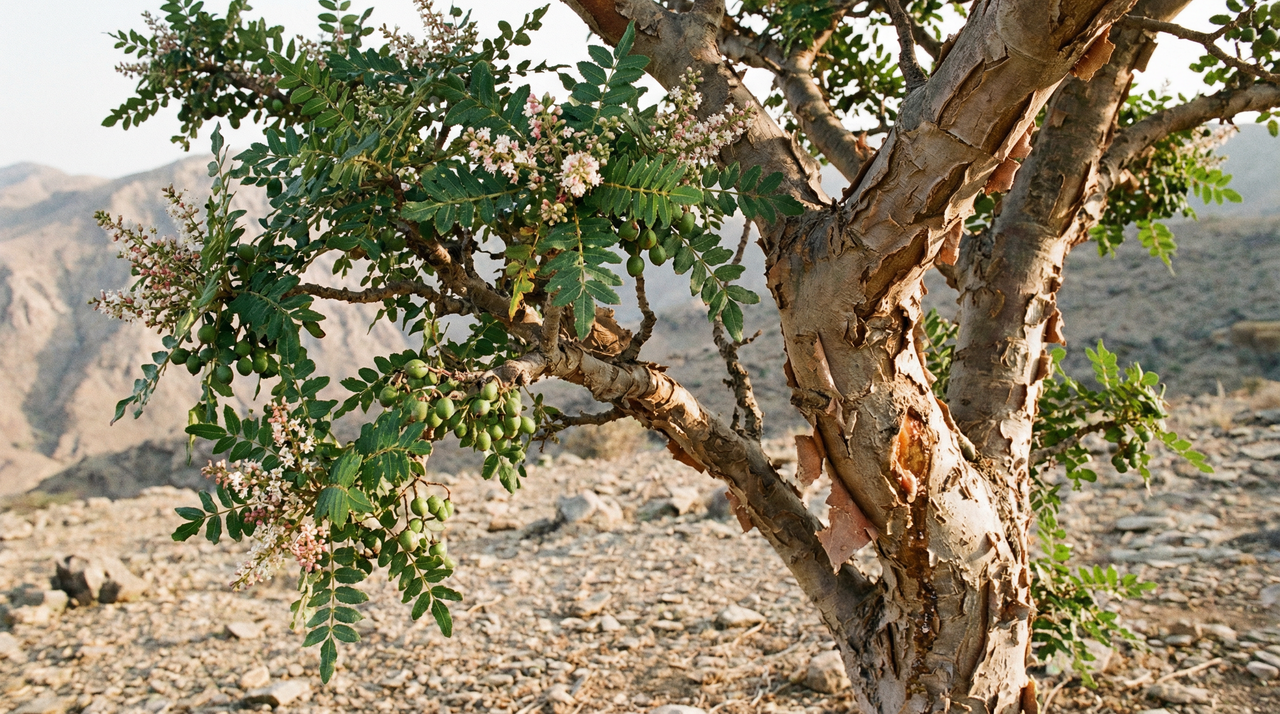
Most people have smelled frankincense without ever seeing the tree that produces it, and if they did see it, they'd probably walk right past it. No lush canopy, no dramatic silhouette. Just a gnarled, almost stubborn-looking small tree clinging to a sun-blasted limestone slope, its papery bark peeling away in translucent sheets, looking for all the world like it's struggling. It isn't. It's thriving in exactly the conditions that would kill most other trees, and that stress is precisely what makes it extraordinary.
Here's the thing that stopped me cold the first time I really dug into Boswellia sacra: the resin that built ancient trade empires, perfumed Egyptian tombs, and traveled the Incense Route alongside gold doesn't come from a tree living in abundance. It comes from wounding one that's already living on the edge. A tap through the bark triggers a defense response, and the tree weeps. Those hardened amber tears are frankincense, and people have been collecting them for at least five thousand years.[1] What I find quietly devastating is that we may be collecting the last of them; most wild populations are now listed as Vulnerable to Critically Endangered, and regeneration in degraded stands has nearly stopped.[2] That context changes everything about how you grow, harvest, and source this plant.
Origin and History of Frankincense (Boswellia sacra)
Botanical Background and Native Range
Frankincense comes from one of the toughest small trees on earth. Boswellia sacra is native to the limestone outcrops and arid hillsides of Oman, Yemen, Somalia, Ethiopia, and Eritrea, clinging to rocky slopes at elevations between 300 and 1,200 meters where most other trees simply refuse to grow.[3][4] It's a slow-growing, polycarpic tree, living 50 to 100 years or more, and it doesn't even hit its stride for resin production until it's 7 to 10 years old.[5][6] I've raised young Boswellia sacra seedlings from seed in containers here in Central Florida, and watching them push out a handful of leaves in their first season, you really feel the weight of that timeline. They are emphatically not in a hurry.
That sluggishness extends to reproduction in the wild. Seedling survival rates in native populations often fall below 10 percent, hammered by drought and herbivory before young plants can establish.[5] Trees flower from October to December in some populations, February to April in others, and by March or April the small winged seeds are releasing from dehiscent capsules to catch whatever wind exists in those parched landscapes.[5] Given how little natural regeneration is happening, the species' current IUCN Vulnerable status is not a surprise; it's a warning.[7] Related Socotran endemics like B. socotrana and B. samhaensis are already Critically Endangered, their populations shrinking under the combined pressure of over-tapping, overgrazing, and a shifting climate.[8][9]
Visual Characteristics of the Frankincense Tree
Boswellia sacra tops out at 2 to 8 meters, with a spreading, somewhat irregular canopy that looks almost skeletal in the dry season when the tree drops its compound leaves to conserve water.[4][10] The leaves themselves are pinnate, 10 to 20 centimeters long, with leathery leaflets that flush back when rains finally return.[11] The bark is what stops you though. It peels away in thin, papery sheets, grayish-green on the outside and reddish beneath, and when you handle damaged bark or fresh resin, there's a faint, almost vanilla-like warmth to the scent that catches you off guard before the deeper balsamic notes come through. Once you've smelled that, identification is effortless.
Incise the bark and the tree responds with a milky latex that slowly hardens into the pale yellow to amber "tears" that made this species famous.[12][13] Flowers are small, white to pale pinkish, arranged in terminal panicles, followed by oval capsules that split open to release small, angular, wind-dispersed seeds.[14] The whole plant is anchored by a deep taproot reaching for groundwater far below the surface, a survival strategy perfectly suited to places where rain is a memory most of the year.[4]
Traditional and Cultural Uses Across Civilizations
For more than 3,000 years, frankincense resin was one of the most economically significant commodities on earth, traded along the ancient Incense Route by South Arabian kingdoms from Red Sea ports to Egypt, Mesopotamia, Greece, and Rome.[15][16] Egyptian records place its use in mummification and sacred Kyphi incense as far back as 2600 BCE, and archaeologists have found resin caches in Tutankhamun's tomb and in storage jars along the old trade corridors.[17][18] The biblical story of the Magi offering gold, frankincense, and myrrh is perhaps the most recognizable distillation of just how precious this resin was understood to be in the ancient world; it appears across Exodus and Leviticus as well, woven into sacred anointing oils and temple offerings.[18]
What I find most compelling about this plant is how unbroken that thread is. The same incisions being made in Dhofar's limestone hills today by Mahra tribespeople are essentially the same cuts made for millennia, yielding resin used for respiratory complaints, wounds, arthritis, and fumigation.[19][20] Frankincense still burns in Christian liturgies, Jewish rites, Islamic purification ceremonies, Hindu puja, and Ethiopian Orthodox worship.[21][22] In Somali communities, Boswellia frereana resin, called maydi, is chewed as a gum for digestion, oral health, and stress relief, and it appears in weddings, poetry, and hospitality traditions in ways that have nothing to do with incense and everything to do with everyday life.[23][24]
Fun Facts and Conservation Challenges
At certain points in antiquity, frankincense was valued more highly than gold.[25] That valuation drove enormous harvesting pressure across centuries, and the consequences are landing on wild trees right now. B. sacra is Vulnerable on the IUCN Red List, B. samhaensis has fewer than 1,000 mature individuals remaining, and Socotran species like B. socotrana are Critically Endangered.[8][26] Having studied sustainable resin-harvesting protocols, I can tell you that tapping more than twice per season or cutting too deeply dramatically shortens the tree's productive life, a mistake early commercial operations made repeatedly and one we cannot afford to keep making.
The genus holds genuine ecological surprises. Boswellia bullata from Socotra grows vegetatively for 40 to 50 years, flowers in one massive event, sets seed, and dies.[27] In a genus where virtually every other species flowers year after year across a century-long lifespan, that strategy is astonishing. At the other extreme, West African B. dalzielii grows to 12 to 18 meters in higher-rainfall savannas,[28] a stature so different from the scrubby, drought-sculpted B. sacra that it's a little like comparing a scrubby sand live oak on a dry ridgeline to a tall live oak spreading over a moist Florida hammock. Same genus, completely different ecological story. These trees have witnessed empires rise and collapse; protecting what remains of them is both a conservation imperative and a way of honoring the longest continuous thread in human botanical history.
Frankincense Varieties, Landraces, and Sourcing
Notable Landraces and Related Boswellia Species
Boswellia sacra has no formal cultivars, no breeding programs, no named selections developed by nurseries. What it has instead are regional landraces shaped entirely by geography and habitat. The most prized is Hojari, from Oman's Dhofar region, known for producing resin with exceptional clarity and boswellic-acid content.[29][30] Najdi, from central Saudi Arabia and Yemen, carries a distinct terpene profile.[30] Taxonomically, three varieties are loosely recognized: var. sacra (the high-resin standard form), var. digitalifolia (adapted to windswept, exposed sites with finger-like leaflets), and the rare var. sapinda.[12][31] None of these are commercially selectable the way you'd choose a tomato variety; you're essentially getting unselected wild stock every time.
Across the wider genus, the shared profile is consistent: slow-growing, drought-adapted, frost-tender, and completely dependent on full sun and sharply draining alkaline soil.[32] After working with other extreme xerophytes, I can tell you that the unifying trait isn't resin chemistry, it's drainage intolerance of standing moisture. One wet heel and you're done. B. dalzielii from West and Central Africa grows much taller (12-18 m) than most relatives and yields a fresh citrusy-woody resin used medicinally and as incense.[33] B. frereana from northern Somalia produces a sweeter, more citrusy resin that's traditionally chewed rather than burned, thriving on rocky limestone at serious elevation.[34] Then there are the Socotran species, and here the conservation picture darkens fast. B. socotrana, with its bottle-shaped trunk storing water against long droughts, is Critically Endangered.[35] B. samhaensis has fewer than 100 mature individuals left in the wild.[36] These aren't varieties you're choosing between for your garden; they're species on the edge.
Sourcing Frankincense Responsibly in the United States
Boswellia sacra is listed as Critically Endangered by the IUCN, with some wild populations having declined by up to 90 percent.[37] Since 2023, all Boswellia species fall under CITES Appendix II, meaning international trade in wild-sourced plants, seeds, resin, and wood is strictly regulated, and importing wild material into the U.S. generally requires a USFWS permit.[38][39] I only work with ethically sourced resin or nursery-propagated plants with clear provenance documentation. Supporting wild harvest is not something I'm willing to do, and I'd encourage every reader here to hold the same line.
For most U.S. growers, cultivating frankincense is a container or greenhouse project at best. The tree needs 8-15 years to reach resin-producing maturity, has no naturalized populations here, and collapses below 50°F.[40][41] I've grown slow-maturing resin trees before and the patience required is real. Seeds of B. sacra, B. carterii, B. frereana, and B. dalzielii are available from specialty suppliers like Sheffield's, Rare Exotic Seeds, and Logee's, typically $5-15 per packet or $20-100 for a young plant.[42][43] Germination runs 20-50 percent and improves with scarification and warmth around 25-30°C.[44] Availability shifts constantly, so I always contact the nursery to confirm provenance and cross-check current CITES rules before ordering. The Socotran endemics, B. samhaensis especially, are not commercially available and shouldn't be; they belong in conservation collections, not shopping carts.
Propagating and Planting Frankincense Trees
Growing a frankincense tree is a commitment measured in decades, and the propagation method you choose shapes everything that follows. I want to be honest with you upfront: this is not a fast crop, and the planting decisions you make today are investments your future self will either thank you for or quietly curse.
Propagation Methods for Boswellia sacra
Seed is the most common starting point for how to grow frankincense trees, but "common" doesn't mean "easy." Untreated Boswellia sacra seeds germinate at a discouraging 10-30%, a reflection of the physical dormancy baked into their tough seed coats.[45][46] The seeds themselves are kidney-shaped, dark brown with pale mottling, about 4-6 mm long with a prominent curved hilum and no wings, mostly monoembryonic in B. sacra though a handful of related species like Boswellia socotrana and Boswellia dalzielii occasionally produce polyembryonic seeds with 2-8 embryos per seed.[47][48] Scarification -- whether mechanical, brief acid treatment, or GA3 soaking -- pushes germination rates up to 20-60% or occasionally higher, which matters enormously when you're working with expensive, ethically sourced material.[49][50]
The good news on storage: B. sacra behaves as an orthodox seed, tolerating desiccation down to 5-10% moisture and surviving years in a freezer at -18 to -20 °C.[51][52] Short-term, keep seeds below 15 °C with relative humidity under 30% in an airtight container. If you're working with ethically sourced Boswellia socotrana or B. dalzielii seed, the situation is completely different -- those species tend toward recalcitrant or intermediate storage behavior, requiring moist, high-humidity conditions around 15-20 °C with viability dropping off sharply after 6-12 months.[53] Sow those within weeks of receipt; I've found that even a brief stint in cool-dry storage devastates germination rates compared with the B. sacra I normally grow.
Cuttings are possible -- semi-hardwood material taken in late spring to early summer, treated with IBA at 2000-4000 ppm and kept at 80-90% humidity -- though success rates of 10-40% are frustratingly variable, improving to 70-90% only with tightly optimized protocols.[54][46] Tissue culture using nodal explants achieves over 80% acclimatization survival but is hobbled in practice by phenolic browning and contamination, and remains firmly in research territory for now.[55][56] Grafting -- cleft or whip onto compatible Boswellia rootstocks -- lands somewhere between seed and tissue culture in accessibility, with success rates of 10-70% depending heavily on scion-rootstock match and humidity management.[57][58] My first cleft-grafting attempts failed outright from poor cambium alignment and desiccation; switching to a humidity dome and being much more deliberate about matching the cambium layers on semi-hardwood scions raised my take rate to over 60%. Grafting also unlocks a dramatically faster path to first resin harvest, which leads directly to the timeline question every frankincense grower eventually obsesses over.
Germination Timeline and Seed Treatment
The practical germination recipe: sow scarified seeds in well-drained sandy or sand-perlite media, maintain 25-30 °C (77-86 °F), and keep humidity around 70-90% without waterlogging.[59][60] Fresh scarified seeds typically emerge in 2-4 weeks, though stragglers can take up to 12 weeks so patience is non-negotiable.[45] After multiple seasons doing this in humid Florida summers, I now use a bottom-heat mat set at 27 °C as standard practice. Even a 2 °C drop noticeably delays emergence and, in humid conditions, increases damping-off risk in those critical first weeks.
Once seedlings are up, recalibrate your expectations against a long arc. Seed-grown B. sacra typically reaches first resin harvest maturity in 8-10 years, with peak resin production coming only around 20-30 years of age.[6][61] Early growth runs 10-20 cm per year -- compared to something familiar like a pomegranate, which might put on 60-90 cm in the same period, frankincense seedlings look almost stubbornly still. Grafted trees compress that wait to 3-5 years before commercial tapping, which is a meaningful difference for growers with production goals.[13] Related species like B. socotrana run 8-12 years, B. frereana 5-8, and B. dalzielii around 8-10 before they're ready to tap.[62][63] Natural seedling survival rates are grim across the genus -- under 10-20% due to drought, herbivory, and the compounding stress of resin tapping on parent trees -- which is exactly why ex-situ cultivation with careful nursery establishment matters so much for conservation efforts.[64]
Soil, Site Selection, and Planting Technique
Drainage isn't just a preference for frankincense trees -- it's the single non-negotiable condition the rest of your site selection hangs on. In its native habitat, B. sacra clings to limestone outcrops receiving 100-250 mm of annual rainfall, and the soil is rocky, calcareous, low in organic matter, and drains almost instantaneously.[65][66] Replicate that as closely as you can. Soil pH of 7.0-8.5 suits the genus broadly, with 7.0-7.5 appearing optimal for resin yield specifically.[67] I test every new batch of container mix with a basic pH meter, and I've seen visibly paler foliage and sluggish growth any time the mix drifts below 6.8 -- it's a reliable early warning that something is off before root stress becomes serious.
For container growing, use a gritty cactus or succulent blend with at least 50% inorganic material: sand, perlite, or horticultural grit.[59] Avoid anything rich or moisture-retentive. Full sun means 6-8 or more hours daily without compromise.[68] With most subtropical trees I've grown, some improvisation on soil and light is survivable; with Boswellia, waterlogging or shade shortens the odds quickly. Established trees are extraordinary in drought tolerance, but young plants bridge that gap only if you've set up the site right from the start.
Spacing, Transplanting, and Initial Establishment
Mature B. sacra typically reaches 2-5 m in height with a 3-6 m canopy spread, though exceptional specimens hit 7 m.[69] Commercial plantations use 4-6 m spacing, yielding roughly 250-625 trees per hectare, with wider spacing preferred wherever sustainable resin tapping is the goal -- more room means less root competition in nutrient-poor soils and better access for harvesting.[70][6] If you're also considering related species, plan for B. dalzielii's taller habit at 6-12 m, B. frereana's 4-6 m stature, and the more compact 2-4 m footprint of B. socotrana and B. bullata -- each needs spacing adjusted accordingly.[71]
Transplant seedlings or grafted trees in spring or early summer, once nighttime temperatures are reliably above 15 °C and frost risk has passed.[59] B. sacra is hardy in USDA zones 9b-11, with zones 10-11 being its comfort zone; if you're in 9b, container culture with winter protection is the more reliable approach.[40][68] Young transplants need careful, measured irrigation to avoid damping-off while roots establish -- then steadily less as the tree matures and its drought tolerance kicks in. Plan your spacing with an 8-10 year first-harvest horizon in mind; trees that seem generously spaced at planting will fill their canopies before you know it, and overcrowding later means difficult choices in a species that really doesn't want to be disturbed.
Frankincense Care Guide: Growing Boswellia sacra
The most important thing I can tell you about growing frankincense is this: it rewards neglect. Boswellia sacra evolved on nutrient-poor, rocky limestone slopes in Oman, Yemen, and Somalia, where thin soils, brutal heat, and months without rain are simply normal conditions. Every instinct that makes you a good gardener of temperate plants, watering generously, feeding regularly, sheltering from stress, works against you here. The healthiest frankincense trees I've seen are the ones their growers have mostly left alone.
Sunlight Requirements and Light Management
Mature frankincense trees need full sun, at least six to eight hours daily, and reduced light quickly compromises both vigor and resin output.[72] Young seedlings are the exception: they benefit from 50-70% shade during the first six to twelve months to prevent scorching while their root systems establish.[73] In my experience growing arid-adapted trees in hot climates, this transition from sheltered seedling to full-sun specimen is where a lot of growers get impatient. Move them out too fast and you'll scorch the leaves; keep them in shade too long and you get weak, drawn growth. I usually shift young plants into progressively more light over a month or two rather than making the jump all at once.
Watering Needs and Drought Tolerance
Boswellia sacra is native to arid regions receiving less than 200-500 mm of annual rainfall and can survive four to nine months of complete dry periods through deep roots, stomatal regulation, and drought-deciduous behavior.[74][75] Established trees want deep, infrequent watering every two to four weeks in the growing season, with soil drying completely between sessions; seedlings need water every seven to ten days until their roots are established, and all watering should taper off dramatically during dormancy.[76][77]
In my first seasons growing Boswellia from seed, I lost several batches to overwatering before I understood the danger. The seedlings look deceptively lush right up until the roots rot. Now I wait until the top three centimeters of soil is bone dry, and I label every flat to track drying rates. Overwatering shows up as yellowing leaves, wilting despite moist soil, and eventually dark, foul-smelling roots; underwatering causes wilting and shriveled stems, but the tree typically bounces back from mild drought far more readily than from saturated roots.[59][78] When in doubt, underwater.
Soil, Fertility, and Feeding Practices
Frankincense thrives in low-fertility, well-drained sandy or rocky limestone soils with a pH of 6.0-8.5, with a preference for the alkaline end of that range, 7.5-8.5.[79] Nutrient needs are minimal by design. Phosphorus supports root development, potassium aids drought resistance, and nitrogen should be kept strictly limited.[75] A soil test for pH, salinity, and phosphorus before you fertilize at all is worth doing; if you do feed, a low-nitrogen formulation like 5-10-10 or 10-20-10 applied once or twice in the growing season is plenty, or go with well-rotted compost to improve structure without risking root burn.[80][81]
Early on I thought pushing fertilizer would speed growth. Instead it produced soft, leafy trees with almost no resin. The research backs this up: high nitrogen diverts energy into foliage at the direct expense of resin yield, and also raises the risk of root burn and salt buildup.[82][75] If you see interveinal yellowing on young trees in a high-pH mix, that's likely iron deficiency; a foliar chelated-iron spray every two weeks for a month has consistently brought the green back on my plants without needing to amend the entire root zone.[82] The tree also tolerates moderate salinity, growing and producing resin below 2 dS/m EC.[83]
Heat and Drought Adaptation
Optimal growth occurs between 20-35°C (68-95°F), and mature trees can tolerate up to 45°C (113°F) through deep roots, leathery leaves, and stomatal control.[84][68] Seedlings are far more vulnerable, with high mortality above 35-40°C, and resin yield drops under severe heat above 40°C.[84] In my zone 9 trials, afternoon shade for young plants in summer has made the difference between scorched leaves and steady growth. Practical mitigation includes 20-70% shade cloth scaled to plant age, a 5-10 cm mulch of gravel or organic matter to keep roots cool, and deep infrequent irrigation every seven to fourteen days during peak heat.[85][86] Worth noting: a degree of controlled heat and drought stress actually increases resin production, so a tree that's mildly challenged is often more productive than one that's been coddled.
Frost Tolerance and Cold Protection
Boswellia sacra is suited to USDA zones 10-11 and tolerates only brief exposure near -5°C (23°F) with protection; damage begins below 5°C (41°F), and severe injury occurs below freezing.[87][88] Young leaves, buds, and growing tips are the most vulnerable. Cold damage shows as leaf browning, bud dieback, stem cracking, and bark splitting; prolonged exposure reduces resin production and can kill the plant outright.[89][90] Container-grown trees I've overwintered in a bright, unheated greenhouse have survived brief dips to 4°C with frost blankets added for extra insurance, but those left outside in a frost pocket showed tip necrosis within 48 hours. If your winters regularly drop below 5°C, plan for containers from the start, a south-facing wall, or a proper greenhouse. These trees have no evolutionary experience with frost, and they show it.
Pruning, Maintenance, and Seasonal Care
Keep pruning minimal and sanitary. Remove only dead, damaged, or diseased branches, never more than 10-20% of the canopy at one time, and time cuts for the dry season after resin harvest to reduce stress and disease entry points.[91][92] On young trees in their first one to three years, light formative pruning to establish a strong central leader is worthwhile; after that, the tree mostly shapes itself. Heavy cuts shift energy away from resin and open wounds that invite secondary infection. On my own trees I rarely do more than remove crossing branches and the occasional dead tip. A 5-10 cm mulch of gravel or sand around the base conserves moisture, regulates soil temperature, and keeps weeds down without introducing the excess moisture that bark mulches can trap.[59][93]
Seasonal Rhythm and Growth Cycle
Boswellia sacra runs on a monsoon clock. Active growth and leaf flush happen during the summer monsoon from June through September; flowering follows in the dry season from February to April, with fruiting from May through September. The tree drops its leaves in the hot dry dormancy of October through January to conserve water.[12][94] Like crepe myrtles in a temperate garden, frankincense drops its leaves as a seasonal strategy, not a distress signal. Recognizing that dormancy rhythm has stopped me from trying to force winter growth with extra water, which is exactly the wrong response.
Patience is the real skill here. Trees reach sexual maturity at around seven years and don't hit peak resin production until they're twenty to thirty years old; a long-lived specimen can persist for a century or more.[95][96] Natural seedling survival in the wild is often below ten percent, which makes every cultivated tree a meaningful contribution. Grow it slowly, stress it gently, and it will reward you with resin for decades.
Harvesting Frankincense Resin from Boswellia sacra
Frankincense rewards patience before anything else. You're not harvesting a seasonal crop; you're working with a tree that operates on its own slow, desert-forged schedule, and respecting that rhythm is the whole game.
When to Harvest: Maturity, Season, and Phenological Cues
A Boswellia sacra tree isn't ready for tapping until it reaches 8-10 years of age or its trunk hits 30-40 cm in diameter.[97][98] Push earlier and you're borrowing against a lifespan the tree hasn't finished building. The harvest window opens in May and peaks from June through August, roughly 2-4 months after the tree's February-April flowering flush.[99][100] Think of flowering as the tree's signal that it's entering its most metabolically active phase; the resin production that follows is a byproduct of that energy. Tapping during the dry season, specifically in morning hours between 6 and 10 AM, keeps humidity low enough to minimize fungal contamination and lets fresh exudate set cleanly in open air.[97][101] I think about this the same way I think about harvesting Mediterranean herbs at peak essential-oil content: the hot, dry conditions aren't incidental, they're what makes the chemistry concentrate.
Sustainable Tapping Technique and Post-Harvest Handling
The incision itself is shallow and precise: a V-shaped or angled cut, 2-5 mm deep and 6-8 cm long, made at 45 degrees with a clean stainless-steel tool.[102][103] FAO guidelines cap sustainable tapping at 10-20 incisions per tree, performed no more than 3-4 times annually with 2-3 months of recovery between sessions and site rotation every 5-10 years.[102][104] In practice, I've found that respecting those limits is what keeps a stand productive for decades rather than collapsing within a few seasons. Over-tapped trees yield deteriorating resin, lose vigor rapidly, and can drop their lifespan from 50-plus years to under 20.[102][105]
After the incision, the fresh exudate flows as milky white latex, gradually shifting to opaque white and then amber as it hardens into the familiar tear-shaped crystals over days to weeks.[106][107] Reading that color progression is a tactile skill. Once the resin has hardened, the tears are scraped from the bark, cleaned of debris, air-dried in partial shade to 10-15% moisture, and sorted into grades A, B, or C based on color (white, yellow, green, or black), clarity, and fragrance.[108][3] For long-term storage, keep resin in cool (15-25°C), dry, airtight opaque containers; properly handled, it holds quality for 5-10 years.[109][110]
Yield Expectations and Flavor Variation by Origin and Tree Age
A single Boswellia sacra tree yields roughly 0.5-2 kg of resin annually under sustainable extraction, with sustainable limits set at around 20% of potential yield per tree.[102][111] What you get in that yield varies considerably depending on where the tree grew and how old it is. Omani resin carries a sweeter, fruitier, more floral profile because of higher monoterpene content, particularly α-pinene and limonene at 30-40%, while Somali material tends toward sharper, camphoraceous notes from elevated sesquiterpenes like β-caryophyllene.[112][113] I've noticed this distinction clearly when comparing high-quality Hojari imports against Somali-sourced material; the difference isn't subtle.
Tree age matters too. Younger trees in their first decade produce lighter resin with brighter citrus character, while specimens over 20 years develop darker, more complex resin with higher boswellic acid content.[114][29] Drought-stressed trees growing in rocky limestone soils tend to concentrate essential oils at 10-15% versus 5-8% in less stressed specimens, which aligns with what I know about stress-induced resin production in other Mediterranean species.[114][115] The resin in your incense burner or oil bottle is a direct record of every decision made during cultivation and harvest.
Frankincense Preparation, Culinary Uses, and Medicinal Applications
The Resin as the Primary Edible and Medicinal Part
The resin is really the only part of Boswellia sacra most people will ever work with in any edible or medicinal sense.[116][117] The leaves, seeds, and fruits of Boswellia sacra aren't regarded as edible and lack any documented safe consumption history, though Boswellia dalzielii occupies an interesting footnote here: in West Africa, its young leaves and fruits have been used as famine foods, carrying modest amounts of protein, vitamin C, and iron.[12][118] That's a survival context, not a culinary one. The resin itself contains boswellic acids responsible for its anti-inflammatory reputation (covered in the health benefits section), and the seeds of some species yield oils high in oleic acid,[119][120] but neither constitutes everyday food. Frankincense resin is not classified as food by the FDA,[121][122] and that regulatory reality is worth keeping front of mind.
Traditional Preparation Methods and Flavor Profiles
I've chewed small pieces of Boswellia sacra resin myself, and the experience is distinctive enough that I'd never confuse it with anything else. The tears start as hard, almost glassy pellets, then gradually soften into a sticky, slightly gummy mass with a piney, lemony edge and a mild numbing tingle on the tongue. There's a pleasant bitterness underneath, balsamic and a little woody. Traditional use in the Arabian Peninsula and East Africa mirrors this: small pieces chewed directly for oral health benefits, or the resin steeped into tea or coffee as a subtle, aromatic flavoring.[116][123] Sparing use as a spice in savory dishes and baked goods appears in some regional cuisines, but "sparing" is the operative word. Frankincense resin has also been central to ritual incense burning across pre-Islamic Arabian, Jewish, Christian, and Islamic traditions, a medicinal-meets-spiritual use that speaks to how deeply this resin is woven into human culture beyond any single category.[124][125]
Boswellia frereana, the Somali maydi, tells you a lot about why species matter when you're sourcing frankincense. Its resin is noticeably sweeter and fruitier than Boswellia sacra, with lemon, pineapple, and a soft apple-like quality that makes it far more pleasant for daily chewing.[126][127][128] If you've ever wondered why Somali oral tradition reaches for frereana rather than sacra for everyday gum use, that flavor difference is your answer. The Socotran species, Boswellia socotrana and Boswellia samhaensis, run sharper and more pungent, used in very small amounts as flavoring in teas and infusions.[129][130] On processing: I prefer working with steamed resin over finely ground powder, because grinding accelerates oxidation and flattens the aromatic top notes into something harsher and less nuanced. Steam-treated resin preserves the floral volatiles that make authentic frankincense worth using.
Safety, Dosage, and Contraindications
I never recommend frankincense resin or extracts during pregnancy because the research on its uterine stimulant effects is clear, and this is one place where caution is non-negotiable.[131][132] Excessive consumption can cause gastrointestinal upset or potential toxicity, and essential oils should not be ingested at all in meaningful quantities. For standardized Boswellia extracts, general guidance suggests 300-500 mg per day containing 30-65% boswellic acids, divided across two or three doses, or 1-3 grams of raw resin daily. I always start with the lowest possible amount when trying any new resin preparation, and I'd strongly encourage consulting a healthcare provider if you're using it alongside medications or managing a specific condition. Children's use warrants professional guidance before proceeding.
Sustainable Harvesting and Ethical Sourcing
Sustainable harvesting means shallow incisions made during the dry season, roughly May through September, with no more than 8-12 taps per tree per year and careful rotation between tapping sites.[133][134][135] I seek out suppliers who follow these FAO-guided limits explicitly. It's not an abstract ethical preference: over-tapped trees decline, regenerate poorly, and die, which is exactly the trajectory facing many wild Boswellia populations right now. Every gram of resin you buy came from a specific tree in a specific landscape, and the sourcing decision you make is a vote for whether that tree and its neighbors survive another generation. Responsible use of this ancient medicine begins with knowing where it came from.
Frankincense Health Benefits and Medicinal Uses
The reputation frankincense carries across millennia is not mere mysticism. There is real chemistry behind the smoke, and the more researchers pull apart Boswellia sacra's resin, the more that ancient intuition looks like hard-won empirical knowledge.
Boswellic Acids: The Key Compounds Driving Frankincense Benefits
Boswellia sacra resin is dominated by a group of pentacyclic triterpenoids called boswellic acids, which can make up 30 to 65 percent of the resin's triterpene fraction, with the most biologically active being KBA (11-keto-β-boswellic acid) and AKBA (acetyl-11-keto-β-boswellic acid).[136] The essential oil, which is what most people encounter when they burn frankincense or use a diffuser, tells a different chemical story: it runs 60 to 70 percent monoterpenes, led by α-pinene at up to 40 to 45 percent in Omani resin, alongside limonene, sabinene, and incensole acetate.[137] Both fractions matter, but for most of the well-studied medicinal effects, the boswellic acids are doing the heavy lifting.
Geography and seasonality shift these concentrations considerably. Trees growing on calcareous limestone soils at higher altitudes during the dry season tend to produce resin with elevated monoterpenes and boswellic acids, while Boswellia frereana, often used as a chewing gum in Somalia, carries notably lower boswellic acid levels (under five percent) but higher phenolics.[138][139] In my work with other resin-producing aromatics, I've noticed that environmental stress seems to concentrate secondary metabolites visibly -- the same logic that makes drought-stressed lavender more fragrant applies here. These boswellic acids are ultimately plant defense compounds, upregulated under the arid pressure of drought and herbivore browsing.[140] I always recommend clients source frankincense from verified Omani or Somali suppliers, because I have encountered striking variation in scent strength that almost certainly reflects the underlying boswellic acid concentration.
Traditional Medicinal Uses Across Cultures and Species
Across Arabian, Omani, Somali, and West African traditions, Boswellia sacra resin has been chewed, steeped into teas, and applied topically for inflammation, arthritis, asthma, gastrointestinal complaints, wound healing, and oral health for thousands of years.[141][142][143] Related species share similar applications: Boswellia dalzielii is used in West Africa for wounds and fever, and Boswellia frereana serves as a widely chewed oral-health gum, though clinical data on these rarer species remains thin. I find it satisfying when the research catches up to what traditional healers already knew, and with frankincense, the convergence is striking.
Scientific Evidence for Anti-Inflammatory, Analgesic, and Other Effects
The mechanistic story comes down to two key pathways. Boswellic acids inhibit 5-lipoxygenase (blocking leukotriene synthesis) and suppress NF-κB signaling, which together explain the anti-inflammatory and analgesic effects seen consistently in both animal models and human trials.[144][145] Clinical evidence is strongest for osteoarthritis, where Boswellia extracts have shown pain reduction and improved mobility comparable to NSAIDs, and for ulcerative colitis, where improved remission rates have been documented.[146][147] Enhanced collagen deposition in wound-healing models also looks solid.[136] Anti-cancer, neuroprotective, and anti-diabetic effects appear promising in preclinical work, but most of that research is in-vitro or in animal models and should be understood as early signal, not established benefit. Broad-spectrum antimicrobial activity against Staphylococcus aureus and Candida albicans has been demonstrated for Boswellia essential oils, again largely in laboratory conditions.[148]
Nutritional Profile and Edible Aspects
Frankincense resin is not a food. At typical medicinal doses of 1 to 5 grams of raw resin or 300 to 1200 milligrams of standardized extract, the caloric contribution is negligible and the mineral content inconsequential.[149][136] The fruits of Boswellia frereana are occasionally eaten in their native range and carry modest vitamin C and unsaturated seed-oil fatty acids, but that is not why anyone grows or sources this genus.[150] One thing I try to explain to clients surprised by how potent a small piece of chewed resin feels: not every useful plant is a vegetable. This one functions like a concentrated herbal extract that happens to grow on a tree. Bioavailability of boswellic acids is inherently low at one to five percent, though certain formulations can improve absorption significantly.[151]
Safety, Dosage, and Cautions for Frankincense Use
The good news first: Boswellia extracts have low acute toxicity, with an LD50 above 2 to 5 g/kg in rodent studies, and at standard doses most people tolerate them well.[152][153] At higher doses, roughly 10 to 20 percent of users experience mild, reversible GI side effects including nausea, reflux, or loose stools. Topical use of the essential oil requires proper dilution at one to three percent; undiluted application risks mucous membrane irritation, and sensitive individuals can develop allergic contact dermatitis from either topical contact or prolonged smoke inhalation.
The cautions that I never skip when working with clients using frankincense for joint comfort: if you are on blood thinners or anticoagulants, talk to your doctor before using it medicinally. The antiplatelet and mild immunomodulatory effects are consistent enough across studies that the interaction risk is real.[154][155] Potential interactions also exist with NSAIDs and drugs metabolized through CYP3A4 or CYP2C9 pathways. Pregnancy and breastfeeding are contraindications due to possible uterine stimulant effects and insufficient safety data; this is not a gray area. For pets, undiluted frankincense essential oil can be toxic, and veterinary guidance is non-negotiable.
On sourcing: adulteration turns up in up to 30 percent of commercial frankincense products, so standardized extracts targeting 30 percent boswellic acids from reputable, traceable suppliers are worth the extra effort and cost.[156][157] A product that smells faintly of frankincense and costs very little is almost certainly delivering very little of what matters.
Frankincense Pests and Diseases
A healthy frankincense tree is surprisingly good at defending itself. The problem is that "healthy" is harder to maintain than it looks, and once stress enters the picture, diseases and insects move in fast.
Common Diseases in Frankincense Trees
The fungal threats that concern me most with Boswellia sacra are the ones that kill from the roots up or the cambium inward. Root rot driven by Fusarium, Phytophthora, and sometimes Rhizoctonia is the predictable consequence of waterlogged soil,[158][159] and in my experience designing arid-adapted guilds, drainage is non-negotiable for any resin-producing tree. Above the soil line, Lasiodiplodia theobromae causes dieback, Ceratocystis fimbriata drives wilt, and Botryosphaeria dothidea produces cankers that girdle branches and stems.[160][161][162] Leaf spot diseases from Alternaria, Cercospora, Pestalotiopsis, and Colletotrichum species show up in more humid conditions but are rarely fatal on their own.[162]
What unlocks all of these pathogens is stress. Drought, intensive tapping, poor soil, overgrazing, and climate shifts all lower natural disease resistance across the genus.[163][164] Stressed Somali stands of Boswellia frereana have seen 30-50% mortality,[165][166] and for critically endangered species like B. socotrana and B. samhaensis, habitat protection matters far more than any fungicide program. There are no disease-resistant cultivars to fall back on; the entire genus still relies on resilient wild genotypes.[167][168] That makes prevention the only real strategy: well-drained sandy-loam soil, careful irrigation, good air circulation, and sanitation of any dead wood.[169][170]
Insect Pests of Frankincense
The insect roster is wide: scale insects, longhorn beetles, bark beetles, borers, termites, resin weevils (Apion spp.), mealybugs, thrips, and the moth Hyposidra talaca all appear in the literature.[159][162][171][172] The real danger isn't just direct feeding damage; boring and bark wounds become highways for the fungal pathogens described above, and young trees can die from the combination before the resin system is fully developed.
What I find genuinely fascinating is that the resin itself is the tree's built-in armor. When you watch frankincense resin harden and seal a fresh tap wound, you're watching the same physical response that gums up insect mouthparts and traps small borers mid-entry. The terpenes, boswellic acids, and incensole acetate in the resin have documented insecticidal, repellent, and antifeedant activity against a range of insects.[173][174][175] Resin canals that seal wounds, resinous bark, and leaf trichomes all work together as a layered physical defense system triggered by wounding or attack.[176][177] It's the same principle I've seen with neem and myrrh: the compounds growers prize for their medicinal value are the very ones protecting the living tree. Boswellia frereana's relative pest resistance is attributed to exactly this aromatic resin richness, while B. dalzielii and B. bullata face heavier pressure from wood borers, termites, and scale insects where resin production is lower.[178][179][180]
Natural Defenses and Integrated Management
The research on dieback in Oman confirms what the trees themselves demonstrate: light, infrequent tapping preserves the natural chemical defense system far better than commercial harvest schedules.[181][182] When tapping intensity or drought drains the resin system, the tree's terpene-based antimicrobial barrier weakens and both pathogens and insects gain ground they'd otherwise never hold. With no resistant cultivars available for any species in the genus,[183] selecting vigorous, regionally adapted seedlings from ethical sources and then actively reducing stress is the only long-game strategy.
For practical integrated management, I'd prioritize Trichoderma-rich compost at planting and wide spacing for airflow; these two steps prevent most root rot and canker problems before they start, and they're far more reliable than reactive fungicide applications on slow-growing, ecologically sensitive trees.[184][185] Where intervention is needed, copper-based fungicides or neem oil used sparingly are the least disruptive options, with biological controls like parasitic wasps and lady beetles supporting insect management without compromising resin quality or pollinators. Pruning out dead wood promptly, removing debris, and monitoring for early scale or borer signs complete the picture. The underlying principle is simple: work with the tree's evolved chemistry by keeping it healthy, and it handles most threats on its own.
Frankincense in Permaculture Design
If you've ever spent time in arid-zone landscape design, you learn quickly which trees are doing real work and which ones are just surviving. Boswellia sacra falls firmly in the first category. Native to the rocky limestone slopes of Oman, Yemen, Somalia, and Ethiopia, growing at elevations between 300 and 1,500 meters,[186][187] this is a tree shaped entirely by scarcity, and that scarcity is exactly what makes it such a compelling design element in dryland permaculture.
Ecosystem Functions and Ecological Roles
Frankincense trees are keystone species in the open woodlands they inhabit, providing shade and nesting habitat for birds and small mammals, and drawing a surprising diversity of pollinators to their small, nectar-bearing flowers.[186][188] They act as nurse plants too, facilitating the establishment of drought-tolerant understory species in terrain where almost nothing else creates that kind of microhabitat. That's a significant function in a harsh landscape.
Below ground, Boswellia sacra is doing equally impressive work. Its deep root system stabilizes slopes and controls erosion on terrain where root failure means landslide, and its leaf litter decomposes to drive nutrient cycling and microbial activity in soils that would otherwise be nearly inert.[178][77] The tree also forms symbiotic relationships with mycorrhizal fungi, including Glomus species, that markedly improve nutrient and water uptake in the calcareous, nutrient-poor soils that would defeat most other canopy trees.[189] In my experience designing with plants that depend heavily on mycorrhizal networks, you have to respect this relationship and avoid conventional soil drench treatments that can disrupt it.
The resin itself is an ecological asset. Boswellia has evolved thick cuticles, water-storing tissues, and a deep taproot to handle prolonged drought, and its resin production actually increases under moderate water stress,[190][100] functioning as both antimicrobial barrier and herbivore deterrent. Beyond individual defense, the species contributes to carbon sequestration and acts as a windbreak and microclimate moderator across dryland agroforestry systems.[191] The flowering period, primarily March through May, draws generalist pollinators including bees, flies, thrips, and ants to its resin-scented blossoms at temperatures between 25 and 40°C.[192] I've noticed that the resinous scent is noticeably sharper in full sun and low humidity, which tracks perfectly with the conditions that most favor pollinator activity for this species.
The conservation dimension here isn't background noise. Most Boswellia species, including the Socotran endemics, are listed as Vulnerable to Critically Endangered on the IUCN Red List, with climate projections suggesting a 20 to 30 percent range contraction by 2050 from a combination of over-tapping, overgrazing, and shifting climate patterns.[193][194] Because wild populations are declining this rapidly, I only source nursery-grown stock and I'd encourage every grower to do the same. Cultivation in designed systems is one concrete way to reduce pressure on what remains.
Climate Requirements and Hardiness Zones
Boswellia sacra is comfortably at home in USDA zones 10 and 11, with zone 9b workable only when you plan carefully for protection. The tree handles daytime temperatures up to about 104°F (40°C) without complaint,[195] and its native range receives just 100 to 300 mm of rain annually, mostly concentrated in a short monsoon flush followed by a long dry season.[178] In my experience working with tender subtropical and arid-adapted trees, the real limiter for frankincense isn't heat, it's any prolonged cold or poorly drained soil. Brief exposure to around 25°F (-4°C) with frost cloth protection is technically survivable, but temperatures dropping below 41 to 50°F (5 to 10°C) for extended periods will cause real damage.[196] I've moved container specimens indoors during unexpected cold snaps, much the same way I handle citrus or Plumeria; the threshold feels similar and the consequences of guessing wrong are just as severe.
Experimental cultivation has succeeded in the arid U.S. Southwest, particularly parts of Arizona and southern California, where the combination of full sun, low humidity, and sharp drainage closely mimics native conditions.[197] Zone 9b attempts should always bank on microclimate selection: south-facing walls, thermal mass, and fast-draining raised beds can shift effective conditions meaningfully. It's also worth knowing that Boswellia dalzielii, a West African relative, tolerates rainfall up to 1,200 mm in semi-arid savannas,[198] showing there's some genus-wide flexibility, though B. sacra specifically wants it hot and bone dry.
Forest Layer and Guild Design
In a dryland food forest or arid agroforestry system, frankincense belongs in the upper canopy, though it's worth understanding that "canopy" here means something different than in a humid food forest. Boswellia sacra typically reaches 3 to 8 meters, forming an open, sparse crown rather than a closed overhead layer,[199] much like you'd see with jojoba or pistachio in arid food forest designs. That open structure is a feature, not a limitation. It lets enough light reach the understory to support a productive layer of Aloe, Commiphora, or drought-tolerant groundcovers without creating the kind of competition that would stress the guild.
For guild design, pairing frankincense with deep-rooted nitrogen-fixing legumes and Acacia species creates a resilient structural combination that mirrors native savanna edges.[200][201] The frankincense tree contributes windbreak protection, partial shade, and resin yield, while its mycorrhizal networks and decomposing leaf litter gradually improve conditions for the surrounding understory in soils that would otherwise remain barren.[202] Some allelopathic effects have been noted that may suppress competing herbaceous plants, which is worth factoring in when choosing groundcover companions.[203] In more productive arid systems, intercropping with millet or sorghum in the wider guild is documented in agroforestry literature as a viable approach.[204]
Every responsibly cultivated tree in a well-designed guild is also doing conservation work. The Socotran endemics, many Critically Endangered, cannot regenerate fast enough to replace what over-tapping and habitat loss are removing. Growing Boswellia in designed systems, even small ex-situ collections, is one of the few concrete actions a permaculture designer can take to reduce that pressure.
The Tree That Taught Me to Stop Being Helpful
Every instinct I had as a gardener told me to water it more, amend the soil, give it something. It was Boswellia that finally broke me of that habit. I stood in front of a struggling specimen once, trying to diagnose the problem, and eventually realized I was the problem. Sometimes the kindest thing you can do for a plant, or honestly for a wild population that's survived thousands of years without you, is to step back and let it be difficult.
Sources 204
- Frankincense - Kew Royal Botanic Gardens ↩
- Boswellia sacra - IUCN Red List ↩
- Boswellia sacra - Missouri Botanical Garden Plant Finder ↩
- Boswellia sacra ↩
- The Frankincense Tree (Boswellia sacra) - Reproductive Biology and Ecology ↩
- Frankincense Trees (Boswellia Species): Cultivation and Resin Production - FAO ↩
- IUCN Red List: Boswellia sacra ↩
- Conservation and Sustainable Use of Frankincense Trees ↩
- Boswellia socotrana ↩
- Boswellia sacra - Missouri Botanical Garden Plant Finder ↩
- Botanical Description of Frankincense Tree ↩
- Boswellia sacra - Wikipedia ↩
- The Frankincense Tree - Kew Gardens ↩
- Boswellia sacra - Plants of the World Online (Kew Science) ↩
- The Ancient Incense Trade ↩
- The Frankincense Trail ↩
- Frankincense: Ancient Wonder Drug? ↩
- Frankincense in Biblical and Ancient Near Eastern Contexts ↩
- Frankincense Harvesting and Trade in Oman ↩
- Ethnobotany of Boswellia sacra in Dhofar, Oman ↩
- Frankincense: Ancient Wonder from Oman ↩
- Incense in Ethiopian Orthodox Church Liturgy ↩
- Traditional Uses of Boswellia in the Horn of Africa ↩
- Frankincense from Boswellia frereana: Traditional Harvesting and Uses in Somaliland ↩
- The Cultural and Historical Significance of Frankincense ↩
- IUCN Red List: Boswellia socotrana ↩
- Boswellia bullata - The Monocarpic Frankincense Tree of Socotra ↩
- Plants of the World Online ↩
- Frankincense Trees of Oman: Distribution, Productivity, and Sustainability ↩
- Chemical Composition of Boswellia sacra Resins from Different Regions ↩
- Chemical Composition of Frankincense Resin from Boswellia sacra Varieties ↩
- Boswellia sacra - Useful Tropical Plants ↩
- Boswellia dalzielii - Wikipedia ↩
- World Checklist of Selected Plant Families: Boswellia ↩
- Boswellia socotrana ↩
- Boswellia samhaensis - The rarest frankincense tree ↩
- IUCN Red List - Critically Endangered - Boswellia sacra ↩
- CITES Appendices ↩
- Inclusion of Boswellia species in Appendix II of CITES ↩
- Boswellia sacra | USDA PLANTS Profile ↩
- Sustainability of Frankincense Production ↩
- Sheffield's Seed Company - Boswellia Seeds ↩
- Boswellia Trees for Sale ↩
- Propagation of Boswellia Species ↩
- Advances in Propagation Techniques of Frankincense Trees (Boswellia spp.) ↩
- Propagation of Boswellia sacra: A Review ↩
- Seed Morphology and Anatomy of Boswellia sacra ↩
- Comparative Seed Morphology in Boswellia Species ↩
- Breaking seed dormancy in Boswellia sacra ↩
- Seed germination of Boswellia sacra ↩
- Seed Information Database - Boswellia sacra ↩
- Conservation of Frankincense Trees: Seed Storage and Germination ↩
- Recalcitrant Seeds in Tropical Trees: Boswellia Genus ↩
- Vegetative propagation of Boswellia sacra using stem cuttings ↩
- Micropropagation of the endangered frankincense tree Boswellia sacra ↩
- Micropropagation of Frankincense Tree (Boswellia sacra) ↩
- Frankincense Tree Grafting Techniques ↩
- Cultivation and Grafting of Boswellia Species for Frankincense Production ↩
- Cultivation of Frankincense Trees (Boswellia spp.) ↩
- Germination and Cultivation of Boswellia Species ↩
- Boswellia sacra: The Source of Frankincense ↩
- Boswellia socotrana: Ecology and Conservation ↩
- Boswellia frereana: A Monograph ↩
- The Frankincense Tree (Boswellia sacra): Ecology and Resin Production ↩
- Soil and Climate Requirements for Boswellia spp. - FAO Report ↩
- Frankincense Tree (Boswellia sacra) - Kew Gardens ↩
- Boswellia sacra - Royal Horticultural Society ↩
- Boswellia sacra - Missouri Botanical Garden ↩
- Boswellia sacra - Plant Finder - Missouri Botanical Garden ↩
- FAO Guidelines on Frankincense Production ↩
- Cultivation of Boswellia sacra in Oman ↩
- Non-wood Forest Products: Frankincense Production and Trade ↩
- Propagation of Frankincense Trees (Boswellia sacra) ↩
- Missouri Botanical Garden Plant Finder ↩
- Drought Tolerance in Boswellia Species: Implications for Conservation ↩
- Boswellia sacra Fact Sheet ↩
- Cultivation of Boswellia in Arid Regions - FAO Report ↩
- Cultivating Frankincense Trees ↩
- Boswellia sacra Cultivation Guide ↩
- Physicochemical properties of soils from Boswellia sacra stands in the Dhofar Mountains, Oman ↩
- Cultivation and Management of Boswellia Species ↩
- Soil Fertility and Frankincense Tree Health in Somalia ↩
- Response of resin yield in Boswellia sacra to soil salinity in coastal Somalia ↩
- Physiological Responses of Boswellia Trees to Heat Stress ↩
- Cultivation and Utilization of Boswellia spp. ↩
- Cultivation of Frankincense Trees (Boswellia spp.) ↩
- Boswellia sacra - Frankincense Tree ↩
- Cultivation of Boswellia sacra: Challenges and Opportunities ↩
- Horticulture of Boswellia sacra in Non-Native Climates ↩
- Growing Frankincense Trees: Managing Cold Stress ↩
- Cultivation and Management of Boswellia sacra in Oman ↩
- Frankincense Trees: Propagation and Cultivation Guide ↩
- World Agroforestry Centre (ICRAF) - Frankincense Tree Management and Sustainable Harvesting ↩
- Phenology of Boswellia papyrifera in Ethiopia - Implications for B. sacra ↩
- Cultivation and Conservation of Boswellia Species ↩
- The Frankincense Trees of Socotra ↩
- Boswellia sacra: Ecology and Resin Harvesting ↩
- Plants of the World Online - Boswellia sacra ↩
- Frankincense Harvesting in Oman ↩
- Phenology of Boswellia sacra in the Dhofar Mountains ↩
- "Wait for the Rain to Dry Your Omani Frankincense" ↩
- Guidelines on Sustainable Frankincense Production ↩
- Boswellia Resin Harvesting: Techniques and Sustainability ↩
- Horticultural Guide to Aromatic Trees: Boswellia Species ↩
- Guidelines for the Sustainable Management of Frankincense (Boswellia spp.) ↩
- "Traditional Frankincense Tree Harvesting Method" ↩
- "Wound healing, exudate formation and regeneration processes" ↩
- Frankincense - Kew Science ↩
- Storage and Preservation of Natural Resins ↩
- Botanical Resin Conservation Techniques ↩
- Boswellia sacra: Resin Collection Techniques ↩
- Journal of Chromatography A: Chemical characterization of frankincense (Jacob et al., 2005) ↩
- Chemical Composition and Antioxidant Capacity of Boswellia Resin Essential Oils ↩
- Influence of Tree Age and Habitat on Resin Yield and Composition in Boswellia sacra ↩
- GC-MS Analysis of Environmental Effects on Frankincense Volatiles ↩
- Frankincense: Therapeutic Properties - PMC ↩
- Ethnobotanical Study of Boswellia sacra in Oman ↩
- Ethnobotanical Survey and Nutritional Potential of Boswellia dalzielii in Nigeria ↩
- Nutritional Composition of Boswellia Seeds ↩
- Frankincense: Therapeutic Properties - NCBI ↩
- Frankincense (Boswellia sacra) Safety and Uses - WebMD ↩
- Frankincense Resin: Uses and Safety in the United States ↩
- Ethnobotanical Uses of Boswellia Species in Somalia - Journal of Ethnopharmacology ↩
- Ethnomedicinal uses of Boswellia sacra Delile in Oman ↩
- Boswellia sacra - Kew Science: Plants of the World Online ↩
- Boswellia frereana ↩
- Traditional Uses and Nutritional Aspects of Edible Frankincense (Boswellia frereana) ↩
- Chemical Composition and Antioxidant Activity of Boswellia frereana Birdwood Resin ↩
- Chemical Composition and Pharmacological Activities of Boswellia Essential Oils ↩
- Ethnobotany of Boswellia Species ↩
- Pregnancy and Lactation Safety of Herbal Medicines ↩
- Boswellia: Overview, Uses, Side Effects, Precautions, Interactions, Dosing and Reviews ↩
- Sustainable Harvesting of Frankincense from Boswellia sacra ↩
- Frankincense Trees and Sustainable Harvesting - FAO ↩
- Sustainable Harvesting of Frankincense Trees in Socotra ↩
- Boswellia sacra (Frankincense Tree): Phytochemistry and Potential Health Benefits ↩
- Essential Oil Composition of Frankincense from Boswellia sacra ↩
- Geographic Variation in the Essential Oil Composition of Boswellia sacra ↩
- Chemical Composition and Antioxidant Activity of Boswellia frereana Birdw. Gum Resin ↩
- Ecological Role of Resin in Boswellia sacra ↩
- Frankincense: Therapeutic Properties ↩
- Ethnobotanical study of medicinal plants used by people in Zhofar, Sultanate of Oman ↩
- Traditional and contemporary use of frankincense: From ancient civilizations to modern times ↩
- Systematic review of boswellic acids anti-inflammatory mechanisms ↩
- Inhibition of leukotriene synthesis by boswellic acids ↩
- Boswellia serrata Extract for Osteoarthritis: A Systematic Review and Meta-analysis ↩
- Boswellia serrata in ulcerative colitis ↩
- Antimicrobial properties of frankincense essential oil (Boswellia sacra) ↩
- Nutritional and Phytochemical Analysis of Boswellia spp. ↩
- Nutritional and Phytochemical Evaluation of Boswellia frereana Fruits ↩
- Bioavailability of Boswellic Acids ↩
- Safety and Toxicology of Boswellia Extracts ↩
- Acute and sub-chronic toxicity studies of Boswellia serrata in rodents ↩
- Boswellia: MedlinePlus Supplements ↩
- Inhibition of human cytochrome P450 enzymes by Boswellia serrata extract ↩
- Frankincense Essential Oil Safety Data Sheet ↩
- Adulteration in Herbal Supplements: Boswellia Case Study ↩
- Frankincense Tree Root Diseases ↩
- Diseases and Pests of Frankincense Trees (Boswellia spp.) ↩
- Pathogenic Fungi Associated with Frankincense Trees ↩
- Dieback of Frankincense Trees ↩
- Diseases and Pests of Frankincense Trees (Boswellia spp.) in Oman ↩
- Environmental Stress and Frankincense Tree Health ↩
- Threats to Boswellia Species in Socotra ↩
- IUCN Red List: Boswellia socotrana ↩
- Conservation Status of Boswellia samhaensis ↩
- Genetic Resources and Breeding of Boswellia ↩
- Boswellia frereana: A Monograph ↩
- Frankincense Tree Cultivation Guide: Irrigation and Sanitation ↩
- Boswellia sacra - Useful Tropical Plants ↩
- Pest and Disease Management in Frankincense Trees ↩
- Insect Pests of Medicinal and Aromatic Plants ↩
- Chemical composition and insecticidal activity of Boswellia sacra essential oil ↩
- Boswellic acids: biological activities and potential therapeutic applications ↩
- Insecticidal activity of frankincense compounds against stored product insects ↩
- Resin-based defenses in conifers and angiosperms ↩
- Defense Mechanisms in Boswellia Species ↩
- Pests and Diseases of Boswellia Species in the Horn of Africa ↩
- IUCN Red List: Boswellia dalzielii ↩
- Boswellia bullata - IUCN Red List ↩
- Boswellia sacra and Relatives: Ecology and Conservation ↩
- Peer-Reviewed Article on Boswellia Stress Responses ↩
- Cultivation of Frankincense Trees: Challenges and Prospects ↩
- Biological Control of Frankincense Pathogens ↩
- Integrated Pest Management for Frankincense Trees ↩
- IUCN Red List: Boswellia sacra ↩
- Kew Science: Boswellia sacra ↩
- Boswellia Species in Arid Ecosystems ↩
- Mycorrhizae in Boswellia Trees ↩
- Frankincense Trees and Drought Tolerance - Kew Gardens ↩
- Ecological Role of Frankincense Trees ↩
- Phenology and Pollination Biology of Boswellia sacra ↩
- Conservation status of Boswellia sacra ↩
- Climate Change Impacts on Frankincense Trees ↩
- Boswellia sacra - Frankincense Tree ↩
- Missouri Botanical Garden - Boswellia sacra ↩
- Growing Frankincense Trees in Arid Climates - University of Arizona Extension ↩
- Boswellia dalzielii - Useful Tropical Plants ↩
- The Frankincense Trees of Socotra ↩
- Permaculture Plants: Boswellia sacra ↩
- Agroforestry Potential of Boswellia in Arid Regions - FAO ↩
- Mycorrhizal Symbiosis in Boswellia Species ↩
- Ecological Interactions of Frankincense Trees in Yemen ↩
- Integrating Frankincense Trees in Dryland Permaculture Systems ↩