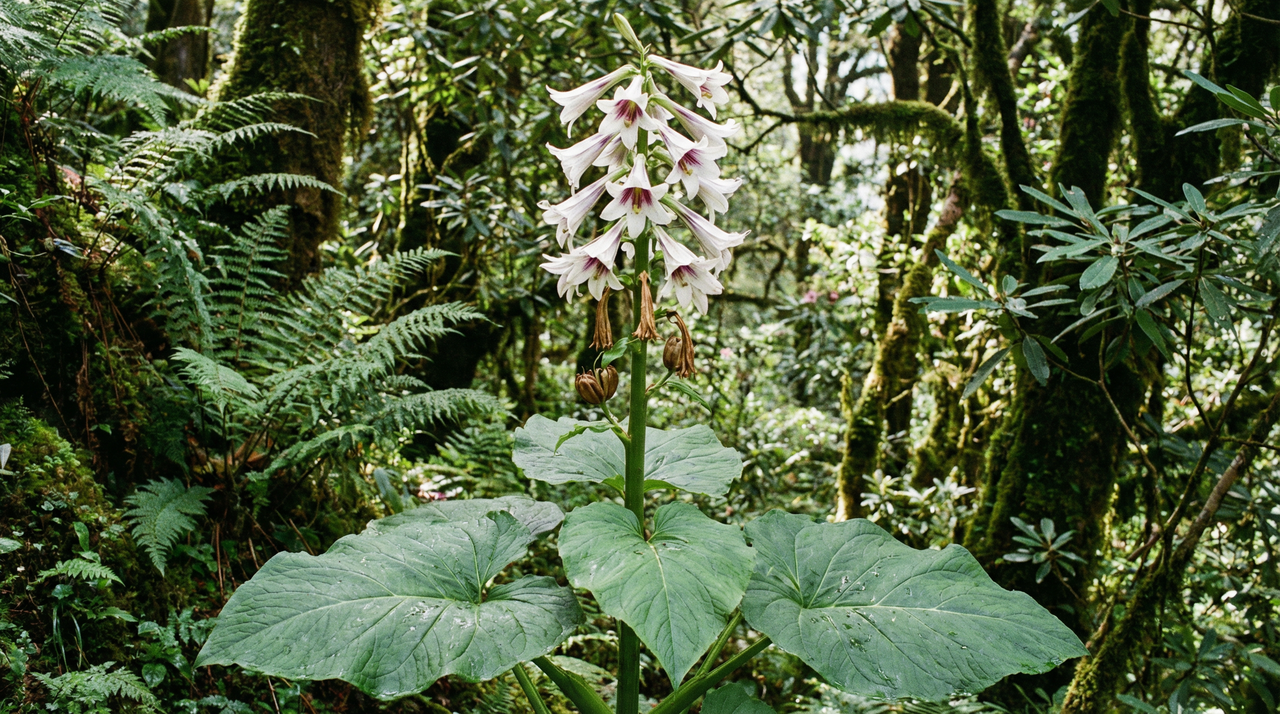
Most plants get one chance to bloom, and they take it every year without much fanfare. Cardiocrinum giganteum does it once in its entire life. The parent bulb spends four, five, sometimes seven years quietly building energy in a cool Himalayan-style understory, then throws up a flower spike taller than most people's ceilings, opens a cascade of white trumpets that fill the evening air with something between jasmine and vanilla, and dies. That's it. One performance, then gone. I've stood next to a flowering specimen in a Welsh woodland garden at dusk and genuinely forgot to take notes.
What gets me is the timing. You don't just plant this and wait for spring. You plant it and wait for years, watching the leaves come up each season a little larger, a little more impressive, with no idea exactly when the show will happen. And yet, once you understand what this plant actually is, where it comes from, what it's been used for across centuries of Himalayan and Tibetan tradition, the waiting starts to feel less like a test of patience and more like an invitation to pay closer attention.
Origin and History of the Giant Himalayan Lily (Cardiocrinum giganteum)
Botanical Background and Native Habitat
There's a moment I remember clearly: standing in the woodland garden of a specialist nursery in the Pacific Northwest, rounding a bend in the path, and suddenly there it was. A colony of giant lilies in full spike, towering somewhere around three meters over my head. I've worked with big perennials for years, but nothing quite prepares you for the scale of this plant in person. Cardiocrinum giganteum is native to the eastern Himalayas, ranging across Nepal, Bhutan, Sikkim, Assam, Arunachal Pradesh, northern Myanmar, and into Yunnan and Sichuan, growing at elevations between 1,800 and 3,400 meters in cool, mist-laden forest understories with humus-rich, acidic soils.[1][2][3] It's a monocarpic bulbous perennial, meaning each individual bulb grows vegetatively for anywhere from 4 to 10 years before producing a single towering flower spike, then dies, leaving behind offsets to continue the colony.[4][5] Growing from seed takes 4 to 7 years to first flowering, with offsets shortening the wait somewhat but still demanding serious patience.[6] The bulbs themselves are extraordinary objects: up to 30 cm across, 60 cm tall, and weighing as much as 5 kg, among the largest of any bulbous plant on earth.[7][8] Having grown this plant from offsets in a shaded woodland bed, I can tell you that the difference in bulb mass between a four-year plant and a seven-year plant is genuinely startling. The wait feels long until the moment you lift one of those mature bulbs and realize what you've been building.
Traditional and Cultural Uses in the Himalayas
Long before Western botanists took notice, Himalayan communities had woven this plant into their medical and culinary traditions. In Ayurvedic practice, Tibetan Sowa Rigpa, and various indigenous systems across Nepal, Bhutan, and northeast India, the bulb was prepared as decoctions, powders, and poultices to treat respiratory complaints including coughs, asthma, and tuberculosis, as well as rheumatism and general weakness, classified as a warming herb to balance excess phlegm.[9][10] The cooked, peeled bulbs also served as a starchy food source in communities across Sikkim, Bhutan, and Nepal, prepared in soups and dishes, though raw consumption was consistently avoided due to irritant compounds.[10] I'll explore the phytochemistry behind these uses more fully in the health benefits section, because the medicinal story is complicated by some real toxicological concerns. What strikes me about the cultural history, though, is how much the ceremonial dimension ties back to the plant's dramatic biology. Those enormous white trumpet flowers, nodding at the top of a three-meter stem, have been offered in Hindu and Buddhist pujas and in Sherpa healing ceremonies, symbols of purity and the ephemeral nature of life. For a plant that blooms once in a decade and then dies, that symbolism feels entirely earned.
Visual Characteristics and Life Cycle
The flowering plant itself is almost implausible. A smooth, waxy, unbranched stem rises 2.5 to 3.5 meters, carrying spirally arranged heart-shaped leaves up to 30 cm long that taper progressively toward the top, then terminates in a raceme of 6 to 20 nodding white trumpet flowers, each 10 to 15 cm long with purple-red spotting and streaking inside.[1][11][12] The fragrance peaks in the evening and carries remarkably far on still, humid summer nights; on the right night it reaches you before you can even see the flowers. After pollination, the stem holds a row of oblong capsules, each 5 to 8 cm long, packed with flat, winged, dark-brown seeds adapted to ride the mountain wind.[13] Think of it like a very tall delphinium in terms of overall height, but with a stem and presence far more architectural in the garden. Nothing else in a temperate woodland guild will stop visitors cold the way a flowering giant lily does.
Discovery, Introduction to the West, and Conservation Status
William Jackson Hooker first described the species formally in Curtis's Botanical Magazine in 1843, publishing it as Lilium giganteum, and in 1849 Thomas Lobb collected seed in Darjeeling for the influential Veitch Nurseries, bringing the giant lily into European cultivation for the first time.[14][15] Later expeditions by Frank Kingdon-Ward further spread it through gardens in Europe and North America, cementing its reputation as one of the great trophies of the Victorian plant-hunting era. The RHS eventually awarded it the Award of Garden Merit, and its pollination ecology only deepened that prestige: those pale, fragrant, evening-opening trumpets evolved specifically to lure nocturnal hawkmoths.[7][16] The prestige, though, comes with a conservation obligation. The species is listed as Vulnerable on the IUCN Red List, with var. yunnanense particularly at risk, driven by overcollection for the medicinal and horticultural trade alongside habitat loss.[17] Sustainable ex-situ propagation programs are being developed to reduce pressure on wild populations, and my own practice aligns with that directly: I only propagate from responsibly sourced offsets or seed, and I won't purchase wild-collected bulbs regardless of how attractively they're priced. Growing a giant lily is a multi-year commitment; it should start with a clean conscience.
Giant Lily Varieties and Sourcing
Recognized Varieties and Subspecies of Cardiocrinum giganteum
The taxonomy here is cleaner than most gardeners expect. Cardiocrinum giganteum has two recognized varieties: var. giganteum, with broader leaves and a native range stretching from Bhutan into Myanmar, and var. yunnanense, a narrower-leaved form endemic to Yunnan Province in China.[18] Some authorities further treat the species as having two subspecies: subsp. giganteum, with green leaves and moderately spotted purple-and-white flowers, and subsp. hemsleyanum from western China, distinguished by glaucous blue-green leaves and more intensely marked flowers.[19] I've grown both var. giganteum and var. yunnanense side by side, and the leaf width difference is genuinely noticeable once you know what to look for. Var. yunnanense also seemed to handle my humid summers with slightly less stress, though I'd hesitate to call that a pattern from just a couple of seasons.
Whatever variety you're growing, the plant's physical scale is the thing that stops visitors cold. Mature stems reach 8 to 12 feet, topped with trumpet-shaped flowers stretching 4 to 6 inches, white with purple spotting and a fragrance that intensifies in the evening.[20][11] Bloom time falls in July and August in the northern hemisphere.[21] Getting there from seed takes 4 to 7 years; offsets cut that down to 2 to 3 years, and the parent bulb dies after flowering, leaving those offsets as your primary means of keeping a variety going.[22] I waited six years for my first offset colony to send up a spike. The moment that stem cleared the surrounding hostas and just kept going, I understood why people dedicate entire garden corners to this plant.
Planting offsets and bulbils in autumn with a generous mulch layer is the standard approach for maintaining stock.[23][22] As for named cultivars, I've seen listings for 'Variegatum,' 'Album,' and 'Dahlberg' float around online, but after checking both RHS and Missouri Botanical Garden records I couldn't find solid documentation for any of them in reliable trade.[24][25] I grow the straight botanical varieties and sleep better for it.
Where to Buy Giant Lily Bulbs and Seeds
In the U.S., your best bets are Plant Delights Nursery, B&B Bulbs, and Old House Gardens.[26][27][28] Stock is genuinely limited and sells fast, so pre-ordering before the spring or fall planting windows is worth the effort. I've tried imported bulbs in the past and they've consistently arrived in worse shape than what I get from domestic specialty sources. Fresher stock, shorter transit, better survival rate. When the bulbs arrive, inspect them immediately: you want firm, plump scales with no soft spots, and a minimum diameter of around 5 to 7 cm for realistic flowering potential. Expect to pay roughly $20 to $50 per bulb; seeds run $5 to $15 a packet but mean committing to that full multi-year timeline all over again.
If you're considering importing giant Himalayan lily bulbs from overseas, USDA APHIS regulations require a phytosanitary certificate, and California adds its own state-level inspection layer on top of federal requirements.[29][30] The plant isn't listed as a federal noxious weed, so the regulatory path is navigable, but the logistics rarely justify the risk when U.S. nurseries are already carrying solid stock.[31] Source locally, inspect carefully, and accept that a colony of these in a shaded woodland garden is a multi-year project. The spectacle at the end earns every year of waiting.
How to Propagate and Plant Giant Lily (Cardiocrinum giganteum)
I'll be honest with you upfront: growing giant lily from scratch is a commitment measured in years, not seasons. Before you sow a single seed or tuck in your first offset, you need to make peace with a 4 to 7 year wait before you ever see a flower spike.[32][33] That timeline holds whether you start from seed or from divisions, though offsets lifted from an established plant do tend to move a little faster than starting from scratch. The actual window depends on how fresh your seed is, how closely you can replicate the cool Himalayan woodland conditions this plant evolved in, and frankly, a certain amount of luck.
Understanding the Monocarpic Lifecycle and Long Timeline to Bloom
Cardiocrinum giganteum flowers exactly once, then dies.[11] For some gardeners that sounds like a flaw. I've come to see it as one of the most elegant demonstrations of succession planting in nature, because as the parent bulb senesces after its one spectacular performance, a cluster of offsets is already pushing up at the base to carry the lineage forward.[34] It's built-in replacement planting, no intervention required. I made the classic beginner mistake with my first-year seedlings, assuming they were struggling because they stayed so small. A few seasons in, I understood: that slow initial growth is the plant building bulb mass underground, not stalling. Once you internalize that, the whole multi-year arc makes sense.
Seed Propagation: Stratification, Sowing, and Storage
Seeds are orthodox in their storage behavior, meaning they tolerate drying to 3 to 7 percent moisture and can be kept viable for 10 or more years at freezer temperatures, or 3 to 5 years in a cool refrigerator.[35][36] That said, my propagation logs consistently show that fresh seed sown in late summer or early autumn outperforms stored seed by a wide margin. Fresh seed can germinate at 70 to 90 percent under ideal conditions; older seed drops off significantly after five years, even when stored correctly.[36] If you can get fresh seed, use it immediately.
The seeds themselves are small, dark brown to black, 4 to 6 mm, with a papery wing that aids wind dispersal in the wild.[37] That wing reminds me of the winged seeds on some Lilium species I've grown, and it matters practically: handle them gently during collection and storage, because the thin seed coat is easy to damage. They're monoembryonic and freely cross-pollinated by bees and moths, so seedlings won't necessarily match the parent plant.[38]
Sow into humus-rich, acidic to neutral compost (pH 5.5 to 7.0) and provide cold moist stratification at 4 to 5°C for four to six weeks before moving to a germination temperature of 15 to 20°C.[37][39] Even then, expect emergence to take 3 to 6 months, and visible bulb formation may take another year or two beyond that. Success rates under optimal conditions run 50 to 70 percent.[39] A note for anyone sourcing seed of related species: C. cathayanum shows morphophysiological dormancy requiring warm then cold stratification, so it behaves differently from C. giganteum. Always confirm your source.[40]
Vegetative Propagation Using Offsets and Bulbils
If you want reliability, go vegetative. Offsets lifted from the base of a mature bulb after foliage dies back offer 80 to 90 percent success, and they preserve the parent plant's characteristics since there's no outcrossing involved.[41][33] I prefer this route for plants I know are performing well in my woodland beds. Bulbils (those firm 1 to 2 cm structures that form in the leaf axils after flowering) are another option; harvest them in late summer when they're firm, store them cool and dry at 5 to 10°C in peat or vermiculite over winter, then replant in spring at 5 to 10 cm deep.[41] Even through vegetative methods, you're still looking at several years before a flower spike, though you'll typically shave time off the seed-to-bloom journey.
Soil, Site Selection, and Planting Technique
Everything about giant lily's cultural requirements traces back to its native habitat: moist, shaded forest floors in the eastern Himalayas at 1,800 to 3,400 meters elevation, in humus-rich, well-drained soils with a loose, granular structure.[11][42] Replicating that cool, organic understory is, in my experience, the single biggest determinant of whether this plant thrives or languishes. Aim for dappled light equivalent to 30 to 70 percent canopy cover, consistent moisture without any waterlogging, and a soil pH of 6.0 to 7.0 with generous organic matter content.[43]
I always test my woodland beds before planting and keep them at 6.0 to 6.5. When pH drifts above 7.5, you'll see iron chlorosis appear as yellowing between the veins on young leaves.[11] I've corrected this reliably with leaf-mold top-dressing, which simultaneously lowers pH and raises organic content. For heavier soils, work in grit or coarse sand to improve drainage; soft, blackened roots and a foul soil odor are signs that waterlogging has already done damage.[44] Annual mulching maintains moisture and keeps roots cool, both critical during the years of quiet bulb building before any flowering spike appears.
Spacing, Depth, and Initial Establishment
Plant mature bulbs or offsets in late summer or autumn, once foliage has died back, so roots can establish before winter arrives. Set bulbs 6 to 8 inches deep (roughly 4 to 6 times bulb height, basal plate down), with offsets and bulbils going shallower at 5 to 10 cm.[45] Spacing should account for the eventual mature footprint: 12 to 18 inches between plants, with rows 24 to 36 inches apart, allows for air circulation and room for offset production over the years to come.[46] The soil needs to go at least 18 to 24 inches deep to support both bulb expansion and the root systems that will anchor a 6 to 12 foot stem at flowering.[45]
Label everything clearly. Young giant lily plants look unremarkable for their first few seasons, and I've seen more than one gardener accidentally dig up a two-year-old bulb thinking nothing was there. The quiet years are the whole point; the bulb is doing exactly what it should. Hardy in USDA zones 7 to 9 (zone 6 with heavy mulch and winter protection), these plants reward patient, attentive siting far more than any amount of supplemental feeding or fussing later on.[11]
Giant Lily Care Guide
Every care decision you make for Cardiocrinum giganteum should start from the same mental image: a cool, misty Himalayan forest at around 2,500 meters, filtered light coming through a canopy of rhododendrons and firs, the soil deep with leaf litter and never truly dry. That picture isn't poetic license; it's the practical blueprint for getting this plant to thrive. Miss any one of those conditions by a wide margin and you'll know it quickly, because giant lily communicates its discomfort in large, dramatic leaves that are impossible to ignore.
Sunlight Requirements for Giant Himalayan Lily
Partial shade is non-negotiable. Cardiocrinum giganteum needs protection from intense afternoon sun, and in most garden climates, a few hours of gentle morning light followed by dappled shade is about as much direct sun as it wants.[6][11] I've seen the damage from even one or two hours of harsh afternoon exposure: the huge heart-shaped leaves develop scorched edges and bleach out within days, sometimes wilting dramatically despite adequate soil moisture. On the flip side, deep shade produces weak, leggy stems that can't support the eventual 10-foot spike, and bulb development suffers too. The sweet spot is the kind of light you'd find under a mature deciduous tree, or on the north or east side of a building where sun angles stay gentle. I'll defer details on heat and mulch to the sections below, but the siting decision really does start here.
Watering Needs and Soil Moisture
From spring emergence through midsummer bloom, the soil around your giant lily should stay evenly moist but never waterlogged.[6][33] Once flowering finishes and the plant moves toward autumn dormancy, you can ease off considerably. Good drainage is genuinely non-negotiable here; bulb rot is the most common way growers lose a multi-year investment, and it almost always starts with waterlogged roots. The plant also prefers slightly acidic to neutral soil in the pH 5.5 to 7.0 range, and if you can use collected rainwater rather than high-salt tap water, the difference over a season is noticeable.[11]
Diagnosing moisture problems is straightforward once you know what to look for. Overwatered plants show progressive yellowing of lower leaves, mushy roots, and blackened stems near the soil line. Underwatered ones curl at the leaf margins, brown inward from the edges, and eventually pull soil away from the bulb as everything shrinks.[47][48] In my experience, a 2 to 4 inch layer of leaf mold makes beds nearly self-regulating through most of the growing season, reducing how often I need to hand-water while keeping roots consistently cool.
Feeding and Soil Fertility for Cardiocrinum giganteum
Giant lily is a moderate feeder that responds beautifully to the same approach it gets in nature: a steady supply of organic matter rather than aggressive fertilization. I mulch annually with compost or well-rotted leaf mold, and in early spring as new growth emerges I apply a balanced slow-release fertilizer, something in the 10-10-10 range or a lower-nitrogen 5-10-10.[6][11] That's usually enough to carry the plant through its vegetative push.
I stopped reaching for high-nitrogen lawn-type fertilizers years ago after noticing that the resulting lush, soft foliage attracted more slugs and, the following year, produced fewer offsets. The research backs that observation: excess nitrogen after flowering diverts energy into leaves at the expense of the monocarpic bulb's developing bulbils, which need another 3 to 5 years to reach flowering size.[49] Once the flower spike has finished, a light potassium-rich feed like diluted tomato fertilizer helps support those offsets without pushing soft growth. I also run a soil test every two or three years; it's caught iron chlorosis risk on a slightly alkaline bed before it became a real problem, and it takes the guesswork out of phosphorus and potassium levels that matter for root and bulb development.[50][51]
Frost Tolerance and Winter Protection
Cardiocrinum giganteum is rated USDA zones 7 to 9 and will tolerate temperatures down to around -12 to -15 °C when the bulb is dormant and well mulched.[11][52] The bulb itself is reasonably tough through winter; the real vulnerability is those young shoots pushing up in late winter or early spring. I've watched them blacken after a late March freeze more than once, and I've learned not to pull back the mulch until warm nights are genuinely consistent. A 4 to 6 inch layer of leaf mold over the crown has reliably brought my plants through zone 8B winters with only minor tip burn on the earliest emerging growth, while unprotected plants nearby sometimes lost an entire season.[53][6] Horticultural fleece adds another layer of insurance during unexpected cold snaps. In zone 5 or colder, lifting bulbs and storing them indoors over winter is really the only reliable option.
Heat Tolerance and Summer Care
Above 30 °C (86 °F), giant lily starts to struggle. Leaf scorch, wilting, and premature dormancy are all on the table, and prolonged heat can desiccate bulbs that took years to develop.[6][54] I think of it similarly to how trillium or Solomon's seal behave in summer heat: they cope with shade and moisture, but push them into full sun and heat and they collapse. The protective strategy for caring for Cardiocrinum giganteum through a hot summer is layered: deep afternoon shade (from a mature tree canopy or 30 to 50 percent shade cloth), 4 inches of organic mulch to keep the root zone noticeably cooler than the air above, consistent deep watering, and good air circulation to prevent the humid stagnation that invites fungal problems.[39] Spacing offsets 12 to 18 inches apart gives each plant the airflow it needs, and in climates with reliably mild summers, most of this becomes less critical.
Pruning, Maintenance, and Seasonal Rhythm
The best maintenance philosophy for this plant is restraint. Allow foliage to die back naturally after flowering; those yellowing leaves are feeding the next generation of offsets, and cutting them early robs the bulbils of stored energy they need for the years ahead.[55] The main bulb is monocarpic and will die after setting seed, which can catch new growers off-guard, but it's not failure. It's the plant doing exactly what it evolved to do. Divide overcrowded offset clumps every 4 to 5 years, mulch annually, protect from drying winds, and maintain that air circulation to reduce fungal pressure in humid conditions.[56]
Understanding the yearly cycle makes all of this feel intuitive rather than arbitrary. Shoots emerge from dormancy in April or May to form a basal rosette of broad leaves, rapid growth follows through early summer, the fragrant white trumpets open on 2 to 4 meter stems in July and August, seeds mature in late summer, and by autumn the foliage yellows and collapses naturally before the plant disappears for winter.[57][58] The first time I grew it, I was genuinely convinced the bulb had died when the leaves went yellow in September. The following spring, healthy offsets proved me wrong. I also now mark every planting with a permanent label because the early spring rosette looks surprisingly like a hosta or ligularia, and I've come close to accidentally digging a bulb that was just beginning its long slow run toward bloom. Patience and clear labeling are, in the end, two of the most important tools in caring for giant lily.
Harvesting Giant Lily Bulbs
After years of growing Cardiocrinum giganteum in shaded woodland borders, I've learned that the hardest part of harvesting isn't the digging. It's the patience. This plant spends years building toward one extraordinary flowering event, and the monocarpic reality is that the parent bulb is spent once that happens. The harvest opportunity and the end of a life cycle arrive at the same moment, which gives the whole thing a weight that most kitchen-garden harvesting simply doesn't have.
When and How to Harvest Cardiocrinum giganteum
Harvesting happens after the midsummer flowering, as those towering 3 to 4 meter stems begin their slow yellowing. My rule with similar woodland lilies is to wait until the stem has clearly started to die back but to act before it fully collapses, because a fallen, decomposing stem makes locating and lifting bulbs cleanly much harder and risks bruising them in the process. The offsets that cluster around the spent parent bulb are your future plants, and most gardeners growing giant lily in a permaculture context will choose to leave them entirely, letting the colony naturalize over several more seasons. I've resisted harvesting the first bulb that flowers every time, because those offsets need a few more years to reach a size worth anything in the kitchen or worth replanting with confidence. Bulbs should only be lifted from established, multi-year plantings where the offset population is healthy enough to absorb the loss.
Yield, Flavor, and Sensory Profile
There's a useful sensory cue I rely on in the lead-up to harvest season: on warm evenings, the flowers release an intensifying jasmine, vanilla, and musk fragrance driven by volatiles including linalool, geraniol, and β-pinene.[39][59][60] When that evening scent peaks and then starts to fade over successive nights, you know the flowering window has passed and the countdown to dieback has begun.
Raw bulbs carry a crisp, juicy texture with high water content that's genuinely similar to water chestnuts, with a mild and slightly bitter flavor.[61][62] Cooked by boiling, roasting, or stir-frying, they transform into something starchy, tender, and sweet with a nutty undertone, along with a pungent garlic-onion aroma from sulfur compounds that develops in the heat.[61][60] That raw-to-cooked shift is significant, not just texturally but from a safety standpoint. I never serve any part of the giant lily raw and keep it well away from curious pets; the research on irritants and lily toxicity is clear, and Himalayan and East Asian communities who have used these bulbs for generations do so with specific cooking methods for exactly that reason. The full preparation picture, including proper technique and safety considerations, is covered in the next section.
Giant Lily Preparation, Culinary Uses, and Safety
Let me be direct before anything else: I grow giant lily purely for the spectacle of those towering flower spikes in my woodland borders, and I have never considered harvesting the bulbs for the table. That's a deliberate choice, and I think any responsible grower should understand why.
Culinary Considerations and Toxicity Warnings for Cardiocrinum giganteum
The ethnobotanical record on Cardiocrinum giganteum edibility is genuinely contradictory. Some sources record no documented traditional consumption and classify it as inedible due to toxicity, while others describe communities in Nepal, India, Bhutan, and China boiling, roasting, or stir-frying the bulbs as a starchy famine food with a mild, sweet flavor reminiscent of potatoes or chestnuts.[63][10][39][64] That contradiction should give you pause, because the plant belongs to the Liliaceae family, whose members commonly carry toxic alkaloids, cardenolide glycosides, and calcium oxalate crystals capable of causing nausea, vomiting, diarrhea, abdominal pain, and in serious cases kidney failure or cardiac complications.[65][66] Raw bulbs are not recommended under any circumstances, and the plant is toxic to cats and other pets.[1] Because all parts carry these compounds, I always advise clients with cats or dogs to site giant lily where animals simply cannot reach fallen foliage or exposed bulbs.
The related Cardiocrinum cathayanum offers a more documented picture of what the genus can look like as a food source: its bulbs are used in Chinese cuisine after peeling, slicing, and prolonged cooking, delivering a tender, slightly gelatinous texture and a nutritional profile rich in starch, protein, and minerals.[67][68] I've seen similar bulbs in Asian grocery stores alongside the more common Lilium lancifolium, and the cooking approach is always the same: thorough heat, not a quick sauté. That genus-level context is useful, but it doesn't transfer directly to the anchor species. Where traditional preparation of C. giganteum is reportedly attempted, it involves slow roasting until the interior blackens, prolonged boiling, or soaking to reduce irritants; even then, scientific confirmation of safe edibility is scarce, and overconsumption may still cause gastrointestinal upset.[69][63] Consult a poison control expert or ethnobotanist with direct regional knowledge before any attempt at consumption.
Traditional Medicinal Preparations and Non-Food Uses
Himalayan folk practice reportedly uses small amounts of prepared bulb, around 3 to 6 grams per day after slow roasting or boiling in milk, as a remedy for certain complaints. There is no standardized dosage, no clinical validation of efficacy or safety, and overdose has been associated with nausea and heart irregularities. I'd treat any such information as ethnobotanical record rather than instruction.
Where this plant truly earns its keep is as a dramatic focal point in shaded woodland gardens, and that's where I put all my energy with it. In my own installations I've used giant lily as a towering vertical accent in dappled-shade borders, planted alongside hostas, ferns, astilbes, and Rodgersia, where it naturalizes slowly into a colony as offsets mature over the years.[11][70] Those companions aren't just aesthetically complementary; they form a layered understory guild that mirrors the cool, moist Himalayan woodland floor this plant evolved in. The bulbs need careful siting because disturbance sets them back significantly, but a well-established colony in a shaded border is one of the most quietly spectacular things a permaculture woodland garden can offer.
Giant Lily Health Benefits and Medicinal Uses
I'll be honest: I grow Cardiocrinum giganteum for the drama of its ten-foot flower spike, not as a medicine cabinet. But the ethnobotanical story behind these bulbs is genuinely fascinating, and understanding it helps explain both the respect this plant commands across Himalayan cultures and the caution it deserves in any garden where pets or children roam.
Traditional Medicinal Uses in Himalayan and Chinese Folk Medicine
Across Tibetan, Nepalese, Bhutanese, and Indian highland communities, the bulbs of this giant lily have a deep history as a remedy for respiratory complaints, including cough, bronchitis, phlegm, and tuberculosis-like symptoms, as well as chest pain, fever, inflammation, and wound treatment.[71][72][73][74] Related species like Cardiocrinum cathayanum carry similar roles in traditional Chinese medicine for clearing heat, moistening the lungs, and easing cough, though the data is limited and the whole genus should be approached with expert guidance.[75][76] That traditional context is worth respecting. It's also worth recognizing that highland communities processing these bulbs through cooking and careful preparation knew something about reducing toxicity that raw enthusiasts today might miss.
While the traditional knowledge is fascinating, there are no published clinical trials, very limited animal data, and no regulatory approval for medicinal use of this species.[77][78] As a landscape designer, I treat these bulbs as spectacular ornamentals first. For anything medicinal, consult a qualified practitioner.
Key Phytochemical Compounds: Cardiac Glycosides, Alkaloids, Flavonoids, and Saponins
The bulbs are the richest source of bioactive compounds in this plant, and the chemistry is genuinely complex. Steroidal alkaloids (cardiocrisine, cardiocrinumins A and B), cardiac glycosides and cardenolides (including chinotoxin and cardiocrinins), flavonoids such as quercetin and kaempferol derivatives, rutin, and hyperoside, steroidal saponins (giganteosides), phenolics, and the lignan gigantol have all been identified.[79][80][81][82][83] The cardiac glycosides work via inhibition of the Na+/K+-ATPase enzyme, a digitalis-like mechanism that might explain traditional uses for chest complaints but is also exactly what makes self-medication dangerous.[84][85]
The concentrations of these compounds aren't fixed. Plants grown at higher elevations tend to show elevated flavonoid levels, and potency shifts with soil conditions, plant age, and season, with bulbs peaking around flowering time.[86][87] The cardiac glycosides put this plant in a different risk category than, say, daylilies. That's not a reason to avoid growing it; it's a reason to understand it.
Reported Pharmacological Activities from In Vitro Research
Preliminary lab studies, mostly on Cardiocrinum giganteum var. rivulare, suggest antioxidant activity comparable to ascorbic acid in DPPH and hydroxyl radical scavenging assays, anti-inflammatory effects through xanthine oxidase inhibition and suppression of NF-κB pathway activity in macrophages, and antimicrobial potency against Gram-positive bacteria and fungi at MIC values often below 50 μg/mL.[88][89][90] Cytotoxicity against cancer cell lines including HeLa, A549, and MCF-7 has also been reported in vitro.[91] These results are intriguing in the same way early research on other lily-family bulbs can be, but in-vitro activity doesn't translate directly to therapeutic use in humans. The absence of clinical trials is a hard stop.
Nutritional Profile of the Edible Bulbs
In highland Himalayan communities where calories were hard-won, the large starchy bulbs were traditionally boiled or roasted after the plant's late-summer decline. The nutritional picture, extrapolated largely from related Lilium species, suggests a predominantly carbohydrate-based food (roughly 70-80% carbohydrates by dry weight), mildly flavored with a faint onion note, and modest in protein (around 2-4 g per 100 g cooked), fiber, and minerals including potassium, calcium, and iron.[92][93] Cooking matters here for reasons beyond texture, as heat reduces the cardiac glycoside load that makes raw bulbs problematic.[94] Any culinary use of these bulbs belongs in heavily hedged territory, and I'd defer to the preparation and uses section for specifics on how traditional communities approached that safely.
Safety Considerations and Toxicity Risks
The most urgent safety issue is cats. Cardiocrinum giganteum is considered toxic to cats and other pets in the way true lilies are; even small ingestions can cause vomiting, lethargy, and potential kidney damage.[65][95] I keep Cardiocrinum well away from our cats; with cardiac glycosides confirmed in the bulbs, that precaution is non-negotiable. For humans, raw bulbs in quantity cause gastrointestinal distress through nausea, vomiting, and diarrhea, though cooking significantly reduces that risk and severe poisonings aren't commonly reported.[96]
Handling bulbs or sap can cause contact dermatitis in sensitive individuals, and the pollen is a genuine irritant for anyone prone to respiratory allergies. I learned this the first time I divided bulbs without gloves and noticed mild skin irritation afterward; now I always wear them.[97] Keep plants away from children and wear gloves for any bulb work. The IUCN lists this species as Vulnerable due to overharvesting for both medicinal and ornamental trade,[77] which is why I source only nursery-grown specimens and avoid anything wild-collected. The traditional medicinal applications belong to a context of expert preparation and cultural knowledge; they are not a DIY invitation.
Giant Lily Pests and Diseases
Let me be honest with you right from the start: the single biggest threat to a giant lily isn't a beetle or a mold spore. It's water sitting against that expensive, years-old bulb for too long. I've lost more than one Cardiocrinum giganteum to basal rot, and every time it happened, the culprit was the same — soil that looked fine but drained just slowly enough to create the conditions these pathogens love. That lesson cost me years of patience and is why I now double-dig every planting hole and work in grit before I even think about putting a bulb in the ground.
Major Diseases of Cardiocrinum giganteum
The fungal triumvirate of Pythium, Fusarium, and Phytophthora can destroy a bulb in a single wet season if drainage is poor.[98][99][100] Bacterial soft rot (Erwinia carotovora) compounds the risk in warm, humid weather, accelerating bulb collapse even faster than the fungi.[98] Above ground, poor airflow and overhead watering invite Botrytis gray mold, rust, powdery mildew, and various leaf spot pathogens including Alternaria and Cercospora.[98][101] Temperatures pushing above 85°F paired with humidity over 70% dramatically increase susceptibility across all of these.[102][103] Then there are viruses: lily symptomless virus and cucumber mosaic virus, both spread by aphids, cause mottling, stunting, and distorted flowers, and neither has a cure.[98][104] Pull and dispose of any visibly infected plant immediately.
The related C. cathayanum shows moderate natural resistance to common lily diseases, likely shaped by its high-altitude native habitat.[105][106] That's worth knowing, but it doesn't help you much with the anchor species, because no cultivar of C. giganteum offers superior disease resistance.[105][104] There's no variety to shop for. Your only tool is good horticulture: sharp drainage, proper spacing, and avoiding anything that pools moisture around the crown.
Common Pests and Natural Defenses
Giant lily isn't entirely without armor. Its Himalayan chemistry includes alkaloids such as cardiocrinumine and phenolic compounds, and the leaves carry a thick waxy cuticle that deters casual grazers.[107][108] I once nibbled the edge of a leaf out of curiosity and can confirm it has a distinctly bitter, unpleasant taste unlike the neutral blandness of a daylily. That chemistry does real work.
Still, two pests reliably find their way through those defenses. Lily leaf beetles (Lilioceris lilii) are the worst offenders; adults and larvae can skeletonize foliage surprisingly fast.[109][110] The larvae disguise themselves in their own fecal matter, a brownish shield that is both revolting and effective camouflage; once you know what you're looking at, you spot them fast. Slugs and snails are a close second, especially on the young emerging shoots that the plant pushes up in spring into exactly the moist, shaded conditions mollusks prefer.[111] Aphids are worth monitoring less for the direct feeding damage and more because they vector the viruses mentioned above.[101] Thrips and bulb maggots round out the roster but are rarely the crisis that beetles and slugs can become.[109]
For controls, I follow a straightforward hierarchy: hand-pick lily beetles and their egg masses first, encourage ladybugs and other beneficial predators, use beer traps or nematodes against slugs, and reach for neem oil or insecticidal soap only when aphid or thrips pressure actually warrants it.[109][110] In my experience, a well-sited giant lily in humus-rich, sharply drained soil with good airflow rarely needs anything beyond that, which is a better track record than most hybrid lilies I've grown. The whole IPM framework rests on what's already been said about site preparation: right soil, right drainage, right spacing, and the plant does most of the work itself.[112][111]
Giant Lily in Permaculture Design
Before you commit years of patience to growing Cardiocrinum giganteum, the first question to answer honestly is whether your site can replicate the cool, misty Himalayan understory this plant spent millennia evolving in. Get that wrong and no amount of care will coax it into flowering.
Climate and Growing Zones for Cardiocrinum giganteum
Giant lily is reliably hardy in USDA zones 7 through 9, with the best results in zones 8 and 9.[11][113] Zone 7 gardeners can push it with deep mulch and careful siting, but temperatures dropping to 0°F (-18°C) will demand real protection.[114] I learned this the emphatic way in my zone 8b garden: even here, a late freeze after the leaves emerge in early spring can blacken those gorgeous heart-shaped unfurling rosettes overnight. Planting under the drip line of established deciduous trees changed everything for me. The canopy delays soil warming just enough to slow emergence, while the microclimate buffers both late frosts and summer heat.
That heat piece matters as much as the cold. Giant lily wants cool summers in the 50-75°F range with high humidity and consistent rainfall equivalent to 40-80 inches annually.[11][33] Once temperatures climb above 90°F for any stretch, these plants sulk, fail to build the bulb energy needed for flowering, and eventually collapse. I've watched it happen. Zone 10 and hot, dry inland climates are simply not viable; no amount of shade cloth or irrigation compensates for the wrong thermal regime. The Pacific Northwest, where cool wet summers and mild winters mimic Himalayan conditions, is the closest thing to a sweet spot in North America, and the plant naturalizes beautifully there under deciduous canopy.[115] For everyone else, the question is how closely you can replicate that environment at a microsite level.
Soil requirements reinforce the same logic: moist, humus-rich, well-drained, and slightly acidic to neutral (pH 5.5-7.0), essentially the forest floor profile the bulbs evolved in.[116][33] In heavy clay, raised beds prevent the bulb rot that will otherwise end your multi-year investment before the plant ever flowers.[117]
Forest Layer, Guilds, and Ecosystem Functions
In the wild, giant lily occupies the tall herbaceous layer of moist temperate Himalayan forests between roughly 1,800 and 3,400 meters, spending years as a ground-level basal clump before sending up a flowering spike that can reach 6-10 feet.[21] In a designed forest garden, it fills that same role: a dramatic vertical accent in the understory, beneath a canopy layer but well above the ground covers. It pairs naturally with companions that share its appetite for cool, acidic, humus-rich conditions, think ferns, hardy gingers, wood sorrel, or low-growing epimediums that can spread comfortably into the gaps the giant lily leaves during its years-long vegetative phase without competing for the same airspace.
The ecological contributions are genuine. Its deep roots improve soil structure and contribute to humus formation as leaves break down, and it forms mycorrhizal associations with Glomeromycota fungi that enhance nutrient uptake even in lower-fertility soils.[118][119] The alkaloids concentrated in its tissues deter most browsing mammals,[120] which is a real practical advantage in deer-pressured woodland gardens where you'd otherwise be losing your understory to browsing every season.
The pollination ecology adds something I find genuinely captivating at the garden scale. The flowers are pollinated primarily by nocturnal hawkmoths, particularly Agrius convolvuli, drawn in by large, fragrant, purple-spotted white trumpets that open toward evening and produce abundant nectar.[121][122] The fragrance on a warm summer evening is powerful enough that I started using it as a cue to go check on other night-active visitors in my garden. Bees and butterflies do visit during the day, but they're much less effective pollinators.[123] Because the species is self-incompatible, planting a colony of several bulbs at different maturity stages, or doing your own hand-pollination in the evening, is usually necessary to get reliable seed set in a garden context.[124]
The monocarpic lifecycle is the design challenge that takes the most planning. After 5-7 years of patient growth as a basal clump, the plant flowers once and dies.[125][39] I've learned to treat that as a succession opportunity rather than a loss. I leave the spent stalk in place to distribute seed and offsets, and I interplant fast-growing low herbs or annual ground covers that can fill the gap gracefully while the next generation of bulbils gets started. Growing it in a staggered colony, with bulbs of varying ages acquired over a few years, keeps the guild from going visually dormant all at once. This is exactly the kind of long-arc thinking that distinguishes a food forest from a garden bed, and giant lily rewards that patience more dramatically than almost any other herbaceous plant I grow.
A word on edibility in the guild context: the young inner stems can be eaten after cooking, and the bulbs have traditional use after careful preparation to remove saponins and bitterness,[126] but I treat this plant primarily as an ecological and ornamental asset rather than a food crop. The multi-year investment to reach a harvestable bulb, combined with the toxicity concerns around raw plant material, means it's not something I'd build a yield strategy around. Growing a cultivated population does carry real conservation value, though: habitat loss from Himalayan deforestation has put wild populations under pressure, and responsibly maintained garden colonies contribute to preserving genetic diversity.[21]
The Plant That Taught Me to Stop Rushing the Garden
I've killed exactly one Giant Lily by moving it too soon, convinced I knew better than a plant that had been perfecting its timeline for millennia. Watching that enormous bulb rot in a poorly drained spot I was "about to improve" was a humbling kind of expensive. What stays with me now isn't the flowering spike, as breathtaking as that is; it's the years of anticipation before it, the way the garden asks you to simply trust something you planted and mostly leave it alone.
Sources 126
- Cardiocrinum giganteum - Wikipedia ↩
- Kew Science - Plants of the World Online: Cardiocrinum giganteum ↩
- Cardiocrinum giganteum - Royal Horticultural Society ↩
- Cardiocrinum giganteum - Royal Horticultural Society ↩
- Giant Lily (Cardiocrinum giganteum) - Missouri Botanical Garden ↩
- Royal Horticultural Society - Cardiocrinum giganteum ↩
- Cardiocrinum giganteum - Royal Horticultural Society ↩
- Cardiocrinum giganteum - Missouri Botanical Garden ↩
- Journal of Ethnopharmacology - Ethnobotanical Survey ↩
- Ethnobotany of the Himalayas ↩
- Giant Himalayan Lily (Cardiocrinum giganteum) - Missouri Botanical Garden ↩
- Cardiocrinum giganteum - Royal Horticultural Society ↩
- Flora of China - Cardiocrinum giganteum ↩
- Curtis's Botanical Magazine, Volume 69, 1843 ↩
- Introduction of Himalayan Plants to the West ↩
- Giant Himalayan Lily (Cardiocrinum giganteum) ↩
- IUCN Red List of Threatened Species ↩
- Flora of China - Cardiocrinum giganteum ↩
- Cardiocrinum giganteum subsp. hemsleyanum - Alpine Garden Society ↩
- Cardiocrinum giganteum - RHS Gardening ↩
- Giant Lily (Cardiocrinum giganteum) - RHS ↩
- Cardiocrinum giganteum - Royal Horticultural Society ↩
- Lilies of the World - Cardiocrinum ↩
- Missouri Botanical Garden - Cardiocrinum giganteum ↩
- Royal Horticultural Society - Cardiocrinum giganteum ↩
- Cardiocrinum giganteum - Giant Lily ↩
- Cardiocrinum giganteum Bulbs ↩
- Heirloom Bulbs: Cardiocrinum giganteum ↩
- Importing Plants and Plant Products into the United States ↩
- Federal Plant Pest Regulations; General ↩
- Noxious Weed List ↩
- Cardiocrinum giganteum - Giant Lily ↩
- Growing Cardiocrinum from Seed ↩
- Cardiocrinum giganteum ↩
- Seed Information Database - Royal Botanic Gardens, Kew ↩
- Germination and Storage of Lilium and Cardiocrinum Seeds - Journal of Horticultural Science ↩
- Cardiocrinum giganteum ↩
- Flora of China - Cardiocrinum giganteum ↩
- Propagation of Cardiocrinum giganteum ↩
- Dormancy and Germination in Liliaceae ↩
- Cardiocrinum giganteum - Growing Guide ↩
- Flora of China: Cardiocrinum giganteum ↩
- Cardiocrinum giganteum - RHS Gardening ↩
- Root Rot in Bulbous Plants: Symptoms and Management ↩
- Cardiocrinum giganteum ↩
- Cardiocrinum giganteum Cultivation ↩
- Cardiocrinum giganteum Plant Care Sheet ↩
- Herbaceous Perennial Care: Watering Issues ↩
- Cardiocrinum giganteum Growing Guide ↩
- Lily Fertilization Recommendations ↩
- Bulb Fertilization Practices ↩
- The Himalayan Lilies: Cardiocrinum giganteum ↩
- Frost Damage in Lilies - University of Minnesota Extension ↩
- Growing Giant Himalayan Lily ↩
- Cardiocrinum giganteum Growing Guide ↩
- Dividing Cardiocrinum ↩
- The Life Cycle of Cardiocrinum giganteum ↩
- Cardiocrinum giganteum - Giant lily ↩
- Fragrance of Lilies: Cardiocrinum giganteum ↩
- Volatile Compounds in Liliaceae Bulbs ↩
- Edible Bulbs of the Himalaya: Traditional Uses ↩
- Wild Edible Plants of Bhutan ↩
- Ethnobotany of Himalayan Plants ↩
- Edible Plants of the Himalaya ↩
- Lilies (Liliaceae Family) Toxicity ↩
- Cardiocrinum giganteum - The Giant Himalayan Lily ↩
- Edible Lilies and Their Uses in Chinese Cuisine ↩
- Nutritional Composition of Lily Bulbs (Lilium spp.) ↩
- ASPCA Animal Poison Control ↩
- Companion Plants for Shade Gardens ↩
- Ethnobotany of the Himalayas ↩
- Medicinal Plants of the Himalayas ↩
- Tibetan Medicinal Plants ↩
- Ethnobotanical Survey of Medicinal Plants Used by Tibetan People in Nepal ↩
- Cardiocrinum cathayanum in Traditional Chinese Medicine ↩
- Medicinal Plants of China - NCBI ↩
- IUCN Red List: Cardiocrinum giganteum ↩
- PubMed Literature Search ↩
- Phytochemical and Pharmacological Review of Cardiocrinum giganteum ↩
- Steroidal Alkaloids from the Bulbs of Cardiocrinum giganteum ↩
- Secondary Metabolites of Himalayan Medicinal Plants: Cardiocrinum giganteum ↩
- Two New Alkaloids from the Bulbs of Cardiocrinum giganteum ↩
- Cardenolides from the Bulbs of Cardiocrinum giganteum ↩
- Chemical Constituents and Biological Activities of Cardiocrinum giganteum ↩
- Bufadienolides from Cardiocrinum giganteum and their cardioselective activity ↩
- Altitude and Soil Effects on Plant Metabolites in Lilium spp. ↩
- Seasonal Variation in Secondary Metabolites of Himalayan Lilies ↩
- in vitro antioxidant, antiinflammatory, and antimicrobial activities of Cardiocrinum giganteum var. rivulare ↩
- Assessment of in vitro antioxidant and antiinflammatory potential of Cardiocrinum giganteum var. rivulare and isolation of kaempferoside derivatives ↩
- Antimicrobial and antioxidant potential of different solvent fractions of Cardiocrinum giganteum Var. rivulare ↩
- Anti-inflammatory activity of Cardiocrinum giganteum extract ↩
- Journal of Food Science and Technology - Edible Lily Bulbs: Nutritional Composition and Processing ↩
- Food Chemistry - Nutritional Composition of Edible Bulbs in Lilium and Cardiocrinum Species ↩
- Plant Foods for Human Nutrition - Toxicity of Liliaceae Family Plants ↩
- Lily Toxicity in Cats - Pet Poison Helpline ↩
- Toxicity of Himalayan Medicinal Plants ↩
- RHS Plant Finder - Cardiocrinum giganteum ↩
- Royal Horticultural Society - Cardiocrinum giganteum ↩
- University of Minnesota Extension - Lily Diseases ↩
- Missouri Botanical Garden - Cardiocrinum giganteum ↩
- University of California IPM - Lily Diseases and Pests ↩
- Royal Horticultural Society (Plant Finder: Cardiocrinum giganteum) ↩
- Missouri Botanical Garden - Plant Finder ↩
- Disease Resistance in Lilies - American Lily Society ↩
- Lilies: Cardiocrinum Species - Pacific Bulb Society ↩
- Cardiocrinum cathayanum - Royal Horticultural Society ↩
- Chemical Defenses in Lilies ↩
- Alkaloids in Cardiocrinum Species ↩
- Royal Horticultural Society: Lily Beetle ↩
- University of Minnesota Extension - Lily Pests ↩
- University of California IPM Online - Lilies ↩
- Diseases of Lilium and Cardiocrinum - Royal Horticultural Society ↩
- Cardiocrinum giganteum - Royal Horticultural Society ↩
- USDA Plant Hardiness Zone Map ↩
- Growing Cardiocrinum giganteum in the Pacific Northwest ↩
- Cardiocrinum giganteum - Royal Horticultural Society ↩
- Cardiocrinum giganteum - RHS Grow plants ↩
- The Giant Lily of the Himalayas: Cardiocrinum giganteum ↩
- Soil Health and Understory Plants in Temperate Forests ↩
- Ecological Role of Alpine Plants in the Himalayas ↩
- Pollination Ecology of Cardiocrinum giganteum in the Eastern Himalayas ↩
- Pollination Ecology of Himalayan Lilies ↩
- Pollinators of Himalayan Lilies ↩
- Pollination Biology of Cardiocrinum giganteum ↩
- Cardiocrinum giganteum - Missouri Botanical Garden ↩
- Cardiocrinum giganteum Details - Missouri Botanical Garden ↩