Most people smell ginger lily before they see it. That wave of sweetness that stops you mid-step on a humid evening, the one that seems too rich to belong to a garden and not a perfumery, that's Hedychium coronarium announcing itself from twenty feet away. I've grown it in a containment bed in Central Florida, and even with a root barrier and a healthy amount of paranoia, I find myself standing next to it at dusk like I've been hypnotized. That fragrance is the whole reason this plant circumnavigated the globe. And it's also, indirectly, why it's now on Florida's Category I invasive species list.
Here's the contradiction that's followed this plant for two centuries: it's genuinely useful, deeply embedded in Ayurvedic medicine, Hawaiian ceremony, and Southeast Asian kitchens, and it's also one of the more ecologically disruptive ornamentals you can put in the ground in a warm, wet climate. The same rhizome that healers have used for respiratory and inflammatory conditions is the same structure that lets a single escaped clump colonize a riverbank and crowd out everything else. Beautiful, fragrant, medicinally promising, and in the wrong hands, a landscape liability. That tension is worth sitting with before you order a rhizome.
Origin and History of Ginger Lily (Hedychium coronarium)
Botanical Background and Native Habitat
Ginger lily (Hedychium coronarium) is a perennial rhizomatous herbaceous plant in the Zingiberaceae family, native to a broad swath of tropical Asia spanning the eastern Himalayas, northeastern India, Bangladesh, Myanmar, Thailand, Laos, Vietnam, southern China, and Indonesia.[1][2][3] In its native range it lives in moist forest understories, along riverbanks, and at shaded wetland edges at elevations between 500 and 2,000 meters, with the sweet spot somewhere around 800 to 1,500 meters.[4] That origin matters enormously for how you grow and, especially, where you plant it.
The plant was first formally described by Johan Gerhard König in 1783 and later validated by William Roxburgh in 1810 in Flora Indica, though European gardeners had already gotten their hands on it by 1780.[1][5][6] From there, the ornamental trade and colonial shipping routes carried it into tropical regions worldwide, and it naturalized across Central and South America, the Caribbean, Africa, and Pacific Islands.[7] Its clumping rhizomes are extraordinarily persistent, with individual shoots lasting one to two seasons but established colonies surviving well over a decade under good conditions.[8][9] I've seen clumps in zone 9B landscapes that have clearly been sitting in moist spots for many years, quietly expanding, unbothered.
Visual Characteristics
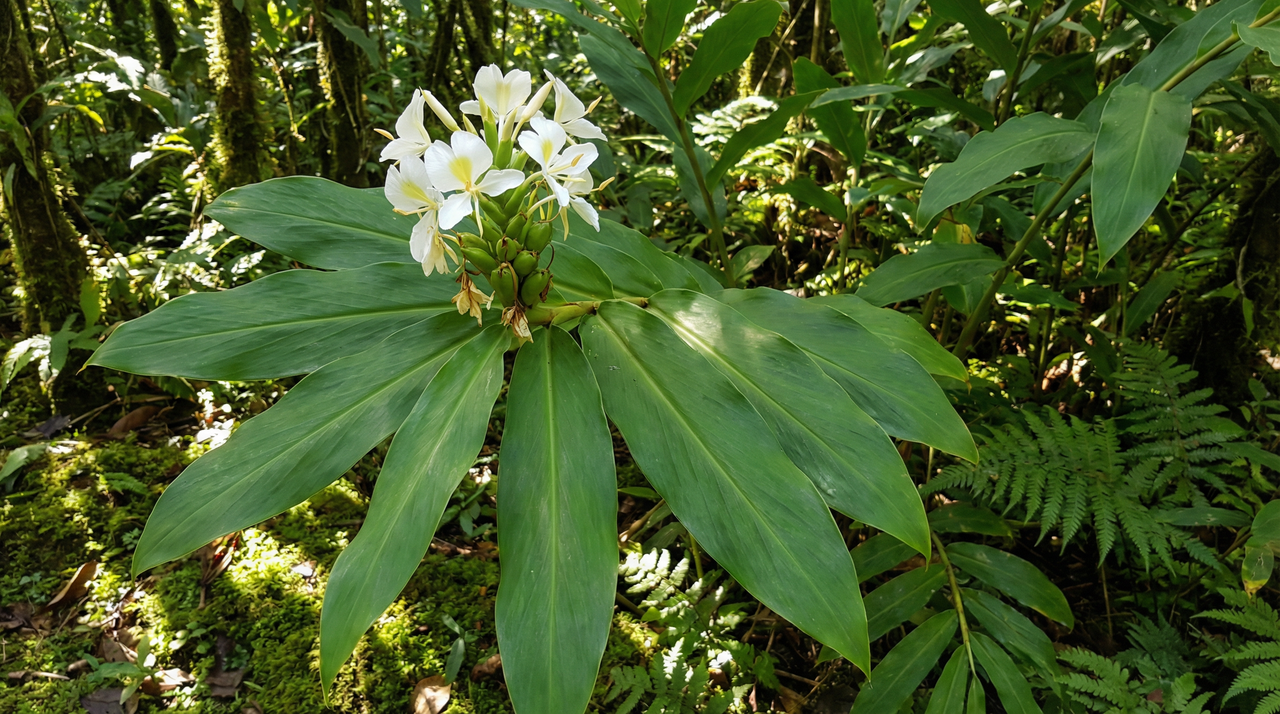
In the garden, ginger lily is unmistakably bold. Plants typically reach 1.5 to 2.5 meters tall with a spread of about 2 to 4 feet, putting on 2 to 3 feet of new growth in a single season.[10][11] The arching stems carry lanceolate leaves 20 to 60 centimeters long, arranged in two tidy ranks with parallel venation that gives the foliage a pleasantly structured, tropical look.[12] Then come the flowers: dense terminal spikes of 20 to 40 white blooms with yellow stamens, opening from summer into early fall, each one 5 to 8 centimeters long.[13][14] The fragrance is the thing. At dusk it drifts across the yard, sweet and spicy in a way that reads as gardenia crossed with jasmine, the kind of scent that stops you mid-step on an evening walk.
After flowering, the plant sets reddish-orange capsules holding black seeds with white arils that attract dispersers, which is part of what makes this plant so effective at spreading beyond where you put it.[15][16] The USDA lists it as a wetland indicator species, and its capacity to spread via both rhizomes and seed has earned it invasive status in Florida, Hawaii, parts of California, the southeastern U.S., and northern Australia.[17][18][19]
Traditional and Cultural Uses
Long before it became a garden escapee, ginger lily was a revered plant across Asia. Known as Shati in Ayurveda, the rhizomes appear in traditional Indian, Chinese, Nepalese, and Southeast Asian medicine for respiratory complaints like asthma and bronchitis, digestive troubles, rheumatism, fever, and wound care, with preparations ranging from decoctions to poultices made from the leaves.[20][21][3] As someone who's grown a lot of Zingiberaceae, the aromatic quality of fresh ginger lily rhizome is immediately familiar, pungent and resinous in a way that makes the medicinal tradition feel intuitive.
Culturally, it carries profound symbolic weight. The flower's white purity makes it a fixture in Hindu and Buddhist rituals, woven into garlands and offered in ceremonies across India, Thailand, Indonesia, Malaysia, Bali, and the Philippines.[22][23][24] In Hawaii and Fiji, where it arrived around the 1850s, it became a popular lei flower for weddings and hula.[25] Burmese folklore associates it with attracting benevolent spirits and protection. The plant also found its way into the fragrance industry and, via the Ming Dynasty trade routes, into Chinese medicine and perfumery, with roots in Ayurvedic texts reaching back to roughly the first century CE.[26][27]
Fun Facts and Invasive Status
Here's the part I always bring up with clients before they fall completely in love with this plant: those same persistent rhizomes that made it a valued remedy and a sacred garland flower are exactly what make it a serious ecological problem outside its native range. In Florida it holds a Category I invasive listing from FLEPPC, meaning it's documented to alter native plant communities; Hawaii and Washington State classify it as noxious; Queensland, Australia prohibits its sale and cultivation outright.[28][19][29] I check those FLEPPC lists before I spec any ornamental in my zone 9B designs, and ginger lily is the kind of plant that always gives me pause near a drainage ditch or stormwater swale. One escaped rhizome fragment is genuinely all it takes. The same rhizomes that produce generations of Ayurvedic medicine and lei flowers can form dense monocultures that crowd out native vegetation and clog waterways.[17][30] That tension between ecological treasure and ecological liability runs through everything else I'll say about this plant.
Ginger Lily Varieties and Where to Buy Them
Notable Cultivars of Hedychium coronarium
White ginger lily earned its RHS Award of Garden Merit for good reason[31] -- the species delivers fragrance and tropical presence that few perennials can match. Beyond the straight species, gardeners have several cultivated selections to consider. 'Variegata' brings cream-striped foliage that earns its keep even between bloom cycles, particularly useful in shady corners that need visual lift. 'Alba' is a clean, pure-white-flowered form. 'Tara' runs noticeably shorter and more compact, which I've found makes a real difference if you're working with smaller beds or containers where the standard species would quickly crowd everything out. 'Sorority', 'Compactum', and 'White King' round out the lineup for those who want to explore the full range.[32][9]
One thing worth getting straight before you start searching: there are no confirmed 'Pink' or 'Gold' cultivars of Hedychium coronarium. Those flower colors belong to related species like H. gardnerianum (kahili ginger) or H. flavum, not to white ginger lily itself. If a vendor is listing a pink or gold-flowered H. coronarium, that's a red flag. The cultivated forms of the species are also generally less aggressive than wild-type plants, which matters a great deal once we get to the invasiveness conversation below.
Sourcing Ginger Lily Plants, Rhizomes, and Seeds
Hedychium coronarium is available from online specialty nurseries, garden centers, and seed banks across the US in three forms: rhizomes, established plants, and seeds.[33][34] Rhizomes are the preferred starting point for most gardeners -- they establish quickly, ship as dormant material in late winter through early spring, and typically run $8 to $25 each.[34] Look for firm, disease-free pieces without soft spots. Established plants cost $15 to $40 depending on size, while seed packets (usually 10 to 25 seeds) come in around $5 to $15 from specialized seed banks, though seeds need soaking or scarification to germinate reliably and are a slower path to your first bloom.[34]
Here's where the sourcing story gets complicated, and I say this as someone gardening in Central Florida where I've watched naturalized colonies of this plant crowd out native vegetation along drainage canals. Florida lists H. coronarium as a Category I invasive.[35] Hawaii prohibits it outright, meaning sale and propagation are illegal there.[36] Louisiana also restricts it,[37] and it appears on the invasive plant radar across much of the humid Southeast.[38] California sits in a grayer zone -- it's on the Cal-IPC watch list but isn't fully classified as invasive there, and out-of-state shipping still requires compliance with CDFA plant quarantine rules.[39] Gardeners in Colorado and New York currently face no state-level restrictions,[40][41] and the USDA does not list it as a federal noxious weed.[42] My habit before ordering any regulated plant is to call the nursery directly and confirm they'll ship to my zip code -- reputable vendors already screen for this, but it's worth verifying yourself.[38] State agriculture department websites are the definitive source for current rules, and they do change.
Propagating and Planting Ginger Lily (Hedychium coronarium)
When I want more ginger lily in my food forest, I reach for a shovel, not a seed packet. Rhizome division is faster, more reliable, and keeps all the traits you love about the parent plant intact. I divide established clumps every 3-4 years in early spring before new growth really gets going, lifting the whole mass and splitting it into sections that each carry at least 2-3 buds and a decent set of roots. Replant the divisions at roughly the same depth they were growing, and you've also rejuvenated the original planting, which tends to get crowded and bloom less freely if left alone too long.[43][9][44] One thing that reassured me when I started dividing hedychiums is that the new shoots emerge looking remarkably like robust iris fans. If your divisions seem quiet for several weeks, don't panic. I've learned to wait a full 4-6 weeks before writing them off as failures.
Choosing Your Propagation Method: Rhizome Division vs. Seed
In my permaculture work, divisions are what I turn to when I need to fill a canopy gap or establish a new guild planting quickly. The 1-2 year timeline to first bloom means the plant is doing useful work in the ecosystem far sooner than any seedling could manage. Seeds have their place, but it's a niche one. The germination window of 2-12 weeks under ideal conditions is manageable; the 3-5 years to a flowering plant is the part that tests most gardeners' patience.[45][44]
There's also the matter of uniformity. Seed-grown plants are genetically variable, partly because of polyembryony (multiple embryos per seed), so you won't necessarily get what you started with.[46] And many naturalized populations outside the native range are sterile triploids anyway, producing no viable seed at all, which makes rhizomes the dominant reproductive strategy in most gardens.[47][48] If you're in a region where the species is invasive, that sterility is actually a small mercy since the plant spreads aggressively via rhizomes regardless.
Understanding Ginger Lily Seeds: Morphology, Behavior, and Challenges
If you do have access to fresh seed, it's worth understanding what you're working with before you try to store it. The seeds are small ellipsoid capsules, 4-6 mm long, with a shiny black coat (testa) and a fleshy white-to-red aril that normally attracts ants and birds for dispersal.[46][49] Each globose capsule holds 20-50 of them. They're recalcitrant seeds, meaning they're desiccation-sensitive and lose viability quickly, typically within 6-12 months under even modest storage conditions.[50] I lost several batches in my early experiments by trying to dry and store them the way I would tomato seeds. Now I sow any fresh seed immediately.
For best results, scarify the seeds lightly or soak them in warm water for 24-48 hours before sowing. Germination rates range from 20-90% depending on seed freshness, and the best results come in a sterile moist medium held at 75-85°F (24-29°C) with 60-80% humidity.[50][51] Gibberellic acid can improve germination rates if you want to experiment further.[52] A heated propagator with a lid does the job well. If you need to hold rhizomes short-term before planting, store them in perforated bags with slightly moist peat or vermiculite at 50-59°F (10-15°C) for up to 8-12 weeks.[44][53]
Soil, Site Selection, and Planting Technique
Ginger lily is native to moist riparian and forest understory habitats in the eastern Himalayas, often growing in alluvial or limestone-derived soils at elevations up to 2,400 meters.[54] That native context tells you almost everything you need to know about its soil preferences: humus-rich, consistently moist, but never waterlogged. I've seen rhizomes rot in heavy clay that looked well-intentioned on the surface, and it's the same rot I encounter with cannas and other Zingiberaceae when drainage isn't what it needs to be. The fix is always the same: amend generously with compost (20-30% by volume) or use a sandy loam that holds moisture without compacting.[43][55]
Soil pH should sit between 5.5 and 7.0, and the bed needs at least 12 inches of workable depth, with 24-36 inches ideal for rhizomes to expand properly over time.[43][56] For containers, a mix of roughly 50% peat or coco coir, 30% perlite or coarse sand, and 20% compost gives the drainage ginger lily needs while still holding enough moisture between waterings.[9] The plant grows best in USDA zones 8-11 and prefers 4-6 hours of direct light with afternoon shade in hot, dry regions, mimicking the dappled light of its native forest floor.[9][43] Where moisture is consistently high, it handles fuller sun without complaint. My own simple drainage test before planting: dig a hole about 12 inches deep, fill it with water, and check back in an hour. If standing water is still there, the site needs work before a rhizome goes in.
Spacing, Timeline, and Establishment Expectations
Plant rhizomes 2-4 inches deep after the last frost in spring, spacing them 18-24 inches apart with 3-4 feet between rows.[43][9] That spacing accommodates the 6-8 foot mature height and keeps air circulating freely around the stems, which matters in humid summers. In my guild plantings in Central Florida, I use the 24-inch spacing consistently so the tall canes don't shade out lower-layer companions. In cooler edge zones, wider spacing helps the clumps harden off better going into winter. I always label fresh divisions, because young ginger lily shoots look similar enough to other Zingiberaceae in the ground that it's easy to confuse them if you're juggling multiple species.[57]
Germination and Growth Timelines
Rhizome divisions typically produce their first flowers within 1-2 years of planting.[58][55] Seed-grown plants spend 3-5 years in mostly vegetative mode before you'll see a bloom.[44] Unless I have a specific reason to work with seeds (a breeding experiment, fresh seed from a rare form, genuine botanical curiosity), I start with divisions or purchased rhizomes every single time. The timeline difference alone makes the choice obvious for most gardens. If you're growing in Florida, Hawaii, Queensland, or anywhere else where this species is documented as invasive, keep that rhizome spread in mind from day one. The responsible path is to plant in contained beds or containers and monitor edges seasonally, not as an afterthought.
Ginger Lily Care Guide
Every care decision you make with Hedychium coronarium flows from the same question: what does a humid tropical riverbank feel like, and how close can you get to that in your garden? That's not a poetic abstraction. It's the practical logic behind every recommendation below, from where you place it to when you stop feeding it in autumn.
Sunlight Requirements for Ginger Lily
Ginger lily evolved in shaded forest understories and along dappled riverbanks, which means it doesn't need full sun to perform beautifully. The sweet spot is morning sun with afternoon shade, and at least 4-6 hours of direct light for reliable flowering.[9][43] One thing I wish someone had told me early on is how quickly you can diagnose a poor placement just by looking at the growth habit. Plants in too much shade get leggy fast, with pale, yellowish foliage and almost no flowers.[43][9] The plants I grow in morning-sun beds are compact and floriferous; the ones I tucked into deeper shade reach for the sky and rarely bloom. Flip the problem the other way and excessive sun brings its own trouble: scorched, bleached leaves and persistent wilting, especially when humidity drops.[43] The plant's sun tolerance does increase with soil moisture, so if you're determined to grow it in a brighter spot, keeping the roots consistently wet gives you more flexibility.
Watering Needs and Soil Moisture Management
Consistent moisture without sogginess is the non-negotiable rule. During active growth from spring through fall, ginger lily wants 1-2 inches of water per week, applied deeply when the top inch or two of soil feels dry.[9][43] I keep 2-4 inches of mulch over the root zone year-round; it moderates temperature, holds moisture, and means I'm watering far less often in summer.[59] The plant has low drought tolerance, and stress shows up quickly. Go about a week or more without water and you'll see wilting and leaf scorch, followed by reduced flowering if the stress continues.[59][60]
In my experience, the first sign of overwatering is yellowing leaves with soft, mushy stems near the base; underwatering looks different, more like browning tips and dry, cracked soil pulling away from the pot or bed edge.[61][50] I also collect rainwater specifically for mine. Hedychium is sensitive to chlorine and high salt loads, and I've seen leaf-tip burn appear within a few weeks of switching back to city tap water during a dry spell.[61] Target a soil pH of 5.5-7.0 and reduce watering significantly once the plant enters winter dormancy; wet, cold roots are a fast track to rhizome rot.[61]
Feeding and Fertility for Ginger Lily
This is a heavy feeder. During the growing season a balanced fertilizer like 10-10-10 or 20-20-20 applied every 2-4 weeks keeps growth strong and flowers coming; switch to a higher-phosphorus formula during the bloom period and stop feeding entirely by mid-autumn.[45][59][50] If you prefer organic inputs, compost, well-rotted manure, and fish emulsion all work well; they feed more slowly but also reduce the salt buildup that synthetic fertilizers can cause over time.[62][63] Container plants need more frequent applications because nutrients leach out with every watering.
Learning to read deficiency symptoms has made me a much better grower of this plant. Yellowing on older, lower leaves usually signals nitrogen deficiency; purplish-tinged leaves with poor bud development points to phosphorus. I watch the young leaves most closely, because interveinal chlorosis on new growth is a classic sign of iron deficiency, and I've seen it appear within a few weeks of switching to a high-phosphorus bloom booster that locks out iron in my slightly alkaline beds.[50][45] Flush the soil periodically and always water thoroughly after applying any granular fertilizer to prevent salt injury.
Frost Tolerance and Winter Protection
Hedychium coronarium evolved in tropical Southeast Asian forests where winter lows stay around 50-59°F (10-15°C) and frost simply doesn't happen.[1] That context explains why foliage collapses at 28°F (-2°C) and why even a mild freeze produces wilting, blackened stems, and total aerial dieback.[9][32] The good news is the rhizomes are considerably tougher than the tops; they can survive down to around 20°F (-7°C) when properly insulated.[9] That's the part worth protecting. The plant is reliably hardy in USDA zones 8-11, marginally so in zone 7 with consistent effort.[9][32]
My go-to ginger lily winter care once frost kills the tops is to apply 8 inches of oak-leaf mulch over the crown; that depth has reliably brought my rhizomes through zone 8-type dips to around 22°F (-5.5°C) without any digging.[9][64] In colder areas, dig the rhizomes after the first frost and store them indoors at 50-60°F. Avoid any spot with wet, poorly drained soil through winter; that combination of cold and moisture is what actually kills rhizomes, not cold alone.
Heat Tolerance in Warm Climates
Ginger lily thrives in daytime temperatures of 70-85°F (21-29°C) with nights around 55-65°F (13-18°C), a range that mirrors its humid Southeast Asian origins where annual rainfall runs 1500-3000 mm.[9] It sits comfortably in AHS Heat Zones 7-11 and tolerates up to 95°F (35°C) when moisture stays consistent, but prolonged heat above 104°F (40°C) reduces both growth and flower production, particularly in seedlings and plants that are actively blooming.[9][65]
Heat stress looks a lot like drought stress: persistent wilting despite adequate water, scorched leaf margins, dropped flower buds, and a general loss of vigor.[66][67] In a hot, humid climate like Central Florida, the combination of afternoon shade and 3-4 inches of mulch over the root zone makes the difference between lush, productive foliage and a plant that limps through July and August. A 30-50% shade cloth during the worst heat waves gives you the same protection.[66] Established rhizomes handle extremes far better than young transplants, so if you're getting plants into the ground in summer, shade them hard for the first few weeks.
Pruning, Maintenance, and Seasonal Rhythm
Caring for a ginger lily follows a clear seasonal rhythm once you understand what the plant is doing underground. In late winter or early spring, as new shoots begin pushing up, cut any frost-damaged stems and dead foliage to ground level; I wait until I actually see those first green nubs before I cut, because it's a satisfying confirmation that the rhizomes made it through.[68][10] Through summer, deadhead spent blooms to encourage continued flower production and thin any overcrowded shoots to improve airflow. Tall stems in exposed sites benefit from staking; they will flop in wind and the stem damage can set back flowering. In autumn, build your mulch layer up to 4-6 inches before the first frost if you're in zone 8, and let the plant prepare for dormancy by stopping fertilizer and reducing water.[68]
How the plant behaves through the year depends entirely on where you're growing it. In tropical and subtropical climates it stays evergreen, with near-continuous growth and flowering that peaks during the wet season.[9][69] In cooler regions the whole plant dies back to the rhizomes in winter and resprouts in spring; flowering typically runs July through October.[9] I've found that rhizomes protected with deep mulch push new shoots within 2-3 weeks once soil temperatures stabilize around 65°F, which is the cue I actually wait for rather than the calendar date. Once you see that growth, it's safe to resume watering and start your first light feeding of the season.
Ginger Lily Harvesting: Timing, Technique, and Flavor
When to Harvest Ginger Lily Flowers, Rhizomes, and Seeds
The flowering window for ginger lily runs from late summer through early fall in temperate climates, with peak bloom typically falling in July through September.[58][12] In warmer zones, that extends from June well into October, and in consistently tropical conditions the plant may flower even longer. I've learned to watch the buds closely as that window opens, because the plant signals its readiness better than any calendar can. A gradual intensifying of that honey-jasmine fragrance through the day means the flowers are close; you'll notice buds showing a blush of white and just beginning to unfurl.
For cut flowers, don't wait for full open blooms. Harvest at roughly one-third to one-half open and you'll get dramatically longer vase life.[70][71] If you're harvesting to eat the petals fresh, a fully opened flower is fine and actually delivers more flavor. Rhizome harvest is a different rhythm entirely: wait until after flowering when the foliage is dying back in late fall, then dig for firm, dense pieces with brownish skin that indicate full maturity.[70][71] Seed pods are a distant third consideration; they mature 60 to 90 days after flowering and are ready when brown and papery,[72][1] but honestly, I only bother with seed collection when I'm saving material for someone else's garden.
Proper Harvesting Techniques and Post-Harvest Care
Early morning is non-negotiable for cut flowers. After several seasons growing these in Central Florida's humidity, I've found the dew-damp stems cut in the first hour after sunrise stay turgid longer and carry the most fragrance. Use sharp shears and cut at a 45-degree angle above a node, keeping stems 12 to 18 inches for the vase.[50][73] Place them immediately into warm water around 110°F with a floral preservative; that thermal shock keeps the stems drinking efficiently rather than sealing off at the cut.
Rhizome harvest calls for a different kind of patience. I wait for a genuine dry spell in late fall after the leaves have fully collapsed, because digging too early yields soft, immature pieces that don't divide or cure as reliably. Carefully lift the whole clump to avoid slicing through rhizomes you want to keep for replanting. After digging, cure the pieces in a shaded, well-ventilated spot at roughly 77 to 86°F with moderate humidity for 7 to 10 days.[50][53] That curing step seals cut surfaces and prevents rot, and skipping it is how people lose a season's worth of divisions to mold.
Flavor, Aroma, Yield, and Vase Life of Ginger Lily
The flowers are the real reward here, both sensory and culinary. The petals carry a mild ginger-like flavor with sweet floral and citrus undertones,[74] far gentler than true culinary ginger (Zingiber officinale), which has a sharp heat these petals simply don't. Having cooked with both, I'd describe ginger lily's edible flowers as something closer to a perfumed garnish than a seasoning. The aroma is intensely sweet with prominent honey and jasmine notes, a subtle spicy undertone, and a lingering finish that can read as slightly minty.[75][76] Use them fresh; light heat is fine but prolonged cooking erases the delicate character entirely.
The rhizomes have their own spicy-earthy scent driven by compounds like 1,8-cineole, linalool, and geraniol,[75] but the flavor tends toward bitterness and can be irritating, so I treat them as a propagation and medicinal resource rather than a kitchen ingredient. For cut flower yield, expect production to begin in earnest during the second year once a clump is established.[44] A mature clump can be genuinely generous with stems. With proper handling including storage around 53 to 59°F and a preservative solution with 2% sucrose, those stems will last 7 to 14 days in the vase.[73][77] I've consistently landed at 10 to 12 days on my own stems when I'm disciplined about that warm initial soak and avoiding ethylene sources nearby.
Ginger Lily Preparation, Culinary Uses, and Medicinal Applications
Edible Parts and Culinary Uses of Hedychium coronarium
The flowers are where ginger lily earns its place in the kitchen. Those delicate white blooms have been used for generations across Thailand, India, and Indonesia in fresh salads, light stir-fries, and as garnishes, offering a flavor that I'd describe as ginger's gentler, more floral sibling: subtly sweet, lightly spiced, with none of the sharp heat you get from true culinary ginger.[21][78] Young shoots and immature seed pods are also eaten as vegetables in some Asian cuisines, and the broad leaves serve as food wrappers for cooking, much like banana leaves.[21][79] The shoots remind me of very tender asparagus tips or young ginger sprouts, best harvested early before any bitterness sets in. Use them fresh, blanch them briefly, or steep the flowers into teas to preserve that delicate character.[80]
The rhizome is a different story. It has a citrusy, spicy profile that becomes more aromatic with heat, but it tends toward bitterness and can cause gastrointestinal irritation, which is why it rarely appears as a culinary ingredient.[81][3] If you're expecting a drop-in substitute for the ginger in your stir-fry, this isn't it. Stick with flowers and young shoots for cooking; the rhizome belongs to a different tradition entirely.
Traditional Medicinal Preparations and Safety Notes
In Ayurvedic and traditional Chinese medicine, the rhizome is respected precisely for the intensity that makes it unsuitable at the dinner table. Practitioners prepare it as decoctions, powders, and infusions to address inflammation, digestive complaints, asthma, and arthritis, while flower teas are used for anxiety, colds, and gentle digestive support.[82][83] Traditional dosage ranges include 50-100 ml of rhizome decoction twice daily or 1-3 g of powder, with ginger lily essential oil used topically at 1-2% dilution.[84][85] I've read enough of the research to say plainly: self-dosing with rhizome preparations is where people get into trouble. The same alkaloids and essential oils that drive the anti-inflammatory activity can irritate the gut if used carelessly. Consult a qualified practitioner before going anywhere near medicinal quantities.
Non-Food and Ornamental Uses of Ginger Lily
Before anything else, if you're in Florida, Georgia, Texas, or along the Gulf Coast, you need to sit with the fact that Hedychium coronarium is a Category I invasive species in these states, spreading aggressively through wetlands and forests via both rhizomes and seeds.[86][87] I grow mine in large containers here in Central Florida specifically to prevent rhizome escape. The blooms are gorgeous; contributing to wetland displacement is not worth it.
That said, as a cut flower it's genuinely stunning. Recut stems underwater at a 45-degree angle, treat with silver thiosulfate solution, and hold them at 10-12°C with high humidity using a citric acid and 8-HQS preservative solution, and you can expect 7-14 days of vase life.[88] I harvest mine in early morning when the scent is most pronounced, and they reliably become the talking point of any arrangement. Beyond the vase, the plant has a long ethnobotanical history spanning fiber production, natural dyes, cultural rituals, and ceremonial use across Asia and the Pacific, with leaves doubling as cooking wrappers throughout the region.[79][89] Appreciating those gifts and growing the plant responsibly are not mutually exclusive, but they do require intention.
Ginger Lily Health Benefits and Medicinal Uses
Most people discover Hedychium coronarium through the nose first, that sweet, jasmine-meets-ginger waft on a warm evening. But spend time with the research literature, as I have over years of growing and using this plant, and you start to appreciate that the same chemistry producing that fragrance is doing some genuinely interesting things in biological systems. The science is almost entirely preclinical at this point, with no human clinical trials yet completed, so I want to be clear upfront: this is a plant worth knowing and respecting, not self-prescribing.
Medicinal Research and Traditional Uses
The strongest case for ginger lily's medicinal potential sits squarely in the anti-inflammatory space. Lab and animal studies consistently show that rhizome extracts inhibit the NF-κB signaling pathway, suppress pro-inflammatory cytokines like TNF-α and IL-6, and block COX-2 and iNOS enzymes.[90][91][92][93] Across multiple peer-reviewed papers, a labdane diterpene called coronarin D keeps emerging as the primary driver of these effects, which is why I pay attention to rhizome maturity when harvesting for any experimental tea. The analgesic activity in rodent pain models aligns with the same pathways,[94][95] which helps explain why Ayurvedic and Traditional Chinese Medicine practitioners have used it for centuries under the name "Wang Jiang Nan" to address stomach pain, asthma, nausea, and inflammation.[96]
The antioxidant data is similarly compelling, with extracts activating the Nrf2 pathway, upregulating protective enzymes, and posting IC50 values of 25-50 μg/mL in DPPH and ABTS assays.[97][98] Antimicrobial work shows meaningful activity against Staphylococcus aureus, E. coli, and Candida albicans, with essential oils disrupting cell membranes and inhibiting biofilm formation.[99][100] Emerging areas include anticancer potential in HeLa and MCF-7 cell lines through apoptosis induction at IC50 values of 20-50 μg/mL,[101][102] and antidiabetic effects via GLUT4 translocation and α-glucosidase inhibition in diabetic rat models.[103] In my reading of the literature, the lab data is strong enough to respect the plant's power, but not yet strong enough to self-prescribe.
Key Phytochemicals in Ginger Lily
The "why" behind those bioactivities is a remarkably diverse chemistry. Rhizomes concentrate labdane diterpenes, including coronarins A through E, while flowers and leaves lean heavier on monoterpenes like 1,8-cineole (up to 40%), β-pinene, and linalool, alongside flavonoids like kaempferol and quercetin.[104][105][106][107] Growing conditions shift the balance considerably: higher altitudes and rainy seasons can push phenolic content up by 20-30%, and nitrogen-rich acidic loamy soils tend to enhance volatile production.[108][109] I've noticed this firsthand: rhizomes from my warm, humid Central Florida garden produce a noticeably milder tea than commercial dried samples, which matches what the research predicts about environment modulating phytochemical profiles. These compounds aren't just pharmacologically interesting; they're ecological tools too, helping the plant deter herbivores, attract moth pollinators, and suppress competing vegetation through allelopathy.[105][110]
Nutritional Profile
The flowers, rhizomes, and young shoots are all edible and have traditional use in Hawaiian and Southeast Asian cuisines,[111][112][113] but I wouldn't call this a nutritional powerhouse. Rhizomes contain roughly 6-8% protein, 20-25% carbohydrates, potassium around 300-400 mg per 100g, and modest vitamin C, while flowers contribute flavonoids with high phenolic content, around 28-45 mg GAE per gram.[114][115] These are approximate values from preliminary studies and not in the USDA database, so take them as directional rather than definitive. Like true ginger, the research is stronger on anti-inflammatory effects than on everyday nutrition, which is why I treat both sparingly in the kitchen and defer to professionals for therapeutic doses. Recommended serving sizes are small, 5-20 grams of fresh material, partly to enjoy the aroma without cooking it all off and partly because larger amounts of raw rhizome can irritate the gut.[111][116] Think of it as a lovely aromatic accent, not a daily vegetable.
Safety Considerations
Ginger lily carries a generally low toxicity profile for humans in small, processed amounts, but the rhizomes in particular contain irritant compounds including hedychenone, saponins, and volatile oils that can cause nausea, vomiting, and abdominal discomfort when eaten raw.[117][118] Skin contact with sap or essential oils is another concern; I've always advised friends with skin sensitivities to patch test before handling the plant extensively, because contact and photodermatitis have been documented in sensitive individuals, and pollen can act as an aeroallergen for some people.[119] If you're pregnant or on blood thinners, skip medicinal doses entirely; potential emmenagogue effects and antiplatelet activity make the risk-benefit calculus unfavorable.[120][121]
For households with pets, the news is more reassuring. The ASPCA classifies ginger lily as non-toxic to dogs, cats, and horses, with only mild GI upset possible in large quantities.[122] Our cats wander through the ginger lily bed regularly without any ill effects, which is consistent with that data. Worth noting: the cyanide concern that sometimes circulates around this plant isn't supported by its actual chemistry; the primary actives are labdane diterpenes and essential oils, not cyanogenic glycosides.[118] One final caution: look-alike species like Hedychium gardnerianum and Alpinia purpurata vary in both toxicity and invasiveness, so positive identification by the distinctive white flowers with protruding stamens matters before any culinary or medicinal use.[17][123]
Ginger Lily Pests and Diseases
Ginger lily holds up reasonably well against pests and diseases relative to others in the Zingiberaceae family, but "reasonably well" doesn't mean trouble-free. Push it into conditions it dislikes, and problems follow quickly. Humidity above 80 percent, poor drainage, waterlogged soil, and temperatures in the 25-30°C range are the primary triggers for most of what gardeners encounter.[124][125] In my experience growing gingers in humid subtropical conditions, the vast majority of problems I've seen traced back to one of those four factors. Get the site right and the plant largely looks after itself.
Common Fungal and Bacterial Diseases of Ginger Lily
Fungal leaf spots are the most frequent issue. Colletotrichum, Bipolaris, Curvularia, Cercospora, and Phyllosticta can all show up as circular to irregular brown necrotic lesions that expand and eventually cause leaf drop.[124][126] Powdery mildew produces white powdery patches; rust shows up as orange pustules on leaf undersides.[125] None of these are dramatic emergencies if you catch them early. I treat my pruning shears with a 10% bleach dip between every cut when I see leaf spot -- it's a small step that has kept problems from spreading in my own beds for years. Remove infected foliage promptly, bag it rather than compost it, and the outbreak usually stops there.
Root and rhizome rots are the more serious concern. Phytophthora and Pythium thrive in waterlogged soil and produce wilting, yellowing foliage, mushy roots with a foul smell, and sometimes full plant collapse.[127][128] Charcoal rot (Macrophomina phaseolina) is the opposite scenario: black sunken lesions appearing under warm, dry stress rather than wet conditions.[129] Bacterial soft rot (Erwinia) hits rhizomes under high humidity, while Ralstonia solanacearum causes rapid bacterial wilt.[124] Viral infections are rare enough in Hedychium that I'd treat any mosaic-pattern foliage with skepticism and rule out nutrient deficiencies first.[130]
No cultivars have been bred for high disease resistance; I've grown both the straight species and 'Alba' and found foliar disease pressure nearly identical once drainage is managed properly.[131] Cultural prevention is where the real protection lives: good spacing, well-drained soil, balanced fertility without excess nitrogen, and keeping water off the foliage.[132] When fungicide is genuinely needed, mancozeb or copper-based products address leaf spots, and metalaxyl targets Phytophthora, but always follow label instructions and exhaust cultural fixes first.[127]
Insect Pests and Natural Defenses
Ginger lily's essential oils, loaded with monoterpenes and sesquiterpenes like β-pinene, α-pinene, and linalool, actively repel and intoxicate many insects.[133] Leaf trichomes create a physical deterrent to feeding, and secondary metabolites including flavonoids and tannins interfere with insect digestion.[134][135] I've noticed that when I brush past the foliage in the garden and that sharp, medicinal scent releases, neighboring plants seem to carry fewer aphid clusters -- a small, sensory observation that lines up with the phytochemical data.
That said, aphids (clustered on new shoots), mealybugs, spider mites, thrips, and scale insects all show up under the wrong conditions.[136][124] Spider mites favor hot, dry spells; scale and aphids tend to surge when humidity is high and airflow is poor. After watching a spider mite outbreak tear through a crowded bed during a brutal humid summer, I now space plants at least three feet apart and hit the first sign of webbing with a strong morning hose-down. Root knot nematodes are a quieter threat, weakening plants gradually and setting the stage for secondary infections.[137]
The same cultural practices that reduce disease pressure also limit pest buildup. For active infestations, ladybugs handle aphid colonies well; insecticidal soap and neem oil cover most soft-bodied insects without heavy chemical intervention.[138][50] No pest-resistant cultivars are commercially available, so attentive monitoring matters more than any product you can buy.[12] A healthy plant in well-drained soil with good airflow is simply harder to colonize.
Ginger Lily in Permaculture Design
Every time I walk a new client through a Central Florida garden and they point to ginger lily with that look of pure want, I have to take a breath before I respond. Because the honest answer is complicated. Hedychium coronarium is genuinely beautiful, genuinely useful in some narrow ecological contexts, and genuinely one of the most aggressive wetland invaders in the state. It is listed as a Category I invasive in Florida and prohibited from sale and cultivation there, and it has caused similar damage in Hawaii, coastal Georgia, and other humid tropical regions where it escapes via rhizomes into natural areas.[139][140][141][142] I've watched it do exactly that in a wetland about a mile from where I garden, crowding out native ferns and sedges until the understory was a solid wall of ginger lily and nothing else. That image is never far from my mind when this plant comes up in a design conversation.
Climate and Hardiness Zones for Ginger Lily
The climate envelope that makes ginger lily thrive is the same one that makes it dangerous. It's genuinely adapted to the humid tropics, needing 60 to 80 inches of annual rainfall, relative humidity in the 70 to 90 percent range, and temperatures between 65 and 86°F to reach its full potential.[2][143] Those conditions also describe the exact landscapes it destroys when it escapes. Reliably hardy in USDA zones 8 through 11, it can take a brief dip to around 28°F before rhizome damage becomes a real concern, and foliage starts looking rough below 50°F.[144][12] In zone 8 it typically dies back to the ground in winter and returns from rhizomes if given a protective mulch layer; below zone 7, it's a rhizome-lifting situation.[55]
It wants moist, fertile soil and can handle partial shade to full sun, though afternoon shade in high-summer heat keeps the foliage from scorching.[32] The key thing I'd point out to any permaculture designer is that its wetland-edge origins are not incidental. That moisture-seeking, shade-tolerant, fast-rhizome-spreading biology is exactly why it naturalizes so effectively the moment it reaches a stream corridor or disturbed floodplain.
Ecological Functions and Guild Roles
I won't pretend the fragrance isn't extraordinary. Right at dusk, when I've worked near it in evening pollinator garden designs, the scent becomes almost intoxicating in a way daytime visitors never quite experience. That's not accidental. The flowers are specifically engineered for nocturnal sphingid moths, with corolla tubes up to 10 centimeters long and a fragrance and nectar production that peak after dark.[2][145] Swallowtail butterflies, long-tongued bees, and occasionally bats will visit too, but hawk moths are the primary partner.[2] In a contained night garden with the right warm, humid conditions, that's a genuine pollinator service worth acknowledging.
The plant also produces substantial biomass, and the cut stems and foliage are genuinely useful as mulch or compost material inside a managed system.[146] I've seen claims that it repels pests; I haven't found reliable evidence to support that, and in fact its ability to create dense habitat can shelter certain pest species.[147] Don't let that marketing language influence a design decision.
The harder truth sits in the peer-reviewed literature. When ginger lily escapes containment, it doesn't just spread; it restructures the soil. Invasion sites show shifts in soil microbial communities, specifically an enrichment of Actinobacteria and a suppression of Proteobacteria, alongside biodiversity losses, waterway clogging, and altered local hydrology.[148][149] Those aren't aesthetic problems. They're ecosystem-level restructuring events. That's why I won't install this plant in any client's in-ground garden bed in zone 9, regardless of how well-intentioned the design is.
Forest Layer Placement and Guild Design
In terms of where it physically sits in a food forest or polyculture planting, ginger lily belongs to the herbaceous understory layer. At 5 to 10 feet tall with sturdy self-supporting stems, it occupies the same vertical niche as something like Turk's cap or firespike here in Florida; a tall, clumping understory presence that works well at forest edges or along water features.[150][3] It tolerates dappled shade and spreads laterally through rhizomes to form dense clumps over time, which is what makes it visually effective and ecologically problematic in equal measure.
Its mycorrhizal associations with Glomeromycota aid its own phosphorus uptake, but in invaded areas those same associations can disrupt the native mycorrhizal networks that neighboring plants depend on.[151] Root exudates also carry allelopathic effects that shift soil bacterial communities in its favor.[152] In a contained pot or raised bed, you get the pollinator value and biomass yield without those cascading effects. In an open ground planting in a warm, humid climate, you're eventually creating exactly the problem the research describes.
My honest design recommendation: in zones 8 through 11, treat it as a container specimen only, or skip it entirely in favor of a non-invasive alternative that fills the same tall understory niche without the ecological liability.[146][153] The beauty is real. The risk is real. A good permaculture design doesn't ask you to pretend otherwise.
The Night I Cut an Armful and Brought the Garden Inside
I still remember standing at the kitchen sink at dusk, arranging stems of Ginger Lily I'd just cut, and realizing the whole house smelled different within minutes. That's a rare thing, a plant that changes the air of a room. I grow mine in a buried container, I watch it constantly, and I'd be lying if I said that felt like a burden; some plants are just worth the extra attention.
Sources 153
- Kew Royal Botanic Gardens - Hedychium coronarium ↩
- Hedychium coronarium - Wikipedia ↩
- Hedychium coronarium - Useful Tropical Plants ↩
- Flora of China - Hedychium coronarium ↩
- Plants of the World Online ↩
- Flora Indica ↩
- Invasive Species Compendium - Hedychium coronarium ↩
- Hedychium coronarium: Biology and Ecology ↩
- Hedychium coronarium - White Ginger Lily ↩
- Hedychium coronarium ↩
- Hedychium coronarium ↩
- Butterfly Ginger (Hedychium coronarium) ↩
- Hedychium coronarium ↩
- Hedychium coronarium ↩
- Hedychium coronarium - Germplasm Resources Information Network (GRIN) ↩
- Hedychium coronarium ↩
- White Ginger (Hedychium coronarium) ↩
- Hedychium coronarium ↩
- Florida Invasive Plant List - Hedychium coronarium ↩
- Hedychium coronarium: Traditional Uses and Phytochemistry ↩
- Ethnobotanical Uses of Hedychium coronarium in Nepal ↩
- Ethnobotanical Uses of Hedychium coronarium in Traditional Medicine ↩
- Cultural Uses of Ginger Lilies in Southeast Asia ↩
- Sacred Plants in Balinese Hinduism ↩
- Lei Making in Hawaiian History ↩
- Hedychium coronarium: Ethnobotany and Pharmacology ↩
- Ethnobotany of Ginger Family in China ↩
- Hedychium coronarium (butterfly lily) | CABI Compendium ↩
- Hedychium coronarium - Queensland Department of Agriculture and Fisheries ↩
- Invasive Species Compendium - Hedychium coronarium ↩
- Royal Horticultural Society - Hedychium coronarium ↩
- Royal Horticultural Society - Hedychium coronarium ↩
- Hedychium coronarium (White Ginger Lily) ↩
- Hedychium coronarium - White Ginger Lily ↩
- Florida's Most Invasive Species List ↩
- Prohibited Plants in Hawaii ↩
- Louisiana Recommended Invasive and Noxious Plants List 2018 ↩
- Invasive Plant Atlas of the United States - Hedychium coronarium ↩
- California Invasive Plant Inventory ↩
- New York State Invasive Species List ↩
- Colorado Noxious Weed List ↩
- Federal Noxious Weed List ↩
- Hedychium coronarium ↩
- Propagation of Ornamental Gingers ↩
- Growing Ginger Lilies from Seed ↩
- Hedychium coronarium ↩
- Plants Profile: Hedychium coronarium ↩
- Invasive Species Compendium - Hedychium coronarium ↩
- Flora of China - Hedychium coronarium ↩
- Propagation of Hedychium coronarium by Seeds ↩
- Germination Studies on Ginger Lilies (Hedychium spp.) ↩
- Germination and Seedling Development in Hedychium Species ↩
- Rhizome Storage and Propagation Techniques for Butterfly Ginger ↩
- Flora of China: Hedychium coronarium ↩
- Growing Ginger Lilies (Hedychium) ↩
- University of Florida/IFAS Extension: Hedychium coronarium ↩
- Royal Horticultural Society - Hedychium coronarium ↩
- Hedychium coronarium - Butterfly Ginger ↩
- Hedychium coronarium (White Ginger), University of Florida - IFAS Extension ↩
- White Ginger Lily Watering Tips ↩
- Hedychium coronarium Care Guide ↩
- Cultivation Guide for Hedychium coronarium ↩
- Hedychium coronarium - Missouri Botanical Garden ↩
- Winter Care for Tender Perennials ↩
- Heat Stress Responses in Tropical Ornamental Plants: Focus on Hedychium coronarium ↩
- Hedychium coronarium Fact Sheet ↩
- Ornamental Ginger (Hedychium spp.) ↩
- Hedychium coronarium ↩
- Hedychium coronarium ↩
- Hedychium coronarium - Plant Profile ↩
- Growing Hedychium coronarium in the Home Garden ↩
- Propagation of Hedychium coronarium ↩
- Postharvest Handling of Cut Flowers and Foliage ↩
- Culinary Applications of Hedychium Species ↩
- Chemical Composition and Antioxidant Activity of Essential Oil from Hedychium coronarium ↩
- Ethnobotanical uses of Hedychium species in the Himalaya: an overview ↩
- Vase Life Extension of Ginger Lilies ↩
- Edible Flowers: A Kitchen Companion ↩
- Ethnobotanical Survey of Medicinal Plants Used by the Tharus of Nawalparasi District, Nepal ↩
- Edible Ginger Lilies: Hedychium Species in Cuisine ↩
- Edible and Useful Plants of the Caribbean ↩
- Ethnobotanical Uses of Hedychium coronarium ↩
- Medicinal Plants of India - Zingiberaceae Family ↩
- Hedychium coronarium: A Review of Its Phytochemistry and Pharmacology ↩
- Ayurvedic Uses of Shati (Hedychium spicatum and coronarium) ↩
- Florida Exotic Pest Plant Council's List of Invasive Species ↩
- Invasive Plant Atlas of the United States ↩
- Postharvest Handling of Cut Flowers of Hedychium coronarium ↩
- Hedychium coronarium - Plants of the World Online ↩
- Pharmacological Activities of Hedychium coronarium: A Review ↩
- Anti-inflammatory Effects of Hedychium coronarium via NF-κB Pathway ↩
- Anti-inflammatory effects of coronarin D from Hedychium coronarium ↩
- Anti-inflammatory activity of Hedychium coronarium ↩
- Anti-inflammatory and Analgesic Effects of Hedychium coronarium Rhizome Extract ↩
- In Vivo Evaluation of Hedychium coronarium in Inflammatory Models ↩
- Medicinal Plants in China: Hedychium coronarium ↩
- Antioxidant Mechanism Involving Nrf2 in Hedychium coronarium ↩
- Antioxidant and antimicrobial properties of Hedychium coronarium ↩
- Antioxidant and Antimicrobial Properties of Essential Oil from Hedychium coronarium ↩
- Essential Oil Composition and Antimicrobial Activity of Hedychium coronarium ↩
- Anticancer Potential of Hedychium coronarium through Apoptosis ↩
- Cytotoxic Activity of Essential Oil from Hedychium coronarium ↩
- Antidiabetic Effects of Hedychium coronarium on Insulin Signaling ↩
- Chemical Constituents and Biological Activities of Hedychium Species ↩
- Secondary Metabolites from Hedychium coronarium and Their Bioactivities ↩
- Phytochemical Analysis of Hedychium coronarium Koenig Essential Oil ↩
- Phytochemical and Pharmacological Profile of Hedychium coronarium ↩
- Influence of Altitude on the Essential Oil Composition of Hedychium Species ↩
- Seasonal Variation in Phenolic Content and Antioxidant Capacity of Hedychium coronarium ↩
- Allelopathic Effects of Hedychium coronarium on Seed Germination ↩
- Edible and Useful Plants of Hawaii ↩
- Zingiberaceae: Hedychium coronarium ↩
- Culinary Uses of Ginger Lilies in Southeast Asia ↩
- Nutritional and Phytochemical Evaluation of Hedychium coronarium Rhizome ↩
- Phytochemical and Pharmacological Profile of Hedychium coronarium ↩
- Nutritional Composition of Some Underutilized Rhizomes in Nigeria ↩
- Hedychium coronarium ↩
- Comprehensive Review on Pharmacologically Active Phyto-Constituents from Hedychium species ↩
- Contact Dermatitis from Plants in the Zingiberaceae Family ↩
- Medicinal Plants in Pregnancy - Safety Concerns ↩
- Antiplatelet and antibacterial activities of Essential Oils from Hedychium coronarium ↩
- Toxic and Non-Toxic Plants: White Ginger | ASPCA ↩
- Chemical Composition of Hedychium coronarium and ADME/Tox Properties of Major Compounds ↩
- Diseases and Pests of Ornamental Ginger (Hedychium spp.) ↩
- Diseases of Ginger Lilies ↩
- Fungal Diseases of Ginger and Ornamental Relatives ↩
- Diseases of Ginger and Management ↩
- Hedychium coronarium: Biology and Pathology ↩
- Diseases of Ginger and Allied Spices ↩
- Bacterial Wilt Disease in Ornamental Plants ↩
- Diseases of Ornamental Ginger Species ↩
- Hedychium coronarium (Butterfly Ginger Lily) ↩
- Chemical Composition and Insecticidal Activity of the Essential Oil of Hedychium coronarium ↩
- Plant Trichomes: Defense Against Herbivores and Opportunities for Pest Management ↩
- Secondary Metabolites from Hedychium coronarium and Their Biological Activities ↩
- Insect Pests of Ornamental Ginger Lilies ↩
- Managing Pests on Butterfly Ginger ↩
- Integrated Pest Management for Ornamental Plants ↩
- White Ginger (Hedychium coronarium) ↩
- Florida Exotic Pest Plant Council - List of Invasive Species ↩
- Invasive Plant Atlas of the United States ↩
- Hawaii Invasive Species Council - Most Invasive Plants ↩
- Hedychium coronarium | Plants of the World Online | Kew Science ↩
- Hedychium coronarium ↩
- Pollination Biology of Hedychium coronarium (Zingiberaceae) in India ↩
- Gardener's Guide to Hedychium ↩
- Biodiversity Project: Hedychium coronarium ↩
- Soil Microbial Community Changes Associated with Hedychium coronarium ↩
- Ecological Impacts of Hedychium coronarium Invasion in Tropical Ecosystems ↩
- Hedychium coronarium ↩
- Mycorrhizal Associations in Invasive Hedychium coronarium and Their Role in Invasion Ecology ↩
- Allelopathic Effects of Hedychium coronarium on Soil Microbes and Nutrient Dynamics ↩
- Ecological Impacts of Hedychium gardnerianum and Hedychium coronarium in Tropical Forests ↩