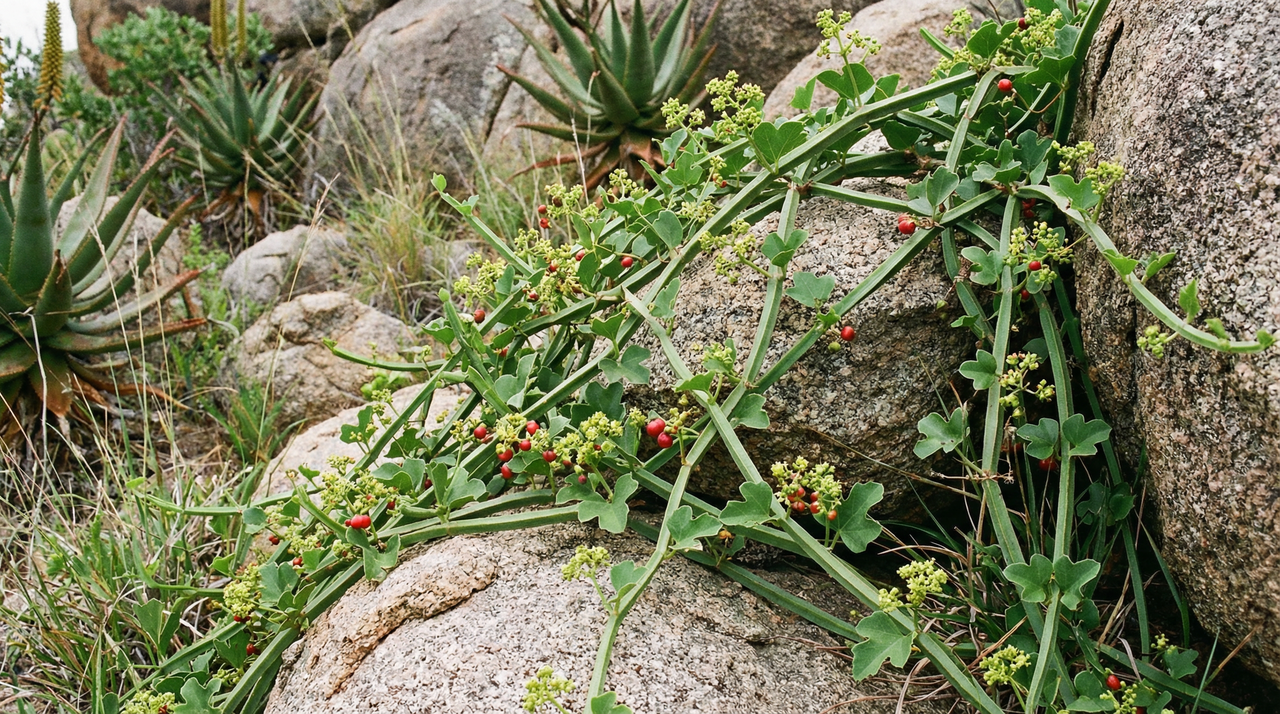
Nobody expects a plant named "Grape Ivy" to have spent three thousand years setting broken bones. But here we are. Cissus quadrangularis shows up in Ayurvedic texts from around 1000 BCE under the name Asthisamharaka, which translates, with zero ambiguity, to "that which unites broken bones,"[1] and modern clinical trials are now confirming fracture union rates up to 30% faster in patients using it.[2] Meanwhile, most people growing it in the West are treating it as a trailing houseplant with interesting square stems, completely unaware they've got one of traditional medicine's most researched bone-healing vines sitting in a decorative pot by the window.
Those stems are the tell. Pick up a cutting and you'll feel it immediately: four hard, succulent edges running the length like a green architectural column, thick with stored water and bioactive compounds that explain every traditional use the plant has accumulated across arid Africa, India, and the Arabian Peninsula. I've grown this vine in humid subtropical gardens and bone-dry indoor setups, and it performs with the same stubborn vitality either way. That resilience isn't incidental. It's the whole story.
Grape Ivy Origin, History, and Botanical Background
Most people hear "grape ivy" and picture a trailing houseplant in a hanging basket, which is usually Cissus rhombifolia. But the species that carries the deeper story, the one with centuries of documented medicinal use and a truly remarkable biology, is Cissus quadrangularis, also sold under the grape ivy common name and sometimes called Veldt Grape or Devil's Backbone. The grape ivy scientific name breaks down simply: Cissus from the Greek for ivy, quadrangularis for its defining feature, those four-angled, fleshy stems with raised ridges running their full length.[3] The physical structure of the stems perfectly illustrates this botanical naming. I noticed this the first time I rooted cuttings in my Florida garden, how the stem walls were already thickening with stored water within weeks of striking.
Botanical Characteristics and Native Range
This grape ivy vine is native to tropical and subtropical Africa (including Madagascar), the Arabian Peninsula through Yemen and Oman, and across South Asia into India and Sri Lanka.[4][5] A member of the Vitaceae family, it's a perennial succulent climber that can persist for ten to twenty years or more in favorable conditions, flowering and setting fruit repeatedly across its long life.[6] Reproduction happens through seed or stem cuttings, and the plant has an almost stubborn regenerative ability: even after fire, grazing, or heavy harvest, new growth pushes from nodes, fallen stem segments, and tuberous roots.[7]
That square stem isn't just visually distinctive. It's a water-storage organ, part of what allows the plant to endure annual rainfall as low as 500 mm and thrive in sandy or rocky soils across a wide pH range.[8][9] Globally, the species is assessed as Least Concern, but that designation doesn't tell the whole story.[10] I've seen wild stands in drier parts of the tropics become noticeably sparse where local collection for the medicinal trade runs heavy; vegetative propagation makes it simple to grow responsibly at home rather than drawing from those pressured populations.[10]
Traditional and Cultural Uses of Hadjod
The Ayurvedic record places this plant among the oldest documented medicinal vines we know of. The Charaka and Sushruta Samhitas, compiled somewhere between 1500 and 1000 BCE, prescribe it under the name Asthisamharaka or Hadjod, literally "bone joiner," for fractures, inflammation, and musculoskeletal complaints.[11][12] Once you hold a mature stem, that nickname makes immediate sense: the segmented, scaffolding-like structure looks almost anatomical, like something designed to support and knit.
Across sub-Saharan Africa, the Khoikhoi, Zulu, and Xhosa peoples used it independently for pain relief, wound healing, and spiritual purification; in Madagascar, it appears in both bone treatments and aphrodisiac preparations.[13][14] Human trade carried it far beyond those origins, and it's now naturalized across tropical and subtropical Americas, Australia, and Pacific islands.[15] Symbolically, the four-sided stem carried meaning too: used in Indian wedding garlands representing enduring love and in African initiation ceremonies for its toughness, the square geometry read as stability across very different cultural frameworks.[16] Young stems were eaten raw or cooked during famines across India and Africa, their texture crisp and slightly succulent when lightly steamed, a fact that surprised me the first time I tried one.
Fun Facts and Folklore
The grape ivy description in most field guides undersells how dynamic this plant actually is. The small greenish-white flowers arrive in umbels and are followed by berries that ripen from green through red to purplish-black, about the size of a large pea, with a juicy, slightly acidic flavor that genuinely earns the "grape" in its common name.[3][17] The leaves drop readily under drought stress, a feature that initially reads as decline but is actually the plant offloading surface area to conserve water, probably through CAM photosynthesis, while the stems carry on regardless.[18]
Beyond the garden, it serves as livestock fodder, erosion control on exposed veldt slopes, and shelter for insects and birds moving through dryland corridors. The common names it's collected across its range, Veldt Grape, Devil's Backbone, Hadjod, Square-stemmed Vine, each point back to the same four-angled stems that defined how every culture encountered and understood it.[19] That four-angled geometry directly enables the survival strategies that define the plant.
Grape Ivy Varieties and Where to Buy Cissus quadrangularis
There are no formally recognized horticultural cultivars of Cissus quadrangularis. Cissus quadrangularis is grown almost exclusively as a single species, with natural morphological variation across its range but no formally recognized horticultural cultivars to speak of.[20][21] For a plant with such a rich medicinal and ecological history, that's actually kind of refreshing. You're not chasing down the right SKU. You're just finding a healthy plant.
Notable Varieties of Grape Ivy
The one form worth knowing about is 'Variegata,' a variant with cream or yellow margins along the leaf edges. It's not formally registered as a cultivar, but it does show up occasionally in the specialty trade. I've grown it alongside the standard green type, and the variegated form is noticeably slower out of the gate. Beautiful, but less vigorous in the early months. That slower growth matters if you're establishing a food-forest edge quickly, so I usually recommend the plain green species for functional plantings and save 'Variegata' for containers where I want the visual interest.
You may also see names like Cissus quadrangularis var. indica or Cissus succulenta listed on plant tags or botanical databases.[20] These are taxonomic synonyms, not separately available selections. There's nothing to hunt down or compare. The natural variation in stem squareness and foliage color across populations is more useful for matching a plant to its intended guild role than any of these names suggest.
Sourcing Grape Ivy Plants, Cuttings, and Seeds
Don't bother checking the garden center. Cissus quadrangularis isn't a mainstream retail plant, so your shopping will happen online through specialty nurseries and exotic plant sellers. Etsy, Amazon, Logee's Greenhouses, Mountain Crest Gardens, and Plant Delights Nursery are your most reliable starting points, with most stock shipping from growers in Florida or California. I check Logee's and Mountain Crest each spring specifically because their plants arrive already acclimated to humid subtropical conditions close to my own zone 9B garden, which cuts down the establishment stress considerably.
Seeds typically run $8 to $20 per pack for a small handful of seeds, cuttings go for $10 to $30 depending on size and vigor, and small potted plants land somewhere between $15 and $40. After years of ordering, I've settled on cuttings as my preferred starting point. Seeds are slow and uncertain, and the variegated form in particular doesn't come true reliably from seed. A vigorous cutting roots in two to four weeks and gets you to a usable, harvestable plant much faster. If you're sourcing internationally, make sure you understand the import regulations for your country before you order; domestic trade within the US is unrestricted and straightforward. Availability is consistent for succulent enthusiasts and tends to peak in spring, so that's when I do most of my sourcing. Starting with healthy, true-to-type material is especially worth the effort if you're growing this plant for teas or extracts rather than just as a climber.
Grape Ivy Propagation and Planting Guide
If you've ever tried to grow a plant from seed and wondered why some species just don't cooperate, Cissus quadrangularis will give you a thorough education. Technically, yes, you can grow it from seed. Practically speaking, almost nobody does, and once you understand the biology, you'll see why.
Seed Morphology, Dormancy, and Why Cuttings Are Preferred
The seeds themselves are small and tidy: ellipsoid to ovoid, just 3-5 mm long, with a thin dark brown coat marked by a subtly wrinkled, reticulate surface.[22][23] Pretty in a botanical-illustration kind of way. The problem starts with that coat: it's physically impermeable, which means seeds exhibit hard-coat dormancy and won't germinate reliably without scarification or 2-4 weeks of cold stratification.[24] Then there's the dioecious issue: Cissus quadrangularis produces separate male and female plants, and fruit set requires insect-mediated cross-pollination.[25] In practice, because most garden plants are propagated vegetatively, you're rarely dealing with both sexes in the same collection. Seed is mostly a theoretical option.
Even under optimal conditions with proper scarification (warm water soak for 24 hours, or a gentle nick to the coat), germination rates run 20-60%.[26][24] Compare that to stem cuttings, which root at 80-95% success rates.[27] Seeds also introduce genetic variability, which matters if you're breeding but not if you want to preserve a particular plant's traits. If you do have seeds you'd like to store, the good news is they're orthodox and can remain viable 2-5 years under standard cool, dry conditions, or up to 20 years in proper seed-bank storage.[28][29] But for actually growing plants? Cuttings every time.
Step-by-Step Stem Cutting Propagation
One thing I love about propagating grape ivy is how easy the stems are to identify in a crowded propagation tray. Those four-angled, quadrangular stems are completely distinctive; you're never going to accidentally grab the wrong cutting. Take 10-15 cm (4-6 inch) semi-hardwood pieces with 2-3 nodes, ideally in spring or early summer when the plant is actively growing.[27][30] Let the cut end callous for a day or two before sticking it into media. This step alone prevents a lot of the basal rot that trips up beginners.
After losing a few batches early in my propagation career, I switched to a 1:1 perlite-sand mix with a bottom heat mat, and my success rate jumped noticeably. Rooting occurs in 15-25 days, typically within 2-4 weeks, at temperatures of 70-80°F (21-27°C) with 70-80% ambient humidity.[31][26] Rooting hormones aren't required, though IBA at 1000-2000 ppm can shave a few days off the timeline if you want to speed things up.[30] Compared to temperamental succulents like adeniums or some euphorbias, this vine is refreshingly forgiving.
Layering is a solid secondary option, achieving 70-90% success with roots forming in 4-6 weeks, and cleft or whip-and-tongue grafting onto compatible Cissus rootstocks can hit 60-80% success for growers with that skill set.[30] Tissue culture exists for commercial producers who need disease-free stock at scale, offering 5-10x multiplication rates from nodal explants, but that's not a home-garden conversation.[32]
Soil, Site, and Light Requirements for Successful Establishment
Cissus quadrangularis is native to arid rocky slopes, scrublands, and dry forests across Africa and Asia, often on calcareous or limestone-derived soils at elevations up to 1500 m.[33] That origin story explains everything about what it needs in a pot or planting bed: exceptional drainage above all else. The preferred pH range is 6.0-7.5, neutral to slightly alkaline, though it tolerates 5.5-8.0 with diminished performance.[3][34] I test my container mixes with a simple soil probe, and I've seen iron deficiency show up first on new growth in pots repeatedly watered with alkaline tap water. Manageable, but avoidable.
For potting mix, aim for 30-50% gritty amendment: perlite, coarse sand, pumice, or fine gravel blended into a cactus base or a straight perlite-sand 1:1 mix.[3][35] Roots are shallow, needing only 15-30 cm (6-12 inches) of depth, so avoid deep containers that hold moisture at the bottom.[3] Heavy clay should be heavily amended or avoided entirely. If you see yellowing leaves, wilting, or mushy stem bases, poor drainage is almost always the culprit before anything else.
Light positioning matters during establishment especially. Bright indirect light or partial shade suits new transplants well; morning sun is fine, but intense afternoon exposure can scorch leaves before the plant is anchored.[3][33] East or west exposures are a practical sweet spot for indoor growers.
Spacing, Support, and Initial Planting Technique
Grape ivy grows fast and climbs eagerly, reaching 1-1.5 m tall with a spread of 1.5-3 m at maturity, so planning spacing around the finished plant prevents the common mistake of planting too close and fighting for airflow later.[36] For general garden or container guild use, space plants 60-90 cm (2-3 ft) apart; for medicinal or orchard production where you want robust individual plants, go 1.5-2 m between specimens.[37][36] Install trellises or support structures before planting, spaced 1.5-2 m apart, and get your new transplants attached immediately; the tendrils will take hold quickly once they have something to grip.[38] Plant in spring after any frost risk has passed.
Germination Timeline and Aftercare
Whether you're tracking cuttings or seeds, expect roots or radicles within 2-4 weeks under the right conditions.[39][26] For cuttings, that means holding 70-80°F (21-27°C) with 70-80% humidity and 12-14 hours of light. Seeds, after scarification, germinate at 70-85°F (21-29°C) in a similar moist, well-draining medium.[40] In both cases, greenhouse optima of 75-85°F during the day and 65-75°F at night will give you the most consistent results.[26]
The tension in aftercare is always between maintaining humidity for rooting and keeping enough airflow to prevent rot and fungal problems. I keep a small fan running at low speed on my propagation bench. Mealybugs, spider mites, and aphids can all show up during this vulnerable window, so check weekly.[39] Sterile technique, disciplined watering (err dry), and good air circulation are what separate a successful propagation run from a tray of mush.
Grape Ivy Care Guide
Every care mistake I've seen with grape ivy indoors traces back to treating it like a tropical foliage plant rather than the succulent vine it actually is. Think jade plant that climbs a trellis. Both store water in their stems, both resent wet feet, and both will punish you for kindness expressed through a watering can. Once that mental shift clicks, grape ivy care becomes genuinely straightforward.
Sunlight Requirements
Grape ivy light requirements sit solidly in the bright-indirect-to-morning-sun range, with protection from harsh afternoon exposure.[3][41] For indoor growing, east or west-facing windows are ideal. After years of shuffling pots around my sunroom, I've found east windows give the most consistent growth without the leaf-tip burn I used to see on south-facing sills. If you push the plant into a dim corner, etiolation shows up fast: pale, yellowish foliage, weak stems, and that telltale stretched, leggy growth.[42][43] My own plants show the first hint of etiolation within about ten days of being moved to a low-light spot, which is a useful diagnostic window. On the flip side, too much direct sun scorches leaves and triggers wilting. Keep humidity in the 40-60% range and mist occasionally if your indoor air runs dry in winter.[41]
Watering Needs
This is where most grape ivy houseplant growers go wrong. Because the plant stores water in those thick quadrangular stems, you can let the soil dry out completely between waterings, typically every two to three weeks indoors once the top two to three inches are dry.[44][45] The biggest lesson I can pass on is that these stems hold so much moisture you can comfortably go three weeks without touching the watering can, far longer than almost any other houseplant. Overwatering triggers root rot fast: yellowing leaves and softening stems are your warning signs, and by the time you see both together, significant damage has already happened.[46] Well-draining soil isn't optional here; it's the whole ballgame.
Fertilizing Schedule and Nutrient Management
Grape ivy evolved in nutrient-poor soils, so its feeding demands are genuinely low. During spring and summer, a balanced fertilizer (10-10-10 or 20-20-20) at half strength every four to six weeks is plenty.[47][48] Stop entirely in fall and winter. I mark my calendar to cut off feeding after Labor Day; the leggy, weak stems I used to see going into autumn were almost always the result of pushing nitrogen when the plant was naturally slowing down. Over-fertilization in general causes root burn, salt buildup, marginal leaf yellowing, and ironically the same leggy growth you were trying to avoid.[47][49] If you do see deficiency signs, the patterns are readable: chlorosis in older leaves points to nitrogen, purplish-toned leaves suggest phosphorus, crispy leaf margins indicate potassium, and interveinal yellowing in new growth typically signals an iron or magnesium issue.[50] Soil pH between 6.0 and 7.5 in a sandy or loamy, well-draining mix keeps nutrients accessible without inviting problems.[47]
Temperature and Frost Tolerance
Grape ivy is hardy outdoors in USDA zones 10-12 only, preferring temperatures consistently above 60°F (15°C).[3][51] Damage begins around 40°F (4°C), and freezing temperatures kill it outright. The cold-stress symptoms to watch for are leaf yellowing, sudden drop, and stem blackening or rot at the base.[52][53] I've overwintered dozens of rooted cuttings successfully in a bright sunroom kept above 55°F, and not once lost a plant to cold when I held to that threshold. In zone 9B and anywhere colder, treat it as a container plant you move indoors before the first fall chill. Frost cloth and mulch can buy marginal protection for short cold snaps, but for sustained cold, moving it inside is the only reliable answer.
Heat Tolerance and Drought Resilience
This is where the plant's heat tolerance gets genuinely impressive. Native to arid tropical habitats, the plant tolerates heat up to 40-45°C (104-113°F) for short periods, with optimal growth between 25-35°C (77-95°F), placing it in AHS Heat Zones 9-11.[54][55] CAM photosynthesis, osmoprotectants, and heat-shock proteins all contribute to that resilience. In practical terms, it means that in my hottest summers I see noticeably better performance when I provide 30-50% afternoon shade and two to three inches of mulch around the root zone; without those, scorched leaf margins and wilting signal the plant is working harder than it needs to.[56][57] Cold is actually the greater limiting factor for most gardeners; the heat side largely takes care of itself.
Pruning, Maintenance, and Seasonal Rhythm
Grape ivy grows continuously in warm climates with no true dormancy, though it slows noticeably in cooler winters and benefits from reduced watering during that period.[58] I do a light prune in early spring before the growth surge, removing any damaged or overcrowded stems and cutting back the longest runners to keep the vine manageable on its trellis. Pruning also encourages bushier, denser growth rather than one long scrambling rope of a vine.[58][59] Repot every two to three years in spring using a cactus or succulent mix; fresh soil and a slightly larger container keep the roots healthy and the plant vigorous without much fuss.[41] The full yearly rhythm is simple: feed and water moderately through spring and summer, ease off both in fall, keep it frost-free through winter, and prune and repot as needed when warmth returns.
Harvesting Grape Ivy (Cissus quadrangularis)
Patience is the first harvesting tool you need with this vine. Whether you started from seed or cuttings, plan on waiting 1 to 2 years before cutting stems for medicinal use.[31][60] Rushing that window gets you woody fiber without the potency.
When and How to Harvest Veldt Grape Stems and Fruit
The visual cue I tell every grower to watch for is the color shift. Young Veldt Grape stems are a bright, almost electric green. As they lignify and concentrate their bioactive compounds, that color mellows into yellowish-green or brownish tones.[61][62] When you also see stems reaching 1 to 2 meters with that fully developed square cross-section, roughly 1 to 2 centimeters in diameter, they're ready.[31]
Timing within the season matters too. In the plant's native range, the dry season from roughly October through March yields the most potent cuts, when moisture content is lowest and bioactive compounds are at peak concentration.[63][64] In my warm-climate trials, stems cut after a dry spell have always felt noticeably firmer and more pungent than those harvested right after heavy rain. If you're growing in consistently tropical conditions, year-round harvest is possible, but I'd still prioritize drier periods when you can.
Fruit is a secondary harvest window at best. Berries ripen 60 to 90 days after flowering, shifting from green to deep red or purple.[61][62] Most growers focus on stems, and for good reason. The fruiting display is modest and inconsistent, especially outside the tropics.
Sustainable Harvesting Technique and Regrowth
Cut at the base of a stem or just above a node, and always leave at least 20 to 30 percent of the plant's overall mass intact.[60][65] Respected, the vine rebounds quickly: with good management, you can return for another harvest every 3 to 6 months.[66] One thing I appreciate about grape ivy in a vertical guild is that the maintenance cuts and the medicinal harvest are the same cut. You're managing the vine's climb and collecting usable stems in one pass. The cuttings you don't process immediately can go straight to the propagation bench, which I covered in the propagation section.
Flavor, Texture, Aroma, and Yield Notes
It's worth being honest with yourself before you bite into a fresh stem: this is primarily a medicinal plant, not a culinary one.[67][68] Raw stems are crisp and succulent, reminiscent of young celery, but with that unmistakable bitter, astringent edge you'd recognize from many traditional Ayurvedic herbs.[69][70] Cooking softens that bite and brings out cooked-vegetable notes, though the bitterness doesn't disappear entirely.[71] Fresh stems smell gently earthy and grassy; dried material concentrates into something more powdery and slightly musty.[72]
Young leaves and shoot tips do show up in regional cooking as a leafy green,[67] and the berries have traditional uses in teas and preserves, but approach the fruit cautiously. Raw berries carry oxalate content that can make them unpalatable or irritating.[73][74] I've found the berries interesting in small trial batches of tea, but I always cook or process them first; the research on this is clear enough that I never use them raw. The preparation section covers oxalate reduction methods in detail.
Grape Ivy Preparation and Uses
You cannot just snap off a stem and eat it. Raw Cissus quadrangularis contains 2-5% oxalic acid by fresh weight, enough to cause real irritation or worse if consumed in quantity without proper preparation.[75][76][74] I've worked with plenty of high-oxalate plants, and the rule I always follow is a hard boil for at least 10-15 minutes, which reduces oxalate content by roughly 30-50% and dramatically improves both safety and palatability. Drying or grinding also works, and traditional communities have used all three methods for centuries. Proper preparation isn't optional here; it's the gateway to everything else this plant offers.
Culinary Uses of Grape Ivy: Flavor, Nutrition, and Safe Preparation
Once you've respected that preparation requirement, what you actually get to eat is surprisingly interesting. Young stems, peeled and eaten raw in salads the way people do in South Asia and parts of Africa, have a crisp, mild crunch that genuinely resembles cucumber.[77][70] Cook those same stems, though, and the texture shifts entirely into something gelatinous and mucilaginous, absorbing spices and broth the way okra does in a stew.[78][79] Traditional cooks mask that inherent bitterness with tomatoes, onions, spices, or sweeteners, and some communities ferment the stems into beverages where the bitterness becomes something more complex.[79][73] I wouldn't call this a plant you'd reach for on a Tuesday night for dinner. It's a famine food and seasonal vegetable in the communities where it's eaten, not a culinary staple, and I think it's important to hold that context.
The nutritional case for eating it, though, is genuinely strong. At 800-1000 mg of calcium and 120-150 mg of vitamin C per 100g fresh weight, it outperforms most leafy greens I grow by a significant margin.[80] That calcium figure especially makes sense once you understand how Ayurveda positioned this plant as "Asthisamharaka," the bone-setter, for millennia. The bioactive compounds backing those traditional claims, including quercetin, resveratrol, and other flavonoids and triterpenoids, carry well-documented antioxidant and anti-inflammatory properties.[81][82] The square stems are your forager's friend here: that distinctive four-angled geometry makes Veldt Grape easy to identify with confidence among similar climbing Cissus species, whether you're harvesting in a food forest or a wilder setting.[83]
Medicinal Preparations and Dosages for Grape Ivy
Traditional preparations run from simple decoctions (50-100 ml twice daily) to tinctures (1-3 ml per day) and powdered stem (1-3 grams daily). The WHO monograph recommends 300 mg to 3 g daily for adults and flags specific caution for pregnant women.[84] I've made the decoction myself, simmering chopped, dried stem segments until the liquid reduces, and it's effective but bitter enough that most people in my circles prefer capsules. That's fine, but here's the thing I always tell people: check for standardized extract. Clinical trials have used 300-600 mg per day of standardized material, and the variability in commercial products is real enough to matter.[85] For home processing, shade-dry chopped stems (5-10 cm segments) at 30-40°C for 2-3 days until moisture drops below 10%, keeping them out of direct sun to protect the medicinal compounds.[86]
Non-Food Uses of Grape Ivy
In rural communities where Veldt Grape grows abundantly, the stems' utility doesn't stop at food and medicine. Those same tough, fibrous stems are twisted into rope and cordage or used for weaving, and the plant also serves as fuel and a source of natural dye.[87] Having handled older stems in my own garden, I can tell you the fiber content is obvious; they're stringy and resistant in a way that makes the cordage application feel completely logical. The same four-angled geometry that makes this plant so identifiable in the field is part of what gives those stems their structural integrity, whether you're weaving with them or burning them for fuel. It's a plant that earns its place through every part of itself.
Grape Ivy Health Benefits and Medicinal Uses
The "grape ivy" sold in nurseries as a trailing houseplant (Cissus rhombifolia or Cissus alata) has no meaningful medicinal or nutritional profile worth discussing. The plant with the actual research behind it is Cissus quadrangularis, the succulent, four-angled Veldt Grape. If you've landed here because you're curious about the ornamental vine on your windowsill, that's a different beast entirely. What follows is about the medicinal species, and it's genuinely worth knowing.
Traditional and Clinical Evidence for Bone Healing
Cissus quadrangularis has been documented in Ayurvedic texts under the name "Asthisamharaka," which translates roughly to "one that prevents bone loss," and traditional practitioners across India, Africa, and Arabia used different plant parts for different purposes: stems for fractures and joint pain, leaves for diabetes management, roots for wound healing, and fruits as a mild laxative.[88][89] That's a sophisticated empirical system, and what drew me to the research on this plant was discovering how well it holds up under clinical scrutiny.
The bone-healing data is the strongest thread in the literature. Stem extracts stimulate osteoblast proliferation through upregulation of BMP-2 and alkaline phosphatase, increasing calcium deposition, collagen synthesis, and bone mineral density.[90][91] Clinical trials report 20 to 30 percent faster fracture union rates versus controls, and a 2004 Phytomedicine study showed significantly improved tibia healing with reduced callus formation time.[92] When I cross-checked multiple meta-analyses on these findings, I noticed that earlier studies varied considerably in extract standardization, so I give the moderate-evidence rating from more recent systematic reviews more weight than older individual trials.[93][94] The verdict is promising, not conclusive, but the consistency across traditional use and clinical data is hard to ignore.
Beyond fractures, the plant inhibits TNF-α, IL-6, COX-2, and NF-κB, producing measurable reductions in swelling and pain scores in trials.[95][96] Animal models show 15 to 25 percent reductions in blood glucose via AMPK pathway activation,[97][98] and smaller human trials show benefits for metabolic syndrome markers and hemorrhoid symptom relief.[99] Larger, high-quality studies are still needed to confirm these secondary indications, but the overall evidence base is unusually broad for a traditional remedy.
Key Phytochemicals and Their Bioactivities
The stems are the most phytochemically dense part of the plant, and concentrations of active compounds can shift meaningfully depending on soil, season, and growing conditions. I've noticed that stems grown through a dry spell become noticeably more pungent and fibrous, and that tracks with a 2017 Journal of Ethnopharmacology study showing drought stress can increase specific flavonoids and ketosterones by 30 to 50 percent.[100][101] It's a bit like how lavender gets more aromatic in poor, dry soil: the stress pushes the plant to produce more secondary metabolites.
The major compound classes include flavonoids (quercetin, kaempferol, and myricetin glycosides, reaching 1 to 2 percent dry weight in stems), phenolic acids like ferulic and gallic acid, triterpenoids, ketosterones, saponins, coumarins, and minor alkaloids.[102][103] Each class pulls a different lever: the flavonoids and phenolics do the antioxidant heavy lifting via radical scavenging and SOD/catalase upregulation; the ketosterones and triterpenoids drive osteoblast activity and estrogenic modulation; the phytosterols and saponins support the anti-diabetic and antimicrobial actions.[104][105] Leaves, roots, and fruits contain distinct but generally lower concentrations than stems, which is why traditional Ayurvedic practice specifically favored the stem as the primary medicinal part.
Nutritional Profile of Veldt Grape
Veldt Grape stems are 85 to 90 percent water, so their nutritional contribution per serving is modest. Per 100 grams fresh weight, you're looking at roughly 1.5 to 2.5 grams protein, 5 to 10 grams carbohydrates, 100 to 300 mg calcium, up to 200 mg vitamin C, and solid magnesium and potassium levels.[106][107] The calcium and vitamin C content tie directly to the bone-healing research, since both nutrients support osteoblast function and collagen synthesis. Drying retains 80 to 90 percent of antioxidant capacity, though cooking can reduce vitamin C by 20 to 30 percent, so preparation method matters.[108] The ornamental grape ivy you're growing indoors isn't a meaningful food source, full stop.
There's an oxalate consideration here worth flagging: stems contain 200 to 300 mg oxalate per 100 grams fresh weight, and cooking reduces that by 30 to 50 percent.[109] I always recommend cooking the stems, and anyone with a history of calcium-oxalate kidney stones should speak with their physician before using Veldt Grape medicinally. The oxalate data here is clear enough that it warrants specific caution rather than a general disclaimer.
Safety Considerations and Contraindications
The reassuring news is that Cissus quadrangularis has low acute toxicity, with an LD50 above 2000 mg/kg in animal studies, and human trials consistently report only mild, dose-dependent side effects: flatulence, loose stools, occasional nausea or dry mouth, typically at doses of 600 mg per day or higher.[110][111] Standard therapeutic dosing runs 300 to 600 mg standardized extract daily in divided doses for 8 to 12 weeks, or 3 to 6 grams powder by Ayurvedic convention.[112]
Fresh sap and calcium oxalate crystals can cause skin irritation or contact dermatitis, so gloves are genuinely worth wearing when you're processing stems in quantity.[113] Rare hepatotoxicity reports exist, but they're almost always associated with very high doses or poorly standardized supplement products rather than traditional culinary or low-dose therapeutic use.[114] Pregnancy and lactation are clear contraindications due to insufficient safety data, and anyone on antidiabetic medications should monitor closely since the plant can potentiate their effect and risk hypoglycemia.[113] On the pet question: Veldt Grape is considered non-toxic, and is even used in some veterinary joint supplements, though livestock may show mild digestive upset if they overgraze it.[111] I still keep all my houseplants out of reach of curious cats and dogs as a general rule, grape ivy included.
Grape Ivy Pests and Diseases
Grape ivy comes reasonably well-armed against pest pressure. Its thick, waxy, quadrangular stems produce bioactive secondary metabolites including flavonoids, triterpenoids, and alkaloids with documented insecticidal and antifeedant properties,[115][116] and its tuberculate, warty surface plus calcium oxalate crystals create a physical obstacle course that deters a surprising number of crawling insects.[117] I love that the same phytochemicals celebrated in the health-benefits research are quietly doing double duty for the living plant. That's elegant plant chemistry. The result is moderate overall pest resistance in conditions that suit its arid origins.[118][119]
Common Pests and Their Symptoms
Pull the plant out of its natural dry-habitat rhythm and the picture changes. Aphids, mealybugs, scale insects, and spider mites are the four pests you're most likely to encounter,[120][121] and pressure spikes sharply in greenhouse and humid indoor conditions compared to the plant's native arid range.[118][122] Watch for distorted or yellowing grape ivy leaves, sticky honeydew residue, fine webbing, stippled or speckled foliage, or unexplained wilting and stunted growth.[123][124] Root-knot nematodes are the less-visible threat, colonizing the root system and forming galls that reduce nutrient uptake, leaving the whole plant looking mysteriously stunted despite adequate care.[125][122]
Early in my career I introduced mealybugs to a client's conservatory through an uninspected new cutting. Since then I quarantine every new plant for two weeks before it goes near anything else. That single habit, along with regular inspection of stem nodes where mealybugs love to hide, has saved me more trouble than any spray ever has. Integrated pest management starts with cultural practice: proper watering and drainage, good airflow, pruning out congested growth, and quarantine.[126][127] Biological allies like ladybugs can handle aphid populations effectively before you ever open a spray bottle.[121][128] When those steps aren't enough, insecticidal soap, neem oil, or horticultural oils are the measured next step, with nematicides reserved for confirmed root-knot problems.[126][124]
Diseases and Management Strategies
If you're asking yourself "why is my grape ivy dying" and pests aren't the answer, moisture is almost certainly the culprit. The plant shows moderate to high resistance to bacterial wilt and viral infections,[129] but it's genuinely susceptible to anthracnose, root rot, and powdery mildew whenever humidity rises or drainage fails.[130][131] Root rot is the silent killer because the stems above ground can look perfectly fine while the root system is already compromised. Powdery mildew shows up as a white dusting on foliage and usually signals poor airflow rather than any inherent weakness in the plant. Pest damage compounds the risk, since wounds and honeydew residue create easy entry points for secondary fungal infections.[130][132]
Prevention is straightforward: good air circulation, a fast-draining mix, moderate watering, and no overhead irrigation.[133][131] In my designs I've found that adjusting the potting mix or container placement resolves most problems before a disease ever gets established. In arid to semi-arid outdoor conditions, fungal pressure is minimal anyway because drought stress keeps leaf surfaces dry.[133][134] I reach for copper-based or sulfur-based sprays only after cultural corrections have been tried and failed; they're a tool, not a first response.[135][131] One honest note on expectations: no named cultivars have been selected for disease or pest resistance, so the grower's skill with environment and site rather than any bred-in trait is what keeps this plant healthy.[136]
Grape Ivy in Permaculture Design
Most climbing vines earn their place in a food forest through prolific fruiting, aggressive nitrogen fixation, or sheer aesthetic drama. Grape Ivy (Cissus quadrangularis) earns its place by simply refusing to die. Those distinctive four-angled, water-storing stems aren't just a botanical curiosity; they're the entire reason this vine belongs in any warm-climate permaculture system that has to weather a dry season. The stems perform CAM photosynthesis, pulling carbon dioxide at night to reduce water loss during the day, and they store enough moisture to carry the plant through seasonal droughts that would finish off most vines in your guild.[137][138] The design implications of that single trait ripple through every placement decision you'll make with this plant.
Climate and Zones for Growing Grape Ivy
The honest starting point is zone hardiness, because this vine has a firm limit. Veldt Grape is reliably hardy outdoors in USDA zones 10 through 12, performing well in southern Florida, southern Texas, and coastal California; once temperatures threaten to drop below 50°F (10°C), it needs protection.[3][139] I grow mine in zone 9B in large containers that I can roll under the porch awning on the handful of cold nights we actually get. The quadrangular stems handle a brief chill far better than you'd expect, bouncing back with new growth within days once warmth returns, but I wouldn't trust it in ground through a genuine frost.
In its native range across arid Africa, southern Asia, and Madagascar, this plant grows on rocky slopes and dry scrubland with as little as 250 mm of annual rainfall.[33][140] Wild plants are noticeably tougher than nursery stock, which is worth keeping in mind if you're sourcing cuttings from established outdoor plants versus a greenhouse-coddled start. It thrives in full sun to partial shade on nutrient-poor, well-drained soils, the kind of rocky, sloped terrain that other garden plants treat as a problem rather than a home.[3][141] Specifics on soil mix, watering frequency, and temperature management are covered in the care guide; for design purposes the key point is simple: this is a plant that rewards placement in your driest, sunniest, most neglected corner.
Ecosystem Functions and Pollination
The flowers won't stop anyone in their tracks. They're small (4 to 6 mm), greenish-white, and star-shaped, arranged in loose panicles with a faint musky scent that comes through in late afternoon.[142] I think of them like the flowers on native grapes I grow nearby: easy to overlook until you notice the hoverflies working them. Nectar production is modest and low to moderately concentrated, enough to attract honeybees, flies, hoverflies, and the occasional beetle without pulling specialist pollinators away from anything more ecologically significant.[143][144] In its native subtropical range, flowering occurs twice a year (March through May and again September through October); in irrigated garden settings it can bloom more sporadically across late spring and summer.[142] That twice-yearly pulse of generalist pollinator support is a quiet ecological service, nothing dramatic, but consistent.
The plant is self-compatible, so you won't need multiple individuals for fruit set, though insect visits improve results in the wild.[143] Pollinator limiting factors worth knowing: prolonged drought suppresses both nectar and flowering, and extreme heat shifts pollinator activity windows, so in the hottest stretches of summer you may see a lull regardless of how healthy the plant looks.[145]
On the safety side: the stems contain oxalates that can cause mild skin or digestive irritation in large quantities.[146] In Florida, the plant has low invasive potential and shows up as a minor weed in disturbed edges, but it's not listed as a noxious species.[147] I've seen self-seeded plants pop up along fence lines in my own garden, but in a managed guild they've never threatened to take over anything.
Forest Layer and Guild Placement
In dry forests and savanna ecosystems, Veldt Grape occupies the understory and vertical layer, using trees and shrubs as scaffolding to climb 1.8 to 3 meters toward brighter canopy gaps.[148][149] That same behavior translates directly to permaculture design: run it up a trellis, up the trunk of an established nitrogen-fixer like leucaena or mesquite, or along a warm wall facing the afternoon sun. Once established as ground cover it functions as a living mulch, keeping soil shaded and cooler than bare earth in hot dry conditions.[139]
Because guild companions with strong research backing for this specific plant are thin in the literature, I lean on what I know about its environmental niche: pair it with other drought-adapted, well-drained-soil plants like rosemary, moringa, or pineapple sage that share the same warm, open conditions and draw generalist pollinators during overlapping bloom windows.[150] Propagation is one of the easiest parts of working with this vine; stem cuttings root readily in moist soil with almost no intervention, meaning you can fill vertical space quickly and inexpensively once you have a single healthy plant.[151] The four-sided stems that define the plant visually are also the functional engine of its design value: the water storage that makes them thick and angular is exactly what lets this vine hold its place in an arid guild through the long dry months when everything else is leaning on irrigation.
The Vine That Made Me Take Bone Health Seriously
I'll be honest: I planted it for the geometry. Those squared stems caught my eye long before I understood what was actually happening inside them. But somewhere between reading the fracture-healing trials and watching this vine climb back from a hard cutback faster than almost anything else in my garden, I stopped thinking of it as a curiosity and started thinking of it as a lesson. Some plants teach you to pay closer attention to the ones your grandmother would have recognized.
Sources 151
- Cissus quadrangularis: A Review of Its Traditional Uses, Phytochemistry and Pharmacological Properties ↩
- Accelerated fracture union in rats treated with Cissus quadrangularis ↩
- Cissus quadrangularis ↩
- Cissus quadrangularis ↩
- Cissus quadrangularis L. ↩
- Cissus quadrangularis: A Review of Its Chemical and Biological Profile ↩
- Cissus quadrangularis: A Review of Its Traditional Uses, Phytochemistry and Pharmacology ↩
- Cissus quadrangularis: HS4 ↩
- Habitat Preferences and Environmental Factors Affecting Cissus quadrangularis ↩
- Assessment Details - Cissus quadrangularis ↩
- Sushruta Samhita: An Ancient Treatise on Surgery ↩
- Cissus quadrangularis: A Review on its Ethnobotanical and Ethnopharmacological Usage ↩
- Medicinal Plants of South Africa ↩
- Ethnobotany of Cissus Species in Madagascar ↩
- Invasive Species Compendium ↩
- Ayurvedic Perspectives on Asthisamharaka (Cissus quadrangularis) ↩
- Vitaceae: Cissus quadrangularis ↩
- Ecology and Adaptations of Cissus quadrangularis ↩
- Cissus quadrangularis ↩
- Cissus quadrangularis ↩
- Cissus quadrangularis L. ↩
- Seed Morphology of Cissus Quadrangularis (Vitaceae) ↩
- Vitaceae Seed Atlas ↩
- Reproductive Biology and Seed Germination of Cissus quadrangularis L. ↩
- Pollination Ecology of Veldt Grape (Cissus quadrangularis) ↩
- Propagation Techniques for Cissus quadrangularis: Seeds vs. Cuttings ↩
- Growing Cissus quadrangularis - University of Florida IFAS Extension ↩
- Viability and Longevity of Cissus quadrangularis Seeds ↩
- Seed Storage of Medicinal and Aromatic Plants ↩
- Propagation Techniques for Cissus quadrangularis: A Review ↩
- Cultivation and Propagation of Cissus quadrangularis ↩
- In Vitro Propagation of Cissus quadrangularis L. through Nodal Explants ↩
- Cissus quadrangularis ↩
- Soil Preferences of Succulent Vines in Tropical Africa ↩
- Veldt Grape (Cissus quadrangularis) Cultivation ↩
- Cultivation Practices of Cissus quadrangularis ↩
- Veldt Grape (Cissus quadrangularis) Growing Requirements ↩
- Cissus quadrangularis - Plant Finder ↩
- Growing Cissus quadrangularis from Seed - Succulent Plant Care ↩
- Cissus quadrangularis ↩
- Cissus quadrangularis - RHS Gardening ↩
- Plant Finder - Missouri Botanical Garden ↩
- Cissus quadrangularis - RHS Plant Finder ↩
- Missouri Botanical Garden – Cissus quadrangularis ↩
- World of Succulents – Cissus quadrangularis ↩
- Missouri Botanical Garden Plant Finder ↩
- Cissus quadrangularis - Missouri Botanical Garden Plant Finder ↩
- Cissus Quadrangularis Care Guide ↩
- Nutrient Management for Veldt Grape ↩
- Nutrient Deficiencies in Plants: Identification and Management ↩
- Cissus quadrangularis ↩
- Frost Damage in Succulents ↩
- Protecting Tropical Plants from Frost ↩
- Thermal Tolerance in Cissus quadrangularis: Implications for Climate Adaptation ↩
- Drought Tolerance Mechanisms in Succulent Plants: A Case Study of Cissus Species ↩
- Environmental Stress Effects on Cissus Species ↩
- Heat Stress Management in Succulent Vines ↩
- Missouri Botanical Garden: Cissus quadrangularis ↩
- Kew Science: Plants of the World Online - Cissus quadrangularis ↩
- Cissus quadrangularis: A Review of its Traditional Uses and Pharmacological Properties ↩
- Cissus quadrangularis: A Review on Its Phytochemistry and Pharmacological Activities ↩
- Cultivation and Utilization of Cissus quadrangularis in Traditional Medicine ↩
- Cissus quadrangularis: Cultivation and Uses ↩
- Cissus quadrangularis: A Review of Its Traditional Uses, Phytochemistry and Pharmacology ↩
- Harvesting Techniques for Succulent Vines in Arid Regions ↩
- Cultivation and Harvesting of Cissus quadrangularis ↩
- Missouri Botanical Garden - Tropicos ↩
- Kew Science - Plants of the World Online ↩
- Nutritional Composition of Cissus quadrangularis ↩
- Edible and Medicinal Plants of Africa ↩
- Pharmacological Studies on Cissus quadrangularis - PubMed ↩
- Journal of Essential Oil Research (2016): Chemical characterization of Cissus quadrangularis essential oil ↩
- Ethnobotanical Survey of Cissus quadrangularis in Traditional Medicine ↩
- Oxalate Content in Succulent Plants Including Cissus Species ↩
- Cissus quadrangularis: A Review of its Traditional Uses and Pharmacology ↩
- Oxalate Content in Selected Edible Plants in India ↩
- Plants of the World Online ↩
- Journal of Ethnopharmacology Study on Cissus quadrangularis ↩
- Ethnobotanical survey of the traditional uses of wild and cultivated plants in Tanzania ↩
- Nutritional Composition of Cissus quadrangularis ↩
- Phytochemical and Pharmacological Profile of Cissus quadrangularis L. ↩
- Cissus quadrangularis: A Review on Its Medicinal Uses ↩
- Cissus Species Similarities ↩
- WHO Monographs on Selected Medicinal Plants - Volume 4 ↩
- Safety and Efficacy of Cissus quadrangularis L. in the Treatment of Obesity: A Randomized Controlled Trial ↩
- Post-Harvest Processing of Medicinal Plants: Cissus quadrangularis ↩
- Cissus quadrangularis: A Review of its Traditional Uses and Pharmacology ↩
- Pharmacological, Phytochemical and Pharmacotherapeutic Review of Cissus quadrangularis L. ↩
- Cissus quadrangularis: A review on its ethnopharmacological specifications ↩
- Efficacy and Safety of Cissus quadrangularis in Bone Healing: A Randomized Controlled Trial ↩
- Mechanisms of Bone Healing by Cissus quadrangularis ↩
- Phytomedicine. 2004 Jan;11(1-2):99-105 ↩
- Meta-analysis of Clinical Trials on Cissus quadrangularis for Bone Healing ↩
- Systematic Review and Meta-Analysis of Cissus quadrangularis for Osteoporosis ↩
- Anti-inflammatory and Antioxidant Activities of Cissus quadrangularis ↩
- Analgesic and Anti-inflammatory Effects of Cissus quadrangularis: A Review ↩
- Anti-diabetic effects of Cissus quadrangularis via AMPK activation ↩
- Journal of Ethnopharmacology. 2004 Feb 11;90(2-3):181-186 ↩
- Clinical Evaluation of Cissus quadrangularis on Metabolic Syndrome ↩
- Chemical diversity in Cissus quadrangularis: environmental and genetic influences ↩
- Phytochemical and pharmacological review of Cissus quadrangularis L. (Vitaceae) - A versatile medicinal plant ↩
- Isolation and characterization of flavonoids from Cissus quadrangularis ↩
- Phytochemical Constituents of Cissus quadrangularis Linn. ↩
- Phytochemical and pharmacological importance of Cissus quadrangularis L. ↩
- Flavonoids and steroids in Cissus quadrangularis: Isolation and characterization ↩
- Nutritional and Phytochemical Analysis of Cissus quadrangularis Stem ↩
- Nutritional composition and antioxidant activity of Cissus quadrangularis ↩
- Antioxidant and Anti-inflammatory Activities of Cissus quadrangularis ↩
- Oxalate Content and Safety Concerns in Medicinal Plants ↩
- Safety Evaluation of Cissus quadrangularis Extracts ↩
- CISSUS: Overview, Uses, Side Effects, Precautions, Interactions, Dosing and Reviews ↩
- Safety and efficacy of Cissus quadrangularis in weight loss ↩
- Cissus quadrangularis: A review of its traditional uses and pharmacological properties ↩
- Hepatotoxicity Associated with Dietary Supplements Containing Cissus quadrangularis: Case Report ↩
- Pyrolysis-gas chromatography-mass spectrometry identification of phytochemicals from Cissus quadrangularis ↩
- Cissus quadrangularis: A botanical, pharmacological and chemical review ↩
- Kew Plants of the World Online ↩
- Cissus quadrangularis: Propagation and Care ↩
- Pests and Diseases of Succulents ↩
- Cissus quadrangularis: Care and Propagation ↩
- Pest Management for Succulents and Vines ↩
- Pests and Diseases of Cissus quadrangularis ↩
- Common Houseplant Pests: Identification and Control ↩
- Veldt Grape (Cissus quadrangularis) Pest Management ↩
- Nematode Management in Ornamental Plants ↩
- Pest Management for Succulents ↩
- Cissus quadrangularis ↩
- Insect Pests of Succulent Plants ↩
- Cissus quadrangularis: A Review of Its Traditional Uses, Phytochemistry and Pharmacology ↩
- Diseases and Pests of Cissus Species ↩
- Diseases of Succulent Plants ↩
- Fungal Pathogens on Vines: A Review ↩
- Cissus quadrangularis: Propagation and Care ↩
- Cissus quadrangularis ↩
- Pest and Disease Management for Ornamental Vines ↩
- Propagation and Cultivation of Cissus quadrangularis ↩
- Cissus quadrangularis: An Overview of Current and Prospective Medicinal Uses ↩
- Missouri Botanical Garden: Cissus quadrangularis profile ↩
- University of Florida IFAS Extension: Botanical Profile of Cissus spp. ↩
- Plants of the World Online: Cissus quadrangularis ↩
- Vitaceae: Cissus quadrangularis ↩
- Flora of Tropical East Africa – Species page for Cissus quadrangularis ↩
- El-Hawiy & Mohamed 2020. Pollination ecology of Cissus quadrangularis (Vitaceae) in semi-arid North Africa. ↩
- de Oliveira & Almeida 2019. Nectar traits of Cissus spp. in tropical Brazil. ↩
- Missouri Botanical Garden – Plant Finder – Cissus quadrangularis ↩
- Cissus quadrangularis - Royal Horticultural Society ↩
- Invasive Plant Atlas: Cissus quadrangularis in Florida ↩
- Flora of South Africa ↩
- Agroforestry Systems Incorporating Climbers and Vines ↩
- Pollination in Vitaceae Family - Botanical Review ↩
- Cissus quadrangularis - Flora of China ↩