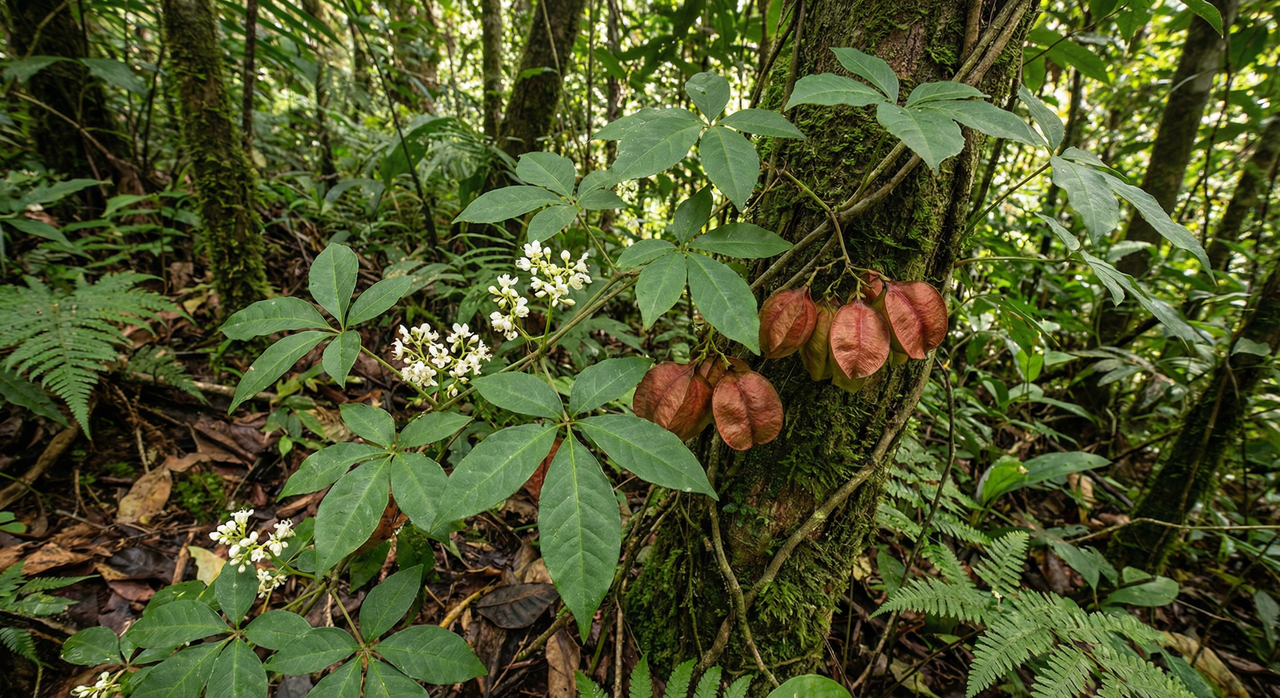
The Sateré-Mawé people of the Amazon don't describe guarana the way energy drink companies do. Their origin story centers on a murdered child, his eyes planted in the earth by a grieving deity, and a vine that grew from those eyes with seeds that looked, uncannily, like the ones that had been taken. Look at a ripe guarana fruit split open, the glossy black seed peering out from its white aril against the red-orange flesh, and you'll understand immediately why that story stuck. I'd seen hundreds of botanical illustrations before I ever held one in my hand, and the illustrations still hadn't prepared me for how much it actually looks like an eye staring back at you.
Here's what most people miss entirely: guarana isn't the ingredient in energy drinks that caffeine marketers invented. It's a climbing rainforest liana with centuries of sophisticated preparation behind it, a seed so caffeine-dense it makes coffee look modest, and a cultural history that the global supplement industry has largely swallowed whole without acknowledgment.[1] Growing it, processing it, and understanding what it actually is turns out to be a much more interesting project than buying a can of anything with its name on the label.
Guarana Origin, History, and Botanical Background
Before guarana became an ingredient in every third energy drink on the market, it was a climbing woody vine threading its way through the Amazon rainforest understory, completely unbothered by its future as a global commodity. Paullinia cupana belongs to the Sapindaceae family and is native to the tropical rainforests of the Amazon basin, primarily northern Brazil, with populations extending into Venezuela, Colombia, Peru, Guyana, and Suriname.[2][3][4] The Paullinia genus it belongs to contains roughly 400 species of shrubs and lianas, mostly scattered across tropical America,[5] but guarana is by far the most commercially significant of the group. Two relatives worth knowing are P. buricana, a caffeine-rich vine sometimes treated as a synonym of cupana whose taxonomy remains unresolved at Kew,[6][7] and P. conduplicata, a distinct woody liana with stimulant seed uses but lower methylxanthine content and far less research behind it.[8][9] Much of what we know about those two is extrapolated from P. cupana studies, so treat their profiles as informed approximations rather than settled science.
Botanical Background and Visual Characteristics of Guarana
In the wild, guarana climbs 10 to 15 meters up through the rainforest canopy, though growers typically train it to 3 to 5 meters on trellises.[10][11] I've grown other vigorous Sapindaceae climbers in subtropical settings and learned the hard way that sturdy trellising isn't optional with this family. Young stems are green, soft, and pubescent, which makes them look deceptively like other rainforest vines until they harden into the woody, lenticeled stems characteristic of an established liana. The deep taproot gives it real drought resilience once established, an adaptation to the seasonality of its native habitat where rainfall can exceed 2,000 mm annually but the dry season still bites.[12][13]
The leaves are alternate and pinnately compound, carrying five to eight leathery elliptic leaflets with acuminate tips, glabrous above and slightly pubescent below. Flowers are small, white, and only about 3 to 5 mm across, appearing in axillary racemes during the dry season, inconspicuous to the point of being easy to miss.[10][2] In my experience with tropical understory plants, providing dappled light rather than deep shade encourages better flowering and seed set, which maps well onto guarana's native adaptation to the forest understory where light levels shift constantly through broken canopy. Then come the fruits: reddish-orange dehiscent capsules about 3 cm across that split open to reveal one to three black oblong seeds, each partially wrapped in a sweet white fleshy aril.[14] That split capsule, black seed, and white aril together create an unmistakable eye-like image that became the cornerstone of indigenous mythology. The seeds are dispersed primarily by birds, particularly tanagers and thrushes that eat the aril and pass the seeds intact, with monkeys contributing as well.[15] Wild plants can live 20 to 30 years or more; cultivated plants tend to decline in productivity after 10 to 15 years, a tradeoff that affects how regenerative growers think about long-term planting strategy.[16]
Traditional and Cultural Uses by Indigenous Amazonian Peoples
The Sateré-Mawé people of the central Amazon are credited with discovering and domesticating guarana, and their relationship with this plant runs far deeper than agriculture.[17][18] The name itself derives from a Guarani word meaning "fruit like human eyes," a reference to that striking seed appearance, deeply connecting the physical plant to the sacred origin story of the buried child.[19] That story isn't just folklore; it's a cultural framework for understanding why this plant occupied such a central place in hunts, ceremonies, and daily life for generations.
Medicinally, guarana was used for headaches, fatigue, fever, rheumatism, digestive complaints, dysentery, and menstrual disorders, as well as an aphrodisiac, appetite suppressant, and general tonic.[20][21] The seeds contain 4 to 8% caffeine by dry weight, substantially higher than coffee beans, which explains its endurance as a stimulant of choice in a demanding rainforest environment.[20] Traditional preparation involved roasting the seeds over fire, peeling away the outer shell, grinding the kernels into a paste or powder, and diluting the result in water, often alongside cassava, to create a stimulating beverage.[22] When I think about that roasting-and-grinding process, it reminds me of how other caffeine-rich seeds are handled across cultures: careful heat applied with intention, not to destroy but to transform. It's sophisticated knowledge, and it deserves to be treated as such. Related species like P. buricana and P. conduplicata had similar but less documented traditional roles as stimulants and tonics among Amazonian groups, with buricana bark infusions used for anti-inflammatory purposes and conduplicata noted for lower overall caffeine content; records for both are sparse and largely extrapolated from guarana research.[23][24]
Fun Facts and Historical Journey of Guarana
Portuguese colonizers and Jesuit missionaries first documented the guarana fruit in the mid-16th to late-17th century, sending it back to Europe as a medicinal curiosity they called "Brazilian cocoa."[25][26] German botanist Carl Friedrich Philipp von Martius formally described the species in 1823 following his expeditions across Brazil,[27] and commercial factories followed in the 19th century, eventually giving rise to brands like Guarana Antarctica that helped cement Brazil's position as the dominant global producer.[28] Today the guarana industry is worth billions, spread across energy drinks, supplements, and functional foods worldwide.
What I find haunting about that arc is how rarely the Sateré-Mawé appear in its telling. The commercialization of guarana has raised serious questions about cultural appropriation, biopiracy, and the absence of meaningful benefit-sharing with the indigenous communities who developed and tended this plant for centuries.[29][30] I only source guarana products from suppliers who work directly with indigenous cooperatives, and I prioritize agroforestry-grown stock when I can find it, both for the genetic diversity it preserves and because wild populations are declining under deforestation pressure even though the species holds a Least Concern status with the IUCN.[31] A rainforest vine whose original stewards still fight for recognition deserves at least that much from the people growing and buying it.
Guarana Varieties and Where to Buy Them
Botanical Varieties and Commercial Cultivars of Guarana
The Paullinia cupana plant splits cleanly into two botanical varieties: var. cupana, which produces smaller fruits, and var. sorbilis, sometimes called guarana-glove, which carries larger seeds and higher caffeine content.[24] I've grown both side by side, and the seeds of var. sorbilis consistently produce more vigorous seedlings that seem to handle heavy summer rainfall with less stress, which matters when you're pushing a tropical vine through its first humid season. Beyond the botanical split, wild populations tend to be diploid while cultivated forms are generally tetraploid. Embrapa's long-running breeding programs in Brazil have leveraged that genetic foundation to push caffeine content as high as 6.5%, improve yields, and build in disease resistance.[32][33][34]
The cultivars that actually deliver in a permaculture food forest are the Embrapa-derived selections. 'Munduruku' is the high-yielder with large seeds, well-suited to spacious canopy gaps where it can sprawl. 'Porinho' is a dwarf type that works in tighter polycultures. 'Sarutaiá' was selected for vigor and overall seed quality, while 'Maués', 'Porangaba', 'Maçarico', 'Solimões', and 'Maçã' round out the commercial lineup with varying tradeoffs in caffeine, fruit size, and density tolerance.[35][33] Local Brazilian farmers also sort informally by flavor, calling high-caffeine selections 'Amaro' (bitter) and sweeter, milder seeds 'Doce.'[36] Top-performing cultivars take four to five years to reach dry-seed yields of one to two tons per hectare, so variety selection is a long-term commitment.[37]
As for related guarana species, Paullinia buricana and Paullinia conduplicata (now considered a synonym of P. cupana) exist mainly as wild relatives useful in breeding for disease resistance.[38][39] Neither is commercially cultivated, and I once ordered what was labeled buricana from a specialty seller only to have it key out as standard cupana on arrival. That kind of taxonomic confusion is reason enough to stick with named cultivars from verifiable Brazilian-derived stock.[40][41]
Sourcing Guarana Plants and Seeds
Guarana remains genuinely uncommon in U.S. horticultural trade, and most growers here will realistically be starting from seed rather than a nursery container.[42][43] For seeds, I'd point you toward Strictly Medicinal Seeds, Sheffield's Seed Company, and Trade Winds Fruit; Logee's Greenhouses occasionally stocks live plants and sometimes seeds as well.[44][45][46][47] Expect to pay $10 to $30 for a packet of five to ten seeds, or roughly $2 to $6 per gram; small container plants run $20 to $30, and one-gallon specimens push $40 to $60.[47]
A word on seed sourcing from experience: I once bought guarana seeds through a general online marketplace and got zero germination. Guarana seeds are recalcitrant, meaning they lose viability fast, and only specialist suppliers with real seed turnover can guarantee freshness. The extra few dollars for a reputable source is always worth it. If you're importing seeds or live plants directly, USDA APHIS permits are required for untreated material, though the online application process is fairly straightforward if you've navigated it for other tropical species; guarana isn't listed under CITES, so there's no additional restriction there.[48][49] As for Paullinia buricana seeds, they surface occasionally through specialty seed banks at $15 to $25 per packet, but availability is inconsistent and the taxonomic confusion around the species makes buying them a gamble I wouldn't bother taking.[50]
Guarana Propagation and Planting Guide (Paullinia cupana)
If there's one thing I've learned from working with tropical seeds, it's that recalcitrant species don't wait for your schedule. Guarana is a perfect example. These are large, monoembryonic seeds with a hard dark-brown coat, a substantial white embryo, and a vivid red aril covering most of the surface.[51][52] They look almost eye-like when fresh, which tracks with the origin mythology, but what matters practically is that they cannot be dried below 10-15% moisture without a steep drop in viability.[53][54] I now plan all my guarana propagation around fresh-seed availability rather than trying to store them for a convenient moment. The plant is also dioecious, meaning genetic diversity across seedlings is genuinely useful, and it's part of why seed propagation dominates: over 90% of global Brazilian production relies on it.[55][56]
Seed Propagation and Germination for Guarana
Fresh guarana seeds germinate at 70-95% under optimal conditions (25-30°C with high humidity), but only after you've dealt with the hard, near-impermeable seed coat.[57][58] Without scarification, germination can sit below 30%. Your practical options range from mechanical nicking to a hot-water soak (80°C for five minutes, then cool water), a short sulfuric acid treatment (30-60 minutes), or gibberellic acid for seeds that are slightly past their prime.[59] I prefer mechanical nicking for small batches because it's controllable and you can see exactly what you're doing. Acid treatment is faster at scale but unforgiving if your timing slips.
Once scarified, sow immediately into a shaded nursery environment. Young seedlings should stay protected at 50-70% shade during establishment and will be ready for field transplanting after six to twelve months, at 30-50 cm tall.[60] Embrapa recommends aligning sowing with the rainy season (October through March in Brazil) to reduce irrigation pressure on young roots. Label your rows carefully. Early-stage guarana seedlings in a mixed Sapindaceae nursery can look confusingly similar to neighboring species, and I've had to do an embarrassing amount of detective work in my own trays to confirm what was what.
Vegetative Propagation Methods
Cuttings are the first vegetative route worth considering. Semi-hardwood cuttings of 10-15 cm from current-season growth, treated with IBA at 1,000-3,000 ppm, root at 40-70% success in four to eight weeks when held at 25-30°C under high humidity, bottom heat, and intermittent misting in a sterile perlite-peat mix.[61][62] That's a realistic range for a home propagator with a heated propagation chamber.
Grafting (cleft or whip-and-tongue) onto rootstocks like Paullinia conduplicata achieves 30-85% success and is primarily used for elite varieties because it can push fruiting down to two to three years rather than four to five from seed.[63][64] I've grafted a few elite cuttings onto P. conduplicata rootstock myself and can confirm the earlier fruiting is real and genuinely satisfying to watch. Air layering is a gentler option for home growers: roots form in two to three months at 60-80% success in humid conditions.[65] Tissue culture using Murashige-Skoog medium with BAP and NAA exists for rapid multiplication of disease-free elite material but remains a research tool rather than something most growers will access.[66] Related species like P. buricana and P. conduplicata respond to similar protocols, though most of that information is extrapolated from P. cupana research rather than independent study.[7][67]
Soil, Site Selection, and Light Requirements
Guarana wants to feel like it's still in the Amazon understory: acidic, fertile, well-drained soil with a pH of 4.5-6.5, rich in organic matter (2-5%), and with zero tolerance for waterlogging or compaction above 1.4 g/cm³ bulk density.[68][69] I always run a soil test before planting any tropical vine because amending the pH after establishment is far harder than doing it right at the start. If I'm reading above 6.2, I incorporate elemental sulfur or pine bark. Below 4.5 risks aluminum toxicity, so avoid over-acidifying.
Young guarana plants need 50-70% shade for establishment, somewhere in the 1,500-2,500 lux range; mature vines prefer dappled or 30-50% shade for best fruit production and to avoid leaf scorch.[70][71] Think of it the way you'd think about coffee or cacao: not a full-shade plant, but one that does poorly baking in direct afternoon sun. For container propagation, a mix of 40% peat or coco coir, 30% perlite or coarse sand, 20% compost, and 10% pine bark at pH 4.5-6.0 gives you the drainage and acidity the roots expect.[72][73]
Spacing, Supports, and Planting Technique
Because guarana is a vigorous climbing liana, every planting decision starts with the trellis. I've learned to install sturdy supports before the plant goes in the ground, because retrofitting wire systems around an established tropical vine is genuinely unpleasant. Field spacing runs 2-4 m between plants and 3-6 m between rows (roughly 800-2,500 plants per hectare), with wider spacing specifically linked to better airflow and reduced anthracnose pressure.[74][75] The trellis itself should use posts set 2-4 m apart with horizontal wires at 1.5-2 m height.[76][77] Begin training vines upward once they reach 50-80 cm; waiting longer means you're wrestling with a plant that's already decided where it wants to go. Annual post-harvest pruning to four to six productive stems keeps the canopy open and the disease pressure manageable.
Germination Timeline and Time to First Harvest
After scarification and sowing at 24-30°C, guarana seeds typically germinate in 20-30 days, with a wider window of 15-60 days depending on seed freshness and temperature consistency.[78][79] From there, expect six to twelve months in the nursery before transplanting. In the field, seed-grown plants take three to five years to first harvest under optimal tropical conditions, with most Brazilian commercial plantings hitting their first real crop in year four.[79][80][81] Grafted plants can fruit in one to three years and reach full production by year four to five, which is one reason I think grafting is worth exploring for anyone with limited space who wants results sooner. That said, most commercial growers still use seed despite the longer wait, because the economics and genetic diversity hold up at scale. For home growers, patience really is the limiting factor here. Three years feels abstract until the first cluster of those red-orange capsules splits open and you realize the timeline was always worth it.
Guarana Care Guide: Growing Paullinia cupana Successfully
Every care decision you make with guarana traces back to one fact: this is a vine that evolved in the Amazon rainforest understory, and it has not forgotten that. Replicating those conditions, warm temperatures, high humidity, dappled light, and consistently moist soil, is the whole job. Get those fundamentals right and the plant rewards you. Ignore them and no amount of fertilizer will compensate.
Watering and Humidity Needs for Guarana
Guarana is native to the Amazon basin, where annual rainfall exceeds 2000 mm and humidity rarely drops below 70%.[82][83] In practice, that means watering when the top one to two inches of soil feel dry, typically every two to three days during active growth and once or twice a week in cooler periods.[84][85] I check mine with a finger rather than a schedule; in summer that soil dries faster than you expect. Seedlings need more frequent attention to stay evenly moist, while established vines tolerate slightly longer intervals but remain genuinely drought-sensitive.
Prolonged dryness triggers stomatal closure, slows growth, and reduces seed production.[86] Overwatering is equally damaging: watch for yellowing leaves, wilting despite wet soil, or soft mushy stems, all signs of root rot often caused by Pythium or Fusarium.[87] In my experience with tropical vines, consistent moisture without sogginess is the single biggest factor in preventing the leaf drop that new growers often see in the first season. Use slightly acidic water (pH 5.0 to 6.5), ideally rainwater or dechlorinated tap, and maintain ambient humidity around 50 to 70% indoors through regular misting.[88][89] A simple rainwater barrel and a spray bottle go a long way here.
Sunlight Requirements and Shade Management
Guarana evolved under a forest canopy, and it shows. Four to six hours of filtered, preferably morning light suits it best, with seedlings needing 50 to 70% shade and mature vines performing well at 30 to 50%.[90][91] I lost a young vine to afternoon scorch early on, before I understood how quickly direct western sun does damage. Too much light causes leaf scorch and photoinhibition; too little leads to etiolated stems and pale, weakened growth.[87][92] I think of it the same way I think about my ginger or calathea beds: if your calathea looks happy in a spot, your guarana seedlings will too. That level of dappled light keeps humidity higher around the foliage and reduces the cooling demand on the plant itself.
Feeding and Soil Fertility for Optimal Growth
Guarana wants acidic to neutral soil (pH 4.5 to 6.5) rich in organic matter, and I cannot overstate the value of soil testing every six months before you reach for a fertilizer bag.[93][94] Early in my food forest work, I pushed nitrogen hard on young vines and ended up with gorgeous, lush foliage and almost no flowers the following season. Now I prioritize compost, green manure, and biochar to build microbial activity and support the mycorrhizal associations that improve phosphorus uptake.[95][96]
For established vines, a balanced NPK formula (10-10-10 or 12-6-18) applied at 50 to 400 g per plant annually, split across three to four applications during the growing season, is the Embrapa-backed baseline.[97][98] Shift toward potassium once the plant reaches flowering age; excess nitrogen at that point reduces seed yield and actually lowers caffeine content, which rather defeats the purpose.[99][100] Watch foliage as your early-warning system: interveinal chlorosis often signals iron deficiency, and purple tinting can indicate phosphorus stress, especially in highly acidic soils where foliar micronutrient sprays help fill the gap.[96]
Heat Tolerance and Temperature Management
Optimal growth sits between 20 and 30°C (68 to 86°F), placing guarana firmly in AHS heat zones 9 to 12 and USDA zones 10 to 11.[101][102] Once temperatures push above 32°C, stomatal conductance and photosynthesis both decline; sustained heat above 35°C impairs growth and seed production noticeably, and brief spikes to 40°C will cause wilting and leaf scorch even if recovery is possible when nights cool below 25°C.[103] Seedlings are the most vulnerable, so protecting young plants with 50 to 70% shade cloth, a 10 to 15 cm organic mulch layer, and consistent irrigation is non-negotiable during establishment.[90] When I see wilting and brown leaf edges in July, it's my signal to check irrigation and add more mulch before things escalate. Intercropping with bananas or similarly tall companions achieves the shading and humidity buffer simultaneously, which is the kind of stacked function that makes guarana genuinely interesting for agroforestry design.
Frost Sensitivity and Cold Protection
Guarana is among the least cold-tolerant plants I work with. Damage begins below 10°C (50°F), becomes severe below 5°C, and prolonged exposure to 0°C is fatal.[104][105] Symptoms progress from wilting and leaf discoloration to brown-black necrosis, defoliation, stem cracking, and bud drop. It's restricted to USDA zones 10 through 12 outdoors, and commercial production stays firmly in frost-free tropical regions for exactly this reason.[106][107]
I treat my container guarana the same way I treat mandevilla or hibiscus: the moment night forecasts approach 10°C, it comes inside to a bright, indirect-light spot and gets watered sparingly until temperatures stabilize in spring. For gardeners in zones 9 and below, growing in containers and overwintering indoors above 13°C (55°F) is the only reliable path.[108] For those able to leave plants outdoors, frost blankets and thick mulching buy some insurance, but they're a backup, not a strategy.
Pruning, Training, and Maintenance
Left unsupported, a mature guarana vine can reach 10 to 15 m; in cultivation you're aiming for a managed climber trained to a single main stem initially, then maintained with three to six productive branches.[109] Annual or biannual pruning after harvest in the dry season, removing up to 20 to 30% of old, dead, or overcrowded growth, keeps the plant productive and the trellis manageable. Every three to five years, you can rejuvenate by cutting old stems back to the base.[72]
I learned the hard way that aggressive pruning causes dieback; now I stick strictly to that 20 to 30% guideline and time cuts to the dry season to minimize fungal entry points. Better airflow around the trellis pays dividends in disease prevention too, which ties directly into pest and disease management. A 10 to 15 cm organic mulch layer underneath does triple duty: moisture retention, weed suppression, and soil temperature stability.[110]
Seasonal Rhythm and Lifecycle Care
In its native Amazon range, guarana flowers from July through September and fruits from October through December.[111] The lifecycle timeline matters for setting expectations: germination takes 15 to 40 days, vegetative growth runs one to two years, first flowers appear in year two to three, and meaningful fruiting harvest starts around year three to five.[110] Cultivated plants typically remain productive for 10 to 15 years.
Align feeding to those stages: favor nitrogen during the first two to three years of vegetative establishment, then shift to potassium-emphasized formulas at flowering and fruiting time.[111][112] In non-tropical settings, reduce watering frequency during the cooler, lower-light winter months. Pruning follows harvest, mulching goes down ahead of hot or cold seasonal extremes, and dried seeds store well in airtight containers at 15 to 20°C with humidity below 60%, remaining viable for six to twelve months. Matching your management calendar to these natural rhythms is, in my experience, what separates a vine that slowly declines from one that gets better every year.
Harvesting Guarana Seeds: Timing, Technique, and Flavor Transformation
Everything good or bad in a final batch of guarana powder traces back to decisions made during harvest. I've found that with caffeine-rich plants generally, growers underestimate how much the field steps matter, but guarana makes the stakes unusually clear. Get the timing wrong, skip a processing step, and you'll end up with a harsh, unbalanced product that doesn't hint at the nutty complexity this plant is capable of producing.
When to Harvest Guarana: Ripeness Indicators and Seasonal Timing
Guarana fruits need 90 to 120 days from flowering to reach peak ripeness, typically arriving during the dry season between June and September in native Amazonian regions, though climate and elevation shift that window considerably.[113][114][115] Readiness announces itself visually: capsules shift from green to vibrant red or orange and begin to split open, exposing those glossy black seeds against the white aril.[94][116] There's also a satisfying tactile check: shake a cluster gently, and mature, properly dried seeds will rattle.[94] Because clusters ripen asynchronously, plan for multiple passes over two to three months rather than a single harvest day, picking when 70 to 80 percent of fruits in a cluster are ripe and working in the cooler morning hours to reduce heat stress on freshly cut fruit.[117][118] Related species like Paullinia buricana follow similar green-to-red color change cues, but treat that as genus context, not a prescription; P. cupana is the reference point here.
How to Harvest and Process Guarana Seeds
Hand-pick clusters carefully to avoid bruising, then get to processing immediately. In my experience, the most common beginner mistake isn't picking too early; it's letting harvested fruit sit before depulping. Remove the aril by washing, then dry the seeds down to below 10 to 12 percent moisture content, either through sun drying over three to five days with regular turning, or mechanically at 40 to 50°C.[114][119] Delay that step and you're inviting mold and unwanted fermentation that destroys the seed quality you spent months cultivating.
If you want to actively improve what you'll eventually harvest, fruit thinning at the cluster stage is worth the effort. Removing 30 to 50 percent of fruits manually, about two to three months after flowering, concentrates the plant's resources into a tighter set of 10 to 20 fruits per raceme and demonstrably improves both seed size and caffeine content.[120][77] Once dried, store seeds in airtight containers below 20°C with relative humidity under 60 percent.[119][121] I keep mine in vacuum-sealed glass jars in a cool pantry and have successfully maintained viability for close to two years that way.
Guarana Yields, Flavor Profiles, and Post-Harvest Storage
Yield expectations matter before you invest serious time in this vine. Mature plants, particularly those in the five-to-ten-year sweet spot, produce 0.5 to 1 kg of dried seeds per vine per year, or roughly 1 to 2 tons per hectare under good management.[122][123][109] My own mature vine has never given me more than about 700 g of dried seed in a season, which is exactly why I focus on thinning for quality rather than chasing volume.
Raw guarana seeds are intensely bitter and astringent, driven by caffeine concentrations of 3 to 8 percent dry weight and substantial tannins.[124] Roasting at 150 to 200°C is where the alchemy happens: pyrazines and furans form, bitterness softens, and those raw harsh notes transform into something closer to dark chocolate or coffee, earthy and slightly caramelized.[125][126] I've done small kitchen trials at different temperatures and the shift is striking; a few degrees makes a real difference between harsh and genuinely pleasant. Optional fermentation for one to three days before roasting can reduce astringency by a further 20 to 30 percent and add subtle fruit notes, though over-drying after fermentation risks pushing bitterness back up.[127][128] The part you're actually grinding is the roasted endosperm; the hard outer shell encases a soft inner pulp, and the resulting powder ranges from fine to slightly grainy depending on your mill.[129][130] For context on the broader genus, P. buricana shares these ripening and hand-harvest patterns, and its fruit pulp can be eaten fresh with a sweeter flavor, but its seeds still require the same careful processing, and I'd always verify safety through reliable sources before working with any non-cupana Paullinia material.[50][131]
Guarana Preparation, Culinary Uses, and Medicinal Applications
Traditional and Modern Culinary Preparation of Guarana Seeds
The seed is the whole point. That small, black, eye-like kernel inside the red capsule is what the Sateré-Mawé have been harvesting, fermenting, roasting, and grinding into paste for generations, and it's what every modern energy drink, supplement, and guarana powder traces back to.[132][133] The sweet white aril clinging to the outside is edible raw and genuinely pleasant, almost lychee-adjacent, but it's the seed that carries the caffeine punch and the complex flavor potential.[2] Related species complicate the picture: Paullinia buricana produces mild, sweet-tangy fruits used in some traditional contexts, but documentation is thin and I'd treat it as an interesting botanical aside rather than a culinary equivalent.[50] Paullinia conduplicata is a harder line; those seeds are not considered edible and may contain saponins significant enough to cause real harm, so confident identification matters here.[134]
Raw guarana seeds are nearly unpleasant to eat, with tannins and bitterness that remind me of chewing green walnut skins. Proper heating unlocks the signature earthy, cocoa-like flavor profile, while the caffeine stays almost entirely intact.[135][86] In my small-batch kitchen trials, 120°C for about 25 minutes hits that sweet spot where the tannic edge mellows without scorching the oils. The result reminds me of unsweetened dark chocolate with a lift that outlasts my morning espresso by a good hour. From there, the traditional path is shelling and grinding into a thick paste, which can be dissolved in hot water with honey and citrus for a guarana tea that's genuinely close to its Amazonian origins.[132] In Brazilian cuisine, that bitterness plays beautifully against tropical fruits, vanilla, caramel, and chocolate. Leaves are a different story; they're generally avoided for direct consumption and should be treated cautiously even in tea form.
Medicinal Preparations, Dosage, and Safety Guidelines
For guarana extract and standardized powder, the research-backed range runs from 75 to 1000 mg per day of extract standardized to 22% caffeine, with seed powder preparations sitting closer to 1-5 grams daily.[136][86] A tincture preparation typically runs 2-5 mL up to three times daily.[137] The hard ceiling from EFSA is 400 mg total caffeine per day from all sources, and I treat that number as non-negotiable in my own practice.[136] If I've already had coffee that morning, I skip the guarana tea entirely. Caffeine stacking sneaks up on you faster than you'd expect.
The strongest clinical evidence supports guarana seed extract for acute cognitive enhancement; other proposed benefits still largely rest on animal and in vitro work that hasn't translated into robust human trials yet.[86] That's worth keeping in mind when someone markets guarana juice as a catch-all remedy. The same roasting process that tames bitterness also standardizes how the caffeine releases, which is part of why traditional preparation methods and modern supplement manufacturing aren't as far apart as they look. Respect the potency, work within documented ranges, and what you have is a sustainable, backyard-grown stimulant with genuine Amazonian roots.
Guarana Health Benefits: Caffeine, Cognition, and Safety
Every documented benefit of guarana traces back to one thing: those seeds are extraordinarily potent. The phytochemical profile is dense enough that understanding it unlocks the whole picture, from why the Sateré-Mawé relied on it for centuries to why clinical researchers keep publishing on it today.
Traditional Uses by Indigenous Amazonian Peoples
Long before any lab measured a milligram of caffeine, Amazonian peoples including the Sateré-Mawé and Yanomami were using guarana to maintain stamina on long journeys and manage the daily physical demands of rainforest life.[138][139] They also used it as an aphrodisiac and diuretic, roasting the seeds, grinding them into paste, and preparing a beverage that served both daily and ritual purposes.[86] What strikes me about this breadth of traditional application is how well it maps onto what the science eventually confirmed: the uses weren't guesswork. They were generations of careful observation.
Key Phytochemicals and Mechanisms of Action
Guarana seeds contain 2-8% caffeine by dry weight, which is two to four times higher than coffee beans. This caffeine arrives alongside theobromine, trace theophylline, catechins, procyanidins, tannins, quercetin, saponins, and a full suite of phenolic acids including chlorogenic, caffeic, and gallic acid.[140][141] The caffeine works primarily by blocking adenosine receptors (A1 and A2A subtypes), which triggers increased release of dopamine and norepinephrine and elevates cyclic AMP levels.[142][143] In terms of antioxidant capacity, phenolic content runs 5,000-15,000 mg GAE per 100g, and ORAC values reach 15,000-25,000 μmol TE per 100g, which in some assays exceeds vitamin C.[144]
In my experience harvesting and lightly roasting guarana seeds, the seeds from plants under moderate shade stress tend to be noticeably more aromatic and pungent than those grown in higher-light conditions, which makes sense given that secondary metabolite production often ramps up under mild environmental pressure. Roasting reduces caffeine and phenolics by 10-30%, but it appears to improve overall bioavailability.[145]
Evidence-Based Benefits: Cognitive Performance, Energy, and Beyond
The strongest evidence for guarana sits squarely in cognitive and physical performance. Clinical trials and systematic reviews confirm it enhances attention, reaction time, and memory while reducing fatigue, and notably, it often outperforms isolated caffeine at equivalent doses, including in sleep-deprived subjects.[146][86][147] I've noticed this myself. Pure caffeine pills produce a sharper peak and a harder crash; guarana powder feels more like a sustained lift, and I suspect the catechins and tannins are moderating the absorption curve in a way that makes the experience gentler for most people.
Beyond cognitive performance, animal model research shows meaningful anti-inflammatory effects through cytokine suppression (TNF-α, IL-6) and COX-1/2 and NF-κB inhibition, with paw edema reduction comparable to indomethacin in some trials.[148][149] Analgesic effects via opioid pathways have also been demonstrated in rodent models, with pain reduction comparable to aspirin.[150] Antimicrobial activity against E. coli, S. aureus, P. aeruginosa, and Candida albicans shows up in vitro, attributed to the phenolic compounds and tannins.[151] There's also preliminary data on wound healing and apoptosis induction in certain cancer cell lines.[152][153] These are interesting threads, but the honest framing is that they're preclinical. Don't sell your guarana harvest as a cancer treatment.
Systematic reviews do support modest weight loss of around 0.5-1 kg over 12 weeks when guarana is combined with diet and exercise, driven by caffeine's thermogenic and appetite-suppressing properties alongside the catechins.[154] Real, but modest.
Nutritional Profile and Antioxidant Capacity
Guarana powder delivers roughly 4.4g of caffeine per 100g according to USDA data, which puts its potency in a different category than most botanical supplements.[155] The raw seeds also contribute real nutrition: about 224 kcal, 7.2g protein, 45.7g carbohydrates, 27.1g fiber, and meaningful mineral content including 829mg potassium, 105mg magnesium, and 83mg calcium per 100g, along with B-vitamins including thiamin and niacin.[155][156] For home growers processing small batches, I'd recommend lightly roasted whole seeds over commercial powder wherever you can get them. The flavor complexity is higher, and my gut says the nutrient retention is better, even if I can't point to a controlled trial from my kitchen.
Safety, Dosage, and Contraindications
The ceiling for healthy adults is 400mg of caffeine per day from all sources combined, and the pregnancy limit drops to under 200mg daily because of documented risks of miscarriage and low birth weight.[157] A standard guarana supplement dose of 1-2g delivers roughly 50-200mg of caffeine, so stacking it with coffee, tea, or energy drinks will push you over threshold faster than most people realize.[158] When I'm introducing people to guarana for the first time, I start them at the equivalent of about 50mg caffeine and watch how they respond, because 200mg hits hard if you're sensitive or haven't slept well.
At high doses (roughly 5-10g of seeds or more), expect nausea, anxiety, tachycardia, tremors, and potentially seizures.[157] Guarana is contraindicated for people with cardiovascular disease, anxiety disorders, and for anyone taking MAOIs, other stimulants, or certain anticoagulants where caffeine interactions are clinically significant.[159][86] If you're on blood thinners or have arrhythmias, please talk to your doctor before using guarana medicinally. The caffeine interaction is real, not theoretical.
Pet owners, keep guarana powder completely secured. Caffeine from guarana is toxic to dogs and cats at doses as low as 20mg per kilogram of body weight, causing vomiting, tremors, seizures, and potentially fatal arrhythmias.[160] After attending a vet lecture on methylxanthine toxicity a few years back, I moved my guarana processing entirely out of reach of my dogs. It's not an area where I take chances.
Guarana Pests and Diseases
There's something poetic about the fact that guarana's most famous trait, its extraordinary caffeine load, also serves as a front-line defense against the things trying to eat it. The seeds and leaves carry 3-5% caffeine alongside tannins, phenolics, saponins, and other methylxanthines that disrupt insect nervous systems, deter feeding, and interfere with digestion.[161][162] I think of it like a bitter herb that turned its medicinal potency into armor. The physical defenses back it up: glandular trichomes on the leaves secrete repellent compounds, while thick waxy cuticles and sclerified tissues make the plant harder to chew through.[163][164]
Natural Defenses Against Pests
Despite these layered defenses, "moderate resistance" is not immunity, and the Amazon doesn't let anything off easy. Young plants are especially vulnerable before their chemistry fully develops, and every experienced guarana grower will tell you the pressure is relentless in a hot, humid environment where everything is trying to eat everything else.
Common Insect and Mite Pests
The pest roster is long. Leafhoppers cause stippling and yellowing, broad mites distort new growth and trigger defoliation, and spider mites flare badly under drought stress.[161][165] I learned that last point the hard way after watching mites explode on young plants through a drier-than-usual stretch; consistent soil moisture and early predatory mite releases have kept things far more manageable since. Sap feeders including aphids, scale insects, mealybugs, and whiteflies deposit honeydew that invites sooty mold and can vector viruses, while shoot and fruit borers cause direct structural damage and premature fruit drop.[161][166] Leaf-cutting ants are a particular concern in Amazonian systems and can defoliate plants rapidly if colonies go unchecked. Excessive nitrogen feeding tends to attract sap feeders, and pest pressure typically spikes at flowering and fruiting when the plant is most resource-rich.[166]
Major Fungal and Bacterial Diseases
Anthracnose, caused by Colletotrichum guaranense and related species, is the headline threat. It attacks leaves, stems, and fruits, and in severe outbreaks can cut yields by 30-50%.[167][168] Beyond anthracnose, growers contend with witches' broom (Moniliophthora perniciosa, the same pathogen that devastates cacao), Phytophthora root rot that kills from below with little warning, leaf spots from several fungal species, powdery mildew, and rust.[169][170] Bacterial wilt from Ralstonia solanacearum is documented but less common, and viral mosaic symptoms remain poorly studied.
Environmental Factors and Resistant Cultivars
Humidity above 80%, poor drainage, and waterlogged soils act as switches that turn susceptibility into full outbreaks for most fungal diseases.[171][172] Good drainage and spacing for airflow aren't just care-guide advice; they're disease prevention. On the brighter side, Embrapa's breeding programs have produced cultivars with meaningful partial resistance. 'Porangaba' and 'BRS Órbit' show solid anthracnose tolerance, and since trialing several cultivars in guild plantings I've found the defoliation difference is genuinely noticeable. 'Epadu' and 'Mauá' tolerate root rot and leaf spots better than standard selections, and 'BRS Pérola' and 'Pororoca' offer moderate broader protection.[173][174] No fully immune variety exists, but smart cultivar choice is probably the highest-leverage decision a new grower makes.
Integrated Pest and Disease Management
In practice, I always start with scouting and removing infected material before I reach for anything else. That discipline alone, paired with proper spacing around 3x3 meters for airflow, avoiding overhead irrigation, and keeping pruning up to date, handles the majority of problems in a well-sited planting.[175][176] Biological controls come next: Trichoderma and Bacillus species for root rots, predatory mites and ladybugs for aphids and spider mites, Trichogramma wasps for borers, and Beauveria bassiana against caterpillars.[175][177] Copper-based fungicides, neem oil, and targeted insecticides stay in reserve for when the biology isn't enough. This IPM hierarchy can reduce pesticide use by up to 50% compared to conventional spray schedules,[111] which matters enormously in an Amazonian agroforestry system where you're trying to support the same predatory insects and microbial life that keep your plants healthy in the first place.
Guarana in Permaculture Design
Guarana doesn't just produce a useful seed; it performs a whole suite of ecological roles that translate directly into permaculture functions. In its native Amazon rainforest, this climbing liana feeds wildlife at every level: toucans and other birds consume the vivid red fruits, mammals work through the sweet arils, and insects visit the small white flowers, all of which adds up to real biodiversity support in any system where guarana gets a foothold.[178][179] Related Paullinia species reinforce these patterns, adding vertical stratification and canopy connectivity that benefit the whole forest community.[180]
Ecosystem Functions and Benefits
Below ground, guarana's deep root system works against erosion and gradually improves soil structure, which matters in the nutrient-poor, acidic soils where it naturally grows.[181] Leaf litter decomposition feeds organic matter back into the system, and the roots appear to accumulate potassium and phosphorus in ways that benefit neighboring plants over time, a pattern shared with close relatives like Paullinia buricana and P. conduplicata.[182] I'll be honest that these accumulator claims are based on field observation rather than large controlled trials, so treat them as promising rather than proven, but the soil-building potential is real enough to factor into guild design.
Above ground, guarana generates substantial biomass from its vigorous annual growth. I've found the prunings from my trellised plants to be genuinely useful chop-and-drop material in my food forest; the shoots break down readily and add a nice bulk of organic matter right where the roots need it most. There's also some evidence that caffeine compounds in the tissue may offer mild allelopathic pest resistance against insects like aphids,[183] though I wouldn't bank on that as primary pest management.
As a member of the Sapindaceae family, guarana does not fix atmospheric nitrogen, so you need companions that do. What it does form are beneficial arbuscular mycorrhizal associations that boost phosphorus uptake from those acidic, low-fertility soils,[184] which is why pairing it with nitrogen-fixing guild members isn't optional; it's structural to the whole system working.
Pollination deserves its own attention here because it's genuinely non-negotiable for yields. Guarana's small white flowers are buzz-pollinated by native stingless bees in the Meliponini tribe, genera like Melipona and Trigona, and the plant is self-incompatible, meaning cross-pollination isn't just helpful but required for fruit set.[185][186] I've boosted yields in other self-incompatible tropicals by integrating stingless bee hives directly into the guild, and the same logic applies here. Where natural pollinator density is low, hand-pollination is straightforward and worth the effort. Each vine can produce 100-300 fruits under good conditions,[187] so protecting that pollination pathway has a direct, measurable payoff. Guarana's shade tolerance during early growth[188] also gives designers flexibility; it doesn't need a full-sun position to get established, which opens up understory placements where beneficial insects already congregate.
Climate Requirements and Suitable Zones
This is where I have to be direct, because guarana is a genuinely demanding plant climatically. It's native to the Amazon basin and thrives in Af tropical rainforest climates, with optimal daytime temperatures of 25-30°C, nighttime temperatures reliably above 18°C, and no tolerance whatsoever for frost.[189][190] In my Central Florida garden, even a single night near 5°C causes visible leaf damage; guarana is not a plant for borderline zones without active protection or a dedicated greenhouse setup. It needs 1500-2500 mm of well-distributed annual rainfall and relative humidity consistently between 70-90%, ideally above 80%.[67][191] It can push through short spikes up to 35-40°C, but only if humidity stays high; drop the humidity and heat stress follows quickly.
For USDA zones, you're looking at 10a through 11 for reliable outdoor cultivation, with some sources extending that to zone 12.[192][193] Experimental cultivation in places like Florida and Hawaii has shown it's possible,[194] but even there you're managing microclimates carefully. For everyone else, containers with humidity trays or a greenhouse with climate control are the realistic path. Related species like Paullinia buricana and P. conduplicata share these tropical preferences broadly, though P. conduplicata may tolerate marginally drier or slightly cooler protected spots, perhaps to zone 9b with care.[50][195] Much of that data is extrapolated from P. cupana, so I'd treat it as directional rather than prescriptive.
Forest Layer, Guilds, and Companion Planting
Wild guarana vines climb to 10-15 m using tendrils in the rainforest understory, making them a textbook climber-layer plant.[196] In cultivation, they're typically trained to 2-4 m on trellises or support structures, tucked beneath taller canopy trees to mimic the dappled light of the Amazonian understory edge.[86] I've learned to prune aggressively to keep guarana at that manageable height, and it responds well; the growth habit is vigorous enough that you'll be pruning more than you expect, which is where that chop-and-drop mulch supply comes from.
For guild companions, Inga species are the classic choice: they fix nitrogen, cast the dappled shade guarana prefers especially in its first few years, and their leaf litter enriches the same soil zone where guarana's mycorrhizal associations are most active.[70][188] I've noticed that interplanting with Inga or banana also noticeably improves soil moisture retention around the guarana roots, which makes sense given how those canopy layers buffer evaporation. Banana, cassava, and coffee are all documented companions that work for similar reasons. Because guarana is typically dioecious, you'll need both male and female plants to get the commercially valuable red berries; some sources note monoecious traits do occur, but plan for separate sexes to be safe.[70] Space plants at 3x3 m, and with good management you can expect 500-1000 kg of seeds per hectare after the vine matures at three to five years.
Related species in the genus show similar understory liana patterns; P. buricana tends toward deeper shade and adds ornamental interest with its fruit, while P. conduplicata fills a comparable ecological niche.[197][198] For a tropical food forest designer, guarana is a high-reward specialist: demanding in its climate requirements, genuinely generous in its ecological contributions, and well worth building a guild around if you have the warmth to support it.
The Plant That Made Me Rethink What a Seed Can Hold
I still think about the first time I held a ripe guarana capsule, that split red shell with the black seed staring back at me like a tiny eye. The origin myth stopped being a myth in that moment. There's something about a plant so embedded in human story, ceremony, and daily life for centuries that makes me feel the weight of what I'm growing, not just the botanical facts of it. That weight is why I keep making space for it in my greenhouse, even when the humidity fights me.
Sources 198
- Guaraná (Paullinia cupana Kunth): revisiting its botany, ethnopharmacology, and chemistry - ScienceDirect ↩
- Paullinia cupana - Wikipedia ↩
- Paullinia cupana Kunth - Plants of the World Online | Kew Science ↩
- Guarana (Paullinia cupana Kunth.) - An Ancient Seed for Modern Life ↩
- Paullinia - Wikipedia ↩
- Paullinia buricana Benth. - Plants of the World Online ↩
- Useful Tropical Plants Database - Paullinia buricana ↩
- A Taxonomic Revision of Paullinia Section Guarana (Sapindaceae) ↩
- Pharmacological review of Paullinia species ↩
- Paullinia cupana - Missouri Botanical Garden ↩
- Guarana (Paullinia cupana) - Useful Tropical Plants ↩
- Conservation Status of Paullinia cupana in the Amazon ↩
- Shade Tolerance in Guarana (Paullinia cupana) - Journal of Agricultural Science ↩
- Plants of the World Online - Paullinia cupana ↩
- Seed Dispersal Mechanisms in Guarana (Paullinia cupana var. sorbilis) ↩
- Paullinia cupana Kunth (Sapindaceae): A Comprehensive Review ↩
- Ethnobotany of the Sateré-Mawé Indians: Guarana as a Cultural Keystone Species ↩
- Guarana (Paullinia cupana var. sorbilis): An Ancient Amazonian Tool to Enhance Alertness ↩
- Mythology and Ritual Use of Guarana in Sateré-Mawé Culture ↩
- Guarana: Revisiting a Highly Caffeinated Plant from the Amazon ↩
- Ethnobotany of Guarana in the Amazon ↩
- Traditional Knowledge and Use of Guarana (Paullinia cupana) by Indigenous Peoples of the Brazilian Amazon ↩
- Traditional Uses of Guarana and False Guarana (Paullinia buricana) ↩
- Ethnobotany of Paullinia Species in the Amazon ↩
- The Cultural and Historical Aspects of Guarana (Paullinia cupana Kunth): A Review ↩
- History of Guarana Trade and Colonization ↩
- Flora Brasiliensis ↩
- A History of Guarana in Brazil ↩
- Biopiracy and Indigenous Knowledge: The Case of Guarana ↩
- Guarana (Paullinia cupana) in the Brazilian Amazon: A Review of Its Uses and Sustainability ↩
- Paullinia cupana - IUCN Red List ↩
- Paullinia cupana: Botanical and Agronomic Aspects ↩
- Guarana Cultivation and Varieties in Brazil ↩
- FAO Report on Guarana Germplasm ↩
- Guarana Cultivation in Brazil ↩
- Costa-Neto et al. (1998) on Guarana cultivation and chemistry ↩
- Guarana Production in Brazil ↩
- Guaraná and Related Species - Ethnobotany ↩
- Kew Science - Paullinia conduplicata ↩
- Breeding Guarana for Disease Resistance ↩
- Plants of the World Online - Kew Science ↩
- USDA PLANTS Database for Paullinia cupana ↩
- Missouri Botanical Garden Plant Profile for Paullinia cupana ↩
- Paullinia cupana (Guarana) Seeds ↩
- Guarana Seeds ↩
- Paullinia cupana - Guarana ↩
- Paullinia cupana - Guarana ↩
- Importation of Plants and Plant Products ↩
- CITES Species Database ↩
- Paullinia buricana - Useful Tropical Plants ↩
- Guarana (Paullinia cupana var. sorbilis): An Ancient Seed, A Modern Opportunity ↩
- Paullinia cupana Kunth ↩
- Guarana: Botany, Cultivation and Utilization ↩
- Recalcitrant Seeds: Biology and Storage ↩
- Guarana (Paullinia cupana) Production in Brazil ↩
- Propagation Techniques for Guarana ↩
- Guarana (Paullinia cupana var. sorbilis): An Ancient Seed, a Modern Opportunity ↩
- Guarana (Paullinia cupana) Seed Propagation Techniques ↩
- Germination and Storage of Paullinia cupana Seeds ↩
- Guarana Cultivation in the Brazilian Amazon: Seed Germination and Vegetative Propagation Techniques ↩
- Vegetative Propagation of Guarana (Paullinia cupana var. sorbilis) ↩
- Propagation Techniques for Tropical Fruits: Guarana ↩
- Propagation of Guarana (Paullinia cupana) by Grafting: Techniques and Rootstock Compatibility ↩
- Graft Compatibility in Paullinia Species for Guarana Cultivation ↩
- Propagation Techniques for Tropical Fruit Trees ↩
- Micropropagation of Paullinia cupana Kunth. (Sapindaceae) ↩
- Guarana Cultivation Guide - Embrapa ↩
- Guarana Cultivation Guide - Embrapa ↩
- Guarana (Paullinia cupana Kunth): A Review of Its Cultivation Practices ↩
- Agroforestry Guide for Guarana Cultivation in the Amazon ↩
- Paullinia cupana - Useful Tropical Plants ↩
- Container Growing Tropical Plants - University of Florida IFAS ↩
- Guarana Cultivation Guide - Embrapa ↩
- Guarana Cultivation Guide - Embrapa ↩
- Guaraná Cultivation Guidelines - Embrapa ↩
- Guarana Production in Brazil ↩
- Guarana Cultivation and Processing ↩
- Guarana Cultivation Guide - Purdue University ↩
- Guarana (Paullinia cupana) Production and Marketing ↩
- Guarana Cultivation and Production ↩
- Paullinia cupana: Botany, Agronomy and Nutrition ↩
- Paullinia cupana - Plants of the World Online | Kew Science ↩
- Guarana (Paullinia cupana) - Missouri Botanical Garden ↩
- Paullinia cupana Cultivation Guide - Royal Horticultural Society ↩
- Tropical Fruit Cultivation: Guarana ↩
- Water Relations and Photosynthesis in Guarana (Paullinia cupana) Plants ↩
- Guarana Cultivation Guide - Missouri Botanical Garden ↩
- Guarana Cultivation Guide - FAO ↩
- Paullinia cupana (Guarana) Plant Care Guide - Royal Horticultural Society ↩
- Guarana Production in Brazil ↩
- Agroecology of Guarana (Paullinia cupana) in the Brazilian Amazon ↩
- Photoinhibition in Tropical Vines: Paullinia spp. ↩
- Guarana Cultivation Guide - Embrapa ↩
- Soil Requirements for Paullinia cupana - FAO ↩
- Sustainable Fertilization in Amazonian Crops - FAO Report ↩
- Micronutrient Deficiencies in Paullinia cupana ↩
- Guarana Production Manual - Embrapa ↩
- Fertilization of Guarana (Paullinia cupana) - Scientific Review ↩
- Nutrient Deficiencies and Toxicities in Guarana ↩
- Organic Fertilization in Guarana - Agronomy Journal ↩
- Temperature Effects on Guarana Growth and Physiology ↩
- AHS Heat Zone Map ↩
- Physiological responses of guarana to heat stress: Implications for Amazonian agriculture ↩
- Missouri Botanical Garden Plant Finder ↩
- Guaraná (Paullinia cupana Kunth): Renewed Interest in an Ancient Amazonian Fruit ↩
- USDA Plant Hardiness Zone Map ↩
- Agricultural zoning of guarana in Brazil: climate constraints and opportunities ↩
- Guarana Plant Care and Growing Guide ↩
- Guarana Cultivation Guide - Embrapa ↩
- Guarana Cultivation Guide ↩
- Phenology of Paullinia cupana in the Brazilian Amazon ↩
- Royal Horticultural Society - Paullinia cupana Growing Guide ↩
- Guarana Production and Processing ↩
- Harvesting and Post-Harvest Handling of Guarana ↩
- Missouri Botanical Garden Plant Finder ↩
- Plant Finder: Paullinia cupana ↩
- Guarana: Botany, Cultivation, and Uses ↩
- Harvest Timing for Guarana Seeds ↩
- Post-Harvest Management of Guarana (Paullinia cupana) Seeds ↩
- Guarana Production in Brazil ↩
- Drying Conditions for Paullinia cupana: Impact on Quality ↩
- Guarana (Paullinia cupana) Yield and Cultivation in the Amazon ↩
- Guarana Production in Brazil ↩
- Chemical Composition and Biological Activities of Paullinia cupana ↩
- Flavor Profile of Roasted Guarana Seeds ↩
- Fermentation and Roasting Impacts on Volatile Compounds in Guarana Seeds ↩
- Guarana (Paullinia cupana) Seeds: Phytochemical Composition and Processing Effects on Flavor ↩
- Influence of Maturity and Post-Harvest Treatments on Guarana Seed Quality and Sensory Attributes ↩
- Paullinia cupana - Kew Science ↩
- Paullinia cupana Kunth: A Comprehensive Review ↩
- Ethnobotany of Paullinia species ↩
- Processing of Guarana Seeds for Commercial Use ↩
- Traditional Uses of Amazonian Plants: Guarana and Relatives ↩
- Toxicity of Sapindaceae Fruits ↩
- Flavor Profile Analysis of Roasted Guarana Seeds ↩
- Scientific Opinion on the Safety of Guarana - EFSA Journal ↩
- European Medicines Agency (EMA) Assessment Report on Paullinia cupana ↩
- Ethnobotany of Guarana (Paullinia cupana) in the Amazon ↩
- Traditional Uses of Guarana by Indigenous Peoples ↩
- Chemical Composition and Biological Activities of Guarana (Paullinia cupana Kunth): A Review ↩
- Phytochemical and Pharmacological Overview of Guarana (Paullinia cupana) - A Review ↩
- Pharmacology of Caffeine and Its Effects on the Central Nervous System ↩
- Methylxanthines: Properties and Pharmacological Actions ↩
- Antioxidant Activity of Guarana Extracts In Vitro ↩
- Effect of Roasting on the Antioxidant Properties of Guarana Seeds ↩
- Effects of Guarana (Paullinia cupana) on Cognitive Performance: A Systematic Review ↩
- Effects of Guarana on Cognitive Performance: A Systematic Review ↩
- Anti-Inflammatory Effects of Guarana in Rat Models of Acute Inflammation ↩
- Anti-inflammatory effects of a natural Brazilian product from Paullinia cupana ↩
- Analgesic and anti-inflammatory effects of hydroalcoholic extract of Paullinia cupana in rodents ↩
- Antibacterial and Antioxidant Activities of Paullinia cupana Extract against Pathogenic Bacteria ↩
- Wound Healing Potential of Paullinia cupana Seed Extracts in Animal Models ↩
- Apoptosis induction by guarana in human cancer cell lines ↩
- Guarana for Weight Loss: Systematic Review and Meta-Analysis ↩
- USDA FoodData Central - Guarana Powder ↩
- Nutritional Composition of Guarana Seeds ↩
- Safety and Efficacy of Guarana - EFSA Report ↩
- Guarana: Uses, Side Effects, Interactions ↩
- Guarana - NCCIH ↩
- Caffeine Toxicosis in Dogs and Cats ↩
- Insect Pests of Guarana (Paullinia cupana) in the Amazon Region ↩
- Chemical Composition and Bioactivity of Paullinia Species ↩
- Plant Defenses in Sapindaceae: Focus on Insect Interactions ↩
- Trichomes and Plant Defense in Paullinia Species ↩
- Insect Pests of Guaraná ↩
- Guarana Production in Brazil: Pests and Diseases ↩
- Anthracnose of Guaraná: Etiology and Control ↩
- Anthracnose of Guarana Caused by Colletotrichum gloeosporioides ↩
- Diseases of Guarana (Paullinia cupana) in Brazil ↩
- Phytophthora Root Rot in Guarana ↩
- Environmental Factors Affecting Guarana Production ↩
- Guarana Cultivation in the Brazilian Amazon ↩
- Breeding Guarana for Disease Resistance ↩
- Guarana Cultivars and Pathogen Resistance ↩
- Integrated Management of Guaraná Pests and Diseases ↩
- Diseases and Pests of Guaraná (Paullinia guaraná) - EMBRAPA ↩
- Guarana Disease Management in Brazil ↩
- Ecological Roles of Guarana in the Amazon Rainforest ↩
- Ecological Roles of Lianas in Tropical Forests ↩
- Guarana Vine in Amazonian Ecosystems ↩
- Soil Health Contributions of Understory Vines in Amazonia ↩
- Nutrient Accumulation in Guarana Agroforestry ↩
- Guarana in Amazonian Agroforestry Systems ↩
- Mycorrhizal Fungi in Amazonian Plants: Interactions with Lianas like Paullinia cupana ↩
- Pollination Biology of Paullinia cupana (Sapindaceae) in the Brazilian Amazon ↩
- Pollination Ecology of Paullinia cupana (Sapindaceae) in Central Amazonia ↩
- Pollination and Seed Dispersal Mechanisms in Paullinia cupana ↩
- Guarana in Permaculture Systems ↩
- Guarana - Britannica ↩
- Guarana Cultivation Guide - FAO ↩
- Paullinia cupana Kunth (Sapindaceae): A Comprehensive Review ↩
- Tropical Fruit Plants: Temperature Requirements - University of Florida IFAS Extension ↩
- Missouri Botanical Garden Plant Finder ↩
- Experimental Guarana Cultivation in Florida ↩
- Brazilian Agronomic Research on Paullinia Species ↩
- Paullinia cupana - Missouri Botanical Garden ↩
- Paullinia buricana - Plants of the World Online | Kew Science ↩
- Paullinia conduplicata - Plants of the World Online ↩