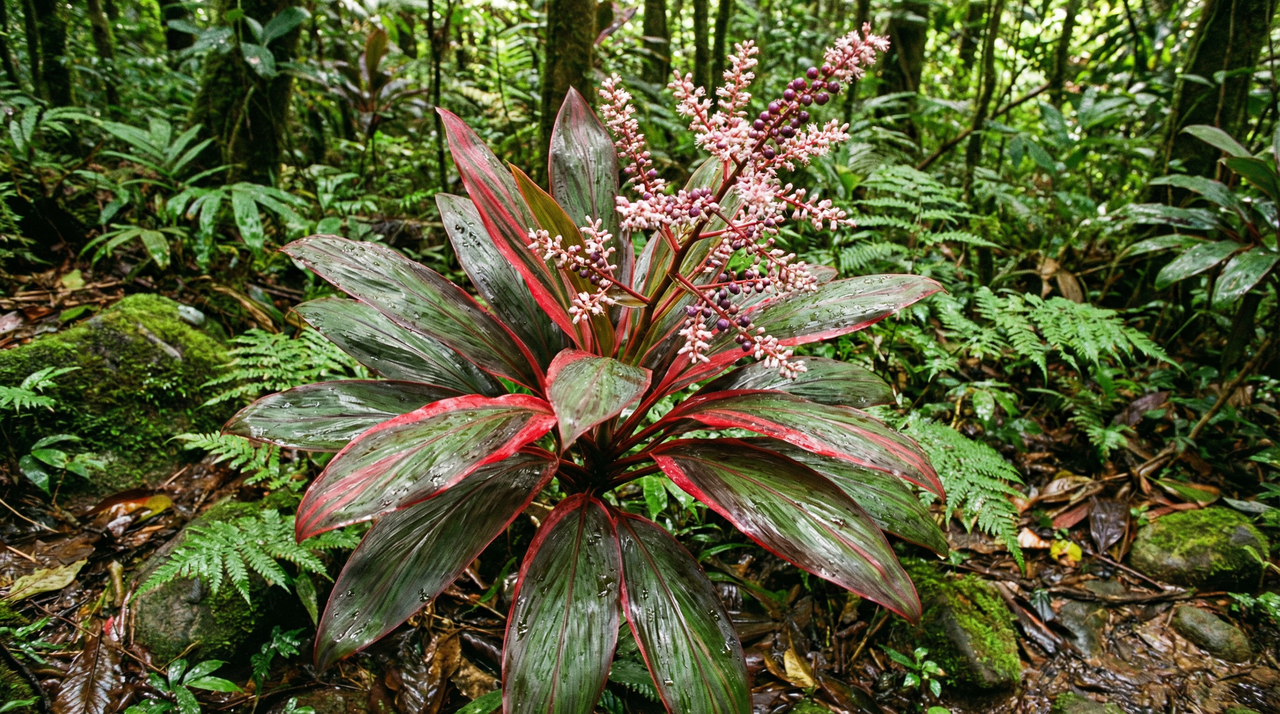
The first Hawaiian Ti plant I ever touched wasn't in a garden. It was tucked beside a doorway in a small house on the Big Island, and my host told me, matter-of-factly, that it had been there longer than she had. It kept things safe, she said. I nodded politely, the way you do when you're twenty-something and think plants are mostly about photosynthesis. What I didn't understand yet was that Cordyline fruticosa had been deliberately carried across thousands of miles of open Pacific, plant by plant, canoe by canoe, specifically because people believed those glossy leaves held something worth protecting.[1] That's not folklore decoration. That's a botanical record of one of the most intentional long-distance translocations in human history.
Most people outside Hawaii know this plant as that dramatic red-leafed thing in the nursery, the one you impulse-buy and then kill by overwatering. But the gap between that potted ornamental and what this plant actually is, ecologically, culturally, and yes, chemically, is wider than I expected when I started really digging into it. It contains compounds studied for antimicrobial and anti-inflammatory properties, parts of it are edible but genuinely toxic if you skip the preparation steps, and in certain Pacific island ecosystems it's now considered invasive despite being sacred. Contradictions everywhere. Stick around.
Hawaiian Ti Plant Origin, History, and Cultural Significance
Botanical Background and Native Habitat
The Hawaiian Ti Plant, known botanically as Cordyline fruticosa, got its start far from Hawaii, in the humid lowland rainforests and forest edges of Southeast Asia, the Philippines, Papua New Guinea, and northern Queensland.[2][3] It's a pioneer species, comfortable scrambling into disturbed patches where rainfall is generous and warmth is constant. In its native Papua New Guinea habitats, mean annual temperatures hover around 25-28°C with rainfall of 2,000-3,000 mm, the kind of relentlessly tropical conditions most temperate gardeners can barely imagine.[2] What that environment produces is a plant built for speed: Cordyline fruticosa reaches reproductive maturity in just 3-7 years, flowers repeatedly through its life, and typically lives 10-50 years in cultivation.[3][2] Compare that to its New Zealand relatives like Cordyline australis, which can take 10-30 years just to mature and lives 100-300+ years in cooler, temperate climates.[4][5] I've grown both in containers, and the difference is immediately practical: the Ti will reward you in a single growing season in ways the cabbage trees simply won't for decades. That quick tropical cycle is part of why it traveled so well with humans.
Visual Characteristics and Growth Habits
If you've ever seen a Hawaiian Ti Plant in person, the foliage is what you remember. The plant grows in a palm-like form, typically 6-10 feet tall with a slender, ringed stem topped by a dramatic spiral rosette of long, arching leaves, each one 12-24 inches long and in colors ranging from deep glossy green through burgundy, bright red, hot pink, and multicolored combinations.[6][7] One thing I've observed growing multiple cultivars over the years is how dramatically light affects color intensity. A cultivar that looks washed-out in a dim corner will deepen into rich burgundy when moved to brighter conditions, which tells you a lot about which plants are genuine landscape performers versus those that really belong indoors. The small, fragrant white-to-pink flowers appear in large terminal panicles and mature into small red berries that birds find immediately.[6][8] I've watched mockingbirds strip those berries within days in my subtropical garden, which is a small reminder of how this plant was always built for distribution.
Traditional and Ceremonial Uses in Pacific Cultures
The real story of the Hawaiian Ti Plant is a migration story. Archaeological evidence places Cordyline fruticosa cultivation at least 3,000 years back in New Guinea and the Bismarck Archipelago.[3] Polynesian voyagers carried it deliberately as a canoe plant, and it reached Hawaii between roughly 1200 and 1400 CE, documented in ceremonial contexts by Captain Cook himself during the late 18th century.[3][9] Plants brought on a voyage across thousands of miles of open ocean were not casual choices. The Ti was sacred.
In Hawaiian culture, the Cordyline fruticosa scientific name barely captures what the plant actually means. Its leaves were used in hula, woven into lei, worn in ceremony, and deployed in purification rituals. They marked the boundaries of kapu sacred spaces, wrapped offerings at heiau temples, and appeared at both births and funerals.[10] The plant was believed to ward off evil spirits and bring protection to a home or site, beliefs still alive in Hawaiian communities today. Māori people hold parallel relationships with related species like Cordyline australis, using them for food, fiber, medicine, and ceremonial protection around marae.[11] The depth and consistency of these traditions across the Pacific tells you something important about how deeply this genus threaded itself into human culture.
Modern realities complicate the picture. The plant has become invasive in parts of Hawaii and French Polynesia, where it outcompetes native species in disturbed areas.[12] Overharvesting for commercial lei production and landscaping puts pressure on wild populations, and the commercialization of traditional uses for tourism raises real questions about cultural appropriation and whether indigenous communities benefit at all.[13] Having studied Hawaiian ethnobotany and grown Ti for years, I choose nursery-sourced plants only, and I'd encourage the same of any gardener. Wild harvesting isn't just ecologically questionable here; it's culturally disrespectful.
Fun Facts and Modern Context
The cultivar explosion that makes the hawaiian ti plant such a nursery favorite today began with intentional breeding that amplified the species' natural color variation into the deep purples, electric pinks, and striking variegated patterns now available.[8][14] It entered European horticulture via Kew Gardens in the late 18th century and never really left the spotlight. The plant shows moderate salt spray tolerance and thrives in 60-80% humidity, with thick-cuticled leaves that help it manage some dryness between waterings.[14][15] I still get surprised at nurseries when a new cultivar appears in a color combination I haven't seen before, and I think that ongoing reinvention, rooted in 3,000 years of human reverence, is exactly why this plant holds its place in gardens around the world.
Hawaiian Ti Plant Varieties and Where to Buy
Popular Cultivars of Cordyline fruticosa
The vibrant foliage palette we associate with the Hawaiian Ti plant today didn't happen by accident. Centuries of Polynesian cultivation selected for ornamental traits, and then 19th and 20th century breeders pushed that natural color variation much further through deliberate hybridization, amplifying reds, pinks, and variegations while also favoring more compact habits suited to garden beds and containers.[16] The result is a genuinely impressive catalog of named selections. 'Red Sister' is probably the most widely planted cordyline in Florida landscapes, and for good reason; I've used the red sister cordyline in multiple Central Florida designs precisely because it holds that deep burgundy-to-pink coloration even in full subtropical sun, something a lot of variegated plants simply can't do. 'Electric Pink' sits at the other end of the spectrum, delivering almost fluorescent pink tones that stop visitors in their tracks. Beyond those two, the genus offers 'Tricolor' with its green, red, and cream banding, the classic deep maroon of 'Burgundy', the soft green-and-red edging of 'Kiwi', and 'Rubra' for a straightforward red-leaved form.[17][18][19]
If you want to go deeper into the genus, relatives like Cordyline banksii offer their own set of cultivars, including the pink-and-green variegated 'Salsa' and several purple-leaved forms.[18][20] I think of those as a different design tool entirely. Where C. fruticosa typically stays shrubby at six to ten feet, C. banksii and C. australis grow into tree-like forms that belong in a completely different garden layer. When I'm planting an understory guild, the compact habit of the Hawaiian Ti cultivars is exactly what I want.
Sourcing and Purchasing Hawaiian Ti Plants
Finding Cordyline fruticosa domestically is genuinely easy. It's carried at retail garden centers across the South and is available through online nurseries like Logee's and Florida Hill Nursery, which ship small specimens nationwide.[21][22][23][24] The plant has also naturalized in Florida, Hawaii, California, Louisiana, and Texas, so if you're in one of those states you may find locally grown stock at specialty native or tropical plant sales.[21] My own experience ordering from Florida growers is that smaller one- to two-foot specimens establish faster than the large boxed plants; the big ones often go into transplant shock in summer heat and spend their first season just trying to recover. For rarer cordylines like C. australis, specialty nurseries such as Monrovia or Plant Delights are reliable sources, with pricing typically running $10-50 for small specimens and $50-150 or more for larger plants.[25][26]
If you're tempted to source unusual cultivars internationally, know that importing Cordyline into the United States requires USDA APHIS import permits and phytosanitary certificates, with additional restrictions in states like California and Florida.[27][28] I've navigated that process when chasing a specific cultivar, and it adds real paperwork and lead time. For most gardeners, the domestic selection is deep enough that the permitting route simply isn't worth it.
How to Propagate and Plant Hawaiian Ti Plant (Cordyline fruticosa)
Most home gardeners discover that propagating cordyline is far simpler than they expect, but only once they stop trying to do it from seed. Understanding why seeds are a specialist's game makes the whole picture cleaner, so let's start there before moving to the methods that actually work reliably.
Propagation Methods for Hawaiian Ti Plant
Cordyline fruticosa seeds are small, black, and glossy, around 2-4 mm across, with a hard smooth coat and a single monocot embryo.[29][30] They look viable right up until they aren't. The problem is that these seeds are recalcitrant, meaning they lose viability quickly if dried below about 20-30% moisture content, can't survive freezing, and even under ideal moist, cool storage at 10-20°C in vermiculite or sand, they stay viable for only a few months to a year.[31][32][33] I've tested this firsthand: batches even six months old showed dramatically lower germination rates than fresh seed, and anything labeled without a harvest date is a gamble I wouldn't take again. Once you understand how quickly viability drops, cuttings become the obvious choice every time.
There's a second strike against seed: it doesn't produce offspring true to type.[34][35] If you've fallen for a cultivar with deep burgundy or tricolor variegation, seed propagation will give you genetic surprises, not clones. For named varieties, vegetative methods are the only reliable path to keeping what you grew.
Stem cuttings are the method I reach for first. Take 4-6 inch sections from healthy, non-flowering stems, cutting just below a node in late spring through summer, and place them in a well-draining medium at 70-80°F with around 70-80% humidity and bright indirect light. Success rates run 80-90% under those conditions.[36][37][38] Dipping the cut end in IBA rooting hormone at 0.1-0.3% speeds things up noticeably, and horizontal cane sections laid in moist medium also root well if you have more stem than you need.[34][36] Roots form in 4-8 weeks, and the surest sign of success is the gentle resistance you feel when you give the cutting a soft tug. I've learned to resist checking before that point; lifting cuttings to peek at root development introduces air pockets and moisture disruption that invites rot faster than almost anything else.
For beginners with a mature plant already in the ground, dividing offsets or suckers at repotting time is even more forgiving. Plants three years old or more produce these basal shoots reliably, and dividing them comes with a 70-90% success rate and genetic clones of the parent.[14][39] Air layering is worth knowing about for large, woody specimens where cutting back cordyline entirely isn't practical; wrapping a notched section of stem in moist sphagnum under plastic produces a well-rooted plant in 4-8 weeks and is particularly good at retaining variegation.[40][41] Commercial growers use tissue culture with Murashige and Skoog medium supplemented with cytokinins and auxins to produce thousands of uniform, disease-free plants from a single explant,[42][43] but that's not the home gardener's territory. Across all methods, sterile tools and media are non-negotiable, and consistent moisture without waterlogging is the single variable that separates thriving cuttings from rotting ones.
Soil, Site Selection, and Planting Requirements
The Hawaiian Ti plant wants well-draining, fertile, humus-rich loam or sandy loam with a pH of 6.0-6.5 for optimal growth, though it tolerates a broader range of 5.5-7.5 before performance visibly declines.[14][44][45] Its roots are shallow, extending only 12-18 inches, and they need 10-20% air-filled porosity to stay healthy; heavy clay or compacted garden soil is a quick path to rot.[46][18] I learned this the hard way in my earlier Florida gardens, planting a beautiful red-leafed specimen straight into my native clay-heavy bed and watching the lower leaves yellow over the course of one wet summer before I finally dug it up to find a soggy root ball. Switching to a container-style mix amended with pine bark and perlite changed everything.
For containers, a mix of 2 parts peat-based potting soil, 1 part perlite or coarse sand, and 1 part pine or orchid bark balances drainage, aeration, and fertility well.[35][18] In ground plantings, I aim for 3-5% organic matter in the soil and incorporate that same pine bark if drainage is even mildly questionable. The goal isn't a perfect pH reading so much as a bed that drains after rain but doesn't dry out completely.
Site selection mirrors the plant's rainforest understory origins. Cordyline fruticosa prefers bright indirect light or partial shade at 4-6 hours daily, tolerating dappled canopy cover well.[14][47] Direct afternoon sun scorches the leaves, and insufficient light causes variegated cultivars to fade and stretch. In forest garden systems, it sits naturally in the shrub layer beneath a taller canopy, and that placement usually handles the light question automatically.
Germination Timeline and Growth to Maturity
If you do pursue cordyline propagation from seed, use only the freshest material. Fresh seed at 25-30°C with high humidity in a moist peat-perlite mix can sprout in as little as 2-6 weeks, though the standard window runs 4-8 weeks.[48][49] Seedlings are sensitive for their first 3-6 months and need consistent warmth and moisture throughout. After that, you're looking at 3-5 years from seed to a plant of 3-4 feet that might flower or produce usable foliage at scale.[48][36]
Stem cuttings shortcut that timeline dramatically: harvestable foliage and a well-established plant often come within 6-12 months.[48][36] For comparison, Cordyline australis, the New Zealand Cabbage Tree, requires cold stratification, germinates over 1-3 months, and takes 8-10 years from seed to flowering.[50][5] The Hawaiian Ti plant's faster tropical timeline is genuinely one of its more appealing traits for impatient gardeners, but cuttings still beat it by years. If you're patient and starting with fresh seed you can verify, expect visible sprouts in 4-8 weeks; most experienced growers skip the wait entirely.
Spacing and Planting Technique
In the landscape, space Cordyline fruticosa 3-5 feet apart to accommodate its mature size of 6-10 feet tall by 2-4 feet wide and to keep air circulating around the foliage, which reduces fungal leaf spot pressure in humid subtropical climates.[49][51] In a Florida summer, I've found that tighter spacing in humid conditions almost always leads to leaf-spot problems by August, so I err toward the wider end. For hedges or mass plantings, 2-3 foot spacing is workable if airflow is otherwise good.
Container plants do best in 12-18 inch pots kept to one plant per pot, or spaced 1-2 feet apart in larger planters to allow the shallow roots room to expand.[52][49] When planting seeds or small seedlings, set them no deeper than 0.25-0.5 inches; these are surface-rooting plants and burying the crown courts rot immediately. Taller relatives like Cordyline australis and Cordyline banksii, which can reach 10-40 feet at maturity, need 5-10 foot centers,[53][54] a useful reminder that the architectural restraint of the Hawaiian Ti plant is actually one of its design advantages in smaller gardens.
Hawaiian Ti Plant Care Guide
Every care decision you make for a Hawaiian Ti Plant should trace back to one simple mental image: a humid Pacific rainforest understory, filtered light, consistently moist but freely draining soil, warm nights, and never a frost in sight. Get that picture clear, and the rules that follow start to make intuitive sense.
Sunlight Requirements for Hawaiian Ti Plants
Cordyline fruticosa wants bright, indirect light for four to six hours daily to hold its color and stay vigorous.[14][55] In my landscape designs for zone 9B clients, I routinely tuck these under tall canopy trees or shade cloth structures. Morning sun is generally fine, but I've watched even the most robust red cultivars develop scorched brown tips and bleached streaks after a week of direct Florida afternoon exposure. Too little light has its own costs: plants stretch toward the window, turn pale, and lose the intensity of those purples and pinks fast.[14][55]
The colorful cultivars especially need adequate brightness to maintain their pigmentation, and indoors an east- or west-facing window with a sheer curtain is usually the sweet spot.[47][14] If you want to give yours a few hours of morning sun, acclimate it gradually over a couple of weeks rather than moving it outside cold turkey. By comparison, Cordyline australis is a full-sun plant, and Cordyline banksii handles more shade but still needs its four to six hours.[56][20] Those New Zealand cousins are simply more tolerant creatures; the Hawaiian Ti needs you to think more carefully about where you put it.
Watering Needs and Soil Moisture for Hawaiian Ti Plants
The rule I repeat to every client is "consistently moist, never soggy." Water deeply when the top inch or two of soil feels dry, roughly every five to seven days in warm months and stretching to ten to fourteen days in cooler indoor periods.[49][57] Overwatering is, without question, the primary killer. Early in my career I kept a container specimen too wet through a humid Florida summer and ended up with exactly what you'd dread: yellowing lower leaves, wilting despite damp soil, and roots that were mushy and foul-smelling from Phytophthora rot.[58][59] Now I teach everyone the same simple protocol: poke your finger an inch into the soil, check that your pot has drainage holes you can actually see water escaping from, and resist the urge to water on a fixed schedule regardless of conditions.
Underwatering announces itself differently, with crispy brown tips, soil pulling away from the pot edges, and noticeably slowed growth.[58] Young plants need more frequent checks since their root systems haven't expanded yet; mature established ones shift to deeper, less frequent watering.[60] Water quality matters too: rainwater or filtered water at pH 6.0 to 7.0 avoids the salt buildup that tap water can deposit over time.[60][61] Cordyline australis, for contrast, can go four to eight weeks without water once established thanks to its deep root system[62] -- a level of drought tolerance the Hawaiian Ti simply doesn't share.
Fertilizing and Nutrient Management for Hawaiian Ti Plants
Hawaiian Ti Plants are moderate feeders. A balanced 10-10-10 or 20-20-20 water-soluble fertilizer at half strength, applied every four to six weeks through spring and summer, is all they typically need.[7][63] Reduce or stop entirely in fall and winter. A little really does go a long way, and over-fertilizing causes problems that look deceptively like deficiencies: leaf tip burn, excessive soft growth that's vulnerable to cold, and salt buildup in the soil.[64][65] Always water the plant before fertilizing to protect roots from burn, and consider slow-release granules or organic options like compost and seaweed extract if you tend to forget that half-strength rule.[64]
Soil pH should stay between 5.5 and 7.0, and I'd recommend annual testing for container plants -- checking both pH and electrical conductivity (target 1.5 to 2.0 mS/cm) catches problems before they show on the leaves.[66][67] Deficiency symptoms are worth learning to read because they're genuinely distinct from one another. Uniform yellowing and stunting on older leaves signals nitrogen shortage; marginal browning and necrosis on older leaves points to potassium; interveinal chlorosis on mature leaves with reddish-brown tones suggests magnesium deficiency; and young leaves turning yellow while veins stay green is classic iron chlorosis, usually triggered by soil pH creeping too alkaline.[66][68] I see those same patterns in croton and dracaena, so once you've trained your eye on one foliage plant, diagnosing the others gets faster. Cordyline australis and C. banksii are naturally less demanding, with banksii even forming mycorrhizal associations that help it thrive in nutrient-poor native soils[69][20] -- but the Hawaiian Ti appreciates more attentive feeding.
Temperature Tolerance: Heat and Frost for Hawaiian Ti Plants
The ideal daytime range is 65 to 80°F, with the plant tolerating up to 90°F but beginning to show stress above 85°F unless humidity stays above 60 to 70%.[70][35] At the stressful end of the heat spectrum, you'll see scorching on leaves and daytime wilting, though that wilt often reverses overnight if temperatures drop back to the 60 to 70°F range the plant prefers.[35][71] Seedlings and plants in flower are the most heat-vulnerable stages, so give those extra afternoon shade and consistent soil moisture during hot spells. Mulch around the base, keep water steady, and try to site the plant where it gets some relief from the hottest sun -- that's essentially replicating the cool-canopy buffering of its native coastal rainforest habitat. Cordyline australis handles far more heat, tolerating short spikes up to 95 to 104°F[72] -- a useful reminder that the Hawaiian Ti is genuinely the more tender of the commonly grown species.
Frost Protection for Hawaiian Ti Plants
Cordyline fruticosa is a true tropical and has no meaningful cold tolerance. Temperatures below 50°F are cause for concern, and even a brief frost can kill the leaves outright -- they're mostly water, so they brown and scorch inward from the tips fast.[49][73] Stems may crack and die back, flower buds are highly susceptible, and while roots can survive if the soil stays insulated, I've never seen a plant that was badly frosted outdoors bounce back to anything worth keeping.[49][74] In my experience managing tender specimens in Central Florida microclimates, I don't wait for an actual frost warning -- when forecasts are dropping toward 50°F, I'm either moving containers indoors or reaching for double-layered horticultural fleece.[75][14] Heavy mulch at the base helps insulate roots, and always choose a sheltered microclimate over an exposed one when planting in the ground. Variegated cultivars tend to be more cold-sensitive than their solid-green relatives, so they get priority when I'm deciding which pots come inside first.[75]
This is where the contrast with the New Zealand species is most dramatic. Cordyline australis (USDA zones 8b to 11) tolerates down to around 10 to 14°F when mature, and C. banksii handles brief dips to 23°F.[76][20] The Hawaiian Ti is really only a permanent outdoor plant in USDA zones 10 to 12; everywhere else, treat it as a container plant that comes inside for winter.
Pruning, Maintenance, and Seasonal Care for Hawaiian Ti Plants
Keep humidity between 50 and 70% around your plant -- pebble trays and regular misting both help, and that humidity buffer is also your first defense against spider mites, which colonize stressed, dry-air specimens fast.[55][14] Stake young or tall plants if you're in a windy spot, and apply two to three inches of organic mulch around the base, kept a few inches back from the stem to prevent rot.
Pruning cordyline plants is straightforward and honestly quite satisfying. I remove dead or yellowing leaves at the base regularly to keep the plant tidy and redirect energy into new growth. Major cuts wait until spring, and if a plant has gotten leggy, pinching or cutting the growing tip encourages branching and a bushier habit.[63][14] If root rot has set in from overwatering, the fix is to unpot, trim the damaged roots cleanly, and repot into fresh sterile mix with genuinely good drainage -- not just hoping the problem resolves itself.
Plants three years or older can produce fragrant white-to-pink flower stalks up to three feet long in spring and summer, but only under the right conditions: bright indirect light, humidity above 50%, and temperatures in the 65 to 80°F range.[14][8] Support heavy stalks with a stake so they don't snap, and cut spent blooms once flowering is done.
Seasonal Rhythm and Growth Cycle of Hawaiian Ti Plants
In the tropics, Cordyline fruticosa grows almost continuously, with flowering and fruiting tied loosely to the wet season rather than any hard dormancy.[6][7] Bring it inside for a temperate winter and that rhythm slows noticeably: growth stalls, color can soften, and a plant that looked lush in summer may drop a few leaves during the adjustment. I move mine gradually over about a week each fall, shifting the pot a little closer to the door each day before bringing it fully indoors, which avoids the sudden light and temperature shock that causes that leggy, washed-out look. Reduce watering during this slower period and hold off on any fertilizer until spring growth resumes.
With proper care -- good drainage, frost protection, moderate feeding, and adequate humidity -- a potted Hawaiian Ti can easily live twenty or more years as a houseplant.[6][7] The things that shorten that lifespan are predictable: frost damage, chronic overwatering leading to root rot, or a spider mite infestation that goes undetected too long.[7][5] That's a sharp contrast to Cordyline australis, which can live five hundred years or more in the wild and matures on a decades-long timeline rather than three to seven years.[7][5] The Hawaiian Ti rewards more attentive stewardship; give it what it needs and it will hold its color and form for years in return.
Harvesting Hawaiian Ti Plant (Cordyline fruticosa)
Most growers will never harvest Ti for food. They'll harvest it for its leaves, and that's where the real rhythm of this plant lives. Under good tropical or subtropical conditions, you can expect your first harvestable leaves around 6-12 months after propagation, though full peak yield doesn't arrive until the plant matures at 2-4 years.[40][77] In my zone 9B garden in Central Florida, the hot, humid summers push growth so fast that I've started light harvesting as early as 8 months from a well-rooted cutting, which is ahead of what the cooler-climate extension guides tend to suggest.
When to Harvest Leaves, Flowers, Fruit, and Edible Parts
The best time to cut leaves is during the warmer, wetter months when the plant is putting on vigorous growth and can recover quickly, though in true tropical climates you can harvest year-round without much worry.[40] Look for leaves that are fully expanded (20-60 cm long), glossy, and richly colored with no yellowing at the margins.[78] Those are your harvest-ready leaves. Anything still unfurling should stay on the plant.
Flowering happens in late spring through summer, roughly May through August, producing fragrant panicles that are beautiful in their own right.[79] If berries follow, they take 90-120 days after flowering to ripen from green to a glossy red that yields slightly to gentle pressure.[40] I've watched those small red berries form after sporadic summer flowers in my garden, but I never use them for food. Unripe fruits contain saponins and should be treated as toxic; even ripe berries are generally considered bland to bitter and not worth the risk.[80][81] The research on saponins is clear, and traditional cooks always cook everything thoroughly.
How to Harvest and Handle Ti Plant Leaves and Rhizomes
I've harvested Ti leaves more times than I can count for arrangements and leis, and the technique is simple once it's a habit. Cut only from the outer, mature leaves using clean sharp shears, making a clean cut at the base of the leaf stem.[82] Morning is the right time, when the leaves are fully turgid and less likely to wilt.[83] The rule I stick to: never strip more than a third of the plant's mature leaves at once. A healthy Ti pushes out 4-6 new leaves per year, and respecting that pace keeps the plant looking lush rather than scalped.
Once cut, get those stems into water immediately. Cure the leaves at around 50-59°F for 24-48 hours to reduce transpiration, then store at 55-60°F with high humidity (90-95%) and good airflow for a shelf life of 7-14 days.[82][84] For lei-making, plan for a shorter window of 3-7 days. Any edible harvests, whether young shoots or rhizomes, follow the same clean-cut principle, though removing rhizomes requires more care to avoid damaging the plant's root structure.
Yield, Flavor Profiles, and Safety Considerations
Traditional Hawaiian and Polynesian uses of Ti extended well beyond the leaves. Young shoots were eaten like spinach or asparagus, the pith at the leaf bases was pounded into a smooth, taro-like paste, and rhizomes were roasted or baked into something sweet and starchy, not unlike taro or sweet potato.[85][86] The flavor profile of those roasted rhizomes reminds me of cooked malanga or cassava from the Florida tropical garden context, mild and starchy with a subtle sweetness.
The safety picture matters here and deserves plain language. Raw parts of this plant contain saponins and cyanogenic compounds that cause real GI distress, and thorough cooking is non-negotiable before consuming any part.[87] Flowers and fruits are generally not eaten; unripe berries are toxic, and even ripe ones tend toward bland or bitter.[3] The related New Zealand Cordyline australis shows similar genus patterns, with edible shoots and baked roots that taste mildly cabbage-like or sweet after proper cooking, though that species' context belongs to Maori traditional practice rather than Hawaiian Ti use.[88] For most gardeners, edible yield from Ti is best understood as a cultural and historical footnote. Leaf yield is where this plant genuinely gives back, generously and reliably, year after year.
Hawaiian Ti Plant Preparation and Uses
Culinary Uses and Safety Considerations
Every part of the Hawaiian Ti Plant contains saponins, and eating any of it raw is a bad idea. Nausea, vomiting, and diarrhea are the likely outcomes.[89][90] Before you even get to preparation, there's an identification problem: Cordyline fruticosa is routinely confused with Dracaena and Yucca species, both of which carry their own toxicity concerns.[91][92] Because I design landscapes for families with pets and small children, I always flag Cordyline as strictly ornamental unless someone has verified traditional training. Treating it as a foraging plant without that knowledge is genuinely risky.
That said, Pacific Islander and Hawaiian communities have been preparing Ti as a famine food for centuries, and the knowledge of how to do it safely is real and specific. Young shoots and leaf bases become edible through prolonged boiling with multiple water changes, steaming, or slow roasting in an underground imu oven; each step drives down the bitterness and saponin load.[93][94] The starchy rhizomes, after the same rigorous treatment, develop a neutral to mildly sweet flavor that reminds me of cassava or malanga, plants familiar to Central Florida gardeners that also require careful prep before they're safe to eat.[95][86] The mature leaves themselves aren't eaten; they're used to wrap foods during imu cooking, lending a subtle earthy, grassy note to whatever's inside.[96] Avoid the berries entirely, the bitterness alone is a warning sign.[97] For genus context, C. australis rhizomes develop a sweet-potato-like caramel sweetness after thorough pit-cooking and were a genuine Māori carbohydrate staple[98]; C. fruticosa is used more sparingly, as a food of necessity rather than abundance. Roots can also be fermented into a beverage called 'oki,'[99] another application where proper process, not improvisation, makes the difference.
Non-Food and Cultural Uses
The culinary applications are real but narrow. The non-food uses are where this plant's cultural footprint becomes enormous. Polynesian voyagers carried Cordyline fruticosa as a canoe plant precisely because it was indispensable: leaves woven into mats, baskets, rain capes, hula skirts, and leis; the same leaves wrapped ceremonial offerings and protected sacred spaces.[77][78] Growing multiple cultivars in my Central Florida garden, I've watched the red-leaved forms deepen in color through summer heat, and it's easy to see why the anthocyanin-rich leaves and roots were prized as natural dyes for tapa cloth and body art.[13] Fresh Ti leaves have a faintly green, almost waxy scent when you handle them; I've used them as natural wraps in garden crafts, and the durability is genuinely impressive for something so flexible.
The plant's ceremonial and ritual roles run even deeper than its practical ones. Ti is woven into hula practice, healing rituals, and the marking of sacred sites throughout Hawaiian culture[100]; these uses aren't historical footnotes, they're living traditions. For designers, the structural form and vibrant foliage make Hawaiian Ti a strong vertical accent in subtropical guilds, but that ornamental appeal has created real pressure. Commercial demand for Ti leaves in lei-making has led to overharvesting concerns in some communities. Harvest lightly, from your own plants if possible, and support indigenous knowledge keepers who hold the deeper understanding of what this plant means and how it should be used.
Hawaiian Ti Plant Health Benefits and Medicinal Uses
The Hawaiian Ti Plant earns its long history of medicinal use on the back of some genuinely impressive chemistry. Cordyline fruticosa leaves contain a broad spectrum of flavonoids including quercetin, kaempferol, apigenin, and luteolin glycosides, alongside phenolic acids like gallic, chlorogenic, and ferulic acid, with total phenolic content in ethanolic leaf extracts running roughly 45 to 60 mg GAE per gram.[101][102][103] Saponins, both triterpenoid and steroidal types, concentrate especially in bark and roots at 0.5 to 2%, while anthocyanins like cyanidin-3-glucoside give those deep red and burgundy cultivars their signature color.[104] Tannins, steroids including beta-sitosterol, and cyanogenic glycosides like taxiphyllin round out the profile, though characterization of the latter group is still thin compared to the flavonoid and phenolic data.
After years working with ornamental foliage plants in Central Florida landscapes, I've noticed that Ti plants grown in fuller sun develop noticeably deeper red pigmentation and denser leaf texture. That's not just aesthetics; plants under higher light or mild stress tend to produce more flavonoids and phenolics, which is consistent with what the research shows about tropical lowland populations and stress-induced upregulation of secondary metabolites.[105][106] It's a useful heuristic: the most vibrantly colored specimen is often the most chemically active one. Related species like C. australis and C. banksii show similar flavonoid-rich leaf profiles, with roots and bark concentrating saponins and triterpenoids at notably higher levels than the leaves.[106][107]
Key Phytochemicals in Hawaiian Ti Plant
The antioxidant activity is where the chemistry becomes most immediately compelling. Leaf extracts show significant free radical scavenging in DPPH, ABTS, and FRAP assays, with IC50 values that compare favorably to other recognized medicinal plants, driven largely by that dense phenolic and flavonoid content.[106][108] Comparable results appear in C. australis and C. banksii extracts, suggesting this is a genus-wide characteristic rather than a quirk of one species.[109] This antioxidant capacity forms the biochemical backbone that connects everything else in the plant's medicinal story.
Traditional Medicinal Uses Across Cultures
Across Pacific Island, Southeast Asian, Hawaiian La'au Lapa'au, and Māori rongoā traditions, healers have independently arrived at remarkably consistent applications. Leaves as poultices or decoctions for wounds, burns, skin infections, boils, and respiratory complaints; roots for diarrhea, dysentery, and stomach ailments; various parts as antiseptic washes or febrifuges.[110][111][112] Māori rongoā practitioners used C. australis bark decoctions and leaf poultices for wound healing and inflammation, root infusions for digestive complaints, and C. banksii sap as an eye wash.[113][114] The geographic spread of nearly identical applications across cultures with no historical contact is hard to dismiss.
Pharmacological Research and Health Benefits
Modern preclinical research has started mapping mechanisms onto those traditional uses, and the alignment is striking. Anti-inflammatory effects work through NF-κB inhibition and reduced production of TNF-α, IL-6, nitric oxide, COX-2, and LOX, which tracks directly with traditional wound and inflammation applications.[115] Antimicrobial activity against Staphylococcus aureus, E. coli, and Candida albicans reaches MIC values below 100 μg/mL in some extracts via membrane permeabilization.[106] Wound healing acceleration of 20 to 30% faster closure in animal models through epithelialization and collagen synthesis supports those leaf poultice traditions rather directly.[116]
Narrower findings are intriguing but need context. Diuretic activity produced a 40% increase in urine output without potassium loss in animal studies.[117] Alpha-glucosidase inhibition with IC50 values comparable to acarbose, paired with improved insulin sensitivity in diabetic models, points toward antidiabetic potential.[118] Neuroprotective effects via the Nrf2 pathway and AChE inhibition, plus apoptosis induction in cancer cell lines through caspase and mitochondrial pathways, add to the picture.[119][120] Related species show supporting genus-wide patterns for antimicrobial and anti-inflammatory activity, with inhibition zones of 10 to 15 mm and consistent COX-2/LOX inhibition.[108][107]
As someone who reads the primary ethnopharmacological literature, I find the preclinical data genuinely exciting and the alignment with traditional use is hard to ignore. But every single one of these studies is in vitro or animal-model work; no clinical trials or human studies have been identified for any Cordyline species.[121][122] I stop short of recommending internal medicinal use until human studies catch up. The traditional applications remain fascinating and the science is building toward something, but "promising in animal models" and "validated human therapy" are very different categories.
Nutritional Profile of Edible Parts
The Hawaiian Ti Plant does have a food history, though most home gardeners in Florida or elsewhere would be surprised to hear it. Across Pacific Island and Māori cultures, young shoots and leaves were boiled, steamed, or eaten in salads, and rhizomes were roasted, fermented into porridge-like foods, or ground into flour; mature leaves primarily served as wrappers for dishes like laulau.[3][123] The cooked pith runs roughly 15 to 20% carbohydrates with high water content and modest protein; young shoots offer around 20 to 30 calories per 100g with 4 to 6g protein, meaningful mineral content (potassium around 320 mg, calcium around 45 mg per 100g), and trace vitamins including up to 20 to 50 mg vitamin C in some shoots.[124][125] That vitamin C is why C. australis young shoots were historically used against scurvy in Māori communities.[126]
To be honest, these numbers don't put Ti shoots anywhere near spinach or kale in nutritional density. They were famine food and cultural staple more than superfood. There's no USDA standardized entry, and figures vary widely by cultivar, soil, and preparation method, so treat them as rough ethnobotanical approximations. The more important nutritional point is that thorough cooking, soaking, or fermenting isn't optional here; it's what neutralizes the saponins and oxalates enough to make these parts safe to eat at all.[88][127] I've experimented with cooking young shoots from similar foliage plants and the difference in palatability and bitterness reduction after proper soaking versus a quick boil is dramatic. Traditional food processing knowledge exists for a reason.
Safety Considerations and Toxicity Profile
The same chemistry that makes this plant medicinally interesting also demands real caution. Saponins act as detergent-like GI irritants and can cause hemolytic effects at sufficient concentration; calcium oxalate crystals cause mechanical irritation to mucous membranes; and cyanogenic glycosides like taxiphyllin, documented especially in C. banksii, can release HCN upon tissue damage.[128][129][130] Stress conditions like drought can push saponin levels higher, which is worth keeping in mind if you're growing these in anything other than ideal conditions.[131]
For humans, raw or excessive ingestion typically causes mild to moderate nausea, vomiting, abdominal pain, and diarrhea; no fatalities have been reported.[132][133] Topical and external use carries low toxicity risk (LD50 above 2000 mg/kg in mouse studies), but internal medicinal use should only happen under expert guidance, and the plant is not recommended during pregnancy given the absence of safety data.[117] Sap contact can cause dermatitis in sensitive individuals, so gloves are the sensible default when you're handling the plant for any length of time.[134]
On pet safety, I'm direct with every client whose landscape I design: the Hawaiian Ti Plant is firmly on the ASPCA's toxic list for both cats and dogs.[135][91] Symptoms in cats and dogs include oral irritation, hypersalivation, vomiting, depression, anorexia, and lethargy; most recover with supportive care, but that's still a vet visit you don't want.[136] I've seen what happens when a dog decides to chew the lower leaves, and the drooling and vomiting make a convincing argument for elevated planters or fencing. Horses and other livestock can experience more serious symptoms including incoordination, weakness, and respiratory distress from large ingestions. Keep this plant well out of reach of children, curious pets, and grazing animals, full stop.
Saponins may also theoretically interfere with drug absorption or enhance sedative effects when combined with certain medications, and chronic internal use warrants monitoring for hepatotoxicity.[137] There's no specific antidote; treatment is supportive. Traditional preparation methods, the thorough boiling, soaking, pounding, washing, and fermenting that Pacific and Māori cooks applied, are what made safe consumption possible historically and remain non-negotiable today.[138] Proper processing is not a suggestion; it's what separates a traditional food from a digestive disaster.
Hawaiian Ti Plant Pests and Diseases
A healthy Hawaiian Ti plant in the right conditions is genuinely resilient. The plant produces saponins, flavonoids, and terpenoids that give it some baseline chemical defense against insect pressure.[139] But "some" is doing a lot of work in that sentence. Stress the plant with cold, overwatering, or poor drainage, and those defenses aren't enough to stop what's coming.
Common Pests of Hawaiian Ti Plant
Spider mites are the pest I see most often, and I've learned they're almost always a humidity problem first. In dry winter air, especially indoors, mite populations can explode almost overnight, leaving characteristic stippling and fine webbing across the leaves.[17][140] I now group my indoor tropical foliage plants together through winter and run a humidifier proactively rather than waiting for mites to show up. Mealybugs settle into leaf axils as white cottony masses, producing honeydew that invites sooty mold; scale insects present as immobile bumps along stems and cause yellowing and wilting as they drain sap.[141] Secondary pests include aphids on new growth (which can transmit viruses), thrips causing distorted silvered foliage, fungus gnats in waterlogged soil, and caterpillars on outdoor plants.[140][142] Stressed plants draw all of these in faster, and pest damage almost always opens the door to secondary fungal or bacterial infections.[143]
Diseases Affecting Hawaiian Ti Plant
Cordyline fruticosa has no documented specific resistance to any major pathogen.[18] I've grown many cultivars over the years, and none have proven bulletproof. The ones that perform best are simply the ones I keep in well-drained, airy spots. Phytophthora root rot is the most serious threat, typically triggered by persistently wet soil; Cercospora, Phyllosticta, and Xanthomonas cause fungal and bacterial leaf spots; Lasiodiplodia theobromae can cause crown rot; and bacterial wilt rounds out the roster.[144][145] Cold temperatures below 50°F weaken the plant significantly, and high humidity combined with poor air circulation compounds disease pressure across all of these pathogens.[17][141] Named cultivars like 'Kiwi', 'Red Sensation', and 'Electric Pink' offer only marginal improvements in tolerance; no cultivar carries strong resistance to leaf spots or root rot.[18][146]
Prevention and Integrated Pest Management
Cultural prevention is the real work here. Well-draining soil at pH 6.0 to 6.5, targeted watering without wetting the foliage, humidity around 50 to 70%, and spacing plants to allow air movement all reduce pressure substantially.[17][51] Remove dead leaves promptly and sterilize tools between plants. When I catch a mealybug problem early, a couple of neem oil applications handle it well; I've found that heavily stressed variegated types often need follow-up with insecticidal soap to finish the job. Flip leaves regularly and check stem joints for honeydew, webbing, or stippling.[147] The IPM ladder runs from cultural fixes through biological controls like predatory mites, ladybugs, and parasitic wasps, then to insecticidal soap, neem oil, or horticultural oils, and finally to targeted copper-based or phosphonate fungicides for disease. Broad-spectrum pesticides should be avoided, particularly in Hawaiian landscapes where native invertebrate communities are already under pressure.[148] In humid tropical settings, no cultivar or product substitutes for regular scouting. Catching problems in the first week changes everything.
Hawaiian Ti Plant in Permaculture Design
Before you slot the Hawaiian Ti Plant into your food forest sketch, the climate question deserves a straight answer. Cordyline fruticosa is genuinely tropical, hardy in USDA zones 10-12 with optimal growth between 65°F and 80°F.[14][59][149] That's not a soft recommendation. It's a hard ceiling for most of the continental United States.
Climate and Hardiness Zones for Hawaiian Ti Plant
Growing Ti Plant in Central Florida, I've watched even established specimens take leaf damage from a single cold snap that barely registered on the thermometer. The research backs that experience: this plant suffers below 50°F and can handle a brief dip to 25-30°F only in the loosest sense of "survive."[14][59] What you usually get after frost exposure is a defoliated, struggling crown that may or may not push back. In zone 9B, you can nurse it through winter in a container brought indoors or tucked against a south-facing masonry wall, but don't count on it as a reliable perennial without that intervention.
It also wants moisture, preferring 60-100 inches of annual rainfall, high humidity in the 50-70% range, and well-drained fertile soil with full sun to partial shade.[7][85][150] In my experience, morning sun with afternoon shade dramatically reduces leaf scorch in subtropical settings; the rainforest understory origin is always worth remembering when you're choosing a spot.
If you want a Cordyline that pushes into colder territory, the genus offers options. Cordyline australis handles USDA zones 8-11 with temperatures down around 10°F given some protection, and Cordyline banksii suits zones 9-11 with light frost tolerance.[72][151][20] Those relatives show how adaptable the family can be. But if it's Cordyline fruticosa you want, commit to a genuinely warm site, and give young plants extra protection while they establish.
Ecosystem Functions and Wildlife Support
In a well-designed tropical system, the Hawaiian Ti Plant earns its space beyond aesthetics. Its dense fibrous root mat stabilizes soil and controls erosion on slopes, and I find that comparison useful here: unlike bamboo or certain aggressive palms I've managed on Florida hillsides, Ti's roots hold the soil without taking over the neighborhood. The plant also cycles organic matter through leaf litter and can supply biomass for mulch or compost.[152][153]
When it flowers, the large fragrant panicles of white-to-lavender blooms support a mixed pollination system. In its native Pacific range, honeycreepers, honeyeaters, and sunbirds do much of that work; elsewhere, bees, flies, moths, and butterflies take over.[3][20] Outside Hawaiʻi, where those specialist birds are absent, pollination success drops. I've had good results using a small soft brush to hand-pollinate containerized Ti Plants on a shaded patio, which sounds fussy but takes about five minutes and actually works. The plant also provides habitat for birds, insects, and small mammals, carries moderate wind and salt tolerance useful in coastal designs, and shows reasonable deer resistance thanks partly to its saponin content.[63][154]
One honest design caveat: in Hawaiʻi and other Pacific islands, Cordyline fruticosa can naturalize in disturbed areas.[155] In my region I monitor Ti Plant carefully near natural areas for exactly this reason. Outside those sensitive contexts the risk is lower, but it's worth knowing before you plant it at the forest edge.
Layering, Guilds, and Design Placement
Cordyline fruticosa fits the shrub or understory layer in a stratified tropical food forest, typically reaching 6-10 feet with high shade tolerance and a multi-stemmed habit that fills mid-story gaps with color.[156][157] Dwarf cultivars drop down even further, functioning as colorful ground covers under taller canopy. I specifically reach for compact selections like 'Electric Pink' when designing shaded guild spots for clients; they mark the understory layer visually without crowding out smaller herbs or ferns below.
For guild companions, I pair Ti with shade-tolerant ferns and understory shrubs that share its preference for consistent moisture and filtered light. Gingers, heliconias, and low-growing native groundcovers all work well in the same moisture-and-shade envelope without competing aggressively. Ti can anchor a low windbreak in coastal designs too, where its salt tolerance earns it a structural role beyond the ornamental.
The broader genus illustrates how Cordyline can fill multiple design layers depending on species. Cordyline australis functions as a tall pioneer or emergent, reaching up to 20 meters, while Cordyline banksii occupies the mid-layer at 5-15 meters, both contributing to forest succession and habitat complexity.[4][20][158] Those relatives won't replace the Hawaiian Ti's foliage drama, but if you're designing in zones 8-9 and want something from this family that won't need a greenhouse exit strategy each winter, they're worth a serious look.
The Plant That Made Me Rethink What "Useful" Actually Means
I spent years valuing plants almost exclusively for yield, for the food, the medicine, the mulch. Then I started working with ti, learning its history, watching visitors stop mid-tour just to run a hand along those leaves. It didn't change what I grow, but it quietly shifted why. Some plants earn their place by feeding you. This one earns it by reminding you that humans have always needed beauty, ceremony, and belonging just as much.
Sources 158
- University of Hawaii CTAHR: Ti Plant in Hawaii ↩
- Cordyline fruticosa - Plants of the World Online | Kew Science ↩
- Cordyline fruticosa - Wikipedia ↩
- Cordyline australis - Wikipedia ↩
- New Zealand Plant Conservation Network - Cordyline australis ↩
- Cordyline fruticosa - Missouri Botanical Garden Plant Finder ↩
- Cordyline fruticosa (Good Luck Plant, Ti Plant) | North Carolina Extension Gardener Plant Toolbox ↩
- Cordyline fruticosa - Kew Science ↩
- The Ti Plant in Hawaiian Culture ↩
- The Sacred Plant in Hawaiian Culture: Ti (Cordyline fruticosa) ↩
- Cordyline australis - Māori use ↩
- Invasive Species in Hawaii: Ti Plant Assessment ↩
- Sustainability and Cultural Appropriation of Hawaiian Ti Leaves ↩
- Cordyline fruticosa ↩
- Cordyline fruticosa ↩
- Cordyline fruticosa - Kew Science ↩
- Cordyline fruticosa - Missouri Botanical Garden ↩
- Cordyline Cultivars - Royal Horticultural Society ↩
- Horticulture of Cordyline fruticosa - University of Florida IFAS ↩
- Cordyline banksii ↩
- USDA PLANTS Database ↩
- University of Florida IFAS Extension ↩
- Cordyline fruticosa Plants for Sale ↩
- Ti Plant (Cordyline fruticosa) - Buy Online ↩
- Cordyline Australis Plants for Sale ↩
- Cordyline australis - New Zealand Cabbage Palm ↩
- Importation of Plants for Planting ↩
- Nursery Stock Regulations ↩
- Missouri Botanical Garden - Cordyline fruticosa ↩
- Germination Biology of Ornamental Asparagaceae ↩
- Seed Conservation Guidelines for Tropical Plants ↩
- Kew Seed Information Database - Cordyline fruticosa ↩
- Recalcitrant Seeds: Biology and Storage ↩
- Propagation of Cordyline Species ↩
- Cordyline fruticosa: Ti Plant Care and Propagation ↩
- Propagation of Ti Plants (Cordyline fruticosa) ↩
- Cordyline fruticosa Propagation ↩
- Commercial Nursery Practices for Tropical Foliage Plants ↩
- Cordyline banksii - Propagation Guide ↩
- Propagation of Ti Plants (Cordyline fruticosa) ↩
- Air Layering Techniques for Houseplants ↩
- Micropropagation of Ornamental Plants: Ti Plant Case Study ↩
- Micropropagation of Cordyline Species ↩
- Cordyline fruticosa - Royal Horticultural Society ↩
- University of Hawaii Cooperative Extension Service - Cordyline ↩
- University of Florida IFAS Extension - Cordyline fruticosa ↩
- Ti Plant Care - University of California Agriculture and Natural Resources (Master Gardener) ↩
- Cordyline fruticosa Growing Guide ↩
- Growing Cordyline Seedlings ↩
- Cordyline australis ↩
- University of Florida IFAS Extension - Cordyline Production Guide ↩
- Cordyline fruticosa Growing Guide ↩
- RHS Gardening - Cordyline australis ↩
- Cordyline banksii Care Guide ↩
- Cordyline fruticosa Care Guide - RHS ↩
- Cordyline australis Plant Profile - RHS ↩
- Cordyline fruticosa Care Guide - RHS ↩
- Root Rot in Ti Plants (Cordyline fruticosa) - University of Minnesota Extension ↩
- USDA Plant Profile: Cordyline fruticosa ↩
- Cordyline Production Guide - University of Florida IFAS ↩
- Cordyline fruticosa - Missouri Botanical Garden ↩
- RHS Gardening - Cordyline australis ↩
- Growing Ti Plants: Fertilizing and Pruning Tips - University of Florida IFAS ↩
- Cordyline fruticosa Care Guide - RHS ↩
- Ti Plant Care - Gardening Know How ↩
- University of Florida IFAS Extension: Cordyline Production Guide ↩
- Fertilizer Recommendations for Foliage Plants - University of Florida IFAS ↩
- Nutrient Deficiencies in Ti Plants (Cordyline fruticosa) ↩
- Cordyline australis - RHS ↩
- Cordyline fruticosa Care Guide - RHS ↩
- Cordyline fruticosa: Habitat & Distribution - Tropicos ↩
- Growing Cordyline: Temperature and Hardiness - Missouri Botanical Garden ↩
- USDA PLANTS Database entry for Cordyline fruticosa ↩
- University of Florida IFAS Extension - Cordyline Species for Warm Climates ↩
- Cordyline fruticosa - RHS Gardening ↩
- Cordyline australis Plant Profile - RHS ↩
- Cordyline fruticosa (Ti Plant) - Cultivation and Uses ↩
- Ethnobotany of the Hawaiian Ti Plant ↩
- Cordyline fruticosa: Propagation and Culture ↩
- Cordyline fruticosa (Ti plant) - Royal Horticultural Society ↩
- Cordyline fruticosa (Ti Plant) - Pacific Cultural Center Frontis Institute ↩
- Cut Foliage Production and Postharvest Handling ↩
- Harvesting Tropical Foliage Plants ↩
- Hawaiian Ti Leaf Production and Handling for Leis ↩
- Cordyline fruticosa - Useful Tropical Plants ↩
- Traditional Uses of Ti Plant in Polynesia - University of Hawai'i ↩
- Ethnobotany of the Hawaiian Ti Plant ↩
- Ti Kouka: The Cabbage Tree ↩
- Missouri Botanical Garden Plant Finder - Cordyline fruticosa ↩
- University of Arizona - Toxic Plant Database - Cordyline fruticosa ↩
- Dracaena vs. Cordyline Identification ↩
- Cordyline Species Identification Guide ↩
- Ethnobotany of Cordyline in Polynesia - Journal of Ethnobiology ↩
- University of Hawaii Extension - Edible Plants of Polynesia ↩
- Ti Plant (Cordyline fruticosa) - Edible Uses and Flavor ↩
- Hawaii Department of Agriculture - Traditional Uses of Ti Plant (Cordyline fruticosa) ↩
- Edible and Poisonous Plants of the Caribbean - Cordyline ↩
- Tī kōuka (Cordyline australis) - Te Ara Encyclopedia of New Zealand ↩
- Cordyline fruticosa in Hawaiian Ethnobotany ↩
- Polynesian Medicinal Plants: Ti Plant Uses ↩
- Phytochemical profiling of Cordyline fruticosa ↩
- Phytochemical and Pharmacological Review of Cordyline fruticosa ↩
- Phytochemical Analysis and Antioxidant Activity of Cordyline fruticosa Leaves ↩
- Secondary Metabolites of Cordyline Species ↩
- Geographic Patterns of Flavonoids in Cordyline fruticosa Populations ↩
- Phytochemical Variation in Cordyline fruticosa Under Different Environmental Conditions ↩
- Phytochemical profiling and biological evaluation of Cordyline banksii ↩
- Antioxidant and Antimicrobial Activities of Cordyline australis Extracts ↩
- Antioxidant and anti-inflammatory activities of Cordyline banksii extracts ↩
- Tropical Plant Database - Cordyline fruticosa ↩
- Cordyline: A review of the phytochemistry and bioactivity of Cordylines ↩
- Ethnobotany of Cordyline fruticosa in Hawaii - University of Hawaii ↩
- Māori Medicinal Flora: Tī kōuka (Cordyline australis) ↩
- Ethnobotany of Cordyline in Aotearoa - Māori Plant Use Database ↩
- Anti-inflammatory and analgesic effects of Cordyline fruticosa extract ↩
- Wound healing properties of Cordyline fruticosa in animal models ↩
- Toxicity and diuretic activity studies on Cordyline fruticosa ↩
- α-Glucosidase Inhibitory Effects of Cordyline fruticosa ↩
- Neuroprotective Role of Cordyline fruticosa via Nrf2 Pathway ↩
- Apoptosis Induction by Cordyline fruticosa in Cancer Cells ↩
- Preclinical studies on Cordyline fruticosa extracts ↩
- ClinicalTrials.gov Search: Cordyline ↩
- Traditional Uses of Ti Plant in Hawaiian Culture - University of Hawaii ↩
- Traditional Foods of the Pacific Islands: Nutrition and Health ↩
- Nutritional Composition of Traditional Pacific Island Vegetables ↩
- Nutritional Analysis of New Zealand Native Plants ↩
- Ethnobotany of the Ti Plant in Polynesia ↩
- Toxicity and Bioactive Compounds in Cordyline Species ↩
- Calcium Oxalate in Plants: Toxicity and Traditional Uses - Poison Control ↩
- Cyanogenic Glycosides in Cordyline Species ↩
- Saponins in Plants: Toxicity and Health Effects ↩
- Cordyline fruticosa - An Overview ↩
- Plant Poisoning in Humans: Ti Plant ↩
- Plant Dermatitis from Cordyline ↩
- Ti Plant (Cordyline fruticosa) Toxicity - ASPCA ↩
- Merck Veterinary Manual: Plant Poisonings in Livestock ↩
- Potential Herbal-Drug Interactions Involving Saponins ↩
- Maori Ethnobotany of Cordyline ↩
- Phytochemical Screening and Insecticidal Activity of Cordyline fruticosa Leaves ↩
- Ti Plant Pests - University of Florida IFAS Extension ↩
- Cordyline Diseases and Pests ↩
- Pests of Ti Plant (Cordyline fruticosa) ↩
- Pests and Diseases of Ornamental Plants: Cordyline ↩
- Ti Plant Care and Common Problems ↩
- Fungal Pathogens of Cordyline ↩
- Disease Resistance in Cordyline Cultivars ↩
- Integrated Pest Management for Ornamental Plants in Hawaii ↩
- Cordyline Diseases and Insect Pests ↩
- Royal Horticultural Society - Cordyline fruticosa ↩
- Cordyline fruticosa (Good Luck Plant, Ti Plant) - Gardenia.net ↩
- Royal Horticultural Society - Cordyline australis ↩
- Ecological Roles of Understory Plants in Pacific Rainforests - USDA Forest Service ↩
- Role of Understory Plants in Soil Stabilization ↩
- Wildlife Interactions with Ti Plants in Hawaiian Forests - Hawaii Natural Heritage Program ↩
- Invasive Species in Hawaii - Hawaii Invasive Species Council ↩
- Cordyline fruticosa - Missouri Botanical Garden ↩
- USDA PLANTS Database - Cordyline fruticosa ↩
- Ecology of Cordyline species in New Zealand forests ↩