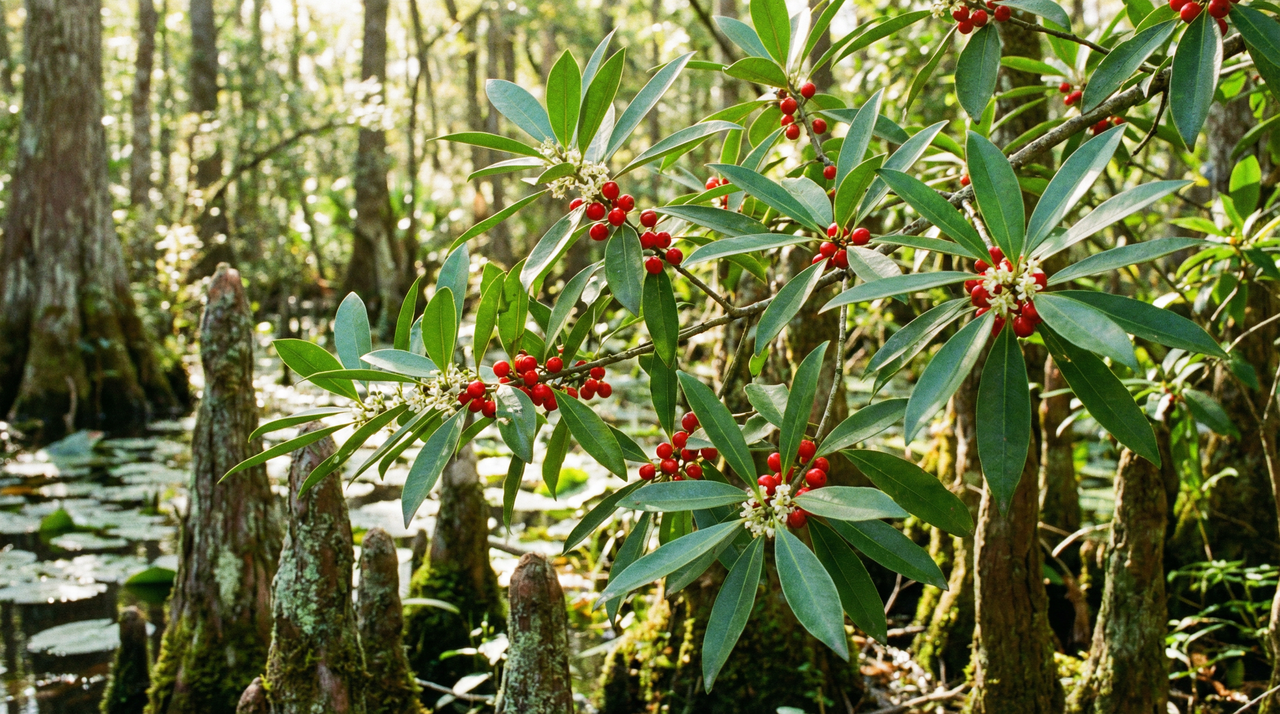
Holly offers structural resilience, deep winter interest, and steadfast wildlife value, yet most people only wire it into wreaths without a second thought. Not because it's wrong, but because we've completely forgotten what we're actually hanging there. Holly was a protective talisman long before it was a decoration, woven into doorways across pre-Christian Europe specifically to shelter households from malevolent spirits through the dark of winter. The plant earned that reputation. It's armed, it's toxic, it stays green when everything around it dies, and its berries blaze red in the coldest months like it's trying to make a point. That's not a gentle, festive shrub. That's a survivor with a mythology to match.
What really gets me, though, is how casually we underestimate it. I've watched designers plant holly as a throwaway hedge, trim it into lollipop balls, and then spend years fighting it because they didn't account for its roots, its allelopathy, or the fact that a single plant can outlive the house it's planted beside. I've also watched it carry a forest edge through brutal drought and freeze, feeding birds when nothing else had fruit left. Holly doesn't ask much, but it absolutely demands that you take it seriously. Give it the right conditions and a little respect, and it'll reward you for decades. Ignore what it actually is, and you'll be pulling seedlings out of your lawn until you move.
Origin and History of Holly (Ilex aquifolium)
Few plants carry as much cultural weight as holly. That glossy, spine-edged silhouette is one of the most recognizable forms in the temperate garden, and it got that way through thousands of years of coexisting with humans who noticed it, feared it, celebrated it, and eventually planted it everywhere they went. Understanding where holly actually comes from, and what it does naturally, makes you a much better designer when it comes time to put one in the ground.
Botanical Background and Natural Habitat
The holly genus, Ilex, spans hundreds of species across temperate and subtropical zones, but the three that matter most for gardeners in the English-speaking world are English holly (Ilex aquifolium), American holly (Ilex opaca), and Dahoon holly (Ilex cassine). All three are dioecious polycarpic perennials, meaning you need both a male and a female plant to get berries, and they will do that for a very long time. Ilex aquifolium can live between 100 and 500 years,[1] and I've learned the hard way in my own design work to always site at least one confirmed male within range of every female I plant if I want clients to actually see berries each winter.
Ilex aquifolium grows naturally as an understory tree or shrub in the mixed deciduous forests of western and southern Europe, from sea level up to around 600 meters, where maritime climates keep moisture consistent through the year.[2][3] That ecology tells you a lot: dappled shade, reliable rain, and decent drainage with a slightly acidic forest floor. The North American relatives tell a different story. American holly (Ilex opaca) spans the eastern United States from southern Massachusetts to eastern Texas, handling everything from humid subtropical to humid continental climates, and it can push into elevations up to about 1,200 meters.[4] Dahoon holly (Ilex cassine), meanwhile, hugs the southeastern coastal plain from Texas to Virginia and is officially classified as a facultative wetland species, found in swamps, marshes, and floodplains.[5] Knowing that kind of habitat range is exactly why I reach for Dahoon in waterlogged site designs where Ilex aquifolium would simply rot.
Visual Characteristics
If you've ever picked up a holly leaf and immediately dropped it, you've experienced Ilex aquifolium's primary defense mechanism firsthand. The leaves are leathery, glossy dark green ovals running 5 to 9 centimeters long, armed with 1 to 2 centimeter spines per side.[6] American holly leaves are a bit duller, more elliptical, with more spines per side but slightly less aggressive ones. Dahoon's leaves are longer, more lance-shaped, and noticeably less spiny overall.[7] One thing I've noticed on mature specimens is that the upper branches often carry leaves with far fewer spines or none at all. That's not random; the plant invests in armor where browsing animals can actually reach it and relaxes the defense higher up where it's safe.
All three species flower in spring with small white four to five-petaled blooms, and only the females set fruit. The berries ripen in autumn and persist through winter: 6 to 10 millimeters in Ilex aquifolium, slightly smaller in the American and Dahoon species, each one containing four to six nutlets inside.[8][9] Against bare winter branches or a dusting of snow, that persistent scarlet is genuinely striking.
Traditional, Cultural, and Symbolic Uses
Holly's written history in Europe goes back at least to Pliny the Elder, who described Ilex aquifolium in Naturalis Historia around 77 AD as a plant used to ward off magic, witchcraft, and poison, and cited its applications in folk medicine.[10] Celtic Druids considered it sacred, associated with protection and the transition from darkness to light, and it figures in the myth of the Holly King. The Christmas connection evolved from Roman Saturnalia celebrations and pagan winter solstice rituals; Christian symbolism later mapped the spiny leaves onto the crown of thorns and the red berries onto the blood of Christ.[11] Even Shakespeare wove holly into his plays. I find it genuinely fascinating that the same physical spines that made it a symbol of mystical protection in ancient folklore are the same ones that deter deer in my clients' gardens today. The symbolism and the function aren't actually that far apart.
Across the Atlantic, Southeastern Native American tribes including the Seminole, Cherokee, Creek, and Choctaw prepared the "black drink" from Dahoon holly leaves, a caffeine-rich ceremonial emetic used for purification before important events.[12][13] European folk medicine also used holly leaf teas for fevers, coughs, and rheumatism, though modern use is firmly discouraged given the toxicity profile I'll cover in the health and preparation sections.
That history of traditional use feeds directly into a conservation concern worth naming now: wild harvesting of holly for Christmas decor has caused genuine population pressure in parts of Europe and the southeastern United States, and some states regulate collection of American holly accordingly.[14][15] I source only nursery-grown stock for clients now, full stop. It's a small shift that makes a real difference.
Fun Facts and Ecological Notes
Holly's winter berries are genuinely critical to local food webs. Blackbirds, song thrushes, woodpigeons, and cedar waxwings rely on them as a key cold-season food source, and the birds disperse the seeds in the process.[16] Ilex aquifolium also supports larvae of more than 40 moth and butterfly species, including the holly blue butterfly, making it a biodiversity anchor during the months when most other plants have nothing to offer.[17] There's something almost paradoxical about a plant that's toxic to mammals being such a powerhouse for everything else in the winter garden. I love watching birds strip a holly of its berries over the course of a few January days; it's a reminder that the ecosystem is working exactly as it should.
The scale these trees can reach over time is also worth appreciating. Champion specimens at Kew Gardens approach 20 meters with trunks over 3 meters in circumference, and some UK trees date to the 17th century.[1] The tallest recorded American holly reached 25 meters in North Carolina.[18] That longevity comes with ecological resilience too: American holly can resprout from its base after fire damage, an adaptation suited to the fire-prone southeastern forests where it evolved.[19]
One caveat I always raise with clients considering English holly outside its native range: Ilex aquifolium is classified as invasive in parts of Washington, Oregon, California, New Zealand, and Australia, where birds spread its seeds into native vegetation with the same efficiency that makes it ecologically valuable in Europe.[20][21] If you're in the Pacific Northwest, I won't recommend it. But in its native European range, or in eastern North America with the native species, it's a different story entirely.
Holly Varieties and Where to Buy Them
The holly genus is almost absurdly diverse if you start pulling on the thread. Ilex aquifolium alone has over 400 named cultivars, the product of a breeding history that stretches back to Roman times, with introductions to American gardens beginning in the 18th century.[22] And that's before you get to the native American holly, which has been selected into more than 1,000 cultivar forms varying in size, foliage texture, berry color, and growth habit.[23][24] The sheer number of choices can be paralyzing, so I try to help clients think about which species makes ecological sense first, then narrow into cultivars from there.
Notable Holly Cultivars for Garden Use
For European holly, the RHS Award of Garden Merit winners like 'J.C. van Tol' represent the reliability end of the spectrum.[25] Among U.S. landscape favorites, 'Blue Prince' gives you a compact pyramidal form at 6-10 feet in zones 5-9 with good red berry production, while 'Black Prince' stays a tidy 3-4 feet with a heavy berry yield, making it far better suited to smaller gardens than the sprawling species.[11][26] In my designs, those compact forms have consistently outperformed the full-size species in urban gardens, staying manageable without constant intervention. 'Winter Red' reaches 10-15 feet with good disease resistance, and 'Pearl Baron' offers the creamy variegated foliage many clients love, topping out at 6-8 feet in zones 7-9.[11][27] Cold-climate gardeners should know that selections like 'Silver Queen' can push hardiness to zone 4 or 5 with some protection, outperforming the species average.[28]
For most clients in the Southeast and mid-Atlantic, though, I steer directly toward Ilex opaca. 'Shamrock' is a workhorse: compact pyramidal form at 8-12 feet, spineless dark green leaves, and abundant red berries.[29] 'Arno' runs taller at 15-20 feet with glossy foliage and heavy fruit set, while 'Capri' stays a rounded 6-8 feet with fine-textured spineless leaves that make it friendlier near walkways and play areas.[24][30] For wet or coastal sites in the Deep South, Dahoon holly cultivars like 'Hickman Gold' and 'SC Gold' offer heat and flood tolerance that neither of the above can match.[31][32]
Remember that most hollies are dioecious, meaning you need both a male and a female plant to get fruit.[33] Buy the pair at the same time, plant them within 50 feet of each other, and confirm compatibility with your nursery. Some hybrid selections like 'Emily Bruner' have more flexible pollination requirements, but verify before you plant, because a berry-less holly in December is a quiet disappointment every single year.[34]
Sourcing Holly Plants Responsibly
Ilex aquifolium is easy to find at major nurseries like Monrovia and Nature Hills, with the best inventory hitting shelves in fall and winter when demand peaks for holiday decor. Small 1-gallon plants typically run $10-25, while 3-6 foot specimens climb to $60-150 or more depending on cultivar and source.[35][36] Before you order, though, check your state regulations. Washington and Oregon have banned or restricted the sale of European holly due to its invasive spread into native woodlands, and parts of Maine have local controls as well.[37][38][39] I've watched European holly escape into Pacific Northwest woodlands firsthand, and after seeing that, I don't specify it for client projects anymore where native alternatives exist. There are no federal import restrictions on it, so the burden is on you to know your local rules.[40]
For American holly, native plant specialists are your best bet: Woodlanders Nursery, Plant Delights, and Pinelands Nursery all carry reliable stock. Expect $20-40 for a 1-gallon, $50-150 for a 3-5 foot specimen, and upward of $300 for larger mature trees.[41][42][43] Worth knowing: Ilex opaca is listed as endangered in Delaware and threatened in Pennsylvania, so always source from reputable nurseries growing propagated stock, not wild-collected plants.[33][44] Dahoon holly is best sourced through southeastern native plant nurseries affiliated with the Florida Native Plant Society or your state's extension programs, with 1-gallon plants around $15-30 and larger specimens reaching $100-200.[31][45] The slightly higher price you'll pay at a native plant specialist almost always pays back in better adaptation, less transplant stress, and plants that actually support the local birds you're growing them for.
Holly Propagation and Planting (Ilex aquifolium)
Holly is not a plant that rewards impatience, and nothing makes that clearer than deciding how to propagate it. I always steer home gardeners and design clients toward vegetative propagation first, and the reason is simple: seeds are slow, unreliable, and won't tell you whether the plant you've grown for years is male or female until it finally flowers. Semi-ripe cuttings preserve the sex and cultivar traits of named selections, which matters enormously with a dioecious species where sex determines whether you get berries at all.[46][47]
Propagation Methods for Holly
If you do want to try seeds, know what you're signing up for. Fresh autumn berries need to be harvested, cleaned of pulp (fungal rot is a real risk if you skip this), and then put through a double stratification: warm at 20-25°C for 8-12 weeks, followed by a cold period at 4°C lasting 12-18 months, before you sow into sandy compost the following spring.[48][49][50] Even after all that, germination success hovers at 20-50% and can take anywhere from one to three years. Seeds can be stored dry at 3-5°C for up to five years if you clean them well first, and tetrazolium staining is the most reliable way to test viability before you commit to the wait.[51] I label every propagation tray obsessively because holly seedlings in their first year are surprisingly easy to confuse with other woodland plants that self-seed nearby, and you do not want to nurture a weed for two years thinking it's your prized female cultivar.
For cuttings, take 10-15 cm semi-ripe stems from current-year, non-flowering growth in late summer, July through August being the sweet spot. Dip the cut end in 0.1-0.3% IBA rooting hormone, insert into a sterile 50:50 perlite-peat or sand-peat mix, and maintain 80-90% humidity under mist or a propagator with 15-21°C bottom heat. Done right, you can expect 50-70% rooting success in 8-12 weeks.[52][48][53] For named cultivars where you want even faster results, grafting (cleft, veneer, or bud) onto Ilex aquifolium or Ilex × altaclerensis rootstock in late winter to early spring offers 70-90% success rates and gets you to a mature, productive plant sooner than any other method.[48][54][55]
Germination and Maturity Timelines
Here's the number that makes most people reconsider growing holly from seed: 10-20 years to first fruit.[46][31][53] A seed-grown plant reaches only 1-2 meters in its first decade, and females often won't flower until after that. I stopped recommending seed propagation for client landscapes years ago for exactly this reason. Cutting-grown plants typically fruit in 6-8 years; grafted specimens can produce berries in 3-7 years.[48][56] Still slow compared to most garden shrubs, but manageable.
Because holly is dioecious, you must plan for both sexes from the start, and vegetative propagation is the only way to guarantee what you're planting. Seedlings split roughly 50:50 male to female, which means years of waiting to find out what you've got. A male plant needs to be within 30-50 feet of your females for pollination to work.[46][56][57] Plan that pairing at planting time, not after you've wondered for a decade why nobody's fruiting. For comparison, Dahoon holly can reach its first berries in 5-10 years from seed under good conditions,[58][59] which is a useful reminder that timeline varies across the genus, but long-term planning is the throughline for all of them.
Soil, Site, and Light Requirements
European holly grows best in well-drained, humus-rich loamy or sandy-loam soil that stays moist without sitting wet. The optimal pH range is 5.0-7.5, with tolerance stretching to 4.5-8.0 at the extremes, but there are real consequences at those edges: iron chlorosis above 7.0, and phosphorus fixation or aluminum toxicity below 5.0-5.5.[60][61][27] I test soil pH before planting any holly, full stop. I've seen iron deficiency misread as pest damage or general nutrient lack in humid climates, and by the time someone figures out it's a pH problem, the plant has been struggling for a season or two unnecessarily.
For containers or heavy clay sites, build your mix deliberately: 50% ericaceous peat-based compost, 30% perlite or grit, and 20% pine bark or leaf mold replicates the woodland floor conditions these plants evolved in while keeping drainage sharp.[62][63] Amend heavy clay with organic matter, sand, or grit before planting, and aim for 2-5% organic matter content to support establishment without compromising drainage. Poor drainage is the primary failure point, opening the door to Phytophthora root rot; mycorrhizal associations help the plant pull nutrients efficiently across its wide pH range, so consider inoculating transplants at planting time.[64][7]
Light mirrors its native understory habitat: full sun to partial shade, with at least 4-6 hours of direct sun daily for good density and berry set.[65] In hotter climates, morning sun with afternoon shade prevents leaf scorch. In my experience working across both European and Dahoon holly, choosing the right light exposure at planting time prevents more problems than any single care decision that follows. American holly tolerates deeper shade than its European cousin,[4] while Dahoon prefers the full sun of wetland edges and tolerates periodic flooding and saline soils that would finish off I. aquifolium quickly.[7][59] Species choice has to match site conditions, not the other way around.
Spacing and Planting Technique
Ilex aquifolium grows slowly, 6-12 inches per year, but it has time on its side: mature specimens reach 15-50 feet tall and 15-25 feet wide.[66][67] Space specimens 6-10 feet apart for open growth, tighten to 3-4 feet for a dense hedge, and leave 6-8 feet between rows if you need maintenance access.[66][67][7] I tend to space more generously in humid climates because airflow is one of the simplest disease-prevention tools available, and dense planting you'll regret in ten years is easy to avoid if you plan for the plant's mature footprint from day one.
Position at least one male within 30-50 feet of every female group, and I'd say 40 feet is a comfortable working target.[64][68] Plant in early spring after the last frost or in autumn to give roots time to establish before summer heat or winter cold arrives. Apply 2-4 inches of mulch to conserve moisture and moderate soil temperature, keeping it pulled back from the trunk, and water deeply once or twice a week through the first growing season. Holly is a long game, but get the site conditions and the sex ratio right at the start, and the plant will reward you for decades.
Holly Care Guide: Growing Ilex aquifolium Successfully
European holly comes from moist, semi-shaded woodland edges and hedgerows across western and southern Europe, and understanding that origin explains almost every care decision you'll make in the garden. This isn't a plant that craves coddling, but it does have preferences, and ignoring them long enough produces a plant that sulks visibly. Get the light, water, and temperature pieces right, and holly will largely take care of itself.
Light Requirements for Healthy Foliage and Berry Production
Ilex aquifolium tolerates full sun to partial shade, but at least four to six hours of direct sun daily is what produces dense foliage, rich leaf color, and reliable berry set.[69][70] Push it into too much shade and you'll see what I see on under-lit boxwood and cherry laurel too: pale, undersized leaves, long leggy internodes, and almost no flower or fruit production.[11] Flip to the other extreme, and marginal browning in July is your plant telling you it needs more water or relief from afternoon sun.[46][71] One detail I find genuinely fascinating: leaves in full sun actually develop more pronounced spines as a stress and herbivore response, while shaded leaves come in smoother.[72] If your garden runs hot, American holly handles shade and heat better than European holly, making it the more sensible choice for warmer exposures.[73]
Watering Needs and Soil Moisture Management
The species originates in regions receiving 600 to 1500 mm of annual rainfall, and it grows best in humus-rich, moist but well-drained soil with a pH of 5.5 to 7.5.[74][46] In the first season, water deeply every week to get roots established. Once the plant settles in, shift to deep irrigation every seven to fourteen days during dry spells, delivering enough to reach the eighteen-to-twenty-four-inch root zone.[46][64] Frequent shallow watering is counterproductive; it keeps roots near the surface where they're most vulnerable. Apply water slowly at the base and let it sink.[53]
Two to four inches of organic mulch over the root zone conserves moisture and keeps soil temperatures stable, which matters more than most people realize in both summer and winter.[46] In my experience with hollies in humid climates, the most common mistake is keeping soil wet through winter. Reduce watering frequency in autumn and winter, checking only that the top two inches aren't bone dry before you water again.[53] Symptoms to know: marginal browning that starts at leaf tips points to drought; yellowing starting low on the plant with any mushiness at the roots points to overwatering and potential Phytophthora.[46]
Frost and Cold Hardiness with Winter Protection Strategies
Mature, established Ilex aquifolium in sheltered sites can handle minimum temperatures down to around -20°F, placing it in USDA zones 5 through 9 on paper.[75][76] In practice, young plants, exposed sites, and poorly drained soils effectively push that limit warmer. I'd treat zone 7 as the comfortable minimum for most new plantings. The native climate, temperate oceanic to Mediterranean, means winters in the 23°F to 50°F range, so sustained cold below that should be respected.[77][74]
The protection playbook I recommend to new clients follows a clear sequence: site against a south-facing wall or wind-sheltered spot, apply three to four inches of leaf-mold mulch around the base before first frost, and cover with frost cloth during hard freeze events.[11][78] Container plants need insulation or a frost-free space entirely. Know what winter damage looks like: blackened stem lesions, brown-to-black leaf margins (especially on south or southwest exposures), and water-soaked patches that dry into crisp brown tissue.[79][78] Flower buds hit by late frosts will reduce your berry crop that autumn, so protecting them matters beyond just aesthetics.
Heat Tolerance and Summer Stress Mitigation
European holly grows best between 50°F and 70°F and genuinely struggles when temperatures hold above 82°F to 86°F for extended periods.[80] Heat is often the real limiting factor in warmer gardens, not cold. Leaf scorch, wilting, and fruit abortion during hot summers can look deceptively similar to drought stress, and often both are happening simultaneously.[81][82] In humid subtropical conditions, I've found that pairing afternoon shade with understory companions that cool the root zone makes a measurable difference for borderline sites.
Mitigation comes down to three things: thirty to fifty percent shade cloth or structural afternoon shade, two to four inches of mulch to buffer soil temperature, and deep early-morning irrigation timed before 9 AM that reaches twelve to eighteen inches down.[83][84] There are no widely available heat-tolerant Ilex aquifolium cultivars, so gardeners in zones 9 and warmer are better served by Ilex opaca or Ilex cornuta from the start.[85][86]
Pruning, Maintenance, and Seasonal Growth Rhythm
Holly follows a satisfying, predictable annual rhythm: rapid spring vegetative growth, small white flowers from April through June, slow fruit development through summer, and berries ripening to red in autumn before persisting through winter as a key food source for birds.[6] That rhythm should drive your pruning calendar. The best time to cut back a holly tree or shape a holly bush is late winter to early spring, February through April, after the berries have dropped.[6] Waiting until after berry drop isn't just convenient; it also extends winter forage for birds, which is a small but meaningful permaculture design choice. Light hedge trimming is fine in summer, but the major structural work happens in late winter.
When pruning a holly bush, remove dead, damaged, or crossing branches first, then step back and assess the natural pyramidal shape before cutting anything else. Never remove more than one-third of the canopy in a single session.[64] Use sharp, clean tools, and wear thick gloves. I still have faint scars from my first un-gloved hedge job on a spiny-leafed English holly, and that lesson stuck. Once your holly is sited correctly for light, water, and temperature, the seasonal maintenance is genuinely minimal: prune in late winter, mulch in autumn, water deeply during dry spells. That's largely the whole ask.
Harvesting Holly (Ilex aquifolium) Berries and Branches
For most gardeners, harvesting holly means one thing: armfuls of glossy, spine-edged branches destined for wreaths, mantels, and holiday arrangements. That's not a limitation. That's the actual point. Understanding when and how to cut those branches well is its own skill, and the phenology of the plant gives you a reliable seasonal map to work from.
When to Harvest Holly: Flowering, Ripening, and Seasonal Cues
Ilex aquifolium flowers in late spring, typically April through June in temperate regions, and then takes its time.[49][74] That 4-6 month ripening window means berries won't reach peak color and firmness until autumn at the earliest, with the best decorative harvest window running November through January.[87] Cut too early and you'll get green berries that simply won't ripen once they're off the plant.[74]
What you're watching for is full red coloration and firm, taut skin. Cold weather actually helps here. In my experience, a light frost sharpens that color transition noticeably, pulling the berries from a dull orange-red into that deep, lacquered crimson that looks perfect in a wreath. I've learned to wait for that first cold snap before I cut, and I always wear gloves because those leaf spines are completely unforgiving at close range. Related species shift the calendar somewhat: Dahoon holly (Ilex cassine) ripens as early as August in southern Florida, while American holly (Ilex opaca) depends on 600-1,000 chill hours below 40°F and may not peak until January or March in northern ranges.[88][89] But for European holly, autumn patience is the strategy.
Holly Berry Taste, Texture, Toxicity, and Practical Yield
I want to be direct here because this genuinely matters: holly berries are not food. The berries of Ilex aquifolium contain ilicin and saponins that irritate the digestive system regardless of ripeness, and ingestion causes nausea, vomiting, and diarrhea.[90][91] A few berries can send a child to the emergency room. I've seen holiday arrangements made without any awareness of this, and that's exactly the kind of oversight that ends badly. The sensory reality backs up the chemistry: even if someone were tempted to taste, what they'd find is a hard glossy exterior giving way to mealy, gritty pulp packed with bitterness that lingers.[92] American holly berries have a tart, acidic quality but are equally off-limits for the same reasons.[93]
Birds handle all of this differently. Thrushes, fieldfares, and robins feast on those same berries through the lean winter months, processing the compounds in ways our digestive systems simply can't manage.[25] That wildlife value is real and ecologically important, but it tells you nothing about human edibility. The practical yield for you is decorative branches, full stop. Cut them when the berries are firm and gleaming, keep the cuts clean, and bring them inside knowing they're beautiful and categorically not for eating. The preparation and safety sections cover exactly where that line sits and why it must hold.
Holly Preparation, Culinary Uses, and Practical Applications
Why Holly Is Not a Food Plant: Toxicity and Historical Attempts at Preparation
Let me be unambiguous about this: European holly berries are not food. The saponins concentrated in those glossy red fruits, primarily ilicin and ilexosides, cause severe gastrointestinal distress, and even two or three berries can make a child seriously ill.[94][90] American holly carries the same risk.[94] I've watched cedar waxwings descend on berry-laden branches and strip them clean, which is a lovely sight, but it also underscores a hard rule: what birds can process, we cannot. If you have small children or pets, treat every part of European holly as potentially toxic, and keep decorative arrangements well out of reach.
The mature leaves carry similar compounds.[95] There is a thread in historical foraging literature about parboiling young spring shoots multiple times to leach out the bitterness, but this practice appears in the context of European famine, not preference.[95][96] Modern botanical authorities are unambiguous: the residual toxicity risk and the unpalatable flavor make it not worth attempting.[97] No amount of freezing, thawing, or boiling renders any part of Ilex aquifolium reliably safe to eat.[90]
The one genuine culinary tradition in the holly genus belongs to a different species entirely. Dahoon holly (Ilex cassine) leaves, dried and roasted then steeped as a tea called cassina or the "black drink," have a long documented history among Southeastern Native American tribes.[12] The leaves contain caffeine, theobromine, flavonoids, and phenolic acids, producing a mild, earthy, tea-like flavor, though excessive consumption can still cause nausea.[12][98] I usually explain this to Florida clients by comparing it to yaupon holly tea, which many local gardeners already know; the preparation logic is similar, but the species identity is non-negotiable. Ilex aquifolium is not a substitute.
Traditional Medicinal Preparations and Modern Safety Guidance
European herbal tradition records holly leaf infusions and decoctions, typically one to two teaspoons of dried leaf simmered for ten to fifteen minutes, used historically for fevers, coughs, and as a diuretic.[99][95] These are past-tense uses. Contemporary medical and botanical authorities strongly advise against any internal use of Ilex aquifolium without professional medical guidance, and the Dahoon holly ceremonial preparations used in purification rituals and traditional medicine[12] are not a workaround for that warning. Different species, different chemistry, different cultural context. They are not interchangeable preparations.
Non-Food Uses: Ornamental, Craft, and Landscape Applications
Here is where holly genuinely earns its place. The glossy, spiny evergreen foliage and bright red berries have made Ilex aquifolium a fixture in Christmas wreaths, garlands, and formal hedging for centuries.[100][11] In my own landscape designs, I rely on its dense, spiny growth habit as a living fence that stops deer and deters foot traffic more reliably than most ornamental shrubs. It's one of the few plants I can point to and say the thorns are a feature, not a problem.
The wood has its own appeal: heavy, fine-grained, and historically valued for carving, tool handles, inlays, and small detailed implements, with young flexible stems traditionally used in European basketry and hurdle making.[100] I'll admit I learned the hard way that stems need to be harvested and worked while still green; once they harden, they become almost impossible to bend without splitting. As a windbreak or privacy screen, the dense evergreen canopy earns its keep year-round.[11][101] American holly bark also has a place in ethnobotanical craft history, yielding black dyes used in basketry and textiles, while Dahoon is sometimes grown for biomass as mulch or fuelwood.[102][103] The genus has a lot to offer. Just none of it happens in the kitchen.
Holly Health Benefits and Medicinal Uses
Holly is toxic, and contemporary medical authorities are unequivocal that no part of Ilex aquifolium belongs in the medicine cabinet or on the dinner table.[104][105][106] The plant contains triterpenoid saponins (ilexosides A and B), ilicin, and cyanogenic glycosides concentrated most heavily in the berries but present in leaves and bark as well.[107][106] That chemistry is precisely what makes the emerging research so interesting to follow at a safe distance, and what makes the history of human use so worth understanding.
Traditional and Modern Medicinal Research
European herbalists from Celtic traditions through the medieval period used leaf infusions and decoctions for fevers, rheumatism, coughs, and as a diuretic.[95][108] Across the Atlantic, Seminole, Cherokee, Creek, and Timucua communities used American holly and Dahoon holly for fevers, rheumatism, digestive complaints, and the famous ceremonial "black drink," a caffeinated emetic tea brewed from roasted leaves.[109][110] These uses span continents and centuries, which tells you something about the plant's genuine bioactivity. It also tells you that traditional practitioners operated without modern toxicology, and that many of those uses carried real risks that weren't fully understood at the time.
The preclinical research paints a genuinely compelling picture. Leaf extracts show strong antioxidant activity in multiple assays, with DPPH radical scavenging capacity comparable to ascorbic acid, attributed to a dense load of phenolic compounds and flavonoids.[111][112] Anti-inflammatory activity has been demonstrated through COX-2 inhibition, NF-κB pathway suppression, and reduction of pro-inflammatory cytokines including TNF-α and IL-6.[111][113][114] Polyphenols activate the AMPK pathway, showing metabolic regulation and enhanced glucose uptake in cellular models.[115] Antimicrobial effects against Staphylococcus aureus and Candida albicans have been recorded, primarily from ethanol extracts and linked to polyphenol content.[116][117] There are even early findings suggesting leaves may inhibit RANKL-induced osteoclast differentiation, with possible implications for bone health.[118] Diuretic effects in animal models have been attributed to saponin content, echoing those old European leaf tea practices.[119]
All of this is intriguing, and none of it has translated to human clinical evidence. No randomized controlled trials exist.[104] While the lab data on anti-inflammatory pathways is genuinely promising, I always tell clients that holly belongs in the landscape, not the apothecary, until rigorous human trials exist. The gap between a petri dish and a prescription is a wide one, and with a plant this toxic, that gap matters enormously.
Key Phytochemicals in Holly
Holly's chemical profile is layered and ecologically sophisticated. The leaf inventory includes flavonoids like quercetin-3-O-rutinoside, kaempferol glycosides, and rutin; phenolic acids including chlorogenic, neochlorogenic, and cryptochlorogenic acids; triterpenes such as ursolic acid and oleanolic acid; saponins; and anthocyanins like cyanidin-3-glucoside.[111][120] Distribution across plant parts matters a lot here: leaves concentrate the flavonoids and phenolic acids that drive the promising bioactivity, while fruits carry higher levels of cyanogenic glycosides and saponins, and bark is richest in tannins.[121][122] This distribution explains why traditional European practitioners generally reached for leaf infusions rather than berry preparations.
Across the genus, the chemistry shifts in telling ways. Dahoon holly leaves contain caffeine (0.2-1.5% dry weight) and theobromine, which explains the stimulant character of the ceremonial "black drink."[123] American holly features additional oleuropein-type secoiridoids and its own unique saponins.[124] I find that observation about Dahoon fascinating from a botanical standpoint, but I would never recommend harvesting it for home tea-making given the variable alkaloid concentrations across individual plants and its long history as an emetic.
Environmental conditions influence potency more than most gardeners realize. Metabolite concentrations peak in summer and autumn, and plants under drought stress can show up to a 30% increase in phenolics; herbivory triggers localized flavonoid surges as well.[125][126] I've noticed this in the landscape too: holly under stress often looks more intensely defended, its foliage somehow more pungent and waxy. The chemistry is doing exactly what it evolved to do, protecting the plant from herbivores and pathogens in shaded understories.[127][128] The "medicine" and the "poison" are the same compounds doing the same job.
Nutritional Profile and Limitations
There is no positive nutritional profile to discuss here. Ilex aquifolium does not appear in the USDA FoodData Central as a safe edible, and reliable databases contain no established nutritional composition for it.[129][130] What limited compositional analysis does exist tells us the berries are mostly water (60-70%) with some sugars, organic acids, and toxic compounds, with rough energy estimates of 50-60 kcal per 100g that are largely unreliable given the variability and the overriding toxicity concern.[131] Dried leaf analysis shows minerals present (potassium, calcium, magnesium, iron), but those figures serve no practical purpose since consuming them is firmly off the table.[132]
The one genuine nutritional footnote in the genus is Dahoon holly's caffeine content, which gave the ceremonial black drink its staying power across generations of Native American ritual use.[133][134] That's a fascinating piece of botanical history, not a modern dietary recommendation.
Safety Considerations and Toxicity
All parts of holly are toxic, with berries and leaves carrying the heaviest load of triterpenoid saponins (ilexosides A and B), ilicin, and cyanogenic glycosides.[106][135][136] Saponins are hemolytic and irritate gastrointestinal mucosa, and ingestion typically causes nausea, vomiting, diarrhea, and abdominal pain; larger doses can bring on drowsiness, dizziness, and in rare cases cardiac irregularities or dehydration.[106][105][137] Most exposures are mild and resolve with supportive care, but "mild" is still a miserable afternoon, especially for a small child.
Children are the highest-risk group precisely because those bright red berries are irresistible.[105][138] In my years designing gardens with holly as a structural element, I've always treated the berries as strictly ornamental and make a point of educating clients about keeping them out of reach of young children and pets. Pregnancy is an absolute contraindication given the potential teratogenic effects and the plant's established emetic properties.[105]
Skin contact with the spiny leaves can cause irritant or allergic contact dermatitis, so gloves are non-negotiable when pruning.[139][140] For pets, both Dahoon and American holly cause vomiting, diarrhea, and lethargy in dogs and cats, with colic and ataxia reported in horses as well.[94][4] Toxin levels also vary with season, with ripe winter berries carrying a heavier chemical load than unripe ones.[141][142] If ingestion is suspected, call Poison Control immediately and don't wait for symptoms to declare themselves. Holly is a plant I genuinely love in the landscape; I simply have no ambiguity about where the line sits.
Holly Pests and Diseases
English holly has earned a reputation as a tough, reliable landscape plant, and the RHS Award of Garden Merit backs that up.[143] In temperate climates with decent growing conditions, Ilex aquifolium shows moderate to good overall disease resistance,[144][145] and its tolerance to foliar problems like tar spot and holly leaf spot means most cosmetic issues stay exactly that: cosmetic. But there's one vulnerability that I've seen take down even well-established plants, and it's not a leaf disease at all.
Disease Resistance and Common Diseases of English Holly
Phytophthora root rot, caused primarily by Phytophthora cinnamomi, is the single biggest threat to holly in the landscape. Young plants are especially vulnerable and can die quickly once waterlogged roots become infected.[146][147][148][149] I always check drainage twice before planting holly, because once this pathogen establishes in heavy clay, you're essentially fighting a losing battle. Prevention is everything here: raised beds, amended soil, and never planting in a low spot where water lingers after rain. If you're seeing a dying holly bush with yellowing, wilting foliage and the stems still look intact, dig down and check the root crown before assuming anything else.
Beyond root rot, the secondary disease roster includes various leaf spots that can cause defoliation under heavy pressure, powdery mildew (Erysiphe spp.), Botryosphaeria and Nectria cankers, and Verticillium wilt, which persists in soil indefinitely with no curative treatment.[150][151] American holly carries a longer disease list still, adding bacterial blight and holly mosaic virus to the mix,[152][153] while Dahoon holly tends to show lower susceptibility to fungal leaf spots and handles Phytophthora better than I. opaca in well-drained situations.[7] That's worth knowing if you're designing for a wet southeastern site. Cultivar choice matters too: 'JC van Tol' has become my go-to recommendation for clients in rainy climates, combining good leaf-scorch resistance with that nearly spineless habit that makes it easy to work around,[154] though no cultivar is fully immune to everything. Good drainage, proper airflow, and well-drained slightly acidic soil are still the real foundation of a disease-free planting.[155][156] When treatment is genuinely needed, phosphonate fungicides address active Phytophthora, and sulfur-based products help with powdery mildew; Verticillium requires preventive site selection because there's simply nothing to do once it's present.[157][158]
Major Insect Pests and Integrated Management
Holly's chemical defenses, saponins, alkaloids, and phenolics combined with those spiny leaves, give it decent protection against generalist herbivores and many insects.[6][64] The usual suspects are holly leaf miners, scale insects, lace bugs, spider mites, and aphids, with damage showing up as serpentine leaf mines, stippling, or sooty mold.[6] I've learned to distinguish those early leaf-miner trails, which look alarming but are mostly cosmetic on a vigorous plant, from the kind of widespread stippling that signals real stress. The difference is usually the overall plant: if new growth looks healthy and the canopy is full, mines are a curiosity, not a crisis.
In roughly twenty years of specifying holly in designs, I've rarely needed anything beyond dormant horticultural oil and sensible pruning for airflow. Horticultural oils and insecticidal soaps handle scale and aphids well; systemic options like imidacloprid exist but should only come out when monitoring confirms thresholds are genuinely exceeded.[32] Calendar sprays do more damage to the beneficial insects than the scale ever would. Keep plants well-irrigated through dry spells too, because drought stress opens the door to borer activity that a healthy holly simply shrugs off.
Holly in Permaculture Design
Holly earns its place in a food forest or woodland edge not as a productive crop but as a structural workhorse with genuine ecological weight. Before you plant, though, you need to understand exactly where it fits climatically and what it demands from the system around it, because siting a holly wrong creates a slow-motion problem that takes years to diagnose.
Climate Adaptability and Hardiness Zones
English holly (Ilex aquifolium) is most reliably itself in USDA zones 7 and 8, where mild winters protect developing buds and you get the dense berry set that makes the plant worth growing in the first place.[159][160][161] Zone 6 is survivable but marginal; exposed sites and drying winter winds can scorch young growth and damage flower buds, so a sheltering windbreak and a thick root mulch make real difference there.[162] In zone 9, the plant grows adequately but starts showing heat stress, especially where afternoon sun is intense; reduced temperature seasonality can also blunt berry color and size, so I always site hollies where they catch some afternoon shade in hot summers.[70] The plant wants 30 to 60 inches of reasonably even annual rainfall, consistent moisture without sitting wet, and once established it handles moderate dry spells reasonably well in good drainage.[163][74][164]
One honest caveat on regional siting: English holly is recommended for Pacific Northwest and southeastern coastal gardens, but in the Pacific Northwest its invasive potential is well documented and it can displace native understory plants with surprising aggression.[28] For colder gardens, American holly (Ilex opaca) pushes the cold edge into zone 5, surviving temperatures down to -20°F and performing best in zones 6 through 8. For hot, humid, or periodically flooded sites in zones 7 through 10, Dahoon holly (Ilex cassine) is the genus answer, handling 100°F heat and acidic wetland conditions that would stress English holly badly.[165][31][59] Understanding which species fits your climate is the whole game with this genus.
Ecosystem Functions and Pollination
Holly is dioecious, and the spacing between sexes matters more than people realize. Keep males within 30 to 50 feet of your females and aim for roughly one male to every three females at minimum.[166][74][167][168] In my own garden, I've found that 30 feet gives noticeably better berry set than planting pairs at 50-plus feet, even with plenty of bees around. The cultivar's bloom timing matters too; if your male and female flower two weeks apart, proximity is irrelevant.
The flowers themselves are small, greenish-white, and low on nectar, offering pollen as the main reward for visiting insects.[169][170][171] Bees in the Andrena, Apis, and Bombus genera do most of the work, with syrphid flies as secondary visitors. Pollination peaks between 50 and 75°F with moderate humidity, so the May to June bloom window is critical; I plant early-flowering companions like phacelia and borage nearby specifically to build up solitary bee populations before holly opens. Broad-spectrum insecticides during bloom are a straightforward way to lose your berry crop, so avoid them entirely in that window.
Beyond pollination, the ecological services are substantial. The evergreen canopy provides year-round shelter and winter nesting cover for birds, and the berries feed thrushes and blackbirds when almost nothing else is available. The berries and foliage are toxic to humans and most pets, so this is wildlife food rather than human forage; the safety section covers the toxicity in full detail. Holly's fibrous root network stabilizes slopes and woodland edges, it supports more than 100 insect species, and its mycorrhizal associations contribute to the wider soil biology of whatever system it's embedded in.[16][172][173] As a long-lived woody perennial, it sequesters carbon quietly over decades. Dahoon adds wetland restoration value and richer spring nectar than English holly, while American holly's slowly decomposing leaf litter cycles nutrients more gradually through eastern woodland guilds.[174][175][4]
Forest Layer Placement and Guild Companions
English holly occupies the shrub and understory layer in temperate food forests, tolerating as little as 5 to 10 percent of full sun and capable of pushing into the sub-canopy over time.[176][177][178] I think of it as a structural backbone for hedgerows and woodland edges, where its density and evergreen spine create both physical shelter and a living boundary. The problems start when you treat it like a benign shrub and plant generously underneath it.
Holly's root system is shallow and fibrous, competing hard for moisture and nutrients, and its leaf litter is genuinely allelopathic. The slow-decomposing, high-lignin leaves acidify the soil to a pH of around 4.5 to 5.5, and root exudates can suppress many understory plants directly.[179][180] I found this out the hard way trying to establish herb companions beneath a mature specimen; most of them sulked and eventually failed. Now I use comfrey as a buffer, placing it between the holly's drip line and any more sensitive planting, and I mulch heavily with other organic matter to keep soil biology active and dilute the allelopathic effect.
In its native European woodland context, holly associates naturally with oak, beech, and hawthorn.[181][182] In a permaculture guild, nitrogen-fixers like alder work well at the canopy level, and clover running through the ground layer handles fertility close to the surface. Keep shallow-rooted edibles at a respectful distance; they won't win that competition. American holly slots into similar logic in eastern North American food forests, pairing with oaks, hickories, sweetgum, and native ferns in moist hardwood understories. Dahoon, by contrast, belongs at the wetland edge of a design, tolerating flooding and shade where almost no other fruiting shrub would survive.[4][183][184] The genus is remarkably versatile across niches; the key is matching the right species to the right layer rather than defaulting to English holly everywhere.
The Plant That Taught Me to Respect a Hard No
I've spent most of my career looking for ways to eat the landscape, so holly was a humbling lesson. It gives you everything: year-round structure, winter berries that glow like something out of a fairy tale, shelter for birds when nothing else is offering it. And then it says, firmly, that none of that is for you. I've made peace with that. Some plants earn their place just by being exactly what they are.
Sources 184
- Champion Trees: Holly - Kew Gardens ↩
- Flora of the European Alps (FEO) - Ilex aquifolium ↩
- Plants of the World Online: Ilex aquifolium ↩
- American Holly (Ilex opaca) ↩
- USDA PLANTS Profile: Ilex cassine ↩
- Ilex aquifolium - Royal Horticultural Society ↩
- Ilex cassine - UF/IFAS EDIS ↩
- Ilex aquifolium L. - Plants of the World Online ↩
- American Holly (Ilex opaca) - USDA Forest Service ↩
- Naturalis Historia ↩
- Ilex aquifolium: Historical Uses ↩
- Ilex cassine - Dahoon Holly ↩
- Native American Ethnobotany Database ↩
- Conservation Status of Ilex aquifolium ↩
- Sustainability of Wild-Harvested American Holly ↩
- Wildlife Benefits of Holly ↩
- Insect Hosts of Ilex aquifolium ↩
- National Register of Big Trees: Ilex opaca ↩
- Trees of the World Online ↩
- English Holly - Ilex aquifolium ↩
- Cal-IPC Inventory: Ilex aquifolium ↩
- RHS Gardening: Holly (Ilex aquifolium) ↩
- Ilex opaca - American Holly ↩
- American Holly (Ilex opaca) Cultivars ↩
- Ilex aquifolium ↩
- Missouri Botanical Garden: Ilex aquifolium ↩
- USDA Plants Database: Holly Cultivars ↩
- Ilex aquifolium - Missouri Botanical Garden ↩
- Ilex opaca 'Shamrock' Description ↩
- History of Ilex Breeding in North America ↩
- Dahoon Holly Cultivars ↩
- Horticulture of Ilex cassine ↩
- Ilex opaca ↩
- Ilex opaca (American Holly) ↩
- European Holly - Ilex aquifolium ↩
- Nursery Stock Availability ↩
- Invasive Plant Atlas: Ilex aquifolium ↩
- Oregon Noxious Weed Control Board - Ilex aquifolium ↩
- Washington State Noxious Weed List ↩
- USDA Plants Profile for Ilex aquifolium ↩
- Ilex opaca - American Holly ↩
- American Holly - Ilex opaca ↩
- Ilex opaca 'Savannah' - American Holly ↩
- American Holly (Ilex opaca) ↩
- Dahoon Holly (Ilex cassine) ↩
- Ilex aquifolium - Propagation ↩
- Ilex aquifolium ↩
- Holly (Ilex) - Propagation ↩
- How to grow holly ↩
- Seed germination of Ilex aquifolium ↩
- Millennium Seed Bank - Kew Gardens ↩
- Ilex aquifolium Propagation Guide ↩
- Propagation of Native Trees, Shrubs, and Vines ↩
- Grafting and Budding Nursery Crop Plants ↩
- Propagation of Hollies ↩
- Growing Hollies ↩
- Propagation of Ilex Species ↩
- Propagation of Native Florida Hollies ↩
- Dahoon Holly (Ilex cassine) ↩
- Ilex aquifolium ↩
- Ilex aquifolium ↩
- Holly (Ilex spp.) in the Home Landscape ↩
- Ilex aquifolium (English Holly) ↩
- Ilex opaca (American Holly) ↩
- Ilex aquifolium ↩
- Ilex aquifolium ↩
- Ilex aquifolium Cultivation - Missouri Botanical Garden ↩
- Holly Culture and Care ↩
- Ilex aquifolium ↩
- Ilex aquifolium ↩
- Holly Leaf Scorch - University of Maryland Extension ↩
- Ecology of Ilex aquifolium in European Forests ↩
- Growing American Holly in the Landscape ↩
- Ilex aquifolium ↩
- Ilex aquifolium (Holly) ↩
- European Holly (Ilex aquifolium) ↩
- Ilex aquifolium ↩
- Winter Injury in Evergreens ↩
- Ilex aquifolium (European Holly) - Plant Care & Info ↩
- Ilex aquifolium ↩
- Heat Stress in Holly Plants ↩
- Drought and Heat Tolerance of Ilex aquifolium ↩
- Ilex aquifolium Fact Sheet ↩
- Growing Holly Shrubs and Trees ↩
- Holly Production and Care ↩
- Ilex opaca ↩
- Holly (Ilex) - Pruning and Training ↩
- Ilex opaca - American Holly ↩
- Hollies of Florida: Flowering and Fruiting Times ↩
- Holly Berries: Poisonous to Humans ↩
- Toxicity of Ilex Species ↩
- Ilex aquifolium - Missouri Botanical Garden ↩
- American Holly - Ilex opaca ↩
- Holly (Ilex) Toxicity - ASPCA ↩
- Ilex aquifolium - European Holly ↩
- Ilex aquifolium ↩
- Ilex aquifolium ↩
- Phytochemical constituents and pharmacological activities of Ilex cassine ↩
- Traditional Uses of Holly ↩
- Ilex aquifolium ↩
- Permaculture Applications of Native Hollies ↩
- Native American Medicinal Plants: An Ethnobotanical Dictionary ↩
- Dahoon Holly: A Native Shrub for Southeastern Landscapes ↩
- Ilex aquifolium L. (Holly): A Review of Its Traditional Uses, Phytochemistry and Pharmacology ↩
- Ilex aquifolium - European Holly ↩
- Holly (Ilex aquifolium) Toxicity ↩
- Toxicology of Ilex Species ↩
- Medicinal Uses of Holly ↩
- Ethnobotany of Dahoon Holly ↩
- Traditional Uses and Antioxidant Activity of Ilex cassine ↩
- Phytochemical Characterization and Antioxidant Activity of Ilex aquifolium L. ↩
- Antioxidant and Anti-inflammatory Potential of Ilex aquifolium Extracts ↩
- Anti-Inflammatory Effects of Ilex aquifolium via NF-κB Inhibition ↩
- Anti-inflammatory Activity of Ilex Leaf Extracts ↩
- Ilex aquifolium Polyphenols and AMPK Activation in Metabolic Disorders ↩
- Pharmacological Activities of Ilex aquifolium L.: A Review ↩
- Antimicrobial and Cytotoxic Potential of Holly Leaf Extracts ↩
- Inhibitory Effects on Osteoclastogenesis by Ilex aquifolium Extracts ↩
- Ilex aquifolium L. (Aquifoliaceae) in Traditional and Modern Medicine ↩
- Bioactive Compounds in Leaves and Fruits of European Holly (Ilex aquifolium L.) ↩
- Phytochemical Profile of Ilex aquifolium Leaves: An Overview ↩
- Secondary Metabolites in Holly Fruits ↩
- Phytochemical Analysis of Ilex cassine Leaves ↩
- Phytochemical Constituents of Ilex opaca Leaves and Fruits ↩
- Secondary Metabolites in Ilex aquifolium: Seasonal and Environmental Influences ↩
- Stress-Induced Metabolite Changes in Ilex Species ↩
- Ecological Role of Secondary Metabolites in Holly Plants ↩
- Toxicity of Holly (Ilex spp.) Berries ↩
- Ilex aquifolium - European Holly ↩
- USDA FoodData Central Search Results ↩
- Nutritional Composition of Wild Fruits ↩
- Mineral Composition of European Wild Plants ↩
- Caffeine Content of Yaupon Holly Tea ↩
- Ilex cassine - Dahoon Holly ↩
- Toxic Plants of North America ↩
- Plant Toxicology: Saponins in Holly ↩
- Holiday Plants with Toxic Misconceptions ↩
- Holly Berry Poisoning ↩
- Contact Dermatitis from Holly (Ilex aquifolium) ↩
- Ilex aquifolium - Allergenic Potential ↩
- Biological Potential and Chemical Profile of European Varieties of Ilex ↩
- Toxic Plants for Pets: Holly ↩
- Ilex aquifolium - Award of Garden Merit ↩
- Ilex aquifolium ↩
- Ilex aquifolium ↩
- Phytophthora Root Rot of Woody Ornamentals ↩
- Holly Diseases and Insect Pests ↩
- Diseases and Pests of Holly ↩
- Phytophthora Root Rot in Woody Ornamentals ↩
- Holly (Ilex) - Problems ↩
- Diseases of Holly ↩
- Holly Diseases and Insect Pests ↩
- American Holly (Ilex opaca) Diseases and Insect Pests ↩
- Ilex aquifolium Cultivars ↩
- Holly (Ilex) - Growing Guide ↩
- Diseases of Woody Ornamental Plants ↩
- Diseases of Holly ↩
- Phytophthora Root Rot of Woody Ornamentals ↩
- Missouri Botanical Garden Plant Finder ↩
- USDA PLANTS Database - Ilex aquifolium ↩
- Royal Horticultural Society - Ilex aquifolium ↩
- USDA PLANTS Database ↩
- Ilex aquifolium ↩
- European Holly (Ilex aquifolium) Plant Profile ↩
- Ilex opaca ↩
- Royal Horticultural Society – Growing Holly for Berries ↩
- University of Washington Extension – Holly Production Handbook ↩
- Pollination of Holly Plants ↩
- Missouri Botanical Garden Plant Finder ↩
- Royal Horticultural Society (RHS) Plant Profile – Ilex aquifolium ↩
- Pollination Ecology of Ilex opaca ↩
- Carbon Sequestration by Native Shrubs in Temperate Europe ↩
- Biodiversity and Ilex aquifolium in European Forests ↩
- Use of Ilex cassine in Wetland Restoration ↩
- Nutrient Cycling in Temperate Forests: Role of Evergreen Understory ↩
- Ilex aquifolium - European Holly ↩
- Ecology of Holly (Ilex aquifolium L.) in British Woodlands ↩
- Shade Tolerance and Competitive Interactions of European Holly (Ilex aquifolium) ↩
- Ilex aquifolium (European Holly) ↩
- Effects of Leaf Litter from Ilex aquifolium on Understory Vegetation ↩
- Ecology and Management of Ilex aquifolium L. in European Forests ↩
- Plant Finder - Ilex aquifolium ↩
- Florida Native Plant Society: Dahoon Holly Ecology ↩
- USDA NRCS Plant Guide - Dahoon Holly ↩