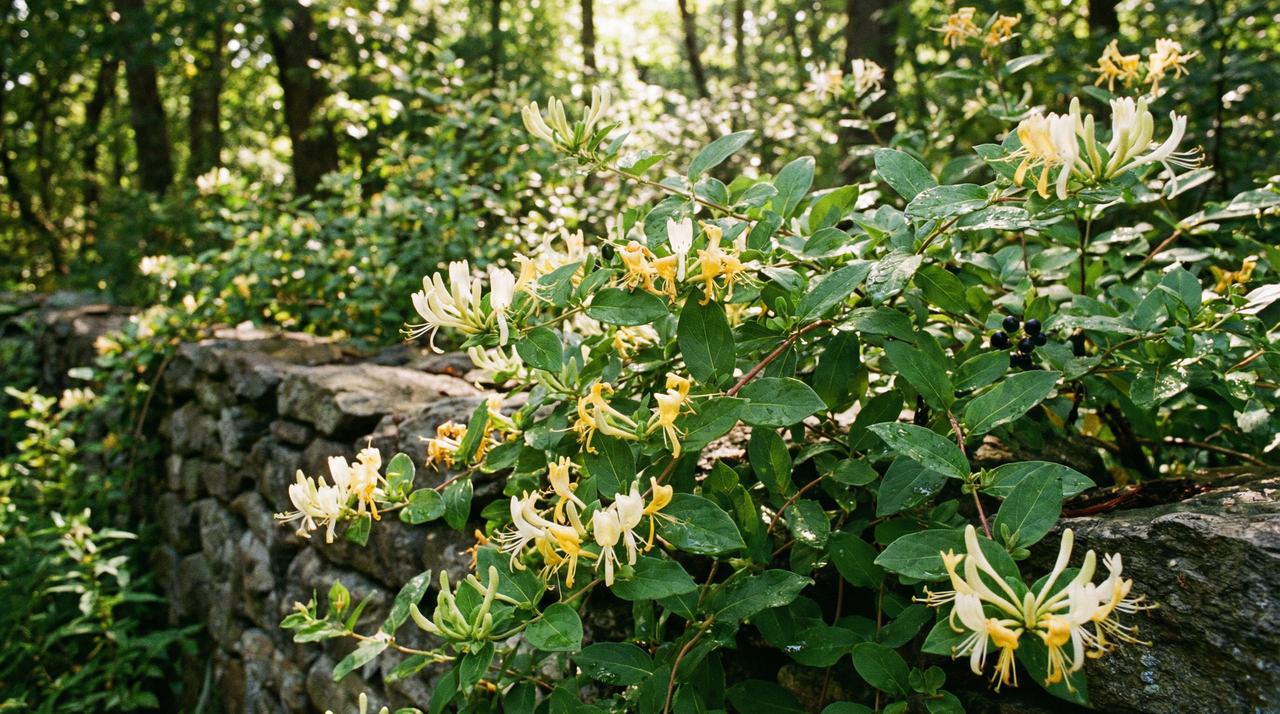
Nobody warns you about the smell. The first time I knelt down to harvest Japanese honeysuckle flowers at dawn, the fragrance hit me so hard I actually sat back on my heels for a second. Sweet, warm, faintly medicinal, like someone had distilled an entire summer evening into a single breath. And that's the contradiction I keep coming back to with this plant: something this genuinely beautiful, this useful, this deeply woven into centuries of traditional medicine across East Asia, is also one of the most ecologically destructive vines you can put in the ground across much of North America. I've watched it blanket entire forest understories in a single season. I've also made tea from its flowers that stopped a sore throat cold.
Most gardeners land hard on one side of that line. Either they love it without reservation or they've been burned by it and won't hear another word in its defense. What I've found, after growing it in contained situations and helping clients rip it out of places it absolutely should not be, is that the truth about Lonicera japonica is genuinely complicated, and that complexity is exactly what makes it worth understanding before you do anything else with it.
Origin and History of Honeysuckle (Lonicera japonica)
Botanical Background and Native Range
Japanese honeysuckle originates from the humid-temperate forests of eastern Asia, specifically Japan, Korea, and parts of China, where it grows naturally in the mesic climates plant scientists classify as Köppen-Geiger Cfa and Cfb zones, with mean annual temperatures between 9°C and 15°C and rainfall averaging 800 to 1800 mm per year.[1][2][3] In its native range it haunts forest margins, woodland edges, and riparian corridors from sea level up to roughly 1500 m, occasionally appearing even higher.[1][4] What strikes me every time I work with this plant is that its phenotypic plasticity isn't a quirk; it's the whole story. The same species can behave as a tidy climber at the edge of a cool temperate woodland or a sprawling, nearly evergreen groundcover in a warm humid garden. That adaptability is exactly why it thrives in so many situations, and exactly why it escapes so easily.
As a long-lived polycarpic perennial, Lonicera japonica can persist for 20 years or more under favorable conditions, reaching sexual maturity in as little as one to three years.[5][6] It reproduces through both vegetative runners and bird-dispersed seeds, potentially generating up to a million seeds per acre annually.[7] Vines extend three to ten meters in a single growing season and can eventually reach ten to twenty-five meters total length.[8][6] Compare that to European woodbine (Lonicera periclymenum), which tops out around three to six meters, lives longer in cultivation, and typically takes two to four years to first flower.[9][10] The faster maturation and semi-evergreen tenacity of the Japanese species give it a meaningful competitive edge. The ecological consequences speak for themselves: where it escapes managed spaces, it can form dense thickets capable of reducing native plant biodiversity by 50 to 90 percent.[4][11] That's not a moral failing of the plant; it's just what happens when you transplant a vigorous forest-edge climber into a continent with no co-evolved checks on its growth.
Visual Characteristics
The vine itself is woody and twining, typically climbing fifteen to thirty feet with opposite, ovate leaves that are dark green above and paler beneath.[12][6] The flowers are tubular and two-lipped, opening white and ageing to yellow through summer and often into fall in mild climates, and the fragrance is one of the most recognizable scents in any garden.[13][14] I've noticed it's strongest in the evening and immediately after rain, the kind of heady sweetness that stops you mid-path. In warmer, humid conditions the plant holds its leaves nearly year-round and grows with noticeably more vigor; in colder zones it drops its foliage and becomes far more compact.[13][14] Those same traits, the ornamental flower display, the lush coverage, the irresistible scent, are precisely what made Western gardeners fall for it in the first place.
Traditional and Cultural Uses
Carl Peter Thunberg formally described Lonicera japonica in 1784 in his Flora Japonica,[15] but the plant's medicinal biography is far older. It appears in the Shennong Bencao Jing, one of the foundational texts of Traditional Chinese Medicine compiled around 200 to 250 AD, where it's listed as Jin Yin Hua and Ren Dong for clearing heat, detoxification, fevers, sore throats, and infections.[16] The flower buds are the medicinal heart of the plant in TCM practice, which is why traditional harvesters work early in the morning before the buds open fully. Related traditions in Japanese Kampo, where it's been used as Suikazura since the Heian period, and in Korean Hanbang medicine, echo the same applications: respiratory complaints, skin conditions, and systemic detoxification.[17][18]
This is a plant that arrived in Europe and North America around 1806 to 1812, introduced as an ornamental and groundcover,[11] carrying none of that cultural context with it. In East Asian tradition the vine's twining habit makes it a symbol of enduring love, fidelity, and attachment, and young shoots and flowers occasionally appear in the kitchen as vegetables, though with caution given the potential toxicity of larger amounts.[19][20] In the West it was simply a pretty, fast-growing climber, and it behaved accordingly. The modern picture is complicated further by wild overharvesting for the herbal trade in Asia, which is driving population declines in native stands even as commercial cultivation expands to meet demand.[21][22] I grow my own from nursery stock for that reason; it feels like the more honest way to engage with a plant that carries so much living cultural history, without extracting it from the places and communities that shaped it.
Honeysuckle Varieties and Responsible Sourcing
Before we talk cultivars, I want to be honest about what we're actually discussing here. Japanese honeysuckle is classified as invasive across much of the United States, particularly in the Southeast, where it forms dense thickets that crowd out native vegetation and reduce biodiversity.[23][6] The named cultivars don't solve that problem. Knowing them is useful; planting them is a different question entirely.
Japanese Honeysuckle Cultivars
'Halliana' is the cultivar you'll most likely encounter, introduced in 1880 and still widely sold where it isn't restricted.[24][5] Its nighttime fragrance is genuinely lovely, and the white-to-yellow flowers are everything the species promises. But I've watched it swallow fences in two seasons in humid southeastern gardens, requiring twice-yearly pruning just to keep it off neighboring shrubs. The fragrance doesn't offset that workload, and it certainly doesn't offset the ecological cost.
'Aureoreticulata' grows somewhat slower, with golden-veined foliage that earns it a spot in ornamental catalogs.[25][26] The bloom period is shorter than the species, so you're trading flowers for foliage interest. I'll grant it's a prettier vine to look at. The problem is that slower growth is not the same as well-behaved, and no sterile cultivars exist for this species at all. Every named variety can still spread by seed, runners, and vegetative fragments. The plant is hardy in zones 4 through 9,[13] which means its invasion range is enormous.
If you want ornamental honeysuckle vines with similar flower forms and fragrance, European honeysuckle (Lonicera periclymenum) offers cultivars like 'Serotina', 'Graham Thomas', and 'Belgica' in creams, yellows, pinks, and bicolored combinations[27] without the invasiveness risk in North American landscapes. That's where I steer clients who want the aesthetic without the ecological liability.
Where to Buy and Legal Considerations
Sourcing Lonicera japonica has gotten genuinely complicated, and that's appropriate. Sale and propagation are prohibited or heavily restricted in California, Massachusetts, New Hampshire, Washington, Oregon, and several other states.[28][29][30] Several states I work in have outright bans; always check your local extension service before purchasing any Lonicera japonica material. University extension programs and environmental agencies broadly recommend against planting it and actively encourage removal where it has naturalized.[31][32] Reputable native plant nurseries have largely stopped carrying it, and the major chains are moving the same direction.[33]
The better path, and the one I recommend in almost every design consultation, is coral trumpet honeysuckle (Lonicera sempervirens) or another regionally native species.[34] In my experience replacing overgrown Japanese honeysuckle with native coral honeysuckle in client yards, the native vine covers a fence just as quickly and actually supports local butterflies and hummingbirds rather than displacing the plants those species depend on. Same beauty, genuinely better garden.
How to Propagate and Plant Japanese Honeysuckle (Lonicera japonica)
Before I do anything else with this plant, I check my state's invasive species list and local ordinances. Since this vine is aggressively invasive,[35][6] and the same vigor that makes propagation so easy is exactly what makes escape into natural areas a genuine risk. If you're in one of those states, please consider Lonicera sempervirens instead. If you've done your homework and you're working in a contained situation, read on.
Propagation Methods for Japanese Honeysuckle
Layering is the method I recommend to most home gardeners: pin a low-growing stem to moist soil, keep it consistently damp, and you'll typically have a rooted plant within a few weeks. Success rates often exceed 80-100%,[36][37] which is about as foolproof as propagation gets.
For cuttings, timing matters. Softwood cuttings taken in late spring or early summer, 4-6 inches with 2-3 nodes, root readily when treated with IBA rooting hormone and held at 70-75°F with 80-90% humidity.[38][39] Semi-hardwood cuttings in late summer are my personal preference: in a 1:1 perlite-peat medium with bottom heat and a humidity tent, I consistently hit 70-90% success, usually within 3-4 weeks.[38][40] Hardwood cuttings taken in late winter are the most forgiving if you miss the other windows; 6-8 inch sections planted directly in moist medium will root without hormone, though they take 6-8 weeks.[38][39]
Seed propagation is possible but rarely worth the effort for most growers. Seeds need 30-90 days of cold moist stratification at 32-41°F before sowing,[41][42] and even under controlled conditions germination tops out around 80%.[43] More importantly, seed-grown plants don't come true to type; the species' genetic heterozygosity means you'll get variable vigor, flower color, and disease resistance from batch to batch.[44] I label my seedling rows carefully because the first true leaves can look deceptively similar to other climbing vines in the early stages, and mix-ups cause headaches later. If you're working with stored seed, viability can persist 5-10 years under cool, dry conditions[45][46] and 2-5 years in a soil seed bank, which is part of why this species is so difficult to eradicate once established.
Whichever method you choose, keep airflow adequate in your propagation setup. High-humidity tents invite damping-off and powdery mildew, and aphid populations can explode quickly on tender cuttings.[47][48]
Soil, Site Selection, and Planting Technique
Japanese honeysuckle is genuinely indifferent to soil texture; it grows in clay, sandy loam, chalk, peat, and rocky ground alike.[49][6] That adaptability is a direct echo of its native East Asian forest-edge habitat, where it grows on slopes, disturbed banks, and woodland margins with variable conditions.[49][50] It's also why it thrives on roadsides and in disturbed urban sites, which is worth keeping in mind if you're planting near natural areas.
I always run a soil pH test before planting any vine in a client garden. The pH tolerance is broad, 4.5-8.0, but flowering and general vigor are noticeably better in the 6.0-7.5 range.[51][32] Below 5.5, phosphorus becomes unavailable and aluminum toxicity becomes a real risk; above 7.5, iron deficiency chlorosis shows up as yellowing between the veins.[52] A little lime or sulfur goes a long way.
Drainage is non-negotiable. The root system is shallow and fibrous with extensive rhizomes, and while established plants handle moderate drought reasonably well, waterlogged or compacted soil opens the door to Phytophthora root rot.[46][53] For containers, I amend potting mix with 20-30% perlite or coarse sand to ensure that drainage.[47] In ground plantings, work 1-2 inches of compost into the planting hole and top with 2-3 inches of organic mulch to hold moisture and suppress weeds.[54] Set the root crown 4-6 inches below the surface and plant into a minimum soil depth of 12-18 inches.[49]
Spacing, Timing, and Establishment Tips
Spring planting after the last frost or early fall are both good windows; that timing gives roots a chance to settle in before stress sets in.[55] Put sturdy supports in at planting time. I've watched this vine overwhelm a lightweight trellis in a single season; the mature plant can reach 20-30 feet tall and spread 10-30 feet wide,[56][49] and a flimsy arbor won't hold it.
For trellis or fence training, space plants 24-36 inches apart as a working recommendation, with a minimum of about 12 inches and a maximum of 5-8 feet in areas where you're actively trying to limit spread.[56][57] As a groundcover, 3-5 feet between plants; for hedge or screen use, 2-3 feet between plants and 3-6 feet between rows.[32][58] Wider spacing does more than improve air circulation and reduce powdery mildew risk; it also makes long-term management more practical. Proper initial spacing is one of the easiest containment tools you have.
Germination Timeline and Expectations
If you've stratified seeds correctly, germination happens in roughly 2-4 weeks after sowing at 65-75°F in moist, well-drained medium.[59][6] From there, expect 1-2 years to establish and 2-3 years before you see meaningful flowering or any kind of harvestable yield.[59] Cuttings are a completely different story. Semi-hardwood and softwood cuttings root in 2-4 weeks,[60][38] and plants started this way can begin flowering within their first year. Clients who go the cutting route are often picking fragrant blossoms the following spring while seed-grown plants are still just leafing out. For anyone who wants to use this plant medicinally or culinarily, that head start is significant, and it's one more reason vegetative propagation is nearly always the smarter path.
Japanese Honeysuckle Care Guide
Japanese honeysuckle is genuinely one of the easier vines to keep alive. The challenge isn't getting it to grow; it's keeping that growth from taking over your entire property. Every care decision I make with this plant runs through that same filter: am I feeding the plant, or am I feeding a future problem?
Watering Needs for Japanese Honeysuckle
New plantings need consistent moisture during that first growing season, roughly an inch of water per week to encourage deep root development.[61][62] I've watched clients skip irrigation on young vines because the plant "looks fine," and then wonder why it barely grew the second year. Shallow roots from inconsistent early watering set the vine back considerably. Once established, though, it becomes genuinely drought-tolerant and only needs supplemental water during extended dry stretches.[61][62]
Feeding and Fertilization for Japanese Honeysuckle
This plant thrives in well-drained soils at a pH of 5.5 to 7.5, with the sweet spot around 6.0 to 7.5, and it does best in fertile loamy conditions but adapts to poorer soils just fine.[63][46] If you're going to fertilize at all, a balanced slow-release 10-10-10 applied in early spring at about one to two pounds per hundred square feet is plenty.[64][65] Container plants can get half-strength liquid fertilizer every four to six weeks through the growing season.[66]
My strong advice: do a soil test before you do anything else. I always test before diagnosing yellowing leaves, because iron chlorosis in alkaline pockets looks identical to nitrogen deficiency until you actually check the pH.[67][68][69] Speaking of nitrogen: excess of it promotes aggressive vegetative growth and actually reduces flowering,[63] which is the opposite of what most gardeners want. Avoid high-nitrogen formulas and skip any late-season feeding entirely, since soft new growth heading into cold weather is vulnerable to frost damage.[68][70] The plant also has a mild nitrogen-fixing capability through symbiotic bacteria,[70] which is part of why it succeeds in poor soils where other vines would struggle. That's a fascinating trait, but it's also a reminder that this plant doesn't need much help from you.
Frost Tolerance and Winter Protection
Japanese honeysuckle is hardy across USDA zones 4 through 9, handling minimum temperatures down to -20°F or even -30°F in some cases.[57][6] Zone 4 is the edge of reliability; plants may die back to the ground but typically resprout from the roots.[57] New growth and leaves are the first casualties, browning out below 28°F, while the woody stems and roots are considerably more resilient.[6] Since its native habitat spans temperate to subtropical forest edges in East Asia, it behaves as a true evergreen in mild winters but drops leaves in colder zones.[71][72] For young plants in zones 4 and 5, three to four inches of organic mulch applied after the ground freezes goes a long way, and breathable fabric covers during surprise cold snaps help protect the tips.[57][73] I once lost the tips of a young vine to a late-season freeze after I'd already done some training work, so now I hold off on any hard pruning or active shaping until after the last expected frost date.
Heat Tolerance and Summer Stress Management
Rated for AHS Heat Zones 1 through 9, Japanese honeysuckle tolerates temperatures up to around 95 to 104°F before stress symptoms appear.[74][75] Mature plants handle humid subtropical summers remarkably well, far better than something like a trumpet creeper, which tends to look ragged by late July in my experience. Where I've seen stress is in seedlings and young transplants during peak heat above 35°C, and flowering can slow or stall above 38°C.[75] Wilting, scorched leaf margins, and flower drop are the warning signs.[76] A two-to-four-inch layer of organic mulch at the root zone, deep infrequent irrigation in the early morning, and temporary shade cloth at 30 to 50 percent during heat events all help manage the worst of summer stress.[77][78]
Pruning, Maintenance, and Invasiveness Control
This is where caring for Japanese honeysuckle stops being passive and becomes active management. The vine is a fast grower, capable of putting on 15 to 30 feet in a single season,[63] which means pruning isn't optional. The best windows are late winter to early spring before new growth pushes, or immediately after flowering.[79][80] Dead, diseased, or damaged wood can come out any time. For vines growing on a trellis or fence, regular training and two hedge-clipping sessions per year keep things tidy.[70] Critically, cut back flowering stems before seed sets; bird-dispersed seed is one of the primary ways this vine spreads into surrounding areas.[81]
After years of working with vines in landscape design, I install root barriers the first season without exception. The above-ground growth gets all the attention, but the underground spread is deceptively aggressive even when the top looks perfectly contained. Combined with avoiding high-nitrogen fertilizers, root barriers are your best structural defense.[82][83] I no longer recommend planting the straight species in most garden situations, because I've watched it escape into adjacent woodlands too many times. If you're already growing it or choose to grow it anyway, commit to rigorous pruning, never let it flower unchecked, and always check local regulations first, since it's considered invasive across much of the southeastern United States and beyond.[49][11]
Japanese Honeysuckle Harvesting and Foraging Guide
With Japanese honeysuckle, the harvest window is short, fragrant, and worth planning for. Flowers bloom from April through July across most U.S. temperate climates, with peak nectar flow in May and June.[84][46] The berries follow about 45 to 60 days after flowering, ripening from green to black between August and October. Leave them alone. They're not considered safe for human consumption.[85][6] The flowers are your target, and knowing when to pick them matters.
Timing and Visual Cues for Harvesting Honeysuckle Flowers
Pick flowers at half-bloom or full bloom, while they're still transitioning from white to yellow and the fragrance is at its peak.[86][87] I always harvest in the morning, and there's a practical reason beyond habit: flowers picked by mid-morning carry noticeably more scent than those left until afternoon heat sets in. The volatile compounds responsible for that honey-jasmine perfume fade fast once the sun climbs. If you want dried honeysuckle with real aroma, morning is the only time to bother.
Dry flowers quickly in the shade to preserve chlorogenic acid and other key medicinal compounds. Traditional Chinese medicine specifically recommends collection on sunny days during the May through July flowering window, and shade drying immediately after.[46][86] Only harvest from unsprayed areas well away from roadsides or treated turf.
I limit myself to about a third of the blooms on any given vine at one time, which still yields plenty for tea and syrup while visibly slowing the plant's spread in my managed landscapes.[88][6] Every flower you pick is also a seed that won't form, which means harvesting from this invasive vine isn't just foraging; it's light management. Check in with your local extension service if you're unsure whether collection is regulated where you live.
Flavor Profile, Yield, and Safety Considerations
The flavor of a fresh honeysuckle flower is exactly what the name suggests: sweet, honey-like, with floral and faintly fruity notes and a tender, nectar-rich texture.[89] That aroma comes from a bouquet of volatile compounds including linalool, geraniol, benzyl acetate, and phenylethyl alcohol, with higher monoterpene levels in summer flowers.[90][91] The nectar itself is primarily sucrose, with glucose and fructose rounding it out.[92] Give the flowers a quick rinse to remove any debris before use.
Young leaves are edible when very tender but lean sour and bitter, closer to very young dandelion greens than anything mild. They're useful in small amounts in salads or teas but shouldn't be a focus of any harvest.[7][93] Berries are a firm no. I never harvest them, and when I'm working with clients who have this vine near play areas, I advise removing fruiting vines entirely.[94][95] In TCM, the flowers are considered bitter-sweet and cooling, suited to clearing heat and used in moderation; overconsumption can have mild laxative effects.[96] Flowers, yes. Leaves sparingly. Berries, never.
Honeysuckle Preparation and Uses
Edibility, Flavor, and Culinary Applications
The first thing most people do with a honeysuckle flower is pull the base of the tube and touch that single drop of nectar to their tongue. That instinct is telling you something real: the flowers of Lonicera japonica are genuinely edible, with a mildly sweet, floral, honey-like flavor that holds up beautifully in teas, syrups, jellies, salads, and desserts.[7][93] I've foraged and dried them multiple times, handling them carefully to preserve that delicate, medicinal nectar. The flowers are also safely used in honey production, contributing to that characteristic sweet floral note without any toxicity concern.[97][93] The flowers are also low-calorie and rich in antioxidant flavonoids like chlorogenic acid and luteolin,[98] which is part of why the edible honeysuckle plant has been valued in both kitchens and pharmacopeias for so long.
Now for the contrast that cannot be skipped. The berries are highly toxic. Green, ripe, or somewhere in between, they should not be eaten.[99][38] I think of them the way I think about ornamental pokeweed or heavenly bamboo berries: familiar-looking, potentially pretty, and a firm no. Positive identification of the flowers matters here too, since foraging errors happen even with experienced eyes.[100] Only harvest from plants you're certain are unsprayed, and since L. japonica is invasive and restricted in several U.S. states, check local regulations before foraging from wild populations.[6]
Medicinal Preparations
In Traditional Chinese Medicine, Lonicera japonica (known as Jinyinhua) is a cooling herb prescribed to clear heat, detoxify, and address sore throats, fevers, and skin inflammations, most often prepared as a tea or decoction, sometimes paired with chrysanthemum.[101][102] Dried flowers are the preferred preparation precisely because the volatile compounds responsible for both fragrance and medicinal activity are sensitive to high heat. I've tried both a dehydrator set to about 45°C and simple shade-drying on raised screens, and in humid climates like mine, shade-drying with good airflow consistently produces a better-colored, more aromatic result. I always label those racks carefully too, because dried honeysuckle flowers look remarkably similar to other small, pale blossoms once they lose their moisture. A good honeysuckle tea should smell faintly sweet before it even steeps; if it smells like hay, the drying temperature was too high.
Non-Food Uses in Permaculture and Beyond
Beyond the cup, this vine earns its keep in designed landscapes through erosion control, living fences, and ground cover on disturbed slopes, and it accumulates nutrients including nitrogen and potassium as it cycles biomass.[103][104] Those are genuinely useful functions. The catch, of course, is the invasiveness, and I'd be doing readers a disservice if I made it sound like a simple tradeoff. In my own design practice, when a client wants that vine-layer functionality, I reach first for native alternatives like Lonicera sempervirens or a non-invasive L. periclymenum cultivar that can fill a similar ecological niche without the ecological cost. When L. japonica is already present on a site, I manage it with root barriers and consistent cutting rather than encouraging its spread. Flower extracts from this species also show up in cosmetics for antioxidant, soothing, and skin-brightening benefits,[105] which reflects how broadly the phytochemical richness of this plant has been put to work. Any use of it, though, starts with containment.
Honeysuckle Health Benefits and Medicinal Uses
Japanese honeysuckle has a medicinal reputation that stretches back well over a thousand years, and the deeper you dig into the chemistry, the more you understand why it earned that reputation. That said, I think it's important to hold the traditional record and the modern research in honest tension, because the science is genuinely promising but still largely confined to labs and animal models. As someone who designs wellness gardens for clients, I focus on honeysuckle as a supportive botanical rather than a primary remedy, and I'd encourage you to read this section with that same calibrated optimism.
Traditional Use and Phytochemical Profile of Lonicera japonica
In TCM, Lonicera japonica goes by Jin Yin Hua, "gold and silver flower," a name that references the way the blooms shift from white to gold as they age. Its use is documented in the Compendium of Materia Medica for clearing heat, detoxifying, and treating fever, upper respiratory infections, skin conditions, and sores, with dried flowers as the primary medicinal form.[106][107] That cooling, anti-infective framing from classical medicine maps surprisingly well onto what phytochemists have since found in the flowers.
The phytochemical profile is genuinely complex. Flowers and leaves contain flavonoids, phenolic acids, iridoid glycosides, coumarins, saponins, essential oils, and trace alkaloids.[108][109][110] The standouts are chlorogenic acid (present at 10 to 25 mg per gram in flowers), luteolin (2 to 5 mg/g in flowers and leaves), quercetin glycosides, and iridoid glycosides including loganin and secoxyloganin.[111][112] Concentration drops as you move from flowers and leaves to stems to roots, which is one reason TCM has always prioritized the flower buds.
These concentrations aren't fixed, either. Iridoids and flavonoids peak during the summer flowering stage, and plants grown under heat or UV stress tend to produce higher flavonoid loads, while nutrient-rich soils tend to boost phenolics.[113][114] I've noticed this anecdotally in my zone 9b garden: the flowers from plants that push through a dry summer seem more intensely fragrant, which often correlates with higher phenolic content in research. Geographic origin matters too, with East Asian plants often showing stronger phenolic profiles than specimens grown elsewhere.[115] It's part of why I tell clients who want to use this plant medicinally to source dried flowers from reputable TCM suppliers rather than harvesting backyard vines of unknown provenance.
Those same secondary metabolites serve the plant ecologically, deterring herbivores, suppressing competing plants through allelopathic root exudates, and inhibiting soil microbes.[116][6] The chemistry that makes Lonicera japonica medicinally interesting is part of the same toolkit that makes it so aggressively successful as an invasive. That duality runs through everything with this plant.
Scientific Research on Medicinal Actions
The strongest modern evidence clusters around anti-inflammatory and antioxidant activity. In preclinical studies, chlorogenic acid and luteolin suppress TNF-α, IL-6, NF-κB signaling, and COX-2 expression, the same inflammatory pathways targeted by many pharmaceutical anti-inflammatories.[106][117] Free-radical scavenging in DPPH and ABTS assays is comparable to ascorbic acid, which is a meaningful benchmark. Chlorogenic acid, for context, is the same compound that drives antioxidant interest in artichoke and green coffee extract, so it behaves predictably here in ways researchers can cross-reference.
Antimicrobial and antiviral effects are also well-documented in the lab. Extracts show activity against Staphylococcus aureus, E. coli, and Streptococcus pneumoniae at minimum inhibitory concentrations as low as 0.5 mg/mL, via membrane disruption.[106] Antiviral targets include influenza, herpes simplex, enteroviruses, and SARS-CoV-2, with mechanisms ranging from blocking viral adsorption to immune modulation.[118][119][120] This tracks with the classical TCM use for upper respiratory infections and fever. The compound Shuang-Huang-Lian, a TCM formula containing Lonicera japonica, has meta-analytic support for acute respiratory infections, though effects can't be cleanly attributed to this plant alone.[121]
There's a longer list of preliminary potentials, including analgesic, immunomodulatory, expectorant, neuroprotective, anti-diabetic, hepatoprotective, and gut microbiota effects, but these come mostly from rodent studies or cell lines.[122][123][124][125][126][127] Promising? Yes. Conclusive for humans? Not yet. Large, well-designed randomized controlled trials are still largely absent, and that gap matters.[106] When I'm designing a wellness garden and a client asks about honeysuckle, I'm honest about that: the traditional use is ancient and coherent, the lab data is exciting, but the human evidence still needs to catch up.
Nutritional Content of Honeysuckle Flowers
The edibility hierarchy here is non-negotiable. Flowers are the safe, time-tested part; young leaves can be used cautiously but may cause digestive upset in quantity; and the berries are toxic and should never be consumed by humans.[7][6] I always make this point bluntly with clients: the berries look tempting when ripe, and children are the most vulnerable.
The dried flowers carry a reasonable nutritional profile for a botanical, with roughly 10 to 15 g protein, 50 to 60 g carbohydrates, and around 10 g fiber per 100 g dry weight, alongside respectable mineral content including potassium (1,200 to 1,500 mg), calcium (700 to 900 mg), and iron (10 to 20 mg).[128][129] Vitamin C has been estimated at 20 to 50 mg per 100 g, though data is limited and variable.[130] These figures come from herbal research rather than standardized food databases, and Lonicera japonica is not currently listed in USDA FoodData Central, so treat all values as approximate.[131] Values shift with growing conditions, harvest timing, and preparation, which is another reason flowers harvested at peak bloom are likely your best bet for both nutrition and phytochemical content. This is a medicinal and culinary herb consumed in small quantities, not a nutritional staple, and moderation with professional guidance applies especially for those with allergies or underlying conditions.[131]
Safety Considerations and Potential Toxicity
Lonicera japonica is mildly toxic overall, but where you sit on that risk curve depends entirely on which part of the plant you're using. The berries are poisonous to humans and pets, causing nausea, vomiting, diarrhea, and abdominal pain.[97][132] Saponins (1 to 5% dry weight in leaves and stems) disrupt cell membranes and irritate the GI tract; iridoid glycosides contribute to other systemic effects.[132] Beyond GI symptoms, possible effects from overexposure include dizziness, drowsiness, headache, and contact dermatitis; rare hepatotoxicity has been reported, though usually linked to overdose or impure preparations rather than the plant itself.[133][134]
The flowers, properly dried and prepared, have a strong traditional safety record at standard doses. TCM dosing typically runs 9 to 15 g of dried flowers per day in decoction.[135] That said, honeysuckle should be avoided during pregnancy and breastfeeding due to insufficient safety data and potential emmenagogue effects, and it may enhance sedatives or interact with anticoagulants.[136][137] Pollen and plant contact carry moderate allergenic potential as well.[138]
My standard advice to clients: never use the berries or raw leaves, and source your dried flowers from a reputable TCM supplier rather than wild-harvesting from invasive populations that may have been treated with herbicide. Because Lonicera japonica is classified as invasive across much of North America, I personally recommend only growing native honeysuckle species in open landscapes, with Japanese honeysuckle reserved for container situations or controlled medicinal gardens where spread can be managed. The traditional safety record at standard flower doses is genuinely reassuring, but this is a plant that rewards careful, informed use rather than casual experimentation.
Honeysuckle Pests and Diseases
Part of what makes Japanese honeysuckle such a successful invader is that it's genuinely difficult to knock back. The plant produces iridoid glycosides, chlorogenic acid, and other phenolic compounds that make the foliage bitter and antimicrobial, grows trichomes on its leaf surfaces as physical deterrents, and even releases volatile organic compounds that recruit predatory insects when herbivores attack.[139][140] I've noticed that crushing a honeysuckle leaf produces that pungent, almost medicinal smell; those are the iridoids doing exactly what they evolved to do.
Common Pests of Japanese Honeysuckle
Even with that chemical arsenal, the plant isn't pest-proof. Aphids are the most common complaint I see, and they behave exactly like aphids on roses or viburnum: curled new growth, sticky honeydew coating the stems below, and a trail of ants attending the colony. Spider mites show up in hot, dry summers, stippling the leaves a pale silvery-yellow. Scale insects, whiteflies, leafrollers, and Japanese beetles round out the usual suspects, and the European woodbine (Lonicera periclymenum) adds thrips to the mix, which silver the leaves and distort flowers.[141][59][142] The reassuring part is that insect pressure rarely kills an established vine; the vigorous growth simply outpaces most damage.[46]
Diseases Affecting Lonicera japonica
Fungal issues are where honeysuckle vine diseases get more serious. After prolonged wet weather I watch for anthracnose, which shows up as dark, sunken lesions and can trigger significant leaf drop, and for leaf spot fungi like Cercospora and Septoria, which produce circular brown patches ringed with yellow halos.[143][144] Powdery mildew on honeysuckle vine is probably the most familiar problem: that white, flour-like coating on the upper leaf surface that causes curling and premature drop.[145] Lonicera japonica has moderate resistance to both mildew and leaf spot, so a healthy plant in good airflow often bounces back without intervention.[146] Verticillium wilt is a different matter. It has low resistance to Verticillium dahliae, which causes vascular discoloration, sudden wilting, and real decline.[46] If your honeysuckle suddenly wilts in a bed where tomatoes or maples have grown before, Verticillium is worth testing for; I've pulled declining vines in exactly those situations and confirmed the soil-borne fungus. Poor drainage adds Phytophthora root rot to the list, overhead watering invites bacterial leaf spot from Xanthomonas, and cankers from Diaporthe can girdle stems and cause dieback.[147][48] European honeysuckles bring their own vulnerabilities, including honey fungus, rusts, and honeysuckle yellow mosaic virus.[148] There's also an ecological wrinkle worth knowing: Lonicera japonica can act as a pathogen reservoir, allowing diseases to spill over into native plants and amplifying its already significant invasive footprint.[149] That's one more reason I steer clients toward coral honeysuckle (Lonicera sempervirens) in new designs.
Defense Mechanisms and Resistance
Cultivar selection is the most underused lever in managing honeysuckle plant diseases before they start. 'Hall's Prolific' and 'Lemon Beauty' show moderate resistance to powdery mildew and fungal issues generally, while 'Hall's Glory' and related hybrids handle aphids and scale better than the straight species.[47][38] If you're working with European species, 'Serotina' and 'Graham Thomas' both carry good mildew tolerance.[148] No cultivar is bulletproof, but starting with a more resistant selection and siting it with adequate spacing buys you real insurance.
Integrated Pest and Disease Management
My most reliable management tool has been a pair of pruning shears in early spring. Cutting out the first crowded, poorly-aired growth before mildew season kicks in has prevented outbreaks far more consistently than any fungicide I've tried. That tracks with the broader IPM approach: prioritize airflow, keep water off the foliage, make sure drainage is solid to head off root rot, and monitor early when the season begins.[46][150][151] When pests do get ahead of you, insecticidal soap or neem handles aphids and mites without wiping out pollinators. Field trials back this up: introduced ladybug populations can reduce aphid colonies by 70 to 90 percent within a few weeks, and miticides achieve over 80 percent control on spider mites.[152] For invasive patches, targeted applications of glyphosate or triclopyr in late summer to fall are most effective.[153] There's also a satisfying ecological argument for doing less in some situations: higher native insect pressure can naturally restrain how aggressively this vine spreads, suggesting that supporting native insect communities in the broader landscape is its own form of biocontrol.[152]
Honeysuckle in Permaculture Design
Japanese honeysuckle sits in an uncomfortable space in the permaculture world: it has real ecological gifts, but those gifts are inseparable from the same traits that make it one of North America's most problematic invasive plants. Understanding that tension clearly is the starting point for any honest design conversation about this vine.
Climate Adaptability and Suitable Zones
The first thing that strikes you about Lonicera japonica is its sheer range. Hardy across USDA zones 4 through 9, it tolerates cold down to roughly -30°F in zone 4 and pushes into 95-100°F heat in zone 9.[154][155][46] I've worked with trumpet creeper and passionflower, both vigorous climbers in their own right, but neither covers that kind of temperature span so effortlessly. It handles annual rainfall between 25 and 60 inches, adapts from riparian margins to dry upland slopes, and runs the full spectrum from full sun to deep shade.[156][154][6] Clay soil, sandy soil, compacted fill, occasional flooding -- it takes most of what you throw at it once established.[49]
Regional behavior shifts considerably depending on where you are. In zones 4 through 6, growth tends to stay more contained and upright. In the humid South, zones 7 through 9, the same plant twines and sprawls with a vigor that feels almost aggressive by comparison.[6][5] Performance is generally optimal in zones 5 through 8, where you get good flowering without quite the same explosive spread pressure of the Deep South. Young plants at the colder end of the range appreciate 2 to 4 inches of organic mulch over their roots after the ground freezes.[49]
That adaptability is exactly why it has spread so effectively. It's documented as invasive in 28 to 42 states, with the Southeast and Gulf Coast carrying the heaviest impact.[11][46][157] Check your local regulations before planting. In many states this isn't just good practice, it's legally required.
Role in Forest Layers and Guilds
In its native East Asian context, this is a woodland edge and understory vine that fills the liana layer of a layered forest in a balanced way, threading through gaps and along margins without dominating.[158][71] Transplant it to a North American food forest and the ecological checks that kept it tidy don't come with it. The vine climbs to 15 to 30 feet when supported. Stems that trail along the ground root at nodes, allowing a single planting to sprawl into dense groundcover across a surprisingly large area.[159][160][32]
In a designed guild, the theoretical roles are appealing: vine layer climber, living fence, slope stabilizer, quick-coverage groundcover. The problem is that in non-native North American systems, it can smother what's growing beneath it, alter forest structure, and crowd out native understory plants that other guild members depend on for habitat and food.[161][46] In many parts of the US, especially the Southeast, I treat Japanese honeysuckle like a guest that might overstay. I site it where I can monitor and contain it, because the research on its ability to dominate native understory matches what I've seen with my own eyes in local natural areas. The temptation to use a vigorous, fast-covering vine for a living fence or steep-bank erosion job is real, but vigorous has a way of becoming unmanageable faster than you expect.
Ecosystem Functions and Services
Where Japanese honeysuckle does earn genuine respect is as a nectar source. The tubular flowers, roughly an inch long and white fading to yellow, bloom from spring through fall with peak flowering in late spring to early summer.[49] Bumblebees, solitary bees, butterflies, moths, and hoverflies all use them, and occasional hummingbird visits are worth knowing about for those designing specifically for native hummingbird habitat.[162] I've watched the butterfly activity around a single flowering vine pick up noticeably in midsummer when little else was blooming nearby. That's a real service.
The trade-off: pollination success exceeds 80% fruit set,[163] and those black berries get dispersed by birds.[164] The same birds that your food forest benefits from will carry seeds into the surrounding landscape, so ecological responsibility doesn't stop at your property line.
On the soil side, honeysuckle isn't a nitrogen fixer, and I'd caution against leaning on it as a dynamic accumulator in the way you might rely on comfrey or yarrow. What it does contribute is leaf litter decomposition and organic matter over time.[164][165] It also demonstrates allelopathic properties that suppress competing plants, which sounds useful for weed management until you realize that same suppression can degrade the diversity of a woodland understory you've spent years building.[166][11] I've used contained honeysuckle on slopes where I needed fast coverage, but only after installing root barriers. That lesson came from an earlier planting that got significantly more enthusiastic than I planned. This plant rewards careful siting and active monitoring more than almost anything else I've put into a food forest design.
The Vine That Taught Me Respect Isn't the Same as Restriction
I grew up pulling this thing off fence lines with my grandmother, both of us stopping every few minutes to steal a flower and taste it, completely unbothered by the work. That memory is probably why I've never been able to write honeysuckle off entirely. I still grow it, carefully, in one contained corner of my oldest food forest, and every June when the fragrance hits me on a warm evening, I remember that a plant can be genuinely complicated and genuinely worth knowing.
Sources 166
- Kew Science: Lonicera japonica ↩
- Flora of China (efloras.org) - Lonicera japonica ↩
- Köppen-Geiger Climate classification map (Beck et al. 2018) ↩
- Japanese Honeysuckle (Lonicera japonica) - University of Florida IFAS Extension ↩
- Lonicera japonica - Missouri Botanical Garden Plant Finder ↩
- Lonicera japonica - USDA PLANTS Database ↩
- Lonicera japonica - Wikipedia ↩
- Lonicera japonica (Japanese honeysuckle) ↩
- Lonicera periclymenum - Wikipedia ↩
- Lonicera periclymenum (Woodbine) - RHS Gardening ↩
- Japanese Honeysuckle - Lonicera japonica ↩
- Lonicera japonica - Missouri Botanical Garden Plant Finder ↩
- Lonicera japonica - Missouri Botanical Garden Plant Finder ↩
- Lonicera japonica - RHS Gardening ↩
- Flora Japonica ↩
- Medicinal Plants of East Asia ↩
- Lonicera japonica in Traditional Chinese Medicine ↩
- Lonicera japonica Thunb. in Traditional Chinese Medicine: Botanical, Phytochemical, and Pharmacological Aspects ↩
- Plants in East Asian Folklore ↩
- Ethnobotany of Honeysuckle Species ↩
- Sustainability Challenges in Wild-Harvested Medicinal Plants: The Case of Honeysuckle ↩
- Cultural Appropriation in the Global Trade of Traditional Chinese Medicines ↩
- Japanese Honeysuckle (Lonicera japonica) - Profile ↩
- Lonicera japonica 'Halliana' - RHS Plant Finder ↩
- Lonicera japonica 'Aureoreticulata' - RHS Plant Finder ↩
- Lonicera japonica 'Aureoreticulata' - Kew Gardens ↩
- Lonicera periclymenum - Royal Horticultural Society ↩
- Invasive Species in Massachusetts ↩
- Prohibited Aquatic and Terrestrial Plants ↩
- California Department of Food and Agriculture - Prohibited Plant List ↩
- Honeysuckle - An Invasive Plant ↩
- Invasive Species in North Carolina ↩
- Native Plant Nurseries Directory ↩
- Native Alternatives to Invasive Plants ↩
- Invasive Plant Propagation Risks ↩
- Missouri Botanical Garden - Lonicera japonica Plant Fact Sheet ↩
- Japanese Honeysuckle (Lonicera japonica) - Cultural Tips ↩
- Lonicera japonica Propagation Guide ↩
- Propagating Woody Plants from Cuttings ↩
- Vegetative Propagation of Ornamental Vines ↩
- Propagation of Ornamental Vines: Honeysuckle ↩
- Kew Seed Information Database - Lonicera japonica ↩
- Seed Germination of Lonicera japonica ↩
- Propagation of Ornamental Plants: Honeysuckle ↩
- Millennium Seed Bank: Seed Conservation Standards ↩
- USDA Forest Service - Japanese Honeysuckle Biology ↩
- Propagation of Japanese Honeysuckle ↩
- Diseases of Lonicera japonica ↩
- Lonicera japonica - Missouri Botanical Garden ↩
- Flora of China - Lonicera japonica ↩
- Missouri Botanical Garden - Lonicera japonica ↩
- Extension - Soil pH and Nutrient Availability for Woody Ornamentals ↩
- Root Rot in Ornamental Plants ↩
- Lonicera japonica (Japanese honeysuckle) - Plant Finder ↩
- Missouri Botanical Garden - Lonicera japonica ↩
- Lonicera japonica: Garden Care ↩
- Invasive Species Management: Japanese Honeysuckle ↩
- Honeysuckle Planting and Care ↩
- Japanese Honeysuckle: Propagation from Seed ↩
- Propagation of Honeysuckle by Cuttings ↩
- Lonicera japonica (Japanese honeysuckle) ↩
- Lonicera japonica ↩
- Lonicera japonica (Japanese Honeysuckle) ↩
- Fertilizing Vines and Climbers ↩
- Fertilizing Ornamental Vines ↩
- Lonicera japonica Cultivation Notes ↩
- Soil Testing for Home Gardens ↩
- Fertilizing Landscape Plants ↩
- Iron Chlorosis in Trees and Shrubs ↩
- Lonicera japonica - Plant Finder ↩
- Lonicera japonica - Kew Royal Botanic Gardens ↩
- Missouri Botanical Garden - Lonicera japonica ↩
- Mulching to Protect Plants in Winter ↩
- AHS Heat Zone Map and Plant Ratings ↩
- Ecological and Physiological Responses of Lonicera japonica to Environmental Stress ↩
- Honeysuckle in the Landscape ↩
- Abiotic Disorders of Woody Ornamentals ↩
- Heat Stress in Ornamental Plants ↩
- Lonicera japonica 'Halliana' / Hall's Japanese honeysuckle ↩
- Pruning Honeysuckle Vines ↩
- Lonicera japonica Thunb. ↩
- Japanese Honeysuckle (Lonicera japonica) ↩
- Invasive Plant Control: Japanese Honeysuckle ↩
- Japanese Honeysuckle ↩
- Phenology of Invasive Exotic Plants in the United States ↩
- Lonicera japonica Thunb.: Ethnopharmacology, Phytochemistry and Pharmacology of an Important Traditional Chinese Medicine ↩
- Honeysuckle Flower (Jin Yin Hua) Harvesting Guide - American Herbalists Guild ↩
- Invasive Plant Guide: Japanese Honeysuckle ↩
- Foraging Honeysuckle Flowers ↩
- Aroma Compounds in Honeysuckle Flowers ↩
- Volatile Constituents of Lonicera japonica Flowers: Seasonal and Geographic Variation ↩
- Nectar Sugar Composition in Honeysuckle Species ↩
- Japanese Honeysuckle: Edible and Medicinal Uses ↩
- Lonicera japonica ↩
- Foraging Guide: Japanese Honeysuckle ↩
- Honeysuckle in Traditional Chinese Medicine ↩
- Honeysuckle Toxicity - ASPCA ↩
- Phytochemical and Pharmacological Aspects of Lonicera japonica ↩
- Toxicity of Honeysuckle Berries ↩
- Edible Honeysuckle Flowers ↩
- Lonicera japonica in Traditional Chinese Medicine ↩
- Medicinal Uses of Japanese Honeysuckle ↩
- Erosion Control with Vines: USDA Study ↩
- Dynamic Accumulators in Permaculture ↩
- Cosmetic Applications of Lonicera Extracts ↩
- Pharmacological Effects of Lonicera japonica ↩
- Medicinal Uses of Lonicera japonica in Traditional Chinese Medicine ↩
- Phytochemical and Pharmacological Progress on the Genus Lonicera ↩
- Chemical Constituents and Biological Activities of Lonicera japonica ↩
- Secondary Metabolites from Lonicera japonica Thunb. and Their Biological Activities ↩
- Phytochemical and Pharmacological Review of Lonicera japonica Thunb. ↩
- Quantitative Determination of Iridoids in Different Parts of Lonicera japonica ↩
- Seasonal Variation of Chemical Constituents in Lonicera japonica ↩
- Influence of Environmental Factors on Secondary Metabolites in Honeysuckle ↩
- Phytochemical Composition and Geographic Variation in Lonicera japonica ↩
- Allelopathic Potential of Lonicera japonica ↩
- Antioxidant and Anti-inflammatory Activities of Honeysuckle ↩
- Antiviral Properties of Lonicera japonica Against Influenza ↩
- Antiviral constituents from Lonicera japonica and their mechanisms ↩
- Chlorogenic acid as a multifunctional antiviral agent ↩
- Review of Shuang-Huang-Lian for Respiratory Infections ↩
- Analgesic and Anti-inflammatory Activities of Lonicera japonica ↩
- Immunomodulatory Effects of Lonicera japonica on Immune Cells ↩
- Antidiabetic Potential of Lonicera japonica in Streptozotocin-Induced Diabetic Rats ↩
- Neuroprotective Mechanisms of Lonicera japonica Against Neurodegenerative Diseases ↩
- Hepatoprotective Activity of Lonicera japonica Polyphenols ↩
- Modulation of Gut Microbiota by Lonicera japonica Extract ↩
- Nutritional Composition of Lonicera japonica Thunb. Flowers ↩
- Proximate Analysis of Honeysuckle Leaves and Flowers ↩
- Lonicera japonica in Traditional Medicine and Potential Nutritional Value ↩
- USDA FoodData Central Search ↩
- Lonicera japonica Ethnopharmacology and Safety ↩
- Missouri Botanical Garden - Lonicera japonica ↩
- Toxicity of Honeysuckle (Lonicera japonica) in Traditional Chinese Medicine ↩
- Honeysuckle - WebMD Vitamins ↩
- Japanese Honeysuckle: Uses, Side Effects, Interactions ↩
- Herbal Medicine: Biomolecular and Clinical Aspects - Honeysuckle Safety ↩
- Contact Dermatitis from Honeysuckle ↩
- Secondary Metabolites from Lonicera japonica and Their Biological Activities ↩
- Chemical and physical plant defences against insect herbivores in Lonicera species ↩
- Insect Pests of Ornamental Plants: Honeysuckle ↩
- Honeysuckle Pests and Diseases ↩
- Honeysuckle—Lonicera spp. ↩
- Diseases of Honeysuckle ↩
- Powdery Mildew on Ornamentals ↩
- Diseases of Woody Ornamental Plants ↩
- Phytophthora Root Rot Management ↩
- Honeysuckle (Lonicera periclymenum) - RHS Gardening ↩
- Invasive Plants as Disease Reservoirs ↩
- Powdery Mildew on Ornamentals ↩
- Integrated Management of Japanese Honeysuckle ↩
- Management of Japanese Honeysuckle (Lonicera japonica) Pests and Diseases ↩
- USDA Forest Service Invasive Plants - Japanese Honeysuckle ↩
- Missouri Botanical Garden Plant Finder ↩
- USDA PLANTS Database: Lonicera japonica ↩
- USDA PLANTS Database - Lonicera japonica ↩
- Invasive Plant Atlas ↩
- Lonicera japonica - Missouri Botanical Garden ↩
- USDA PLANTS Database ↩
- Missouri Botanical Garden Plant Finder ↩
- Invasive Plant Atlas: Lonicera japonica ↩
- Pollination Ecology of Japanese Honeysuckle ↩
- Reproductive Ecology of Japanese Honeysuckle in Native and Introduced Ranges ↩
- Ecological Role of Honeysuckle in European Forests - Kew Gardens ↩
- Invasive Species Compendium: Lonicera japonica ↩
- Ecological Impacts of Japanese Honeysuckle in Forests ↩