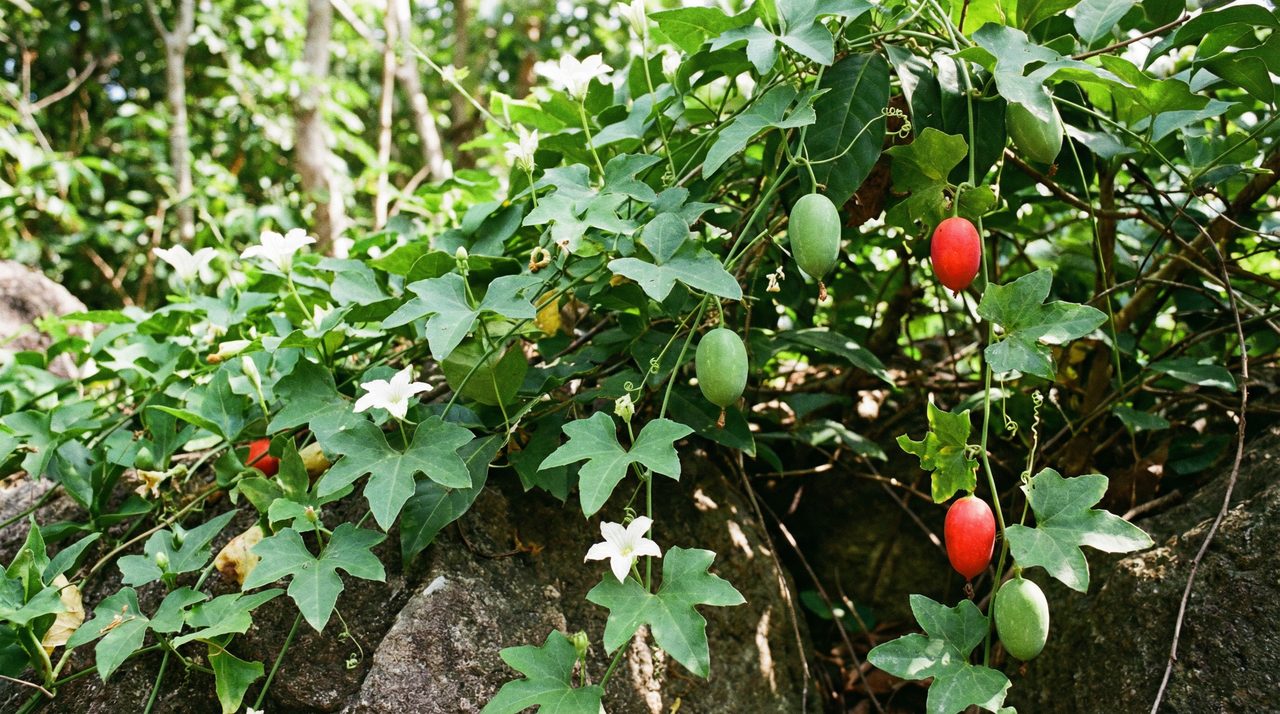
The first time I grew ivy gourd, I made a rookie mistake: I harvested too late. The fruits had blushed red overnight, and I thought I'd stumbled onto something beautiful. What I actually had was a gourd full of rising cucurbitacins, climbing bitterness, and a texture that belonged in a compost pile, not a curry. That five-day window between "perfect" and "ruined" is something no seed packet warned me about, and it reframed how I thought about the whole plant. Ivy gourd doesn't reward the casual gardener who checks in once a week. It rewards attention.
What's strange is that this same urgency, this restless biological momentum, runs through everything ivy gourd does. It climbs to 20 meters if you let it. It fruits prolifically across an entire season. In Florida and Hawaii, it's escaped cultivation entirely and is now classified as invasive, which tells you something about the energy you're working with.[1] But in the right climate, inside a managed food forest or a container setup where its enthusiasm has somewhere useful to go, this vine pays rent in ways few edible climbers can match. Understanding it starts with respecting what it actually is, not the tidy little trellis plant the catalog photo suggests.
Ivy Gourd Origin, History, and Botanical Background
Few vegetables carry as much botanical ambition as ivy gourd. The moment I grew my first plant up a simple wire trellis, I understood why it's been both celebrated and cursed across three continents. This is a vine with opinions about where it's going, and it will get there fast.
Botanical Profile and Native Range
Ivy gourd's scientific name is Coccinia grandis, and it belongs to the Cucurbitaceae family, putting it squarely in the company of cucumbers, melons, and pumpkins.[2][3] Its native range is primarily sub-Saharan Africa, spanning from Senegal through to South Africa, with early naturalization across India and Sri Lanka that likely happened via ancient trade routes.[2][4] Today it's also naturalized across Australia and the Pacific, which tells you something about its talent for making itself at home.
What gives this plant its extraordinary vigor is the combination of a tuberous taproot system that stores both water and nutrients, a dioecious reproductive strategy with separate male and female plants, and a polycarpic life cycle that keeps producing fruit season after season for five to ten years or more.[5][6] Vines reach up to 20 meters in length using branched axillary tendrils, and fruit matures from green to scarlet red in just two to four weeks after pollination.[7][8] That tuberous root is also the engine behind its vegetative spread, which is exactly why it's classified as invasive in subtropical regions outside its native range.
Visual Characteristics of the Vine
The plant starts as slender, slightly angular green stems, white-pubescent when young, that quickly become a confident scrambler across whatever support is nearby.[9][7] Leaves are alternate, simple, ovate to cordate, running roughly 4-10 cm long with shallowly lobed or toothed margins and five to seven main veins.[10] The flowers are small, white, and funnel-shaped, about 1.5-5 cm across, occurring singly or in racemes.[11][9]
The fruit is where the plant really announces itself. Oblong berries 2.5-5 cm long begin as bright green and ripen to a vivid scarlet red that genuinely stops you in your tracks.[12] As a garden designer, I've found few vegetables that pull off the combination of ornamental drama and edible productivity the way ivy gourd does. The related Coccinia intermedia is sometimes treated as a synonym or variety, differing mainly in leaf lobing and fruit traits, which speaks to how much morphological plasticity runs through this genus.[13]
Traditional and Cultural Significance
Archaeobotanical evidence places ivy gourd in cultivation on the Indian subcontinent from roughly 1500-1000 BCE at sites like Hallur, suggesting the plant arrived from Africa via ancient trade routes well before 2000 BCE.[14] Once it arrived, it stayed permanently. The Charaka Samhita and Sushruta Samhita both document it as 'Bimb' or 'Kunduru,' valued as a cooling, bitter, astringent herb for diabetes (prameha), skin conditions, wounds, and digestive complaints.[15][16] The consistency of that diabetes use across Ayurveda, Unani medicine, and the traditional practices of tribal communities like the Luo, Yoruba, Santals, and Bhils speaks to something worth paying attention to.[17]
On the kitchen table, ivy gourd is simply beloved. Known as tindora, kundru, or pora across South Asia, the young fruits and tender shoots appear daily in curries, stir-fries, and soups.[18][19] In Indian, Thai, and African traditions, the plant carries cultural symbolism around resilience, vitality, and healing, appearing in fasting diets and festivals alike.[20] That's not coincidence. When a plant grows this prolifically and produces this abundantly, cultures tend to find meaning in it.
Fun Facts About Ivy Gourd
The growth rate on this vine is genuinely startling. Under ideal tropical conditions, Coccinia grandis can reach 20 meters in length, with growth rates in the genus reported at 30-50 cm per day.[21] I've grown passionfruit, which most gardeners consider an aggressive climber, and ivy gourd makes it look leisurely. The tendrils are thigmotropic and phototropic, coiling rapidly on contact with any support they encounter.[22] Watching them find the wire on a new trellis section is almost hypnotic.
That fruit color transformation happens just as fast. Berries shift from green to vivid scarlet in two to four weeks at 25-30°C, while the plant simultaneously seeds the next generation and clones itself via the tuberous root system.[23][8] Both strategies running simultaneously is what makes it such a successful plant globally, and what makes it a serious problem outside its native range. In Florida and Hawaii, ivy gourd has formed dense thickets that smother native vegetation and climb over trees and structures with alarming speed.[24][25][26] Having seen how quickly a subtropical garden can lose control of an enthusiastic climber, I always recommend checking local regulations before planting and using container culture or physical barriers where escape into native ecosystems is a real risk. The plant rewards you generously when you understand its power and work with it intentionally.
Ivy Gourd Varieties and Where to Source Them
If you go looking for ivy gourd in the major international databases, you won't find a tidy list of named cultivars waiting for you. The USDA PLANTS Database, Missouri Botanical Garden, and Royal Horticultural Society all record Coccinia grandis without formal cultivar entries.[27][28][29] That's typical for many vegetables that have lived primarily in kitchen gardens and smallholder plots across Africa and Asia for centuries. What you're really navigating is a world of landraces, regional selections, and a modest but growing formal breeding effort concentrated in India.
Regional Landraces, Improved Indian Lines, and Taxonomic Confusion with Coccinia intermedia
Indian breeding programs have been quietly making progress, focused on developing thornless types, F1 hybrids with better yield and disease resistance, and selections with uniform fruit size.[30] The most notable result so far is 'Arka Manik,' an F1 hybrid that has gotten attention from commercial growers, with research also exploring gynoecious lines that push the ratio of female flowers higher for better fruit set.[30] These are real improvements, but they're still not widely available outside specialized Indian agricultural supply chains.
For most home growers, the practical choices are the regional types that agronomic literature describes even if nobody has formally registered them. The 'Hyderabad' type produces slender, uniformly green fruits that slice beautifully into stir-fries; the 'Nellore' type runs straighter with fewer seeds, which home cooks tend to appreciate. A 'Thai Green' type shows up darker and slightly warty. I've grown the slender Hyderabad-style fruit and genuinely prefer it for quick sautés where you want the pieces to hold their shape. West African landraces like 'Ncho' and the Caribbean 'Oil Pomme' exist too, though they're rarely named in any formal way and even harder to track down outside their regions of origin.
One thing to watch for: you may see the names 'Green Moon,' 'Crown,' or 'Arka Sumeet' associated with Coccinia intermedia, which is sometimes treated as synonymous with C. grandis or as a close relative. Major databases don't recognize distinct varieties for it either,[31][29][32] and those names likely represent local selections, foliage ornamentals, or just plain mislabeling.[33][34] I'd treat them as useful curiosities rather than reliable catalog options.
Buying Ivy Gourd Seed Responsibly: Invasive Status, Regulations, and Practical Germination Advice
Before you order anything, check your local regulations. Coccinia grandis is listed as a noxious weed in Hawaii and a prohibited aquatic plant in Florida, with sale, transport, and cultivation restricted in both states.[35][36][37][38] It isn't federally listed as a noxious weed, but the USDA does document it as an introduced species with documented invasive potential across the southeastern U.S.[36] In my subtropical region I treat this vine exactly as I treat other aggressive growers: only in containers or in spots where I can fully control its spread. That's not overcaution; it's just responsible gardening with a plant that genuinely earns its reputation.
Seed is available through specialty suppliers including Baker Creek Heirloom Seeds, Restoration Seeds, and various Etsy and eBay vendors, though availability varies by state. Mislabeling is a real problem in these channels, so stick to reputable suppliers, and make sure any imported material meets USDA plant-health requirements.[39] For anyone outside the true tropics, container culture is the sensible default, both to manage spread and to bring the plant indoors if temperatures dip.
On germination: fresh seed performs best, with 70-90% success at soil temperatures of 25-30°C (77-86°F), but viability drops noticeably after one to two years in storage.[40][32] Early on I lost several batches to slow, uneven sprouting before I understood why. Once I started lightly scarifying the seed coat and soaking seeds in water for 24 hours before sowing, and keeping soil at around 80°F, germination jumped into that 80-90% range the research describes. Label your flats carefully too; the seedlings look remarkably similar to other cucurbits in those first weeks, and I've mixed up more than one tray by assuming I'd remember which was which.
Ivy Gourd Propagation and Planting Guide
Ivy gourd is not a plant you grow carelessly. It's listed as invasive in Florida and Hawaii, and having watched it escape into a central Florida landscape firsthand, I now recommend growing it only in large containers or raised beds with root barriers.[35][41] Better safe than spending years pulling volunteers out of a hedge. If you're outside those states and you've checked your local regulations, read on, because this vine is a genuinely rewarding plant to grow from scratch.
Propagation Methods: Seeds, Cuttings, and Grafting
Ivy gourd can be started three ways: seeds, semi-hardwood stem cuttings, or grafting onto cucurbit rootstocks.[42][43] Seeds are oval to elliptical, about 1.2-1.8 cm long with a smooth, reddish-brown coat when fully mature[44], and fresh seed is almost always the better bet: viability starts at 80-95% but drops to 50-70% after just 6-12 months of ambient storage.[45] If you can't plant immediately, cold storage at 4°C slows that decline considerably.
The real issue with seeds is physical dormancy from a hard seed coat. Skipping scarification is a mistake I made exactly once. Seeds that I scarified (I use light sandpaper rather than acid) and soaked for 24 hours before sowing in warm summer conditions consistently hit the upper end of the 70-90% germination range. Seeds I planted without treatment in cooler shoulder seasons often fell below 50%, and my germination logs from those seasons are pretty discouraging to look back at.[45][46] Soil temperature of 25-30°C is non-negotiable for that success rate, so use a heat mat if your space runs cool.
For named or selected types, I actually prefer cuttings. Because ivy gourd is insect-pollinated and cross-pollinating, seedlings are genetically variable and won't reliably match the parent plant's fruit size or flavor.[47] Semi-hardwood cuttings 10-15 cm long with 2-3 nodes, dipped in IBA at 1000-2000 ppm and stuck into a 1:1 sand-perlite mix, root at 80-95% success in just 2-4 weeks when you keep temperatures at 25-30°C and humidity around 80-90%.[48][49] A simple plastic-tented propagation tray works well for maintaining that humidity without a dedicated mist bench.
Grafting onto bottle gourd or pumpkin rootstock via cleft or wedge technique is the third option, with 70-90% success when done cleanly.[50][51] I first learned the cleft technique at a university extension workshop on cucurbits and later adapted it to ivy gourd; compared to seedling plants, my grafted vines fruited earlier and yielded noticeably better in the first season. The rootstock's tolerance for soil-borne disease is the real payoff if your beds have a history of Fusarium. Whatever your starting method, harden seedlings off for 7-10 days once they have 3-4 true leaves, and use sterile, well-draining media throughout because young plants are genuinely susceptible to damping-off and root rot.[52][53]
Soil, Site Selection, and Sun Requirements
Ivy gourd wants full sun, at least 6-8 hours of direct light daily, and it'll tell you when it's not getting enough by flowering poorly and producing sparse fruit.[46][54] In its native range across tropical Africa, it grows on slopes and disturbed forest edges with 500-1500 mm of annual rainfall[55][56], which tells you a lot about what it expects: good drainage, plenty of light, and room to run.
For soil, think loamy or sandy with generous organic matter and a pH of 6.0-7.5.[57][56] Heavy clay is the enemy here, the same way it is for melons or basil: waterlogged roots mean rot, and this vine won't recover the way a hardier perennial might. Roots need at least 30-45 cm of uncompacted, well-aerated soil depth to establish properly.[55][56] If your soil trends alkaline, watch for iron chlorosis: yellowing young leaves with green veins, the same telltale pattern I see on ixora and hibiscus in Florida landscapes. Older leaves showing interveinal yellowing point instead to magnesium deficiency. Both respond to chelated micronutrients or Epsom salts, but soil test first so you're treating the actual problem.[46][58]
Spacing, Trellising, and Planting Technique
Trellis first, plant second. I can't stress this enough. Ivy gourd is a vigorous climber, and putting transplants in the ground before you have solid infrastructure in place means you'll be scrambling to build while the vines are already looking for something to grab. Use sturdy poles spaced 2-3 m apart with horizontal wires or netting at 1.5-2 m height, and space your plants 1.5-2.5 m apart in rows 2-3 m apart.[59][60][51][61] That spacing isn't arbitrary; it's what gives you the airflow that keeps powdery mildew from becoming a recurring problem.
Train new vines to a single main stem and tie young shoots as they grow. A pruning pass every 15-20 days keeps the canopy open and light penetrating to fruiting wood.[51][61] Two weeks after transplanting, apply a balanced 10-10-10 fertilizer at roughly 20-30 g per plant, then follow with monthly nitrogen-rich side-dressings through the vegetative phase.[42][8] If you're working within a polyculture system, beans make a natural companion here, quietly improving soil nitrogen while ivy gourd climbs above them.
Germination Timeline and Growth Expectations
With scarified, soaked seeds sown into 25-30°C soil, expect germination in 7-14 days. Seedlings reach transplant size in another 20-30 days, first flowers appear around 60-75 days from sowing, and you're harvesting fruit at 90-120 days.[42][62] Stem cuttings compress that timeline by 20-30 days, and grafted plants can begin fruiting within 4-6 months with yields possible in the first year.[63][42]
The single biggest variable you can control is that soil temperature. Everything else, the scarification, the IBA dip, the trellis infrastructure, compounds on top of that foundation. One last practical note: I now label every flat I start, because ivy gourd seedlings at the first true leaf stage look remarkably similar to certain melons. Early in my zone 9B years I mixed up an entire flat and didn't figure it out until flowering. Labels are cheap; that kind of confusion is not.
Ivy Gourd Care Guide: Growing Coccinia grandis Successfully
Caring for ivy gourd really comes down to one guiding principle: think tropics. This vine evolved in warm, humid, seasonally wet environments, and most of the problems I see in gardens trace back to conditions that drift too far from that origin. Get the fundamentals right and the plant rewards you generously. Get them wrong and it tells you quickly, which is actually one of the things I appreciate about it.
Sunlight Requirements for Optimal Growth and Fruiting
Six to eight hours of direct sun daily is the sweet spot for this vine.[64][65] Less than that and you'll see etiolated, spindly stems, sparse flowering, and poor fruit set. Too much intense direct exposure, especially in a location with afternoon sun bouncing off a wall or fence, and the relatively thin leaves scorch and drop.[21] In my experience, morning sun with some afternoon relief in the hottest months is the ideal orientation. The vine fruits best when light drives photosynthesis through the cooler part of the day rather than the scorching hours when the plant is already managing heat stress.
Watering Needs and Drought Tolerance
Aim for roughly one to two inches of water per week, applied deeply and infrequently, letting the top inch or two of soil dry out between waterings.[46] That single habit prevents most root rot and fungal problems I've seen gardeners struggle with. The ivy gourd plant can push through seven to fourteen days of drought without catastrophe, but consistent moisture matters far more at three specific moments: germination, flowering (dry spells cause flower abortion), and active fruit development, where inconsistency leads to bitter or split fruits.[62]
The plant is surprisingly good at signaling what it needs if you know what to look for. Wilting, leaf curl, and browning edges mean it's thirsty. Yellowing lower leaves and wilting despite wet soil usually point to overwatering and possible root damage.[66] A thick layer of organic mulch and drip irrigation make the whole watering equation much easier to manage, keeping soil moisture even and reducing fungal splash. The vine tolerates moderate salinity up to about 2-4 dS/m, but if you're on hard tap water, it prefers rainwater.[67]
Feeding and Nutrient Management
Fast-growing cucurbits are hungry, and the ivy gourd vine is no exception. I watch my established plants for the two most common deficiency signs: yellowing of older leaves signals nitrogen shortage, while scorched or browned leaf margins usually point to potassium deficiency.[68] A sidedressing of compost tea in midsummer has corrected that older-leaf yellowing on my vines more than once before fruit set was affected. For a more structured approach, a balanced 10-10-10 fertilizer every four to six weeks through the growing season works reliably, or work compost and aged manure into the planting bed at the start.[68] The one mistake I see consistently is over-applying nitrogen in hopes of accelerating growth; you get abundant coccinia leaves and very little fruit.
Heat Tolerance and Management in Hot Climates
Ivy gourd is genuinely built for heat, thriving between 25-35°C (77-95°F) and capable of surviving short spikes up to 40-45°C.[46] What I find fascinating is that the plant activates its own antioxidant and osmotic responses under stress, so it can recover if you catch the problem early.[69] Sustained temperatures above 35-38°C are where trouble starts: flower drop, sunscald on fruits, and stunted growth become real concerns, and seedlings are especially vulnerable.[70] I use 30-50% shade cloth during peak afternoon heat in the same way I'd protect bitter melon through a Central Florida summer; it's not coddling, it's protecting the reproductive stage of the plant. Pair that with drip irrigation to maintain consistent soil moisture and mulch to cool the root zone by a few degrees, and the vine handles subtropical summers well.[71]
Frost Tolerance and Cold Protection Strategies
Ivy gourd has no meaningful frost tolerance. Vines sustain damage at or near 0°C, and chilling injury can begin below 10-12°C even without actual frost.[72][73] The plant is reliably perennial in USDA zones 10-12. Zone 9 is marginal at best, and I never rely on mulch alone there; I've lost too many vines to an unexpected dip below 10°C to trust that strategy.[74] After that experience, I switched to growing my ivy gourd in large containers on wheels so I can roll them under cover when the forecast turns. For in-ground plants in cooler areas, digging and storing tubers at 7-10°C in moist peat or vermiculite is a far more reliable overwintering strategy than hoping roots survive under mulch.[75]
Pruning, Maintenance, and Pest Considerations
Left unpruned, this vine will enthusiastically fill every available space, and while that's impressive, it works against fruit production. I prune every four to six weeks during the growing season, maintaining four to six strong main stems and removing anything dead, diseased, or so crowded it's blocking airflow.[76] Pinching stem tips encourages lateral branching, which is where most of your flowers and fruits will form. This routine has consistently given me 20-30% more fruit on the following flush compared to seasons when I let the vine run unchecked.[77] Good airflow from pruning also reduces the humid microclimate that fungal problems love, so it's doing double duty as both a yield tool and a preventive measure. Regular walkthroughs to remove damaged material are your first line of defense against the pest and disease issues covered in the next section.
Seasonal Rhythm and Overwintering
In its native tropical range, the ivy gourd plant flowers and fruits year-round, never truly resting, with peak activity tracking the warmest and wettest months.[78] The rhythm shifts considerably once you move into subtropical or temperate gardens. Expect semi-dormancy or complete dieback after the first frost, followed by regeneration from the perennial tuberous root system in spring if the roots have survived.[8] Where that's too unreliable, treat it as an annual or, better, dig the tubers after first frost, clean and cure them briefly, and store at 7-10°C in barely moist peat until soil temperatures climb back above 15°C in spring.[79] Once you've mastered that rhythm, the same plant can produce for years. The tuberous root is genuinely the gardener's insurance policy with this vine, and treating it with care is what separates growers who enjoy ivy gourd season after season from those who start over every spring.
Harvesting Ivy Gourd (Coccinia grandis)
When and How to Harvest Ivy Gourd for Best Quality
The entire harvest strategy for ivy gourd comes down to one rule: catch them young. Fruits are ready when they're 2-6 cm long, firm, and wearing that bright, glossy green skin with faint white stripes.[46][80] At this stage they sit in a 3-5° Brix window, which means mild, crisp, and just barely bitter in the best possible way.[81] I think of it like harvesting green beans: that satisfying snap when you pull one off the vine tells you everything you need to know. Under good tropical conditions, fruits are harvestable just 10-15 days after pollination.[42][82] I watch the fruits rather than the calendar, though, because heat, irrigation, and cultivar all affect the exact timing.
Once peak production hits, plan on picking every 2-3 days.[80] Miss a round and you'll find fruits that have crept past 4 inches, gone soft, and climbed to 6-8° Brix or higher as cucurbitacin levels rise.[81][83] Nobody wants that. Any yellowing or red blush at the tips is your signal you've already waited too long.[35] That dramatic green-to-scarlet shift is gorgeous to look at on the fence, but it means the fruit is past its kitchen prime. In my experience, the vines respond almost immediately to regular harvest with a fresh flush of female flowers, so frequent picking isn't just about quality — it's what keeps the whole system productive.
Harvest Technique, Flavor Profile, and Storage
Use pruning shears or sharp scissors and leave about 1-2 cm of stem attached to each fruit.[46][84] Yanking them off might feel faster, but it tears the vine and opens wounds that invite disease. Store your harvest in perforated plastic bags in the refrigerator at 4-10°C; they'll hold for up to 7 days.[80] I treat them the same way I treat fresh okra or cucumbers: use them within a few days or plan around them, because that high moisture content means quality drops fast at room temperature. Blanch and freeze what you can't use immediately, or pickle promptly.
The payoff for all this vigilance is a fruit with real culinary character: mildly bitter, crisp, with a grassy, faintly citrusy aroma from volatile compounds like hexanal and (E)-2-hexenal.[85][86] That's exactly what Indian, Thai, and Filipino cooks are after. Drought stress and over-maturity both push cucurbitacin levels up, which is the chemistry behind bitterness nobody wants on the plate.[87] A well-managed home vine can yield 20-50 fruits per plant, scaling up to 10-15 kg with attentive care,[80][35] which is a generous return for something you're essentially harvesting fresh every few days all season long.
Ivy Gourd Preparation and Uses
Culinary Uses and Flavor Profile of Ivy Gourd
The edible parts of ivy gourd are the young leaves, tender stems, and immature green fruits.[78][88] Raw, the young fruit tastes like a cross between a cucumber and a green bean: crisp, mildly sweet, faintly grassy.[89] I've harvested hundreds of these at the two-to-three inch stage, and I can tell you the difference even a few extra days makes is noticeable. Fruits that seemed fine yesterday will have that unmistakable bitter edge by tomorrow, because cucurbitacin content rises steadily as the fruit matures.[78]
Heat transforms the flavor entirely. Stir-frying, boiling, currying, and pickling all break down cucurbitacins and mellow whatever bitterness exists,[90][88] and the cooked result shifts toward something earthy, nutty, and savory.[46][85] An Indian dry sabzi with turmeric, cumin, and chili is probably the most common preparation you'll encounter; the vegetable holds its shape beautifully in a hot pan. Thai cooks use it in nam prik ong and stir-fries, Sri Lankans fold it into pol sambol, and Filipino pinakbet is another worthy destination.[91][92] The ivy gourd stir fry method is honestly the quickest way to see what the vegetable can do.
Nutritionally, it's a smart everyday vegetable rather than a dramatic one: low in calories and highly hydrating, with solid vitamin C, potassium, iron, calcium, and a meaningful contribution of flavonoids, carotenoids, and quercetin.[93][94][95] That same plant on your dinner plate also carries a long tradition of use in Ayurveda and African medicine for blood-sugar support, inflammation, and wound healing.[96][94] Eaten as prepared food it's generally safe,[97] but if you grow it in zone 9-11 in the southern U.S., know that it's considered invasive in some states and should be managed carefully.[46][41] I also want to say clearly: before eating any wild vine with palmate leaves and small fruits, confirm your identification. Common look-alikes include bitter melon, luffa, and passionfruit relatives,[98][99] and I recommend positive ID to every student and client before anything goes in the mouth.
Medicinal Preparations from Ivy Gourd
The traditional Ayurvedic approach uses powdered dried leaves or roots, 1-3 grams mixed with honey or water, taken twice daily for blood-sugar support.[100] The same leaves that go into an ivy gourd curry recipe can be dried and powdered, which I find a satisfying kind of efficiency. Beyond powder, traditional practitioners prepare decoctions by boiling 10-20 grams of plant material in 200-300 ml of water until reduced by half, taken at 50-100 ml twice daily; leaf infusions use 5-10 grams of fresh leaves steeped for ten minutes, one cup two to three times daily; and topical poultices of crushed leaves or fruit are applied directly to wounds, eczema, or psoriasis.[101][102][100] These are ethnobotanical practices, not standardized pharmaceuticals, and the dosages vary considerably across traditions. If you take medications to lower blood sugar, talk with your doctor before using ivy gourd therapeutically. The hypoglycemic effect is real and the interaction with antidiabetic drugs is well documented.[97]
Non-Food Uses of Ivy Gourd
Beyond the kitchen, ivy gourd stem fibers have traditionally served for rope and basket weaving, mature stems as fuelwood, and the fruits and stems as a source of red dye for textiles.[103] As a landscape designer, I've also recommended it as a flowering screen in fully managed zone 10-11 gardens: the star-shaped white flowers and bright scarlet fruits against a trellis or fence are genuinely ornamental.[104] That ornamental appeal is real, but it doesn't change the management responsibility. A vine this vigorous rewards you generously and escapes quietly if you aren't watching it.
Ivy Gourd Health Benefits and Medicinal Uses
What strikes me every time I research ivy gourd is how consistently it shows up in the medical literature of three distinct continents, each tradition arriving independently at the same conclusions. That kind of convergence tends to mean something.
Traditional and Ethnomedicinal Uses of Ivy Gourd
Across tropical Asia and sub-Saharan Africa, Coccinia grandis has been a working medicine plant for centuries before anyone ran an in-vitro assay on it. In Ayurveda, it's classified under the condition "Prameha" and prescribed specifically for diabetes management, skin disorders, wounds, and digestive complaints, described in classical texts as bitter and cooling in action.[105][106] You'll hear it called "Kundru" or "Bimb" depending on the region. African ethnomedicine takes a different angle, using it for malaria, respiratory ailments, wound care, and as an analgesic.[107] Traditional Chinese medicine draws on it for heat-clearing, detoxification, and liver and kidney support.[108] Every part of the vine has some documented traditional use, though leaves and roots are the workhorses of these systems.[105]
Key Phytochemicals in Ivy Gourd
The reason those traditional applications hold up under scrutiny comes down to a genuinely complex phytochemical profile. The major players are flavonoids (quercetin, kaempferol, rutin), phenolic acids (gallic acid, ferulic acid, chlorogenic acid), β-sitosterol, saponins, triterpenoids, and carotenoids including β-carotene and lutein, alongside the cucurbitacins B, E, and I that are responsible for the vine's characteristic bitterness.[109][110] These compounds aren't evenly distributed. Leaves tend to be significantly richer in phenolics and flavonoids than the fruits, which is something I've noticed empirically: a fresh young leaf has a stronger, almost spinach-like mineral bite compared to the mild cucumber flavor of an immature fruit. The cucurbitacins, conversely, concentrate in roots, mature fruits, and seeds.[111] Think of them as the plant's defense chemistry that we have to manage, while the quercetin and chlorogenic acid are the compounds we actually want to concentrate in edible portions. Phytochemical levels also shift with ripeness, growing conditions, and how you process the plant, so treating any single number as fixed is a mistake.[112]
Proven Medicinal Properties and Pharmacological Research
The antioxidant work is solid. Leaf extracts show strong free-radical scavenging activity in standard DPPH and ABTS assays, with IC50 values in the 20-50 µg/ml range, driven by that high phenolic, flavonoid, and ascorbic acid content.[105][113] Anti-inflammatory activity has been demonstrated in paw-edema and arthritis animal models via inhibition of pro-inflammatory cytokines and COX-2, while the triterpenoids and saponins show meaningful antimicrobial action against Staphylococcus aureus, E. coli, and Candida albicans at MIC values of 50-200 µg/mL.[114][115]
The antidiabetic story is where the evidence gets most compelling, and also where I'd encourage readers to hold the nuance carefully. In alloxan- and streptozotocin-induced diabetic rats, leaf extracts at 200 mg/kg reduced fasting blood glucose by up to 45% over 21 days, working through multiple mechanisms: enhanced insulin secretion, improved GLUT4 translocation, α-amylase and α-glucosidase inhibition, and even β-cell regeneration.[116] Small human clinical trials (enrolling 25-152 participants) using 1 g/day extract over 6-8 weeks as adjunct therapy in type 2 diabetes showed modest but statistically significant reductions in fasting blood glucose and HbA1c.[117] Results are mixed across trials and the studies are small. Drawing firm clinical conclusions would be premature.[118] Adding cooked ivy gourd to a meal feels genuinely light and balancing alongside other low-GI vegetables, which aligns with the mild glucose-moderating mechanisms in the data, but that's a kitchen observation, not a prescription. The broader preclinical picture also includes analgesic effects in writhing and hot-plate tests, diuretic activity comparable to furosemide, antispasmodic relaxation of ileum smooth muscle, accelerated wound healing with 80% faster epithelialization, hepatoprotection in CCl4-induced liver damage models, and cardioprotective effects in myocardial infarction models.[105][119][120] Systematic reviews of the combined preclinical and limited clinical data conclude that the plant shows significant potential for diabetes management with an acceptable short-term safety profile, but high-quality large-scale human trials are still absent.[121]
Nutritional Profile of Ivy Gourd
As a daily vegetable, ivy gourd earns its place on nutritional merit alone, independent of its medicinal applications. Immature fruits come in at just 17-20 kcal per 100 g with 90-96% water content, making them genuinely low-calorie and hydrating.[122] The fruit contributes meaningful vitamin C (22-25 mg per 100 g, roughly 24-37% of daily value), a useful dose of provitamin A from β-carotene (210-1250 IU), potassium around 130-287 mg, plus small amounts of calcium, magnesium, iron, and B vitamins.[123] The young leaves are where the nutrition concentrates most dramatically: vitamin C can reach up to 100 mg per 100 g in leaves, and phenolic and flavonoid levels run significantly higher than in the fruit.[124] In my experience the leaves have a stronger, almost spinach-like mineral flavor and a noticeable antioxidant punch when eaten fresh or lightly wilted. Cooking method matters considerably: boiling can strip up to 50% of the vitamin C, while stir-frying retains significantly more.[125] All values shift with ripeness and growing conditions, so treat ranges as directional rather than fixed.
Safety, Side Effects, and Contraindications
Young fruits, tender leaves, and shoots prepared through normal cooking are generally safe with low acute toxicity (rat LD50 exceeding 2000 mg/kg), and commercial cultivars have been selectively bred to reduce cucurbitacin content and bitterness.[126][127] After growing this vine for several seasons, I've learned to harvest only the youngest, darkest-green fruits and always cook them thoroughly. The difference in bitterness and digestibility between a perfectly timed harvest and a fruit that's gone even a day past its window is immediately obvious to anyone who's eaten both. That bitterness is cucurbitacins at work, and those same compounds are why roots, mature fruits, and seeds carry real GI risk: nausea, vomiting, abdominal pain, and diarrhea if consumed raw or in quantity.[128] Plants grown in acidic tropical soils tend to accumulate higher cucurbitacin levels, so the same variety can behave differently depending on where it's grown.[126]
The interaction risks are real and I want to be direct about them. If you take metformin, insulin, or antihypertensives, start with small culinary amounts and monitor your blood sugar; the additive hypoglycemic effect is documented and not theoretical.[126] Roughly 5-10% of users in some studies reported gastrointestinal upset, and allergic contact dermatitis from the sap has been recorded.[129] Ivy gourd is contraindicated in pregnancy due to potential uterine stimulant activity and hypoglycemia risk, and should be avoided during lactation.[126] It's also toxic to dogs and cats, causing vomiting and diarrhea, so keep that in mind if your food forest is pet-accessible.[130] On identification: the vine's distinctive simple tendrils and cordate leaves with a deep basal notch have helped me differentiate it quickly from look-alikes in mixed plantings. That visual check matters because cucurbitacin poisoning from misidentified plants is a documented clinical problem, and no specific antidote exists; treatment is supportive hydration and electrolyte replacement.[131] The short version: culinary use of properly selected, cooked young parts is reasonable for most healthy adults, but long-term high-dose supplementation doesn't yet have robust human safety data behind it.[132]
Ivy Gourd Pests and Diseases
Ivy gourd sits in an interesting middle ground for disease resistance. The vine has genuine defenses, but calling it tough would be overselling it. Grown in humid subtropical conditions without attention to airflow and irrigation, it can face serious pressure from pathogens that hit the whole cucurbit family hard.
Common Diseases and Integrated Management
The three ivy gourd plant diseases that cause the most damage in humid growing seasons are Fusarium wilt, downy mildew, and powdery mildew. All three can trigger chlorotic lesions, yellowing, premature defoliation, and real yield loss if conditions favor them.[133][134] After several seasons growing this vine on trellises in warm, wet conditions, I can tell you that keeping the canopy thinned from the start prevents more mildew outbreaks than any spray I've ever used. That's not a hunch; the research backs it up consistently.[135]
Secondary concerns include Cucumber mosaic virus, Watermelon mosaic virus, Cercospora leaf spot, root-knot nematodes, and occasional bacterial fruit blight.[133][134] The viruses matter here partly because they're insect-vectored, which connects directly to aphid and whitefly pressure. No commercial cultivars with strong resistance to the major disease complex have been widely released, though Indian selections like 'Arka Divya' and 'IIHR Selection-1' show moderate foliar tolerance.[136] Some wild Coccinia intermedia accessions carry partial CMV resistance and are being used in breeding programs, but most home gardeners are still working with cultural practices rather than genetics.[136][137]
The cultural foundation is what I return to every season: rotate with non-cucurbits for at least three years, space rows 2 to 3 meters apart, use drip irrigation to keep foliage dry, and remove infected material promptly.[135] On the biological side, I only reach for a copper or mancozeb spray after Trichoderma soil drenches and Bacillus subtilis foliar applications have had time to work; those tools handle Fusarium pressure and powdery mildew remarkably well when applied early.[138][139] The two windows where I pay closest attention are two to four weeks after transplant and during fruit fill, roughly 20 to 45 days post-anthesis; those are when problems escalate fastest.[139][140]
Key Insect Pests and Natural Defenses
Aphids and whiteflies top the pest list, and not just because they cause leaf curl, stunting, and sooty mold on their own. Like on cucumbers or squash, they're also the primary vectors for the mosaic viruses mentioned above, so a heavy aphid flush in week three can trigger a disease problem that follows the vine all season.[141] Fruit flies (Bactrocera spp.) are the other major threat; unmanaged infestations can cause up to 70% yield loss from larval rot and premature fruit drop.[142][77] In my experience, fruit bagging combined with yellow sticky traps keeps losses under 10% most years without a single broad-spectrum spray. Thrips, leaf miners, and mealybugs round out the list at lower severity.[33]
What makes IPM so effective on ivy gourd is that the vine brings real defenses of its own. Herbivory triggers cucurbitacin B production, glandular trichomes exude sticky secretions that trap small insects, and the latex gums up mouthparts.[143][144][145] Layered management that works with those defenses includes yellow sticky traps, fruit bagging, consistent sanitation, and biological applications of Beauveria bassiana or Bacillus thuringiensis, all while protecting the beneficial insects that keep secondary pest populations in check.[146] Proactive monitoring during those early transplant weeks and through fruit fill is the habit that separates a productive vine from a problem one.
Ivy Gourd in Permaculture Design
Ivy gourd is one of those plants that rewards honest assessment before you ever put it in the ground. The ecological services it delivers are real, and in the right system it's a genuinely productive vine-layer plant. But it comes with a clear responsibility attached, and I think permaculture practitioners especially need to hear that up front rather than buried in fine print.
Climate Requirements and USDA Hardiness Zones
Coccinia grandis is a committed tropical. It grows best between 20-35°C (68-95°F), can tolerate brief spikes to around 40°C (104°F), but starts declining below 10°C (50°F) and won't survive a genuine freeze.[78][77][21] It also wants serious moisture, somewhere in the range of 1,000-2,000 mm of annual rainfall with consistently high relative humidity.[78][147] USDA zones 10-11 are where it truly thrives as a perennial; zone 9 can work with microclimate protection and heavy mulching over winter, and zone 8 is really annual territory.[77][148][8]
Here in Florida, I treat ivy gourd as a contained plant precisely because it is listed as invasive in Florida, Hawaii, and parts of California, where it has shown a serious ability to escape cultivation and spread rapidly along disturbed edges.[148][149][150] I only recommend it in open ground where you can genuinely manage it, or in large containers where escape via runners is structurally impossible. If you're in the continental U.S. outside those warm subtropical zones, the invasive risk drops considerably, but the climate probably won't sustain it as a perennial anyway. For growers interested in a closely related species with no documented U.S. invasive status, Coccinia intermedia occupies similar tropical niches (USDA zones 10-12) and behaves more modestly in both height and spread.[151][9]
Ecosystem Functions and Pollination Services
What I find genuinely compelling about this vine is the pollinator activity it generates once it hits flowering size. The small greenish-white flowers open in the evening and stay active through the morning, with bee and butterfly visitation peaking between roughly 9 and 11 AM under warm, humid conditions.[152][153] I've watched native bees and swallowtails work those pale flowers from first light until they close, and it's a reliable daily show once the vine matures. In a food forest designed to support pollinators throughout the growing season, that early-morning window is a real contribution.
Beyond pollination, ivy gourd earns its place ecologically as a wildlife food source (birds and frugivores eat the fruits and disperse the seed), a soil stabilizer on slopes where its dense foliage and root system check erosion, and a pioneer-type species comfortable in disturbed tropical edges.[154][155] One thing to be clear about, though: it does not fix nitrogen and isn't a meaningful dynamic accumulator.[156] Its permaculture contributions are edible yield, ground cover, habitat, and biomass for mulch, which are legitimate functions, but the nitrogen has to come from somewhere else in the guild. Pairing it with legumes or cereals that do the fertility lifting is the sensible move.[157] Planting companion pollinator plants like Lantana, Salvia, or Hibiscus nearby also improves fruit set, as does hand-pollination during seasons when natural pollinator pressure is low.[158][46]
Forest Layer Placement and Guild Design
Structurally, ivy gourd belongs in the vine and climber layer of a tropical food forest. It reaches 5-10 meters using axillary tendrils and can push even further given the right support, so it needs sturdy infrastructure: heavy-gauge trellises, established posts, or mature trees with enough canopy to absorb the competition.[78][159] After growing it on trellises in my Central Florida yard, I now label every vine carefully because the early foliage can look deceptively like benign cucurbits, while the tendrils are already claiming vertical space at a pace that surprises first-time growers.
On the positive side, ivy gourd forms associations with arbuscular mycorrhizal fungi that improve phosphorus uptake and extend its drought tolerance, making it genuinely useful in nutrient-poor tropical soils where other heavy feeders would struggle.[160] I think of it a bit like passionfruit or a vigorous pole bean in this respect: it brings mycorrhizal partnership and edible yield to the guild, while a nearby nitrogen-fixer handles the soil fertility side. That division of labor, when it's designed intentionally, works well.
The catch, and it's an important one, is that unchecked ivy gourd will shade out and physically smother companions with alarming speed.[78][161] My first attempt at letting it scramble without a dedicated support taught me that one season of inattention can bury an entire understory herb bed. Now I prune aggressively and keep it on defined structure, and the whole guild benefits from the management discipline. For smaller-scale systems or growers who want the genus without the containment challenge, Coccinia intermedia tops out at 3-6 meters and functions more as a savanna-edge scrambler than a canopy-reaching climber, offering similar pollinator support and soil stabilization without the same overpowering growth rate.[162][163] Ivy gourd's value as a living trellis, biomass source, and edible producer is real, but it shines inside managed food forests where its hunger for heat, humidity, and consistent moisture can be fully met and its vigor can be fully redirected.
The Vine That Taught Me to Respect a Plant's Ambition
I still think about the first time I let an ivy gourd go a week without checking it, distracted by other beds, convinced it could wait. It couldn't. Half the fruits had blushed red, gone fibrous, done their own thing entirely. That's ivy gourd in a sentence: it doesn't slow down for you, it doesn't apologize, and honestly, I've grown to find that quality more admirable than inconvenient. Just plant it where it belongs, and it will outwork everything else in the garden.
Sources 163
- Ivy Gourd - Invasive Species Info ↩
- Kew Science - Plants of the World Online: Coccinia grandis ↩
- Coccinia grandis: A Review of Its Phytochemistry and Pharmacological Activities ↩
- University of Florida IFAS Extension - Ivy Gourd ↩
- Kew Science - Plants of the World Online - Coccinia grandis ↩
- Ivy Gourd (Coccinia grandis) - CABI Compendium ↩
- USDA PLANTS Database - Coccinia grandis ↩
- Horticultural Guide to Growing Ivy Gourd - University of Florida IFAS ↩
- Missouri Botanical Garden - Ivy Gourd (Coccinia grandis) ↩
- Flora of China: Coccinia grandis ↩
- Coccinia grandis ↩
- Plants of the World Online: Coccinia grandis ↩
- PlantZAfrica - Coccinia intermedia ↩
- Archaeobotanical Evidence of Cucurbits in Ancient India ↩
- Ayurvedic Uses of Ivy Gourd (Coccinia grandis) in Traditional Medicine ↩
- Traditional Uses and Pharmacological Profile of Coccinia grandis in Ayurveda ↩
- Coccinia grandis: A Review on Phytochemistry and Pharmacological Aspects ↩
- Culinary and Medicinal Uses of Ivy Gourd in South Asian Communities ↩
- Coccinia grandis: Ethnopharmacology, Phytochemistry, and Pharmacology ↩
- Traditional Vegetables in Maharashtra: Tindora and Its Cultural Significance ↩
- Ivy Gourd (Coccinia grandis) ↩
- Growth Rates of Invasive Vines in Tropical Regions ↩
- Plants of the World Online ↩
- Florida's Invasive Species: Ivy Gourd ↩
- Ecological Impacts of Ivy Gourd in Hawaii ↩
- Invasive Plant Atlas: Coccinia grandis ↩
- Missouri Botanical Garden Plant Finder ↩
- USDA PLANTS Database ↩
- Royal Horticultural Society - Ivy Gourd Plant Profile ↩
- Breeding Strategies for Ivy Gourd (Coccinia grandis) ↩
- USDA Plants Database - Coccinia grandis ↩
- Plant Finder - Ivy Gourd Cultivars ↩
- Ivy Gourd Cultivation Guide ↩
- USDA PLANTS Database: Coccinia intermedia ↩
- Coccinia grandis: Ivy Gourd ↩
- Coccinia grandis ↩
- Prohibited Aquatic Plants ↩
- Noxious Weed List ↩
- USDA Plant Health Regulations for Coccinia grandis ↩
- Seed Germination of Tindora (Coccinia grandis) ↩
- Invasive Plant Atlas: Ivy Gourd ↩
- Ivy Gourd (Coccinia grandis) Production Guide ↩
- Propagation of Ivy Gourd (Coccinia grandis): A Review ↩
- Seed Morphology and Germination of Coccinia grandis ↩
- Seed Germination Studies in Coccinia grandis ↩
- Propagation of Ivy Gourd (Coccinia grandis) ↩
- Genetic Variability in Seedlings of Ivy Gourd (Coccinia grandis) ↩
- Vegetative Propagation Techniques for Tindora ↩
- Propagation of Ivy Gourd (Coccinia grandis) ↩
- Grafting Techniques in Vegetable Crops: Cucurbitaceae ↩
- Grafting Cucurbits for Disease Management ↩
- Propagation of Ivy Gourd (Coccinia grandis): Techniques and Challenges ↩
- Powdery Mildew on Cucurbits ↩
- Ivy Gourd (Coccinia grandis) Plant Profile ↩
- Coccinia grandis - Useful Tropical Plants ↩
- Coccinia grandis (ivy gourd) ↩
- Ivy Gourd Cultivation Guide ↩
- Soil pH and Nutrient Availability ↩
- Ivy Gourd (Coccinia grandis) Production Guide ↩
- Agronomic Practices for Tindora ↩
- Pruning and Training Ivy Gourd ↩
- Ivy Gourd Cultivation Guide ↩
- Propagation and Cultivation of Ivy Gourd (Coccinia grandis) ↩
- USDA PLANTS Database: Coccinia grandis ↩
- Ivy Gourd (Coccinia grandis) - Introduction ↩
- Ivy Gourd Plant Care: How To Grow Coccinia ↩
- Salinity Tolerance of Vegetable Crops ↩
- Nutrient Deficiencies in Tropical Vegetables ↩
- Heat Stress Tolerance in Coccinia grandis: Physiological and Biochemical Responses ↩
- Coccinia grandis (ivy gourd) ↩
- Heat Stress Management in Ivy Gourd (Coccinia grandis) ↩
- USDA Plants Database - Coccinia grandis ↩
- Plants of the World Online: Coccinia grandis ↩
- Frost Protection for Tropical Vines ↩
- Royal Horticultural Society - Coccinia grandis ↩
- Coccinia grandis Cultivation Guide ↩
- Ivy Gourd Production Guide ↩
- Coccinia grandis - Wikipedia ↩
- Missouri Botanical Garden Plant Finder ↩
- University of Hawaii CTAHR Fact Sheet: Tindora (Ivy Gourd) ↩
- Maturity Indices and Quality Attributes of Ivy Gourd Pods ↩
- Cultivation of Tindora (Coccinia grandis) ↩
- Cucurbitacins in Ivy Gourd: Biosynthesis and Bitterness ↩
- Harvesting and Post-Harvest Handling of Ivy Gourd ↩
- Flavor Characteristics of Tindora (Coccinia grandis) ↩
- Volatile Compounds of Ivy Gourd (Coccinia grandis) Fruits ↩
- Coccinia grandis: A Review of Its Ethnopharmacology and Phytochemistry ↩
- Ivy Gourd (Coccinia grandis): A Review of Its Traditional Uses, Phytochemistry and Pharmacology ↩
- Royal Horticultural Society: Food Gardening - Coccinia grandis ↩
- UC Agriculture and Natural Resources: Pacific Island ECHO - Ivy Gourd ↩
- Ivy Gourd: A Versatile Vegetable in Indian Cuisine ↩
- Traditional Uses of Tindora in Sri Lankan and Thai Dishes ↩
- Nutritional Composition and Phytochemical Analysis of Ivy Gourd (Coccinia grandis) ↩
- Antioxidant and Antidiabetic Properties of Coccinia grandis Fruits ↩
- Proximate Composition and Mineral Content of Coccinia grandis ↩
- Medicinal Uses of Coccinia grandis in Ayurveda ↩
- Pharmacological Review of Coccinia grandis ↩
- Coccinia grandis Plants - Missouri Botanical Garden ↩
- Momordica charantia - CABI Invasive Species Compendium ↩
- Medicinal Plants of Ayurveda: Coccinia grandis ↩
- Ethnopharmacological Survey of Plants Used in the Traditional Management of Diabetes in Central Uganda ↩
- Coccinia grandis: Traditional Uses, Phytochemistry and Pharmacological Activities - A Review ↩
- Fiber and Dye Extraction from Coccinia grandis ↩
- Coccinia grandis (Ivy Gourd) ↩
- Pharmacological Activities of Coccinia grandis: A Review ↩
- Traditional Uses and Phytochemical Profile of Ivy Gourd in India ↩
- Ethnomedicinal Survey of Coccinia grandis in East Africa ↩
- Coccinia grandis in Traditional Chinese Medicine ↩
- Ethnopharmacological Survey and Phytochemical Screening of Coccinia grandis ↩
- Bioactive Compounds from Coccinia grandis and Their Pharmacological Activities ↩
- Phytochemical analysis of flavonoids and carotenoids in Ivy gourd (Coccinia grandis) ↩
- Antioxidant and Anticancer Properties of Coccinia grandis Extracts ↩
- Antioxidant activity and phenolic content of Coccinia grandis leaves ↩
- Anti-inflammatory activity of leaves of Coccinia grandis ↩
- Antimicrobial Activity of Ivy Gourd (Coccinia grandis) Extracts ↩
- Hypoglycemic effects of Coccinia grandis in alloxan-induced diabetic rats ↩
- Effect of Coccinia indica leaves on fasting and postprandial blood glucose levels in type 2 diabetes patients ↩
- Systematic review of the medicinal uses of Coccinia grandis ↩
- Wound healing activity of Coccinia grandis in mice ↩
- Cardioprotective effects of Coccinia grandis in rat myocardial infarction model ↩
- Evidence-based review on the pharmacological potential of Coccinia grandis ↩
- Ivy Gourd (Coccinia grandis) Nutrition Facts ↩
- Nutritional composition of ivy gourd (Coccinia grandis) fruits ↩
- Nutritional Composition of Underutilized Leafy Greens ↩
- Effect of Cooking on Nutrient Content of Tropical Vegetables ↩
- Hypoglycemic activity of Coccinia indica and its toxicity ↩
- Genetic diversity, morphological traits, quality traits in Coccinia grandis germplasm ↩
- Coccinia grandis: A Review on Phytochemistry and Pharmacological Aspects ↩
- Allergic contact dermatitis due to ivy gourd (Coccinia grandis) ↩
- Toxic Plants for Pets ↩
- Cucurbitacin poisoning: a case report ↩
- Coccinia grandis (L.) Voigt: A review on its ethnopharmacology, phytochemistry and pharmacological activities ↩
- ICAR – National Research Centre for Cucurbit Crops, India (Peer‑Reviewed Disease Survey, 2021) – Disease incidence in Coccinia grandis in Gangetic plains ↩
- Diseases of Ivy Gourd (Coccinia grandis) ↩
- ICAR-NAARM – Growing Ivy Gourd (Coccinia grandis) – Production Practices ↩
- Disease Resistance in Wild Coccinia Species: Implications for Ivy Gourd Breeding ↩
- Breeding for Disease Resistance in Cucurbitaceae ↩
- Bacillus subtilis and Trichoderma spp. efficacy trials on Fusarium wilt of cucurbits ↩
- University of Florida Extension – Integrated Pest Management for Cucurbits (IPM‑07) ↩
- University of Hawaii – Cucurbit Report 2023, Pathogen prevalence and management ↩
- University of Florida IFAS Extension - Ivy Gourd (Coccinia grandis) Insect Pests ↩
- Management of Fruit Flies in Cucurbit Crops ↩
- Cucurbitacins: Natural Insecticides from Cucurbitaceae ↩
- Physical and Chemical Defense Mechanisms in Coccinia grandis ↩
- Trichomes and Latex in Cucurbitaceae: Roles in Plant Defense ↩
- Integrated Pest Management for Coccinia grandis ↩
- Coccinia grandis - Ivy Gourd ↩
- Coccinia grandis (ivy gourd) ↩
- Ivy Gourd (Coccinia grandis) ↩
- California Invasive Plant Council - Coccinia grandis profile ↩
- Coccinia intermedia ↩
- Floral Biology and Pollination in Coccinia species ↩
- Pollination Biology of Coccinia grandis ↩
- Coccinia grandis ↩
- Dynamics of vine flora in tropical savannas: a case study on Coccinia intermedia ↩
- Permaculture Plants: Coccinia grandis ↩
- Intercropping Studies with Coccinia grandis ↩
- Companion Planting for Pollinators ↩
- Intercropping Systems with Climbing Vegetables ↩
- Mycorrhizal Associations in Tropical Vines ↩
- Invasive Species Compendium - Coccinia grandis ↩
- Kew – Plants of the World Online: Coccinia intermedia ↩
- Missouri Botanical Garden - Plant Finder ↩