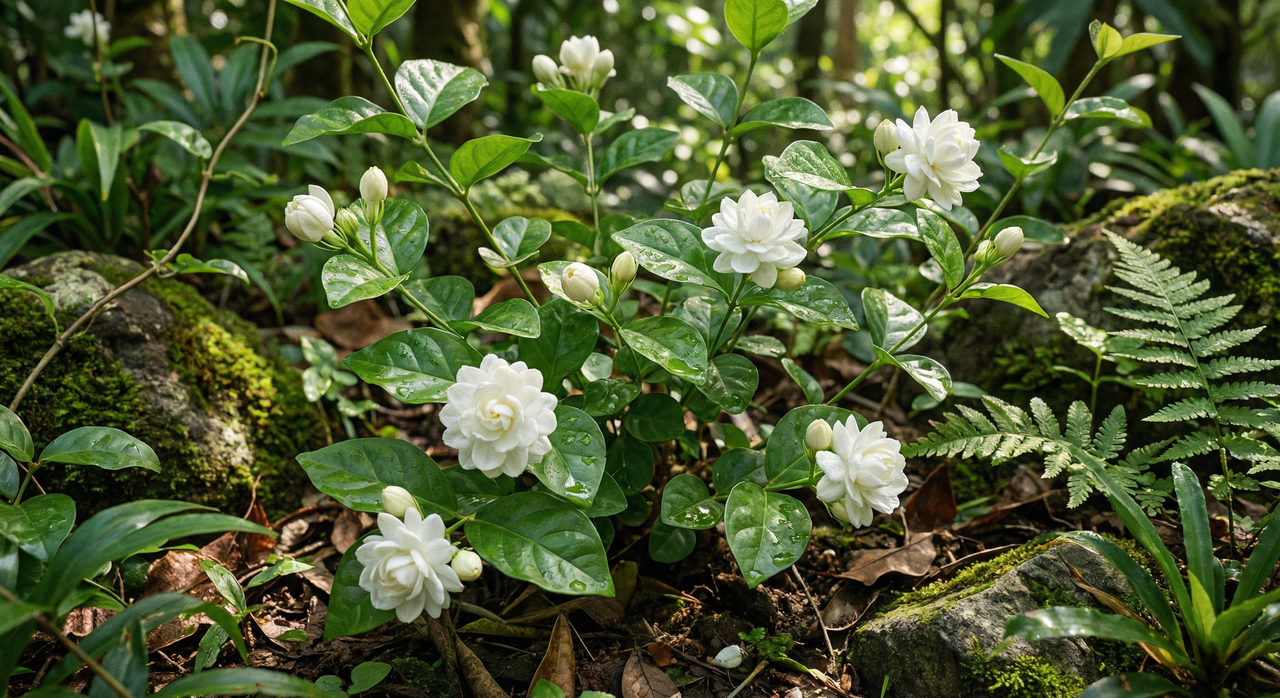
Nobody warned me that jasmine blooms on its own schedule, not mine. The first time I grew Jasminum sambac in a humid Florida summer, I kept stepping outside at noon, sniffing, and coming up empty. It wasn't until a neighbor pulled me out into her garden at dusk that I finally understood: this plant saves everything for after dark. The flowers crack open in the evening, flood the air with something almost narcotic by midnight, and by the time the sun is fully up, the scent is already retreating. Miss that window and you've missed the whole point of growing it.
That nocturnal rhythm isn't an accident or an inconvenience; it's a sophisticated ecological contract between the plant and the moths that pollinate it, shaped over millennia in the humid lowlands of South and Southeast Asia.[1] And once you understand that contract, everything else about this plant, how to grow it, when to harvest it, why it's been sacred in Hindu rituals and woven into bridal garlands from Mumbai to Manila for centuries, starts to make a different kind of sense. There's a whole world packed into that small white star-shaped flower, and most gardeners in temperate climates never quite get close enough to see it.
Jasmine Origin, History, and Cultural Significance
Botanical Background and Native Range
Jasminum sambac, the botanical name behind what most people in tropical gardens call Arabian jasmine, is native to a broad sweep of South and Southeast Asia, from India and Bangladesh through Myanmar, Thailand, Indonesia, and the Philippines, growing naturally in humid lowland forests, riverbanks, and disturbed edges from sea level up to about 1,300 meters.[2][3] That native range matters because it tells you almost everything about what the plant wants: warmth, humidity, and no frost. As an evergreen polycarpic perennial, it flowers and fruits repeatedly across its lifetime rather than burning out after one reproductive event, with a typical cultivated lifespan of five to ten years and the potential for fifteen or more under genuinely optimal conditions.[4][5] Starting from seed, expect to wait two to three years before you see a single flower; it prefers temperatures between 60 and 85°F and a slightly acidic to neutral, well-drained loamy soil in the pH 6.0 to 7.5 range.[6][7] That evergreen habit is something I genuinely appreciate in a warm-climate garden; while my temperate-zone colleagues are watching Jasminum officinale drop its leaves every autumn, sambac keeps its structure year-round. Officinale, for context, is native to the Caucasus, northern Iran, Afghanistan, and the Himalayas at elevations stretching to 3,000 meters, while Jasminum polyanthum hails from southwestern China and the eastern Himalayas at 300 to 2,500 meters, which explains why those two tolerate far colder conditions.[8][9] The genus is genuinely diverse in what it will tolerate; sambac just happens to be the tropical heart of it.
Visual Characteristics of Arabian Jasmine
Jasminum sambac grows as a shrub or scandent vine reaching roughly 0.5 to 3 meters, typically four to six feet when grown as a freestanding shrub and eight to twelve feet when trained up a support, though it's not a true vine and won't self-grip the way a climbing hydrangea does.[3][10] The leaves are dark, glossy, and leathery, opposite on the stem, ovate to rounded, typically one to four inches long; they stay evergreen in warm climates and help the plant manage moderate dry spells without drama.[3][11] The flowers are star-shaped and white, small at 0.5 to 2.5 centimeters across in single-flowered selections, though cultivars like 'Grand Duke of Tuscany' push closer to three or four centimeters with their full double blooms.[3][12] Individual flowers last only one to two days, but the plant offsets that brevity with near-continuous bloom cycles in warm conditions. It does produce small berries, 6 to 10 millimeters across, ripening from green to purplish-black, though fruit is not the point here.[3][13]
From a design perspective, that dense, glossy foliage and trainable form make this plant a genuinely useful structural element; I've used it on trellises to create fragrant courtyard screens that hold their shape and greenery even in the depths of subtropical winter. Compare that with Jasminum officinale, a deciduous twining vine to fifteen feet that goes bare in winter, or Jasminum polyanthum, an evergreen twiner that can reach twenty to thirty feet with pink buds that open white in late winter to spring.[14][15] Sambac's cultivar range gives you options for almost any vertical or hedging situation: 'Grand Duke of Tuscany' grows upright and shrubby with rose-like double flowers, 'Belle of India' has elongated petals on medium double blooms, and 'Mysore Mulli' is the vining type with single flowers and a scrambling habit.[16][17] These visual traits, the white stars against deep green, the compact moundable form, are precisely what captured human attention across so many cultures long before anyone knew what benzyl acetate was.
Traditional and Cultural Uses Across Asia and Beyond
Domestication of Jasminum sambac almost certainly began in India, where Ayurvedic texts reference it more than 2,000 years ago, and from there it traveled along ancient trade routes to the Middle East, through Southeast Asia, into China during the Tang Dynasty (618 to 907 CE), and eventually to Europe in the sixteenth and seventeenth centuries via Portuguese and Dutch traders.[18][3] Jasminum officinale, for contrast, reached Spain from Persia through the Moors in the ninth century, a different lineage crossing a different sea.[19] What's remarkable about sambac's spread is that it moved not as a curiosity but as a plant already dense with meaning.
In Hindu tradition, it holds a place among the five sacred flowers of the pancha pushpam, woven into malas for Shiva and Lakshmi at Diwali and weddings, carrying associations of purity, devotion, and love that are still alive in flower markets across South India today.[20][3] In Southeast Asia it moved into Buddhist and Taoist ceremonial life, representing impermanence and enlightenment in temple offerings. It is the national flower of both the Philippines, where it is called sampaguita and worn in hair garlands as a symbol of humility and hospitality, and Indonesia, where it appears in wedding ceremonies as a token of eternal love.[3] Jasminum officinale carries its own national honor as Pakistan's national flower, a reminder that the genus spread its symbolic weight across cultures in both directions.[19]
Medicinally, Ayurveda valued sambac for its cooling properties in treating headaches, fevers, skin conditions, and eye inflammations, while Traditional Chinese Medicine employed it to calm the mind, support digestion, and address anxiety and respiratory complaints.[21][22] Folk uses in Sri Lanka, the Philippines, Malaysia, and Vietnam extended to wound care, cough remedies, and digestive support; those traditional knowledge systems built up over centuries of observation deserve respectful framing rather than dismissal while science catches up with validation. The plant also earned its place in the Middle Eastern perfume tradition and in Hawaiian lei-making, carried there by nineteenth-century immigrants who brought it as a fragment of home.[3] Ornamentally it is now cultivated globally as a hedge, container plant, and trellis subject, and its flowers flavor jasmine teas and desserts across South and East Asian cuisines.[23]
The IUCN currently lists Jasminum sambac as Least Concern globally, but local wild populations face real pressure from commercial harvesting for essential oil and cut flowers.[24] I try to source plants from growers who use organic practices and fair labor standards; at the scale of demand this crop now sees, those choices matter.[25]
Fun Facts About Jasmine
The fragrance of Jasminum sambac is produced by a suite of volatile compounds including benzyl acetate, linalool, (E)-β-ocimene, indole, and jasmine lactone, and it peaks at night, which is why the plant has historically been so associated with evening rituals and perfumery.[26][27] I've noticed this most sharply on warm, humid evenings when the concentration of scent is almost disorienting in the best possible way; step outside on a cool dry night and the same plant barely registers. Jasminum officinale is fragrant too, but its scent is generally less intense, more subtle.[28] That intensity is precisely why Jasminum sambac became the dominant jasmine in the perfume industry of Grasse, France, and why the 'Grand Duke of Tuscany' cultivar reportedly originated there.[3][29]
One thing I'd add about 'Grand Duke of Tuscany' from my own growing experience: those big double blooms are visually spectacular, but in peak summer heat the fragrance can feel slightly muted compared to single-flowered types like 'Mysore Mulli'. The plant is frost-sensitive enough that temperatures dropping below 50°F will stress it noticeably.[4][5] For a plant that has traveled from tropical riverbanks in South Asia to garland sellers in Manila, perfumers in Grasse, and Hawaiian lei makers, that's a story of human affection doing a lot of the heavy lifting that climate alone could never manage.
Jasmine Varieties and Where to Buy Them
Notable Cultivars of Jasminum sambac and Jasminum officinale
If you're shopping for jasmine, you're really choosing between two very different plants that share a name and a perfume. Jasminum sambac, the Arabian jasmine plant, is the tropical evergreen anchor of this profile. Among its cultivars, Mysore is the one I reach for first: the fragrance is almost aggressively intense in the best possible way. Bangalore trades some of that scent for vigor and disease resistance, which matters when you're growing in humid, buggy conditions. Then there's Grand Duke of Tuscany, the showoff of the group, with its dense double blooms that look almost like tiny gardenias. I've grown it in containers on my patio and can confirm it needs noticeably more consistent humidity than the single-flowered forms; during Central Florida's dry spring spells, it sulks in ways Mysore simply doesn't.[30][31]
Jasminum officinale, common jasmine, is a different creature entirely: deciduous, considerably hardier, and structured almost entirely around horticultural cultivars rather than botanical varieties.[19][32] The selection is genuinely wide. 'Inverleith' opens pink-tinged buds to white flowers and holds an RHS Award of Garden Merit. 'Grandiflorum' delivers large, fragrant blooms. For foliage interest, 'Argenteovariegatum' brings silver-edged leaves, though I've found it grows slower and appreciates a touch more shade to look its best.[33][34] If space is limited, 'The Lillydale Spray' stays compact and works well in containers.[32] The Grand Duke name even crosses species lines: there's a 'Grand Duke of Tuscany' in officinale too, with double flowers blooming June through September and vigorous growth that usually needs staking.[35] Whatever the species, fragrance is still the thread that connects all of them.
Sourcing Jasmine Plants and Seeds
For sambac, I'd skip the big-box gamble and go straight to specialty nurseries. Logee's and Plant Delights are my usual first calls; named cultivars from those sources reliably deliver the intense scent that makes Arabian jasmine worth growing, whereas unlabeled plants at home centers can be a fragrant mystery.[36][37] Expect to pay $10-50 per plant depending on size, with peak availability in spring and summer.[38] Seeds are technically available through specialty suppliers and Etsy, but germination rates hover around 20-30% and you won't preserve cultivar traits anyway.[39] A well-rooted cutting simply pays off faster and more predictably, which the propagation section covers in detail.
Common jasmine is easier to source through conventional channels, including Home Depot, Lowe's, and seed suppliers like Sheffield's, with 1-gallon plants running $15-35 and seed packets around $5-15.[40][41] On the ecological side: sambac is not on California's invasive plant inventory or the USDA federal noxious weeds list, so I've never had concerns about it spreading beyond its welcome.[42][43] Officinale is a different story in warm climates; it's monitored for invasive potential in California and Florida, so check your state's current guidance before planting it in the ground.[42] And if you're importing plants internationally, USDA APHIS requires a phytosanitary certificate, so plan ahead.[44]
Jasmine Propagation and Planting Guide (Jasminum sambac)
I'll be honest with you about jasmine seeds: I've tried saving them from my own plants, watched them lose viability within a few months, and eventually gave up entirely. Jasminum sambac is recalcitrant, meaning its seeds are highly sensitive to desiccation and cold storage, and even under ideal conditions (20-50% moisture content held at 5-15°C) viability typically lasts only 6-12 months before crashing.[45][46][47] The seeds themselves are tiny (2-3 mm), tucked inside small black berries, and come with a hard woody coat that requires cold stratification or scarification to break dormancy.[48][49] Even fresh seed under ideal warmth and humidity germinates at wildly variable rates, anywhere from 30 to 70%.[50][51] And then there's the bigger problem: because sambac is largely outcrossing with high genetic variability, seedlings rarely resemble the parent plant in flower size, form, or habit.[52][53] If you've fallen for a named cultivar like 'Grand Duke of Tuscany' or 'Maid of Orleans,' seeds are simply not going to give you what you want.
Propagation Methods: Why Cuttings Beat Seeds
Semi-hardwood stem cuttings are where jasmine plant propagation really shines. I've rooted dozens of 'Grand Duke of Tuscany' cuttings over the years, and the results have been consistently reliable once I dialed in the timing. Taking cuttings just after the spring flush, when stems are firm but still green, consistently hits that 80-90% rooting success rate the research supports.[15][12][54] The method itself is straightforward: take 4-6 inch cuttings from non-flowering stems, dip the cut end in rooting hormone, and stick them in a perlite-peat mix. Keep humidity between 70-90% and bottom heat around 70-75°F, and you'll typically see roots in 4-6 weeks. A clear plastic bag over the pot works fine if you don't have a mist bench.
Ground or air layering is a good low-tech alternative if you have an established plant and want to guarantee success. Wound a healthy stem, apply hormone, keep the site moist, and roots generally form in 4-8 weeks during the growing season with 70-85% success.[6][55] Grafting onto a compatible Jasminum rootstock is less common for home gardeners but worth knowing about: grafted plants can produce their first significant flower harvest in as little as 6 months to 2 years, compared to the multi-year wait from seed.[56][57] Tissue culture achieves near-100% success commercially but isn't something most of us have the lab setup to attempt.[58] Regardless of method, use sterile tools and sterile media, maintain consistent moisture without letting things get soggy, and keep plants in bright indirect light with high humidity throughout the rooting period.[59][60] Cutting corners on sterility is how you end up with a tray full of rotted stems.
Soil, Site Selection, and Planting Technique
If there is one thing I'd have you walk away remembering about planting a jasmine vine or shrub, it's drainage. The root system is fibrous and relatively shallow, reaching only 12-18 inches deep, and it does not tolerate waterlogged or compacted soil.[61][11][62] That's not an accident of cultivation; in the wild, sambac grows on rocky limestone hillsides and slopes at 300-1500 m elevation, rooting into porous substrates that drain fast after monsoon rains.[63][64] Replicate that drainage in your garden by choosing a slope, raised bed, or heavily amended planting site. Work perlite or coarse sand into heavy clay soils before planting.
Soil pH matters more than most people realize. The sweet spot is 6.0-7.5, and while sambac technically tolerates a range of 5.5-8.0, anything pushing above 7.0 risks iron chlorosis: that telltale interveinal yellowing that makes leaves look washed out while blooming grinds to a halt.[61][50][65] In my early gardening years I lost several plants to alkaline irrigation water I never thought to test. Now I test both soil and water before planting any jasmine and amend with sulfur or chelated iron if needed. It's a step that takes twenty minutes and saves months of frustration. Plant at nursery-container depth in a hole at least 12-18 inches deep and wide, incorporate organic matter for fertility, and mulch the surface to retain moisture without letting it pool against the stem.[66][67] For sun exposure, aim for a minimum of 6 hours of direct light daily; afternoon shade helps in climates with brutal summer heat, but too little light means etiolated stems and sparse flowers.[68][69]
Spacing, Timing, and Aftercare at Planting
How you space jasmine depends on what you're asking it to do. For shrubs or informal hedges, 3-5 feet apart gives plants room to develop without crowding. Training star jasmine or confederate jasmine as a vine on a trellis or wall calls for a bit more generosity, 4-6 feet between plants, to accommodate their mature spread of 3-5 feet and eventual height of 6-10 feet.[70][71] I grow all of my fragrant climbers, jasmine included, with at least 4 feet between plants. In Florida's humidity, I learned the hard way that tight planting is essentially an open invitation for powdery mildew and leaf spot to move in and stay. Good airflow around the foliage is one of the most effective disease-prevention tools you have, and it costs nothing.[72][73] Spring planting, after the last frost date in your region, gives new transplants the warmth and long days they need to establish roots before summer's heat arrives. Label your plants clearly at this stage too; young jasmine can look deceptively similar to other vines before they set their first flowers.
Germination and Establishment Timeline
If you do attempt growing jasmine from seed, fresh seeds can germinate in 2-4 weeks at 70-75°F, but that's where the good news ends.[56][50] Seedlings then spend 3-5 years working toward flowering size, with no guarantee the blooms will resemble the parent. A rooted cutting can bloom the same season or the next, making the case for vegetative propagation abundantly clear.
Jasmine Care Guide: Sunlight, Watering, Feeding, and Seasonal Maintenance
I've grown both Jasminum sambac and Jasminum officinale for years, in containers and in the ground, and the plants have taught me that consistent routines matter far more than any single intervention. Get the basics right, and jasmine is genuinely generous. Push against its preferences and it'll tell you immediately, usually through yellowing leaves or a frustrating absence of buds.
Sunlight Requirements for Healthy Growth and Flowering
Arabian jasmine requires 6 to 8 hours of direct sunlight daily to flower well. The plant is not bluffing about that number. [68][12] A shadier spot will keep it alive but will cost you blooms. That said, in climates with brutal afternoon heat, some afternoon shade genuinely helps. [74] I've seen potted sambac wilt and sulk when left in direct western sun past 3 pm in summer, and a little afternoon relief made an immediate difference. Common jasmine (Jasminum officinale) can actually be more vulnerable to excess intensity; when high light combines with heat, drought, or depleted soil, it's prone to photoinhibition and leaf scorch or bleaching. [75][76] Think of it as bright but not punishing.
Watering Needs and Drought Tolerance
The rule I come back to every time is: deep, infrequent watering. Let the top inch of soil dry out between sessions, then water thoroughly so it reaches the full root zone. [68][77] About an inch per week in the growing season covers most situations. I still check the soil with my finger rather than relying on a schedule, because pot size, humidity, and season change everything. Once established, jasmine handles short dry spells reasonably well, but prolonged drought will trigger leaf drop and noticeably fewer flowers. [78][79]
Underwatering shows as wilting, crispy brown leaf edges, and bone-dry compacted soil. [68][80] Overwatering looks deceptively similar at first (wilting despite moist soil) but comes with yellowing lower leaves, leaf drop, and the telltale mushy blackened roots of root rot, especially in poorly draining soils. [81][82] The seasonal adjustment is straightforward: water regularly in spring and summer, ease off in fall, and in winter water only when the soil is completely dry. [83][84]
Fertilizing Jasmine: Soil, Nutrients, and Deficiency Signs
Before reaching for any fertilizer, test your soil. Jasmine prefers a pH of 6.0 to 7.5. [68][60] Above 7.5, micronutrient availability tanks regardless of how much you feed. I've watched new gardeners chase yellowing leaves with fertilizer when the real problem was alkaline soil locking out iron. The plant also wants fertile, well-drained loam rich in organic matter; salinity stress becomes a factor above 2.0 dS/m electrical conductivity. [68][60]
During the growing season, a balanced 10-10-10 fertilizer at half strength every four to six weeks does the job, shifting toward a phosphorus-rich formula mid-season to support bloom. [85][86][87] Withhold fertilizer in winter entirely. Always apply at half strength and water thoroughly afterward to protect roots. [60][88] Pale older leaves with stunted growth signal nitrogen deficiency; purplish young foliage with poor flowering points to phosphorus; scorched brown edges on older leaves suggest potassium. [89] Interveinal chlorosis in young leaves is usually iron deficiency triggered by high pH, correctable with chelated iron; the same pattern in older leaves is more likely magnesium, where Epsom salts help. Over-fertilizing is its own trap: lush green growth with no flowers, leaf tip burn, and salt crust on the soil surface are all signs you've pushed too hard.
Heat Tolerance and Protection Strategies
Arabian jasmine is genuinely heat-adapted, rated for USDA Zones 9a through 11b and AHS Heat Zones 8 through 12. [68][4][90] It thrives in the 60 to 85°F range [91] and can push through brief spikes to 100°F if humidity and soil moisture are adequate. [91][74] One particularly brutal summer, I watched flower buds drop off a sambac I'd placed in unrelenting afternoon sun. Chlorophyll degradation, wilting, and bud drop are the heat-stress symptoms to watch for, and the flowering stage is especially sensitive. [92][93] Adding 30 to 50% shade cloth by late morning fixed the problem almost immediately. Pair that with a 2 to 4 inch organic mulch layer, deep morning irrigation, and pruning for airflow, and you've covered all the bases. [74][94]
Frost Tolerance and Overwintering
Jasminum sambac is a true tropical and has no meaningful frost tolerance. Growth slows below 50°F, damage begins at 32°F, and anything below 28°F causes severe injury. [95] The RHS classifies it H1c, meaning it needs frost-free conditions year-round or greenhouse protection in winter. [96] Frost damage shows up as blackening leaves, wilting, stem dieback, and leaf drop. [97][98] Woody mature stems are somewhat tougher than soft growth and can handle down to about 20 to 30°F, but I wouldn't bet on it. [99][100] I've had good results overwintering potted sambac on a bright south-facing windowsill at 55 to 65°F with reduced watering and ambient humidity kept around 50%. [68] If frost is in the forecast, cover garden specimens overnight with frost cloth or burlap and mulch the base heavily. [99][101] Common jasmine handles cold considerably better, hardy to USDA Zones 7 through 10 with established plants tolerating down to 10°F with protection, which makes officinale the practical choice for anyone gardening north of Zone 9. [68][102]
Pruning, Training, and Seasonal Care Rhythm
The highest-leverage thing you can do for next season's flower count is prune right after bloom. Cut spent stems back in late summer to early fall, removing dead wood and shaping the plant while avoiding the heavy cuts that strip away next year's budding sites. [103][104][105] I cut just above an outward-facing bud and get a noticeably bushier, more floriferous plant the following year versus the leggy, sparse growth I used to get from imprecise cuts. For vining types, a trellis or other support to 6 to 10 feet lets you train lateral shoots horizontally, which consistently improves flowering along the length of the vine. Keep the soil moist and fertile, with a 2 to 3 inch layer of organic mulch around the base to conserve moisture and suppress weeds, but always kept clear of the stem to avoid rot. [103][105] Indoors, keep humidity at 50 to 70%; without it, leaves drop and growth stalls. [106]
Seasonal Rhythm and Overwintering Tips
Unlike common jasmine, which goes deciduous in cooler climates and flowers from June to September, Jasminum sambac is a true evergreen with no dormancy period in tropical conditions. [107][108][109] My own sambac slows but never fully stops in mild winters, producing the occasional flush even when I've significantly reduced water and light. Flower production is best between 60 and 85°F and drops off noticeably below 55°F. [68][12] In winter, scale back watering until the soil is fully dry before you add more, stop fertilizing entirely, and if the plant is indoors maintain at least 50% humidity to prevent the leaf drying that indoor heating causes. [68] Follow these seasonal cues and the care cycle becomes self-reinforcing: a plant that's watered, fed, and pruned correctly through the year will come into its warm-season bloom flush with the energy and structure to be genuinely spectacular.
Jasmine Harvesting: Timing, Technique, and Yield
Patience is the first skill jasmine teaches you. Jasminum sambac grown from seed typically takes 3 to 5 years to produce its first flowers, while J. officinale can range from 1 to 4 years, with first-year blooms possible under genuinely ideal conditions.[68][110] I've shortened that wait considerably by buying larger nursery specimens or working with grafted plants.[6] For anyone designing a food forest or kitchen garden, that timing distinction is worth factoring into your plant sourcing from the start.
When to Harvest Jasmine Flowers for Maximum Fragrance
Jasmine flowers undergo anthesis in the evening, opening overnight, and are typically ready for harvest 1 to 2 days later.[111] The window is narrow. Pick every 2 to 3 days during the main flush, which runs March through September for sambac in tropical conditions, or June through September for J. officinale in temperate gardens.[112][77] Go out early, after the dew has lifted but well before the heat builds, because volatile oils fade fast once temperatures climb.[112] Missing that morning window is one of the quickest ways I know to lose fragrance intensity entirely.
The flower itself tells you when it's ready. Look for buds that are 50 to 70% open, creamy white without any browning, firm and plump, with a pronounced sweet scent.[113][114] The petals should feel moist and yield gently under light pressure, similar to the supple give you look for in a freshly harvested basil flower. Skip anything wilted, browning, fully open for more than 24 hours, or still a hard green bud.[115]
How to Harvest Jasmine Flowers Without Damaging the Plant
For essential oil production, harvest at the bud stage before the flowers fully open. For tea, garlands, or general home use, wait until you see that slight color shift and around 10 to 20% of buds are showing open.[85][116] Either way, hand-pick gently, sometimes with the calyx attached depending on the intended use, and avoid crushing petals against each other in a bucket.[115] The handling is delicate, closer to chamomile than to anything you'd tug or snap.
Once picked, move quickly. I've seen a single apple left near fresh blooms during processing shorten their usable life from days to hours, because ethylene is that effective at degrading the volatiles.[117] Keep all fruit away, store harvested flowers at 50 to 59°F with some misting to extend life 2 to 5 days if needed, and process as soon as you can.[118] Commercial cut-flower operations use rapid cooling to 4 to 10°C and ethylene inhibitors for longer vase life, but at home garden scale, shade, coolness, and speed are your best tools.[119]
Expected Yield, Flavor, and Post-Harvest Handling
The payoff for precision is real. Early-morning harvests at peak bloom consistently deliver the highest fragrance and essential oil content, and the difference between a well-timed pick and one left until afternoon is dramatic enough to notice immediately in the kitchen.[120][121] Consistent picking every 2 to 3 days during flush periods also keeps yield high across the season without stressing the plant, because regular harvesting signals continued production rather than allowing the plant to shift energy toward seed set.[122] All those years of waiting for first bloom feel worthwhile the moment you bring a handful of perfectly timed flowers inside and the room shifts entirely.
Jasmine Flower Preparation, Uses, and Safety
Before anything else, the safety boundary: only the flowers of Jasminum sambac and Jasminum officinale are edible, and only when you know with certainty they haven't been sprayed.[3][123][124] Leaves, stems, berries, and seeds across the genus are toxic and can cause vomiting, diarrhea, and gastrointestinal upset. I only harvest from my own unsprayed vines or a trusted local organic source. A commercial jasmine tea I bought once turned out to contain processed stems, resulting in severe stomach upset.
Culinary Applications and Flavor Profile of Jasmine
What draws people to jasmine flowers culinarily isn't really flavor in the conventional sense. It's aroma. The blooms of Jasminum sambac carry an intensely sweet, honey-like fragrance with lily and faintly musky undertones; the actual taste is mild, floral, with subtle citrus and occasional delicate bitterness depending on how you prepare them.[125][126] That signature scent comes primarily from benzyl acetate (20-40%) and linalool (5-20%), alongside benzyl alcohol, indole, and methyl anthranilate.[127] Jasminum officinale runs even higher in benzyl acetate (40-70%), which gives it a slightly sharper, more linear character.
Cultivar matters more than most people realize. After several seasons growing Mysore, Bangalore, and Grand Duke of Tuscany side by side, I've found the Grand Duke carries a noticeably richer indole note that makes it my favorite for both morning tea and evening aromatherapy.[128] Mysore tends to be higher in benzyl acetate and produces a cleaner, sweeter scent that's lovely for syrups and desserts.
Fresh blooms deliver the most aromatic intensity, but drying reduces volatile concentrations by up to 50% while concentrating phenolics, which is useful for tea blending and storage.[129] Home-dried sambac is noticeably more subdued than commercial jasmine green tea blends, which are typically scented multiple times with fresh flowers. That layered jasmine tea tradition dates back to the Tang Dynasty, where flowers were used to scent green or black tea bases.[130] Beyond tea, the flowers appear in South and Southeast Asian cuisines in rice dishes, syrups, lassi, phirni, sticky rice, halo-halo, and candied or pickled preparations.[3][131]
Label your jasmine rows carefully. Trachelospermum jasminoides (star jasmine) and Jasminum polyanthum look plausible in a garden lineup, especially before flowering, and both are problematic if consumed.[132][133] True Jasminum sambac has opposite leaves, a vining habit, and white to pinkish flowers with 5-9 narrow petals. If it doesn't smell intensely fragrant at dusk, be skeptical.
Traditional and Modern Medicinal Preparations
The same flowers you use in the kitchen have been valued in Ayurvedic, Unani, and Southeast Asian traditional systems for centuries, employed in infusions for digestive support, aromatherapy for stress and anxiety, and treatments for headaches, colds, and skin conditions.[134][135] Standard guidance points to 1-2 teaspoons of dried flowers infused in hot water for 10-15 minutes, up to 3 cups daily, or a decoction simmered for a similar period.[136][137]
Essential oil is a different matter. Both sambac and officinale yields are very low (0.02-0.2%), which is why the oil is typically produced by solvent extraction or enfleurage rather than steam distillation.[138] I never apply jasmine absolute undiluted to skin. A 1-2% dilution in a lightweight carrier like jojoba works beautifully for a roll-on, and anything stronger risks irritation or nausea.[139] High doses can act as a uterine stimulant, so jasmine preparations are not appropriate during pregnancy or breastfeeding without medical guidance, and there are documented interactions with sedatives worth knowing about.[140]
Non-Food Uses in Perfumery, Dyes, and Permaculture
Jasmine's utility doesn't stop at the table or the medicine cabinet. The flowers yield natural dyes for textiles and craft work, while the plant's vigorous growth produces consistent biomass for mulching and composting.[141] In my own garden, spent blooms and trimmings go straight to the compost pile, closing the loop in a way that feels right for a plant this generous. In perfumery, both sambac and officinale are prized as luxury ingredients, their labor-intensive dawn harvests linking back to traditional attar production in India, Bangladesh, and Sri Lanka, where hand-picking at first light preserves the volatile compounds that make the oil so valuable.[3][142] That same harvest, when the flowers are woven into garlands or temple offerings across Hindu and Buddhist traditions, or fashioned into the leis that honor Jasminum sambac as the national flower of the Philippines, reminds me that this plant has always been worth the effort.[143]
Jasmine Health Benefits and Medicinal Uses
Long before anyone ran a cell assay on jasmine flowers, healers across Asia had already mapped this plant's therapeutic territory with considerable precision. What I find fascinating is how consistent the traditional uses are across cultures that never communicated with each other, which to me signals real plant action rather than folklore.
Traditional and Modern Medicinal Applications of Jasminum sambac
In Ayurveda, Jasminum sambac is documented in classical texts including the Charaka Samhita for pacifying Pitta dosha and addressing fevers, headaches, eye ailments, and inflammatory conditions through its cooling properties.[144] The broader Ayurvedic and Unani pharmacopoeias also describe diuretic, expectorant, antispasmodic, astringent, and wound-healing applications across the plant's different parts.[145][146] Traditional Chinese Medicine, meanwhile, directed jasmine specifically toward the respiratory system, using flower decoctions and steam inhalations for coughs, bronchitis, asthma, and sore throats.[147] Jasminum officinale extended these patterns into Turkish and Middle Eastern folk practice for wound healing and joint pain, and into European herbalism as a mild sedative and skin remedy.[148] Even Jasminum multiflorum carries its own Indian folk record, with leaf decoctions for fever and skin infections, bark preparations for rheumatism, and root extracts for joint pain.[149]
Modern pharmacology has started filling in the mechanisms behind these uses, mostly through in-vitro and animal models. The antioxidant activity is among the best characterized: jasmine's flavonoids and phenolic compounds activate the Nrf2-ARE pathway, upregulating protective enzymes like superoxide dismutase and catalase to reduce cellular oxidative damage.[150][151] Anti-inflammatory action works through NF-κB inhibition and COX-2 suppression, with leaf extracts demonstrably reducing paw edema in carrageenan-induced animal models.[152][153] The essential oil also shows meaningful antimicrobial activity against Staphylococcus aureus and Candida albicans by disrupting bacterial cell membranes and inhibiting biofilm formation.[154] For the calming effects that gardeners experience intuitively, there is now at least one randomized clinical trial showing significant anxiety reduction from jasmine aromatherapy among hemodialysis patients, with GABA receptor modulation proposed as a contributing mechanism.[155] I'd compare a fresh jasmine tisane to a mild chamomile in terms of noticeable effect: gentle, real, not sedating. A 2021 literature review points toward anticancer and neuroprotective potential via quercetin-driven apoptosis induction and acetylcholinesterase inhibition, but those findings need far more rigorous human trials before any clinical conclusions can be drawn.[156][157]
Key Phytochemicals in Jasmine Flowers and Essential Oil
The therapeutic and aromatic value of jasmine traces back to a fairly specific set of compounds. Jasminum sambac flowers contain linalool (up to 30% of the essential oil), benzyl acetate (20-50% depending on origin), and a supporting cast of flavonoids including quercetin, kaempferol, and rutin, alongside phenolic acids like gallic, caffeic, and ferulic acid, plus coumarins.[158][159] The volatile oil yield itself is modest at 0.02-0.1% by hydrodistillation, which explains why genuine jasmine absolute commands such high prices commercially.
Growing conditions shift these profiles significantly. After years of growing Jasminum sambac in my Central Florida garden, I've noticed the flowers smell noticeably richer in linalool after warm, humid days, and a 2020 field study in Pakistan found that monsoon seasons tend to increase sesquiterpene content while nitrogen-rich loam enhances ester levels.[160][161] Jasminum multiflorum offers an interesting comparison: it yields a much higher oil percentage from flowers (0.5-1.2%) dominated by benzyl acetate, and its roots contain iridoids like jasminoside with hepatoprotective potential that you simply don't find in sambac.[162] The flavonoids and volatile compounds don't just work independently; they act synergistically, which is part of why whole-flower preparations often outperform isolated fractions in bioactivity studies.[163]
Nutritional Profile of Edible Jasmine Flowers
Nutrition is not really jasmine's headline, but it's worth a clear-eyed look. The flowers are almost entirely water (85-90%), which puts caloric content somewhere around 2-5 kcal per 100g fresh.[164] They carry modest amounts of vitamin C, vitamin A, and potassium, with antioxidant activity from phenolics that dries down well, retaining 80-90% of activity in dried tea-grade flowers.[165] Think of the flowers less as a nutrient source and more as a fragrant vehicle for the phytochemicals already discussed. Standard food databases don't have reliable entries specific to Jasminum sambac, so the figures available are approximations from broader edible-flower research.[166] One boundary worth drawing clearly: edibility applies to sambac flowers only. Leaves, stems, and fruits of related species like Jasminum officinale are not considered edible and can cause irritation.[167]
Safety Considerations for Jasmine Use
The good news is that Jasminum sambac has a genuinely reassuring safety profile for most people and their pets. The ASPCA lists it as non-toxic to cats, dogs, and humans, with only mild gastrointestinal upset possible from very large ingestions of leaves or flowers due to saponin content.[124] This is worth emphasizing because the genus name "jasmine" gets applied loosely to several unrelated plants, and online searches often conflate safe sambac with genuinely hazardous species.
Essential oil is a different conversation. Early in my practice, I applied undiluted jasmine absolute to my inner wrist as a quick scent test, and within an hour I had noticeable redness and irritation. Now I always dilute to a maximum of 4% in carrier oil, which aligns with IFRA guidelines for dermal use, and I recommend a patch test regardless.[168] Acute systemic toxicity is low (LD50 above 5 g/kg in rats), but allergic contact dermatitis is a real possibility for sensitive individuals.[169]
Pregnancy deserves a direct answer: culinary use of the flowers in moderate amounts is generally considered safe, but essential oils should be avoided or used only under medical guidance due to potential uterine stimulant effects.[170] The coumarin content in the flowers also raises a theoretical interaction with anticoagulant medications, and the plant's calming properties could theoretically potentiate sedatives, though clinical evidence for both interactions remains sparse.[171] If you're on blood thinners or CNS medications, a quick conversation with your prescriber is worth more than any single herb review.
The look-alike issue is the one I take most seriously in the field. I always double-check flower structure and scent before harvesting any white-flowered vine, because Cestrum nocturnum (night-blooming jasmine) and Gelsemium sempervirens (Carolina jasmine) are both common in my region and genuinely toxic.[172][173] Proper botanical identification isn't optional here; it's the foundation that makes everything else safe.
Jasmine Pests and Diseases
A well-grown jasmine plant is genuinely not high-maintenance from a pest and disease standpoint. I've seen healthy specimens go entire seasons without a single intervention. The catch is that "well-grown" is doing a lot of work in that sentence, because the warm, humid conditions that make Jasminum sambac bloom with such intensity are exactly what fungal pathogens love too. Keep the plant stressed or the air stagnant, and the balance tips fast.
Common Pests of Arabian Jasmine
The sap-feeders are the usual suspects: aphids, spider mites, whiteflies, scale insects, and mealybugs. They cluster on new growth and leave a calling card of distorted leaves, yellow stippling, and sticky honeydew that quickly turns into sooty mold.[174][175] Spider mites in particular are sneaky. My first signal is a subtle stippling on older leaves that most gardeners miss until webbing appears, so I do a quick underleaf check every week during dry stretches when mite pressure climbs.
Jasmine isn't passive about any of this. Jasminum sambac produces volatile organic compounds including linalool and benzyl acetate, alongside saponins, flavonoids, and phenolics, and it deploys a waxy cuticle and trichomes as physical barriers. Jasmonic acid signaling coordinates these defenses and actively recruits beneficial insects like ladybugs and predatory mites.[176][177] The plant is essentially signaling for backup. Jasminum officinale takes this a step further; its essential oil runs 50-70% linalool, which functions as a genuine repellent and antifeedant against aphids and mites, though it's not immunity and stressed plants still need help.[178]
In my garden, once spacing and watering are sorted, neem oil and encouraging resident ladybug populations handles almost everything. I rarely need anything stronger.[179][174] Leaf miners occasionally show up as serpentine trails in the foliage, but they're minor and rarely warrant specific treatment when the plant is otherwise healthy.[174]
Diseases Affecting Jasminum sambac
The jasmine plant diseases you'll encounter most often are root rot (from Phytophthora, Pythium, or Fusarium), powdery mildew, leaf spot, and bacterial blight. All of them spike under high humidity, poor drainage, inadequate airflow, or less than six to eight hours of light.[180][181] Overhead watering is a fast track to disease: one humid August of watering by sprinkler in the evening and I had leaf spot spreading through a whole bed within two weeks. Now it's base watering in the morning, no exceptions.
Root rot deserves special mention because it disguises itself as a watering problem. If a jasmine suddenly wilts despite moist soil, check drainage before adding more water; soggy roots and healthy tops don't coexist for long. Yellow leaves on a jasmine plant that also looks wilted and sits in wet soil should send you straight to the roots, not the fertilizer bag. Jasminum officinale yellow leaves combined with soft, discolored roots at the crown is a root rot situation until proven otherwise.
Cultivar Resistance and Management Strategies
Not all cultivars handle disease pressure equally. Mysore and Bangalore types, with their more open single-flowered growth, dry out faster after rain and see less powdery mildew and leaf spot than denser cultivars.[182] I've watched Grand Duke of Tuscany hold moisture in its canopy long after a downpour, and that trapped humidity shows up as mildew within days. No cultivar is immune, so variety choice buys you margin, not a free pass.[183]
Pest and disease incidence rises sharply under stress from overwatering, drought, compacted soil, or temperature swings outside the plant's comfort zone.[184] A vigorous jasmine grown in full sun with good drainage simply has fewer entry points for trouble. Star jasmine (Jasminum multiflorum) reinforces this point; its moderate pest resistance and drought tolerance once established come directly from sound site selection rather than any special toughness.[185] Across the genus, the integrated approach holds: cultural practices first, then biological allies, then targeted organic treatments if needed. That sequence protects the beneficial insects the plant is already working hard to attract.
Jasmine in Permaculture Design
Jasminum sambac earns its place in a designed system not just for its fragrance but for what it actually does ecologically. Before you can use those functions, though, you have to be honest about where it will and won't grow, because planting it outside its comfort zone turns a productive guild member into a problem you're managing every winter.
Climate and Hardiness Zones for Jasminum sambac
Jasminum sambac is a zones 9-11 plant with a real intolerance of frost.[68][186] It can survive a brief dip to 20-30°F but suffers visible damage below freezing and needs protection any time temperatures fall under 50°F.[5] In the Southeast U.S., that means Florida, Louisiana, coastal Texas, and Hawaii are generally viable; northern Florida gardeners may still see dieback after a hard freeze.[12][187] Where the climate cooperates, it can flower continuously from May through September, with year-round blooming possible in reliably warm conditions.[60] It thrives in daytime temperatures between 70-80°F and nights above 59°F, tolerates summer heat up to 100°F in humid conditions, and prefers 50-70% humidity with 1000-2000 mm of annual rainfall.[69][11]
In my subtropical design work, I've found these limits manageable with the right strategy: a deep mulched root zone and a southeast-facing wall position get marginal-zone plants through most winters without moving them indoors. In genuinely cold winters, though, a container-grown specimen you can bring under cover is far less heartbreaking than losing an established shrub. What I'd caution against is treating this as a design afterthought. Zone placement should be the first question you answer, not the last.
There's also the Florida invasive status to address directly. Jasminum sambac carries a Category I invasive listing there, where its rapid growth and seed dispersal allow it to outcompete native flora.[188][68] Having watched how quickly it can spread in local landscapes, I now limit it to contained areas or choose sterile cultivars when adding it to food-forest edges in warm climates. This isn't a reason to avoid the plant, but it is a reason to be a responsible designer.
For designers in cooler zones, the genus offers real alternatives. Common jasmine (Jasminum officinale) is hardy in zones 7-10, surviving down to about -12°C with mulching and protection,[68][189][190] while pink jasmine (J. polyanthum) slots into zones 8-10 with slightly more cold exposure possible.[191] Both carry trade-offs, which the varieties section covers in more depth. The point here is that the genus has real range; matching species to site is just good design.
Ecosystem Functions and Pollination Services
The ecological story of Jasminum sambac is almost entirely a nocturnal one. Its white flowers open at dusk and release an intense nighttime fragrance peaking at 20-25°C and around 70% humidity.[192][193] That scent isn't decorative. It's a long-range signal to hawk moths and noctuid moths, which are its primary pollinators, guided in by sucrose-rich nectar produced at the base of a tubular corolla shaped precisely for visitors with long proboscises.[194]
The flower structure itself reinforces cross-pollination. Jasminum sambac exhibits herkogamy, with a wet stigma positioned above the anthers, and is largely self-incompatible, meaning it depends on insect visitors to reproduce effectively.[195][196] Honeybees do visit during the day, but they're working a flower that was designed for something else entirely. Optimal pollination happens at 20-30°C and 60-80% humidity, right in that sweet spot of a warm, humid evening.
Beyond pollination, the plant contributes in quieter ways: leaf litter supports nutrient cycling, dense growth offers habitat, the small black fruits feed birds, and its aromatic oils have documented pest-repelling properties against aphids, mosquitoes, and certain beetles.[197][68] None of these are dramatic functions on their own, but together they add up to a plant that earns its footprint.
Those functions are under real pressure, though. Neonicotinoids and other pesticides can reduce pollinator efficiency by 10-30%, while habitat fragmentation cuts pollinator diversity and effectiveness up to 40%.[198][199] Artificial night lighting disrupts moth navigation, and climate change is advancing jasmine's flowering phenology by 1.2-1.8 days per degree Celsius, risking a mismatch with peak moth abundance.[200][201] Since I stopped using neonicotinoids in my own garden, moth activity at dusk has noticeably recovered, which is one of those observable results that reinforces the science in a way no study chart quite does.
The practical design response is to actively support the nocturnal pollinator community. Pairing jasmine with other night-blooming fragrant species like Cestrum nocturnum or Phlox paniculata draws more moths to that area of the garden;[202][203] I tried this pairing with Cestrum nocturnum in a subtropical guild and the increase in moth visitation at dusk was dramatic. In low-pollinator situations, manual cross-pollination with a soft brush can fill the gap. J. officinale is worth noting here as a contrast: its protandrous flowers attract considerably more daytime activity from honeybees, bumblebees, butterflies, and hoverflies,[204][205] which gives temperate designers a genuinely different pollinator profile to work with.
Forest Layer Placement and Guild Roles
Jasminum sambac sits comfortably in the understory layer of a food forest or polyculture guild. As a multi-stemmed evergreen shrub or scandent climber reaching 1-3 m in height and spread, it's shade-tolerant enough to work beneath taller fruit trees while still flowering reliably.[3][206][207] Train it on a trellis and it becomes a vertical element; keep it pruned as a shrub and it works as a fragrant edge plant or soft boundary between zones. That flexibility is genuinely useful in tight guild designs.
The genus contrast here matters for design decisions. Related species like J. officinale can reach 3-5 m as a twining vine and J. polyanthum is similarly vigorous; both have a documented track record of smothering native vegetation in parts of the UK, California, and Florida forests.[208][209][210] Star jasmine (J. multiflorum) extends that pattern further, climbing 3-6 m and occupying understory to edge layers in South Asian moist forests.[211][212] Where J. sambac stays compact and manageable, these relatives can climb straight into canopy layers and create serious management problems if left unchecked. I think of it this way: J. sambac is a shrub that can climb; J. polyanthum is a climber that will take over if you let it. That distinction shapes everything about how you position them in a layered system.
For guild companions, I favor plants that complement the nocturnal pollination story without risking aggressive spread of their own. Keeping planting partners non-invasive and selecting cultivars carefully are the ground rules I return to every time I site a jasmine in a new design.
Why Growing Jasmine is Worth the Effort
I used to rush harvests. With jasmine, that cost me more than a few flushes before I finally understood that the window isn't just early, it's almost unreasonably brief. Now I'm out there before the dew burns off, quiet, paying attention. Honestly, that ritual matters as much to me as anything the plant produces. It's the only spot in my food forest that makes me stop moving.
Sources 212
- Floral scent chemistry of Jasminum sambac ↩
- Plants of the World Online | Kew Science ↩
- Jasminum sambac - Wikipedia ↩
- North Carolina Extension Gardener Plant Toolbox - Jasminum sambac ↩
- University of Florida IFAS Extension - Arabian Jasmine ↩
- Royal Horticultural Society - Jasminum sambac Growing Guide ↩
- University of Florida IFAS Extension: Jasmine Production Guide ↩
- Plants of the World Online | Kew Science ↩
- Plants of the World Online (Kew Gardens) – Jasminum polyanthum ↩
- Missouri Botanical Garden - Jasminum sambac ↩
- Jasminum sambac at Royal Botanic Gardens, Kew ↩
- University of Florida IFAS Extension ↩
- Flora of China - Jasminum sambac ↩
- Missouri Botanical Garden - Jasminum officinale ↩
- Missouri Botanical Garden - Jasminum polyanthum ↩
- Royal Horticultural Society - Jasminum sambac Cultivars ↩
- University of Florida IFAS Extension - Jasminum sambac ↩
- Historical Cultivation of Jasmine in Asia ↩
- Jasminum officinale - Wikipedia ↩
- Religious Symbolism of Jasmine in Hinduism ↩
- Jasminum sambac: Ethnobotanical and Pharmacological Review ↩
- Jasminum sambac in Traditional Medicine ↩
- Traditional Uses of Jasmine in Indian Culture ↩
- Jasminum sambac - IUCN Red List ↩
- Sustainable Production of Jasmine Essential Oil ↩
- Fragrance Chemistry of Jasminum sambac ↩
- Volatile Constituents of Jasminum sambac Flowers ↩
- Volatile compounds in Jasminum officinale flowers ↩
- Perfume Production in Grasse ↩
- Jasminum sambac Cultivars: Cultivation and Care ↩
- Growing Arabian Jasmine Varieties in India ↩
- RHS - Jasminum officinale cultivars ↩
- Missouri Botanical Garden Plant Finder ↩
- Common Jasmine (Jasminum officinale) - Gardenia.net ↩
- Jasminum officinale 'Grand Duke of Tuscany' ↩
- Jasminum sambac Varieties ↩
- Jasminum sambac 'Maid of Orleans' ↩
- Arabian Jasmine (Jasminum sambac) ↩
- Propagation of Jasmine Plants ↩
- Jasminum officinale ↩
- Jasmine Seeds - Jasminum officinale ↩
- Invasive Plant Inventory ↩
- Federal Noxious Weeds List ↩
- Importing Plants and Plant Products into the United States ↩
- Recalcitrant Seeds: A Status Report ↩
- Seed Storage of Recalcitrant Species ↩
- Kew Millennium Seed Bank - Recalcitrant Seeds ↩
- Flora of China: Jasminum sambac ↩
- Seed Dormancy and Germination Strategies in Oleaceae ↩
- Royal Horticultural Society: Jasmine Propagation ↩
- Germination and Storage Behavior of Jasminum Seeds ↩
- Genetic Diversity and Propagation in Jasmine ↩
- Reproductive Biology and Mating System of Jasminum officinale ↩
- How to Propagate Jasmine from Cuttings ↩
- Layering Propagation of Ornamental Vines ↩
- Jasminum sambac: Grand Duke of Tuscany Cultivation Guide ↩
- Propagation of Jasminum sambac by Grafting ↩
- Micropropagation of Jasminum Species ↩
- Propagation of Ornamental Plants: Jasmine ↩
- Propagation of Jasmine ↩
- Missouri Botanical Garden - Jasminum sambac ↩
- Jasminum sambac Cultivation Guide ↩
- Flora of China ↩
- Florida State University IFAS Extension - Jasminum sambac ↩
- Johnson & Liu (2015). Soil pH effects on ornamental woody vines. ↩
- University of Georgia Extension - Jasmine in the Home Landscape ↩
- Royal Horticultural Society (RHS): Jasminum sambac ↩
- Missouri Botanical Garden - Jasminum sambac ↩
- Royal Horticultural Society - Jasminum sambac ↩
- Arabian Jasmine (Jasminum sambac) ↩
- University of Florida IFAS Extension - Arabian Jasmine ↩
- University of Florida IFAS Extension ↩
- Missouri Botanical Garden Plant Finder ↩
- Growing Jasmine in Hot Climates ↩
- Jasminum officinale - RHS Gardening ↩
- Jasminum officinale - Kew Royal Botanic Gardens ↩
- Jasminum officinale - Plant Finder ↩
- Jasminum officinale - RHS Gardening ↩
- Jasminum officinale - Missouri Botanical Garden ↩
- RHS - Jasminum officinale Growing Guide ↩
- Jasminum officinale - Common Jasmine ↩
- Common Jasmine Plant Care ↩
- Jasminum officinale - Missouri Botanical Garden ↩
- Irrigation Guidelines for Jasminum - UC Cooperative Extension ↩
- Jasmine (Jasminum spp.) Production in Florida ↩
- Nutrient Management for Ornamental Plants: Jasmine ↩
- Effect of NPK Fertilizers on Flower Yield of Jasminum sambac ↩
- Nutrient Management for Jasmine ↩
- Identifying Nutrient Deficiencies in Ornamental Plants ↩
- AHS Plant Heat Zone Map ↩
- Jasminum sambac Care Guide ↩
- Heat Stress in Jasminum sambac: Physiological Responses and Management ↩
- Jasminum officinale (Common Jasmine) ↩
- Heat Stress Management for Vines ↩
- Jasminum sambac - Missouri Botanical Garden ↩
- Jasminum sambac - RHS Gardening ↩
- Jasminum sambac - Arabian Jasmine ↩
- Frost Damage on Tropical Plants ↩
- Jasminum sambac - Missouri Botanical Garden ↩
- Missouri Botanical Garden Plant Finder ↩
- RHS Gardening - Jasmine sambac Care Guide ↩
- Jasminum officinale - North Carolina Extension Gardener Plant Toolbox ↩
- Jasminum sambac ↩
- Pruning and Harvesting Techniques for Jasmine ↩
- Jasminum officinale ↩
- Arabian jasmine ↩
- Flora of India - Jasminum sambac ↩
- Missouri Botanical Garden Plant Finder ↩
- Royal Horticultural Society ↩
- Jasminum officinale, Common Jasmine ↩
- Jasmine Cultivation Practices ↩
- Jasminum sambac (Arabian jasmine) ↩
- Maturity Indices for Flower Crops in India ↩
- Aromatic Plants: Jasminum sambac Harvest Guidelines ↩
- Jasmine Cultivation: Harvesting Techniques ↩
- Jasmine (Jasminum sambac) Oil: Chemistry, Manufacture and Quality Aspects ↩
- Postharvest Handling of Cut Flowers ↩
- Jasmine Cultivation Guide - University of Florida IFAS Extension ↩
- Postharvest Handling of Cut Flowers ↩
- Harvesting Jasmine for Essential Oils ↩
- Cut Flower Production: Jasmine Varieties and Techniques ↩
- Jasmine Flower Harvesting Guide ↩
- Missouri Botanical Garden Plant Finder - Jasminum officinale ↩
- Toxic and Non-Toxic Plants - Jasmine ↩
- RHS Plant Finder - Jasminum sambac ↩
- Flavor Chemistry of Jasmine Flowers ↩
- Chemical Composition of Jasminum sambac Essential Oil ↩
- Comparative Analysis of Volatile Compounds in Different Cultivars of Jasminum sambac ↩
- Effect of Drying on the Volatile Constituents of Jasmine Flowers (Jasminum sambac) ↩
- Jasmine Tea History and Traditions ↩
- Culinary Uses of Jasmine in Indian and Thai Cuisine ↩
- Jasminum sambac - Missouri Botanical Garden ↩
- ASPCA Animal Poison Control - Trachelospermum jasminoides ↩
- Medicinal Uses of Jasminum sambac: A Review ↩
- Jasminum sambac in Traditional Medicine ↩
- Jasminum sambac in Traditional Medicine ↩
- Memorial Sloan Kettering Cancer Center: Herbs and Supplements - Jasmine ↩
- The Chemistry of Jasmine Essential Oil ↩
- Tisserand Institute - Essential Oil Safety: Jasmine ↩
- Drugs.com - Jasmine Uses, Benefits & Dosage ↩
- Jasminum sambac in Permaculture - Florida Extension ↩
- Traditional Uses and Sustainability of Jasmine in South Asia ↩
- Sampaguita: The National Flower of the Philippines ↩
- Jasminum sambac in Ayurveda ↩
- Ethnopharmacological Survey of Jasminum sambac in Traditional Medicine ↩
- Traditional uses of Jasminum species ↩
- Flora of China - Jasminum sambac ↩
- Jasminum officinale L. (White Jasmine): Updated Review on Its Phytochemistry, Pharmacology, and Therapeutic Applications ↩
- Medicinal Plants of India - Jasminum multiflorum ↩
- Antioxidant and Antimicrobial Properties of Jasminum sambac Extracts ↩
- Phenolic Compounds in Jasmine: Antioxidant and Anti-inflammatory Review ↩
- Anti-inflammatory effects of Jasminum sambac through NF-κB inhibition ↩
- COX-2 inhibition by leaf extracts of Jasminum sambac ↩
- Antimicrobial mechanisms of Jasminum sambac essential oils ↩
- Effect of aromatherapy with Jasminum sambac on anxiety in hemodialysis patients: A randomized clinical trial ↩
- Anticancer potential of jasmine flavonoids ↩
- Pharmacological Properties of Jasminum sambac: A Review ↩
- Phytochemical Composition and Antioxidant Activity of Jasminum sambac (Jasmine) Leaves and Flowers ↩
- Chemical Composition and Antioxidant Activity of Jasminum sambac Essential Oil ↩
- Influence of Soil and Seasonal Factors on Jasmine Oil Yield in Pakistan ↩
- Geographic Variation in Secondary Metabolites of Jasminum sambac in Southeast Asia ↩
- Essential Oil Composition of Jasminum multiflorum Flowers by GC-MS ↩
- Anti-inflammatory Constituents of Jasminum sambac Flowers ↩
- Edible Flowers: Nutritional Value and Bioactive Compounds ↩
- Nutritional Composition of Jasminum sambac ↩
- USDA FoodData Central - Search for Jasmine ↩
- Edible Flowers: Jasmine - Eat The Weeds ↩
- IFRA Standard Amendment 49: Jasmine Absolute (Sambac) ↩
- Jasminum sambac: A review on ethnopharmacology, phytochemistry and pharmacology ↩
- Essential Oil Safety Guidelines - Tisserand Institute ↩
- Updates on the Clinical Evidenced Herb-Warfarin Interactions ↩
- Cestrum nocturnum - Wikipedia ↩
- Gelsemium sempervirens ↩
- Jasmine Insect Pests - University of Florida IFAS Extension ↩
- Jasmine Pests and Diseases - UC IPM Online ↩
- Volatile Organic Compounds from Flowers of Jasminum sambac and Their Insecticidal Activity ↩
- Secondary Metabolites in Jasminum sambac: Phytochemical and Pharmacological Review ↩
- Insecticidal Properties of Jasminum officinale Essential Oil Against Stored-Product Pests ↩
- Integrated Pest Management for Jasmine ↩
- Pests and Diseases of Jasmine ↩
- Diseases of Jasmine ↩
- Disease Resistance in Jasminum sambac Cultivars ↩
- Horticulture of Arabian Jasmine in India ↩
- Jasminum sambac Care Guide ↩
- Jasminum multiflorum - Missouri Botanical Garden ↩
- University of Florida IFAS Extension - Jasmine in Florida ↩
- Arabian Jasmine in the Southeast ↩
- Invasive Plant Atlas - Arabian Jasmine ↩
- Royal Horticultural Society - Jasminum officinale ↩
- USDA Plants Database ↩
- Missouri Botanical Garden Plant Finder: Jasminum polyanthum ↩
- Pollination Biology of Jasminum sambac ↩
- Nocturnal Pollination in Jasmine Species ↩
- Pollination Biology of Jasminum sambac in Tropical Regions ↩
- Flower Biology of Jasminum sambac ↩
- Effects of Temperature on Jasmine Pollination ↩
- Ecological Role of Jasminum in Indian Flora - Botanical Survey of India ↩
- Impact of Pesticides on Floral Pollinators ↩
- Habitat Fragmentation and Plant Reproduction ↩
- Moth Pollination under Artificial Light ↩
- Impacts of Climate Change on Floral Traits in Ornamentals ↩
- Arabian Jasmine (Jasminum sambac) in the Landscape (UF/IFAS) ↩
- Pollination of Jasmine Plants ↩
- Hawkmoth Pollination in Nocturnal Flowers ↩
- Pollination Ecology of Jasmine (Jasminum spp.) ↩
- Agroforestry Species: Jasmine (Jasminum sambac) ↩
- Royal Horticultural Society - Arabian Jasmine ↩
- Missouri Botanical Garden - Jasminum officinale ↩
- Invasive Species Profile: Jasminum polyanthum ↩
- California Invasive Plant Council - Jasminum officinale ↩
- Flora of China - Jasminum multiflorum ↩
- Kew Science - Plants of the World Online ↩