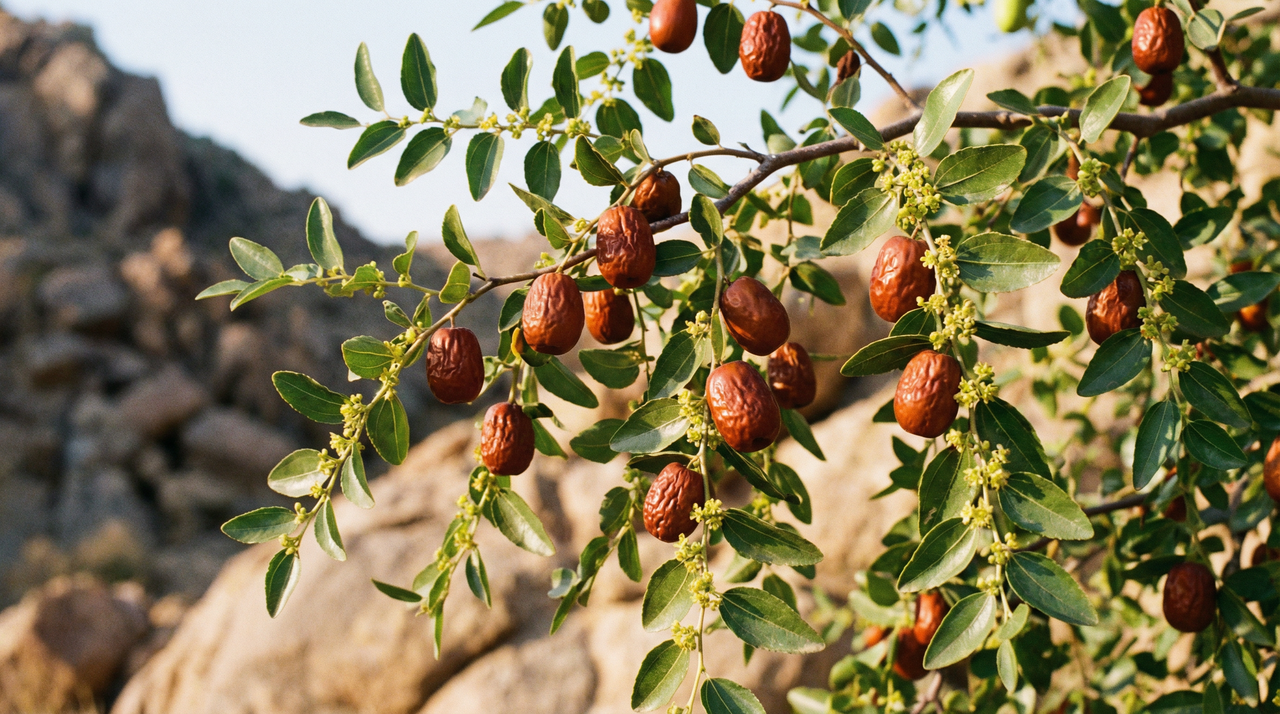
Most people who grow jujube will tell you it tastes like an apple. That's true for about three days. What they don't mention is that if you leave the fruit on the tree another week or two, the flesh starts to wrinkle, the sugars concentrate, and you're suddenly eating something closer to a honey caramel wrapped in thin mahogany skin. I've handed fresh jujubes to visitors in my food forest and watched them look genuinely confused when I offered them a dried one from the same tree, same season. They didn't believe me at first. Same fruit. Completely different food.
That shape-shifting quality is, I think, why jujube keeps getting underestimated in Western gardens. We don't have a good mental category for it. It's not quite a fresh fruit, not quite a dried fruit, not quite a medicinal herb, though it's been all three for somewhere between 4,000 and 9,000 years in China.[1] And it grows with a stubbornness that borders on indifference to neglect, thriving in alkaline soil, brutal heat, and drought conditions that would send most fruit trees into slow decline. I've seen it fruit prolifically in climates where I wouldn't have bet a nickel on it.
Once you understand what jujube actually is, not what the catalog copy says it is, you'll wonder why it's not in every food forest in the country.
Jujube Origin, History, and Botanical Background
Before I get into where jujube comes from, I want to tell you what it looks like standing in your landscape, because the first time I encountered a mature specimen I almost walked right past it. The zigzag stems with their paired thorns, the glossy serrated leaves, the way the whole canopy shimmers a little in a breeze -- it reads more like an ornamental than a fruit tree until you notice the small waxy fruits blushing red against the foliage. Once you see it, you don't forget it.
Botanical Characteristics and Visual Appeal of Jujube
Ziziphus jujuba is a deciduous small tree or large shrub, typically maturing to 15-30 feet with a canopy spread to match, though it can push 40 feet in ideal conditions and takes well to espalier training if you want to tuck it against a wall.[2][3] The young stems are what give jujube its character: slender, zigzagging between leaf nodes, armed with paired thorns where one shoots straight (up to 5 cm) and the other curves back like a hook.[4] Older wood loses most of the thorniness and develops a grayish-brown bark with a rough, corky texture that occasionally peels in strips.[5]
The leaves are small but refined, lanceolate to ovate with finely serrated margins and three prominent veins running from the base -- a feature I find oddly satisfying as an identification cue.[6] They emerge bright green in spring, settle into a deep glossy green through summer, then flip to clear yellow in autumn.[7] Clients are often surprised that a tree this drought-tough still delivers real fall color. Flowers come late spring to early summer: small, yellow-green, borne in clusters of two to five, nothing flashy but reliably attractive to pollinators.[8] Fruit follows, ripening from waxy green through red to mahogany brown over a long, staggered season.[9]
Below ground is where the real story lives. The taproot on a mature jujube can push 5-10 meters deep, with fibrous laterals spreading well beyond the canopy.[10] I've seen fruit trees planted with great fanfare in compacted clay fail in their third summer because they couldn't get roots down. Jujube doesn't have that problem. The related Christ's Thorn Jujube (Ziziphus spina-christi) shares those signature paired thorns but with even longer, more aggressive spines (up to 9 cm) and leaves that tend to stay glossier through extended heat and drought -- an indicator of even stronger arid adaptation than its temperate cousin.[11]
Native Range, Ecology, and Global Spread
Ziziphus jujuba is native to China's Yellow River valley and surrounding temperate and subtropical regions, growing naturally in woodlands, scrublands, and riverbanks across a wide swath of East and Central Asia.[12] It's a full-sun plant by nature, and its closest wild relative, Ziziphus spina-christi, extends that range further into the hot deserts of Africa, the Middle East, and South Asia -- a pioneer species tough enough to colonize open desert shrublands with less than 500 mm of annual rain.[13]
What I find reassuring from a design standpoint is the polycarpic nature of this tree: it fruits annually once established, begins bearing in just 2-4 years on grafted stock, and just keeps going.[14] A typical lifespan runs 50-100 years in productive cultivation, though some ancient Chinese specimens are documented at over 1,000 years old.[15] Visiting botanical collections and seeing old-growth jujubes up close reshaped how I think about what a "permanent" planting actually means. That's the kind of infrastructure worth building into a food forest.
Jujube reached the United States in the late 19th and early 20th century via USDA plant introductions from China, finding early traction in California.[16] Today it's cultivated in over 50 countries, with China still producing the vast majority of the global crop.[17]
Cultural Significance and Traditional Uses Across Civilizations
Few edible plants can claim a cultivation history as deep as jujube's. Neolithic archaeological evidence from Peiligang culture sites places it in the Yellow River valley 4,000-9,000 years ago, with active domestication underway roughly 4,000-5,000 years back.[18][19] It's counted among the Chinese "five fruits" alongside peach, plum, apricot, and chestnut -- a grouping that carries symbolic weight around prosperity, longevity, and good fortune, woven into Mid-Autumn and Lunar New Year celebrations and documented in classical texts including the Shijing (Book of Odes) from around 1000-600 BCE.[20]
Jujube spread along the Silk Road from China into Central Asia and the Middle East during the Han Dynasty (206 BCE-220 CE), reached Europe in the Roman era, and arrived in Korea during the Three Kingdoms period and Japan during the Nara period.[17] In Korean tradition, it carries associations with fertility and protection, appearing in weddings, ancestral rites, and traditional foods. In Traditional Chinese Medicine and Ayurvedic practice, the fruit (known as Da Zao) serves as a tonic for digestion, energy, and blood nourishment, while the seeds (Suan Zao Ren) have a long history as a sedative for insomnia and anxiety.[21] Those traditional uses will be examined more closely in the health benefits section.
The genus carries remarkable religious and cultural weight beyond Z. jujuba itself. Ziziphus spina-christi is widely held in Christian tradition to be the source of Christ's crown of thorns, cited in ancient sources from the Ebers Papyrus (~1500 BCE) through Hippocrates and Dioscorides, and identified in Islamic tradition with the Sidrat al-muntaha, the lote tree of Paradise.[22][23] I mention it here because that cultural depth gives the whole genus a richness that's worth knowing, even when our planting focus stays firmly on the edible, landscape-friendly Z. jujuba.
On the sustainability side, wild jujube populations in China have declined as much as 50% from overharvesting for food and medicine.[24] In my design work, I always recommend planting named cultivars from reputable nurseries for exactly this reason: it lets you grow the fruit you want while reducing pressure on wild populations that have already taken a hit. Cultivated orchards are genuinely part of the conservation story here, not just a commercial afterthought.
Fascinating Facts and Longevity of the Jujube Tree
Jujube's drought tolerance isn't accidental or marginal -- it's the result of layered adaptations that work in concert. The deep taproot accesses groundwater far below the reach of most other fruit trees, while thick leaf cuticles reduce transpiration and small, leathery leaves minimize the surface area losing water to the air.[25] A mature tree can persist on as little as 4-10 inches of annual rainfall, though optimal fruit production happens around 20-30 inches.[26] Z. spina-christi pushes even further into arid territory through drought-deciduous behavior and reduced stomatal conductance -- a useful comparison that shows just how wide the genus's resilience band actually runs.[27]
Pair that drought toughness with a lifespan that routinely hits 50-300 years in cultivation, and you have an argument for jujube that almost makes itself.[28][15] Commercial productivity holds strong for 30-50 years even in managed orchards.[29] I find myself using jujube as a counterargument whenever a client says they want to skip the "slow" perennials in favor of faster annuals: a single grafted tree starts fruiting in two to four years, then potentially outlives everyone who planted it, turning yellow every autumn as reliably as it drops fruit every summer. That's not a compromise. That's a legacy planting.
Jujube Varieties and Where to Buy Them
The genetic depth behind jujube is almost hard to believe until you look it up. There are over 800 cultivars in China alone, with more than 90 recognized by Kew Plants of the World Online.[30][31] For home growers and permaculture designers, that number is both thrilling and paralyzing. The good news is that a handful of cultivars have proven themselves in American conditions, and after evaluating quite a few of them for clients across warmer zones, I keep coming back to the same reliable performers.
Notable Jujube Cultivars for Home Gardens and Permaculture
The two workhorses you'll see recommended by virtually every university extension program, from NC State to Texas A&M, are 'Li' and 'Lang'.[32][33] 'Li' produces large, oval fruits with a sweet, crisp flavor that honestly reminds me of a cross between an apple and a Medjool date. Mature trees can yield up to 100 pounds of fruit, and the disease resistance is excellent.[34][35] 'Lang' fruits are a bit smaller and pear-shaped, with a sweet-tart edge that some people actually prefer, and it often ripens ahead of 'Li', which is useful for extending your harvest window.[30]
Beyond those two, the jujube variety list for US growers also includes 'Sherwood', 'GA 866', 'Sugar Cane', 'Honey Jar', and 'Chico', each with its own niche.[36] It helps to think about intended use before ordering. 'Li', 'Lang', and 'Chico' are your fresh-eating types: prioritize size, crunch, and flavor complexity. 'GA 866', 'Honey Jar', and 'Sugar Cane' lean toward intense sweetness and dry beautifully, concentrating their sugars as they mature.[34][35] Matching maturation time to your local frost dates matters more than people realize: early cultivars like 'Honey Jar' and 'Sugar Cane' ripen in 100 to 120 days, while late types such as 'Winter Delight' need 150 or more days to fully develop.[34] I've seen gardeners in shorter-season climates order a late cultivar and then wonder why it never quite finishes before frost.
For colder sites, cultivars like 'Maine', 'Contorted', and 'Russian Hardy' push cold hardiness into USDA zones 4 to 5 with some protection.[37][33] And if you're curious about related species, I'll occasionally specify a thornless 'Maltese' form of Ziziphus spina-christi for arid guild edges where thorny stems near pathways would be a problem, but that's a niche choice for warm, dry climates and a different design conversation entirely.[38]
Sourcing Jujube Trees, Seeds, and Plants in the US
Jujube is far less common in garden centers than apples or peaches, so expect to order from specialty nurseries rather than a big-box store.[2] One Green World, Raintree Nursery, and Trees of Antiquity (for certified organic stock) are my go-to recommendations. Georgia Mountain Farm, Seed Savers Exchange, Sheffield Seed Company, and Baker Creek are solid options for seeds if you want to grow rootstock or experiment with types.[39][40][41] Seed packets typically run $3 to $15, bare-root young trees $15 to $45, and container-grown specimens $30 to $70. Mature trees over five feet can reach $100 to $350.[41]
I always recommend buying grafted trees rather than seedlings. Named jujube varieties come true on grafted stock and fruit in two to three years instead of the eight to ten you'd wait with seed-grown plants. I learned that lesson the hard way early in my career with a batch of variable seedlings that fruited years late and produced fruit nothing like the cultivar description. If you're tempted to import directly from China to access more of those 800-plus types, be aware that USDA APHIS requires permits, phytosanitary certificates, and compliance with treatment protocols for any live plant material or seed.[42][43] Stick with domestic nurseries and the process is simple. And for anyone concerned about adding a new tree to their landscape: neither Ziziphus jujuba nor Ziziphus spina-christi appear on any US federal noxious weed list or the California and Florida invasive plant inventories, so you can plant with a clear conscience.[44][45]
Jujube Propagation, Planting, and Soil Requirements
Before you order a jujube tree or crack open a fruit to save seeds, there's one fundamental decision that shapes everything else: grafted tree or seedling? Getting that choice right saves years of waiting and a lot of frustration. I've watched clients plant seed-grown jujubes with high hopes, then stand in the garden six years later eating something vaguely sweet and apple-like that bears no resemblance to the 'Honey Jar' fruit that inspired them. The biology explains why, and once you understand it, you'll never approach jujube propagation the same way again.
Understanding Jujube Seeds: Polyembryony, Dormancy, and Why They Don't Grow True-to-Type
Jujube seeds are genuinely strange in the best way. Each seed is a one-seeded pyrene with 2-6 embryos packed inside, arising from both sexual and asexual origins within the same structure.[29][46] You'd think polyembryony would help preserve parent traits, but jujube's high heterozygosity works against you. Seedlings show significant variation in fruit size, flavor, and ripening time, making seed propagation essentially useless for replicating a named cultivar.[47][48] After growing both grafted 'Li' trees and seed-started seedlings side by side, I can tell you the seedling variation is real and humbling. Some produced decent fruit; others gave me something barely worth eating. Seed propagation has its place, but that place is rootstock production, not fruiting trees.
The seed itself is ellipsoid to ovoid, 8-15 mm long, with a hard woody testa that creates physical dormancy.[29][49] Without help, germination rates are poor. Scarification, either mechanical abrasion, hot water at 80-90°C held for 24 hours, or sulfuric acid treatment, pushes germination rates up to 80-90% at 25°C.[50][51] Optional cold stratification at 4°C for 30-60 days can improve those rates further. I keep a small supply of scarified seed in the refrigerator for rootstock trials, and the orthodox storage behavior of these seeds means I can maintain viability for 2-5 years (sometimes longer) when they're dried to 5-10% moisture and held in hermetic containers with desiccant.[52][53] Germination rates do vary considerably by cultivar, ranging from 30-90%, so don't assume one batch represents the species.[50]
Vegetative Propagation Methods: Grafting, Cuttings, and Layering
Grafting is how commercial production works, and for good reason. Whip-and-tongue, cleft, and T-budding onto seedling rootstocks like Ziziphus spinosa or Ziziphus mauritiana achieve 70-95% success when performed in late winter to early spring at temperatures above 15°C, ideally between 20-25°C.[51][54][55] For dryland or saline sites, Ziziphus spina-christi (Christ's Thorn) makes an excellent rootstock, achieving 60-80% cleft or whip graft success in spring while contributing superior drought and salinity tolerance to the union.[51][56]
If grafting feels like too much for a home grower, cuttings and layering are both worth trying. Semi-hardwood cuttings of 10-15 cm taken in late summer, treated with 1000-3000 ppm IBA, root at 50-80% in 4-8 weeks under high humidity (80-90%) and warm temperatures in a sand-peat mix.[57][58] Softwood in early summer and hardwood in winter are both possible, but expect lower rooting rates of 20-50% even with bottom heat. Air or ground layering in summer (July-August specifically for air layers) gives 70-80% rooting with hormone treatment during active growth.[51] Tissue culture pushes success rates to 80-95%, but the sterile lab conditions required make it practical only for large-scale nursery production.[59]
Germination Timeline and Seed Starting Techniques
The timeline difference between a grafted tree and a seed-grown one is the clearest argument for buying quality nursery stock. Grafted jujube trees typically begin bearing fruit in 2-3 years.[60][61] Seed-grown trees may produce something in 3-5 years, but full production, and whatever that variable fruit turns out to be, doesn't arrive until year 8-10.[60][61] For rootstock purposes, though, seeds are perfectly efficient. Start them indoors 8-12 weeks before last frost after scarification, at 70-85°F (21-29°C), and expect germination in 2-4 weeks under optimal conditions.[62][63] Direct sowing post-frost is possible but indoor starting gives you much more control over that germination window. For those growing in hot arid climates, Z. spina-christi seed germinates at similar temperatures and can reach first fruit in roughly 3 years from seed, making it a slightly faster option as rootstock in warm regions.[64]
Soil, Site Selection, and pH Considerations for Jujube
Drainage is the one thing I won't compromise on with jujube. The tree adapts to sandy, loamy, or clay soils, and it develops a taproot reaching up to 4.5 m once established, but poorly drained or waterlogged soil will kill it through root rot faster than almost any other stressor.[65][66][67] In heavy clay, plant on raised mounds 12-18 inches high. Minimum soil depth should be 60-90 cm, and incorporating compost into low-fertility soils to reach 2-3% organic matter will give young trees a meaningful boost.[44][68]
On pH, jujube is remarkably tolerant, surviving from 4.5 to 8.5, with optimal growth between 5.5 and 7.5.[69][70] Its origin in calcareous Asian soils explains the alkaline adaptability, but push above pH 8.0 and iron chlorosis appears, that interveinal yellowing that tells you the tree can't access the iron it needs.[69][71] I test soil pH regularly in my Central Florida projects, and when I've encountered chlorosis in high-pH soils I've had good results combining chelated iron foliar sprays with elemental sulfur amendments worked into the soil over time. Target 6.0-7.0 if you're amending; acidic soils below 5.5 want lime, alkaline soils above 7.5 want sulfur or extra organic matter. The genus breadth here is worth mentioning: Z. spina-christi thrives at pH 7.0-8.5 with taproots exceeding 5 m, illustrating just how deeply wired this genus is for marginal calcareous terrain.[72][73]
Full sun is non-negotiable. Six to eight hours of direct sunlight daily is the minimum for good fruiting, and shade doesn't just reduce yields, it increases disease pressure and weakens the overall structure.[2][74] This is a tree of open riverbanks and arid fringes, and its whole physiology reflects that. Tuck it into a shaded corner and you're working against everything the plant is built to do.
Spacing, Planting Technique, and Establishment
Standard Z. jujuba trees reach 15-25 feet in height and spread at a moderate growth rate of 12-24 inches per year, and standard orchard spacing runs 15-20 feet between trees and 20-25 feet between rows for adequate light and airflow.[75][76][2] I planted two trees at 10 feet apart early in my career, thinking I'd prune my way out of the problem. By year three I was doing serious corrective cuts that stressed both trees and cost me a season of fruit. Now I hold the 15-20 foot line even in tight gardens, because these trees are long-lived and their roots are committed. Dwarf cultivars can work at 8-10 feet, and espalier or bush forms allow 8-15 feet, but in humid climates like mine, tight spacing also invites fungal issues, so the airflow argument doubles.[75] For arid-zone growers using Z. spina-christi as a windbreak or hedge, 6.5-10 feet apart is appropriate, with orchard specimens needing 13-26 feet.[77]
Plant in early spring after last frost when soil reaches 50°F (10°C). Bare-root trees planted during dormancy establish very well; container-grown stock can go in anytime temperatures are moderate.[62][78] Dig a wide, shallow hole rather than a deep narrow one, amend with compost if your soil is genuinely poor, and ensure that drainage is perfect before you put a single root in the ground. In Zone 6 or colder, choose proven cold-hardy cultivars like 'Li', 'Lang', or 'Contorted' rather than assuming any named variety will be winter-tough.[62][78] A well-prepared site and a few extra feet of spacing are decisions you'll stop thinking about after year one. The tree will outlive most of what's planted around it, and it rewards that upfront care for decades.
Jujube Tree Care Guide and Growing Requirements
The jujube tree has a reputation as nearly indestructible, and honestly, a mature specimen earns that. But I've watched enough gardeners plant one carelessly, give it nothing, and wonder why it sulks for years before producing a handful of fruit. The difference between a tree that barely survives and one that produces heavily for decades comes down to how attentively you treat it in the first two to three years, and how smartly you maintain it after that.
Sunlight Requirements for Optimal Growth and Fruiting
Full sun is non-negotiable. Jujube needs at least six to eight hours of direct sunlight daily, and anything less cascades into problems fast: leggy, elongated stems, smaller and paler leaves, sparse canopy, and fruit yields that drop sharply.[79][2] Shade doesn't just reduce production; it fundamentally changes the tree's architecture in ways that are difficult to correct later.[80] Site selection is everything here. That said, in hot inland climates and the desert Southwest, extremely intense afternoon sun can flip from asset to liability. Young trees exposed to sustained heat above 95°F benefit from 30 to 50 percent shade cloth during peak afternoon hours, along with extra water and a good mulch layer.[81][82] Once established, the tree handles intense sun with ease.
Watering Needs: From Establishment to Drought-Tolerant Maturity
Jujube evolved across arid China, the Mediterranean, and North Africa, developing a deep taproot and impressive water-use efficiency that lets mature trees survive on as little as 200 to 500 millimeters of annual rainfall.[56] That taproot is the tree's superpower, but it takes time to build. During the first one to three years, consistent moisture is essential: one to two inches per week, applied deeply so roots are encouraged downward rather than sideways.[83][84] I now use a simple soil probe and check the top twelve inches before watering; since my trees hit year four, I've cut supplemental irrigation by more than half and the trees haven't complained once.
Once established, shift to infrequent deep soaks that wet twenty-four to thirty-six inches of soil, roughly every two to six weeks adjusted for rainfall.[79] Bump that frequency during flowering and fruit set when consistent moisture improves retention and size, then back off sharply going into dormancy. Overwatering in heavy or poorly drained soil is the most common way to kill a jujube; look for yellowing lower leaves and wilting despite wet soil as early warning signs of Phytophthora root rot.[85] Drip irrigation at the root zone, topped with two to four inches of organic mulch, keeps soil moisture even and foliage dry.[86]
Fertilizing and Nutrient Management
Before you apply anything, test your soil. Soil chemistry varies enormously by region, and since the tree tolerates such a broad baseline, guessing at fertilizer needs is a good way to create problems rather than solve them.[75][87] Retest every two to three years. The single biggest feeding mistake I see is overloading nitrogen. Excess N pushes vegetative growth at the expense of fruit, delays bearing, darkens foliage, and attracts pests. Mature bearing trees need only about half a pound to one pound of actual nitrogen per tree per year, with more emphasis on potassium for fruit size and sweetness.[35] Phosphorus supports root development and fruit set, and boron is critical for flowering; boron deficiency shows up as poor fruit set and malformed fruit.[88]
On my slightly alkaline soils in Florida, iron chlorosis (interveinal yellowing on young leaves) is the deficiency I catch most often. A single chelated-iron foliar spray in early summer consistently greens trees up within two weeks. Zinc deficiency shows as rosetting and small distorted leaves, while potassium shortfall produces marginal leaf scorch and fruit cracking.[89] For any of these, confirm with a leaf or soil analysis before spraying. Well-rotted compost or manure at five to fifteen kilograms per tree annually is my preferred base; it feeds slowly, builds soil structure, and doesn't risk the salt buildup that synthetic fertilizers can cause in poor-draining spots.[90]
Frost and Heat Tolerance
Established jujube trees are cold-hardy in USDA zones 5 to 10, handling winter lows down to −20°F during dormancy.[2] The weak points are young trees and flower buds; a late spring frost can wipe out the year's crop even when the tree itself is perfectly fine. In zone 6, I'd strongly recommend wrapping trunks with white tree guards through winter. I learned the hard way that skipping this step cost me a young tree to vole girdling one unusually cold season; the guard prevents both sunscald and rodent damage in one step.[91] Three to four inches of mulch over the root zone, plus frost cloth during hard freezes, rounds out the protection toolkit for young trees in marginal climates. By contrast, Ziziphus spina-christi is only hardy to about 20°F, suited to zones 9 to 11, which illustrates the genus's wide climatic spread but shouldn't concern most growers focused on the cold-hardy Chinese types.[92]
On the heat side, jujube is exceptional. Established trees shrug off sustained temperatures up to 115 to 120°F with minimal damage, performing best in AHS Heat Zones 7 to 10.[93] Flowering and young fruitlets are most vulnerable to extreme heat spikes; flower drop and fruit abort at sustained highs without some relief. Shade cloth, deep irrigation timing, and heat-tolerant cultivar choices like 'Li', 'Lang', or 'Honey Jar' are the practical toolkit for growers in the hottest climates.[94]
Pruning, Maintenance, and Seasonal Rhythm
Prune during dormancy in late winter to early spring, before new growth pushes. The first year I grew jujube, I let a young tree run completely unchecked and ended up with a tall, lanky specimen that shaded its own lower branches. The subsequent dormant thinning was more work than it needed to be, and it set the tree back a season. Starting right with an open-center form, selecting three to five well-spaced scaffold branches and removing competing leaders, pays off for the life of the tree.[83][95]
On mature trees, the annual task is lighter: remove dead, diseased, and crossing branches, thin for light penetration and airflow, and head back vigorous water sprouts to push energy toward fruiting spurs. Done consistently, this kind of light dormant pruning improves fruit quality and lifts yields by 20 to 30 percent while reducing the tendency toward alternate bearing.[83] If a tree has been neglected, heavier rejuvenation cuts every three to five years can bring it back into productive form.[72] Year-round, keep three to four inches of mulch over the root zone and use windbreaks or burlap to protect young trees in exposed sites during establishment.[96] Jujube is deciduous with a clear winter dormancy; new growth and flowering come in spring, and fruit ripens from late summer into autumn, giving you a long harvest window to look forward to once the tree hits its stride.[97]
Jujube Harvesting: Timing, Technique, and Flavor Transformation
When to Harvest Jujube: Ripeness Cues and Seasonal Windows
Established trees fruit reliably for decades with almost no encouragement.[98][99] From full bloom to physiological maturity runs 90-150 days, putting peak harvest in most temperate gardens somewhere between September and October.[100][101] In hotter arid climates, that window compresses; Christ's Thorn Jujube can hit maturity in as few as 70-90 days, with ripe fruit appearing as early as July.[102]
The ripeness cues you actually use in the field are color and firmness. Skin shifts from green to yellow-red and eventually to a deep mahogany red as sugars climb and flesh softens.[103][51] Ripening is rarely uniform across the whole tree, so plan on returning for multiple passes over several weeks rather than a single big harvest day. After growing several cultivars, I've learned to taste-test a few fruits from different parts of the canopy because ripeness can vary by nearly two weeks between the sun-exposed outer branches and the shadier interior.
Harvesting Jujube Fruit: Best Techniques to Avoid Damage
Hand-pick individual fruits that release easily with a gentle twist, and leave anything still firm or green for the next round.[104][105] Go out in early morning or late afternoon during dry weather; mid-day heat bruises soft ripe fruit quickly, and wet conditions invite mold.[104] Mind the thorns on most cultivars; long sleeves and slow, deliberate movements spare you scratches and protect the branch tips that carry next year's fruiting wood.
After picking, handle the fruit gently, wash and sort immediately, and set any bruised ones aside to use the same day. Bruised jujubes spoil surprisingly fast in humid summers. I lost a good portion of my first-year harvest to mold because I was too casual about sorting at the basket. For drying, sun-drying takes about 5-7 days and reduces fruit weight by 70-80%;[106][107] in Florida's humidity I prefer shade-drying to hold more of those honey aromatics. A short cure at 25-30°C for 2-3 days before full drying improves both flavor and texture.[108]
Jujube Flavor, Texture, and Yield at Different Harvest Stages
What I love about jujube is that you're essentially harvesting three different fruits from the same tree depending on when you pick. Fruit caught in the green stage is crisp, juicy, and tart, remarkably close to a young Asian pear or a slightly unripe apple.[44][109] Let it ripen fully to mahogany and the flesh turns soft, honey-sweet, and date-like; the aroma shifts from fresh green and floral notes toward caramel, honey, and something almost nutty.[110][111] Dried jujube goes further still, concentrating into a chewy, intensely sweet, caramel-flavored fruit with a mild tannic finish that lingers pleasantly.[112][113]
A mature tree yields 50-200 pounds of fruit per year, with exceptional specimens pushing past 300 pounds.[98] My own mature tree consistently gives me 80-120 pounds most seasons, enough to eat fresh, fill the dehydrator several times over, make syrup, and still send bags home with friends. For a low-input tree that largely takes care of itself, that's a serious return on a small footprint.
Jujube Preparation and Uses
Culinary Uses and Flavor of Jujube Fruit
Fresh jujube is one of those fruits that surprises people the first time they bite in. The texture is crisp, almost like a small Asian pear, and the flavor is sweet with a honey-like warmth and just enough tang to keep it interesting.[114] As fruit dries down, those sugars concentrate, the flesh turns chewy and date-like, and a subtle nuttiness emerges.[17][115] That transformation is why Chinese cooks call dried jujubes "red dates" and reach for them constantly. You can braise them with pork, stir them into congee, fold them into stuffings, simmer them into syrups, or pair them with ginger, goji berries, cinnamon, and nuts in teas and pastries.[17][116][117]
From a nutrition standpoint, fresh fruit delivers around 79 calories per 100g alongside 69 mg of vitamin C, 250 mg of potassium, and meaningful amounts of iron, calcium, and magnesium.[118][119] The flavonoid and polyphenol content adds to that picture.[120] A word of caution on unripe fruit: higher tannin levels can cause digestive upset if you eat too many before they've colored up properly, so I hold off until the skin shows that characteristic mahogany blush.[121][120] On seeds: I always remove and discard them before cooking or eating. Jujube seeds contain cyanogenic glycosides including amygdalin, which can release cyanide and must never be eaten raw.[122][123] The research is clear enough that I don't take chances.
Young leaves are worth knowing about too. They brew into a mild, caffeine-free herbal tea[124][115] that's quieter than chamomile and pleasant for an evening cup. Dry them gently to preserve that gentle character.
Medicinal Preparations and Traditional Applications
I grow jujube primarily for its culinary and ecological value, but I'd be shortchanging this plant's story by skipping its medicinal traditions entirely. For those making traditional medicinal preparations, sedative formulas for insomnia and anxiety, prepared at 9-15 g per day in decoctions; the fruit runs 20-30 g dried in similar preparations.[125][126] Seeds used medicinally must be steamed or roasted first, never raw.[122]
Korean Hanbang medicine calls the fruit Daechu and uses it in teas targeting fatigue, digestive complaints, and blood tonification.[127] Ayurvedic practitioners reach for both fruit and seeds for debility, insomnia, and Vata-pacifying nervine support, with roots occasionally applied to wounds.[128] Across Middle Eastern and historical Islamic traditions, jujube has served as a throat soother, fever treatment, and nutritive tonic.[129] The related Christ's Thorn Jujube carries its own parallel tradition in Egyptian and Arabic practice, where leaves, bark, and roots enter poultices and decoctions for wounds, fever, and hypertension.[130] I use small amounts in seasonal teas, but for anything therapeutic, I defer to qualified practitioners on dosing and interactions.
Non-Food Uses of Jujube
The wood on a mature jujube tree is genuinely impressive. It's dense and hard, the kind of material traditionally shaped into furniture, tool handles, and carvings, and it burns hot enough to be valued as firewood and charcoal.[17] As a landscape designer, I appreciate trees that earn their keep at every layer, and jujube's bark delivers too: it's tannin-rich enough to use in natural dyeing and leather tanning, and can be processed into fiber for rope.[17] Christ's Thorn Jujube extends the genus picture further still, its leaves used as fodder, its thorny habit making it a functional barrier plant, and its heat tolerance making it a xeriscape anchor in arid warm climates.[56][131] The broader genus pattern is the same: very little of this plant goes to waste.
Jujube Health Benefits and Medicinal Uses
Few plants in my collection sit at the intersection of ancient medicine and modern pharmacology quite as comfortably as jujube. This is a fruit that has been earning its place in kitchens and apothecaries for millennia, and researchers are now finding out why.
Traditional Chinese Medicine Uses of Jujube Fruit and Seeds
In Traditional Chinese Medicine, jujube does double duty depending on which part of the plant you're working with. The dried fruit, called Da Zao, enters the spleen, stomach, and heart meridians and is used to tonify the spleen, nourish blood, promote digestion, relieve constipation, and support liver function, particularly for patterns of spleen deficiency with poor appetite and fatigue.[132][133] The seeds, known as Suan Zao Ren, are a separate herb entirely, used specifically to calm the spirit, ease anxiety, reduce palpitations, and promote sleep in formulas like Suan Zao Ren Tang for heart and liver blood deficiency.[132][134]
I find this fruit-versus-seed distinction genuinely useful when talking to people about jujube, because it's a common misconception that the whole fruit handles everything. It doesn't. The fruit is your digestive tonic and daily food medicine. The seed is your nervine. Knowing the difference shapes how you harvest and prepare this plant.
Key Phytochemicals in Jujube: Flavonoids, Saponins, Polysaccharides, and Vitamin C
Jujube contains over 200 identified phytochemicals, which goes a long way toward explaining its broad range of traditional applications.[135][136] The main classes are flavonoids (quercetin, rutin, spinosin, kaempferol), triterpenoid saponins (jujubosides A and B, oleanolic acid, betulinic acid), polysaccharides that can make up 10-20% of the dry weight of the fruit, phenolic acids, tannins, alkaloids, and cyclic peptides.[137] These aren't evenly distributed: the fruit concentrates flavonoids (up to 500 mg/100g) and vitamin C, while the seeds are enriched with jujubosides and lipids, and the leaves carry meaningful saponins and alkaloids.[138][139]
What I've noticed in my own garden is that fruit harvested during a dry, hot stretch tastes noticeably more concentrated and almost resinous compared to fruit from a cooler, wetter season. Research backs this up: drought stress and arid conditions can boost phenolics by up to 30%, while cooler months also tend to increase phenolic biosynthesis.[140][141] Processing temperature matters too: drying at 50°C retains significantly more flavonoids than drying at 80°C, which is why I do my home drying low and slow.[142]
Modern Research on Jujube's Pharmacological Effects
The clinical evidence on jujube seed extract for sleep is some of the stronger human data we have for any botanical nervine. Multiple clinical trials and a systematic review and meta-analysis support its efficacy for insomnia, including a randomized, triple-blind trial specifically in postmenopausal women.[143][144][145] The mechanism is reasonably well understood: spinosin, the major flavonoid in the seeds, modulates GABA receptors and serotonin pathways to promote sleep and reduce anxiety-like behavior,[146][147] while jujuboside A works through the HPA axis and GABAergic neurotransmission and has shown neuroprotective effects in cerebral ischemia models via the central cholinergic system.[148]
Beyond sleep, jujube extracts show strong antioxidant activity through flavonoids, ascorbic acid, and activation of the Nrf2 pathway, along with anti-inflammatory effects via NF-kappaB and MAPK inhibition that reduce cytokines like TNF-alpha and IL-6.[149][150] Hepatoprotective effects have been demonstrated in rat studies, where extracts protected against CCl4-induced liver damage by enhancing antioxidant enzymes and reducing liver injury markers.[151] The pharmacological profile extends further to analgesic, antimicrobial, immunomodulatory, and wound-healing activities, and across the genus, the related Ziziphus spina-christi shows comparable anti-inflammatory, antidiabetic, and neuroprotective patterns.[152][153][154] I get excited about the preclinical breadth here, but I'm also honest about it: most of this evidence beyond sleep is still from animal and cell models. The human trials are needed, and the insomnia data remains the most clinically actionable piece right now.[155]
Nutritional Profile of Fresh and Dried Jujube
Fresh jujube sits at around 79 calories per 100g with 20g of carbohydrates, modest protein and fat, and a water content of nearly 74%.[118] The standout is vitamin C: USDA data puts it at 48-69 mg per 100g, while research literature reports up to 500 mg per 100g in some cultivars, which would put it well above oranges (roughly 53 mg) and in the neighborhood of kiwifruit.[156] The wide range reflects genuine variability by cultivar, ripeness, and growing conditions, so treat the upper bound as a best-case figure. Potassium runs around 250 mg per 100g alongside meaningful calcium, magnesium, and phosphorus.
Drying concentrates nearly everything except that vitamin C, which drops by 80-90%.[157][158] Dried jujube reaches around 350 calories with nearly 90g carbohydrates and 13.7g fiber per 100g, plus concentrated polysaccharides and phenolics that may be partially enhanced through Maillard reactions during drying. So fresh fruit is your vitamin C source; dried fruit is your fiber and polysaccharide delivery system. They're genuinely different foods, and choosing between them should depend on what you're after.
Safety Considerations and Potential Side Effects
Ripe jujube fruit has millennia of culinary use behind it and an oral LD50 greater than 10 g/kg in rats, which puts it firmly in the low-risk category for most adults.[120] Mild GI upset, dry mouth, or rare allergic reactions can occur, and high doses of saponins may cause some GI irritation, but these are uncommon at typical culinary amounts.[159]
The seeds are a different story. They contain cyanogenic glycosides that can release cyanide and present a real mechanical choking hazard given their hardness.[160] I've made it a firm habit to remove and discard seeds before drying any fruit for tea or decoctions. It's a simple step, and it's the difference between a safe daily-use herb and an avoidable risk. Commercial dried jujube typically removes seeds already, but if you're processing your own harvest, don't skip this.
For medicinal use, typical guidance suggests 1-3g dried fruit or 9-15g dried seeds daily as a decoction, with clear contraindications for pregnancy due to possible uterine stimulation, lactation, children, and those with autoimmune conditions.[161][121] If you're already taking sedatives or antidiabetic medications, the additive sedative and hypoglycemic potential of Suan Zao Ren formulas warrants a conversation with your prescriber before adding them in.
Jujube Pests and Diseases
Jujube has a well-earned reputation for toughness, and I'll be the first to say it holds up. Compared to stone fruits or apples, a well-sited jujube tree rarely needs a spray schedule to survive the season.[3][162] But "low-input" doesn't mean "invincible," and the growers who run into real trouble are usually the ones who assumed the tree would handle everything without them looking up.
Common Diseases of Jujube and How to Manage Them
The biggest determining factor in how much disease pressure your tree faces isn't the fungus itself, it's whether you've given the fungus conditions it loves. Humidity, wet weather, and poorly drained soil are the consistent culprits.[37][163] In drier climates, jujube practically manages itself. In the humid Southeast or the Pacific Northwest, you'll need to pay more attention.
The disease roster includes anthracnose (Colletotrichum spp.), which shows up as dark lesions on leaves, flowers, and fruit that spread fast in wet weather; powdery mildew (Erysiphe spp.), recognizable as the chalky white coating that reduces photosynthesis and mars fruit skin; witches' broom, a phytoplasma infection that turns branch tips into dense, disoriented twig clusters and quietly steals yield over seasons; post-harvest fruit rots from Alternaria, Botrytis, and Monilinia; Phytophthora root rot in waterlogged soils; and various rust and leaf spot fungi rounding out the list.[164][165][166] In my experience, powdery mildew appears first on the shadiest interior branches where airflow is worst. Opening up the canopy through dormant-season pruning has done more for me than any fungicide I've tried.
Cultivar selection is genuinely one of the most powerful tools here. 'Li' and 'Lang' carry better overall resistance profiles, 'Huizao' shows resistance to witches' broom specifically, 'Dongzao' handles anthracnose pressure more gracefully, and 'Linyi Zao' resists leaf spot diseases.[162][167] I've watched neighbors with witches' broom problems do a lot of unnecessary work because they planted susceptible cultivars when 'Huizao' would have made the decision for them. Where witches' broom is a known issue locally, choosing the right cultivar upfront is simply the smarter path.
Integrated management means combining good site preparation, proper spacing for airflow, sanitation by removing fallen fruit and diseased wood, and targeted applications of sulfur-based fungicides or potassium bicarbonate only when pressure actually warrants it.[163][168] The related Christ's Thorn Jujube (Ziziphus spina-christi) handles root-knot nematodes exceptionally well in arid conditions and shares moderate pathogen resistance with Z. jujuba, though both species become more vulnerable to foliar fungal diseases when moisture stays high.[169] The lesson from the whole genus is the same: drainage and airflow do most of the protective work.
Key Insect and Mite Pests of Jujube
Jujube isn't defenseless against insects. Those sharp thorns aren't just a hazard for the pruner; phenolic compounds including flavonoids and tannins, triterpenoids like betulinic acid, volatile organic compounds that draw in parasitic wasps while discouraging herbivores, mycorrhizal root associations that build plant vigor, and even the insecticidal properties of leaf extracts all contribute to why this tree handles pest pressure better than most.[170][171] I've noticed that my thornier, more vigorous 'Li' and 'Lang' trees deal with aphid and psylla pressure noticeably better than the weaker seedlings I tried early on, which tracks with what the research suggests about physical and chemical defenses working together.
That said, the pest list is long and worth knowing. Sap feeders cause the most consistent annoyance: aphids curl leaves and trigger sooty mold, scale insects and mealybugs hide under waxy coats while slowly weakening the tree. Spider mites cause stippled leaf discoloration in hot dry spells, and jujube psylla produces leaf curl especially in arid regions.[172][173] Fruit attackers are a separate category: fruit flies (Bactrocera spp.) infest ripening fruit and cause premature drop, borers tunnel into developing fruit, and thrips leave cosmetic scarring on the skin. Defoliators like leaf rollers, leaf beetles, and weevils can skeletonize young growth quickly when populations build. Underground, root-knot nematodes form galls that compromise uptake and leave the tree more vulnerable to secondary infection.[174]
Regional context matters. Fruit fly pressure concentrates in subtropical areas, while psylla problems tend to spike in arid zones.[172][175] Stress also amplifies everything; drought pushes sap-sucker populations up, excess moisture invites fungal disease, and any significant defoliation from insects opens the door to secondary problems. Your local extension office is genuinely worth a call for site-specific thresholds.
For management, cultivars like 'Li', 'Lang', and 'Zhang Qulou' show lower susceptibility to common insects, which is worth factoring into selection.[176] Beyond genetics, the IPM framework I've settled into combines well-drained, properly spaced planting (15-20 feet gives real airflow), consistent sanitation, and weekly scouting during fruit development rather than calendar spraying.[177][168] I learned to wait for actual thresholds before reaching for anything, even organic sprays, which took some patience early on. When intervention is warranted, horticultural oils handle mites and scale well, protein baits or sticky traps manage fruit flies, and preserving beneficial insects like lady beetles and parasitic wasps does more ongoing work than any spray.[178] Good drainage, I always add compost to encourage mycorrhizal associations, and those root systems stay healthy even when soil tests show some nematode presence. Most growers paying moderate attention end up with a remarkably clean tree.
Jujube in Permaculture Design
Few fruiting trees earn their place in a food forest as decisively as jujube. I've watched so many well-intentioned growers gamble on fruit trees that demand constant attention, collapse in a drought, or sulk through a cold snap, and then I point them toward this one. It's not a miracle plant, but its tolerance profile is genuinely unusual, and understanding the parameters that shape that tolerance is the first step to placing it well in any design.
Climate Adaptability and Hardiness Zones
Jujube is rated for USDA zones 5-10, with optimal fruiting typically in zones 6-9, and established trees can handle lows of -15°F to -25°F.[179][115][113] That cold hardiness improves significantly after the first three to five years, which is a detail I wish someone had told me earlier. Young trees in marginal zones need a bit of coddling; older trees shrug off cold snaps that would have finished them as juveniles.
On the warm end, jujube handles heat that would stress a peach or a citrus tree into leaf drop, tolerating temperatures well above 100°F in dry climates with equanimity.[180] Chill hour requirements are modest too, just 150-400 hours below 45°F, which puts it within reach of growers in mild-winter climates who struggle to satisfy stone fruit.[115][180] Once established, jujube can persist on as little as 4-10 inches of annual rainfall, and it only needs 20-30 inches for genuinely productive fruiting.[179][181] Compare that to a young citrus tree in a Central Florida summer, which wants water almost continuously, and you start to appreciate just how different jujube's baseline demands are.
Soil flexibility is real but not unlimited. The tree handles moderate salinity and adapts to both arid and moderately humid conditions, while maintaining broad adaptability to varying soil chemistry.[44][115][182] What it cannot abide is waterlogging; poor drainage above roughly 35 inches of annual rain invites root rot fast.[183] In humid zones, good air circulation becomes a design requirement rather than a nice-to-have. For growers in truly arid regions who want even greater drought performance, Christ's Thorn Jujube (Ziziphus spina-christi) can thrive on just 2-4 inches of annual rain[2], though it tops out at zones 8-11 and brings a more competitive character that requires a different design approach.[184]
Ecosystem Functions and Pollination
Jujube is self-fertile, which matters enormously for small-space designs where you can only fit one tree. That said, cross-pollination by honeybees and other Apidae species can boost fruit set and yield by 20-50%.[185][186] I've noticed this firsthand: the season after a neighbor positioned a hive 30 meters from my food forest, the jujube crop was visibly heavier. The flowers are small, greenish-yellow, and mildly scented, opening best at temperatures between 68-86°F with moderate humidity around 40-60%.[187][88] They're protandrous, releasing pollen before the stigma is receptive, which is another reason insect movement between trees pays dividends.
Beyond the harvest, jujube delivers genuine ecological work. Its deep, fibrous root system, reaching several meters down, stabilizes soil, improves water infiltration, and supports nutrient cycling.[188][189] During Florida's summer thunderstorms I've watched the soil directly under established jujubes hold firm while bare beds nearby erode noticeably. The tree also sequesters carbon, provides bird and insect habitat, and accumulates potassium and phosphorus as a modest dynamic accumulator.[190][191] It doesn't fix nitrogen, so plan for a nitrogen source elsewhere in the guild, but the trade-offs in every other column are favorable.
Forest Layer, Guilds, and Companion Planting
At maturity, jujube reaches 5-12 meters with a spreading, deciduous canopy.[44][192] That puts it in the middle to upper canopy of a layered food forest, somewhere between a mulberry's eventual bulk and a serviceberry's more modest footprint. It can be pruned to shrub form if space is tight, which I've done in a couple of smaller kitchen garden designs where a full-sized tree would have overwhelmed everything below. The deciduous habit means it drops its leaves in winter and lets light flood the understory at exactly the time understory plants need it most.
Guild design is where this tree becomes genuinely fun to work with. Its deep roots create minimal competition with shallow-rooted companions, and there's little evidence of meaningful allelopathy.[193] I run comfrey and yarrow directly beneath mine; they thrive in the filtered light and their root activity feeds back into the soil the jujube's own roots are building. White clover fills in as a nitrogen source since the tree doesn't bring that function itself. Insectary plantings around the drip line extend the pollinator benefits well beyond flowering season.[194][191] Space trees 3-5 meters apart to give both canopy and root systems room to develop without crowding companions into the shade.[44]
Before planting, I always check my county's invasive-species list. Ziziphus jujuba has naturalized in some disturbed areas of the southern US, so site selection and monitoring matter, particularly near natural areas.[195] Christ's Thorn Jujube, by contrast, is more competitive and more allelopathic, better suited as a thorny windbreak or boundary hedge than as a guild centerpiece.[196] In earlier, overcrowded plantings I also saw more leaf-spot pressure in humid conditions; giving each tree breathing room and keeping the canopy open has been the most reliable prevention I've found.
The Tree I Planted When I Stopped Apologizing for Difficult Sites
There's a jujube in my food forest that went into the worst corner of the property, the spot I kept skipping over because the soil was shallow, the drainage was questionable, and nothing else seemed to want it. That tree fruited in year three and hasn't stopped. I think about it every time someone tells me a site is too hard for growing food, because honestly, sometimes the most unforgiving spots just need the right plant.
Sources 196
- Jujube: A potential nutrient-dense food product - ScienceDirect ↩
- Missouri Botanical Garden - Ziziphus jujuba ↩
- USDA PLANTS Database - Ziziphus jujuba ↩
- Kew Gardens - Ziziphus jujuba ↩
- Missouri Botanical Garden - Jujube Tree Description ↩
- Flora of China ↩
- Kew - Plants of the World Online ↩
- Missouri Botanical Garden Plant Finder ↩
- Kew - Plants of the World Online ↩
- Horticulture International Journal ↩
- Kew Science - Ziziphus spina-christi ↩
- Missouri Botanical Garden - Ziziphus jujuba ↩
- Kew - Ziziphus spina-christi ↩
- Flora of China ↩
- NCBI - Ancient Jujube Trees in China ↩
- Jujube Cultivation in California - UC ANR ↩
- Jujube - Wikipedia ↩
- The Domestication History of Chinese Jujube ↩
- Archaeological Evidence for the Domestication of Jujube in China ↩
- Jujube: Botany, Horticulture, and Applications ↩
- Ziziphus jujuba in Traditional Chinese Medicine ↩
- Plants of the Bible: Ziziphus spina-christi ↩
- The Sidr Tree in Islam ↩
- Conservation Status and Sustainable Utilization of Ziziphus jujuba in China ↩
- Drought Tolerance Mechanisms in Ziziphus jujuba ↩
- Jujube: Botany, Horticulture, and Applications ↩
- Drought Tolerance in Ziziphus spina-christi ↩
- Missouri Botanical Garden - Ziziphus jujuba ↩
- Ziziphus jujuba Mill. - Jujube (USDA) ↩
- Ziziphus jujuba Mill. (jujube) | CABI Compendium ↩
- Ziziphus jujuba ↩
- Jujube Cultivars - UC ANR ↩
- Jujube - An Uncommon Fruit ↩
- NC State Extension - Jujube Production ↩
- Jujube Cultivars ↩
- Jujube (Ziziphus jujuba) Varieties for the Southern United States ↩
- Cold Hardiness of Jujube ↩
- Jujube Cultivation - UC ANR ↩
- Jujube Trees for Sale ↩
- Organic Jujube Trees ↩
- Ziziphus Jujuba - Chinese Date Seeds ↩
- Importing Plants and Plant Products into the United States ↩
- Nursery Stock Regulations ↩
- Ziziphus jujuba ↩
- Invasive Plant Inventory ↩
- Polyembryony in Ziziphus Species: Implications for Propagation ↩
- Propagation of Jujube (Ziziphus jujuba Mill.) ↩
- Jujube Production Manual ↩
- Dormancy Mechanisms in Ziziphus jujuba Seeds ↩
- Seed Germination of Ziziphus jujuba Mill. as Affected by Different Pretreatments ↩
- Propagation of Jujube (Ziziphus jujuba) ↩
- Seed Storage of Horticultural Crops ↩
- Viability and Longevity of Jujube Seeds ↩
- Jujube Production Manual ↩
- Grafting Techniques for Deciduous Fruit Trees Including Jujube ↩
- Propagation of Ziziphus Species: Compatibility and Rootstock Selection ↩
- Propagation of Jujube (Ziziphus jujuba) by Cuttings: Effects of Auxin Type and Concentration ↩
- Vegetative Propagation of Jujube Using Softwood and Semi-Hardwood Cuttings ↩
- Micropropagation of Ziziphus jujuba ↩
- Jujube Production and Propagation ↩
- Jujube Production Manual ↩
- Jujube Growing in the Florida Home Landscape ↩
- Seed Germination of Ziziphus spina-christi ↩
- Ziziphus spina-christi (L.) Desf. ↩
- UC IPM - Jujube (Ziziphus jujuba) ↩
- The Jujube Tree ↩
- Ziziphus jujuba - CABI Compendium ↩
- Jujube Cultivation Practices ↩
- Jujube: Botany, Horticulture, and Uses ↩
- Jujube Production Manual ↩
- Soil pH Effects on Nutrient Availability in Fruit Trees ↩
- Christ's Thorn Jujube - USDA Plants Database ↩
- Ziziphus spina-christi Cultivation Guide ↩
- Flora of China - Ziziphus jujuba ↩
- Jujube Production Manual - University of California Agriculture and Natural Resources ↩
- University of Florida IFAS Extension - Ziziphus jujuba ↩
- Ziziphus spina-christi Cultivation Guide ↩
- Growing Jujube Trees in the South - NC State Extension ↩
- Jujube Growing Guide ↩
- Missouri Botanical Garden Plant Finder ↩
- Leaf Scorch in Fruit Trees Under Stress ↩
- Heat Stress in Plants ↩
- Jujube Tree Care - University of Florida IFAS Extension ↩
- Missouri Botanical Garden Plant Finder - Ziziphus jujuba ↩
- Jujube Tree Care: Watering and Disease Management ↩
- Ziziphus spina-christi Care Guide ↩
- Nutrient Management for Fruit Trees ↩
- Micronutrient Deficiencies in Ziziphus jujuba ↩
- Deficiency Symptoms in Fruit Trees: Jujube ↩
- Fertilizer Burn and Salt Toxicity in Fruit Trees ↩
- Winter Protection for Fruit Trees ↩
- Ziziphus spina-christi - University of Florida IFAS Extension ↩
- Jujube Production Manual ↩
- Management of Heat Stress in Jujube Orchards ↩
- Pruning Fruit Trees: Jujube ↩
- Growing Jujube Trees ↩
- Missouri Botanical Garden Plant Finder ↩
- Jujube Fruit Production ↩
- Jujube: Choice Varieties for Zone 4 and 5 ↩
- Jujube Production in Arkansas ↩
- Jujube Production and Harvesting ↩
- Ziziphus spina-christi Profile ↩
- Jujube: Botany, Horticulture, and Applications ↩
- Ziziphus spina-christi (Christ's Thorn Jujube) ↩
- Cultivation and Harvesting of Jujube Fruits ↩
- Postharvest Technology of Ziziphus Fruits ↩
- Drying and Storage of Jujube Fruits ↩
- Christ's Thorn Jujube: Cultivation and Postharvest Management ↩
- University of Arkansas Cooperative Extension: Jujube Cultivation ↩
- Volatile Compounds and Aroma Characteristics of Seven Edible Native Jujube Cultivars ↩
- Characterization of Key Aroma Compounds in Jujube Fruit during Ripening ↩
- UC Agriculture and Natural Resources Jujube Blog ↩
- Jujube Fruit Description - Extension Services ↩
- Jujube - Wikipedia ↩
- Jujube | Missouri Botanical Garden ↩
- Jujube: Traditional Uses and Modern Research ↩
- Chinese Jujube Recipes - The Woks of Life ↩
- USDA FoodData Central - Jujube, raw ↩
- Nutrient Composition of Jujube Fruit ↩
- Ziziphus jujuba Mill. (jujube plum, ber) fruits: A review of current knowledge of fruit composition and health benefits ↩
- Jujube (Ziziphus jujuba): Safety and Side Effects ↩
- Cyanogenic Glycosides in Jujube Seeds - NCBI Study ↩
- Toxicity of Ziziphus jujuba seeds ↩
- Ziziphus jujuba / jujube / RHS ↩
- Ziziphus jujuba: A comprehensive review of botanical characteristics, traditional uses, pharmacological activities and clinical applications ↩
- Ziziphus jujuba: A Review of Traditional Uses and Pharmacological Activities ↩
- Korean Traditional Medicine and Food Uses of Jujube ↩
- Ayurvedic Uses of Ziziphus jujuba ↩
- Historical Uses of Jujube in Middle Eastern Medicine ↩
- Ziziphus spina-christi: Traditional Uses and Pharmacology ↩
- Christ's Thorn Jujube - University of Florida IFAS Extension ↩
- Ziziphus jujuba in Traditional Chinese Medicine ↩
- Medicinal Uses of Ziziphus jujuba in Traditional Chinese Medicine ↩
- Suan Zao Ren for Insomnia in TCM ↩
- Phytochemical and Pharmacological Review of Ziziphus jujuba ↩
- Chemical Constituents and Pharmacological Activities of Ziziphus Jujuba ↩
- Phytochemical and Pharmacological Properties of Ziziphus jujuba ↩
- Quantitative Analysis of Bioactive Compounds in Jujube Fruits and Leaves ↩
- Secondary Metabolites from Ziziphus jujuba: Distribution in Plant Parts ↩
- Influence of Soil Properties on Bioactive Compounds in Ziziphus jujuba ↩
- Seasonal Variation in Phenolic Content of Jujube Fruits ↩
- Effects of Drying Methods on Bioactive Compounds in Jujube ↩
- Clinical Trial: Ziziphus jujuba for Insomnia Treatment ↩
- Efficacy of aqueous extract of Ziziphus jujuba on sleep quality of postmenopausal women: a randomized, triple-blind, placebo-controlled clinical trial ↩
- Ziziphus jujuba (Zizyphi semen) for insomnia: A systematic review and meta-analysis ↩
- Spinosin, a major bioactive compound in Ziziphus jujuba, exerts sedative effects ↩
- Neuroprotective effects of flavonoids from Ziziphus jujuba ↩
- Jujuboside A protects from cerebral ischemia by regulation of the central cholinergic system ↩
- Antioxidant and Anti-inflammatory Properties of Ziziphus jujuba Extracts In Vitro ↩
- Anti-inflammatory effects of Ziziphus jujuba through NF-κB and MAPK inhibition ↩
- Hepatoprotective Effect of Ziziphus jujuba in Rats ↩
- Phytochemical and pharmacological aspects of Ziziphus spina-christi: A comprehensive review ↩
- Analgesic and Anti-inflammatory Effects of Ziziphus jujuba in Rats ↩
- Antimicrobial Activity of Ziziphus jujuba Against Pathogenic Microorganisms ↩
- Ziziphus jujuba: A Review of Its Traditional Uses, Phytochemistry, and Pharmacological Activities ↩
- Nutritional Composition of Jujube Fruit (Ziziphus jujuba): A Review ↩
- USDA FoodData Central - Jujube, dried ↩
- Effect of Drying on Bioactive Compounds in Ziziphus jujuba ↩
- Ziziphus jujuba (jujube): A review of pharmacology, toxicity, and efficacy in human health ↩
- Ziziphus jujuba: A review of current knowledge and potential applications ↩
- Memorial Sloan Kettering Botanical Safety - Chinese Date ↩
- Jujube Production Manual - UC ANR Publication ↩
- Jujube Disease Management - New Mexico State University Extension ↩
- Jujube Tree Diseases ↩
- Phytoplasma Diseases in Jujube ↩
- Phytophthora Root Rot in Jujube ↩
- Diseases and Pests of Jujube in China ↩
- UC IPM Online: Jujube Pest Management Guidelines ↩
- CABI Datasheet on Ziziphus spina-christi ↩
- Chemical Composition and Biological Activities of Ziziphus jujuba ↩
- Mycorrhizal Associations in Ziziphus jujuba ↩
- Insect Pests of Jujube (Ziziphus jujuba) in California ↩
- Insect Pests of Jujube and Their Management ↩
- Arthropod Pests of Ziziphus spp. ↩
- Pests and Diseases of Ziziphus spp. ↩
- Pest Management in Jujube Orchards: Cultivar Resistance ↩
- Integrated Pest Management for Jujube Trees ↩
- Fruit Fly Management in Orchards - USDA APHIS ↩
- University of California Agriculture - Jujube Production ↩
- Jujube Production in California ↩
- Purdue University - Jujube (Ziziphus jujuba) ↩
- North Carolina Extension Gardener - Jujube ↩
- Jujube Growing Guide - University of Florida IFAS Extension ↩
- North Carolina Extension Gardener Plant Toolbox - Ziziphus spina-christi ↩
- Jujube Pollination and Fruit Set ↩
- Insect Pollinators of Jujube ↩
- Missouri Botanical Garden - Ziziphus jujuba ↩
- Ecological Roles of Jujube Trees in Asian Ecosystems ↩
- Biodiversity and Soil Stabilization by Ziziphus Species ↩
- Ziziphus spina-christi (L.) Desf. ↩
- Permaculture Plants: Jujube ↩
- Agroforestry Systems Involving Ziziphus jujuba ↩
- Intercropping Potential of Ziziphus jujuba ↩
- Companion Planting Guide for Fruit Trees ↩
- Agroforestry Potential of Ziziphus spina-christi in Arid Lands ↩
- University of Arizona Cooperative Extension - Ziziphus spina-christi ↩
About the Author
Samiksha is a Certified Permaculture Designer and Teacher. Raised on a regenerative farm, she has over 20 years of experience learning and growing with local and indigenous communities.