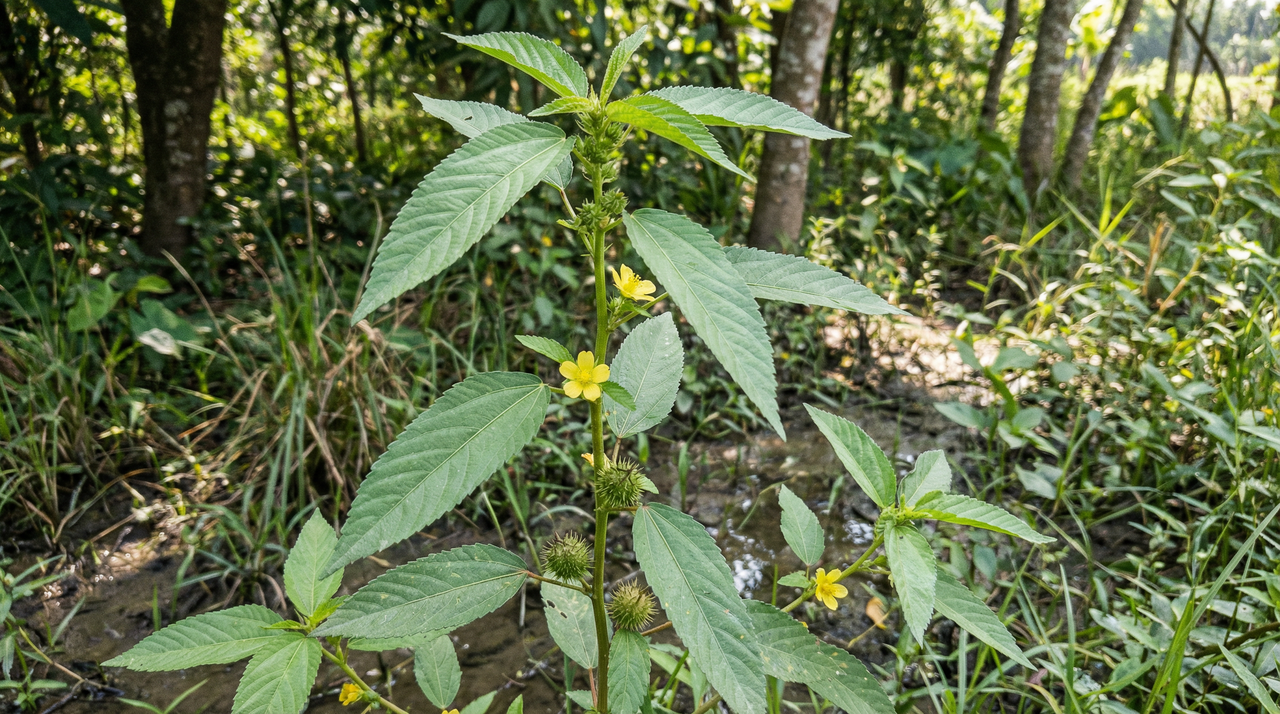
The first time I cooked jute leaves, I almost threw the whole pot out. The texture was unlike anything I'd prepared before: slick, ropy, almost gelatinous, somewhere between okra and seaweed. I'd grown a patch of Corchorus olitorius in my Central Florida garden mostly out of curiosity, harvested a big handful of the tender tops, and then stood over my stove genuinely uncertain whether I'd done something wrong. I hadn't. That slipperiness is exactly the point, and in Egypt, Nigeria, and Bangladesh it's precisely what people have been cooking toward for thousands of years.
Most people in the West don't realize that jute, the plant that made burlap sacks and gunny bags a global commodity is also a beloved leafy green with a culinary and medicinal history that runs just as deep as its fiber one. The same genus feeds families and clothes trade goods, appears in the Ebers Papyrus and in colonial-era shipping manifests, grows wild along the Nile and in managed rows across the Bengal delta. That dual life, fiber crop and kitchen staple, ancient medicine and modern geotextile, is what makes jute one of the more surprising plants I've ever brought into a food forest design.
Jute Origin, History, and Botany
Few plants have shaped tropical economies and dinner tables in equal measure. The jute plant, anchored by its primary species Corchorus capsularis, is one of those rare crops that has fed people, clothed goods, and built livelihoods across two continents for thousands of years without ever becoming a household name in the West.
Botanical Background and Native Range of Corchorus capsularis
Corchorus capsularis, the scientific name for white jute, is native to the Indian subcontinent, with its natural distribution centered on the Indo-Gangetic plains and Ganges Delta region.[1][2] It belongs to the Malvaceae family, completes its entire life cycle in a single season, and thrives in the warm, wet conditions of tropical and subtropical climates, with optimal temperatures sitting between 25 and 35°C.[3][4] What I find compelling from a systems design perspective is how perfectly its monocarpic life cycle syncs to the monsoon: it flowers once, sets seed, and dies, all within roughly 120 to 180 days from sowing.[5][6] That's a textbook fast-turnover pioneer species, exactly the kind of annual workhorse that earns its place in regenerative tropical systems.
Its African counterpart, Corchorus olitorius (tossa jute), tells a parallel origin story rooted in the tropics of Africa and Asia, with cultivation dating back roughly 6,000 years to ancient Egypt.[7] The two species are closely related and sometimes confused, and the taxonomic picture gets murkier still because C. pseudocapsularis is often treated as a synonym of C. capsularis in major databases.[8] Getting the identification right matters, especially if you're growing jute for leaves rather than fiber.
Visual Characteristics: How to Identify White Jute
C. capsularis is a striking plant in person. Stems shoot up to 2 to 4 meters within 60 to 90 days, angular and ribbed, sometimes blushing reddish at the nodes.[9][10] The leaves are simple and alternate, ovate-lanceolate with serrated margins and a noticeably pointed tip, running 5 to 15 cm long.[11][12] Small yellow flowers, just 1 to 2 cm across with orange stamens, appear in axillary clusters from June through October.[13]
The surest identification feature is the fruit capsule: globose to cylindrical, 1 to 2 cm long, with 5 to 6 longitudinal ridges, maturing to grayish-brown.[14] That rounded shape separates it immediately from C. olitorius, whose capsules are longer (4 to 8 cm) and more slender, and from C. decemangularis, which gives itself away with its distinctly ten-angled capsules.[15] When I'm trialing tropical fiber and leafy crops together in guild plantings, capsule shape and leaf margin detail are the first things I check. It's a small habit that prevents a lot of misidentification headaches later, especially once you start harvesting leaves for the kitchen.
Traditional and Cultural Uses Across Continents
Jute's cultivation history runs deep on both continents. Archaeological evidence of jute cordage at Indus Valley sites dates to roughly 2000 to 1500 BCE, with references appearing later in the Arthashastra and Buddhist texts.[16][17] Meanwhile, the Ebers Papyrus documents C. olitorius use in Egypt as far back as 2500 to 2000 BCE.[18] Two civilizations, separated by thousands of miles, independently recognized this plant's value.
On the fiber side, jute became the source of ropes, sacking, and burlap through water retting, and its economic weight in Bengal earned it the nickname "golden fiber."[19][20] But the culinary identity is just as ancient. The leaves form the foundation of major regional dishes across South Asia, North Africa, and West Africa.[21][22] I've grown C. olitorius as a summer green and the cooked leaves have that same silky, mucilaginous quality as okra, which I work with constantly in Florida gardens. Once you know that texture, it reframes the whole culinary tradition immediately. Molokhia also carries ceremonial weight in Egyptian and Sudanese weddings, funerals, and Eid celebrations, where it symbolizes abundance and communal bonds.[23]
Fun Facts and Modern Legacy of the Golden Fiber
Today, global jute production sits around 3.2 to 3.3 million tonnes annually, with India and Bangladesh supplying the overwhelming share.[24] Under good conditions, the crop yields 1.5 to 2.5 tonnes of fiber per hectare.[25] The ecological story has some genuine strengths: C. capsularis tolerates periodic flooding through aerenchyma tissue that moves oxygen into waterlogged roots,[26] and when incorporated as green manure it builds organic matter, suppresses weeds, and supports nutrient cycling.[27]
There's a real tension here, though. As a renewable fiber that sequesters carbon, jute compares favorably to synthetics. Industrial production requires 4,000 to 5,000 liters of water per kilogram of fiber, and large-scale monoculture brings its own soil-depletion pressures.[28][29] My own thinking is that rotating jute with legumes in a small-scale system can absorb a lot of that nutrient drawdown, which makes it far more defensible at garden and homestead scale than it is in industrial monoculture. The dual fiber-and-leaf role, combined with its soil-building chop-and-drop potential, still gives it a legitimate seat at the permaculture design table.
Jute Varieties and Sourcing
Notable Cultivars of Corchorus capsularis
Most of the cultivar work in jute has happened through deliberate, institution-driven breeding rather than the kind of slow folk selection you see in many traditional crops. ICAR in India, the Bangladesh Jute Research Institute, and FAO-affiliated programs have developed the commercially important Corchorus capsularis lineup specifically to push on three levers: fiber yield, disease resistance, and regional adaptability.[30][31] The result is a set of named cultivars that read like an engineering spec sheet: JRC 321 for early maturity and broad adaptability, Bidhan Pat-1 for stem rot resistance, CIN 162 for waterlogging tolerance, and a cluster of others including JRC 212, JRO 524, JRO 7835, JRC 7447, HC 95, CVL-1, and D-154, each tuned to a specific production context.[32][33] When I'm evaluating a seed packet, the first things I look for are claimed plant height and whether there's any disease language on the label. That's not arbitrary: taller, thicker-stemmed plants yield more fiber, and the correlation between plant size and usable bast output in C. capsularis is well-supported.[10] In humid subtropical conditions like Central Florida, I also prioritize stem-rot resistance because even mild fungal pressure can wipe out the bottom third of the stem, which is exactly where the best fiber sits.
Corchorus olitorius (tossa jute, or the jute mallow plant most home gardeners know as molokhia) splits into two distinct groups: tall fiber types bred for long bast fiber, and shorter, leafier cultivars selected entirely for edible greens.[15] These serve genuinely different markets, and confusing them when ordering seeds will leave you disappointed in one direction or the other. You may also encounter references to Corchorus pseudocapsularis online; it's a recognized separate species grown mainly as a leafy vegetable in India and Bangladesh, not a synonym for white jute, despite what some older sources suggest.[34] At the wild end of the genus, Corchorus decemangularis has essentially no formal breeding behind it, relying instead on local landraces adapted to African and Asian growing regions.[35]
Where to Source Jute Seeds and Plants
Commercial fiber jute production isn't happening in the US, and that's just the reality.[36] What does exist is a small but reliable niche market for home experimenters and permaculture gardeners. For C. capsularis seeds, Sheffield's Seed Company and Strictly Medicinal Seeds both carry them, and the USDA's National Plant Germplasm System is an option for research-oriented growers.[37][38] If you're after the corchorus olitorius seeds most people actually cook with, Baker Creek Heirloom Seeds, High Mowing Organic, and Taxon Seeds all sell molokhia packets in the $3-5 range for 50-100 seeds.[39][40] I've grown both from mail-order packets and the seeds arrive in good condition; germination has been strong when I've given them warm soil and moisture from the start.
One thing I learned the hard way: if you're tempted to order seeds directly from suppliers in Bangladesh or India, be aware that importing any Corchorus plant material into the US requires a USDA APHIS import permit and phytosanitary certification.[41] I now stick to US-based vendors because they've already handled the compliance side. It's not worth the regulatory headache when domestic sources are perfectly adequate for garden-scale growing.
Jute Propagation and Planting Guide
Growing jute starts with a simple decision: are you after fiber or food? That single question shapes nearly every choice that follows, from how you handle seed to how far apart you plant. Most of what you'll read about jute propagation comes from the commercial fiber world, where Bangladesh and India have refined the process over centuries, but the core principles translate well to a backyard patch or small permaculture trial bed.
Propagation Methods for Jute
Direct seeding is how virtually all Corchorus capsularis is grown, from smallholder plots in West Bengal to large commercial fields. Commercial production targets 5-7 kg of seed per hectare, sown about 2-3 cm deep during the early monsoon window in May or June.[42][43] Those timings translate to "sow when nighttime temperatures are reliably above 20°C and your rainy season is underway" for gardeners outside the subcontinent. Germination peaks between 25-30°C, with success rates of 70-90% under good moisture conditions.[44] A 12-24 hour presoak or a light fungicide treatment before sowing improves emergence and cuts damping-off losses, especially in heavier soils that stay wet.[44][45]
Seed storage is worth paying attention to if you're saving between seasons. Jute seeds are orthodox, meaning they tolerate drying down, and when held at 5-7% moisture and kept at 5-10°C in sealed containers they can stay viable for 5-10 years.[46][47] Under humid tropical ambient conditions, expect closer to 2-3 years.[46] I keep small packets vacuum-sealed in the refrigerator and have had germination stay above 80% for three full years using that method, which tracks well with the research. The related species, C. olitorius and C. pseudocapsularis, follow nearly identical seed protocols, so what works for white jute transfers across the genus.
While seed is the norm, vegetative options do exist. Stem cuttings of 10-15 cm taken from semi-hardwood or softwood growth, treated with IBA at 1000-2000 ppm, root in 20-30 days with 60-90% success in warm, humid conditions around 25-30°C.[48] In my Central Florida summer humidity, cuttings root readily in a sand-coco peat mix with occasional misting; you don't need much infrastructure. Air layering and grafting are possible but mainly show up in research contexts.[48][49] Micropropagation on MS medium achieves 70-95% success for disease-free clones, but the cost keeps it out of everyday production.[50] Most home growers will never need it, though cuttings are genuinely worth experimenting with if you want to clone a particularly vigorous plant for leaf production.
Soil and Site Requirements for Jute
Jute rewards good site preparation more than almost any other annual I grow. It prefers well-drained fertile loamy, alluvial, or sandy-loam soils with a pH between 5.5 and 7.5, with the sweet spot sitting at 6.0-7.0 and organic matter around 1.5-2.5%.[51][52] Soil compaction above 1.5 g/cm³ and waterlogging are hard limits; both will stunt or kill young plants even if every other condition is perfect. I always check drainage first. A beautifully amended bed at the right pH means nothing if water pools there after rain.
If your soil pH falls below 5.5, apply lime at 1-2 tonnes per hectare (scale that down to roughly 200-400 g per square meter for garden beds) and work it in well ahead of sowing.[53] I apply lime or sulfur at least four to six weeks before planting and re-test before I sow, the same discipline I use for brassicas, though jute tolerates a slightly broader pH window than most of my cole crops. Incorporating 5-10 tonnes per hectare of well-rotted compost or manure before planting gives the soil the organic matter and microbial activity jute needs to feed quickly once it gets growing.[53]
Full sun is non-negotiable. Jute needs 6-8 hours of direct light for vigorous growth and fiber quality; shade can cut yields by up to 50% and causes etiolation, chlorosis, and stunting.[54] I ran a shaded trial bed one summer and the difference was stark: pale, floppy seedlings with noticeably smaller leaves compared to the full-sun row two meters away. If you're siting jute in a food forest, keep it in a canopy gap or on the sunny edge where it won't be overtopped.
Spacing, Technique, and Timeline
Spacing is where the fiber-versus-leaf decision really shows up in practice. For fiber production, seed densely and thin to 10-15 cm between plants and 20-30 cm between rows, targeting roughly 250,000-300,000 plants per hectare.[53] That tight stand pushes plants to grow tall and straight with minimal branching, exactly what you want for long, quality bast fiber. For leaf production in the molokhia style, open it up considerably: 20-40 cm between plants and 30-60 cm between rows to allow air movement and make repeated harvests manageable without damaging neighboring stems.[53][55]
Under warm, moist conditions at 25-30°C, seeds germinate in 5-10 days.[56] Label your rows. Young jute seedlings have a feathery, carrot-top look that I once confused with a self-seeded volunteer in a mixed bed, and I lost track of an entire row before the plants were large enough to distinguish easily. The full cycle to fiber harvest runs 120-150 days from sowing.[56][57] If you're growing for leaves instead, the timeline compresses dramatically: edible tops from vegetable Corchorus species can be ready as early as 30-45 days after sowing, or 45-60 days from cuttings.[57] That faster return is one of the reasons I tend to grow the leafy types in my kitchen garden even when the goal isn't fiber at all.
Jute Care Guide: Growing Corchorus capsularis Successfully
Jute is not a forgiving crop if you get the fundamentals wrong, and I say that as someone who has grown it alongside okra, sweet potato, and other tropical heavyweights in Central Florida summers. Get the temperature, light, moisture, and nutrition right, and you'll be rewarded with impressively fast biomass in a single season. Miss any one of them badly enough, and the plant just stalls. Once you understand what it actually needs, the management logic is pretty straightforward.
Sunlight Requirements
Jute wants full, unobstructed sun for at least 6 to 8 hours a day, and it means it.[51] Even partial afternoon shade noticeably softens the stems and washes out the leaf color in my garden. The research backs that up with a harder number: shade can cut fiber yield by up to 50%.[51] Site your plants in the most open, sunny spot you have. The one caveat is that full sun combined with temperatures above 38°C can tip into stress territory, but that's a heat-management question I'll get to below, not a reason to shade the planting unnecessarily.
Water Needs and Irrigation
The crop needs 500 to 1000 mm of water across its 120 to 150 day cycle, and the demand isn't constant.[53][58] Young seedlings are relatively light drinkers at 25 to 50 mm per week, the vegetative stage ramps that up to 100 to 150 mm, and flowering drops back to 50 to 100 mm.[53][59] The goal is to keep soil at 60 to 80% field capacity, which in practice means irrigating every 7 to 10 days in a typical season.
Both extremes will hurt you. Drought causes wilting, yellowing, and premature flowering with 20 to 40% yield loss; waterlogging causes root rot and yellowing with losses of 20 to 50%.[53][60] I've found that a drip system paired with 8 to 10 cm of organic mulch is the most reliable way to keep moisture steady without sitting water at the roots. The mulch alone cuts evaporative loss substantially and makes a real difference during Florida's unpredictable dry spells within the wet season. One thing to watch: irrigation water with an EC above 2 to 4 dS/m will impair both growth and fiber quality, so if you're in an area with saline water, test before you irrigate.[58]
Soil, Fertility, and Feeding
Jute grows best in well-drained loamy or alluvial soils with a pH between 6.0 and 7.0, though it tolerates a broader 5.5 to 7.5 range.[61][62] I always amend my beds with generous compost before planting because the nitrogen demand alone will strip even decent Florida soils fast. Commercial guidance calls for 5 to 30 tonnes per hectare of well-decomposed farmyard manure or compost worked in before sowing.[63]
For fertilization, think in a roughly 2:1:1 NPK ratio: 80 to 120 kg N, 40 to 60 kg P₂O₅, and 40 to 60 kg K₂O per hectare.[53][64] Apply all the phosphorus and potassium at planting, then split the nitrogen: a portion at planting, another at 30 to 35 days, and often a third at 60 days.[53][65] After a few seasons I've learned to hit that 30-day top-dress without missing it, because if I do, I start seeing chlorosis creep up from the older leaf tips within days. If your lower leaves are yellowing from the tips inward, that's a nitrogen deficiency signal and you want to respond quickly because the stunting compounds fast.[66] Marginal scorch on older leaves with weak stems points to potassium; interveinal chlorosis on young leaves suggests iron; a rosetting pattern with small leaflets indicates zinc.[67] Overfeed nitrogen and you'll see the opposite problem: dark, succulent leaves, reduced fiber quality, and potential induced micronutrient deficiencies.[66]
Temperature, Heat, and Frost Tolerance
This is the hard filter. Jute cannot survive frost. Temperatures below 10°C (50°F) cause wilting, browning, and tissue death, with seedlings and young stems being the most vulnerable; prolonged exposure below 5 to 10°C injures vascular tissue even in older plants.[68][69] I compare it to basil or okra for gardeners trying to calibrate, because all three check out at roughly the same threshold. The RHS rates it H1c (tender), and USDA hardiness zones 9 to 11 are the practical growing range.[70][71] In zone 9B, I treat it as a warm-season annual and don't put seeds in the ground until nighttime lows are reliably above 15°C and soil temperatures have climbed past 21°C.[72] Outside zones 9 to 11, row covers or container culture that can move indoors are your main tools for extending the window on either end of the season.[70]
Heat Tolerance and Management
Optimal growth happens between 24 and 37°C with humidity in the 70 to 90% range, putting it squarely in AHS Heat Zones 10 to 12.[73] Push past 35 to 40°C and the problems stack up: seedling mortality rises, photosynthesis slows during the vegetative stage, and at flowering you get pollen sterility and flower abortion that can slash yield by 20 to 50%.[74][75] Since I started running 30% shade cloth during peak Florida summer afternoons, that flower drop problem has essentially disappeared for me. Research supports it: a 20 to 50% shade cloth can cool the canopy by 3 to 5°C.[76] Pair that with heavy mulch and early-morning drip irrigation timed before the heat builds, and you can maintain productive growth even through the worst of the summer.[77]
Pruning, Maintenance, and Seasonal Rhythm
How you prune depends entirely on what you're growing for. For fiber production, remove side shoots and lower leaves two or three times during vegetative growth, starting at 30 to 45 days after sowing; this channels energy into tall, straight stems and improves fiber length and quality by 15 to 20%.[78] My fiber rows get that treatment religiously because a branchy plant makes a mess of retting and shortens usable fiber length. For leafy production following a molokhia model, the approach flips entirely: pinch the growing tip at 30 to 50 cm height and then harvest the top 10 to 20 cm every 7 to 14 days to keep the plant branching and productive.[58] Same genus, opposite technique.
Seasonally, the traditional monsoon calendar runs sowing from April to June, peak vegetative growth through the rainy season, flowering in July to August, and fiber harvest at 100 to 120 days when early flowers appear.[79][57] In the American South, the logic mirrors that pattern: sow after last frost and harvest the fiber well before any risk of early cool nights. The full cycle runs 90 to 150 days depending on your goal, which makes calendar timing the last, non-negotiable piece of the puzzle.
When and How to Harvest Jute
Timing and Maturity Indicators for Fiber and Leaves
For fiber growers, the harvest window for Corchorus capsularis is genuinely non-negotiable. The sweet spot arrives 90-120 days after sowing, once plants hit 2-3 m tall and roughly 5-10% have developed flower buds but before full flowering or pod formation.[80][81][82] Visual cues confirm what the calendar suggests: 80-90% leaf drop, yellowing lower leaves, slight browning at the stem base, and a stem diameter around 1.5-2.5 cm. I've found that waiting even a week past those first visible buds coarsens the bast fibers noticeably; stems that test-ret cleanly and separate easily are ready, and ones that don't yet separate are worth a few more days. In South Asia, where most commercial production occurs, this timing typically lands in August-September for April-May sowings in Bangladesh and West Bengal; growers in Myanmar, Thailand, or China's Yunnan province work a shifted window of July-October depending on monsoon timing and elevation.[83][84]
The edible-leaf pathway runs on a completely different clock. In my Central Florida landscape I grow C. olitorius as a fast summer hedge, and the first harvestable tops appear as early as 30-50 days after sowing.[58][72] Harvest every 15-20 days and the plants just keep pushing new growth all season, giving you a continuous supply of tender greens while still leaving the option of a final fiber cut from the main stems. C. decemangularis responds the same way; even C. capsularis can donate leaves, though fiber stays its primary purpose.[85]
Harvesting Techniques and Post-Harvest Handling
Fiber stems get cut close to the ground with a sickle, bundled immediately, and moved out of the field before conditions turn.[80][81] Early morning or late afternoon are the preferred windows; cutting in rain invites rot before retting even begins. What you're actually after is the bast layer, the phloem just inside the outer stem, and its quality depends entirely on how quickly you move from cut to retting tank.[86][87] Delay softens the fiber's reputation for strength before it's ever used.
For leafy harvests, the same sickle or a pair of pruning shears works perfectly. Snip the top 10-15 cm of tender stems, leaving lower leaves and buds intact to encourage branching and the next flush of growth.[88][89] I use the same tool I'd reach for when topping basil; the logic is identical.
Expected Yield, Storage, and Quality Factors
Properly dried jute fiber stores for 6-12 months if kept cool (10-20°C), dry (45-60% relative humidity), and dark with good airflow; moisture above 12-14% is where microbial trouble starts.[90][91] I hang dried bundles in breathable mesh bags in a shaded shed rather than stacking them; the airflow keeps that musty smell from developing, which is your first sign humidity has crept too high. When fiber stripped from stems at the right moment feels silky and strong rather than stiff and rough, you know the timing was good.
Fresh jute leaves are far more perishable. Refrigerate them quickly at 0-5°C and 90-95% relative humidity and you'll get 7-10 days of usable life.[92] Harvest young leaves and that short window matters less because you're more likely to use them immediately anyway. Young leaves also carry the pleasant mucilaginous quality that makes molokhia worth cooking; over-mature leaves turn stringy and noticeably bitter, a trade-off that's impossible to fix in the kitchen.[93][94] Whether you're growing for fiber or for the table, the harvest decision made in the field is the one that determines what you actually end up with.
Jute Preparation and Uses
Culinary Uses of Jute Leaves
Most people who grow jute for fiber discover somewhere around the second week that the thinnings make excellent eating. The young leaves and tender stems of Corchorus capsularis are the edible parts worth knowing, and younger is always better: once the plant matures, leaves toughen and the bitterness intensifies enough to become a real obstacle rather than a nuance. Flavor-wise, expect something mildly earthy and slightly bitter with that unmistakable mucilaginous pull that so closely resembles okra.[95] And yes, the sliminess threw me off completely the first time. What changed everything was treating it the way I treat okra: garlic, lentils, a generous squeeze of lemon, and suddenly the texture became the point of the dish rather than the problem.
The mucilaginous polysaccharides released during cooking are genuinely useful as a natural thickener in soups and stews, a quality that cooks across South Asia, West Africa, and the Middle East have relied on for centuries.[96] In Bangladesh and India, leaves appear in pat shak stir-fries and curries. In Egypt, C. olitorius becomes molokhia soup, and in Nigeria the same leaf type becomes ewedu.[97][98] C. olitorius tends toward a nuttier, more umami-forward flavor, while C. decemangularis runs milder still with a faint citrus-grassy note after a good 20-60 minutes of cooking.[99]
Cooking does more than tame the flavor. Raw leaves carry volatile compounds like hexanal and linalool that contribute grassy, green aromas; heat knocks these back by 30-50 percent and opens up spinach-like and nutty notes instead.[100] More practically, boiling effectively reduces soluble oxalates, while steaming preserves 80-90 percent of vitamins versus the 60-70 percent retained after boiling.[101][102] I routinely steam for 10-15 minutes when I want to hold onto vitamin C, and boil when I'm making a thick soup and the oxalate reduction matters more. Anyone with a history of kidney stones should cook these leaves thoroughly every time and keep portions moderate. Fermentation and pickling are also traditional options that further reduce antinutritional factors and add a pleasant tangy depth.[103] The leaf nutrition is genuinely impressive: vitamins A, C, and K, iron, calcium, magnesium, and a meaningful antioxidant load that makes it one of the more rewarding greens you can grow in a hot-summer garden.[104]
Medicinal Preparations
Across South Asia and sub-Saharan Africa, the line between a pot of jute soup and a medicinal preparation has always been a blurry one. Crushed leaves of C. capsularis have traditionally been applied as poultices for wounds, boils, and joint pain, while leaf decoctions are taken internally for fever, dysentery, constipation, and digestive complaints.[105][106] Typical decoction practice involves 10-30 g of dried leaves simmered in 500-1000 ml of water, consumed as one to two cups daily; infusions using 5-15 g steeped 10-15 minutes are common for C. olitorius, up to three times a day.[107][108] The deeper pharmacological story behind this traditional use is covered in the health benefits section; what matters here is that communities growing jute have always treated the same leaves as both dinner and medicine, which is exactly the kind of dual-purpose plant that earns a permanent spot in any integrated growing system.
Non-Food Applications
The bast fiber extracted from C. capsularis stems is the plant's primary commercial identity: burlap sacks, ropes, carpets, geotextiles, and the erosion-control nets that hold steep riverbanks and slopes in place while vegetation establishes.[1][109] After the fiber harvest, almost nothing needs to go to waste. Bark and leaves yield natural dyes, stems can be processed into paper or woven into craft basketry, and what can't be used otherwise burns as fuelwood.[109] I've noticed that smallholder farmers in fiber-growing regions automatically fold leaf thinnings into their cooking without a second thought, treating the edible byproduct as simply part of what the plant provides. That instinct is good permaculture thinking: a crop that feeds people, builds soil, stabilizes slopes, clothes goods for shipping, and still has stems left over for fuel is not producing waste. It's cycling resources.
Jute Health Benefits and Medicinal Uses
Most people encounter jute as a fiber plant, which means its long history as a medicinal herb tends to get overlooked entirely. That's a shame, because Corchorus capsularis has deep roots in both Ayurvedic and African folk medicine, where it's been used for generations to treat dysentery (as an astringent), fever, cough, constipation, skin wounds, and urinary complaints. Corchorus olitorius shares nearly the same traditional portfolio, covering digestive issues, respiratory ailments, pain, and spasms across communities from South Asia to West Africa.[110][111][112] That kind of broad ethnobotanical consensus across unrelated cultures is always worth paying attention to.
Traditional and Modern Medicinal Applications of Jute
The preclinical science is genuinely compelling, even if it hasn't fully caught up to the folk record. Pharmacological studies in Phytotherapy Research demonstrate that Corchorus capsularis inhibits key pro-inflammatory pathways, specifically COX-2, TNF-α, IL-6, IL-1β, and NF-κB signaling, which gives a plausible biochemical explanation for its traditional use in inflammatory conditions.[113][114] On the antidiabetic front, extracts have shown meaningful inhibition of α-glucosidase and α-amylase (IC50 values around 50-100 μg/mL), improved insulin sensitivity, and reduced blood glucose in animal models.[115][116] The antioxidant activity is strong in DPPH and ABTS assays, supported by elevated superoxide dismutase levels and high phenolic and flavonoid content across the plant.[113][117]
Hepatoprotective effects have been documented too, with Corchorus capsularis showing liver-protective properties and enhanced antioxidant enzyme activity (SOD and CAT) against oxidative liver damage in animal studies.[118][119] Add antimicrobial activity against Staphylococcus aureus and Candida albicans, analgesic effects comparable to aspirin in rodent models,[120][121] and emerging cytotoxic activity against cancer cell lines like HeLa and MCF-7 (IC50 values below 50 μg/mL via apoptosis), plus neuroprotective and antihypertensive potential from related Corchorus species,[118][122] and you have a plant with a surprisingly wide preclinical profile.
I'm excited about where this research is heading, but I want to be honest about where it stands now. The vast majority of evidence comes from in vitro and animal studies, and large-scale human clinical trials are essentially absent.[123] Ayurvedic tradition has used jute safely for centuries, and that counts for something, but until we have robust human data, I treat it as a nutritious vegetable first and a therapeutic herb second.
Key Phytochemicals in Jute Leaves and Seeds
The reason all those bioactivities show up in the lab is a genuinely diverse phytochemical profile. Corchorus capsularis leaves are rich in flavonoids including quercetin, kaempferol glycosides (isoquercitrin, quercitrin), vitexin, isovitexin, rutin, and gossypetin, alongside phenolic acids where ferulic acid tends to dominate, with sinapic, p-coumaric, chlorogenic, caffeic, gallic, and ellagic acids rounding things out.[124][125] Beyond the flavonoids and phenolics, the leaves contain triterpenoids (betulinic acid, friedelin), steroids (stigmasterol, β-sitosterol), cardiac glycosides, tannins, and saponins, with total phenolics reaching up to 45 mg/g dry weight in C. capsularis.[126][127]
You can directly influence this phytochemical profile through how you manage the plant. Growing conditions, nitrogen fertilization, season, and cultivar all shift the phytochemical balance: moderate nitrogen (50-100 kg/ha) enhances flavonoids while excess can actually reduce diversity, full sun and mild stress conditions increase flavonoid and antioxidant levels by 20-30%, and wild accessions often outperform commercial cultivars in antioxidant activity.[128][129] I've noticed similar patterns with other leafy Malvaceae I grow: leaves harvested during drier, slightly stressful periods taste noticeably more bitter and pungent, which tracks with what the research shows about stress-induced secondary metabolite production. Those same compounds that make the leaf more complex in a tea or stir-fry are doing the antioxidant and anti-inflammatory work. C. pseudocapsularis pushes phenolics even higher (50-70 mg GAE/g), while C. olitorius adds notable carotenoids to the mix.[130]
Nutritional Profile of Jute Leaves
As a food, jute leaves hold up extremely well against more familiar greens. Per 100g raw, they deliver roughly 43 kcal, 3.6g protein, and 2.6g dietary fiber, along with impressive vitamin A (6,900 IU as beta-carotene), 44mg vitamin C, 181-212mg calcium, 2.57-3.5mg iron, and around 398-462mg potassium.[131][132] The spinach comparison that comes up in the ethnobotanical literature is apt. I'd add that when you cook these leaves, the mucilaginous texture is very much like okra or malva greens, which is either an asset or a hurdle depending on the cook. Once I learned to lean into that quality rather than fight it, using jute as a thickener in soups and stews, the nutrition started landing on the plate instead of getting discarded.
Leaf age makes a real difference both nutritionally and culinarily. Young leaves are more nutrient-dense and far more tender; I learned this the hard way in my early trials when I harvested too late and ended up with leaves too fibrous to enjoy. The phenolic and flavonoid content in the leaves ranges from 20-60 mg GAE/g and 10-40 mg QE/g dry weight, respectively, giving them a meaningful antioxidant load on top of the vitamin and mineral profile.[133] Cooking does reduce vitamin C by 40-60% with boiling (steaming is gentler), so if C is a priority, steaming is the better call.[134] Closely related species show consistent profiles, with C. olitorius, C. pseudocapsularis, and C. decemangularis all delivering comparable vitamins, minerals, and fiber,[135][136] which reinforces that the whole genus is worth growing if you're interested in edible leaves. Seeds, for the record, are not a food source for humans and should be left alone entirely.
Safety Considerations and Potential Interactions
For cooked leaves eaten in normal culinary amounts, jute is well-established as safe. Acute toxicity studies put the LD50 above 2000 mg/kg in rodents, and there's no record of serious poisoning from leaf consumption in traditional diets.[137] The seeds are a different story entirely: they contain cyclopropenoid fatty acids that can affect fertility and cause problems in animals when consumed unprocessed, so I keep those out of the kitchen without question.[138]
The main practical concern with the leaves is oxalate content, which can reach up to 1g/100g raw. Boiling the leaves for 10-15 minutes and discarding the water reduces soluble oxalates by 30-90%.[139] In my work with clients using traditional greens, I always recommend that step for anyone with a history of kidney stones, because the reduction is real and it costs almost nothing. The other antinutritional factors (tannins, saponins, phytates) are present at low levels comparable to spinach or amaranth and are further minimized by cooking.[140]
A few specific groups need extra care. Pregnancy warrants caution with medicinal doses due to limited safety data, and anyone managing kidney disease should be conservative with portions even when cooking thoroughly. If you're on antidiabetic medications, the hypoglycemic activity documented in animal studies means there's a plausible interaction worth discussing with a healthcare provider. The vitamin K content is also worth flagging for people on anticoagulants.[141][142] Workers processing raw jute fiber can develop respiratory symptoms from dust exposure, and the plant can accumulate heavy metals from contaminated soils, so sourcing from clean ground matters if you're growing for eating.[143] As a vegetable, jute has an excellent safety record. As a concentrated medicinal extract, the long-term human data just isn't there yet, and that gap deserves respect.
Jute Pests and Diseases
Growing jute in a Florida garden means you're working outside the crop's well-studied South Asian context, where decades of commercial pressure have generated detailed pathogen data and named resistant cultivars. Most of what we know about disease management comes from Bangladesh and India, and I adapt those principles the same way I adapt kenaf and roselle care: the underlying biology is the same even if the extension bulletins aren't written for my zip code.[144] The cultural practices I'd be doing anyway for healthy annuals, good airflow, proper spacing, rotation, do the heaviest lifting here.
Major Diseases of Corchorus capsularis and Their Management
Variety choice is genuinely the most powerful tool you have before the season starts. Resistance in Corchorus capsularis is cultivar-specific and shifts with regional pathogen populations, soil conditions, and how wet the season runs.[145][146] For Cercospora leaf spot, the range runs from JRC 7446, which tests as highly resistant (under 5% infection in field trials), to JRC 321 at moderate resistance (5-20%), to susceptible traditional types well above that threshold.[145] When I see those small brown angular spots on my jute, they remind me instantly of early Cercospora on beets or Swiss chard — same chalky halo, same tendency to start on older leaves first — which at least tells me what I'm dealing with before I reach for anything.
Fusarium wilt is the threat I take most seriously. Susceptible genotypes lose 20-30% of their fiber yield under field conditions, and while improved varieties like JRC 534 show moderate resistance, traditional types offer very little protection.[145][147] White jute (C. capsularis) generally holds up better against leaf spots than tossa jute, though it remains moderately to highly susceptible to root rot from Macrophomina phaseolina, anthracnose from Colletotrichum spp., and bacterial leaf spot from Xanthomonas campestris pv. corchorii, especially when humidity climbs.[145][148] The BJRI breeding program has done solid work here: MJU-1 and Sonali-2 carry meaningful resistance to soft rot, CVL-1 handles multiple diseases at a moderate level, and BJRI Tossa Pat-4 performs well against root rot specifically.[149][150]
Florida summers push temperature and humidity squarely into the danger zone. Fungal outbreaks accelerate at 25-35°C with relative humidity above 80%, and waterlogged soil turns a manageable Fusarium pressure into a wipeout.[151][152] Root rot announces itself clearly once you know what you're looking for: yellowing leaves, sudden wilting, stunted growth, and then you pull the plant and the roots are mushy, discolored, sometimes with a faintly sour smell instead of the clean, firm, white fibers a healthy root system should have.[153] That difference is unmistakable, and recognizing it early has saved more than one planting for me. The integrated management toolkit — two to three year rotation with rice or legumes, proper plant spacing for airflow, removal of infected debris, and avoiding overhead irrigation — maps directly onto the cultural practices already covered in the planting and care sections, where those same habits pull double duty as disease prevention.[154][155]
Common Pests Affecting Jute and Integrated Control Strategies
On the research frontier, the most exciting development in jute pest management is the successful introduction of the Cry1Ab/Ac gene from Bacillus thuringiensis into C. capsularis. Transgenic lines show significant mortality and growth inhibition in hairy caterpillars (Spilosoma obliqua) while maintaining normal agronomic traits and fiber quality.[156] I haven't grown the GM varieties myself, but the unchanged fiber quality data aligns with what I observe in other Bt crops I've trialed, and I read this as a legitimate engineering success rather than hype. That said, conventional breeding toward pest resistance has been slow because the cultivated gene pool carries limited genetic variability, which is exactly why researchers have had to turn toward wild relatives and transformation work.[157]
For most home growers, the practical pest list is long. Jute hosts over 30 insect species, with the jute semilooper (Anomis flava), Bihar hairy caterpillar (Spilarctia obliqua), aphids (Aphis gossypii), stem girdlers, and apion weevils topping the damage charts.[158][159][160] Integrated pest management combining rotation, timely planting, intercropping with mustard, biological controls like ladybirds, spiders, Trichogramma parasitoids, and Bt applications, with targeted chemicals held back as genuine last resort, can cut pest damage and disease incidence by 30-70%.[161][162] Early in my practice I made the mistake of defaulting to neem without bothering to scout first, which meant I was spraying on schedule rather than responding to actual pressure. What I've learned since is that plants growing in diverse guilds with good airflow, surrounded by flowering companions that feed beneficial insects, rarely need intervention at all. Healthy, well-spaced jute in a thoughtfully planted bed is simply a harder target than a stressed monoculture row.
Jute in Permaculture Design
Most people encounter jute as a burlap sack or a ball of twine and never think of it as a garden ally. That's a missed opportunity. In a warm, humid climate, this fast-growing annual earns its place in a designed system the same way any hardworking polyculture plant does: by doing several useful things at once without much fuss.
Ecological Functions and Services
What I find genuinely exciting about jute is the sheer stack of ecological roles it fills. Under good tropical conditions, Corchorus capsularis can produce 20-30 tons of biomass per hectare annually,[163][164] locking up significant carbon in the process. That biomass doesn't just sit there; when you cut and drop the stems and leaves, they decompose rapidly, cycling nitrogen, phosphorus, and potassium back into the soil and improving organic matter in ways you'd normally associate with a dedicated cover crop.[165][166] I treat it much like comfrey in my beds: chop it back every few weeks through the growing season and let the mulch do the feeding. Some sources suggest possible microbial associations that support nitrogen availability, though I'd frame that as a bonus from soil biology rather than true nitrogen fixation in the legume sense.
Below ground, the fibrous root system anchors soil in flood-prone or disturbed spots,[167][168] which matters a lot to me in Central Florida where summer downpours can strip bare soil in minutes. Phytoremediation studies demonstrate jute can accumulate heavy metals including cadmium and zinc from contaminated soils,[169][170] so it has real potential as a remediation crop on disturbed urban sites before you transition them into food production. Natural compounds in the leaves and roots also exhibit allelopathic effects that suppress weeds and can deter aphids and nematodes,[171][172] meaning dense plantings pull double duty as living weed suppression while the chop-and-drop is building your soil. Jute behaves a lot like okra in a warm garden: same heat, same humidity, same general vigor. The difference is you also get fiber and a serious pollinator draw.
Climate Requirements and Hardiness Zones
Before you get too excited about everything jute can do, there's a hard constraint you need to accept. This plant is genuinely tropical. Corchorus capsularis belongs in USDA zones 9-11; anything colder is borrowed time.[36][9][173] Growth stalls when temperatures dip below 10°C (50°F), and a frost is essentially a death sentence.[36] I wait until soil temperatures hit 20°C before I sow directly, because anything cooler just stalls germination and leaves seeds sitting in the ground getting attacked by fungal pathogens. Optimal vegetative growth happens in the 24-35°C range,[174][175] which in Central Florida means a solid window from late spring through early autumn. Couple that with an annual rainfall requirement of 1000-2500 mm and relative humidity in the 70-90% range[176][51] and you'll understand why Bangladesh produces it so successfully and why Minnesota doesn't.
The related species don't offer much relief from this constraint. Corchorus olitorius, C. pseudocapsularis, and C. decemangularis all share the same frost sensitivity, though that last one will manage on as little as 800 mm of rainfall in drier savanna settings.[177][178] In zone 8 or at the cooler edges of zone 9, you can push the season with row covers, cloches, or a greenhouse start, but treat it the same way you'd treat basil: if temperatures drop to where basil suffers, your jute is already struggling.
Pollination Ecology and Pollinator Support
Corchorus capsularis is primarily self-pollinating, with small, protogynous flowers that are partially cleistogamous, but don't let that fool you into thinking pollinators are irrelevant.[179][180] Those tiny 5-8 mm yellow flowers open in the early morning and produce nectar and sticky pollen that pull in honeybees, wild bees, syrphid flies, and butterflies.[181] Insect-mediated cross-pollination can increase seed set by 25-50% compared to selfing alone.[182][183] I've watched this play out in my own beds. The years I interplanted with marigolds and basil, the buzz around flowering jute was constant and the seed harvest was noticeably heavier than in isolated plantings. Flowering generally begins 45-60 days after sowing, with peak bloom requiring 6-8 hours of sun and temperatures in the 25-35°C range.[184][185] If you want to save seed reliably, plant companion flowers like marigold, coriander, or sunflower nearby and reduce or eliminate any pesticide use once buds appear.[186][187]
Forest Layer Placement and Guild Integration
At 2-4 m tall, jute sits in the herbaceous understory layer of a warm-climate food forest.[188] It tolerates 50-70% shade, but performs best with at least 6 hours of direct sun[189] so the sweet spot is under young fruit trees that haven't yet closed the canopy. In my mixed food-forest beds I pair jute with cowpea and young mango trees: the jute shades the soil and provides chop-and-drop mulch, the cowpea feeds nitrogen into the root zone, and the mango provides just enough dappled light once it establishes. That's a guild that practically manages itself through the hot months.
The dynamic accumulator function is the real design asset. Cut jute repeatedly through the season and that fast-decomposing biomass builds organic matter and returns nutrients in a matter of weeks, not months.[190][191] Paired with nitrogen-fixing legumes like cowpea, mung bean, or leucaena, intercropping efficiency can increase by 20-30% over monocultures of either crop alone.[192][190] Jute also integrates successfully alongside maize, rice, groundnut, and sugarcane in tropical polycultures, which tells you something about its sociability as a companion plant. For designers working in African-inspired savanna guilds, C. decemangularis occupies a slightly taller shrubby niche while still functioning as a dynamic accumulator, and C. olitorius offers a more edible-leaf-focused herbaceous layer option.[193][178] The genus gives you options across multiple design contexts, all built on the same basic toolkit of rapid growth, soil improvement, and beneficial insect support.
The Plant That Made Me Stop Apologizing for the Slime
I'll be honest: the first time I served jute leaves to friends, I warned them about the texture before they even sat down. I oversold the apology. Now I just put the bowl on the table. There's something clarifying about a plant that asks you to meet it on its terms, and once you do, the mucilage stops being a problem you manage and starts being the whole point.
Sources 193
- Corchorus capsularis - Wikipedia ↩
- Corchorus capsularis - Kew Science Plants of the World Online ↩
- Corchorus capsularis - Missouri Botanical Garden ↩
- Jute: Botany, Cultivation, Uses, and Environmental Significance ↩
- Jute Cultivation Guide - FAO ↩
- Britannica - Jute Plant ↩
- Corchorus olitorius - Kew Science Plants of the World Online ↩
- Corchorus capsularis - Kew Science ↩
- Corchorus capsularis - Missouri Botanical Garden ↩
- Indian Council of Agricultural Research (ICAR) - White Jute Production ↩
- USDA Plants Database - Corchorus capsularis ↩
- World Agroforestry Centre - Corchorus capsularis ↩
- Missouri Botanical Garden Plant Finder ↩
- USDA Plants Database - Corchorus capsularis ↩
- Corchorus olitorius - Wikipedia ↩
- The Origin and Domestication of Jute (Corchorus spp.) ↩
- Jute: Botany, Cultivation and Utilization ↩
- The Ebers Papyrus: Ancient Egyptian Medicine ↩
- Jute: The Golden Fiber of Bangladesh ↩
- Historical Uses of Jute in South Asia ↩
- Traditional Uses of Corchorus in Indian Subcontinent ↩
- Molokhia: A Traditional Egyptian Food Plant with Potential for Modern Diets ↩
- Ethnobotanical Survey of Sudanese Traditional Food Plants ↩
- FAOSTAT: Production of Jute (including other textile bast fibres) ↩
- Jute: Botany, Cultivation, Processing and Potential ↩
- Botany of Jute: Growth and Adaptation ↩
- Jute as a Green Manure Crop: Potential for Soil Fertility Improvement ↩
- Sustainability of Jute Production ↩
- Environmental Impact of Jute Cultivation ↩
- Bangladesh Jute Research Institute - Varietal Development Program ↩
- ICAR-Jute and Allied Fibres Research Institute - Breeding Objectives ↩
- Journal of Natural Fibers - Genetic Improvement of Jute ↩
- Bangladesh Jute Research Institute - Varieties of Jute ↩
- Synonyms of Corchorus pseudocapsularis - The Plant List ↩
- Corchorus: Botany, Uses and Production ↩
- Corchorus capsularis (Jute) ↩
- Jute Seed ↩
- Jute Seeds for Sale ↩
- Baker Creek Heirloom Seeds - Corchorus olitorius ↩
- Molokhia Seeds (Corchorus olitorius) ↩
- Importation of Plants and Plant Products ↩
- Jute Cultivation Practices ↩
- FAO Guidelines on Jute Production ↩
- Jute Seed Germination and Propagation ↩
- Propagation of Jute Mallow (Corchorus olitorius) ↩
- Seed Storage Behaviour: A Compendium ↩
- FAO Seed Storage Guidelines ↩
- Propagation of Jute (Corchorus spp.) by Cuttings ↩
- Vegetative Propagation Techniques for Leafy Vegetables Including Corchorus spp. ↩
- Micropropagation of White Jute (Corchorus capsularis L.) through Nodal Explants ↩
- Jute Cultivation Practices ↩
- Corchorus capsularis - USDA Plant Guide ↩
- Jute Cultivation Practices ↩
- FAO Jute Production Manual ↩
- Molokhia (Corchorus olitorius) Production Guide ↩
- Jute Cultivation Practices ↩
- FAO Jute Production Guidelines ↩
- Water Management in Jute - FAO Guidelines ↩
- Irrigation Requirements for Fiber Crops ↩
- Drought Tolerance in Jute (Corchorus spp.): A Review ↩
- Jute Cultivation Practices - ICAR ↩
- FAO - Jute Production Manual ↩
- Organic Manure Effects on Molokhia Production ↩
- Fertilizer Recommendations for Jute in India - TNAU ↩
- Nutrient Management in Jute - FAO ↩
- Nutrient Deficiency Symptoms in Jute (Corchorus capsularis) ↩
- Nutrient Management in Jute: Deficiencies and Toxicities ↩
- Frost Damage in Jute (Corchorus spp.) ↩
- Chilling and Freezing Stress in Plants ↩
- RHS Plant Finder: Corchorus capsularis ↩
- USDA Plant Hardiness Zone Map ↩
- Frost Protection for Vegetables - FAO ↩
- Corchorus capsularis (jute) ↩
- Response of Jute (Corchorus spp.) to Heat Stress: A Review ↩
- Physiological Responses of Jute to High Temperature ↩
- Shade Net Effects on Temperature Tolerance and Yield in Jute Mallow ↩
- Heat Stress Management in Jute Cultivation ↩
- Jute Cultivation Practices - ICAR ↩
- Jute Crop Calendar - Bangladesh Agricultural Research Institute ↩
- Jute Cultivation Guide ↩
- Jute: Botany, Cultivation, Processing and Quality Assessment ↩
- Jute Cultivation Practices - FAO ↩
- Jute Cultivation in Bangladesh ↩
- Jute Harvesting Seasons in Southeast Asia ↩
- Cultivation of Corchorus olitorius and Corchorus decumcularis ↩
- Plants of the World Online (Kew Science) ↩
- University of Florida IFAS Extension: Cultivation of Jute ↩
- Cultivation of Jute Mallow (Corchorus olitorius) ↩
- Molokhia Production Guide ↩
- Post-Harvest Management of Jute ↩
- Jute: Cultivation, Processing and Marketing ↩
- Jute Mallow Harvest and Post-Harvest Management ↩
- Jute Production and Processing ↩
- Agronomy of Jute - ICAR ↩
- Jute Leaves: Nutrition and Culinary Uses ↩
- Jute mallow (Corchorus olitorius and C. pseudocapsularis) as a nutritious non-conventional vegetable ↩
- Ethnobotanical uses of jute (Corchorus spp.) in Bangladesh ↩
- Ethnobotanical Study of Corchorus olitorius ↩
- Molokhia (Corchorus olitorius): Nutritional Value and Culinary Uses ↩
- Volatile Constituents of Corchorus olitorius and Corchorus pseudocapsularis Leaves ↩
- Effect of processing on oxalate levels in leafy vegetables ↩
- FAO - Leafy Vegetables: Processing and Preservation ↩
- Flavor Profile of Fermented Jute Leaves in Traditional Foods ↩
- Nutritional and medicinal importance of jute (Corchorus capsularis L.) in Bangladesh ↩
- Ethnopharmacology of Corchorus capsularis ↩
- Traditional Uses and Phytochemistry of Corchorus Species ↩
- Corchorus olitorius - Traditional Uses and Pharmacology ↩
- Medicinal Potential of Corchorus Species: A Review ↩
- Jute (Corchorus spp.) - FAO ↩
- Traditional Uses of Corchorus capsularis in Folk Medicine ↩
- Ethnopharmacological Survey of Corchorus Species in Traditional Medicine ↩
- Medicinal Properties of Corchorus Species: A Review ↩
- Anti-inflammatory and Antioxidant Properties of Jute Leaf Extract ↩
- Phytotherapy Research on Anti-inflammatory Effects ↩
- Antidiabetic Potential of Corchorus olitorius in Streptozotocin-Induced Diabetic Rats ↩
- Anti-diabetic Effects of Corchorus capsularis in Experimental Models ↩
- Antioxidant activity of Corchorus capsularis leaf extract in vitro ↩
- Medicinal Potential of Corchorus capsularis: A Review ↩
- Hepatoprotective Effects of Corchorus olitorius in Animal Models ↩
- Antimicrobial Activity of Corchorus Species ↩
- Pharmacological Activities of Corchorus capsularis: A Review ↩
- Phytochemical and pharmacological importance of plant genus Corchorus L. (Tiliaceae/Jute/Malta): A systematic review ↩
- Systematic Review of Health Benefits of Corchorus olitorius ↩
- Flavonoids and Phenolic Acids in Corchorus capsularis Leaves ↩
- Phytochemical Screening and Antioxidant Activity of Corchorus capsularis L. ↩
- Chemical Constituents and Biological Activities of Jute Plant (Corchorus spp.) ↩
- Secondary Metabolites from Corchorus Species: A Review ↩
- Seasonal and Geographic Variation of Phytochemicals in Jute ↩
- Genetic Diversity and Secondary Metabolite Variation in Corchorus capsularis Cultivars ↩
- Secondary Metabolites of Jute Plant: A Comprehensive Overview ↩
- USDA FoodData Central - Mallow, jute, raw ↩
- Nutrient Composition of Jute (Corchorus olitorius) Leaves - Research Article ↩
- Flavonoid and Phenolic Content in Molokhia (Corchorus olitorius) and Health Implications ↩
- Nutritional composition and antinutritional factors of Corchorus olitorius leaves ↩
- USDA FoodData Central - Mallow, jute, cooked, boiled, drained, without salt ↩
- Nutritional Composition of Jute Leaves (Corchorus olitorius and Corchorus pseudocapsularis) ↩
- Toxicity study of Corchorus capsularis leaves ↩
- Toxicity of Cyclopropenoid Fatty Acids ↩
- Phytochemical Study on Oxalate Content in Corchorus spp. ↩
- Nutritional and Toxicological Evaluation of Corchorus olitorius Leaves ↩
- Traditional uses and safety concerns of Corchorus species ↩
- Corchorus olitorius (Molokhia): A Review of Nutritional Value and Health Benefits ↩
- Occupational asthma in jute mills ↩
- UF/IFAS Extension: Plant Disease Management in Florida ↩
- Disease Resistance in Jute: A Review ↩
- Breeding for Disease Resistance in Corchorus capsularis ↩
- Genetic diversity and population structure of jute (Corchorus capsularis L.) under Fusarium wilt pressure ↩
- Diseases of Jute and their Management ↩
- BJRI Jute Varieties and Their Characteristics ↩
- Development of Soft Rot Resistant Cultivars in Corchorus capsularis ↩
- Impact of Temperature and Humidity on Fungal Diseases in Corchorus spp. ↩
- Environmental Factors Influencing Jute Diseases ↩
- Root Rot in Jute (Corchorus spp.) ↩
- Bangladesh Jute Research Institute (BJRI) Guidelines ↩
- FAO Jute Production Manual ↩
- Development of Insect Resistant Transgenic Jute Expressing Cry1Ab/Ac Gene of Bacillus thuringiensis ↩
- Status of Research on Genetics and Breeding of Jute: A Review ↩
- Jute Pests and Diseases Management ↩
- Pests of Jute in Subtropical Regions ↩
- Genetic Transformation of Jute (Corchorus capsularis L.) for Insect Resistance ↩
- Insect Pests of Jute and Their Management ↩
- Integrated Pest Management for Jute ↩
- Carbon Sequestration Potential of Fiber Crops like Jute ↩
- Biomass Production of Corchorus capsularis ↩
- Ecological Roles of Jute (Corchorus spp.) in Tropical Agroecosystems ↩
- Jute as Green Manure for Soil Improvement ↩
- Biodiversity and Soil Conservation Benefits of Corchorus capsularis ↩
- Ecological Role of Jute in Tropical Agroecosystems - FAO ↩
- Phytoremediation Potential of Corchorus capsularis ↩
- Phytoremediation Capabilities of Jute (Corchorus olitorius) ↩
- Weed Suppression Potential of Jute in Intercropping Systems ↩
- Pest Repellent Properties of Jute ↩
- Jute: Botany, Cultivation, Processing and Potential ↩
- Jute Cultivation Practices - FAO ↩
- Corchorus capsularis: Agronomic Requirements ↩
- Jute Production Guidelines - FAO ↩
- Corchorus olitorius - North Carolina Extension Gardener Plant Toolbox ↩
- Corchorus decemangularis ↩
- Pollination Biology of Jute (Corchorus capsularis L.) ↩
- Pollinator composition and seed set in Corchorus olitorius L. and C. capsularis L. ↩
- Floral Biology of Jute (Corchorus spp.) - ResearchGate ↩
- Pollinator Attraction by Jute Flowers ↩
- Insect Pollinators of Jute and Their Role in Crop Productivity ↩
- Environmental Factors Affecting Jute Flowering ↩
- Jute Cultivation Practices ↩
- Enhancing Pollinator Visitation in Jute Agroecosystems ↩
- Habitat Management for Pollinators in Fiber Crops like Jute ↩
- Corchorus capsularis - USDA PLANTS Database ↩
- Agroforestry Systems Involving Corchorus capsularis ↩
- Permaculture Applications of Jute ↩
- Ecological Role of Corchorus capsularis ↩
- Intercropping of Maize and Jute: A Sustainable Farming Practice ↩
- Agroforestry Uses of Corchorus species - World Agroforestry Centre ↩