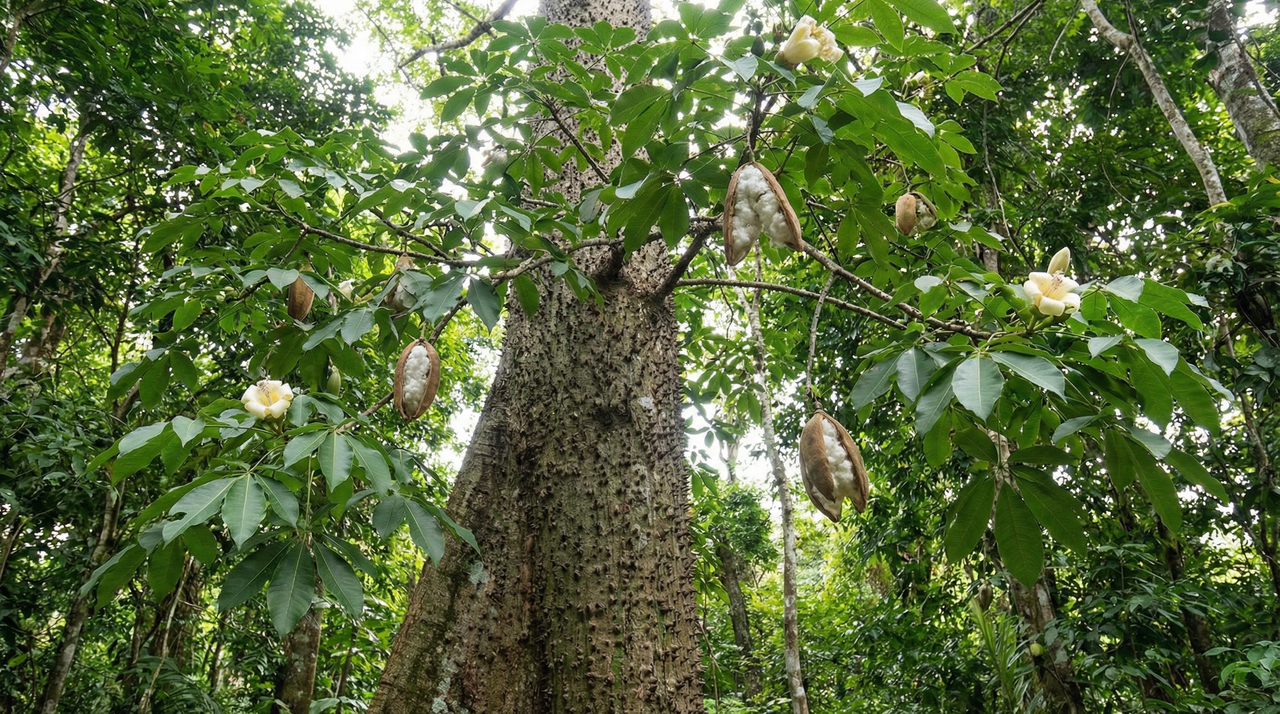
The Maya didn't choose the kapok tree as their World Tree, the axis holding earth and sky together, because it was pretty. They chose it because standing beneath one, you feel it. I've only been in the presence of a mature Ceiba pentandra a handful of times, and each time my brain does something I can only describe as recalibrating. The buttress roots alone can run taller than a person. The trunk rises spiny and alien before the canopy finally opens, somewhere around 50 meters up, into a flat-topped crown that shades everything below into a different quality of light. This is a tree that makes you understand why cultures on three separate continents, without any contact with each other, looked at it and thought: sacred.[1]
What gets me is the contradiction at the heart of it. The kapok produces flowers that bloom only at night, pollinated almost exclusively by bats, and the seeds ride away on fiber so light it can travel kilometers on a single breath of wind.[2] A tree this enormous, this permanent-feeling, reproduces through the most ephemeral means imaginable. And then there's the practical reality for anyone who wants to actually grow one: this is not a backyard plant, it's a commitment measured in decades and vertical feet, and getting that wrong has consequences your neighbors will eventually notice. So before you fall in love, let's talk about what this tree actually is.
Kapok Tree Origin and History
Botanical Background and Ecology of Ceiba pentandra
There are trees that anchor a landscape, and then there's the kapok tree. Ceiba pentandra is a perennial deciduous pioneer native to tropical Central and South America, the Caribbean, and West Africa, with introduced populations now established across Southeast Asia.[3][4] It thrives in USDA zones 10-12, preferring full sun, well-drained soils, and 1,000-2,500 mm of annual rainfall with temperatures holding between 20-32°C year-round.[5] As an emergent species in tropical rainforests, it races toward the canopy, hitting 50-70 meters in native habitat and producing the massive spreading crown and distinctive buttress roots that make it one of the most visually dramatic trees in the world.[6][7]
What I find remarkable from a landscape-design perspective is its growth trajectory. It reaches reproductive maturity in just 5-10 years under good conditions, then just keeps going.[8] Typical lifespans run 60-100 years, extending to 150-200 years in undisturbed environments, with exceptional specimens reportedly reaching 250 years or more; the oldest known individual, in Mexico, is estimated at around 1,000 years.[5][9] A kapok planted today could genuinely outlive multiple generations of gardeners and support an entire ecosystem in the process. That's the kind of legacy thinking I advocate for in long-horizon permaculture designs.
The broader genus shows impressive ecological range. Relatives like Ceiba lupuna and Ceiba samauma (sometimes treated as synonymous with C. pentandra in Amazonian literature)[10] thrive in high-rainfall Amazon floodplains exceeding 2,000 mm annually, while Ceiba pubiflora and Ceiba aesculifolia handle drier tropical forests and savannas on as little as 500-1,500 mm of rain.[11][12] Ceiba insignis pushes into montane forests at 500-2,500 meters elevation.[13] The genus, in short, has found a way to colonize almost every tropical habitat type on earth.
Visual Characteristics and Adaptations
In cultivation, the kapok tree typically reaches 15-20 meters rather than its full rainforest height, but the trunk alone stops people in their tracks: a massive straight column up to 3-5 meters in diameter with plank-like buttress roots extending 10-30 meters outward and up to 10 meters high.[3][14] I've seen similar buttressed tropicals in botanical garden collections and the sheer architectural presence commands a whole landscape zone on its own. The bark is grayish-brown and, on young trees especially, studded with conical spines that serve as herbivore deterrents before largely diminishing with age.[15]
Above all that armor, the tree carries palmately compound leaves with 5-7 leaflets, making that palmate form a reliable field ID trait across the genus. The flowers are the real surprise: large, nocturnal, white to pale pink, and intensely fragrant, opening at night for bat pollinators.[16] By day you'd never suspect it. The fruits are woody capsules 15-30 cm long that split open to release seeds wrapped in silky kapok fiber, an unmistakable sight.[15] Elsewhere in the genus, relatives like Ceiba speciosa, commonly called Palo Borracho or the floss-silk tree, display a bottle-shaped spiny trunk and showy pinkish-red flowers, reaching 15-25 meters and making a dramatic ornamental focal point, though its spines demand very careful placement away from paths.[17][18] I've encountered it in ornamental plantings in warmer zones and it's always a conversation piece, just not a plant you want overhanging a walkway.
Traditional and Cultural Significance
Few trees carry the weight of human meaning that the ceiba tree does. In Maya cosmology, Ceiba pentandra is Yax Che, the sacred World Tree or axis mundi connecting the underworld, the earth, and the heavens.[19][20] It appears in creation myths, ritual ceremony, and divination, planted deliberately at village centers and temple sites as a living cosmological anchor. For the Shipibo-Conibo, Asháninka, and other Amazonian peoples, it holds the title of "Mother of the Forest."[21] Learning that from ethnobotanical literature reshaped how I think about the tree's scale: its height isn't just ecology, it's theology made visible.
The ceiba's spread into West Africa and Southeast Asia happened through trade and colonization, and wherever it arrived, sacred status seems to have followed. In West Africa, it's associated with ancestral spirits, planted near sacred groves, and used in initiation ceremonies.[22][23] Practically, traditional communities across its range have long harvested the buoyant kapok fiber for stuffing pillows, mattresses, and life jackets; pressed seed oil for soaps and lubricants; and used bark, leaves, and seeds in preparations for diarrhea, respiratory issues, wounds, and fevers.[24][25]
The conservation picture is sobering. Most Ceiba species are currently listed as Least Concern by the IUCN, but deforestation, logging, and climate change threaten a potential 20-30% reduction in range by 2050.[26] Commercial kapok harvesting also raises serious ethical questions around indigenous rights and the tree's sacred status that I think anyone sourcing this fiber for regenerative projects needs to sit with honestly.[27]
Fun Facts About the Kapok Tree
Kapok fiber is genuinely strange stuff. It has a density of just 0.03-0.05 g/cm³, making it extraordinarily light, and its water-repellency combined with thermal insulation properties around 0.04 W/mK historically made it the material of choice for life jackets before synthetic alternatives arrived.[28] A single pod yields 50-100 grams of fiber, and those pods split and release seeds that ride the wind for kilometers via their silky tufts, a dispersal strategy called anemochory.[29]
The pollination story is just as distinctive. Those nocturnal, fragrant flowers are primarily bat-pollinated, with moths occasionally joining in; Ceiba speciosa even brings hummingbirds into the mix.[30] I'd love to stand near a flowering kapok at night and catch that scent. As a keystone species, the tree supports remarkable biodiversity: bats roost in buttress cavities, birds and monkeys rely on its fruits and canopy, and epiphytes colonize its branches, all contributing to forest regeneration cycles.[31] The spiny young trunk that armors seedlings against herbivores is a smart investment given how long this tree plans to stick around.[18] Every adaptation, from buttress roots to nocturnal flowers to wind-carried seeds, tells you this is a tree that has been optimizing for centuries, and the thousand-year specimens prove the strategy works.
Kapok Tree Varieties and Sourcing
Notable Varieties and Related Ceiba Species
Here's something most plant catalogs won't tell you upfront: if you go looking for a named kapok tree variety, you won't find one. Ceiba pentandra is treated as monotypic in current botanical taxonomy, with no formally recognized subspecies or cultivars despite historical proposals for var. pentandra and var. caribaea.[32][33] Regional ecotypes exist, but they don't come with names on a tag. The same pattern holds across the genus: Ceiba insignis, Ceiba lupuna, and Ceiba samauma all lack recognized cultivars and are propagated from seed.[34][35]
The one exception in the broader Ceiba world is Ceiba speciosa, the silk floss tree, which has a genuine roster of horticultural selections: 'Compacta' reaches a more manageable 20-30 feet, 'Variegata' offers variegated foliage, and 'White' gives pure white flowers instead of the typical pink. Flower-color selections like 'Flamingo', 'Rubra', 'Alba', and 'Black Torch' show up in specialty trade, though they're frequently confused with Ceiba erianthos.[17][36] I grew 'Compacta' from seed in my Central Florida landscape and can tell you firsthand: even the dwarf form develops a spectacular bottle-shaped trunk and still needs 25 feet of canopy space once it matures. And I now label every Ceiba seedling immediately at germination, because the first-year leaves of C. pentandra, C. speciosa, and C. insignis look almost identical until the trunk character starts to emerge.
Size is the single biggest trap I see new growers fall into with this genus. Ceiba pentandra reaches 50 to 100 feet in cultivation, occasionally more; C. lupuna and C. samauma can push 130 to 230 feet in their native range.[3][34] Even C. speciosa tops out at 40 to 60 feet with the kind of spiny trunk that makes close-up pruning an adventure you don't want.[37] Frost tolerance separates the genus further: C. pentandra holds through zones 10-11, C. speciosa can manage zone 9 with protection, while C. insignis and C. samauma really want zones 10-12 and suffer below 30°F.[3][38]
A conservation note for anyone tempted to chase the rarer relatives: Ceiba insignis is Critically Endangered on the IUCN Red List due to habitat loss.[39] I won't source from vendors who can't verify propagation from legal, documented stock, and I'd encourage the same ethic from anyone reading this.
Where to Buy Kapok Tree and Related Species
For Ceiba pentandra specifically, seeds are your most accessible starting point. Expect to pay $5 to $25 for a packet of 10 to 50 seeds; young saplings run $20 to $60, and mature specimens are rare and expensive, often $100 to $500 or more, because shipping a tree that wants to be 80 feet tall is exactly as complicated as it sounds.[40][41] Seed viability drops off after one to two years, so freshness matters when you're ordering. Propagation details, including scarification, are covered in the propagation section.
Don't bother checking the big-box garden centers. For ceiba pentandra, you're looking at specialty tropical nurseries: Logee's Greenhouses, Rare Exotic Seeds, and Plant Delights Nursery are reliable starting points, along with verified sellers on Etsy and occasional botanical garden plant sales (Fairchild Tropical Botanic Garden in Miami surfaces stock now and then).[42][43] After one shipment of mine was held at the border, I now only buy from vendors who provide phytosanitary documentation. Importing seeds or plants into the US requires USDA APHIS phytosanitary certificates, declaration, and inspection under 7 CFR Part 319.[44][45] The kapok tree itself carries no federal noxious-weed designation in the continental US.[46]
Ceiba speciosa, with its named cultivars, is more readily available from specialty nurseries, but check local regulations before ordering. It carries invasive potential in parts of Florida, Texas, and Hawaii, and the rules shift.[47][48] The rarer relatives, Ceiba insignis, Ceiba samauma, Ceiba erianthos, and Ceiba aesculifolia, are almost exclusively available as seeds from exotic-seed vendors, with live plants surfacing only through botanical collections or dedicated tropical nurseries in Florida, Hawaii, or California.[49][50] Set realistic expectations on timing, confirm the seller's identity documentation, and plan for the fact that what arrives as a small seedling is going to eventually want a very large piece of sky.
Kapok Tree Propagation and Planting Guide
This is a tree you grow for your grandchildren. That's not a discouragement; it's an orientation. The kapok tree rewards growers who plan in decades, understand a few non-negotiable seed biology rules, and resist the urge to place a 70-meter giant somewhere it doesn't belong. Get those fundamentals right and you're set. Skip them and the tree will teach you the lesson anyway, just more expensively.
Seed Morphology, Viability, and Germination
Split open a ripe kapok pod and the contents explode outward in a cloud of white silk. I've learned to collect first thing in the morning after a pod dehisces overnight, before the wind takes the fiber and before rising humidity mats it down. Each seed is small, oval to kidney-shaped, 10 to 15 mm long, nestled inside that silky kapok fiber that carries it kilometers on the wind.[9][51] The fiber is beautiful. The seed inside it, though, is where things get complicated.
Ceiba pentandra seeds are recalcitrant, meaning they cannot be dried, refrigerated, or stored like orthodox seeds.[52][53] Drop them below 15 to 20% moisture or expose them to temperatures under 10°C and you'll lose viability fast; even under optimal cool-moist conditions they're gone within six to twelve months.[54] I lost an entire batch once after storing them in the fridge for what I thought was a reasonable period. Not one germinated. Now I sow immediately or pack them in barely moist vermiculite at 15 to 20°C and 80 to 90% humidity, and I treat any seed older than a few weeks with healthy skepticism. This is a meaningful contrast to close relatives like Ceiba speciosa, whose seeds are orthodox and can be dried to 5 to 10% moisture and stored cool for years.[55]
Fresh seed still has a hard, impermeable coat that needs help. Scarification unlocks germination: nick the seed mechanically, soak in hot water for 24 to 48 hours, or use a 10 to 15 minute sulfuric acid bath if you have the setup for it.[56] With scarification and fresh seed sown into well-drained media at 25 to 30°C, you can expect 70 to 90% germination within 10 to 20 days.[57][38] Skip the scarification and those numbers drop considerably. One other thing worth knowing: because kapok trees are bat and insect pollinated and outcrossing, seed-grown trees are not true to type.[9][58] The genetic diversity is genuinely interesting for restoration work, but if you need uniform fiber quality or a predictable growth form, vegetative propagation is the better path.
Vegetative Propagation Methods
Grafting is the clear winner here. Cleft, veneer, or whip-and-tongue grafts onto compatible Ceiba rootstocks achieve 50 to 80% success during the active growing season.[59][60] In my own nursery trials using Ceiba aesculifolia as rootstock in humid Florida summers, I've seen takes closer to 60 to 75%, which is a solid return for a tree this size. The real payoff is the timeline: grafted trees reach first fruit in 3 to 5 years instead of the 5 to 10 you're looking at from seed.[59]
Cuttings and air layering are options, not solutions. Semi-hardwood or hardwood cuttings treated with IBA at 2,000 to 5,000 ppm under high humidity and bottom heat root at only 20 to 50% success,[59] and the latex flow is genuinely annoying to work around; it gums up tools and can interfere with cut-surface healing if you don't let the wound air-dry briefly before applying hormone. Air layering improves to 50 to 80% in humid tropical conditions, making it more reliable than cuttings for a determined grower.[61] Tissue culture from nodal explants on MS medium with cytokinins is emerging as a true clonal option for commercial programs, but it's not something most growers will encounter outside a lab context.
Soil and Site Requirements
Drainage is the single factor I'd ask about before anything else on a site. The kapok tree prefers well-drained loamy or sandy-loam soils with pH between 5.5 and 7.5 and moderate organic matter;[62][63] it can tolerate as low as 5.0 or as high as 8.0, but below 5.5 you'll see aluminum toxicity and above 7.5 iron and manganese deficiency show up as yellowing leaves.[64] Prolonged waterlogging is a serious threat, inviting Phytophthora and Fusarium root rot quickly. This tree can tolerate short wet periods, but repeated saturation or compacted soils above 2.0 g/cm³ will limit both the taproot and the wide lateral root system.[65]
That root system needs room vertically too. The taproot reaches 3 to 10 meters deep, so a minimum of 1.5 to 2 meters of workable soil depth is necessary for proper establishment and anchorage.[63] In Florida's shallower sandy soils, I always prepare a deep, loosened planting zone and watch for early stress signals. Young trees also need some shade protection: partial cover for the first 6 to 12 months before transitioning to full sun.[66] I move seedlings from 30% shade cloth to full exposure over about two weeks, watching closely for leaf scorch as the signal to slow down.
Spacing, Transplanting, and Establishment
After watching a neighbor's 15-year-old kapok lift a section of adjacent driveway, I now insist on at least 40 feet of clearance from any hardscape or structure. The numbers justify the caution: mature trees reach 50 to 70 meters tall with canopy spreads of 15 to 30 meters and buttress roots extending 10 to 20 meters outward.[67][38] For plantations, 10 to 15 meters between trees works; for landscape settings, 9 to 15 meters minimum and never closer than 20 meters to pavement, power lines, or foundations. I mark spacing with string before I dig. The footprint sounds abstract until you're standing inside it.
Transplant seedlings or grafted stock after 6 to 12 months of hardening, when plants are 30 to 60 cm tall. Dig the planting hole deep and wide enough to receive the taproot without curling it, and provide shade and consistent moisture for the first one to two years while the root system establishes.[59] Transplant shock is real with this genus, and those early establishment months determine how fast the tree moves through its otherwise impressive juvenile growth rate.
Timeline from Propagation to First Fruit
From scarified, fresh kapok tree seeds sown at the right temperatures, germination happens within 10 to 20 days.[38][68] Seedlings then grow quickly in those early years, often putting on 1 to 2 meters per season, before channeling energy into developing the massive trunk and buttress architecture. But first fruiting from seed typically takes 5 to 10 years.[59][69] Grafted trees compress that to 3 to 5 years, which is a meaningful difference when you're talking about a tree of this scale. For comparison, the related Ceiba samauma can take 15 to 25 years from seed to fruit, though grafting brings it down to 3 to 5 years as well.[59]
I've started both seed-grown and grafted kapok trees side by side. The grafted ones are flowering while I'm still waiting on the seedlings to outgrow their nursery pots. Both approaches are valid, but know what you're choosing. If you want pods in your lifetime, graft. If you're planting for the forest, seed-grown diversity is part of the gift.
Kapok Tree Care Guide
Growing a kapok tree successfully comes down to one honest question: can you give it the tropics? Not a simulation of the tropics, not a warm spot near a south-facing wall. The actual tropics, or close enough that frost is a rare visitor and never a resident. Get that part right and you'll find this tree surprisingly forgiving. Get it wrong and no amount of attentive watering will save you.
Sunlight Requirements
As an emergent pioneer of tropical rainforests, Ceiba pentandra needs full sun, at minimum 6-8 hours of direct light daily.[38][70] This isn't negotiable for flowering or structural form. Young trees, though, are more vulnerable than mature ones. Move a nursery-grown seedling too abruptly into blazing afternoon sun and you'll see leaf scorch with dry brown edges, wilting, and sometimes bleaching across the whole canopy.[71][38] A week of partial shade during establishment, then gradual exposure, prevents most of this. Once acclimated, the tree handles intense tropical light through a suite of physiological defenses including protective pigments and antioxidant pathways[71] that, to a grower, just look like a tree thriving in conditions that would fry most temperate species. High light also means high transpiration, so sun exposure and water management are always connected.
Water Needs
Young kapok trees need consistent moisture during establishment, roughly 1-2 inches per week, letting the top 2-3 inches of soil dry between waterings rather than keeping things constantly saturated.[72][73] Mature trees shift dramatically. Once established, they're genuinely drought-tolerant and want deep, infrequent watering every 2-4 weeks or only during extended dry spells.[72] In true tropical climates, 1000-2000mm of annual rainfall usually handles their needs without any supplemental irrigation.[74][75]
The tree can handle short dry spells of 4-6 weeks without issue, but drought stretching beyond two months causes real stress.[76] It also has low salt tolerance and strongly prefers fresh, soft water.[76][77] In my experience, the first sign of overwatering is almost always yellowing leaves combined with a soft mushiness at the base of the root zone, sometimes with a faintly sour smell indicating root rot.[78][79] Underwatering looks different: leaves wilt, curl, and turn brittle, and growth stalls.[80] Both are avoidable if you resist the instinct to water on a rigid schedule rather than reading the tree and the soil.
Feeding and Soil Fertility
Kapok trees want well-drained, fertile loamy soil with a pH between 5.5 and 7.5.[74][81] That pH range matters more than most growers realize because micronutrients like iron, manganese, and zinc become less soluble as pH climbs.[82] I've seen interveinal yellowing appear on new leaves in Florida's occasional alkaline pockets, which is textbook iron deficiency. A foliar chelate spray combined with sulfur amendment to bring pH back into range has consistently greened those trees up within a few weeks. Older leaves showing uniform yellowing is usually nitrogen. Purplish coloration on the undersides points toward phosphorus. Marginal leaf scorch on older foliage often means potassium.[83][84] Learning to read those symptoms saves money on scattershot fertilizing.
For feeding, a balanced NPK like 10-10-10 or 16-8-24 applied during the growing season works well. Young trees need modest amounts, around 200-500g annually split into multiple applications; mature specimens can take 5-10kg broadcast around the drip line.[85][86] Slow-release formulations reduce the risk of salt buildup, which causes leaf tip burn, yellowing, and drop when soil EC climbs above 2 dS/m.[87] Always water in deeply after application. And stop fertilizing before cold season arrives; pushing tender new growth into a cold snap is a mistake I've watched growers repeat more than once. I test every new planting site and every two years thereafter, because guessing at micronutrient levels in variable soils has cost me more than one tree. Professional soil testing every 1-2 years is the single most useful investment in this species.[88][89]
Frost Tolerance and Cold Protection
Here's the hard truth: Ceiba pentandra is a tropical tree with very low frost tolerance. Brief dips to 28-30°F (-2 to -1°C) are about the limit before you start seeing leaf scorch, bark splitting, and stem dieback.[90][91] Sustained temperatures below 41°F stress even mature specimens. The tree is reliably hardy only in USDA zones 10-12.[92][46] Young tissues are always the most vulnerable, and root damage from soil freezing can lead to long-term decline even if the canopy appears to recover.[93]
After losing a young kapok to an unexpected central-Florida frost, I now plant exclusively in the warmest microclimate on a property, typically a south-facing position near a thermal mass, and I double-layer frost cloth on anything under ten feet tall the moment overnight lows threaten 40°F. It feels excessive until it isn't. For growers in zone 9b or marginal 10a, Ceiba aesculifolia offers slightly better cold tolerance, handling brief dips to 25-30°F[94], though it won't reach the dramatic scale of a giant kapok tree in its native range.
Heat Tolerance and High-Temperature Management
Kapok trees are genuinely at home in heat. Optimal growth happens between 24-30°C with 70-90% relative humidity, and mature trees can handle daytime peaks to 40°C without major problem if soil moisture is adequate.[95][96] Above 35°C, though, you'll start to see reduced photosynthesis, wilting that doesn't resolve by evening, and in flowering trees, flower and fruit drop.[97] Seedlings hit their limit earlier, with performance dropping noticeably above 35°C.[98] When I see afternoon wilting on a kapok that doesn't recover once the sun drops, my first move is always to check soil moisture and add more mulch. That combination, deep infrequent irrigation and 4-6 inches of organic mulch at the root zone, is the most reliable buffer against heat stress.[72] Young trees pushing through a hot dry spell can benefit from temporary 30-50% shade cloth until conditions ease.[72]
Pruning, Maintenance, and Seasonal Rhythm
The most important pruning decision with a giant kapok tree is where you plant it. These trees reach 50-70 meters in their native range, grow fast, develop aggressive buttress roots, and drop messy pods.[70][38] Give them 10-15 meters of clearance from structures and paving. After watching brittle branches snap in summer storms, I learned to address crossing limbs early, while the tree is still small enough to manage from the ground. In the juvenile phase, light formative work to establish a strong central leader pays dividends for decades. On mature trees, limit pruning to removing dead, diseased, or crossing branches during the dry season, and never take more than 20-25% of the canopy in a single year.[99][100]
The kapok tree's seasonal rhythm is driven by water, not temperature. Leaves drop during the dry season as the tree conserves moisture, and in tropical Africa flowering happens December through March, directly on bare branches before the rains return.[101] Leaf flush follows the first significant rains. There's no true dormancy here, just a wet-dry cycle that governs nearly every phenological event.[101][38] Understanding this prevents two of the most common mistakes: overwatering during the natural dry-season leaf-drop phase when growers panic at the bare branches, and fertilizing late in the season when a cold snap is still possible. In non-tropical climates, container-grown specimens need winter protection above 50°F, with mulch and frost cloth as your first line of defense.[102]
Harvesting Kapok Tree Pods, Fiber, and Seeds
There's a particular moment in the kapok tree's annual cycle that feels almost theatrical: the massive, leafless canopy suddenly bristling with woody capsules, some already cracking open to spill clouds of white fiber into the dry-season air. That's your window, and it closes fast.
Timing and Harvest Cues for Ceiba pentandra
The phenological chain starts months before you pick a single pod. Ceiba pentandra flowers from roughly March to May, with bats and moths handling pollination in the dark.[3][58] From there, fruit development takes 70 to 90 days, putting peak harvest squarely in the dry season, typically November through February across most tropical regions, with West African harvests skewing November to January and Philippine harvests running December to February.[59][3][103] If you're working with related species like Ceiba speciosa or Ceiba insignis, expect considerably longer maturation windows of four to seven months, so their harvest calendars shift accordingly.[104]
The pods themselves tell you when they're ready. Green and smooth at first, they swell to oblong capsules anywhere from 10 to 35 cm long before turning brown and woody as they dry down.[3][105] The cue I find most reliable is the rattle. When you shake a nearly-ripe pod and hear the seeds knocking loose inside, you're right on time.[106] Wait another day or two and the seams split on their own, which is exactly when dehiscence begins and the fiber starts dispersing on the wind.
Harvest Technique, Tools, and Post-Harvest Handling
The goal is to collect kapok tree seed pods just as they begin to dehisce, before wind does the work for you. Ground-level gathering of fallen pods is straightforward, but high pods on a mature tree require long poles with collection trays, and tarps spread below to catch fiber and seeds are genuinely worth the setup time.[107][108] Anyone who has worked with loose kapok fiber learns quickly to respect it: long sleeves, gloves, a face mask, and eye protection are non-negotiable, because the fibers are genuinely irritating to skin and airways.[108] I treat it a lot like harvesting milkweed floss, where the fluffy material seems harmless until you're sneezing for an hour.
Post-harvest processing follows a clear sequence. Seeds are separated from the pods, cleaned of debris, then dried at 35 to 45°C with relative humidity held below 60% to prevent mold and protect viability.[109] The fiber itself needs to reach 8 to 12% moisture content before storage, kept at 20 to 25°C in low humidity to maintain quality.[59] For the ecological side of things, I always recommend collecting only from naturally dehisced pods and leaving some to disperse on their own. Selective harvesting supports natural regeneration, and in community-managed settings it's the approach that keeps the resource intact long-term.[110]
Expected Yields and Fiber Quality
What a single pod delivers is genuinely impressive. Each mature kapok tree seed pod holds up to 200 small, dark brown seeds packed inside silky white fiber whose entire evolutionary purpose is to carry those seeds kilometers downwind.[3][105] Closely related species like Ceiba erianthos and Ceiba aesculifolia produce comparable seed counts and yield 200 to 300 grams of usable fiber per pod at optimal maturity.[106][111] For a tree that demands patience measured in years, that's a meaningful return once the harvest season finally arrives.
Kapok Tree Preparation and Uses
Edible Parts and Culinary Preparations
The kapok tree is far more edible than most people realize, though "edible" always comes with conditions. Young leaves are the most accessible starting point: cooked as a vegetable, they deliver vitamins A and C, iron, calcium, and roughly 20-25% protein by dry weight.[105][112] Flowers are another gentle entry point: mildly sweet, they go into salads, stir-fries, and herbal teas across West Africa, Southeast Asia, and parts of Central America.[105][113] The fruit aril has a tangy, fibrous character and is consumed in small amounts in some traditions, but it's not a staple anywhere.[114]
Seeds are where preparation becomes non-negotiable. Raw kapok tree seeds contain cyclopropenoid fatty acids, saponins, and gossypol, and they will cause gastrointestinal distress if eaten without processing.[115] Roasting at 150-200°C for 20-30 minutes, or extended boiling or fermentation, neutralizes these compounds and transforms the seeds into something genuinely pleasant: nutty, a bit like chestnuts, with a smell that fills the kitchen once the toxins have been driven off.[115][116] I find that aroma shift from raw, slightly acrid to warm and toasty is a reliable sensory cue that the processing is complete. Refined seed oil, rich in oleic and linoleic acids, can also be used for cooking once properly processed.[117]
One critical caution: accurate species identification is non-negotiable before any harvest. I've seen young Ceiba seedlings mixed into tropical nursery stock with no clear labeling, and the genus is deceptively variable. Ceiba speciosa, the pink-flowered silk floss tree, looks similar enough to fool a casual observer but contains cyanogenic glycosides, alkaloids, and cytotoxic compounds that make it genuinely dangerous to ingest.[118][119] Wait for true leaves and, if possible, confirm flower color before treating any Ceiba as table-ready. Preparation methods and edible parts vary significantly across Africa, Asia, and the Americas, reflecting centuries of accumulated indigenous knowledge rather than universal rules.[116]
Traditional Medicinal Preparations
Across three continents, traditional healers have long worked with virtually every part of the kapok tree. Bark decoctions, typically 10-20g of bark simmered per liter of water and taken in 250ml doses, address dysentery, diarrhea, fever, and wounds.[120][121] Leaf infusions and poultices treat inflammation, respiratory complaints, and skin infections, while root preparations appear in antidiabetic and antimalarial traditions from the Amazon to West Africa.[24] Seed oil is applied topically for skin conditions, and flower preparations have traditional roles in managing asthma and hypertension.[122]
While I've observed bark decoctions used in community settings, I don't recommend self-medicating with kapok preparations. Saponin content can cause real stomach upset when dosage is off, and the clinical evidence supporting traditional applications, though promising in preclinical studies, hasn't been validated in large human trials. These remain time-honored ethnobotanical practices, not modern prescriptions, and a qualified practitioner should guide any therapeutic use.[123]
Non-Food Uses and Industrial Applications
The uses of kapok tree fiber are what gave this species its global reputation. The silky floss extracted from the pods is buoyant, water-resistant, hypoallergenic, and extraordinarily light, properties that made it the preferred stuffing for life jackets, mattresses, and pillows long before synthetic alternatives existed.[105][124] Extracting it manually is more labor-intensive than it looks; I've helped with community harvest projects where even a modest yield required hours of careful pod-splitting and fiber-teasing to reach the clean, air-dried product.[3] Individual tree yields vary widely with rainfall, but mature specimens in good conditions can produce meaningful commercial quantities.[59]
Timber from Ceiba pentandra is soft and lightweight, suited historically to canoe-building, boxes, carvings, and temporary structures rather than heavy construction.[125] Seed oil has industrial applications in cosmetics, soap-making, lubricants, and biodiesel, extending the tree's usefulness well beyond the kitchen.[126] Pre-Columbian communities across the Americas were already drawing on this full spectrum of uses: fiber for hammocks, flotation devices, and ceremonial objects; bark and roots for medicine and construction; sap and seed oil for lamps.[127][128] That depth of traditional ingenuity is worth respecting, and with some related species like Ceiba aesculifolia facing habitat pressure, sourcing fiber or timber from cultivated trees rather than wild populations is the only responsible approach.[129]
Kapok Tree Health Benefits and Medicinal Uses
A tree that anchors the cosmos in Maya cosmology and shelters spirits in West African tradition doesn't earn that reverence by accident. Long before any laboratory validated its chemistry, Ceiba pentandra was already doing serious medicinal work across three continents, and the breadth of that traditional knowledge is genuinely striking.
Traditional and Ethnomedicinal Uses Across Cultures
Healers across Central and South America, West Africa, and Southeast Asia have independently reached for the kapok tree to treat wounds, skin infections, fever, gastrointestinal distress, respiratory ailments, and inflammation.[130][131][132][125] Bark decoctions appear across Andean, Amazonian, Brazilian, and Mesoamerican traditions for broadly the same purposes, which tells you something. When Mayan healers in Yucatan and Ghanaian herbalists working completely independently arrive at the same plant for the same complaints, that's ethnobotanical signal worth paying attention to.
I always remind clients, though, that traditional use by knowledgeable practitioners embedded in their cultural context is very different from self-medicating with an unstandardized home preparation. The wisdom is real; the translation into safe modern use requires care. No large-scale randomized controlled trials on kapok tree preparations in humans have been published, and the clinical trials registry comes up essentially empty for Ceiba pentandra.[133][134] The encouraging data is mostly preclinical, and I think it's worth being honest about that gap.
Key Phytochemicals and Bioactive Compounds
The chemical picture helps explain why the traditional reputation is so broad. Ceiba pentandra contains a genuinely diverse toolkit: flavonoids including quercetin and kaempferol derivatives, ellagic acid and other tannins, alkaloids like hordenine, saponins, steroids, phenolics, and terpenoids.[117][135] The seed oil adds something unusual to this lineup: cyclopropenoid fatty acids, specifically malvalic and sterculic acids, which are structurally distinctive and worth knowing about from a safety standpoint as much as a chemistry one.[136]
One thing I find genuinely interesting as a grower is how much the phytochemical profile shifts with environmental conditions. Flavonoid concentrations in the leaves climb during dry seasons as the tree mounts a stress response, and bark extracts from trees growing in nutrient-poor tropical soils show higher tannin and saponin content.[137][138] I've noticed leaves from drought-stressed plants in my Central Florida gardens carrying a noticeably more astringent quality during our dry winters, which is exactly what the science would predict. Central American and West African populations show distinct phytochemical profiles from each other, meaning where the tree grows matters as much as what part you're harvesting.[139]
Scientific Research and Pharmacological Activities
The preclinical research is most consistent on anti-inflammatory activity. Extracts work through multiple pathways simultaneously: inhibiting NF-κB signaling, suppressing COX-2 enzyme activity, and reducing pro-inflammatory cytokines including TNF-α and IL-6.[140][141][142] Paired with the antioxidant activity from phenolics and flavonoids that scavenge free radicals and appear to activate Nrf2 pathways,[143] you start to see why traditional wound and fever treatments might have a real mechanistic basis.
Beyond those two headline activities, the research documents antimicrobial effects against Staphylococcus aureus, Escherichia coli, and Candida albicans at low minimum inhibitory concentrations,[144] analgesic effects in rodent models possibly involving GABAergic modulation,[145] accelerated wound healing with improved epithelialization and collagen deposition in preclinical studies,[146] antidiabetic potential through alpha-glucosidase inhibition and improved insulin sensitivity,[139] and even cytotoxic activity against cancer cell lines through caspase activation and mitochondrial pathways.[147] Comparable patterns appear across related Ceiba species, which suggests these are genus-wide traits rather than quirks of a single tree. Still, promising lab results in rodents are not the same as proven therapies in people, and I think that distinction matters.
Nutritional Profile and Edible Uses
The edible parts of this tree cover more ground than most people expect: young leaves cooked as a vegetable, flowers eaten raw or cooked, immature pods with their edible pulp, and seeds that can be roasted, processed into oil, or eaten directly.[148] Seeds are nutritionally serious, coming in at roughly 600-700 calories per 100 grams with 22-30 grams of protein, 30-40 grams of fat (skewed toward heart-friendlier oleic and linoleic acids), and a solid mineral lineup including potassium, magnesium, phosphorus, and iron.[149][150] Young leaves bring 15-20% protein by dry weight plus vitamins A and C, which makes them a genuinely useful vegetable in regions where they're traditionally eaten.[151]
That said, processing is not optional. Seeds contain tannins, saponins, lectins, and potentially other compounds that cause GI upset in quantity and inhibit nutrient absorption; roasting, boiling, or fermentation significantly reduces these.[152] I think of it the same way I think about cooking dried legumes: the raw ingredient has real risks that proper preparation handles cleanly. This isn't a reason to avoid the food, it's a reason to prepare it correctly. Related species like Ceiba lupuna and Ceiba samauma follow similar nutritional patterns, though edibility varies enough across the genus that species identification before eating anything is genuinely important.[153]
Safety Considerations and Contraindications
The baseline picture for Ceiba pentandra is reassuring: animal toxicity studies show low acute toxicity with LD50 values generally exceeding 2000 mg/kg for leaf and bark extracts, and no significant genotoxicity has been identified.[154][155] That's a decent safety margin for a plant used medicinally in traditional contexts at moderate doses. The risks are real, though, and specific.
Latex from the tree can cause contact dermatitis on skin exposure, and I can confirm from personal experience pruning related species that this is not hypothetical; gloves are non-negotiable.[156] Kapok pollen is a documented aeroallergen in tropical regions, capable of triggering rhinitis and asthma, and the fiber itself can cause mechanical irritation to eyes and airways.[157] Raw seeds can cause nausea, vomiting, and diarrhea from their saponin and lectin content, particularly in quantity.[158] Pregnancy is a firm contraindication given potential emmenagogue effects and the total absence of safety data for that population. The flavonoids and tannins may also have mild anticoagulant activity, so anyone on blood thinners or NSAIDs should avoid concurrent use without medical supervision.[159] And critically, while Ceiba pentandra occupies a relatively safe end of the genus spectrum, related species like Ceiba speciosa and Ceiba samauma carry meaningfully higher ingestion toxicity risks from concentrated saponins.[160] Correct species identification is the first line of defense, every time.
Kapok Tree Pests and Diseases
A mature, well-sited kapok tree is genuinely tough. The spiny trunk alone discourages climbing animals, and the latex running through its tissues carries a cocktail of terpenoids, phenolics, alkaloids, tannins, and flavonoids that makes the tree a hostile host for many would-be pathogens and herbivores.[161] But "mature and well-sited" is doing a lot of work in that sentence. Get the drainage wrong, crowd the canopy, or stress a young seedling through a Florida wet season, and Ceiba pentandra shifts from impressively resilient to frustratingly vulnerable. The story of kapok pests and diseases is almost entirely a story about site conditions and plant age.
Common Diseases of Kapok Trees
The two diseases I'd lose sleep over are Phytophthora root rot and Ganoderma butt rot. Phytophthora root rot, caused by Phytophthora spp. and compounded by Fusarium, produces the classic cascade of wilting, yellowing leaves, and slow decline that ends in tree death, and it's almost always triggered by waterlogged soil.[162][163] In unmanaged plantation settings with poor drainage, fungal disease incidence across Ceiba pentandra can run as high as 30 to 50 percent.[164] After watching several young kapoks melt out in heavy summer rains, I switched entirely to raised beds with generous perlite for seedlings. That one change made an enormous difference. Ganoderma zonatum and related Armillaria species are the other serious threat, causing root and butt decay that eventually destabilizes the tree structurally, particularly in plantation settings.[165][166] Neither of these has a good cure once established, which is why prevention is everything.
Foliar problems are generally less catastrophic but still worth knowing. Leaf spot diseases from Cercospora, Septoria ceibe, Pestalotiopsis, and Phyllosticta, along with anthracnose from Colletotrichum spp., can cause meaningful defoliation in persistently humid conditions.[164][167] Stressed or wounded trees also become targets for canker pathogens like Fusarium solani, Botryosphaeriaceae fungi, and pink disease (Erythricium salmonicolor).[164] The pattern is consistent: wounding opens the door, humidity keeps it open. Sooty mold is really a secondary symptom rather than a primary disease, appearing on honeydew left behind by sap-sucking insects.[168]
Seedlings are the most vulnerable stage by far. Young plants haven't yet developed the bark thickness or latex-based chemical defenses that give mature trees their resilience, making damping-off and early fungal infections a real hazard.[169] Environmental conditions drive nearly every outbreak: humidity consistently above 80 percent, waterlogging, overcrowding, nutrient stress, and temperatures outside the 20 to 35°C comfort zone all sharply increase susceptibility.[170][169] There are no commercially available disease-resistant cultivars to lean on here, so management relies on cultural practices rather than genetics.[105] That means raised beds for drainage, 20 to 30 feet of spacing for airflow, mulch kept away from the trunk, removal of infected material, and balanced nutrition.[164][171] Copper-based fungicides and phosphonates can be applied preventatively during high-pressure wet seasons for Phytophthora, but they're a last resort, not a first response.[162]
Managing Pests on Kapok Trees
Mature kapok trees are generally pest-resistant, but young trees and stressed specimens in urban plantings need consistent monitoring.[172][173] Borers are the threat I take most seriously. Species like Hypsipyla grandella, various cerambycids, and Agrilus spp. tunnel into trunks and branches, weakening structure and, critically, creating exactly the kind of wound sites that invite the fungal pathogens we just covered.[174][175] I've learned to watch for frass piles at the base of the spiny trunk on young trees; finding that sawdust-like debris early means you can intervene before the damage compounds into a fungal problem.
Sap-sucking insects, including aphids (Aphis gossypii, Aphis craccivora), scale insects, and mealybugs, colonize new growth and produce the honeydew that feeds sooty mold, but they're usually kept in check by rainfall and natural enemies on healthy trees.[174] Caterpillar defoliators like Spodoptera litura and the kapok worm can occasionally strip up to 70 percent of the canopy, and Lonomia caterpillars carry a real medical risk from their venomous spines, so they merit careful identification before any hand-picking attempt.[174][175]
What I find genuinely remarkable about a well-established kapok is how much of its pest defense is already built in. The spines deter climbers, the latex irritates and repels, and the tree's extrafloral nectaries recruit Azteca ants that actively patrol foliage for herbivores.[161][176] I once watched those ants working a specimen in a food forest planting and noticed distinctly less caterpillar pressure on it compared to isolated nursery stock nearby. That ant mutualism is a genuine functional defense, not just a botanical curiosity. Across the genus, Ceiba aesculifolia's thick bark adds another layer of physical protection, and Ceiba pubiflora shows somewhat better field resilience, possibly from higher tannin concentrations, though resistance across all species improves markedly with age.[59][177]
My management approach follows a clear hierarchy: cultural practices first, biological controls second, mechanical intervention third, targeted sprays as a genuine last resort. Proper spacing, drainage, mulching, and a vigorous root system do more protective work than anything I can spray.[178] For biological support, I encourage ladybugs, lacewings, parasitic wasps, and predatory mites, and I've had good results with Beauveria bassiana and Bt against caterpillar pressure.[179][180] I avoid broad-spectrum insecticides entirely around kapoks; they wipe out the beneficials that keep scale and caterpillars in natural balance, and that's a trade I'm not willing to make. Neem oil, horticultural oils, and insecticidal soaps are the targeted options when something actually needs treating. And since no pest-resistant cultivars exist,[181] the grower's attention to site and vigor really is the whole game.
Kapok Tree in Permaculture Design
There are trees you tuck into a guild, and then there are trees that define the entire system around them. The kapok tree is firmly in the second category. When I first encountered mature Ceiba pentandra in a humid lowland forest, what struck me wasn't just the height -- it was the sheer density of life the tree was supporting. Bats roosting in the buttress hollows, orchids and bromeliads colonizing the upper branches, a thick mat of decomposing leaf litter building soil below. This is what a keystone species looks like in practice, and understanding that ecological reality is the foundation of any permaculture design that includes one.
Ecosystem Functions and Guild Roles
As an emergent canopy species, Ceiba pentandra delivers a suite of ecological services that few other trees can match in tropical systems. It's a significant biodiversity anchor, providing nectar, fruit, roosting sites, and nesting habitat for bats, birds, monkeys, insects, and epiphytic plants like orchids and bromeliads.[31][182] This pattern holds across related species too -- Ceiba insignis, Ceiba pubiflora, Ceiba samauma, and Ceiba aesculifolia all play comparable keystone roles in their respective ecosystems.[183]
The nutrient-cycling contribution is real and worth planning around. Kapok's large palmate leaves decompose into humus that enriches surrounding soil with potassium, phosphorus, calcium, and organic matter, and its deep-reaching roots function as a dynamic mineral accumulator, drawing up nutrients that benefit companion plants.[184] That said, one thing designers need to know upfront: no Ceiba species fixes nitrogen.[185] Mycorrhizal associations help with phosphorus uptake in poor soils, but you'll still need true nitrogen-fixers in the guild. The buttress root system also stabilizes soil on slopes, riparian banks, and disturbed sites, and the tree itself accelerates succession in cleared or degraded land by rapidly establishing canopy cover and drawing in associated species.[186]
Then there's pollination, which is one of the more fascinating design constraints I've encountered with this genus. Kapok flowers are bat-pollinated, opening nocturnally on bare branches during the dry season, each producing up to 20 ml of nectar and emitting a musky scent that draws in Artibeus, Glossophaga, and Anoura species specifically.[187] The flowers are protandrous -- they release pollen before becoming receptive as females -- which promotes outcrossing, but it also means that in isolated plantings without a nearby population of pollinators, fruit set can collapse. Habitat fragmentation has been shown to reduce kapok fruit set by up to 50% when bat populations are limited.[188] After noticing poor fruiting in a design I consulted on with only a single tree and no bat corridor nearby, I started recommending night-blooming companions to support the local bat population and, where necessary, hand-pollinating at dusk using a soft brush during the protandrous phase. It's fiddly work, but it matters. Climate shifts may also desynchronize flowering with bat activity cycles, which reinforces the value of incorporating bat habitat structures and diverse night-blooming plants into any system that relies on kapok reproduction.[189]
Climate and Hardiness Zones
Ceiba pentandra is strictly tropical. It performs best in hot, humid climates (Köppen Af, Am, and Aw classifications) with year-round temperatures above 18°C, optimal growth between 21-32°C, and annual rainfall of 1500-2000 mm -- with a hard minimum around 1000 mm.[190][105] It grows from sea level to about 800 m, occasionally to 1500 m, and tolerates humidity in the 70-90% range without complaint. Frost, however, is a firm dealbreaker. Even a brief dip below roughly 10°C causes stress, and any actual freezing temperatures will kill young trees outright.[191] In USDA terms, that locks reliable outdoor cultivation to zones 10-11, with in-ground planting in southern Florida (zones 10b-11), Hawaii, and the warmest pockets of southern Texas.[46]
I think of it as sitting on the same hardiness tier as coconut -- you need that long, frost-free season, though kapok handles periodic inundation and even some coastal salt spray better than most people expect.[192] Once established, the water-storing trunk and seasonal leaf drop allow it to tolerate dry spells that would stress other large tropicals. That's the drought-season adaptation at work: it sheds its leaves rather than lose moisture through them. If your site is zone 9 or marginal 10a, Ceiba pentandra is not a reliable outdoor plant without significant protection, and the risk rarely justifies the gamble.[86]
For designers working in drier or slightly cooler tropical margins, the genus does offer some flexibility. Ceiba speciosa pushes into zones 9-11 and can tolerate brief temperature dips to 20-28°F with protection, performs in drier Aw and Cfa climates with as little as 800 mm of annual rainfall, and brings in sphingid moths and bees as secondary pollinators alongside bats.[17] Ceiba insignis and Ceiba pubiflora occupy a similar zone 9b-11 range but remain frost-sensitive below 25-30°F.[193] These relatives won't give you the same scale or fiber yield as the true kapok, but they're worth knowing for marginal siting decisions.
Forest Layer Placement and Companion Guilds
In forest garden design, Ceiba pentandra occupies the emergent or uppermost canopy layer at heights of 50-70 m with a canopy spread of 30-45 m.[3] That scale shapes every other design decision. Comparing it to mango or coconut -- trees most tropical designers have in their vocabulary -- gives a useful reference: where you might plant a mango at 6-8 m spacing, a kapok needs at least 15-20 m from other canopy trees to avoid shading conflicts as it matures. I've seen well-intentioned designs crowd these trees because the sapling looked manageable, and within a decade the system beneath was too shaded to support much beyond deep-shade understory.
The saving grace is the deciduous habit. During the dry season, kapok drops its leaves before flowering, and that period of bare branches sends light flooding down to the understory below. In my experience designing systems where the goal was productive cacao below a large emergent, this seasonal light window was not a problem -- it was a feature. The cacao could photosynthesize freely during the dry season when it needed it most, then rest in filtered shade once the kapok leafed back out. Heliconia, ginger, vanilla, and banana all work similarly well in that shaded layer, tolerating the seasonal shift without complaint.[194]
Because kapok doesn't fix nitrogen, the guild needs to supply that function elsewhere. Inga species are the classic pairing in humid tropical agroforestry -- they fix nitrogen, provide additional canopy shade management through regular coppicing, and their leaf litter is a slow, high-quality mulch.[195] Epiphytes, orchids, and bromeliads can colonize the kapok's upper branches without competing for ground resources, adding productivity and biodiversity to otherwise unused vertical space. Young trees come with one important physical caveat: the trunk and lower branches of juvenile kapok are armored with conical spines that diminish as the tree ages.[191] Early in my design practice I placed a young specimen too close to a walking path, and the maintenance crew made their feelings about it very clear. Keep young trees away from foot traffic until the trunk smooths out -- typically within the first several years. That one adjustment separates a theoretical plan from a functional landscape. The tree will repay the space it demands with decades of free mulch, a constantly active wildlife corridor overhead, and a canopy presence that no other tropical genus quite replicates.[196]
The Tree That Made Me Rethink What "Big" Means in Design
I stood under a kapok in Costa Rica once, craning my neck until it ached, and I still couldn't find the canopy. That moment broke something loose in my thinking about scale, about what a plant can actually be in a system. I design food forests for human lifetimes, but this tree operates on a different clock entirely, and honestly, that humility has made me a better designer.
Sources 196
- Ceiba pentandra ethnobotany and cultural significance ↩
- Bat pollination and wind dispersal in Ceiba pentandra ↩
- Ceiba pentandra - Wikipedia ↩
- Ceiba pentandra - USDA Plants Database ↩
- Ceiba pentandra - Missouri Botanical Garden ↩
- Reproductive Biology of Ceiba pentandra - FAO Report ↩
- Kapok Tree Ecology in the Amazon - Smithsonian Tropical Research Institute ↩
- The growth and natural history of Ceiba pentandra in the forest of Trinidad ↩
- Longevity and Ecology of Ceiba pentandra - USDA Forest Service ↩
- Synonyms and Taxonomy of Ceiba pentandra ↩
- Ceiba pubiflora - Useful Tropical Plants Database ↩
- Distribution and Ecology of Ceiba lupuna in the Peruvian Amazon ↩
- Plants of the World Online: Ceiba insignis ↩
- Ceiba pentandra - Kew Royal Botanic Gardens ↩
- Ceiba pentandra - Missouri Botanical Garden Plant Finder ↩
- Pollination and Dispersal in Ceiba pentandra ↩
- Ceiba speciosa - Missouri Botanical Garden ↩
- Ceiba speciosa - Wikipedia ↩
- The Sacred Ceiba: Mythology and Ritual in Mesoamerica ↩
- The Sacred Ceiba: Maya World Tree Symbolism ↩
- Ceiba samauma: The Mother Tree of the Amazon ↩
- Ethnobotany of Ceiba pentandra in West Africa ↩
- Neotropical Origins and Global Dispersal of Ceiba pentandra ↩
- Ceiba pentandra: A Review of Its Uses and Potential ↩
- Traditional Uses of Ceiba pentandra in Tropical Medicine ↩
- Ceiba pentandra (Kapok) - IUCN Red List ↩
- Sustainable Harvesting of Kapok Fiber: Challenges and Opportunities ↩
- Kapok Fiber: Properties and Applications ↩
- Pollination and Seed Dispersal in Ceiba Species ↩
- Pollination Biology of Ceiba speciosa ↩
- The Role of Ceiba Trees in Amazonian Biodiversity ↩
- Plants of the World Online: Ceiba pentandra ↩
- Missouri Botanical Garden Plant Finder: Ceiba pentandra ↩
- Ceiba insignis ↩
- Ceiba insignis (Planch. & Linden) Britton & Baker f. ↩
- Silk Floss Tree Varieties ↩
- Silk Floss Tree (Ceiba speciosa) ↩
- Kapok Tree (Ceiba pentandra) - UF/IFAS Extension ↩
- Ceiba insignis ↩
- Ceiba pentandra Seeds ↩
- Kapok Tree - Ceiba pentandra ↩
- Kapok Tree (Ceiba pentandra) - Availability in Florida Nurseries ↩
- Silk Floss Tree (Ceiba speciosa) ↩
- Federal Noxious Weeds ↩
- Importation of Plants and Plant Products ↩
- Ceiba pentandra ↩
- Ceiba speciosa Invasive Species Profile ↩
- Invasive Plant Atlas ↩
- Ceiba samauma Seeds for Sale ↩
- Ceiba erianthos - Mexican Silk Floss Tree ↩
- Ceiba pentandra (Kapok Tree) - Seed Morphology and Dispersal ↩
- Recalcitrant Seeds: Biology and Storage ↩
- Recalcitrant Seeds: A Status Report ↩
- Tropical Tree Seed Manual ↩
- Seed Storage of Orthodox and Recalcitrant Species ↩
- Germination and Dormancy in Ceiba insignis ↩
- Germination Physiology of Ceiba Species ↩
- Reproductive Biology of Ceiba pentandra ↩
- Propagation of Ceiba pentandra ↩
- Grafting Techniques for Tropical Trees ↩
- Micropropagation of Ceiba pentandra L. Gaertn ↩
- Kapok Tree (Ceiba pentandra) - USDA Plant Guide ↩
- Soil Requirements for Tropical Trees - FAO ↩
- Ceiba (Kapok Tree) Cultivation Guide ↩
- Soil Aeration and Tree Growth in Tropical Forests ↩
- Missouri Botanical Garden Plant Finder ↩
- Silvics of North America: Ceiba pentandra ↩
- Seed Germination of Amazonian Trees ↩
- Phenology and Reproduction of Ceiba Species in Tropical Dry Forests ↩
- Ceiba pentandra - Missouri Botanical Garden ↩
- Plant Stress Physiology: Photoinhibition and Photoprotection ↩
- Tropical Trees: Watering and Irrigation - University of Florida IFAS Extension ↩
- Growing Kapok Trees ↩
- Ceiba pentandra - Tropical Forages ↩
- Cultivation of Ceiba pentandra ↩
- Kapok Tree Care and Growing Guide ↩
- Salinity Tolerance of Landscape Plants ↩
- Ceiba pentandra Cultivation Guide ↩
- Overwatering Symptoms in Tropical Trees ↩
- Drought Stress in Tropical Trees ↩
- Micronutrient Deficiencies in Tropical Trees ↩
- Soil pH and Nutrient Availability ↩
- Nutrient Deficiencies in Tropical Trees ↩
- Nutrient Deficiencies in Tropical Trees ↩
- Cultivation of Ceiba pentandra (Kapok Tree) ↩
- Fertilizing Tropical Trees: Guidelines for Ceiba Species ↩
- Fertilizer Burn in Trees: Symptoms and Prevention ↩
- Fertilizing Ornamental Trees in the Landscape ↩
- Fertilization of Trees and Shrubs - USDA Forest Service ↩
- Ceiba pentandra (Kapok Tree) ↩
- Frost Damage in Tropical Species: A Case Study of Ceiba pentandra ↩
- Kapok Tree (Ceiba pentandra) - University of Florida IFAS Extension ↩
- Frost Sensitivity in Tropical Trees: Cellular Mechanisms ↩
- Ceiba aesculifolia Hardiness - University of Florida IFAS Extension ↩
- Ceiba pentandra: Ecology and Distribution ↩
- Ceiba pentandra (Kapok Tree) - Plant Profile ↩
- Physiological Responses of Tropical Trees to Heat Stress ↩
- Thermotolerance in Tropical Kapok Tree (Ceiba pentandra) ↩
- Pruning Practices for Tropical Hardwoods ↩
- Pruning Deciduous Tropical Trees: Guidelines for Kapok (Ceiba pentandra) ↩
- Phenology of Ceiba pentandra in Tropical Africa ↩
- Tropical Fruit Trees: Cold Protection - University of Florida IFAS Extension ↩
- Kapok Production in the Philippines ↩
- Fruiting seasons of Bombacaceae in neotropical forests ↩
- Kapok Tree (Ceiba pentandra) - Useful Tropical Plants Database ↩
- Ceiba erianthos (Pochote, Mexican Silk-Floss Tree) ↩
- Kapok Production and Processing ↩
- FAO FOREST PRODUCTS HIGHLIGHTS: Ceiba pentandra ↩
- Kapok Production and Processing ↩
- Ceiba insignis (White Silk-Floss Tree) ↩
- Silk Floss Tree (Ceiba speciosa and Related Species) ↩
- Biochemical Composition of Ceiba pentandra Leaves and Pods ↩
- Ceiba Trees: Sacred and Edible Aspects ↩
- Kapok Tree (Ceiba pentandra) - Edible Uses ↩
- Toxicity of Kapok Seed Oil - Journal of Food Science ↩
- Ethnobotany of the Ceiba Genus in the Amazon ↩
- Kapok Seed Oil: Fatty Acid Profile and Uses ↩
- Missouri Botanical Garden Plant Finder - Ceiba speciosa ↩
- Toxicological Assessment of Ceiba speciosa Seed Pods ↩
- Ethnobotanical Survey of Ceiba pentandra in Africa ↩
- Phytochemical and Pharmacological Profile of Ceiba pentandra - NCBI ↩
- Ceiba pentandra (L.) Gaertn.: A Comprehensive Review on Phytochemistry, Pharmacology and Ethnomedicinal Uses ↩
- Pharmacological Activities of Ceiba pentandra: An Updated Review ↩
- Kapok: The Versatile Fiber from Ceiba pentandra ↩
- Ethnobotany of the Ceiba Tree ↩
- Industrial Utilization of Kapok Seed Oil ↩
- Ethnobotany of the Maya: Ceiba pentandra Uses ↩
- Indigenous Uses of Kapok in the Amazon ↩
- USDA Forest Service: Ceiba pentandra (Kapok Tree) ↩
- Medicinal Plants Used By The Akans In Ghana ↩
- Ethnomedicinal Uses of Plants at the Mexico-Guatemala Border ↩
- Ethnobotany of Amazonian Trees: Uses of Ceiba lupuna ↩
- ClinicalTrials.gov search for Ceiba pentandra ↩
- Pharmacological potential of Ceiba samauma: A review ↩
- Phytochemical and Pharmacological Profile of the Bombacoideae Subfamily: A Comprehensive Review ↩
- Chemical Composition of Seed Oil from Ceiba aesculifolia ↩
- Phytochemical Screening and Seasonal Variation of Secondary Metabolites in Ceiba pentandra Leaves ↩
- Influence of Soil Composition on Secondary Metabolite Production in Tropical Trees Including Ceiba pentandra ↩
- Geographic and Environmental Variation in Phytochemical Profiles of Ceiba pentandra ↩
- Anti-inflammatory Activity of Ceiba pentandra Extracts ↩
- Anti-inflammatory Flavonoids from Ceiba pentandra ↩
- Phytochemical Analysis and Anti-Inflammatory Activity of Ceiba pentandra Leaves ↩
- Antioxidant and Antimicrobial Properties of Ceiba pentandra ↩
- Antimicrobial and Anti-inflammatory Activities of Ceiba pentandra Extracts ↩
- Anti-inflammatory and analgesic activities of Ceiba pentandra leaf extracts ↩
- Wound healing activity of flowers of Kalpavriksha Ceiba pentandra in Wistar rats ↩
- Apoptosis Induction by Ceiba pentandra in Cancer Cells ↩
- Ceiba pentandra - Useful Tropical Plants ↩
- Nutritional Composition of Kapok (Ceiba pentandra) Seeds ↩
- Fatty Acid Composition of Kapok Seed Oil ↩
- Edible Plants of West Africa: Ceiba pentandra Uses ↩
- Antinutritional Factors in Kapok Tree Seeds ↩
- Nutritional Potential of Ceiba samauma Seeds from the Brazilian Amazon ↩
- Acute and Subacute Toxicity Study of Methanolic Extract of Ceiba pentandra on Rats ↩
- Ceiba pentandra: A comprehensive review on phytochemistry and pharmacological activities ↩
- Botanical Dermatology: Kapok ↩
- Kapok Allergy Information ↩
- Toxicity studies on Ceiba pentandra seed extracts ↩
- Risks of Oral Anticoagulants: Interactions with Drugs and Medicinal Plants ↩
- Toxicity and Safety Evaluation of Ceiba pentandra in Experimental Models ↩
- Chemical Defense in Kapok Tree ↩
- Phytophthora Root Rot in Ceiba pentandra: Symptoms and Control ↩
- Diseases of Ceiba pentandra ↩
- Ceiba pentandra (kapok). CABI Compendium ↩
- Ganoderma zonatum on Kapok Trees: Incidence and Management ↩
- Diseases of Ceiba Trees ↩
- Diseases of Kapok (Ceiba pentandra) ↩
- Pest Management for Silk-Cotton Trees ↩
- Diseases and Pests of Kapok (Ceiba pentandra and Relatives) ↩
- Environmental Factors Affecting Fungal Pathogens in Ceiba spp. ↩
- Management of Phytophthora Root Rot in Tropical Trees ↩
- CABI Invasive Species Compendium (Ceiba pentandra datasheet) ↩
- University of Florida/IFAS - Kapok Tree (Ceiba pentandra) ↩
- Insect Pests of Kapok and Ceiba Trees ↩
- Insect Pests of Tropical Trees: Ceiba pentandra ↩
- Extrafloral Nectaries in Neotropical Trees: Ceiba spp. Ant-Plant Interactions ↩
- Ceiba samauma - Useful Tropical Plants Database ↩
- Integrated Pest Management for Kapok Trees ↩
- Potentiality of Beauveria bassiana (Bals.) Vuill. and other entomopathogenic fungi as biological control agents against Lonomia obliqua ↩
- Pest Management for Ornamental Trees in Florida ↩
- Missouri Botanical Garden PlantFinder - Ceiba pentandra ↩
- Ceiba Trees of Tropical America ↩
- Ecological Roles of Bombacaceae in Amazonian Ecosystems ↩
- Ecology of Ceiba Trees in Neotropical Forests ↩
- Ceiba aesculifolia | International Union for Conservation of Nature (IUCN) Red List ↩
- Ceiba spp. (Kapok Tree) ↩
- Floral Biology and Pollinators of the Kapok Tree ↩
- Impacts of Habitat Loss on Tropical Pollinators ↩
- Pollination Ecology of Ceiba pentandra in Tropical Dry Forest ↩
- FAO: Kapok Tree Distribution and Ecology ↩
- Missouri Botanical Garden - Ceiba pentandra ↩
- University of Hawaii - Ceiba pentandra ↩
- Ceiba pubiflora - North Carolina Extension Gardener Plant Toolbox ↩
- Permaculture with Tropical Trees: Ceiba spp. ↩
- Agroforestry Systems Involving Ceiba Species ↩
- The Kapok Tree: Keystone Species in Amazonian Forests ↩