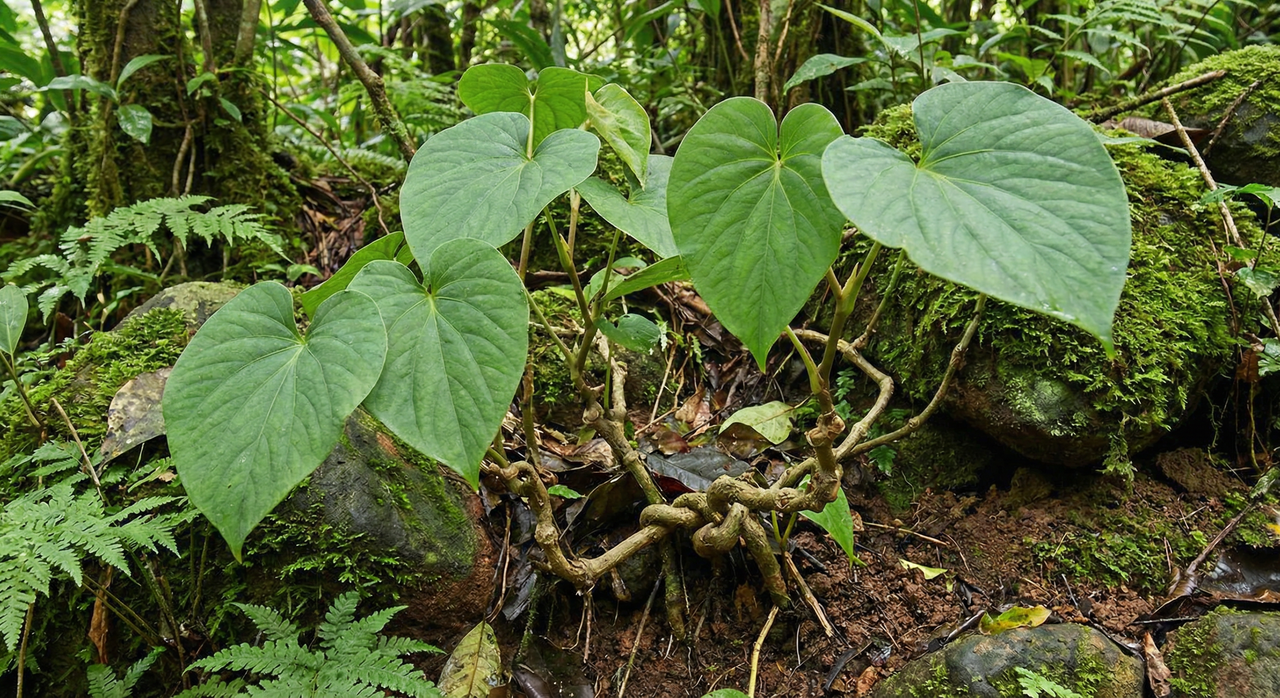
The most celebrated leaves in New Zealand belong to kawakawa. Not perfect, unblemished specimens, but leaves riddled with insect damage, sometimes so thoroughly chewed they look more like lace than foliage. Kawakawa, Macropiper excelsum, wears that damage as a kind of badge: in Māori tradition, heavily perforated leaves are the ones most prized for ceremony and healing, because a leaf worth eating must be a leaf worth finding.[1] I've grown a lot of plants where pest damage is a problem to solve. This is the first one where it genuinely changed how I think about "healthy."
What makes kawakawa so compelling isn't just that single inversion of expectation, though. It's that the plant keeps doing it. It thrives in shade when you'd expect it to struggle. Its peppery, slightly numbing leaves taste like something a chef invented, yet they've been wrapped around hangi stones and brewed into rongoā teas for centuries. And those insect holes? They're partly a consequence of the very chemical compounds that make the plant medicinally interesting, because nothing about kawakawa is accidental.
Kawakawa Origin, History, and Cultural Significance
Botanical Background and Native Range
Kawakawa was originally described as Piper excelsum before morphological and molecular studies moved it into the distinct genus Macropiper, where it now sits as Macropiper excelsum within the Piperaceae family.[2][3][4] That reclassification matters because it places kawakawa in a genus shared with Pacific relatives, most notably Macropiper latifolium, a tropical species native to Papua New Guinea, Vanuatu, Fiji, Samoa, and nearby island groups.[5][6] The two share a family resemblance, but kawakawa is strictly a New Zealand plant, endemic to coastal and lowland forests of the North Island, northern South Island, the Chatham Islands, and nearby offshore islands, typically growing from sea level up to around 600-800 m in shaded, moist conditions within broadleaf and podocarp forest.[7][8][9]
What I find compelling about kawakawa from a permaculture standpoint is its sheer longevity. This is a dioecious, polycarpic perennial that can live 50 to 100 years in natural settings, grows at a moderate 30-60 cm per year when young, and reaches sexual maturity in just 3-5 years.[7][4] A plant that fruits repeatedly for decades and contributes stable structure to the understory is exactly the kind of long-term collaborator I look for when designing a food forest. M. latifolium shares that polycarpic, dioecious reproductive strategy but typically lives 20-50 years and, importantly, should not be confused with true kava (Piper methysticum), a separate species entirely.[10][6] That confusion comes up constantly, so it's worth saying clearly from the start.
Visual Characteristics and Identification
In the field, kawakawa announces itself before you even read the leaves properly. The first thing I look for is the perforations. Those irregular insect-chewed holes aren't damage in any meaningful sense; they're a signature, a record of ecological relationships between this plant and the specialist insects that have evolved alongside it. The leaves themselves are heart-shaped (cordate) with a pointed tip, 5-12 cm long, dark green, glossy, and immediately aromatic when crushed. That peppery scent from the leaf's resins and oil dots connects directly to its traditional culinary and medicinal reputation in a way that's hard to forget once you've experienced it.[7][11] Other helpful identification cues are the translucent leaf margins and the distinctly jointed stems.
The plant grows as a densely branching shrub or small tree, typically 3-7 m tall with a multi-stemmed habit when young that gradually develops a single trunk, with a shallow fibrous root system that allows for some clonal spread.[4][7] Flowers are small, greenish-yellow, and apetalous, appearing on slender cylindrical spikes from spring through early summer (September to December in the Southern Hemisphere), with male and female flowers on separate plants.[7] The fruit clusters are the showstopper: dense spikes 5-10 cm long packed with small fleshy drupes that ripen from green to a vivid orange or red, each with a peppery aroma that draws birds in.[7] The Norfolk Island variety (M. excelsum var. psittacorum) shows broader leaves than the typical mainland form, a small but useful natural variation to be aware of.[12]
Traditional Maori Uses and Cultural Importance
Few plants carry the weight of kawakawa in Māori rongoā tradition. Leaves, bark, and stems have been used across a remarkable range of applications: digestive complaints, toothaches, rheumatism, bruises and cuts, skin conditions, respiratory issues, and as a diuretic or relaxant, prepared as teas, infusions, poultices, and balms.[11][13] The leaves also served as a pepper substitute, which makes sense the moment you crush one and get that sharp, aromatic punch. Seeing the breadth of these uses documented across sources like Te Ara and Landcare Research reinforces something I believe deeply: this kind of encyclopedic indigenous knowledge doesn't emerge from casual observation. It accumulates over generations of careful, respectful practice.
Beyond medicine, kawakawa is woven into Māori ritual and ceremony, used for protection, healing, welcoming, and spiritual purposes as an integral part of indigenous knowledge systems in Aotearoa.[14][15] The related Pacific species M. latifolium carries comparable traditional uses across Pacific Island cultures, from treating skin conditions and rheumatism to ceremonial roles in social bonding and chiefly gatherings, though it lacks significant kavalactones and is pharmacologically distinct from true kava.[16] The confusion between kawakawa, M. latifolium, and Piper methysticum persists in popular writing. For kawakawa specifically, the cultural continuity is what strikes me most: this is not a historical medicinal plant that fell out of use. It remains a living part of Māori identity, ecological heritage, and, increasingly, the regenerative gardens of growers who want their landscapes to carry meaning as well as function.
Kawakawa Varieties and Sourcing
Subspecies and Leaf Morphology of Macropiper excelsum
Macropiper excelsum splits into two recognized subspecies, and the leaf shapes are different enough that once you've seen both, you won't mix them up. Subsp. excelsum carries those classic rounded, heart-shaped leaves up to 12 cm long with a pointed tip and 5-9 longitudinal veins, something like a large-leafed violet scaled up considerably.[7][4][17] Subsp. psittacorum is the one that stops people in their tracks: distinctly lobed, shorter, and broader, with rounded tips that genuinely do look like a parrot's foot. It's a memorable identification cue that sticks.
The broader Pacific relative Macropiper latifolium (sometimes treated as a subspecies or synonym of M. excelsum depending on which taxonomic authority you follow) grows as an upright evergreen shrub reaching 2-3 m with glossy dark-green, heart-shaped leaves 5-15 cm long.[10][18] Crush the leaves and you get that sharp peppery, licorice-like aroma the whole family is known for. It's frost-sensitive, suited to USDA zones 9-11, and is often conflated with both kawakawa and true kava (Piper methysticum). Kawakawa contains only low to negligible kavalactone levels, which matters for anyone expecting kava-like effects.[4][19]
Neither Macropiper excelsum nor M. latifolium has named horticultural cultivars in any formal sense.[7][20] A few specialist nurseries offer selections chosen for leaf size, compact habit, or variegation, but in my trials the variegated forms have been noticeably less vigorous than straight species material, so I'd treat them as curiosities rather than go-to choices for a working food forest.
Sourcing Kawakawa Plants and Seeds in the United States
Kawakawa is not something you'll find at a big-box garden center, and it's not naturalized anywhere in the United States.[21][22] That said, it's findable with some persistence. In the US, One Green World in Oregon and Logee's have carried live plants; Sheffield's Seed Company lists seed.[23][24][25] For New Zealand sources, Koanga Institute, Kings Seeds, Tawhiri Native Plants, and Landscape Plants Nursery all offer seed or plants.[26][27][28][29]
Importing from New Zealand requires a USDA PPQ permit and a phytosanitary certificate from the country of origin confirming the material is pest-free.[30][31] I've navigated this process for other New Zealand natives and the paperwork is manageable, but it takes patience and you should verify current APHIS requirements before ordering because rules shift. M. latifolium faces the same limited US market, with ethnobotanical and specialty tropical-plant suppliers like Strictly Medicinal Seeds being your best domestic bet.[32][33] Whether you go seed or live plant depends partly on budget and partly on kawakawa's notoriously short seed viability, something the propagation section addresses in detail.
Kawakawa Propagation and Planting Guide (Macropiper excelsum)
Kawakawa rewards patient gardeners, but it doesn't reward uninformed ones. Seed-grown plants typically take 3-5 years to reach fruiting maturity, [7] the species is dioecious, meaning you need both male and female plants to get fruit at all, [7] and the seeds are genuinely fussy to work with. I always plant at least three to guarantee both sexes; the first time I waited four years only to discover I had all males taught me to buy extras or propagate both types from known stock.
Seed Characteristics and Germination Timeline
Fresh kawakawa seeds will germinate in around 2-4 weeks at 20-25°C in moist, well-drained media, with success rates between 50-70% when the seed is genuinely fresh. [7] [34] That qualifier matters enormously. Kawakawa seeds are recalcitrant, meaning they're desiccation-sensitive and lose viability fast. [35] From my experience collecting seed from forest-edge plants, even leaving fresh berries sitting on the bench for a few days noticeably drops your odds. Sow within weeks of collection, not months.
Propagation Methods
Kawakawa fruits are small orange-red to black drupes, each holding 1-5 seeds just 1-3 mm across, glossy, dark, with a hard seed coat that often benefits from scarification before sowing. [36] [7] Beyond scarification, germination rates improve with smoke treatment, gibberellic acid, or cold stratification at 4°C for 4-6 weeks; germination rates on stored or dried seed drop sharply and become unpredictable. [37] [38]
For most home gardeners, semi-hardwood cuttings are the smarter route. Taken in late summer or early autumn (late spring works too), 10-15 cm stem sections with lower leaves removed and the base dipped in IBA rooting hormone will root at 70-90% success under high humidity in 4-8 weeks. [39] [40] A peat-perlite-sand mix, indirect light, and optional bottom heat round out the conditions. I lost my first batch to drying out between misting sessions, which taught me to either use a humidity tent or set a timer. Cuttings also fruit faster, typically within 2-3 years rather than 3-5, [7] and if you take cuttings from plants of known sex, you solve the male-female guessing game entirely. Tissue culture exists for commercial production but requires lab conditions that aren't practical at home. [41]
Soil, Site, and Planting Requirements
Kawakawa is a forest understory plant, and its preferences reflect that completely. Partial shade to dappled light is ideal; morning sun is fine, but harsh afternoon exposure causes leaf scorch and bleaching within days. [42] [7] It's similar to the way basil or Piper relatives bleach out under full Florida afternoon sun: fast and unforgiving.
Soil should be a fertile, well-drained loam with good organic matter content, ideally 10-20% compost or leaf mold worked in, at a pH of 5.5-7.0. [7] [43] The root system is shallow and fibrous, a bit like ginger, which means waterlogging causes root rot quickly and soil compaction during establishment sets plants back hard. [44] I now loosen planting holes more thoroughly than I once did after noticing that tightly-packed soil around shallow-rooted plants was slowing establishment. For containers, aim for 40-50% loam, 30-40% organic matter, and 20-30% perlite or sand, with drainage holes and a balanced fertilizer applied sparingly during the growing season. [45]
Spacing, Technique, and Establishment
Kawakawa grows as a multi-stemmed shrub or small tree reaching 2-6 m tall with a 2-4 m spread. [46] For a dense hedge or screen, space plants 1-1.5 m apart; as specimens in a food forest understory, 2 m gives them room to develop naturally. [10] Some climbing subspecies can reach 10 m with structural support, but most garden plants are the upright forms. Plant in spring after any frost risk passes, or in early autumn to allow root establishment before winter. Dig holes twice the root-ball width, backfill with your amended mix, water well, and mulch generously. That first season of consistent moisture is non-negotiable in my experience; kawakawa will tell you very quickly if it's drying out, and recovering a stressed young plant always takes longer than just keeping it moist from the start. Given that you're looking at 3-5 years before fruit, [7] getting establishment right is the investment that makes the whole timeline worthwhile.
Kawakawa Care Guide: Sunlight, Water, Feeding, and Maintenance
Every care decision for kawakawa becomes easier once you accept a single premise: you're trying to replicate a New Zealand lowland forest floor in your garden. That means dappled light, consistent moisture, humus-rich soil, and protection from extremes on both ends of the thermometer. Get those fundamentals right and kawakawa is genuinely forgiving. Miss them and the plant will tell you about it fast.
Light and Water Requirements for Healthy Growth
Kawakawa is a classic understory shrub, happiest in semi-shade to partial sun with dappled light filtering through a canopy above.[47][10] Morning sun is fine; harsh afternoon exposure is not. I've grown it as a specimen in a sheltered east-facing courtyard where the heart-shaped leaves catch that low morning light and practically glow, and it performs beautifully there. In an open south-facing bed with no canopy break? Scorched edges within a season. The soil underneath should be well-drained, fertile, and rich in organic matter, with a pH somewhere between 5.5 and 7.0.[7][48] I target the lower end of that range, around 5.5 to 6.5, which aligns well with the leaf litter soils it evolved in.
Watering Needs and Drought Tolerance
Because kawakawa evolved in humid, high-rainfall understory conditions, it expects consistent moisture and has genuinely low drought tolerance despite what you might assume about a woody native shrub. Young plants need water every one to two days in hot spells, settling to every two to three days under normal summer conditions.[7][49] Once established, you can stretch to every seven to ten days and let the top inch dry slightly between waterings, but never let it go bone dry. Curling leaves, tip burn, and a slightly wilted look signal underwatering; yellowing with soft, soggy roots points to the other direction.[7][1] Those symptoms are worth learning early; catching them before they escalate saves a lot of recovery time.
In practice, the single most effective thing I do is maintain a 10 cm layer of organic mulch around the root zone at all times.[7][50] Leaf litter or bark mulch keeps roots cool, cuts moisture loss by a meaningful margin, and slowly feeds the soil biology that kawakawa depends on. It's the closest approximation to a native forest floor you can create in a cultivated bed. The plant is also sensitive to chlorine and high salinity, so where possible I use rainwater or filtered water rather than straight tap water.
Fertilizing Kawakawa: Low-Input Nutrition
Kawakawa is adapted to low-nutrient forest floor conditions, so the instinct to feed generously is exactly wrong here. Once a year in spring, a light application of balanced organic fertilizer, compost, or well-rotted manure is plenty.[51][47] If you're using a synthetic product, half the recommended strength is the right call. I learned this the uncomfortable way early in my native plant work: too much nitrogen produced lush, soft new growth that became an open invitation for aphids. Not a mistake I made twice.
High-phosphorus fertilizers are worth avoiding too, since excess phosphorus can interfere with the mycorrhizal fungi that kawakawa relies on for nutrient uptake.[52][53] Watch for yellowing leaves (nitrogen shortage), pale areas between leaf veins (iron or magnesium), or brown leaf margins (potassium) as signs the plant needs support. Brown leaf tips with otherwise healthy foliage often indicate over-fertilization rather than deficiency, especially if the plant is also wilting despite adequate moisture.[54][55] A soil test before any application removes the guesswork entirely.
Temperature Tolerance: Frost and Heat Management
Kawakawa is reliably hardy in USDA zones 9 through 11, tolerating temperatures down to around -5°C with good protection, though any frost below 0°C carries real risk of damage.[56][57] The damage pattern looks similar to what you'd see on tender basil or young gingers after a cold snap: blackened, water-soaked leaf tips that quickly turn necrotic.[58] Young plants are especially vulnerable and worth protecting with row covers or a thick mulch layer through the coldest months.[59] A sheltered position against a wall or under a canopy makes a measurable difference in marginal climates.
Pruning, Maintenance, and Seasonal Rhythm
Kawakawa is genuinely low-maintenance once established. Light pruning in late winter or early spring after flowering or fruiting keeps the shape tidy and encourages bushier growth; that's really all it needs.[7][60] Remove dead or damaged leaves as you notice them, but resist the urge to cut back hard. Heavy pruning stresses the plant and rarely benefits it.
The seasonal rhythm is satisfying to follow once you know it. New growth flushes in spring, the plant carries its fullest canopy through summer, and flowers appear from August through November (Southern Hemisphere spring).[4][9] Fruits ripen December through April and are taken quickly by birds. In cooler conditions kawakawa may drop some leaves in autumn, but it's largely evergreen with no true dormancy period, so it stays present and attractive year-round in a suitable climate.[4][10] It's a plant that rewards patient observation rather than intervention, and that's one of the things I genuinely appreciate about it.
Overwintering and Container Growing Tips
Kawakawa prefers temperatures between 15 and 25°C and starts showing heat stress above 30°C, particularly when humidity drops.[7] Wilting, scorched leaf margins, and reduced new growth are the typical signs. In hot, dry summers, 50 to 70% shade cloth over young plants and consistent irrigation are the reliable fixes.[7]
For gardeners outside zones 9 to 11, containers are a practical solution. I've kept kawakawa through cooler snaps by moving pots to a bright, humid indoor spot once temperatures threaten to drop below 10°C, and it handles the transition well as long as the light remains decent and the roots don't dry out.[61] A greenhouse or a sheltered heated porch works equally well. The key is avoiding both cold drafts and dry indoor air, since kawakawa wants the same humid, stable conditions indoors that it enjoys in its native coastal forest habitat. Macropiper latifolium shares most of these cultivation needs and has some additional salt tolerance from its coastal range, though it's a distinct species.[7]
Kawakawa Harvesting: Timing, Technique, and Flavor
Kawakawa is evergreen, so there's a temptation to treat it as an always-open pantry. It isn't. The plant will carry leaves year-round, but the spring-to-autumn window (September through May in the Southern Hemisphere) is when you're getting something genuinely worth harvesting. Young, vibrant green leaves with strong apical buds are the target; early spring harvests in particular yield higher volatile oils and noticeably greater pungency.[11][7][62] The way I think about it is similar to how I select new growth on my basil or pepper plants: that vivid green, tender tip is what you want, not the older, tougher material lower on the stem.
When and How to Harvest Kawakawa Leaves and Fruit
Flowering on Macropiper excelsum runs roughly November through January, with fruit following through summer into autumn. From flower to ripe berry takes about 6 to 8 weeks,[7] which is a relatively quick turnaround compared to the related Macropiper latifolium, where the same process stretches to 90 to 120 days.[63] For kawakawa berries, the visual cue is reliable: wait until clusters are fully black or dark purple, soft to the touch, and detach easily from the spike without tugging.[64][1] That window runs approximately December through April. Where you are in New Zealand matters too; northern populations can start as early as August, while southern gardeners are working within a tighter December-to-February slot.[7] I've noticed the same kind of regional shift in other New Zealand natives, where latitude compresses or stretches every phenological window considerably.
Sustainable Harvesting Practices and Flavor at Peak
The core rule is straightforward: never take more than 20 to 30 percent of foliage from a single plant in one go.[11][7][1] I learned this the hard way after a couple of overly enthusiastic harvests early on. Taking closer to a quarter of the canopy in one session led to noticeably slower regrowth the following season, and the plants looked sulky for months. Traditional Māori harvesting is guided by lunar calendars and careful visual assessment of plant vigor, which is a level of attention that translates well regardless of your cultural background. Harvest in the morning, select healthy young leaves, and treat it like a gentle pruning rather than a collection event. The plant responds well to that kind of respect.
Expected Yields and Flavor Profile
What you're harvesting toward is one of the more distinctive flavor experiences in any New Zealand garden: peppery and spicy with citrus and anise undertones, finishing with a numbing, tingling sensation on the lips and tongue that genuinely stops people in their tracks.[65][66][67] That numbing quality is most pronounced when I chew a leaf harvested in the cool of an early spring morning; older leaves from the heat of summer are milder, sometimes noticeably bitter. The intensity is genuinely timing-dependent, which is exactly why the harvest window matters. On the question of roots: Macropiper latifolium is sometimes used for root preparations after three to five years, though its kavalactone content is substantially lower than true kava.[10][68] Don't let the similar common names confuse you; kawakawa is its own plant entirely, and the leaf harvest is where most of its value lives.
Kawakawa Preparation, Culinary Uses, and Safety
Edible Parts and Flavor Profile of Kawakawa
The young, light-green kawakawa leaves and ripe berries are the parts you actually want in your kitchen.[11][7] That peppery bite isn't random; myristicin and piperine-like compounds are doing the heavy lifting for both flavor and the antioxidant reputation you've likely read about.[69] Fresh leaves hit your nose like a cross between raw onion and black pepper, and the first time I smelled a crushed leaf I genuinely did a double-take. That sharpness mellows considerably with heat or drying, shifting toward something earthier and more herb-like. Mature leaves don't get better with age; they turn tough, bitter, and can cause mouth irritation or stomach upset when eaten raw, so stick to the young growth.[70]
The berries are a separate pleasure entirely: orange-to-black, sweet-tart with peppery depth, lovely dried or in preserves.[7] I think of them as something close to a Sichuan peppercorn in their numbing quality, which makes them genuinely useful in spice rubs and seafood dishes. Eat them in moderation though; a handful can have a mild laxative effect.[1] Roots and stems are a different story: higher alkaloid concentrations make them poor eating, and they're best left to traditional medicinal applications rather than the kitchen.[64]
On nutrition, kawakawa is modest; small amounts of vitamin C and fiber, low calories, not a dietary staple by any stretch.[71] And for anyone wondering about a connection to kava: there isn't one worth chasing. It produces no intoxicating effects.[6] I've grown both, and they're genuinely different plants with different stories. A little kawakawa goes a long way; serious poisoning is unreported, but that's no reason to ignore the moderation guideline.[1]
Traditional Māori Preparation Methods
The Māori kitchen and the Māori medicine cabinet have always overlapped when it comes to kawakawa. Steeping young leaves in boiling water for 10 to 15 minutes produces a tea that captures the plant's beneficial compounds while cooking off much of the raw irritation.[11] I always tell people to start with just one or two young leaves per cup; the myristicin content makes it potent enough that more isn't better, and you can always adjust from there. Drying and grinding leaves into a seasoning powder is another traditional approach, and wrapping food in leaves for hangi or steaming imparts flavor the way bay leaves work in a slow braise.[11][72]
Drying is where the flavor transformation really happens. After about 24 hours in my dehydrator, the sharp allium-pepper scent drops away almost completely, leaving something earthier and more manageable. I learned quickly to label those drying racks, because dried kawakawa looks remarkably like several other herbs once the color shifts. Poultices and medicinal baths round out the traditional repertoire across the broader Macropiper genus, though these sit more firmly in rongoā Māori practice than in everyday cooking.[53]
Modern Culinary Applications and Non-Food Uses
Contemporary New Zealand cooks have picked up where traditional preparations left off, working kawakawa into pestos, rubs, chocolate, and infused oils that bring its distinctive character to a wider audience. The peppery bite pairs particularly well with seafood and strong cheeses. Balms and topical preparations blending kawakawa oil with other botanicals have also found a following, which makes sense given the plant's documented anti-inflammatory compounds.
Beyond the table and the medicine cabinet, kawakawa earns its place in the garden on its own terms. As a landscape designer I often recommend it for its handsome, heart-shaped foliage and its role in supporting native birds and insects.[11] It's a taonga species in Māori culture, and that status deserves real respect in how we grow and harvest it. I leave plenty of berries for the birds and never take more than the plant can comfortably give back. A plant that connects garden, kitchen, and a living cultural tradition is one worth treating with care.[10]
Kawakawa Health Benefits and Medicinal Uses
What strikes me every time I work with kawakawa in a healing garden context is how thoroughly modern research keeps circling back to validate what Māori healers were already doing centuries ago. The plant's medicinal story isn't a recent discovery; it's one of the most coherent bridges between indigenous knowledge and phytochemical science I've encountered in over a decade of working with native plants.
Traditional Māori Medicinal Applications
In rongoā Māori, kawakawa has been a go-to remedy for an impressive range of complaints, used both internally and externally depending on the preparation. These include:
- Skin conditions
- Rheumatism
- Toothaches
- Digestive troubles
- Urinary problems
Key Phytochemicals and Their Roles
The chemistry backs up that complexity. Kawakawa leaves and fruit contain phenylpropanoids (myristicin, elemicin, eugenol, safrole, methyleugenol), piper amides including pellitorine and piperlonguminine, flavonoids such as rutin and quercetin derivatives, and a modest presence of kavalactones (kawain, dihydrokawain, yangonin).[78][79][80] That mention of kavalactones sometimes raises eyebrows, so it's worth being clear: kawakawa is not true kava (Piper methysticum). The kavalactone levels are modest, the psychoactive potential is negligible, and unlike Piper methysticum it carries no documented hepatotoxicity risk.[81][82] I always make sure clients understand that distinction before they start brewing.
The concentration of these compounds isn't fixed; it shifts with geography, season, and growing conditions.[83][84] I've noticed that leaves harvested after a stretch of dry, warm weather tend to have a noticeably more pungent, peppery aroma, which aligns with what the research suggests about stress-induced secondary metabolite accumulation. If your kawakawa smells especially sharp when you crush a leaf, that's the chemistry talking.
Pharmacological Research and Potential Benefits
Preclinical and in-vitro studies have confirmed several of the activities Māori herbalists were relying on long before anyone had a mass spectrometer. Anti-inflammatory effects operate through inhibition of TNF-α, COX-2, iNOS, and NF-κB pathways; antioxidant activity comes from phenolic and flavonoid free-radical scavenging; and antimicrobial action has been demonstrated against Staphylococcus aureus, E. coli, Candida albicans, and oral pathogens.[85][86][75] Leaf extracts have also shown α-glucosidase inhibition (a pathway relevant to blood sugar management) and acetylcholinesterase inhibition with potential neurological implications, alongside preliminary cytotoxicity against certain cancer cell lines, though that last finding is very early-stage.[87][88] The consistent pattern across multiple university studies gives me confidence that kawakawa benefits are real, even while large-scale human clinical trials remain limited. The science is catching up to centuries of observed efficacy.
Nutritional Profile of Berries and Leaves
The nutritional story is supporting cast rather than headline act. Young leaves contain a useful amount of vitamin C (around 100-200 mg per 100 g fresh weight), along with potassium, calcium, magnesium, and iron, plus the bioactive phenylpropanoids that blur the line between nutrition and medicine.[65][89] The bright orange berries are low in calories with high moisture content,[74] edible in moderation, and genuinely refreshing straight off the plant on a warm day in the New Zealand bush. The raw leaves are bitter and peppery with a mild tingling that reminds me of Sichuan pepper; like that spice, the buzz mellows considerably once the leaves are dried or cooked.[90]
Safety Considerations and Cautions
The safety record here is genuinely reassuring. Kawakawa has a long history of traditional use with low acute toxicity and, critically, no documented hepatotoxicity.[91][92] The name similarity to true kava still causes confusion despite kawakawa's lack of liver concerns. I always tell clients: centuries of Māori use show kawakawa is safe in moderation, but if you're pregnant or on blood thinners, get professional guidance before you start a tea habit.
Excessive consumption can cause GI upset, nausea, or oral irritation from the myristicin and pellitorine content, effects that reduce significantly with drying or proper preparation.[91] Skin contact can cause mild irritation or contact dermatitis in sensitive people, so a small patch test before committing to topical use is sensible. Pregnancy and breastfeeding warrant caution given uterine stimulant effects reported in related Piper species, and the plant's anti-inflammatory activity suggests theoretical interaction with anticoagulant medications.[93][94] For pets, large quantities may cause mild digestive upset, though kawakawa isn't considered highly toxic to animals. None of this should frighten anyone away from a plant that has been safely used for generations; it just asks for the same common sense you'd apply to any potent herbal medicine.
Kawakawa Pests and Diseases
Natural Defenses Against Pests and Pathogens
Kawakawa isn't as defenseless as those holey leaves might suggest. The plant produces an impressive suite of bioactive compounds, including myristicin, pellitorine, flavonoids, alkaloids, and terpenes, that actively deter generalist herbivores and demonstrate measurable insecticidal activity.[95][96] These are the same phytochemicals behind kawakawa's medicinal reputation, doing double duty in the plant's own survival strategy. I find that connection genuinely satisfying in a permaculture context: what heals us also protects the plant. Beyond chemistry, kawakawa has a structural trick worth knowing about. Its leaves develop small domatia, tiny hollow structures that house ants, which in turn patrol the foliage and deter leaf-eating insects.[97] I've seen similar ant mutualism in other subtropical understory plants I work with, and it's a reminder that a healthy ecosystem around your kawakawa does a lot of pest management for you.
Common Insect Pests and Management
All those defenses don't stop the kawakawa looper caterpillar (Cleora scriptaria). This specialist has evolved specifically to breach kawakawa's chemical arsenal, and it's the reason your plant ends up with those characteristic holes.[98][99] Populations peak seasonally, and I've learned to check young spring leaves closely because that's when damage accelerates fastest. The good news is kawakawa tolerates this reasonably well and can push new growth after heavy defoliation.[100] Pest pressure does tend to run higher in cultivated gardens than in intact forest settings, so expect to be more hands-on than you might with a wild planting.[101]
Beyond the looper, aphids, scale insects, leafrollers, psyllids, and bronze loopers (Cnephasia quasimodo) can all show up, along with slugs and snails in damper spots.[7][1] Aphids and scale can lead to honeydew buildup and sooty mold, but these respond well to insecticidal soap or horticultural oil rather than anything heavy.[7] For the looper specifically, I reach for Bacillus thuringiensis (Bt) over broad-spectrum options because it leaves the parasitic wasps and tūī intact, and those natural predators are doing real work in a well-designed guild.[102][103] Stressed plants from poor drainage, drought, or nutrient-poor soils are noticeably more vulnerable across the board, so getting the site conditions right is genuinely the first line of defense.[1]
Fungal Diseases and Prevention
Kawakawa's antimicrobial chemistry, myristicin in particular, gives it a baseline of moderate resistance to many bacterial and fungal pathogens.[104][7] The real vulnerabilities are fungal, and they cluster around the same conditions the care guide warns against: poor drainage and poor airflow. Phytophthora root rot is the biggest concern, particularly in waterlogged soils.[105][106] Across multiple plantings, improving drainage has been my single most effective prevention measure, more reliable than any spray treatment. Myrtle rust (Austropuccinia psidii), leaf spot fungi like Mycosphaerella and Alternaria, Botrytis, and Armillaria dieback round out the disease picture, all of them worsened by humidity and crowding.[107][108]
Good spacing, appropriate mulching, restrained fertilization, and avoiding overwatering address most of these risks before they start.[7][109] Comprehensive disease research on Macropiper excelsum specifically is limited, and much of what exists is qualitative, so I'd frame everything here as informed monitoring rather than fixed protocol.[7] Plants in biodiverse, well-structured plantings consistently show less disease pressure than isolated specimens, which is about as permaculture a conclusion as you can draw.
Kawakawa in Permaculture Design
There's a particular moment in a well-established food forest that I keep coming back to: you're moving through the shrub layer and your sleeve catches a kawakawa leaf, and suddenly the whole corridor smells peppery and alive. That scent isn't just pleasing; it's a reminder that this plant is doing chemistry even when you're not paying attention. Macropiper excelsum is native to New Zealand's temperate maritime forests, and every trait it has evolved there maps cleanly onto what permaculture designers actually want from an understory plant.
Climate Suitability and Growing Zones
Kawakawa evolved under Köppen Cfb conditions: mild average temperatures of 10-16°C, high humidity, and 800-2000 mm of annual rainfall.[7][110] It isn't drought tolerant, and once leaves start scorching you're already behind. In cultivation it settles most comfortably into USDA zones 9-11, handling light frosts down to around -2 to -6°C with some site protection.[111][112] In my experience, a frost cloth or a north-facing wall placement has been enough to carry it through the occasional zone 8 dip, but I'd never count on that for a prolonged hard freeze. Exact cold tolerance shifts considerably with plant age, soil drainage, and how long the temperatures hold. In marginal zones, greenhouse protection keeping night temperatures above 10°C is the sensible call.[111] Consistent humidity and wind shelter matter at least as much as hitting an exact temperature minimum.
The related Pacific species Macropiper latifolium grows in true tropical rainforest understories, preferring 21-29°C and rainfall north of 1000-2500 mm, thriving in zones 10-12.[113] For designers working in warmer, wetter climates, the genus stretches that far, but the temperate food-forest case is built squarely around M. excelsum.
Ecosystem Functions and Guild Roles
Kawakawa is dioecious and primarily wind pollinated, its tiny 1-2 mm apetalous flowers arranged in 2-6 cm spikes that produce light, dry pollen with no nectar or scent to attract insects.[7][114] Flies, beetles, moths, thrips, and fungus gnats do visit opportunistically, and pollination success peaks between 15-25°C with humidity above 70%.[115][116] I learned the hard way with an early planting that a single specimen produces beautiful foliage but no fruit; once I added a second plant of the opposite sex with reasonable air circulation between them, the orange-red drupes appeared the following spring. Those fruits attract tūī and kererū for dispersal, so isolation and poor wind flow translate directly into reduced wildlife value.[7][117]
Below ground and through its litter, kawakawa earns its place. It concentrates potassium and other minerals, contributing to soil fertility and microbial activity as its aromatic leaves break down slowly.[11][118] Its roots stabilize slopes and reduce erosion, which makes it a sensible choice on any bank planting. Above ground it hosts the kawakawa looper moth (Cleora scriptaria) and a range of other insects, functioning as a genuine habitat plant rather than just a pretty specimen.[119] The bioactive compounds in the Piperaceae family, including myristicin and elemicin, do deter generalist feeders to a degree, so you're not inviting pest pressure onto neighboring plants.[41]
Forest Layer and Companion Planting
In canopy structure terms, kawakawa sits in the shrub and small tree layer, typically reaching 3-6 m and occasionally pushing to 10 m in ideal conditions.[7][4] It tolerates 70-90% canopy cover, which puts it in the same functional niche as cardamom or a robust ginger — but with better cold hardiness and a native-pollinator benefit that subtropical culinary plants don't deliver. It behaves as a pioneer and early-to-mid successional species, colonizing light gaps and forming arbuscular mycorrhizal associations that help it pull phosphorus from acidic soils.[120][121]
I routinely pair kawakawa with hen-and-chicken fern (Asplenium bulbiferum) and have noticed consistently better vigor in both compared to where I've planted either alone. I suspect the shared mycorrhizal network plays a role, though I can't claim a controlled experiment. Coprosma species make strong companions too, and tree ferns give the shading overhead structure that kawakawa genuinely appreciates.[122][7] The main thing to avoid is pairing it with aggressive heavy feeders that will outcompete at the root zone; kawakawa is a contributor to the guild, not a fighter for it. For designers working in subtropical climates, M. latifolium's more scandent habit and taproot-driven drought tolerance open up different design possibilities,[10] but for the temperate maritime food forest, M. excelsum is the one to plant and learn.
The Holey Leaf That Redefined Perfection
I used to instinctively weed out insect-chewed foliage before photographing a garden. Kawakawa cured me of that. Those looper holes aren't damage; they're the plant's biography, proof that something wild and specific chose it. The first time I brewed a simple tea from leaves I'd grown myself, that peppery warmth sitting at the back of my throat, I felt connected to something much longer than my own gardening life. That doesn't happen often.
Sources 122
- Kawakawa | New Zealand Department of Conservation ↩
- Tropicos ↩
- Angiosperm Phylogeny Group - APG IV ↩
- Macropiper excelsum - Wikipedia ↩
- Macropiper latifolium - Kew ↩
- Macropiper latifolium - Wikipedia ↩
- Kawakawa (Macropiper excelsum) - New Zealand Plant Conservation Network ↩
- Plants of the World Online ↩
- Kawakawa (Macropiper excelsum) - Te Ara Encyclopedia of New Zealand ↩
- Kawakawa (Macropiper latifolium) - New Zealand Plant Conservation Network ↩
- Kawakawa - Te Ara ↩
- Flora of New Zealand: Macropiper excelsum ↩
- Kawakawa (Macropiper excelsum): Traditional Uses and Bioactivity ↩
- Kawakawa - Te Ara ↩
- Traditional Uses of Kawakawa - New Zealand Forest and Bird ↩
- Ethnobotany of the Pacific Islands: Macropiper latifolium in Traditional Ceremonies ↩
- Flora of New Zealand - Taxa: Macropiper excelsum ↩
- Plants of the World Online (POWO) - Macropiper latifolium ↩
- Kawakawa (Macropiper latifolium): Chemistry, Traditional Use and Study of Biological Activity ↩
- Pacific Island Kava Cultivars and Their Diversity ↩
- Macropiper excelsum - Kawakawa ↩
- USDA PLANTS Database - Macropiper excelsum ↩
- Kawakawa - Macropiper excelsum ↩
- Macropiper excelsum Seeds ↩
- Kawakawa (Macropiper excelsum) - Availability ↩
- Kawakawa (Macropiper excelsum) Seeds ↩
- Macropiper excelsum - Kawakawa ↩
- Native Plants for Sale ↩
- Kawakawa Plants ↩
- Importing Plants and Plant Products ↩
- Federal Noxious Weed List ↩
- USDA PLANTS Database - Plant Profile for Macropiper latifolium ↩
- Kawakawa Seeds - Macropiper latifolium ↩
- Kawakawa - Growing Native Plants ↩
- Seed Storage of New Zealand Native Plants ↩
- Flora of New Zealand - Macropiper excelsum ↩
- Kawakawa Propagation Guide ↩
- Seed Germination in Macropiper excelsum ↩
- Growing Kawakawa from Cuttings ↩
- Propagation of Native Plants in New Zealand ↩
- Micropropagation of Macropiper excelsum ↩
- RHS Plant Finder - Macropiper excelsum ↩
- Growing Kawakawa - Te Ara Encyclopedia of New Zealand ↩
- Soil Requirements for Native NZ Trees ↩
- Growing Native Shrubs in Pots - New Zealand Plant Conservation Network ↩
- Growing Kawakawa in Your Garden ↩
- Kawakawa (Macropiper latifolium) - Cultivation Guide ↩
- Kawakawa – New Zealand Plant Conservation Network ↩
- Growing Kawakawa - New Zealand Garden Journal ↩
- New Zealand Native Plants: Watering and Soil Requirements ↩
- Nutrient Requirements of Native New Zealand Trees ↩
- Fertilizer Guidelines for Native New Zealand Plants ↩
- Horticulture of Kawakawa ↩
- Nutrient Deficiency Symptoms in Piper Crops ↩
- Soil Fertility for Native New Zealand Plants ↩
- Macropiper excelsum - Kew Royal Botanic Gardens ↩
- Kawakawa (Macropiper excelsum) - RHS Gardening ↩
- Frost Damage in Plants - Royal Horticultural Society ↩
- Growing Kawakawa: Frost Tolerance and Care ↩
- Pruning Techniques for Piper Species - University of Hawaii Extension ↩
- Royal Horticultural Society - Overwintering Tender Plants ↩
- Kawakawa (Macropiper excelsum): A Review of Its Traditional Uses and Phytochemistry ↩
- Phenology and reproductive biology of Macropiper latifolium ↩
- Kawakawa (Macropiper excelsum subsp. excelsum) ↩
- Kawakawa: Flavor and Uses in Maori Cuisine - Te Ara Encyclopedia ↩
- Chemical Composition and Flavor of Kawakawa Leaves - Journal of Essential Oil Research ↩
- Kawakawa (Macropiper excelsum) - A Review of Its Traditional Uses and Phytochemistry ↩
- Harvesting Kava (Piper methysticum): Maturity and Techniques ↩
- Phytochemical Investigation of Macropiper excelsum ↩
- Kawakawa - Macropiper excelsum ↩
- Nutritional and Bioactive Compounds in Indigenous New Zealand Plants ↩
- Māori Healing and Herbal Medicine ↩
- Traditional Uses of Kawakawa in Māori Medicine ↩
- Kawakawa (Macropiper excelsum) ↩
- Kawakawa (Macropiper excelsum): Traditional Uses and Pharmacology ↩
- Kawakawa (Macropiper excelsum): A Review of its Traditional and Medicinal Uses ↩
- Macropiper excelsum: Ethnobotany and Phytochemistry ↩
- Phytochemical Investigation of Macropiper excelsum ↩
- Chemical Composition of Essential Oils from Kawakawa Leaves ↩
- Secondary metabolites from the leaves of Macropiper excelsum (Piperaceae) ↩
- Kavalactones in New Zealand Kawakawa (Macropiper latifolium) ↩
- Toxicological Profile of New Zealand Native Plants ↩
- Chemical Variation in Kava (Piper methysticum) from the Western Pacific ↩
- Influence of Environmental Factors on Kavalactone Accumulation in Kava ↩
- Antioxidant and Anti-inflammatory Activities of Macropiper excelsum ↩
- Antimicrobial Activity of Extracts from Macropiper excelsum ↩
- Antioxidant and enzyme inhibitory activities of kawakawa extracts ↩
- In Vitro Cytotoxicity of Macropiper excelsum Leaf Extracts ↩
- Nutritional and medicinal properties of New Zealand native plants ↩
- Traditional Maori Uses of Kawakawa ↩
- Safety Assessment of New Zealand Native Plants: Kawakawa ↩
- Exploring the Chemical Space of Kawakawa Leaf (Piper excelsum) - PMC ↩
- Herbal Medicine Safety in Pregnancy ↩
- Toxic Plants in New Zealand ↩
- Chemical and structural defenses in Macropiper excelsum ↩
- Phytochemistry of Piperaceae species ↩
- Ant-plant interactions in New Zealand flora ↩
- Kawakawa Looper - Landcare Research ↩
- Herbivory on Endemic New Zealand Plants - Journal of Ecology ↩
- Herbivory impacts on kawakawa ↩
- Insect Pests of Kawakawa - Landcare Research New Zealand ↩
- Integrated Pest Management for Native Plants - Te Ara Encyclopedia ↩
- Kawakawa Looper Control - Manaaki Whenua Landcare Research ↩
- Pathogen Susceptibility in Piperaceae ↩
- Phytophthora Diseases in Native Plants ↩
- Phytophthora Root Rot in Piperaceae ↩
- Myrtle Rust in New Zealand ↩
- Diseases of Native New Zealand Plants ↩
- Horticultural Management of Native New Zealand Plants ↩
- Köppen-Geiger Climate Classification Map for New Zealand ↩
- Kawakawa (Macropiper excelsum) ↩
- Kawakawa (Macropiper excelsum) Plant Profile ↩
- Macropiper latifolium - Useful Tropical Plants Database ↩
- Reproductive ecology of kawakawa, Macropiper excelsum (Piperaceae) ↩
- Pollination Biology of Macropterix excelsa (Piperaceae) in New Zealand ↩
- Insect Visitors to Flowers of Kawakawa (Macropiper excelsum) ↩
- Seed Dispersal by Birds in New Zealand Forests ↩
- Nutrient Cycling in Temperate Rainforests ↩
- Insect-Plant Interactions in Kawakawa Forests ↩
- Ecology of Kawakawa (Macropiper excelsum) in New Zealand Forests ↩
- Mycorrhizal Fungi and Native Shrubs: Case Study on Macropiper excelsum ↩
- Kawakawa in Permaculture ↩