There's a plant sitting in my Central Florida food forest right now that could stop a determined cow, feed a family, and outlive most of the trees around it on almost no care whatsoever, and most people I talk to at plant swaps have never heard of it. The Kei Apple, Dovyalis caffra, gets lumped into the "interesting thorny hedge" category and promptly forgotten. This is a shame, because that framing misses the whole point. This is a fruit tree that just happens to also be a fortress.
The first time I bit into a ripe one, I wasn't prepared. The color is this warm, golden-apricot glow that says "sweet," the aroma backs that promise up completely, and then your mouth hits something closer to a sour gooseberry crossed with a shot of citrus. It's startling in the best way. The fruit is intensely acidic, almost aggressively so, and that quality is actually the key to understanding why this plant deserves a serious second look, both in the kitchen and in the landscape. Once you know what you're working with, it stops being a disappointment and starts being exactly what you needed.
Kei Apple Origin and History
Some plants earn their common name from mythology or marketing. The kei apple earned its name from a river. The Kei River runs through South Africa's Eastern Cape, and it's the heart of native Dovyalis caffra territory, a region of savanna thickets and thornveld where this small, ferociously spiny tree has held its ground for centuries. That geography tells you something fundamental about the plant before you've even touched it: it comes from a place that rewards toughness and punishes complacency.
Native Range and Traditional Cultural Significance of Dovyalis caffra
In its homeland, the kei apple tree has long been valued by Xhosa and Zulu communities not just as a source of tart, apricot-colored fruit, but as a living barrier that kept livestock in and predators out. Those thorns, which can run an inch and a half long on mature stems, are not incidental. They are the whole point of the hedge. This is a plant that has protected homesteads and fed families for generations in its native South Africa, and when I think about how I use similarly armed species in my own permaculture designs here in Central Florida, I find myself looking at the kei apple with a lot of earned respect. It was doing agroforestry before we had a word for it.
Western botany formally described Dovyalis caffra in the 19th century, and by the early 20th century it had begun traveling to warmer regions across the globe as a hedge plant and minor fruit crop. Australia, California, Florida, and parts of the Mediterranean all saw introductions, usually driven by the same logic that made it useful in the Eastern Cape: you can't get through it, and the fruit is a bonus. In my food forest, watching it grow through its first few seasons, I came to understand viscerally why traditional communities treated it as infrastructure rather than just another fruiting shrub.
Botanical Background and Visual Characteristics
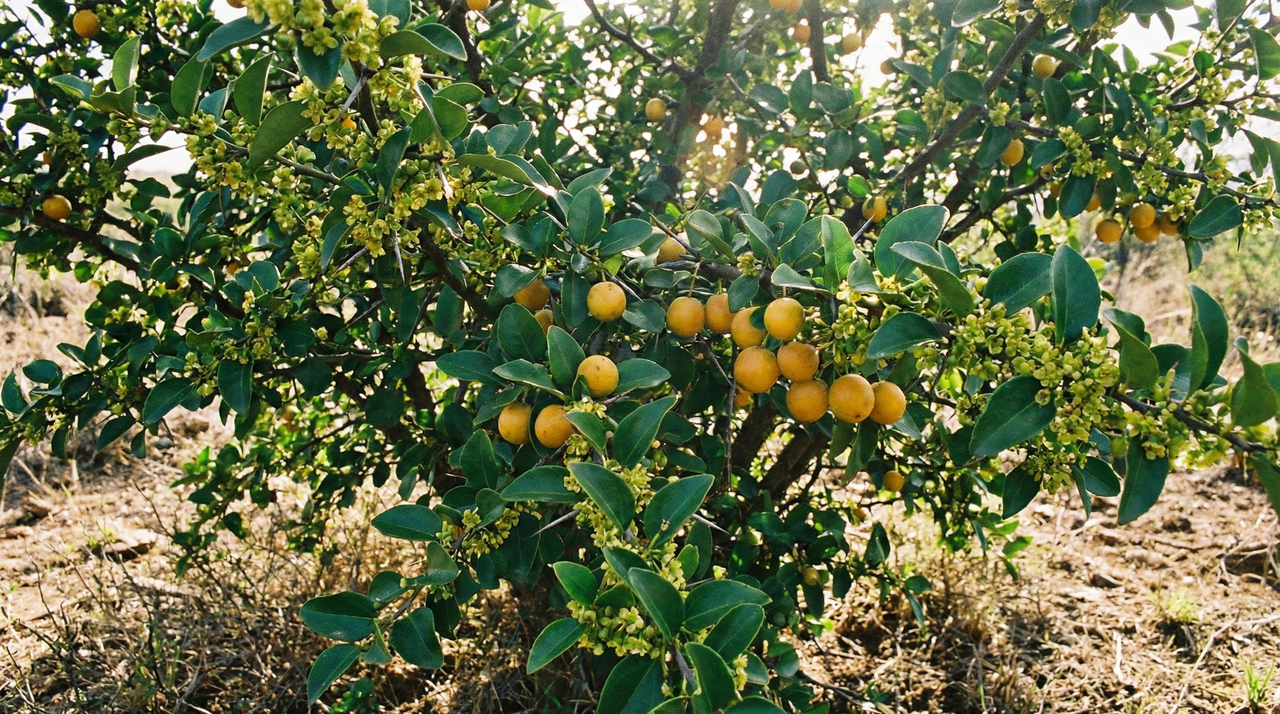
Classified in the Salicaceae family (it was long housed in Flacourtiaceae before molecular work reorganized the group), Dovyalis caffra is typically a small evergreen tree or large shrub, reaching anywhere from ten to twenty feet depending on site and management. The leaves are glossy, slightly leathery, and deep green. The flowers are insignificant. The thorns are not. And then in summer, clusters of smooth, golden-yellow fruits appear among all those spines, looking almost cheerful against the ferocity of the wood that holds them.
The physical appearance of the fruit presents a striking contrast against the defensive thorns. The scent is lovely, floral and bright, which makes the pucker that follows feel like a bit of a trick. In my subtropical climate, the plant holds onto that assertive, tangy character that its African origins seem to have locked in genetically, regardless of our humidity and heat. That resilience across wildly different environments is exactly why regenerative gardeners are starting to pay closer attention to this underutilized African fruit, and why understanding its roots matters for anyone who wants to grow it well.
Kei Apple Varieties and Sourcing
Dovyalis caffra doesn't have a tidy catalog of named cultivars the way apples or citrus do. That's just the reality of working with a plant that has spent most of its horticultural life as a utilitarian hedgerow species rather than a commercial crop. A few regional selections do exist, chosen over generations for larger fruit, better sweetness, or slightly less ferocious thorniness, but they've never been systematically named, registered, or propagated at scale. You're unlikely to find them described in any nursery catalog outside southern Africa or a handful of specialist growers in California, Florida, and Australia.
Named Selections and Regional Forms
The broader Dovyalis genus includes several related species worth knowing if you're deep in the rabbit hole:
- Dovyalis zeyheri
- Dovyalis abyssinica
- Dovyalis hebecarpa (Ceylon gooseberry)
- Dovyalis rhamnoides
- Dovyalis macrocalyx
- Dovyalis longispina
- Dovyalis afra
How to Source Kei Apple Plants
Sourcing is where patience becomes a real virtue. I've had far better luck tracking down kei apple through tropical fruit societies and rare-plant exchanges than through conventional nurseries. The California Rare Fruit Growers network and similar groups in Florida are good starting points. When you do find a plant, check it carefully: glossy, deep green leaves, visible thorns even on young growth, and no signs of scale along the stems. Compared to finding pineapple guava or loquat, which show up at nearly any independent garden center in zone 9, kei apple requires some real hunting.
Grafted selections fruit faster, but the seedling-grown plants I've installed in Central Florida hedgerows have developed the densest, most impenetrable branching over time. For a living security fence, that trade-off often favors the seedling. Supporting the small nurseries and enthusiast networks keeping this species in circulation matters more than it might seem. Every plant sold is an argument for growing the collection.
Kei Apple Propagation and Planting Guide
Growing Kei Apple from seed is not a weekend project. The seeds can take anywhere from two to four months to germinate even under good conditions, and plenty of them simply won't. I've worked with similarly finicky subtropical species, pawpaw being the obvious comparison, and Kei Apple requires that same kind of stubborn patience. The reward is worth it, but you need to go in with realistic expectations or you'll give up right before things get interesting.
Seed Propagation and Germination for Kei Apple
Fresh seed gives you the best odds. Extract seeds from ripe fruit, rinse off the pulp, and let them dry briefly before sowing. That hard seed coat is the main obstacle, so I always scarify lightly with sandpaper or nick the coat with a nail file before soaking overnight in warm water. Sow into a mix of coarse sand and quality seed-raising mix, about one part to two, which keeps things draining well without drying out entirely. Bottom heat, around 75 to 85 degrees Fahrenheit, speeds things up considerably. Keep the medium consistently moist but never waterlogged, and then wait. And wait some more.
The seedlings, when they finally arrive, will look almost disappointingly spindly for the first season. I used to second-guess myself when I saw those thin little stems barely moving. Then the second year hits and the plant seems to remember what it is, and suddenly you've got something vigorous and unmistakably thorny on your hands. That slow start is normal; resist the urge to overfeed it into faster growth.
Semi-hardwood cuttings taken in late summer are worth attempting if you want more reliable results, particularly if you need female plants for fruiting. Treat cut ends with rooting hormone powder, stick them into a moist perlite and peat mix, and cover to maintain humidity. Rooting takes six to ten weeks. The bigger reason to go the cutting route is one thing I'd tell any new grower of dioecious species: label everything carefully. Male and female Kei Apple plants are completely indistinguishable until they flower, which from seed can take three to five years. If you're sourcing cuttings from a known female, you're saving yourself years of uncertainty.
Site Selection, Soil, Spacing, and Planting Techniques
Full sun is non-negotiable. I've seen Kei Apple planted in partial shade for hedging purposes and it just sulks, growing slowly and producing poorly. Choose the sunniest, most open spot on your property, ideally with some protection from strong prevailing winds while the tree establishes, since young specimens are more vulnerable than mature ones.
Soil pH matters more than most people realize with this species. I always run a simple pH test for clients before planting, and for Kei Apple I'm aiming for something between 5.5 and 7.0. Below 5.5, you start seeing nutrient lockup, and the plant never quite hits its stride. If your soil is naturally acidic, a lime application a few weeks before planting is a straightforward fix.
Dig a generous hole, roughly twice the root ball, and backfill with a blend of native soil and mature compost. Skip the fertilizer at planting; fresh roots are sensitive and there's no benefit in burning them before the plant has even settled in. For a productive living fence or hedge planting, space individual plants eight to twelve feet apart. You'll get more security and a tighter barrier at the closer end, but the plants will appreciate the breathing room as they mature into what can eventually become twenty-foot specimens. Water consistently through the first year, especially during dry spells, because establishment is where most losses happen with this species.
Kei Apple Care Guide: Growing Dovyalis caffra Successfully
The single biggest mistake I see people make with kei apple is treating the establishment phase like an afterthought. Those first two to three years are genuinely make-or-break. Young trees need consistent moisture to drive deep root development, and even one prolonged dry spell during that window can set a sapling back severely or kill it outright. I check my young specimens far more often than I think I need to, because once you lose one to drought stress, you don't forget it. The reward for that vigilance is a mature tree that becomes one of the most self-sufficient specimens in the food forest, requiring only deep, infrequent watering rather than anything like a regular schedule.
Water, Sunlight, and Soil Needs for Young and Mature Trees
I watch for a specific visual cue to know when a young kei apple has turned the corner: the new leaves stop looking soft and slightly translucent and start developing that characteristic glossy toughness. When I see that shift, I know the root system has gone deep enough to start pulling from the soil's reserves, and I can begin backing off irrigation. Until then, I treat it like any other demanding subtropical fruit tree.
On placement, full sun is non-negotiable if you want heavy crops. Dovyalis caffra will survive in partial shade, but the fruit production drops off enough that it stops justifying the thorns. I always position mine where it gets at least six hours of direct sun, ideally more.
Feeding, Pruning, and Seasonal Maintenance
Kei apple is not a greedy plant. I treat it more like a native understory tree than a pampered orchard specimen: a light application of balanced organic fertilizer in spring for young trees, and then essentially nothing for established ones in decent soil. Compare that to citrus, which will send you shopping for amendments every few months. The kei apple largely feeds itself once it's settled in.
Pruning is where having the right tools matters more than technique. I keep a pair of long-handled loppers and a set of gauntlet gloves specifically for this tree; regular garden gloves are not adequate protection against those spines. Prune in late winter, before the spring growth flush, and focus on removing crossing branches and opening up the center for airflow and easier harvest access. You can shape it as a single-trunk tree or a multi-stemmed shrub depending on your design intent. Either way, the goal is a structure you can actually reach into without injury.
Through the growing season, spring to early fall, the tree takes care of itself. In winter, I scale back irrigation and just keep an eye on the forecast.
Frost Protection and Heat Tolerance Strategies
Once established, kei apple laughs at Florida summers that would cook most other fruit trees, handling temperatures well past 100°F as long as there's some soil moisture available during the worst of it. That heat tolerance is genuine and remarkable. The frost picture is more nuanced. Mature trees can handle brief dips to around 20°F, but young trees and open flowers are at risk below 28°F. I learned this the hard way: I lost my first tree to an unexpected dip below that threshold before I took the dormancy window seriously. Now I keep frost cloth ready from November through February and plant near thermal mass wherever possible. The temperature thresholds are well established enough that I don't take chances with young specimens anymore. Plant in a protected microclimate if you're in a marginal zone, and that investment of thought upfront buys you decades of essentially hands-off growing.
Harvesting Kei Apple (Dovyalis caffra)
One thing that surprised me in my first full fruiting season was how the kei apple doesn't hand you a harvest so much as it doles one out. Fruit ripens individually and continuously over what can stretch into a two-to-three-month window, which means you're not dealing with a single overwhelming glut. You're doing small, frequent picks. After a few seasons I've settled into harvesting every other day at peak, partly because I've learned the birds are paying equally close attention, and in Central Florida's humidity the fruit flies don't need much of an invitation.
Ripeness reads in two ways: color and touch. Watch for the shift from bright green to a warm golden-orange, then cup the fruit in your palm and apply gentle thumb pressure. A ripe kei apple gives just slightly, like a plum that hasn't quite gone soft. There's also a faint, almost pineapple-like aroma that releases right when the fruit is ready. I trust that cue more than any calendar now.
The thorns are genuinely formidable, so thick gloves and long sleeves aren't optional. Technique matters too. Cup the fruit and twist rather than yank; yanking tears the skin and can damage the fruiting spurs you're counting on for next year's crop. I think of it the way I harvest citrus or passionfruit, a deliberate, gentle motion that respects the plant's architecture.
A mature ten-foot specimen will realistically give you somewhere in the range of thirty to fifty pounds across the season. My first year I tried picking unripe green fruit for pickling and ended up with something so searingly sour it was nearly inedible. That experiment taught me the color change isn't decorative; early-harvest fruit works in cooked preparations with plenty of sweetener, but it is not forgiving eaten out of hand. Tree-ripened fruit is a different thing entirely, pleasantly tart-sweet with genuine depth. Whatever stage you pick, use it within two or three days. In this heat and humidity, a bowl of ripe kei apples doesn't wait around for you to get organized.
Kei Apple Preparation and Uses
The raw fruit commands a serious warning: bite into one unprepared and its extreme astringency will overwhelm you. I say this from experience with similarly astringent fruits, and the sensation is real. Raw, the fruit is almost aggressively tart and tannic, which is why most people who encounter it fresh and unprepared write it off entirely. That's a mistake. The same intensity that makes it nearly inedible out of hand is exactly what transforms it into something extraordinary in the pot.
Culinary Uses: From Tart Fruit to Jams, Jellies, and Syrups
Cooked with sugar, kei apple develops a bright, complex flavor that lands somewhere between gooseberry and apricot, genuinely unlike anything you'd get from a standard fruit preserve.[1] What makes it especially appealing for home preservers is the naturally high pectin content, meaning you don't need to add commercial pectin to get a firm, glossy set.[2] The fruit basically does the work for you, once you get the sugar ratio right.
And that ratio matters. My early experiments with high-pectin fruits taught me that under-sweetening is the most common first-batch mistake. Most kei apple recipes call for a 1:1 sugar-to-fruit ratio or higher, with long cooking times to mellow the acidity while the pectin locks in a solid set.[3] In South Africa, the fruit has long been made into chutneys, pickles, and baked goods, and there's even a tradition of fermenting it into a pale, dry wine.[4][5] Those traditions speak to a deep understanding of how to get the most from a fruit that doesn't give itself up easily. You don't need specialty equipment to follow their lead; a heavy-bottomed pot, good sugar, and patience are enough to turn a thorny harvest into pantry gold.
Traditional and Medicinal Preparations
The kei apple's vitamin C content supports its use in traditional wellness preparations, typically cooked down into syrups or teas where the heat tempers the tartness and concentrates the nutrients.[1] Leaves and roots also appear in African folk medicine, used historically as decoctions or poultices for chest complaints, rheumatism, and as a vermifuge.[6] I'd frame these honestly: the scientific validation is thin, and this isn't a primary medicinal plant. If you're curious about those traditional applications, speak with a qualified practitioner rather than relying on folk documentation alone.
Non-Food Uses of Kei Apple
The fruit isn't the only useful product here. Kei apple wood is dense, yellowish, and tough enough to be fashioned into tool handles, fence posts, and small implements,[4][7] and in humid climates that density means it holds up where softer woods would rot. The thorny branches, of course, have always been the plant's most legendary feature, and their value as a living security barrier is something any permaculture designer should factor into the guild from day one. In a well-designed system, nothing from this plant goes to waste.
Kei Apple Health Benefits and Medicinal Uses
Honest answer: the research on Kei apple's health benefits is thin. Not because the fruit lacks nutritional merit, but because Dovyalis caffra simply hasn't attracted the clinical attention that more commercially prominent fruits have. What we do have is a solid nutritional foundation and a long thread of traditional use that points toward real value, even if the peer-reviewed data hasn't caught up yet.
Nutritional Profile and Vitamin Content
The fruit is a meaningful source of vitamin C, with the kind of immune-supporting, antioxidant-relevant content you'd expect from a fruit this aggressively tart.[8] That sharply acidic intensity is actually a useful heuristic. Very tart fruits tend to be vitamin C-dense, and Kei apple follows that pattern in the same way lemon, tamarind, or unripe guava does. Beyond vitamin C, the fruit delivers potassium, calcium, and magnesium per 100g serving,[9] making it a more complete contribution to the diet than its obscurity might suggest. These values do shift with ripeness and growing conditions, so treat them as a useful ballpark rather than a fixed figure.
Potential Antioxidant and Traditional Benefits
Traditional use in South Africa includes applications for digestive ailments and general tonic purposes,[10] and that tracks with what we know about high-acid fruits in general. Acidity and astringency have long been used empirically to support digestion, and the fruit's phenolic compounds show preliminary antioxidant activity in lab analysis, even though human trials remain scarce.[11] While we don't have the depth of clinical literature that exists for fruits like amla or elderberry, the polyphenol presence suggests genuine antioxidant potential rather than wishful thinking. What I've found working with underutilized subtropical fruits is that ethnobotanical records are often a reliable early signal, and the South African traditional knowledge around Kei apple is worth taking seriously as a starting point, not a conclusion.
Safety Considerations
The fruit is safe to eat for most people, with no significant contraindications or toxicity documented in the literature.[12] I've never personally seen an adverse reaction from eating the fruit itself, though eating too many on an empty stomach will cause the kind of stomach twinge you'd expect from any very acidic fruit. That's physiology, not toxicity. If you're pregnant or considering concentrated medicinal preparations rather than culinary use, consulting a healthcare provider is simply good practice.[13] My honest recommendation is to enjoy Kei apple primarily as food, where its nutrition is unambiguous, rather than leaning on it as a medicine where the evidence is still catching up to the tradition.
Kei Apple Pests and Diseases
This is one of the shortest conversations I have when someone asks me about growing Kei apple. Compared to the citrus, passionfruit, and stone fruits sharing space in my Central Florida garden, Dovyalis caffra is about as close to bulletproof as a fruiting plant gets. I've never reached for a spray bottle on mine. Not once.
The literature on Kei apple pests and diseases is thin, and that scarcity actually tracks with what I see in practice. Where my loquat collects leaf spot and my pawpaw attracts every caterpillar in the county, the Kei apple sits there unbothered. The thick, waxy leaves seem to hold little appeal for the chewing insects that devastate softer-leaved fruiting shrubs, and I've never noticed the kind of scale or aphid buildup that regularly plagues my citrus in summer.
In warm, humid climates, fruit flies can occasionally take interest in any ripening fruit, and Kei apple is no exception when the crop is heavy. But even then, good garden hygiene handles it: collect fallen fruit promptly, keep the area under the canopy clear, and the problem rarely compounds. A diverse planting around the shrub also helps. I've found that interplanting with aromatic herbs and flowering perennials reduces pest pressure across the whole guild by supporting predatory insects that do the cleanup work for you. That's the permaculture approach anyway, and with Kei apple, you barely need it.
The thorns themselves are not poisonous. They're formidable, absolutely, but the danger is purely mechanical. Wear thick gloves during any work near the plant and you're fine. The thorn concern is a handling issue, not a toxicity one, and it shouldn't factor into your pest management thinking at all.
Plant it, mulch it, diversify around it, and largely leave it alone. Few fruiting plants in this climate reward that approach as reliably.
Kei Apple in Permaculture Design
There's a category of plants I think of as "doing double duty on the edge," and the Kei apple sits firmly in that group. It's not a plant you tuck into the middle of a design and forget about. It wants to be at the boundary, working the margins, and that's exactly where it earns its place. I've spent years incorporating thorny barrier species into client landscapes in Central Florida, and the logic is always the same: why install a fence when you can grow one that also feeds you?
Ecosystem Functions and Roles
The Kei apple's most obvious function in any permaculture system is physical security. Those spines are genuinely formidable, and a mature hedge planting becomes impenetrable to livestock, deer, and, yes, uninvited human visitors alike. That's not a small thing if you're managing a homestead or food forest on a rural property. Beyond security, the dense, evergreen canopy structure creates real microclimate value. Planted on a prevailing wind side, a row of Kei apple significantly reduces wind velocity at ground level, which matters for protecting more tender fruiting plants nearby.
One question I get asked occasionally is whether a thick hedge like this attracts snakes. Any dense groundcover or shrub can provide snake habitat because it provides the cover and prey habitat (rodents, lizards) that snakes follow. The Kei apple hedge is no exception. The practical answer is to keep the base of the hedge clear of debris and low groundcovers if that's a concern, especially near high-traffic areas. The thorns themselves offer no deterrent to reptiles whatsoever.
On the nutrient side, Kei apple is not a nitrogen-fixer, so don't expect it to do that work for the guild. What it does contribute is biomass. Regular formative pruning yields woody material for chop-and-drop mulching, and the fallen fruit that doesn't get harvested feeds soil biology as it breaks down. The dense root system also holds soil on slopes, which is a quiet but real function in erosion-prone sites.
Forest Layer and Guild Opportunities
In a layered food forest, the Kei apple occupies the shrub-to-small-tree layer, typically reaching somewhere between three and six meters depending on conditions and pruning history. That puts it comfortably beneath a canopy of larger trees like pecans or avocados while still clearing the ground layer entirely. I'd site it along the sunny southern or western edge of a food forest rather than tucking it into an interior position where it would compete for light and create access problems.
A lesson I learned the hard way early in my design work: spiny plants need a buffer. I once placed a thorny shrub too close to a main harvest path, thinking I could just "keep it trimmed." Two seasons later, clients were complaining, and I was out there with heavy gloves fixing a problem that proper placement would have prevented. Give the Kei apple at least two to three meters of clearance from any path you walk regularly. Site it deliberately near a boundary, not as an afterthought.
For guild companions, I'd pair it with drought-tolerant nitrogen-fixers like pigeon pea or Leucaena on the interior side, letting them feed the soil the Kei apple can't. Low-growing, thornless ground covers that won't compete aggressively work at the drip line. The dense canopy suppresses weeds well enough that you don't need heavy mulching once the plant is established. Think of it like loquat or pineapple guava in its role: a tough, adaptable fruiting layer plant that handles neglect far better than most, but rewards thoughtful placement.
Suitable Climates and Growing Zones
The Kei apple comes from the dry forests and thicket margins of South Africa's Eastern Cape, an environment defined by heat, occasional drought, and periodic cold nights but rarely hard freezes. That background translates reasonably well to USDA zones 9 through 11, with some reports of successful cultivation in protected microclimates in zone 8. In my zone 9B garden in Central Florida, plants with this kind of semi-arid subtropical origin almost always perform best when given full sun, decent drainage, and the occasional dry period rather than constant irrigation. They seem to respond to a little stress the way most of us respond to a deadline.
Frost is the real limiting factor. Young plants are more vulnerable than established ones, and a hard frost will set them back significantly even if it doesn't kill them outright. If you're on the cooler edge of the range, siting the Kei apple against a south-facing wall or in a frost pocket-free zone on your property isn't just cautious, it's strategic. The same placement that protects the plant also tends to maximize fruit production, so there's no design sacrifice involved. Warm-climate gardeners in humid subtropical regions will find it far more forgiving than the sparse literature suggests.
The Plant That Made Me Respect a Thorn
I've drawn blood from this plant more than once, and I keep planting it anyway. There's something clarifying about a fruit tree that genuinely doesn't need you, that would thrive just as well along a South African riverbank as in my Central Florida food forest. My jar of Kei apple jelly from last August is almost gone, and I'm already looking forward to the scratches that earned it.
Sources 13
- Dovyalis caffra (Kei Apple) - Useful Tropical Plants ↩
- Kei Apple | San Diego Zoo Wildlife Alliance ↩
- Kei Apple Jelly Recipe and Uses ↩
- Dovyalis caffra - Wikipedia ↩
- Kei Apple | South African National Biodiversity Institute (SANBI) ↩
- Dovyalis caffra - PROTA ↩
- Kei-Apple | University of Florida IFAS Extension ↩
- Nutritional composition of Dovyalis caffra ↩
- South African indigenous fruit nutritional data ↩
- Ethnobotanical survey of Dovyalis caffra ↩
- Phytochemical analysis of Kei Apple ↩
- Safety profile of indigenous South African fruits ↩
- Herbal medicine safety compendium ↩