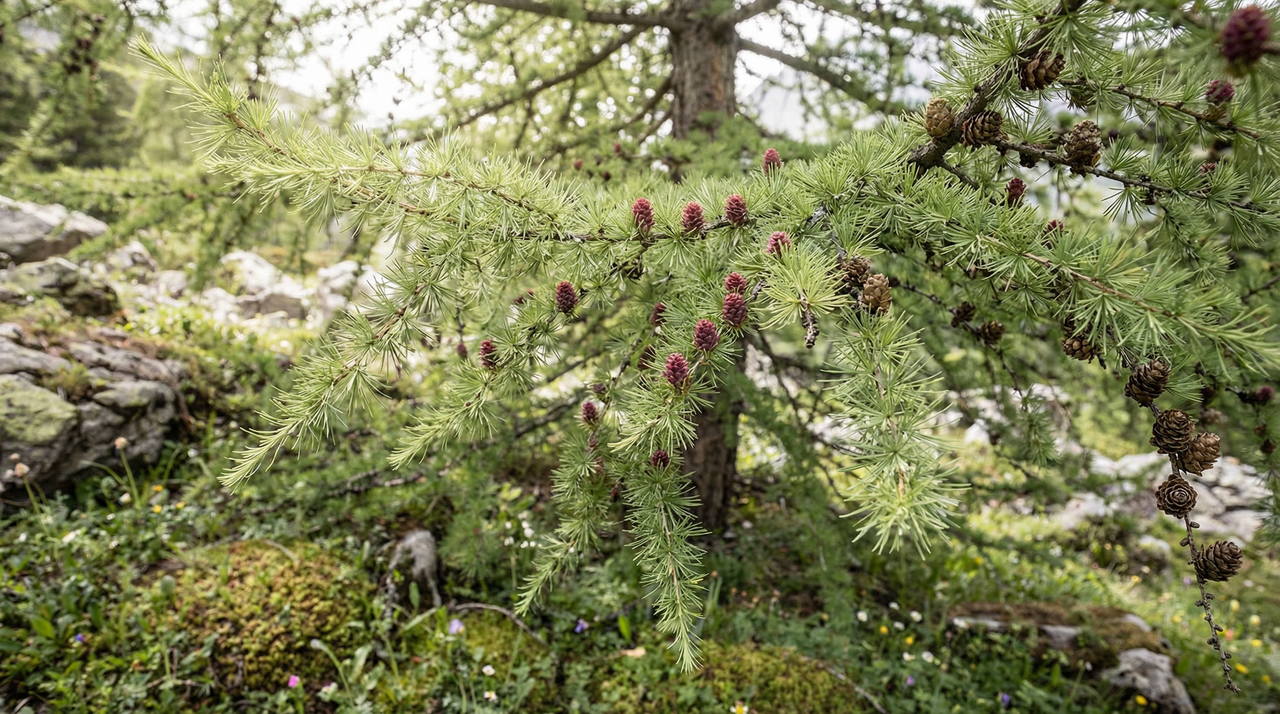
Most conifers do the same thing every winter: they keep their needles, hunker down, and wait. Larch does something that stops people cold the first time they see it. In October, those soft, feathery needles turn a burning, almost implausible gold, and then the tree drops every single one of them. Bare branches, full winter, standing there looking dead to anyone who doesn't know better. I've watched visitors to a food forest I designed practically argue with me that the tree was diseased, or dying, or had been planted wrong. It hadn't. It was doing exactly what it evolved to do across the Alps and Carpathians, where being a deciduous conifer isn't a contradiction, it's a survival strategy.[1]
The annual needle drop cascades into everything else about how larch behaves in a landscape. It changes the light beneath it. It changes what you can grow under it. It changes how the soil builds, how the mycorrhizal community develops, and where larch actually belongs in a food forest design versus where people reflexively try to plant it. A tree that looks like it belongs in the evergreen canopy turns out to play by completely different rules.
Origin and History of European Larch (Larix decidua)
Botanical Background and Native Range
European larch, Larix decidua, is a mountain native through and through. Its natural home spans the Alps, Carpathians, Sudetes, and Tatra Mountains, where it grows from roughly 600 to 2,500 meters elevation in cool, humid conditions with well-drained soils.[2][3][4] This is a tree forged by altitude, and everything about its biology reflects that origin. Typical lifespans run 200 to 500 years, with exceptional individuals in favorable alpine pockets exceeding 800 to 1,000 years.[2][5] I've stood in front of century-old larches in European arboreta and private estates and they still look vigorous, almost aggressively alive. That quality gives me real confidence when recommending them for long-term permaculture plantings where most of us won't live to see the tree hit its stride.
Elevation shapes larch in measurable ways. Higher-altitude populations grow more slowly and produce denser wood with enhanced cold tolerance, and cone output drops above 2,000 meters where the growing season simply isn't long enough to support heavy reproduction.[6][7] I think about this kind of phenotypic plasticity a lot when I'm choosing plants for tricky microclimates; the fact that one species can express itself so differently across a few hundred meters of altitude tells you something important about its adaptability. As a pioneer species, larch also rebounds quickly after disturbance -- fire, windthrow, logging -- achieving 70 to 90 percent regeneration success in canopy gaps.[7][4] It's a shade-intolerant opportunist that needs open sky, and it uses disturbance the way other pioneers use it: as an invitation. Sexual maturity typically arrives at 15 to 25 years, after which the tree produces cones annually; female cones are pollinated in their first year and release seeds the following autumn.[8][9]
Visual Characteristics
Larch's defining physical characteristic is shedding its needles, an evolutionary adaptation for reducing winter water loss at altitude. After years of specifying conifers in landscape designs, I still find the larch's autumn needle drop startlingly beautiful. I use it deliberately to create seasonal drama that clients genuinely don't expect from a tree that looked like a spruce all summer. Larch is one of very few deciduous conifers, and shedding its needles is both a visual event and an adaptive strategy for reducing winter water loss at altitude.[10][5]
Those needles are soft clusters of 20 to 40, each 2 to 4 centimeters long, which is a tactile pleasure compared to the stiff, skin-catching spines of pines I've worked with in drier landscape settings. The tree itself is pyramidal when young, loosening into a more irregular habit with age, growing 30 to 50 meters tall in good conditions with bark that starts smooth and gradually deepens into coarse furrows.[11][5] The small ovoid cones, just 2 to 4 centimeters, are charming and persistent, often clinging to branches long after seeds have dispersed. The root system anchors deep with a taproot, spreading laterally in the way you'd expect of a tree engineered to grip mountain slopes. At higher elevations, needles and cones both run smaller, a phenotypic shift that's ecologically sensible.[8] The cultivar 'Aurea' takes the golden autumn display and makes it a near year-round feature with foliage that comes in already warm-toned.
Traditional and Cultural Uses
Larch has a documented human history that stretches back to classical antiquity. Pliny the Elder was writing about its timber in 77 to 79 AD, specifically praising its rot-resistant wood for Roman shipbuilding.[12] That reputation held for centuries. Medieval Alpine communities wild-harvested it for buildings and bridges; Linnaeus formally classified it in the 18th century; and the Industrial Revolution sent demand soaring again for railway sleepers.[13][14] Venetian shipyards relied on it for their galleys, and the chalets and mountain architecture of Switzerland still show its timber performing in wet conditions where softer woods would have failed generations ago.[15][16] When I'm selecting rot-resistant materials for structures in humid southeastern projects I usually reach for cypress or cedar, but larch in its native Alpine context matches that performance level with centuries of receipts to prove it.
Alpine folk medicine found uses for almost every part of the tree. Bark decoctions treated respiratory ailments and colds and served as diuretics; resin and pitch went onto wounds, skin conditions, and wherever a natural adhesive was needed.[17][18] Culturally, the tree carried symbolic weight that matched its physical presence. In Alpine folklore, larch represents resilience and renewal, specifically because of its strange habit of dropping needles while all the other conifers hold theirs. Branches appeared in protective rituals against evil spirits and lightning, and the tree wove itself into Christmas traditions and transhumance landscapes across Switzerland.[19] I find that symbolism genuinely fitting: a tree that sheds everything in winter and returns fully clothed in spring is a pretty good model for the adaptive mindset that regenerative landscape work actually requires. Plantation-grown larch is generally considered sustainable, though native mountain stands deserve protection and introduced North American populations warrant monitoring for naturalization pressure.[20][21]
Fun Facts About the Larch
Some trees earn superlatives honestly. Mature larches can reach 30 to 55 meters tall, and certain individuals in the Italian Alps have been documented exceeding 1,000 years of age.[22][5] Those small egg-shaped cones often persist on branches for years after releasing their seeds, which means even a bare-needled winter larch carries some visual structure. And that autumn golden display isn't just beautiful; it's a physiological strategy, the tree reclaiming nutrients from its needles before winter the same way a broadleaf does.[10][5]
As a pioneer, larch earns its ecological keep. It stabilizes mountain soils, its seeds feed crossbills and siskins, and it hosts the larch budmoth, an insect whose population cycles are so regular they've actually been used to reconstruct historical climate patterns.[5][23] Mature larch forests sequester 2 to 5 tons of CO2 per hectare annually, a figure that earns it a legitimate place in climate-aware planting conversations.[24][25] A tree that builds soil, feeds birds, fixes carbon, and has been framing the timber structures of mountain civilization for two millennia has earned every bit of the attention it's finally getting in temperate permaculture design.
Larch Varieties and Sourcing Guide
European larch is one of those plants that surprises people who assume all conifers are evergreen. Larix decidua provides dynamic seasonal shifts unlike static evergreens. It's native to the Alps and Carpathians, thriving at elevations between 1,000 and 2,400 meters where winters are brutal and summers are short.[26][5] That alpine origin matters a lot when you're choosing a larch for your site, and I'll come back to it.
Notable Cultivars of European and Japanese Larch
The straight species grows at a solid 30 to 60 cm per year and will eventually become a tall forest tree, but the cultivar range gives designers a lot more to work with.[26] The RHS has awarded Garden Merit to 'Pendula' and 'Blue Ball,' two very different plants that illustrate the spread of what's available.[26] 'Pendula' is the one I've specified most often for clients with a water feature or a spot that needs something dramatic; those cascading branches over a small pond in October, going gold, are genuinely stunning. On the compact end, 'Rotundiformis' and 'Arnold' form dense mounds that fit rockeries or small gardens without crowding, while 'Columnaris' pulls the form into a tight vertical for confined urban spaces. If you want something sculptural in a more architectural sense, 'Crispa' has contorted branchlets that hold interest through winter when the needles are long gone. 'Aurea' pushes the golden needle color even further, holding yellow-tinged foliage through the growing season rather than just at the autumn drop.[27][28][29]
All of these are reliably hardy in USDA zones 2 through 7, though I'd be cautious pushing them into the warmer end of that range where summer heat and humidity combine.[10] These are cool-climate trees. They laugh at -30°F, but they struggle in the hot, sticky summers you get south of zone 7. I've seen people try to push larch into marginal warmer zones and it never ends well; the tree sulks, becomes disease-prone, and never develops the confident structure you see in cooler regions.
Japanese larch (Larix kaempferi) rounds out the picture nicely for gardeners who want similar autumn drama at a smaller scale. 'Conica' stays at 2 to 3 meters with golden spring needles and bronze-orange fall color; 'Mini' is even more compact and offers that same coppery autumn shift.[30][31] Japanese larch cultivars share the genus preference for full sun, moist well-drained acidic soils, and cold hardiness to around -30°C.[32] Forward-thinking breeding programs, particularly WSL in Switzerland, are now actively selecting for drought tolerance and climate resilience in European larch, which will matter more and more as summers warm in formerly reliable zones.[33] Just as we now reach for heat-tolerant selections of other landscape trees, provenance-matched and drought-adapted larch stock is going to be the smart buy within a decade.
Where to Buy Larch Trees and Seeds
European larch has been cultivated in the US since the early 1800s and is genuinely available from good nurseries.[34] Sheffield's Seed Company carries stratified seed, Musser Forests stocks nursery-grade trees, and Nature Hills ships landscape specimens to most continental states.[35][36][37] Expect to pay roughly $20 to $50 for small 1 to 3 foot saplings and $100 to $300 for a 5 to 10 foot specimen, depending on size and vendor. Order during dormancy, late fall through early spring, to minimize transplant stress; a larch that ships while dormant settles in far better than one caught mid-flush.[38]
Provenance is something I always ask about when sourcing for clients, and it's not a small detail. Alpine and Tyrolean seed origins tend to outperform lowland material in cooler microclimates, and I've seen the difference firsthand between a tree that thrives from day one and one that just sits there looking confused for three years.[33][39] Ask your nursery directly. Also, before you load anything into your cart, take a close look at the bark on any stock you're buying in person. Larch canker (Lachnellula willkommii) causes branch dieback and can kill young trees; reputable nurseries selling certified disease-free stock are worth the extra few dollars.[39] If you're importing stock from Europe, you'll need USDA APHIS permits and phytosanitary documentation, so stick to domestic vendors unless you have a specific cultivar need that can't be met stateside.[40]
European Larch Propagation and Planting Guide
Larch rewards patience. Getting one established from seed takes planning, cold storage, and a willingness to work with the tree's biology rather than against it. But once you understand what these seeds actually need, the whole process clicks into place.
Understanding Larch Seeds: Morphology, Dispersal, and Dormancy
European larch seeds are small and precise: an ovoid body just 3 to 5 mm long with a pitted, dark reddish-brown coat, attached to a membranous wing that brings the total length to 8 to 15 mm.[41][42] That wing is the whole ecological strategy: dispersal is wind-driven, happening in late summer through autumn,[43][44] which is why natural larch regeneration clusters on exposed, open ridges where alpine winds carry seeds across rocky slopes. It's a clue to what the tree needs in cultivation: light, air, and no competition overhead.
The catch is dormancy. These seeds won't germinate on warmth alone. They exhibit physiological dormancy that requires cold moist stratification for 30 to 60 days at around 4°C before they'll respond to warmth.[45][44] After stratification, they want 15 to 20°C with light exposure.[46] I've grown larch from stratified seed over multiple seasons, and I'll tell you: even a 10-day difference in stratification length shows up clearly in how evenly the tray germinates. Rush it, and you get a staggered, patchy result. Give it the full 6 to 8 weeks in moist sand or peat in the fridge, and germination is reliably uniform. I also label my seedling trays obsessively because larch germinants look nearly identical to other conifer seedlings at first flush.
Seed Storage, Viability Testing, and Orthodox Behavior
Fresh larch seed lots typically test at 60 to 80% viability,[44] which is solid for a conifer. What makes larch genuinely practical for seed banking is that these are orthodox seeds: they tolerate desiccation down to 5 to 8% moisture content without significant damage,[47][48] which means you can store them cold and dry for a long time. Sealed in airtight containers at -18 to -20°C, viability can hold for 10 to 20 years, though germination rates tend to drop off after the first 5 to 10.[49][50] I keep leftover seed in a sealed glass jar in my household freezer and still get 60% or better germination from lots that are 4 to 5 years old, as long as the seed was dry going in.
If you want to assess a lot before sowing, tetrazolium testing correlates strongly with actual germination results (r = 0.9+), and X-ray radiography can visualize healthy, dense embryos without destructive sampling.[51][52] For most home growers a simple germination test on moistened paper towel will tell you what you need to know.
Vegetative Propagation: Cuttings, Grafting, and Tissue Culture
Seed is the dominant propagation method commercially for good reason: larch is genuinely recalcitrant to vegetative techniques. Seeds are collected in autumn (September to October), stratified, and sown indoors in late winter.[46][27] Fall direct-sowing works but gives lower success because you're trusting outdoor conditions to handle stratification consistently.
Cuttings are possible, but I won't pretend they're easy. My early attempts at softwood cuttings in late spring were mostly disappointing until I switched to semi-hardwood material taken in late summer, added reliable bottom heat at 18 to 22°C with mist, and bumped IBA rooting hormone to 3,000 to 8,000 ppm. Even then, expect 20 to 50% success and consider that a win.[46][53] Grafting is a different story: whip-and-tongue or cleft grafts onto 1 to 2 year old rootstocks in late winter achieve 70 to 90% success,[54] which is why it's the go-to method for preserving named weeping or dwarf cultivars where seed would produce variable offspring. One propagation-stage disease to watch regardless of your method: damping-off from Pythium and early larch canker both hit seedlings hard. Sterile media, good airflow, and a preventive fungicide drench go a long way.[55]
Soil and Site Requirements for Successful Establishment
Full sun is non-negotiable. Larch needs at least 6 to 8 hours of direct sun daily; in partial shade it produces sparse, weak growth and frequently fails to establish at all.[56] This makes complete sense when you picture its native habitat: the rocky, open slopes of the Alps and Carpathians at 1,000 to 2,400 meters, where sunlight is intense and competition is sparse. That's the baseline your planting site should approximate.
Drainage is equally critical. European larch cannot tolerate waterlogging or soil compaction above about 1.5 g/cm³ bulk density; its root architecture simply doesn't adapt to saturated or compacted conditions.[41][57] Medium to coarse loams and sandy loams with a little organic matter are ideal, though it tolerates clay and chalk if drainage is sorted. Soil pH should sit between 5.5 and 6.5 for best results; the species will manage up to 7.5, but above that you start seeing iron-deficiency chlorosis as interveinal yellowing on young growth.[58][59] I spotted exactly that on a specimen I'd planted into amended clay that had crept alkaline; a simple soil test and chelated-iron drench cleared it up, but it was a good reminder to test before you plant. Below pH 5.0, aluminum toxicity becomes a concern.[60]
For container growing, aim for a mix of roughly 50% ericaceous compost, 30% perlite, and 20% coarse grit to keep pH down and drainage sharp.[61] Field planting wants at least 60 to 90 cm of workable soil depth, ideally over a meter, to accommodate the taproot and spreading laterals.[62]
Planting Techniques, Spacing, and Early Care
European larch is hardy from USDA zones 2 through 7, tolerating winter lows to -50°F.[27] Plant bare-root or container stock in early spring after the last frost; seedlings can go in after stratification and indoor germination, or you can direct-sow in fall and let winter handle dormancy-breaking naturally.[46]
Spacing depends entirely on purpose. Forestry plantations start at 2 to 3 meters apart (roughly 1,600 to 2,500 trees per hectare) to drive straight, competitive growth, then thin to 400 to 800 trees per hectare after 10 to 15 years as crowns fill in.[63] For specimen or ornamental planting in a designed landscape, I use 6 to 9 meters (20 to 30 feet) between trees, which gives the canopy room to develop its characteristic open, airy structure. Hedging can go as tight as 30 to 60 cm. The contrast is stark: the same species, one squeezed into a timber grid for straight boles, the other given room to express its full pyramidal form.
Establishment care is where most larch plantings succeed or fail. For the first three years, water deeply every 5 to 10 days during dry spells, aiming to moisten the soil 12 to 18 inches down.[64] Apply 3 to 4 inches of organic mulch around the base, keeping it away from the trunk, to conserve moisture and moderate soil temperature. A light balanced fertilizer (10-10-10) in early spring supports seedlings through their first growth flush.[65] Young trees also benefit from wind protection for the first couple of winters while the root system anchors in. Get those early years right, and what felt like a finicky seedling becomes a fast-growing, long-lived tree that largely looks after itself.
European Larch Care Guide
Everything about larch care flows from one foundational decision: where you plant it. Get the site right and you're mostly working with a tree that wants to thrive. Get it wrong and you'll spend years compensating for problems that proper siting would have prevented entirely. I've seen this play out repeatedly with conifers, and larch is less forgiving than most when it comes to light and drainage.
Sunlight Requirements
Larch needs a minimum of six to eight hours of direct sun daily, and honestly, more is better.[66][67] This is an alpine pioneer species that colonizes open slopes after disturbance. Shade is genuinely incompatible with its growth habit. Trees planted in anything less than open sky go leggy, lose density, and become structurally weak. Physiologically, European larch reaches its photosynthetic light saturation point around 1000 to 1500 µmol m⁻² s⁻¹, which corresponds to bright, unobstructed outdoor conditions.[68] In unusually hot spells, I watch for needle tip browning, which signals heat stress or photooxidative damage rather than disease -- younger trees and those pushed outside their native climate range are particularly vulnerable to scorch.[69][68] More on that under heat tolerance below.
Water Needs
Young larches are thirstier than you'd expect. For the first two to three years, plan on deep watering every seven to ten days during the growing season, or every two to three days during dry spells for seedlings.[70][71] Once established, they're moderately drought-tolerant and typically only need supplemental irrigation during droughts stretching beyond two weeks. The target is about one to two inches per week, allowing the top few inches of soil to dry between sessions, with two to four inches of organic mulch over the root zone to retain moisture and moderate soil temperature.[72][73]
Soil drainage is non-negotiable. European larch prefers moist, well-drained soil with a pH of 5.5 to 7.5, and it's genuinely sensitive to waterlogging; Phytophthora root rot is a real risk in saturated conditions.[74][75] The symptom picture is worth knowing: underwatering shows as needle tip browning, yellowing, and premature drop, while overwatering looks similar but comes with wilting despite wet soil.[76][77] If your site stays persistently soggy, tamarack (Larix laricina) is far better adapted, tolerating periodic flooding with specialized root structures evolved for saturated soils.[75][78] European larch's water demand also drops significantly in winter once the needles have fallen and the tree is dormant -- don't overcompensate during that period.
Feeding and Fertility
European larch is a moderate feeder. A balanced slow-release fertilizer, something in the 10-10-10 range with emphasis on nitrogen for needle growth and potassium for resilience, applied in early spring covers most situations.[79][80] That said, soil testing first is something I always recommend. Rates and products matter less than knowing what your soil actually needs, and over-fertilizing causes salt burn and pushes lush, pest-prone growth that creates more problems than it solves.[80][81] The deficiency symptoms are readable once you know what to look for: yellowing of young needles with green veins points to iron deficiency, which I've corrected with foliar sprays or soil sulfur on alkaline sites with visible results within weeks; broader yellowing suggests nitrogen; purplish needles indicate phosphorus; tip scorching that looks like drought stress can actually be potassium deficiency.[81] Tamarack, by contrast, is a light feeder native to nutrient-poor peat soils and rarely needs supplemental nutrition in cultivation.[82][83]
Frost Tolerance
Cold hardiness is where larch genuinely impresses. European larch is rated for USDA Zones 2 through 7 and RHS H7, with dormant tissues tolerating temperatures as low as -40°C.[84][85] These trees shrug off winters that would kill many other conifers outright. The deciduous habit is actually a real advantage here -- dropping needles before hard frost reduces tissue exposure compared to evergreen species.[10]
The real vulnerability is spring, not winter. Newly flushing needles and expanding buds can sustain damage at temperatures as mild as -1°C to -5°C, well after the tree looks like it's safely past winter.[86] I learned this the hard way after losing a season of new growth to a late April frost -- now I choose planting sites with good air drainage, which lets cold air flow away rather than pool, and I keep a light mulch layer that I pull back in early spring to let the soil warm. For trees under three to five years old, a frost cloth on cold nights during bud break is cheap insurance.[87]
Heat Tolerance
This is where larch has a clear ceiling, and it's important to be honest about it. Native to alpine and subalpine elevations between 800 and 2,000 meters, European larch is optimized for cool summers in the 15 to 25°C range.[88][89] Stress begins above 30°C, and sustained exposure above 35°C causes real physiological damage. Its AHS rating is Heat Zones 1 through 5, which excludes most of the American South and lower Midwest.[90] I've watched larch in marginal heat conditions drop needles early and slow almost to a standstill in midsummer, similar to the stress response you see on birches during a bad heat dome -- the tree retreats rather than pushing through.
If you're in a warmer zone pushing the boundary, mitigation helps. Site younger trees where they get afternoon shade, apply five to ten centimeters of organic mulch, and water deeply during heatwaves (roughly 20 to 30 liters per tree per week).[91][92] Cool nights below 15°C aid recovery significantly. Some genetic variation across provenances offers modest acclimation potential, so sourcing from lower-elevation populations may help in warmer sites.
Pruning, Maintenance, and Seasonal Care
Prune during dormancy, ideally late February through March before bud break, to minimize sap bleed and stress.[93] I actually prefer right after needle drop in autumn for the same reason I'd give anyone choosing to prune any deciduous tree in winter: the bare structure makes branch decisions obvious. For young trees, formative pruning in the first ten to fifteen years focuses on removing crossing or competing leaders and cleaning up the lower crown.[93] Mature specimens need little intervention beyond removing dead or diseased wood.
The seasonal calendar gives you a reliable rhythm to work with. Bud burst in late April to early May (triggered by cumulative warmth above 5°C) kicks off the growth flush, with needle expansion over two to three weeks; this is when nutrient uptake peaks, making it the right window for spring fertilization.[94][95] Cones ripen August through September, seeds disperse through October, and needles drop October through November.[94] One practical tip I give anyone planting larch among evergreens: label your young trees. A bare-branched larch in January looks suspiciously like a dead conifer to anyone who doesn't know the species, and I've seen well-intentioned gardeners pull perfectly healthy trees in winter because they panicked. Keep an eye on needle color through the growing season as your main diagnostic tool -- yellowing at bud break, unusual tip browning, or early drop all signal something worth investigating before it becomes a bigger problem. Pests and diseases specific to larch get their own thorough treatment in the next section.
Larch Harvesting: Timing, Techniques, Yields, and Flavor Profiles
Harvesting larch asks you to think in two very different timeframes simultaneously. For seeds and edible plant parts, you're working within tight seasonal windows measured in weeks. For timber, you're planning across human generations. I find that framing useful because it captures something essential about this tree: larch rewards patient, observant growers who understand the difference between what's available now and what they're stewarding for later.
Optimal Timing and Maturity Cues for Seed, Needle, and Timber Harvest
Seed collection is where most home growers will engage with larch harvest, and the timing window is more compressed than it looks on paper. After spring pollination in May or June, cones need roughly 60 to 90 days to reach full seed maturity,[96][3] putting harvest in central Europe somewhere between late August and October.[21] The visual cue that matters most is color: collect when cones have shifted from green to brown and scales are just beginning to part, but before they've opened fully and scattered the seed.[60][3] In commercial seed orchards, collectors aim for the point when 80 to 90 percent of cones have browned.[3]
I've learned to check cone color weekly starting in early August because elevation and local microclimate can shift that brown-stage window by two or three weeks. A tree at 1,500 meters in the Alps may still be ripening cones in October while a lower-elevation planting finished in September.[60] Warmer continental sites push maturation closer to 60 days; cooler alpine conditions stretch it past 90.[60] Watch your specific trees, not a calendar.
Timber harvest operates on an entirely different scale. Rotations typically run 60 to 100 years depending on site quality, with Alpine stands often harvested around 80 years and denser northern forests sometimes requiring 120 or more.[91] When I include larch in a permaculture overstory design, I'm explicit with clients that this is likely a multi-generational tree. The harvest itself happens in winter, November through March, when reduced sap flow lowers the risk of breakage and improves wood quality.[91] Site factors growers can actually influence, things like maintaining a soil pH between 5 and 7, full sun exposure, and early thinning, can meaningfully accelerate growth and shorten timelines.[97] Poor drainage, shade, or compaction work in the opposite direction; I've watched crowded plantings stagnate for years once you remove competition they accelerate visibly.
Flavor Profiles and Edible Yields from Different Larch Parts
The edible larch is fundamentally a spring tree, and the flavor tells you why. Young shoots carry a bright, tangy sourness with citrus and pine undertones,[98] and in my experience that tang is sharpest in the first couple of weeks after bud break. Think of them as a more resinous, slightly bolder version of spruce tips if you've foraged those before; same general family of flavors, different emphasis. The chemistry behind it is worth understanding: larch needles are rich in monoterpenes including alpha-pinene, beta-pinene, limonene, and bornyl acetate, with concentrations peaking in spring and early summer before declining through the season.[99][100] If you want the best flavor, harvest early.
The inner bark reads differently: mild, sweet-resinous, with a slight bitterness and a mucilaginous texture that becomes quite pronounced when you simmer it into tea.[98] That slipperiness can be a pleasant surprise or mildly off-putting depending on who's drinking it. Needle teas tend toward a lemony brightness with mild bitterness,[101] and most people find them the most accessible entry point to foraging this tree. For context on genus variation, Tamarack shoots (Larix laricina) have a much more cucumber-forward flavor with far less of that citrus-pine quality,[102] so don't expect identical results if you're comparing notes with someone foraging a different larch species.
On yields: a home forager should think in handfuls, not pounds. I only ever harvest a small percentage of new growth from any single tree, maybe a light gathering of shoots from several branch tips, enough to make a tea or a small batch of something without visibly stressing the tree. Larch doesn't regenerate as rapidly as some shrubby species, and for a tree you're stewarding across decades, a light hand now protects the resource you're planning to return to every spring.
Larch Preparation and Uses: From Needle Tea to Durable Timber
Most people walk past a larch and see only a tree. I see an early April morning, a handful of soft new needles, and a cup of tea that smells like a pine forest and tastes like lemon zest. That's where I'd encourage anyone to start with this plant: the simplest preparation, the brightest reward.
Culinary Uses of European Larch and Related Species
Young larch needles brewed into tea are genuinely one of spring's better-kept wild foods. The vitamin C content in fresh needles runs roughly 50 to 200 mg per 100 g, spiking highest in those first two weeks of the spring flush.[17][103] I've brewed batches in late March and again in mid-May from the same tree, and the difference in brightness is unmistakable: early harvest tastes almost citrusy, a clean lemony-pine note with just a whisper of resin; later needles go flatter, more piney, less alive. The tender shoot tips from that same early window are worth trying raw in a spring salad or wilted briefly in butter, where they contribute a citrus-pine tanginess with a faint resinous edge.[2][104]
Further down the utilitarian end of the spectrum, inner larch bark has a long history as a survival carbohydrate. Boiled, dried, and ground into meal or flour, it has a mild sweetness underneath the resin and provides enough caloric substance to matter when little else is available.[105][102] The seeds inside the cones are technically edible raw or roasted, and tamarack sap can be boiled into a sweet syrup reminiscent of maple production, but neither is worth planning around: seed yields are tiny relative to the effort of harvesting them, and I'd file both in the "good to know, rarely practical" category.[17]
Larch resin has traditionally been chewed as a gum for oral health, but I don't personally recommend it as a regular habit.[106] It's intensely warming and can cause real gastrointestinal discomfort, and I've seen that play out. For most people, a needle infusion delivers the goods without the risk. A few firm cautions before you go foraging: larch wood is not food-safe for direct contact with food surfaces without proper finishing, and the bark's tannins can cause digestive upset if consumed in quantity. Most critically, confirm your identification carefully. European Larch can be confused with yew (Taxus baccata), which is highly toxic; larch has clustered, soft, deciduous needles on short spur shoots, while yew has flat, opposite, evergreen needles arranged in two ranks.[107][108] That distinction took me a full cautious season of double-checking every conifer before it felt automatic. Harvest only from trees well away from roadsides or agricultural run-off, keep quantities moderate, and respect the limits that resins, tannins, and potential pollutant accumulation impose.
Medicinal Preparations, Dosages, and Safety Guidelines
Traditional European preparations of larch lean on the bark, needles, and resin, most commonly as tinctures (1 to 2 ml, roughly 20 to 40 drops, three times daily) or simple infusions (1 to 2 teaspoons of dried material per cup, steeped 10 to 15 minutes, taken two to three times daily).[109] My preference in practice is the infusion route. It's gentler, easier to dose, and far less likely to cause the irritation that comes with concentrated resin preparations. I've watched clients with sensitive digestion react badly to chewed resin or strong bark decoctions, so I always start people at the low end of the infusion range and watch how they respond.
The safety picture deserves direct attention. Potential side effects include gastrointestinal upset from the tannins, allergic reactions, and skin or mucous membrane irritation from the essential oils and resins.[110][111] Avoid larch preparations entirely during pregnancy given insufficient safety data and possible uterine stimulant effects, and use caution if there's any kidney impairment because of its diuretic activity.[110] Anyone on lithium or anticoagulants like warfarin should also check with their prescriber first, as larch preparations may amplify those drugs' effects.[112] None of this makes larch a dangerous plant to work with; it just calls for the same attentiveness any active botanical deserves.
The brightest modern chapter in larch medicine is arabinogalactan, the polysaccharide extracted commercially from larch wood (including Japanese larch). It's FDA GRAS, well tolerated at 8 to 10 g per day, and backed by stronger clinical evidence for immune support than most of the traditional bark and needle preparations.[111][113] If you're sourcing bark for home preparations rather than buying a supplement, take only small amounts from multiple trees rather than girdling any single trunk. That's just basic permaculture ethics applied to wildcrafting.
Non-Food Uses of Larch Wood, Bark, and Resin
European Larch timber has an almost unfair reputation for durability. Its exceptional resistance to rot in moist conditions put it to work across centuries of Alpine construction: houses, bridges, ships, furniture, and railway sleepers all leaned on this wood precisely because it outlasted nearly everything else available.[13][18] In my landscape design work, when a client in a wet Pacific Northwest climate asks me what timber to specify for a long-lived raised bed frame or pergola, certified larch lumber is often my first answer. Structures I've helped specify a decade ago still look solid. That kind of longevity is what permaculture design should be aiming for.
The bark contributes beyond the medicinal realm too. Its high tannin content made it historically valuable for tanning leather and as a source of natural dye.[17] Sustainable management of larch in Central Europe now runs through certified forestry programs that balance timber yield against biodiversity, which means sourcing FSC-certified larch lumber connects your garden project to a conservation framework that takes the long view on these forests.[114] For a tree that can live eight centuries, that seems like exactly the right way to work with it.
Larch Health Benefits and Medicinal Uses
Larch's traditional medicinal uses are remarkably consistent across cultures that never had contact with each other. European healers were brewing bark decoctions for coughs and bronchitis long before anyone understood expectorants; Native American tribes used Tamarack (Larix laricina) for respiratory and gastrointestinal complaints; Siberian and Mongolian traditions built parallel practices around Dahurian larch (Larix gmelinii). That kind of convergence is always worth paying attention to.
Traditional Medicinal Uses of European Larch
European larch (Larix decidua) has a long folk medicine record spanning respiratory, digestive, wound, and skin care uses.[115][116] Bark decoctions were used as expectorants for bronchitis; the same astringent bark treated diarrhea; topical preparations addressed wounds, skin inflammation, and eczema.[115] Diuretic and antispasmodic applications show up in Alpine folk records too, as does the use of Venice turpentine, the resin tapped from larch, as a topical antiseptic.[117][118] I've handled fresh larch resin, and its sticky, balsamic intensity is immediate; the antiseptic quality is almost self-evident from the scent alone, though concentrated resin absolutely needs diluting before it goes anywhere near skin.
Modern research has started explaining why these traditions held. Larch arabinogalactan, a polysaccharide concentrated in the bark, shows real immune-modulating effects in human clinical trials: NK cell activity increased up to 40% at doses of 1.5 to 4.5 grams per day, and the incidence of upper respiratory infections dropped by up to 23% in studied populations.[119][120][121] During winter respiratory season, I source standardized larch arabinogalactan supplements for my own family rather than relying on bark preparations; the clinical data is specific enough that it informs a real-world decision.
The antioxidant and anti-inflammatory activity runs through flavonoids like taxifolin and quercetin, which appear to activate the Nrf2 pathway for ROS scavenging and suppress NF-κB signaling to reduce pro-inflammatory cytokines and enzymes like COX-2 and LOX.[122][123][124] Antimicrobial activity against bacteria including Staphylococcus aureus is linked to tannins and terpenoids like larixol disrupting cell membranes, which supports the wound-healing folk use, though most of this evidence is in vitro.[124][125] Human clinical trials for whole larch extracts remain limited; the strongest data applies to isolated arabinogalactan, and preliminary hepatoprotective or anticancer findings in related species are genuinely early-stage.[103][126]
Key Phytochemicals in Larch: Flavonoids, Arabinogalactan, and Terpenoids
The bark alone is a chemical library. Larix decidua typically contains 5 to 15% proanthocyanidins and tannins by dry weight, 10 to 20% arabinogalactan, flavonoids including taxifolin, quercetin, catechins, and kaempferol glycosides, phenolic acids like ferulic and caffeic acids, terpenoids and diterpenes (larixol and abietic acid derivatives in the resin), lignans, stilbenes, and coumarins.[124][125][127][128] The needles contribute their own profile: essential oils running approximately 20 to 40% α-pinene, 15 to 25% bornyl acetate, and 10 to 20% limonene, with flavonoid content typically around 1 to 3% of dry weight.[129][130]
None of these numbers are fixed. Flavonoid concentrations peak in spring and again in autumn as the tree responds to environmental stress, and needles harvested at higher altitudes tend to run richer in protective compounds because of elevated UV exposure.[130][131] I've noticed in my own spring harvests that the needles smell noticeably more resinous than late-summer growth, and the research backs that observation. European larch shows higher certain flavonoid and stilbene levels than its relatives, while Dahurian larch runs higher on bark tannins at 20 to 30%; both profiles drive overlapping but distinct bioactivities.[132][133] Think of the phytochemistry as the mechanism underlying everything else in this article: the immune support, the wound healing, the antioxidant capacity all trace back here.
Nutritional Profile of Larch Shoots, Bark, and Needles
Young larch needles and shoots are genuinely useful wild foods, particularly in spring. Vitamin C content is reported from roughly 10 to 20 mg per 100 g fresh weight on the conservative end, with some analyses reaching considerably higher, and historically they were brewed into a tangy tea specifically to prevent scurvy.[134][135] The flavor reminds me of a brighter, more citrus-forward version of pine needle tea -- more approachable than most people expect from a conifer, and genuinely pleasant in early spring. Macros are modest: around 25 to 35 kcal per 100 g, 1.5 to 2.5 g protein, 4 to 6 g carbohydrates, and 2 to 3 g fiber, with useful amounts of potassium and calcium.[135]
Inner bark was an emergency famine food across northern peoples, dried and ground into flour. It provides approximately 3 to 5 g protein and up to 10 g fiber per 100 g dry weight, with meaningful mineral content, but tannins reduce bioavailability and eating much of it causes real digestive upset.[60][136] Needle extracts show high phenolic content correlating with strong antioxidant capacity in lab assays,[137] and for reference, Dahurian larch needles can run far higher in vitamin C than European larch, making it the more nutrient-dense species on that measure.[138] For European larch, these are best understood as valuable supplementary wild foods when properly prepared, not dietary staples.
Safety Considerations and Potential Side Effects
Larch has a solid low-toxicity profile overall. The wood is non-toxic, severe poisoning is rare, and the tree is not classified as a hazard to pets or livestock under normal conditions.[139][140] That said, tannins, resins, and phenolics in the bark and needles are real irritants; consuming concentrated preparations or large quantities can produce nausea and diarrhea, and resin applied undiluted to skin will cause irritation.[141] In practice, small amounts of properly prepared needle tea rarely cause problems for most people, but moderation and correct preparation (boiling reduces tannin load) matter. Claims about cyanogenic glycosides in Larix decidua don't hold up in the scientific literature, so that particular fear is unfounded.[75]
The arabinogalactan supplement picture is more nuanced and deserves direct attention. At typical doses of 1 to 4.5 grams per day, larch arabinogalactan is considered safe with a low rate of mild side effects.[142] However, because its immune-stimulating effect is measurable, including that documented NK cell increase, it can reduce the efficacy of immunosuppressant medications like cyclosporine.[119][143] If you're on immunosuppressants, larch arabinogalactan is not a casual addition; check with your prescribing doctor first. Pregnancy and breastfeeding are also clear cautions, as safety data simply isn't established for those populations, and anyone with autoimmune conditions should approach it carefully.[119] Allergy to other Pinaceae family plants is a contraindication worth flagging. Proper species identification before foraging any part of the tree is non-negotiable; look-alike errors are the most preventable risk of all.[75]
Larch Pests and Diseases
European larch carries specific vulnerabilities in the disease department. It's a stunning, productive overstory species, but it carries real vulnerabilities that reward attentive management. The good news is that most problems are predictable, site-dependent, and manageable if you catch them early and design accordingly.
Common Diseases of European Larch
The two diseases that define larch's reputation in forestry are larch canker, caused by Lachnellula willkommii, and Dothistroma needle blight. Canker is the one that keeps foresters up at night: it hits young trees and branches hard, and no strong natural resistance has been identified across European larch populations.[144][145][146] I've seen the resinous lesions firsthand on landscape plantings after unusually wet seasons, and early sanitation pruning in dormancy was the single intervention that limited spread most effectively. Dothistroma needle blight is similarly troublesome, though Alpine provenances do show meaningfully higher resistance than Central European sources, which is worth knowing when sourcing stock.[144][147]
Beyond those two, larch tree fungus pressure comes from several directions. Needle cast diseases caused by Mycosphaerella laricina, Lophodermium spp., and related fungi cause premature defoliation, with incidence rates of 20-50% recorded in Europe, proliferating when temperatures sit between 15-20°C with high humidity.[148][149] Larch needle blight after a wet spring is honestly one of the more alarming-looking events in a young planting, but established trees with good air circulation typically bounce back. Rust diseases including Melampsora species require alternate hosts like poplars or pines to complete their cycle, so removing those from close proximity is a straightforward preventive move.[144][148]
Root diseases deserve their own mention because they're often invisible until serious damage is done. Phytophthora species, including P. cinnamomi and the emerging threats P. ramorum and P. kernoviae, hit hard in waterlogged or acidic soils below pH 5.5.[150][151] I've stopped planting larch in heavy clay without serious amendment after watching decline in poorly drained trial sites; it's simply not worth it. Heterobasidion annosum and Armillaria (honey fungus) round out the root disease picture, with some southern Italian provenances showing better tolerance to the latter.[144][152] Optimal soil pH runs 5.5-7.0, and keeping trees out of extremes on either end matters as much as drainage.[153] Proper spacing of 20-30 feet, sanitation pruning, and dormant-season removal of infected material are the cultural practices that move the needle most reliably on larch tree disease management.[154]
Key Insect Pests and Their Impact
Pest pressure on European larch varies by region, tree age, and how stressed the planting is, but a handful of insects reliably show up as major players.[155] The larch casebearer (Coleophora laricella) mines needles from inside, leaving behind the tell-tale browning and premature needle drop that I've learned to check for every spring in young plantings.[156] Frass at the base of needles is an early sign, and catching it before defoliation becomes severe saves a lot of grief. The European larch sawfly (Pristiphora erichsonii) is more dramatic: outbreaks can strip entire stands of foliage and the species is a major defoliator across Europe and North America.[157][158] The larch bud moth (Zeiraphera diniana) operates on a predictable cycle, causing defoliation outbreaks every 6-8 years in European forests.[159]
Secondary but real threats include Ips cembrae bark beetles, which target stressed trees and can transmit fungi through the phloem;[160] the larch borer (Arhopalus rusticus), another wood-boring beetle drawn to weakened specimens;[155] larch tip moths (Argyresthia spp.) causing shoot dieback;[161] and the larch aphid (Adelges laricis), which produces honeydew that encourages sooty mold.[155] If you're working in North America with tamarack (Larix laricina), the eastern larch beetle (Dendroctonus simplex) and the tamarack leafminer (Coleotechnites laricis) are the analog threats to know.[162][163]
Compared to Japanese larch (L. kaempferi), European larch tends to be more vulnerable to needle diseases and some pests, which is part of why I lean toward hybrids or carefully selected provenances when siting trees in humid areas.[155][164] Selections like 'Kornik' show moderate resistance to sawfly through physical and chemical barriers, though no cultivar is fully immune.[165]
Natural Defenses and Resistance Factors
Larch isn't defenseless. The tree's arsenal includes constitutive and inducible terpenes, phenolics in the bark, endophytic fungi that interact with herbivores, and volatile organic compounds that can actually recruit natural predators when the tree is under attack.[166][167][168] What I find genuinely compelling about this is that these defenses express more strongly in vigorous, well-sited trees, so the best pest management you can do happens before planting. Alpine provenances in particular show better baseline tolerance to certain pressures, reinforcing that provenance choice is as important as any spray schedule.
Integrated Management and Cultural Practices
The most effective approach to larch pest and disease management follows IPM principles: monitor first, intervene with the lightest tool that works, and build prevention into design from the start.[169] Sanitation pruning in dormancy, adequate spacing for air circulation, and maintaining soil pH in the 5.5-7.0 range address the majority of fungal and root disease risks before they escalate. Biological controls and targeted applications are available for pest outbreaks but should follow monitoring, not replace it. When I source selections like 'Kornik' for better performance, I pair them with companion plantings that support parasitoid wasps and other natural enemies, because guild diversity is genuinely one of the most reliable tools in reducing insect pressure over time. Observation through spring and early summer, when most defoliators and fungal infections are establishing, gives you the intervention window that matters most.
Larch in Permaculture Design
There's a particular kind of northern food forest that most permaculture literature barely touches: the cold continental overstory, where summers are short, winters are brutal, and most of the design wisdom written for temperate climates simply doesn't apply. Larch is made for exactly that place. Its role in a cold-climate food forest isn't incidental; it's structural. But placing it well requires understanding where its climate tolerance ends, because a larch in the wrong summer becomes a liability rather than an asset.
Climate and Hardiness Zones for Growing Larch
European larch (Larix decidua) spans USDA zones 2-7 and can survive winter temperatures down to -40°F, making it one of the most cold-hardy large trees available to northern designers.[41][170] The sweet spot, though, is zones 3-6, where cold continental winters and moderate precipitation (20-60 inches annually) match the Köppen Dfb and Dfc climates it evolved in.[171][5] At the warm end of its range, heat above 85-90°F triggers real stress, and persistent summer humidity compounds the problem fast.[10] I've watched cold-adapted conifers planted in marginal zones deteriorate steadily as summers warm, and larch follows the same pattern; by zones 6-7, disease pressure climbs and growth becomes reluctant. If your summers regularly push past that 85°F ceiling with humidity on top, larch will disappoint you, and no amount of soil work or irrigation will fix a climate mismatch.
Within the genus there's useful variation to know. Tamarack (Larix laricina) runs zones 2-5, handles -60°F winters, but is even more heat-sensitive than European larch and demands consistently cold conditions.[172][75] Dahurian larch (Larix gmelinii) matches European larch's cold tolerance in zones 2-7 with survival down to -50°F, while Japanese larch (Larix kaempferi) anchors at zone 4 with slightly less extreme hardiness.[173][174] The design takeaway is consistent across species: these are trees for cold, open, well-drained sites. Choose your species to match your cold floor, and let the heat ceiling be your hard limit.
Pollination and Reproductive Ecology
Larch is monoecious and entirely wind-pollinated. The male cones shed pollen roughly 7-10 days before the female cones are receptive, a timing offset called protandry that pushes the tree toward cross-pollination rather than selfing.[175][176] Pollination happens in spring, March through May depending on elevation, and the ideal window is 50-70°F with moderate humidity and light winds in the 5-15 mph range.[176][177] Late spring frost, heavy rain, and humidity above 70% are the primary disruptions; any of those during the pollination window can gut seed set for the year.[178]
I time a lot of early-spring decisions in my designs around frost windows, and larch flowering is exactly the kind of event that makes site microclimate matter. A frost pocket that loses only a few degrees on an April night can be the difference between a good cone crop and nothing. For most food forest applications, a single specimen will produce some seed, but pollen can travel several kilometers, so isolation is rarely the issue; late cold snaps are the real risk to plan around. If you're ever designing a small seed orchard or working with limited tree numbers, manual pollen transfer and cold storage of collected pollen are viable options for improving synchronization,[179] though for most backyard or farm-scale designs that level of intervention isn't necessary.
Larch as a Canopy Tree in Forest Gardens and Guilds
Young larch trees hold a tight pyramidal form, but they grow into something quite different: tall, open, irregularly branched canopy trees that can reach 80-150 feet at maturity.[5][10] That open crown matters enormously for what grows beneath. Larch is a light-demanding pioneer, not a shade-caster; it occupies the overstory while letting substantial light reach the ground, and its deciduous habit makes that light dynamic seasonal rather than static.[180] Every winter and early spring, the understory of a larch canopy floods with light at precisely the moment when ground-layer plants most need it to build root reserves before summer. I've used this principle with other deciduous overstory trees in food forest designs for years, always positioning them over berries and herbs that need that spring boost; larch takes that strategy to its logical extreme in the boreal and montane context.
The underground dimension adds another layer. Dahurian larch forms ectomycorrhizal networks with fungi including Suillus, Rhizopogon, and Laccaria, partnerships that improve nutrient access in poor soils and extend their influence to neighboring plants.[181] Edible understory companions native to larch forest systems include lingonberry (Vaccinium vitis-idaea) and cloudberry (Rubus chamaemorus), acid-loving groundcovers that slot naturally into the mycorrhizal web the canopy sustains.[182] Pairing larch with these plants isn't just aesthetically coherent; it's ecologically grounded. I recommend exactly this pattern to clients designing cold-climate food systems, because the guild is supported by both the light dynamics above ground and the fungal networks below.
Tamarack offers a different entry point: it tolerates flooding and highly acidic soils, making it the genus representative for wetland margins and bog edges where European larch would struggle.[183] Japanese larch tends toward mixed overstory situations, sharing canopy space with hardwoods and other conifers and admitting moderate rather than abundant understory light.[184] The common thread across the genus is the same: shade-intolerant canopy pioneers whose needle drop is their greatest gift to the layers below. For cold-climate permaculture, that makes any larch species a compelling overstory anchor, as long as the site is cool enough to keep it healthy.
The Tree That Taught Me to Rethink "Evergreen"
Larch continually challenges conventional expectations of how a conifer should behave in a landscape. Now it's the first thing I tell anyone who asks why I keep coming back to this genus: the most cold-hardy, guild-friendly overstory tree I've worked with looks, for about three weeks every autumn, like it's giving up. It isn't. It never was.
Sources 184
- Fire Effects Information System: Larix decidua ↩
- Larix decidua - Wikipedia ↩
- European Larch (Larix decidua Mill.) ↩
- Ecology and Distribution of European Larch ↩
- Larix decidua ↩
- Genetic Variation in Larix decidua Across Europe ↩
- Life History Traits of Larch in the Carpathians ↩
- European Larch (Larix decidua) - Gymnosperm Database ↩
- Seed Production of European Larch - Journal of Forest Ecology ↩
- Larix decidua ↩
- Larix decidua ↩
- Pliny the Elder's Natural History Book 12, Chapter 13 ↩
- Historical Timber Use in the European Alps ↩
- Kew Royal Botanic Gardens: Larix decidua ↩
- Venice: A New History ↩
- Alpine Wood and Cultural Heritage ↩
- Larix decidua Mill. - European Larch ↩
- Ethnobotany of the Alps: Traditional Uses of Larch ↩
- The Cultural Significance of Larch in the Alps ↩
- Larix decidua Mill. ↩
- Larix decidua Schrank ↩
- Larix decidua - European Larch ↩
- Ecological Role of European Larch in Mountain Forests ↩
- Carbon Sequestration Potential of Larix decidua in Europe ↩
- Ecosystem Services Provided by European Larch ↩
- Larix decidua - European Larch ↩
- European Larch Varieties ↩
- Larix decidua 'Rotundiformis' ↩
- Larix decidua 'Crispa' - RHS Plant Finder ↩
- Missouri Botanical Garden Plant Finder - Larix kaempferi cultivars ↩
- Royal Horticultural Society - Larix kaempferi cultivar listings ↩
- USDA PLANTS Database - Larix kaempferi species profile ↩
- Breeding of European Larch ↩
- The European Larch ↩
- European Larch Seeds ↩
- Larix decidua Nursery Stock ↩
- European Larch - Larix decidua ↩
- European Larch Plant Information ↩
- Larix decidua Care and Growing Guide ↩
- Importation of Plants and Plant Products ↩
- Larix decidua - European Larch ↩
- Handbook of Conifer Seed Technology ↩
- Conifer Seed Dispersal Mechanisms ↩
- European Larch (Larix decidua): Seed Biology and Silviculture ↩
- Germination and Dormancy in Larix Species ↩
- Propagation of Larix decidua ↩
- Seed Storage Behaviour of Forest Tree Species ↩
- Kew Seed Information Database ↩
- Longevity of Larix decidua Seeds Under Different Storage Conditions ↩
- Long-term Storage of Conifer Seeds ↩
- International Rules for Seed Testing (ISTA) ↩
- X-Ray Analysis of Seed Viability in Conifers ↩
- Propagation of Larch by Cuttings ↩
- Grafting Techniques for European Larch ↩
- Diseases of Larch in Nurseries ↩
- Larix decidua ↩
- Root Architecture of Larix decidua in Varied Soil Conditions ↩
- European Larch ↩
- Soil pH Effects on European Larch ↩
- Soil pH Effects on Conifer Nutrition ↩
- Larix decidua (European Larch) Growing Guide ↩
- Growing Conifers in Containers ↩
- Silviculture of European Larch ↩
- RHS Gardening: Larix decidua ↩
- Missouri Botanical Garden Plant Finder: Larix decidua ↩
- Royal Horticultural Society - Larix decidua ↩
- Missouri Botanical Garden: European Larch ↩
- Light Response of Photosynthesis in Larix Species ↩
- Ecophysiology of Dahurian Larch (Larix gmelinii) in Siberian Forests ↩
- Missouri Botanical Garden - Larix decidua ↩
- Larix decidua ↩
- Watering Guidelines for Conifers ↩
- RHS Plant Selector - Larix decidua ↩
- European Larch (Larix decidua) - Cultivation and Care ↩
- USDA Forest Service - Larix laricina ↩
- Larix decidua Care and Common Problems ↩
- Root Rot in Trees: Causes and Prevention ↩
- Missouri Botanical Garden - Larix laricina ↩
- Royal Horticultural Society: Larix decidua Care Guide ↩
- University of Minnesota Extension: Conifer Fertilization ↩
- Nutrient Deficiencies in Conifers ↩
- USDA PLANTS Database ↩
- USDA Forest Service - Silvics of North America: Larix laricina ↩
- Missouri Botanical Garden - Larix decidua ↩
- Cold acclimation and deacclimation of Norway spruce, Scots pine and European larch ↩
- Phenological frost sensitivity of European larch (Larix decidua Mill.) ↩
- Frost Protection for Woody Plants ↩
- Larix decidua - Plant Finder ↩
- Thermal Tolerance in Larix decidua: Implications for Climate Change ↩
- Impacts of Climate Extremes on European Larch (Larix decidua Mill.) ↩
- Silvicultural Guidelines for European Larch (Larix decidua) ↩
- Heat Stress in Forest Trees: Mitigation Strategies ↩
- RHS Gardening: How to prune larch ↩
- Phenology of European Larch (Larix decidua Mill.) ↩
- Climate Change Impacts on Tree Phenology in Europe ↩
- Conifer Seed Growing Manual ↩
- European Forest Institute - Larix decidua Growth Study ↩
- European Larch (Larix decidua) - Edible and Medicinal Uses ↩
- Chemical Composition and Antioxidant Activity of Essential Oil from Needles of Larix decidua Mill. ↩
- Chemical Composition and Seasonal Variation of Essential Oils from Larix decidua ↩
- Traditional Uses of European Larch in Herbal Medicine and Cuisine ↩
- Native American Ethnobotany: Larix laricina ↩
- Vitamin C Content in Needles of Conifers Including Larix decidua ↩
- Foraging Guide to Conifers - Eat the Weeds ↩
- Nutritional Composition of Larch Inner Bark ↩
- European Larch (Larix decidua) - Traditional Uses in Alpine Folk Medicine ↩
- Yew - Taxus baccata Toxicity ↩
- Identifying Larch Trees - Arbor Day Foundation ↩
- European Larch (Larix decidua) - Herbal Monograph ↩
- European Larch - Drugs and Lactation Database (LactMed) ↩
- Larch Arabinogalactan: Clinical Relevance of a Novel Immune-Modulating Polysaccharide ↩
- Toxicity of Conifer Resins and Oils - PubMed Review ↩
- FDA GRAS Notice for Larch Arabinogalactan ↩
- Management and conservation of European larch (Larix decidua) in Central Europe: balancing timber production and biodiversity ↩
- Larix decidua Mill. (European Larch) Bark: Traditional Uses and Phytochemical Profile ↩
- Medicinal Plants of Europe: Folk Medicine and Traditional Uses ↩
- Pharmacological Activities of Larch Species: A Review ↩
- Folk Remedies with Larch in Alpine Traditions ↩
- Larch arabinogalactan: clinical relevance of a novel immune-modulating polysaccharide ↩
- Randomized trial of arabinogalactan (Larix spp.) for the treatment of acute upper respiratory tract infections ↩
- Effects of a proprietary arabinogalactan on natural killer cell activity in healthy adults ↩
- Antioxidant and Anti-inflammatory Activities of Larix decidua Extracts ↩
- Anti-Inflammatory and Antioxidant Properties of European Larch (Larix decidua) Bark Extract ↩
- Phytochemical Composition and Biological Activities of Larix decidua Mill. Extract ↩
- Secondary Metabolites from Larix decidua and Their Pharmacological Activities ↩
- Anti-Tumor and Hepatoprotective Properties of Larix gmelinii Extracts ↩
- Larch Bark: Chemical Composition and Potential Uses ↩
- Flavonoids and Phenolic Acids from Larch Species (Larix decidua L.) ↩
- Chemical Composition of the Essential Oil from Needles of Larix decidua Mill. ↩
- Seasonal Variation of Phenolic Compounds in Needles of Larix decidua ↩
- Altitudinal Effects on Flavonoid Content in European Larch ↩
- Comparative Phytochemistry of Larix Species: Focus on Terpenes and Stilbenes ↩
- Phytochemical investigation of Larix gmelinii bark ↩
- European Larch (Larix decidua) - Traditional Uses and Ethnobotany ↩
- Nutritional Analysis of Wild Edible Plants: European Larch ↩
- Nutritional Composition of Conifer Species ↩
- Phytochemical Profile and Antioxidant Activity of Larix decidua Extracts ↩
- Nutritional Composition of Siberian Larch (Larix gmelinii) Needles ↩
- Larch - ASPCA ↩
- Conifer Toxicity in Animals - Merck Veterinary Manual ↩
- European Larch (Larix decidua) ↩
- Safety and Efficacy of Larch Arabinogalactan in Healthy Adults ↩
- Herbal Medicine: Biomolecular and Clinical Aspects - Larch Entry ↩
- Disease Resistance in European Larch (Larix decidua Mill.) ↩
- Field Trials on Larch Canker Resistance ↩
- Larch Canker and Needle Diseases ↩
- Dothistroma Needle Blight in European Larch Provenances ↩
- Diseases of Larch in Europe ↩
- Larch Needle Cast ↩
- Susceptibility of Larix decidua to Phytophthora species ↩
- Phytophthora in European Larch: Temperature and Soil Effects ↩
- Armillaria Root Disease in Conifers: Focus on Larix ↩
- Diseases of Larix decidua and Environmental Influences ↩
- Extension Services - Conifer Disease Management ↩
- European Larch Pests and Diseases ↩
- Larch Casebearer Management ↩
- Pristiphora erichsonii (Larch Sawfly) ↩
- USDA Forest Service - Larch Sawfly ↩
- Zeiraphera diniana (Larch Bud Moth) ↩
- Bark Beetles on Conifers ↩
- Insect Pests of Larch in Europe ↩
- Eastern Larch Beetle ↩
- Tamarack Leafminer ↩
- Comparative Susceptibility of Larch Species to Needle Cast ↩
- Breeding for Insect Resistance in European Larch ↩
- Terpenoid Defences of Conifers against Insect Herbivory ↩
- Phenolics in the Bark of Larix decidua as Indicators of Resistance to Ips typographus ↩
- Volatile Organic Compounds in Larix decidua: Herbivore-Induced Emissions ↩
- Integrated Pest Management for European Larch ↩
- European Larch Hardiness - North Carolina Extension Gardener ↩
- European Larch ↩
- Lady Bird Johnson Wildflower Center - Tamarack ↩
- USDA PLANTS Database - Larix gmelinii ↩
- Missouri Botanical Garden Plant Finder ↩
- Pollination Biology of Larix decidua ↩
- Reproductive Biology of European Larch (Larix decidua Mill.) ↩
- Pollination Ecology of Conifers: Larix decidua ↩
- Phenology and Environmental Requirements for Larch Pollination ↩
- Assisted Pollination Techniques in Gymnosperms ↩
- Successional Dynamics in Subalpine Forests ↩
- Diversity of ectomycorrhizal fungi in larch forests of eastern Siberia ↩
- Dahurian Larch (Larix gmelinii) Ecology and Management ↩
- USDA PLANTS Database ↩
- Forest Ecology of Larix kaempferi in Japan ↩