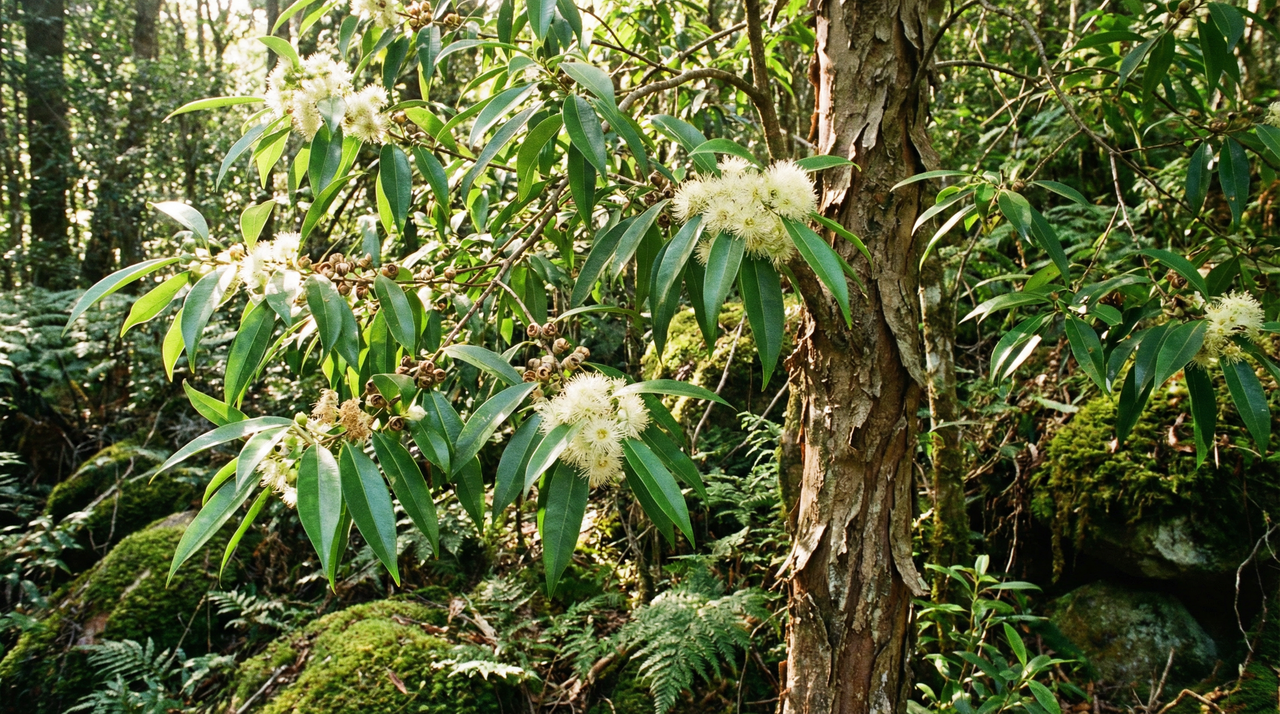
Lemon myrtle contains more citral than lemon.[1] More than lemon verbena. More than lemongrass. More, frankly, than anything else I've grown or cooked with in twenty-plus years of food forest design, and that includes some genuinely wild finds. The first time I crushed a fresh lemon myrtle leaf between my fingers I actually laughed out loud, because the smell was so aggressively, perfectly lemon that it felt almost synthetic, like someone had engineered it in a lab. They hadn't. It's a rainforest tree from coastal Queensland that Aboriginal communities have known about and used for a very long time, while the rest of the world was busy squeezing citrus and calling it a day.
Here's the contradiction that keeps pulling me back to this plant: something with that kind of aromatic firepower, that kind of culinary potential, is still practically invisible in North American gardens and food forests. Most growers who could be cultivating it in zones 9 through 11 have never heard of it. Those who have often assume it's too fussy, too tropical, or too hard to source legally in the US. Some of those concerns are real. None of them are dealbreakers. And once you understand what this tree actually offers, a properly placed lemon myrtle starts to feel less like an exotic curiosity and more like a gap in your design you didn't know was there.
Lemon Myrtle Origin, History, and Traditional Uses
Botanical Background and Native Habitat
Backhousia citriodora is one of those plants that introduces itself. Native to the subtropical rainforests of coastal Queensland and northern New South Wales, it's an understory species through and through, spending its life in the dappled light beneath a forest canopy rather than pushing up into open sky.[2][3] That preference matters to growers. I always tell people: this isn't a sun-baked pioneer on a roadside bank. It's a rainforest interior plant, and it behaves accordingly.
The plant is surprisingly sensitive to disturbance. Lemon myrtle doesn't colonize cleared land readily, struggles with logging and fire damage, and has limited capacity to bounce back from severe habitat fragmentation.[4] It's a conservative grower with a long game: specimens can live 50 to 100 years, sometimes longer under favorable conditions, and populations show real genetic variation across their range, particularly in citral content and leaf shape.[5][6] The genus has some ecological flexibility, though. Its relative cinnamon myrtle (Backhousia myrtifolia) occupies overlapping rainforest edges from central Queensland down into northern New South Wales and has somewhat better fire adaptation via lignotubers,[7] which tells you something about how lemon myrtle landed on the more sheltered, specialist end of the genus spectrum.
Visual Characteristics and Identification
In cultivation lemon myrtle typically reaches 3 to 8 meters, though wild trees can push 15 to 20 meters in the right forest conditions.[8] Young plants have a tidy, upright pyramidal form that opens up and spreads with age, with smooth pale greyish-brown bark that peels in patches. The leaves are the real identifier: opposite, lanceolate to elliptic, glossy dark green on top, paler underneath, with tiny translucent oil glands you can hold up to the light and see.[9][10] Those glands are the entire story. Crush a leaf and citral floods out. I've grown both lemon myrtle and cinnamon myrtle side by side, and that scent test settles any identification question instantly: cinnamon myrtle's leaves give off only a faint lemony or eucalyptus-like note,[11] while lemon myrtle is emphatic.
New growth often flushes with a reddish tinge in early spring, which I find genuinely beautiful and a useful seasonal cue. Flowers are small, white to cream, star-shaped, with numerous stamens in terminal clusters during the warmer months.[5] One misidentification worth flagging: lemon-scented gum (Corymbia citriodora) shares the common name territory but is a completely different beast, with alternate leaves, rough bark, and a stature that dwarfs this understory myrtle.[8] If you're comparing them in a garden center, the leaf arrangement alone settles it.
Traditional Aboriginal Uses and Cultural Significance
Long before European botanists arrived with their specimen jars, Aboriginal communities including the Bundjalung, Gubbi Gubbi, Yuggera, Butchulla, and Yugambeh peoples of subtropical Queensland were using lemon myrtle leaves in ways that make intuitive sense once you understand the plant's chemistry. Leaf infusions for colds and respiratory complaints, poultices for wounds and skin infections, steam inhalations, insect repellent applications, and flavoring in bush tucker: these are documented across multiple groups and reflect thousands of years of working knowledge.[12][13] As someone who follows the research on citral's antimicrobial properties, those traditional respiratory and wound applications feel less like folk wisdom and more like applied biochemistry. The compound driving the aroma is the same one doing the medicinal work.[12][14]
European botanical documentation came much later. Allan Cunningham collected specimens in 1853, the genus Backhousia was named in 1858 after Quaker botanist James Backhouse, and Backhousia citriodora wasn't formally described until 1913 by Cyril Tenison White.[15] That's a gap of millennia between the knowledge and the Latin name.
Scientific Discovery, Commercialization, and Modern Applications
The late 20th century brought commercial essential oil production into the picture, with cultivation expanding into subtropical regions worldwide and oil yields ranging from 0.5 to 3.5 percent from standard leaf material, up to 4 to 5 percent in selected high-citral cultivars.[16] Australian native cuisine embraced it as a signature ingredient, and aromatherapy found a receptive global audience for its clean, concentrated lemon profile. All of that is genuinely exciting. But I source only certified sustainable or cultivated lemon myrtle for my designs, full stop. This is not a plant that can absorb the pressure of wild harvesting at scale, given its sensitivity to disturbance and slow recovery from habitat damage. Benefit-sharing with Traditional Owners and transparent supply chains aren't optional considerations; they're the baseline for responsible use of a plant whose entire cultural and commercial value rests on knowledge developed over millennia.[17][18]
Every time I walk past a lemon myrtle in a garden and catch that scent on the air, I think about what it means for a plant to carry that much history in its leaves.
Lemon Myrtle Varieties and Sourcing
Notable Varieties and Selections of Lemon Myrtle
If you're expecting a long list of named cultivars, lemon myrtle will surprise you. Unlike many culinary herbs that have been selectively bred into dozens of distinct forms, Backhousia citriodora remains largely true to its wild-type form, with most commercial plantings relying on high-citral selections chosen for oil yield, growth vigor, and leaf morphology rather than formally registered cultivar names.[19][20] The two variants you'll actually encounter are a straight-leaf form and a wavy-leaf form; both are natural variations rather than cultivars anyone has officially named.[8] I've grown both, and in humid subtropical conditions the wavy-leaf form tends to produce slightly broader leaves that are genuinely easier to pinch off for fresh tea. Subtle difference, but once you're harvesting regularly, you notice it.
Two selections worth knowing by name are 'Directors Choice', bred for a compact habit, and 'Lemon Twist', selected for an especially pronounced lemon scent.[8] Serious commercial growers care most about yield benchmarks: well-established plantations produce 2-5 tonnes of dry leaf per hectare annually after 3-5 years, with essential oil extraction running 20-50 kg per hectare.[20][21] Those numbers drive selection decisions far more than ornamental traits.
The rest of the Backhousia genus tells a richer cultivar story. Cinnamon myrtle (B. myrtifolia) has been developed into forms like 'Compacta', 'True Blue', 'Tellervii' (variegated), and 'Hot Flash'.[22][23] Its grey-green leaves carry up to 80-90% citral and release a cinnamon-lemon scent that's distinctly different from lemon myrtle's cleaner profile.[11] Anise myrtle (B. anisata) brings a similar citral dominance (up to 90%) with a lemon-eucalyptus edge, and its selections like 'Ringwood' and 'Murray' were developed specifically for superior oil yield.[24][25] I've used all three as guild companions in subtropical food forests precisely because their shared chemistry creates overlapping pollinator and aromatic functions without flavor redundancy in the kitchen.
Where to Buy Lemon Myrtle: Regulations, Suppliers, and Propagation Tips
US growers need to understand one regulatory reality before searching any nursery catalog. Because lemon myrtle belongs to the Myrtaceae family, USDA APHIS restricts its importation to prevent the introduction of myrtle rust (Austropuccinia psidii); whole plants, cuttings, grafts, and unprocessed material are generally prohibited from entering the country.[26][27] When I first brought lemon myrtle stock into my nursery operation, the permitting process, phytosanitary certificates, and inspection steps took considerably longer than I'd anticipated. Sterilized seeds can be imported under permit, but approval isn't guaranteed and shipments are subject to inspection and possible treatment.[26][28] The practical upshot: buy domestic.
Seeds are your most accessible entry point because they face fewer phytosanitary barriers than live plants.[29][30] Sheffield's Seed Company, Logee's Plants, Eureka Farms, and One Green World all carry lemon myrtle domestically, and international sources like Daley's Fruit Tree Nursery in Australia ship only when USDA rules are satisfied.[31][32] Seed packets typically run $5-15 for 10-50 seeds; small potted plants start around $10 for starters and climb to $30-50 for larger specimens depending on season and supplier.[31][33] Germination rates run 70-80% when seeds are properly scarified and kept warm, which makes seed starting a reasonable path if you're patient. Cinnamon myrtle is not listed under CITES and can sometimes be sourced more easily from specialized Australian native nurseries or US online retailers, particularly for coastal California, Florida, and Texas gardens, with tissue culture emerging as a commercial propagation option.[34][23] One hard lesson I learned with B. myrtifolia seed: don't let it dry out before sowing. Viability drops off quickly, and I once wrote off an entire batch before figuring out that fresh seed sown immediately at 20-25°C is a completely different proposition from dried seed left in an envelope for two months.
Lemon Myrtle Propagation and Planting (Backhousia citriodora)
If you want to grow lemon myrtle from scratch, the first decision you'll make is also the most consequential: seeds or cuttings. I've tried both, and the biology of this plant makes that choice a lot less open than it might seem.
Propagation Methods for Lemon Myrtle: Seeds, Cuttings, and Beyond
Lemon myrtle seeds are small, dark, and winged for wind dispersal, typically just 1-3 mm long with a hard woody coat and an interesting quirk: each seed can carry 2-4 embryos (polyembryony).[35][36] What the biology giveth, storage quickly taketh away: natural viability sits at just 10-20%, and that number drops sharply after six months.[35][37] I've lost whole batches to seeds I thought were still good; now I treat fresh-seed sowing like a narrow seasonal window and get them in the ground within three months of collection. With pre-treatments like scarification or a gibberellic acid soak, germination can reach 60-80%, but under average conditions expect something closer to 20-50%.[38][36] If long-term storage is unavoidable, airtight containers with silica gel at 4-5°C can preserve viability for 1-2 years, though germination rates still slide below 20% after 18 months.[39]
The deeper problem with seed propagation is genetic. Because lemon myrtle outcrosses freely, seedlings are not reliably true to type for foliage aroma or citral content.[40] I noticed this firsthand: cuttings taken from a known high-citral mother plant fill the air when you brush past them; seedlings grown from a friend's tree were pleasant but noticeably softer in scent. For anyone growing lemon myrtle for culinary or essential-oil use, that variation matters.
Semi-hardwood cuttings are the practical answer for home and small-scale growers. Take 10-15 cm tip cuttings in late summer, treat the cut end with IBA rooting hormone at 3000-5000 ppm, and place them in a sterile 1:1 perlite-to-peat mix under 80-90% humidity at 20-25°C.[41][42] Roots typically form in 4-8 weeks with success rates of 50-80%. The catch is humidity: Myrtaceae species are notoriously prone to damping-off and Phytophthora root rot, and I learned this the hard way during one particularly muggy Queensland summer when an entire cutting batch collapsed from fungal rot.[43] Sterile tools, fresh rooting medium, and a misting setup with good airflow between intervals have been non-negotiable in my propagation bench ever since.
For those with more patience or commercial ambitions, air layering achieves up to 90% success given 3-6 months for root development, and tissue culture on Murashige and Skoog medium reaches 80-95% success at laboratory scale.[44][45] Grafting onto compatible Myrtaceae rootstocks succeeds at 50-70% in late winter but remains a specialist technique most home growers won't need.[46]
Soil, Site, and Planting Requirements for Lemon Myrtle
Everything about lemon myrtle's ideal growing conditions traces back to where it evolved: the well-drained slopes and leaf-litter floors of Queensland's subtropical rainforests, where annual rainfall runs 1000-2000 mm and roots never sit in standing water.[47] That habitat is the template. What you're trying to replicate is fertile, humus-rich, well-drained loam or sandy loam with around 5-10% organic matter and a fibrous root zone that breathes freely.[48] Clay soils need heavy amendment or avoidance altogether; raised beds or mounded planting work well where drainage is marginal.
Soil pH should sit between 5.5 and 6.5.[49] Once pH climbs above 7.0-7.5, iron and manganese become unavailable and you'll see interveinal yellowing on the new growth; below pH 5.0, aluminum toxicity becomes a risk.[50] I now always test soil before planting after watching a lemon myrtle in a slightly alkaline raised bed turn progressively chlorotic. A pine bark amendment and a light sulfur application brought it back, but the setback cost a full season. Compost, peat, and pine bark all improve structure while nudging pH in the right direction, and a deep layer of leaf-litter mulch mimics the rainforest floor beautifully.[49]
On light, aim for 6-8 hours of direct sun daily for the best foliage density and oil production, though some afternoon shade in hot climates prevents leaf scorch.[51][52] Young plants need consistent moisture during establishment but tolerate moderate drought once the root system settles in. Wilting, dark mushy roots, or persistent chlorosis are the plant's way of telling you something fundamental is wrong with drainage or soil chemistry -- better to catch those signs early than nurse a struggling specimen for years.[53]
Spacing, Timing, and Establishment Techniques
Lemon myrtle grows 30-60 cm per year in its early stages and can eventually reach 6-9 m tall with a 3-5 m spread in garden settings (taller still in its native rainforest).[49][5] Those dimensions should drive your spacing decisions. For a standard garden specimen, 2-3 m between plants allows good airflow and keeps fungal pressure manageable; orchard planting calls for 3-5 m between plants and 6-8 m between rows; for a hedge, 1-1.5 m spacing creates a dense screen relatively quickly.[49] I've run a hedgerow at both 1.5 m and 3 m, and the difference in disease incidence after a wet summer was stark. The tighter planting needed regular thinning and vigilance; the wider spacing mostly took care of itself.
Plant in spring or early summer after the last frost risk has passed, ideally in USDA zones 9-11.[49] After planting, mulch generously, water consistently through the first dry season, and protect young plants from cold snaps and desiccating winds.[54] Light tip pruning after flowering will help shape the plant and encourage bushier growth without stressing the new root system.
From Propagation to First Harvest: Timelines for Lemon Myrtle
The honest answer to "how long until I can harvest?" depends almost entirely on how you propagated the plant. Seed-grown lemon myrtle typically takes 2-4 years to reach first commercial leaf harvest and 4-6 years before it flowers and sets seed.[49][42] Plants from cuttings or grafts get you there faster: a light harvest is possible at 12-18 months, with first commercial-scale picking at 2-3 years under optimal conditions.[55] In my experience, late-summer cuttings that root well by early autumn are usually ready for their first modest harvest the following spring, which puts you on the better end of that 12-18 month window if you're in a reliable zone 9 or warmer climate. It's not instant gratification, but it's a much more predictable timeline than gambling on seeds and waiting to see which seedlings actually smell like anything worth growing.
Lemon Myrtle Care Guide: Growing Backhousia citriodora
Getting lemon myrtle to thrive is fundamentally an exercise in replicating its native habitat: the warm, humid, well-drained slopes of Queensland's subtropical rainforests. Once you understand where it comes from, most care decisions become obvious. The two things that matter most, and that will ripple through everything else, are light and water. Get those right and the rest of the care routine falls into place.
Sunlight Requirements for Healthy Growth and Aroma
Lemon myrtle wants at least six hours of direct sun daily, and I've noticed a real difference in leaf fragrance between plants grown in full morning light versus those tucked into dappled afternoon shade.[56][21] The full-sun plants are noticeably more aromatic, which tracks with what we know about citral production: more light, more oil. In cooler climates, full sun is ideal. In hotter inland spots, afternoon shade becomes your friend, because prolonged intense exposure on young plants causes leaf scorch, bleached patches, and curling that tells you the canopy can't keep up with the transpiration demand.[57][8] If you're moving a container plant from indoors to outdoors, acclimate it gradually over two to three weeks rather than putting it straight into full summer sun.
Watering Needs and Soil Moisture Management
In its native range, lemon myrtle grows in areas that receive 1000 to 2000 mm of rainfall annually, usually on well-drained soils near streams.[52] That tells you everything: consistent moisture, yes, but never sitting water. Overwatering is actually more dangerous than underwatering, because soggy roots invite Phytophthora and Pythium, and the symptoms (yellowing leaves, wilting despite wet soil) are easily misread as drought.[6] Young plants need water every two to three days during the growing season; established specimens are a different story entirely.[52][58] Once mine have been in the ground a couple of seasons and roots are deep, I routinely go three weeks between deep soakings without seeing any stress signals. Australian National Botanic Gardens growing guides put the established drought window at four to six weeks, which aligns with my experience.[52] A thick organic mulch layer is the single most useful thing you can do to stabilize soil moisture through humid subtropical summers. Rainwater is preferred; avoid high-salinity water and dial back watering frequency in winter.
Feeding and Nutrient Management for Native Sensitivity
This is where I see growers make the most expensive mistakes, and I'll admit I made one early in my career: I lost a young lemon myrtle to a fertilizer labeled "for native plants" that was still way too high in phosphorus. Lemon myrtle is adapted to low-nutrient soils, and phosphorus levels above 20 to 30 ppm can cause genuine root damage, a sensitivity shared across the Myrtaceae family.[59][60] Always read the label, and soil test every spring before you reach for the fertilizer bag. Look for NPK ratios around 10-0-10 or 13-1.5-8; the near-zero phosphorus middle number is your guide.[59][61] Apply 5 to 10 g per young plant or 50 to 100 g per mature tree annually, no more.[59] Over-fertilization doesn't just burn roots; research confirms it actually dilutes essential oil concentration, which defeats the whole purpose of growing this plant.[61] If you prefer organic options, a one to two inch top dressing of compost, aged manure, or seaweed extract is gentler and harder to overdo. Watch older leaves for yellowing (nitrogen deficiency) and leaf margins for scorching (potassium deficiency); micronutrient problems like interveinal chlorosis respond well to chelated foliar sprays.[62][63]
Frost Tolerance and Cold Protection Strategies
Lemon myrtle is reliably hardy in USDA zones 9 to 11, with the sweet spot in zones 10 and 11.[52][64] Established plants can handle brief dips to around -5°C (23°F), but young plants and tender new growth are much more vulnerable, and prolonged exposure below -4°C starts causing real damage.[65] What I find interesting (and only obvious if you've watched it happen) is that new growth will turn a distinctive bronze-red after a light frost, similar to how citrus behaves, before gradually recovering as temperatures rise. It's unsettling the first time you see it, but it's not necessarily fatal. UK growers should note the RHS rates this as H1C, meaning greenhouse protection is required.[66] For marginal zone 9 winters, mulch roots heavily with three to four inches of organic matter, use frost cloth on cold nights, and choose a sheltered site away from frost pockets.[52][67] I've successfully overwintered seedlings in a bright garage kept above 10°C (50°F) more than once. Container growing is genuinely useful here.
Heat Tolerance in Subtropical and Marginal Climates
Optimal growth happens between 15 and 30°C; the lemon myrtle plant handles up to 35 to 40°C when moisture and humidity are adequate, but prolonged heat above 40°C causes leaf scorch, wilting, and reduced growth.[68][8] The practical mitigation in very hot spells is the same quartet I return to repeatedly: afternoon shade, deep irrigation, a good mulch layer, and windbreaks to reduce desiccating airflow. I've also noticed that plants kept well-watered during heat waves seem to hold their aroma better than stressed ones, which makes sense given that drought stress redirects resources away from secondary metabolite production. Seedlings are especially vulnerable and need the most attention in their first summer through extreme heat.
Pruning, Maintenance, and Seasonal Rhythm
One of the more useful things about lemon myrtle in zones 9 to 11 is that it has no real dormancy.[8] Spring brings a flush of new lemon-scented growth, flowering follows in summer, and fruit ripens into autumn. I use that spring growth surge as my natural cue to fertilize and do any shaping, rather than watching a calendar date.[69] Light pruning after flowering (or after a harvest cut) encourages bushy regrowth and dense branching without stressing the plant.[8][70] The decision between tree form and shrub form is a design choice I make early: for a lemon myrtle hedge or screening plant, I tip the laterals regularly to keep it full and low; for a specimen tree, I develop a strong central leader and let it go. Either way, avoid heavy pruning, which sets the plant back significantly and can reduce leaf yield for a full season.[8] Winter care in marginal areas is mostly about mulch and frost covers rather than any major intervention. Get the first two or three years right, and you'll have a resilient, productive lemon myrtle tree that essentially looks after itself.
Harvesting Lemon Myrtle: Timing, Technique, and Flavor at Peak
Patience is the first skill this plant teaches. From seed, lemon myrtle won't give you a real harvest until the plant reaches 1.5 to 2 meters, which takes roughly 24 to 36 months.[71][49] I now start almost everything from cuttings or buy advanced nursery stock because waiting three years for that first harvest tested me in ways I didn't expect. Cuttings bring that window down to 12 to 18 months, which matters when you're designing a guild that needs to function.
When to Harvest Lemon Myrtle Leaves for Maximum Flavor and Oil
The window that consistently delivers the best leaves runs from late spring through autumn, roughly October to March in the Southern Hemisphere, when warmth and active growth push essential oil content to its peak.[72][73] The leaves you want are fully expanded, 5 to 10 centimeters long, deep vibrant green without any yellowing, and at least four to six months old.[72] Crush one between your fingers: if it releases a clean, intensely sweet lemon scent with no mustiness or flatness, you're there. If the aroma is weak, wait. Once flowering begins or a prolonged dry spell sets in without irrigation, citral levels drop and the flavor shifts noticeably.[71][73] Harvest between 6 and 10 AM on a dry morning, before the day's heat starts volatilizing those top notes off the leaf surface.[74] Established plants sustain two to three harvests per year on a six to twelve month rotation, and well-managed specimens stay productive for a decade or more before yields begin tapering off.[71][42]
How to Harvest and Process Lemon Myrtle Leaves
Hand-pick only the outer mature leaves, working around the canopy rather than stripping any single branch. Selective pruning that removes no more than one-third of the canopy at once encourages dense bushy regrowth and keeps the plant productive season after season.[75][48] Early on I took more aggressive cuts and watched the plants sulk for a full season; now I prune lightly after each harvest and the regrowth stays vigorous. What you do immediately after picking matters just as much as when you pick. For culinary use, dry the leaves at 35 to 45°C with good airflow to hold the volatile oils in place.[72][76] For essential oil production, fresh leaves need to reach the still within hours of harvest before that citral starts to dissipate.[77]
Lemon Myrtle Yield, Flavor Profile, and Post-Harvest Quality
Here's what all that timing work is actually buying you: leaves harvested at peak deliver citral concentrations above 90% of essential oil content, reaching up to 4% of leaf dry weight in warm months.[71][73] That translates to a flavor that's sweeter, more intense, and cleaner than lemon zest, without any of the acidity or bitter pith.[78][79] I've used dried lemon myrtle leaves in everything from herbal teas to fish marinades and that absence of bitterness is exactly what lets the herb hold its own rather than fight the other ingredients. The aftertaste lingers, slightly camphoraceous but refreshing, in a way fresh lemon simply can't replicate.[80] Mature plants at three to five years provide the most reliable and sustainable leaf yields.[81] Its relative, Backhousia myrtifolia, offers an interesting genus comparison with a more complex spicy and herbal profile, but none of that clean citrus intensity that makes lemon myrtle the standout.[82]
Lemon Myrtle Preparation, Uses, and Recipes
The first thing anyone notices when they cook with lemon myrtle for the first time is how little it takes. The citral content in these leaves delivers a lemon character that's genuinely cleaner and sweeter than zest, without any of the bitter pith, and far more concentrated than lemongrass or lemon verbena.[83][70] I actually label my lemon myrtle clearly in the herb garden specifically for this reason -- new cooks reach for it like lemongrass and immediately overdose the dish.
Culinary Applications and Flavor Profile of Lemon Myrtle
Leaves are where most of the action happens, though the flowers are worth knowing about too: milder in flavor, they make a delicate garnish or a subtler addition to salads and teas where you want a hint rather than a punch.[83] The leaves themselves shine in teas, baked goods, fish and chicken seasonings, and modern Australian bush tucker dishes where the combination with wattleseed or macadamia is particularly good -- but always use sparingly and taste as you go.[84][85]
Drying at home is straightforward, but temperature matters more than most people realize. I learned after a few flat-smelling batches that keeping the dryer below 40°C preserves the bright citral aroma; higher heat drives off the volatile compounds you're actually after.[86] Once dried, store in airtight, opaque containers between 15-25°C at under 60% humidity and you'll have good flavor for up to two years.[87] In my Florida humidity, I vacuum-seal small batches in dark jars rather than fight the ambient moisture.
For a quick genus note: cinnamon myrtle (Backhousia myrtifolia) offers a spicy, curry-like leaf profile that behaves very differently in the kitchen -- better suited to savory spice blends than anything where you want that clean citrus hit.[11] I grow both and use them for completely separate purposes.
Medicinal Preparations from Lemon Myrtle
The same citral that makes this plant a kitchen herb also drives its traditional medicinal applications, but the concentration matters enormously. For a simple tea, steep 1-2 teaspoons of dried leaves (around 3-6 g total daily) in 250 ml of boiling water for 5-10 minutes, or simmer as a decoction for 10-15 minutes if you want a stronger draw. A tincture can be prepared at a 1:5 ratio of dried leaves to 40-60% ethanol, taken at 1-2 ml up to three times daily. Topical essential oil applications should be diluted to 1-2% before any skin contact. I always dilute the oil to that range because undiluted citral is genuinely irritating; that's not a vague precaution, it's what the Food Standards Australia safety assessment supports.[88]
Culinary leaf use is generally regarded as safe. Internal use of the concentrated essential oil, however, is a different matter entirely and warrants professional guidance before you go further than a properly diluted topical application.[88]
Non-Food Uses of Lemon Myrtle
Beyond the kitchen and the medicine cabinet, this plant earns its space in a design. It forms excellent hedges and screens -- I use mine as a fragrant garden boundary that also supplies my kitchen -- and the fine-grained timber has a history in small specialty woodworking. Natural dyes and traditional crafts round out the list of applications that Indigenous Australians developed over centuries.[89] Cinnamon myrtle works similarly as an ornamental screen with its own aromatic appeal.[90] The foliage that makes lemon myrtle useful in the kitchen is the same foliage that makes it useful everywhere else -- which is exactly the kind of multipurpose redundancy a good permaculture design depends on.
Lemon Myrtle Health Benefits and Medicinal Uses
What I find compelling about lemon myrtle isn't just the research, it's how cleanly the traditional knowledge and the modern science line up. Queensland and New South Wales Aboriginal communities were brewing leaf teas for respiratory ailments, coughs, colds, and digestive complaints long before any laboratory isolated a single compound.[91][92][12] When you understand the chemistry driving those effects, it stops feeling like coincidence.
Traditional Aboriginal Medicinal Uses and Cultural Context
The leaf infusions used across generations weren't just pleasant-smelling hot drinks. They were working with a plant whose leaves carry 1 to 5 percent essential oil by fresh weight, and that oil is dominated by citral to a degree that makes lemon myrtle one of the richest natural citral sources on earth.[93][94] When you steep the dried leaf, you're extracting a mild fraction of that chemistry into water. The antimicrobial and anti-inflammatory properties that researchers now measure in labs make the traditional respiratory and digestive applications look very sensible indeed.
Key Phytochemicals: Citral, Flavonoids, and Supporting Compounds
Citral, a mixture of the geranial and neral isomers, typically makes up 70 to 98 percent of the essential oil.[93][95] I've noticed this variation firsthand: leaves harvested in the peak of summer smell almost narcotically lemony compared to winter growth, which tracks with research showing citral content rises with heat and sun exposure.[93] That shift in aroma intensity is a real, observable phenomenon for anyone growing this tree, and it matters if you're harvesting for potency.
Citral doesn't work alone. The leaf also contains quercetin derivatives, rutin, rosmarinic acid, chlorogenic acid, and tannins, all contributing to antioxidant capacity independent of the volatile oil.[96][97] Minor oil constituents including limonene, linalool, and beta-caryophyllene add breadth to the antimicrobial profile. These compounds evolved as plant defenses, herbivore deterrents, and competitive tools in a dense subtropical rainforest. We're essentially borrowing that chemistry for our own benefit. Compare this to cinnamon myrtle, where methyl cinnamate dominates at 70 to 95 percent, yielding comparable antioxidant activity through completely different chemistry.[98] I've grown both; knowing your chemotype isn't an academic exercise.
Scientific Research on Medicinal Properties
The antimicrobial evidence is the most robust. Lemon myrtle essential oil shows potent activity against Staphylococcus aureus, E. coli, and Candida albicans, with minimum inhibitory concentrations as low as 0.25 percent, operating by disrupting cell membranes, inhibiting efflux pumps, and interfering with quorum sensing.[99][100][101] Anti-inflammatory activity follows a similar pattern, with citral suppressing NF-κB signaling, reducing TNF-α and IL-6, and inhibiting COX-2 and LOX enzymes.[102][103] The antioxidant action is comparably strong, with high DPPH radical scavenging capacity rivaling synthetic antioxidants like BHT.[104]
Preclinical models have also shown analgesic effects, anticancer apoptosis induction, improved insulin sensitivity, and reduced lipid accumulation.[105][106][107] These are exciting results, but almost all of it is in vitro or animal data, and human clinical trials remain sparse.[91][108] My role as a grower is to use the plant responsibly within its proven strengths, and I'm cautious about claiming cures until the human data catches up.
Nutritional Profile of Lemon Myrtle Leaves
A cup of lemon myrtle tea uses roughly 1 to 2 grams of dried leaf, which sounds modest until you look at what's in those leaves.[109] Per 100 grams, dried leaves contain 1200 to 2250 mg calcium, around 1400 mg potassium, 300 to 350 mg magnesium, and 120 mg iron, figures that put most culinary herbs I grow to shame on a gram-for-gram basis.[109][110] Vitamin C sits between 379 and 700 mg per 100 grams, alongside meaningful vitamin A and a full complement of quercetin, rutin, chlorogenic acid, and lutein.[111]
Air-drying preserves these nutrients far better than high heat; boiling can strip out up to 30 percent of the vitamin C.[112] For practical purposes, a modest daily amount in tea or cooking delivers genuine mineral density alongside that vivid lemon aroma, which is exactly how I use it. You don't need concentrated extracts to get real value from this plant.
Safety Considerations and Responsible Use
Dried leaf at culinary amounts is well-supported. Food Standards Australia New Zealand has approved lemon myrtle as a novel food ingredient, and it carries GRAS status for use as a herb or tea at 1 to 3 grams of dried leaf per day, with low acute toxicity confirmed in testing.[113][114] After years of growing and using the leaves, I've never encountered issues at those levels.
The essential oil is a different matter entirely. I keep the undiluted oil out of my diffusers and off my skin. Concentrated citral is a skin and mucous membrane irritant, a contact allergen for sensitive individuals, and potentially hepatotoxic in larger ingested quantities.[115][116] For pregnancy and breastfeeding, citral's potential uterine stimulant effects warrant caution even with leaf tea, and the data is too thin to advise confidently.[117] Essential oil should be diluted to 0.5 to 1 percent for children over six and avoided entirely in infants; concentrated forms also pose toxicity risks to cats and dogs.[118][117] There's also potential for interactions with CYP3A4-metabolized drugs and anticoagulants, so anyone on those medications should check with a professional before making the tea a daily habit.[119]
For those who find citral-heavy preparations too intense, cinnamon myrtle's methyl-cinnamate-dominant profile tends to be gentler on the skin and stomach while offering comparable antioxidant capacity and a similarly safe culinary profile at food levels.[120][121] The leaf tea is plenty effective and far gentler than the concentrated oil. That's the practical takeaway.
Lemon Myrtle Pests and Diseases
Natural Pest Resistance from Citral-Rich Essential Oils
One thing I genuinely love about lemon myrtle is that its best defense mechanism is also its greatest culinary asset. That extraordinary citral concentration functions as serious chemical armor against a wide range of insects, with peer-reviewed studies confirming strong repellency against mosquitoes and ants and moderate deterrence against cockroaches.[122][123] I work with a lot of lemon-scented plants, including lemon balm and lemon verbena, but lemon myrtle's citral levels are in a completely different league. Around an established hedge, I genuinely notice fewer mosquito issues than anywhere else in the garden.
That said, the armor has gaps. Specialists that have evolved alongside Myrtaceae know how to get past the defenses, and lemon myrtle hosts a cast of them: psyllids, leaf beetles capable of skeletonizing foliage, aphids, scale insects, mealybugs, borers, and leaf miners.[52][124] Young or stressed plants are significantly more susceptible, which is a pattern I've seen play out after wet spells when plants are already dealing with saturated roots. AgriFutures Australia field trials show that the plant's natural volatiles reduce aphid and psyllid pressure overall,[125] but "reduced" is not "eliminated," and the specialists still show up.
Disease Vulnerabilities and Environmental Triggers
Healthy, well-sited lemon myrtle has solid natural resistance to most common diseases.[126] The problem is that "well-sited" is doing a lot of work in that sentence. Get the drainage or airflow wrong and the same plant becomes a disease magnet. Myrtle rust (Austropuccinia psidii) is the one I watch most closely: it produces those unmistakable bright yellow to orange spore masses on new growth, triggers defoliation, and can genuinely weaken a tree through repeated wet-season cycles.[127] In areas where lemon myrtle rust is established, I treat site selection as a biosecurity decision rather than something cultural practices can fully compensate for.
Phytophthora root rot is the other one I take seriously. Caused by Phytophthora cinnamomi in waterlogged or poorly drained soils, it presents as gradual dieback and decline that looks vague until the plant is already in trouble.[128][129] In my experience, once it takes hold it's extremely difficult to eradicate. Leaf spot fungi from genera including Mycosphaerella, Cercospora, and Colletotrichum are secondary concerns, appearing when humidity is high and air circulation is poor.[130] All of these diseases share the same environmental triggers: poor drainage, waterlogging, temperatures consistently outside the 15-30°C optimal range, and soil pH drifting outside the slightly acidic sweet spot.[131]
No commercially recognized disease-resistant lemon myrtle cultivars currently exist, though 'Straight Back' shows promising rust tolerance.[132][133] I've found that selecting vigorous, seed-grown plants and focusing on optimal site conditions has been more reliable in my designs than waiting for definitive cultivar guidance that hasn't yet arrived.
Integrated Pest and Disease Management Strategies
The most effective IPM for lemon myrtle starts before the plant goes in the ground. Site selection, generous spacing, and soil preparation do more than any spray ever will.[134] After several seasons growing lemon myrtle in humid subtropical conditions, I've learned to space plants more generously than nursery tags suggest: the extra airflow cuts leaf spot and rust pressure dramatically. Positioning plants where morning sun dries the foliage quickly is worth as much as any fungicide application.
Beyond site setup, regular monitoring lets you catch psyllid and aphid populations before they spiral. The plant's own citral volatiles genuinely support this approach by suppressing casual insect browsing.[135][136] I've also experimented with companion planting to boost populations of predatory wasps and ladybirds around lemon myrtle hedges, and in high-biodiversity plantings I see noticeably fewer psyllid outbreaks. When intervention is genuinely needed, targeted neem oil or insecticidal soap is the appropriate tool, not routine preventive spraying. Commercial plantations confirm that proper site selection and sanitation are what keep disease pressure minimal.[137] Avoiding overhead irrigation and removing infected material promptly rounds out a practical, low-intervention approach that keeps the garden working with the plant's natural chemistry rather than against it.
Lemon Myrtle in Permaculture Design
Every time it rains on my lemon myrtle, the whole garden shifts. That clean, intensely citrus scent lifts off the glossy leaves and hangs in the air for minutes. It's one of my favorite sensory cues in the garden, and it also tells me something practical: the essential oil glands are healthy and productive. A plant that smells this good after a shower is doing exactly what it should.
Climate and Hardiness Zones for Lemon Myrtle
Lemon myrtle is native to the subtropical rainforests of coastal Queensland, stretching from Gympie north toward Cooktown, where it evolved under humid subtropical conditions (Koppen-Geiger Cfa), humidity between 50-80%, and annual rainfall of 1,000 to 2,000 mm.[5][8][138] That origin story matters enormously when you're deciding where to site one. This is a plant that wants warmth, moisture, and good air movement. It grows best between 15-30°C and can push through temperatures up to 35-40°C if humidity stays adequate, but cold is a genuine vulnerability.[5][8] Leaf damage starts below freezing, and anything below -2°C can cause serious injury.[139][21]
In practice, that puts reliable in-ground culture squarely in USDA zones 9b through 11, with central and southern Florida being some of the best growing territory in North America.[5][140] Even in zone 9b, I've learned to keep frost cloth within arm's reach for young plants. A single cold snap can strip the foliage off a juvenile tree that a well-established specimen would shrug off. My own plants have survived brief near-freezing events under a simple layer of fabric while an unprotected neighbor's lost every leaf. Growers in marginal zone 8b sites can try containers brought indoors through winter, which also works as a hedge against unusually cold years.[141] Soil preferences follow the same subtropical logic: well-drained, fertile loamy or sandy loam with plenty of organic matter, a pH between 5.5 and 7.0, and consistent moisture without standing water.[5][8]
If you're drawn to the genus but need something that handles light frosts and coastal salt spray with more grace, cinnamon myrtle (Backhousia myrtifolia) occupies the same USDA 9-11 window but shows moderate cold tolerance down to around -6°C once established.[142][23] It's a useful genus companion for coastal sites where lemon myrtle might struggle.
Ecosystem Functions and Benefits
The creamy-white flower clusters that appear from spring through summer are a genuine pollinator magnet. Native stingless bees, blue-banded bees, butterflies, flies, and European honeybees all work lemon myrtle blooms regularly.[8][52] I think of it the way I think about bottlebrush in a guild: you plant it partly for its own yield and partly because it pulls beneficial insects into the whole system. The lemon myrtle tends to outlast the bottlebrush in terms of sustained mid-season flower interest, which helps bridge gaps between the big pollinator flushes.
Below the flowers, the chemistry does its own ecosystem work. The citral-rich essential oil, which can reach up to 90% of the leaf's volatile fraction, delivers strong antimicrobial and insect-repellent activity against bacteria, fungi, and a range of garden pests.[143][144] A well-sited lemon myrtle in a mixed guild creates a kind of aromatic buffer that seems to reduce pest pressure on neighboring plants. It's a passive IPM benefit that costs nothing once the tree is established.
Underground, it contributes through mycorrhizal associations that improve phosphorus uptake and through leaf litter that breaks down relatively quickly, returning nitrogen and potassium to the soil and building organic matter.[145][146] It doesn't fix nitrogen itself, so pairing it with acacias or other legumes in the guild is the practical move to cover that function.[145] Its dense canopy and root system also provide meaningful erosion control and windbreak value, while the structure itself creates shelter for birds, insects, and small vertebrates.[147][8] In several Florida projects I've used it specifically as a fragrant mid-story screen, where it does double duty as a wind buffer and a habitat corridor without ever becoming the aggressive spreader that some tropical shrubs turn into.
Cinnamon myrtle pulls in a different pollinator crowd, with rainbow lorikeets among its visitors, and shows some allelopathic potential worth noting if you're planning close interplanting.[23][148] Good to keep in mind when designing mixed Backhousia guilds.
Forest Layer, Guilds, and Companion Planting
In its Queensland rainforest home, lemon myrtle occupies the subcanopy, reaching 8-20 m tall in mature stands. In cultivation it typically stays between 3-8 m, with a dense rounded form and moderate shade tolerance suited to dappled light.[149][8] That size and habit make it a natural mid-story element in a food forest: substantial enough to provide real structure, small enough to fit under a taller canopy of hoop pine or Moreton Bay fig without conflict.
In its native associations it grows alongside Syzygium species, Acmena smithii, Doryphora sassafras, and various rainforest companions.[150][151] In designed guilds I lean toward pairing it with nitrogen-fixing understory legumes to address its soil-nitrogen gap, and with Melaleuca and Callistemon species that share its preference for full sun to partial shade and moderate water needs.[57] One lesson I picked up from early guild designs: resist the temptation to surround it with thirsty, heavy-feeding companions. I once planted it too close to some aggressive tropicals and ended up with root competition that stunted growth for two seasons. Australian natives with similar drought-tolerance profiles tend to make much better long-term neighbors.
Both lemon myrtle and cinnamon myrtle bring edible, aromatic leaves and traditional medicinal value into the same design space. This means a small Backhousia guild delivers food, medicine, pollinator habitat, and structural screening from just two tree species.[8][11] For subtropical food forest designers working in the zone 9b-11 belt, that's a compelling return on a small footprint.
The Leaf I Keep in My Pocket on Long Design Days
I started growing lemon myrtle because a client needed a hedge. I kept growing it because of what happens when you brush a leaf absentmindedly while walking past, and suddenly the whole afternoon smells clean and bright and possible again. There's something quietly generous about a plant that gives you that without being asked. It's earned more than a spot in my food forest; it's earned the habit of reaching for it.
Sources 151
- Lemon Myrtle: A Review of the Literature - AgriFutures Australia ↩
- Backhousia citriodora ↩
- Backhousia citriodora: Ecology and Conservation in Queensland Rainforests ↩
- Backhousia citriodora Species Profile - Australian Government EPBC Act ↩
- Backhousia citriodora - Wikipedia ↩
- Lemon Myrtle Cultivation Guide - AgriFutures Australia ↩
- Backhousia myrtifolia - Royal Botanic Garden Sydney ↩
- Backhousia citriodora - Lemon-scented Myrtle ↩
- Royal Horticultural Society - Backhousia citriodora ↩
- Kew Science - Backhousia citriodora ↩
- Backhousia myrtifolia - Grey Myrtle ↩
- Ethnobotany of Australian Native Plants ↩
- Lemon Myrtle: Traditional Uses and Bioactivity ↩
- Medicinal Plants of Australia ↩
- The Lemon-scented Myrtle (Backhousia citriodora). Description of a new species ↩
- Commercial Cultivation of Lemon Myrtle ↩
- Sustainable Harvesting of Native Bush Foods ↩
- Cultural Appropriation in Australian Bush Tucker ↩
- Lemon Myrtle - Backhousia citriodora ↩
- Commercial Production of Lemon Myrtle ↩
- Lemon Myrtle Cultivation Guide - AgriFutures Australia ↩
- Horticultural Selections of Backhousia myrtifolia ↩
- Backhousia myrtifolia - Grey Myrtle ↩
- Backhousia anisata ↩
- Backhousia anisata - Australian Native Plants Society ↩
- Federal Order on Myrtaceae Imports ↩
- Myrtle Rust and Myrtaceae Imports ↩
- Federal Register: Plants for Planting Whose Importation Is Not Authorized ↩
- Backhousia citriodora (Lemon Myrtle) for Sale ↩
- onegreenworld.com ↩
- Backhousia citriodora - Lemon Myrtle Seeds ↩
- Buy Lemon Myrtle Plant ↩
- Lemon Myrtle Plant - Backhousia citriodora ↩
- CITES Appendices ↩
- Seed Morphology and Germination in Backhousia citriodora ↩
- Seed Germination and Viability in Backhousia citriodora ↩
- Propagation of Australian Native Plants ↩
- Propagation of Lemon Myrtle (Backhousia citriodora) ↩
- Backhousia citriodora Seed Germination and Storage ↩
- Genetic Diversity and Propagation in Backhousia citriodora ↩
- Propagation of Australian Native Plants ↩
- Propagation and Production of Lemon Myrtle ↩
- Challenges in Commercial Propagation of Backhousia citriodora ↩
- Propagation of Lemon Myrtle (Backhousia citriodora) ↩
- Tissue Culture of Lemon Myrtle: A Review ↩
- Grafting Techniques for Myrtaceae Species ↩
- Backhousia citriodora - Fact Sheet ↩
- Lemon Myrtle Cultivation Guide ↩
- Lemon Myrtle Cultivation Guide ↩
- Backhousia citriodora Cultivation Guide ↩
- Lemon Myrtle Growing Guide ↩
- Growing Lemon Myrtle ↩
- Backhousia citriodora - Missouri Botanical Garden ↩
- Growing Backhousia myrtifolia ↩
- Backhousia citriodora - Species Details ↩
- Backhousia citriodora Plant Profile ↩
- Growing Lemon Myrtle - University of Florida IFAS Extension ↩
- Lemon Myrtle Cultivation Guide ↩
- Cultivation of Lemon Myrtle (Backhousia citriodora) ↩
- Phosphorus Sensitivity in Myrtaceae ↩
- Fertilizer Effects on Growth and Essential Oil Yield in Lemon Myrtle ↩
- Nutrient Deficiencies in Native Plants ↩
- Nutrient Deficiencies in Australian Native Plants ↩
- Missouri Botanical Garden - Backhousia citriodora ↩
- Frost Tolerance of Australian Native Plants ↩
- Royal Horticultural Society - Lemon Myrtle ↩
- Frost Protection for Subtropical Plants - Gardening Australia ↩
- Backhousia citriodora (Lemon Myrtle) - Cultivation Guide ↩
- Phenology of Backhousia citriodora in Subtropical Rainforests ↩
- Royal Botanic Gardens, Kew - Backhousia citriodora Fact Sheet ↩
- Lemon Myrtle (Backhousia citriodora) Production and Marketing ↩
- Lemon Myrtle: Production and Marketing ↩
- Phenology and Essential Oil Yield of Lemon Myrtle ↩
- Backhousia citriodora - Department of Primary Industries, Queensland ↩
- Harvesting Australian Native Plants: Lemon Myrtle Guide ↩
- Post-Harvest Handling of Native Herbs ↩
- Essential Oil Extraction from Lemon Myrtle ↩
- Flavor and Aroma Profile of Lemon Myrtle - Journal of Agricultural and Food Chemistry (Peer-reviewed) ↩
- Sensory Evaluation of Backhousia citriodora Leaves - Food Research International ↩
- Sensory and Chemical Analysis of Lemon Myrtle ↩
- Using Australian Native Herbs and Spices in the Kitchen ↩
- Edible Native Plants of Australia ↩
- Backhousia citriodora - Lemon Myrtle ↩
- Australian Native Foods: Lemon Myrtle Culinary Uses ↩
- Edible Australian Natives: Lemon Myrtle ↩
- Lemon Myrtle Production and Processing ↩
- Storage and Handling of Native Australian Herbs ↩
- Safety Assessment of Lemon Myrtle ↩
- Backhousia citriodora Fact Sheet ↩
- Backhousia myrtifolia Profile ↩
- Lemon Myrtle (Backhousia citriodora): A Review of Its Traditional Uses, Phytochemistry, and Pharmacology ↩
- Lemon Myrtle: Traditional and Contemporary Uses ↩
- Chemical Composition and Bioactivity of Backhousia citriodora Essential Oil ↩
- Lemon Myrtle (Backhousia citriodora) Essential Oil: A Review of Its Composition and Bioactivity ↩
- Lemon Myrtle (Backhousia citriodora) Essential Oil: A Review ↩
- Chemical Composition and Bioactivity of Backhousia citriodora Essential Oil ↩
- Phytochemical Analysis and Antioxidant Activity of Lemon Myrtle Leaf Extracts ↩
- Antioxidant and Anti-inflammatory Activities of Backhousia myrtifolia Leaf Extracts ↩
- Antimicrobial activity of Backhousia citriodora essential oil ↩
- Antibacterial and Antioxidant Activities of Backhousia citriodora Leaf Extracts ↩
- Antimicrobial Mechanisms of Citral: A Target-Oriented Review ↩
- Anti-inflammatory and Antioxidant Activities of Backhousia citriodora Essential Oil ↩
- Anti-inflammatory Effects of Backhousia citriodora via NF-κB Inhibition ↩
- Citral Activates Nrf2 Pathway for Antioxidant Defense ↩
- Analgesic activity of citral in rodent models ↩
- Apoptosis Induction by Lemon Myrtle Essential Oil in Cancer Cells ↩
- Anti-Diabetic Properties of Backhousia citriodora in Animal Models ↩
- Review of Backhousia citriodora essential oil pharmacology ↩
- Nutritional and chemical composition of lemon myrtle (Backhousia citriodora) ↩
- Nutritional profile and bioactive compounds in edible native Australian plants including lemon myrtle ↩
- Nutritional Composition of Australian Native Leafy Plants ↩
- Effect of Drying Methods on Nutritional Quality of Lemon Myrtle ↩
- Food Standards Australia New Zealand - Lemon Myrtle Approval ↩
- Safety Assessment of Lemon Myrtle Oil ↩
- Essential Oil Safety: A Guide for Health Care Professionals ↩
- Contact allergy to citral in lemon myrtle oil ↩
- Essential Oil Safety: Lemon Myrtle ↩
- ASPCA - Essential Oils Toxicity in Pets ↩
- Lemon Myrtle: Benefits, Uses, and Preparation ↩
- Backhousia myrtifolia: A Review of Its Phytochemistry and Pharmacology ↩
- Bush Tucker Guide: Grey Myrtle Usage and Safety ↩
- Insecticidal Activity of Lemon Myrtle Essential Oil ↩
- Chemical Composition and Bioactivity of Backhousia citriodora ↩
- Insect Pests of Native Australian Plants ↩
- Pest Management in Lemon Myrtle Plantations ↩
- Myrtle Rust - Impact on Australian Natives ↩
- Pest and Disease Management for Lemon Myrtle ↩
- Phytophthora in Native Plants ↩
- Susceptibility of Backhousia spp. to Phytophthora cinnamomi ↩
- Lemon Myrtle Production Guide ↩
- Growing Lemon Myrtle ↩
- Myrtle Rust Resistant Native Plants ↩
- Breeding for Myrtle Rust Resistance in Australian Natives ↩
- University of Queensland - Lemon Myrtle Production Guide ↩
- Integrated Pest Management for Native Plants ↩
- Backhousia citriodora Cultivation Guide ↩
- Myrtle Rust Management in Native Plants ↩
- Distribution and Ecology of Lemon Myrtle - Queensland Government Department of Agriculture ↩
- Growing Lemon Myrtle - Gardening Australia ↩
- Lemon Myrtle Cultivation Guide - University of Florida IFAS ↩
- Missouri Botanical Garden - Backhousia citriodora ↩
- Backhousia myrtifolia - Wikipedia ↩
- Antimicrobial Activity of Lemon Myrtle Essential Oil ↩
- Insect Repellent Properties of Lemon Myrtle Essential Oil ↩
- Agroforestry Potential of Lemon Myrtle ↩
- Mycorrhizal Associations in Australian Rainforest Myrtaceae ↩
- Ecological Role of Myrtaceae in Australian Rainforests - CSIRO Publishing ↩
- Allelopathic Potential of Backhousia myrtifolia Essential Oil ↩
- The Ecology of Lemon Myrtle (Backhousia citriodora) in Australian Rainforests ↩
- Distribution and Habitat of Backhousia citriodora - Atlas of Living Australia ↩
- Subtropical Rainforest Vegetation of New South Wales ↩