Most people look at a tiger lily and see a garden ornament. I look at it and see lunch. The first time I dug a Lilium lancifolium bulb, sliced it thin, and dropped it into a broth, it came out tasting something like a cross between a water chestnut and a sweet potato, faintly floral, genuinely delicious. Nobody at the table believed it came from the same genus as the lilies growing in every suburban border they'd ever ignored. That gap between "pretty flower" and "edible, medicinal, ecologically complex plant" is exactly where this profile lives.
Tiger lily doesn't let you be casual with it. It'll naturalize across your woodland edge before you notice, the bulbils dropping off the stem like little orange beads all season long.[1] It'll put a cat into kidney failure from a single nibble of any part of the plant.[2] It carries centuries of serious ethnobotanical weight in Chinese, Japanese, and Korean traditions that most Western growers never hear about. This is a plant that rewards the people who actually pay attention to it, and quietly punishes everyone who doesn't.
Origin and History of the Tiger Lily (Lilium lancifolium)
Botanical Background and Native Range
The tiger lily is a child of East Asia in the truest sense, native to the moist forests, stream banks, and meadows of China, Japan, Korea, and the Russian Far East, where it grows in organically rich soils with a pH around 6.0 to 7.0 and handles everything from full sun to dappled shade.[3][4][5] It's a bulbous polycarpic perennial in the Liliaceae family, meaning it dies back each winter and regrows from scaly ovoid bulbs in spring, flowering and setting seed multiple times over a lifespan that can stretch 10 to 20 years or well beyond if the bulbs are left undisturbed.[6][7] Gardeners in temperate climates know the spring ritual well: a few green spears pushing up through cool soil, reliable as clockwork, with no fussing required. Carl Linnaeus formally described the species in his Species Plantarum in 1753, and its primary cultivated role has always been ornamental.[8][9]
It has since been introduced across temperate regions worldwide and naturalized in USDA zones 3 through 9, but that adaptability has a shadow side: tiger lily is considered invasive in parts of the northeastern United States, eastern Canada, the UK, and Germany, where it outcompetes native flora along roadsides, wetland edges, and disturbed ground.[4][10][11] If you garden anywhere in those regions, containment is part of the deal from day one.
Visual Characteristics of the Tiger Lily
Few flowers announce themselves quite like a tiger lily in full bloom. Plants stand 90 to 180 cm tall on stout erect stems lined with lanceolate leaves 8 to 15 cm long, arranged in whorls of five to ten or alternately depending on stem position.[5][12] The flowers themselves are classic Turk's-cap form, the strongly recurved petals sweeping sharply back from the center to create that vivid starburst effect, orange-red and liberally scattered with purplish-black spots, each bloom 5 to 7 cm across.[5][12] After flowering, the plant produces dehiscent capsules releasing flat, disc-shaped black to dark brown seeds 2 to 4 mm wide.[13][14]
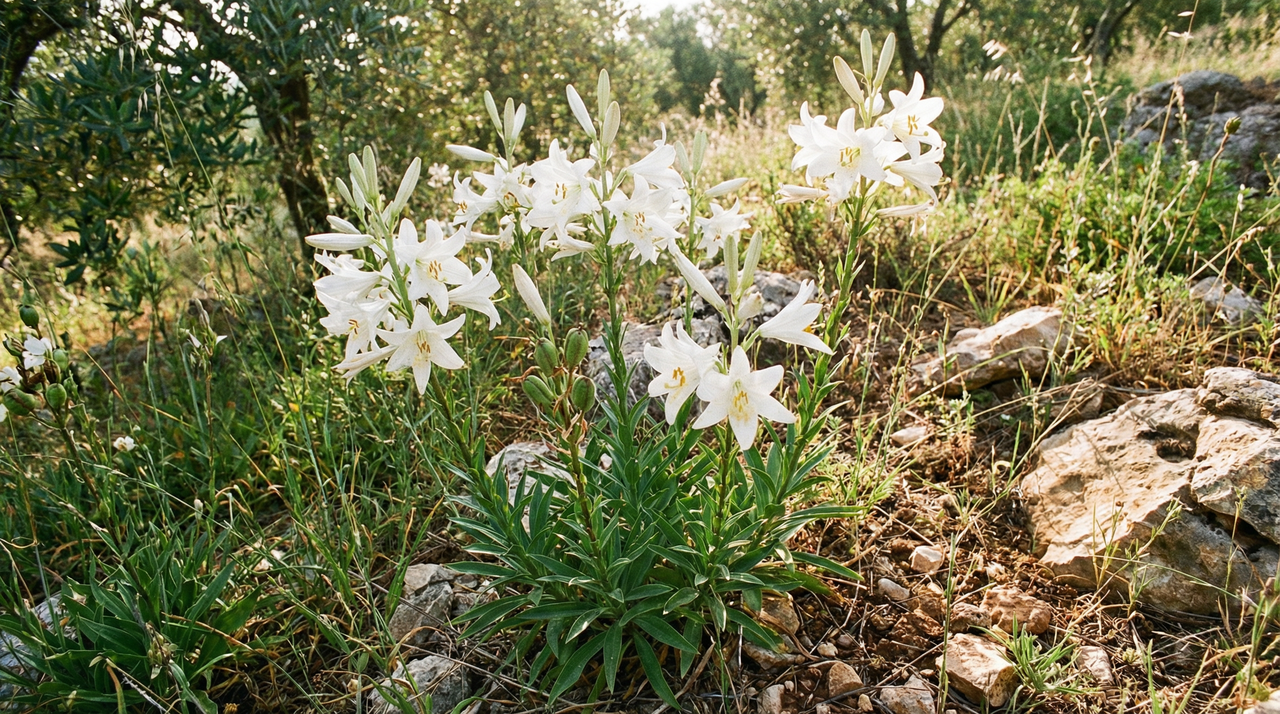
The contrast with close relatives makes that orange spotted look all the more diagnostic. The Madonna lily (Lilium candidum) could not look more different: pure white, fragrant, trumpet-shaped flowers 7.5 to 10 cm across without a spot in sight.[15][16] The goldband lily (Lilium auratum) goes large and lavish, white flowers 10 to 15 cm across striped with orange-gold bands.[17] That diversity across the genus is part of what makes lily identification so satisfying once you know what you're looking for.
Traditional and Cultural Uses
In Traditional Chinese Medicine, the dried bulb of Lilium lancifolium and the closely related Hong Kong lily (Lilium brownii) have been used under the name Bai He for centuries: clearing heat, moistening the lungs, relieving dry cough, nourishing yin, and calming the mind in cases of insomnia and irritability.[18][19] The Shennong Ben Cao Jing and Li Shizhen's Ben Cao Gang Mu both document these applications, and Korean and Japanese ethnobotany echo them for respiratory relief, fatigue, and fever.[20][21] The bulbs have been cooked and eaten in East Asian cuisines for just as long; I'll cover preparation in detail later in this profile, but the short version is that thorough cooking is non-negotiable.
Symbolically, the tiger lily carries associations of wealth, prosperity, and good fortune in China, appearing in Lunar New Year celebrations, while Japanese folklore links it to purity and the afterlife; Victorian flower language, never subtle, assigned it to passion and pride.[22][23] The Madonna lily has an even longer symbolic history in the West, appearing in Minoan art, ancient Greek and Roman texts, and centuries of Christian Annunciation paintings as an emblem of the Virgin Mary's purity.[24][25] The goldband lily, cultivated in Japan since at least the 12th century, holds its own deep cultural life in hanakotoba, ukiyo-e prints, samurai gardens, Obon festivals, and tea ceremonies, symbolizing purity, renewal, and dignity, though it is now Vulnerable in the wild due to habitat loss.[26][27]
Fun Facts and Ecological Notes
If you've grown tiger lily, you already know its most remarkable trick. By midsummer, small reddish-brown bulbils appear in the leaf axils, and by the time they're ripe they practically fall into your hand. Each one is a fully viable propagule, and a single mature plant can produce enough to generate 20 to 50 new plants in a season, with bulbil viability running above 90 percent when stored cool and moist.[28][29][30] I've used this for years as an almost embarrassingly easy propagation method. The flip side is that gravity, rain, and human foot traffic disperse those bulbils readily, which is exactly how tiger lily turns into an invasive problem along wetlands, roadsides, and forest edges in the Northeast and eastern Canada, hybridizing with native lilies and crowding out the plants that belong there.[10][11] I label every bulbil-producing plant in my garden and monitor any that grow near natural areas.
The flowers draw bees, butterflies, and hummingbirds, and the night-fragrant relatives like the goldband and Madonna lilies pull in nocturnal moths on warm summer evenings, which is one of the better reasons to plant a lily guild where you can sit and enjoy it after dark.[31] One ecological note that I repeat to every client, every time: all true Lilium species are toxic to cats, causing acute kidney failure from even a small exposure.[31] I've been saying this for years and I'll keep saying it. If you have cats, these plants do not belong anywhere they can access.
Lily Varieties and Sourcing for Your Garden
Notable Varieties of Tiger Lily and Related Lilium Species
Tiger Lily (Lilium lancifolium) is a bulbous perennial from East Asia that has naturalized across parts of the United States, and while it's treated as a single species botanically, a lot of what gets sold under that name in garden centers is actually a hybrid.[32][33][34] Worth knowing before you buy. The true species grows 3 to 6 feet tall, blooms July through August with clusters of 10 to 20 orange-red, black-spotted flowers, and carries a surprisingly pleasant citrus-like fragrance that I find much stronger in the evening.[5] It's hardy in USDA zones 3 through 9, tolerates a soil pH range of 5.5 to 7.5, and will even grow in a large container if you give it depth.[5]
Within the species, two botanical varieties are worth knowing: var. alba, which produces white flowers and spreads more slowly, and var. viridiflorum, a less common greenish-flowered form with moderate vigor.[35] Among cultivars, 'Flore Pleno' is my go-to recommendation for anyone gardening in a humid climate. It's double-flowered, particularly vigorous, and has shown noticeably better disease resistance in my humid subtropical summers compared to the straight species.[36][33] 'White Queen' is another one I've grown, and honestly its fragrance is sweeter and softer than the standard orange form. 'Red Monarch' deepens into a rich scarlet that photographs beautifully but doesn't stray far in cultural needs from the rest.[37]
The disease picture is worth taking seriously at the selection stage. Tiger Lily has moderate botrytis resistance but is susceptible to aphids, lily mosaic virus, and struggles in persistently humid conditions,[5][38] which is exactly why cultivar selection matters more than most people think.
Then there's the spread. Tiger Lily produces bulbils in its leaf axils that drop, root, and multiply with zero encouragement from you.[5][39] I learned this the hard way in a community food forest plot where it quietly colonized a wet margin and started outcompeting some lovely native sedges. Now I only grow it in contained raised beds or pots in my zone 9B garden. Missouri Botanical Garden explicitly recommends against planting it in natural areas, and it's documented as invasive in the Northeast, Midwest, and Pacific Northwest.[39][34]
The rest of the genus offers compelling alternatives depending on what you're after. Madonna Lily (Lilium candidum) brings pure white trumpet flowers 4 to 6 inches wide with one of the strongest sweet fragrances in the genus, blooms earlier in the summer, and is hardy through zone 3. The catch is it prefers alkaline soil and is genuinely more disease-prone, with few true cultivars because of its genetic uniformity.[40][41] Goldband Lily (Lilium auratum) from Japan goes in the opposite direction entirely: enormous 8 to 12 inch blooms with golden-yellow bands and crimson streaks, intensely fragrant, and available in cultivars like 'Empress of India' and the robust var. platyphyllum. It wants moist, acidic, well-drained soil and some afternoon shade.[42][43] Hong Kong Lily (Lilium brownii), native to southern China, is quieter in the garden but valuable as a hybrid parent and has traditional medicinal uses for its bulbs. It carries multiple botanical varieties and contributes fragrance and hardiness to its offspring.[44][45]
Ethical Sourcing and Purchasing Considerations
Tiger Lily bulbs are widely available from specialty suppliers including Plant Delights Nursery, Brent and Becky's Bulbs, White Flower Farm, Breck's, Burpee, and Eden Brothers.[46][47][48] Bulb packs typically run $10 to $20 and mature plants $25 to $35, though prices shift seasonally.[49][50] Fall is generally the best time to shop for best selection and bulbs that can go straight into the ground. Seeds are available too, but they require 30 to 60 days of cold stratification before germination.[51]
Before you order, check your local regulations. Tiger Lily is listed as invasive in Massachusetts, New Hampshire, New York, and Washington, among others, and sale or planting may be restricted depending on where you are.[39][52][53] Even where it's legal, keep it away from natural areas and unmanaged edges.
Madonna and Goldband Lilies are available from many of the same reputable vendors, so you're not starting from scratch sourcing them.[54][55] Buy from named, reputable suppliers to reduce the risk of mislabeled hybrids, especially with Madonna Lily, which gets confused with white-flowered Asiatic hybrids constantly. Hong Kong Lily is a different story: it's genuinely rare in the US trade, available primarily from niche specialists like B&D Lilies and Plant Delights, and it carries a Vulnerable designation on the IUCN Red List due to habitat loss and over-collection.[56][57][58] I source it only from nurseries recommended by the North American Lily Society and always confirm it's nursery-propagated stock, not wild-collected. The extra diligence is genuinely worth it.
Tiger Lily Propagation and Planting
Tiger Lily has a propagation trick that most other lilies simply don't offer, and it's one of the reasons I keep coming back to this species when I want to expand a planting quickly. Those small, dark, pearl-like bulbils that form in the leaf axils each summer are basically the plant handing you free starts. I've collected them dozens of times, and when I gather them in late summer once they're plump and have turned glossy black, then tuck them into moist seed-start mix about an inch deep, I routinely see 80 to 90 percent of them establish without fuss. That kind of success rate from a passive, no-effort propagation method is genuinely rare in the lily world.
Propagation Methods for Tiger Lily
The vegetative hierarchy for Lilium lancifolium runs like this: bulbils are the easiest and fastest, bulb division during dormancy (late summer through fall, or early spring before growth begins) is the most reliable home method for producing flowering-size plants quickly, and bulb scale propagation works well too though it asks for a bit more patience.[59][60][5] All three methods produce plants that are true to type, which matters because seed propagation in Tiger Lily does not. This species hybridizes readily, so open-pollinated seed will give you genetic variability rather than reliable replicas of the parent plant.[61]
Seed is absolutely possible, just slow and genetically unpredictable. Tissue culture is used commercially for rapid, disease-free production at scale, but it's not a home-gardener tool.[5] Two methods I sometimes see people attempt that don't belong in your toolkit: stem cuttings and grafting. Neither is reliable for Tiger Lily. Stem cuttings fail because of the plant's bulbous nature, and grafting has low success rates and is used only experimentally or for disease-resistant rootstocks in other species like Hong Kong Lily (Lilium brownii).[59][62]
Regardless of which vegetative method you choose, start with disease-free stock. I've learned from experience to discard any bulb that shows even slight softness at the base before it touches the ground. Basal rot can wipe out a new planting faster than almost any other problem, and the RHS and Missouri Botanical Garden are clear on why good air circulation and clean planting material are non-negotiable from day one.[59][5]
Tiger Lily Seed Characteristics, Storage, and Germination
Tiger Lily seeds are orthodox, which means they store well when handled correctly. Fresh seed has viability of roughly 70 to 90 percent, and you can maintain that viability for two to three years at 0 to 5°C, or considerably longer (potentially decades) with cryopreservation at -18°C or below.[63][64] My method is simple: dry seeds to around 3 to 10 percent moisture content using silica gel in a sealed jar, then refrigerate. I've kept lily seed viable for three full seasons this way, following guidance from Kew and the USDA, and it works reliably when you don't cut corners on the desiccant.[65]
The seeds themselves are small (2.5 to 3.5 mm long), fusiform with longitudinal ridges, mottled brown, and carry a thin membranous wing. Each seed contains a single embryo (monoembryonic), which is why open-pollinated seedlings show so much variability.[66][67] That's worth contrasting with Goldband Lily, Madonna Lily, and Hong Kong Lily, all of which frequently produce polyembryonic seeds with two to five embryos per seed from both zygotic and nucellar tissue.[68] For Tiger Lily specifically, germination requires four to eight weeks of cold moist stratification at around 4 to 5°C to break physiological dormancy, followed by germination at 15 to 25°C over four to eight weeks.[69] If you want to confirm seed quality before committing to a long grow-out, viability testing via tetrazolium assay, X-ray radiography, or standard germination tests per ISTA guidelines will tell you what you're working with before you invest the time.[70]
Soil and Site Requirements for Tiger Lily
This species is native to forest edges, grassy slopes, and open woodlands across China, Japan, and Korea at elevations up to 2000 meters.[71] That habitat tells you everything about what it wants in your garden: good light, consistent but well-drained moisture, and a loamy soil with reasonable organic matter. The target pH is 6.0 to 7.0, though Tiger Lily tolerates a range of 5.5 to 7.5, and it wants around 5 to 10 percent organic matter in a soil that drains freely but doesn't dry out completely between waterings.[5][72] For comparison, Madonna Lily prefers a slightly higher pH (6.5 to 7.5, tolerating alkaline conditions), while Goldband Lily favors higher organic matter closer to 10 to 20 percent, so they're not interchangeable in a mixed planting without some adjustment.
Drainage is the non-negotiable. I've lost bulbs in compacted clay that held water after rain, and I've had the same variety thrive in sandy loam amended with compost. Tiger Lily tolerates various textures from loamy sand to clay loam, but only if drainage is genuinely excellent.[73][74] If your native soil is heavy, amend generously with compost, well-rotted manure, and coarse grit or sharp sand before planting. For containers, a mix of equal parts potting soil and coarse organic material with 25 to 33 percent inorganic grit or perlite in a pot with drainage holes is what I'd use.[75][76] Mulching after planting helps maintain cool, moist roots through summer without creating the saturated conditions that invite rot.
For light, aim for full sun to partial shade with at least six hours of direct sun daily. In hotter climates, afternoon shade prevents leaf scorch. Too little light and the plant etiolates and produces few blooms; too much harsh sun and you'll see wilting and bleached foliage.[75] Soft bulbs, yellowing leaves, and stunted growth are your soil distress signals, and they almost always trace back to waterlogging or compaction rather than nutrition.
Planting Depth, Spacing, and Technique
Plant Tiger Lily bulbs 6 to 8 inches deep and 8 to 12 inches apart, or open that up to 12 to 18 inches if you want better air circulation between plants. Row spacing of 18 to 24 inches gives you room to work the bed without disturbing the bulbs.[77][78] I go to 6 to 8 inches even in my sandier Florida beds because those tall stems (reaching 3 to 6 feet under good conditions) need the depth to anchor against summer storms. Madonna Lily is the exception in the genus where shallower planting applies, but Tiger Lily is not that plant. Go deep.
Timing is straightforward: fall planting in September or October, after foliage dies back, is preferred in mild climates. In colder zones (USDA zone 3), spring planting before growth begins works well, with mulch applied after to prevent frost heave.[74] Plan to divide established clumps every three to four years as the planting becomes crowded, both to keep flowering vigorous and to manage the colony's spread. Mature plants may need staking when flower load is heavy, which is a planning consideration rather than an afterthought.[77]
Timeline from Propagation to Flowering
Here's where method choice really shows its consequences. Bulbils are the shortcut: planted in late summer, they can produce flowering plants in as little as one to two years.[79] Bulb division and scale propagation get you there in two to three years. Seed is a different commitment entirely: three to five years to first bloom under good conditions, and four to six years if you're waiting for a mature harvestable bulb.[80][5]
I once started a batch of Tiger Lily seed alongside faster-maturing perennials as a teaching exercise with clients. Years later, I use that planting as my go-to example when someone wants instant results: the satisfaction of watching a seedling build toward its first bloom across multiple seasons is genuine, but it's a different relationship with the plant than most kitchen garden clients are prepared for. For breeders who want genetic diversity, seed is the path. For everyone else, bulbils are the answer. Commercial production brings bulbs to marketable size (18 to 20 cm circumference) in three to four years, which gives you a useful benchmark for what "established" actually looks like.[60] From a purchased mature bulb, you can realistically expect blooms in the first or second year after planting, which is why buying from a reputable nursery rather than growing from seed makes practical sense for most home gardeners who want orange flowers in their lifetime rather than several seasons from now.
Tiger Lily Care Guide: Watering, Feeding, and Seasonal Maintenance
Tiger lily is genuinely forgiving once you understand what it's asking for, and what it's asking for is pretty simple: decent drainage, consistent moisture during the growing season, and a soil pH that doesn't stray too far from neutral. Get those three things right and this plant will reward you with minimal fuss for years.
Water Needs and Soil Moisture Management
The goal with tiger lily watering is even moisture, never saturation. During active growth, that typically means about 1-2 inches of water per week, or a deep watering every 7-10 days, adjusted upward during hot spells.[5][81] The soil should be humus-rich, well-drained, and sitting at a pH of 6.0-7.0; tiger lily has low tolerance for high salinity and strongly prefers water that isn't alkaline or heavily mineral-laden.[82][83]
Knowing what goes wrong in both directions helps enormously. Overwatering shows up as yellowing, wilting leaves and soft mushy stems; in waterlogged soil, Fusarium and Phytophthora move in fast.[84][85] Underwatering looks different: leaf tips and edges brown and scorch, foliage goes dry and brittle, growth slows visibly.[86] I've found the finger-in-the-soil test more reliable than any calendar, especially in humid summers. Seasonally, the rhythm is straightforward: ramp up moisture as shoots emerge in spring, maintain it steadily through summer, ease off as foliage yellows in autumn, and during dormancy keep the soil barely moist, almost dry.[81][5] Compare that to Madonna lily, which actually wants quite dry conditions during its summer rest; tiger lily is considerably more tolerant of ambient humidity during dormancy, but it still doesn't want to sit wet.
Sunlight, Heat Tolerance, and Shade Strategies
Tiger lily is rated for USDA zones 3-9 and AHS heat zones 1-8, which is a genuinely wide range.[5][87] But comfortable and merely survivable aren't the same thing. Optimal growth happens in that 15-25°C (59-77°F) sweet spot; once temperatures push past 30°C (86°F) and stay there, you'll start seeing leaf scorch, wilting, and premature flower drop.[88][81] In hotter climates, partial shade during the afternoon is a practical necessity, not optional.[5] For reference, Goldband lily drops buds even faster under heat stress, so tiger lily is relatively robust within the genus, but it still appreciates relief.
The two most effective tools are a 30-50% shade cloth during peak summer heat and 2-3 inches of organic mulch around the base.[89][90] The mulch does double duty, conserving moisture and keeping the root zone noticeably cooler, which is where you'll see the real benefit on a 95°F afternoon.
Feeding and Nutrient Management
Balanced fertilization is the target, with NPK ratios like 10-10-10 or 5-10-10 being reliable starting points; a slightly higher phosphorus component supports both root development and flowering.[5][81] Apply every 4-6 weeks from spring through early summer, then stop after flowering so the bulb can quietly recharge before dormancy.[5][91] At planting time, I work in bone meal or a low-nitrogen bulb fertilizer; organic options like well-rotted compost and aged manure are excellent for slow-release nutrition without the risk of burning.[5][83]
Knowing the deficiency signs gives you real diagnostic confidence. After a rainy spring, I've started watching for interveinal chlorosis on the lower leaves, yellowing between the veins while the veins themselves stay green, which points directly to magnesium deficiency.[92][93] Phosphorus deficiency shows as a purplish cast on lower leaves; potassium deficiency gives you marginal necrosis, browning and yellowing around leaf edges with weak stems. Nitrogen excess, on the other hand, produces lush dark green growth with no flowers and can contribute to bulb rot in wet soils.[5][94] When in doubt, do a soil test before adding anything.
Frost Tolerance and Winter Protection
The dormant bulbs themselves are remarkably tough, hardy through zone 3 winters without drama.[95][5] The vulnerable moment is spring, when new shoots push up and a late frost can blacken tips, cause wilting, and in bad cases cause mushy necrotic tissue; the plant can often recover from bulb reserves if the damage isn't severe, but it's a setback worth avoiding.[96][97]
For winter mulching, I apply 4-6 inches of organic mulch after foliage has fully browned and soil temperatures drop below 50°F; mulching too early when the soil is still warm invites rot and rodents setting up cozy winter homes right over your bulbs.[98][99] In zones 3-5, going up to 8 inches gives extra insurance against the hardest freezes.[81]
Pruning, Maintenance, and Seasonal Rhythm
Tiger lily emerges in April or May, builds vegetative mass through late spring and early summer, and blooms for roughly 3-4 weeks in mid to late summer, typically July into August.[5][100] Those stems can reach 3-6 feet, and I've learned to put stakes in early before the plant needs them; bamboo canes or peony rings both work, tied loosely so the stem can still move naturally.[5] After flowering, deadhead spent blooms promptly by cutting just above a leaf node to prevent seed set, then let the foliage yellow and die back completely before cutting stems to the ground in fall.[5][81] That senescence period is the bulb recharging for next year; cutting it short is genuinely counterproductive.
Dividing every two to three years maintains vigor and, honestly, keeps the plant from wandering.[5] Tiger lily spreads enthusiastically via bulbils along the stems, and in parts of the Northeast and Midwest it has escaped cultivation and displaced native vegetation.[101] In my early gardens I let the bulbils spread unchecked because it felt like abundance; now I deadhead rigorously and divide on a regular schedule to keep both the display and the surrounding ecology in balance. It's a small habit that makes a real difference.
Harvesting Tiger Lily Bulbs and Flowers
There's a particular kind of gardening patience that Tiger Lily teaches you, and it starts the moment you put a bulbil in the ground. You're not harvesting anything that first summer, or the one after that. Edible bulbs worth digging take two to three years of growth to develop, and I'll be honest: that timeline tests new growers. What's kept me from giving up on the wait is that the intervening summers deliver something genuinely spectacular. The flowers carry their own reward while the underground storage organs quietly mature.
Timing Your Harvest: From Flowering to Bulb Maturity
Tiger Lily blooms July through August in temperate Northern Hemisphere gardens, and that flowering period is your starting point for calculating when to dig.[5] After the flowers fade, the plant spends the next eight to twelve weeks pushing energy back down into the bulb, and harvest comes once the foliage has fully yellowed and died back in late summer or fall.[5][102] Madonna and Goldband lilies follow a nearly identical rhythm, with bulbs ready six to twelve weeks after their own blooms once foliage senesces in late summer to early autumn.[103][104] Hong Kong lily (Lilium brownii) takes a bit longer, reaching full bulb maturity ninety to one hundred twenty days post-bloom before the same senescence cues signal it's time to dig.[105][106] Across the genus, the pattern holds: watch the leaves, not the calendar. Climate shifts the exact week, but yellowing foliage never lies.
Best Techniques for Cut Flowers and Edible Bulbs
For cut flowers, I harvest in the morning before heat builds, when the lowest buds are showing color but haven't yet opened. The stem goes at a 45-degree angle, leaving eighteen to twenty-four inches intact, and the cut end drops immediately into water with floral preservative.[60][107] I always recut the stems under water before arranging and keep the bucket out of direct sun. The same bud-color cues apply to Madonna and Goldband lilies, which similarly reward morning harvest and angled cuts with the longest vase life.[108] Stored cold at 32 to 41°F with high humidity and away from ethylene sources like fruit, a well-handled Tiger Lily stem will stay display-worthy for ten to fourteen days.[109]
For bulb harvest, slightly damp soil makes the job much easier. I use a fork rather than a spade and start digging wide, because the bulbs spread further than you'd expect. Leaving a few smaller bulblets behind means next year's flowering colony practically plants itself.
Expected Yields, Flavor, and Post-Harvest Care
A mature Tiger Lily clump blooms midsummer through early fall and, after two to three years, yields multiple bulbs per plant with that characteristic starchy, mildly sweet flavor that's been prized in traditional East Asian cooking for centuries.[110][111] Harvesting at full maturity, after complete foliage die-back, is what delivers that quality. Bulbs dug too early taste thin and starchy in the wrong way. Get the timing right and you have something genuinely good to bring to the kitchen, plus a vase of flowers that lasted nearly two weeks. That combination, beauty and food from a single clump, is exactly the kind of multipurpose payoff that makes Tiger Lily earn its space in a productive garden.
Tiger Lily Culinary Preparation and Uses
Culinary Preparation, Flavor, and Edible Uses
Tiger lily has fed people across East Asia for centuries, and once you've actually cooked with the bulbs, you understand why. Known as yuri ne in Japan and closely related to the Bai He used in Chinese cooking, the starchy bulbs of Lilium lancifolium have a potato-like, slightly chestnut-y texture when cooked and a mild, nutty sweetness that takes on other flavors beautifully.[112][113] The flowers, eaten raw or cooked, add a tangy, slightly bitter crispness as a garnish or in teas.[112] Traditional applications span Korean jeon pancakes, Japanese tempura, soups, porridges, stir-fries, and desserts; bulbs are also dried and rehydrated, which concentrates their sweetness into a pleasantly chewy texture.[114][115]
Raw bulbs are not safe to eat. They must be peeled, boiled at least once (ideally twice), and fully cooked before consumption to neutralize alkaloids, saponins, and other irritants that cause significant digestive upset.[102][116] I treat it like preparing dried beans: the process is non-negotiable. Lilium brownii, the Hong Kong lily, has similar culinary properties with a somewhat more gelatinous, creamy texture after cooking and young shoots that prepare like asparagus,[117] while Lilium candidum appears in some Balkan and Mediterranean stews and relishes with comparable potato-chestnut flavors, though sources conflict enough on safety that I'd recommend consulting a specialist before going that route.[118][119]
One critical identification note: Lilium auratum, the gold-banded lily, is not edible despite appearing in some lists of "Japanese edible lilies." It can cause gastrointestinal upset and should not be confused with L. lancifolium or L. brownii, which are the actual culinary species.[120][121] I label every lily variety in my gardens precisely because the young shoots can look confusingly similar at emergence. If you're foraging tiger lily from wild populations, know that it's documented as invasive across much of the Northeast and Midwest, which actually makes selective thinning of dense patches an ecologically sound harvest opportunity.[122] Never harvest from protected native lily populations, though; L. auratum has conservation protections in parts of the U.S. where wild collection is outright illegal.[123]
Medicinal Preparations and Traditional Applications
As a TCM ingredient, dried Bai He bulbs from L. lancifolium and L. brownii are prepared in decoctions (typically 10-15g daily), infusions (5-10g steeped), tinctures (2-4ml taken two to three times daily), or powders (3-9g) to nourish yin, moisten the lungs, calm the spirit, and address dry cough, insomnia, and heart palpitations.[18][124][125] I always cross-reference those dosages against the current Chinese Pharmacopoeia before including them in any educational materials, and I'd encourage the same rigor from anyone exploring this tradition. These preparations have real historical depth, but clinical trial data in humans remains thin, so they complement rather than replace professional medical guidance.
Lilium candidum has its own separate medicinal lineage in Mediterranean and European traditions, where bulb decoctions and infused oils were applied externally for burns, wounds, and skin ailments, and where respiratory preparations were documented alongside poultice uses.[126][127] The patterns across both traditions reflect a genus consistently valued for topical, respiratory, and nervous system applications, even when the botanical species and preparation methods diverge.
Safety, Toxicity, and Responsible Foraging
In my years designing gardens for clients with pets, this is the section I take most seriously. Every part of every true lily, including Lilium lancifolium, is acutely toxic to cats and dogs. Petals, leaves, pollen, and bulbs can all cause kidney failure, and even small ingestions can be fatal.[128][129] I've redesigned entire garden beds to keep lilies out of reach, and I'd do it again without hesitation. If you have cats or dogs with outdoor access, the responsible choice is no true lilies in reachable spaces, full stop.
For humans, properly cooked bulbs are generally safe for most people, but raw material carries real risk of digestive irritation.[130] Overconsumption of cooked bulbs can still cause issues in sensitive individuals, and anyone considering medicinal use should consult a qualified practitioner given the limited clinical data and potential for herb-drug interactions.[131] Proper species identification before any culinary or medicinal use is equally non-negotiable; look-alikes exist, and the consequences of misidentification are not worth the risk.[128] Used knowledgeably, with plants sourced ethically and prepared correctly, tiger lily rewards that care with genuine culinary and traditional value.
Tiger Lily Health Benefits and Medicinal Uses
Traditional Uses and Medicinal Research
The tiger lily's medicinal story begins in Traditional Chinese Medicine, where the dried bulb — known as Bai He — has been used for centuries to moisten the lungs, clear heat, nourish Yin, and calm the spirit.[132][133] Dry cough, insomnia, anxiety, irritability, and fever from Yin deficiency are the classic indications, and the overlap with its close relative Lilium brownii (also called Bai He in Korean and Chinese traditions) reinforces just how consistent this ethnobotanical record is across Asia.[134] While I still value the traditional use of bai he simmered into winter soups for soothing dry-season respiratory complaints, I'm careful to frame it as exactly that: a traditional use backed by centuries of empirical observation, not a clinically validated treatment.
Modern pharmacology has given researchers reasons to look seriously at that tradition. Lab and animal studies show tiger lily extracts inhibiting NF-κB, COX-2, TNF-α, and IL-6 (anti-inflammatory), scavenging free radicals (antioxidant), and inducing apoptosis in cancer cell lines.[135][136] Similar patterns appear across the genus, including in L. candidum, which carries a long European tradition of topical wound and burn healing, and L. auratum, used in Japanese folk medicine for respiratory and skin complaints.[137][138] That said, no peer-reviewed human clinical trials yet exist for any of these species.[139][140] The evidence is preclinical, and anyone considering medicinal use should work with a qualified practitioner.
Key Phytochemicals and Bioactive Compounds
The bulb is the primary chemistry lab of the plant. It concentrates steroidal saponins (including marinacine A, B, and C), the alkaloid lycorine, flavonoids such as kaempferol-3-O-rutinoside and quercetin derivatives, chlorogenic acid at roughly 1.2–2.5% dry weight, and polysaccharides.[141][142] Marinacine A is particularly striking, showing cytotoxicity against leukemia, lung, and breast cancer cell lines at IC50 values of 1–5 μM by inducing apoptosis; lycorine demonstrates antiviral activity against SARS-CoV-2 in vitro at an IC50 of approximately 0.086 μM.[141][143] The flavonoids and phenolics pull antioxidant and anti-inflammatory duty, with DPPH IC50 values in the 50–100 μg/mL range.[144]
These compound profiles aren't fixed. Phenolic content peaks in summer, acidic soils tend to push concentrations higher, and altitude and geographic origin all shift the numbers meaningfully.[145] I've noticed that bulbs harvested after a hot, sunny season smell noticeably more pungent and resinous when sliced, and that tracks with the research on seasonal phenolic peaks. Across the genus, L. brownii adds imperialine and lilidine alkaloids, L. candidum contributes cardiac glycosides and monoterpene-rich essential oils, and L. auratum carries unique isoquinoline alkaloids auratine A and B.[127][146] These defensive metabolites evolved to protect the bulb from herbivores and pathogens, which is a tidy reminder that the plant's chemistry serves its own survival first — and our pharmacopeia second.
Nutritional Profile
Tiger lily bulbs have fed people across East Asia for a long time, valued in Chinese bai he preparations and Korean byeokgol cuisine in soups, stir-fries, and desserts.[147] Nutritionally, a 100 g fresh bulb delivers roughly 72–100 kcal, 15–20 g of carbohydrates (primarily starch and fructans), 1.7–3 g protein, and modest fiber, alongside meaningful amounts of vitamin C (15–30 mg), potassium (200–350 mg), calcium, iron, and magnesium.[148][149] The polysaccharides and total phenolics (20–50 mg/g) bridge the gap between food and medicine, lending antioxidant and immunomodulatory effects that align neatly with the traditional tonic reputation.[150]
A word from experience: the first time I cooked bai he bulbs I underestimated how much cooking they needed, and the result was a mild scratchiness at the back of the throat that cleared up fast but was a useful lesson. Raw bulbs contain calcium oxalate crystals that can cause gastrointestinal irritation and nausea; boiling, steaming, or a thorough stir-fry removes the problem.[148][151] Properly cooked, the texture lands somewhere between a firmer water chestnut and lotus root: mild, slightly sweet, pleasant. Overcooking turns them mushy, so there's a sweet spot worth chasing.
Safety Considerations
As someone who shares a garden with cats, I treat every true lily as a non-negotiable exclusion zone. Any part of a Lilium species — pollen, leaves, flowers, bulbs, even water from a vase — can cause acute kidney failure and death in cats within 12–24 hours of ingestion.[128][152] This applies to L. lancifolium, L. candidum, L. brownii, and L. auratum alike. The exact nephrotoxic compounds are still under investigation but appear to be water-soluble and distinct from the alkaloids like lycorine.[153] I keep cut arrangements on high shelves and never plant true lilies anywhere my cats roam. This is not an area where caution can be relaxed.
For dogs and livestock the picture is considerably less severe — dogs typically experience gastrointestinal upset, and horses or cattle generally show only mild effects at very large quantities.[128][154] Humans fare better still: small ingestions cause self-limiting nausea and digestive discomfort, and properly dried and cooked L. lancifolium or L. brownii bulbs have a long TCM safety record at standard decoction doses of around 10–15 g.[155][156] Pollen and fresh sap can irritate skin or trigger allergic rhinitis in sensitive people, so gloves during handling are wise. One critical identification note: true lilies are frequently confused with daylilies (Hemerocallis spp.), which do not carry the same feline kidney toxicity, making correct botanical ID essential before any culinary or medicinal use.[157][158] Lilium species are not recommended during pregnancy, and anyone considering regular medicinal use should consult a qualified practitioner — the human clinical trial gap is real, and LD50 data from rodent studies, while reassuring at ordinary doses, does not substitute for proper guidance.[139]
Pests and Diseases of Tiger Lily (Lilium lancifolium)
Common Pests and Insect Threats
If you grow tiger lily long enough, the lily leaf beetle will eventually find you. Scarlet red, absurdly pretty, and absolutely ruthless, Lilioceris lilii can strip a healthy stand of foliage within days. Asiatic lilies including Lilium lancifolium tend to take harder hits from this pest than Trumpet or Oriental types.[159][160][161] In my experience, once you spot the orange-brown larvae, you have maybe a day or two before the damage becomes severe. I check the undersides of every leaf when I do my spring walk-through, and I label each row carefully because young Botrytis lesions and beetle eggs look surprisingly similar at first glance.
Beyond the beetle, the usual suspects include aphids (which cause distorted growth, reduced vigor, and sooty mold), thrips, spider mites in dry weather, slugs on young shoots, bulb mites in wet soils, Japanese beetles, and root-knot or bulb nematodes.[162][163][164] Tiger lily's broad, waxy leaves with thick cuticles do offer some physical deterrence, and related species in the Liliaceae produce alkaloids and saponins that deter smaller insects.[165][166] Contrast that waxy surface with the thinner leaves of Oriental hybrids and you start to understand why tiger lily holds up better against slugs and minor pests. Against the beetle, though, that cuticle does almost nothing. There are currently no widely documented cultivars of L. lancifolium with meaningful resistance to lily leaf beetle or nematodes; most breeding work has prioritized disease over insect resistance.[167][168] The genetics of Lilium brownii are a genuine bright spot in breeding programs, offering moderate overall pest tolerance,[169] but that hasn't yet filtered into widely available tiger lily selections.
Major Diseases and Viral Issues
Tiger lily has low to moderate disease resistance overall, and Botrytis blight (Botrytis elliptica or cinerea) is the fungal threat you're most likely to meet. Cool, humid conditions trigger the characteristic leaf spots and bud rot fast.[170][171][172] Fusarium wilt and basal rot (Fusarium oxysporum f. sp. lilii) follow close behind, and both get dramatically worse in poorly drained or overly acidic soils below pH 5.5.[173][174][175] In my experience, the difference between a healthy colony and a constant battle is almost entirely drainage and airflow.
Viruses are where tiger lily's story gets complicated. The species is highly susceptible to lily symptomless virus, tulip breaking virus, cucumber mosaic virus, and lily mottle virus, all spread by aphids and all incurable once established.[176][177][178] Worse, L. lancifolium can carry some viruses asymptomatically and act as a reservoir, silently infecting neighboring plants.[176] When I spot a plant showing mosaic patterns I remove it immediately and do not compost it; the research is unequivocal that these plants act as reservoirs even when they look almost normal. Secondary pathogens including Alternaria and Cladosporium leaf spots, Rhizoctonia corm rot, Pythium rhizome rot, and bacterial soft rot round out the disease picture,[173][179] though you're less likely to meet them if the fundamentals are right. Some cultivars do offer a measure of hope: 'Celeste' and 'Fortune's Giant' show reasonable tolerance to Botrytis and bulb rot,[169][83] and Lilium brownii genetics contribute 60-70% resistance to Botrytis and Fusarium in breeding lines,[169][180] though that species is itself quite susceptible to viruses.
Prevention and Integrated Management
Informed cultural practice genuinely tips the odds in your favor. Start with certified virus-free bulb stock, space plants 12-18 inches apart for airflow, plant bulbs 4-6 inches deep, avoid overhead watering, and rotate the planting area every 3-4 years.[170][164][181] Maintaining soil pH between 6.0 and 7.0 with good drainage removes the conditions that Fusarium and Botrytis count on.[170][181] These aren't optional refinements; they're the foundation everything else rests on.
From there, integrated management layers in well: hand-pick beetles and slugs (it works better than most people expect), encourage ladybugs to handle aphid pressure, and reach for neem oil or insecticidal soap before anything stronger.[164][182] Reserve targeted fungicides like chlorothalonil for Botrytis or thiophanate-methyl for Fusarium for situations where cultural control genuinely isn't holding.[164][178] For persistent soil-borne problems, solarization is worth considering. Virus-infected plants get removed without hesitation, never composted. Tiger lily's inherent resistance is modest, but with this kind of attentive management it's a reliable, long-lived garden and food plant.
Lily in Permaculture Design
Tiger Lily is one of those plants where I have to lead with the honest part before I get to the beautiful part. It's genuinely useful in a permaculture landscape, and those flame-orange flowers do real ecological work. But in much of the Northeast and Midwest, Lilium lancifolium is documented as invasive, spreading aggressively through the aerial bulbils it drops from leaf axils, outcompeting native flora in ways that can meaningfully disrupt local plant communities.[183][184] I don't recommend unrestricted planting of Tiger Lily in any region where it appears on an invasive species list. That's a line I hold even when clients fall in love with the bloom. Responsible design means knowing when a beautiful plant is the wrong plant for a particular place.
Ecosystem Functions and Wildlife Value
Where it can be planted responsibly, Tiger Lily earns its place as a high-value pollinator magnet. The flowers are built for insects: large, three to four inches across, vivid orange with black spots, slightly sweet-scented, and shaped in that distinctive reflexed Turk's-cap that positions the stamens for contact with visiting bees and butterflies.[5][185] Bumblebees are the primary movers here, though butterflies contribute meaningfully to cross-pollination.[186][187] The species is self-incompatible, so it depends on those insect visitors to produce seed.[188] Hummingbirds occasionally visit in its introduced North American range, though they're not considered effective pollinators for this species.[187] Peak bloom runs July through August when temperatures sit between 68 and 86°F, and pairing it with bee balm, borage, or salvia in the surrounding guild amplifies pollinator traffic considerably.[189][190]
The other lilies in the genus tell a fascinating parallel story. While Tiger Lily's activity is entirely diurnal, Goldband Lily and Madonna Lily are hawkmoth-pollinated species whose flowers release their strongest fragrance after dark.[191][192] I've noticed this firsthand: sitting in the garden at dusk near a Madonna Lily feels completely different from a midday visit to a Tiger Lily bed. Different insects, different light, different mood. Hong Kong Lily splits the difference with a mixed diurnal-nocturnal strategy that draws from both pollinator pools.[193] If you're designing for pollinator diversity across a full day, planting genus representatives thoughtfully can give you meaningful coverage from morning through night.
Tiger Lily's soil contributions are real but modest. Its rhizomatous root system provides some erosion resistance, and its bulbs serve as food for voles and deer.[194][195] The plant forms arbuscular mycorrhizal fungal associations that improve phosphorus uptake, particularly valuable in the nutrient-poor soils of shaded woodland sites.[196][197] When I establish new woodland beds, I routinely inoculate planting holes with mycorrhizal inoculant. It's a small step that connects the research to something a gardener can actually do, and I've seen noticeably stronger establishment in inoculated beds compared to controls. Hong Kong Lily carries the same fungal partnership, making it equally well-suited to low-nutrient forest soil situations.[5] For hand propagation purposes, pollen transfers from anther to stigma easily with a soft brush, a useful bridge to multiplying your stock while keeping spread controlled.[198]
Climate Adaptability and Hardiness Zones
Tiger Lily is genuinely impressive in its cold tolerance. Hardy from USDA zones 3 through 9, with best performance in zones 5 to 7, the bulbs survive minimum temperatures down to -40°F during dormancy because they're underground and need that cold period for proper vernalization before they'll flower.[5][91] Snow acts as insulation in those colder zones, and the plants handle repeated freeze-thaw cycles without issue. In marginal zones, mulching with four to eight inches of organic material after the ground freezes helps protect bulbs and regulate soil temperature.[91][199] I use the same approach in warmer zones (7 and above) to keep roots cool through summer, which matters more than most gardeners realize.
The heat side of the equation is where Tiger Lily's impressive range starts to narrow. It prefers daytime temperatures between 59 and 77°F during the growing season and begins to struggle when heat lingers above 86°F for extended periods.[200][201] Having grown daylilies in zone 9 conditions, I'd say Tiger Lily behaves more like a cool-season performer by comparison; it doesn't have that same baked-July resilience. Annual rainfall needs of 800 to 1,500mm with consistent summer moisture reflect its East Asian temperate origins.[4] Soil drainage and good air circulation aren't optional; without them, fungal problems accelerate in humid heat.[202]
Across the genus, the hardiness picture shifts considerably. Goldband Lily and Hong Kong Lily generally suit zones 4 to 9 and 6 to 9 respectively, while Madonna Lily spans zones 3 to 8 but with a Mediterranean climate preference that means it thrives in coastal California or the Pacific Northwest and sulks in the humid Southeast.[5][203] Goldband is the most heat-sensitive of the group, struggling above 35°C in humid summer conditions.[204] My honest experience is that zone maps are a starting point, not a guarantee. Drainage and site selection routinely matter more than the zone number on the tag.
Forest Layer Placement and Guild Companions
In its native East Asian range, Tiger Lily inhabits the herbaceous layer of deciduous forests, woodland edges, thickets, and stream margins.[205][206] That native context is your design template. At three to five feet tall (occasionally reaching six feet in ideal conditions), it reads as a mid-height structural element that creates genuine vertical interest beneath a canopy layer without competing for the overstory.[207][208] It performs well in dappled light and tolerates partial shade, though flowering is best with more sun and growth can thin out in dense understories.[205]
For guild companions, ferns, hostas, and astilbe are the naturals: they share the same dappled-light preference, provide low ground coverage that suppresses weeds and holds moisture around the bulbs, and create a layered aesthetic that feels cohesive rather than planted.[209] Adding alliums nearby discourages some pests, and nitrogen-fixers like clover threading through the understory floor quietly improve soil fertility over time.[210] I've used this kind of woodland-edge guild successfully in designs that lean toward the feel of a naturalistic forest margin, with Tiger Lily providing the summer color punctuation. Every single one of those installations included physical containment, though. Root barriers or regular bulbil removal aren't optional steps when you're planting a known spreader near native habitat. The RHS Award of Garden Merit that both Tiger Lily and Goldband Lily hold confirms their reliability as designed-landscape plants,[211][212] but ornamental merit and ecological appropriateness are different questions entirely.
The related species fill similar herbaceous-layer roles: Goldband Lily in Japanese montane forest understories, Hong Kong Lily adapted to 30 to 70 percent canopy shade in subtropical Chinese forests, Madonna Lily in Mediterranean open woodlands and grassy slopes.[213][214][215] The shared thread across the genus is that these are plants shaped by edge habitats and filtered light, which is exactly where a thoughtful permaculture design positions them. Know your region's invasive watch lists before you plant any of them, and you'll be in good shape.
The Lily That Taught Me to Slow Down and Pay Attention
I've pulled hundreds of tiger lily bulbils from places they had no business colonizing, and I've also eaten those same bulbils roasted with a little salt over a fire. That contradiction sits at the heart of this plant for me. It asks you to hold beauty and caution in the same hand, and I think that's exactly the kind of attention a good garden, and honestly a good gardener, should practice.
Sources 215
- Invasive Plant Atlas of the United States: Lilium lancifolium ↩
- ASPCA Animal Poison Control: Tiger Lily ↩
- Plants of the World Online: Lilium lancifolium ↩
- Flora of North America - Lilium lancifolium ↩
- Missouri Botanical Garden - Lilium lancifolium ↩
- Missouri Botanical Garden Plant Finder ↩
- Lilium lancifolium - Royal Horticultural Society ↩
- Species Plantarum ↩
- Lilium lancifolium Profile ↩
- Invasive Plant Atlas of the United States ↩
- Invasive Alien Plants in Europe ↩
- Lilium lancifolium - Royal Horticultural Society ↩
- Lilium lancifolium - Wikipedia ↩
- The Lily Handbook by the North American Lily Society ↩
- Missouri Botanical Garden - Lilium candidum ↩
- Royal Horticultural Society - Lilium candidum ↩
- The Golden-Rayed Lily: Lilium auratum ↩
- Tiger Lily in Traditional Chinese Medicine ↩
- Compendium of Materia Medica (Bencao Gangmu) ↩
- Ethnobotany of Lilium Species ↩
- Ethnobotany of Lilium Species in Japan ↩
- Lilies in East Asian Folklore ↩
- Biblical Flora ↩
- The Madonna Lily: Symbolism and History ↩
- Natural History ↩
- Lilium auratum: The Goldband Lily of Japan ↩
- Lilium auratum ↩
- Tiger Lily - Royal Botanic Gardens, Kew ↩
- Propagation of Lilium lancifolium by Bulbils ↩
- Asexual Reproduction in Lilium Species ↩
- Edible Lilies in Japanese Cuisine ↩
- Lilium lancifolium ↩
- Lilium lancifolium ↩
- Lilium lancifolium ↩
- Lilium lancifolium and Its Cultivars ↩
- Lilium lancifolium ↩
- Missouri Botanical Garden Plant Finder ↩
- University of California Statewide Integrated Pest Management ↩
- Invasive Plant Atlas: Tiger Lily ↩
- Lilium candidum - Madonna Lily ↩
- Lilium candidum ↩
- Lilium auratum - The Goldband Lily ↩
- Cultivars of Lilium auratum ↩
- Royal Horticultural Society - Lilium brownii ↩
- Lilium brownii ↩
- Lilium lancifolium - Tiger Lily ↩
- Tiger Lily Bulbs for Sale ↩
- Lilium lancifolium ↩
- Lilium Bulbs Wholesale Pricing Guide ↩
- Lilium Lancifolium Bulbs ↩
- Tiger Lily Bulbs ↩
- Invasive Plants in Massachusetts ↩
- Lilium lancifolium ↩
- Lilium candidum - Madonna Lily ↩
- Lilium auratum - Golden Ray Lily ↩
- Lilium brownii - Hardy Asiatic Lily Bulbs ↩
- IUCN Red List of Threatened Species ↩
- Rare Lilies for the Garden ↩
- Royal Horticultural Society - Propagation of Lilium Species ↩
- University of Minnesota Extension - Growing Tiger Lilies ↩
- North American Lily Society - Propagation ↩
- Interspecific Grafting in Lilium ↩
- Kew Seed Information Database - Lilium lancifolium ↩
- Kew - Seed Storage of Lilium Species ↩
- USDA Forest Service Seed Storage Guidelines ↩
- Flora of China - Lilium lancifolium ↩
- Seed Morphology and Anatomy in Lilium Species ↩
- Polyembryony in Lilium ↩
- Germination and Dormancy in Lilium Species ↩
- International Seed Testing Association (ISTA) Rules ↩
- Flora of China - Lilium lancifolium ↩
- Royal Horticultural Society - Lilium lancifolium ↩
- HortTechnology - Soil Compaction Effects on Bulb Crops ↩
- USDA Plants Database ↩
- Missouri Botanical Garden - Growing Lilies ↩
- Royal Horticultural Society - How to Grow Lilies ↩
- Missouri Botanical Garden - Lilium lancifolium ↩
- Royal Horticultural Society - Lilium lancifolium ↩
- Royal Horticultural Society - Growing Lilies from Seed ↩
- North American Lily Society - Seed to Bloom Timeline ↩
- Royal Horticultural Society - Growing Lilies ↩
- Lilium lancifolium ↩
- Growing Tiger Lilies: Care Tips ↩
- Tiger Lily Care: Watering and Common Problems ↩
- Identifying and Treating Root Rot in Lilies ↩
- How to Grow and Care for Tiger Lilies ↩
- AHS Heat Zone Map and Plant Ratings ↩
- Physiological Effects of High Temperature on Bulbous Plants ↩
- Heat Stress Management in Bulbous Plants ↩
- Managing Heat Stress in Bulbous Flowers ↩
- Growing Lilies ↩
- Nutrient Deficiencies in Bulb Crops ↩
- Diagnosing Nutrient Deficiencies in Ornamental Plants ↩
- Nutrient Management for Lilium Species ↩
- Lilium lancifolium (Tiger Lily) ↩
- Frost Damage in Lilies ↩
- Identifying Cold Injury in Bulb Plants ↩
- Lilium lancifolium (Tiger Lily) ↩
- Overwintering Bulbs: Mulching for Protection ↩
- Royal Horticultural Society - Lilium lancifolium ↩
- USDA PLANTS Database: Lilium lancifolium ↩
- Tiger Lily - WildFoodNC ↩
- Lilium candidum (Madonna Lily) ↩
- Lilium auratum (Golden-rayed Lily) ↩
- Lilium brownii ↩
- Lilium brownii: Cultivation and Propagation ↩
- Postharvest Handling of Cut Lilies - University of Massachusetts Extension ↩
- Lilium candidum (Madonna Lily) ↩
- Harvesting Ornamental Lilies - Washington State University ↩
- Missouri Botanical Garden Plant Finder ↩
- Edible Lily Bulbs in Chinese Cuisine - USDA Plants Database ↩
- Edible Lilies: Tiger Lily (Lilium lancifolium) ↩
- Edible Lilies: Yuri (Lily Bulbs) in Japanese Cuisine ↩
- Culinary Uses of Edible Lilies in Asia ↩
- Journal of Ethnobiology and Ethnomedicine: Wild edible plants of East Asia ↩
- Culinary Use of Lilium candidum Bulbs in the Balkans ↩
- Flora of China: Lilium brownii ↩
- Traditional Uses of Madonna Lily in Sicilian Cuisine ↩
- Lilium candidum - North Carolina Extension Gardener Plant Toolbox ↩
- Missouri Botanical Garden Plant Finder - Lilium auratum ↩
- Kew Royal Botanic Gardens - Lilium auratum Fact Sheet ↩
- Invasive Plant Atlas: Tiger Lily ↩
- Goldband Lily (Lilium auratum) Conservation ↩
- Bai He (Lilium lancifolium) in Traditional Chinese Medicine ↩
- Chinese Pharmacopoeia (2020 Edition) ↩
- Medicinal Uses of Lilium candidum in Traditional Medicine ↩
- Lilium candidum - Traditional Uses in Medicine and Culture ↩
- Lilies Are Toxic To Cats - ASPCA ↩
- Lilium lancifolium - Missouri Botanical Garden ↩
- Plant Toxicity in Humans: Liliaceae Family ↩
- USDA Plants Database - Lilium lancifolium ↩
- Lilium lancifolium - Traditional Uses and Pharmacology ↩
- Medicinal Plants in China: A Selection of 365 Species ↩
- Traditional Uses of Lilium lancifolium in Chinese Medicine ↩
- Phytochemical and Pharmacological Review of Lilium lancifolium ↩
- Anti-Cancer Activity of Lilium lancifolium Extracts via Apoptosis ↩
- Madonna Lily in Traditional Medicine ↩
- Ethnobotany of Lilium auratum in Hokkaido ↩
- Zhang et al. (2020). Anti-inflammatory effects of steroidal saponins from Lilium lancifolium ↩
- Phytochemical and Pharmacological Review of Lilium Species ↩
- Chemical Constituents and Pharmacological Activities of Steroidal Saponins from Lilium lancifolium ↩
- Phytochemical Analysis of Lilium lancifolium Thunb. Bulb ↩
- Anti-SARS-CoV-2 Potential of Lycorine and Analogues ↩
- Bioactive Compounds from Tiger Lily (Lilium lancifolium) and Their Health Benefits ↩
- Environmental Influences on Secondary Metabolites in Lilium Species ↩
- Alkaloids from Lilium auratum ↩
- Edible Lilies in Asian Diets ↩
- Nutritional Evaluation of Tiger Lily (Lilium lancifolium) Bulbs ↩
- USDA FoodData Central - Lilium, bulbs, raw ↩
- Nutritional Composition and Bioactive Compounds in Edible Lilium Bulbs ↩
- Traditional Chinese Medicinal Uses of Lily Bulbs ↩
- Lilium Species Poisoning in Cats ↩
- True Lily Poisoning in Cats ↩
- Guide to Poisonous Plants - Lily, Easter lily, Asiatic lily, tiger lily ↩
- Plant Toxicity - Poison Control ↩
- Bai He (Lilium brownii) in Traditional Chinese Medicine - American Dragon ↩
- Lilies and Daylilies: What's the Difference? ↩
- Are Lilies Poisonous to Humans? ↩
- Lily Leaf Beetle ↩
- Invasive Lily Leaf Beetle in North America ↩
- Lily Beetle Management ↩
- Pests and Diseases of Lilium Species ↩
- Pests and Diseases of Lilies ↩
- Integrated Pest Management for Ornamental Plants ↩
- Missouri Botanical Garden Plant Finder ↩
- Phytoalexins in Lilium: Defense Against Pathogens and Herbivores ↩
- Nematode Problems in Bulb Crops ↩
- Pest-Resistant Lily Cultivars ↩
- Disease Resistance in Wild Lilium Species ↩
- Lily Diseases and Pests ↩
- Botrytis Blight of Lilies ↩
- Botrytis Blight of Lilies ↩
- Diseases of Lilium ↩
- Fusarium Bulb Rot in Lilies ↩
- Fusarium Rot in Lilies ↩
- Virus Resistance in Lilies ↩
- Diseases of Lilium ↩
- Lily Viruses: Identification and Management ↩
- Onion White Rot in Ornamentals ↩
- Resistance to Fusarium oxysporum in Lilium Species ↩
- Growing Lilies ↩
- Botrytis Blight of Lilies ↩
- Ecological Impacts of Invasive Lilium lancifolium ↩
- Lilium lancifolium ↩
- Lilium lancifolium - Royal Horticultural Society ↩
- Insect pollinators of Lilium lancifolium in China: Diversity, abundance, and their pollination efficiency ↩
- Pollination of Lilium lancifolium ↩
- Pollination Ecology of Asiatic Lilies ↩
- UC IPM: Companion Planting for Pollinator Attraction ↩
- Lilium lancifolium - Missouri Botanical Garden Plant Finder ↩
- Pollination Biology of Lilium auratum in Japan ↩
- Hawk Moth Pollination in Lilium candidum ↩
- Pollination Biology of Lilium brownii ↩
- Tiger Lily (Lilium lancifolium) Plant Profile ↩
- Invasive Potential and Erosion Control with Perennials ↩
- Mycorrhizal Associations in Lilium Species ↩
- Mycorrhizal Associations in Lilium Species ↩
- Kew Gardens - Pollination in Lilium species ↩
- Lilium lancifolium ↩
- Royal Horticultural Society - Tiger Lily Care ↩
- Kew Royal Botanic Gardens - Lilium lancifolium ↩
- Lilium lancifolium - Missouri Botanical Garden ↩
- Lilium candidum (Madonna Lily) ↩
- Lilium auratum ↩
- Missouri Botanical Garden - Lilium lancifolium ↩
- Ecological Role of Lilium lancifolium in Asian Forests ↩
- Tiger Lily in Garden Design ↩
- USDA Plants Database - Lilium lancifolium ↩
- Companion Planting Guide for Lilies ↩
- Permaculture Companion Plants for Lilies ↩
- Lilium lancifolium ↩
- Goldband Lily (Lilium auratum) — Royal Horticultural Society ↩
- Lilium auratum - Missouri Botanical Garden ↩
- Ecology of Understory Plants in Chinese Subtropical Forests ↩
- Lilium candidum - Madonna Lily ↩