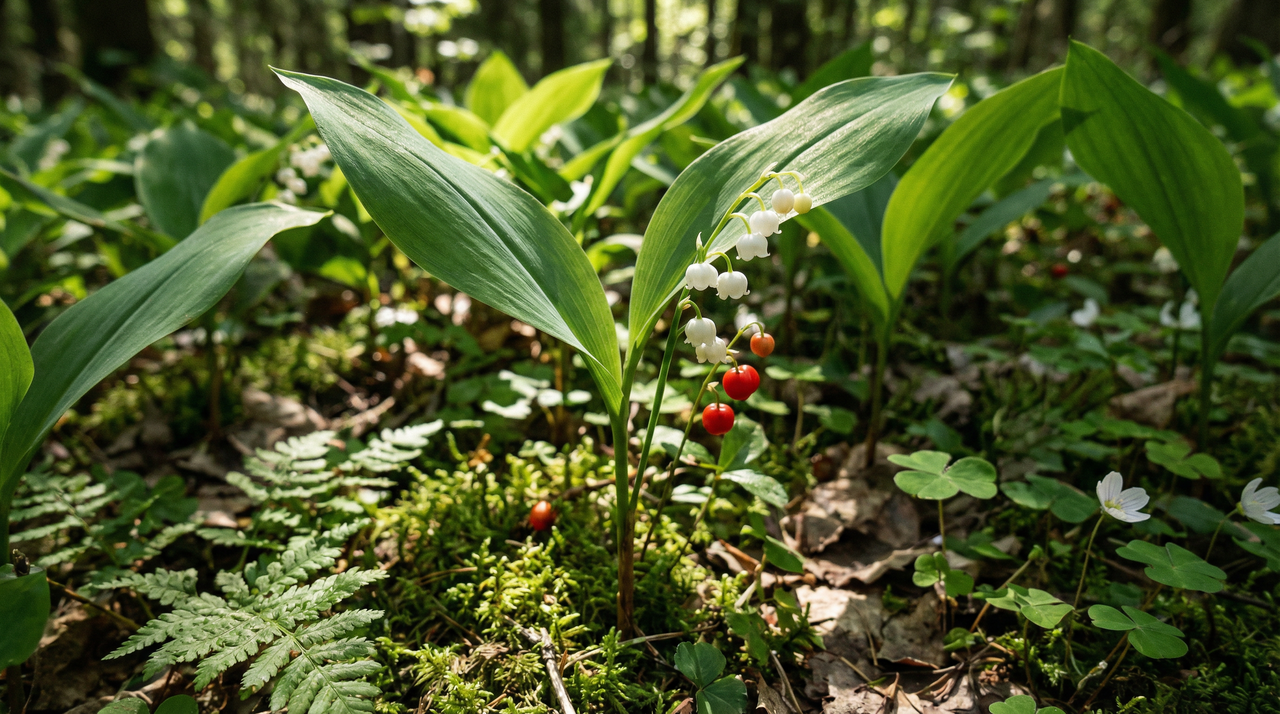
Every May, florists across France hand out tiny bouquets of Lily of the Valley to strangers on the street, a tradition called la fête du muguet that goes back centuries and carries genuine legal protection: for one day a year, anyone can sell these flowers without a vendor's license.[1] It's one of the most charming botanical customs I know. It's also a national celebration built around distributing one of the most toxic plants in the temperate garden. Every single part of it, including the water in the vase, can cause cardiac arrhythmia if ingested.
That tension is the whole story with this plant. The fragrance is genuinely extraordinary, a deep green sweetness that perfumers have spent decades trying to synthesize because the real thing can't be extracted at commercial scale. The flowers look like something a child would draw: perfect white bells, impossibly delicate, nodding along an arching stem. And underneath that charm, running through every cell of every leaf and berry and rhizome, is a suite of cardiac glycosides that the plant evolved specifically so that nothing would eat it. Lily of the Valley didn't end up in royal wedding bouquets and Christian iconography and a hundred years of perfume bottles because it's a safe, easy garden plant. It got there because it's beautiful in a way that makes people willing to overlook what it actually is.
Lily of the Valley Origin, History, and Cultural Significance
Few woodland plants carry as much cultural weight as lily of the valley (Convallaria majalis), and almost none combine such delicate beauty with such serious toxicity. Before any of that complexity can be appreciated, though, it helps to know where this plant actually comes from and how it lives in the wild, because its behavior in gardens makes a lot more sense once you understand its natural character.
Botanical Background and Native Range
Convallaria majalis is native to temperate regions across three continents, with a native range spanning Europe from the British Isles east to the Caucasus, across eastern Asia including Japan, Korea, and Russia, and down into eastern North America from Newfoundland south to Georgia and west toward Ontario and Alabama.[2][3] That's a wide footprint for a plant that only grows six to twelve inches tall. It thrives in cool, moist temperate forests, from beech and maple woodlands at sea level all the way up to around 2,000 meters elevation,[4][5] which tells you immediately that this is a plant built for deep shade, cold winters, and leaf-litter soil.
It spreads via creeping underground rhizomes at a rate of roughly 10 to 30 centimeters per year under good conditions,[6][7] forming dense clonal colonies that can persist for centuries. Individual rhizomes live 20 to 50 years in the wild, and some established colonies are estimated to be over a hundred years old.[8][9] From a permaculture perspective, that's a groundcover with serious staying power. In my experience designing shade gardens, a single healthy clump can fill a four-by-four-foot patch within five to seven years if moisture stays consistent, which is a useful mental benchmark when you're spacing it in a new woodland guild.
The taxonomy gets a little interesting at the edges of the range. Genetic studies suggest that European and North American populations are minimally differentiated, with most variation driven by environmental factors rather than distinct subspecies.[10] Appalachian populations show clinal adaptation around elevation and phenology, but they're still recognizably the same plant.[11] The Transcaucasian form (Convallaria transcaucasica), native to the forested mountain slopes of Armenia, Georgia, and Azerbaijan up to 2,000 meters,[12][13] sits in ongoing taxonomic debate as to whether it's a true species or a regional variety, but for gardeners the practical differences are minor.
Visual Characteristics and Growth Habit
The plant's visual identity is remarkably consistent across its range. Two to three broad, elliptical basal leaves emerge each spring,[14][15] and I've learned to recognize them in shade borders almost the way I recognize hosta spears: they push up looking almost architectural before the flowers arrive, which matters practically because clients sometimes confuse early-emerging lily of the valley with edible wild plants. Getting that visual cue locked in early prevents mistakes. From those leaves, leafless scapes arch outward, tipping downward to carry five to twelve white, bell-shaped flowers per spike, each about five to eight millimeters long and intensely fragrant.[16][17] That pendant posture, bells hanging like tiny white lanterns, is the image that has embedded itself in centuries of European art and symbolism.
By late summer the flowers give way to small, spherical red berries, six to ten millimeters across, each containing hard seeds equipped with an elaiosome that attracts ants for dispersal.[18][15] The whole plant then dies back to its shallow, creeping rhizomes, quietly waiting out the cold months below the leaf litter.[8] The Transcaucasian variant is similar but carries slightly glossier leaves and more upright flowers,[19] a subtle difference that underscores just how regionally adapted the genus has become across its range. Every part of this plant, from root to berry, contains cardiac glycosides toxic enough to cause serious harm if ingested,[20] so accurate identification isn't just botanical curiosity; it's a genuine safety issue.
Traditional and Cultural Uses
The cultural story of lily of the valley is tangled up with May, with brides, and with Christian legend. In France, the tradition of gifting bunches on May 1st dates to 1561 when King Charles IX distributed sprigs for good luck, and the practice still runs deep across France and Sweden.[21] In Christian iconography, the flower is known as "Our Lady's Tears," the white bells said to represent the Virgin Mary's tears, while Celtic traditions linked it to healing, protection, and the threshold energy of May Day.[22][23] Its symbolism of purity, humility, and the return of happiness made it a natural choice for European bridal bouquets, a tradition that has carried straight into modern weddings.[24] I love all of that history, genuinely. But I always tell clients who want to include it in wedding arrangements to source cut stems from reputable florists rather than harvesting straight from the garden, because the toxicity risk doesn't disappear just because the occasion is romantic.
Alongside the romance sits a long and complicated medical history. European herbalists and physicians used Convallaria majalis for heart failure, angina, palpitations, and dropsy, relying on its cardiac glycosides in much the same way digitalis was used.[25] Russian ethnobotany reached for it as a diuretic and nervous-system remedy,[26] and some Native American communities used American variants sparingly as a heart tonic and diuretic.[27] Across the Caucasus, the Transcaucasian form carried similar folk roles in Georgian, Armenian, and Azerbaijani medicine for arrhythmia and edema.[28] What all these traditions share is the underlying reality that the same glycosides that made the plant medicinally interesting can cause nausea, vomiting, and fatal cardiac arrhythmias in doses that aren't carefully controlled,[29] and accidental poisonings from misidentification have a long history too. The beauty and the danger have always been the same plant.
Interesting Facts About Lily of the Valley
The fragrance alone has secured this plant a permanent place in human culture. That signature sweet scent comes from compounds including benzyl acetate and benzyl alcohol,[30] and I've noticed it seems strongest after warm spring rain, when the whole woodland garden takes on that heady, almost honeyed smell. It's one of those plant moments that stops people mid-path. The fragrance is prized enough in high-end perfumery that flower absolutes are extracted for luxury fragrances, though the yields are low and the supply chain complicated.[31]
Ecologically, it forms mycorrhizal associations with fungi in the genus Tuber, which helps it pull nutrients from the kind of acidic, low-fertility forest soils where many competitors struggle.[32] Its root exudates include convallarin, a compound with mild allelopathic properties that suppresses neighboring vegetation and helps the colony hold its territory in dense understory conditions.[33] Meanwhile, the arching flowers draw in bees, hoverflies, and bumblebees as pollinators, while the red autumn berries are eaten by thrushes and blackbirds that can carry seeds several kilometers from the parent colony.[34][3] I rarely see heavy fruit set in cultivated plantings, honestly, and I've long since stopped waiting on seed and just divide clumps instead. But out in the right woodland setting, this plant is doing real ecological work, and the cardiac glycosides that make it dangerous to ingest are exactly what deters the deer, rabbits, and most insect herbivores from touching it at all.
Lily of the Valley Varieties and Sourcing
The classic lily of the valley most gardeners know is Convallaria majalis, a low-growing, rhizomatous perennial that forms dense colonies in shade.[35][16] Those fragrant white bells arrive in April and May, and the plant is reliably hardy from zones 3 through 8.[36][37] A surprising amount of cultivar diversity exists within a plant that looks, at first glance, like a one-note woodland sprite.
Popular Cultivars of Convallaria majalis
There are over 20 named varieties in horticulture, though you'll realistically encounter around 10 to 15 of them through commercial channels.[38][39] These cultivars weren't created through formal hybridization programs; they were selected in 19th-century Europe from naturally occurring variants, which means the gene pool is narrower than it might look on a nursery shelf.[40]
For foliage interest, 'Variegata' (creamy-striped leaves, zones 4-8) and 'Aurea' (golden foliage) are the ones I reach for most often when I need to brighten deep shade.[41][42] I do warn clients up front: both establish noticeably more slowly than the straight species. Variegated forms have reduced chlorophyll, which translates directly to reduced vigor, so if you're expecting quick coverage, they'll frustrate you.[39] For bloom variation, 'Rosea' and 'Bordeaux' deliver the pink lily of the valley flower that catches people off guard, since most assume the species only produces white bells.[39] Convallaria majalis 'Rosea' (also sold as Convallaria rosea in some catalogs) tends to be the most widely available pink-flowered forms you'll find at mainstream nurseries. 'Flore Pleno' offers double flowers in zones 3-7, 'Fortin's Giant' goes noticeably larger on both blooms and leaves, and 'Multiflora' produces two to five flower spikes per stem rather than the usual one.[43][16]
One thing I wish someone had told me early on: every single one of these cultivars carries the same cardiac glycoside toxicity as the straight species, and every one of them will spread aggressively given the right conditions.[16] I watched a shaded border at a client's property get completely colonized within four years. The plant is listed as invasive in Massachusetts, Minnesota, and New York, among other states, so the beauty is real and so are the consequences of casual placement.[44][45] I now site it only where the spread is genuinely welcome or where a physical barrier can contain the rhizomes.
Related Species: Transcaucasian Lily of the Valley
If you're gardening at the warmer edges of the hardiness range, or if you simply want something less likely to take over, Transcaucasian lily of the valley (Convallaria transcaucasica) is worth knowing about. It has broader leaves and taller stems than C. majalis, performs in zones 4-8, and is considered less invasive and more heat-tolerant than its more common cousin.[46][47] Taxonomically, it's a bit slippery; some authorities treat it as a full species, others fold it back into C. majalis as a variety or subspecies, so don't be confused if you see it labeled differently across catalogs.[48][49] It's genuinely rare in the US trade and commands a correspondingly higher price, typically $15 to $25 per plant compared to a few dollars for a bare-root majalis.[46]
Where to Buy Lily of the Valley Plants
Convallaria majalis is genuinely easy to find. Bluestone Perennials, Nature Hills Nursery, Plant Delights, and Everwilde Farms all carry it, and it shows up at big-box garden centers every spring.[50][51] Bare-root rhizomes run $5 to $15 each; bundles of 5 to 10 pips typically land between $20 and $50.[52][53] Before you order, check your state's invasive plant regulations. Some jurisdictions restrict sale or cultivation outright, and toxicity contributes to shipping limitations in certain areas.[54][44]
My strong preference is purchasing from certified nurseries that propagate from cultivated stock. Healthy rhizomes should be firm, plump, white, and roughly 1 to 2 inches long with no soft spots or discoloration.[18] Fall planting, September through October, gives them the best start.[55] I avoid Etsy and Amazon for this plant specifically; misrepresented or wild-collected material is a real risk on those platforms, and in some regions wild collection is actively discouraged because of overharvesting pressure.[18] For the Transcaucasian species, specialty sources like Plant Delights or North Creek Nurseries are your best bet; importing from outside the US requires a USDA APHIS permit and phytosanitary certificate, which is a meaningful paperwork commitment for a single plant.[56]
Lily of the Valley Propagation and Planting
Ask almost any experienced gardener how they got their Lily of the Valley patch, and the answer is almost always the same: someone handed them a clump dug up from an established colony. That's not coincidence. Rhizome division is how this plant has traveled from garden to garden for centuries, and for good reason. Before you touch anything, though, I want to be direct: all parts of Convallaria majalis contain cardiac glycosides, and that toxicity doesn't stop at the berries. Rhizomes and roots included. I always wear gloves when I'm dividing my patch, and I keep the whole operation away from the area where my kids and dog spend time.
Propagation Methods: Why Division Beats Seed Every Time
Dividing established clumps every third spring is something I do almost on autopilot now. You lift the clump, tease apart the rhizomes (each piece needs at least one bud and a few roots), and replant. Done well, in cool, moist conditions, success rates run 80 to 95 percent.[57][58][16] The other major advantage: you know exactly what you're getting. Division preserves the cultivar. If you fell in love with 'Flore Pleno' or a particularly fragrant form, the only way to reliably reproduce that is vegetatively.
Seed is biologically fascinating and practically maddening. Seedlings exhibit high genetic variability, which means what germinates may or may not resemble the parent.[59][60] And then there's the wait. I've never attempted to grow lily of the valley from seed in my own garden, and after looking at the timeline, I don't intend to. The seeds are dispersed primarily by ants, which collect them specifically for the white elaiosome (a fatty, nutrient-rich appendage) attached to each seed; the ants get a meal, the seed gets moved.[61] It's an elegant ecological arrangement that has nothing to do with speed. Division gives neighbors a flowering colony in two seasons. Seed makes you wait.
Seed Characteristics, Dormancy, and Germination Timeline
Pips divided from healthy clumps typically flower in their second spring and reach full maturity over three to five years.[58][6] Seeds are another story entirely. The seeds themselves are small (2 to 5 mm), dark brown to black, hard, and shiny, with a tough, nearly impermeable seed coat.[61][62] They exhibit morphophysiological dormancy, meaning the embryo itself must grow before physiological dormancy can even be broken. Getting there requires sequential warm stratification (20 to 25°C for 12 to 16 weeks) followed by cold stratification (2 to 5°C for 8 to 12 weeks).[63][64] In the wild, germination can take 18 to 36 months, with success rates of only 20 to 50 percent.[65]
If you're determined to try it, sow fresh seed. Viability under ordinary storage drops off within 6 to 12 months.[66] Even under ideal conditions, seed-grown plants commonly take 3 to 7 years to reach first bloom, and some accounts put that ceiling at 15 years.[59][60] Seed propagation is genuinely the territory of patient experimenters and botanical researchers, not the average gardener who wants flowers by next May.
Soil, Site Selection, and Light Requirements
Lily of the Valley is a woodland plant, and siting it well means thinking like a woodland. It wants humus-rich, moist but well-drained loam with a meaningful percentage of organic matter and a soil pH between 5.5 and 7.0, with the sweet spot sitting around 6.0 to 6.5.[67][16] I test the pH before establishing new colonies and amend with leaf mold until I hit that range; it's the single most reliable preparation step I've found. Push pH above 7.5 and you'll see chlorosis; drop below 5.5 and aluminum toxicity becomes a real concern. Neither is what you want from a plant you're expecting to naturalize.
Light is the other variable that matters enormously at planting time. Convallaria majalis is genuinely shade-tolerant in a way that hostas and ferns are, and I'd site all three together without hesitation. More than four hours of direct sun causes leaf scorch; deep shade suppresses flowering while still keeping the foliage lush.[68][69] In my own garden, the patches that get morning sun with afternoon dappled shade consistently flower most prolifically. Those in deeper shade stay beautifully green but bloom more quietly. On drainage: compacted or waterlogged soil invites Phytophthora root rot fast, and yellowing, wilting foliage is usually the first sign.[67][69] If your site doesn't drain freely, amend before you plant rather than after.
Planting Technique, Spacing, and Establishment
Set rhizomes with the bud pointing up, no deeper than 1 to 2 inches (roughly 5 cm).[67][69] Spacing comes down to your goal: 6-inch spacing accelerates that ground-cover effect, while 12 inches gives better airflow and reduces fungal pressure.[69][70] Both work; it just depends on whether you're in a hurry or cautious about disease.
Early spring (when soil sits between 45 and 60°F) and autumn after foliage dies back are both reliable planting windows.[58][16] My honest preference is autumn division: I've found those pips establish a stronger root system before winter than ones moved in spring, and they come out of dormancy the following year looking more settled. Once established, a colony spreads 6 to 12 inches per year via rhizomes,[69] which is something to plan for from the start. I use buried edging along beds where the colony borders other perennials, because once it starts moving it doesn't negotiate. Dividing every three to four years keeps the planting vigorous and gives you fresh material to share or extend into new areas.[58][16] That rhythm keeps the colony from getting dense and congested, and crowded colonies are exactly the conditions where disease pressure builds.
Lily of the Valley Care Guide
Every care decision you make for lily of the valley should start from the same mental image: a cool, dim European forest floor, carpeted in decomposing leaves, smelling faintly of earth and rain. That's the habitat this plant spent millennia adapting to, and the closer you get to replicating it, the less effort this plant actually requires. I've grown it in shaded borders for years, and what surprises new gardeners most is how little intervention it needs once the site is right.
Watering Needs and Soil Moisture Management
Consistent moisture is the single most critical factor in caring for lily of the valley. Aim for about 1 inch of water per week during the growing season, using rainwater where you can since tap water's salt content can accumulate in soil over time.[71][72] Established colonies tolerate a dry spell of a week or two, but young plants need steady moisture right through establishment.[3]
In practice, I water deeply every 5 to 7 days in spring, bump that to once or twice a week during summer heat, then ease back to every 10 to 14 days in fall.[73] The soil should feel evenly moist but never soggy; let the top inch dry just slightly between waterings. In my experience, the first sign of trouble is usually brown edges curling on the newer leaves, which signals underwatering. Yellowing leaves combined with soft, mushy soil, on the other hand, points to root rot from overwatering, and fungal problems tend to follow quickly.[20][74] When in doubt, adjust for your soil type and microclimate. A sandy loam drains faster than a clay-heavy bed, so neither schedule is universal.
Sunlight and Shade Requirements
Lily of the valley wants partial to full shade, with no more than 4 to 6 hours of indirect light per day.[69][75] Direct afternoon sun is the fastest way to stress this plant; you'll see leaf scorch and wilting within days.[72] A north-facing border or the sheltered understory beneath deciduous trees is ideal. I've also found that a good shade position does double duty in hot summers by keeping the root zone naturally cooler, which ties directly into managing heat stress (discussed below).
Feeding and Fertility Needs
Here's where I made an embarrassing early mistake. I applied a high-nitrogen lawn fertilizer to a struggling colony, hoping to green it up, and the plants responded beautifully -- in the worst possible way. Dense, lush foliage all season, and almost no flowers. It was a painful lesson in how this plant actually evolved: on nutrient-poor forest floors with high organic matter but minimal available nitrogen.[71] In organically amended soil, no supplemental fertilizer is needed. An annual spring top-dressing of leaf mold or compost is all it takes to maintain that rich, humus-like woodland habitat.[76]
If you do suspect a deficiency, soil-test first. I've seen interveinal chlorosis on lily of the valley in high-pH soils that looked almost identical to what I'd see on my hydrangeas -- a reliable visual reference if you grow both.[77][78] If a test confirms a need, a balanced low-nitrogen formula like 5-10-10 applied at half rate (about 1 tablespoon per square foot) in early spring is the most you should reach for.[71][79] Over-fertilization risks root burn, leggy growth, and reduced flowering -- none of which is worth it.[80]
Frost Tolerance and Winter Protection
The rhizomes themselves are impressively tough, hardy down to -40°F in established plants across USDA zones 3 through 8.[69][81] The vulnerability comes in spring, when emerging shoots and buds are at serious risk below 28°F, showing up as browning, wilting, and water-soaked lesions on young growth.[18] Frost-damaged plants can recover by pushing new shoots from the rhizomes, though flowering is often reduced that season.[82]
After years of gardening in colder zones, I've made a thick leaf-mold mulch my standard practice every fall. A 2 to 4 inch layer applied after the ground freezes insulates the root zone against frost heaving and holds moisture through winter.[18] I wait until after the last expected frost to pull it back in spring, giving the rhizomes a little extra buffer. Snow cover, if you get it, is genuinely beneficial. And a reminder worth repeating: all parts of the plant contain cardiac glycosides, so wear gloves when you're cleaning up frost-damaged foliage. It's a habit I've kept for years without regret.
Heat Tolerance and Summer Care
Lily of the valley performs best between 50 and 70°F and in AHS Heat Zones 1 through 7.[83] Once temperatures push above 75°F, you'll see wilting, leaf scorch, yellowing, and poor flowering.[75][84] My hottest summers taught me that the same 3-inch leaf-mold mulch I use for frost protection keeps the root zone measurably cooler during unexpected heat spikes. Short exposure to 80°F is tolerable if soil stays consistently moist, but this is not a plant for full-sun beds in warm climates.
For gardeners in warmer regions, siting in a north-facing spot or beneath a dense canopy (where light stays indirect all day) is non-negotiable. Gardeners in the upper range of zone 8 might consider Convallaria transcaucasica, which tolerates greater heat, though it still needs cool nights below 65 to 70°F for best performance.[16][85]
Pruning, Maintenance, and Seasonal Rhythm
This plant asks very little from your pruners. Remove dead foliage in late winter or early spring before new growth emerges, deadhead spent flowers for tidiness, but leave any yellowing leaves intact until they die back naturally; they're still feeding the rhizomes below.[86][87] I pile that spent foliage back around the colony rather than removing it entirely, returning a little organic matter to the bed each year. Every 3 to 5 years, divide overgrown patches in spring or fall to maintain vigor and manage their enthusiastic spread.[86] Wear gloves for every maintenance task, division included.
Seasonal Growth Cycle and Care Calendar
Lily of the valley follows a tight spring-ephemeral rhythm that determines when every care task makes sense. Shoots emerge in March or April, flowers open April through May in Europe and May through June across much of North America, then the plant sets its small red berries through June and July before retreating into dormancy by late summer.[16][67] Those fragrant bells require both a vernalization period below 41°F and cool flowering temperatures in the 50 to 64°F range to perform at their best.[10]
I mark my patches each spring because the early emerging leaves look deceptively similar to some weedy woodland plants for the first week or two. Once dormancy sets in by midsummer, dial back watering significantly and focus on keeping mulch in place ahead of fall. If you're storing dormant pips, keep them at 35 to 39°F in a low-humidity environment.[67] Think of the yearly calendar as a series of small, well-timed nudges: spring compost top-dressing, consistent summer moisture, fall mulching, late-winter cleanup. Get those four rhythms right and lily of the valley practically cares for itself.
Lily of the Valley Harvesting: Timing, Technique, and Safety
Before anything else: nothing you harvest from lily of the valley is ever eaten. Not the flowers, not the berries, not the rhizomes. Every part of Convallaria majalis contains cardiac glycosides, and that reality shapes every decision you make in the garden from the moment buds appear in spring. Keep that front of mind as you read on.
When to Harvest Lily of the Valley Flowers, Berries, and Rhizomes
The cut-flower window is narrow and moves fast. The ideal moment is when the buds show their first color shift, pale pink tips just beginning to blush before the bells fully open.[20][88] In my experience, that color change happens almost overnight once warm weather hits, so I check the patch every morning in May. Cut in the cool morning hours before heat builds; wilting starts quickly if you wait until afternoon.[89] You can also harvest after the clusters are fully open, as long as petals haven't started dropping.[18]
If you're collecting seed, patience is the tool. Berries take 90 to 120 days from flowering to reach maturity, turning bright red in late summer, typically August into September.[90][67] Deep red color with a firm but slightly yielding skin and dark seeds inside tells you they're ready.[91] As for rhizomes, I rarely dig them on purpose. They reach a useful size, roughly 1 to 2 inches in diameter and 4 to 6 inches long, after 2 to 3 years in the ground.[92][88] I treat any rhizome harvest as propagation-by-division, not routine collection, and only when a clump is crowded enough that division genuinely serves the colony.
Safe Harvesting Techniques and Post-Harvest Handling
Use clean, sharp scissors or pruners and cut flower stalks at the base near the soil surface. Never pull. Pulling can disturb the rhizome network and damage next year's buds.[93] I follow a strict rule I learned the hard way: take no more than half the flower stalks from any section of the colony per season, and always leave at least two-thirds of the foliage intact for photosynthesis.[94] The year I got greedy with a particularly lush patch, bloom production dropped noticeably the following spring. That was a lesson I only needed once.
Wear gloves. The cardiac glycosides absorb through skin with repeated handling, and I always wash my hands thoroughly after working with this plant regardless. Once cut, get the stems into water immediately and cool them fast, ideally to 32 to 36°F at 90 to 95% humidity.[95] Take a few leaves along with each spike; the foliage helps the stems hydrate and holds up better than stems alone.[96] Rhizome harvest, when you do it, happens after foliage fully dies back in late summer or fall, and it ends that parent crown.[67]
Yield, Vase Life, and Why Lily of the Valley Is Never Eaten
Expect 5 to 10 days of vase life under optimal conditions.[96][97] I wish it were longer; compared to roses or even tulips, these blooms are fleeting. But once you accept that, you plan for it. A small vase cut fresh every few days beats one large arrangement that collapses by day four.
The fragrance is the harvest. That's the honest answer. There is no culinary yield here, no edible part, no preparation that makes any portion of this plant safe to eat. The berries look attractive and the scent of the flowers is extraordinary, but the bitter taste is the plant's warning system, and the cardiac glycosides back it up completely. I keep every vase well above toddler height and treat the plant accordingly in the garden. Beautiful as they are, these are strictly for the vase, kept safely out of reach of children and pets, and enjoyed for exactly the brief, perfect time they last.
Lily of the Valley Preparation, Uses, and Safety
Every spring, I add an extra label to the lily of the valley patch in my woodland garden: "NOT RAMPS." It sounds dramatic until you've watched a client crouch down over a patch of emerging Convallaria leaves, convinced they'd found a forager's jackpot. The two plants share a similar two-leaf emergence habit, and the confusion is genuinely dangerous. Every part of lily of the valley is poisonous, roots most concentrated of all, and that toxicity does not diminish with cooking, drying, or any other home preparation.[98][99]
Why Lily of the Valley Is Not Edible
There is no safe dose. No preparation method, no duration of boiling, no folklore recipe changes that fact.[99][100] The cardiac glycosides responsible, primarily convallatoxin, cause nausea, vomiting, arrhythmia, and seizures within thirty minutes to three hours of ingestion; as few as one or two grams of fresh leaf can be fatal to a child.[101][102] The bitter, acrid taste that lingers even after prolonged boiling is the plant's own warning system, and it's worth taking seriously.[103]
If you forage, learn the look-alikes cold. Solomon's seal and false lily of the valley both share the same shaded habitat, and neither is a safe substitute; they carry their own cardiac glycosides.[104][105] True Convallaria identifies itself by those pendant, bell-shaped flowers on an arching scape rather than upright racemes or alternating leaves along a stem. When there's any doubt, walk away.
The fragrance is a different story entirely. The essential oil contains benzyl acetate, phenethyl alcohol, linalool, and rose oxide, a profile that explains why perfumers have been chasing this scent for centuries.[106] Because direct extraction from toxic plant material poses obvious problems, most commercial "lily of the valley" fragrance today is synthesized rather than distilled from real flowers.[107] I grow mine specifically for that unmatched spring scent in shaded borders, and I tell every client the same thing: enjoy it with your nose, full stop.
Traditional and Standardized Medicinal Preparations
I have never recommended a homemade lily of the valley tincture and never will. The therapeutic window between a medicinal dose and a toxic one is vanishingly narrow, comparable to foxglove, and home preparation cannot achieve the precision that safety requires. Where medicinal use exists at all, it is in standardized pharmaceutical extracts: German Commission E protocols specify 0.3 to 1 mL of a 1:5 tincture one to three times daily, delivering 0.02 to 0.06 mg of cardiac glycosides; the European Medicines Agency suggests dry extracts standardized to 0.04% cardiac glycosides at 50 to 100 mg daily for adults.[108][109] Those numbers mean nothing without laboratory verification of glycoside content, which is exactly why traditional preparations from rhizomes and leaves require professional processing far beyond what any home herbalist can safely attempt.[110] If you're interested in the phytochemical depth behind these preparations, the health benefits section covers the cardiac glycoside pharmacology in detail.
Safe Non-Food Uses in Perfumery, Ornamental Gardening, and Beyond
Here is where the plant earns uncomplicated admiration. The flowers are genuinely beautiful as cut stems; keep them in a clean vase with fresh floral preservative solution and change the water every day or two to slow bacterial growth, and they'll hold for up to a week.[96][111] For longer-lasting fragrance, alcohol or glycerin extractions work well for sachets and potpourri, provided you're handling the plant material with gloves.[112]
In the garden, Convallaria majalis thrives as a woodland groundcover under canopy trees, paired with ferns and hostas where it provides textural contrast and reliable spring interest in spots that defeat most other plants.[113] One sourcing note I always pass along: wild French populations have been significantly depleted by overharvest for the perfume trade, which is why I encourage sourcing nursery-grown divisions over any wild-collected material.[114] The plant's cultural and aesthetic value is real; it just deserves to come from a garden, not a disappearing wild colony.
Lily of the Valley Health Benefits and Risks
There's a hard truth that comes up every time someone asks me whether lily of the valley has any medicinal value: yes, it does, and that's precisely what makes it so dangerous. The chemistry here is genuinely fascinating, but it's not the kind of fascinating you want to experiment with at home.
Phytochemical Profile of Lily of the Valley
The defining compounds in Convallaria majalis are cardiac glycosides, primarily convallatoxin, convallarin, and convallamarin. These molecules inhibit the sodium-potassium ATPase pump in cardiac cells, raising intracellular calcium and forcing the heart to contract more forcefully.[115][116] That mechanism is the same double-edged story you see with foxglove: useful at a precise dose, lethal at a slightly higher one. Concentration varies by plant part, with rhizomes running 0.06 to 0.2 percent convallatoxin by dry weight and leaves somewhat lower at 0.02 to 0.06 percent, and both peak in spring during flowering.[117][118] Plants grown at northern latitudes tend to accumulate higher glycoside loads, and there's evidence that the acidic, organic-rich woodland soils I recommend elsewhere in this profile also push metabolite production upward.[119] This potent biochemical defense doesn't turn off when a curious child or pet makes contact.
Beyond the glycosides, the plant carries a surprisingly rich supporting cast: flavonoids including quercetin, kaempferol, and rutin; phenolic acids like chlorogenic and ferulic acid; coumarins; steroidal saponins; and the flower volatiles (linalool, benzyl acetate, 2-phenylethanol) that give that legendary fragrance.[120][121] The flavonoids and phenolics contribute antioxidant and anti-inflammatory activity in laboratory settings, while the volatiles attract the bees that the plant depends on for seed set.[122][123] It's a neat ecological balance: the same plant that repels grazers with cardiac glycosides draws in pollinators with perfume.
Medicinal Research and Traditional Uses
European herbalists, particularly in German and Eastern European traditions, used standardized Convallaria preparations as a heart tonic for centuries, specifically for mild congestive conditions and edema where the positive inotropic effect was considered beneficial under physician supervision. That history is real, and I do respect traditional knowledge. But the transition to modern pharmacology is where things get complicated fast. Preclinical research has documented anti-inflammatory activity, DPPH radical scavenging, antimicrobial action against Staphylococcus aureus and Candida albicans, diuretic effects, and even some early anti-cancer signals in cell and animal models. None of that has translated into robust human clinical trials. The therapeutic index is simply too narrow, meaning the gap between a dose that helps and a dose that causes cardiac arrhythmia is uncomfortably small. Today, EMA and WHO guidance consistently warns against unsupervised use, and modern cardiology has safer, better-characterized drugs to do the same job. Think of it the way I think about foxglove: a plant that taught us something profound about cardiac pharmacology, but one whose clinical era has largely passed because we now have options with more predictable safety profiles.
Why Lily of the Valley Has No Nutritional Value
Short answer: you can't eat it, so nutrition is irrelevant. Every part of this plant is toxic, and no traditional food culture has ever incorporated it into a diet. The cardiac glycosides alone guarantee that ingestion triggers nausea, vomiting, abdominal pain, and, in significant exposures, arrhythmias. Official food composition databases list no nutrient values for Convallaria majalis because there are none worth measuring in any edible context. Yes, the flavonoids and phenolic acids show antioxidant activity in a laboratory extract, but that's a bench observation, not a case for consumption. I'd never taste any part of this plant, not even to be curious, and I'd say the same to any gardener who asked.
Critical Safety Information and Toxicity
Every single part of lily of the valley is poisonous: leaves, flowers, berries, roots, and the water in a vase of cut stems. Symptoms of lily of the valley poisoning typically begin within one to two hours of ingestion and follow a predictable escalation from gastrointestinal distress (nausea, vomiting, abdominal cramping, diarrhea). This escalates into cardiovascular effects including bradycardia, arrhythmias, and hypotension that can progress to cardiac arrest in serious cases. The mechanism is the same Na+/K+-ATPase inhibition described above. Treatment in hospital typically involves digoxin-specific Fab antibody fragments, the same antidote used for severe foxglove poisoning, which should tell you something about the potency involved. Dogs, cats, horses, and livestock are all susceptible, and the ASPCA lists Convallaria majalis as a toxic plant for companion animals.
If you suspect any ingestion, even a single red berry, call Poison Control immediately (in the US: 1-800-222-1222) and don't wait for symptoms to appear. In my work with clients who have young children or pets, this is the non-negotiable rule for any cardiac-glycoside plant. Waiting to see what happens is not a safe strategy.
There are also a few look-alike situations worth knowing. I've seen newer perennial gardeners mistake young Solomon's Seal shoots for lily of the valley in early spring; the plants share a woodland habitat and similar emerging foliage, but their toxicological profiles are quite different, which is exactly why correct identification matters before any foraging or medicinal consideration. Wild garlic, snowdrops, and autumn crocus can also create confusion in certain situations, and autumn crocus carries its own severe toxicity through colchicine. Contact dermatitis from handling is a low to moderate risk, so gloves are a reasonable precaution for anyone with sensitive skin or who is doing extensive work with rhizomes. Contraindications for the historical supervised medicinal preparations include heart block, Wolff-Parkinson-White syndrome, and pregnancy, with significant interaction risk alongside beta-blockers, diuretics, and other cardiac glycosides. The bottom line: this is a plant to grow, admire, and photograph, not to prepare or ingest under any circumstances without specialist medical oversight.
Lily of the Valley Pests and Diseases
For a plant that grows in moist shade and never sees full sun, lily of the valley holds up remarkably well against the usual cast of garden troublemakers. Most of that resilience comes down to chemistry, not luck.
Natural Defenses and Pest Resistance
The cardiac glycosides that make Convallaria majalis toxic to humans and pets do double duty as a formidable insect deterrent. Convallatoxin and convallarin disrupt cardiac function in invertebrates and make the foliage deeply unpalatable to most herbivores.[117][124] Japanese beetles, deer, and rabbits largely leave it alone, which is one of the reasons I've relied on it as a groundcover under trees where other shade-tolerant plants get browsed to stubs.[16][69]
Slugs are the real exception. After a rainy spell, those irregular holes appear in the foliage almost overnight, and if you walk the beds daily you learn to recognize the pattern fast. Moist, shaded conditions are exactly what slugs want, and they're exactly what lily of the valley wants too, so the overlap is unavoidable.[125][126] Beyond slugs, secondary pests are situational: aphids show up occasionally on stressed plants, spider mites become an issue in unusually dry stretches, and greenhouse-grown material can attract thrips or scale.[16][127] In a well-sited outdoor planting, you'll rarely encounter them.
Cultivar choice matters here. I've stopped planting variegated forms like 'Variegata' in humid microclimates because they simply don't have the vigor to shrug things off the way the green-leaved types do. 'Fortin's Giant' and 'Bordeaux' hold up noticeably better under pest pressure.[128][129] For slugs specifically, I skip chemical baits entirely because of the plant's own toxicity and instead rely on iron-phosphate pellets, hand-picking after dusk, and encouraging ground beetles by keeping some leaf litter nearby.[130]
Common Diseases and Cultural Management
Disease resistance in lily of the valley is genuinely good when the plant is sited correctly. Bacterial and viral problems are rarely documented.[129] The threats that actually materialize are fungal: crown rot from Fusarium, root and stem rot from Phytophthora and Pythium, leaf spots including anthracnose, and Botrytis blight in cool, humid conditions.[129][131] Every one of those problems is strongly linked to poor drainage, humidity above 80%, and overcrowded planting.[131][32]
I learned this the hard way. My first planting went into heavy clay that I hadn't amended properly, and crown rot took out a whole section before summer arrived. Now I always work in generous amounts of leaf mold, keep spacing at 6 to 12 inches to allow air to move through the colony, and avoid any overhead watering.[90][127] Fall sanitation, removing infected foliage rather than leaving it to overwinter, cuts disease pressure significantly the following spring. Dividing clumps every three to five years keeps the planting from becoming the dense, airless mat that fungi love.[90]
If you're choosing between species, Convallaria transcaucasica has modestly better leaf-spot resistance thanks to thicker foliage and its adaptation to drier mountain climates.[128][120] Among cultivars, the showier variegated forms ('Aurea', 'Variegata') are consistently more prone to leaf spot because their reduced vigor leaves them with less capacity to fight off infection.[132] When disease pressure is a real concern in your garden, the plain green-leaved types simply perform better season after season.
Chemical intervention should be the last resort, especially given how toxic this plant already is. If cultural fixes aren't enough, preventive applications of chlorothalonil or mancozeb can help, and biological options like Bacillus subtilis show some research promise, though documentation specific to this species is limited.[133] Rotate products if you do use them to avoid resistance buildup. Personally, I'd rather fix the drainage than reach for a fungicide, and in my experience, that's almost always the right instinct.
Lily of the Valley in Permaculture Design
Lily of the valley occupies a specific and genuinely useful niche in temperate woodland gardens, but it earns that place on its own terms, not yours. Understand those terms first, and you'll have a groundcover that solves real design problems. Ignore them, and you'll spend years trying to rein in something that was never going to cooperate.
Climate and Hardiness Zones
Convallaria majalis is one of the hardier herbaceous perennials you'll work with, rated USDA zones 3-8 and tolerating winter lows down to -40°F.[134][3] It needs 800-1,000 chill hours below 45°F to flower properly, which is one reason it performs so reliably across the Northeast, Midwest, Pacific Northwest, and Appalachians.[69] In my experience with similar shade perennials, that chill requirement is also why gardeners in zones 3-5 can feel almost smug about this plant: a hard winter followed by a cool spring is exactly what it wants, and a good 2-3 inch leaf-mold mulch helps protect the early emerging tips without cheating it out of the cold it needs.
At home in oceanic (Cfb) and humid continental (Dfb) climates, it prefers 30-50 inches of annual rainfall and moist, humus-rich, slightly acidic to neutral soils under partial to full shade.[135][16] Heat is where its confidence starts to crack: survival tops out around 85°F, and in zones 7-9 you're looking at consistent deep shade and reliable moisture to prevent summer decline.[16] The Transcaucasian species, C. transcaucasica, tolerates a few more degrees of heat (up to 86-95°F) and is rated zones 4-8, but it originates from higher-elevation Caucasus forests at 800-2,000 meters with its own specific moisture regime, so don't treat it as simply a warmer-zone swap.[136][137] The native American species, C. montana, belongs to Appalachian understories and has its own ecological story.[138] For most temperate permaculture designers in the Northern Hemisphere, though, the main species is the one you'll be working with and managing.
Ecosystem Functions and Pollination
The most immediate permaculture argument for lily of the valley is its soil work. Those dense rhizomatous colonies stabilize slopes, reduce erosion, and suppress weeds with real effectiveness. They also provide cover for invertebrates and small wildlife.[8][139] This vigorous underground spreading is either a feature or a problem depending entirely on where you've planted it.[140] More on that below.
The pollination picture is richer than most people expect from such a small flower. Those fragrant white bells attract bumblebees, honeybees, solitary bees, hoverflies, butterflies, beetles, and moths, with bees and flies being the most effective visitors. Nectar per flower is low (under 1 μL), but pollen is abundant and the flowers reflect UV light and support buzz pollination.[8][141] In my gardens I've watched bumblebees vibrate the bells for pollen while hoverflies work whatever nectar is available, and it's a good reminder that this plant rewards pollinator diversity rather than a single specialist visitor.
There's a practical catch, though. Many populations of C. majalis are self-incompatible, with protandrous flowers that release pollen before the stigma is receptive. That creates high dependence on cross-pollination, and in fragmented habitats seed set can drop by up to 50%.[142][143] Gardeners who have a single patch and wonder why they never see those red berries often have a monoculture of genetically identical rhizome divisions to blame. Seeds that do form are dispersed by ants (myrmecochory), which is a lovely bit of ecology but not something you can rely on for rapid spread.[144] C. transcaucasica shows higher self-compatibility in some populations and offers a modest additional benefit: documented phytoremediation potential, particularly for cadmium and zinc accumulation, alongside mycorrhizal associations and leaf-litter soil building.[145] It's generally less vigorous than the main species, which may actually suit tighter designs. For the core species, mycorrhizal partnerships enhance phosphorus uptake,[146] but claims about dynamic accumulation or pest repellency don't hold up to scrutiny in major sources.[147]
Forest Layer and Guild Design
At 6-12 inches tall, lily of the valley lives in the herbaceous and groundcover layer of a temperate food forest, dying back in winter and re-emerging each spring with that characteristic paired-leaf flush.[148] It's genuinely good at filling the floor under established canopy trees where little else thrives, and I've used it successfully beneath nut trees and along shaded woodland edges where a mown path or dense shrub layer contains its rhizomatous ambitions. Think of it the way you'd think about pachysandra or vinca: reliable, lush, and determined. The key difference is that lily of the valley also exhibits allelopathic effects that suppress competitors,[149] so it's not a neutral neighbor.
Good guild companions for shaded beds include ferns (Dryopteris spp.), trillium, wild ginger (Asarum canadense), bloodroot (Sanguinaria canadensis), and hepatica, especially species that bloom around the same time to keep pollinator traffic moving through the space.[150][151] Pair it with robust competitors rather than delicate natives you don't want crowded out. C. montana is a better choice for Appalachian restoration work where native provenance matters, and C. transcaucasica (reaching 6-10 inches) provides similar groundcover function with less lateral aggression in either case.[7][152]
The honest permaculture calculus here is that you're getting real ecosystem services: soil stabilization, early-season pollinator forage, mycorrhizal soil activity, and dense weed suppression in a layer that's otherwise difficult to fill.[153] Set against that are the spreading rhizomes, the allelopathic tendencies that can displace preferred natives over time,[154] and the cardiac glycosides that make the entire plant toxic. I've learned to site it where children and pets won't wander, and I walk the edges every spring to catch rhizome runners before they cross into sections I want to keep diverse. The flowers are genuinely enchanting and the cardiac glycosides are genuinely dangerous; those two things coexist, and good design accounts for both.
The Plant That Taught Me Respect Before Wonder
I grew up with a patch of Lily of the Valley under my grandmother's silver maple, and for years I thought I understood it: small, sweet, utterly harmless-looking. It took a deeper education to realize that everything gentle about this plant is also a warning. I've never stopped loving the fragrance, but I love it differently now, the way you love something that has quietly demanded you pay attention.
Sources 154
- BBC Travel: The French flowers you can sell for one day a year ↩
- Kew Science - Plants of the World Online - Convallaria majalis ↩
- Convallaria majalis - USDA PLANTS Database ↩
- RHS Plant Selector - Convallaria majalis ↩
- Flora of North America - Convallaria majalis ↩
- Convallaria majalis - Lily-of-the-Valley ↩
- Flora of North America: Convallaria majalis ↩
- Convallaria majalis (Lily-of-the-Valley) ↩
- Biology and Ecology of Lily-of-the-Valley (Convallaria majalis L.) ↩
- Phylogeography of Convallaria majalis ↩
- Clinal Variation in Flowering Time among Populations of Convallaria majalis in the Southern Appalachians ↩
- Plants of the World Online ↩
- Convallaria transcaucasica ↩
- Convallaria majalis ↩
- Convallaria majalis ↩
- Convallaria majalis ↩
- Lily-of-the-Valley ↩
- Convallaria majalis (Lily-of-the-Valley) ↩
- Convallaria transcaucasica ↩
- Convallaria majalis ↩
- May Day Traditions: Lily of the Valley in France and Sweden ↩
- Folklore and Symbolism of Convallaria majalis ↩
- Celtic Herbalism and Lily of the Valley ↩
- Lily of the Valley ↩
- Convallaria majalis (Lily of the Valley) - Traditional Uses ↩
- Herbal Remedies in Russian Traditional Medicine ↩
- Native American Ethnobotany Database ↩
- Ethnobotany of the Caucasus ↩
- Convallaria majalis (Lily-of-the-Valley) Poisoning ↩
- Floral scent of lily of the valley (Convallaria majalis) and the effects of environment on scent emission ↩
- Convallaria majalis Plant Profile ↩
- Convallaria majalis - Lily-of-the-Valley ↩
- Convallaria Species: Botany, Phytochemistry, and Pharmacology ↩
- Plant Finder - Convallaria majalis ↩
- USDA PLANTS Database ↩
- Almanac ↩
- Royal Horticultural Society Plant Selector ↩
- Wikipedia - Convallaria majalis ↩
- RHS Gardening ↩
- Missouri Botanical Garden Plant Finder ↩
- RHS - Convallaria majalis 'Variegata' ↩
- Missouri Botanical Garden - Convallaria majalis 'Aurea' ↩
- RHS - Convallaria majalis 'Multiflora' ↩
- Massachusetts Invasive Plant List ↩
- Minnesota Noxious Weed List ↩
- Missouri Botanical Garden - Convallaria transcaucasica ↩
- RHS - Convallaria transcaucasica ↩
- Plants of the World Online (POWO) ↩
- Tropicos - Convallaria transcaucasica ↩
- Bluestone Perennials ↩
- Nature Hills Nursery ↩
- Everwilde Farms ↩
- Plant Delights Nursery ↩
- USDA PLANTS Database ↩
- RHS - Growing Lily of the Valley ↩
- USDA APHIS - Importing Plants ↩
- Lily-of-the-valley ↩
- Propagation of Lily-of-the-Valley ↩
- Germination of Convallaria majalis Seeds ↩
- Seed Germination of Lily-of-the-Valley (Convallaria majalis) and Related Species ↩
- Myrmecochory in Temperate Forest Herbs: Convallaria majalis ↩
- Seed Morphology and Dispersal in Convallaria majalis ↩
- Morphophysiological Dormancy in Convallaria majalis Seeds ↩
- Seed Dormancy and Germination in Convallaria majalis ↩
- Seed Information Database (SID) - Convallaria majalis ↩
- Seed Information Database (SID) ↩
- Lily-of-the-valley ↩
- Convallaria majalis ↩
- Lily-of-the-Valley ↩
- Convallaria majalis ↩
- Lily-of-the-Valley (Convallaria majalis) ↩
- Lily of the Valley Care ↩
- Convallaria majalis - Growing Guide ↩
- Watering Perennials ↩
- Convallaria majalis (Lily-of-the-Valley) ↩
- Convallaria majalis - RHS ↩
- Nutrient Deficiencies in Ornamental Plants ↩
- Diagnosing Plant Nutrient Deficiencies ↩
- Fertilizing Perennials ↩
- Nutrient Disorders of Plants ↩
- USDA Plant Hardiness Zone Map ↩
- Frost and Freeze Injury to Plants ↩
- Heat Zone Map ↩
- Heat Stress in Understory Perennials ↩
- Convallaria transcaucasica: Cultivation and Hardiness ↩
- Lily-of-the-valley ↩
- Lily of the Valley: How to Grow and Care ↩
- Harvesting Lily of the Valley ↩
- Convallaria majalis ↩
- Convallaria majalis (Lily-of-the-valley) ↩
- Convallaria majalis - Plant Finder ↩
- Lily-of-the-Valley, Convallaria majalis ↩
- Convallaria majalis ↩
- Lily of the Valley cultivation and harvest ↩
- Postharvest Biology and Handling of Lily of the Valley ↩
- Postharvest Handling of Cut Flowers ↩
- Lily-of-the-Valley: Forcing for Cut Flowers ↩
- Missouri Botanical Garden Plant Finder - Convallaria majalis ↩
- Missouri Botanical Garden Plant Finder ↩
- USDA PLANTS Database ↩
- Cardiac glycoside poisoning from lily of the valley (Convallaria majalis) – Clinical case series and literature review ↩
- Royal Horticultural Society (RHS) Plant Database: Convallaria majalis toxicity ↩
- Lily of the Valley Toxicity - StatPearls - NCBI Bookshelf ↩
- Missouri Botanical Garden Plant Finder - Maianthemum racemosum ↩
- Flora of North America - Polygonatum biflorum ↩
- Volatile Constituents of Convallaria majalis Flowers from Different Localities ↩
- European Medicines Agency - Assessment Report on Convallaria majalis ↩
- German Commission E Monographs: Convallariae Herba (Lily of the Valley Herb) ↩
- European Union Herbal Monograph on Convallaria majalis, Folium ↩
- Convallaria majalis and its subspecies in traditional medicine ↩
- Postharvest Technologies for Cut Flowers ↩
- Plants For A Future - Convallaria majalis ↩
- Royal Horticultural Society (RHS) Plants: Convallaria majalis ↩
- Lily of the Valley ↩
- Cardiac Glycosides from Convallaria majalis: Structure and Activity ↩
- Cardiac Glycosides: Mechanism of Action ↩
- Phytochemical and Pharmacological Review of Convallaria Species ↩
- Seasonal Dynamics of Cardiac Glycosides in Convallaria majalis ↩
- Geographical Variation in Secondary Metabolites of Convallaria majalis Across Latitudes ↩
- Secondary Metabolites of Lily of the Valley ↩
- Flavonoids and Phenolics in Lily-of-the-Valley ↩
- Antioxidant Activity of Lily of the Valley Extracts ↩
- Volatile Compounds in Lily of the Valley Flowers ↩
- Cardiac Glycosides of Convallaria majalis and Related Species ↩
- Slugs and Snails on Ornamental Plants ↩
- Lily-of-the-Valley: Pest and Disease Management ↩
- Lily-of-the-Valley: Problems ↩
- Lily-of-the-Valley: Potential for Landscape Use ↩
- Lily-of-the-Valley Pests and Diseases ↩
- Integrated Pest Management for Perennials ↩
- Diseases of Lily-of-the-Valley ↩
- Convallaria majalis - Missouri Botanical Garden ↩
- University of Missouri Extension: Fungal Diseases of Shade Gardens ↩
- Missouri Botanical Garden Plant Finder: Convallaria majalis ↩
- Global Biodiversity Information Facility: Convallaria majalis ↩
- Missouri Botanical Garden - Convallaria majalis var. transcaucasica ↩
- Royal Horticultural Society - Convallaria transcaucasica ↩
- USDA PLANTS Database - Convallaria montana ↩
- Missouri Botanical Garden - Convallaria majalis ↩
- University of Minnesota Extension: Lily of the Valley ↩
- Pollination Biology of Convallaria majalis ↩
- Pollinator limitation and reproductive success in fragmented populations of Convallaria majalis ↩
- Effects of habitat fragmentation on pollination in a clonal herb, Convallaria majalis ↩
- Myrmecochory in Convallaria majalis ↩
- Phytoremediation Potential of Liliaceae Family ↩
- Mycorrhizal Associations of Convallaria majalis and Their Impact on Nutrient Dynamics ↩
- USDA PLANTS Database ↩
- Convallaria majalis - Missouri Botanical Garden ↩
- Allelopathy in the Understory: The Role of Convallaria majalis in Forest Ecosystems ↩
- Convallaria majalis ↩
- Enhancing Pollination in Woodland Gardens ↩
- Convallaria transcaucasica - Missouri Botanical Garden ↩
- Permaculture Plants: Lily of the Valley ↩
- Competition and Coexistence in Forest Understory Plants: Insights from Convallaria majalis ↩