Few shade trees offer the centuries of medicinal history and immense ecological generosity of a linden tree. When it reaches full bloom in early summer, the fragrance alone will stop you mid-stride. years ago on a street in a city I was visiting, and I genuinely could not figure out what I was smelling. It was floral but not sweet in the cloying way roses are sweet; it had this clean, almost honeyed warmth to it, and it seemed to be coming from everywhere at once. I looked up, and there was a row of linden trees overhead, buzzing so loudly with bees that I could hear them from the sidewalk. That smell, and that sound, are the things linden growers talk about in hushed tones, like they're sharing something the rest of the world somehow missed.
What surprises most people is that this is the same tree planted up and down urban streets across the northern hemisphere, often treated as little more than a tidy shade provider. Generations of city planners chose it for its pollution tolerance and tidy habit, not realizing (or maybe not caring) that they were also planting one of the most medicinally storied, ecologically generous, culturally layered trees in the temperate world. Linden has been a food, a medicine, a fiber source, a gathering place, and a symbol of justice and love across European and North American traditions for longer than most of our countries have existed. That street tree outside the coffee shop has a biography worth knowing.
Linden Origin, History, and Cultural Significance
Botanical Background and Native Range of Linden Trees
This reliable canopy tree has one of the most quietly impressive biographies in the temperate plant world. Small-leaved Linden, whose scientific name is Tilia cordata, is the species you'll encounter most often in European woodland edges, historic avenues, and North American urban plantings, and it's a fitting anchor for understanding the whole genus. Native to mixed deciduous woodlands across Europe and western Asia, it ranges from the UK east to Ukraine, thriving on fertile, well-drained soils.[1][2] Through centuries of cultivation, it's now naturalized in parts of the northeastern and midwestern US and Canada, where you'll find it lining streets and anchoring parks.[3]
Growth is moderate in youth, typically half a meter to a meter per year, and the tree settles into a long, patient life.[4] Most specimens live 200 to 400 years, with exceptional individuals pushing well beyond 800.[2] That longevity is one reason I keep recommending linden to clients who want a legacy planting rather than a quick fix. It flowers and fruits repeatedly across its entire lifespan, which is more than most trees can claim.[5]
The latin name for the linden tree, Tilia cordata, places it within a genus spanning two continents. American Linden, or basswood (Tilia americana), is native to eastern and central North America in zones 3 through 8; Large-leaved Lime (Tilia platyphyllos) covers much of continental Europe from France to Turkey; Silver Linden (Tilia tomentosa) hails from southeastern Europe and southwestern Asia; and Common Lime (Tilia ×europaea), the hybrid of T. cordata and T. platyphyllos, is the one plastered across historic European boulevards.[6][7][8] Different species, similar soul.
Visual Characteristics: Leaves, Flowers, Bark, and Form
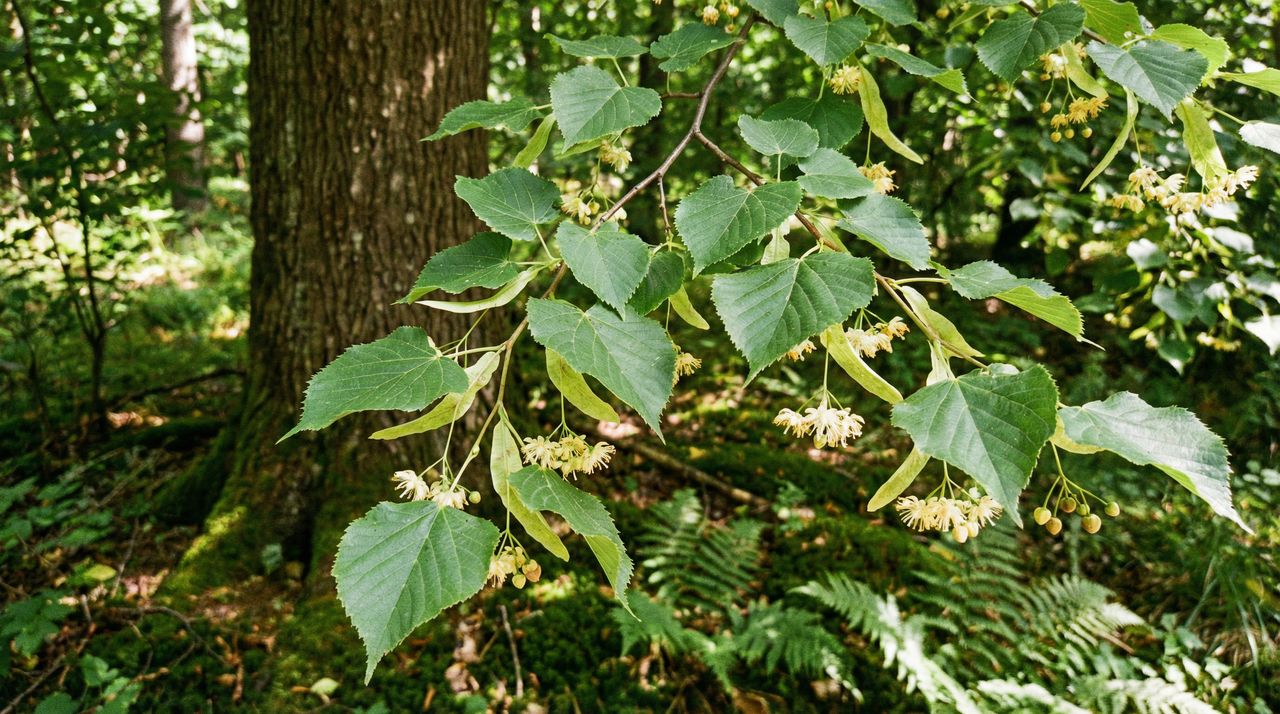
Once you know what a linden looks like, you'll spot one from a block away. Tilia cordata typically reaches 50 to 70 feet at maturity with a spread of 30 to 50 feet, starting pyramidal when young and rounding out gracefully with age.[9] The leaves are the tell: heart-shaped, 3 to 10 centimeters long, with finely serrated margins, a pointed tip, and a charmingly asymmetrical base.[10] Flip one over and you'll find small tufts of rusty hairs in the vein axils, a quick ID trick that distinguishes it from similar species.[5]
Bark starts smooth and gray, developing shallow ridges with age. The flowers are small, pale creamy-yellow, and arranged in pendulous clusters of 6 to 20 blooms, each cluster attached to a distinctive strap-like bract up to 10 centimeters long that doubles as a sail for seed dispersal.[9] Bloom time falls in late June to July, and in my experience the fragrance during that window is extraordinary. Leaves turn a clean yellow in autumn before dropping.[11]
The other species in the genus each have their own visual signature. T. platyphyllos and T. americana carry larger leaves, 7 to 18 centimeters, giving them a bolder, more tropical-feeling canopy.[12] Silver Linden is the dramatic one: the underside of each leaf is covered in dense, silvery-white fuzz that catches the light with every breeze.[13] I've planted both T. cordata and T. tomentosa in residential designs, and there's something quietly theatrical about Silver Linden at dusk when that silver flash comes alive. Clients who want pollinator support with a bit of elegance almost always end up choosing it on first sight.
Traditional and Cultural Uses Across Europe and North America
The relationship between humans and linden trees goes back further than most of us imagine. Pollen records place Tilia cordata in Neolithic and Bronze Age European landscapes, and by the time Pliny the Elder was writing in the first century, the tree was already being documented for its timber, shade, and medicinal applications including treatment for epilepsy.[14][15] Medieval herbalists continued the tradition; Hildegard of Bingen referenced linden in her 12th-century Physica for heart palpitations, nerves, and colds.[16]
The wood itself earned a devoted following. Fine-grained and easy to carve, linden timber was the preferred material for religious sculptures, masks, musical instruments, and household utensils across Europe.[17] The inner bark, or bast, was equally valued: Iroquois, Cherokee, and Ojibwe peoples worked it into cordage, baskets, nets, and rope, a practice that mirrored its use in European folk crafts independently across two continents.[18]
The flower tea is the thread that runs through nearly every culture that has lived alongside a linden. Germanic, Slavic, and Baltic traditions, along with Alpine herbalism and Cherokee and Ojibwe plant knowledge, all converge on the same preparation: an infusion of the fragrant blooms used for fevers, anxiety, insomnia, colds, and mild digestive complaints.[19][20] Young leaves were eaten fresh in salads or cooked as greens, and the nectar-rich flowers have long supported prized linden honey production that's still celebrated today.[21]
Across Germanic and Slavic traditions, linden symbolism centers on love, protection, justice, and community, connected to goddesses like Freya and Lada.[22] Village courts held their sessions beneath linden branches, oaths were sworn under them, weddings celebrated beside them, and the tree was believed to guard against thunder and evil spirits.[23][24] I think about that every time I use a shade tree to create a gathering space in a permaculture design. The impulse to pull people toward a generous canopy is apparently ancient and universal. If you grow your own linden for herbal use, I'd encourage sourcing cultivated plants and harvesting respectfully; wild linden populations face pressure in some regions, and misidentification between species is a real concern when foraging.[25]
Fun Facts and Remarkable Linden Traits
The longevity of linden trees is the detail that stops people in their tracks. Heritage specimens in the UK and Germany have been estimated at 800 to 1,200 years old, and some European records, including a Tilia platyphyllos in London, carry dendrochronology-supported age estimates approaching 2,300 years.[26][27] Aging ancient trees is genuinely difficult and estimates should be held lightly, but even the conservative end of those numbers is humbling. I've visited centuries-old lindens in historic English gardens and come away with a much keener appreciation for good soil stewardship. Urban trees planted in compacted, drought-stressed sites will never come close to that potential.
The ecological intelligence of linden is worth appreciating too. Extrafloral nectaries on the leaves attract ants and predatory insects, giving the tree a built-in pest-management system that I find genuinely elegant from a permaculture standpoint.[9] The lime hawk-moth (Mimas tiliae) uses it as a larval host, and the small nut-like fruits draw finches, sparrows, and thrushes through autumn and winter.[28] A tree that outlives cathedrals while feeding bees, moths, birds, and centuries of human tradition is, in my view, one of the most rewarding canopy choices a grower can make.
Linden Varieties and Cultivars
Notable Varieties of Small-Leaved Linden (Tilia cordata)
If I had to pick one linden to recommend across the board, it would be the littleleaf linden, Tilia cordata. Hardy from zones 3 through 7, tolerant of compacted soil and urban pollution, and perfectly happy in full sun to partial shade with reasonably moist, well-drained conditions, it's the practical backbone of the entire genus in temperate North American gardens.[9] More importantly, the cultivar range is deep enough that you can match a specific linden to almost any site constraint without compromise.
For most landscape and street situations, I reach for 'Greenspire' first. It tops out around 30 to 50 feet with a 20 to 30 foot spread, grows a dependable 12 to 15 inches per year, and keeps a clean pyramidal form with glossy foliage and real urban toughness.[9][29] The linden tree 'Greenspire' has become a standard for a reason: it requires almost no corrective pruning once established because its branch structure is already predictable. If the planting strip is genuinely narrow, say under ten feet, 'Fastigiata' (sometimes sold as 'Greentree') is the better call, growing in a tight upright column at a brisk 60 to 90 centimeters per year.[30] I've specified both in my practice and the difference in maintenance hours between a well-chosen columnar form and a seedling-grown tree planted too close to pavement is genuinely dramatic.
Beyond the street-tree forms, T. cordata offers foliage selections worth knowing. 'Rubra' opens with reddish-violet new growth, 'Aurea' emerges bronze before settling into green with pink-tinged petioles (though it loses a bit of cold hardiness in the bargain), and 'Variegata' adds white leaf margins for a softer textural effect.[5][29] I've noticed 'Aurea' and 'Rubra' hold their spring color better with a little afternoon shade in hot summers, which is worth factoring into placement. For habit alone, 'Pendula' gives you a weeping silhouette and 'L'Hedouin' stays compact and dwarf if space is truly limited.[5] Fall color enthusiasts tend to gravitate toward 'Harvest Gold' or 'Winter Orange,' both of which deliver warm tones that most lindens skip. Across all these selections, the common thread is moderate disease resistance, reasonable drought tolerance once established, and a preference for 50 to 100 centimeters of annual rainfall.[9][31]
Other species are worth a brief mention for comparison. If you're in a hotter, drier climate and zone 4 to 7 fits your hardiness range, Silver Linden (Tilia tomentosa) handles summer heat better than T. cordata, reaches 50 to 70 feet, and has that distinctive silver leaf underside that flickers beautifully in the wind.[32] Its cultivars mirror the T. cordata lineup: narrow 'Green Spire' and 'Fastigiata' for tight spaces, weeping 'Petiolaris', and compact 'Compacta'.[33] For permaculture readers specifically, I understand the pull toward our native Tilia americana (basswood), with its larger stature, deeper ecological roots, and genuine native-range wildlife value.[34] That said, its cultivars are harder to source outside their native eastern range, and the more compact European selections often fit a suburban food forest canopy layer far better without sacrificing the pollinator value that makes any linden worth planting.[35]
Sourcing Linden Trees and Seeds
Tilia cordata is easy to find in the U.S. It's not native, but it's not invasive either, and there are no significant federal import or phytosanitary hurdles beyond standard nursery protocols.[36] Most independent nurseries and many big-box garden centers stock at least the species and 'Greenspire,' and specialty cultivars like 'Fastigiata' or 'Aurea' are a quick call or online order away. If you're in the eastern U.S. and want the native species, tilia americana is easiest to source through native-plant nurseries as bare-root, potted, or seed.[37]
On quality: I look for straight stems, a healthy root system with no circling roots at the container edges, a caliper above about 2.5 centimeters, and a height of 1.5 to 2 meters as a baseline for nursery stock.[38] Don't let a bargain price talk you into a small, poorly rooted tree; the transplant stress alone can set a linden back two or three growing seasons. Basic seedlings run roughly $20 to $30, decent saplings $40 to $60, and once you get into 6 to 10 foot specimens or named cultivars, expect $150 to $500 or more depending on the supplier and the season.[39] Prices fluctuate, so treat those ranges as a rough sanity check, not a catalog.
Home propagation is genuinely doable, though it takes commitment. Seed needs 90 to 120 days of cold moist stratification at 1 to 5 degrees Celsius before it will germinate reliably, and semi-hardwood cuttings taken in late summer can root at 40 to 60 percent success rates with a 3000 ppm IBA treatment, high humidity, and bottom heat around 20 to 25 degrees Celsius.[40] The propagation and planting section covers all of that in much more detail. One thing I'll say from personal experience: label your young linden stock the moment it goes in the ground. The heart-shaped leaves of different Tilia species and cultivars look nearly identical for the first year or two, and I learned that lesson the hard way early in my career when a few unlabeled pots turned into a genuine guessing game by spring.
Linden Propagation and Planting (Tilia cordata)
The first question anyone asks about growing a linden tree from scratch is whether to start from seed or buy a grafted tree, and the honest answer is that it depends entirely on what you're willing to wait for. Seed-grown trees produce genetically diverse offspring that don't come true to type, which is exactly what you want if you're building a multi-decade food forest or trying to establish a local-provenance grove.[41] If you're growing a named cultivar like 'Greenspire' or want reliable flowers within a reasonable human timeframe, vegetative propagation is non-negotiable.[42]
Propagation Methods for Linden
Grafting is the professional standard for named cultivars. Whip-and-tongue, cleft, side-veneer, and chip budding techniques on Tilia cordata or Tilia americana rootstocks achieve 60-85% success when done in late winter to early spring on dormant wood.[43][44] It's skilled work, and most home gardeners are better served by cuttings.
Of the cutting methods, semi-hardwood cuttings taken in late summer are by far the most reliable at the home scale. With 3000-8000 ppm IBA rooting hormone, you can expect 60-80% success.[45][46] I've had my best results with semi-hardwood, consistently better than softwood cuttings in late spring or early summer (30-60% with lower IBA rates), and much better than hardwood cuttings in winter, which rarely break 20-40% even under good conditions.[47] Air layering in summer or ground layering in spring is slower (12-18 months) but achieves 50-80% success if you're patient.[45][48]
One practical note on disease management during propagation: damping-off, powdery mildew, and aphid pressure are real problems in humid propagation environments.[9] Start with certified disease-free stock, keep good air circulation around your cuttings, and don't skip sanitation steps. I also label every propagation row carefully because young linden seedlings are surprisingly easy to mistake for young elms or even maples in their first season. The leaf shape is similar enough to cause real confusion before the distinctive linden venation becomes obvious.
If you're collecting seed for long-term storage, Tilia cordata seeds are orthodox, meaning they can be dried to 5-10% moisture content and stored at 0-5°C for 2-5 years (or at -18°C for a decade or more) with viability staying at 70% or higher under ideal conditions.[49][50] Don't confuse this with Tilia americana, which is recalcitrant and cannot be dried or frozen without losing viability.[49]
Linden Seed Germination and Dormancy
Here's the timeline reality that shapes every decision about how to grow a linden tree from seed: seed-grown Tilia cordata typically takes 15-20 years to flower for the first time, with reliable blooming and nutlet production not arriving until 20-30 years after germination.[51][37] Grafted trees, on the other hand, typically begin flowering 3-5 years after grafting.[52] I've grown both side-by-side in my food forest, and I can tell you from direct experience that my grafted linden flowered in year four while the seedlings I started at the same time are still only head-high after eight years. For permaculture plantings where genetic diversity matters, that long wait is worth it. For most home gardeners wanting flowers and fragrance, it's a reason to buy grafted stock.
The seeds themselves are beautiful and strange. Each one is a small woody nutlet, 6-10 mm long, attached to a distinctive 5-7 cm asymmetrical papery bract.[26][1] I collect them from under my mature tree every September, watching them helicopter down from the canopy, spinning on those papery wings. In the wild, they disperse an average of 20-50 meters from the parent tree that way.[26] What looks delicate on the outside, though, hides a genuinely hard pericarp inside, and that hard coat is a big part of why linden seeds are so difficult to germinate without proper preparation.
The deep physiological dormancy in Tilia cordata seed requires 60-120 days of cold moist stratification at 1-5°C (34-41°F) before germination becomes possible.[53][26] Fresh seed stratified properly can germinate at 50-70%, but viability drops quickly without cold dry storage between harvest and sowing.[52] Even with perfect stratification, germination tends to be uneven, trickling in over several weeks rather than all at once. If you're growing for a conservation collection, professional viability testing before you invest time in stratification is genuinely worthwhile. For the patient home grower, sow more seeds than you think you need and let the process unfold on its own schedule.
Soil, Site Selection, and Planting Linden
Tilia cordata prefers moist, fertile, well-drained loamy soils with good organic matter content at pH 6.0-7.5.[54][55] It can adapt to clay, loam, or sandy soils, but one thing it will not tolerate under any circumstances is waterlogging. Root rot from Phytophthora moves fast in wet conditions, and I learned that lesson the hard way early in my career when I lost two young lindens planted in a low spot that stayed wet through winter. Since then, I run a simple percolation test on any new bed before I plant a linden: if a hole doesn't drain within a few hours, I either amend heavily with coarse grit, build a raised planting mound, or find a different spot.[56]
For light, the species shows moderate shade tolerance, and seedlings actually establish best under dappled light, but flowering and overall vigor are significantly better with at least six hours of direct sun daily.[57][58] Too little light produces etiolated growth, smaller leaves, and dramatically reduced bloom. In a food forest context, I place lindens where they'll get full canopy exposure even if the understory beneath them is dappled.
Root depth matters more than most people realize when planting a linden tree. Young trees develop a deep taproot in the first seven to eight years before transitioning to the shallow, spreading fibrous system that characterizes mature trees.[26] Adequate soil depth of 60-90 cm minimum, ideally 1-2 meters, gives those roots room to anchor and feed the tree properly.[59] This also explains why linden performs so well as an urban street tree once drainage is managed: it tolerates moderate pollution and compaction reasonably well, reflecting its native habitat on calcareous, base-rich substrates in European woodlands.[60]
Spacing, Technique, and Establishment
Mature Tilia cordata reaches 30-70 feet tall with a 30-50 foot spread and grows at a moderate rate of 13-24 inches per year.[61][26] For street plantings, space trees 25-50 feet apart; for landscape specimens, 20-40 feet; for hedges, 10-15 feet.[61] I always plant on the wider end of those ranges. Lindens that are crowded early develop aphid infestations and powdery mildew much faster than trees with good airflow around them, and once a tree is established, you can't move it.
Plant in early spring or fall. Dig your hole two to three times wider than the root ball but no deeper than the root flare, and make sure that flare sits at or slightly above grade.[9] Stake young trees with flexible ties for one to two years to prevent wind rock while the roots establish, then remove stakes promptly so the trunk doesn't become dependent on support. Apply 2-4 inches of mulch in a wide ring around the tree, keeping it several inches away from the trunk; mulch piled against bark creates exactly the moist, dark conditions that rot pathogens love.[62] Water deeply once or twice a week for the first one to two years, about 10-15 gallons per session, then reduce frequency as the tree develops its own root depth and resilience.[9] Get these first two years right, and you're setting up decades of shade, fragrant bloom, and the kind of pollinator activity that makes a garden feel genuinely alive.
Linden Tree Care Guide
After planting lindens in settings ranging from suburban food forests to exposed urban streetscapes, the pattern I keep coming back to is this: give them what they need in the first three to five years, and they'll mostly take care of themselves for the next few centuries. The challenge is that "what they need" shifts dramatically between a freshly planted sapling and a settled, mature specimen.
Feeding and Soil Management
Mature lindens in decent loamy soil rarely need fertilizer at all.[9][63] For young trees in poor soil, a balanced 10-10-10 slow-release fertilizer in early spring works fine at about 1-2 lb per inch of trunk diameter, but mature specimens should be fed every two to three years only when a soil test says they need it.[64] In my experience, over-fertilizing is a far more common mistake than under-fertilizing with this genus. Excess nitrogen produces soft, succulent growth that invites pests and disease and can cause salt buildup that scorches roots.[65]
Yellowing is the symptom that sends most growers straight to the fertilizer bag, and I'll admit I made this mistake myself early on. I had a young linden showing interveinal yellowing on new growth and assumed nutrient burn from a previous owner's overzealous feeding. A soil test came back with pH just above 7.8, which explained everything: high pH locks up iron, and the fix is chelated iron or gradual soil acidification, not more fertilizer.[66][67] Linden prefers pH 6.0-7.5 and will show that interveinal yellowing on young leaves when it climbs higher. Pale older leaves usually signal nitrogen deficiency; marginal scorch points toward potassium. These are visually distinct once you know what to look for.[68] My default recommendation is a soil test every three to five years before reaching for any product, and 2-4 inches of compost around the drip line as the organic baseline that keeps most lindens perfectly content.[64]
Sunlight Requirements
Linden trees want full sun, at least six hours of direct light daily, to develop their characteristic form, flower well, and stay disease-resistant.[9] They'll tolerate partial shade. Deep shade, however, produces lanky growth and suppresses flowering, and humid shade creates the conditions that fungal issues love. In hotter climates (zones 6 and warmer), afternoon shade becomes a meaningful compromise during the peak of summer, something I'll come back to in the heat tolerance section.
Water Needs
Once a linden tree is settled, it's genuinely moderate in its water demands. Established trees in climates receiving 30-40 inches of annual rainfall typically need about an inch of supplemental water per week during dry stretches and can handle two to four weeks without irrigation if the soil drains well.[9][69] By year three or four, my own lindens typically need supplemental watering only during the kind of drought that has everything else looking ragged too.
Getting there, though, requires consistent attention in years one through three. I water newly planted trees slowly at the drip line with 10-15 gallons per session, checking soil moisture at 6-8 inches before watering again. The goal is 1-2 inches weekly, moistening the top 12-18 inches of soil without waterlogging.[70][71] Both overwatering and underwatering show up as yellowing and wilting, but overwatered trees tend to have soft, limp leaves while drought-stressed trees show crisp scorch at the margins and premature drop. The most effective single thing you can do to buffer both extremes is lay 2-4 inches of organic mulch from about three inches off the trunk out to the drip line. It conserves moisture, moderates soil temperature, and gives roots a genuinely hospitable environment to grow into.[9][72]
Frost Tolerance and Winter Protection
Small-leaved Linden requires almost no winter protection once mature.[9][73] Mature trees handle hard winters without fuss. Young trees, tender new shoots, and especially flowers are another story: leaves show damage around -2 to -5°C, buds around -5 to -10°C, and an unexpected late-spring frost can wipe out the entire flower crop for the year.[12][74]
For young trees in their first few winters, I wrap trunks with burlap or a commercial tree guard to prevent sunscald and frost cracks, and I push mulch depth to 3-6 inches at the drip line (keeping it clear of the trunk itself).[75][76] Avoid planting in frost pockets or exposed wind corridors where cold air pools. The zone rating matters less than microclimate in my experience. A zone 5 tree in a sheltered south-facing site often outperforms a zone 4 tree planted at the bottom of a slope.
Heat Tolerance and Summer Stress Management
Linden trees grow best between 60-80°F and tolerate summer highs up to about 95°F before showing real stress.[9] Above that threshold, especially when drought compounds the heat, expect leaf scorch, wilting, and reduced photosynthesis with meaningful biomass loss in seedlings.[77] I've grown both 'Greenspire' and straight-species T. cordata through stretches of 95°F+ summer heat, and the cultivar consistently showed less leaf scorch when sited with afternoon shade. Silver Linden (T. tomentosa) has notably superior heat and drought tolerance compared to small-leaved types, handling up to about 104°F, so it's worth considering if your site runs hot.[78][79]
The practical heat-mitigation toolkit is the same things that reduce drought stress: deep watering early in the morning or evening, afternoon shade in the hottest weeks, and well-maintained mulch.[80] Cultivar selection matters too. 'Greenspire' and 'Nova' (T. americana) are better bets for warmer sites than generic nursery stock.[63] Urban heat islands compress what would otherwise be a manageable temperature range into sustained stress, which is part of why urban lindens live shorter lives than their forest counterparts.
Pruning, Mulching, and Maintenance
Late winter is the only time I prune lindens now. February through early March, before bud break, gives you clean healing cuts and keeps the tree from bleeding sap or sending out frost-vulnerable new growth into a late cold snap.[9][81] I learned this the hard way after pruning a young linden in early summer and watching the wounds ooze sap for weeks before a minor canker set in. Never again. The rule across the genus is the same: remove dead, diseased, crossing, or rubbing branches and cut basal suckers as soon as you see them. Keep removal under 25% of the canopy in any single session.
Beyond pruning, the maintenance calendar is honestly simple. Keep that 2-4 inch mulch ring consistent year-round, replacing it as it breaks down.[9] Linden tolerates urban pollution and moderate salt reasonably well, but compacted soil and poor drainage are the real lifespan killers.[26] Urban trees in stressed conditions often live 50-150 years where a well-sited specimen could reach several centuries.
Seasonal Rhythm and Longevity
Linden follows a reliable temperate deciduous rhythm: bud break and leaf-out in April through May, flowering from late spring into early summer, fruit maturation through late summer and autumn, and leaf senescence in October and November leading into dormancy through March.[82][12] Latitude and microclimate can shift these windows by a week or two, so the calendar is a guide rather than a guarantee.
Flowering typically begins when the tree reaches reproductive maturity at 15-25 years, sometimes earlier under ideal conditions.[9][83] In good forest conditions, a well-sited linden will outlive its planter by generations. The contrast with stressed urban specimens, which often top out at 50-150 years, is stark and entirely explained by compaction, drought, poor drainage, and the accumulated insults of an unforgiving environment. What I tell anyone planting a linden is this: the care decisions you make in the first decade are an investment measured in centuries of shade, flowers, and ecological value. Get the soil right, mulch consistently, prune at the right time, and this tree will quietly outlast everything else in the garden.
Harvesting Linden Flowers, Leaves, and Seeds
Every June I find myself watching my Tilia cordata the way some people watch a sourdough starter. The moment those tiny yellowish-white flower clusters crack open and the sweet scent drifts across the garden from several feet away, I know the window has arrived. That fragrance is the cue. The essential oil content in linden flowers climbs from roughly 0.1% at bud stage to somewhere between 0.5% and 0.8% at full bloom, then drops off as petals age and wilt.[84][85] You're harvesting chemistry as much as flowers.
Timing: When Linden Blooms and Fruits Are at Their Peak
For T. cordata in the northeastern and midwestern United States, peak bloom generally falls between mid-June and mid-July, with flowers appearing as small, fragrant clusters attached to their characteristic pale bract.[86][26] I've learned to trust the flowers more than the calendar. A warm spring can push bloom a week early; a late cold snap delays it. The tree tells you when it's ready. American basswood (T. americana) moves a bit faster from flower to ripe fruit, finishing seed development in roughly 45 to 60 days compared to the 60 to 90 days typical for T. cordata.[12] If you're interested in collecting linden tree seed pods, mark your calendar for September through October, when the small grayish-brown nutlets turn woody and the attached bracts begin to dry.[26][10] For most home growers, though, seeds are a secondary concern. The flowers are the prize.
Sustainable Harvesting Techniques
I never take more than 20 to 30% of the flowers from any single tree in a season, and I physically mark the branches I've already worked so I don't accidentally return to the same side twice.[85] That habit started after I watched a neighbor strip a mature linden almost bare one summer; it stressed the tree badly and bloomed sparsely for two years afterward. Beyond the ethical dimension, sustainable limits are just good long-term strategy for a tree you hope will flower for decades.
Harvest on dry, sunny mornings, always. I learned the rain lesson exactly once: a batch of flowers picked an hour after a shower smelled musty within days of drying and was fit for nothing.[87] The flowers, bract and all, snap off easily by hand. If you're also collecting young spring leaves or inner bast from older branches, the same dry-morning rule applies.[9] Avoid harvesting near roadsides or any site with heavy traffic; these flowers are going into tea, and their surface area absorbs whatever surrounds them.
Yield, Flavor, and Post-Harvest Quality
A healthy, mature linden tree can yield 2 to 5 kilograms of dried flowers in a season,[88] which is more than most home gardeners will ever use, especially once they've tasted what proper timing produces. The flavor profile is genuinely distinctive: sweetly floral with hints of honey, a whisper of apple or caramel, occasionally a subtle spice note.[89][90] Those characteristics come directly from aroma compounds including linalool, farnesol, geraniol, and eugenol that concentrate at peak bloom and dissipate rapidly once flowers fade.[91] The linden honey that comes from bees working these flowers is light-colored, fragrant, and spicy-floral in a way that makes it my first choice for a calming evening cup. That said, the honey note in the flowers themselves is only that bright if you've harvested at the right moment and dried them gently.
Spring leaves harvested when they're 2 to 4 centimeters long are tender enough to eat raw, with a mild flavor that reminds me of young spinach.[9] By midsummer they toughen considerably, so don't wait. If you do collect fall seed pods for propagation, bring the moisture content down from the 30 to 50% range at harvest to around 10 to 15% before long-term storage, or you'll lose viability fast.[12] Flavor and scent will always vary a little by cultivar, growing conditions, and climate,[92] but the first time I dried flowers from my own trees and compared them to store-bought, the difference was immediate. Timing and care in drying matter more than most people expect.
Linden Preparation and Uses
Culinary Uses and Flavor Profile of Linden Flowers and Leaves
Every summer, when my Tilia cordata finally opens, the whole garden shifts into something almost edible in the air. The scent is honey-floral with a thread of citrus underneath, and that's exactly what lands in your cup when you brew fresh or dried flowers into tea. [10][93] The same flowers that have calmed nerves for centuries also make a genuinely lovely caffeine-free evening drink, and that's before you've considered the broader kitchen possibilities: syrups, cordials, jellies, fritters, candied blossoms, honey infusions, baked goods. [94][95] A simple linden flower syrup stirred into sparkling water tastes like someone bottled the good part of June.
One thing first-time harvesters notice is the texture. Fresh flowers and their infusions are distinctly mucilaginous, that same soothing, slightly viscous quality you'd recognize if you grow okra or mallow. [96] It's not unpleasant; it's actually part of what makes linden tea feel so gentle on a raw throat. Drying the flowers changes this to crisp and papery, and pulling the stamens before eating fresh blossoms keeps things from getting gritty.
Young leaves picked in early spring, before they toughen, are mild and slightly tangy with occasional citrus notes, fine raw in salads or wilted briefly like spinach. [10][97] Buds are worth trying too; raw they have a subtle nutty, resinous quality, and pickled they function like a homegrown caper, a trick practiced with Tilia platyphyllos buds that I find genuinely clever and underused. The nutlets and inner bark are technically edible across Tilia americana and other relatives, but I'll be honest: I roasted some nutlets out of curiosity once and found them tolerable only with considerable effort. [98] Worth knowing in a pinch, not worth planning a recipe around. American basswood sap tapped in spring and boiled into a mild, woodsy syrup is the more interesting survival use across the genus. [98]
On drying: keep your temperatures gentle, below 40°C, in well-ventilated shade. [92] I learned this the hard way with a dehydrator set too high. The resulting tea was earthy and flat, the sweet linalool notes gone entirely. Low and slow, two to seven days until the petals crumble, makes all the difference.
Medicinal Preparations and Dosages
I keep printed copies of the EMA and German Commission E monographs in my apothecary notebook, and I always weigh dried flowers rather than guess by volume, because the guidance here is specific enough to honor. For a standard infusion, that's 1 to 2 grams of dried Tilia cordata inflorescences per 150 to 250 ml of just-boiled water, steeped five to fifteen minutes, two to three times daily. [99][100] In practice, that's a heaping teaspoon of dried flowers per mug. For a tincture, the standard preparation is a 1:5 ratio in 25 to 30 percent ethanol, macerated two to three weeks, with a typical dose of 2 to 4 ml taken two to three times daily. [101][99] These numbers reflect centuries of European use now validated by modern pharmacopeias, and flowers remain the gold standard preparation across all Tilia species.
Proper storage protects what you harvested so carefully. Dried flowers and leaves belong in airtight glass or metal containers, kept cool, dark, and dry, where they'll hold quality for one to two years. [102][100] Plastic traps humidity; avoid it. A well-organized dried flower stash means you're pulling linden tea from your pantry in February and it still smells like summer.
Non-Food and Traditional Applications
For those of us planting with a multi-decade view, linden offers yields beyond the kitchen. The inner bast fiber of Tilia cordata has a long history in European cordage and textile production, and the fine-grained, lightweight wood (density 0.45 to 0.55 g/cm³) is prized by carvers and woodturners who value its workability. [103][104] These aren't yields that reward impatience; mature timber requires trees in the fifty-to-eighty-year range. But in a food forest designed to outlast its planter, that's entirely reasonable. The cambium layer has also served as a demulcent survival food across Native American traditions, though it's best treated as emergency rather than regular use. [18] Plant a linden tree well, tend it with respect, and what you're really doing is giving future hands more options than you can fully imagine from here.
Linden Health Benefits and Medicinal Uses
For centuries, a cup of linden flower tea was the standard European remedy for a cold that wouldn't quit, a mind that wouldn't quiet, or a fever that needed coaxing out. That tradition wasn't guesswork. The flowers of Tilia cordata carry a genuinely impressive phytochemical toolkit, and the more I've worked with this tree in client landscapes, the more I appreciate how tightly the old herbalists' observations map onto what the chemistry actually shows.
Key Phytochemicals in Linden Flowers and Leaves
The flowers and leaves of Small-leaved Linden contain flavonoids (quercetin, kaempferol, tiliroside, rutin, hyperoside, and up to 20 glycosides), phenolic acids including chlorogenic and caffeic acid, terpenoids like ursolic and oleanolic acid, an essential oil fraction with linalool making up as much as 30% of that oil, plus mucilage running 5-10%, tannins, saponins, and coumarins.[105][106][107] The flowers specifically concentrate flavonoids at 1-2.5% dry weight with phenolics reaching 20-60 mg GAE per gram, while Tilia ×europaea can push total flavonoid content to 2-5%.[108][109]
What this means practically: the delicate fragrance you notice when you lean into a blooming linden is linalool doing exactly what it does in your cup. After years of harvesting from trees I've planted in client food forests, I've noticed that flowers picked at their most intensely fragrant point in early summer brew into noticeably more aromatic and effective tea than those picked even a few days later. That's not coincidence. Flavonoid and phenolic concentrations peak during summer flowering, vary with geography, and can shift 20-50% based on soil pH, organic management, shade, and growing conditions.[110][111] Harvest timing matters as much as plant selection.
Scientific Research on Anti-Inflammatory, Antioxidant, and Sedative Effects
Tilia cordata exerts anti-inflammatory effects by inhibiting TNF-α, IL-6, the NF-κB signaling pathway, and COX-1/COX-2 and LOX enzymes, with consistent results across multiple species in the genus.[112][105][113] The high polyphenol content drives strong antioxidant activity through Nrf2 pathway activation and DPPH scavenging, with flowers and leaves showing the highest capacity across the genus.[114][115] These are the strongest and best-replicated findings; the chemistry explains why old herbalists were right about linden's calming, anti-inflammatory reputation long before anyone named a flavonoid.
The sedative side of the story runs through the flavonoids modulating GABA-A receptors, producing anxiolytic effects validated in animal models and supported by limited clinical data showing reduced anxiety and improved sleep.[116][117] The essential oil's linalool and farnesol contribute mild antimicrobial activity against Staphylococcus aureus and Candida albicans,[118] and the mucilage fraction explains the soothing diaphoretic and expectorant effects that made linden the go-to flower tea for colds, coughs, and respiratory irritation across European and Native American traditions alike.[119][120] Human clinical evidence is still limited mostly to in vitro work, animal studies, and ethnobotanical records, but EMA, WHO, and Commission E monographs formally endorse linden flowers for mild stress, restlessness, sleep disturbance, colds, and dry cough at standardized doses.[121][100] Larger randomized trials are still needed, and I wouldn't frame this as a pharmaceutical substitute, but the regulatory endorsements carry real weight.
Nutritional Profile of Edible Linden Parts
The flowers, young leaves, and small nutlets of Tilia cordata are all edible, with flowers and leaves being the most practically useful.[122][123] Dried flowers provide roughly 250-350 kcal per 100 grams, 50-85 grams of carbohydrates, meaningful vitamin C (20-150 mg depending on fresh versus dried state), vitamin A precursors, B vitamins, and substantial minerals including potassium, calcium, and magnesium.[124][125][126] Nutrition here is supporting cast, not the headline, but it does explain why a daily cup of linden tea can feel genuinely nourishing rather than just medicinal.
How you dry the flowers matters more than most people realize. Shade-drying or low-temperature drying at 35-40°C preserves up to 90% of phenolics and vitamin C, while oven drying causes substantial losses.[127] I've done both and the difference is visible: shade-dried flowers hold their pale yellow color and sweet fragrance, where oven-dried batches go brownish and flat. The same flavonoids responsible for that antioxidant punch and the calming GABA-receptor effects are what you're trying to preserve, so slow and cool is always worth the wait.
Safety Profile and Practical Considerations
Linden flowers are well-established as safe for short-term adult use at typical doses of 1-3 grams of dried flowers per cup, up to three or four cups daily. No significant toxicity cases are documented in humans at these levels; excessive intake might bring mild gastrointestinal upset or, rarely, heart palpitations.[127][128] The German Commission E theoretical note about cardiotoxicity at very high prolonged doses has not been supported by documented poisoning cases, and the plant contains no significant cyanogenic glycosides or major toxins at normal consumption.[129] For internal medicinal use, stick to dried flowers; leaves, bark, roots, and seeds carry higher tannin, saponin, or irritant levels and aren't recommended without expert guidance.[130]
The caveats that do matter: linden is contraindicated during pregnancy and breastfeeding due to insufficient safety data and possible uterine stimulant effects, and anyone on sedatives, antihypertensives, diuretics, or alcohol should be aware of additive effects.[131][132] I tell every client who is pregnant, nursing, or on CNS medications to check with their doctor first; the research on those interactions is clear enough that it's simply not worth the risk. For anyone with known tree-pollen sensitivity, especially birch, I always recommend a small test cup first, because the cross-reactivity is real even though processed tea is generally well tolerated.[133] On the foraging side, early in my design career I learned the hard way not to assume every street tree is a safe edible: urban lindens can accumulate heavy metals, and pesticide-treated ornamentals are a real concern.[134][135] Harvest cleanly, dry slowly, use in moderation, and linden remains one of the safest and most pleasant medicinal trees you can grow in a temperate garden.
Linden Pests and Diseases
The linden tree has a reputation in the landscape trade for being tough, and honestly, it's earned. Tilia cordata shows good overall disease resistance compared with most other linden species, and its tolerance for urban conditions, compacted soil, and air pollution gives it a built-in head start against the kinds of chronic stress that invite pathogens and pests to move in.[136][137] That said, no tree is problem-free, and a stressed or poorly sited linden will absolutely remind you of that.
Common Diseases of Linden Trees
The foliar issues that show up most often are anthracnose, powdery mildew, and various leaf spot diseases. Wet springs are the main trigger. Tilia cordata handles anthracnose reasonably well and usually recovers even after a rough season, which puts it ahead of Tilia americana and Tilia ×europaea on that front.[136] Powdery mildew (Erysiphe tiliae) does appear, but severity tends to be milder than on Tilia platyphyllos or American basswood.[138] Leaf spot diseases including Apiognomonia tiliae can cause yellowing and early defoliation in persistently wet conditions, and tar spot from Rhytisma species looks alarming but is mostly cosmetic.[139]
The more serious threats are vascular and root problems. I've personally never lost a properly sited Tilia cordata to Verticillium wilt, but I've watched Tilia americana decline in the same soil in the same season, which tells you something meaningful about species selection.[140] Armillaria root rot and Phytophthora are real risks in poorly drained sites and can cause serious decline, but both are almost always linked to a drainage problem that existed before the tree went in.[141] There's no chemical cure for either, so avoidance and site preparation are the only reliable tools.[142]
If you're choosing a tree and linden tree diseases are a concern, cultivar selection does real work here. 'Greenspire' offers good anthracnose resistance, 'Green Knight' steps that up further with improved powdery mildew resistance as well, and 'First Lady' and 'Lake County' round out the reliable options.[9][143] For foliar diseases where you do want to intervene, preventative fungicides like sulfur, copper, or neem can help, though they work best before symptoms develop rather than after.[144]
Common Pests of Linden Trees
The complaint I hear most from gardeners is sticky leaves and black sooty mold, and the culprit is almost always the linden aphid (Eucallipterus tiliae). These insects colonize new growth and produce honeydew that coats everything below, including cars in street-tree situations, and the mold that follows is unsightly even when the tree itself isn't seriously harmed.[63][145] Japanese beetles are the other headline pest, skeletonizing foliage in midsummer, though Tilia cordata actually holds up better than American basswood or Tilia platyphyllos here because its leaves are somewhat bitter and less palatable.[9] Linden borers (Saperda vestita), leaf miners, spider mites, scale insects, and lace bugs round out the pest roster, though mature healthy trees tolerate moderate pressure from all of them without lasting harm.[146]
One thing I love about lindens that most gardeners overlook: those tiny extrafloral nectaries on the leaves attract predatory ants, and once you start watching them patrol the branches, you realize the tree is running its own pest management program.[147] The foliage chemistry adds another layer, with tannins, flavonoids, and induced volatile compounds that deter herbivores and recruit parasitoid wasps.[148] It's a reminder that a thriving tree is not defenseless.
After dealing with repeated aphid and sooty mold problems on stressed street lindens, I now routinely recommend 'Greenspire' or 'Harvest Gold' for clients who want lower pest pressure baked into the genetics. 'Harvest Gold' in particular shows high resistance to aphids, beetles, and borers, and 'Greenstar' performs well against aphids and leaf miners.[149][150] If aphid pressure is especially severe in your area, Tilia tomentosa cultivars have the strongest aphid resistance across the genus and are worth serious consideration for urban yards.[151]
Prevention and Integrated Pest Management
I avoid broad-spectrum insecticides on lindens because they kill the predatory insects doing most of the real work. A strong jet of water in the morning handles early aphid colonies without touching the lacewings and ladybugs, and in my experience that's usually enough to keep populations below the threshold where actual damage occurs. When monitoring shows something more is needed, insecticidal soap, horticultural oil, neem, or Bt are the tools I reach for, in that order, and only after I've confirmed the problem exceeds what the tree can manage on its own.[152][153]
The bigger picture is that most linden tree pest and disease problems trace back to the same root causes: poor site selection, drainage issues, or chronic stress from drought or compaction. Good pruning for air circulation (covered in the care guide) removes the humid microhabitats that foliar pathogens love, and keeping fallen leaves cleaned up in autumn reduces overwintering inoculum for fungal diseases.[154] A well-chosen, well-sited linden tree rarely needs more than occasional monitoring and a few cultural adjustments to stay healthy for generations.
Linden in Permaculture Design
If I had to name one upper-canopy tree that earns its keep across almost every dimension of permaculture design, linden would be near the top of that list. It's not flashy in the way that fruit trees are, where you get an obvious payoff in a basket of produce. The returns from a linden tree are slower, richer, and more layered: decades of pollinator support, a yearly honey harvest, soil-building leaf litter, genuine urban resilience, and shade that you can actually feel. The challenge is matching the right species to your site, because the genus spans a wide range of climates and the differences matter.
Climate Adaptation and Hardiness Zones
Small-leaved Linden is the cold-climate workhorse of the genus, hardy from USDA zone 3 through zone 7 and capable of surviving winter lows near -40°F.[9][26] It genuinely thrives in zones 3 through 5, where cooler conditions support the exceptional longevity this tree is known for, often exceeding 200 years.[3] In those cooler zones, it holds excellent form even in tough urban settings, which is rare for a tree with this kind of stature.
The climate picture gets more nuanced as you move south. T. cordata prefers 15 to 40 inches of annual precipitation with consistent moisture through summer, and it can show leaf scorch when sustained heat pushes above 90°F, especially in humid conditions.[155][9] For designers working in zones 6 and 7, that's a real limitation worth planning around. I've seen Silver Linden selections handle the warmer edge of zone 7 with afternoon shade and a good 3 to 4 inches of mulch over the root zone, and that combination makes a meaningful difference.[156][157] Silver Linden (T. tomentosa) runs zones 4 through 7 or 8 with better drought tolerance once established, while American basswood (T. americana) stretches into zone 8 and handles higher precipitation and heat that would stress its European cousins.[158][9] The genus gives you options, but hedge your bets based on your actual microclimate rather than just the zone map.
Ecosystem Functions and Pollinator Support
The functional argument for linden in an urban or suburban food forest starts with its extraordinary tolerance for difficult conditions. Small-leaved Linden shrugs off air pollution, compacted soils, and road salt in ways that many canopy trees simply can't manage.[9] Beyond structural resilience, its dense canopy and high rate of evapotranspiration can lower surrounding surface temperatures by 10 to 15°F, which is a genuine asset in the urban heat island conditions many of us are designing around.[159] I noticed this concretely after a neighbor's street-planted linden matured near my patio; sitting under its canopy on a July afternoon versus six feet into the open sun is not a subtle difference.
Then there's the pollination story, which is where linden really distinguishes itself. The flowers, small creamy-yellow clusters attached to that distinctive pale bract, open in June and July and flood the air with a sweet, linalool-rich scent.[160] Honeybees, bumblebees, and hoverflies arrive in numbers that can make a healthy tree sound like it's humming. Under ideal conditions, Silver Linden can support honey yields of up to 100 kilograms per hive.[161] That's not a trivial yield, and even at more modest scales, the annual linden honey flow is one of those yields that connects a garden to something much older than modern beekeeping.
Pollination does depend on local microclimates. T. cordata is self-incompatible, so cross-pollination is essential, and bee activity drops sharply when temperatures fall below 10 to 12°C or humidity exceeds 80%.[162][163] Climate-driven phenology shifts and pesticide exposure are real threats to successful bloom years.[164] My rule is simple: I never spray during bloom. The USDA Natural Resources Conservation Service guidelines on bee safety during flowering are clear, and I've watched my lindens support healthy pollinator populations year after year by just keeping that window clean.[165] Planting in clusters, adding companion plants with overlapping bloom times, and committing to integrated pest management are the practical steps that pay off.[166] Linden is sensitive to juglone, so keep it well away from black walnut.[9]
Forest Layer Placement and Guild Design
In the food forest stack, linden belongs in the upper canopy. Small-leaved Linden can reach 20 to 40 meters at maturity, creating 40 to 60 percent canopy closure with broad, heart-shaped leaves that cast real shade.[12][167] That shade is dappled and dynamic enough to support a decent understory, though it does limit the sun-hungry fruiting shrubs. What the canopy gives back is substantial: the leaf litter breaks down fast relative to many temperate trees, releasing potassium and calcium back into the soil in a way that benefits the whole guild.[168] In my own garden beds where linden leaves collect and break down, I've noticed visible improvement in soil structure and earthworm activity within a single season. That's not a subtle observation; it's the kind of thing that makes you start deliberately directing the leaf fall.
Across the genus, mature heights vary enough to offer design flexibility: Silver Linden typically matures at 9 to 21 meters on limestone soils, while American basswood can exceed 30 meters in mesic North American sites.[9][12] That range lets you match stature to site in a way that a single-species approach wouldn't allow. Juvenile lindens have moderate shade tolerance but do need increasing light as they push toward the canopy, which is worth accounting for in the planting plan.
For guild companions, I keep coming back to alder. Linden forms arbuscular mycorrhizal associations that improve its own nutrient uptake, and pairing it with nitrogen-fixing species like alder creates a nutrient-cycling partnership that's reminiscent of the oak-alder combinations I've used in wetter sites.[169][170] In the understory beneath a mature linden, shade-tolerant plants like ferns work well. Just keep walnut out of the design entirely, and you have a guild that earns dividends in soil health, wildlife habitat, and that annual honey harvest for decades to come.[171]
The Tree I Planted for the Bees
I put my first linden in for the pollinators, purely practical, a gap in the canopy that needed filling with something useful. But the summer it finally bloomed, I found myself standing under it in the early morning with a cup of tea made from its own flowers, and I realized I'd been designing for everyone else while this tree had quietly, slowly been designing for me. Some plants earn their place in the plan. Linden earns something harder to name.
Sources 171
- Tilia cordata - Flora of North America ↩
- Tilia cordata Fact Sheet - Kew Gardens ↩
- USDA PLANTS Database - Tilia cordata ↩
- Missouri Botanical Garden Plant Finder ↩
- Tilia cordata ↩
- USDA Plants Database - Tilia americana ↩
- Tilia platyphyllos - Wikipedia ↩
- Tilia × europaea - Wikipedia ↩
- Littleleaf Linden (Tilia cordata) ↩
- Tilia cordata ↩
- Small-leaved lime / Tilia cordata - RHS ↩
- Tilia americana - USDA Forest Service ↩
- Tilia tomentosa - Missouri Botanical Garden ↩
- The Holocene History of Tilia in Europe ↩
- Natural History by Pliny the Elder ↩
- Hildegard von Bingen's Physica ↩
- Linden (Tilia spp.) in European Traditional Medicine ↩
- Ethnobotany of Tilia americana ↩
- Tilia Genus: Ethnopharmacological and phytochemistry review ↩
- Medicinal Plants of Europe: Linden ↩
- Linden Honey Production and Benefits ↩
- The Linden Tree: Symbolism in European Folklore ↩
- The Folklore of Trees: Linden ↩
- Ethnobotany of Lime Trees (Tilia spp.) in Europe ↩
- Tilia tomentosa: A Review of Its Phytochemistry and Pharmacology ↩
- Tilia cordata: Growth and Longevity ↩
- London & Myth: The Age of St Giles-in-the-Fields Lime Tree ↩
- Species: Mimas tiliae ↩
- Tilia cordata Cultivars - University of Florida IFAS Extension ↩
- Missouri Botanical Garden Plant Finder: Tilia cordata 'Fastigiata' ↩
- USDA PLANTS Database: Tilia cordata ↩
- Tilia tomentosa - Missouri Botanical Garden Plant Finder ↩
- Tilia tomentosa - Silver Linden ↩
- Flora of North America: Tilia americana ↩
- North Carolina Extension Gardener Plant Toolbox: American Basswood Cultivars ↩
- USDA PLANTS Database - Tilia cordata ↩
- Missouri Botanical Garden Plant Finder: Tilia americana ↩
- Nursery Stock Standards for Trees ↩
- Tree Planting Cost Guide ↩
- Propagation of Lindens (Tilia spp.) ↩
- Genetic Variation in European Limes (Tilia spp.) ↩
- The Linden Tree (Tilia spp.): Botany, Horticulture, and Uses ↩
- Propagation of Woody Plants by Grafting ↩
- Grafting and Budding Nursery Crop Plants ↩
- Propagation of Trees, Shrubs and Conifers ↩
- Vegetative Propagation of Tilia Species ↩
- Woody Plant Propagation from Cuttings ↩
- Propagation of Trees and Shrubs ↩
- Seed Information Database - Kew ↩
- Genebank Standards for Plant Genetic Resources for Food and Agriculture ↩
- Tilia cordata (Small-leaved Lime) ↩
- Tilia cordata Growing Guide ↩
- Seed Propagation of Tilia Species ↩
- Tilia cordata ↩
- Royal Horticultural Society - Tilia cordata ↩
- USDA Plants Database - Tilia cordata ↩
- Missouri Botanical Garden Plant Finder ↩
- USDA Forest Service - Tilia cordata ↩
- Root Systems of Urban Trees: Tilia spp. ↩
- Tilia cordata - Kew Science Plants of the World Online ↩
- Littleleaf Linden - University of Minnesota Extension ↩
- Watering and Mulching Trees and Shrubs ↩
- Linden Tree Care - University of Minnesota Extension ↩
- Fertilizing Trees and Shrubs - University of Minnesota Extension ↩
- Fertilizer Injury in Trees ↩
- Linden (Tilia spp.) ↩
- Iron Chlorosis in Trees and Shrubs ↩
- Nutrient Deficiencies in Trees - University of Minnesota Extension ↩
- Drought Tolerance of Landscape Trees ↩
- Overwatering Symptoms in Trees ↩
- Drought Stress in Trees ↩
- Mulching Trees and Shrubs ↩
- USDA Plant Hardiness Zone Map ↩
- Frost Damage to Trees: Linden Species ↩
- Winter Tree Care - University of Minnesota Extension ↩
- Winter Injury to Trees and Shrubs ↩
- Heat Stress Effects on Tilia cordata Seedlings ↩
- Tilia tomentosa Plant Profile ↩
- Comparative Heat Tolerance in Tilia Species ↩
- Heat Stress Management in Deciduous Trees ↩
- Pruning lime (Tilia) trees ↩
- Phenology of Trees in Temperate Regions - Kew Science ↩
- Small-leaved Lime (Tilia cordata) ↩
- Chemical Composition of Linden Flowers at Different Developmental Stages ↩
- Guidelines for Harvesting Medicinal Plants: Tilia cordata ↩
- Tilia cordata (Littleleaf Linden) ↩
- Harvesting Linden Flowers ↩
- Tilia europaea - Kew Science ↩
- Linden Honey Flavor Profile - National Honey Board ↩
- The Scent of Linden Flowers - Fragrantica ↩
- Aroma Compounds in Tilia Flowers - Journal of Agricultural and Food Chemistry ↩
- Volatile Composition of Tilia × europaea Flowers: Influence of Harvest Time and Drying ↩
- Small-Leaved Lime (Tilia cordata) - Herbal Academy ↩
- Small-Leaved Lime (Tilia cordata) - Plants for a Future ↩
- Linden Tea and Culinary Uses ↩
- Tilia platyphyllos - RHS Gardening ↩
- Tilia platyphyllos - Useful Temperate Plants ↩
- American Basswood (Tilia americana) - Eat The Weeds ↩
- Assessment report on Tilia cordata Mill., Tilia platyphyllos Scop., Tilia tomentosa Moench, flores ↩
- WHO Monographs on Selected Medicinal Plants - Volume 2 ↩
- British Herbal Compendium - Tilia spp. ↩
- Post-Harvest Handling of Medicinal Plants ↩
- Ethnobotany of the Linden Tree ↩
- Wood Database - Basswood (Tilia spp.) ↩
- Phytochemistry and Bioactivities of Tilia Species ↩
- Phytochemical Profile of Tilia Species: A Review ↩
- Secondary metabolites of Tilia genus: A review ↩
- Phytochemical Profile and Antioxidant Activity of Tilia tomentosa Moench. Extracts ↩
- Phytochemical Profile and Health-Promoting Effects of Tilia spp. ↩
- Flavonoid Variation in Linden Species: Influence of Season and Geography ↩
- Influence of Environmental Factors on Phenolic Compounds in Linden Trees ↩
- Anti-inflammatory mechanism of Tilia cordata in LPS-stimulated RAW 264.7 macrophages ↩
- Antioxidant and Anti-inflammatory Activities of Tilia Species ↩
- Antioxidant and Anti-inflammatory Activities of Linden (Tilia cordata Mill.) Extracts ↩
- Phytochemical Profile and Antioxidant Activity of Tilia tomentosa Moench. Infusions ↩
- Sedative and Anxiolytic Effects of Tilia cordata: A Behavioral and Neurochemical Study ↩
- Clinical Efficacy of Linden Flower Extracts for Sedation ↩
- Antibacterial activity of Tilia cordata essential oil against common human pathogens ↩
- Traditional uses of Tilia species in Europe: A review ↩
- Lime flower (Tiliae flos) ↩
- Assessment Report on Tilia cordata Andrews, Tilia platyphyllos Scop., Tilia x vulgaris Heyne, folium ↩
- Tilia cordata - Linden Tree Edible Uses ↩
- Edible Wild Plants: Linden ↩
- Nutritional and Phytochemical Composition of Tilia platyphyllos and Tilia cordata ↩
- Nutritional Composition of Herbal Teas and Flowers ↩
- Mineral Content in European Linden Species ↩
- European Medicines Agency (EMA) Assessment Report on Tilia cordata Miller, Tilia platyphyllos Scop., Tilia x vulgaris Heyne, folium and flores ↩
- Linden - Tilia spp. ↩
- German Commission E Monograph: Linden Flower ↩
- European Medicines Agency (EMA) Monograph on Tiliae Flos ↩
- Tilia cordata - Drugs and Lactation Database (LactMed) ↩
- Assessment report on Tilia cordata Miller and Tilia platyphyllos Scop., folium ↩
- Allergenic Pollen from Tilia Trees ↩
- Bioaccumulation of Potentially Toxic Elements in Tilia tomentosa from Urban Parks ↩
- Identifying and Using Linden Trees ↩
- Linden, Littleleaf - University of Minnesota Extension ↩
- Tilia cordata (Littleleaf Linden) - North Carolina Extension Gardener Plant Toolbox ↩
- Powdery Mildew on Trees and Shrubs - Penn State Extension ↩
- Powdery Mildew on Trees ↩
- Verticillium Wilt on Trees ↩
- Armillaria Root Rot ↩
- Managing Verticillium Wilt in Trees - Purdue Extension ↩
- Disease-Resistant Linden Cultivars - University of Minnesota Extension ↩
- Tree Diseases: Linden - University of Minnesota Extension ↩
- Common Pests of Littleleaf Linden ↩
- Tilia cordata Pest Management ↩
- Extrafloral Nectaries and Ant Protection in Tilia Species ↩
- Phenolic Profiles and Insect Resistance in Lime Trees ↩
- Tilia cordata Cultivars - Morton Arboretum ↩
- Pest-Resistant Linden Cultivars - Purdue Extension ↩
- Tilia tomentosa - Silver Linden ↩
- Integrated Pest Management for Linden Trees ↩
- Integrated Pest Management for Landscape Trees ↩
- Linden Tree Insects and Diseases ↩
- Royal Horticultural Society - Tilia cordata ↩
- University of Illinois Extension - Tilia cordata ↩
- Morton Arboretum - Littleleaf Linden ↩
- USDA PLANTS Database - Tilia americana ↩
- Urban Forestry - Linden Trees and Heat Islands ↩
- Tilia cordata (Small-leaved Lime) - Royal Horticultural Society ↩
- Bee Visitation and Nectar Production in Silver Linden ↩
- Floral Biology and Pollination in Lindens - Botanical Journal ↩
- Phenology and Climate Effects on Lime Trees ↩
- Impact of Climate Change on Plant-Pollinator Interactions ↩
- Enhancing Pollinator Habitats in Forests ↩
- Horticultural Management of Linden for Pollinators ↩
- Canopy Structure and Light Transmission in European Mixed Forests ↩
- European Journal of Forest Ecology (2016): Decomposition Dynamics of Tilia Litter ↩
- Mycorrhizal associations in Tilia species ↩
- Tilia platyphyllos in Permaculture ↩
- Missouri Botanical Garden Plant Finder - Tilia americana ↩