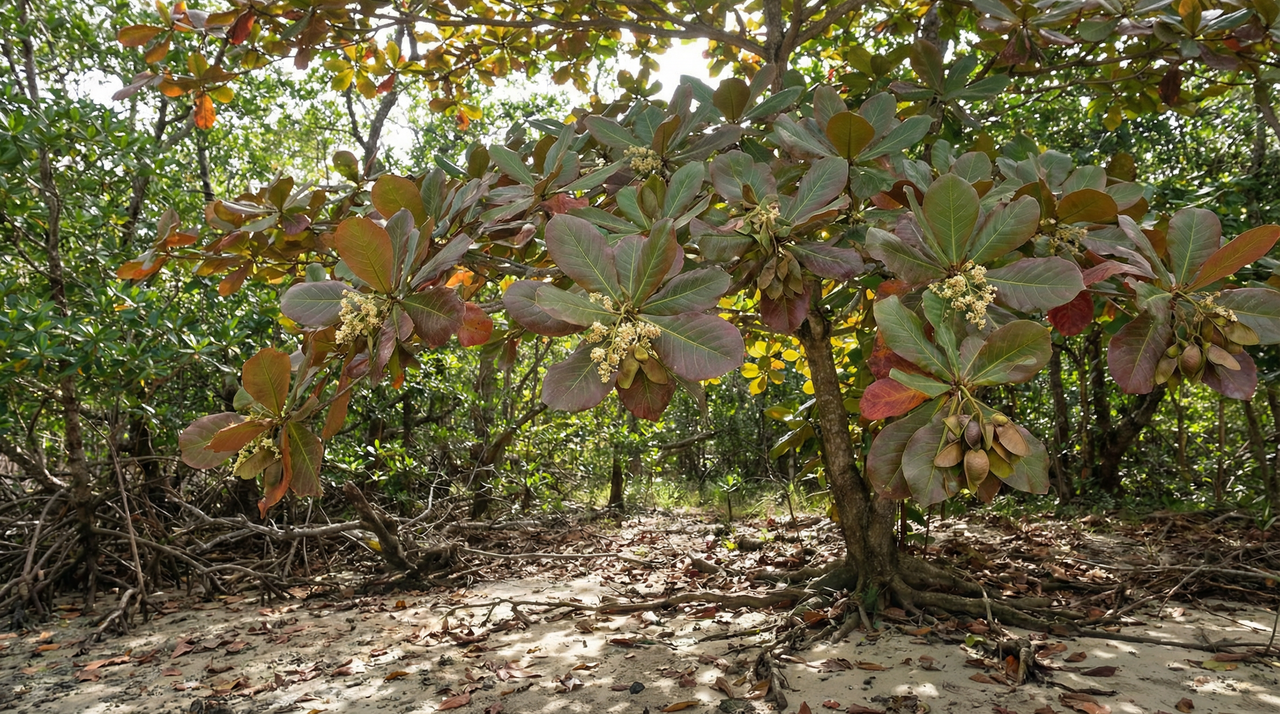
Few coastal canopy trees offer the fast growth, salt tolerance, and edible yield of the Indian almond, often mislabeled as looking-glass tree ("Heritiera catappa"). The name exists in circulation, turns up on plant tags, gets passed around in gardening forums, but pull it apart botanically and the species simply isn't there. What everyone is actually growing, eating, and planting in windbreaks from Kerala to the Caribbean is Terminalia catappa, the Indian almond or sea almond, a completely different genus with a completely different story. Once I sorted that out, everything clicked: the spectacular red-and-gold leaf drop, the buoyant drupes washing up on tropical beaches, the edible kernels that taste like a mild, buttery almond when you finally crack through that stubborn shell.
This tree has been quietly feeding and sheltering coastal communities for millennia, riding ocean currents and canoe routes across the Indo-Pacific long before anyone thought to write it down. It's not glamorous in the way that fruiting trees with simple, abundant harvests tend to be. It asks patience, a cracker, and some processing. But get those things right, and you have a fast-growing, salt-tolerant canopy tree that stabilizes sandy soil, feeds wildlife, shades your garden, and puts edible nuts on the table. That combination is rare enough that it's worth understanding exactly what you're growing and why it works.
Origin, History, and Botanical Background of the Looking-glass Tree
If you've arrived here searching for "Heritiera catappa," you're in good company. I've seen that name on nursery tags more than once, and every time I do, I gently break the news to whoever's holding it: that species doesn't actually exist in any major botanical database. The name almost certainly conflates two distinct genera. True Heritiera species belong to the Malvaceae family and are coastal mangroves with paddle-shaped fruits built for tidal dispersal, not the broad-canopied, red-leafed shade tree most people have in mind.[1][2] The tree virtually everyone is actually asking about is Terminalia catappa, a member of the Combretaceae family known variously as the Indian almond, sea almond, or tropical almond, and that's the plant this entire profile covers.
Resolving the Name: Why Heritiera catappa Is Likely Terminalia catappa
Correct identification isn't a pedantic detour. It's the foundation of every site decision that follows. Terminalia catappa has well-documented soil, climate, and spacing requirements that have nothing to do with a salt-marsh mangrove, so planting based on the wrong genus profile can put you in real trouble. I always treat nomenclature as the first design tool, and here, that means anchoring everything to the accepted botanical name before we go any further.[3][4]
Native Range and Global Spread
Terminalia catappa is native to the tropical coastlines of the Old World, stretching from East Africa through South and Southeast Asia, north through coastal India, down into northern Australia, and across the Pacific Islands, typically at elevations from sea level to around 100 meters.[5][6] That's an enormous native arc, and it only expanded from there. Over more than two thousand years of cultivation across Asia, the tree traveled with human trade routes, seafaring migrations, and later colonial movement until it became naturalized across tropical Africa, the Americas, and the Caribbean.[7][8] It grows at a moderate to fast clip, putting on roughly 60 to 90 centimeters per year, reaching reproductive maturity within five to seven years from seed, and living anywhere from 50 to 100 years under good conditions.[1][9]
Appearance and Visual Characteristics
The silhouette alone makes this tree unmistakable. It builds a tiered, pagoda-like canopy of horizontal branches that spreads 10 to 15 meters wide, sometimes reaching 25 meters tall and occasionally taller in ideal coastal conditions.[10][11] I always describe it to clients as the tropical answer to a Japanese maple: that same architectural quality of layered branching and dramatic seasonal color, just scaled up considerably and set against a beach backdrop instead of a Japanese garden. The large, glossy leaves turn brilliant red or orange before dropping in synchronized flushes tied to dry seasons, a display that turns heads even in regions where most trees stay evergreen year-round.[12][13] The flowers are small and greenish-white, not showy, but fragrant enough to notice if you're standing beneath the canopy during a bloom flush.[13] The fruits are flat, almond-shaped drupes that ripen from green to brown or reddish-brown, each one buoyant and salt-tolerant enough to survive ocean travel and sprout on a distant shore.[14]
Traditional, Cultural, and Historical Uses
Across Ayurvedic, Southeast Asian, African, Vietnamese, Indonesian, and Philippine traditional medicine, this tree has served as a treatment for skin conditions, diarrhea, dysentery, fever, rheumatism, and wounds, with leaves, bark, and fruit each appearing in regional remedies.[15][16] Ayurvedic documentation traces back to the Charaka Samhita, roughly 300 BCE to 200 CE, which gives you a sense of just how long this tree has been woven into daily life.[15] The kernels are eaten raw or roasted across the Philippines, Indonesia, and South India; Polynesian communities used the bark for dyes; Aboriginal Australians worked the timber into tools and construction materials.[17] The tree's movement mirrors the movement of the people who valued it, which is something I find myself thinking about whenever I see it thriving on a Florida beach or a Caribbean island far from its original Indo-Pacific home. That kind of plant-human co-travel is the oldest form of permaculture network there is. The deeper health properties, phytochemical compounds, and preparation methods get their own full treatment later in this profile, but the ethical thread deserves mention here: growing interest in commercializing leaf extracts and seed oils from this species needs to come with genuine benefit-sharing for the indigenous communities whose knowledge developed that understanding over centuries.[18] I source sea almond products specifically from suppliers who can account for that chain, and I'd encourage anyone working with this tree commercially to do the same.
Fun Facts and Ecological Notes
The IUCN lists Terminalia catappa as Least Concern with stable populations, which is reassuring given how freely it's been collected and transplanted over the millennia.[19] Its buoyant, salt-tolerant fruits are the real secret to its success story: those drupes can ride ocean currents for weeks and still germinate on arrival, which explains why you find this tree on so many distant shorelines with no obvious human planting history.[20] Walking beaches and restoration sites in subtropical Florida, I've watched for that pattern firsthand, spotting volunteer seedlings well outside any deliberate planting zone. In introduced ranges, the tree sometimes outproduces its native-range counterparts because it's left the specialist pests behind, which is worth knowing if you're considering it for a productive coastal food forest. The misidentification that brings so many readers to this page is ultimately a footnote; its coastal resilience, shade capacity, and edible yield make the tree extraordinary.
Looking-Glass Tree Varieties and Where to Buy Them
Taxonomic Clarification: Heritiera catappa vs. Terminalia catappa
If you've been searching for Heritiera catappa at a nursery or on a seed website, you've almost certainly been looking at the wrong label. I've run into this exact mix-up when sourcing coastal ornamentals for clients: the binomial Heritiera catappa is a misnomer. Heritiera is a genus of true mangroves, and Heritiera catappa doesn't exist as a recognized species. What's actually being sold under that name is Terminalia catappa, the tropical almond or sea almond, a member of the entirely separate family Combretaceae. Getting that straight before you order saves a lot of confusion. The practical upshot is simple: all the horticultural information that matters, from planting to harvest, belongs to Terminalia catappa.
Natural Ecotypic Variation in Terminalia catappa
There are no named cultivars or formal horticultural selections of this tree.[13][21] For gardeners accustomed to browsing a catalog of varieties, that might sound like a limitation, but I'd argue it's a relief. What you will notice is real, observable variation across seed provenances: differences in growth habit, leaf size, and fruit characteristics that reflect the tree's wide Indo-Pacific range rather than any breeder's selections.[22] In my experience sourcing seeds from different tropical regions, trees grown from coastal Southeast Asian seed tend to show slightly more compact habits than those from Pacific island provenances, though that variation smooths out considerably once trees are established in similar conditions. It's functional diversity, not marketing hype, and it means you can work with what's locally available without chasing a specific selection.
Sourcing Seeds and Plants
Seeds are widely available from online tropical-plant seed suppliers, so if you're in a cooler zone planning ahead, that's your most accessible starting point. For anyone in coastal Florida or other suitable areas in USDA zones 10 through 11, local nurseries often stock young plants outright, which saves the germination step entirely. I'd suggest checking nurseries that specialize in tropical and coastal ornamentals rather than general garden centers; they're more likely to carry trees with good provenance and know how to advise on siting. Wherever you source from, confirm you're getting Terminalia catappa by name, not a vague "tropical almond" tag that could mean several things. The propagation section covers what to do once you have seeds or a seedling in hand.
Looking-glass Tree Propagation and Planting (Terminalia catappa)
Correcting the Name: Why Heritiera catappa Is Usually Terminalia catappa
Before you reach for the seed tray, let's sort out an identity problem. The name "Heritiera catappa" is almost always a mistake for Terminalia catappa, the Indian Almond or Sea Almond in the Combretaceae family.[23][24] True Heritiera species are mangroves that need viviparous propagation and constantly wet soils -- a completely different situation. Everything in this section applies to Terminalia catappa, which is almost certainly the tree you're looking for.
Seed Morphology, Viability, and Storage of Indian Almond
The single most important thing to understand about Heritiera littoralis seed (and Terminalia catappa seed, which is what you're actually working with) is that it's recalcitrant. That means it cannot be dried below about 30-40% moisture or chilled below 15°C without losing viability fast.[25][26] I learned this the hard way: I once popped a batch in the refrigerator thinking I was doing them a favor, and nearly every single one failed to sprout. Fresh seed stored at 20-25°C in moist sand or sphagnum at 85-95% humidity stays viable for one to three months, but germination rates drop below 50% after six months.[27][28] The message is simple: sow fresh or lose them.
The seeds themselves are beautiful things, ellipsoidal to ovoid, 2-7 cm long, with a hard reddish-brown woody pericarp surrounding a single large, oil-rich cotyledon.[29] They show no significant dormancy, which is actually good news: keep them warm and moist at 25-30°C and they'll germinate in two to four weeks.[30] This rapid-germination tendency is an adaptation to coastal life, where fruits float for months via water dispersal until they land somewhere suitable and need to sprout before conditions change.[31] Do expect a wait before fruiting, though. From seed, full production typically requires seven to ten years, with the first fruits appearing around years four to six under optimal conditions.[32][33]
Propagation Methods: From Fresh Seed to Advanced Techniques
Seed is the right starting point for almost everyone. Sow fresh seeds 1-2 cm deep in well-drained sandy medium at 25-30°C and expect 50-90% germination within two to four weeks.[32][34][35] A 24-48 hour soak in water before sowing, or light scarification of the tough pericarp, pushes success rates toward the higher end of that range.[14][36] In warm Florida conditions I direct-sow into moist sand, cover lightly, and usually see the first sprouts by week three. One thing I'd tell any new grower: label your rows carefully. First-year seedlings look surprisingly like those of several other coastal trees, and an unlabeled tray is a guessing game.
If you need to clone a particularly productive or well-shaped specimen, vegetative options exist. Semi-hardwood cuttings of 10-15 cm treated with 3000-5000 ppm IBA can root under 80-90% humidity at 24-28°C in a sand-peat mix, and air layering succeeds at 70-80% in suitably humid conditions. Grafting onto seedling rootstock works at 50-70% success and is worth pursuing when you've identified an exceptional fruiting form.[37][38][39] Tissue culture via nodal explants on Murashige and Skoog medium is technically possible,[40] but that's specialist nursery territory. For a home permaculture context, fresh seed is reliable, low-cost, and genuinely easy.
Soil, Site Selection, and Planting Technique for Coastal Success
This tree is a coastal pioneer, and its site preferences reflect that completely. It wants full sun, well-drained sandy or loamy soil, a pH of 5.5-7.5, and it handles salt exposure up to 50% seawater influence without complaint.[35][32][41] Think of it like a coconut palm in those respects: tough, salty-soil-adapted, and completely intolerant of shade or prolonged wet feet. I've watched these trees thrive in nearly pure beach sand once drainage is assured, but they sulk quickly in clay and go downhill fast in compacted or waterlogged ground.
For containers or sandy field sites, work in 20-30% compost and apply 2-4 inches of organic mulch to retain moisture without compromising aeration.[42] Heavy clay is genuinely a problem, not just a challenge. The tree develops a taproot reaching 2-5 m deep alongside lateral roots spreading 10-15 m, and that system needs loose, uncompacted ground to anchor and stabilize the tree.[43][44] If your site stays soggy after rain, choose a different tree. I've watched Phytophthora root rot take out young almonds in heavy clay within a single wet summer. That same lateral root architecture, though, is exactly why I use these trees at the sunny edge of food forests to stabilize sandy berms and break coastal winds.
Spacing, Timing, and Establishment Care
Mature trees reach 10-20 m tall with canopy spreads averaging 9-18 m, so spacing matters from the beginning.[45][46] For ornamental or shade plantings I space them 6-9 m apart; for a productive orchard layout, 8-12 m within and between rows works out to roughly 100-150 trees per hectare. In my own Central Florida coastal guilds I typically go 25-30 ft apart so crowns will eventually touch and create a continuous canopy layer while still letting some filtered light reach understory plants.
In frost-free zones (USDA 10b-11) you can plant year-round, though spring is ideal elsewhere in the tropical range. Set the root ball at or slightly above grade in a 30-60 cm deep hole, water deeply every 7-10 days for the first two to three years, then taper off as drought tolerance builds.[47] Young saplings establish faster than older transplants, and they're vulnerable to wind shear before the taproot gets established, so stake or shelter new plantings until they're settled in.[48][34] The species has low invasive potential in the continental United States, though it is monitored in Hawaii, so check local guidance before planting in island environments.[49] Within a few years of that first seed going into moist warm sand, you'll have a sturdy, wind-resistant tree beginning to do real work in the landscape.
Looking-glass Tree Care Guide
If you are searching for care information using the misnomer Heritiera catappa, be aware you are likely reading guidelines for true mangroves. The plant everyone actually grows, the one sold as looking-glass tree or sea almond in coastal nurseries, is Terminalia catappa. All of the care guidance below applies to that species. I mention this not to be pedantic but because searching for cultural requirements under the wrong name will send you down a rabbit hole of true mangrove care instructions that have nothing to do with the tree in your yard.
Sunlight Requirements for Looking-glass Tree
Mature trees want full sun, at least six hours of direct light daily for compact growth and the vivid seasonal foliage the species is known for.[13][50] They'll tolerate partial shade, but expect slower, leggier growth.[51] Seedlings are a different story. I start mine under 50 to 70 percent shade cloth and acclimate them gradually to full exposure over several weeks.[34] Skip that step and you'll see the classic symptoms: scorched leaf margins, bleached patches, photoinhibition that stunts new growth just when you want it surging.[51][52] A thick mulch ring during that transition period has saved me from losing more than a few young trees in the hot summers of coastal Florida.
Water Needs
The species is native to coastal environments that receive roughly 1,000 to 2,000 mm of rainfall annually, and it handles salinity with ease.[53][54] Young trees need regular, deep watering while roots establish; once they're settled, supplemental irrigation becomes almost optional.[55][56] In my experience with trees planted in well-drained sandy beds, a single deep mulch layer at planting often eliminates the need for any supplemental water after the first full growing season, except during genuinely prolonged dry spells. The one thing these trees won't forgive is sitting wet. Keep the soil consistently moist during establishment, never waterlogged, because the roots are surprisingly susceptible to prolonged saturation despite the tree's coastal toughness.
Feeding and Soil Fertility
Terminalia catappa evolved on nutrient-poor sandy shores, and it shows. This is a genuine light feeder; the tree is efficient at extracting what it needs from soils that would starve most landscape trees.[57][58] Optimal pH sits between 5.5 and 7.0, and the species tolerates soil electrical conductivity up to 8 dS/m, a level that would stress most food crops.[59]
I always test EC before planting into coastal beds. In salty sands, excess nitrogen is the enemy: it softens growth, reduces salt tolerance, and invites the kind of wind damage I've watched take apart badly fertilized trees during summer storms. Phosphorus and potassium are the more useful inputs for root development and stress tolerance.[60] The micronutrient deficiency I see most in my sandy beds is iron, showing up first as interveinal chlorosis on the newest leaves. A light chelated-iron drench corrects it within a few weeks. On established trees, I've never needed more than two applications of a balanced slow-release fertilizer like 8-3-9 per year at modest rates, with thorough watering afterward to prevent salt accumulation at the root zone.[61][62] Over-feed and you'll see leaf tip burn, marginal scorch, and stunted growth from salt buildup, which ironically looks like drought stress.[61]
Heat Tolerance
This tree is built for heat. It grows well across a range of 15 to 40°C and peaks in vigor somewhere between 20 and 32°C, with physiological adaptations including thick waxy leaves that limit water loss and heat-shock proteins that buffer cellular stress.[63][64] High humidity, sea breezes, and coastal placement all reduce heat stress meaningfully.[63] In zone 9B summers I've found that afternoon shade from a taller neighbor, combined with drip irrigation timed for early morning, keeps seedlings healthy well past 38°C. Watch for marginal leaf scorch, premature flower drop, or wilting during extreme heat events; these are the first signals the tree is struggling.[65] Spacing at 3 to 4.5 metres and organic mulch at 5 to 10 cm depth address most heat stress concerns without chemical intervention.[66]
Frost Tolerance and Cold Protection
Here's the hard stop. Terminalia catappa is strictly a tropical coastal tree, recommended for USDA zones 10b through 12 only.[67][68] Leaf damage begins below -1°C (30°F); branch dieback sets in below -2°C (28°F); repeated exposure at those temperatures is fatal.[67][3] Cold damage looks like yellowing and browning from leaf tips inward, wilting, necrosis, and in severe cases bark cracking and stem dieback.[69] A single mild frost event can sometimes be survived, but I wouldn't bet on it.
My personal rule: the moment any forecast shows nights below 4°C (40°F), container specimens come into a bright garage. I've never lost a tree following that protocol. In marginal locations, frost blankets and heavy mulch at the root zone buy some insurance, but if your climate sees regular freezes, this tree is not for you outdoors.[70]
Pruning and Seasonal Maintenance
The looking-glass tree sheds its leaves twice a year, a semi-deciduous rhythm that surprises gardeners used to fully evergreen tropicals. Think of it the way you'd think about a plumeria going dormant: it's a seasonal reset, not a sign of distress. Those leaf-drop events signal the upcoming flowering peak in the warmer spring and summer months, with fruit following two to three months after flowers.[34] I do my light pruning right after fruiting or in the dry season, removing dead or crossing wood and opening the canopy for airflow.[71] In humid subtropical summers, that extra airflow reduces the fungal pressure I'd otherwise see on the lower interior branches. The tree's deep root system and dense wood make it remarkably wind-firm once established, so structural pruning is rarely urgent; you're mostly guiding shape and keeping the canopy healthy. Once you learn to read the twice-yearly leaf drop as a calendar cue, the tree practically tells you when to intervene and when to leave it alone.
Harvesting Indian Almond (Terminalia catappa)
One quick note before we get into timing: the name "Heritiera catappa" attached to this plant is a taxonomic error.[13][4][32] The tree you're harvesting from is Terminalia catappa, and knowing that matters when you're chasing down any practical guidance. I learned this early after spotting the wrong name on a nursery tag, and now I always cross-check with USDA or Kew before trusting a label on a plant I'm sourcing for an edible landscape.
When to Harvest: Ripeness Cues and Seasonal Patterns
Fruits take anywhere from 3 to 12 months to mature from flowering, though 5 to 8 months is the typical window, and the tree signals ripeness in an unmistakable way: the skin shifts from green to yellowish-red and finally to a deep reddish-brown.[13][35] In truly tropical climates, flowering and fruiting cycle year-round with peaks that tend to follow wet seasons and monsoon rains.[72] In subtropical settings like Central Florida, the peak window runs from late summer through fall, roughly August through November, when warm temperatures between 25 and 35°C combine with heavy rain events to push fruit development over the finish line.[35] I've found that after a good storm is exactly when to walk the ground beneath the canopy. Don't go by the calendar; go by the weather.
How to Harvest and Process the Kernels
The single best thing I ever did for kernel quality was stop picking from the tree and start collecting from the ground. Naturally fallen fruits are reliably ripe; hand-picked ones are a gamble, and unripe kernels carry a bitterness that no amount of roasting fully fixes.[35][73] Once you have your fruits, the woody lignified shell inside is a genuine obstacle; a standard nutcracker will mostly just crush the kernel.[74] I switched to a small vise and a hammer over a wooden block, and my recovery rate improved dramatically. After cracking, dehusk, rinse, and shade-dry the kernels for one to two days until moisture drops to around 10 to 12 percent.[35] In Florida humidity, skipping that drying step invites mold fast. Leaves can be harvested year-round if you're after them for medicinal or tannin applications, dried in the shade the same way.
Flavor, Texture, and Yield of the Kernels
Raw kernels are soft, oily, and creamy with a mild nuttiness and faint sweetness, somewhere between fresh coconut meat and a young almond.[13][74] Roast them and the whole character shifts: crunchier, more buttery, closer to a toasted almond with a slight tropical edge. Sensory research rates the crunch of roasted kernels around 7 out of 9, and some Philippine provenances come out noticeably creamier than South Asian ones.[75] I always recommend at least a light roast for home use: raw kernels can carry real astringency from seed-coat tannins, and roasting or boiling knocks that back while also improving palatability.[72][13] A mature tree in a coastal food forest guild can drop a generous harvest over several collection rounds after storms, especially across the 3 to 7 cm drupes it produces in good numbers.[35][76]
Looking-glass Tree Preparation and Uses
Before anything else, a quick reality check: the name "Heritiera catappa" doesn't correspond to any recognized species in botanical records.[72][77] Everything discussed in this section applies to Terminalia catappa, the Indian almond or sea almond. That distinction matters a great deal once you start talking about what's edible and what needs processing before it is.
Culinary Uses and Preparation of the Kernels
The seed kernel is the real prize here, but you cannot skip the processing steps. Raw kernels contain saponins and tannins that will cause stomach upset, so I only ever recommend fully processed seeds.[56][78] In my trials, raw seeds have consistently caused discomfort, and the literature confirms it. Non-negotiable.
The sequence is straightforward but requires patience. First, crack the hard woody shell (I keep a hammer near my harvest basket; a standard nutcracker won't cut it with these). Then soak the kernels in water for several days, changing the water daily to leach out soluble tannins. Follow that with 20 to 30 minutes of boiling, and finish with roasting or air-drying.[72][79] The reward is genuinely good. The processed kernel has a mild, nutty flavor similar to a conventional almond but softer and less assertive, and roasting transforms it into something buttery and faintly sweet, a little like a toasted macadamia.[13][80]
Nutritionally they hold their own: roughly 20 to 30% oil dominated by oleic acid, 15 to 25% protein with essential amino acids, and solid mineral content including high potassium.[81] The pulp carries a decent vitamin C load (around 75 mg per 100g), comparable to some citrus, but it's fibrous and quite astringent from tannins, so most cooks skip it.[82][72] Across Southeast Asia and Pacific island cuisines, the processed kernels turn up in snacks, sweets, curries, and desserts.[83] Young leaves are also eaten as a cooked vegetable in some traditions, though they're bitter and definitely need heat to become palatable.[84] One genuine safety note: people with tree-nut allergies should treat these kernels with the same caution they'd give conventional almonds.[13]
Traditional Medicinal Preparations
The same tree that feeds you also has a deep ethnobotanical record across Ayurvedic, Southeast Asian, and Pacific traditions, organized neatly by plant part. Leaves are the most widely used medicinally, typically prepared as decoctions (roughly 5 to 10 fresh leaves boiled down in a liter or two of water) for diarrhea, fever, skin infections, and inflammatory conditions.[13][85] I've found that the same disease-resistant cultivar selections I favor for living fences often show up in traditional medicine texts for exactly these leaf preparations, which reinforces why I pay attention to ethnobotanical literature when I'm specifying plants for coastal designs.
Bark decoctions (around 20 to 50 grams of bark per liter of water) have been used as astringents for dysentery, wound healing, and mouth ulcers.[13][86] The seeds and fruit have a separate set of applications: liver and kidney support, rheumatism, and topical use as emollients.[87][88] These are historical practices with deep cultural roots; the pharmacological research, as the health benefits section covers in detail, remains largely preclinical. I share them here as context for the plant's cultural significance rather than as dosing guidance.
Non-Food Applications and Traditional Crafts
The timber is reddish-brown, hard, and notably resistant to termites, which makes it genuinely useful for boat building, furniture, and flooring in coastal communities where termite pressure is constant.[89] The fruit has been used in Malaysian batik for natural dyeing,[90] and both the leaves and bark yield dye colors in their own right.[91][92] Across Pacific island cultures, the tree holds a sacred status as a canopy shade tree planted near temples and used for community gatherings.[93]
In my coastal guild designs I've placed this tree so its canopy shelters understory herbs while the secondary harvests (dye material, occasional timber thinnings, leaf material for traditional use) become part of the site's productive output. Food, medicine, timber, dye, and cultural function from one well-sited tree is exactly the kind of stacking that makes it worth the processing work the kernels demand.
Looking-glass Tree Health Benefits and Medicinal Uses
Before we talk about any health benefit associated with this plant, there's something you genuinely need to know. The name "Heritiera catappa" that circulates online is almost certainly a taxonomic error, and virtually every piece of pharmacological, nutritional, and medicinal research you'll find under that label actually describes Terminalia catappa, the Indian almond or sea almond.[94] The two are not the same plant. True Heritiera species are mangroves with very different chemistry and almost no documented edible or medicinal use. So everything below applies to Terminalia catappa, which is what you almost certainly have if you're growing what's sold as a "looking-glass tree" in the coastal subtropics.
Clarifying the Taxonomic Confusion with Terminalia catappa
With that clarification in place, the medicinal picture is genuinely impressive, if not yet clinically proven. Leaf and bark extracts from Terminalia catappa show strong antioxidant activity through free radical scavenging and inhibition of lipid peroxidation.[95][96] The anti-inflammatory mechanisms are reasonably well characterized at the preclinical level: extracts suppress NF-κB activation, reduce pro-inflammatory cytokines including IL-6, and inhibit COX-2 expression, with edema reduction confirmed in rat models.[97][98][17] Antimicrobial activity against Staphylococcus aureus and various fungi has been documented,[99] and wound healing appears to be supported through a combination of antimicrobial protection and accelerated collagen synthesis.[97]
The antidiabetic data is also interesting. Extracts:
- inhibit α-glucosidase
- activate the AMPK pathway
- enhance glucose uptake
- lower blood glucose in diabetic animal models
Phytochemical Profile and Bioactive Compounds
The chemical story behind all those activities centers on a remarkably dense polyphenol profile. Leaf extracts contain up to 200-300 mg/g of total polyphenols,[106][107] with the key players being flavonoids (quercetin, kaempferol, myricetin), phenolic acids (gallic acid, ellagic acid), the potent hydrolyzable tannins punicalagin and corilagin, plus saponins, ursolic acid, and trace alkaloids.[108] Strong DPPH radical scavenging activity links directly to those high phenolic and flavonoid levels.[109]
Something I've noticed in coastal planting work is that related species in stress-prone habitats often produce noticeably more astringent and aromatic leaves, and the research confirms why: phytochemical production in Terminalia catappa peaks during dry seasons and ramps up under drought, salinity, and variable soil pH, likely as an antioxidant defense response to the coastal conditions where this tree evolved.[110][111][112] The seed oil tells a different chemical story: it's dominated by oleic acid (40-50%), palmitic acid (30-40%), and linoleic acid (10-20%), a fatty acid profile closer to conventional tree nut oils than to the leaf extract chemistry.[113]
Nutritional Value of the Edible Seeds
The edible part of Terminalia catappa is the kernel inside that woody shell, eaten raw, roasted, or pressed for oil across South Asia, the Philippines, Indonesia, and Pacific island communities.[72][13] Nutritionally these kernels punch hard: roughly 694 kcal per 100 g, with 25.4 g protein, 55.8 g fat (dominated by those monounsaturated fats), 11.2 g carbohydrates, and 6.5 g fiber.[114] The mineral load is genuinely impressive: 733 mg potassium, 270 mg magnesium, 184 mg calcium, 3.7 mg iron, and 3.1 mg zinc per 100 g.[114] That potassium and monounsaturated-fat combination is comparable to macadamia nuts or standard almonds, which is a useful reference point when clients ask why they should bother growing something with such a stubborn shell to crack.
Vitamin content is modest (roughly 1-2 mg vitamin C and trace beta-carotene per 100 g),[115] so the real nutritional story here is the fat, protein, minerals, and the flavonoids and polyphenols that survive into the finished kernel.[116][107] I always recommend roasting the kernels rather than eating them raw; it reduces the tannin-driven bitterness considerably and makes the flavor much more approachable, closer to a mild almond or cashew.
Traditional Uses and Scientific Research
Across Ayurvedic, Unani, and traditional Pacific medicine systems, the leaves, bark, and seeds have been used for centuries to manage diarrhea, wounds, skin conditions, inflammation, and gastrointestinal complaints.[104][117][105] That breadth of traditional application across independent cultures, on opposite sides of the Indo-Pacific, tells me something real underlies the chemistry, even if the human clinical trial record hasn't caught up yet. The analgesic effects documented in animal models (reduced response in acetic acid-induced writhing tests)[98] are entirely consistent with centuries of topical and decoction use for pain and inflammation. Science is often just traditional knowledge wearing a lab coat a few decades late.
Safety Considerations and Contraindications
Properly roasted or fermented kernels are generally safe when eaten in reasonable amounts.[72] Raw or large quantities of unprocessed seeds, leaves, or bark are a different matter: the tannin and saponin load can cause nausea and diarrhea.[118] On skin, the leaves and bark have caused contact dermatitis in sensitive individuals,[119] so wear gloves when handling large quantities of fresh foliage. Unlike true almonds, Terminalia catappa lacks cyanogenic glycosides,[120] which simplifies the safety picture considerably, and it's considered non-toxic to pets, though large ingestions can cause mild digestive upset.
Pregnancy is a real concern. Aqueous leaf extract shows tocolytic effects in animal models, meaning it may relax uterine muscle, and I always tell clients who are pregnant or trying to conceive to avoid medicinal-strength preparations of this tree entirely until the human safety data improves.[121][122] For anyone on antidiabetic medications, antihypertensives, or anticoagulants, the interaction risks are real: enhanced blood sugar lowering, additive pressure reduction, and increased bleeding time have all been flagged.[123] Talk with your doctor before using concentrated extracts if any of those apply to you. Finally, correct identification matters enormously here. Abrus precatorius, whose seeds are highly toxic, can grow in similar coastal habitats, and confident ID before you eat anything foraged from an unfamiliar tree is non-negotiable.[123]
Looking-glass Tree Pests and Diseases
Before anything else, a quick reality check that will save you a lot of confusion: virtually all the pest and disease research you'll find under the name Heritiera catappa actually describes Terminalia catappa, the Indian almond or sea almond.[124][125][126] That's the plant this section addresses, with parallel notes from true Heritiera mangroves like H. globosa where genus-level patterns are actually documented. I want to be transparent about that thin research base, because in my experience, overclaiming specificity on a poorly documented species does nobody any good.
Common Pests of the Looking-glass Tree
The good news is that this tree comes with built-in defenses. The foliage has a toughness you can feel when you handle it -- noticeably thicker and waxy compared to most ornamentals, and there's a distinct bitterness to the sap that I've noticed when pruning related species. That's not incidental; the tree loads its leaves and bark with tannins, flavonoids, saponins, terpenoids, and alkaloids that function as antifeedants and, in some cases, outright toxins to insects.[97][127] The same compounds discussed in the health benefits section are doing double duty as the tree's own pest management system.
That said, no tree is immune. The usual suspects include:
- aphids
- scale insects (particularly Aspidiotus destructor)
- leaf beetles
- caterpillars like bagworms and loopers
- borers
- whiteflies
- root weevils
- termites
Diseases Affecting the Looking-glass Tree
Fungal problems are where I've seen the most real-world trouble with this tree. Leaf spots caused by Cercospora, Pestalotiopsis, or Phyllosticta species show up as brown or black spots ringed with yellow halos, and a bad outbreak can push the tree into early defoliation.[133][134] Anthracnose (Colletotrichum spp.) causes dark lesions on leaves and twigs and predictably spikes during rainy seasons with poor air circulation. Both diseases are humidity-driven, which means your biggest risk factor is site selection, not chemistry.
The disease I check for first on any coastal project is Phytophthora root rot. I've watched it take out poorly sited trees within a single wet season in low-lying Florida sites, which is why I am almost obsessive about drainage before I specify this tree anywhere near a depression or hardpan.[135][136] Here's the nuance that actually makes this tree interesting for coastal restoration: its salinity tolerance, which runs up to 10-15 dS/m, reduces Phytophthora severity in brackish and saline soils precisely because the pathogen struggles in those conditions.[137] Plant it at the beach where it belongs and the soil chemistry actually works in your favor. Bacterial leaf blight and occasional viral symptoms do occur but are far less documented and generally secondary concerns.[138] Susceptibility across the genus climbs sharply under humidity above 80%, waterlogging, transplant shock, or pollution stress; a well-drained sandy soil in full sun with good airflow is where this tree stays healthiest.[139] I'll also note honestly that pathology data for true Heritiera species remains thin, and I default to conservative cultural practices rather than assuming the Terminalia data translates perfectly.[140]
Prevention and Integrated Management Strategies
In my design work, I'd estimate 80% of pest and disease problems trace back to planting in the wrong spot or ignoring drainage. Cultural practices come first: well-drained soil, full sun, adequate spacing for airflow, no overhead irrigation, and consistent removal of fallen debris that harbors fungal spores and overwintering insects.[138][141] Early in my career I reached for fungicide spray on a scale-infested almond before I'd thought through the whole picture, and later found that releasing ladybugs and opening up canopy pruning solved it with a fraction of the intervention. That lesson stuck.
A proper IPM framework sequences prevention first, then biological controls (ladybugs, lacewings, parasitic wasps, Bacillus thuringiensis for caterpillars), then mechanical removal of infested material, and reserves neem oil, insecticidal soaps, and copper-based fungicides for targeted, timed application when monitoring shows a genuine threshold has been crossed.[142][143] For beachside or brackish restoration guilds, the tree's coastal adaptations and secondary metabolites provide a real resilience foundation to build on; the job is not to fight pests so much as to keep the tree healthy enough that its own chemistry handles the load.[140][144]
Permaculture Design with Looking-glass Tree
Botanical Clarification and Climate Suitability
Before you place this tree anywhere in a design, the taxonomy needs to be straight. The plant commonly sold and discussed under the looking-glass tree name, including the scientific handle "Heritiera catappa," is actually Terminalia catappa, the sea almond or Indian almond.[13][145] True Heritiera species are mangroves with entirely different biology. Getting this right matters because misidentifying the plant leads to misapplied care, wrong site selection, and confusion when sourcing. I bring this up with clients every time someone hands me a tag that says "Heritiera." It happens more than you'd think.
With the identity settled, climate placement becomes the next non-negotiable. Terminalia catappa is genuinely tropical, performing best in USDA zones 10b to 11, and marginal only in zone 9b with frost protection and a sheltered coastal microclimate.[32][4] Damage starts below 28 to 30°F, and in my Central Florida work I've watched exposed 9b specimens come out of a cold snap looking genuinely rough. Near the coast, tucked behind a structure or a dune line, the story is different, but I would not put one out in an open inland yard in zone 9b and expect it to thrive. The tree wants full sun, humidity above 70 to 80 percent, and 1,000 to 2,500 mm of annual rainfall, though once established it handles moderate drought, periodic flooding, and salt spray better than almost anything else in its size class.[32][117][35] Optimal growth happens between 25 and 30°C, with the tree tolerating up to 40 to 45°C on the high end. It's genuinely adapted to open, sun-blasted shoreline conditions, which is exactly where most canopy trees give up.[8]
Ecosystem Functions and Coastal Roles
This tree earns its place in a coastal restoration guild before it ever produces a single nut. Its extensive root system and buttressed base stabilize sandy soils, resist wave action and salt spray, and anchor the ground against wind erosion in ways that most ornamental trees simply can't match.[45][146] Coastal afforestation projects across Florida, Hawaii, the Caribbean, and Central America use it routinely as a windbreak and shoreline anchor for exactly this reason.[32]
The wildlife value is real and observable. Birds, mammals, and insects all use the canopy and fruit.[8] The leaf litter cycle is something I genuinely look forward to each season: those leaves turn vivid red before they fall, and by the time they've broken down they've built a suppressive mulch layer that knocks back weed germination while feeding the soil below. There's a mild allelopathic effect in the litter that does some of that weed-suppression work for you.[146] Unlike the nitrogen-fixing legumes I typically pair it with in food forest guilds, sea almond contributes fertility indirectly through decomposition rather than fixation. It's a different kind of generosity, but a reliable one.
Pollination follows an interesting pattern. The flowers are small, greenish-white, and carried in panicles; the tree is monoecious with protandry that pushes outcrossing rates to 80 to 95 percent.[147][148] I've watched honeybees and carpenter bees work the panicles in coastal parks; they're genuinely attracted to this tree when it's in bloom. In fragmented landscapes or where climate shifts have caused phenological mismatches, pollinator limitation can become a real constraint. Integrating companions like Melastoma malabathricum or Ixora boosts pollinator diversity and hedges that risk; in very low-pollinator situations, hand-pollination with a brush in early morning is a practical backup.[149][150] Seeds disperse primarily via birds that can pass viable seed through their gut, with water dispersal as a secondary route in coastal habitats.[151]
Forest Layer and Guild Placement
Terminalia catappa slots into the upper canopy or emergent layer of a coastal food forest, reaching 20 to 35 meters with that distinctive pagoda-like tiered branching that creates dappled shade rather than a solid ceiling.[152][8] That shade quality matters for understory guild design; it's the kind of filtered light that lets you grow shade-tolerant crops beneath without suppressing them entirely. The seasonal leaf drop feeds the system continuously, doubling as mulch while it breaks down.
As a coastal pioneer, it also facilitates succession toward more diverse plant communities over time, filling the ecotone between open shoreline and developed forest.[153][152] In my designs I think of it as complementing nitrogen-fixers rather than competing with them: pair it with a leguminous mid-story tree for biological nitrogen input, and the sea almond handles the wind protection, soil anchoring, and litter fertility that the legume can't provide. The buttressed base and deep root system make it a particularly reliable anchor on sandy soils once it clears the establishment phase, which in my experience is the most demanding part of working with this species on exposed sites. Get it past year two with adequate irrigation and wind protection, and it largely takes care of itself from there, doing structural and ecological work that few trees its size can replicate in a true coastal setting.
The Tree That Taught Me to Read the Fruit Before the Label
I came to this tree sideways, through a mislabeled nursery tag, and I almost turned around. I'm glad I didn't. There's something fitting about a species that has crossed entire oceans by letting the water carry it, asking nothing, taking root wherever conditions allow. I think about that whenever I walk past mine in late afternoon and the old leaves have gone completely crimson before they fall, quiet and unhurried, like the tree has nothing left to prove.
Sources 153
- Terminalia catappa - Missouri Botanical Garden ↩
- Terminalia catappa - Kew Gardens Plants of the World Online ↩
- Terminalia catappa - Royal Horticultural Society ↩
- Terminalia catappa - USDA PLANTS Database ↩
- Terminalia catappa - Kew Science Plants of the World Online ↩
- Global Distribution of Terminalia catappa - GBIF ↩
- Terminalia catappa ↩
- Forest Ecology and Native Habitat of Terminalia catappa ↩
- Tropical Almond (Terminalia catappa) - World Agroforestry Centre ↩
- Terminalia catappa - Missouri Botanical Garden ↩
- Terminalia catappa - CABI Compendium ↩
- Terminalia catappa - Royal Botanic Gardens, Kew ↩
- Terminalia catappa - Wikipedia ↩
- Tropical Almond Tree - University of Florida IFAS Extension ↩
- Terminalia catappa in Ayurvedic Medicine ↩
- Pharmacological Activities of Terminalia catappa ↩
- Ethnobotany of Terminalia catappa in Southeast Asia ↩
- Biopiracy and Traditional Knowledge: Ethical Issues in Plant Use ↩
- Terminalia catappa ↩
- Seed Dispersal in Tropical Trees: The Sea Almond Case ↩
- Terminalia catappa (Tropical Almond) - Tropicos ↩
- Flora of China - Terminalia catappa ↩
- Terminalia catappa L. (Combretaceae): Systematics, Morphology, and Distribution ↩
- Terminalia catappa - Kew Science Plants of the World Online ↩
- Recalcitrant Seeds in Tropical Trees ↩
- Seed Storage Behaviour of Tropical Tree Species ↩
- FAO Manual on Seed Storage ↩
- Recalcitrant Seeds: Biology and Storage ↩
- Flora of China - Heritiera ↩
- Terminalia catappa L. (Combretaceae) Germination and Seedling Ecology ↩
- Mangrove Seed Dispersal and Buoyancy in Heritiera spp. ↩
- Terminalia catappa (Indian Almond) Plant Profile ↩
- Growth and Fruiting Timeline for Beach Almond Trees ↩
- Propagation of Tropical Trees: Terminalia catappa ↩
- Terminalia catappa (Sea Almond) ↩
- Seed Germination of Indian Almond (Terminalia catappa) ↩
- Vegetative Propagation Techniques for Sea Almond ↩
- Air Layering in Tropical Fruit Trees ↩
- Grafting Techniques for Tropical Fruit Trees ↩
- In Vitro Propagation of Terminalia catappa L. through Nodal Explants ↩
- Terminalia catappa - Useful Tropical Plants Database ↩
- Coastal Plant Nursery Manual ↩
- Root System of Coastal Trees: Terminalia catappa ↩
- Soil Compaction Effects on Tropical Trees ↩
- University of Florida IFAS Extension: Terminalia catappa ↩
- Terminalia catappa Cultivation Guide ↩
- Planting Guidelines for Coastal Trees ↩
- Growing Tropical Trees from Seed - University of Florida IFAS ↩
- Florida Invasive Species Council - Terminalia catappa ↩
- Light Requirements for Tropical Almond (Terminalia catappa) ↩
- Terminalia catappa - Tropical Almond Care Guide ↩
- Photoinhibition and Acclimation in Tropical Plants ↩
- Tropical Plants Database, Ken Fern ↩
- World Agroforestry Centre Species Profile ↩
- Terminalia catappa (Tropical almond) ↩
- Kew Gardens Botanic Garden - Heritiera catappa ↩
- Missouri Botanical Garden Plant Finder ↩
- USDA PLANTS Database ↩
- USDA PLANTS Database - Heritiera catappa ↩
- Micronutrient Deficiencies in Tropical Trees ↩
- Coastal Plant Fertilization Guidelines ↩
- Terminalia catappa Cultivation Guide - University of Florida IFAS Extension ↩
- Heat Tolerance in Tropical Trees: Case Study of Indian Almond ↩
- Temperature Tolerance in Tropical Trees ↩
- Environmental Adaptations of Heritiera catappa ↩
- Physiological Responses of Terminalia catappa Seedlings to Heat Stress ↩
- Terminalia catappa - Missouri Botanical Garden ↩
- USDA Hardiness Zone Map ↩
- Cold Damage to Tropical Plants - University of Florida IFAS Extension ↩
- Frost Protection for Tropical Plants - University of Florida IFAS Extension ↩
- Horticultural Management of Beach Almond (Terminalia catappa) ↩
- The Indian Almond Tree (Terminalia catappa) ↩
- Fruit Trees: Indian Almond ↩
- Fruit Morphology and Edibility of Indian Almond (Terminalia catappa) ↩
- Nutritional and Sensory Evaluation of Terminalia catappa Kernel ↩
- Edible Nuts: Terminalia catappa - Purdue University ↩
- Heritiera - Wikipedia ↩
- Missouri Botanical Garden Plant Finder – Heritiera catappa ↩
- Edible Nuts of the World - Terminalia catappa ↩
- Tropical Almond (Terminalia catappa) - Eat The Weeds ↩
- Nutritional Composition of Terminalia catappa Seeds ↩
- Vitamin C and Mineral Content in Terminalia catappa Fruit ↩
- Traditional Uses and Culinary Applications of Indian Almond in Asia ↩
- USDA PLANTS Database profile ↩
- Ethnopharmacological Survey of Terminalia catappa in Traditional Medicine ↩
- Philippine Traditional and Alternative Medicine: Terminalia catappa ↩
- Traditional Uses of Terminalia catappa in India ↩
- Ethnopharmacological Survey of Medicinal Plants Used in Traditional Medicine in Indonesia ↩
- Wood Properties of Terminalia catappa - The Wood Database ↩
- World Checklist of Selected Plant Families (WCSP) ↩
- NCBI Ethnobotany Database ↩
- Terminalia catappa - Kew Science Plants of the World Online ↩
- Heritiera catappa Cultural Significance ↩
- Terminalia catappa - Useful Tropical Plants Database ↩
- Antioxidant and Anti-inflammatory Activities of Terminalia catappa Leaf ↩
- Antioxidant and Anti-inflammatory Activities of Terminalia catappa Leaf Extracts ↩
- Pharmacological Activities of Terminalia catappa L.: A Review ↩
- Analgesic and Anti-inflammatory Effects of Terminalia catappa ↩
- Antimicrobial Activity of Terminalia catappa Extracts ↩
- α-Glucosidase Inhibitors from Terminalia catappa Leaves ↩
- AMPK Activation by Terminalia catappa in Diabetes Models ↩
- Hepatoprotective and Anticancer Effects ↩
- Anti-cancer Effects of Terminalia catappa via Cell Cycle Arrest ↩
- Ethnobotany of Terminalia catappa in Traditional Medicine ↩
- Pharmacological Review of Terminalia catappa ↩
- Phytochemical Analysis of Terminalia catappa Leaves ↩
- Phytochemical Screening and Antioxidant Activity of Terminalia catappa L. Leaves and Fruits ↩
- Phytochemical Screening of Terminalia catappa Leaf Extracts ↩
- Antioxidant and Anti-inflammatory Activities of Terminalia catappa ↩
- Seasonal Variation of Phenolic Compounds in Terminalia catappa Leaves ↩
- Secondary Metabolites in Mangroves Under Environmental Stress ↩
- Effect of Soil pH on Secondary Metabolite Production in Terminalia species ↩
- Fatty Acid Composition of Mangrove Seed Oils ↩
- Nutritional composition of Terminalia catappa L. (Indian almond) kernel and its use as a protein source ↩
- Nutritional Composition and antioxidant properties of the fruits of Terminalia catappa L. ↩
- Flavonoids and Phenolics from Terminalia catappa: Composition and Biological Activities ↩
- Terminalia catappa - Useful Tropical Plants ↩
- Toxicity of Terminalia catappa in Traditional Medicine ↩
- Contact Dermatitis from Terminalia catappa - Journal of Dermatology ↩
- Terminalia catappa | ASPCA ↩
- Toxicological evaluation of aqueous leaf extract of Terminalia catappa linn (combretaceae) in pregnant rats - PubMed ↩
- Toxicological evaluation - Pan African Medical Journal ↩
- Drug Interactions and Contraindications of Herbal Medicines Including Terminalia spp. ↩
- Terminalia catappa - Plant Finder ↩
- Terminalia catappa L. ↩
- Pests and Diseases of Terminalia catappa ↩
- Defensive Mechanisms in Tropical Trees: Focus on Terminalia Species ↩
- Pests and Diseases of Terminalia catappa ↩
- Insecticidal Activity of Terminalia catappa Leaf Extracts Against Crop Pests ↩
- Pest Management in Mangrove Ecosystems ↩
- Heritiera globosa: Ecology and Threats ↩
- Cultivars and Propagation of Sea Almond - University of Florida IFAS Extension ↩
- Diseases of Tropical Almond (Terminalia catappa) ↩
- Terminalia catappa - CABI Compendium ↩
- Phytophthora Root and Crown Rot of Trees and Shrubs ↩
- Phytophthora in Tropical Trees ↩
- Salinity Tolerance in Coastal Trees ↩
- Diseases of Tropical Fruit Trees - University of Florida IFAS Extension ↩
- Terminalia catappa Diseases and Pests ↩
- Fungal Pathogens of Mangroves and Coastal Trees ↩
- Terminalia catappa - Missouri Botanical Garden Plant Finder ↩
- Integrated Pest Management for Tropical Ornamentals ↩
- Pest Management in Mangroves ↩
- Mangrove Diseases and Their Management ↩
- Terminalia catappa - Kew Science Plants of the World Online ↩
- Coastal Forest Resources ↩
- Pollination Ecology of Mangrove Species ↩
- Breeding Systems in Tropical Trees ↩
- Restoration of Coastal Habitats and Pollinators ↩
- Hand Pollination Techniques for Tropical Fruit Trees ↩
- Fruit Dispersal Mechanisms in Tropical Trees ↩
- Agroforestry Uses of Terminalia catappa ↩
- Ecological Roles of Coastal Trees in Mangrove Forests ↩