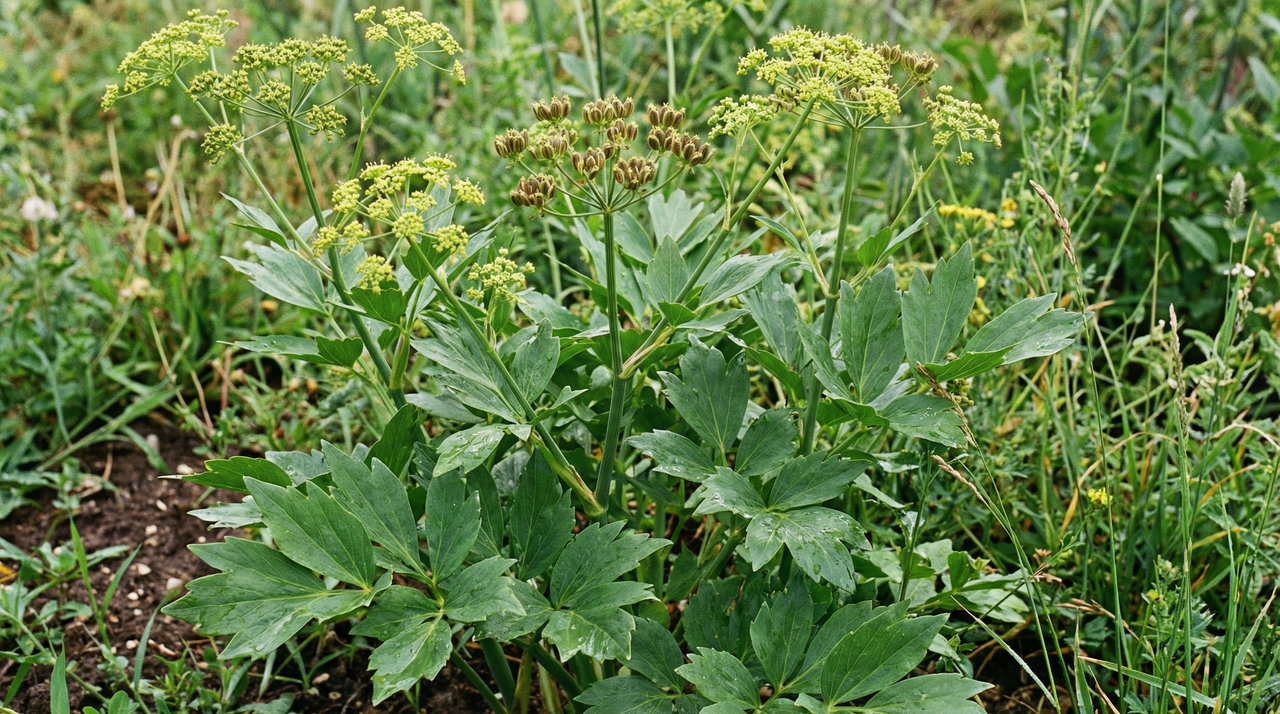
Every few years I meet a gardener who's been growing lovage for a decade and still thinks of it as a celery substitute. That framing undersells it so badly it's almost funny. Celery is the shadow; lovage is the thing casting it. One medium leaf dropped into a pot of soup delivers what three stalks of celery can't quite manage, and the flavor is deeper, more savory, with this faint yeasty undertone that I've never been able to fully explain to someone who hasn't tasted it. The Romans noticed. Medieval monks noticed. Somehow, somewhere between the monastery garden and the modern seed catalog, a significant chunk of the English-speaking world forgot entirely.
What makes lovage genuinely strange is how little it asks in return for what it gives. I've grown it in a wet Welsh-style climate, in a dry continental zone with brutal winters, and in a mid-Atlantic garden where August feels punishing. In all three situations it came back, bigger each time, throwing up flower stalks taller than my head by June. It's a perennial that behaves more like a small shrub in terms of sheer presence, and yet most gardeners I know treat it as an afterthought, tucked in a corner near the compost. That's exactly backwards, and the rest of this article is going to make the case for why.
Origin and History of Lovage (Levisticum officinale)
Botanical Background and Native Habitat
Lovage is a clump-forming herbaceous perennial in the Apiaceae family, native to the mountain meadows, stream banks, and woodland edges of southern and southeastern Europe, the Caucasus, Turkey, Iran, and southwestern Asia.[1][2][3] Its home range spans the Alps and Pyrenees through the Balkans, where cool, damp conditions at roughly 300 to 600 meters of elevation shaped the deep taproot, high moisture demand, and pungent celery-like chemistry that gardeners know today. Understanding that origin explains a lot about how the plant behaves: it wants consistent moisture, it sulks in dry heat, and it invests heavily in that root system before putting much effort into above-ground growth. It's also a genuinely long-lived plant, capable of persisting for 15 years or more in a well-chosen spot, though young plants often spend their first two seasons building root mass before reaching full flowering size.[4][5] I've started it from seed several times, and that first-year rosette looks almost exactly like a very glossy, oversized carrot top; don't mistake the slow start for failure. It's just doing exactly what its mountain ancestors were built to do.
Visual Characteristics
Once it hits its stride, lovage is genuinely architectural. The hollow, ridged stems reach 1.8 to 2.4 meters tall in typical garden conditions, sometimes pushing toward 3 meters in rich, moist soil.[4][5] I've watched it reach shoulder height in a single season in demonstration gardens with consistent irrigation and a generous layer of compost, which tends to surprise visitors who expected an herb rather than a small tree. The large, dark-green leaves are deeply divided and glossy, smelling unmistakably of celery the moment you brush against them; in late spring to early summer those stems terminate in compound umbels of small yellowish-white flowers, followed by light-brown ribbed seeds about 5 millimeters long.[6] Below ground, the taproot can extend one to two meters into the soil, which is why I always dig a generous, deep planting hole at establishment; cramped roots genuinely do shorten the productive life of a clump. Hardy across USDA zones 3 through 8, lovage prefers full sun to partial shade in a moist, fertile site, though intense afternoon heat can push it toward early bolting.[1][7]
Traditional and Cultural Uses
Lovage has been a kitchen and apothecary staple since antiquity. Ancient Greeks and Romans grew it as both a seasoning and a vegetable, and Pliny the Elder singled it out as a particular favorite among gourmets.[8] Medieval monks carried that enthusiasm across Europe, planting it reliably in monastic gardens for the kitchen and the infirmary alike. Dioscorides, Hildegard von Bingen, and later herbalists across Germany, Russia, Hungary, the Balkans, Turkey, and Italy all documented it as a diuretic, digestive aid, carminative, and remedy for respiratory and urinary complaints.[9][10] That living folk tradition is something I genuinely admire. It represents centuries of accumulated observation, even if the clinical research is still catching up to the anecdote. Culinarily, the plant seasons soups, stews, cured meats, cheese, and bread across a wide swath of Europe, with regional signatures like dried lovage in Hungarian soups and root preparations in Italian cooking.[9][1] It arrived in North America with European settlers in the 17th century and has naturalized across temperate parts of the continent, as well as parts of Asia and Australia.
Fun Facts About Lovage
A few things about lovage that tend to stick with people: Pliny called it "the darling of the gourmet," and medieval monks grew it so routinely it became almost synonymous with the monastery kitchen garden.[11] European folklore took that affection even further, associating lovage with love spells, protection rituals, and purification, which is a lot of symbolic weight for a plant that mostly tastes like very good celery. On the ecological side, a mature clump in full bloom is a reliable magnet for beneficial insects; those nectar-rich umbels attract hoverflies, parasitic wasps, and native bees in numbers that make it worth growing even if you never harvest a leaf.[12] One note I take seriously, especially working with clients who handle Apiaceae regularly in sunny climates: the foliage contains psoralens, the same compounds found in parsnip and carrot tops, that can cause phototoxic skin reactions in susceptible people when handled in bright light. It's the same caution I'd give with any member of this family, and it's not a reason to avoid the plant, just a reason to harvest with long sleeves on a cloudy morning. Once established, lovage becomes a permanent fixture, so select its planting site carefully.
Lovage Varieties and Where to Buy
Notable Lovage Cultivars
While lovage lacks the sprawling cultivar catalog of basil or thyme, its simplicity is part of its charm. Most of what you'll encounter is the standard green-stemmed species, Levisticum officinale, grown from seed and perfectly capable of feeding a household for years on end.[13][1] There are named selections worth knowing about, though. 'Tantissimum' stays compact, which is genuinely useful if you're working a tighter bed or a smaller food forest edge. 'Budapest' and 'Jolly Green Giant' lean the opposite direction, growing vigorously and producing heavily when given rich, moist soil. In my experience, if culinary volume is what you're after, those larger types are worth tracking down. 'Atropurpureum' brings a purple-stemmed contrast that reads beautifully in a mixed perennial border, and 'Aureum' offers soft golden foliage that I've grown side by side with the standard green form. The golden leaves do hold their color better when shielded from intense afternoon sun in hot summers; without that protection they tend to fade and scorch. 'Argenteum' adds a variegated option for designers who want visual interest. Regional names like 'Goldstorm' or 'Hardy ABC' appear occasionally, but these aren't widely standardized.[13][7] For most kitchen gardens, the straightforward common form does everything you need.
Sourcing Lovage Plants and Seeds
Finding lovage in the U.S. is refreshingly easy. Johnny's Selected Seeds, Baker Creek Heirloom Seeds (RareSeeds), Plant Delights Nursery, and Seed Sistas all carry it reliably.[14][15][16][17] I've ordered from several of them over the years and keep coming back to Johnny's and RareSeeds for seed; germination is straightforward and the seedlings take off fast enough that any transplant awkwardness is forgotten within weeks. Seed packets typically run $3 to $10 depending on quantity and certification.[15] Because lovage is such a long-lived perennial, a single good purchase can supply your garden for a decade or more, so I'd rather spend a little more on quality seed from a trusted vendor than bargain-hunt and end up with low-germination stock.
Lovage performs solidly in USDA zones 4 through 8, preferring full sun to partial shade and moist, fertile, well-drained soil.[5][18] It's not native here, but it isn't a problem plant either; USDA lists it as non-invasive and it stays put without taking over neighboring guilds.[1] That matters to me in permaculture design: I want plants that contribute without colonizing. If you're tempted to order seeds from an international specialty source, know that USDA APHIS regulates those imports and a Small Lots of Seed permit may be required.[19][20] Honestly, with this many reputable domestic sources available, there's rarely a reason to go that route anyway.
Lovage Propagation and Planting Guide
Lovage is a decade-long commitment, and I mean that in the best possible way. From seed, you're looking at roughly two years before you get a meaningful harvest, and once it's settled in, a well-placed plant will keep producing for ten years or more.[21][22] That framing matters before you pick your method, because everything from where you site it to how deep you prepare the bed should reflect the fact that you're planting for the long haul, not filling a seasonal gap.
Seed Viability, Storage, and Germination
Lovage seed is orthodox, meaning it stores reasonably well, but "reasonably" has a ceiling. Under cool, dry conditions (around 40-50°F with low humidity in an airtight container with a silica gel packet), viability holds for three to five years, dropping below 50% after that.[23][24] In my experience, fresh seed is noticeably more vigorous. I've started three-year-old stock and gotten a thin, patchy flat; the same variety from the current year's harvest filled the tray. Use the freshest seed you can get.
Fresh seeds germinate in 10 to 21 days at 60-70°F with rates around 60-80%.[23][12] If you're working with older stock or getting inconsistent results, a four-to-six-week cold stratification period at 40°F can help break dormancy and improve those numbers.[25] I'll dampen a paper towel, fold the seeds inside, seal it in a bag, and stick it in the back of the refrigerator. It's low-tech and it works.
Propagating Lovage by Division, Cuttings, and Other Methods
If you want the simplest, most reliable path, skip seeds altogether and divide an established plant. Root division in spring or autumn has close to a 100% success rate, and it gives you a flowering-size plant almost immediately rather than a two-year seedling odyssey.[26][27] I've divided my own clumps every third spring for years, and the divided sections reliably rebound with noticeably more vigorous growth the following season. It's become one of my favorite early spring rituals: dig the clump, split it with a sharp spade, replant the divisions, and within a few weeks you have multiple productive plants where there was one.
Root cuttings and basal stem cuttings are viable alternatives if you need more material than division provides. Two-to-three-inch root sections planted horizontally in gritty compost over winter, or stem cuttings taken with rooting hormone under high humidity, can work with roughly 50-70% success on the stem side.[28][29] They're more fussy than division and rarely necessary in a home garden context. Grafting and tissue culture exist on paper but aren't realistic options for most growers.[30][31] For a home food forest, seed or division covers every scenario you'll actually encounter.
Soil, Site Selection, and pH Requirements
Lovage evolved in the damp, well-drained mountain meadows of the Alps, Pyrenees, and Carpathians,[13] and that origin tells you everything about what it wants from a garden: fertile, moisture-retentive loam that never waterlogged. The taproot is the non-negotiable part. It goes deep, and it needs room to do it. Prepare your bed to at least 18-24 inches, incorporating generous compost as you go.[5][22] I double-dug my first lovage bed and watched how aggressively the taproot followed the loosened soil down. Compact or waterlogged ground stops that root cold and the plant tells you about it quickly.
The pH sweet spot is 6.0-7.5, with some tolerance out to 5.5 on the low end and 8.0 on the high.[32][33] Push below 5.5 and you'll see interveinal yellowing as iron, manganese, calcium, and magnesium become unavailable. I watched exactly that in a slightly acidic bed, amended with lime, and the chlorosis disappeared within a few weeks. Always soil-test before you plant something you expect to harvest for a decade. For sun, full sun works well in cooler northern gardens; if you're in a hotter southern climate, plan for afternoon shade and consistent irrigation.[34] Lovage is cold-hardy in USDA zones 3-8, so the primary limiting factor in most temperate gardens is usually heat, not cold.[35]
Planting Depth, Spacing, and Transplant Technique
A mature lovage plant stands 4-6 feet tall with a spread of 2-3 feet,[5] so the spacing numbers aren't arbitrary. Set plants 18-24 inches apart within the row and 24-36 inches between rows to give each plant enough light and air movement to stay healthy long-term.[27][23] That spacing will feel generous in year one and exactly right by year three.
For direct sowing, press seeds about a quarter-inch deep after your last frost date, or sow in fall for spring germination.[23] If starting indoors, begin six to eight weeks before last frost, then harden off transplants over seven to ten days before planting out.[22] Keep the bed consistently moist but not soggy through establishment; once the plant is settled, it shows decent drought tolerance and handles light frost without complaint. One practical note I'd pass along: label your seedlings clearly. First-year lovage looks remarkably like young carrot or parsley, and I've lost a section to mistaken weeding exactly once. That was enough. A simple marker saves a year of growing time. The plants you're nurturing through that first modest season are building toward a productive patch that, with division every three to four years, will keep going for a decade or more.[21][36]
Lovage Care and Growing Guide (Levisticum officinale)
Lovage is one of those plants that rewards you for getting a few fundamentals right and then mostly leaves you alone. Give it the conditions it wants and a single crown can feed your household for fifteen years. Get the basics wrong and you'll end up with a floppy, bitter six-foot stalk that flowers too early and disappears by August. Most of the care mistakes I've seen come down to light, water, and fertility — so let's work through each one.
Sunlight Requirements for Healthy Lovage Growth
Lovage prefers full sun to partial shade, and your plants will tell you when they're not getting what they need.[1][12] Too little light produces the classic symptoms: leggy, pale stems reaching toward whatever brightness they can find, sparse foliage, and a plant that just never gets going.[37][38] Too much intense afternoon sun, especially in warmer summers, scorches the leaf edges brown and triggers early wilting.[27][39] In my experience, the sweet spot is full morning sun with dappled light in the afternoon. Plants grown that way produce leaves that are genuinely pungent and aromatic — noticeably more flavorful than the bitter, stressed foliage I've harvested from clumps caught in relentless western sun all day.
Watering Needs and Irrigation Tips
Consistent moisture is non-negotiable; lovage needs about an inch of water per week in soil that remains evenly moist.[1][12][40] Established plants can handle a dry week without collapsing, but sustained drought reduces both vigor and flavor in ways that take the rest of the season to recover from. Young plants are far less forgiving and need more frequent, lighter watering until their roots are established, at which point you can shift to deeper, less frequent irrigation.[23][41] Yellow wilting usually means you've gone too wet; crispy brown edges and stunted growth say you've gone too dry.[41][40] A three-inch layer of straw mulch is the single biggest labor saver I've found for keeping moisture consistent through a warm summer, and running a soaker hose beneath it takes the guesswork out entirely. Lovage also prefers a soil pH of 6.0–7.5 and is happiest with soft rainwater; highly chlorinated or saline water will stress it over time.[42][41]
Soil, Fertilization, and Nutrient Management
Lovage does best in fertile, well-drained loamy soil enriched with organic matter.[33][5][12] It's a moderate-to-heavy feeder, and a balanced 10-10-10 fertilizer applied in early spring alongside annual compost or well-rotted manure gives it an excellent start.[33][22] I used to think more fertilizer meant bigger plants until I watched a well-fed bed produce tall, weak stems that flopped in the first summer storm. The culprit was excess nitrogen. Back off on it and the stems grow stout, the flavor sharpens, and the essential oils are noticeably stronger. For plants older than three years, reduce fertilizer and focus instead on working compost into the soil to maintain structure rather than push growth.[23][43] Each spring I do a quick visual scan before deciding whether to side-dress: yellowing on older leaves signals nitrogen shortage, stunted purplish growth points to phosphorus, marginal scorch suggests potassium, and interveinal yellowing between leaf veins indicates magnesium deficiency. Those four symptoms, once you've seen them a few times, tell you more than a fertilizer schedule ever will.
Frost Tolerance and Winter Protection
Lovage is genuinely tough in cold. It's rated hardy through USDA Zones 4–8, surviving minimum temperatures around -30°F (-34°C), with established crowns and roots easily outlasting hard winters in full dormancy.[44][13][5][45] The vulnerability is in spring, not winter. Young emerging shoots are far more susceptible to late frost damage, showing up as blackened, wilted, or necrotic tips after an unexpected cold snap.[22][46] I now wait until after the last expected frost date before pulling back any mulch from the emerging crowns. I lost a few tender shoots one April by uncovering them too early during a warm spell that was followed by a hard freeze, and it set the plants back by several weeks. For young plants or those growing at the colder edges of Zone 4–5, a layer of straw mulch around the base in late fall is good insurance.
Heat Tolerance and Summer Care Strategies
Lovage evolved in the cool, damp mountain regions of southern and eastern Europe, and its preferences reflect that origin. Optimal daytime temperatures sit between 60–70°F (15–21°C), and it handles up to about 75°F (24°C) without significant stress, rating for AHS Heat Zones 4–7.[5][47][33][22] Above 80°F (27°C), heat stress shows as scorched leaf edges, wilting, and slowed growth; seedlings are particularly vulnerable above 86°F (30°C), and heat during flowering accelerates bolting and strips out essential oils and leaf quality.[48][49][22] I've seen leaf scorch appear in my own beds once temperatures push past 82°F on dry days, and the same plants bounce back quickly once afternoon shade and a thick mulch layer are added. In warmer sites, 30–50% shade cloth through the afternoon, two to four inches of mulch over the root zone, and consistent irrigation of up to two inches per week during heat waves are your best tools for keeping lovage productive through summer.[5][50][51]
Seasonal Rhythm and Lifecycle
Lovage follows a clean, reliable seasonal pattern once you know what to expect. Growth emerges from the rootstock in late winter or early spring, often before most other perennials are moving. The plant climbs to its full height — up to six feet in good conditions — flowers in June or July, and sets seed through late summer before dying back completely to the ground in winter.[5][52] That dormancy is complete and tidy; nothing lingers above ground to manage. Watching those tall yellow umbels open in early June is one of my favorite early-summer moments in the garden, but I've learned to cut most of them before seed shatter. Lovage left to flower freely will self-seed generously into surrounding beds, and while the seedlings are easy to manage, they do add up faster than you'd expect.
Pruning, Maintenance, and Long-Term Care
The single most important long-term practice for lovage is division. Every three to four years, dig and divide the clumps in early spring before the growth gets away from you.[27][53][23] I've watched undivided crowns slowly lose productivity, flowering earlier each year and producing progressively smaller leaves. After division and replanting into freshly composted ground, those same plants come back with the vigor of a first-year bed. Cut stems back after flowering to prevent excessive self-seeding and to encourage a flush of fresh, flavorful foliage. Annual compost keeps the soil structure sound, and older established plants need very little additional fertilizer beyond that. With these few habits maintained, a single original planting will supply a household for a decade or more.
Harvesting Lovage: Timing, Technique, and Yield
When and How to Harvest Lovage Leaves, Seeds, and Roots
Lovage is a hardy perennial in zones 4-8, and if you've followed it from seed, you've already accepted that first full season as mostly a waiting game.[22][1][54] The serious harvests don't arrive until year two. Once they do, though, the plant is generous. Leaves come in spring, seeds follow in late summer, and roots reward the most patient growers in year two or three.
I time my first leaf cut by scent as much as calendar. When you snap a young lovage stem in April or May, the smell is shockingly like cutting fresh celery in the kitchen: bright, green, a little sweet. That's your signal. Leaves harvested then are tender and intensely aromatic, and I've learned the hard way that waiting past the pre-flowering window changes the equation fast. Once flowering kicks in around June or July, the foliage gets tougher and noticeably less fragrant. Cut stems 2-3 inches above the ground, and the plant will rebound for repeat harvests every four to six weeks from late spring through early autumn.[22][54][55] Those April-June windows shift noticeably depending on where you garden; warmer southern climates will be moving earlier while northern growers are still watching for that first flush of new growth.
Seeds mature 60-90 days after flowering and need to be collected once they turn brown and papery dry.[56][57][55] I watch the umbels more than the calendar; one week they're greenish-tan, and then suddenly the color shifts and the seeds start to loosen. Catch them before they scatter. Roots are harvested in fall, and only once the plant has enough size behind it, which realistically means year two or three.[54][55] The ones I've pulled in year three had a depth of flavor that early harvests simply couldn't match.
Lovage Flavor Profiles and Expected Yields
Each part of the plant carries its own distinct character. Leaves deliver that bold celery-like flavor and scent, seeds shift toward something warmer and more curry-adjacent, and the roots taste closer to parsley.[7][54] Knowing what you're harvesting for helps you decide when to cut, since the leaf flavor peaks before flowering and drops off afterward.
A mature, well-fed lovage plant in fertile, consistently moist soil can yield several pounds of leaves over a season.[23][13][55] For drying lovage, that pre-flowering window matters just as much as it does for fresh use; dried lovage leaves hold their flavor best when harvested young, and dried lovage made from post-flowering stems is noticeably flatter. The two-year wait to full productivity is real, but the harvest scale once you're there makes it feel like a fair trade.
Lovage Preparation and Uses in the Kitchen and Beyond
Crush a young lovage leaf between your fingers and you'll understand immediately why this plant anchored European kitchens for centuries. The scent that hits you is unmistakably celery, but louder, yeastier, with a faint whisper of curry and citrus underneath. That intensity comes from a complex blend of volatile compounds including limonene, carvone, and α-terpinyl acetate,[58] and it's stronger than anything celery delivers fresh from the grocery store. I keep a patch right outside my kitchen door specifically because one or two leaves go where a whole head of celery might otherwise.
Culinary Applications: Leaves, Stems, Roots, and Seeds
Every single part of this plant is edible, which is part of what makes it such a high-value perennial.[1][59] Young leaves work beautifully fresh in salads or cooked into soups and stews; the hollow stems can be braised or roasted much like celery; the roots are boiled or roasted and have a parsnip-like depth; the seeds deliver a caraway-adjacent spice that's excellent in pickling brines or bread.[1][60] Heat mellows the pungency considerably, which is something I wish more people knew before they add raw stems to a lovage soup recipe and wonder why it's so aggressive. Cooked, it becomes savory and almost umami-rich rather than sharp.
The leaves are mineral-dense too, delivering meaningful vitamin C, vitamin K, potassium, and iron at a genuinely low caloric cost.[61] Pair that with a solid phenolic and flavonoid profile, including quercetin and chlorogenic acid, and you're getting real nutritional work done alongside the flavor.[62]
Anyone cooking with lovage needs to be confident in their identification. The Apiaceae family is full of umbrella-shaped, compound-leaved plants that look similar at a glance, and the toxic ones, poison hemlock with its purple-spotted stems and water hemlock, are genuinely dangerous.[63][64] Early in my design work I started labeling all my Apiaceae rows carefully because even I got turned around. Grown lovage's grooved, hollow stems and coarse, glossy leaves become unmistakable once you've spent a season with them side by side against parsley or celery, but you need that first season.[65] Anyone with Apiaceae allergies should also treat lovage cautiously; I've seen contact dermatitis in sensitive individuals and always recommend starting with a small test amount.[66] And if you're pregnant, skip it entirely; the uterine stimulant compounds are a real concern.[67]
Medicinal Preparations and Dosages
European folk tradition has long used lovage as a carminative, diuretic, and respiratory aid, drawing on leaves, roots, and seeds prepared as teas, decoctions, and tinctures.[68] For a basic leaf tea, steep one to two teaspoons of dried leaves per cup for ten to fifteen minutes and drink two to three times daily. Root decoctions follow a similar frequency but require simmering one to two grams of dried root in about 150 milliliters of water for ten to fifteen minutes. A tincture runs one to two milliliters at a 1:5 ratio, also two to three times daily. Personally, I reach for the leaf tea rather than the root preparation; it's milder in flavor and gentler on the digestive system, which suits everyday use better than the more concentrated root work. The essential oil is not for internal use and should be diluted to one to two percent for any external application.
Non-Food and Garden Uses
One mature lovage plant generates an impressive volume of biomass each season, and I've made it a habit to chop the tall spent stems after seed harvest and lay them directly as mulch over nearby beds. The trimmings break down quickly and return potassium and organic matter right back to the soil, completing the loop without a trip to the compost bin. Historically the strong hollow stems were also used for natural fibers and cordage, a traditional craft application that's mostly a curiosity now but worth experimenting with if you're drawn to that kind of material culture. There's something satisfying about a single perennial that feeds the kitchen through spring and summer, stocks the medicine cabinet, and then closes the season by feeding the garden right back.
Lovage Health Benefits and Medicinal Uses
Lovage has a reputation in European herbalism that stretches back to Roman kitchens and medieval monastery gardens, but the chemistry underneath that reputation is worth understanding before you start brewing it as a tea or reaching for the roots. The plant's bioactive profile is genuinely distinctive, and knowing what's in it helps you use it intelligently rather than just hopefully.
Key Phytochemicals in Lovage: Phthalides, Terpenes, Coumarins, and Flavonoids
Lovage's characteristic aroma, somewhere between celery and sharp parsley with a slightly yeasty depth, comes primarily from a group of compounds called phthalides, especially Z-ligustilide and related forms like levistilide A and B, butylphthalide, and sedanolide.[69][70] The essential oil is dominated by monoterpenes, with β-phellandrene reaching up to 40-50% of the fraction, and α-pinene, β-pinene, myrcene, and limonene rounding out that bright, herbaceous top note.[71][72] Flavonoids including quercetin, rutin, and kaempferol contribute antioxidant activity, and the plant also contains coumarins and furanocoumarins, including bergapten, psoralen, and imperatorin, which become relevant in the safety conversation.
The plant's chemical profile shifts dramatically depending on which part you're working with. Roots and seeds are richest in phthalides and essential oils, with ligustilide reaching up to 40% of root extracts, while leaves concentrate flavonoids, polyphenols, and the compounds that drive antioxidant capacity.[73][74] Total essential oil yield ranges from 0.1% to 2.7% dry weight, and that range is shaped by soil, climate, harvest timing, and extraction method.[75] I've noticed that leaves harvested from plants in full sun and used fresh have a noticeably sharper, more aromatic punch than those from shadier spots, which tracks with what researchers observe about phenolic and oil content under higher light conditions. Z-ligustilide is now used as the standardization marker in commercial lovage extracts,[75] which means home-grown material and commercial preparations can vary considerably in potency.
Traditional Uses in European Herbal Medicine
Lovage has been used medicinally since at least Greek and Roman times, and Germany's Commission E, one of the most rigorous herbal medicine regulatory bodies in the world, officially recognizes its root for treating dyspepsia, stimulating appetite, and as a diuretic for urinary tract complaints.[76][77] Traditional European herbalists reached for it as a carminative and antispasmodic for bloating, flatulence, and indigestion; as a diuretic for cystitis and kidney gravel; as an emmenagogue for menstrual irregularity; and as an expectorant for coughs and congestion.[78][79] These aren't just folk claims either; the WHO monographs also document lovage's traditional applications, giving the historical record some institutional weight.
Scientific Research on Lovage's Pharmacological Activities
Preclinical research has started to catch up with what herbalists observed centuries ago. Laboratory and animal studies have shown that lovage extracts suppress pro-inflammatory cytokines, inhibit the NF-κB and COX-2 pathways, and demonstrate meaningful antioxidant activity, with DPPH scavenging IC50 values in the 20-50 μg/mL range.[80][81][82] The essential oil also shows antimicrobial effects against Staphylococcus aureus and E. coli, and rodent models have produced signals for diuretic, analgesic, hepatoprotective, and even antidiabetic activity through α-glucosidase inhibition.[83][74][84]
None of this has been tested in randomized controlled trials in humans.[85][86] I enjoy lovage as a culinary herb and appreciate what the preclinical data suggests, but I wouldn't self-prescribe medicinal doses without consulting a trained herbalist. The Commission E and WHO acknowledgments of traditional applications give a reasonable foundation for cautious use, and the part-specific effects are worth remembering: leaves for antioxidants, seeds for antimicrobial applications, roots for anti-inflammatory and diuretic effects.
Nutrition Profile of Lovage Leaves, Roots, and Seeds
All parts of lovage are edible, which is one of the things I love about growing it.[87] The leaves are the most frequently analyzed, and the numbers are genuinely impressive for a plant most people walk right past at the herb nursery. Per 100 g fresh leaves, you're looking at roughly 20-30 kcal, meaningful amounts of vitamin C (18-30 mg, around 30-50% daily value), and vitamin K values reported around 338 μg, which is close to 282% of the daily value.[88][89] Calcium, iron, potassium, and magnesium round out a mineral profile that competes directly with the well-documented nutrient density of parsley.
I do want to flag that reported values vary widely across sources, partly because some figures are extrapolated from dried material back to fresh weight.[90] Treat the exact numbers as directionally useful rather than precise. What matters practically is that a generous handful of lovage leaves chopped into soup or a salad is doing something nutritionally, not just flavoring. The vitamin K load deserves a specific mention for anyone on warfarin or other anticoagulant therapy: lovage's K content is comparable to, or higher than, parsley, which most anticoagulant users are already warned to be consistent with.[91] The phenolics and flavonoids in the leaves also contribute genuine antioxidant capacity, which may be part of why traditionally this plant was seen as more than a condiment.
Safety Considerations, Contraindications, and Interactions
Used in typical culinary quantities, lovage is considered safe.[92] That's the reassurance. The cautions start when doses increase or preparations shift toward concentrated extracts and essential oil. Those furanocoumarins I mentioned earlier, bergapten, psoralen, and imperatorin, can cause phytophotodermatitis: skin contact followed by sun exposure can result in burns or persistent pigmentation changes.[93][94] I wear gloves when I'm doing large harvests on sunny days and rinse off any sap before I head back out into bright light. It sounds fussy but after one minor incident years ago, it's just habit now.
Pregnancy is a firm contraindication. The phthalides concentrated in roots and seeds have demonstrated uterine-stimulant and potential abortifacient activity in preclinical research, and lovage should simply not be used medicinally during pregnancy or lactation.[95][96] People with kidney disease or bleeding disorders should avoid it, and if you're taking anticoagulants, diuretics, or lithium, the cumulative effects of lovage's coumarin content and its own diuretic action deserve a conversation with your prescriber before adding more than kitchen seasoning amounts to your diet.
For those with dogs, cats, or horses, the ASPCA lists all parts of the plant as toxic to these animals, with increased urination from the volatile phthalide lactones being the primary clinical sign.[97] Because lovage is such a vigorous perennial it can spread to edges of a garden bed quickly; I keep mine well fenced off from the areas where our dogs roam. And the essential oil, like most concentrated plant oils, requires professional dilution before any topical application and should never be ingested undiluted.[98]
Lovage Pests and Diseases
Natural Pest Resistance from Aromatic Compounds
That bold celery-parsley scent you get from brushing against a lovage leaf isn't just pleasant; it's the plant actively defending itself. The essential oils responsible for that smell, including myrcene, limonene, α-pinene, carvone, and various furanocoumarins, function as feeding deterrents, repellents, and in some cases fumigants against insect pressure.[99][100][101] I've noticed that crushing a fresh leaf and rubbing it on my arms during summer garden sessions genuinely seems to cut down on mosquito attention. Whether that's placebo or the furanocoumarins doing their job, I can't say for certain, but the research at least gives it some credibility.
This chemical defense is what makes lovage a useful companion near brassicas and legumes, where it can help suppress aphid pressure and draw in hoverflies and other beneficial insects.[102] The resistance isn't absolute and it isn't cultivar-specific since no one has bred lovage selections for enhanced pest tolerance; it's simply a species-wide trait tied to aromatic chemistry.[103]
Common Pests and Management
Despite that aromatic armor, a few insects will still find their way in. Aphids are the most common visitor, typically clustering on young shoots, and I've noticed they're far more likely to appear when the plant is stressed by a recent transplant or inconsistent watering. A strong jet of water handles most light infestations before they establish. Carrot rust fly, celery fly, and slugs (especially in damp conditions) round out the occasional pest list, with spider mites showing up mainly in greenhouse situations.[104][105] None of these should feel alarming; they're occasional rather than inevitable, and the plant usually outgrows minor damage without intervention.
When pressure does escalate, insecticidal soaps and beneficial insects are the first tools I reach for. I reserve neem oil for genuine outbreaks, not routine use. Crop rotation away from other Apiaceae every three to four years reduces carrot rust fly populations over time.[104][106] Pest-free gardens aren't realistic, but culturally healthy plants require a lot less intervention.
Fungal and Other Diseases
Fungal issues are where lovage's resilience has clearer limits. Downy mildew shows up as yellowing leaves with grayish-white growth on the undersides during humid stretches; powdery mildew leaves a similar chalky coating on dense plantings. Root rot from Fusarium, Pythium, or Phytophthora causes wilting and crown decay in waterlogged or overly rich soil, and Septoria leaf spot produces yellowing with brown spots in wet conditions.[107][13] Bacterial blight can occur but is far less common, and viral disease data for lovage specifically is essentially nonexistent.
A couple of named selections ('Elixir' for moderate leaf spot tolerance, 'Sow Easy' for some downy mildew tolerance in trials) exist, but the data behind them is sparse and no option offers meaningful root rot protection.[23] Honest answer: cultivar selection matters far less than where and how you plant.
Prevention and Integrated Management
I lost a couple of plants in my early seasons to root rot before I started mounding planting sites slightly and double-checking drainage before I put anything in the ground. That simple adjustment, combined with keeping spacing at 18-24 inches for good airflow,[22] and watering at the base rather than overhead, has made a significant difference. Remove affected leaves promptly, rotate the planting site every few years, and mulch to buffer soil temperature and moisture swings.[104][108] Copper-based sprays or neem work as a backup in severe cases, but cultural practice does the real heavy lifting here.
Lovage in Permaculture Design
Lovage is one of those plants that rewards designers who read the climate before they dig the hole. Get the conditions right and you've got a productive, self-sustaining perennial for a decade or more. Get them wrong and you're fighting a sulky, bolting mess that smells vaguely of celery and regret. So let's start with the basics.
Climate and Hardiness Zones for Growing Lovage
Lovage is hardy in USDA zones 4 through 8, tolerating winter lows down to -30°F once established, with the sweet spot being zones 4-7 where cool summers and reliable moisture align with what this plant evolved for.[5][1][4] It prefers average summer temperatures below 75°F, and once you push past 86°F you're looking at premature bolting, bitter leaves, and a plant that just gives up on you.[109][110] I think of it like cilantro in a Central Florida summer: the heat doesn't kill it outright, it just makes it sprint to seed before you can enjoy it.
Moisture is equally non-negotiable. Lovage wants the equivalent of 30-35 inches of annual rainfall, consistent soil moisture, and enough ambient humidity that it never has to struggle.[4][111] Let it dry out and those big, architectural leaves go leathery fast, and the flavor follows suit. In my gardens, the plants that performed best were the ones sitting near a swale or tucked into a spot where the soil holds moisture through midsummer.
Regionally, lovage is almost effortless in the Pacific Northwest, the Northeast, and the Upper Midwest, where cool summers and adequate winter chill match its native mountainous Eurasian habitat.[112][113] Push into zones 8 or 9 or into drier climates and you're designing around the plant's limitations: afternoon shade, deep mulch, and careful siting to keep root temperatures down.[110][114] It's doable, but you're working against the plant's instincts rather than with them. Once you've found your right spot, plan for spacing of 24-36 inches with eventual heights of 4-6 feet, and budget time to deadhead before it self-seeds; once sited correctly, maintenance is otherwise quite manageable.[115][23]
Ecosystem Functions and Benefits of Lovage
When lovage blooms in early to midsummer, it produces large compound umbels loaded with small yellow-green flowers, and the pollinators find them fast. Honeybees, bumblebees, solitary bees, hoverflies, beetles: the whole generalist crew shows up.[1][116][117] The species is self-incompatible, which means it needs cross-pollination for viable seed set, so it's actively recruiting those insects rather than freeloading on wind.[118][119] In a food forest guild, that bloom window becomes a biodiversity engine right when many spring-flowering shrubs have already finished.
Below ground, lovage is doing equally serious work. That taproot reaches 60-90 cm into the soil, breaking compaction, aerating the subsoil, and drawing up minerals, particularly potassium, phosphorus, and iron, that shallower-rooted neighbors can't access.[120][4] As a dynamic accumulator, it makes that mineral wealth available when you chop the foliage and leave it as mulch. I've noticed that tomatoes growing near lovage mulch seem to perform particularly well in subsequent seasons, which makes intuitive sense given the potassium cycling going on.
Above ground, the aromatic foliage earns its keep as a companion. That unmistakable celery-like scent, which I can pick up just brushing past the leaves during a guild scout, seems to confuse or deter aphids and carrot flies, offering some protection to nearby tomatoes, brassicas, and beans.[121][122][123] Pair that pest-deterrent role with the pollinator attraction and the chop-and-drop biomass production, and lovage companion planting becomes one of the more multifunctional relationships you can build into a temperate polyculture.
Lovage in Forest Layers and Guilds
In the wild, lovage occupies forest margins, disturbed sites, and woodland edges rather than deep-canopy understories, which tells you exactly where to put it in a food forest design.[124][5] It belongs in the tall herbaceous layer at a sunny-to-partially-shaded edge, where it can stretch to its full height without being smothered by canopy and where the taproot can reach into undisturbed subsoil.[125][1] That edge position also puts its insect-attracting flowers right where pollinators moving through the system will encounter them first.
There are some nuances worth knowing about its soil relationships. The taproot likely benefits neighboring plants through mineral cycling and soil-structure improvement, and there may be some allelopathic pest-repelling effect from root exudates, though the research there is still thin. Some Apiaceae relatives can inhibit certain soil fungi, so I'd be cautious about assuming lovage always plays nicely with mycorrhizal-dependent species planted directly beside it; observe rather than assume.
The self-seeding tendency is the main design consideration to stay ahead of. Lovage is naturalized across much of North America in disturbed areas and can spread aggressively if flower heads are left to ripen.[126][127] In my early gardens I learned the hard way that one missed flower head can lead to a lovage thicket the following spring. Deadhead promptly if you want to control spread, or deliberately let a few seeds fall in spots where you'd welcome new plants. Its substantial biomass, once cut, goes straight back into the guild as chop-and-drop mulch, which is the most elegant way to manage a plant that's trying to take over: let it contribute on its way out.
The Herb That Made Me Stop Apologizing for a Six-Foot Plant
I used to hedge when visitors asked about the giant in the back of my herb guild, offering some disclaimer about its size before they'd even decided how they felt about it. I don't do that anymore. One taste from a fresh stem, one spring watching the swallowtails work those flat-topped flowers, and most people just go quiet for a moment. That quiet is the whole argument for lovage, and it makes itself.
Sources 127
- USDA PLANTS Database - Levisticum officinale ↩
- Plants of the World Online (Kew) ↩
- Flora Europaea: Levisticum officinale ↩
- Royal Horticultural Society - Lovage ↩
- Missouri Botanical Garden - Levisticum officinale ↩
- Flora of North America - Levisticum officinale ↩
- Missouri Botanical Garden Plant Finder ↩
- Missouri Botanical Garden - Plant Finder ↩
- Lovage: Levisticum officinale in Traditional European Medicine ↩
- Ethnobotany of the Balkans ↩
- Missouri Botanical Garden - Plant Finder ↩
- Royal Horticultural Society - Lovage ↩
- Lovage Plant Profile - RHS Gardening ↩
- Lovage Plants for Sale ↩
- Organic Lovage Seeds ↩
- Lovage Seeds ↩
- Organic Lovage Seeds ↩
- Levisticum officinale ↩
- Small Lots of Seed Import Permit ↩
- Importing Plants and Plant Products into the United States ↩
- Levisticum officinale (Lovage) ↩
- How to Grow Lovage ↩
- Growing Lovage ↩
- Viability and Longevity of Vegetable Seeds ↩
- Lovage: Levisticum officinale ↩
- Levisticum officinale ↩
- How to Plant, Grow, and Care for Lovage ↩
- Lovage (Levisticum officinale) - Growing Guide ↩
- Propagation of Herbs: Lovage ↩
- Propagation of Lovage (Levisticum officinale) ↩
- Micropropagation of Levisticum officinale ↩
- Missouri Botanical Garden Plant Finder ↩
- Soil pH for Herbs: Lovage (Levisticum officinale) ↩
- Levisticum officinale Care & Growing Guide ↩
- Levisticum officinale ↩
- Levisticum officinale ↩
- Lovage (Levisticum officinale) Plant Profile ↩
- Lovage ↩
- Common Herb Problems: Sunscald and Leaf Scorch ↩
- Levisticum officinale ↩
- Royal Horticultural Society - Lovage (Levisticum officinale) ↩
- Herb Profile: Lovage - University of Maryland Extension ↩
- Nutrient Deficiency Symptoms in Plants ↩
- USDA Plant Hardiness Zone Map ↩
- Kew Science - Levisticum officinale ↩
- Frost Tolerance of Herbs - University of Minnesota Extension ↩
- Heat Zones ↩
- Lovage Production and Management ↩
- Herb Gardening in Warm Climates ↩
- Levisticum officinale ↩
- Growing Lovage ↩
- Levisticum officinale in Flora of North America ↩
- Lovage (Levisticum officinale) - RHS Gardening ↩
- Growing Lovage ↩
- Lovage Production and Marketing ↩
- Growing Lovage ↩
- Lovage: Levisticum officinale ↩
- Flavor Compounds of Lovage ↩
- Levisticum officinale (Lovage) ↩
- Lovage: The Forgotten Herb ↩
- Nutritional Composition of Levisticum officinale ↩
- Bioactive Compounds and Antioxidant Activity of Lovage ↩
- Poison Hemlock (Conium maculatum) ↩
- Water Hemlock (Cicuta douglasii) ↩
- Apiaceae Field Guide ↩
- Toxicity of Apiaceae Family Plants ↩
- Lovage Safety in Pregnancy ↩
- Lovage: Traditional Uses and Phytochemicals ↩
- Phytochemical and Pharmacological Review of Lovage (Levisticum officinale Koch.) ↩
- Phthalides from the Apiaceae Family: Occurrence, Biological Activities and Potential Applications ↩
- Essential Oils of Levisticum officinale: Composition and Bioactivity ↩
- Chemical Composition of the Essential Oil of Levisticum officinale ↩
- Phytochemical Composition and Antioxidant Activity of Levisticum officinale Leaves ↩
- Antimicrobial Activity of Lovage (Levisticum officinale) Essential Oil from Seeds ↩
- Chemical Composition of Levisticum officinale W.D.J. Koch: A Comprehensive Review ↩
- Traditional Uses and Phytochemistry of Levisticum officinale ↩
- Commission E Monographs: Lovage Root ↩
- Phytochemistry and Pharmacology of Lovage (Levisticum officinale Koch.) ↩
- WHO Monographs on Selected Medicinal Plants - Volume 3 ↩
- Pharmacological Activities of Levisticum officinale: A Review ↩
- Antioxidant and Anti-inflammatory Properties of Lovage Extracts ↩
- Phthalides from Levisticum officinale and Their Anti-inflammatory Activity ↩
- Diuretic Activity of Levisticum officinale in Rats ↩
- Hepatoprotective and Antidiabetic Properties of Lovage Extracts ↩
- Herbal Medicines: Biomolecular and Clinical Aspects ↩
- Anti-inflammatory Properties of Levisticum officinale Root Extracts ↩
- Edible Uses of Lovage ↩
- USDA FoodData Central - Lovage ↩
- Lovage Nutrition Facts and Health Benefits ↩
- USDA National Nutrient Database for Standard Reference, Legacy Release (SR-28) ↩
- Flavonoid Content and Antioxidant Potential in Leaves of Levisticum officinale ↩
- Levisticum officinale - European Medicines Agency Assessment ↩
- Contact Dermatitis from Lovage Essential Oil ↩
- Lovage (Levisticum officinale L.): Ethnic uses, phytochemistry, and pharmacological aspects ↩
- Lovage - Drugs and Lactation Database (LactMed) ↩
- Assessment Report on Levistici radix ↩
- ASPCA - Lovage Toxicity to Pets ↩
- Essential Oils Toxicity - Poison Control ↩
- Secondary Metabolites and Insect Resistance in Lovage (Levisticum officinale) ↩
- Essential Oils of Apiaceae: Bioactivity Against Insects ↩
- Furanocoumarins as Defense Compounds in Apiaceae ↩
- Companion Planting with Herbs for Pest Control ↩
- Missouri Botanical Garden Plant Finder: Levisticum officinale ↩
- Lovage (Levisticum officinale) - Pests and Diseases ↩
- Pests and Diseases of Herbs ↩
- Managing Pests in Home Vegetable Gardens ↩
- Missouri Botanical Garden Plant Finder ↩
- University of Minnesota Extension: Downy Mildew on Vegetables ↩
- Journal of Agronomy and Horticultural Science – Lovage Cultivation Study (2021) ↩
- UC Master Gardener – Cool-Season Culinary Herbs ↩
- Kew Gardens – Plant Detail for Levisticum officinale ↩
- Washington State University Extension – Pacific Northwest Herb Guide ↩
- Oregon State University Extension - Growing Herbs in the Pacific Northwest ↩
- USDA PLANTS Database – Levisticum officinale Distribution ↩
- Missouri Botanical Garden – Levisticum officinale ↩
- Pollination in the Umbelliferae ↩
- Insect visitors to Apiaceae flowers ↩
- Apiaceae pollination ecology review (Journal of Economic Entomology, 2015) ↩
- Missouri Botanical Garden Plant Finder ↩
- Dynamic Accumulators in Permaculture ↩
- Lovage Companion Planting Guide ↩
- Nutritional value and ecological relevance of apiaceous plants: Focus on pollen and nectar. ↩
- Lovage in Permaculture Systems ↩
- Plants of the World Online ↩
- Apiaceae Root Characteristics and Mycorrhizal Associations ↩
- USDA PLANTS Database – Levisticum officinale ↩
- Lovage (Levisticum officinale L.) ↩