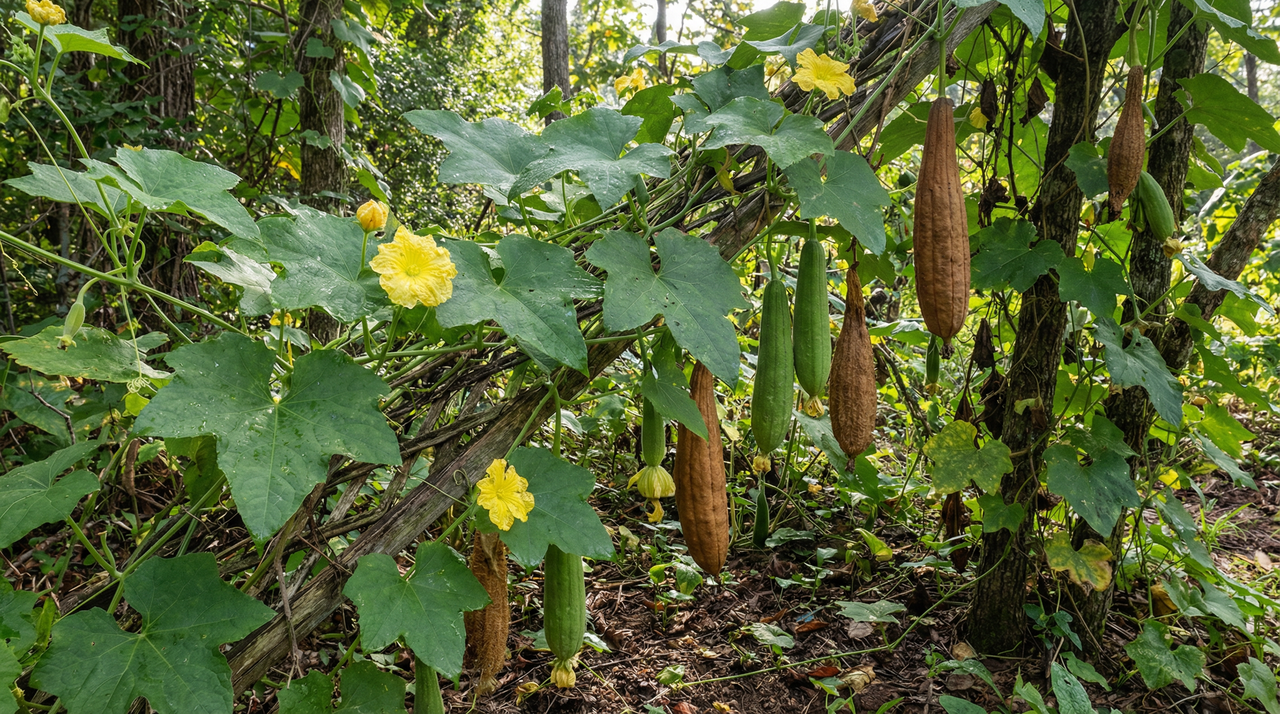
Most people have held a luffa in their hands without ever connecting it to a plant. It sits on the shower shelf, rough and fibrous, and nobody thinks "gourd." That's the contradiction I love most about growing this vine: the same fruit you'd slice into a stir-fry at 50 days becomes, if you just leave it on the vine another two months, the scrubbing sponge hanging in your bathroom. I've grown luffa in humid Florida summers where the vines hit the top of a ten-foot trellis and kept going, and the moment that clicks for most visitors isn't the yellow flowers or even the dangling fruits. It's when I hand them a mature, dried sponge and tell them they could've eaten that thing six weeks ago.
What nobody tells you upfront is that luffa isn't some exotic novelty crop requiring arcane knowledge. It's a cucurbit, a close cousin to your cucumbers and squash, with all the vigorous ambition that implies. Its domestication story starts in tropical Asia, most likely India, somewhere around 4,000 years ago.[1] It traveled trade routes westward and the name stuck, a small geographical injustice that botanical history is full of. Once you know where it actually comes from, a lot of its growing requirements start making a lot more sense.
Origin and History of Luffa (Luffa aegyptiaca)
Botanical Background and Native Range
The luffa plant is a tropical perennial vine that most of us in temperate climates grow as an annual, and that basic tension between its true nature and how we use it shapes everything about growing it well. Scientifically, Luffa aegyptiaca is native to tropical regions of Africa and Asia,[2] while its close relative the ridged gourd (L. acutangula) hails specifically from the tropical and subtropical zones of South and Southeast Asia, including India, Bangladesh, China, Indonesia, and the Philippines.[3][4] In frost-free conditions, L. aegyptiaca can climb to 10 meters and persist for one to three years as a short-lived perennial.[5][6] Bring it into a temperate zone and frost kills it back, giving you a three-to-six-month annual window instead.[7][8] Knowing that helps explain why gardeners in zone 9B and warmer can treat the vine as something closer to a short-lived perennial, while everyone north of that should plan for a long, uninterrupted warm season.
The species name aegyptiaca trips a lot of people up, and I'll admit it confused me the first time I looked it up. It does not mean the plant originated in Egypt. The name reflects 18th-century European cultivation of the plant in Egypt; actual primary domestication traces back to India, around 2000 BCE at the latest, and there's no archaeological evidence of luffa use in Egyptian sites before the Ptolemaic period.[9][10] Genetic and archaeological evidence points squarely to tropical Asia as home base, and the Latin name is simply a reminder that botanical nomenclature sometimes preserves historical accidents rather than ecological truths.
Visual Characteristics of the Luffa Plant
If you've never grown luffa before, prepare yourself: this vine moves fast. Under optimal conditions it can put on 20 to 50 cm of new growth per day,[5][11] and during a hot Central Florida summer I've watched mine cover an entire cattle-panel trellis in a matter of weeks. The stems are angular, 1 to 2 cm thick, and covered in short, stiff hairs that give them a rough, hispid texture.[12] The leaves are alternate, palmately lobed into five to seven divisions, and 10 to 20 cm across, with a sandpaper-like surface from dense stellate hairs.[13] That rough texture is actually a reliable field identification trick I use before the flowers even open: run your hand across a leaf and if it feels like coarse-grit sandpaper, you've got your luffa.
Bright yellow, trumpet-shaped flowers 5 to 7 cm across appear in summer, each a small beacon for bees.[14] The fruits are cylindrical pepos that reach 15 to 60 cm in length, green when young, and distinguished from ridged gourd by their 10 rounded longitudinal ridges rather than the sharp, angular ridges of L. acutangula.[15][16] As the fruit matures and dries, the outer skin disintegrates to expose something remarkable: a latticed interior skeleton of sclerenchyma fibers built from cellulose, hemicellulose, and lignin, threaded through with longitudinal vascular bundles.[17] That's the loofah sponge. Over 100 flat, black oval seeds sit embedded in mucilaginous pulp inside each fruit.[18] Below ground, a deep taproot can penetrate 1 to 2 meters into loose soil alongside an extensive network of lateral roots.[19]
Traditional and Cultural Uses Across Civilizations
Luffa has been cultivated for over 3,000 years, spreading from India along the Silk Road, Indian Ocean trade routes, and later colonial exchanges until it became pantropical.[20][21] Ancient Chinese texts including the Shennong Bencao Jing (circa 200 BCE) and Ayurvedic works like the Charaka Samhita (circa 300 BCE to 200 CE) both document the plant's medicinal role: in Traditional Chinese Medicine it was called Si Gua and prescribed to reduce swelling and clear heat; in Ayurveda it appeared as Koshataki, used for skin disorders, jaundice, and as a purgative.[22][23] Ethiopian and Nigerian traditions independently documented uses for wound treatment, anthelmintic action, and gastrointestinal complaints.[24] I grow luffa primarily for sponges and young edible fruits myself, but I have deep respect for that ethnobotanical record spanning multiple continents.
Ptolemaic Egyptian sites from the Fayum region (circa 305 to 30 BCE) have yielded actual luffa fibers used as bath sponges, though the plant doesn't appear in earlier Egyptian papyri, which aligns with everything we know about its Asian origin and late westward migration.[25][26] The fiber skeleton became the primary use across cultures for bathing, cleaning, painting, and stuffing mattresses after the plant reached Europe and the Americas.[27] Young immature fruits, meanwhile, have been eaten as a vegetable across China, India, Southeast Asia, the Mediterranean, and the Caribbean for just as long,[28] and the plant even carries cultural symbolism in Chinese New Year traditions as a sign of prosperity.[29] One vine, one season, and you could feed your family, stock the bathroom, and keep a medicine cabinet supplied. That's a track record worth appreciating.
Fun Facts About Luffa
The growth rate alone is enough to stop visitors in their tracks. Under ideal heat and humidity, luffa can extend 20 to 50 cm in a single day,[5] which is why I tell anyone planting their first vine to build the trellis before the seed even goes in the ground. The fruiting math is equally impressive: commercial plantings can yield 15 to 20 tons of mature fruits per hectare.[30]
One early lesson I learned the hard way is that the window between "tender and edible" and "structural fiber" closes faster than you'd expect. Fruits left past their prime eating stage become too fibrous to cook, but they produce the most durable sponges. The mature cellulose-lignin lattice typically lasts three to six months of regular use, and the vine needs 90 to 120 days to produce sponges worth harvesting.[31][32] The taxonomy adds one more layer of quirk: what we now call Luffa aegyptiaca was long listed as Luffa cylindrica or Luffa vulgaris in older references,[33] so if you're hunting seed catalogs or old botanical texts, those synonyms are worth knowing. When the dried fruit finally releases its seeds, it does so elegantly: the lightweight fibrous capsule splits open and the buoyant seeds spill out, a dispersal strategy shaped by millennia of floodplain ecology.[34]
Luffa Varieties and Sourcing
Notable Varieties and Fruit Types of Luffa aegyptiaca
If you're used to browsing tomato catalogs with their hundreds of named cultivars, luffa will feel refreshingly minimal. Luffa aegyptiaca doesn't really have a deep bench of branded hybrids; most of what you'll encounter are informal strains and regionally adapted landraces rather than anything with a pedigree.[7][2] The named strains you do see in seed catalogs, things like Egyptian, Loofah Sponge, Paddywack, and Georgia, are better understood as landrace selections than true cultivars.[7]
The choice that actually matters for garden planning is morphological: long-fruited types produce elongated fruits in the 50-70 cm range and are the ones grown for high-quality sponges, while short-fruited types stay at 15-30 cm, develop thicker walls, and are the better pick when you want tender, edible young gourds.[35][36] That long-fruited type is a rampant vining climber that needs serious vertical infrastructure and room to run; in my zone 9B garden I've watched those vines reach 30 feet and then keep going, which is glorious on a sturdy pergola and a design headache in a tight space. The short-fruited types are noticeably more compact and bushier, and I've found they suit containers and smaller trellises far better.[36] They also seemed to hit maturity a bit earlier in my experience, which matters when you're racing the end of the warm season.
By comparison, the ridged gourd (Luffa acutangula) has a considerably more developed cultivar list, including named selections like Pusa Summer Prolific Long, Punjab Sadabahar, Green Long, and POU 3, reflecting its longer history as a commercial vegetable crop in South and Southeast Asia.[3][30] If you want more cultivar options and a slightly more predictable crop, the angled luffa is worth a look alongside the smooth type.
Sourcing Luffa Seeds and Plants
Seed is your most reliable entry point. A solid handful of specialty vendors carry smooth luffa, including Baker Creek, Johnny's, Southern Exposure Seed Exchange, Territorial, Botanical Interests, and Victory Seed Company, among others.[37][38] Standard packets of 10-50 seeds typically run $3-10, bulk packs of 100 seeds come in around $8-10, and the occasional starter plant sells for $5-15 where you can even find one.[39][40] Availability is seasonal and mostly mail-order, so ordering early is just good practice.
Climate is the real limiting factor before sourcing even becomes a conversation. Luffa aegyptiaca needs a long, hot growing season of 150-200 days and performs best in USDA zones 10-11, though it can be pushed in zones 8-9 with a head start indoors.[41][38] In the U.S. it's primarily grown in Florida, Texas, California, and Hawaii.[38][42] The angled luffa (luffa acutangula) handles a slightly broader range, zones 7-11, and reaches harvest in just 50-70 days, which is why I see it offered more often in Asian produce markets in Florida than its smooth cousin.[38][43]
There's no federal ban on importing luffa seed, but the material needs to be clean, free of soil and pests, and properly declared at entry.[44] California and Hawaii add another layer: California requires a permit for seed imports and Hawaii has its own phytosanitary and quarantine rules that can slow things down.[45][46] I've ordered from several of the vendors above without any trouble, but gardeners in those states should budget extra time and check requirements before clicking "add to cart." For everyone else, a domestic specialty seed order is genuinely straightforward.
Luffa Propagation and Planting Guide
Everything about growing luffa from seed starts with understanding the seeds themselves, because these aren't your typical packet contents. They're substantial: black, glossy, oval seeds measuring roughly 10-18 mm long with a noticeably hard coat that you can feel when you roll one between your fingers.[47][48] That hard coat is part of why pretreatment matters, but it's also part of what makes them so storable.
Understanding Luffa Seeds: Appearance, Polyembryony, and Storage
One trait I love about luffa seeds is polyembryony: a single seed can contain 2-5 embryos arising from nucellar tissue, meaning one soaked seed sometimes sprouts a cluster of strong seedlings.[49][50] When that happens, thin ruthlessly to the single strongest seedling. I know it feels wasteful, but leaving two in the same cell creates competition that hurts both. Your seed goes further than you'd expect, which is handy since luffa is monoecious and cross-pollinated by insects, so you'll want to save seed from your best fruits knowing there's always some chance of outcrossing.[51]
Seed storage is genuinely impressive with this plant. Kept dry (5-10% moisture content), cool (4-10 °C), and sealed in an airtight container with a desiccant packet, luffa seeds maintain viable germination for 3-5 years under typical home conditions.[52][53] I've successfully germinated 3-year-old seed saved from my own fruit stored in a mason jar in the back of the refrigerator. Before sowing anything old, a quick germination test on moist filter paper at 25-30 °C for 7-14 days tells you what you're working with; expect 70-90% germination from healthy, properly stored seed.[54]
Germination Requirements and Timeline
That hard seed coat is the main obstacle to reliable germination. Soaking seeds for 24 hours in room-temperature water, or treating briefly with 50 °C water for 20-30 minutes, can push germination rates from a frustrating 50-60% up past 80%.[55][56] Don't skip this step. Once pretreated, seeds germinate in 7-14 days at soil temperatures of 70-85 °F (21-29 °C).[55]
For anyone in a shorter-season climate, starting seeds indoors 4-6 weeks before the last frost date in sterile, well-drained mix gives the vines a meaningful head start. Use a sand-and-compost blend, sow at 1-2 cm depth, and transplant after 3-4 weeks once seedlings have 2-3 true leaves and have been hardened off.[55] Sterile media and good airflow are non-negotiable here; damping-off from Pythium or Rhizoctonia can wipe a flat fast. I label my flats meticulously because young luffa seedlings look nearly identical to cucumber or squash in those first weeks and it's an easy mix-up to regret later.
Here's what I want every first-time grower to hold onto: you're looking at 60-75 days from planting to edible baby luffa, but a full 100-150 days to reach mature sponge.[55][11] That long runway is the central reality of how to grow luffa as a sponge crop, and it shapes everything: your start date, your site, your trellis. Grafting onto Cucurbita moschata or Lagenaria rootstocks (70-85% success rates) can accelerate first fruit set to 45-60 days after transplant and adds disease resistance, but that's an advanced technique once you're confident with the seed route.[57]
Soil, Site Selection, and Sun Requirements
Luffa comes from tropical Africa and Asia, and the soil preferences reflect that origin directly.[58] Give it full sun (6-8 hours minimum), a well-drained loamy or sandy-loam soil rich in organic matter (ideally 2-5%), and a pH between 6.0 and 7.5, with the sweet spot sitting around 6.5-7.0.[59][60] Stray above 7.5 and iron and manganese become unavailable, showing up as interveinal chlorosis on young leaves; drop below 5.5 and aluminum toxicity locks out phosphorus with stunting and leaf burn as the result.[61] Soil testing before you plant isn't optional if you want to avoid troubleshooting a struggling vine mid-summer.
Drainage deserves its own emphasis. After losing early vines to waterlogged clay during a wet summer, I now amend every bed with compost and perlite before transplanting, and I rely on raised beds or containers in anything that holds water. Poor drainage is a direct pathway to Fusarium or Phytophthora root rot.[42] Roots need at least 45 cm of good soil depth, ideally 60-90 cm, so shallow beds or heavy clay are going to limit what you get.[11] For containers, an equal-parts mix of coconut coir, perlite, and vermiculite plus generous compost covers all the bases.[62]
Spacing, Planting Technique, and Trellising
Luffa vines reach 15-30 feet and they will use every inch, behaving more like a determined morning glory than a polite pole bean. Plan for a trellis at least 10-15 feet tall and build it stronger than you think you need; I've had lighter structures pulled down by the weight of a full season's growth.[63] Standard spacing runs 12-24 inches between plants in rows 6-10 feet apart, but trellised plants can go as tight as 12-18 inches in-row because the vertical growth keeps airflow and light from becoming problems.[64] Hill planting, where you sow 3-4 seeds per mound spaced 6-10 feet apart, works well if you prefer a more traditional cucurbit setup.[65]
Direct sow after soil hits 70 °F, or transplant once nights stay reliably above 50 °F and soil is at least 60-70 °F.[5] In zone 9B, that usually means late March to early April for direct sowing and a couple of weeks earlier for transplants started indoors. Ridged gourd (L. acutangula) prefers slightly wider spacing at 36-48 inches and tolerates a broader germination temperature range, but the anchor principles for site and timing are the same across the genus.[66] Get the trellis up before you plant, not after, and adjust spacing based on your soil fertility; richer soil means more aggressive growth and you'll want that room.
Luffa Care Guide: Growing and Maintenance
Luffa is not a forgiving plant for gardeners who want to wing it. Everything about how you care for it flows from one foundational reality: this is a tropical vine that will die at frost and needs a long, uninterrupted stretch of heat to do what you're growing it for.
Frost Tolerance and Temperature Requirements
Cold damage begins below 10-15°C (50-59°F), causing wilting and reduced yield, and any frost is lethal.[67][11] As a true perennial, luffa is only viable in USDA zones 10-11; everywhere else it's strictly a warm-season annual that needs 120-200 frost-free days to mature.[2][68] I start seeds indoors 4-6 weeks before last frost and wait until soil temperatures reliably hit 21°C (70°F) before transplanting.[7] My first season I put transplants out a week too early during a cool snap and watched them just sit there, yellowing and sulking. Row covers and 3-4 inches of organic mulch at the base have been my insurance policy ever since.[2]
Heat Tolerance and Sunlight Needs
Luffa thrives between 25-35°C (77-95°F) with nights staying above 18°C (64°F), and it's rated across AHS Heat Zones 1-12, but above 35-38°C the vine starts struggling.[11][69] Flower drop, poor fruit set, leaf wilting, and scorching are the signals to watch for.[70] During stretches above 35°C in my garden, I've seen measurably better fruit set from vines with afternoon shade cloth and consistent mulch compared to unprotected plants in the same bed. A 30-50% shade net and drip irrigation at 25-50mm weekly during peak heat keeps flowers from aborting.[71]
For light, luffa wants 6-8 hours of direct sun daily.[55] Too little and you get etiolated, chlorotic vines with reduced flowering; too much concentrated heat paired with insufficient water and you get scorched leaves and bleached fruit. Training vines vertically on a trellis solves both problems at once, spreading foliage for better light interception while improving the airflow that prevents the kind of humid stagnation that encourages disease.
Watering Requirements
The watering rhythm shifts through the season. Seedlings need water every 2-3 days to establish; once vines are running, deep irrigation every 4-7 days at 1-2 inches weekly builds a root system that can reach 60-90cm deep.[72][73] During flowering and fruiting, bump that up to 2-3 inches per week. An established vine can handle a 7-14 day dry spell without catastrophic loss, but prolonged drought noticeably degrades fruit quality.[74]
I check older leaves first: wilting and curling that starts low on the vine points to underwatering, while generalized yellowing and soft stems usually mean overwatering and the root rot that follows.[42] Straw mulch cuts evaporation by 20-30% and reduces how often I need to run the drip line, which is the setup I'd recommend to anyone growing in a hot climate.[75][73]
Feeding and Soil Fertility
Luffa is a heavy feeder, and the fertility program needs to shift with the growth stage. Start with a balanced 10-10-10 fertilizer at planting (2-4 lbs per 100 sq ft), then side-dress with nitrogen as vines start running.[76][77] Once fruit sets, shift toward potassium-rich formulas; the vine's full seasonal needs run roughly 100-150 kg/ha nitrogen, 50-80 kg/ha phosphorus, and 80-120 kg/ha potassium, applied in split doses.[78] In my experience, a roughly 2:1:1 NPK ratio through the vegetative phase keeps vines productive without the excessive leafy growth I used to see when I front-loaded nitrogen. All those leaves and no fruit is a frustrating outcome that's easy to avoid.
Soil testing first is worth the effort since luffa is also sensitive to micronutrient deficiencies in zinc, boron, and calcium.[79][80] Organically, 2-4 inches of compost worked in before planting combined with a mid-season compost top-dressing has been my most reliable approach, supplemented with fish emulsion when vines are actively extending.[81] Container plants need feeding more frequently since nutrients leach with every watering.[82]
Pruning, Maintenance, and Seasonal Rhythm
A luffa vine can reach 3-10 meters (10-30 ft) without any intervention, so vertical training on a sturdy trellis isn't optional.[63] I train new vines onto a 6-8 ft cattle panel as soon as they reach 30cm; the improved airflow and light penetration have consistently given me more usable sponges than unpruned vines sprawling on a fence. Pinching early suckers and lateral shoots directs energy toward the main vine and developing fruits rather than into a chaotic tangle of unproductive growth.[55]
The seasonal arc ties everything together. Vegetative growth runs the first 30-60 days after germination with rapid vine extension; male flowers appear around days 50-70, followed by females.[7][83] Young edible fruits are ready in 60-90 days; mature sponges need 100-120 days from sowing.[84] For most of us outside zones 10-11, that entire cycle has to fit between last and first frost. Even in frost-free climates, productivity declines after the first year, making an annual replanting cycle the practical norm almost everywhere.[85] Watching a midsummer luffa go from a 12-inch transplant to a vine blanketing a 30-foot fence in a single season still surprises me every time, but that rapid pace is exactly why getting the warm-season timing right from day one matters so much.
Luffa Harvesting: When and How to Pick for Kitchen or Sponge
Every decision you make on a luffa vine traces back to one question: are you growing this for dinner or for the shower? The answer determines everything, because the same fruit that makes a tender, mild vegetable at 50-70 days from sowing becomes a fibrous, inedible gourd by 90-120 days, and a perfectly usable bath sponge shortly after that.[63][55][86] Once you've decided what you want from a given fruit, the timing is surprisingly unforgiving on the edible side and surprisingly forgiving on the sponge side.
Timing and Maturity Cues for Edible vs. Sponge Use
Flowering typically kicks off around 40-60 days after planting, and from there the young fruit window opens fast.[63][42] For eating, you want to catch fruits between 10 and 15 centimeters long, still deep green, firm, and slightly fuzzy to the touch.[42][87] In my warm Florida climate I often see usable fruits before the 50-day mark, and I've learned to check daily once flowering starts because a fruit that feels perfect one morning can already be starting to fiber up two days later. Pick one up: if it's heavy for its size and the skin gives just slightly under your thumbnail, you're in the window. If the skin feels papery or the flesh yields without resistance, it's already past.
For sponge production, patience is the whole game. Wait until the fruit turns yellow-brown, the skin starts to dry and loosen, and you can hear the seeds rattling inside when you shake it.[63][86] Most U.S. growers hit this point somewhere between August and October depending on their zone.[88][89] If you're growing ridged gourd (Luffa acutangula) alongside, note that its edible window arrives a touch earlier and the fruits need to come off even smaller, around 10-20 centimeters, before cucurbitacins concentrate and the flavor turns bitter.[55][90]
Harvest Technique, Yield, Flavor, and Storage
Once your vine starts setting fruit, get into a picking rhythm every two to three days, just like you would with summer squash or cucumbers.[42][63] Cut with a sharp knife or pruners and leave a short stem stub. Letting fruits linger past their prime tells the vine to stop producing, so consistent harvesting is the single biggest lever you have over total yield. A vigorous, well-supported vine will typically give you somewhere around 10-20 usable fruits across a season; in good years mine have reliably come in at 12-18, so that range isn't just a data point, it's what success actually looks like.
Young Luffa aegyptiaca fruits have a mild, slightly sweet flavor and a crisp, zucchini-like texture raw that becomes neutral and wonderfully absorbent of other flavors once cooked.[7][69] Store freshly harvested edible fruits at 10-13°C with high humidity and use them within two to three weeks; drop below 10°C and you'll get chilling injury.[87]
For sponge processing, harvest mature fruits (25-45 cm long) once they rattle, then let them finish drying for two to three weeks before peeling.[63][86] I've found that hanging them in a dry shed with good airflow works better than leaving them on the vine through a humid Florida summer, where mold becomes a real risk. Peel back the dried skin, shake out the seeds, rinse out the soft pulp, and sun-dry the fibrous skeleton. It's a satisfying afternoon's work, and the result is genuinely better than anything you'll find in a plastic package at the health food store.
Luffa Preparation and Uses
Culinary Uses of Young Luffa Fruits
Every fruit on a luffa vine has two possible futures, and timing the harvest decides which one it gets. Pick them young, somewhere in that 10-15 cm window while the skin still has a deep-green gloss, and you have a genuinely pleasant edible gourd with a mild, subtly sweet flavor that sits somewhere between zucchini and cucumber.[91][92] Low in calories, high in water, and providing fiber along with vitamins A and C, young luffa is the kind of workhorse vegetable that fills a meal without demanding attention.[93][94] The young leaves and flowers are also edible, which I appreciate on days when I want to harvest without committing a fruit.[92]
My go-to before cooking any luffa is to slice off a thin raw sliver and taste it. If it's noticeably bitter, I put it in the compost and don't think twice. That bitterness signals cucurbitacins and saponins at levels that can cause serious gastrointestinal distress if eaten raw or in quantity; cooking reduces that risk substantially, but a fruit that's already bitter before the pan is worth discarding.[95][96][97] Always cook luffa before eating it.
Once you have a good fruit, preparation is simple: wash it, peel if the ridges are tough, and remove the spongy core and seeds.[98] From there, the options are broad. Stir-frying is the method I use most; cooked quickly over high heat, the flesh softens like eggplant or okra but stays together, soaking up whatever aromatics you give it.[7][99] Indian and Chinese kitchens have been exploiting that spongy, flavor-absorbing quality for centuries, pairing it with garlic, ginger, turmeric, cumin, chili, and tamarind or folding it into coconut-milk curries and clear soups.[7][100] If you're holding fruit longer than a few days, it keeps refrigerated at 7-10°C for up to two weeks in a sealed bag.[101]
Traditional Medicinal Preparations
Beyond the kitchen, both Luffa aegyptiaca and its ridged relative L. acutangula carry a long ethnobotanical history across Ayurvedic, Traditional Chinese, and African healing traditions. Decoctions, infusions, poultices, and powders made from leaves, seeds, or fruit have been used to address conditions ranging from diabetes and skin disorders to jaundice, swelling, and dysentery.[102][103] Traditional practice references leaf decoctions at roughly 2-4 mL two to three times daily and seed or fruit powders at 1-3 grams per day, though none of these are clinically standardized doses.[104] I grow luffa primarily for food and sponges, and I respect these traditions deeply, but I only experiment with leaf teas after consulting reliable sources and I'd always encourage anyone considering medicinal use to talk to a qualified practitioner first, especially given the cucurbitacin risks already in play.
Non-Food Uses: Natural Loofah Sponges
Leave a fruit on the vine past that edible window and something remarkable happens. The flesh deteriorates, the outer skin yellows and loosens, and what remains is the fibrous vascular skeleton that most people know as a loofah sponge. The resulting firm, biodegradable scrubber is ready for the bath, the kitchen sink, or craft projects like mats and hats.[91][105] My home-grown sponges have a satisfying firmness that commercial versions rarely match, and the whole process requires zero plastic packaging and zero synthetic inputs. In a permaculture garden where nothing is wasted, that's exactly the kind of payoff that makes a vine like luffa earn its trellis space many times over.
Luffa Health Benefits and Medicinal Uses
Most people discover luffa as a bath sponge and are genuinely surprised to learn it starts life as a vegetable. The health story lives in that gap between its everyday identity as mild summer produce and a surprisingly rich pharmacological profile that researchers have been picking apart for decades. The honest version of that story includes both the real nutritional value and a clear-eyed look at how much of the exciting research actually applies to the fruit on your plate.
Nutritional Profile of Young Luffa Fruit
Young luffa fruit is refreshingly modest on paper: around 14 to 20 calories per 100 grams, roughly 94 to 95 percent water, with about 1.4 grams of protein, 3.1 grams of carbohydrates, and 1.2 grams of dietary fiber.[106][107] Vitamin C, vitamin A, several B vitamins, calcium, iron, magnesium, and potassium are all present in modest amounts. It's not a nutritional powerhouse by density, but paired with its high water content and low calorie load it works beautifully as a hydrating summer vegetable, which is exactly how it's used across traditional Asian, African, and Indian kitchens where the young shoots and tender leaves are eaten as greens right alongside the fruit.[108]
Harvest timing matters here more than most people realize. Fruits under about 15 centimeters, still tender and non-bitter, are the edible window for both Luffa aegyptiaca and Luffa acutangula.[7][109] Once the fruit matures it becomes fibrous and bitter, and that bitterness is a signal worth respecting. I pick mine on the early side, and in my experience the texture is closest to zucchini at that stage. How you cook it also affects what nutrition you actually retain: boiling can leach 20 to 50 percent of the vitamin C, while stir-frying holds more of those water-soluble vitamins intact, and cooking in any form improves digestibility by reducing anti-nutritional factors.[110]
Key Phytochemicals Driving Luffa's Benefits
The more compelling part of luffa's chemistry lies beneath the nutrition label. Luffa aegyptiaca contains flavonoids including quercetin, kaempferol, rutin, vitexin, and isovitexin; phenolic acids including ferulic, caffeic, gallic, and chlorogenic acid; saponins; terpenoids; carotenoids; and cucurbitacins B and E, the bitter triterpenoids concentrated in mature fruits and seeds.[111][112] The seed oil adds linoleic and oleic acids to that picture.[113] Young fruits show total phenolic content in the range of 20 to 50 mg GAE per gram dry weight and flavonoid content of 10 to 30 mg QE per gram, which is a respectable antioxidant load for a mild vegetable.[114]
None of those numbers are fixed, though. Cucurbitacin levels, flavonoid concentrations, and phenolic content all shift depending on plant part, growth stage, soil conditions, water availability, and cultivation method; organic practices tend to push secondary metabolite levels higher.[115][116] I've noticed this directly: after a dry stretch in a hot summer, my luffa vines sometimes produce fruits with a noticeably sharper edge, occasionally crossing into slightly bitter territory even at a small size. That's stress-induced cucurbitacin accumulation in action.[117] The saponins and phenolics serve ecological roles too, acting as defense compounds against herbivores and pathogens and providing UV protection to the plant itself.[118] Luffa acutangula carries a similarly broad profile with additional reported alkaloids, glycosides, tannins, and coumarins, with leaves particularly rich in flavonoids and saponins.[119]
Medicinal Research and Traditional Uses
Ayurveda, Traditional Chinese Medicine, and African healing traditions have used luffa for centuries to address inflammation, diabetes, jaundice, skin infections, respiratory complaints, and digestive disorders.[22][120] That's a consistent cross-cultural track record, and it has drawn serious scientific attention. Preclinical studies in cell models and animals show antioxidant activity from flavonoids and phenolics, anti-inflammatory effects through COX-2 and pro-inflammatory cytokine inhibition, antimicrobial activity against E. coli and Staphylococcus aureus, blood-glucose lowering, hepatoprotective effects, and anticancer potential from cucurbitacins targeting STAT3 pathways.[121][122][123] Luffa acutangula adds antihypertensive, anti-obesity, and neuroprotective activities to that list in animal models.[124]
Here's where I want to pump the brakes a little. Nearly all of that data is preclinical. Human clinical trials are sparse; the most notable is a small study exploring topical luffa for wound healing, and rigorous trials simply haven't been done yet.[125][126] I tell people the real everyday value of luffa is still as a nutritious vegetable rather than a concentrated medicine. The lab results are genuinely interesting; they just haven't translated into proven human therapies yet.
Safety Considerations and Potential Side Effects
Young, non-bitter luffa fruit is a safe, widely eaten vegetable with a long track record across multiple food cultures.[127] The safety concerns cluster around one consistent principle: maturity. As the fruit ages and especially in the seeds, cucurbitacin concentrations rise sharply, and those compounds can cause nausea, vomiting, diarrhea, and abdominal pain if enough is consumed.[128][118] Toxicity is generally mild to moderate rather than life-threatening, with oral LD50 values reported above 2000 mg/kg, but that's no reason to eat bitter fruits deliberately.[128]
Bitterness is your most reliable field warning. Drought stress and other environmental stressors drive cucurbitacin levels up even in young fruit, so any fruit that tastes off should be discarded immediately.[129] My own practice is simple: I always take a small taste of any new harvest, and if there's even a hint of bitterness I compost it and don't look back.
Luffa is contraindicated during pregnancy because of documented emmenagogue and fetotoxic effects in animal studies, and caution extends to lactation as well.[130] I don't use luffa medicinally during pregnancy and would encourage readers to avoid concentrated preparations for the same reason. People taking antidiabetic or blood pressure medications should also be aware of potential interactions given the plant's observed hypoglycemic and diuretic properties, even though that evidence comes primarily from preclinical models.[131] Those with sensitivity to other cucurbits may experience contact dermatitis or pollen allergies, and misidentification with toxic wild cucurbits like Citrullus colocynthis is a genuine risk for foragers who haven't grown the plant themselves.[132][133] When you grow it yourself, harvest young, and cook it properly, luffa is a wholesome, refreshing addition to a summer garden and kitchen.
Luffa Pests and Diseases
Growing luffa in a warm, humid climate means accepting that you're also growing prime cucurbit pest and disease habitat. The good news is that this vine isn't defenseless, and consistent monitoring makes the difference between a manageable season and a lost one.
Common Diseases of Luffa
Like every cucurbit I've grown, luffa faces the familiar fungal trio: Fusarium wilt, powdery mildew, and downy mildew.[134][135][136] Bacterial leaf spot and bacterial wilt can also move through a planting fast once humidity climbs.[134][137] Ridged gourd carries essentially the same disease load, with regional variation in which pathogens dominate.[138][139] My subtropical summers make preventive spacing and sanitation non-negotiable; tight plantings and leftover debris are basically a disease incubator.
Before any of that feels discouraging, there's real hope in resistant cultivar selection. Indian breeding programs have produced varieties like 'Pusa Ujjwal' and 'Surajmukhi' with partial powdery mildew resistance, and 'Pusa Supriya' with downy mildew tolerance for L. aegyptiaca, while 'Pusa Naveen' and 'Swarna Sagar' cover similar ground for ridged gourd. Field trials show these bred lines can yield 20-30% more under disease pressure than unimproved seedlings.[140][141] That yield gap is exactly what I've observed in my own rows: by midsummer, the bred selections show visibly cleaner foliage and need fewer interventions than unnamed landraces grown alongside them. Soil treatment with Trichoderma spp. at 5-10 g/kg seed and Bacillus subtilis foliar sprays round out the biological prevention toolkit, with targeted fungicides like mancozeb or sulfur held in reserve when conditions deteriorate.[142]
Major Insect Pests and Natural Defenses
The pest roster reads like a who's-who of cucurbit troublemakers. These include aphids, whiteflies, cucumber beetles, squash bugs, spider mites, squash vine borers, and for ridged gourd in particular, fruit flies and fruit borers.[143][144] Seedlings are especially soft targets for slugs and cutworms in the first few weeks.[145] Luffa isn't passive, though. The plant produces cucurbitacins, bitter triterpenoids concentrated in leaves and trichomes, that deter feeding by cucumber beetles and squash bugs; the physical trichomes also reduce egg-laying.[146][147] I actually taste a leaf on young seedlings sometimes, and that sharp bitterness tells me the plant is chemically armed. Spider mites and aphids, though, are less deterred, particularly when heat spikes or humidity swings stress the vine.[148][149] Managing aphids isn't just about saving leaves; it's about breaking the virus chain before it starts, since aphids and whiteflies vector cucumber mosaic virus and other pathogens that can devastate a planting far faster than the insects themselves.[134][150]
Integrated Pest and Disease Management
After losing early plantings to spider mites during a dry spell, I now scout weekly with a hand lens and deploy predatory mites as a first-line response rather than reaching for a spray bottle. That shift changed everything. The full IPM framework that research supports combines 3-4 year crop rotation, 1-2 m plant spacing for airflow, removal of infected debris, biological controls like lady beetles and parasitic wasps, and pheromone or yellow sticky traps for monitoring.[151][152] I treat cucumber beetles only once I see damage on 20% of plants, which keeps my spray schedule light and preserves the beneficial insects doing real work in the garden.[145] For organic systems, neem-based biopesticides are the backbone: Indian field studies show neem oil reduces aphid, whitefly, and beetle pressure by 30-70% when used as part of a consistent IPM program, with no yield penalty.[153][154] Reflective mulches and companion planting round out the toolkit. Managed this way, luffa's vulnerabilities become predictable variables rather than garden emergencies, which is exactly how I want to spend a summer.
Luffa in Permaculture Design
Every plant has a personality in the garden, and luffa's is unambiguously exuberant. Once I started integrating it into food forest designs in Central Florida, I stopped thinking of it as just a novelty gourd and started seeing it as a genuine ecological workhorse. But getting there requires understanding one thing first: this vine has strict opinions about where it will thrive, and those opinions are non-negotiable.
Climate and Growing Zones for Luffa
Luffa aegyptiaca is a tropical vine with roots in the warm, humid landscapes of Africa (Ethiopia, Sudan) and South Asia, and it carries those origins in its growing requirements.[18][155] It thrives in USDA zones 9 through 11, where it can behave as a short-lived perennial, though most growers treat it as an annual.[55] Daytime temperatures between 24 and 35°C (75-95°F) and nighttime lows that stay above 15°C (59°F) are what it wants, along with humidity in the 60-80% range and roughly 1000-2000 mm of annual rainfall distributed evenly through the season.[156][33]
Frost is simply not in its vocabulary. Temperatures at or below 10°C (50°F) stress the plant significantly, and a hard freeze at 0°C kills it outright.[7] In practical terms, that means reliable outdoor cultivation is limited to Florida, the Gulf Coast states, southern California, and similar climates.[157][55] Gardeners in zones 7 or 8 can start seeds indoors 6-8 weeks early and treat it as a warm-season annual, but they're racing the clock to hit that 150-200 day frost-free window the vine needs to mature fruit. I've watched northern visitors to my zone 9B garden genuinely surprised by how much raw growing season luffa demands. For permaculture design purposes, this climate constraint is the first filter: if you don't have the zone, you have to engineer around it with microclimates, season extension, or simply choose a different vine layer candidate.
Ridged gourd (Luffa acutangula) shares similar tropical Asian origins and performs best in the same zone 9-11 sweet spot, though it tolerates slightly higher humidity (70-90%) and shows some promise in zone 8 with protection.[158][159] It's a useful option when you want to compare design choices within the genus, but the two species slot into the same ecological niche.
Ecosystem Functions and Pollination Services
Once you've confirmed the climate fit, luffa's ecological contributions start stacking up fast. The flowers are a significant part of the story. Large, bright yellow funnel-shaped blooms (5-7.5 cm wide) open in the late afternoon and remain receptive for roughly one day, attracting honeybees, native squash bees, halictid bees, and butterflies with high-protein pollen.[160][161] I've trellised these vines over arbors in Central Florida, and when the yellow flowers open in midsummer, the buzz is audible from ten feet away. It's one of the more reliable pollinator magnets I've seen in a subtropical kitchen garden.
The plant is monoecious and protandrous, meaning male flowers open before females are receptive, which favors outcrossing even though the species is self-compatible.[162][161] That floral timing makes pollinator density genuinely critical. A 2022 University of Florida IFAS report found that plots with fewer than 5 bees per square meter achieve less than 30% fruit set, while plots with more than 15 bees per square meter push above 80%.[163][164] I use those numbers as a quick diagnostic when I'm assessing a new site. If the bee activity looks thin, I know before the season starts that fruit set will be disappointing.
Summer heat compounds the problem. Above 35°C, bee foraging drops by more than 70% and the window of stigma receptivity shrinks to just 2-4 hours.[165] In my hot, humid summers, I've learned to hand-pollinate early in the morning on days when the forecast pushes past 95°F, using a small brush to transfer pollen from male to female flowers before heat sets in. That single practice can lift fruit set from the 30-60% range to above 80%.[166]
For passive pollinator support, companion planting earns its keep here. Interplanting with buckwheat, dill, sunflower, or cowpea boosts native bee abundance and can improve fruit set by around 22%.[167] I keep a strip of dill and sunflower running alongside my luffa beds specifically for this reason. Sucrose lures can push visitation rates up another 15-30%, and if you're managing at any kind of scale, placing 2-5 beehives per hectare is the single most reliable intervention.[168] I've seen firsthand how adding even a couple of hives can transform a patchy harvest into a reliable abundance of both sponges and young edible fruit.
Beyond pollination, the same vine that draws in bees also mines the soil for potassium, phosphorus, nitrogen, and calcium, cycling those nutrients back into your system through abundant biomass.[169][170] I routinely chop spent vines at the end of the season and add them directly to my compost piles; they break down quickly, and I've noticed the difference in potassium availability for the following season's tomatoes. Ridged gourd runs parallel dynamics, producing up to 20 meters of vine with equally generous biomass returns.[171]
Forest Layer and Guild Placement
In a permaculture food forest or productive guild, luffa belongs in the vine layer without much debate. Vines of L. aegyptiaca reach 3-10 meters under typical conditions, sometimes stretching to 15 meters in optimal heat and fertility, climbing by tendrils onto trellises, fences, or living supports.[172][173] Spacing plants 1-2 meters apart optimizes airflow and light interception without crowding the canopy.[18] Corn is a traditional living trellis, and it works well as a companion plant for luffa; beans round out a classic three-sisters-style guild, fixing nitrogen while luffa climbs above. Marigolds and nasturtiums add pest deterrence at the base.[174][175]
One lesson I learned early: luffa's canopy shades aggressively. In one of my first guild designs, I placed shorter crops too close and watched their yields drop by a noticeable margin once the luffa hit its stride. Now I site luffa on the equator-facing edge of a guild, letting it climb north-facing structures so the shade falls away from the productive understory rather than onto it. The 10-20% yield reduction that shading can cause in understory companions is real enough to plan around.[69]
The vine prefers well-drained, fertile loamy soil with a pH of 6.0-7.5 and full sun, completing its annual cycle in 150-200 frost-free days.[176][177] In disturbed areas or at the margins of native habitat, it's worth monitoring to prevent it from spreading beyond intentional planting zones.[178] Ridged gourd (L. acutangula) occupies the same vine layer and can reach 10-20 meters, making it a useful alternative when you want to compare vertical space options across slightly different humidity profiles within the genus.[5][179] Between the two species, a designer working in the subtropical South has real flexibility in how to fill vertical space productively. The sheer volume of biomass both produce more than earns their keep in the compost system, regardless of whether the season ends with a basket of young edible fruits or a pile of fiber-ready sponges.
The Vine That Turned My Shower into a Garden
I still get a little giddy handing someone a sponge I grew. Not bought, not ordered online: grew, dried, and peeled in my own backyard. There's something quietly radical about a plant that starts as dinner and ends in the bathroom, and I think that's what keeps me replanting it every spring even when the summer heat absolutely humbles me.
Sources 179
- Luffa aegyptiaca: A review of its botany, phytochemistry and pharmacology ↩
- USDA PLANTS Database: Luffa aegyptiaca ↩
- Luffa acutangula - Wikipedia ↩
- Luffa acutangula (ridged gourd) | CABI Compendium ↩
- Luffa aegyptiaca (Loofah) ↩
- Luffa aegyptiaca ↩
- Luffa aegyptiaca - Wikipedia ↩
- Luffa aegyptiaca - CABI Compendium ↩
- Luffa - An Overview of Its History and Uses ↩
- The Origin and Domestication History of Luffa (Cucurbitaceae) ↩
- Growing Loofah (Luffa aegyptiaca) ↩
- Luffa aegyptiaca - Missouri Botanical Garden ↩
- Luffa aegyptiaca - USDA PLANTS ↩
- Luffa aegyptiaca - PlantFinder ↩
- Luffa aegyptiaca ↩
- The Genus Luffa: A Review ↩
- Anatomy and Development of the Luffa Sponge ↩
- Luffa aegyptiaca ↩
- Vegetative and Reproductive Morphology of Luffa Species ↩
- Sponge Gourd: Botany, Production and Utilization ↩
- The Economic Botany of Luffa Species ↩
- Medicinal Uses of Luffa aegyptiaca: A Review ↩
- Luffa aegyptiaca in Ayurveda: Pharmacognostic and Therapeutic Perspectives ↩
- Ethnobotany of Africa ↩
- The Plant Wealth of Egypt ↩
- Historical Uses of Luffa in Ancient Civilizations ↩
- The Loofah Sponge: History and Uses ↩
- FAO: Underutilized Vegetables like Luffa ↩
- Medicinal Uses of Luffa Species in Traditional Medicine ↩
- Ridge Gourd Cultivation Guide ↩
- Ethnobotanical Documentation of Luffa aegyptiaca in Traditional Medicines ↩
- Cultivation and Processing of Luffa Sponges in Egypt ↩
- Luffa aegyptiaca ↩
- Luffa acutangula ↩
- ATF Plant Profile - Luffa aegyptiaca ↩
- Missouri Botanical Garden Plant Finder - Luffa aegyptiaca ↩
- Ridged Gourd Seeds (Luffa acutangula) ↩
- USDA PLANTS Database: Luffa aegyptiaca ↩
- Vegetable Information Guide Database ↩
- Garden Center Plants Pricing Report ↩
- UF/IFAS Plant Guide: Luffa ↩
- Luffa Cultivation in the US ↩
- Luffa acutangula (Ridged Gourd) ↩
- Fruits and Vegetables Import Requirements (FAVIR) Database ↩
- California Regulations: Control of Seeds (J) ↩
- Hawaii Plant Quarantine Regulations ↩
- Seed Morphology and Dimensions of Luffa Species ↩
- Botanical Description of Luffa aegyptiaca ↩
- Polyembryony and Its Significance in Cucurbitaceae ↩
- Embryology of Luffa aegyptiaca: Polyembryony and Seed Development ↩
- Luffa (Luffa spp.): Botany, Uses, and Production ↩
- Seed Information Database (SID) ↩
- Viability and Longevity of Vegetable Seeds ↩
- Germination and Storage of Vegetable Seeds ↩
- Propagation of Luffa (Loofah) Plants ↩
- Germination and Seed Dormancy in Luffa Species ↩
- Propagation of Luffa Species: A Review ↩
- Iron Chlorosis in Vegetable Crops ↩
- Luffa (Luffa) Production Guide ↩
- Soil pH and Nutrient Management for Vegetable Crops ↩
- Nutrient Deficiencies in Cucurbits ↩
- Growing Vegetables in Containers (G1960) ↩
- Growing Loofah (Luffa cylindrica and Luffa aegyptiaca) ↩
- Luffa (Loofah) Production ↩
- Growing Gourds and Luffa ↩
- Ridge Gourd (Luffa acutangula) ↩
- Growing Luffa Gourds ↩
- Growing Loofah (Luffa) - How to Grow Luffa Gourds ↩
- Luffa (Luffa cylindrica) Plant Profile ↩
- Management of Heat Stress in Vegetable Crops ↩
- Heat Stress Effects on Cucurbit Pollen and Fruit Set ↩
- Growing Loofah (Luffa) in the Home Garden ↩
- Luffa (Loofah) Production ↩
- Drought Tolerance in Vegetable Crops: Cucurbitaceae Family ↩
- Agronomic Practices for Luffa Cultivation ↩
- Cucurbit Fertilization Guidelines ↩
- Loofah (Luffa) Production Guide ↩
- Fertilizer Recommendations for Luffa (Loofah) Production ↩
- Loofah (Luffa) Production Guidelines ↩
- Soil Fertility for Vegetable Crops ↩
- Organic Fertilization for Vine Crops ↩
- Nutrient Management for Vegetable Crops in Home Gardens ↩
- Sponge Gourd (Luffa aegyptiaca) Production Guide ↩
- Luffa aegyptiaca (Loofah) ↩
- Missouri Botanical Garden - Luffa acutangula Plant Profile ↩
- Cultivation of Luffa (Loofah) ↩
- Growing Luffa (Loofah) Vines ↩
- Loofah (Luffa cylindrica and Luffa aegyptiaca) ↩
- Luffa (Sponge Gourd) Production ↩
- Vegetable Crop Handbook: Luffa Species ↩
- Luffa aegyptiaca - Missouri Botanical Garden ↩
- Edible Parts of Luffa - Useful Tropical Plants ↩
- USDA FoodData Central - Ridge Gourd (immature) ↩
- Luffa, cooked, boiled, drained, without salt ↩
- Cucurbitacin - ScienceDirect ↩
- Cucurbitacin Toxicity in Cucurbits ↩
- Edible Loofah (Luffa spp.) ↩
- How to Cook Ridged Gourd: Traditional Indian Recipes ↩
- How to Prepare and Cook Loofah (Luffa) ↩
- Ridged Gourd: Nutritional Profile and Culinary Applications ↩
- Post-Harvest Handling of Tropical Vegetables ↩
- Traditional Phytotherapy of Luffa Species ↩
- Ethnobotanical Uses of Luffa in Africa ↩
- Luffa aegyptiaca: A Review on Its Ethnopharmacology and Phytochemistry ↩
- Industrial Applications of Luffa Fibers ↩
- USDA FoodData Central ↩
- Nutritional composition of Luffa acutangula fruit: A study from India ↩
- Culinary Uses of Loofah in Traditional Diets ↩
- Plant Finder - Luffa acutangula ↩
- Effect of cooking on the nutritional quality of vegetables ↩
- Phytochemical and pharmacological review of Luffa aegyptiaca ↩
- Cucurbitacins in Luffa species ↩
- Chemical composition of Luffa aegyptiaca seed oil ↩
- Phytochemical Composition and Antioxidant Activity of Luffa aegyptiaca ↩
- Environmental Influences on Secondary Metabolites in Luffa aegyptiaca ↩
- Phytochemical Variation During Growth Stages of Sponge Gourd ↩
- Geographical and Cultivation Effects on Cucurbitacins in Luffa Species ↩
- Secondary Metabolites of Luffa aegyptiaca: Ecological and Pharmacological Implications ↩
- Phytochemical Screening and Antioxidant Activity of Luffa acutangula ↩
- Traditional Chinese Medicine: Si Gua (Luffa) ↩
- Pharmacological Activities of Luffa aegyptiaca: A Review ↩
- Antimicrobial Activity of Luffa aegyptiaca Extracts ↩
- Hypoglycemic Effect of Luffa aegyptiaca in Diabetic Rats ↩
- Pharmacological Activities of Luffa acutangula: A Review ↩
- Clinical Trial on Topical Luffa aegyptiaca for Wound Healing ↩
- Pharmacological Activities of Luffa Species (Cucurbitaceae): A Critical Review ↩
- Cucurbitacins and Cucurbitacin Glycosides: An Overview on Their Biological Activity and Pharmacological Properties ↩
- Toxicity of Cucurbitaceae Plants - NCBI ↩
- Toxicity and Safety of Luffa Species in Traditional Medicine ↩
- Luffa aegyptiaca (L.) Mill: A Review on Its Ethnopharmacology, Phytochemistry, and Pharmacological Activities ↩
- Herbal Interactions with Antidiabetic Medications ↩
- Allergic Reactions to Plants of the Cucurbitaceae Family ↩
- Wild Cucurbits and Human Poisoning ↩
- Diseases of Cucurbits and Their Management ↩
- Powdery Mildew of Cucurbits ↩
- Downy Mildew of Cucurbits ↩
- Pathogens Affecting Luffa acutangula in Tropical Asia ↩
- Diseases of Luffa Species ↩
- Luffa acutangula Insect and Disease Control, University of Florida IFAS Extension ↩
- Breeding for Disease Resistance in Ridge Gourd and Sponge Gourd ↩
- Ridge Gourd: Varieties and Disease Management ↩
- Management of Diseases in Luffa (Luffa cylindrica and Luffa aegyptiaca) ↩
- Insect Pests of Cucurbit Vegetables ↩
- Insect Pests of Ridged Gourd (Luffa acutangula) ↩
- Insect Management for Cucurbits ↩
- Cucurbitacins: Natural Compounds with Promising Biological and Pharmacological Activities ↩
- Cucurbitacin Distribution in Luffa Species and Their Role in Insect Resistance ↩
- Integrated Pest Management for Cucurbits ↩
- Spider Mite Infestation on Luffa aegyptiaca and Control Methods in a Greenhouse ↩
- Cucumber Mosaic Virus in Cucurbits ↩
- Integrated Pest Management for Cucurbit Vegetables ↩
- Organic Production of Luffa (Loofah) ↩
- Efficacy of Neem Oil against Major Pests of Cucurbitaceous Vegetables ↩
- Integrated Pest Management for Cucurbits ↩
- FAO - Luffa aegyptiaca Habitat and Cultivation ↩
- Tropical Vegetables: Luffa - Temperature Requirements ↩
- Growing Loofah Plants - Gardening Know How ↩
- Luffa acutangula - Useful Tropical Plants Database ↩
- Köppen Climate Classification for Luffa Cultivation - FAO ↩
- Missouri Botanical Garden - Plant Finder: Luffa aegyptiaca ↩
- Journal of Pollination Ecology, 2019 - Pollinator effectiveness in Luffa aegyptiaca farms in South India ↩
- USDA PLANTS Database - Luffa aegyptiaca ↩
- UF/IFAS Extension - Cucurbit Pollination (EC-250, 2022) ↩
- UC Davis - Pollination Ecology of Luffa (2009 report) ↩
- Singh & Pathak 2020. Effects of high temperature on bee foraging and cucurbit flower physiology. Journal of Thermal Biology ↩
- Leiss, B. et al. 2020 - Efficacy of manual and bumblebee pollination for Luffa aegyptiaca in tropical smallholder farms ↩
- Goulson, D. et al. 2015 – Pollinator supplementation in cucurbit crops: effects of companion planting and sucrose lures ↩
- Florida Cooperative Extension Service – Cucurbit Pollination Management (FS-CGA-04, 2021) ↩
- Permaculture Plants: Loofah (Luffa cylindrica) ↩
- Biodiversity and Ecosystem Services of Cucurbitaceae - FAO ↩
- Dynamic Accumulators in Permaculture ↩
- Luffa (Luffa spp.) in Tropical Agriculture ↩
- Growing Luffa (Loofah) Vines ↩
- Agroforestry Species: Loofah Vine ↩
- Intercropping Potential of Luffa Species ↩
- Luffa aegyptiaca ↩
- Luffa aegyptiaca (Loofah) ↩
- Luffa aegyptiaca (loofah) ↩
- Luffa acutangula - Kew Science ↩