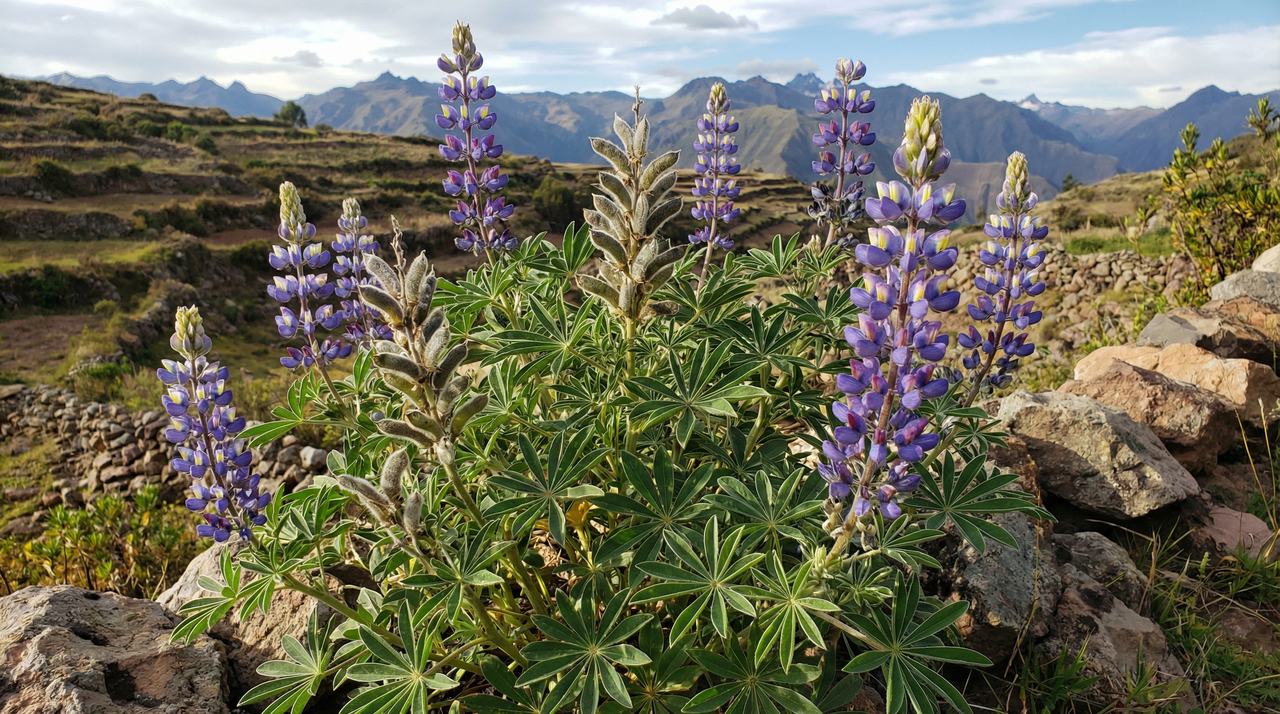
Most people grow lupine for the flowers and quietly ignore the seeds. I get it; those tall, candlestick spikes in violet and blue and cream are genuinely hard to look away from. But here's what stopped me cold the first time I really dug into this genus: the Inca were eating lupine seeds as a primary protein source at elevations above 10,000 feet, in soils so thin and cold that most legumes wouldn't bother, and they were doing it for thousands of years before anyone in Europe had figured out that this plant was even edible.[1] The species is Lupinus mutabilis, called tarwi or chocho in the Andes, and it's one of those plants that makes you feel like Western horticulture has been leaving real money on the table.
The catch, and there always is one, is that the raw seeds will make you sick. They're loaded with bitter alkaloids that require serious traditional processing before the seeds are safe to eat. That sounds alarming until you remember that we do this with olives, with acorns, with cassava. Andean communities perfected a soaking and rinsing method over generations that neutralizes the problem completely, and the result is a seed with a protein profile that rivals soybean.[2] For me, as someone who's always hunting for nitrogen-fixing plants that actually pull double duty in a food forest, tarwi raises a question I keep coming back to: how did a crop this useful end up nearly forgotten?
Origin and History of Lupine (Lupinus mutabilis)
If you've spent any time reading about the "lost crops of the Andes," you've probably encountered tarwi, also known as chocho or Andean lupine, under its scientific name Lupinus mutabilis. This is a plant with a genuinely ancient story, cultivated by pre-Inca and Inca peoples for somewhere around 4,000 years in the high mountain valleys of Peru, Ecuador, and Bolivia. Alongside potatoes, quinoa, and kiwicha, tarwi was a cornerstone of Andean food security, offering a remarkable protein source in soils and elevations where many crops simply refused to cooperate. Understanding that history is part of why I find this plant so compelling as a permaculture species today.
Andean Roots: Domestication and Traditional Cultivation
What made tarwi so valuable in traditional Andean agriculture wasn't just its nutrition. It was the whole package: a legume that fixed atmospheric nitrogen into degraded mountain soils while simultaneously producing a high-protein seed that could sustain communities through harsh winters. The seeds are naturally loaded with bitter quinolizidine alkaloids, and Indigenous farmers developed a multi-day soaking and rinsing process to remove them before eating. In my reading of traditional methods and experiments with similar alkaloid-rich seeds, that debittering step isn't just tradition; it's absolutely essential to make the nutrition accessible without bitterness or toxicity. That practical wisdom encoded in preparation methods is exactly the kind of thing that gets lost when a crop falls out of use.
And tarwi did fall out of use. The Spanish conquest in the sixteenth century brought a wave of Old World crops, and Andean staples like tarwi were steadily pushed aside in favor of more familiar European grains and legumes. For centuries, this protein-dense legume survived mainly in rural Andean communities, largely invisible to the wider agricultural world. My work with related Lupinus species has shown me firsthand how these plants pioneer disturbed or nutrient-poor sites with almost stubborn persistence, which makes their historical decline feel all the more like a missed opportunity.
Botanical Background and Visual Characteristics
Botanically, L. mutabilis belongs to a genus of roughly 200 species distributed across the Americas and the Mediterranean. The characteristic features most lupine growers will recognize are all present here: deeply palmate leaves that catch and hold moisture in dry climates, a strong taproot that digs into compacted soils, and tall flower spikes in blues, purples, pinks, and whites that are hard to miss at the back of a border. Like all lupines, it forms symbiotic relationships with Rhizobium bacteria that allow it to fix nitrogen, which is exactly why Andean farmers intercropped it to restore exhausted mountain soils long before anyone coined the term "regenerative agriculture." I've incorporated lupines into guild plantings for years with that same logic in mind, and the soil biology response is real.
The modern revival of tarwi is being driven by food security researchers and plant breeders interested in climate-resilient protein crops, and the regenerative farming community is paying closer attention. That ancient Andean knowledge of growing protein in poor soils at altitude is starting to look less like a historical footnote and more like a blueprint.
Lupine Varieties for Permaculture Gardens
Not all lupines are created equal, and that distinction matters enormously once you're trying to grow one for food. The genus Lupinus contains hundreds of species spread across the Americas, Europe, and Africa, but most gardeners encounter them as ornamentals first. For permaculture work, you need to know which types pull double or triple duty as food, fertility builders, and ecological contributors rather than just putting on a flower show.
Edible Andean Lupine Cultivars (Lupinus mutabilis)
Lupinus mutabilis is the undisputed standout for anyone serious about growing lupine as food. Its seeds are large, high in protein, and have fed Andean communities for millennia, but wild and landrace forms carry significant levels of bitter alkaloids that require traditional leaching to render them safe and palatable. That's a real barrier for most home growers, and it's where modern plant breeding has genuinely changed things. Low-alkaloid "sweet" cultivars now exist that dramatically reduce or eliminate the need for that multi-day debittering process. I always steer clients toward these sweet strains first. The difference between biting into a properly prepared sweet cultivar seed and one from an unselected wild population is not subtle.
Other grain species in the genus are worth knowing about. L. albus (white lupine), L. angustifolius (narrow-leafed lupine), and L. luteus (yellow lupine) are all grown as edible crops or green manures in different parts of the world, each with its own alkaloid profile and soil preferences. Then there are the ornamental types, primarily hybrids derived from L. polyphyllus, which include the beloved Russell lupines with their tall, jewel-toned flower spikes. Gorgeous plants, genuinely. But they're bred for bloom, not seed yield, and their alkaloid levels make them a poor choice for edible experimentation. In a food forest, L. mutabilis has a physicality and productive mass that the ornamental hybrids simply can't match.
Sourcing Lupine Seeds and Plants
Finding sweet L. mutabilis cultivars takes a bit more effort than grabbing a packet off a garden center rack. Your best options are specialty seed companies focused on Andean crops, permaculture-oriented seed suppliers, or international seed banks. When I help clients source unusual species like this one, I always recommend verifying alkaloid status with the supplier before you order, because "lupine seeds" on a label tells you almost nothing about which species or strain you're actually getting. Annual lupine seeds sold as cover crop blends are often a different species entirely. A small adaptation trial before planting out at scale is worth the patience, especially if you're bringing in varieties from a very different climate or elevation.
How to Propagate and Plant Lupine (Lupinus mutabilis)
Of all the lupines I've worked with over the years, Lupinus mutabilis has the most demanding germination personality. Where common garden lupines often reward you with quick, reliable sprouting from a simple pre-soak, this Andean species comes armored with a seed coat shaped by thousands of years of high-altitude adaptation. That coat is a survival mechanism, not a flaw, but it does mean you need to work with it rather than around it.
Seed Scarification and Germination Methods
Scarification is non-negotiable with tarwi. My preferred method is a combination approach: nick each seed gently with a small file or nail clipper, just enough to breach the coat without damaging the embryo, then follow with a 12-to-24-hour soak in lukewarm water. You'll know it's working when the seeds visibly swell. Skip the nicking and rely on hot water alone, and your results will be inconsistent at best.
In my early attempts, I lost whole batches to damping off by keeping the germination mix too wet. Now I use a barely moist, well-draining seed-starting mix and gentle bottom heat, targeting 59 to 68°F (15 to 20°C). At those temperatures, expect germination in 10 to 20 days. Fresh seed germinates considerably better than seed that's been sitting in a drawer for a year, so source from reputable suppliers and use it promptly. If you can get your hands on a lupine-specific rhizobia inoculant, dust the seeds before planting. I think of it like starting a new guild member off with the right microbial community; the nitrogen-fixing relationship has to be established from the beginning, and in soils without prior lupine history, the bacteria simply won't be there waiting.
For timing in cooler-winter climates, starting seeds indoors in late winter for spring transplanting gives the plants a chance to do most of their growing before summer heat shuts them down. In frost-free gardens, a fall sowing can work well too.
Soil, Site Selection, and Planting Techniques
Tarwi wants full sun, excellent drainage, and soil in the pH 6.0-to-7.0 range. Loamy or sandy soils suit it far better than heavy clay, which holds moisture around the crown and invites root rot. I've observed noticeably better nodulation and overall vigor in slightly phosphorus-rich soils, which tracks with what I've seen across other nitrogen-fixing legumes: the symbiosis works better when the plant isn't stressed by nutrient poverty from the start.
Space plants 30 to 45 centimeters apart to allow for bushy development and good airflow. If you're direct sowing after your last frost date, plant seeds about 2 centimeters deep. Waterlogging at any stage is the fastest way to lose these plants, so if your site holds water after rain, build up the bed or choose a different spot entirely. The care guidance for ongoing water management is its own conversation, but the decisions you make at planting, choosing a well-drained site, amending compacted soil, inoculating the seeds, set the foundation for everything that follows. Getting this part right makes the whole relationship with this plant much more satisfying.
Lupine Care Guide
Lupinus mutabilis earns its reputation as a tough, self-sufficient plant, but "tough" has limits. Growing up in the high Andes, it developed a deep taproot, thickened sclerophyllous leaves, and the nitrogen-fixing partnership with Rhizobium bacteria that together let it handle dry spells most crops can't tolerate. Under well-drained conditions, it can go two to four weeks without irrigation before stress becomes significant; push past that threshold and you'll see real yield losses and eventual plant death.[3][4][5] The care story, then, is really about finding the middle ground: enough moisture to keep the plant productive, never enough to drown those roots.
Watering Needs for Andean Lupine (Lupinus mutabilis)
I've grown several lupine species and the thing I learned fastest is to watch the lower leaves. Long before the plant wilts, the bottom of the canopy starts to curl and yellow at the edges when water is running short. That's your early warning.[6][7] Catch it there and recovery is easy. Wait for full wilt and you've already lost pod set. On the other end, overwatering leaves its own unmistakable calling card: dark, mushy roots with a foul odor, yellowing and wilting despite wet soil, and the telltale sluggish growth of a plant drowning in Fusarium or Phytophthora.[8][9] Raised beds and genuinely fast-draining soil aren't optional for this species; they're the whole foundation of a healthy plant.
For watering schedules, growth stage matters a lot. Seedlings need the top inch of soil kept consistently moist, which usually means watering every two to three days.[10] Once plants hit the vegetative stage, back off to about an inch of water per week and let the soil surface dry slightly between sessions. During flowering and pod fill, I switch to deeper irrigation every four to five days; the root system needs that moisture to convert into seed protein. Established mature plants are happy with a deep soak every seven to ten days depending on your local heat and drainage speed.[11][12] The practical rule I use, similar to how I manage beans and peas, is letting the top two to three inches go dry before watering again. It keeps you honest about not overwatering while still respecting the plant's needs at depth.[8]
In temperate climates, scale back irrigation in fall and keep watering minimal through winter unless soils are completely dry. This species is genuinely sensitive to winter wetness.[13] On water quality, the research is clear: aim for pH 6.0–7.5 and salinity below 4–6 dS/m.[14][15] I tell my clients to actually test their tap water rather than assume it's fine; chlorinated municipal water can push those thresholds in dry summer months.
One practice I now apply without fail is Rhizobium inoculation at seeding. The nitrogen-fixing partnership it enables doesn't just reduce fertility inputs; it measurably improves the plant's performance during dry spells, because a well-nourished root system holds up under stress far better than one working in nutrient-limited soil.[8][16] Related species like L. angustifolius and L. albus tell the same water story, needing 300–600 mm seasonally and always prioritizing drainage,[17][12] which tells me these baselines are solid genus-wide. That said, adjust them to your own soil feel and local rainfall. I do every season.
How to Harvest Lupine (Lupinus mutabilis)
All that careful attention to watering through flowering and pod set pays off the moment you start watching the pods change. In my experience with lupines, the shift from plump green to tan and papery happens faster than you'd expect, and here in Central Florida's humidity, you really can't afford to wait too long. Mold moves in quickly once pods start drying on a humid stem. I've learned to harvest when the pods have turned fully brown but before they begin to twist and split open, which is when you lose seeds to the ground whether you're ready or not.
The pods on Lupinus mutabilis are tidier to work with than the sprawling herbaceous ornamental lupines I've used in border plantings. The plant's upright habit makes it easy to snip entire seed stalks into a paper bag or dry them upside down in a warm, well-ventilated spot for a week or two before threshing. Threshing is simple: roll the dried pods between your palms or lay them on a tarp and give them a gentle beat. The seeds release cleanly.
One thing I want to be direct about: if you're growing the traditional bitter variety rather than a modern low-alkaloid cultivar, taste a tiny piece of the raw seed before deciding how to proceed. Bitter means high alkaloids, and those need to come out before the seeds are safe to eat in quantity. Testing is a responsible habit I've built into my practice whenever I'm working with any nitrogen-fixing legume that doubles as a food crop, and tarwi absolutely falls into that category. The seed pods themselves are not edible, but the seeds inside, properly prepared, are the whole point of this ancient crop.
Lupine (Lupinus mutabilis) Preparation and Uses
Traditional Preparation Methods for Andean Lupin Seeds
Here's the thing nobody warns you about when you first try preparing tarwi at home: the smell. During the multi-day soak, the water takes on a strong, slightly funky aroma, somewhere between raw beans and something you'd rather not describe at dinner. It dissipates completely once the seeds are properly processed, but that smell is actually a useful signal that the alkaloids are doing what they do best, which is leaving. The debittering process itself is non-negotiable. Seeds of Lupinus mutabilis contain toxic alkaloids, including lupanine, that must be removed through prolonged soaking with repeated water changes over several days before the seeds are safe to eat.[18][19] I've learned the hard way with related lupin species that skipping even one day of water changes leaves residual bitterness and potential digestive upset, so always err on the side of longer soaking, not shorter.
Culinary Applications and Nutritional Value
Once properly debittered and cooked, tarwi seeds behave a lot like chickpeas in texture and versatility. I reach for that comparison often when introducing this edible lupin plant to gardeners who've never tried it, because the familiarity makes it less intimidating. Traditionally across the Andes, the cooked seeds show up in stews, soups, and salads, or simply eaten as a snack; they can also be ground into flour for baked goods or used in fermented preparations.[18][20] What makes all that effort worthwhile is the nutritional payoff: seeds contain up to 40-50% protein on a dry basis, 15-20% oil with a solid omega-3 and omega-6 fatty acid profile, and meaningful dietary fiber.[21][22] That's genuinely competitive with soy, from a plant that simultaneously fixes nitrogen in your soil.
Medicinal and Non-Food Uses
Traditional Andean communities have long used decoctions of lupine leaves, stems, or unprocessed seeds for diabetes management, inflammation, and as a diuretic.[23][24] Scientific validation on these uses remains thin, so I'd treat them as ethnobotanical heritage worth respecting rather than protocols to adopt at home without professional guidance. Outside the kitchen entirely, the alkaloid-rich soak water from processing has traditional applications as a natural insecticide, and the plant itself functions as green manure, enriching soil with nitrogen after incorporation.[25][26] Pharmaceutical researchers have also flagged those same alkaloids for potential antimicrobial and antifungal applications.[27]
Safety Considerations for Lupine Consumption
The alkaloid content that makes unprocessed tarwi toxic is the same chemistry that makes it interesting to researchers and useful as a pest deterrent. But in the kitchen, there's no shortcut around thorough preparation. If you're growing this lupine and want to eat the seeds, commit to the full debittering process, taste as you go in the final rinse stages, and don't rush it. Pre-debittered seeds are available commercially if you want to experiment with the food before committing to home processing. What I find genuinely exciting from a regenerative gardening perspective is that you get a plant fixing nitrogen in your polyculture, contributing biological fertility that lifts subsequent crops, and offering a high-protein harvest when prepared correctly. That combination of soil service and edible yield is exactly the kind of stacking functions that makes a plant worth including in a food forest guild.
Lupine Health Benefits and Nutritional Profile
Let me be straight with you here: if you've come to this section expecting a tidy list of clinical health benefits for Lupinus mutabilis, I have to disappoint you a little. The honest truth is that the bulk of research on lupine nutrition and physiology has been done on European species, particularly Lupinus albus and Lupinus angustifolius. Those studies do show real promise: high protein content, prebiotic fiber fractions, and some early-stage evidence around blood sugar management and cholesterol reduction. But extrapolating those findings directly onto the Andean tarwi without species-specific clinical data is a leap I'm not comfortable making. Comprehensive reviews of lupine research make clear that L. mutabilis needs its own targeted human studies before anyone can confidently list specific therapeutic benefits. We're not there yet.
What I can say, with considerable confidence from years of working these plants into regenerative designs, is that lupine's most reliable health contribution is indirect. I've seen L. mutabilis transform depleted, compacted soils in a single growing season far more reliably than I've seen it transform human health metrics. The nitrogen it fixes, the structure its deep taproot opens in the soil, the pollinators it draws into the garden: those ecosystem services have downstream benefits for everything grown alongside it, including the food on your plate. That's not a consolation prize. That's a genuine return on investment that I think often gets undervalued when we're laser-focused on the seeds themselves.
Understanding Lupine Alkaloids and Safety Considerations
This is where I always slow down with clients who are excited about growing tarwi as an edible crop. Lupinus mutabilis in its raw, unprocessed state contains quinolizidine alkaloids at concentrations that make the seeds bitter at best and potentially toxic at worst. This isn't a minor caveat. Raw or under-processed lupine seeds can cause real discomfort, and in meaningful quantities, the alkaloids warrant serious concern, particularly for dogs and cats, both of whom are more sensitive to these compounds than humans. If you're growing lupines in a yard with pets, keep that in mind.
My standing advice to edible-landscape clients is to start with pre-debittered lupini beans from a reliable food source while they're learning the multi-day soaking and rinsing process. I learned this the unglamorous way: my first harvest from a home-grown batch was genuinely unpleasant and irritating enough that I went back and read more carefully about traditional Andean preparation. That debittering process is non-negotiable, and I'll cover the specifics in the preparation section. If you're considering lupine seeds for any therapeutic or nutritional purpose, please consult a healthcare provider first. The absence of solid clinical data on this species isn't just a research footnote; it's a meaningful reason for caution.
Pests and Diseases of Lupine (Lupinus mutabilis)
I'll be honest with you: targeted pest and disease research specific to Lupinus mutabilis is thin. What we know comes mostly from the broader lupine genus and from growers working with this Andean species in conditions far removed from its native highlands. That knowledge gap is real, but it doesn't leave you without a plan. As a landscape designer, my first line of defense against pest and disease pressure is always the design itself, not a spray bottle.
Aphids are the most predictable visitor. Much like what you'd see on peas or favas, they tend to colonize the tender new growth first. In my experience, they show up on the undersides of the uppermost leaves before you notice any visible damage, so that's exactly where I look during my early-morning walkthroughs. A strong blast of water handles minor infestations well, and a robust guild with flowering companions that attract predatory wasps and ladybirds keeps colonies from establishing in the first place. Those companion relationships I've already touched on in the permaculture design section do real work here.
Slugs love the same cool, moist conditions that young lupine seedlings prefer, so this is a pairing you'll want to plan around. I've found that certain groundcover companions in the guild reliably reduce slug pressure by disrupting the damp, sheltered microhabitats they need to thrive.
Fungal issues, particularly powdery mildew and damping off in seedlings, tend to show up when airflow is poor or humidity is relentless. In my Central Florida designs, I site lupines where they catch morning sun and a consistent breeze, which does more to prevent mildew than anything I could apply after the fact.
Root rot is the one I worry about most. I've seen too many otherwise healthy lupines lost to waterlogged roots, and elevating the planting bed just a few inches makes all the difference. When the soil stays well-drained and the guild is diverse, these plants are surprisingly resilient.
Lupine in Permaculture Design
Of all the nitrogen-fixers I've worked with over the years, lupines hold a special place in my designs because they pull double duty in a way that quieter legumes like clover simply can't. They fix nitrogen, yes, but they also produce dramatic vertical structure, attract pollinators in waves, and leave behind a root system that does visible, measurable work on soil structure. Lupinus mutabilis brings all of that, plus the added resilience of its Andean lineage, shaped by centuries of life in thin, cold, nutrient-poor mountain soils.
Ecosystem Functions of Lupinus mutabilis
The nitrogen fixation story with this species starts underground. Like other lupines, L. mutabilis develops a deep taproot that physically breaks up compacted layers and pulls nutrients from below the rooting zone of most annuals. I've watched heavy clay beds transform over two to three seasons when lupines were planted into them, not just softening but genuinely draining faster and warming up earlier in spring. The root channels they leave behind when they die back act almost like slow-built drainage tile, and neighboring plants tend to visibly perk up as a result.
For chop-and-drop biomass, I'd put L. mutabilis somewhere between comfrey and yarrow. It doesn't match comfrey's sheer bulk, but the leafy stems break down quickly and the nutrient return to the soil surface is meaningful, especially when you're cycling through a couple of plantings per season. If you're building fertility in a new food forest bed, cutting plants back before flowering and leaving them in place is one of the more underrated moves you can make.
Forest Layer Placement and Guild Companions
In food forest design, L. mutabilis belongs in the herbaceous layer, typically at the sunny edges where it can reach full height without being shaded out. I've used it successfully at the drip line of young fruit trees, where it feeds the root zone without competing for canopy space, and the pollinators it pulls in benefit the whole guild. Heavy feeders like brassicas or squash make natural neighbors since they're the ones most likely to cash in on that fixed nitrogen.
Comfrey and yarrow are my go-to companions for filling in around lupines. Comfrey handles the deep mineral accumulation while yarrow provides low groundcover and additional pest deterrence. The one placement mistake I'd caution against is situating L. mutabilis anywhere it will face significant shade from established shrubs or sprawling perennials. It'll stretch toward the light and topple, which wastes the plant's energy and makes harvest awkward. Give it full sun and let it do what it's built to do.
Suitable Climates and Hardiness Zones
Here's where I have to be honest about the limits of what's been formally studied versus what I've observed through experimentation. The specific climate data for Lupinus mutabilis outside its native Andean range is thin. What we do know from its background is that it evolved at altitude, where nights are cool, soils are lean, and moisture can be unpredictable. That heritage gives it more cold tolerance and drought resilience than most tropical legumes, but also means it tends to struggle when summer heat is relentless and humidity stays high through the night.
In practice, I'd treat it as a solid performer in temperate zones and worth trialing in protected microclimates through zone 9, particularly if you can time it as a cool-season annual in warmer regions. The detail I've found most critical in borderline climates is moisture consistency during the flowering window. When I've let it dry out too much right as buds are forming, drop happens fast and the yield drops with it. Zone maps give you a starting point, but this is a plant that rewards careful local observation over any rigid hardiness chart.
The Crop That Survived Colonization Just to End Up in My Backyard
There's something I keep coming back to with tarwi: it fed whole civilizations at 12,000 feet, got pushed aside for centuries, and somehow found its way into my Florida food forest where it's quietly fixing nitrogen between my fruit trees. I didn't plant it because it was trendy. I planted it because something that stubborn and useful deserves a second chance, and honestly, so does the soil it's healing.
Sources 27
- Tarwi (Lupinus mutabilis Sweet): A Lost Crop of the Andes – Purdue University New Crops ↩
- Lupinus mutabilis: Composition, uses, toxicology, and debittering – Food Chemistry ↩
- Drought Tolerance in Lupin Species ↩
- Drought tolerance mechanisms in Lupinus mutabilis: Physiological responses ↩
- Drought Tolerance in Lupinus Species ↩
- Lupinus mutabilis: Cultivation and Water Management ↩
- Tarwi (Lupinus mutabilis) Production Guide ↩
- Lupinus mutabilis: Cultivation and Management ↩
- Diseases of Lupins in the Andes ↩
- Cultivation of Lupinus mutabilis ↩
- Andean Lupin (Lupinus mutabilis) Production Guide ↩
- FAO Lupin Irrigation Practices ↩
- USDA PLANTS Database ↩
- Lupinus mutabilis Cultivation Guide ↩
- Water Quality for Irrigated Crops ↩
- USDA PLANTS Profile for Lupinus mutabilis ↩
- Narrow-Leafed Lupins for Crop and Forage ↩
- Lupinus mutabilis - Wikipedia ↩
- Andean lupin (Lupinus mutabilis Sweet): Processing effects on chemical, nutritional and functional properties of its flours and protein isolate ↩
- Lupins in Human Nutrition ↩
- Nutritional and chemical characterization of Lupinus mutabilis Sweet ↩
- Andean lupin (Lupinus mutabilis Sweet) as a sustainable protein source ↩
- Ethnopharmacological uses of Lupinus species ↩
- Medicinal properties of Andean Lupin ↩
- Lupinus mutabilis as Green Manure ↩
- Non-food uses of lupins ↩
- Alkaloids from Lupinus mutabilis and their bioactivity ↩