Here's something I didn't expect the first time I grew lychee: the fruit waits for you to stop hovering. I'd watched the clusters for weeks, checking color, pressing gently, second-guessing myself, and then a single warm rain came through and half a dozen fruits split open overnight because I'd waited three days too long. That's lychee. It gives you a window measured in days, sometimes hours, and it has no interest in accommodating a busy schedule. What surprises most people isn't how difficult the tree is to grow, though it does have opinions about that, it's how little margin the fruit itself offers between perfect and ruined. The Chinese have cultivated this tree for over 2,000 years[1] and still describe the window for eating fresh lychee in terms of days, not weeks.
That urgency is baked into the plant's whole biology, and once you understand it, you start to see why lychee inspires the kind of devotion that got it written into Tang Dynasty poetry and shipped in relay riders to imperial courts.[2] This isn't a fruit that tolerates indifference, from the grower or the eater. What follows is everything I've learned about growing it well, choosing the right cultivar, and not wasting a single one of those perfect translucent arils when the season finally arrives.
Lychee Origin, History, and Botany
Botanical Background and Native Range
Litchi chinensis is a perennial evergreen tree that has called the subtropical forests of southern China home for millennia, with its native range centered on Guangdong and Fujian provinces and extending into Guangxi, Hainan, and northern Vietnam.[3][4] It belongs to the soapberry family Sapindaceae and has been under cultivation for over 2,000 years.[5][6] In its native environment, lychee grows in humid subtropical climates with hot summers, mild dry winters, annual rainfall between 1,200 and 2,000 mm, and average temperatures of 20 to 25°C, often appearing at forest edges and disturbed areas as an early successional or pioneer species.[4][7] That pioneer-species character matters to me practically: it means lychee naturally colonizes disturbed edges, which translates well to the edge zones and canopy gaps that show up constantly in food forest design.
What I find equally remarkable is the tree's sheer longevity. Lychee is polycarpic, capable of living over 100 years in cultivation and reportedly up to 600 years in exceptional cases, with peak productivity typically falling between 20 and 40 years of age.[8][9] Planting one is genuinely a multi-generational decision. The most consequential practical question, though, is how you propagate it; deciding between seed and grafted stock shapes the entire timeline of the planting.[10][11] I've grown both, and once you've harvested a first basket from a grafted tree while a same-age seedling is still nowhere near flowering, you understand immediately why nearly every serious grower skips the seedling route for anything except rootstock production.
Visual Characteristics of the Lychee Tree
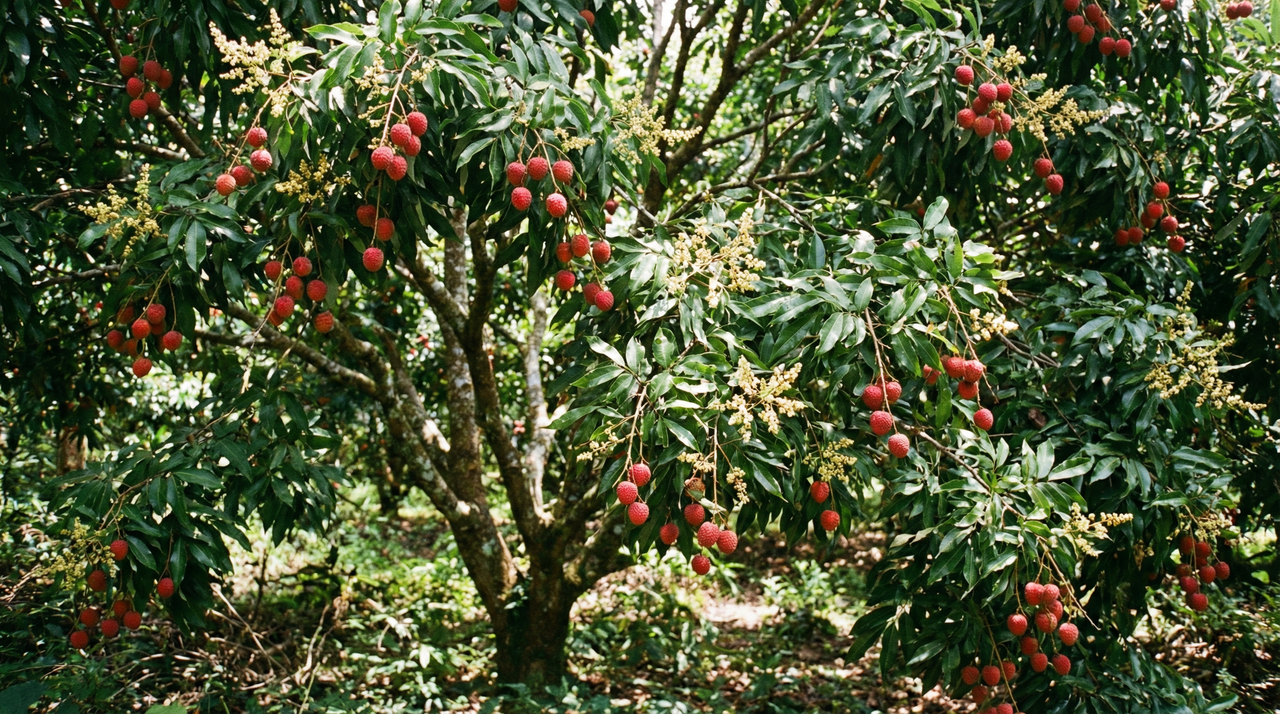
Mature lychee trees reach 10 to 20 meters tall, carrying a dense, rounded canopy spread of 8 to 12 meters, with bark that starts gray-brown and becomes rough, flaky, and almost tessellated with age.[11][12] The leaves are alternate and pinnate, with 4 to 10 pairs of leathery, glossy dark green leaflets that are lanceolate to elliptic, each 5 to 15 cm long, complete with thick cuticles and drip tips adapted to high-humidity conditions.[13][14] The foliage is genuinely beautiful in a landscape, with that deep glossy green holding year-round.
The flowers, by contrast, are easy to overlook: small, apetalous, greenish-white to yellowish-white, just 2 to 5 mm across, borne in terminal panicles 15 to 30 cm long in spring.[15][16] They are slightly fragrant, which is where their real contribution lies. The fruit is where the drama is: a globose to ovoid drupe, 3 to 5 cm in diameter, with a thin rough reddish pericarp that turns its iconic red color through anthocyanin accumulation, then reveals a translucent, juicy white aril surrounding a single large, hard, glossy brown seed.[6][17] The root system is primarily shallow and spreading rather than deeply taproot-anchored in maturity, which is why I always install a thick organic mulch layer around new plantings and why careful irrigation matters more than many gardeners initially expect.[18][19]
Traditional and Cultural Uses in China
The documented history of lychee reaches back to the Warring States period (475 to 221 BCE), with references appearing in ancient texts including the Shanhaijing, the Erya dictionary, and the Book of Songs.[20][21] By the Han Dynasty (206 BCE to 220 CE), systematic cultivation was underway and lychee had already been elevated to a tribute fruit reserved for emperors.
The Tang Dynasty is where the story becomes almost cinematic. Emperor Xuanzong ordered fresh lychees transported over 1,000 miles by relay horse to reach his consort Yang Guifei, an extravagance that poets including Du Mu and Li Bai immortalized in verse, and that later drew sharp critique from Su Shi in the Song Dynasty.[22][23] That imperial appetite drove lychee cultivation steadily northward through China, and the Ming herbalist Li Shizhen eventually documented its medicinal properties in the Bencao Gangmu. The name "lychee" itself derives from the Cantonese "lai chih."[12] In Chinese tradition, the fruit remains a symbol of romance and good fortune, woven into festivals and poetry for centuries.[20] I'll admit that knowing this history makes the moment my own trees set a heavy crop of red fruit feel quietly significant, in a way that a bag from the grocery store never quite does.
Interesting Facts About Lychee Ecology and Cultivation
Lychee flowers rely heavily on insect pollination, with bees (Apis cerana, Apis mellifera, and wild species) responsible for over 80% of effective pollination, and cross-pollination required for optimal fruit set due to self-incompatibility.[24][25] I plant companion nectar flowers around my lychees specifically for this reason: watching native bees and honeybees swarm those panicles in early spring is reassuring, because a season with poor bee activity is a season with a thin crop.
The fruit's development is unusually rapid. The edible aril reaches maximum size within just 30 to 50 days after pollination, before full pericarp enlargement is even complete, and the red pericarp color develops through anthocyanins triggered by ethylene as ripening follows a sigmoid curve.[26][27] That speed comes with a trade-off: fresh lychee has a post-harvest shelf life of only 2 to 4 weeks and is highly prone to pericarp browning and fungal decay.[28]
In its native habitat, seed dispersal depends on zoochory, with birds like bulbuls and hornbills, and mammals including bats, squirrels, and civets, all carrying fruit and spreading seeds.[29] Below ground, lychee forms beneficial mycorrhizal associations, particularly with Glomus species, that enhance phosphorus uptake and drought tolerance.[30] I always inoculate new plantings with mycorrhizal fungi at planting time, and the difference in establishment speed compared to un-inoculated trees has been consistently noticeable in my own gardens.
Globally, lychee production now exceeds 2.4 million tonnes annually, with China accounting for roughly 75% of that total.[31] In the US, it was introduced to Hawaii around 1797 and Florida around 1825, and today grows in southern Florida, Hawaii, parts of California, and Puerto Rico.[32][33] Reliable fruiting requires a chilling period of 300 to 600 hours at 45 to 55°F to trigger flowering, and mature trees can tolerate brief exposure to around 25°F, though flowers and young trees are far more vulnerable to cold damage.[34][35] A single cold night during bloom can wipe out an entire season's crop, something I learned the hard way before I started treating flower protection as non-negotiable.
Lychee Varieties and Cultivars
Notable Lychee Cultivars for Home Gardens and Commercial Growers
Before you fall in love with a specific cultivar, it helps to picture what all lychee trees share. Litchi chinensis grows as a substantial evergreen, typically 30-50 feet tall with a canopy spread of 20-40 feet, though most home growers keep them considerably shorter with regular pruning.[32][36] The fruit that draws everyone in is consistent across the species: rough red skin, translucent white pulp, sweet floral flavor with a texture that's both juicy and tender, and that unmistakable subtle rose-like scent.[2][32] What varies is everything else: yield, ripening time, size, cracking resistance, and how well a given tree handles your specific microclimate.
There are over 100 named cultivars worldwide, developed primarily for fruit quality, yield, and ripening season.[37][38] For practical purposes, they sort into early, mid, and late season, a framework that matters enormously if you want to extend your fresh-fruit window across several weeks rather than scrambling through a single glut.[37]
If you're growing in Florida or a comparable humid subtropical climate, 'Brewster' is the one you'll see everywhere, and for good reason. I've visited Florida orchards where Brewster trees were producing reliably year after year while fancier Chinese imports sat struggling after a mild cold snap. It produces large fruit up to 40 grams with an attractive red rind and juicy sweet-tart flesh, consistently yielding 50-100 kg per tree, and it handles the combination of summer humidity and occasional winter chill better than most.[8][32][37] The lesson I keep learning in this work is that matching cultivar to local humidity matters more than chasing the sweetest flavor profile on paper.
For early-season production, 'Feizixiao' (sometimes written Fay Zee Siu) is worth serious consideration. It's a high-yielding Chinese cultivar with medium to large fruit, capable of 100-150 kg per tree, good resistance to fruit cracking, and that sweet floral flavor that practically defines what fresh lychee should smell like.[39][37] The first time I smelled a ripe Feizixiao cluster at a Florida farm stand, I understood immediately why growers bother with the early-season management challenge.
Beyond those two, the lineup includes 'Mauritius' (early to mid-season, pinkish-red skin, high yield, performs well in humid areas), 'Kaimana' (late season, exceptional sweetness at 18-20° Brix, exceptional aroma, but demanding about drainage), 'Emperor' (large late-season fruit with good crack resistance), and 'Kwai Mi', which dominates Asian markets for its intensely floral small fruit.[32][40][41][37] Cold tolerance varies among them: Brewster, Mauritius, and Willow Leaf offer the most reliable intermediate hardiness, though all need protection once temperatures drop below about 30°F.[32]
Sourcing Lychee Trees, Seeds, and Fresh Fruit in the US
Most Americans meet lychee through imports, roughly 5,000-10,000 metric tons arriving annually, with domestic fresh fruit available from Florida, Hawaii, and California between May and August and canned or frozen forms year-round.[42][32][43] Those imports must clear USDA APHIS quarantine treatments for fruit flies and mites before entering the country, which is part of why the supply chain is tight and the fresh window is short.[44] Growing your own starts to make a lot of sense when you realize how quickly that imported fruit declines in quality after harvest.
For trees and seeds, nurseries like Everglades Farm, Logee's, and FastGrowingTrees.com carry lychee stock, with Sheffield's offering seeds as well.[45][46][47][48] Seeds typically run $5-20 per pack, young plants $20-60, and mature trees $50-300 or more depending on size and cultivar. I steer clients toward grafted trees from reputable sources rather than seedling-grown stock; the quality difference in early fruiting and true-to-type performance is real. Stock rotates, so search specifically for named varieties like Brewster or Feizixiao rather than accepting a generic "lychee tree" listing without cultivar information.
Lychee Propagation and Planting Guide
Most subtropical fruits will forgive a lot of propagation shortcuts. Lychee is not most fruits. Get the method wrong here and you're either waiting a decade for something that may not resemble what you planted, or watching a stressed young tree fail before it finds its footing. I've grown a lot of fruit trees from seed out of sheer curiosity, but with lychee I learned pretty quickly that patience has its limits.
Lychee Seed Characteristics and Germination
The seed itself is striking: a large, smooth, dark reddish-brown to nearly black ovoid, roughly 1 cm long, with a hard glossy coat and two thick cotyledons packed with nutrients.[49][50] It looks like it should be indestructible. It isn't. Lychee seeds are recalcitrant, meaning they cannot tolerate drying below about 20% moisture content and lose viability within 3 to 5 days at room temperature without careful moist storage.[51][52][32] If you're sowing fresh-eaten seeds on a whim, sow them the same day. If you need to hold them, pack them in damp sphagnum moss or vermiculite at 4 to 10°C and 85 to 100% relative humidity, where they can stay viable for 2 to 6 weeks at best.[51][53] Unlike the mango pit sitting on my counter for two weeks, a lychee seed left to dry is simply gone.
Fresh seeds sown at 25 to 30°C with over 80% humidity can germinate in 1 to 4 weeks, achieving 70 to 90% success; scarification or GA3 treatment may help if dormancy is an issue.[54][55] The catch is what you get: because lychee seeds are highly heterozygous (80 to 95% variable) and the species outcrosses readily, seedlings are genetically all over the place and won't reliably reproduce the parent's fruit quality.[32][56] Seed-grown trees also take 5 to 10 years, often closer to 7, before they'll fruit at all.[32][57] In practice, seedlings serve mainly as rootstock material rather than trees destined for the fruit bowl.
Vegetative Propagation Methods for Lychee
Air-layering, called marcotting in much of Asia, is the method I reach for first. Done in late spring or early summer when temperatures sit between 25 and 30°C and humidity stays above 80%, air-layers root reliably and produce true-to-type trees that can fruit within 2 to 3 years.[8][58] I've had air-layers taken in Florida's humid summer root in 6 to 8 weeks; the ones I attempted in cool, dry January took twice as long and had a much higher failure rate. The humidity really does matter. Grafting on 1 to 2 year old seedling rootstocks achieves 70 to 90% success using veneer, cleft, or approach techniques, and it scales well for anyone planting more than a handful of trees.[8][59] Hardwood cuttings with IBA are rarely worth the effort, rooting less than 20% of the time, and tissue culture remains too expensive and inconsistent for home growers.[8][60]
When choosing rootstocks, Litchi chinensis seedlings from cultivars like Brewster, Mauritius, or Hak Ip offer good vigor and adaptability.[8] If Phytophthora root rot is a concern in your soil, Kwai Mi selections have shown better resistance.[8] Some interspecific hybrids and Tai So rootstocks can reduce tree size by 20 to 30% for tighter planting, though longan rootstocks are generally incompatible with lychee scions.[61] One thing I wish I'd taken more seriously early on is the transplant shock warning: up to 50% first-year mortality is documented under some conditions, driven by root disturbance, erinose mite pressure, anthracnose, and frost sensitivity.[8][62] I've lost more than one newly planted tree to root disturbance; now I pot air-layers into progressively larger containers and harden them thoroughly before they go in the ground. Starting with certified, quarantine-compliant nursery stock is non-negotiable.
Soil, Site, and Sunlight Requirements for Planting Lychee
Lychee evolved on well-drained slopes in subtropical southern China, receiving 1200 to 2500 mm of annual rainfall that drains quickly through the soil rather than pooling around roots.[63][64] Replicating that drainage is the single biggest favor you can do for a young tree. Waterlogging triggers Phytophthora root rot fast, and by the time you see symptoms above ground the root system is already compromised.[8] Aim for sandy loam or well-structured loam with at least 60 cm of workable depth (ideally 100 to 150 cm), and if your site is flat or heavy, raise the planting bed 30 to 50 cm or install subsurface drainage tiles.[8][65]
Soil pH should land between 5.5 and 7.5, with the sweet spot in the slightly acidic range of 5.5 to 6.5 that mirrors the lateritic red earths of lychee's native range.[66][67] Organic matter between 2 and 5% helps with moisture retention and nutrient cycling without creating the waterlogging risks that come with heavy clay soils.[68] Full sun is non-negotiable: at least 6 to 8 hours of direct light daily, with partial shade producing leggy growth and reduced fruit set.[63][32] For container growing in marginal zones, use an acidic mix of coconut coir or peat, perlite, pine bark, and compost at pH 5.5 to 6.5, and plan on consistent irrigation and micronutrient supplementation.[32][69]
Lychee Spacing, Planting Technique, and Time to Fruiting
Left alone, a lychee tree will eventually reach 30 to 50 feet tall with a wide rounded canopy to match.[10] Most home growers and orchardists manage them to 10 to 20 feet through selective pruning, but the spacing you set at planting still needs to account for that underlying vigor.[32] University of Florida recommends 25 to 30 feet between trees in a row and 30 to 35 feet between rows for subtropical conditions, with vigorous cultivars like Mauritius and Brewster needing the wider end of that range and dwarfing rootstock selections allowing slightly tighter spacing.[10][32] I've seen crowded lychees in a neighbor's yard develop anthracnose every wet season while my own more widely spaced trees stay cleaner. Airflow through the canopy isn't a luxury; it's disease management.
Plant from container-grown air-layers or grafted stock rather than bare-root whenever possible, and disturb the root ball as little as you can during transplanting. Grafted trees and air-layers typically fruit in 3 to 5 years with commercial yields following by years 5 to 7, compared to the 5 to 10 year wait (with no guarantees on fruit quality) from a seed-grown tree.[32][38] That 3 to 5 year window is the real argument for vegetative propagation: it's not just about genetic fidelity, it's about actually harvesting fruit within a reasonable slice of your life.
Lychee Care Guide: Growing and Maintaining Litchi chinensis
Learning to care for lychee well means learning to read the tree. After several seasons growing it in central Florida, I've found that most problems trace back to one of three things: not enough sun, inconsistent moisture, or mistimed fertilizer that pushes leafy growth right when you need flowers. Get those three dialed in and most other issues sort themselves out.
Light and Sunlight Requirements
Lychee wants full sun, at minimum 6 to 8 hours of direct light daily, and it will tell you immediately when it isn't getting enough. Yellowing leaves, stunted growth, pale new flushes: these are the classic signs of a tree parked in too much shade.[8][32] On the other end, when summer temperatures push past 95°F with low humidity, that same direct sun can cause leaf scorch and necrotic spots.[37][70] For young trees in the hottest climates, a bit of afternoon shade during the first summer can prevent sunburn while the root system establishes. After that, full sun is the goal.
Water Needs and Irrigation
This species is remarkably thirsty, pulling from a shallow root system that primarily lives in the top three feet of soil.[8] Mature trees in subtropical climates typically need 40 to 60 gallons per week during dry stretches, and the annual total across the year runs 40 to 60 inches.[71][55] I water mature trees every seven to fourteen days in dry periods and bump that to weekly during flowering and fruit development.[8][72] Young trees need far more attention: seedlings every two to three days, and trees in their first few years once or twice a week.[73]
Drip irrigation is the right tool here. It targets the root zone directly, keeps foliage dry, and reduces fungal pressure.[73] Established trees can handle four to six weeks without water before showing real stress, but fruit drop accelerates well before that point.[74] Overwatering is just as damaging: yellowing leaves and wilting despite wet soil usually mean root rot is developing. Aim for moist but never waterlogged, and if your tap water is alkaline or salty, rainwater collection is genuinely worth the effort since lychee prefers water pH between 6.0 and 6.5 with low chloride.[8][75]
Feeding and Fertility Needs
Lychee is a moderate to heavy feeder, but the timing matters more than the volume. I learned early on that I was pushing too much nitrogen in late summer, which drove a flush of vegetative growth heading into fall and suppressed flowering entirely.[10] A balanced fertilizer in the 3:1:2 N-P-K ratio, something like 12-4-8 or the 8-3-9-3 formula common in Florida that also includes magnesium, works well for most soils.[8][76] Apply in split doses, two to three times per year for mature trees, timed after harvest for recovery and again before the flowering window.[10]
On sandy soils especially, micronutrients disappear fast. Iron, zinc, manganese, and boron deficiencies show up as interveinal chlorosis or poor fruit set, and they're easy to miss until the problem is well established.[77] That's exactly what happened in my first year, and now I always start with a soil test and follow with a leaf tissue test if something looks off. Keeping pH between 5.0 and 6.5 is non-negotiable for nutrient availability; anything higher locks out iron and manganese fast.[10][8]
Frost Tolerance and Cold Protection
Lychee is best suited to USDA zones 10a through 11.[8][11] Mature trees can tolerate a brief dip to about 28°F before serious damage begins, but young trees show injury closer to 30°F.[78] Flowers are the real vulnerability. One night below freezing during bloom blackens and collapses the flower clusters, and the season's crop is gone.[8] I keep frost cloth staged and ready from December through February, because in zone 9b that risk is real every winter.
High humidity reduces radiative cooling and offers some natural protection; wind does the opposite by accelerating heat loss.[79] For home growers, the most effective defense is site selection first: plant on the south side of a structure or windbreak where cold air drains away rather than pools. Pre-frost soil watering, root mulching, and frost blankets that can raise canopy temperature by 4 to 8 degrees cover most events.[8][80]
Heat Tolerance and Stress Management
Lychee thrives between 77°F and 95°F and handles sustained heat up to about 104°F, though anything beyond that starts to compromise fruit set and quality.[10][81] In practice it responds to heat stress much like mango: water demand spikes, flowering becomes erratic, and fruit development stalls if irrigation doesn't keep pace.[82] Thick organic mulch, drip irrigation, and choosing a site with good airflow handle the worst of it. For particularly exposed young trees, a 30 to 50 percent shade cloth through the hottest weeks buys time while roots deepen.[83] If cultivar choice is still on the table, 'Brewster' holds up to heat better than 'Mauritius' in my experience.[84]
Pruning, Maintenance, and Seasonal Rhythm
Prune right after harvest, in late summer or early fall, removing dead wood, crossing branches, and anything crowding the interior canopy.[10] The goal is light penetration and airflow, both of which support the following year's bloom. Lychee is an alternate bearer, meaning heavy production years naturally give way to lighter ones, and no amount of pruning changes that cycle entirely.[10] Setting realistic expectations around this habit saves a lot of frustration.
Flower induction is the hinge of the whole year. Lychee needs 6 to 8 weeks of cool, dry conditions with night temperatures between 59°F and 68°F and day length under 12 hours to initiate bloom.[85] I watch night temperatures carefully through December and January and hold back on irrigation slightly during that window to reinforce the dry-cool signal. When warm humid spring conditions follow, the tree responds. Skip that winter rest and flowering becomes unreliable, which is exactly why lychee simply won't perennialize as a fruiting tree in climates that stay warm and wet year-round without intervention.[8][86]
Harvesting Lychee: Timing, Technique, and Flavor at Peak Ripeness
When to Harvest Lychee: Color, Brix, and Maturity Cues
From the moment you see lychee flowers, you're roughly 90 to 120 days from harvest, with popular cultivars like Brewster and Mauritius typically landing in that 100 to 110 day range depending on your climate and the season's warmth.[37][87] That window lands squarely in summer, usually May through July, and it moves fast once it starts.[32]
The primary signal I watch is skin color. You're looking for that shift from green to 75 to 80 percent reddish-pink coverage as chlorophyll breaks down and anthocyanins develop.[37][71] Pair that with a gentle tug (ripe fruit starts to release slightly from the panicle) and a sniff. A sweet, floral aroma is one of the clearest confirmations you can get in the field.[88] If you have a refractometer, you're aiming for 16 to 20° Brix; I consider anything below 16° under-ripe for eating fresh, regardless of how red the skin looks.[37][89] Fruit size also stabilizes at maturity, typically settling around 20 to 30 grams per fruit, so a noticeably small cluster that isn't filling out is usually telling you something.[71][38]
After growing several cultivars, I've learned to start checking my lower branches first every June. Because of better light exposure and airflow, those clusters consistently hit that 75 percent red and sweet-aroma stage 10 to 14 days before the top of the tree.[37][89] That staggered ripening is actually a gift; it spreads your harvest window out and keeps you from losing everything to a single hot week. What you cannot do is wait. I've seen lychees split and develop off-flavors within two days of peak ripeness in a hot, wet summer, so I pick clusters as soon as most fruits on them show good color and refrigerate immediately.[89] Over-ripe lychee brings splitting, bitterness, and rapid quality drop; you really do not get a second chance.
How to Harvest and Prepare Fresh Lychee Fruit
Harvest whole clusters by cutting the panicle stem rather than pulling individual fruits, which protects next year's growth wood and keeps the skin intact longer. Once a cluster is off the tree, the clock on peak flavor starts immediately. Peel back the rough skin, pop out the seed, and eat the aril chilled.[20] That's the whole technique. The complexity is all in the timing, not the picking.
Lychee Flavor, Texture, and Cultivar Differences
The edible aril is that translucent, white, gelatinous flesh surrounding the seed, with a texture I'd describe as a grape that borrowed a little crunch from a water chestnut.[90][37] The flavor is sweet with floral overtones and a brightness from citric and malic acids that softens as the fruit ripens fully; at peak maturity, total sugars climb to 20 to 22 percent while acidity drops by roughly half, which is why that Brix window matters so much.[37][91]
Cultivar choice shapes the experience noticeably. Brewster leans toward rose and floral aromatics, driven by higher levels of benzaldehyde and linalool, while Mauritius (sold as Fei Chee in some markets) delivers a sweeter, fruitier profile with lower acidity.[92] The moment you peel a perfectly ripe one, that aroma hits you before you even take a bite. Overripe fruit loses that perfume fast and turns bland or faintly sour in a way that no amount of chilling can rescue, which is the best argument I know for picking on time.
Lychee Preparation, Culinary Uses, and Medicinal Applications
Safety First: Only the Ripe Aril Is Edible
Before anything else: only the white, fleshy lychee aril is safe to eat.[93][94] The seed contains hypoglycin A and related compounds that are genuinely toxic,[95][96] and unripe fruit carries even higher concentrations of those same toxins, enough to cause acute encephalopathy and dangerous hypoglycemia, particularly in children eating on an empty stomach.[97][98] As someone who grows fruiting trees, I treat this with the same caution I give cassava or ackee: I never let children forage freely from the tree, and I harvest only when the fruit has fully colored. The seed slides out cleanly once you've peeled and halved the aril, similar to the technique for preparing rambutan or longan, but do not crush it or let it linger where curious hands can find it.
Nutrition Profile of Fresh Lychee
That careful preparation pays off. A 100g serving of fresh lychee delivers 66 kcal, 14g of carbohydrates, and a very modest 0.4g each of fat, protein, and fiber[99] -- genuinely light eating. The ascorbic acid and mineral content add considerable value to every fresh serving.[99] You also get meaningful potassium (171 mg), copper, manganese, and folate in every serving.[99] In my Central Florida summers, fresh lychees left at room temperature in high humidity spoil within two or three days, so I've learned to prep them immediately for salads or freeze batches in syrup, treating perishability as a reason to be decisive rather than leisurely.
Traditional Chinese Medicine Uses of Fruit and Seed
TCM draws a clean line between fruit and seed. The fresh aril is considered sweet and warm in nature, used to tonify the spleen and stomach, nourish blood, and support qi circulation.[100] The seed, known as Li Zhi He, is prepared very differently: as a decoction or powder at 6-12g per day in decoction form or 3-9g as powder, traditionally used as an analgesic for hernia, testicular pain, and hypochondriac discomfort.[101] I always defer to licensed practitioners on medicinal dosing, but understanding this historical distinction between fruit as food and seed as medicine helps my clients decide which parts of a landscape tree are worth carefully saving after harvest, rather than discarding everything. Lychee leaves have occasionally been used in medicinal teas as well, though they aren't a standard food and carry potential toxicity risks if overconsumed.[102]
Processing Methods and Culinary Applications
Because lychee is so perishable fresh, centuries of Asian ingenuity developed ways to extend it: drying into what are called "lychee nuts," canning in syrup, fermenting into wines or spirits, and pickling in vinegar or brine.[103] Each method changes the flavor profile noticeably. Drying preserves some aromatic compounds but replaces the fresh floral notes with caramel undertones; canning triggers glycoside hydrolysis and Maillard reactions that push it squarely into cooked-fruit territory.[104][105] Canned lychee is what most people outside Asia encounter first, and it's fine, though a world away from eating a fresh one still slightly warm from the tree. Across Asian cuisines, the fruit appears in desserts, bubble tea with lychee jelly, lychee martini cocktail recipes, and savory Cantonese dishes where its sweetness balances pork or shrimp in a sweet-sour sauce.[106][107] There are genuinely good lychee recipes across that whole spectrum, from simple fruit salads to fermented drinks, so don't let "shelf-stable" mean "lesser."
Non-Food Uses of the Lychee Tree
The fruit is what draws most growers, but the tree itself has a long material legacy. The bark yields tannins used in leather tanning, cordage, and textiles; the roots and bark produce red and brown dyes; and the dense, heavy wood has been used for furniture, tools, construction, carving, and fuel.[108] I primarily grow lychee for the arils, but knowing how durable the timber is explains why old orchard trees are often salvaged for craftwork rather than chipped. In a permaculture context, that's a meaningful closing-the-loop quality: a tree that produces food for decades and, when its productive life ends, still offers material value rather than a stump-grinding bill.
Lychee Health Benefits and Medicinal Uses
Lychee has a long medicinal reputation that predates any laboratory by centuries. I find that context genuinely useful, not just as historical color but as a starting point for understanding how people have interacted with this plant and what modern research is now trying to verify or explain.
Traditional Medicinal Uses in TCM and Ayurveda
In Traditional Chinese Medicine, the fresh fruit pulp was valued for cooling the body, relieving summer thirst, and supporting digestion, thought to nourish yin and blood.[109][110] Different parts of the tree served different purposes: seeds were decocted for abdominal pain and hernias, leaves applied topically for eczema and insect bites, and bark used as an astringent for diarrhea and dysentery.[109][111] Ayurvedic tradition classified lychee as cooling in nature (sheeta virya), using it to treat bilious fevers and digestive disorders and as a tonic for the heart and brain.[109]
What I respect about these traditions is their specificity. They weren't prescribing "lychee" in a vague wellness sense; they were distinguishing between plant parts, preparation methods, and target conditions. That kind of granularity tends to hold up at least partially when researchers start looking closely.
Key Phytochemicals and Their Distribution
The chemistry behind lychee's traditional reputation is genuinely interesting. The plant produces a wide range of secondary metabolites: flavonoids including quercetin, rutin, kaempferol, and epicatechin; phenolic acids like gallic and ellagic acid; proanthocyanidins; saponins; triterpenoids such as oleanolic acid and lupeol; and some quite unique structures like litchiosides (triterpenoid saponins) and the cyclic diarylheptanoid litchketone.[112][113] These aren't evenly distributed: the aril and pericarp concentrate flavonoids and proanthocyanidins, while the seeds are especially rich in saponins, tannins, and ellagic acid, and the leaves carry glycosides, coumarins, and triterpenes.[114][115]
Here's something I've noticed in my own subtropical garden that the research actually supports: phenolic content shifts substantially with growing conditions. Cultivar matters (some, like 'Feizixiao,' run higher than 'Nuomici'), but so do soil pH, geography, and even moderate water stress, which can push flavonoid levels 20-30% higher.[116][117][118] Full-sun, well-drained conditions with thoughtful irrigation timing seem to produce noticeably richer fruit in my experience, and the science on phenolic accumulation gives a plausible reason why. The plant produces these compounds partly as ecological armor: defense against pests and pathogens, UV protection, and pollinator attraction through volatile compounds like linalool and geraniol in the flowers.[119][120]
Potential Health Benefits and Pharmacological Activities
Lychee extracts show strong antioxidant activity, with polyphenols, flavonoids, and proanthocyanidins accounting for over 80% of total antioxidant capacity in some assays, and anti-inflammatory effects via NF-κB pathway inhibition and reduced cytokines including TNF-α and IL-6.[121][122][123] Preclinical studies have also documented antimicrobial effects against Staphylococcus aureus, analgesic activity, antidiabetic potential through α-glucosidase inhibition, anticancer effects via apoptosis induction in cell lines like HepG2, and neuroprotective activity reducing amyloid-beta toxicity.[124][125][126][127]
These findings are exciting, and I track this literature closely due to the plant's rich phytochemical profile. But lychee's human clinical evidence is thin. One small randomized controlled trial showed reduced oxidative stress markers after lychee juice consumption, and Oligonol, a patented low-molecular-weight lychee polyphenol extract, has been studied for reducing visceral fat and improving circulation.[128][129] Nearly everything else, including the nervine and adaptogenic claims sometimes attributed to lychee, rests on traditional use or in vitro and animal work rather than robust human trials. The plant deserves more clinical attention than it has received.
Nutrition Profile of the Edible Aril
The part you eat, that translucent white flesh surrounding the seed, is a nutritionally solid fruit despite its reputation as a sweet indulgence. A 100 g serving of raw lychee, roughly 10-11 fruits, provides 66 kcal, about 16.5 g carbohydrates (mostly glucose and fructose), 1.3 g fiber, and is more than 80% water.[130] The calorie count in lychee is modest, which surprises people given how sweet it tastes. What stands out most is the vitamin C: 71.5 mg per 100 g, exceeding the daily value in a single generous serving and comfortably outpacing an orange of similar weight.[130] You also get meaningful potassium (202 mg), copper (14% DV), B6, riboflavin, niacin, and folate alongside it.[130]
The polyphenol content adds another layer of value: 100-200 mg GAE/100 g total phenolics, including 20-30 mg of epicatechin, rutin, quercetin glycosides, and proanthocyanidins that contribute substantially to antioxidant capacity.[129][131] Harvest timing matters here: fully ripe fruit provides higher antioxidant capacity than unripe, and canning can strip 20-50% of the vitamin C.[132][133] Fresh and ripe is where the nutritional value actually lives. I always separate out the seed and discard the papery peel before passing lychee to anyone, which brings me directly to why that habit matters.
Safety Considerations, Toxicity Risks, and Allergies
The seeds and unripe lychee contain hypoglycin A and methylenecyclopropylglycine (MCPG), compounds that inhibit fatty acid oxidation and gluconeogenesis, leading to acute hypoglycemia and encephalopathy.[134][135] The Muzaffarpur outbreaks in India in 2013-2014 traced acute toxic encephalopathy syndrome in children directly to consumption of unripe lychee, particularly on an empty stomach and in malnourished children who already had depleted glycogen reserves.[136][137] Having read through that research, my practical advice to parents in warm climates is straightforward: be especially vigilant during lychee season, never let children snack on unripe fruit, and always make sure kids have eaten a proper meal first.
Ripe aril contains only minimal hypoglycin A and is safe for most healthy people in normal quantities.[138] The seeds also carry saponins that can cause gastrointestinal distress if ingested, so peel and seeds go in the compost, every time, not on the plate.[139] Allergy risk is real, particularly for people with birch pollen sensitivity, latex-fruit syndrome, or cross-reactivity within the Sapindaceae family; reactions can range from oral allergy syndrome to anaphylaxis, and cross-reactivity with mango has been documented.[140][141] People managing diabetes or taking blood glucose-lowering medications should moderate their intake given lychee's high natural sugar load and the hypoglycemic potential of its bioactive compounds.[142][143] For pets, ripe aril is low-risk for dogs in small amounts, but seeds are a choking hazard and unripe fruit is toxic to them for the same hypoglycin reasons that concern us.[144]
Lychee Pests and Diseases
No lychee cultivar is immune to the full range of pathogens and insects it will encounter over a long life in a humid subtropical garden.[8][145] The cultivar you choose influences your odds, but it doesn't change the fundamental reality: growing lychee means managing pests and diseases as a continuous practice, not a one-time fix. I've found that the growers who do this well aren't necessarily spraying more; they're watching more closely and acting earlier.
Major Diseases of Lychee
Anthracnose, caused by Colletotrichum gloeosporioides, is the disease that keeps lychee growers honest. In humid conditions with monthly rainfall above 100 mm and humidity sustained above 85%, incidence can exceed 90%, destroying flowers, rotting fruit, and collapsing an entire season's potential before you've picked a single cluster.[146][147][148] I learned the hard way that waiting to see symptoms is already too late. After a few consecutive days at those humidity levels, I start copper-based fungicide applications proactively, rotating to mancozeb or strobilurins timed around flowering and early fruit set.[63][149] The timing matters as much as the product.
Bacterial blight (Xanthomonas campestris pv. litchii) produces the leaf scorch, gummosis, and cankers that many growers misread as drought stress, while powdery mildew (Oidium litchi) shows up as leaf necrosis and triggers fruit drop under the same muggy conditions.[146][150] Phytophthora root rot is the one I worry about most in heavy soils: it hits trees planted in poorly drained or waterlogged sites and causes root and trunk decay that's hard to reverse.[8][151] Botryosphaeria dieback, Aspergillus fruit rots, and viral pathogens including lychee ringspot virus and chlorotic leafspot virus round out the disease list, though the viral issues are less well documented and resistance data remains thin.[152]
Cultivar selection does shift the odds. 'Sevenhill,' 'Valerie,' and 'Winter Melon' show better anthracnose resistance; 'Mauritius' handles Phytophthora pressure comparatively well; 'Pak Sha' and 'Brewster' offer moderate resistance to several common diseases.[153][154] Treat that data as a starting point, not a guarantee; I've seen 'Brewster' trees in poorly ventilated sites get hit as hard as anything else. The cultural framework matters more than any single variety choice: trees spaced 10 to 12 meters apart, pruned after harvest to open the canopy, irrigated by drip rather than overhead spray, and kept clear of infected debris start each season with a meaningful structural advantage against fungal pressure.[37][155]
Key Insect Pests and Their Management
Many of the same practices that suppress anthracnose also reduce pest pressure, which is one reason I frame disease management and pest management as one integrated system rather than two separate programs. The lychee erinose mite (Aceria litchii) is among the first things to check in early spring: it produces those distinctive felt-like galls on new flushes and shoots that are easy to spot if you're in the habit of looking.[151] I prune out affected growth immediately on sight; letting it spread through an entire new flush is a problem that compounds fast, especially in warm, wet weather when mite populations accelerate.[156]
Fruit borers, particularly Cryptophlebia leucotreta and Conopomorpha sinensis, represent the most serious economic threat in the pest category, with documented losses reaching 80% where populations go unmanaged.[151][157] Consistent sanitation is what keeps those numbers from becoming reality in the home orchard; I remove and destroy any fruit showing signs of larval entry rather than leaving it on the tree or the ground. Scale insects, aphids, leafhoppers, and psyllids round out the sucking pest complex, weakening trees and promoting sooty mold that further reduces photosynthesis and overall vigor.[158]
Lychee does produce phenolic compounds, flavonoids including rutin and quercetin, and terpenoids that deter some lepidopteran pests, and the thick cuticle adds a physical layer of resistance.[159][160] Those defenses help, but they're never enough on their own after a prolonged humid stretch. 'Kwai Mi,' 'Tai So,' and 'No Mai Tsui' show higher resistance to erinose mite and several other pests, making them worth considering where mite pressure is historically heavy.[161]
For my own setups, I prioritize predatory mites and parasitic wasps as the first line of response because a functional biological balance reduces the need for even low-impact sprays over the long term.[162][163] Pheromone traps for early borer detection, regular scouting during and after monsoon periods, horticultural oils or neem for sucking pests, and spinosad baits when borer thresholds are exceeded form the practical toolkit.[164][165] The calendar-based spray program is a last resort, not a starting point.
Lychee in Permaculture Design
Most people encounter lychee as a fruit bowl curiosity, that strange pink orb at the Asian grocery. But spend time with the tree itself and you start seeing something much more interesting: a subtropical canopy species shaped by millions of years of monsoon-forest ecology, carrying a whole suite of ecosystem services that translate almost directly into permaculture design value.
Native Ecology and Ecosystem Functions
Lychee is native to subtropical mixed forest across southern China and neighboring parts of Southeast Asia, including Vietnam, Thailand, and the Philippines, where it grows at elevations from roughly 100 to 1000 meters in monsoon-influenced evergreen and semi-deciduous canopy.[166][167] In that native context, the tree is doing real ecological work. Its extensive native root system effectively accesses potassium, phosphorus, calcium, and trace minerals,[168] making it a genuine dynamic accumulator in the chop-and-drop sense. The leaf litter decomposes quickly in humid subtropical conditions, adding an estimated 2 to 4 percent organic matter annually and cycling nitrogen and phosphorus back into the root zone.[169] That same litter, once it builds up as a mulch layer, can reduce soil moisture evaporation by 30 to 40 percent, which matters a lot during dry spells.
Frugivorous birds, squirrels, and civets consume the aril and move viable seeds away from the parent tree, supporting natural regeneration and wildlife connectivity. The tree also provides year-round habitat and seasonal food during the hungry gap when other species aren't producing. Mature canopies reduce wind speed by up to 50 percent at orchard edges, offering real protection for understory plantings on exposed sites, while extensive root systems stabilize slopes and reduce runoff.[168] In mixed agroforestry systems, lychee orchards sequester a reported 5 to 10 tons of CO2 per hectare annually, with mixed polyculture arrangements pushing that figure 20 to 30 percent higher.[170] I'd hedge those numbers a little since real-world variation is considerable, but the direction is clear: more layers around a lychee tree means more carbon stored.
There's also the pest-deterrence angle. Aromatic compounds in the leaves and bark appear to deter certain insects, including aphids,[168] which I've noticed anecdotally when designing guilds around established trees. It doesn't make lychee immune to pest pressure by any means, but it's one less thing to manage in a diverse planting. And from a purely aesthetic standpoint, the dense glossy canopy, fragrant cream-colored spring flowers, and those vivid red fruit clusters in summer create one of the most visually rewarding upper-layer trees I've worked with.[171][172] The bright fruit draws in birds that also contribute to on-site seed dispersal and biodiversity, which closes the loop nicely.
Climate and Growing Zones for Lychee
Frost is the primary limiter, full stop. Lychee sits comfortably in USDA zones 10 and 11, tolerates brief dips to around 30°F (-1°C), and prefers a growing range of 68 to 95°F (20 to 35°C) with an upper ceiling near 104°F (40°C).[74][8][78] Zone 9b is possible, but it requires real microclimate thinking. I've helped clients in cooler inland pockets keep young trees alive through winter using south-facing walls, thermal mass, and frost cloth, though mature trees handle brief cold snaps considerably better than juveniles.[6][63] Don't let the occasional success story convince you zone 9b is easy; it isn't.
Beyond temperature, humidity is non-negotiable. Lychee wants 70 to 90 percent relative humidity for optimal growth, and consistent humidity above 60 percent as a baseline.[173][174] Coastal sites naturally provide this and buffer against cold extremes, which is exactly why south Florida, coastal Hawaii, and sheltered parts of coastal California produce reliable crops.[10][175] Rainfall should ideally fall between 60 and 80 inches annually, though the tree can survive on 40 inches with irrigation; above 100 inches requires impeccably drained soil to prevent root rot.[176]
Here's the detail that surprises most new lychee growers: the tree actually needs a cool, dry period of 2 to 3 months to trigger reliable flowering.[177][8] I've seen this play out clearly in gardens where winter rains stayed consistently heavy; the panicle development was noticeably weaker compared to years with a distinct dry spell. It's counterintuitive for a tree that loves humidity, but that seasonal drought stress is part of what sets the bloom. This shapes site selection and irrigation design: you want a system where you can withhold water in winter without stressing the tree to the point of defoliation.
Pollination Strategies in the Food Forest
Lychee flowers are small, cream-colored, borne in large panicles, and emit a mild sweet fragrance that draws pollinators during morning hours between roughly 6 and 10 AM.[178][37] The flowers are protogynous, meaning the female phase precedes the male, which promotes outcrossing but also means the timing window for effective pollination is narrow. Honeybees, both Apis cerana and Apis mellifera, are the primary and most effective pollinators, with flies, ants, and thrips playing supporting roles.[15][179]
The piece that catches most home growers off guard is self-incompatibility. Many cultivars won't set fruit reliably from their own pollen; 'Brewster' and 'Mauritius' are a classic cross-compatible pairing.[180][181] Without compatible cultivars or supplemental bee hives, natural fruit set often falls below 5 percent, sometimes much lower. I learned this the frustrating way before I understood the mechanics. With active bee pollination, set can climb to 10 to 20 percent or higher, and managed hive placement (2 to 4 hives per hectare) has been shown to boost yields by 20 to 50 percent.[182][37] Optimal pollinator activity happens between 68 and 86°F (20 to 30°C) with high humidity; rain, wind, or cold snaps during the short 24 to 48 hour pollen viability window can devastate fruit set for the entire season.[37][183] The practical upshot for food forest design: plant at least two compatible cultivars, integrate pollinator-attracting companion plants that bloom alongside or just before lychee's spring flowering, and consider proximity to a beehive as seriously as you would water access.
Forest Layer Placement and Guild Design
At 10 to 20 meters in its natural form, lychee belongs in the upper canopy or emergent layer of a food forest,[36][184] though it can be pruned down and maintained at a more manageable 10 to 15 feet in smaller gardens without sacrificing fruiting entirely.[93] What makes it particularly useful in multi-tiered designs is root architecture: the deep taproot system goes well below the zone occupied by most understory species, which means genuine vertical niche separation rather than the constant root competition you get with some shallower canopy trees.[185]
For guild design, nitrogen-fixing legumes are the obvious first layer to add underneath. I routinely establish pigeon pea or beans around young lychees during establishment, and the difference in foliage color and growth rate compared to unfertilized trees is consistently visible. Research backs this up: intercropping with legumes like pigeon pea, mung bean, or peanuts can reduce fertilizer needs by 30 to 50 percent.[185][186] In the lower understory, shade-tolerant species like ginger, turmeric, and cowpeas work well beneath the dappled canopy.[185] One pairing to avoid: walnuts and eucalyptus both produce allelopathic compounds that can suppress lychee growth, so keep those well away from your guild.[168]
The root system heavily depends on underground fungal partnerships,[187] so avoiding synthetic fungicides near the root zone protects a partnership the tree genuinely depends on. A well-assembled lychee guild, correctly sited for humidity and drainage, with compatible cultivars, active pollinators, and a diverse understory of fixers and accumulators, is one of the most productive canopy arrangements available to subtropical food forest designers. Getting the climate match right is the hard part. Everything else follows from there.
The Summer I Finally Stopped Rushing My Lychee
I once picked a cluster three days too early because I couldn't wait, and the difference in flavor was humbling enough that I've never done it again. That's lychee for you; it teaches patience the only way that actually works, by making impatience cost you something. There's a tree in my food forest I've been tending for six years now, and every summer when that first cluster turns deep rose and the fragrance hits before I even reach the branch, I think, yes, this one was worth every slow year.
Sources 187
- Lychee - Purdue University NewCrop Resource Online ↩
- Lychee | Description, Fruit, & Facts | Britannica ↩
- Litchi chinensis - Kew Science ↩
- Lychee (Litchi chinensis Sonn.) | CABI Compendium ↩
- Flora of China: Litchi chinensis ↩
- Litchi chinensis - Missouri Botanical Garden Plant Finder ↩
- The Lychee: Botany, Production and Uses ↩
- Lychee Production in Florida ↩
- Litchi chinensis - Lychee ↩
- Lychee Production in Florida ↩
- Litchi chinensis ↩
- Lychee ↩
- Litchi chinensis - Missouri Botanical Garden ↩
- Flora of China ↩
- Litchi chinensis - Missouri Botanical Garden ↩
- The Lychee: Botany, Production and Uses ↩
- Litchi chinensis - Flora of China ↩
- The Lychee: Botany, Production and Uses ↩
- Root System Architecture of Lychee (Litchi chinensis Sonn.) in Response to Soil Moisture ↩
- Litchi chinensis - Flora of China ↩
- The Lychee in China: Cultigen and Cultivation ↩
- Food in Chinese Culture: Anthropological and Historical Perspectives ↩
- Classical Chinese Poetry: An Anthology ↩
- Pollination Requirements of Litchi chinensis ↩
- Bee Pollination in Litchi chinensis ↩
- Anthocyanin Biosynthesis in Lychee Fruit ↩
- Ripening Physiology of Litchi chinensis Fruits ↩
- Phenology and Growth of Lychee (Litchi chinensis Sonn.) ↩
- Seed Dispersal and Pollination Biology of Litchi chinensis ↩
- Mycorrhizal Associations in Lychee ↩
- FAOSTAT Production Quantity (Crops/List) - China ↩
- Lychee Production in Florida ↩
- Litchi chinensis Sonn. - USDA PLANTS Database ↩
- Lychee Production in Florida ↩
- Flowering in Litchi chinensis: Environmental Factors ↩
- Litchi chinensis - Plant Finder ↩
- Lychee Cultivars - University of Florida IFAS Extension ↩
- Commercial Litchi Production - FAO ↩
- Chinese Lychee Varieties: Feizixiao Characteristics ↩
- Lychee Production in California ↩
- Lychee Varieties - Fairchild Tropical Botanic Garden ↩
- Lychee Production and Imports in the United States ↩
- Exotic Fruit Market Trends in North America ↩
- Importation of Litchi from Certain Countries ↩
- Lychee Trees for Sale ↩
- Buy Lychee Seeds Online ↩
- Lychee Plant - Litchi chinensis ↩
- Lychee Trees | FastGrowingTrees.com ↩
- Missouri Botanical Garden: Litchi chinensis ↩
- Seed Development in Litchi chinensis Sonn. ↩
- Seed Storage of Horticultural Crops ↩
- Storage Behavior of Litchi chinensis Seeds ↩
- Recalcitrant Seeds: Biology and Storage ↩
- Seed Propagation and Germination in Litchi chinensis ↩
- Horticultural Practices for Lychee Seed Germination and Nursery Management ↩
- Genetic Diversity and Heterozygosity in Lychee Seedlings ↩
- Propagation of Litchi chinensis ↩
- Litchi Production Guide ↩
- Propagation of Lychee ↩
- Tropical Fruit Propagation ↩
- Rootstock Evaluation for Litchi chinensis in Subtropical Regions ↩
- Challenges in Lychee Cultivation in California ↩
- Lychee Growing in the Florida Home Landscape ↩
- Litchi chinensis: Botany and Cultivation ↩
- Growing Lychees: Soil and Site Preparation ↩
- Lychee Production in Florida ↩
- Soil and Climatic Requirements for Lychee Production ↩
- Soil Management for Lychee Orchards ↩
- Lychee Growing Guide ↩
- Growing Lychees in California ↩
- Lychee: Botany, Horticulture, and Utilization ↩
- Lychee Production in California ↩
- Irrigation Management for Lychee Orchards ↩
- Litchi chinensis Plant Profile ↩
- Water Quality for Agriculture ↩
- Nutrient Requirements of Lychee Trees ↩
- University of Florida IFAS Extension ↩
- Cold Tolerance of Lychee Trees ↩
- Environmental Factors Affecting Lychee Hardiness ↩
- Frost Protection for Citrus and Other Subtropical Crops ↩
- Litchi chinensis: Botany, Horticulture, and Uses ↩
- Lychee Production in Florida ↩
- Mitigation of Heat Stress in Litchi chinensis ↩
- Heat Stress Impacts on Flowering and Fruit Set in Lychee ↩
- Photoperiod and Temperature Effects on Flowering in Litchi chinensis ↩
- Litchi chinensis Sonn.: Botany ↩
- Fruit Development and Maturation in Litchi (Litchi chinensis Sonn.) ↩
- Postharvest Handling of Lychees ↩
- Lychee Harvesting Guidelines ↩
- Litchi chinensis Fruit Description ↩
- Sugar and Acid Content in Ripening Litchi chinensis ↩
- Comparative Flavor Analysis of Lychee Cultivars Brewster and Fei Chee ↩
- Lychee - Wikipedia ↩
- Lychee (Litchi chinensis) - Fruit and Nut Resources ↩
- Toxicity of Lychee Seed - NCBI ↩
- Toxicity of Lychee Seeds ↩
- Litchi-Associated Acute Encephalopathy Outbreaks ↩
- Hypoglycin A Toxicity from Litchi Fruit ↩
- USDA FoodData Central ↩
- Lychee in Traditional Chinese Medicine - Review ↩
- Bencao Gangmu (Compendium of Materia Medica) - Lychee Entries ↩
- Traditional Uses of Lychee Leaves - Herbal Medicine Resources ↩
- Lychee Production and Processing ↩
- Volatile Compounds in Processed Lychee Fruit ↩
- Sensory Evaluation of Postharvest Lychee Processing ↩
- Ethnobotany of Litchi chinensis ↩
- Ethnobotany of Litchi chinensis in Asia ↩
- Traditional Uses of Lychee in Medicine ↩
- Litchi chinensis Sonn.: Phytochemistry, Ethnomedicine, Pharmacology, and Nutrition ↩
- Litchi chinensis: Botanical, Phytochemical, and Ethnopharmacological Profile ↩
- Medicinal Uses of Litchi chinensis Sonn.: A Review ↩
- Phytochemical and Pharmacological Attributes of Litchi chinensis ↩
- Bioactive Compounds and Bioactivities of Lychee (Litchi chinensis Sonn.): A Review ↩
- Phytochemical Composition and Antioxidant Activity of Litchi chinensis Sonn. Fruits ↩
- Secondary Metabolites from Litchi chinensis Seeds: Isolation and Biological Activities ↩
- Seasonal Variation of Phenolic Compounds in Litchi chinensis ↩
- Cultivar Differences in Phenolic Content of Lychee Fruits ↩
- Effect of Water Stress on Lychee Phenolics and Secondary Metabolites ↩
- Secondary Metabolites of Litchi chinensis Mill.: Their Antioxidant and Antimicrobial Activities ↩
- Volatile Compounds in Lychee Flowers and Their Role in Pollination ↩
- Pharmacological Activities of Litchi chinensis: A Review ↩
- Antioxidant and Anti-inflammatory Properties of Litchi Fruit ↩
- Anti-Inflammatory Effects via NF-κB Inhibition ↩
- Antimicrobial Activity of Litchi chinensis Extracts ↩
- Antidiabetic Potential of Litchi chinensis ↩
- Anticancer Apoptosis in Litchi Extracts ↩
- Neuroprotective Effects of Lychee Seed Extract ↩
- A Randomized Controlled Trial on Lychee Juice and Oxidative Stress in Healthy Adults ↩
- Polyphenols in Litchi chinensis: A Review ↩
- USDA FoodData Central - Litchis, raw ↩
- Flavonoid Composition of Lychee Fruit ↩
- Horticulture Research - Seasonal Variations in Lychee Nutrients ↩
- Journal of Agricultural and Food Chemistry - Processing Effects on Lychee ↩
- Association of acute toxic encephalopathy with litchi consumption in an outbreak in Muzaffarpur, India, 2014: a case-control study ↩
- Hypoglycin A Toxicity From Litchis - CDC ↩
- Association of Acute Encephalopathy with Consumption of Lychees in Children, Muzaffarpur, India ↩
- Hypoglycin A Content of Lychee Fruit and Pits from Muzaffarpur, India ↩
- Hypoglycin A in Litchi chinensis ↩
- Lychee (Litchi chinensis Sonn.) as a Potential Source of Food Toxicants: A Review ↩
- Allergy Journal - Lychee Allergenicity ↩
- Cross-Reactivity Between Mango and Lychee in Sapindaceae Family ↩
- Lychee: Health Benefits, Side Effects, Uses, Dose & Precautions - RxList ↩
- Litchi-related Hypoglycemia: A Public Health Challenge - PMC ↩
- Can Dogs Eat Lychee? Vet-Reviewed Nutrition Facts - Dogster ↩
- Lychee Production and Disease Management ↩
- Lychee Production in Florida Handbook ↩
- Anthracnose of Lychee ↩
- Environmental Factors Affecting Lychee Diseases ↩
- Anthracnose of Mango, Avocado, and Lychee ↩
- Bacterial Leaf Spot of Lychee ↩
- Diseases of Litchi in Florida ↩
- Viral Diseases of Litchi chinensis ↩
- Litchi and Longan in the Florida Home Landscape ↩
- Growing Lychee and Longan ↩
- Lychee Production in Asia ↩
- Environmental Influences on Lychee Pests ↩
- Insect Pests of Lychee in Asia ↩
- Insect Pests of Lychee ↩
- Chemical Composition and Insecticidal Activity of Litchi chinensis Pericarp Extracts ↩
- Secondary Metabolites in Lychee and Their Role in Plant Defense ↩
- Pest Management in Lychee Orchards ↩
- Lychee and Longan Production in Florida: A Guide for Commercial Growers ↩
- Integrated Pest Management for Lychee Orchards ↩
- Integrated Pest Management of Lychee: A Review ↩
- Pests and Diseases of Lychee in Asia ↩
- Kew Plants of the World Online - Litchi chinensis ↩
- Missouri Botanical Garden Plant Finder - Litchi chinensis ↩
- Permaculture Plants: Litchi chinensis ↩
- Soil Management with Mulches and Leaf Litter ↩
- Carbon Sequestration in Fruit Orchards - FAO Report ↩
- Missouri Botanical Garden Plant Finder ↩
- Royal Horticultural Society (RHS) - Litchi chinensis ↩
- Lychee Cultivation Guide - University of Florida IFAS Extension ↩
- Humidity Effects on Lychee Trees - Journal of Horticultural Science ↩
- Lychee Production in California - UC ANR ↩
- Lychee Growing in the Florida Home Landscape - University of Florida IFAS Extension ↩
- Lychee Cultivation - FAO ↩
- Pollination Biology of Litchi chinensis ↩
- Role of Bees in Lychee Fruit Set ↩
- Self-Incompatibility in Lychee Cultivars and Cross-Pollination Compatibility ↩
- Self-Incompatibility and Cross-Pollination in Lychee ↩
- Challenges in Lychee Pollination Due to Pollinator Scarcity ↩
- Pollen Viability and Storage in Litchi chinensis ↩
- Agroforestry Systems Involving Litchi chinensis ↩
- Agroforestry Practices for Tropical Fruits: Lychee Intercropping ↩
- Nitrogen Fixation with Legumes in Subtropical Orchards ↩
- Mycorrhizal Associations in Litchi chinensis Orchards ↩