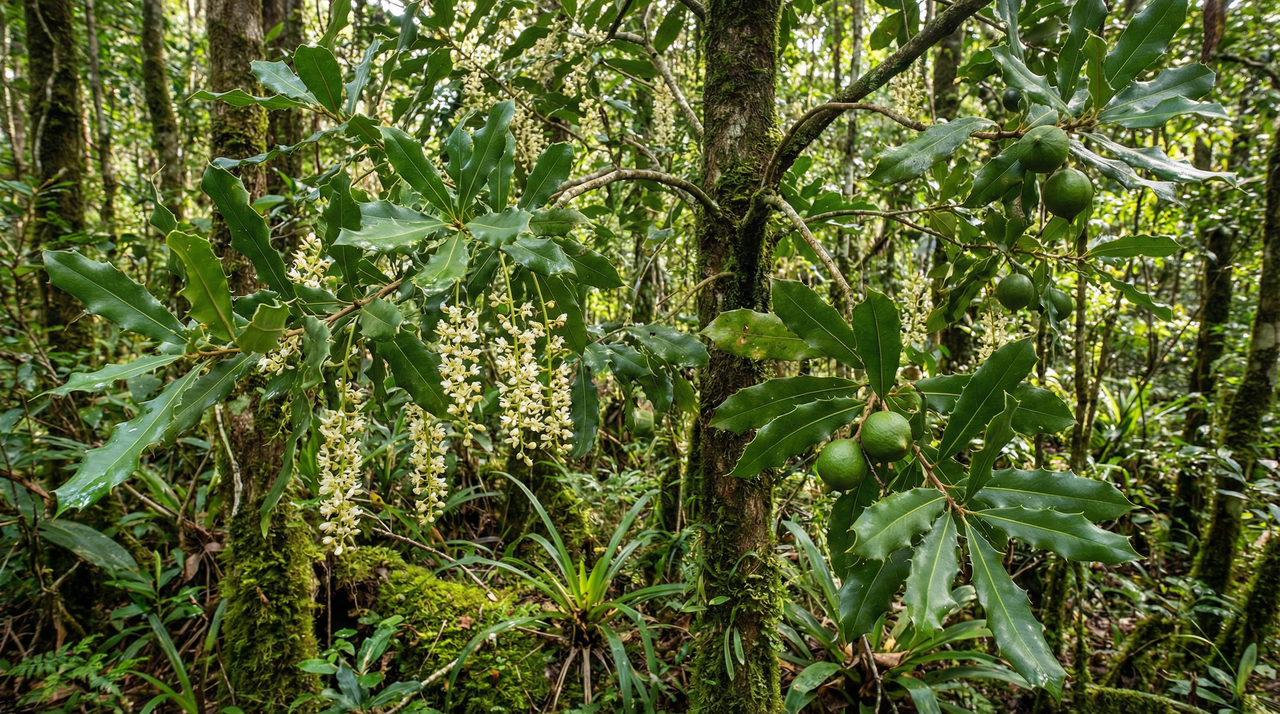
The hardest nut in the world to crack is also one of the most valuable, and those two facts are not a coincidence. Macadamia shells require somewhere between 300 and 2,000 newtons of force to break open,[1] which is why your kitchen nutcracker will fail spectacularly and why the tree held its secrets from most of the world for so long. Indigenous Australians had been cracking them with stones for thousands of years before any European botanist ever wrote the species down, a detail that tends to get buried under the glossy marketing of what's now a billion-dollar global crop. That gap between who knew this plant and who profited from it is something I keep turning over whenever I walk past the two trees growing in my food forest.
What pulls me to macadamia, though, isn't the history or even the flavor, though the flavor is extraordinary. It's the contradiction of growing a tree that is, by any honest measure, slow, particular, and demanding, inside a system built on patience and observation. You'll wait years for your first harvest. The roots will punish you for poor drainage. And yet this is the same species that spent millions of years perfecting itself in Queensland rainforests without any help from us at all. Understanding what it actually needs, rather than what we assume it needs, changes everything about how you grow it.
Macadamia Origin, History, and Botanical Background
The macadamia tree's story starts long before any European botanist gave it a name. Macadamia integrifolia is native to the subtropical rainforests of eastern Queensland, Australia, from the Bunya Mountains south to Gympie and across to the McPherson Range near the New South Wales border, where it lives as a canopy or understory tree in humid, species-rich forest.[2][3] Its native climate is Köppen Cfa: warm and humid, with average temperatures of 15 to 25°C, annual rainfall of 1,500 to 2,000 mm spread across the year, and essentially no dry season.[4] When I grow macadamias in Central Florida's zone 9b, I'm always struck by how closely that matches our own subtropical rhythms. The same well-drained, humid soil and frost-free winters that suit our citrus groves suit this tree too.
The macadamia tree scientific name honors a Scottish chemist. Ferdinand von Mueller formally named the genus Macadamia in 1857 after John Macadam, though the species itself was first collected by Allan Cunningham in 1828 and initially described under a different genus entirely.[5] It's a long-lived evergreen that can reach 10 to 20 meters tall with a canopy spreading 8 to 12 meters wide, and wild trees may persist for a century or more while commercial orchards remain productive for 30 to 40 years.[6][4] This long developmental timeline asks for intentional patience from the grower.[7] Patience is the first lesson. I always label my macadamia seedlings carefully because the early foliage, those leathery, glossy, lanceolate leaves arranged in whorls of three or four,[8] can look convincingly like other subtropical trees when they're young and you're not paying close attention.
Come spring, the fragrant cream flowers appear in long pendulous racemes, 10 to 30 centimeters of honey-scented blossoms that the bees absolutely work over.[9] That floral display is the first sign that the long wait for nuts is finally beginning. The roots beneath all of this are notably shallow and fibrous, rarely exceeding 60 centimeters in depth,[10] which is why drainage and careful siting matter so much from the very start.
Traditional Indigenous Uses
The Gubbi Gubbi, Bundjalung, Yugambeh, and Dhurga peoples have been harvesting macadamia nuts for well over 10,000 years.[11][12] Nuts could account for up to 40 percent of calories during the season, roasted over fire, eaten raw, or ground into a flour for porridge and cakes.[13] That fire-roasting technique, simple and direct, does something not so different from what I do in my kitchen: a dry pan over medium heat until the color deepens and the oils release. The method is thousands of years older than any modern recipe.
From Discovery to Global Crop
The first recorded European trial came in 1863, when botanist Walter Hill propagated the species at the Brisbane Botanic Gardens and reportedly became the first non-Indigenous person to eat one.[14] Commercial cultivation followed in the 1880s in Australia, but it was the introduction to Hawaii in 1881 and 1882 by William H. Purvis that launched the global industry.[15][16] Florida received its first trees in 1887.[15] From Hawaii, the crop spread to South Africa in the 1960s and California in the 1970s, and eventually to China, Madagascar, and subtropical growing regions across several continents.[17] Today the major producers are Australia, South Africa, Hawaii, and China, though the expansion of commercial monocultures has raised real questions about habitat loss and the lack of recognition or compensation for the Indigenous knowledge that made domestication possible in the first place.[18] Seeking out ethically sourced or Australian-grown nuts is one of the most direct ways I know to support both cultural integrity and rainforest conservation through ordinary purchasing decisions.
Fun Facts and Cultural Significance
Wild specimens can reach roughly 20 meters with trunk diameters approaching one meter,[19] and high-yielding orchards can push five tons of nuts per hectare with individual mature trees producing 100 to 150 kilograms annually under good conditions.[20] Seeing a tree in full production, branches draped with splitting husks, knowing it started as a high-fat staple cracked open beside a Queensland campfire, is genuinely humbling. Macadamia is among the very few Australian native plants to achieve global commercial scale,[21] yet wild populations remain vulnerable to rainforest clearing and overharvesting. The commercial success and the conservation problem are the same story, just told from different ends.
Macadamia Varieties and Where to Buy Them
The cultivars we grow today didn't happen by accident. Systematic breeding programs at the University of Hawaii began in the 1950s, evaluating more than 400 accessions to select for high kernel recovery, yield, disease resistance, and climate suitability.[10] That work gave us a much clearer field to choose from than the seedling lottery most early growers were playing.
Notable Macadamia Cultivars for Home Gardens and Small Orchards
Cultivar differences are real and worth understanding before you buy. Growth rates range from vigorous to moderate, flowering times shift pollination windows, and kernel recovery rates span roughly 35 to 45 percent or higher, which matters a lot when you're cracking nuts by hand.[22][23] Shell thickness, drought tolerance, and oil content (commercial selections typically run 72 to 80 percent) all vary between named varieties too.[15]
Among the cultivars you're most likely to encounter, Beaumont (also called 246) is the one I consistently recommend to clients in zone 9b. It's early-season with large kernels and shows marginally better cold tolerance than most others.[24][23] I've watched young Beaumont trees recover from light frost events that finished off more sensitive selections nearby, so that tolerance edge is genuine. Kakea offers high yield at moderate tree size, while Purvis (344), Mauka, and Pahala round out the list of University of Hawaii selections bred for superior kernel size and reduced alternate bearing.[25]
Most cultivars start sustaining damage below 22°F and aren't reliably hardy below 28°F, so zones 9 through 11 are the realistic target.[15][26] Hawaii produces roughly 90 percent of the world's macadamia nuts, and mainland cultivation in Florida and California stays small-scale precisely because of hurricane exposure, water limitations, and the specific subtropical climate requirements that are hard to replicate on the continent.[15]
Sourcing Macadamia Trees in the United States
There are no federal restrictions on growing Macadamia integrifolia, and nursery stock is genuinely accessible through specialty suppliers like Just Fruits and Exotics and Burnt Ridge Nursery for anyone in a suitable zone.[27][28] Seeds typically run $10 to $20 each, young trees in one-gallon pots range from $50 to $150, and larger specimens can reach $200 to $500 or more depending on size and vendor.[27][29] Treat those figures as ballpark ranges; prices shift with market conditions and seasonal availability.
If you're sourcing grafted stock, ask specifically about Phytophthora-free certification. I've helped clients work through the frustration of disease arriving with the plant, and it's entirely avoidable with a little due diligence upfront. Lead times of six to twelve months are common from reputable commercial suppliers in Australia, South Africa, Hawaii, and California, so plan ahead rather than impulse-buying something that ships fast with no documentation. Genetic verification and root integrity matter as much as the cultivar name on the tag.
Macadamia Propagation and Planting Guide
Getting a macadamia into the ground is straightforward. Getting it to the point where it produces nuts is a different conversation entirely, and it starts with one fundamental choice: do you grow from seed, or do you graft? Everything else flows from that decision.
Seed Characteristics and Germination
Macadamia seeds are recalcitrant, which means they don't dry down and sit patiently in storage the way, say, tomato seeds do. They're monoembryonic, they lose viability fast, and the impermeable woody endocarp creates physical dormancy that can slow or prevent germination without scarification.[25][30] Historically, in the Queensland rainforest, the megafauna handled that job; now you either nick the shell or sow extremely fresh seed and hope for the best.[31]
At room temperature, viability can collapse within three to four weeks.[25] I learned that the hard way years ago, leaving a batch on the bench too long and wondering why nothing germinated. If you need to store them, pack them in moist vermiculite or sphagnum moss in an airtight container at 4 to 10°C with humidity around 70 to 90%; that buys you a reliable four to six months.[25][32] Sow at 1 to 2 cm deep into warm soil (25 to 30°C), keep humidity above 80%, and fresh seed can hit 80 to 95% germination within a month, though vegetative growth takes longer to establish.[33][34]
Here's the catch: seedlings don't come true to type, and they typically take 7 to 10 years to bear nuts.[10][35] I've started plenty from fresh nuts and the seedlings are genuinely charming, but I always label them clearly because you never quite know what you'll get. For rootstock production, seeds are perfect. For a productive orchard or backyard tree, they're the long and unpredictable road.
Vegetative Propagation: Grafting and Cuttings
Every serious macadamia grower eventually arrives at grafting. It preserves cultivar traits, it compresses the timeline to first harvest down to 3 to 5 years, and it gives you access to rootstocks bred for disease resistance.[36][37] The standard rootstock is Macadamia tetraphylla, particularly the 'Ic-239' selection, which offers strong union success, good vigor, and meaningful tolerance of Phytophthora.[38][39] I've grafted onto 'Ic-239' stock repeatedly and the take rate is noticeably better than on generic seedling rootstocks, and the trees just seem more settled once established.
Bark grafting (sometimes called veneer grafting) is the technique to prioritize, achieving 70 to 95% success when done during active growth between November and March in subtropical climates.[38][36] Cleft grafting works but tends to run a little lower; T-budding is the least reliable at 40 to 70%.[40] Precision matters: cambium alignment, matching scion and rootstock diameters, keeping temperatures in the 20 to 25°C range, and careful moisture management all contribute to the outcome.[38] Semi-hardwood cuttings are an option, but they're humbling: treated with IBA at 3,000 to 8,000 ppm, rooted under bottom heat and mist, you'll typically see 20 to 60% success after 8 to 12 weeks.[15] Cuttings work best as a backup or for hobbyists who enjoy the process; grafting is where production efficiency lives.
Soil and Site Requirements
In the wild, macadamia grows on well-drained, fertile acidic soils on slopes in the Queensland rainforest understory.[9] Cultivated trees need something similar below ground but radically different above it: full sun, 6 to 8 hours of direct light, is what drives nut yield.[41] Young plants tolerate partial shade and in hot climates some afternoon protection helps them establish, but every productive tree I've grown or seen in orchards demands that full-sun exposure. The difference in nut set is dramatic.
On soil, the requirements are specific and non-negotiable. You want a well-drained, fertile loam or sandy loam with at least 5 to 10% organic matter, a minimum depth of 1 to 1.5 meters, and bulk density below 1.4 g/cm³.[10][35] Heavy clay, compacted ground, and any situation that holds water around the roots are serious problems because they create the conditions Phytophthora root rot thrives in.[42] Where drainage is uncertain, raised beds or mounded planting sites mimic the natural slope drainage of the native habitat and dramatically reduce that risk.[43]
Soil pH should sit between 5.5 and 6.5.[10] Drop below 5.0 and you risk aluminum toxicity and phosphorus lockout; creep above 7.0 and iron chlorosis sets in along with zinc and manganese deficiencies.[35] I test every new bed before planting and again every two to three years; catching a rising pH early with a sulfur application has saved more than one tree from chronic yellowing in my experience. Lime and sulfur are your adjustment tools, but they take time to act, so test before you plant rather than after you see symptoms.[44]
Planting Density, Spacing, and Establishment
Macadamia trees get large. Mature specimens reach 9 to 15 meters tall with canopy spreads of 8 to 12 meters, putting on roughly half a meter to a meter of growth per year once established.[15][10] Spacing needs to account for that eventual size. Traditional orchard layouts use 6 to 8 meters within rows and 8 to 10 meters between rows, running roughly 100 to 150 trees per hectare.[45] High-density systems compress that to 4 to 6 meters and push past 1,000 trees per hectare, but they demand serious hedging and pruning to prevent canopies from merging and cutting off airflow.[46] For a home orchard or food forest, traditional spacing gives the tree room to express itself and keeps management simple. Planting multiple varieties at that spacing also supports cross-pollination, which improves yield.[47]
Plant grafted nursery stock in spring after frost danger has passed, targeting USDA zones 9b through 11.[28] The first two to three years are critical: consistent moisture reaching 30 to 45 cm into the root zone, a good mulch layer to retain that moisture and buffer soil temperature, and protection from any frost dips are what determine whether a young grafted tree hits the ground running or struggles.[10] I've seen otherwise healthy young trees set back significantly by a single cold night in a poorly sited location in zone 9b. The investment in finding the right microclimate before you plant pays dividends for decades, because once a macadamia is established and bearing, it really does reward the patience it demanded getting there.
Macadamia Care Guide: Growing and Maintaining Healthy Trees
Every care decision you make for a macadamia tree is really an attempt to recreate a humid subtropical rainforest edge in your backyard or orchard. Macadamia integrifolia evolved under 1000–2000 mm of annual rainfall with humidity hovering around 60–80%.[10][21] Get those fundamentals right and the tree rewards you. Miss them and it tells you immediately.
Water Requirements and Irrigation for Macadamia Trees
Water is the single biggest lever in macadamia performance. Needs shift dramatically by growth stage: seedlings want 20–30 mm per week, vegetative trees 40–60 mm, flowering trees 50–70 mm every 7–10 days, and fruit-filling trees 60–80 mm weekly.[48][49] Mature orchards typically need 800–1200 mm annually in subtropical conditions, with California growers relying on 800–1200 mm of supplemental irrigation and Florida growers often running closer to 1000–1500 mm.[48][50][15] Established trees can handle a dry spell of four to six weeks without catastrophic damage,[51] but prolonged drought quietly erodes nut quality long before you see dramatic symptoms.
Overwatering is just as dangerous as drought. Yellowing leaves, wilting, and premature leaf drop signal waterlogging; tip browning, wilting, and reduced nut set point to thirst.[52][53] I guide my Central Florida clients toward soil-moisture probes or simple tensiometers because by the time leaves show visible wilting, flower bud initiation for next season may already be compromised. The practical rule is deep, infrequent irrigation, letting the top 6–8 inches dry slightly between cycles, with irrigation water ideally at pH 5.5–7.0 and electrical conductivity below 0.7 dS/m.[47][54]
Sunlight Needs: Balancing Native Shade with Production Demands
The tree evolved in 50–70% shade but needs full sun to flower and set nuts reliably.[55][25] Too much intense direct light causes leaf scorch and sunburn; too little produces chlorosis, etiolated growth, and poor flowering. I've had good results using temporary 30–40% shade cloth on young trees through their first two Florida summers, then removing it as the canopy matures and can handle full exposure. Watch the leaves as your ongoing diagnostic: bronzing at the tips usually means too much sun combined with heat stress, while pale, elongated new growth almost always means insufficient light.
Frost Tolerance and Cold Protection Strategies
Macadamia integrifolia is reliably suited to USDA Zones 9b–11, with the sweet spot in Zones 10–11. Leaf browning and shoot dieback begin below 30°F (-1°C) and brief exposure to 28°F (-2°C) can kill flower buds outright, causing crop failure for that season.[8][56] Young trees are significantly more vulnerable than mature ones, and chilling injury can occur even in the 32–50°F range.[57] M. tetraphylla, by contrast, tolerates brief dips to 25°F (-4°C) when mature and is rated RHS H3, making it the better bet in marginal zone 8b situations.[58][59] I've noticed that young macadamias drop their newest growth flush at roughly the same temperature that damages young citrus, which gives my Florida clients a useful field reference for knowing when to act.
Protection starts at site selection: avoid low-lying frost pockets, choose a sheltered position, and lay 4–6 inches of organic mulch over the root zone.[43][15] Frost cloth or burlap on trunks during cold snaps, combined with pre-frost irrigation to release latent heat, rounds out the toolkit. Generous mulch rings are now non-negotiable on every macadamia I plant.
Heat Tolerance and Managing High-Temperature Stress
The optimal range is 59–86°F (15–30°C). Stress begins above 86°F for flowering and above 95°F for kernel fill, and seedlings are the most vulnerable of all growth stages.[10][60] Visible symptoms include scorched leaf margins, canopy thinning from premature drop, and aborted nuts.[61] In unusually hot summers I've seen 30–40% shade cloth make the difference between decent kernel fill and near-total abortion on new plantings. The mitigation package is straightforward: shade cloth, 2–4 inches of mulch, drip irrigation delivering 40–60 liters per tree weekly timed for early morning, and windbreaks spaced 30–50 feet apart.[62]
Feeding and Nutrient Management
Macadamia is a moderate feeder with a clear nutritional arc: nitrogen drives establishment and vegetative growth in young trees, then potassium takes over as the dominant input for mature nut production, typically running 1–1.5 times the nitrogen rate.[63][25] Soil pH needs to stay between 5.5 and 6.5; above that, iron, zinc, manganese, and boron lock up and deficiencies appear even on well-fertilized trees.[56] Annual soil testing plus leaf tissue analysis every one to two years is the standard recommendation for good reason.[64] After seeing interveinal chlorosis on several landscape specimens that looked otherwise healthy, I now recommend testing for zinc and boron proactively rather than waiting for symptoms to show up in the leaves.
Commercial orchards scale fertilizer to yield, targeting roughly 0.5–0.75 kg N, 0.3–0.6 kg P₂O₅, 1.6–2.5 kg K₂O, and 0.3–0.5 kg MgO per tonne of nut-in-shell, applied in three to five split applications broadcast under the canopy drip line.[65][66] Home growers can simplify this to a high-potassium slow-release blend (something like NPK 10:5:20) applied three or four times a year, always under the drip line with a thick mulch layer on top. Avoid pushing nitrogen on mature trees; excess vegetative growth comes at the direct expense of nut production and increases frost vulnerability.
Seasonal Rhythm and Pruning Maintenance
Macadamia trees flower late winter to early spring, with nuts maturing six to eight months later, and growth flushes running hardest through spring and summer in subtropical climates.[67][15] Pruning fits into the calendar right after harvest, in late summer to early autumn. The macadamia nut tree pruning philosophy I learned the hard way early in my career is simple: less is more. Heavy heading cuts stress the tree and invite disease, so I cap removal at about 15% of canopy per year, targeting dead, diseased, or crossing branches to improve light penetration without disrupting the whole structure.[68][69] Young trees get more deliberate attention in their first three to five years as I establish either an open vase or central-leader form; after that, the annual tidy-up is mostly maintenance rather than shaping.
Integrated monitoring is part of every site visit. I check for the telltale signs of nutrient shortfall (older-leaf yellowing for nitrogen, marginal scorch for potassium, mottled small leaves for zinc), and I keep one eye on drainage at all times because Phytophthora root rot is the disease most likely to kill an otherwise healthy tree.[70][71] Consistent balanced management, with the emphasis on potassium fertility and clean drainage, is also the most effective counter to biennial bearing.[72][73] A well-sited, well-fed macadamia can be productive for decades; most of the problems I've seen come down to a drainage compromise or a nutrition program that was set up once and never revisited.
Harvesting Macadamia Nuts
When to Harvest: Maturity Indicators and Timing
Macadamia nuts tell you when they're ready if you know how to listen. The most reliable signal is natural drop: at full maturity, the green husk splits and the nut falls on its own.[74] What you'll also notice is weight. A mature nut feels noticeably heavier in the hand than an immature one, and if you shake it, the kernel rattles inside the shell. That rattle-and-heft combination is something I've come to trust across multiple seasons as much as any measurement. Biochemically, what's happening at that moment is remarkable: kernel oil content has reached 70-78% of dry weight, moisture sits at 30-35%, and specific gravity lands between 0.8 and 1.0 g/cm³.[74][25][75] NIR spectroscopy can verify oil content precisely, but for a backyard grower that's not realistic. Husk split and shell color shifting from green to tan or brown, combined with natural drop, are the indicators I use.
Getting to that moment takes patience. From full bloom to maturity is 210-240 days, roughly seven to eight months of waiting.[10][15] Harvest windows shift with climate and cultivar: in Hawaii, nuts drop September through March, with early selections starting in August and late ones stretching into April; in subtropical Australia, the window runs December to July depending on the region.[76][25] Commercial growers wait for natural drop rather than stripping trees precisely because premature harvest is one of the fastest ways to ruin what the tree spent seven months building.
Yield, Texture, and Flavor at Harvest
A perfectly ripe M. integrifolia kernel delivers something genuinely special: firm but tender crunch, a rich buttery mouthfeel, and a sweet-nutty finish that lingers. That experience comes from the high monounsaturated oil content and a suite of volatile compounds, including pyrazines and aldehydes, that produce the characteristic nutty and fruity notes.[77][78] Harvest too early and none of that develops. Immature nuts are astringent, thin-flavored, and the volatile profile simply isn't there.[79] I've tasted both, and the difference isn't subtle.
If you're growing M. tetraphylla alongside integrifolia, expect a noticeably more bitter, astringent raw kernel due to higher tannin and polyphenol levels.[80][81] Roasting at 150-170°C for 15-20 minutes corrects most of that, triggering Maillard reactions that unlock caramel, vanilla, and toasted notes while reducing bitterness.[82] I almost always roast fresh small batches the same day they drop because the aroma transformation is dramatic and because in warm humid conditions, the clock on quality starts immediately. Lipid oxidation accelerates fast in oxygen-permeable containers or heat, and after six months at 30°C, rancidity is measurable and obvious in flavor.[83] Whatever I'm not using within the week goes straight into the freezer. The macadamia tree rewards patience at every stage; post-harvest is no place to rush it.
Macadamia Preparation, Storage, and Culinary Uses
Traditional Aboriginal Uses and Cultural Significance
Long before macadamia became a luxury ingredient, Aboriginal Australians had built an entire material culture around the tree. Beyond providing immediate sustenance, the harvested nuts furnished vital raw materials that structured daily tasks.[84][9] The hard shells became fish hooks, needles, and digging tools, bark decoctions treated headaches and sore eyes, and leaf poultices addressed wounds and skin irritations.[85] When I first learned about the shell-tool tradition, it genuinely changed how I design systems around nut trees. Nothing gets wasted; every part has a function. That's not a modern permaculture insight, it's thousands of years of Indigenous knowledge.
Flavor Profiles: Raw vs Roasted Macadamia Nuts
Raw macadamias have a creamy, buttery quality that I find closer to avocado or young coconut than to any other tree nut: mild, faintly sweet, almost custardy.[86] Roasting transforms that completely. The Maillard reaction kicks in around 120-150°C, building a toasted, caramelized aroma and a genuine crunch.[87] I roast mine at around 130°C rather than pushing higher; the lower temperature hits that sweet spot of crunch and fragrance without tipping into bitterness. The difference between a properly roasted macadamia and an over-roasted one is significant enough that I'd recommend tasting every ten minutes the first time you try it.
Nutritional Profile and Health Benefits
The fat content is extraordinary: 75-85 grams per 100 grams, with roughly 80% of those being monounsaturated, including substantial oleic and palmitoleic acids.[88] Clinical trials have shown that regular consumption significantly lowers LDL cholesterol and improves the LDL/HDL ratio, with tocotrienols and polyphenols contributing antioxidant and anti-inflammatory effects on top of the fat profile.[89] The mineral profile deserves attention too: manganese and copper both exceed 100% of daily value per 100 grams, and magnesium comes in at around 35%.[90] I've noticed that nuts from well-managed trees in healthy soil taste richer and keep longer, which makes sense given how much fat quality depends on the tree's own stress levels and nutrient status.
Culinary Applications and Preparation Methods
The range of applications is genuinely broad. You can eat them straight as a snack, fold them into baked goods, press them into nut butter, toss them through salads or stir-fries, or pair them with chocolate and fruit in desserts.[25] The white chocolate macadamia nut cookie is the combination most people already know, and it works because the buttery creaminess of the nut balances the sweetness of white chocolate without disappearing into it. Macadamia nut cookie recipes in general benefit from a light hand with sugar precisely because the nut brings its own richness. The oil, with its ~80% monounsaturated composition and excellent oxidative stability, also functions beautifully as a finishing oil or high-heat cooking fat.[91] For storage, dry harvested nuts to 1.5% moisture and keep them at 10-15°C; handled properly, they'll last up to 12 months.[92]
Safety Considerations and Look-Alikes
Macadamias are safe for people, with tree nut allergy being the main concern for sensitive individuals.[93] Ensure stored nuts are kept securely away from household pets.[94] Worth knowing: raw cashews contain urushiol and raw candlenuts contain saponins and phorbol esters that cause nausea unless properly cooked, so if you're foraging or working with unfamiliar nuts, identification matters.[95][96]
Medicinal Preparations from Traditional Knowledge
Aboriginal communities used bark decoctions for sore eyes, headaches, and digestive complaints, and leaf poultices directly on wounds and skin irritations.[97] Modern research supports the oil's value as an emollient with hydrating, anti-inflammatory, and mild UV-protective properties in topical applications.[98] The evidence base here is ethnobotanical and preliminary rather than conclusive, but the direction is consistent: the same compounds that make the nut nutritionally valuable seem to support skin health when applied externally.
Non-Food Uses: Oil, Wood, and More
Beyond the kitchen, macadamia offers stacking functions that genuinely impress me as a designer. The oil goes into high-end cosmetics and skincare formulations, the timber is dense and beautifully grained enough for fine furniture and craft work, and the ornamental form earned the tree an RHS Award of Garden Merit.[99][100] Indigenous communities also used the husks for weaving and fuel, and the shells as fishing weights.[101] A single tree, given time and good conditions, feeds you, supplies your kitchen and medicine cabinet, contributes to your landscape structure, and leaves useful material behind at every stage. That's the kind of productivity that makes a long wait worthwhile.
Macadamia Health Benefits and Medicinal Uses
The case for eating macadamia nuts regularly isn't built on wellness-industry hype. It's built on controlled human trials. I appreciate that about this tree, because so much of what gets marketed as a "superfood" collapses under scrutiny. Macadamia holds up.
Cardiovascular and Lipid-Lowering Effects
The cardiovascular evidence is the strongest starting point. A study published in the Journal of Nutrition found that eating roughly 42 grams of macadamia nuts daily lowered LDL cholesterol and triglycerides while maintaining or increasing HDL levels in people with high cholesterol.[102][103] That's a meaningful result. The mechanism traces back to the fat profile: oleic acid makes up roughly 59% of the total fat content, producing lipid-modulating effects that researchers have compared directly to olive oil, with bioactive polyphenols amplifying those benefits.[104][105] I've seen this play out with clients who swap butter for macadamia oil in everyday cooking. It's not dramatic, but over months the numbers tend to move in the right direction, which matches what the clinical data suggests.
Antioxidant Activity and Phytochemical Profile
The phytochemical picture is richer than most people realize. The nuts and oil contain flavonoids including quercetin and kaempferol, phenolic acids like gallic and protocatechuic acid, tocopherols at around 20 to 30 mg per 100 g of oil, and phytosterols with beta-sitosterol reaching up to 200 mg per 100 g of oil. Polyphenol content in the nuts runs between 1.5 and 3.5 mg per gram GAE.[105][106][107][108] None of this is fixed. Concentrations shift by cultivar, soil type, and season, and drought stress can push flavonoid levels 20 to 50 percent higher across leaves and other tissues.[105] After years of observing trees in food-forest designs, I've noticed that nuts from trees grown under mild water stress seem to taste richer and store better, which makes sense when you understand what environmental pressure does to secondary metabolites. It's one reason I'll sometimes recommend slightly drier siting over constant irrigation where the climate allows it.
Anti-Inflammatory, Antimicrobial, and Traditional Uses
Beyond the cardiovascular work, the research gets more preliminary but stays genuinely interesting. Macadamia nut oil has shown anti-inflammatory effects in animal models of arthritis, working through pathways including NF-κB inhibition and reduced COX-1 and COX-2 expression.[109][110] Leaf extracts have demonstrated free radical scavenging, inhibition of lipid peroxidation, and antimicrobial activity against bacteria including Staphylococcus aureus.[111] These are in vitro and preclinical findings only; no published human trials exist for those specific applications, and I think it's worth being honest about that distinction rather than extrapolating too far.[112] The traditional record adds a different kind of depth. The Butchulla, Yuggera, and Quandamooka peoples used bark and leaves for wound healing and as an analgesic, with some applications for skin conditions alongside the primary use of the nuts as food.[113][85][97] I grow this tree primarily for food and habitat value, but the ethnobotanical record is a useful reminder that every part of a permaculture plant carries stories beyond what ends up on the kitchen counter.
Nutritional Composition of Macadamia Nuts
Raw macadamia nuts clock in at 718 calories per 100 grams, with 75.77 grams of total fat dominated by monounsaturated fatty acids, roughly 7.9 grams of protein, 13.8 grams of carbohydrates, and 8.6 grams of fiber.[114] The mineral profile is where things get quietly impressive: magnesium at 130 mg, potassium at 410 mg, phosphorus at 218 mg, iron at 3.69 mg, and copper at 0.756 mg per 100 grams.[114] Thiamin stands out too, at 1.195 mg per 100 grams, which is higher than most nuts.[114][115] Roasting bumps the calorie count slightly and leaves the fatty acid profile essentially intact, but it does reduce total phenolic content by 10 to 20 percent.[116][117] For everyday nutritional value, raw or lightly roasted are both solid choices. If you're eating them for the polyphenol contribution specifically, raw is the better bet.
Safety Considerations and Potential Side Effects
Macadamia nuts have held FDA GRAS status since 1958, and their allergy risk is relatively low compared to other tree nuts, though cross-reactivity with hazelnuts or walnuts is possible for people who already have tree-nut sensitivities.[112][118] Overconsuming them can cause gastrointestinal discomfort given the high fat content, which is worth mentioning to anyone who thinks of nuts as a food you can eat without limits.[119] The cyanogenic glycoside question comes up occasionally: the leaves, flowers, and husks do contain dhurrin, but kernel HCN levels are very low and the nuts are safe for human consumption.[120] No significant drug interactions with statins or anticoagulants are well documented.[120] Dogs are a completely different story. In every edible-landscape consultation I give, I warn about macadamia nuts and dogs directly: symptoms including hind-leg weakness, ataxia, tremors, and vomiting can appear within 6 to 12 hours at doses as low as 0.7 grams per kilogram of body weight. The exact toxin is still unidentified, but I treat the risk as absolute.[121][122] If you have dogs and you're planting this tree where nuts can drop and be found, plan for it from the start.
Macadamia Pests and Diseases
In my experience designing subtropical food forests in Central Florida, the question isn't whether a macadamia tree will encounter pests or disease pressure — it's whether the site you chose gives it a fighting chance. This is a tree with a reasonably manageable pest profile overall, but one critical vulnerability that can kill an established specimen fast: Phytophthora root rot.
Major Diseases and Root Rots
Macadamia integrifolia is highly susceptible to Sudden Death caused by a Phytophthora spp. complex, which strikes with terrifying efficiency — rapid canopy wilt, few prior symptoms, dead tree. The same genus causes Phytophthora root and trunk rot, with infection rates reaching 80% in poorly drained orchards.[123][124][125] After watching a client's tree collapse in a low spot after a wet summer, I now insist on mounded beds or raised planting areas for every macadamia I install. If your soil stays waterlogged for more than a few days after rain, this tree will almost certainly develop Phytophthora. There is no reliable cure once the roots are gone.
Root rots caused by Berkeleyomyces basicola and related pathogens compound the problem in acidic soils below pH 5.5 with poor aeration.[126][127] Humidity above 80%, temperatures between 20 and 30°C, and rainfall exceeding 1,500mm annually all push disease risk dramatically higher.[128] The secondary fungal complex — anthracnose, husk spot, alternaria leaf spot, algal leaf spot, and butt rot — behaves the same way: mostly quiet in good conditions, opportunistic once humidity and shade tip the balance.[123][129] Algal leaf spot in particular shows up as a signal that canopy airflow is inadequate — those orange-red crusty patches on leaves turning brown are worth taking seriously as a site-management cue, not just a cosmetic problem.
No fully immune commercial cultivars exist, but breeding programs hybridizing with M. tetraphylla have produced selections with meaningfully better Phytophthora tolerance, including 'Kakea' (691), 'Pahala' (761), and 'Kau' (344).[130] I've observed 'Kakea' hold up noticeably better through extended wet periods compared to standard seedlings — it's not immune, but it buys you margin when the weather turns against you.
Common Insect Pests
Compared to pecans or citrus, macadamia's insect load is genuinely modest. The roster includes macadamia nut borer, leafrollers, macadamia weevil, fruit weevils, thrips, mites, aphids, scale, and the macadamia psyllid,[15][131] but fewer than half of the 20-plus listed USDA pests become economically damaging under good management.[132] The nut borer is the one to watch — without intervention it can cause up to 30% kernel damage.[133] M. tetraphylla's higher phenolic and tannin content gives it stronger physical and chemical defenses against weevils and borers, which is part of why it's used as a rootstock and why Beaumont hybrids show useful partial resistance.[134]
Prevention and Integrated Management
In my landscape practice, the most effective disease management happens before a single tree goes in the ground. Soil pH held between 5.5 and 6.5, impeccable drainage, spacing that keeps air moving through the canopy, and a companion guild that includes nitrogen-fixers and groundcovers reduces trunk humidity and lowers Phytophthora risk without any chemical inputs.[135] For cases where conditions push toward the wet edge, phosphonate fungicides and biological inoculants like Trichoderma and mycorrhizal fungi serve as secondary lines of defense — not a substitute for the cultural work.[136]
For insects, scouting is everything. Pheromone traps for nut borer take the guesswork out of timing, and once you know the thresholds, you stop spraying on a calendar and start intervening only when it actually pays. Sanitation, targeted pruning, and biological controls — parasitoids and beneficial microbes — handle most of the load when combined with partially tolerant cultivars like 'A4', 'A38', 'Renown', and 'Daddow'.[137][138] A macadamia nut tree with good bones — the right site, the right cultivar, a living mulch keeping the soil biology active — is a surprisingly resilient thing.
Macadamia in Permaculture Design
A mature macadamia earns its space in a food forest the way any great canopy tree does: by doing far more than just producing food. In its native Queensland habitat, Macadamia integrifolia grows as an evergreen canopy or sub-canopy tree reaching 15 to 20 meters tall,[139][140] a scale that puts it firmly in the upper layer of any layered garden system. That's the version you're designing around. Yes, you can prune it into a more compact, shrub-like form when space is restricted,[141] but that's a management compromise, not the tree's natural ambition. For anyone planning a serious subtropical food forest, give it the room it wants and let it anchor the canopy.
Forest Layer and Guild Placement
Siting a macadamia well means thinking about what goes underneath it as much as the tree itself. I've found it pairs naturally with avocado and other subtropical canopy trees at the upper layer, with nitrogen-fixing legumes tucked into the mid-story to handle soil fertility. Below that, comfrey makes an excellent groundcover for biomass, nutrient cycling, and living mulch, and pollinator companions like borage and lavender scattered through the guild do meaningful work attracting the bees this tree depends on.[142][143] Spacing trees 6 to 9 meters apart keeps airflow healthy and lets pollinators move freely between canopies,[144] which matters more than people initially realize.
Ecosystem Functions and Services
What I find genuinely exciting about macadamia as a permaculture element is how much it gives back at the soil level. As a member of the Proteaceae family, it develops specialized cluster roots that dramatically improve phosphorus acquisition in nutrient-poor soils,[145] and it forms both ectomycorrhizal and arbuscular mycorrhizal associations that boost drought tolerance and nutrient uptake.[146] When I talk to clients about investing in perennial root networks, this is exactly the kind of soil biology I'm pointing toward. The extensive root system also stabilizes slopes and contributes meaningfully to carbon sequestration through leaf litter decomposition.[147][148]
The allelopathy is worth understanding rather than fearing. Macadamia leaf litter contains phenolic compounds including gallic acid and ellagic acid that suppress germination of many understory plants,[149] which I've watched work as a surprisingly effective weed suppressant under mature trees. The trick is choosing guild companions that establish before the leaf litter accumulates heavily. Comfrey, once rooted, shrugs it off; and dynamic accumulators planted early tend to hold their ground even as the canopy thickens.
The pollination picture is where guild design really pays off. Macadamia is self-incompatible, meaning it requires cross-pollination between genetically distinct cultivars to set nuts.[150] Bees, including honeybees, stingless bees, and native species, handle most of that work most effectively at temperatures between 15 and 30 °C.[151][152] A client of mine had a single-cultivar tree that barely set nuts for years; once we added a compatible second cultivar nearby, the difference was obvious within the first full flowering season. For smaller home systems without hives, hand-pollination can boost yields by 20 to 30 percent when pollinator activity is low.[153][154] Monoculture plantings consistently underperform on pollinator diversity,[155] which is one more reason the diverse guild approach serves this tree so much better than rows of a single variety ever could.
Climate and Hardiness Zones
Macadamia has a fairly specific climate envelope, and being honest about that upfront saves a lot of heartbreak. Its sweet spot is 20 to 30 °C with relative humidity in the 60 to 80 percent range; prolonged heat above 32 °C combined with low humidity stresses the tree and cuts yields.[10][156] On the cold end, frost damage typically sets in below 5 to 7 °C, and young trees are especially vulnerable. Mature specimens can handle a brief dip to around -4 °C,[10][15] but "brief" is doing a lot of work in that sentence. The Royal Horticultural Society rates it H1c, meaning frost protection is considered mandatory.[157]
Officially, macadamia is hardy in USDA zones 9b through 11, performing most reliably in zone 10a and warmer.[158][15] Zone 9b is the marginal edge, and I'd treat it the way I treat young citrus or avocado in those same pockets: site it on a south-facing slope if you can, use rocks or water barrels for thermal mass to buffer overnight cold snaps, and keep frost cloth accessible for the first few winters while the tree establishes. Consistent nut production in zone 9b is genuinely possible but less predictable than in zones 10 and 11.
Rainfall needs fall between 1000 and 1500 mm annually, and even distribution across seasons matters as much as the total.[159][160] The soil underneath should be well-drained sandy loam at a pH of 5.5 to 6.5, and the tree performs best below 300 meters elevation.[43][161] If you're in a high-rainfall zone above 2000 mm annually, drainage infrastructure becomes non-negotiable; waterlogged roots invite the exact soil-borne pathogens this tree is most vulnerable to.
The Tree That Taught Me to Think in Decades
I planted my first grafted macadamia on a warm October morning and stood there calculating birthdays before I'd even finished tamping the soil. There's something clarifying about a tree that asks you to think that far ahead; it reframes the whole garden, honestly. You stop planting for next season and start planting for the life you want to be living ten years from now. That shift is the real gift macadamia gave me.
Sources 161
- Mechanical properties of macadamia nut shells - ScienceDirect ↩
- Macadamia - Queensland Government ↩
- Macadamia integrifolia ↩
- Macadamia integrifolia - Wikipedia ↩
- Ferdinand von Mueller and Australian Botany ↩
- Kew Sciences - Plants of the World Online ↩
- University of Florida IFAS Extension - 'Macadamia Tree Cultivation' ↩
- Macadamia integrifolia ↩
- Macadamia - Description ↩
- Macadamia Production Guide ↩
- Aboriginal Food and Fibre Plants: Macadamia nut - Climate Ready Coasts ↩
- Indigenous Knowledge of Australian Flora ↩
- Macadamia Nuts: The Australian Story ↩
- History of Macadamia Cultivation in Australia ↩
- Macadamia Nut Production in Florida ↩
- The Macadamia Nut in Hawaii ↩
- Introduction of Macadamia to California ↩
- Sustainability Challenges in Macadamia Cultivation ↩
- Record Sizes of Australian Native Trees ↩
- High-Yield Macadamia Orchards: Case Studies ↩
- Macadamia integrifolia - Native Range and Ecology ↩
- Macadamia spp. Cultivars: Growth Characteristics and Nut Quality ↩
- Macadamia Cultivars for Hawaii ↩
- Macadamia Cultivars ↩
- Commercial Macadamia Production ↩
- Cold Hardiness of Macadamia Cultivars ↩
- Macadamia Nut Trees for Sale ↩
- Macadamia integrifolia ↩
- Commercial Macadamia Trees Pricing ↩
- Recalcitrant Seeds: A Status Report ↩
- Seed Dispersal and Germination in Macadamia integrifolia ↩
- Seed Storage of Horticultural Crops ↩
- Macadamia Propagation Guidelines ↩
- Seed Germination of Macadamia integrifolia ↩
- Macadamia Production Guide ↩
- Macadamia Production Manual ↩
- HS1562/UW280: Growing Macadamia in South Florida ↩
- Grafting Macadamia Trees ↩
- Grafting and Rootstock Compatibility in Macadamia ↩
- Graft Compatibility in Macadamia ↩
- Missouri Botanical Garden - Macadamia integrifolia ↩
- Phytophthora Root Rot in Macadamia ↩
- Macadamia Nut Growing Guide ↩
- Lime and Sulfur for Soil pH Adjustment in Nut Orchards ↩
- Macadamia Orchard Establishment and Management ↩
- High Density Planting in Macadamia Orchards ↩
- Pollination Requirements for Macadamia ↩
- Irrigation Management for Macadamia Orchards ↩
- Water Management in Macadamia Production ↩
- Growing Macadamia Nuts in California ↩
- Drought Tolerance in Macadamia integrifolia ↩
- Macadamia Nut Production Guide ↩
- Water Relations and Irrigation of Macadamia ↩
- Irrigation and Water Quality for Macadamia Orchards ↩
- Managing Sunburn and Leaf Scorch in Macadamia Orchards ↩
- Macadamia Nut Production in Florida ↩
- Macadamia integrifolia ↩
- RHS Plant Finder: Macadamia tetraphylla ↩
- University of Florida IFAS Extension: Macadamia Production ↩
- Physiological Responses of Macadamia to High Temperatures ↩
- Macadamia Heat Stress Management ↩
- Macadamia Production in a Changing Climate ↩
- Macadamia Australia - Fertilization Guidelines ↩
- Macadamia Orchard Management in Hawaii ↩
- Macadamia Nut Management Guide ↩
- Nutrient Management for Macadamia Orchards ↩
- Macadamia Nut Production Guide ↩
- Pruning and Training Macadamia Trees ↩
- Macadamia Orchard Management: Pruning Guidelines ↩
- Macadamia Pests and Diseases ↩
- Phytophthora Root Rot in Macadamia ↩
- Macadamia Nut Growing Guide - University of Hawaii ↩
- Macadamia Cultivation - Australian Macadamia Society ↩
- Maturity Indices for Macadamia Nuts ↩
- Physiological Maturity in Macadamia integrifolia ↩
- Macadamia Production in Hawaii ↩
- Texture Analysis of Macadamia Kernels ↩
- Flavor Compounds in Macadamia Kernels ↩
- Volatile Compounds in Macadamia Nuts: Influence of Maturity and Cultivar ↩
- Comparative Analysis of Macadamia integrifolia and tetraphylla ↩
- Sensory Evaluation of Macadamia Nuts ↩
- Effect of Roasting on Macadamia Sensory Quality ↩
- Postharvest Handling of Tree Nuts ↩
- Bush Foods: Aboriginal Plant Use in Australia ↩
- Traditional Bush Medicines of Australia ↩
- Macadamia Nuts Nutrition and Flavor ↩
- Sensory Evaluation of Roasted Macadamia Nuts ↩
- USDA FoodData Central, Branded Food Products ↩
- Macadamia Nuts Reduced LDL Cholesterol Without Affecting HDL Cholesterol in Adults Consuming a Reduced-Energy Diet ↩
- Nutritional Composition of Macadamia Nuts ↩
- Culinary Uses of Australian Macadamias ↩
- Macadamia Nut Harvesting and Post-Harvest Handling ↩
- Tree Nut Allergy ↩
- Toxicity of Macadamia Nuts ↩
- Cashew ↩
- Aleurites moluccanus ↩
- Ethnobotany of the Australian Macadamia ↩
- Therapeutic Potential of Macadamia Nut Oil in Dermatology ↩
- Macadamia integrifolia ↩
- Macadamia integrifolia ↩
- Traditional Bush Foods of Australia ↩
- Effects of Macadamia Nut Consumption on Serum Lipids and Lipoproteins ↩
- Effects of Macadamia Nut Consumption on Serum Lipids and Lipoproteins ↩
- Macadamia Nuts and Cardiovascular Health: A Review ↩
- Phytochemical Composition of Macadamia integrifolia Seed Oil ↩
- Polyphenolic Compounds in Macadamia Nuts: Enzymatic Antioxidant Mechanisms In Vitro and In Vivo ↩
- Phytochemical investigation of the Australian native plant Macadamia integrifolia ↩
- Fatty Acid and Tocopherol Profiles in Macadamia Oil ↩
- Anti-inflammatory Effects of Macadamia Nut Oil in Preclinical Studies ↩
- Anti-Inflammatory Effects of Macadamia integrifolia Leaf Extract via NF-κB Pathway Inhibition ↩
- Antioxidant and Antimicrobial Activities of Macadamia integrifolia Leaf Extracts ↩
- FDA GRAS Status for Macadamia Nuts ↩
- Traditional Medicinal Uses of Australian Native Plants Including Macadamia ↩
- Nuts, macadamia nuts, raw ↩
- Bioactive Compounds in Macadamia Nuts: A Review ↩
- Nuts, macadamia nuts, dry roasted, without salt added ↩
- Effect of Roasting on the Phytochemical Composition of Macadamia Nuts ↩
- Tree Nut Allergies Including Macadamia ↩
- Macadamia Nut Side Effects ↩
- Cyanogenesis in Macadamia: Direct Analysis of HCN in Flowers, Leaves, Husks and Nuts ↩
- Toxicity of Macadamia Nuts in Dogs ↩
- Macadamia Nut Poisoning in Dogs ↩
- Macadamia Diseases and Disorders Resource Guide ↩
- Phytophthora Root and Trunk Rot of Macadamia ↩
- Diseases of Macadamia ↩
- Macadamia Root Rot: Causes and Management ↩
- Diseases of Macadamia ↩
- Environmental Factors Affecting Macadamia Diseases ↩
- Anthracnose of Macadamia in Hawaii ↩
- Breeding Macadamia for Disease Resistance ↩
- Insect Pests of Macadamia ↩
- Integrated Pest Management for Macadamia Nuts ↩
- Chemical and Physical Plant Defences in Macadamia ↩
- Comparative Pest Resistance in Macadamia Species ↩
- Macadamia Nut Industry Pest and Disease Management ↩
- Integrated Pest Management for Macadamia ↩
- Pest Management in Macadamia Orchards ↩
- Macadamia Psyllid Management and Resistant Varieties ↩
- Plants of the World Online: Macadamia integrifolia ↩
- USDA PLANTS: Macadamia integrifolia ↩
- Royal Horticultural Society (RHS): Macadamia integrifolia ↩
- Permaculture Companion Plants for Nut Trees ↩
- Enhancing Pollinator Attraction through Companion Planting ↩
- Macadamia, Growing the Tree in Florida ↩
- Cluster Roots: A Curiosity of Proteaceae ↩
- Mycorrhizal Associations in Macadamia integrifolia ↩
- Role of Macadamia Orchards in Soil Conservation ↩
- Biomass Production in Macadamia Plantations ↩
- Allelopathic Effects of Macadamia Leaf Litter ↩
- Pollination Requirements of Macadamia integrifolia ↩
- Effects of Temperature on Macadamia Flower and Pollen Development ↩
- Pollination Ecology of Macadamia integrifolia in Native and Cultivated Habitats ↩
- Pollination Management in Macadamia Orchards ↩
- Hand Pollination Techniques for Macadamia integrifolia ↩
- Pollinator Decline in Monoculture Macadamia Orchards ↩
- Macadamia integrifolia Plant Profile ↩
- Royal Horticultural Society - Macadamia integrifolia ↩
- Growing Macadamia Trees ↩
- Macadamia Nut Production Guide ↩
- Soil and Climate Requirements for Macadamia - FAO ↩
- Growing Macadamias in Australia ↩