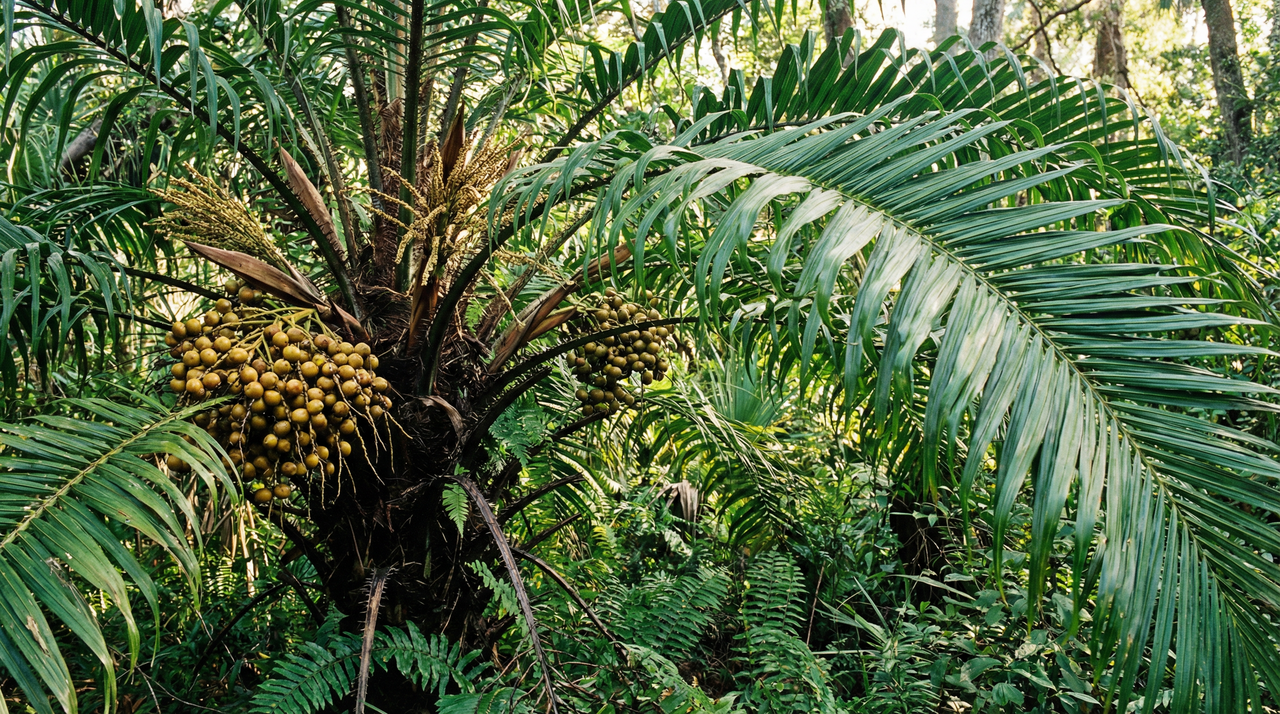
Nobody warns you about the spines. The first time I stood under a mature Macaw Palm, what struck me wasn't the fruit clusters or the feathery crown overhead; it was the trunk, absolutely armored, like something from before mammals existed. Acrocomia aculeata doesn't ask for your respect so much as it demands it. And yet Indigenous communities across the Neotropics have been climbing these things, harvesting these things, building with these things for thousands of years, which tells you something important: the reward has always been worth the negotiation.
That reward is a fruit so oily and nutritionally dense that macaws, parrots, and people have competed over it since long before anyone thought to write any of this down.[1] The palm gets its common name from the birds, which is a detail I find oddly moving. A tree named for the animals that loved it first. What most growers in warm climates don't realize is that this palm is genuinely one of the highest oil-yielding plants on the continent, sometimes outperforming African oil palm per hectare under good conditions. Furthermore, it accomplishes this while tolerating drought, poor soils, and the kind of neglect that would finish off a more delicate species.[2] That combination should be turning more heads than it currently does.
Macaw Palm Origin and History
Some plants have a way of announcing their importance before you ever read a word about them. The macaw palm is one of those. Ranging from central Mexico down through the Caribbean coast, across Central America, and deep into South America as far as Argentina and Paraguay, Acrocomia aculeata occupies one of the widest natural distributions of any palm in the Western Hemisphere. It shows up in dry tropical forests, open savannas, gallery forest edges, and disturbed scrublands alike, which tells you something immediate about its character: this is a plant built to endure.
Natural Range and Ecological Distribution of Acrocomia aculeata
The acrocomia palm's native ecology remarkably resembles other keystone palms I've worked with in Central Florida landscapes, like coconut or peach palm, in the sense that it anchors the structure of its plant community and provides resources that cascade through the food web. But its tolerance for seasonally dry conditions puts it in a different category entirely. It's not a rainforest specialist. It persists through drought, bounces back from fire, and colonizes degraded ground where other trees struggle to take hold. In its native savannas, it often grows as the tallest living thing in the landscape, a solitary giant that defines the skyline and shapes the microclimate beneath it.
Traditional and Cultural Significance Across the Neotropics
Indigenous peoples across the Neotropics have relied on this palm for millennia, and the breadth of those traditional uses is genuinely humbling. The oily fruit pulp was eaten fresh or rendered for cooking oil. The hard kernel yielded a second oil prized for skin care and lamp fuel. Leaf fibers were woven into cordage, baskets, and thatch. The spiny trunk, formidable as it is, provided structural timber. Roots and fruit entered traditional medicine for everything from inflammation to digestive complaints. What this tells a permaculture designer is that you're not looking at a single-use crop that happened to grow wild; you're looking at a plant that human communities shaped their material lives around over generations. When I integrate a species with that kind of ethnobotanical depth into a food forest design, I try to honor those relationships rather than flatten them into a single yield category. Knowing that this palm fed, clothed, and sheltered people for thousands of years changes how intentionally I place it in a guild system.
Fun Facts and Modern Interest in Macaw Palm
In their native habitat, macaws and other large parrots have long cracked the palm's hard fruits with their powerful beaks, and watching footage of scarlet macaws working through a fruiting cluster makes you immediately understand why the association stuck. That same oil-rich fruit, it turns out, has attracted very different attention in recent decades: researchers studying biodiesel crops have identified Acrocomia as one of the highest oil-yielding palms in the Americas, highly productive yet adapted to landscapes that don't require clearing primary forest. Reading through that research shifted something in my thinking about designing multi-yield systems. A palm that can produce fuel-grade oil, edible food, fiber, and wildlife habitat from the same canopy position isn't a compromise; it's exactly the kind of layered productivity that regenerative design is chasing. The macaw palm has been doing this quietly across two continents for millennia. We're just catching up.
Macaw Palm Varieties and Sourcing
Most of the literature, most of the research trials, and most of the commercial interest in macaw palm points squarely at a single species: Acrocomia aculeata. But the genus itself is more varied than that single label suggests. Species like Acrocomia media, Acrocomia crispa, Acrocomia totai, Acrocomia hassleri, and a handful of others occupy different pockets of the neotropics, each shaped by local soils, rainfall patterns, and centuries of ecological pressure. Even within A. aculeata itself, I've been struck by how much variation exists from one population to the next in spine density, fruit size, and growth habit.
Notable Varieties and Forms of Acrocomia
There are no commercially standardized cultivars here, which is both the honest truth and, frankly, an opportunity for observant growers. What I look for when evaluating young macaw palm seedlings is spine habit in the first year or two, long before fruit tells you anything useful. Some forms are absolutely ferocious, with dense spine coverage extending well up the petiole. Others, particularly certain regional ecotypes of A. aculeata from drier savanna edges, tend toward sparser spination. I've steered clients away from the most heavily armed forms near pathways more than once after watching an otherwise beautiful food-forest planting become a maintenance headache every time someone needed to pass through.
Beyond spines, the variation that matters most from a design standpoint is oil yield and adaptation to marginal conditions. Acrocomia totai, for instance, appears better suited to poorer soils in parts of Paraguay and Argentina, while Acrocomia glaucescens and Acrocomia vinifera represent further regional divergence worth knowing about if you're working in specific Central American or Caribbean contexts. Without named cultivars to rely on, the real skill is learning to read seedling vigor, growth rate, and leaf character as early proxies for performance.
Sourcing Macaw Palm Plants or Seeds
Outside of tropical growing regions, macaw palm remains genuinely uncommon in the nursery trade. Big-box garden centers won't carry it, and most online plant sellers who list "tropical palms" either don't carry Acrocomia at all or sell mislabeled seedlings. Slow-growing palms are among the most frequently misidentified plants in the trade, and with a species that takes two to three years before its true adult leaf character shows, you often won't discover a labeling error until you're well invested.
I always ask suppliers for provenance data before purchasing. This isn't pedantry; ecotypes from cooler or drier parts of the range can show meaningfully better cold hardiness and drought tolerance, which matters enormously if you're pushing the limits of zone 9B. Reputable palm seed banks, botanical garden seed programs, and specialist tropical nurseries with documented collection locations are your safest bets. A supplier who can tell you where the mother tree grows is a supplier worth trusting.
Macaw Palm Propagation and Planting Guide
Acrocomia aculeata is not the palm you grow when you want quick results. It's the palm you grow when you're thinking in decades, and the propagation process sets that expectation right from the start. The seeds are encased in a notoriously hard endocarp that evolved to survive passage through the gut of large frugivores, so sitting in your germination tray on a warm windowsill isn't exactly what they had in mind. That said, I've had good success with challenging palm species once I stopped expecting them to behave like annuals.
Propagation Methods for Acrocomia aculeata
Seed is the only realistic propagation route here. Fresh seed germinates far more reliably than stored seed, so if you can source directly from a producer or collect from a known tree, do it. The hard shell benefits from scarification before sowing: a file or coarse sandpaper applied carefully to a small section of the endocarp without nicking the embryo gives moisture a way in. Some growers prefer a 24-hour warm water soak instead, which works reasonably well for lighter-coated specimens.
Bottom heat is the other variable that makes or breaks the process. Through trial and error with other stubborn Arecaceae, I've found that keeping the rooting medium consistently at 85 to 90°F (around 30 to 32°C) does more for germination rates than almost anything else. A seedling heat mat under a deep container works well. Germination can take anywhere from a month to six months or more, and I say that not to discourage you but because I've watched growers compost perfectly viable palm seeds at the two-month mark, convinced they'd failed.
Soil, Site Selection, and Planting Technique
In the ground, this palm wants full sun and drainage above everything else. It's adapted to the well-drained sandy loams and lateritic soils of tropical savannas, so heavy clay or any site that holds standing water after rain is going to cause problems at the roots long before you notice anything above ground. I site these the same way I site other heat-loving, drought-tolerant species in subtropical guild designs: open position, good air movement, plenty of sky. Slightly acidic to neutral soil (roughly pH 6.0 to 7.0) suits it well, though it will tolerate poorer substrates once it's established.
One thing I learned working with spiny Arecaceae the hard way: protect yourself from the seedling stage onward. Thick gloves and long sleeves are non-negotiable. Even juvenile plants produce sharp spines that have an uncanny ability to find skin. I always brief clients on this before we do any planting work with macaw palm.
Spacing, Germination Timeline, and Early Care
Allow 15 to 25 feet between trees to give each palm room to develop its eventual canopy without crowding understory companions. Plant seeds at a depth roughly equal to the seed's diameter, and seedlings at the same level they were growing in the container. Firm the soil around the root zone without compacting it; these taproots need to move down.
Heavy mulching after planting is one of the best investments you can make. I mulch out to the drip line, keeping material a few inches clear of the emerging spear. It holds moisture through the dry season, moderates soil temperature, and suppresses weeds while the palm is too young to shade them out itself. Water consistently through the first growing season without letting the soil become saturated. Think of it the way you'd treat a mango or avocado seedling: warm, humid, and well-drained, just with considerably more patience required and a much spikier subject.
Label your seed trays and planting spots with dates. Slow germinators have a way of looking dead right until they don't, and a small stake with a planting date has saved me from pulling more than one future productive tree.
Macaw Palm Care Guide
Most of the work involved in growing Acrocomia aculeata happens in the first three years, and very little of it happens after that. I've watched this pattern play out with other tough palms in my Central Florida landscapes, and the Macaw Palm takes it further than most. Young trees can look almost grass-like during their slow juvenile phase, sitting at knee height for what feels like forever before trunk development kicks in. That wait can stretch four or five years, and first-timers often assume something is wrong. Nothing is wrong. Patience is the primary care requirement here, and learning that early saves a lot of unnecessary intervention.
Water Needs and Drought Tolerance
During establishment, deep and infrequent watering does far more good than frequent shallow irrigation. I aim for a thorough soak two or three times a week for young trees in the dry season, then let the soil dry out between sessions to encourage roots to chase moisture downward. Once the palm has two or three seasons in the ground, you can largely step back. Mature Macaw Palms are genuinely drought-tolerant, adapted to the boom-and-bust rainfall cycles of South American savannas. One technique I've carried over from working with other drought-tolerant palms is leaving dropped fronds as mulch around the base; it holds soil moisture surprisingly well and builds organic matter over time without any extra effort on your part.
Sunlight Requirements
Full sun, without compromise. This palm evolved in open savannas and disturbed edges where it gets direct light all day, and it shows when you try to push it into partial shade. I've seen similar Arecaceae species get leggy and slow in dappled conditions, and the Macaw Palm behaves the same way. If you want strong growth and eventually fruit production, give it the sunniest spot on your property and don't let neighboring plantings crowd it as the system matures.
Fertilizing and Soil Nutrition
Young trees benefit from a balanced, slow-release palm fertilizer weighted toward potassium during their first few years in the ground. Beyond that, I lean on mulching with organic matter as the main feeding strategy, which fits naturally into a permaculture system where the palm itself contributes to that cycle through leaf litter. Once established, the Macaw Palm is genuinely low-input. Heavy fertilization can push lush growth that's more vulnerable to stress, so tapering off as the tree matures is the right move.
Frost and Cold Tolerance
Established specimens handle brief dips down to around 20 to 25°F with typically minor leaf damage, which puts them in a similar category to some of the tougher cold-hardy palms I work with in zone 9B. Young trees are the vulnerable ones. I've used temporary burlap wraps and strategic microclimate planting near south-facing structures to protect juveniles through unexpected cold snaps, and well-drained soil is non-negotiable here; cold, wet roots cause far more damage than air temperature alone.
Heat and Humidity Tolerance
This is where the Macaw Palm really earns its keep. Triple-digit heat doesn't faze it once the root system is established, which is more than I can say for a lot of the palms I've trialed in hot, humid subtropical conditions. Where more sensitive species show sunscorch or tip burn during brutal summers, Acrocomia aculeata just keeps going. It's one of the reasons I consider it a genuinely climate-resilient choice for landscapes that need to perform through increasingly intense heat events.
Pruning and Maintenance
The Macaw Palm is largely self-cleaning, meaning old fronds drop on their own schedule without much prompting. You may want to remove dead leaves occasionally for aesthetics or to reduce hazards around foot traffic, but this is where the plant demands your full respect. I learned early on, with a few memorable encounters, that thick leather gloves and long-handled tools are non-negotiable with this species. The spines on the trunk and frond bases are not decorative. Approach any pruning task as you would a rose hedge multiplied by ten, and you'll be fine.
Seasonal Growth Rhythm
Growth flushes visibly with the rainy season, slows during drier months, and nearly pauses in cooler weather. Flowering and fruiting tend to follow the drier periods, which tracks with its native habitat. Once I started syncing my garden tasks to that rhythm rather than fighting it, managing this palm became much simpler. Water and mulch during establishment in dry spells, stand back during the wet season, and let the plant tell you where it is in its cycle. The juvenile phase asks for years of observation and restraint, and that's genuinely the hardest part of growing this palm well.
Macaw Palm Harvesting Guide: Timing, Technique, and Yield
The first thing I tell anyone who wants to harvest macaw palm fruit is this: the tree will not make it easy. I learned that lesson the hard way on an early design project in subtropical Florida, reaching toward a bunch without gloves and catching a spine squarely in my palm. Long poles with a hooked blade, leather gloves, and a catching net or tarp below the bunch are non-negotiables. The spines on Acrocomia aculeata are not decorative.
Once you've sorted out your protective approach, timing becomes your main puzzle. Unlike coconut, which ripens in fairly predictable flushes, macaw palm staggers its ripening across a single bunch over weeks, and different bunches on the same tree ripen at different points. That extends your harvest window to two or three months per tree, which sounds generous until you realize it means you need to check regularly rather than harvest once and walk away. The visual cue to watch for is a shift from deep green to yellowish-orange in the mesocarp. The tactile cue is more reliable: I gently twist an outer fruit, and if it pulls free with light pressure, the bunch is ready. If it resists or the skin feels rubbery and tightly set, give it another week.
Fruits that drop to the ground before you collect them can ferment within a day or two in warm weather, so timing matters for quality as much as for yield. A mature, well-established tree can produce somewhere in the range of 20 to 50 kilograms of fruit in a good year, but home-scale growers should understand that figure honestly. Processing the acrocomia aculeata fruit for its two distinct oils, pulp and kernel, takes real labor. In a food forest context, this palm earns its place through ecosystem contributions and supplementary yields, not as a primary oil crop. Think of the harvest as a reward for patience, not a production line.
Macaw Palm Preparation and Uses
The macaw palm fruit is really two crops in one, and that duality is what makes it so compelling from a food systems perspective. The oily, yellow-orange mesocarp surrounding the nut yields a reddish oil similar in composition to conventional palm oil, while the kernel inside produces a lighter, higher-quality oil closer to babassu or coconut oil in its fatty acid profile. Traditional communities across the Neotropics have extracted both for generations, usually through boiling and hand-pressing the pulp, or small-scale milling of the kernels once the hard endocarp is cracked. I've cold-pressed oil from a few other tropical nuts over the years, and the process always surprises newcomers with how labor-intensive it is before the first golden drips appear. With macaw palm the reward is worth it: a rich, nutty oil that works beautifully for high-heat cooking and, in smaller quantities, as a skin-nourishing carrier oil.
Culinary and Edible Uses of Macaw Palm Fruit and Oil
Beyond the oil, the fresh pulp can be eaten directly or folded into animal fodder, giving smallholders a practical way to process fruit that doesn't make it to pressing. The palm heart is occasionally harvested as well, though anyone who has worked with other Arecaceae species knows that sustainable management means taking it only from offshoots when possible rather than sacrificing the whole tree. Given that a productive macaw palm can yield fruit for decades, protecting the main trunk is simply good economics.
Medicinal and Non-Food Applications
The byproducts after pressing are where the systems thinking really kicks in. The fibrous residue from mesocarp extraction composts readily or serves as livestock bedding, and the hard endocarp shells are dense enough to be carbonized into charcoal or shaped into small handicrafts and buttons. Nothing goes to waste, which is exactly the kind of closing-the-loop logic that makes a plant worth including in a regenerative design.
The conversation around Acrocomia aculeata and biodiesel has been growing steadily, and I'm genuinely enthusiastic about it. Its oil yields per hectare compare favorably to soy while requiring far less land disturbance, and the tree produces on marginal ground that wouldn't support annual crops anyway. Compared to the environmental costs of monoculture Elaeis guineensis plantations, a well-integrated macaw palm agroforestry system starts looking like a genuinely responsible alternative. Modern small-scale expeller presses are bringing that possibility within reach of family farms, not just industrial processors. For regenerative growers wanting a high-yield, multi-layered system, this palm has more to offer than most people realize.
Macaw Palm Health Benefits and Traditional Medicinal Uses
If you're coming to macaw palm looking for a stack of clinical trials and peer-reviewed dosing protocols, you're going to be disappointed. The science is thin. What we have instead is a deep ethnobotanical record stretching across Latin America, and a phytochemical profile that makes a pretty compelling case for why those traditional uses have persisted for generations. That's the real story here, and I think it's worth telling on its own terms.
Nutritional Composition and Phytochemical Profile
The fruit pulp and kernel oil of Acrocomia aculeata are genuinely impressive from a nutritional standpoint. Both are rich in unsaturated fatty acids, particularly oleic acid, alongside meaningful concentrations of carotenoids, tocopherols (that's vitamin E), and phenolic compounds that give the oil a respectable antioxidant capacity.[3][4] The kernel oil in particular has a fatty acid profile that compares favorably to olive oil, with that same high monounsaturated fat ratio that nutritionists associate with cardiovascular support.[5] I've worked with a number of tropical oil crops over the years, and the macaw palm's profile puts it in genuinely good company as a functional food fat, whether you're thinking about cooking or skincare applications.
Traditional and Ethnobotanical Applications
Across Central and South America, traditional communities have long used the fruit, leaves, and roots of macaw palm to address respiratory ailments, rheumatism, digestive complaints, and inflammation.[6][7] Preliminary phytochemical screening has found flavonoids and tannins in the leaves and fruit tissue, which at least offers a plausible biochemical explanation for the anti-inflammatory and antimicrobial effects that folk practitioners observed, even if controlled human trials simply don't exist yet.[8] In my work with regenerative systems, I've seen this pattern repeatedly with promising tropical species: the ethnobotanical record is rich, the phytochemistry is suggestive, and the rigorous clinical research just hasn't caught up. Macaw palm is squarely in that category, and I'd rather say so plainly than dress it up.
Safety Considerations and Current Research Gaps
As a food, macaw palm products are generally considered safe, with no major adverse effects widely documented from traditional consumption.[9][10] That said, data on allergenicity and potential drug interactions for concentrated extracts is essentially absent, so medicinal use warrants a more cautious approach. Pregnant or breastfeeding individuals should consult a healthcare provider before using this palm therapeutically; the absence of documented harm isn't the same as a documented safety record.[11] And a practical note from someone who has gotten too close to this plant's spines: harvesting and processing the fruit requires proper gloves and eye protection. The physical hazard is real and immediate in a way the nutritional science sometimes isn't. Treat the fruit and oil as functional foods that support overall wellness, not as replacements for medical care, and you're in solid territory.
Macaw Palm Pests and Diseases
The scientific literature on specific pests and diseases affecting macaw palm is remarkably thin. You can search through palm pathology databases and come away with almost nothing dedicated to Acrocomia aculeata. My honest read on that gap is that it reflects the plant's genuine toughness rather than a lack of research interest. A species that evolved across fire-prone savannas and rocky hillsides, competing against stress that would flatten most cultivated palms, tends not to be a soft target.
In my zone 9B design work, I've noticed that the Macaw Palm's formidable spine coverage discourages the kind of browsing damage I regularly see on smoother-trunked species. Deer that will casually chew on a young queen palm give a spiny Acrocomia a wide berth. That physical armor translates into less bark scarring too, which matters because mechanical wounds are often the entry point for fungal pathogens and boring insects on palms generally.
For the pests that do affect palms broadly in subtropical settings, the usual suspects are worth keeping on your radar: palm aphids, scale insects, and occasionally palm weevil borers. I've spent time managing scale on coconut palms that needed persistent attention every season. With the Macaw Palms I've worked around, I haven't encountered the same pressure. The tougher foliage and growth habit seem to offer some natural resistance, especially when the tree is planted into a diverse guild rather than isolated in a monoculture bed where pest populations can build unchecked.
On the disease side, the biggest lesson I learned early in my career came from overwatering a young palm in compacted soil -- root rot set in before I understood what was happening. Macaw Palm's preference for well-drained sites isn't just about drought tolerance; it's a genuine buffer against the fungal root diseases that wet feet invite. Keep it out of low spots. If you're planting in Florida or similar humid subtropical zones where lethal yellowing phytoplasma circulates, that's worth monitoring regardless of species. No palm is entirely immune to regional disease pressure, and growers in endemic areas should stay current with local extension guidance on resistant varieties and management practices.
Macaw Palm in Permaculture Design
If you're designing a food forest in a warm climate and you want a canopy anchor that pulls triple duty, the macaw palm deserves serious consideration. It's a big, structural plant with a generous frond spread, a deep root system, and dual harvests from the same fruit. The design potential is real. But so are the spines, the slow start, and the heat requirement. I'd rather tell you both sides upfront than have you plant one in the wrong spot and regret it for years.
Ecosystem Functions and Guild Placement
Palms such as Acrocomia aculeata tend to function as the structural backbone of a guild rather than its most dynamic element. The canopy layer they create is dappled rather than dense, which is a genuine gift for the plants underneath: enough shade to moderate soil temperatures and reduce moisture loss, but enough light to support a productive understory. Meanwhile, those massive fronds are constantly cycling biomass. When they drop, and they do drop, they break down into substantial organic matter that feeds soil life and slowly builds fertility over time. The root system runs deep, tapping subsoil moisture and nutrients that shallower-rooted companions simply can't reach. That's a classic nutrient pump function, and it's one of the reasons I think this palm earns its footprint in a well-designed system.
The dual yield from pulp oil and edible kernels also gives the guild a high-value human harvest layered on top of its ecological contributions. Wildlife benefits too; the fruit draws birds and small mammals that contribute to the broader food web of the system. As a design element, you're stacking functions without adding much management complexity once the tree is established.
Forest Layer and Companion Planting
In my own designs with similar pinnate palms, I've had good results underplanting with comfrey and pigeon pea in the establishment years. They fix nitrogen, suppress weeds, and build soil quickly while the palm is still finding its feet. Once the canopy fills in, I'll often transition to more shade-tolerant, long-term companions: cassava, turmeric, or shade-adapted fruit shrubs that appreciate the wind protection a tall palm provides.
One thing I wish someone had told me early on: the spines make underplanting essentially a one-time decision in the immediate zone around the trunk. Getting in close to swap out species later is genuinely unpleasant. So choose your inner-guild plants thoughtfully before the palm matures. I've actually leaned into this constraint by using young macaw palms as a security hedge along property boundaries, where those vicious spines become a feature rather than a problem. It reframes the whole thing.
For the broader guild radius, nitrogen-fixing trees like leucaena or Gliricidia make excellent neighbors, and ground covers that tolerate partial shade will help close the canopy gap at soil level, reducing erosion during heavy tropical rains.
Climate Suitability and Hardiness Zones
The macaw palm is at home in USDA zones 9b through 12. It can tolerate a brief, light frost once it's well established, but it's fundamentally a heat-loving species that performs best where summers are long, wet, and warm. I garden in zone 9b, and I treat palms like this one the way I treat my queen palms: worth growing, but positioned in the warmest microclimate I can find, ideally with some protection from north winds during cold snaps.
The palm's native range spans tropical savannas and seasonally dry forests, which tells you something useful: it handles drought reasonably well once mature, and it can make do on poor soils. That combination makes it genuinely interesting for degraded land restoration in appropriate climates, where you want something tough enough to survive neglect while still building fertility and biomass.
For gardeners in cooler climates, I'd be honest: this is a conservatory specimen or a microclimate gamble, not a reliable outdoor canopy tree. But for those of us in the warmer parts of Florida, the Gulf Coast, or comparable subtropical regions, the macaw palm's preference for heat is increasingly an asset as temperatures trend upward. A deep-rooted, productive, carbon-sequestering palm that thrives in conditions other crops struggle with? That's a plant worth watching closely in regenerative design circles.
Rethinking "Low Maintenance" With Macaw Palm
I planted my first macaw palm wearing gloves I thought were thick enough. They weren't. But standing there, bleeding a little and laughing at myself, I realized this palm was already teaching me something: it doesn't need your help, it doesn't want your coddling, and it will outlast almost every other decision you make in that food forest. That kind of stubbornness, in a plant, feels like a gift.
Sources 11
- Acrocomia aculeata: An underutilized palm with potential for bioenergy and food production ↩
- Macauba palm: A promising tropical species for bioenergy ↩
- Composition and bioactive compounds in the pulp, oil, and kernel of Acrocomia aculeata ↩
- Acrocomia aculeata (Jacq.) Lodd. ex Mart. - A promising oil crop for the tropics ↩
- Chemical characterization of the pulp, kernel, and oil of Acrocomia aculeata ↩
- Ethnobotanical study of Acrocomia aculeata in traditional communities ↩
- Traditional uses of Macaw palm (Acrocomia aculeata) in Brazil ↩
- Phytochemical screening and biological activities of Acrocomia aculeata extracts ↩
- Safety assessment of Acrocomia aculeata oil for food use ↩
- Toxicological evaluation of macauba palm products ↩
- Ethnopharmacology and safety profile of Acrocomia aculeata ↩