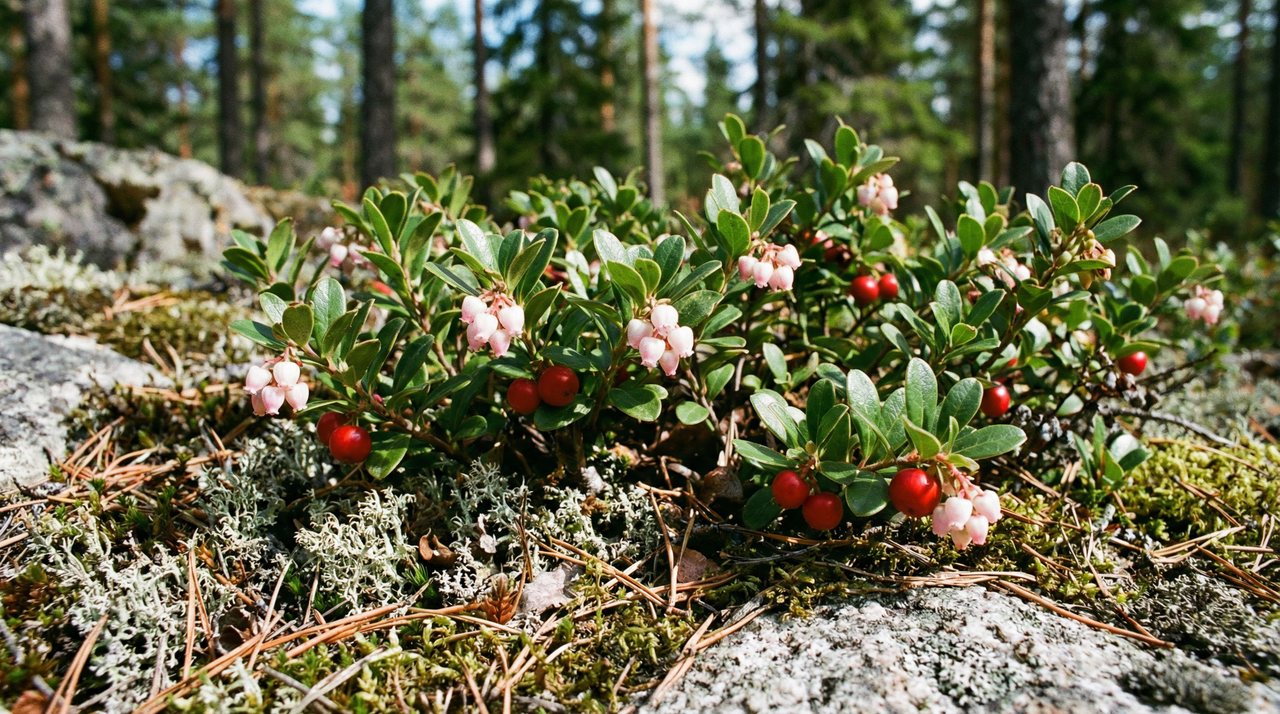
Manzanita is a remarkably tough evergreen groundcover that thrives in freezing, windswept conditions where most other plants fail, spreading quietly across frozen ground in a climate that kills almost everything else. It doesn't look impressive. It barely clears your ankle. But manzanita, specifically the bearberry species most growers know as kinnikinnick, has this way of making you reconsider what "tough" actually means. I've crouched down to examine its waxy little leaves after a hard frost and thought, genuinely, that I had more to learn from this plant than from half the trees in my food forest.
Here's the thing most people get wrong about it: they treat it like a novelty groundcover, something to tuck in a rock garden and forget. And yes, it will survive that. It'll survive almost anything you throw at it, drought, compaction, nutrient-starved soil, minus fifty degrees Fahrenheit.[1] But kinnikinnick earned a place in Indigenous medicine bundles and ceremony fires long before it earned a spot in any landscape catalog, and once you understand why, you start looking at those tiny red berries and leathery leaves very differently.
Manzanita Origin, History, and Botanical Background
There's a moment in late winter when bearberry does something I find quietly spectacular: its leathery leaves flush red at the edges, the whole mat warming to a burgundy blush across otherwise dormant ground. That's usually when I point it out to clients who've walked past it a dozen times without a second glance. Bearberry, or kinnikinnick, is easy to overlook. It's also one of the most enduring native groundcovers on the continent.
Botanical Characteristics and Visual Form
The scientific name is Arctostaphylos uva-ursi, and it earns every syllable. This is a prostrate, mat-forming evergreen shrub, rarely breaking 6-12 inches in height but spreading 3-6 feet or more across the ground via trailing woody stems that root at nodes as they go.[2][3][4] The leaves are small, obovate, and glossy dark green above, paler beneath, with that characteristic winter reddening I mentioned. Spring brings tiny urn-shaped flowers in white or pale pink, nodding in small clusters. By late summer, those become globose red drupes about the size of a large pea, mealy inside, beloved by wildlife and not particularly loved by humans as a snack.
What's less visible but equally important is the root system. It's shallow and fibrous with rhizomatous spread, which is exactly why this plant excels at soil stabilization on slopes and rocky barrens.[5][6] I've used it in restoration plantings precisely for that knitting-the-ground-together quality. Plants grown in full sun develop thicker, waxier leaves with deeper pigmentation compared to shade-grown forms, a morphological plasticity that signals how broadly adaptable the species can be within its preferred climate.[5][6] There's also notable intraspecific variation across its range, with recognized subspecies differing in leaf size, hairiness, and fruit traits, which can complicate conservation assessments when we're trying to protect the right population in the right place.[5][7]
Native Range, Distribution, and Climate Adaptation
Ask where manzanita grows and the honest answer is: almost everywhere cold. The distribution of Arctostaphylos uva-ursi is circumboreal, meaning it circles the northern hemisphere across North America, Europe, and Asia.[2][8][5] In North America, its native range spans Alaska, across Canada, and into northern U.S. states including Maine, Michigan, Washington, and the Rockies, reaching elevations up to roughly 11,500 feet.[2][9] Tundra, boreal forest, rocky barrens, open heathland: this is a plant of harsh, exposed places. It's adapted to boreal and subarctic climate zones with acidic, well-drained soils, which is about as far from my zone 9B design territory as you can get.[4][10] When I specify it for northern clients, I always frame it as a specialist: extraordinary resilience within a specific climate envelope, not a generalist for every garden.
Life Cycle, Longevity, and Reproduction
Bearberry is a perennial woody shrub with a wild lifespan typically running 30-50 years, occasionally exceeding a century under favorable conditions.[11][12] It flowers and fruits repeatedly across its lifetime rather than burning out after one reproductive event, and it spreads both by seed and vegetatively through rhizomes and layering.[13][6] The seed route is slow; germination requires cold moist stratification and plants take 3-5 years from germination to first flowering.[13][11] In my propagation work I've found that patience isn't just a virtue with this plant, it's the entire job description. The slow start rewards you with something that can outlive the gardener who planted it. The prostrate habit itself contributes to longevity: staying low reduces wind exposure and cold damage while the clonal spread keeps the colony expanding long after individual stems might fail.[6] Along the way it supports pollinators, birds, and other wildlife through its flowers and fruit, and forms mycorrhizal associations that aid nutrient cycling in the poor soils it typically calls home.[6][4]
Traditional and Cultural Significance
The common name kinnikinnick comes from an Algonquian word meaning roughly "mixture" or "something chewed," and it points directly to one of the most widespread traditional uses of this plant: dried bearberry leaves blended with tobacco or other herbs for ceremonial smoking mixtures.[14][15] Tribes including the Ojibwe, Cree, Blackfoot, Cherokee, and Iroquois used it in peace pipes, spiritual rituals, and social gatherings across generations.[14][16]
Medicinally, the leaves were used as teas and decoctions for urinary tract infections, kidney complaints, wounds, burns, diarrhea, and inflammation, a pattern documented across many North American tribes.[14][17] European records stretch back to the 13th century, including references by Hildegard of Bingen, and the plant eventually entered official pharmacopeias as European herbalists adopted what Indigenous practitioners had known for far longer.[18][19] The berries saw occasional use as a trail food, though food applications were always secondary to medicine and ceremony.[20]
On the question of sourcing: when I specify bearberry for a project, I seek nursery-grown stock without exception. Overharvesting has led to population declines in some areas, regeneration is slow, and the ethical obligations around Indigenous knowledge and benefit-sharing are real.[21][22][23] This is a plant with a deep cultural history, and that history deserves more than casual harvest from wild populations.
Etymology and Fun Facts
Both halves of the scientific name tell the same bear story from different languages. Arctostaphylos is Greek for "bear's grape," while uva-ursi is the Latin equivalent, "bear's berry," reflecting the well-documented reality that bears eat the fruit and disperse the seeds.[24] So the full name is essentially "bear-grape bear-berry," which is either redundant or emphatic depending on how you look at it. I find it charming. The bears presumably don't care either way.
Manzanita Varieties and Where to Buy
Notable Cultivars of Bearberry and Related Manzanita Species
The cultivar selection within Arctostaphylos uva-ursi is richer than most gardeners realize. You've got 'Massachusetts' with its dense, compact form and deep green foliage that holds color beautifully through winter; 'Point Reyes' with those distinctive reddish stems that hug the ground in a prostrate mat; 'Vancouver Jade' with brighter, almost lime-tinted leaves; and dwarf selections like 'Nana' that tuck neatly into rock garden pockets. All of them share the species' slow, deliberate pace of about 6 to 12 inches per year and that same cold toughness through zones 2 to 6. They're different instruments playing the same core melody.
I tend to reach for 'Wood's Compact' when I'm designing tight spots along a food forest edge, the way I might use a low thyme or sedum. It builds up a lovely natural mulch layer underneath itself without bullying neighboring plants. For winter interest, 'Radiant' and 'Wood's Red' earn their keep with foliage that turns a vivid, almost cranberry red in cold weather, stunning against light-colored mulch or snow. Since these cultivars are propagated asexually through cuttings or layering to preserve their traits, you know exactly what you're getting once you find a good source.
If you're working with more challenging soils, Arctostaphylos glandulosa opens up additional possibilities. The 'Avate' selection handles cold down to around -12°C and stays compact, while 'Turbulenta' goes essentially prostrate at about 30 centimeters, making it useful on rocky, sharply drained slopes where you want living mulch rather than a statement shrub. There's even a selection noted for tolerance of higher soil alkalinity in inland valley conditions, which matters if your site leans away from the acidic sweet spot that uva-ursi prefers.
Sourcing Manzanita Plants and Seeds
For Arctostaphylos uva-ursi specifically, Prairie Moon Nursery, Izel Native Plants, and Plant Delights Nursery are all solid starting points. I always encourage people to look closely at Izel in particular because they source regionally appropriate ecotypes, and in my experience, that local genetic match translates directly into plants that establish with noticeably less supplemental water in the first year. A bearberry grown from Pacific Northwest coastal stock may behave quite differently on a Minnesota slope than one sourced closer to that environment. Match the ecotype to your region and you'll fight the plant far less.
Seed packets typically run $10 to $20, plugs around $5 to $10, and one-gallon pots somewhere in the $15 to $30 range, with mature shrubs reaching $25 to $60 depending on the supplier and season. I personally prefer starting with plugs or small pots rather than seed, mostly because germination from seed is genuinely slow and patience has its limits. A healthy plug dropped into well-prepared acidic soil gets you into the ground faster and still gives you years of establishment time to build that dense, spreading mat you're after.
Manzanita Propagation and Planting Guide
Bearberry rewards gardeners who go in with realistic expectations. This is a plant that can live for decades and spread into a dense, beautiful mat, but it asks for patience and precision upfront. Get the propagation method and the site right, and it's one of the most self-sufficient groundcovers I know. Get either one wrong, and you'll be puzzling over a dying plant that looks perfectly healthy until it suddenly isn't.
Propagation Methods for Arctostaphylos uva-ursi
The seeds of Arctostaphylos uva-ursi are tiny: 1 to 2 mm, reddish-brown, with a hard seed coat and a rudimentary embryo that carries both physical and physiological dormancy.[5][25][26] I've sown them multiple seasons, and the difference between stratified and unstratified seeds is immediately visible once you're looking for it. Properly cold-treated seeds plump up and swell when they're ready to germinate; untreated ones stay hard and resistant no matter how long you wait.
For most gardeners, though, vegetative propagation is the practical choice. Semi-hardwood cuttings taken in late summer, right after that first flush of new growth firms up, consistently give me the best results. Aim for 4 to 6 inch cuttings, treat the base with IBA at 3,000 to 8,000 ppm, and stick them in a 1:1 peat-perlite mix under intermittent mist with bottom heat around 18 to 24°C. Done correctly, rooting rates run 70 to 90% in 4 to 8 weeks.[27][28] The wood needs to be firm but not yet fully lignified; that narrow window is the thing university trials confirm and my own propagation bench has taught me to trust.
Layering is another solid option, especially if you already have an established plant to work with. Pin a low-growing stem to the soil in late spring or early summer, and roots typically form in 6 to 12 months at 70 to 90% success rates.[29][30] A light application of IBA at 1,000 to 3,000 ppm can speed things along. Micropropagation using nodal explants achieves comparable success rates and is worth knowing about for large-scale groundcover projects or conservation plantings where genetic uniformity matters, though it's beyond most home gardeners' reach.[31][32] Grafting onto compatible Arctostaphylos rootstock is possible but rarely attempted; success rates are low and the technique is usually reserved for accelerating fruiting rather than routine multiplication.[33][34]
Seed Germination Timeline and Dormancy Requirements
Seed-grown bearberry needs 30 to 90 days of cold moist stratification at around 4°C before it will germinate, and even then you're looking at 20 to 50% germination under good conditions, dropping below 10 to 20% without treatment.[4][35][6] The seeds are orthodox and store beautifully at low moisture and freezing temperatures, remaining viable for 10 to 20 years or more,[36][37] which is worth knowing if you're collecting from the wild for restoration work.
The bigger timeline issue is fruiting. From seed, bearberry typically takes 3 to 5 years to produce its first berries, and in harsher wild conditions that can stretch to 7 years.[38][4][8] For clients who need erosion control or wildlife cover sooner rather than later, I always recommend starting with rooted cuttings or nursery-grown stock rather than seeds. The wait is real. That said, in a permaculture system, slow-growing and long-lived is a feature: a mat that establishes over a few seasons and then persists for decades with minimal intervention is exactly what you want in the ground layer.
Soil, Site Selection, and Planting Technique
Site selection dictates 80 percent of your success with bearberry. I mean that quite literally. This plant is extraordinarily resilient once it's in the right spot, but it has no tolerance for the wrong one. It needs well-drained, acidic, sandy or gravelly soil with a pH of 4.5 to 6.0, full sun to part shade, and the absolute absence of waterlogging.[39][25][40] Heavy clay and alkaline conditions invite Phytophthora root rot and iron chlorosis, and I've watched gorgeous mats disappear from client gardens where drainage was only slightly compromised. I always amend clay soils aggressively with coarse sand and pine bark before I plant bearberry, because once Phytophthora takes hold, you're essentially starting over.
Bearberry forms ericoid mycorrhizal associations with fungi like Rhizoscyphus ericae that are critical for nutrient uptake in these low-fertility acid soils.[41][42] That means amendments should focus on drainage and acidity, not fertility. A container mix of equal parts peat moss, coarse sand, and perlite or pine bark works well for establishing transplants. I always test soil pH before planting; yellowing new growth is the first sign of alkalinity trouble, and correcting it after the fact is much harder than preventing it.
In hotter climates, afternoon shade prevents leaf scorch, and avoiding deep soils that hold moisture at root depth is essential given the plant's shallow 6 to 12 inch root system.[40][5] It's worth comparing this to Eastwood's manzanita (Arctostaphylos glandulosa), which tolerates slightly higher pH up to 7.5 and demands strict full sun with deeper spacing.[43][44] Bearberry's mat-forming, cold-climate nature means the two plants respond differently to the same site conditions, and assuming their needs are interchangeable is a mistake I've seen made more than once.
Spacing, Establishment, and Groundcover Techniques
For a solid groundcover planting, space bearberry 12 to 36 inches apart. Closer spacing at 12 to 18 inches fills in faster; wider at 24 to 36 inches improves air circulation and reduces competition as the plants spread.[45][42][25] The plants grow 6 to 12 inches per year and will eventually spread 3 to 6 feet wide at only 6 to 12 inches tall, achieving dense coverage in 2 to 3 years under good conditions. For erosion control on a slope, I lean toward the closer spacing and accept that I'll need to thin or redirect stems in a few years.
Plant in spring or fall, handling the root ball gently to preserve the mycorrhizal network that's already established in nursery stock.[46][27] Water consistently, about an inch per week, for the first one to two years while roots establish, then back off to infrequent deep watering. Overwatering during establishment is the fastest way to undo everything you've done right. Young bearberry also looks deceptively similar to other small-leaved evergreen groundcovers; I always label my rows clearly, because more than once I've had a volunteer come through and mistake tiny bearberry seedlings for something expendable.
Comprehensive Manzanita Care and Growing Guide
Every plant teaches you something about its native home, and manzanita's lessons are clear: grow it cold, grow it lean, and for the love of good drainage, don't try to coddle it. Arctostaphylos uva-ursi evolved in arctic tundra, boreal ridges, and windswept mountain slopes where soils are poor, winters are brutal, and nobody is out there fertilizing anything. The closer you replicate those conditions, the more this plant rewards you. Veer toward the generous side with water or nutrients, and you'll find out quickly that kindness can be its own kind of damage.
Sunlight Requirements for Manzanita
Manzanita wants light, and plenty of it. Give it at least 4-6 hours of direct sun daily, and you'll get a reasonably healthy mat; push toward 6 or more hours and you'll see noticeably denser growth, better spring bloom, and stronger fruit set.[47][25][48] If you see pale, chlorotic leaves and stems reaching awkwardly upward instead of spreading low, the site is too shaded.[39][49] That said, in the warmer edges of its range, a bit of afternoon shade can prevent scorch while still meeting the minimum light requirement. It's a small adjustment that makes a meaningful difference without compromising the plant's fundamental need for sun.
Watering Needs and Drought Tolerance
The first year or two, water deeply every one to two weeks to help it root in.[7][25] Once established in well-drained sandy or rocky soil, this plant can go months on natural rainfall without any help from you. That's not an exaggeration; it's genuinely drought-tolerant in a way that most garden plants aren't.
What it absolutely cannot handle is consistently wet roots. Yellowing or wilting leaves over moist soil, soft blackened roots, and creeping fungal issues are all signs that drainage has failed.[50] If your soil stays constantly moist, especially through winter, you'll lose the plant to root rot no matter how cold-hardy it is. That's not a warning I give lightly. On the other side, leaf curling, brown tips, and branch dieback signal underwatering or salt stress; the plant performs best with slightly acidic, low-salinity water.[50] The diagnostic key is always looking at soil moisture first before reaching for the hose.
Soil and Fertilizer Needs
Bearberry has genuinely low nutrient requirements and thrives in the kind of acidic, nutrient-poor soils that would frustrate most other plants, with an optimal pH range of 4.5-6.0 and no need for regular fertilization once established.[51][52][53] I think of it the same way I think about blueberries and rhododendrons: acid-lovers that have an intimate relationship with ericoid mycorrhizal fungi for nutrient uptake, making a synthetic fertilizer regime not just unnecessary but actively counterproductive.[54]
Fertilizer is usually the fastest way to ruin a healthy bearberry patch. I only consider it for severely stressed nursery stock in the first year, and even then I use an acidifying, low-nitrogen, slow-release ericaceous formula at well under half the recommended rate, applied once in early spring only.[55][56] Excess nitrogen produces the exact problems you're trying to avoid: leggy open growth, increased disease susceptibility, and reduced cold hardiness going into winter.[55] Soil test before you do anything, and if the numbers look reasonable, put the fertilizer bag back on the shelf.
Frost Tolerance and Cold Hardiness
This is where manzanita genuinely earns its reputation. Hardy from USDA zones 2 through 6 and occasionally into zone 7 in favorable microclimates, it tolerates temperatures down to -40°F and sometimes colder.[25][57][12][58] The RHS rates it H7, their hardiest category, and that's not an accident. Its thick leathery leaves, flexible woody stems, and circumboreal native range from arctic tundra to high-elevation ridges across North America and Europe explain exactly how it manages it.[57][42]
In truly cold climates, few evergreen groundcovers match its reliability. I've watched mature plants shrug off brutal winters with their foliage intact while everything around them went dormant. Young plants are more vulnerable, though, and worth mulching and shielding from desiccating winds in their first winter or two.[59] Watch for browning or blackening of leaves, wilting, and twig dieback as signs of freeze-thaw or wind damage. Recovery is possible, but the real secret to winter survival is always the same thing: well-drained soil that doesn't hold standing water against the roots when the ground freezes and thaws.
Heat Tolerance and Summer Care
Here's the honest truth for gardeners in warmer regions: bearberry is a boreal plant, rated for AHS heat zones 1-4, and it begins to struggle when temperatures stay above 85-90°F for extended stretches.[60][61][62] Shallow roots and relatively thin cuticles make it genuinely vulnerable to combined heat and drought, and in my experience the older basal leaves show scorch first, turning brown at the margins before the newer growth is affected. That's a useful early diagnostic if you're watching for stress.
Heat stress symptoms range from marginal leaf scorch and curling to premature leaf drop, stunted growth, and reduced flowering.[63][64] In zone 7 and warmer, mitigate with 30-50% afternoon shade, 2-4 inches of pine needle or bark mulch, and deep infrequent irrigation of about an inch per week during dry spells.[65][66][67] The goal is replicating its native microclimates: cool, breezy, rocky, and well-drained. I've seen it survive in zone 9 with heavy afternoon shade and perfect drainage, but it never looks as vibrant as it does further north. Some cultivars show marginally better resilience, but no selection fully overrides the climate mismatch. This is a plant that reminds you to match the species to the site.
Pruning, Maintenance, and Seasonal Rhythm
Manzanita's seasonal arc is quiet and satisfying: blooms appear April through June, fruit ripens August through October and often persists into winter, and the evergreen foliage holds year-round with growth slowing in cold months.[2][68] Pruning requirements are minimal; a light trim right after the white-to-pink flowers fade removes dead or damaged wood and keeps the mat tidy without sacrificing next year's buds.[39][69]
Early in my career I made the mistake of cutting too hard going into fall, and I lost almost an entire season of flowering on a planting I was genuinely proud of. Heavy pruning in late summer or autumn stresses the plant, eliminates next spring's blooms, and pushes out tender new growth that's vulnerable to winter damage. I learned to prune only post-bloom and let the plant's natural mat-forming habit do most of the shaping work on its own.
For winter protection, 2-4 inches of organic mulch and a site away from harsh winds and frost pockets is usually all established plants need.[68] If you're harvesting leaves medicinally, take no more than 20-30% in early summer before flowering, then dry them below 40°C.[70] Beyond that, the job is mostly observation. A little mulch, a post-bloom tidy, and you get red berries through winter with almost no ongoing effort. That's the quiet satisfaction of working with a plant that evolved to take care of itself.
Harvesting Manzanita (Bearberry) Berries
After watching bearberry plants slowly establish across multiple landscape projects, I've learned to treat the annual fruiting cycle as a small, hard-won reward rather than a primary design goal. The phenological arc is worth understanding, though, because once your plants finally mature, knowing what to look for makes the difference between harvesting at peak and missing the window entirely.
When and How to Harvest Bearberry
Bearberry blooms run from April through June, and the fruit takes 90 to 120 days to develop from those small pink flowers to ripe berries.[71][72][4] In a warm, low-elevation planting, you might be checking for ripe fruit in July or August. Push up to 2,000 meters or into northern Canada or Alaska, and that window shifts to September or October.[50][73] Elevation and latitude matter enormously here, so don't anchor yourself to a single calendar date.
The cues to watch for are a color shift from green to bright red and a noticeable softening of the berry.[25][69] I've found that full red color doesn't always mean peak palatability, especially at higher elevations where the season compresses, so I taste-test a few berries before committing to a full harvest. Aim to finish picking one to two weeks before your first expected frost, and do it on a dry day. Berries harvested in wet conditions mold quickly; I've observed that fruit left on the plant in dry weather holds for weeks without deteriorating, which gives you some flexibility if your timing isn't perfect.
Yield, Flavor Profile, and Realistic Expectations
Here's the honest assessment: bearberry fruit is technically edible, but high tannin content gives it a dry, mealy texture with little sweetness and a distinct astringency that hits like an unripe persimmon crossed with a very bitter cranberry.[2][74] Most people who pop one raw immediately understand why traditional uses focused on processing rather than fresh eating. In my designs, I plant bearberry for its evergreen mat, erosion control, and wildlife value; once you've tasted the berries, the traditional medicinal and smoking-mixture applications start making a lot more sense. Think of any fruit you do harvest as a forager's curiosity or a survival food, not a seasonal bounty. The real return on this plant shows up year-round in the ground it holds and the pollinators it feeds, long before a single berry appears.
Manzanita Preparation and Uses
Before you harvest anything from this plant, get your identification airtight. I spent several seasons learning to distinguish bearberry from its look-alikes by smell and leaf venation alone, and I still crouch down for a close look before I touch anything. Common confusion species include Gaultheria procumbens (American wintergreen), Mitchella repens (partridgeberry), and Empetrum nigrum (black crowberry).[4][75][76][77] Wintergreen is the one I'd worry about most: it contains methyl salicylate that can be genuinely toxic in large amounts, and it grows in similar boreal habitats. Crush a leaf. Wintergreen smells like a candy cane. Bearberry doesn't. That one sensory check has saved a lot of confusion in my field work.
Identifying Kinnikinnick and Look-Alikes Before Harvest
Beyond wintergreen, chokeberry (Aronia spp.) and mountain ash (Sorbus spp.) can cause confusion at the berry stage, though Arctostaphylos species don't contain cyanogenic glycosides; the main risk from overconsumption is gastrointestinal irritation from tannins rather than anything more alarming.[78][79][80] Still, confirm your ID twice. The leaf shape, the trailing woody stem, and the characteristic papery bark on older growth all matter.
Culinary Uses of Manzanita Berries
Most foragers leave the bearberry fruit for the birds once they've tasted it, and I count myself among them. The small red drupes are technically edible, ripening from late summer through fall and persisting into winter, but they're dry, mealy, and tart in a way that's hard to work around.[25][81] Eating them in quantity can also cause stomach upset, so there's not much incentive to push through the flavor.[82]
The story improves with Eastwood's manzanita (Arctostaphylos glandulosa). Those berries have a mild, slightly sweet quality that people compare to dried apple or an apple-cranberry blend, and they become genuinely useful once you process them. Native peoples ground them into meal and flour, mashed them for a cider-style drink, or roasted them as a coffee substitute.[83][84] I've tried drying and grinding them myself, and the powdery texture that makes fresh berries off-putting actually works in your favor once they're processed into something else. They offer modest vitamin C, some fiber, and antioxidants from flavonoids and phenolic acids, though the caloric value is modest and I wouldn't treat them as a nutritional cornerstone.[85][86]
Medicinal Preparations from Bearberry Leaves
The leaves are where this plant earns its place in the herbal pharmacopoeia. Standard decoction efficiently extracts the compounds that deliver antimicrobial action in the urinary tract, but only when urine is sufficiently alkaline.[87][88] The standard preparation is a decoction: simmer one to two grams of dried leaves in 150-200 ml of water for ten to fifteen minutes, used at a dose of 1.5-4 g of leaf daily.[89][90] Standardized extracts (20% arbutin) are used at 200-800 mg daily, divided into two to four doses, for a maximum of five to fourteen days.[91]
When a client asks me about harvesting leaves for tea to treat a UTI, I always say the same thing: confirm your diagnosis with a doctor first, check your urine pH, and treat this as a short-term course, not a daily habit. The hydroquinone risk is specific and real: potential liver and kidney damage, nausea, vomiting, and significant drug interactions with medications metabolized by CYP1A2 or combined with diuretics.[87][92][93] Pregnant or nursing women, children, and anyone with kidney or liver conditions should avoid it entirely.[94] This isn't a casual kitchen herb. Respect the chemistry.
Traditional, Ornamental, and Non-Food Applications
The Indigenous history of this plant runs much deeper than UTI tea. Bearberry leaves were central to kinnikinnick smoking blends used in ceremony by many Native American tribes, and Eastwood's manzanita leaves were brewed for stomach ailments and diarrhea, with the astringent tannins doing the functional work.[5][84] That breadth of use across cultures and centuries tells you something important about how well this plant was understood long before arbutin had a name.
As a landscape designer, I regularly specify bearberry cultivars like 'Vancouver Jade' on erosion-prone slopes, and I've watched the dense mat improve soil structure visibly over two to three years while the winter foliage color shifts to burgundy and the red berries feed birds through the coldest months.[95][96] The ornamental value is real, but so is the ecological function underneath it. That's the manzanita ethos, really: useful at every layer, but only if you take the time to know what you're working with.
Manzanita Health Benefits and Medicinal Uses
Long before any clinical trial, bearberry was medicine. Tribes across North America, including the Ojibwe, Cree, Haudenosaunee, Cheyenne, Dakota, and Cherokee, were using Arctostaphylos uva-ursi leaves specifically for urinary tract infections, kidney complaints, and as a diuretic.[97][98][99] That kind of convergent ethnobotanical knowledge, spanning many distinct cultures across a huge geographic range, tends to get my attention. It tells me the plant was doing something real.
Traditional and Modern Medicinal Uses of Manzanita
The mechanism behind those traditional uses is now reasonably well understood. Bearberry leaves contain arbutin at 5 to 15 percent of dry leaf weight, a glycoside that hydrolyzes in alkaline urine to hydroquinone, which then acts as an antimicrobial directly in the urinary tract.[100][101] The proanthocyanidins work through a separate pathway, blocking E. coli from adhering to urinary tract cells by inhibiting the fimbriae those bacteria use to grab on and form biofilms.[102][103] So you have two distinct mechanisms working together, which is probably why this plant ended up in so many medicine bundles independently.
The broader anti-inflammatory and antioxidant picture comes from the tannins and phenolic compounds. Tannins appear to inhibit COX enzymes and pro-inflammatory cytokines, while the phenolics scavenge free radicals.[104][105][106] The plant also has a mild diuretic effect, which tracks with its traditional use as a kidney flush. Where the evidence gets more complicated is in clinical trials. A systematic review of clinical trials confirms symptom reduction for recurrent UTIs comparable to antibiotic therapy, but systematic reviews keep flagging insufficient evidence, small sample sizes, and too much heterogeneity between studies to draw firm conclusions.[107][108][109] As someone who designs with plants for practical purposes, I find the traditional evidence genuinely compelling, but I wait for stronger RCTs before I'd suggest bearberry as anything more than a short-term supportive herb. The ethnobotany earns it serious consideration; the clinical literature isn't quite there yet.
Related manzanitas like Eastwood's (Arctostaphylos glandulosa) show comparable in vitro antimicrobial activity against Staphylococcus aureus and others, with some preclinical work suggesting enzyme inhibition relevant to blood sugar regulation and cytotoxic activity against certain cancer cell lines.[110][111] That's genus-level potential worth watching, not a clinical recommendation.
Key Phytochemicals in Manzanita: Arbutin, Proanthocyanidins, and More
Bearberry leaves carry one of the most distinctive phytochemical profiles I've encountered in a native groundcover. Arbutin sits at the center, typically 5 to 15 percent of dry leaf weight, with standardized medicinal preparations requiring at least 6 percent.[112][113][114] Alongside it, the leaves contain proanthocyanidins and tannins up to 15 to 30 percent, flavonoids including quercetin, hyperoside, and kaempferol, phenolic acids like gallic, ellagic, and chlorogenic acid, plus triterpenes such as ursolic acid and methyl salicylate. What's notably absent: coumarins, saponins, and alkaloids are negligible. This is a phenolic and tannin powerhouse, not a broadly diverse phytochemical kitchen sink.
What I find genuinely useful from a grower's perspective is how dramatically those concentrations shift with season and conditions. Arbutin peaks in early summer leaves and declines through autumn. Plants growing in northern latitudes or nutrient-poor acidic soils produce higher concentrations, and drought or elevated UV-B stress can push arbutin up by as much as 30 percent as a defense response.[115][116][117] Nitrogen fertilization, on the other hand, brings those levels down.[118] After years of working with this plant, I harvest leaves in early summer specifically because the chemistry is at its strongest then. If you're growing bearberry for any medicinal purpose, lean into that sandy, unfertilized, slightly stressed growing situation rather than fighting it. The plant performs best medicinally when you treat it like the wild northerner it is.
Eastwood's manzanita follows a similar blueprint: arbutin-rich leaves up to 8 to 10 percent, tannins in the bark, anthocyanins and vitamins in the fruits, plus flavonoids, terpenoids, and phenolic acids, with saponins appearing in a way they don't in uva-ursi.[110][119] Direct studies on that species are still limited, so most of what we infer comes from the genus-level picture.
Nutritional Profile of Manzanita Berries and Leaves
The nutritional profile of the berries differs significantly from the leaves. Bearberry fruits offer modest nutrition: roughly 45 to 60 calories per 100 grams, 8 to 13.5 grams of carbohydrates with 4 to 5 grams of fiber, vitamin C in the range of 15 to 30 mg per 100 grams, modest vitamin A, anthocyanins, and trace minerals including iron, potassium, and manganese.[120][121][122] Eastwood's manzanita berries appear to reach higher vitamin C concentrations, up to 100 to 200 mg per 100 grams in some accounts, though comprehensive USDA data doesn't exist for either species so all ranges should be treated as approximate.[110] Compared to rose hips or highbush cranberries, which I've foraged from the same northern landscapes, bearberry fruit ranks well below both in nutritional density. It's honest survival food, not a superfruit. I ate a handful fresh once, understood immediately why traditional preparation focused on drying or mixing into pemmican, and never tried them raw again.
The leaves aren't food at all. Their arbutin content of 5 to 20 percent combined with tannins up to 30 percent makes them far too astringent for any culinary use, and as you'll read in the safety section below, those same compounds create real toxicity risks when consumed in excess.[123][124] Traditional use kept leaf preparations firmly in the medicinal category, not the kitchen.
Safety, Dosage, and Contraindications for Manzanita
This is the part of the profile I take most seriously, and where I think a lot of casual herb guides fall short. The same arbutin that makes bearberry leaves medicinally effective converts in the body to hydroquinone, and hydroquinone at elevated concentrations is toxic.[101] Symptoms of overuse include: 1) nausea, 2) vomiting, 3) abdominal pain, 4) greenish urine, 5) tinnitus, 6) convulsions, 7) methemoglobinemia, 8) liver damage, and 9) kidney irritation.[123][125][126] The leaves carry the primary risk; berries are considerably less potent and are edible sparingly. Livestock and pets can experience GI upset and renal effects from leaf ingestion as well, so keep that in mind if you're growing this in a silvopasture or pet-accessible space.[127]
Dosage limits from the European Medicines Agency are specific and should be treated as hard ceilings, not rough guidelines. Standardized leaf extract (20 percent arbutin) is dosed at 200 to 840 mg daily in divided doses, capped at 400 to 600 mg of arbutin per day, for a maximum of 5 to 7 days and no more than 14 days at a stretch.[114][128] Use shouldn't exceed five courses per year. In my work with native medicinals, I never recommend bearberry for more than a week at a time. Those limits exist for good reason, and I've seen how even mild overuse results in stomach upset that confirms the body is handling hydroquinone load. As a tea, the traditional preparation runs 1 to 2 grams of dried leaves per cup.[129]
The contraindication list is long and meaningful. Bearberry is not appropriate during pregnancy due to uterine stimulation risk, during breastfeeding, for children under 12, or for anyone with kidney disease, liver disease, or gastric ulcers. Drug interactions include diuretics, NSAIDs, lithium, and it can interfere with urine glucose testing. Topical leaf extracts used in skin lightening at 1 to 2 percent concentration can cause contact dermatitis, erythema, or leukoderma in sensitive individuals, and hydroquinone in cosmetics faces regulatory scrutiny for a reason.[130][131][132]
Accurate identification is non-negotiable before any medicinal use. Bearberry's diagnostic features are its small evergreen leathery leaves (1 to 2 cm) with rusty-colored undersides on new growth, urn-shaped flowers, bright red berries, and trailing stems in dry acidic soils.[4] Early in my plant identification work, I confused bearberry with wintergreen until I made a habit of flipping young leaves and checking for that rusty underside on new growth. It was a mistake that sharpened my whole approach to medicinal foraging. Look-alikes include other manzanita species, lingonberry, crowberry, and wintergreen, the last of which carries its own toxicity concerns from methyl salicylate in large quantities.[133] Confirm your identification twice before harvesting anything for internal use. That's not overcaution; that's the baseline with any wild medicinal this potent.
Manzanita Pests and Diseases
There's a reason manzanita has a reputation as a tough, low-fuss groundcover. Arctostaphylos uva-ursi produces arbutin, tannins, and flavonoids that actively deter insect feeding and disrupt digestion, giving it a strong chemical defense that most other Ericaceae can't match.[134][135] I always find it interesting that arbutin, the same compound giving this plant its pest resistance, is the one that drives its traditional medicinal value. The chemistry working against insects is working for us too. That said, the plant's resilience is conditional. Get the site wrong, and the same species that thrives for decades on a windswept ridge can collapse in a few seasons.
Common Pests of Manzanita
When manzanita is well-sited and unstressed, pest pressure stays genuinely low. Spider mites, aphids, scale insects, and leaf beetles do show up occasionally, but in my experience they're almost always a symptom of something else going wrong rather than the primary problem.[136][137] Spider mites tend to flare up in hot, dry stretches, causing stippling and yellowing on leaves; aphids go after new growth in spring and cause that tell-tale leaf curl. Neither is a crisis on a healthy plant. On Eastwood's manzanita (A. glandulosa), you might also encounter leaf miners like Coleotechnites occidentis, plus weevils and bark beetles, though damage is mostly cosmetic and shows up mainly on plants under drought stress.[136] Eastwood's has an extra layer of protection through glandular hairs that secrete sticky, terpenoid-rich resins, combined with the waxy leaf surface that makes it physically harder for herbivores to get purchase.[138] Mature specimens are also considered deer-resistant once they've filled in, though young plants can take some browsing pressure before they get there.[139] The bigger concern with any insect damage is indirect: stressed, wounded tissue invites fungal entry, which is where things get more serious.
Diseases Affecting Manzanita
Phytophthora root rot is the headline disease threat for manzanita in cultivation.[140][141] I've watched this plant hold on for years through cold, drought, and compaction, and then die in a single wet season when drainage wasn't right. If you see sudden wilting and collapse in soil that's been staying moist, root rot is almost certainly the culprit, and honestly, replacement is often the most practical path forward. Fungicides can suppress Phytophthora temporarily, but they only buy time if drainage isn't addressed at the same time.[142] Foliar fungal problems are secondary concerns but worth knowing. Septoria leaf spot causes brown or black spots and favors humid conditions; powdery mildew from Erysiphe spp. is less common and generally kept in check by full sun and good airflow; Botrytis gray mold can cause blights when humidity stays high.[42] Bacterial and viral problems are rare enough that they're not worth losing sleep over. If you're selecting cultivars for disease resilience, 'Compacta' is the one I reach for in variable or humid conditions; it shows noticeably better resistance to powdery mildew and leaf scorch compared to straight species.[143] Soil pH threads through all of this: manzanita wants acidic, sandy or gravelly soil in the 4.5-6.0 range, and plants pushed into neutral or alkaline conditions develop iron-deficiency chlorosis that weakens them and opens the door to disease.[61]
Prevention and Integrated Management
For manzanita, an ounce of prevention really does outweigh a pound of treatment. My monitoring routine is simple: check new growth for aphids in spring, and before planting anything, pour water into the planting hole and time how fast it drains. Space plants 3 to 5 feet apart to keep air moving through the canopy, water at the base rather than overhead, and clear debris that holds moisture against stems.[136] These cultural steps eliminate the conditions that invite nearly every problem on this list. When something does break through, copper-based sprays, sulfur, or neem oil cover most foliar fungal situations; phosphonate fungicides can help manage Phytophthora as a bridge measure while you fix drainage.[142][144] When I see manzanita struggling in a landscape, it traces back to one of two things almost every time: soil that holds too much water, or pH that has crept out of the acidic range.[25] Get those two things right at planting and this genus rewards you with years of low-maintenance, deer-resistant ground coverage that mostly takes care of itself.
Manzanita in Permaculture Design
If you're working with a cold, dry, acidic slope that's defeated every other groundcover you've tried, manzanita is probably the plant you've been looking for. I've spent enough time designing restoration landscapes on windy, north-facing banks to know that most plant failures come down to one thing: we keep trying to grow the wrong plant in a harsh spot instead of finding the right plant for it. Arctostaphylos uva-ursi is built for harsh spots.
Climate and Hardiness Zones for Manzanita
Bearberry is cold-hardy well beyond what most groundcovers can tolerate, rated for USDA zones 2 through 6, with documented survival at temperatures as low as -40 to -50 °F.[8][145][25][50] Some cultivars will push into zone 7 in protected microclimates, though I'd treat that as a hopeful hedge rather than a guarantee. On the heat end, it handles temperatures up to around 90 °F but starts to sulk through prolonged stretches above 85 °F without some moisture, with the sweet spot for growth sitting between 50 and 70 °F.[39][25]
What dictates survival far more than the hardiness zone, however, is what the local soil is doing. This plant is native to sandy, rocky, and gravelly acidic soils with a pH of 4.5 to 6.0, and it wants annual precipitation in the range of 15 to 30 inches, tolerating as little as 10 once it's established.[146][42][25] Low humidity is part of the picture too. It performs best in dry-summer climates like the Pacific Northwest and genuinely struggles in high-humidity conditions where fungal pressure builds on the foliage and roots.[25][12][147] I learned this the hard way early on: I lost a planting to root rot not because the climate was wrong, but because I didn't amend for drainage aggressively enough. Since then I've always gone gritty, with plenty of coarse sand or gravel mixed in, and I've never lost another mat. In exposed, windy sites, some shelter helps prevent winter desiccation, and a good snow cover actually benefits the root system during the coldest months. Poor drainage is the one reliable way to kill this plant regardless of what zone you're in.
Forest Layer and Guild Roles
In a food forest or restoration planting, manzanita occupies the ground-cover layer cleanly and without ambition to climb into other layers. It trails horizontally and roots at its nodes, forming dense, suppressive carpets under taller canopy layers.[8][4][25] Think of it like a woody creeping thyme or a slower cotoneaster: low enough to stay out of the light path for anything above it, dense enough to suppress weeds underneath. I've used it under taller ericaceous shrubs like blueberry and Labrador tea where it fills horizontal space without competing for canopy, and it genuinely reduces the weeding burden once it knits together.
The reason it thrives in nutrient-poor, acidic soils where other groundcovers give up is its ericoid mycorrhizal network, a fungal partnership that dramatically boosts phosphorus and nitrogen uptake in oligotrophic conditions.[148][50][149] This is the same type of association shared by blueberries, heathers, and rhododendrons, which is exactly why manzanita belongs in ericaceous guilds. Don't add nitrogen fertilizer and don't disturb the soil around established plants; you're protecting a fungal infrastructure that's doing more work than you can see.[12][25]
Ecosystem Functions and Wildlife Support
On slopes and disturbed sites, the mat-forming root system earns its place as a pioneer. It's one of the few plants that will establish on post-fire landscapes, sandy banks, and eroded hillsides and actually knit the soil together rather than just sitting on top of it.[150][151][4] I've installed bearberry mats on several north-facing restoration slopes and watched them stabilize visibly eroding ground within two growing seasons. That kind of performance builds confidence fast.
Early spring is when manzanita's pollinator value really shows itself. The small, urn-shaped pinkish-white flowers open from February through June depending on latitude, offering pollen (accessed via buzz pollination) when almost nothing else in a cold-climate garden is blooming.[152][50] I've crouched next to a bearberry mat in early April watching bumblebees work those tiny flowers while the rest of the garden was still dormant. It's a good reminder that ecological timing matters as much as abundance. If you're worried about pollinator limitation due to habitat fragmentation or late frosts, pairing bearberry with other early-blooming companions helps, though the plant itself is already doing the heavy lifting when the bees need it most.[153]
The bright red berries that follow persist from late summer well into winter and feed more than 40 species of birds and mammals, including grouse, waxwings, bears, deer, and elk.[154][4] From a design standpoint, those berry-eating birds are also contributing to pest regulation in adjacent plantings, so the wildlife loop closes in useful ways. I treat the fruit as wildlife food first; the preparation and culinary side of things is covered elsewhere in this profile.
Below the surface, the leaf litter and mycorrhizal networks build soil organic matter, support microbial communities, and contribute to carbon storage over time.[149][155] The mats also create microhabitats for ground-dwelling insects and small mammals, which nudges overall biodiversity upward in ways that benefit the whole system. Bearberry is native to boreal forests, arctic tundra, and alpine zones across North America, Europe, and Asia, so it carries real ecological depth.[156][157] Global populations are secure, though local stands can decline under fire suppression, overgrazing, or habitat loss. Choosing nursery-propagated stock supports those native populations while still giving you all of the ecological utility this plant delivers on the ground.
The Slowest Plant I've Ever Loved
I almost pulled it out the second year. Nothing seemed to be happening, and I'd convinced myself it had died over winter. Then I got down on my knees and looked closely, and there were new shoots, barely an inch, pushing out from the mat. That was almost a decade ago. It now covers a full slope I used to fight with every spring, and it's never asked me for a single thing.
Sources 157
- USDA Plant Profile: Arctostaphylos uva-ursi ↩
- USDA PLANTS Database: Arctostaphylos uva-ursi ↩
- Missouri Botanical Garden - Arctostaphylos uva-ursi ↩
- USDA Forest Service - Arctostaphylos uva-ursi ↩
- Flora of North America: Arctostaphylos uva-ursi ↩
- USDA Forest Service FEIS - Arctostaphylos uva-ursi ↩
- Missouri Botanical Garden - Arctostaphylos uva-ursi Fact Sheet ↩
- Lady Bird Johnson Wildflower Center - Bearberry ↩
- NatureServe Explorer: Arctostaphylos uva-ursi ↩
- GBIF: Global Distribution of Arctostaphylos uva-ursi ↩
- Missouri Botanical Garden - Arctostaphylos uva-ursi ↩
- Kew: Arctostaphylos uva-ursi ↩
- Native Plants Journal: Propagation of Bearberry ↩
- Native American Ethnobotany Database - Arctostaphylos uva-ursi ↩
- Journal of Ethnopharmacology: Kinnikinnick Traditional Smoking Mixtures ↩
- Ethnobotany of the Blackfoot Indians ↩
- Scoping Review on Bearberry as Urinary Tract Agent ↩
- HerbalGram: Uva-Ursi Historical Use ↩
- HerbalGram: Historical Use of Bearberry in European Herbal Medicine ↩
- Native American Ethnobotany Database ↩
- Population Decline of Bearberry in Eastern Woodlands ↩
- Kew: Cultivation Guidelines for Medicinal Plants ↩
- Traditional Knowledge Protocols & Plant Harvesting ↩
- Missouri Botanical Garden - Arctostaphylos uva-ursi ↩
- USDA Plants Database: Bearberry ↩
- Seed Dormancy and Germination of Bearberry ↩
- Propagation of Native Plants ↩
- Bearberry (Arctostaphylos uva-ursi) Propagation Guide ↩
- Propagation of Native Plants: Bearberry ↩
- Layering Techniques for Ericaceous Plants ↩
- Micropropagation of Ericaceae Species ↩
- In vitro propagation of Arctostaphylos uva-ursi (L.) Spreng.: A medicinal plant ↩
- Propagation of Ericaceous Plants ↩
- Grafting Techniques for Woody Ornamentals ↩
- Seed Dormancy and Germination in Ericaceae ↩
- Kew Seed Information Database - Arctostaphylos uva-ursi ↩
- Seed Storage of North American Trees ↩
- Arctostaphylos uva-ursi (Bearberry) Plant Profile ↩
- Arctostaphylos uva-ursi ↩
- Bearberry (Arctostaphylos uva-ursi) ↩
- Ericoid Mycorrhizas in Arctostaphylos ↩
- Bearberry (Arctostaphylos uva-ursi) ↩
- Arctostaphylos glandulosa - Calscape ↩
- Growing Manzanitas: Arctostaphylos ↩
- Arctostaphylos uva-ursi (Bearberry) Plant Care & Growing Guide ↩
- Bearberry (Arctostaphylos uva-ursi) Plant Care ↩
- Missouri Botanical Garden Plant Finder ↩
- Royal Horticultural Society - Bearberry ↩
- Flora of North America ↩
- Fire Effects Information System (USDA) ↩
- Missouri Botanical Garden Plant Profile ↩
- USDA PLANTS Database ↩
- Royal Horticultural Society - Nutrient Requirements of Ericaceous Plants ↩
- Missouri Botanical Garden Plant Finder ↩
- University of Minnesota Extension - Nutrient Management for Ericaceous Plants ↩
- USDA Plant Guide: Bearberry ↩
- Missouri Botanical Garden Plant Finder ↩
- Royal Horticultural Society ↩
- University of Minnesota Extension - Frost Damage in Woody Plants ↩
- Missouri Botanical Garden Plant Finder ↩
- North Carolina Extension Gardener Plant Toolbox ↩
- AHS Heat Zone Map and Plant Ratings ↩
- Missouri Botanical Garden ↩
- Royal Horticultural Society ↩
- Missouri Botanical Garden Plant Profile ↩
- University of Minnesota Extension - Managing Heat Stress in Native Shrubs ↩
- North Carolina State University - Kinnikinnick Care Guide ↩
- Missouri Botanical Garden - Bearberry, Kinnikinnick ↩
- Royal Horticultural Society - Growing Bearberry ↩
- NCBI - Herbal Medicine: Bearberry ↩
- Phenology of Arctostaphylos uva-ursi ↩
- Bearberry Fruit Development in Northern Ecosystems ↩
- Mountain Plant Phenology: Elevation Effects on Bearberry ↩
- Missouri Botanical Garden Plant Finder - Arctostaphylos uva-ursi ↩
- Gaultheria procumbens - Wintergreen ↩
- Mitchella repens - Partridgeberry ↩
- Empetrum nigrum - Crowberry ↩
- USDA PLANTS Database - Aronia arbutifolia ↩
- Manzanita Toxicity - California Native Plant Society ↩
- Plants for a Future - Arctostaphylos uva-ursi ↩
- Wild Edible Berries of the Pacific Northwest - Bearberry ↩
- Kew Science Plants of the World Online - Arctostaphylos uva-ursi ↩
- Ethnobotany of Manzanita Berries ↩
- Native American Ethnobotany Database ↩
- Nutritional Composition of Wild Berries ↩
- Arctostaphylos Species: Phytochemistry and Bioactivity ↩
- Mount Sinai Health Library - Uva Ursi ↩
- Journal of Ethnopharmacology (Review on Medicinal Uses of Arctostaphylos Species) ↩
- Assessment Report on Arctostaphylos Uva-Ursi Folium ↩
- Bearberry Leaf - Monograph ↩
- Uva Ursi (Arctostaphylos uva-ursi) - Herbal Monograph ↩
- Uva Ursi: MedlinePlus Supplements ↩
- Bearberry (Arctostaphylos Uva-Ursi) Safety - Drugs.com ↩
- WebMD - Bearberry ↩
- Arctostaphylos uva-ursi - Missouri Botanical Garden Plant Finder ↩
- Royal Horticultural Society - Bearberry ↩
- Ethnobotany of the Forest Potawatomi Indians ↩
- Native American Medicinal Plants: An Ethnobotanical Dictionary ↩
- Bearberry in Traditional Medicine ↩
- Uva-ursi (Bearberry Leaf) - Monograph ↩
- Pharmacological Properties of Bearberry (Arctostaphylos uva-ursi) ↩
- Mechanisms of Action of Bearberry in UTI Prevention ↩
- Antibacterial Activity of Proanthocyanidins from Uva Ursi ↩
- Arctostaphylos uva-ursi (Bearberry) Leaf: Review of Antimicrobial and Anti-Inflammatory Properties ↩
- Antioxidant and Proanthocyanidin Content in Bearberry Extracts ↩
- Pharmacology of Arbutin in UTI Treatment: In Vitro and In Vivo Evidence ↩
- Clinical Trials of Uva Ursi for Urinary Tract Infections: A Systematic Review ↩
- Cochrane Review: Herbal medicine for urinary tract infection ↩
- Systematic review and meta-analysis of Arctostaphylos uva-ursi in UTIs ↩
- Phytochemical Analysis and Biological Activities of Arctostaphylos glandulosa ↩
- Pharmacological Activities of Arctostaphylos uva-ursi and Related Species ↩
- Uva-Ursi: A Systematic Review of Effectiveness and Safety in Urinary Tract Infections ↩
- Uva-ursi (Arctostaphylos uva-ursi) - Monograph ↩
- EMA Assessment Report on Arctostaphylos Uva-Ursi Folium ↩
- Geographic Variation in Chemical Composition of Arctostaphylos uva-ursi ↩
- Seasonal Variation in Phenolic Compounds of Bearberry (Arctostaphylos uva-ursi) ↩
- Effects of Abiotic Stress on Phenolics in Medicinal Plants ↩
- Cultivation and Arbutin Yield in Bearberry ↩
- Phytochemical Profile of Arctostaphylos glandulosa and Biological Activities of Its Metabolites ↩
- Wild Edible Berries: Nutritional Composition ↩
- Nutritional Analysis of Native American Wild Fruits ↩
- Nutritional Composition of Bearberry Fruits ↩
- Uva-ursi (Bearberry) - Drugs and Lactation Database (LactMed) ↩
- Bearberry - Arctostaphylos uva-ursi ↩
- Hydroquinone and Toxicity of Uva Ursi ↩
- Toxicity of Bearberry (Arctostaphylos uva-ursi) ↩
- Bearberry (Arctostaphylos uva-ursi) Poisoning in Animals ↩
- Arctostaphylos Uva-Ursi ↩
- Bearberry ↩
- Uva Ursi Toxicity ↩
- Arctostaphylos Uva Ursi (Bearberry) Leaf Extract Ingredient Allergy Safety Information ↩
- Hydroquinone Safety in Cosmetics ↩
- Plant Identification: Bearberry Look-Alikes ↩
- Chemical and morphological characteristics of leaves of some bearberry (Arctostaphylos uva-ursi (L.) Spreng.) provenances ↩
- Phenolic Compounds from Arctostaphylos uva-ursi ↩
- Manzanita Pests and Diseases ↩
- Bearberry (Arctostaphylos uva-ursi) - Pests and Diseases ↩
- Chemical and Physical Plant Defenses Against Insect Herbivores in the Manzanita Genus ↩
- UC IPM - Manzanita Pests and Diseases ↩
- Phytophthora Diseases of Woody Ornamentals - UC IPM ↩
- Pacific Northwest Pest Management Handbooks - Ornamentals ↩
- Managing Phytophthora in Native Plants ↩
- Bearberry Cultivars: Selection and Care ↩
- Penn State Extension: Managing Diseases in Plants ↩
- Arctostaphylos uva-ursi ↩
- Arctostaphylos uva-ursi (Bearberry) Plant Profile ↩
- Growing Bearberry in the Pacific Northwest ↩
- Mycorrhizal Associations in Ericaceae ↩
- Nutrient Cycling in Arctostaphylos uva-ursi Dominated Ecosystems ↩
- USDA PLANTS Database ↩
- Erosion Control and Biodiversity Support by Kinnikinnick ↩
- Royal Horticultural Society Plant Profile ↩
- USDA Plant Guide: Bearberry ↩
- Wildlife Use of Bearberry Berries and Habitat Provision ↩
- Ecological Role of Ericaceous Shrubs in Northern Ecosystems ↩
- USDA PLANTS Database ↩
- Flora of North America ↩