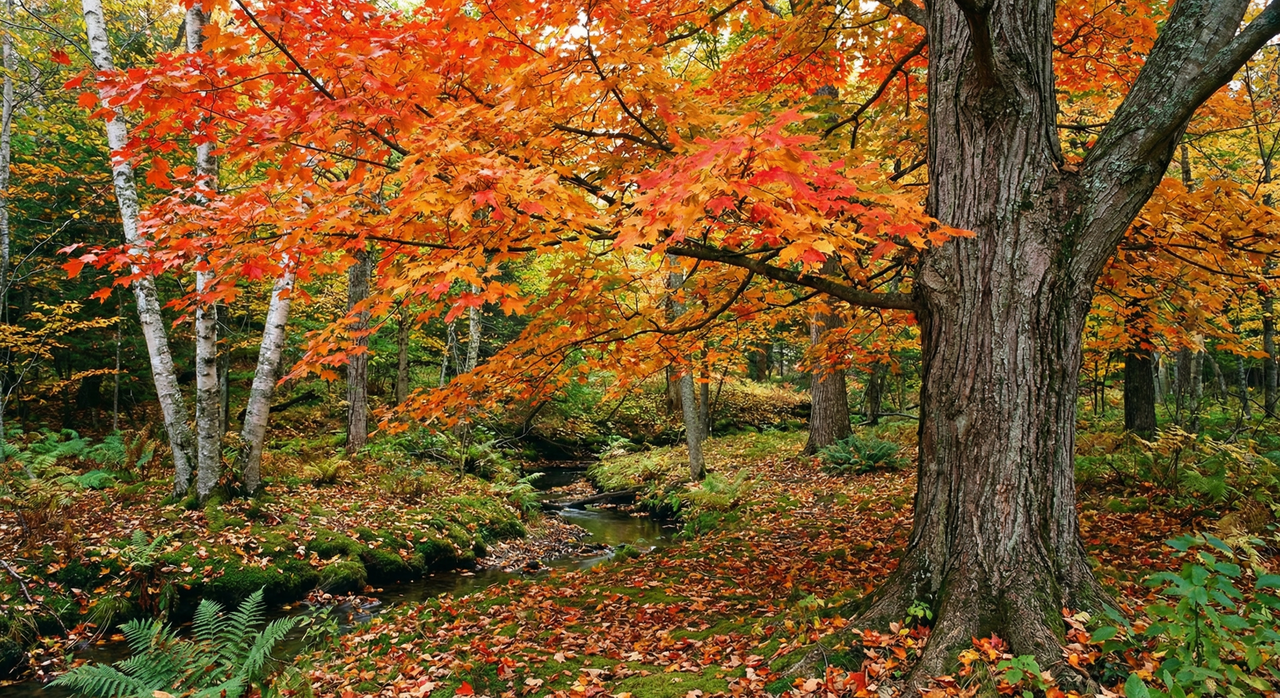
Most people who've tasted maple syrup have never tasted maple sap, and that gap tells you almost everything about this tree. Raw sap from a Sugar Maple in late February is barely sweet, maybe 2 to 3 percent sucrose, thin and cold and faintly mineral, like very good water with a whisper of something underneath it. I tapped my first tree on a rented property in Vermont years ago, crouched in knee-deep snow at six in the morning while the bucket dripped and steamed in the cold air, and I remember thinking: nobody would have discovered this by accident. Someone sat with this tree across many seasons, paying close attention, and figured out that forty gallons of that almost-not-sweet liquid would boil down into one gallon of something extraordinary.[1] That kind of knowledge takes generations.
Indigenous peoples had been working with Sugar Maple for somewhere between 3,000 and 4,000 years before Europeans arrived and immediately tried to industrialize the process.[2] That history matters here, because Sugar Maple isn't a fast-gratification plant. It grows slowly, matures slowly, and asks for patience in a way that genuinely sorts out who's serious about planting one. If you're considering this tree for a food forest or a backyard sugarbush, you're making a decision that will outlast most of your other garden plans by decades. That's not a warning. For me, it's the whole point.
Origin and History of Maple (Acer saccharum)
Botanical Background and Native Range
Sugar Maple (Acer saccharum) is the kind of tree that makes you recalibrate your relationship with time. Native to eastern and central North America, it ranges from Newfoundland and Nova Scotia west to North Dakota and south to northern Georgia and Texas,[3][4][5] and in that span it grows slowly, patiently, and with remarkable longevity. Growth averages 12 to 24 inches per year, reproductive maturity arrives somewhere between 25 and 60 years depending on stand density, and a typical tree lives 200 to 400 years -- with some individuals clearing 500.[3][6] I've watched young Sugar Maples on my property spend their first decade looking almost suspiciously unbothered, and that patience is exactly the point. This is a tree that thinks in centuries. It doesn't mast every year either; bumper seed crops arrive irregularly, every two to seven years, which makes planning a sugarbush from seed a genuine long game.[7]
Red Maple (Acer rubrum) and Silver Maple (Acer saccharinum) share a similarly broad native footprint across eastern to central North America, spanning humid subtropical to continental climates,[8][9] but they play very different ecological roles. Red Maple reaches reproductive maturity in as few as 5 to 15 years and tolerates everything from wetlands to dry uplands with an adaptability that feels almost aggressive.[8] Silver Maple is a fast-growing pioneer of riparian and floodplain sites that tends to get outcompeted as forest succession advances.[10] Sugar Maple, by contrast, is a late-successional dominant -- the anchor of mature eastern hardwood forest. Permaculture teaches us that a guild is only as strong as its anchor species, and for anyone designing a temperate food forest with a multi-generational horizon, that anchor is Sugar Maple.
Visual Characteristics and Identification
The leaves are what most people recognize first: opposite, palmately lobed with five distinct lobes, lustrous dark green in summer, with margins that are doubly serrate and sinuses that open to angles greater than 45 degrees.[11] That shallow sinus angle is the single most useful quick ID I know for separating Sugar Maple from Red Maple in the field. One thing I wish someone had told me when I was still labeling seedlings in my propagation beds is that Red Maple volunteers have noticeably sharper, deeper sinuses and often carry distinctly red petioles, whereas young Sugar Maples sit there looking almost innocently rounded.[12] Silver Maple is even easier to spot once you flip the leaf over: five deeply cut lobes with silvery-white woolly undersides that shimmer in any breeze.[13]
Bark on young Sugar Maples is smooth and grayish-green; by maturity it develops the gray-brown, deeply furrowed ridges that look almost scaly in profile.[11] Flowers arrive before the leaves in early spring: small, yellowish-green, hanging in pendulous clusters, and the species is dioecious, so not every tree produces seeds.[14] The paired samaras that follow have wings spreading at 45 to 65 degrees and run 20 to 30 millimeters total, the classic helicopter seed that kids have been tossing skyward forever.[15] Twigs are stout and reddish-brown to purplish-brown with pale lenticels.[16] Below ground, the root system is predominantly shallow and fibrous, with most mass in the top 12 to 36 inches and lateral spread that can extend two to three times the crown width,[17] a detail that matters enormously when you're siting a tree near paths or structures. Silver Maple's surface roots are even more aggressive and have heaved more than a few of my clients' walkways when planted too close.
Traditional and Cultural Uses
Long before European contact, the Iroquois, Algonquin, Cherokee, Ojibwe, Menominee, Potawatomi, and other Indigenous peoples had been tapping Sugar Maple for syrup and sugar for somewhere between 3,000 and 4,000 years.[18][19] The tree supplied far more than sweetener: bark and inner wood became medicine, fibrous materials went into basketry, heartwood dyes colored textiles, and Sugar Maple held ceremonial significance as a symbol of renewal across many traditions.[20] Red and Silver Maple served similar roles where they grew alongside; their sap was tapped for lower-sugar syrup, their bark used in medicinal decoctions, and their seeds roasted and eaten in limited quantities by many of the same communities.[21][22]
French colonists documented maple tapping in the early 17th century, learning directly from Indigenous peoples who held that knowledge. By 1745, the first commercial sugar house had opened in New York's Hudson Valley,[23] and what had been Indigenous subsistence and ceremony became a colonial industry. Sugar Maple was formally described by William Aiton in 1792.[24] Today it's the official state tree of New York, Vermont, West Virginia, and Wisconsin.[25] Sustainable tapping removes less than 10% of a tree's annual sap with no lasting harm,[26] yet the full context of the maple syrup industry still involves unresolved questions about the marginalization of Indigenous knowledge and food sovereignty.[27] I only purchase maple products from suppliers who work directly with Indigenous producers, and I explain that sourcing decision to every client I set up with taps -- because honoring where this knowledge came from is part of practicing permaculture ethically.
Fun Facts and Ecological Importance
The sheer volume of sap required to produce a single gallon of finished syrup requires extraordinary patience from the processor.[28] Each mature tree yields an average of 10 to 20 gallons of sap per season, with the tapping window running late February to early April in the Northeast -- a brief 4 to 6 weeks governed entirely by freeze-thaw cycles.[29] I've noticed on my own property that trees growing on well-drained, north-facing slopes tend to produce sweeter sap than those in heavier clay downslope, and that matches what traditional tappers have understood for generations long before anyone measured Brix levels.
The wood is another story altogether. Sugar Maple registers a Janka hardness of 950 to 1,450 lbf,[30] which is why you'll find it under basketball courts, in furniture shops, and at the grip end of hockey sticks. The fall color that makes it iconic results from chlorophyll breakdown exposing anthocyanins, a process intensified by the combination of cool nights around 45 to 55°F and bright sunny days.[31] Red Maple can be just as spectacular under the right conditions. Ecologically, all three species feed birds, squirrels, and deer on their seeds, provide canopy shelter, and contribute to carbon sequestration, while Sugar Maple specifically anchors eastern deciduous forest biodiversity through nutrient cycling, shade, and watershed protection.[4][32] A tree that can live 400 years, feed a forest, and still produce something as quietly extraordinary as maple syrup -- that's the kind of anchor worth planting, even when you know you might never taste its peak.
Sugar Maple Varieties for Permaculture and Landscape Use
Sugar maple is the anchor species in the Acer genus for anyone serious about syrup production or long-lived ornamental value. At 60-75 feet tall with a 40-50 foot spread and sap averaging 2-2.5% sucrose (climbing to 3-4% in mature trees over 40 years),[33][34] it sets the benchmark that other maples are measured against. That spectacular orange-red-yellow fall display isn't incidental; it's a feature that holds across zones 3-8, tolerating winters down to -40°F while struggling with prolonged summer heat toward the southern edge of its range.[12][10] Climate projections suggest its suitable habitat may shift northward by up to 500 km by 2100,[35] which is worth factoring into long-horizon permaculture plantings right now.
Notable Sugar Maple Varieties and Cultivars
Botanically, Sugar Maple splits into two main varieties: var. saccharum, the typical form most of us know, and var. nigrum (black maple), sometimes elevated to its own species as Acer nigrum depending on which taxonomist you're reading.[36][3] For practical cultivar selection, 'Green Mountain' is my go-to recommendation for most sites; it holds an upright form, delivers vibrant fall color reliably, and shows better disease resistance than straight-species seedlings in my experience. 'Fall Fiesta' is the pick for sites pushing into warmer or drier conditions, and 'Apollo' works well where a tighter pyramidal footprint matters, such as urban streetscapes or smaller food forest canopy slots.[37][38][12] I've planted both 'Green Mountain' and a straight-species sugar maple in the same project under comparable soil conditions and the cultivar outperformed on both drought recovery and fall color depth. That's the kind of difference that matters when you're designing for decades.
Red maple (Acer rubrum) earns its place in the nursery trade through sheer adaptability: zones 3-9, faster growth at 1-2 feet per year (some cultivars like 'Autumn Blaze' push 2-3 feet), and a cultivar lineup that includes 'October Glory' and 'Red Sunset' for reliable fall color and heat tolerance.[39][8] For permaculture growers eyeing syrup, though, red maple sap runs at only 1-2% sugar,[40] which means dramatically more boiling for the same yield. I've tapped both species and the difference in sap quality pushed me toward focusing sugarbush efforts squarely on sugar maple. Red maple is excellent for fast canopy cover, wetter sites, and southern zones where sugar maple declines; just go in with clear eyes about its syrup limitations.
Silver maple (Acer saccharinum) grows fast, over 2 feet per year, but its wood is brittle and its lifespan short at 30-50 years, with surface roots that can lift pavement and infrastructure.[41][42] Improved cultivars like 'Princeton' (stronger branching, seedless) address some of those weaknesses for urban applications, but most extension programs still steer designers toward better alternatives.[42][43] Box elder (Acer negundo) is the toughest member of the genus, hardy in zones 2-9 and tolerant of poor soils, but it's invasive in over 20 states and lives only 20-30 years.[44][45] I've spent time pulling self-seeded volunteers from a previous landscape project and I won't make that mistake again; I'd reserve it only for genuine reclamation sites where nothing else will grow, and even then I'd choose one of the ornamental cultivars like 'Flamingo' that are slightly less aggressive seeders.[46]
Sourcing Sugar Maple Trees and Seeds
Sugar maple is widely available from US nurseries. For native-sourced or certified stock, Prairie Moon Nursery and Sheffield's Seed Company are my first stops for seeds, while Nature Hills Nursery and the Arbor Day Foundation carry containerized and bare-root trees.[47][48][49][50] Bare-root seedlings run roughly $1.50-$5 for small transplants; 3-5 foot saplings typically fall in the $15-$40 range; larger 5-10 foot trees run $50-$150, and mature specimens can reach $200-$500 or more depending on caliper and form.[51][52] State conservation nurseries and USDA programs can bring that down to under $2 per tree when buying in bulk, which is worth knowing for large-scale sugarbush or restoration plantings. I'd always verify current pricing and availability directly with vendors, as stock fluctuates considerably by season.
There are no broad federal restrictions on growing or propagating sugar maple, but state-level quarantines for Asian longhorned beetle may require phytosanitary certificates for trees moving across state lines.[53][54] Check your state agriculture department before ordering from out of state. When evaluating nursery stock in person, I look for a straight trunk, a balanced crown without co-dominant leaders, and roots that fill the container without circling at the bottom.[55] For restoration work especially, native-sourced material that matches your regional genetics is worth the extra effort to find; it matters more for long-term climate resilience than any particular cultivar name on the tag.
Sugar Maple Propagation and Planting Guide
Sugar maple asks for patience before it ever asks for anything else. Every planting decision you make in year one will still be echoing when that tree reaches tappable size three or four decades from now, which means understanding how this species actually reproduces is not just botanical trivia. It's the foundation of a plan that works.
Seed Morphology, Dormancy, and Germination Timeline
The paired samaras ripen in September and October, but that flight-ready wing structure hides a seed that isn't actually ready to grow. Sugar maple embryos are underdeveloped at harvest, and the whole package requires 90 to 120 days of cold moist stratification before it'll wake up in spring.[3][56] In my nursery, I start stratifying sugar maple seeds in December to hit reliable April germination. That's the longest cold requirement I work with in the genus, and I've learned that rushing it produces spotty, frustrating results. Red maple, by contrast, needs far less stratification before germinating, and its seeds are viable for far less time after dispersal, so the handling logic is entirely different between species.[57]
The other thing that shapes how I think about growing sugar maple from seed is the timeline to maturity. Young trees put on one to two feet a year in their early years, then slow down considerably after two or three decades.[3] Seed production doesn't begin until the tree is 30 to 40 years old, while red maple is producing viable seeds by year three to ten and silver maple by year five to ten.[58][59] If you're planting a sugar maple for syrup, you are making a multigenerational investment. That's not a warning, just context worth holding clearly from the start.
Propagation Methods: From Stratified Seeds to Grafting
For true cold stratification, sugar maple seeds actually benefit from a two-stage protocol: roughly 60 to 90 days of warm stratification at around 20 to 30°C followed by 90 to 120 days of cold moist stratification at 3 to 5°C, which pushes germination rates into the 70 to 90% range with clean, properly stored seed.[60][61] Collect samaras in late fall when they've turned brown and dry, clean the wings promptly, and test viability within three months of harvest using germination trials or tetrazolium testing.[62] Fresh sowing is always preferred; stored seed loses viability relatively quickly even under ideal cool, dry conditions.[63]
Here's the complication with seed-grown sugar maples: they're highly outcrossing, with genetic variability running 80 to 95%, so no two seedlings are identical.[64][65] I've had batches of seedlings that looked so much like young ash that I lost track of them before they leafed out properly. Careful labeling is non-negotiable. When consistent syrup production or a specific cultivar is the goal, grafting is a far better path. I've had 70 to 90% take rates grafting sugar maple scions onto red or black maple rootstock using cleft, whip-and-tongue, or bark methods in late winter,[66][67] and grafted stock gets you to first tapping considerably faster than starting from seed. Cuttings are largely not worth the effort at 10 to 30% success, and tissue culture, while promising in lab settings, isn't practical for most growers.[68]
Soil and Site Requirements for Successful Establishment
I test every new bed before planting sugar maple. The species wants deep, well-drained loamy soil, at least 90 cm deep, with 3 to 5% organic matter and a pH in the 5.5 to 7.3 range.[69][70] I've watched untested planting sites turn into slow disasters; alkaline soil triggers iron, manganese, and magnesium deficiencies that show up as interveinal chlorosis and stunted growth, and once I corrected the pH with sulfur amendments I saw yellowing young trees recover visibly within a single season. Compacted soil above 1.4 g/cm³ bulk density is equally problematic, as is any tendency toward waterlogging, which opens the door to Phytophthora root rot.[71]
Red maple handles much of what sugar maple refuses: wetter conditions, compacted profiles, more acidic soils down to pH 4.0 to 5.0, even periodic flooding.[72] If a site doesn't pass the drainage and pH test for sugar maple, red maple is usually my alternative rather than trying to amend my way around a fundamentally wrong location. For light, seedlings are genuinely shade-tolerant and can establish under a canopy,[3] but once the tree matures it performs best with four to six or more hours of direct sun. Full sun deepens fall color and drives vigor, though on hot, dry sites it can also cause leaf scorch, another reason site moisture matters so much from the beginning.[73]
Spacing, Planting Technique, and Initial Care
Sugar maple matures at 60 to 75 feet tall with a 40 to 50 foot spread, and its shallow fibrous roots extend two to three times the canopy width.[3][74] For landscape shade plantings, space 40 to 60 feet apart. For a sugarbush, target 30 to 40 feet between trees, which works out to roughly 100 to 200 trees per acre and balances sap collection efficiency against long-term tree health.[75][76] Forest plantation starts can go in at 8 to 12 feet with gradual thinning toward 20 to 30 feet as the stand develops. I keep sugar maple well away from driveways, sidewalks, and foundations; those shallow roots find infrastructure eventually.
Plant bare-root stock in early spring while trees are still dormant, or container stock in either spring or fall. Set the root flare exactly at grade, not buried, and water one to two inches per week for the first two to three years until the root system is properly established.[32] Prune only in late fall or true winter dormancy to minimize sap bleeding.[32] And if the site has road salt, vehicle traffic, or heavily compacted soil nearby, plant a red maple instead. I've lost enough sugar maples to urban stress to know that species selection is the most important decision, and no amount of attentive aftercare substitutes for a well-chosen location.[3]
Sugar Maple Care Guide
Sugar maple is the kind of tree that rewards patience and punishes guesswork. It's genuinely tough in deep winter, surprisingly particular about soil chemistry, and more sensitive to summer heat than most people expect. Get those fundamentals right and you'll have a tree that largely takes care of itself for decades. Get them wrong and you'll spend years chasing symptoms that trace back to one fixable decision you made early on.
Soil and Feeding Requirements
Sugar maple wants slightly acidic to neutral soil, pH 5.5 to 7.3, with good drainage and decent organic matter.[77][78] Red maple is similarly picky, preferring pH 5.5 to 7.0, while silver maple will tolerate a wider range down to 4.5 but risks iron chlorosis once you push above 7.0.[79] I always recommend a soil test every three to five years before reaching for fertilizer, because the most common problems I see in suburban plantings aren't pests or disease. They're iron chlorosis and salt burn from well-meaning but uninformed feeding.
If you do need to fertilize, apply a balanced N-P-K at roughly 0.5 to 1 lb of actual nitrogen per 1,000 square feet under the drip line in early spring, with a lighter fall application for root development.[80][81] Mature trees often need supplemental feeding only every two to three years, and only when a deficiency is actually visible or confirmed by testing.[82] Know what you're looking for: nitrogen deficiency shows as generalized yellowing on older leaves, magnesium as interveinal chlorosis on older leaves, and iron as interveinal chlorosis on new growth first.[83] Nitrogen toxicity is easy to miss. Dark green foliage and excessive soft growth sound positive until the tree enters winter with reduced cold hardiness.[84]
Frost Tolerance and Protection
Sugar maple is cold hardy in USDA Zones 3 through 8 and dormant buds can tolerate down to -30°C or colder.[85][13] The paradox that catches people off guard is what happens in spring. Once those buds begin to swell and deacclimate, tolerance drops sharply to around -5°C to -10°C, and a late frost at that stage can blacken leaf margins, kill twig tips, and reduce seed set for the season.[86][87] I've learned to watch for bud blackening in late April and just wait. If damage is confined to twig tips, I prune those out in early summer once the extent of the dieback is clear, and the tree usually pushes back without drama.
For young trees and exposed sites, site selection does more work than any protective wrap ever will. A north- or east-facing slope provides a 2 to 5°C microclimate advantage that delays bud swell past the worst frost windows.[88] I use three inches of hardwood mulch on those cooler slopes for clients in marginal microclimates, keeping it pulled back from the trunk to avoid rot.[89] Red maple extends into Zone 9 but shares the same spring bud vulnerability; silver maple, rated Zones 3 to 9, is particularly susceptible to desiccation from cold, drying winds in exposed sites.[8][3] Once a tree is established past the first five years or so, most of this becomes background noise.
Heat Tolerance and Summer Stress Management
Sugar maple is rated for AHS Heat Zones 3 through 8, and stress begins when daytime temperatures climb above 86°F.[90] What's less intuitive is the nighttime piece: the tree needs temperatures to drop below 18°C at night to recover from daytime heat load, and nights that stay above 20°C deplete carbohydrate reserves and raise mortality risk over time.[91] My canary-in-the-coal-mine for summer stress is leaf scorch along the margins in July and August. When I see that on a maple that's otherwise getting adequate water, I add mulch and, where possible, create evening shade or airflow before assuming a pest or disease problem.[92] Red maple shows more plasticity here based on local moisture availability, which is part of why it handles southern sites better; silver maple benefits from 30 to 50% shade cloth and deep watering during peak heat.[93]
Watering Needs and Drought Management
Established sugar maples need roughly one inch of water per week during dry periods, delivered as deep, infrequent irrigation that encourages roots down to 12 to 36 inches.[32] They're moderately drought tolerant once mature, typically handling four to eight weeks before showing stress, but they do best where annual precipitation stays between 30 and 60 inches.[3] The signals are readable if you know to look: yellowing lower leaves on wet soil usually mean overwatering or drainage trouble, while marginal leaf scorch and premature fall coloration point toward drought.[94] Two to four inches of organic mulch over the root zone, clear of the trunk, makes a meaningful difference in moderating both extremes.[13]
Young trees need consistent moisture in their first season, typically one to two sessions per week, to establish that deep root system.[95] Silver maple, which naturally occupies riparian zones, needs reliably moist to wet conditions and more frequent watering when young; red maple tolerates occasional flooding and behaves more like sugar maple once established.[96] Once you understand which maple you're working with, the watering rhythms become intuitive pretty quickly.
Pruning, Maintenance, and Seasonal Rhythm
Prune sugar maples during true dormancy, late winter to early spring before bud swell, to minimize sap bleeding and reduce disease entry points.[97][98] I do my own mature maples in February, every four or five years at most. I pruned one in early April once, before I knew better, and the sap bled extensively and the wounds were slower to close. Lesson learned. For young trees up to about seven years, the priority is establishing a strong central leader by removing competing leaders and watersprouts; never take more than 25% of the canopy at once.[13] Mature specimens need only light thinning for light and air circulation. Heavy pruning on a well-structured adult maple invites decay without providing any real benefit, and I tell clients "less is more once the structure is set" pretty much every time the topic comes up.
Sugar maple's seasonal cycle is a useful care calendar in itself. It flowers before leaf-out in March and April, requiring 800 to 1,000 chilling hours below 7°C for proper bud break.[5] Samaras mature in late summer, and the famous autumn color runs September through November.[4] Red maple follows a similar arc but colors slightly earlier; silver maple's samaras drop by May or June, notably faster than the rest of the genus.[8] Once you've watched a sugar maple cycle through a few seasons, those phenological shifts become the most reliable indicators of when to fertilize, water deeply, or check winter protection. When the leaves start turning in my yard, I take it as my reminder to inspect the mulch ring and make sure everything is set before the ground freezes.
Harvesting Maple Sap and Syrup
Sugar maple teaches you patience before it teaches you anything else. Seed-grown trees typically take 30 to 40 years to reach the minimum 10-inch trunk diameter required for tapping, and trees should be at least 40 years old before you drill that first hole.[99][100] When clients want a sugarbush in their lifetime, I steer them toward grafted trees, which can reach tappable size in 10 to 20 years, or established nursery saplings with a head start already on them.[101] The wait is genuinely part of the deal. Once you understand that, the whole harvest becomes something you approach with appropriate respect.
When and How to Tap Sugar Maple Trees
The harvest window is short, weather-dependent, and unforgiving about timing. Sap flows when nights drop below freezing, ideally into the low 20s, and days climb back above 32°F, with that sweet spot sitting around 35 to 40°F during daylight hours.[102][103] In northern regions that typically means February through April, peaking in March. The season ends when the buds begin to swell. I've tasted the difference firsthand: sap collected even a few days after bud break develops an off, slightly funky bitterness that no amount of boiling will fix. When the buds start to look plump, it's over.
Red maple can be tapped by the same 10-inch DBH threshold, though its sap runs earlier and its sugar content sits lower, usually 1 to 2.5% versus sugar maple's 2 to 3%.[104][105] The finished syrup tends toward earthy, tangy, and subtly bitter. Worth knowing, but it's a secondary option, not a replacement. Silver and red maple seeds also offer a different kind of harvest entirely: samaras ripen from late spring into early summer when wings turn brown and brittle and begin to drop naturally.[92] That timeline is measured in weeks, not decades, which feels almost absurd by comparison.
Sustainable Tapping and Sap Collection Techniques
After decades of waiting for a tree to reach tappable size, the last thing you want is to damage it. Use 5/16-inch spiles, which cause less wound area than older larger-diameter taps, and follow the one-tap-per-10-inch-DBH rule strictly.[106][107] A 20-inch tree might support two or even three taps, but only on a healthy, vigorously growing specimen. I've watched maples go into slow decline from over-tapping, and it's a painful thing to see on a tree that old. The stewardship ethic here is simple: take less than the tree can comfortably give, and it will keep giving for generations.
Once collected, sap is perishable. Store it between 32 and 38°F and process it within five to seven days.[108][109] Microbial activity moves fast once the temperature climbs, and sour sap makes mediocre syrup at best. Cold nights during sugaring season work in your favor here; collecting in the evening and keeping buckets shaded helps buy time if you can't get to the evaporator immediately.
Sap Yield, Syrup Processing, and Flavor Development
Sugar maple sap runs 1.5 to 3% total sugars, with sucrose making up 95 to 99% of that fraction.[110][111] Fresh from the tap it smells faintly sweet and woody, almost clean. The complexity comes later, built through evaporation: the finished syrup develops caramel, vanilla, toffee, and woodsy notes layered with floral and umami tones from amino acids and minerals concentrated in the boil.[112][113] Lighter grades stay mild and sweet; darker grades push toward robust caramel intensity.[114] Soil chemistry and regional climate shape the result too; I find my Northeastern harvests tend toward brighter vanilla character, while syrups from farther north often carry a woodier, earthier depth.[115][116]
Silver maple sap tops out around 1 to 2% sugar and produces a thin, weakly flavored syrup prone to crystallization.[117][118] Red maple falls in between, earthier and more complex than silver but never quite the clean sweetness of sugar maple.[105] Both are worth understanding as options for a mixed-species sugarbush, but neither displaces the anchor species. Sugar maple earned its reputation through 3,000 years of use and chemistry that no other maple in the genus quite matches.
Maple Preparation and Uses
Culinary Uses of Maple Syrup, Leaves, Seeds, and Bark
Everything about how we use maple in the kitchen traces back to Indigenous knowledge. The boiling techniques settlers adopted were already refined over thousands of years of Indigenous practice.[119][120] That inheritance is worth naming every time we talk about a tap and a bucket.
The process itself is straightforward and humbling: roughly 40 gallons of sap boiled down to a single gallon of syrup, harvested during those precious late-winter weeks when nights still freeze and days warm just above freezing.[4][121] What comes out of that boil is something no other sweetener quite replicates: caramel and vanilla up front, then toffee, a hint of umami, a woody finish.[122] I've drizzled it on meat glazes and stirred it into winter cocktails, and it always does something the recipe didn't fully anticipate. The mineral profile is part of that complexity: manganese, zinc, potassium, riboflavin, and polyphenolic antioxidants that simply aren't present in cane sugar or corn syrup.[123][124]
Beyond syrup, the tree offers a quieter edible palette. Young sugar maple leaves and flowers are genuinely pleasant in early spring salads, with a mild sweetness that reads more like baby spinach than anything maple-flavored.[4][125] I harvest mine before the leaves fully unfurl, when they're still tender enough to eat raw. Red and silver maple young parts are edible too, but I treat them more cautiously. Both contain gallotannins that can cause serious hemolytic anemia in livestock, particularly from wilted leaves, and while humans generally tolerate small amounts without issue, bitterness and mild digestive upset are real possibilities if you overdo it.[8][126] I never leave wilted red maple leaves anywhere my animals can reach them.
Red and silver maples can also be tapped for syrup, though both have lower sucrose content than sugar maple, around 1 to 2 percent versus 2 to 3 percent, which means you're often looking at 40 to 50 gallons of sap per gallon of syrup and a final product with a milder, woodier character.[127] Worth doing if that's your tree, but know what you're getting into. And wherever you're foraging any maple species, proper identification matters; boxelder is the most common mix-up, and it has compound leaves rather than the simple palmate leaves you'd expect on a true maple.[128] After years of planting Acer species in designed landscapes, I still check opposite branching and leaf shape before I taste anything I haven't personally planted. Forage only from clean sites, well away from roadsides or industrial areas, since maples will accumulate heavy metals from contaminated soil.[129]
Traditional Medicinal Preparations
Indigenous peoples historically used sugar maple inner bark as a tea for coughs, diarrhea, and wound care, with traditional preparations running about one to two teaspoons of bark decoction or one to three cups of sap daily.[130][131] I approach this history with real respect and real caution: these are traditional preparations that require proper training to use safely, and none of them carry FDA approval. The phytochemical research behind maple's bioactivity is covered in the health benefits section; here I'll just say that the ethnobotanical record is rich enough to take seriously, and humble enough to keep me from recommending anything beyond what a knowledgeable practitioner can guide you through.
Non-Food Uses of Maple Wood, Bark, and Sap
Sugar maple wood is genuinely beautiful to work with. Hard, light-colored, and exceptionally stable, it's been the material of choice for furniture, flooring, cabinetry, and veneer for centuries.[132] I've specified locally milled sugar maple for raised bed edging and tool handles in permaculture projects, and there's something satisfying about using a material that came from the same land you're restoring. The U.S. produces over four million gallons of maple syrup annually, primarily from northeastern sugarbushes,[133] which speaks to the scale of this tree's economic and cultural presence.
The bark has a separate tradition worth acknowledging. Indigenous peoples extracted yellow and red dyes from sugar maple inner bark, with similar dye uses documented for red and silver maple across the genus.[130][134] I've experimented with natural dye workshops using bark from sustainably pruned branches, and the ochre tones are subtle but real. These are practices worth learning properly, both for the craft and for the relationship with the tree they require you to develop.
Maple Health Benefits and Medicinal Uses
Long before modern pharmacology, the maple genus was already a working medicine cabinet for Indigenous peoples across eastern North America. The story of maple's therapeutic potential begins there, with centuries of accumulated knowledge, and it's worth holding that context close as we look at what the science is beginning to confirm.
Traditional Medicinal Uses of Sugar Maple
The Ojibwe and Iroquois used Sugar Maple extensively as medicine, turning to inner bark decoctions for headaches, coughs, bronchitis, and respiratory ailments, while bark and root preparations addressed kidney issues, urinary tract infections, gonorrhea, and diarrhea. Leaves were applied as poultices for wounds and inflammation; sap served as a tonic and cough remedy.[135][130][136] These weren't isolated practices. The Cherokee, Ojibwe, and Menominee used Red Maple bark similarly, as a wash for sore eyes and open wounds and a decoction for coughs and blood cleansing, with sap boiled into syrup for kidney issues and sore throat.[134] Silver Maple filled comparable roles among the Cherokee and Iroquois, with sap consumed as a mild laxative and nutritional food.[137] Anyone who has spent time with traditional woodland plant medicine will notice how familiar these applications feel: digestive bitters, respiratory teas, wound poultices. The patterns repeat across cultures because they work, at least at the level of lived experience.
Phytochemical Profile and Pharmacological Research
Modern research has started putting names to the chemistry behind those traditional uses. Sugar Maple extracts from bark, leaves, and sap-derived syrup show anti-inflammatory activity through phenolic compounds including quebecol (formed uniquely during the syrup-making process) and gallic acid, with mechanisms involving COX-2 inhibition.[138][139] Red and Silver Maple extracts show parallel effects via NF-kappaB suppression and cytokine inhibition in cell and animal models.[140] Antioxidant activity is well-documented across the genus through standard DPPH and FRAP assays, attributed to flavonoids and phenolics concentrated in bark and leaves.[138][141] Bark extracts from Sugar Maple also demonstrate antimicrobial activity against bacteria including E. coli, with flavonoids like quercetin playing a role, while Red and Silver Maple extracts show moderate activity against Gram-positive bacteria such as Staphylococcus aureus.[142] All of this, though, is preclinical. Every study cited here is in vitro or animal-based. There are no clinical trials, no human efficacy data, and Silver Maple's research base is especially thin.[140] I find the traditional record genuinely compelling, but I'm careful not to overstate what the current science can actually support.
Nutritional Value of Maple Products
Where maple stands on firmer nutritional ground is in the syrup itself. Maple syrup delivers real minerals: 204mg potassium, 67mg calcium, 12mg magnesium, and 1.47mg zinc per 100g, along with manganese.[124] The riboflavin content is striking at approximately 1.85mg per 100g, which represents around 142% of the daily value.[124] Phenolic compounds including gallic acid, syringic acid, and coumaric acid concentrate during boiling, giving real maple syrup a measurably higher antioxidant capacity than other syrups.[143][144] I prefer single-source, small-batch syrup when I can get it. This preference is partly for flavor and partly because that polyphenol profile varies with tree health and processing conditions. The trees I've tapped on leaner, drier sites tend to yield darker syrup with more complexity, which aligns with research showing that stress and seasonal cycles drive higher secondary metabolite production.[145] It's still sugar, with about 260 calories and 67g of carbohydrates per 100g[124], so moderation matters, especially for anyone managing blood sugar. Seeds are worth noting as a wild edible with roughly 20g protein and 400kcal per 100g dry weight, though Red and Silver Maple seeds need roasting or boiling to reduce bitterness from tannins before they're palatable.[146]
Key Phytochemicals Across Maple Species
Sugar Maple bark is particularly rich in secondary metabolites, with phenolic levels around 50-70mg per gram dry weight, while leaves run 15-25mg/g and seeds contain flavonoids including catechin and epicatechin at 20-30mg/g.[147] Key flavonoids identified in leaf extracts include quercetin and kaempferol derivatives linked to anti-inflammatory effects, alongside trace stilbenes and coumarins like scoparone in bark.[148] These concentrations aren't static. Secondary metabolite levels climb in spring and autumn, and stressed trees under drought or pest pressure ramp up chemical defenses further.[145][149] Geography shapes the profile too, with climate and soil composition influencing what the tree produces. I've noticed this in practice: the flavor of syrup from a single stand shifts year to year, and you can taste when a tree has had a hard season.
Safety Considerations for Humans and Animals
For humans, Sugar Maple has a clean safety record. Sap and syrup are safe food-grade products for the vast majority of people, though high sugar content warrants caution for those with fructose intolerance or diabetes.[150] Bark tea and leaf preparations are considered generally non-toxic in moderation, with occasional mild gastrointestinal upset as the main reported concern.[136] Pollen from all three maple species is a documented seasonal allergen, causing hay fever symptoms in spring, and Red Maple sap can cause contact dermatitis in sensitive individuals.[151] With animals, the picture changes sharply. Sugar Maple is considered mildly toxic to dogs and cats, and wilted or dried leaves can potentially cause hemolytic anemia in horses.[136] Red Maple is a far more serious concern: even a small amount of wilted leaves, as little as 1.5-3kg for a 450kg horse, can cause severe hemolytic anemia and methemoglobinemia.[152][153] Having grown up around horses, I take this seriously. Even where I'm growing Sugar Maple rather than Red, I clear fallen leaves from any area where horses could graze. It's a small habit that costs nothing.
Maple Pests and Diseases
A healthy sugar maple in the right location is a genuinely resilient tree. That sentence matters, because the list of things that can go wrong with Acer saccharum is long enough to make any new grower nervous. The honest framing is this: sugar maple carries moderate to low overall disease resistance, with susceptibility shifting considerably depending on cultivar, climate, and site conditions.[154][155] Stress is almost always the real culprit. A maple struggling in compacted urban soil, fighting drought, or planted in poorly drained fill is essentially hanging out a welcome sign for everything on that list.
Common Diseases of Sugar Maple
The two diseases I take most seriously are anthracnose and Verticillium wilt, and for good reason. Anthracnose, caused by fungi including Discula destructiva and Apiognomonia spp., produces leaf blight, irregular brown spots, and sometimes significant early defoliation, particularly during cool, wet springs in the eastern, midwestern, and southern US. Red maple and silver maple are equally susceptible.[156][157][158] A defoliated maple looks alarming, but a vigorous tree typically pushes new leaves and recovers. Verticillium wilt is a different story entirely. Caused by V. dahliae and V. albo-atrum, it moves through the vascular system, producing branch dieback and wilting that can kill the tree, and there is no cure.[159][160] Early in my design career I lost a young sugar maple to exactly this, planted into compacted subsoil left behind after construction. That experience is why I now insist on deep soil testing and refuse to site maples in urban fill.
The foliar diseases are mostly cosmetic by comparison. Tar spot (Rhytisma spp.) produces those striking black tar-like patches on leaves that I see every humid summer on my own trees; it's common across sugar, red, and silver maples and is rarely lethal.[161][162] Those black spots on maple tree leaves also include contributions from Septoria, Phyllosticta, and Cercospora leaf spots, powdery mildew from Erysiphe spp., and Nectria canker, all worsened by humidity, poor air circulation, or wounds.[155][163][164] I've found that maple tree diseases causing black spots on leaves look worse than they are most seasons; raking up infected leaf litter each fall breaks the cycle reliably. What I don't take lightly are root rots (Armillaria, Phytophthora) and the complex syndrome called maple decline, which layers pathogens onto abiotic stressors until a tree simply can't recover.[165][166][3] Decline is especially prevalent in urban or polluted sites, with anthracnose hitting harder in the South and tar spot concentrating in humid northern regions.[167][168]
Insect Pests of Maple
The pest list for sugar maple is genuinely broad:
- aphids, borers, and gypsy moth
- cankerworms, scale insects, and leaf miners
- forest tent caterpillar, spotted lanternfly, and mites
Silver maple sits at the more vulnerable end of the genus spectrum, suffering frequent heavy infestations partly because its fast growth and brittle wood create more wound entry points.[172][3] Red maple faces similar pressure from the same cast of insects but with more site-specific variation in severity.
Natural Defenses and Resistance
Sugar maple isn't defenseless. Thick bark, leaf trichomes, and waxy cuticles create physical barriers, while a suite of phenolics, tannins, and flavonoids deters herbivores and inhibits larval development.[173][148] After herbivory, the tree ramps up phenolic production and emits volatiles that recruit natural enemies of its attackers; mycorrhizal fungi and endophytes layer on additional resistance.[174][175] These defenses work best when the tree is vigorous. In my permaculture plantings I've watched maples in well-structured guilds with strong mycorrhizal networks come through aphid pressure seasons with noticeably less damage than isolated specimen trees planted in turf nearby. That's not anecdote for its own sake; it reflects what the research on induced and symbiotic defenses actually predicts.
Prevention and Integrated Management
Prevention comes first, always. Proper site selection, deep and consistent watering, two to three inches of organic mulch, and adequate spacing for air circulation address more maple problems than any spray ever will.[176][177] Fall sanitation, removing infected leaf litter and pruning with sterilized tools in late fall or winter, breaks disease cycles reliably for tar spot and most foliar issues. When a client asked me about 'Green Mountain' sugar maple after seeing it hold up under drought where seedling-grown trees faltered, I had a ready answer: certain cultivars genuinely outperform, and 'Green Mountain', 'Fall Fiesta', and 'Apollo' all show improved tolerance to anthracnose and Verticillium wilt compared to generic nursery stock, though no cultivar is immune.[178][179]
For insects, I work to conserve natural enemies first, encouraging lady beetles and lacewings through companion planting before reaching for anything else. Horticultural oils, insecticidal soaps, or Bt are reasonable options when monitoring confirms a real threshold has been crossed; preventive fungicides like chlorothalonil exist for high-risk anthracnose situations but shouldn't become routine.[180][181] One structural note: Verticillium can spread between nearby maples through root grafts, so air gaps or root barriers are worth considering in close plantings or sugarbush situations.[3] The bottom line is that a stressed maple in the wrong place will keep fighting losing battles regardless of what you spray. Right plant, right place, well-established; that is the real pest and disease strategy.
Sugar Maple in Permaculture Design and Forest Systems
Sugar maple is not a plant you fit into a design. It's a plant you design around. Once you accept that, everything about siting and guild-building with Acer saccharum starts to make sense.
Climate and Hardiness Zones for Sugar Maple
On paper, sugar maple is hardy in USDA zones 3 through 8, tolerating temperatures down to roughly -40°F.[3][85] In practice, the zone number tells you less than the site does. This is a tree that needs cold winters to reset, struggles with prolonged heat above 90-95°F, and grows best where mean annual temperatures sit in the 45-55°F range.[3][12] Zone 6 in a hot, humid valley is not the same as zone 6 on a north-facing hillside in Vermont, and sugar maple knows the difference.
Precipitation matters just as much. Survival requires at least 25-30 inches annually, with optimal growth somewhere in the 30-50 inch range; drought sensitivity is real and persistent throughout the tree's life.[182][4] In my designs, I always prioritize a sheltered north- or east-facing slope with windbreak protection, which mimics the stable humidity and cooler microclimate sugar maple seeks in its native upland habitat at 300-1,200 meters elevation.[4][3][183] South-facing slopes, frost pockets, and coastal sites with salt exposure are all poor choices, and no amount of mulching fully compensates. Speaking of mulching: I've mulched heavily around young sugar maples on marginal sites to retain snow cover through the winter, which noticeably reduced tip dieback compared to unprotected trees on the same property.
Syrup production is most reliable in zones 4-6, where consistent freeze-thaw cycles drive sap flow.[184] Climate projections are sobering: suitable habitat for sugar maple could shrink by up to 50% at the southern edge of its range as drought intensifies and temperatures climb, with the species tracking northward over coming decades.[185][186] If you're planting in a warming zone 6 or 7, selecting northern-provenance stock is worth the extra effort, and in warming or wetter sites, Red Maple and Silver Maple both extend the genus's reach; Red Maple handles a pH range from 3.7 to 8.5 and periodic flooding far better than sugar maple will, while Silver Maple pushes into urban-adjacent and riparian conditions where sugar maple simply wouldn't survive.[9][187]
Ecosystem Functions and Guild Roles
Sugar maple's ecological résumé is long. As a dominant canopy species in northern hardwood forests, it accumulates biomass slowly and stores carbon over centuries, stabilizes soil with a deep taproot, supports wildlife through seeds, buds, and structural habitat, and drives nutrient cycling through calcium-rich leaf litter that gradually sweetens the soil beneath it.[3][4] That litter chemistry is one of the things I love most about designing with this tree. Over time, the understory soil profile under a mature sugar maple is noticeably richer and better buffered than the surrounding ground.
The flowers are inconspicuous, petal-less, and wind-pollinated; sugar maple is self-incompatible and needs cross-pollination from genetically distinct individuals, with pollen transfer working best under moderate wind and temperatures in the 40-60°F range.[3][188][189] I've watched early bees investigate the flowers incidentally on warm spring mornings, and planting multiple genetically distinct trees has consistently improved samara set in my designs, even though the official pollination story is all about wind.
Where sugar maple excels in slow, stable, late-successional functions, its genus relatives offer different tools. Red Maple is a genuine pioneer: it colonizes disturbed sites rapidly, supports over 250 caterpillar species, and delivers early pollen and nectar for pollinators while still contributing to carbon storage and nutrient cycling.[8][190] I once used Red Maple to stabilize a wet edge on a restoration site; within five years it had created enough shelter and leaf-litter accumulation that the Sugar Maple saplings I added afterward established far faster than they would have on the exposed original ground. Silver Maple fills a different niche again, stabilizing streambanks and cycling nutrients quickly through fast-decomposing litter high in nitrogen and potassium, though its brittle wood and salt sensitivity are real design constraints.[187]
Forest Layer Placement and Companion Guilds
Sugar maple belongs in the canopy layer. Full stop. At 60-100 feet with a broad, rounded crown, it casts dense, reliable shade that suits shade-tolerant ferns and sedges in the understory while reliably suppressing aggressive weeds below.[13][4][3] I find its shade management comparable to beech or large oaks in density; spring ephemerals can complete their cycle before leaf-out, but once that canopy closes, you're working with the deep shade and not against it.
Saplings establish under moderate shade but require eventual canopy gaps to mature into full dominance, so succession timing matters in the design.[5] Sugar maple forms ectomycorrhizal associations that improve nutrient and water uptake,[191] and over decades those fungal networks, combined with calcium-rich leaf litter, build soil conditions that favor understory medicinals and spring bulbs. Think of it as a slow-motion soil amendment program with a beautiful autumn payoff.
For guild companions, the shade profile and root chemistry steer the choices. Shade-tolerant ferns, wild ginger, and spring ephemerals work well in the deep understory. Where you want a more productive shrub layer, plan to establish it before full canopy closure or along the dripline where light still reaches. Red Maple, with its intermediate shade tolerance and flexibility between canopy and understory roles, pairs naturally with serviceberry, elderberry, and ferns in wetter or disturbed guild edges.[192][193] On flood-prone or riparian margins where sugar maple won't thrive, Silver Maple's faster growth and quicker litter turnover can accelerate succession while you wait for conditions to stabilize enough for other species.[59] Box Elder can play facilitator on the most disturbed, flood-prone edges, establishing quickly and providing enough partial shade and structure to give slower species a foothold.[194][195] The genus gives you a remarkably complete toolkit for building layered temperate canopies across a wide range of site conditions; the art is matching the right maple to the right microclimate from the beginning.
The Tree I Planted for Someone I'll Never Meet
There's a sugar maple I put in the ground sixteen years ago that won't produce a single tap-worthy drop of sap until long after I've retired from this work. I knew that when I planted it. I think that's why I did it. Some plants teach you productivity; this one taught me that the most generous thing a gardener can do is build something they'll never fully harvest.
Sources 195
- USDA Forest Service: Maple Syrup and Indigenous Foodways ↩
- Traditional Knowledge and Maple Syrup Production in North America ↩
- Acer saccharum ↩
- Acer saccharum L. ↩
- Acer saccharum Marshall ↩
- Silvics of North America: Acer saccharum ↩
- Masting in Sugar Maple (Acer saccharum) ↩
- Acer rubrum ↩
- Acer rubrum L. red maple ↩
- Acer saccharinum ↩
- Missouri Botanical Garden Plant Finder - Acer saccharum ↩
- Acer rubrum ↩
- Silver Maple (Acer saccharinum) ↩
- Royal Botanic Gardens Kew - Sugar Maple ↩
- Flora of North America ↩
- Acer saccharum - Sugar Maple ↩
- USDA PLANTS Database - State Fact Sheet: Acer saccharum ↩
- Sugar Maple: Ethnobotany and Traditional Uses ↩
- Native American Ethnobotany Database - Acer saccharum ↩
- The Cultural Significance of Maple Syrup to Indigenous Peoples ↩
- Native American Ethnobotany Database ↩
- Ethnobotany of Acer rubrum ↩
- Historical Accounts of Native American Maple Sugar Production ↩
- Species Plantarum ↩
- Climate Change Impacts on Sugar Maple Forests ↩
- Sustainability of Maple Syrup Harvesting ↩
- Maple Syrup Production from Indigenous Perspectives ↩
- Maple Syrup Production for the Beginner ↩
- Sugar Maple Syrup Production ↩
- Wood Handbook: Wood as an Engineering Material ↩
- Fall color of red maple (Acer rubrum) in relation to weather ↩
- Sugar Maple in Minnesota ↩
- Proctor Maple Research Center - University of Vermont ↩
- Cornell Cooperative Extension - Maple Production ↩
- USDA Forest Service - Sugar Maple Climate Change ↩
- Acer saccharum (Sugar Maple) ↩
- Sugar Maple Cultivars for the Landscape ↩
- Disease-Resistant Trees: Acer saccharum Selections ↩
- Missouri Botanical Garden Plant Finder ↩
- Maple Syrup Production - Penn State Extension ↩
- Silver Maple (Acer saccharinum) ↩
- Silver Maple - University of Missouri Extension ↩
- Invasive Plants in Pennsylvania ↩
- Acer negundo - Missouri Botanical Garden Plant Finder ↩
- Invasive Plant Atlas - Acer negundo ↩
- Boxelder Maple Varieties - Royal Horticultural Society ↩
- Sugar Maple - Acer saccharum ↩
- Sugar Maple Tree ↩
- Acer saccharum (Sugar Maple) ↩
- Sugar Maple Seeds ↩
- Forest Tree Seedlings Price List ↩
- Buying and Planting Sugar Maple Trees ↩
- Asian Longhorned Beetle Quarantine Information ↩
- Plant Protection and Quarantine (PPQ) Regulations ↩
- Nursery Stock Quality Standards for Deciduous Trees ↩
- Seeds of Woody Plants in the United States ↩
- Germination of Acer rubrum Seeds: Stratification Requirements ↩
- Red Maple (Acer rubrum) ↩
- Silvics of North America: Acer saccharinum ↩
- Seed Dormancy and Germination in Acer Species ↩
- Storage Behavior of Sugar Maple Seeds ↩
- Sugar Maple Seed Production and Dispersal ↩
- Woody Plant Seed Manual ↩
- Genetic Variation and Structure of Remnant Sugar Maple Populations ↩
- Outcrossing Rates and Self-Incompatibility in Sugar Maple ↩
- Propagation of Maples by Grafting ↩
- Sugar Maple Propagation ↩
- Micropropagation of Acer Species ↩
- USDA Plants Database - Acer saccharum ↩
- Soil Requirements for Sugar Maple ↩
- Effects of Soil Compaction on Sugar Maple Regeneration ↩
- Red Maple (Acer rubrum) ↩
- Leaf Anatomy and Physiology of Acer saccharum in Forest Light Gradients ↩
- Sugar Maple - Missouri Botanical Garden ↩
- Sugarbush Management: Tree Spacing ↩
- Planting and Managing Sugarbushes ↩
- Missouri Botanical Garden - Acer saccharum ↩
- University of Vermont Extension - Sugar Maple Soil Requirements ↩
- Red Maple (Acer rubrum) Fact Sheet ↩
- University of Illinois Extension - Fertilizing Trees ↩
- Michigan State University Extension - Tree Fertilization ↩
- Fertilizing Landscape Trees ↩
- University of Minnesota Extension: Acer saccharum Problems ↩
- University of Massachusetts Extension - Maple Nutrient Disorders ↩
- USDA Plant Hardiness Zone Map ↩
- Frost Injury to Trees: Sugar Maple Case Study ↩
- University of Minnesota Extension: Frost and Freeze Damage ↩
- Sugar Maple Care and Planting Guide ↩
- Protecting Trees from Winter Injury ↩
- AHS Plant Heat Zone Map ↩
- Heat Stress and Nighttime Recovery in Sugar Maple (Acer saccharum) ↩
- Red Maple (Acer rubrum) Stress Symptoms ↩
- Silver Maple ↩
- Drought Stress in Trees ↩
- Watering Trees and Shrubs ↩
- Silver Maple (Acer saccharinum) ↩
- Pruning Trees and Shrubs - University of Minnesota Extension ↩
- Pruning Deciduous Trees - USDA Forest Service ↩
- Sugar Maple Tapping Basics ↩
- Maturity and Tapping Guidelines for Maple Trees ↩
- Propagation of Sugar Maple by Grafting ↩
- Guidelines for Tapping Sugarbushes ↩
- Sugar Maple Sap Flow and Harvesting ↩
- Tapping Red Maple for Syrup Production ↩
- Red Maple (Acer rubrum) Sap and Syrup Production ↩
- Maple Syrup Production: Best Practices ↩
- University of Vermont Proctor Maple Research Center - Tapping Guidelines ↩
- Maple Syrup Production Guidelines ↩
- Handling and Storing Maple Sap ↩
- Tapping Sugar Maple Trees ↩
- Sugar Maple Sap Production ↩
- Flavor Chemistry of Maple Syrup - Journal of Agricultural and Food Chemistry ↩
- Amino Acids and Umami in Maple Products - Food Research International ↩
- Maple Syrup Grades and Processing Impact on Flavor ↩
- Soil Nutrient Effects on Maple Syrup Quality - Cornell Cooperative Extension ↩
- Flavor Chemistry of Maple Syrup: Regional Differences ↩
- Maple Sap Production Guide ↩
- Maple Syrup Production from Non-Sugar Maples - University of Vermont Extension ↩
- The History of Maple Syrup Production ↩
- Ethnobotany of the Eastern Woodlands ↩
- North American Maple Syrup Producers Manual ↩
- University of Vermont Extension: Maple Syrup in Cooking ↩
- Nutritional Composition of Maple Sap ↩
- Maple Syrup Nutrition Facts (USDA FoodData Central) ↩
- Wild Edible Plants of Eastern North America ↩
- Red Maple Toxicity - Penn State Extension ↩
- Maple Syrup Production from Non-Sugar Maples - Penn State Extension ↩
- Identifying Common Eastern Maples - USDA Forest Service ↩
- Heavy Metal Accumulation in Trees ↩
- Native American Ethnobotany Database ↩
- Medicinal Plants of North America - Moerman ↩
- Sugar Maple Wood Properties - The Wood Database ↩
- Maple Syrup Production - USDA National Agricultural Statistics Service ↩
- Red Maple (Acer rubrum) Traditional Uses ↩
- Traditional Medicinal Uses of Sugar Maple (Acer saccharum) by Indigenous Peoples ↩
- Sugar Maple (Acer saccharum) - Traditional Uses and Pharmacology ↩
- Silver Maple (Acer saccharinum) - Ethnobotanical Uses ↩
- Antioxidant and Anti-Inflammatory Activities of Phenolic Compounds from Maple Syrup ↩
- Pharmacological Properties of Acer saccharum Extracts: A Review ↩
- Anti-inflammatory Activity of Red Maple (Acer rubrum) Bark Extract ↩
- Antioxidant Activity of Maple Syrup ↩
- Antimicrobial Activity of Maple Bark Extracts ↩
- Bioactive Compounds in Maple Syrup and Potential Health Benefits ↩
- Phenolic Compounds and Antioxidant Activity of Commercial Maple Syrups from Acer saccharum ↩
- Seasonal Variation in Phenolic Compounds of Sugar Maple Leaves ↩
- Journal of Food Composition and Analysis (2021) – Maple (Acer spp.) Sap, Seed, and Leaf Nutritional Composition ↩
- Secondary Metabolites from Sugar Maple Bark: Antimicrobial Activity ↩
- Phytochemical Analysis of Acer saccharum Leaves: Antioxidant Potential ↩
- Stress-Induced Secondary Metabolites in Acer Species ↩
- Maple Syrup Health Benefits - Mayo Clinic ↩
- Tree Pollen Allergens Overview ↩
- Red Maple Poisoning in Horses ↩
- Merck Veterinary Manual - Maple Poisoning in Horses ↩
- Sugar Maple - Acer saccharum ↩
- Diseases of Maple ↩
- Anthracnose of Shade Trees ↩
- Maple Anthracnose ↩
- Anthracnose on Trees ↩
- Verticillium Wilt of Maple ↩
- Verticillium Wilt of Trees and Shrubs ↩
- Tar Spot of Maple ↩
- Tar Spot of Maple ↩
- Powdery Mildew on Trees and Shrubs ↩
- Diseases of Sugar Maple ↩
- Sugar Maple Decline ↩
- Phytophthora Root Rot in Woody Ornamentals ↩
- Regional Variation in Forest Health: Sugar Maple ↩
- Maple Decline ↩
- Sugar Maple Insect Pests ↩
- Insect Pests of Maple Trees ↩
- Forest Pests of North America: Sugar Maple Borer ↩
- Insect and Mite Pests of Red Maple ↩
- Physical and chemical leaf traits in maples ↩
- Induced Defenses in Sugar Maple to Aphid Infestations ↩
- Mycorrhizal Fungi and Plant Defenses Against Insects ↩
- Sugar Maple Pests and Diseases ↩
- Cultural Practices for Maple Trees ↩
- Sugar Maple Cultivar Evaluation for Disease Resistance ↩
- Selecting Disease-Resistant Maples ↩
- Integrated Pest Management for Woody Ornamentals ↩
- Tree Diseases: Prevention and Management ↩
- Silvics of North America: Acer saccharum ↩
- Kentucky Native Plant Society - Sugar Maple Habitat ↩
- USDA Plant Guide: Sugar Maple (Acer saccharum) ↩
- Impacts of Climate Change on Sugar Maple Forests ↩
- Climate Change Impacts on North American Trees ↩
- Silver Maple (Acer saccharinum) ↩
- Pollination Biology of Acer saccharum - Journal of Ecology ↩
- Reproductive Biology of Sugar Maple - Canadian Journal of Forest Research ↩
- Native Trees for Pollinator Gardens ↩
- Mycorrhizal Associations in Sugar Maple Forests ↩
- Permaculture Plants: Red Maple ↩
- Species profile: Acer rubrum ↩
- Missouri Botanical Garden Plant Finder ↩
- USDA PLANTS Database Profile ↩