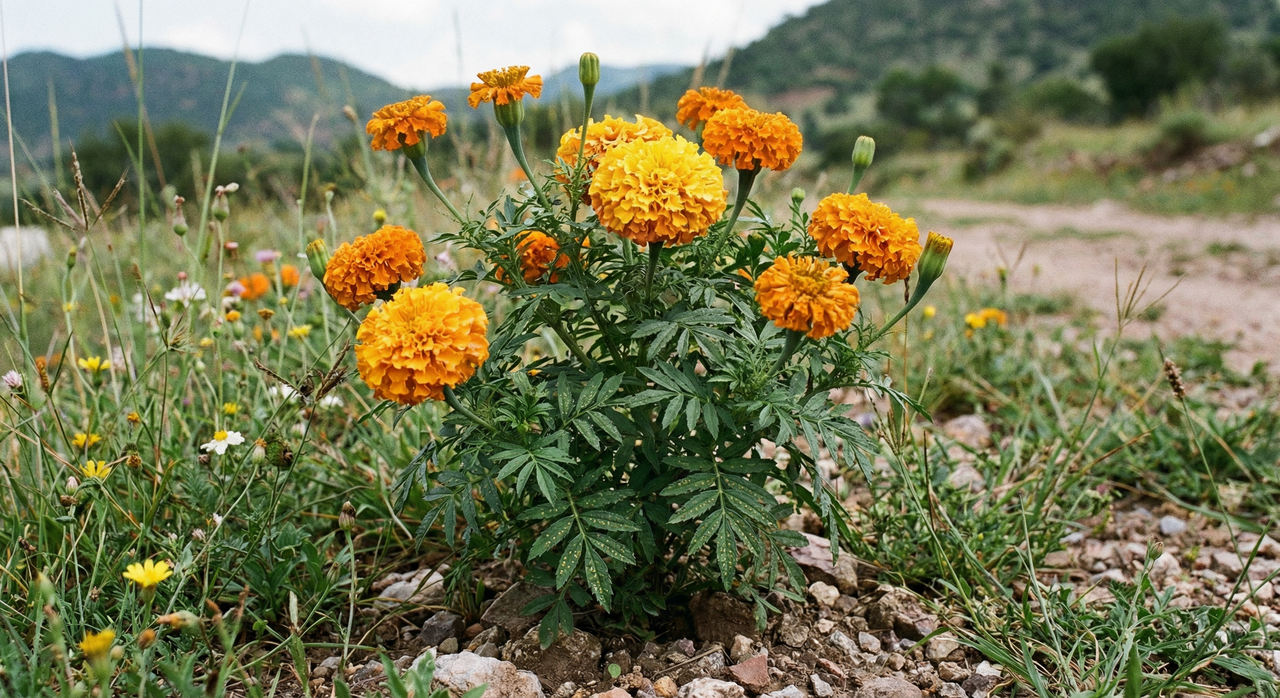
Every gardener I know has grown marigolds, and almost none of them know they're growing a sacred Aztec flower that guided the dead home. That's the thing about Tagetes erecta: it's so relentlessly cheerful, so orange, so available in every gas-station garden display in April, that it's easy to miss the fact that this plant has one of the richest cultural histories of anything you'll put in the ground. The Aztecs called it cempasúchil and cultivated it centuries before Europeans even knew the Americas existed, weaving its flowers into offerings, medicines, and ritual. Today it carpets ofrendas every Día de los Muertos, and somehow it also ended up woven into garlands at Hindu weddings in India. One plant. Two continents. Deep, unrelated reverence on both sides.
What I keep coming back to, after years of growing these in food forests and kitchen gardens, is how thoroughly the "pest repellent companion plant" label flattens everything interesting about this genus. The roots are doing genuine soil chemistry, the petals are edible and worth cooking with, the seeds are trivially easy to save, and the whole plant carries a scent so specific it stops you mid-garden-walk. There's a lot more here than the cheerful border filler everyone treats it as.
Marigold Origin, History, and Traditional Uses
Botanical Background and Native Range
The plant most gardeners call African marigold is actually entirely American. Tagetes erecta, known variously as African marigold, Aztec marigold, or big marigold, is native to Mexico and Central America, from the Mexican highlands down through Guatemala and Honduras, where it colonized disturbed roadsides and agricultural edges from sea level up to around 2,000 meters.[1][2][3] The rest of the genus is equally adventurous in its range. Tagetes minuta, a Southern Cone native, climbs Andean grasslands to 3,500 meters, while Tagetes lucida moves comfortably from sea level up through pine-oak woodlands, and the French marigold (T. patula) claims the mountainous middle ground at 1,000 to 3,000 meters.[4][5] That kind of elevational plasticity across a single genus tells you something useful: Tagetes species are pioneers, plants that evolved to thrive in disrupted, often lean conditions.
I've grown T. erecta from saved seed for over a decade, and I've consistently noticed that plants in my leaner, less-amended beds produce noticeably more pungent foliage than those in richer soil. That sharpness is the plant's chemistry doing what it evolved to do in tough, disturbed ground. It's a reminder that cultural practices shape the plant you get, not just its genetics. That said, the self-seeding is something to manage deliberately. In warm climates, African marigold can naturalize rapidly, and it has invasiveness concerns in Hawaii and Australia; the related T. minuta is already managed as a weed in parts of the United States.[6][7] I treat enthusiastic volunteer seedlings with the same respectful caution I give any vigorous pioneer species and label the ones I want to keep.
Visual Characteristics of Tagetes erecta and Related Species
Tagetes erecta is a tender annual in the Asteraceae family with a bushy, upright habit typically reaching 60 to 90 cm, though some cultivars push to 4 feet on a good year.[8] The stems are sturdy, slightly woody by midsummer, and green to greenish-purple. Brush against them and you immediately get the foliage: pinnately compound leaves with 5 to 7 dark green leaflets, sharply pungent in a way that takes some people by surprise the first time.[8] Compare that to the feathery lemon-scented filiform leaves of signet marigold (T. tenuifolia), and you see why I reach for the two species for completely different jobs: the signet for low edging and the big Aztec types for bold background structure.[9]
The flowers are the showpiece: large, solitary composite heads, 2 to 6 inches across, saturated in yellow, gold, or orange, blooming from midsummer until frost.[8] Those enormous pom-pom cultivars look spectacular in a photo, but in Central Florida's late-summer downpours I've found the more open-headed types hold up far better than the fully double ones, which trap moisture and rot at the center. The fruits are dry, ribbed achenes 6 to 10 mm long, brown to near-black at maturity and straightforward to collect.[4] The plant needs full sun and well-drained soil, tolerates drought once established, and performs well in lean conditions, which makes it genuinely suited to the kind of food-forest understory edges and annual guild beds where I use it most.[10][11]
Cultural Significance and Traditional Uses
The Aztecs domesticated Tagetes erecta long before Europeans arrived, using it for ritual, ornament, and medicine in ways that were already deeply embedded in Mesoamerican life.[12] Spanish colonization moved the plant into the global exchange of the 16th century, and it traveled fast. Within a few generations it was growing in Africa and within Indian gardens, where it took on a whole new ritual life as garlands in Hindu weddings and ceremonies symbolizing prosperity and auspiciousness.[13]
The most vivid cultural use is the one I know best: cempasúchil, the Día de los Muertos flower. In Mexico, the brilliant orange petals and penetrating scent of T. erecta are believed to guide ancestral spirits back to the altars of the living.[14] I build an ofrenda each year with flowers from my own beds, and I can tell you the fragrance hangs in the air in exactly the way the old stories describe. Beyond ceremony, Aztec, Nahua, and Maya peoples used the plant for gastrointestinal disorders, inflammation, wound healing, and as an anthelmintic, uses that parallel what T. lucida offered for digestive and sedative complaints and T. minuta contributed in Andean respiratory medicine.[12][15] The petals also yielded a rich yellow-orange dye from their carotenoid content, and the essential oils served in incense and perfume.[16]
Ethnopharmacological research has since confirmed flavonoids and terpenoids in T. erecta with antioxidant, anti-inflammatory, and antimicrobial activity, offering partial scientific support for many of these traditional applications, though robust clinical trials remain limited and concerns about overharvesting of wild populations are real.[17][18]
Fun Facts About Marigold
The "African" in African marigold is a geographical accident, a naming quirk that stuck after the plant naturalized so quickly across Africa post-Columbian Exchange that early European botanists assumed that was its homeland.[14] And the October birth flower with its centuries of flower symbolism tied to grief, remembrance, and spiritual passage? Entirely a New World plant, born in Mexican mountain scrub. That gap between name and origin is a good reminder that plant histories rarely travel in straight lines.
What keeps marigold in my garden year after year, honestly, is the reliability. The aromatic foliage has been valued by gardeners for centuries for its pest-repellent and nematicidal properties, and that chemistry works whether you know the mechanism or not.[19] There's also the small autumn ritual the plant makes possible, the cutting of those deep orange heads for an ofrenda, which connects a permaculture bed in Florida to a tradition rooted in pre-Columbian Mexico. Not many annuals carry that kind of weight.
Marigold Varieties and Where to Buy Them
The Tagetes genus offers far more variation than most gardeners realize. Walk into any garden center in spring and you'll see flats of bright orange pom-poms, but those represent just a slice of what's actually out there. Understanding the main groups helps you pick the right plant for the right spot rather than grabbing whatever looks cheerful at the checkout.
Main Horticultural Groups and Popular Cultivars
The three main horticultural groups give you a useful mental framework. African marigold plants (Tagetes erecta) are the tall, bold ones, reaching 60 to 100 cm with large 7.5 to 10 cm pompom blooms in golden yellow, orange, and gold.[3][20] French marigold plants (Tagetes patula) stay compact at 20 to 40 cm with smaller 4 to 5 cm flowers. They bring a much broader color palette including reddish-brown and bicolors that the tall types rarely offer.[21] Signet types (Tagetes tenuifolia) are the delicate, lacy ones that most people don't even recognize as marigolds until they get close.
I grow tall and compact types side-by-side every season, and one thing I've consistently noticed in Central Florida's punishing humidity is that the 'Inca' and 'Antigua' series hold their flower form weeks longer than older open-pollinated African lines, which tend to go mushy and brown in prolonged summer rains. Other reliable Tagetes erecta cultivars worth knowing include 'Jubilee', 'Safari', the creamy-white oddity 'Vanilla', and 'Yellow Boy'.[3][8] For french marigold seeds, the 'Bonanza', 'Durango', and 'Queen Sophia' series are the workhorses I return to most years.[22]
The Signet types open the door to kitchen-garden use. The 'Gem' series, including 'Lemon Gem', 'Tangerine Gem', and 'Golden Gem', have lemon-scented foliage and small edible flowers that are genuinely good in salads.[23] The Mexican marigold plant (Tagetes lucida) is its own category entirely, growing 60 to 90 cm with a strong anise aroma and used more as an herb than an ornamental.[8] Tagetes minuta, by contrast, has no named cultivars at all and is grown only as the straight species for essential oil or culinary purposes.[24]
Sourcing Marigold Seeds and Plants
African marigold plants are about as easy to find as any annual in North America. Every garden center, hardware store seed rack, and mainstream catalog carries them, and reputable seed suppliers like Baker Creek, Burpee, High Mowing, Johnny's, and Seed Savers Exchange report germination rates consistently above 90 percent.[25][26] Seed packets for Tagetes erecta typically run $3.95 to $6.95, while french marigold seeds are slightly cheaper at $2.50 to $5.95; potted starts cost $4 to $8 for either type.[27]
For the less common species, you'll need to look further. I order my Tagetes lucida from Native Seeds/Search or Strictly Medicinal because both avoid chemical seed treatments, which matters when you're planning to use the herb in the kitchen.[28][29] Richters Herbs and Plant Delights Nursery also carry it when stock allows. If you want to see how any of these cultivars perform in your specific region before spending money, check whether your local university extension has a demonstration planting; it's an underused resource.
Tagetes minuta is listed as invasive in California, New York, Pennsylvania, Georgia, and North Carolina, and may be restricted or prohibited for sale in those states.[30][31] I personally don't grow it in my own garden because its reseeding in warm climates requires more monitoring than I'm willing to commit to. Always check your state's noxious weed list before ordering from suppliers like Horizon Herbs or Sheffield's Seed Company who carry it.[32] The other four species have no federal restrictions.[1]
Marigold Propagation and Planting (Tagetes erecta)
Marigold seeds are one of the most beginner-friendly things you can sow, and I say that after years of watching first-time gardeners succeed with them under conditions that would stress out fussier plants. But there's more going on inside that little packet than most people realize, and understanding what you're actually working with makes everything downstream easier.
Seed Morphology and Reproductive Biology
Pick up a handful of Tagetes erecta seeds and look closely. They're elongated, wedge-shaped achenes (a dry, one-seeded fruit typical of the Asteraceae family) measuring roughly 5 to 12 mm long, dark brown to nearly black, with a ridged, slightly rough surface and a small crown-like tip where the feathery pappus used to attach.[33][1] Crush one between your fingers and you'll get that sharp, spicy-aromatic hit that's unmistakably marigold. I've found that scent a genuinely useful quality indicator when sorting home-harvested seed from old or damaged batches.
When saving seed from your own plants, note that marigolds are primarily cross-pollinated by bees. Though the flowers are self-compatible, they are strongly outcrossing.[34] That means seeds from open-pollinated plants can show 20 to 50 percent variation in flower color, plant height, and overall habit.[35] I learned this the hard way after saving seed from a mix of neighborhood marigolds one autumn, fully expecting to replant the same beautiful orange cultivar I'd grown that summer. What came up the following spring was a cheerful but chaotic assortment of colors and heights that bore almost no resemblance to what I started with. Keeping varietal purity requires isolation distances of at least 30 to 50 meters, sometimes up to 400 meters for true purity.[36] For most home gardeners, buying fresh F1 hybrid seed is the practical solution for consistency. That said, deliberately growing open-pollinated heirlooms with isolation or simply embracing the variation can be genuinely fun if you're not chasing a specific look.
Most T. erecta seeds develop a single embryo, but some cultivars show polyembryony, producing two to five embryos per seed including clones of the mother plant.[37] The related T. lucida takes a completely different approach with apomixis (seed production without fertilization), which means it reliably breeds true from saved seed with minimal variation.[38] Seed is overwhelmingly the method of choice for T. erecta; stem cuttings are possible but show only 40 to 60 percent success compared to the 70 to 90 percent germination rates you get from fresh, well-stored seed.[39][40] Cuttings work much better on T. lucida and T. tenuifolia; tissue culture exists commercially but has no practical application for home gardeners. Store any unused seed in an airtight container with a desiccant in a cool, dark spot and you can expect reliable germination for two to five years, with properly sealed seed bank conditions extending viability a decade or more.[41]
Germination Timeline and Starting Methods
Germination is fast and satisfying. At the optimal soil temperature of 70 to 80°F, T. erecta seeds typically sprout in four to seven days, and you should expect first blooms around 60 to 75 days from sowing.[40][8] Start seeds indoors six to eight weeks before your last frost date, sowing about a quarter to half an inch deep in a warm spot or on a heat mat.[42] In my Central Florida garden, where damping-off is a real threat in humid conditions, I watch soil moisture carefully during that germination window; consistent bottom heat matters more than ambient air temperature here.
Direct sowing works beautifully once soil has warmed to at least 60°F and your last frost has passed. French marigolds (T. patula) tend to be the speediest of the bunch, blooming in 50 to 70 days, while T. minuta takes its time with germination stretching to seven to 21 days and flowering anywhere from 60 to 120 days depending on daylength.[43] Fresh seed is always your best bet; properly stored seed stays reliable for two to three years, but I've opened packets left in a warm shed over summer and gotten heartbreakingly poor results. Cool, dark, and dry is the rule.
Soil, Site Selection, and Planting Technique
Tagetes erecta comes from semi-arid Mexican highlands with well-drained volcanic and limestone-derived soils, and that native context explains nearly everything about what it needs in your garden.[44] Drainage isn't just a preference; it's non-negotiable. Waterlogged or heavy clay soil is the fastest route to root rot, and the plant will tell you quickly with yellowing, wilting, and rapid collapse. The sweet spot is a loamy or sandy loam texture with moderate organic matter (around 2 to 5 percent) and a pH of 6.0 to 7.0, though the plant tolerates a broader range of 5.5 to 8.0.[45][40] Push above 7.5 and you'll see interveinal chlorosis as iron and manganese become unavailable. A simple spring soil test followed by a light lime or sulfur amendment has eliminated that yellowing for me in beds where I previously struggled with it.
Full sun (six to eight hours of direct light daily) is the other non-negotiable.[40] Adequate sunlight is the primary driver of rapid early establishment. The fibrous root system reaches 12 to 18 inches deep, so aim for at least 12 inches of workable soil depth in beds and containers alike, and avoid compacted spots where bulk density climbs above what roots can easily penetrate.[46] For containers, I use a mix of roughly half peat or coco coir, a third perlite, and the remainder compost; it drains fast enough to keep roots happy even through heavy subtropical rains. One thing I've noticed in Florida's sandy soils specifically: adding too much compost chasing "rich soil" can actually retain more moisture than the plant wants. Moderate fertility, good structure, excellent drainage.
Spacing, Thinning, and Establishment Tips
Standard T. erecta plants need 12 to 18 inches between them, with rows 24 to 36 inches apart.[40] That feels generous when you're tucking in small transplants, but these plants spread 30 to 45 inches at maturity, and crowding them invites the powdery mildew and botrytis that thrive without airflow.[47] In my mixed borders, I keep the tall African types toward the back at 18 inches apart so their bold vertical presence doesn't overwhelm the signet or French types planted in front at closer six to twelve inch spacings. The spacing difference becomes a design principle as much as a cultural one.
Pinching the growing tips when plants reach six to eight inches tall encourages branching and more flower stems, which can also let you push plants slightly closer in a dense planting scheme without sacrificing airflow at the base.[48] Transplant hardened-off seedlings after your last frost once soil hits 60°F, setting them at the same depth or just slightly deeper to help with stem stability. Thin direct-sown seedlings to final spacing once they have their first true leaves. For T. minuta, the giant Southern Cone species that can reach five to ten feet, treat it the way you'd treat a volunteer sunflower: give it 18 to 30 or more inches and keep it away from herbs and vegetables you care about, because its allelopathic roots will suppress neighboring plants.[49] Generous spacing isn't just about plant health; it's about setting up the whole guild to function well from the start.
Marigold Care and Growing Guide
Marigolds are about as unfussy as annual flowers get, but "unfussy" doesn't mean "ignore them and hope for the best." There's a short list of things they genuinely need, and getting those right is the difference between a handful of scraggly stems and a bed that blooms from June until frost. I've grown both African and French types from seed for years in Central Florida's punishing summer humidity, and most of the problems I've seen come from the same few missteps: too much shade, inconsistent watering, or too much fertilizer. Get the fundamentals right and the plant does the rest.
Sunlight Requirements
Tagetes erecta wants full sun, full stop. At least 6 to 8 hours of direct light daily is what produces the compact habit and prolific flowering that gardeners are after.[50][42] Plants in partial shade will technically survive, but they'll stretch toward the light, produce fewer blooms, and become the leggy disappointment you see in neglected garden corners. In Central Florida, where afternoon sun is genuinely brutal from June onward, I've found that a bit of filtered shade after 3 p.m. actually extends bloom quality without sacrificing much flower production. Mexican marigold (Tagetes lucida) tolerates more shade than its relatives[8], which makes it the better call for spots under taller crops like tomatoes or pole beans.
Water Needs
The target is about 1 inch of water per week during active growth, delivered deeply and infrequently so the full root zone gets moistened while the top inch or two of soil dries between sessions.[51][40] Young seedlings need more attention, roughly every 2 to 3 days with lighter watering, but once plants hit their stride they develop real drought tolerance and can go 5 to 7 days without irrigation before you'll notice stress.[42] In my experience, established marigolds sail through two-week dry spells with only mild wilting, especially compared to thirstier annuals like petunias that collapse dramatically at the first sign of drought.
The failure modes are easy to read once you know them. Overwatering shows up as yellowing lower leaves and soft stems; underwater stress produces wilting and brown leaf edges.[40][42] The fix for both is the same: check the soil before reaching for the hose. A 2-inch layer of pine straw or other organic mulch makes a real difference in raised beds where moisture evaporates quickly, and it's become a non-negotiable step in my summer planting routine.
Feeding and Soil Fertility
Marigolds are light feeders and they perform best that way. Rich soil or heavy fertilization, especially anything high in nitrogen, pushes lush foliage at the direct expense of flowers.[52][40] Over-feeding is far more common than under-feeding in home gardens. In my sandy Central Florida soil, a single incorporation of compost at planting is usually all the season requires. If you're working with poorer ground, a balanced formula like 10-10-10 or a phosphorus-forward 5-10-10 applied lightly every 4 to 6 weeks supports steady growth without pushing it into vegetative overdrive.[53]
Soil pH should sit between 6.0 and 7.0 for best nutrient uptake.[43][54] Alkaline conditions above 7.0 can trigger iron, zinc, or manganese deficiencies that show up as pale, yellowing leaves. If you're seeing purplish foliage and weak roots, suspect phosphorus. Marginal browning and floppy stems often signal potassium deficiency. Leaf-tip burn and excessive green growth with few flowers, on the other hand, usually mean you've been too generous with the fertilizer bag.
Frost Tolerance and Cold Protection
Tagetes erecta is frost-tender. Temperatures at or below 32°F (0°C) are lethal, and even a brief dip to around 28°F (-2°C) can cause wilting and leaf necrosis.[55][56] Growth slows noticeably below 50°F, and the sweet spot is daytime temperatures between 60 and 75°F. Plant after your last frost date, full stop.
Across USDA zones 2 through 8, marigolds are true annuals that die with the first hard freeze.[40] In zones 9 through 11 they can persist as short-lived perennials with some protection: floating row covers add 4 to 8°F of buffer, 3 to 4 inches of organic mulch protects the root zone, and container plants can move indoors to a bright, cool location.[57] Mexican marigold (Tagetes lucida) handles a bit more cold, tolerating down to roughly 10 to 20°F in sheltered spots and generally rated for zone 8.[8]
Heat Tolerance and Summer Management
Marigolds are remarkably well-suited to heat, rated across AHS Heat Zones 1 through 11 with an optimal daytime range of 70 to 85°F.[40] They can sustain 90°F without significant stress, and brief spikes to 95 or 100°F are survivable if nights cool below 60°F for recovery.[58] Their Mexican and Andean origins gave them deep taproots, thickened leaves, and protective pigments that translate directly into garden resilience. Seedlings are the vulnerable stage; above 95°F they show reduced growth and real oxidative stress, so get transplants established before peak summer heat hits.[59]
When sustained heat is unavoidable, a few interventions help considerably. A 30 to 50 percent shade cloth during peak afternoon hours, 2 to 3 inches of organic mulch, and deep morning irrigation together address the main stress factors.[60][61] If you're in a region where summers regularly push past 90°F, cultivars like 'Golden Jubilee' or 'Pusa Narangi' are worth seeking out for their documented heat tolerance.
Pruning, Maintenance, and Seasonal Rhythm
Pinch the growing tip when seedlings reach 6 to 8 inches tall or develop three to four sets of true leaves.[62][40] The difference is dramatic: plants that would have produced a few large blooms on bare stems instead branch out into compact, floriferous mounds that keep the pollinators busy for months. From there, consistent deadheading back to a healthy leaf node is the single highest-return maintenance task you can do, extending bloom continuously from early summer through the first frost.[8] A layer of organic mulch handles the rest of the housekeeping, suppressing weeds and moderating soil temperature. Tall varieties may need staking in exposed or windy spots.
At season's end in zones 9 through 11, cut perennial plants back hard after a frost and clear all debris to reduce overwintering disease and pest pressure.[8][63] Mexican marigold (Tagetes lucida) benefits from division every 2 to 3 years in spring or fall to stay vigorous. A word of caution on Southern Cone marigold (Tagetes minuta): I've seen it form dense stands in disturbed areas in warm climates, and if you're growing it in the southern U.S. you should deadhead ruthlessly or confine it to containers.[64]
Tagetes erecta runs from seed to first bloom in 50 to 70 days and flowers prolifically until hard frost, adjusting its needs at each stage.[65][42] Seedlings want consistent moisture and minimal fertilizer; vegetative plants respond to pinching and balanced feeding; flowering plants want slightly reduced water and nitrogen with more emphasis on phosphorus. Follow that seasonal rhythm and the reward is months of color, beneficial insects drawn to every bloom, and soil that's measurably better for nematode suppression by the time you pull the plants in autumn.
Harvesting Marigolds: Timing, Technique, Yield, and Flavor
When and How to Harvest Tagetes erecta Flowers and Seeds
One thing I love about marigolds is how quickly they reward patience. Tagetes erecta reaches first bloom 55 to 70 days after sowing, with compact varieties sometimes opening as early as 50 days and the full flush arriving by 90.[66][40] Cut flower harvest typically begins around week 8 to 10, and from there, regular picking every 3 to 5 days keeps the flushes coming all season.[67][68] In my Central Florida beds, that translates to a relentless bloom cycle from early summer straight through the first frost threat.
For cut flowers, I do a quick inspection every morning before 10 a.m. What I'm looking for: petals that are 75 to 100 percent open, color that's vivid and saturated rather than fading at the edges, and that sharp pungent fragrance that hits you when you lean in.[43][69] Firmness matters too. I gently pinch the base of the head; if it feels turgid and solid, it's ready. Skip buds entirely on erecta -- unlike some cut flowers that open beautifully in the vase, marigolds peak on the plant.
For seed saving, the cue is completely different. You're waiting 30 to 45 days past anthesis until the heads turn brown, dry, and papery.[43][66] My practical test is a shake: if the dried head rattles when you tap it, the seeds are loose and ready. That little tactile cue has improved my germination rates more than any other adjustment I've made. French types (Tagetes patula) complete their seed cycle faster, maturing in 90 to 120 days from planting, while Southern Cone marigold needs a full 150 to 180 days -- worth planning for if you're growing it specifically to save a dried marigold flower for next season's sowing.[66][70]
Post-Harvest Handling, Storage, and Flavor Profiles Across Marigold Species
The cut itself matters more than most gardeners realize. I use a 45-degree angle just above a node, drop the stems immediately into clean water with floral preservative, then recut 2 to 3 cm underwater and strip any foliage below the waterline.[43][71] I learned the hard way that skipping the underwater recut lets an air bubble seal the stem. The flowers look fine for a day and then collapse. Stored at 0 to 5°C with high humidity, erecta stems can hold 7 to 10 days,[71][72] and I've routinely gotten 8 to 9 days when I nail the temperature and use a proper STS pulse. The research numbers are accurate -- they just require the whole protocol, not shortcuts.
On flavor: the petals are what you want from Tagetes erecta, full stop. They deliver a crisp, citrusy-tangy bite with a peppery-spicy edge and a mild bitter finish.[73][74] The leaves are fibrous, bitter, and not worth eating. French marigold petals run milder and slightly sweeter when young, and dried petals intensify into something close to a paprika substitute.[75][76] Mexican marigold (Tagetes lucida) is a different beast entirely; the leaves and flowers carry a sweet anise-licorice character driven by high anethole content, which is why I grow it specifically as a warm-climate tarragon substitute.[77] Harvest those leaves at 60 to 70 days, just before flowering, for peak flavor.[78] Signet marigold (Tagetes tenuifolia) is the most kitchen-friendly of the group -- its flowers and leaves have a fresh, bright lemon-citrus quality, with the youngest flowers offering the mildest, sweetest taste.[79][80] Whatever species you're harvesting for the kitchen, the window of best flavor overlaps almost exactly with the window of best cut-flower quality: early morning, peak color, just before the plant sets seed.
Marigold Preparation and Uses
Culinary Uses and Safety Guidelines for Tagetes erecta
The first rule I follow with edible marigolds is simple: petals only, and only from plants I know haven't been sprayed. The FDA recognizes marigold petals as generally recognized as safe for food use in small quantities,[81][76] but leaves, stems, and essential oils contain potentially irritating thiophenes including alpha-terthienyl.[82] I never use anything but the petals in food, full stop. If you have Asteraceae allergies, extra caution applies, and it's worth knowing that marigolds can cause vomiting or dermatitis in pets if they consume significant quantities.[83]
Tagetes erecta petals are highly valuable in the kitchen. The flavor is peppery and citrusy with a slight bitterness,[75] and the carotenoid content, especially lutein and zeaxanthin, makes them a nutritional bonus in salads, rice dishes, soups, infused oils, and flavored butters.[84] Traditional Mexican cooks have long used them as a saffron substitute to color and flavor rice, moles, and salsas.[85] I harvest my blooms early in the morning when volatile aromatic compounds are at their peak, and if I'm drying petals, I shade-dry at low heat rather than leaving them in the sun. Phytochemical analyses confirm what my nose already told me: shade or air-drying at around 40°C preserves far more of those aromatic volatiles than sun-drying does.[86]
The genus extends the flavor palette considerably. Tagetes lucida (Mexican tarragon) brings sweet anise-like leaves and flowers that substitute beautifully for French tarragon in moles, teas, and tamales,[87] while Tagetes tenuifolia, the signet marigold, offers mild lemony petals that are far gentler than the citrus punch of erecta.[88] Tagetes minuta, huacatay, is in a category of its own: the pungent, citrus-mint leaves are used sparingly in Andean sauces and marinades and harvested from young, pre-flowering plants to keep the bitterness manageable.[89]
Medicinal Preparations and Traditional Remedies
Traditional preparations with Tagetes erecta flowers lean on methods that have been in use across Mesoamerica long before clinical trials existed. Simple infusions run about one to two teaspoons of dried petals per cup steeped for ten minutes; decoctions simmer fifteen to twenty minutes for a more concentrated result; tinctures are taken at roughly five to fifteen drops three times daily; and fresh-petal poultices are applied directly to minor skin irritations.[75][90] I'll occasionally press a fresh petal poultice onto a minor sting or scrape in the garden, but I'm clear with myself that these dosages are traditional and unstandardized, not clinical prescriptions. Related species like Tagetes lucida and Tagetes minuta carry their own ethnomedicinal histories across Mexico and South America, used for digestive complaints, colds, and respiratory ailments,[91][92] and modern supplement formulations now extract flower constituents specifically for their antioxidant and anti-inflammatory properties. The preclinical evidence is genuinely interesting; the human trial data, as covered elsewhere in this profile, remains thin.
Non-Food Applications: Dyes, Decoration, and More
Every fall I hang bundles of Tagetes erecta upside down in my drying shed, and watching those blooms hold their vivid gold and orange through weeks of drying never gets old. The color stays because the carotenoids in the petals are genuinely stable when you keep humidity low and light out.[93] For anyone drying for decoration or for natural dye work, aim for a cool, dark, ventilated space over one to two weeks, then store the dried material in airtight jars at 60 to 70°F with humidity below 60 percent; done right, color and fragrance hold for up to two years.[94] As a natural dye source, marigolds have centuries of use in Mexico, India, and the Andes for textiles and food coloring alike,[95] and essential oils distilled from several Tagetes species find their way into perfumery and insect-repellent formulations. Tagetes minuta rounds out the genus with modest utility in rural South American communities, where stems have been used for rough cordage, fodder, and even biofuel,[96] though these uses are niche and the data on them is sparse. The flowers you grow for your kitchen or your companions earn their place in the drying shed too.
Marigold Health Benefits and Medicinal Uses
Marigolds are not some newly discovered superfood. Most of the pharmacological research on them hasn't yet made it into human clinical trials. What they do have is a long, serious ethnobotanical record and a growing body of preclinical science that makes that record a lot more credible. That's a combination worth understanding, especially for gardeners who already grow them and wonder what else the flowers are good for.
Traditional Uses and Modern Research on Marigold
Indigenous Mexican communities historically applied Tagetes erecta to treat eye infections and respiratory coughs, alongside its recognized gastrointestinal uses.[97][98] Similar uses appear across T. patula, T. lucida, and T. tenuifolia, suggesting these aren't coincidental folk observations but a coherent body of traditional knowledge built up across generations.[99] I deeply respect that lineage, and I also think it deserves honest scrutiny: most of the supporting science is from in vitro studies and animal models, and large-scale randomized human trials remain scarce across the whole genus.[100][101]
The preclinical data is genuinely interesting. Anti-inflammatory effects have been confirmed in extracts, attributed in part to the flavonoid quercetagetin.[102] Antioxidant activity is strong across the genus, with marigold extracts scavenging free radicals through the Nrf2 pathway at levels comparable to ascorbic acid in some assays.[103] The essential oil shows antimicrobial action against Staphylococcus aureus, E. coli, and Candida albicans, with thiophene compounds like alpha-terthienyl generating reactive oxygen species in a photodynamic, light-dependent process.[104] Secondary findings in animal models include alpha-glucosidase inhibition comparable to acarbose (suggesting antidiabetic potential), hepatoprotective effects, and analgesic activity.[105][106] Anticancer researchers have also observed apoptosis induction via caspase activation in cancer cell lines, which is noteworthy but a long way from clinical application.[107] My position as a grower and educator: traditional uses passed down through generations carry real weight, and so does the need to consult a qualified healthcare provider before using marigold medicinally.
Key Phytochemicals in Marigold
What drives all of the above is a dense phytochemical profile. The flowers contain flavonoids (quercetin, patuletin, quercetagetin), phenolic acids like chlorogenic and caffeic acid, terpenoid essential oils including limonene and tagetone, carotenoids, thiophenes, saponins, coumarins, and tannins.[108][109] The real standouts are the carotenoids: lutein makes up 60 to 70 percent of total carotenoids in the petals, reaching up to 16 to 20 mg per 100g fresh weight, with zeaxanthin alongside it.[110] Lutein's association with reduced risk of age-related macular degeneration is probably the most clinically grounded health claim attached to this plant.[111]
Compound distribution matters here. Flowers are richest in carotenoids and flavonoids; leaves carry moderate phenolics; roots concentrate thiophenes, with alpha-terthienyl reaching 0.05 to 0.1 percent by dry weight.[112] Growing conditions shift these concentrations significantly, up to 40 percent in some studies, depending on UV exposure, drought stress, and seasonal timing.[113] After years growing marigolds in full Central Florida sun, I've noticed that flowers from the hottest, brightest spots always run deeper orange with a stronger resinous scent, and that tracks with what the research says about UV stress pushing carotenoid and essential oil production higher.
Nutritional Profile of Marigold
Fresh marigold petals are low in calories (roughly 35 to 50 kcal per 100g), with modest protein (2 to 3g), carbohydrates (6 to 8g including 2 to 3g fiber), around 10 to 15 mg vitamin C, and potassium running high at approximately 1200 mg per 100g dry weight.[114][115] These figures aren't standardized in USDA databases and vary by cultivar and conditions, so treat them as ballpark values. The real nutritional argument for eating marigold petals isn't the macros; it's the lutein that most people don't get nearly enough of. Think of it like adding calendula blooms or squash blossoms to a salad: you're not transforming the dish nutritionally, but you're pulling in a fat-soluble carotenoid that earns its place. Flavonoids in the petals also show DPPH free-radical scavenging up to 80 to 90 percent in extract studies, though those values come from concentrated extracts, not a handful of flowers scattered on a plate.[109][116] Edible species, including T. patula, T. tenuifolia, and T. minuta flowers and T. lucida leaves, all share a similar low-calorie, carotenoid-forward profile when consumed in food amounts from pesticide-free plants.[117]
Safety Considerations for Marigold
Culinary use of marigold petals in moderate amounts is genuinely safe. Human toxicity data puts the LD50 for T. erecta above 2000 mg/kg, and no significant adverse effects are reported at typical food quantities, though overconsumption can cause mild gastrointestinal upset.[75] The situation changes quickly when you move from petals to other plant parts, or from food use to medicinal doses. Sap and essential oils can cause contact dermatitis, and if you have ragweed sensitivity or react to other Asteraceae, that risk is higher.[118][119] I learned this the hard way in my own garden: a family member reacted to handling leaves of a nearby Asteraceae, which is exactly why I now keep all my rows clearly labeled and harvest only petals for the kitchen.
Livestock are a separate concern. The thiophenes concentrated in marigold tissue, especially in T. minuta, can cause photosensitization in animals that graze on large amounts, leading to phototoxic skin damage on sun-exposed areas.[120] The same compounds that make marigold roots such a useful nematode suppressant in my permaculture beds are the reason I keep livestock well away from those plantings. Off-flavor transfer to milk and meat is also documented in grazing animals.[121] For pets, the ASPCA lists marigold as mildly toxic; small amounts are unlikely to cause serious harm, but larger ingestion can produce vomiting or diarrhea.[122]
Essential oils require specific caution: they're toxic if swallowed undiluted and require heavy dilution for any topical application. T. lucida oil is high in estragole, which raises hepatotoxic and potential carcinogenic concerns at excess doses.[123] All oils should be avoided in sunlight due to phototoxicity. For pregnancy, the traditional record includes emmenagogue and uterotonic uses, and safety data for medicinal doses during pregnancy or breastfeeding is simply insufficient to recommend it.[124] There's also theoretical CYP3A4 inhibition from quercetagetin in vitro, which could affect metabolism of certain medications, though clinical evidence for meaningful drug interactions remains thin.[102] If you're on regular medications or managing a health condition, that's a conversation for your doctor, not your gardening guide.
Marigold Pests and Diseases
Marigold's reputation as a companion plant isn't folklore. The same chemistry that gives the roots their pungent smell is actively working in the soil, and after years of growing these plants as borders and intercrops in my food forest designs, I can say the research holds up in real garden conditions. The key is understanding exactly what marigolds do well, and where they have limits, so you can build them into a system that actually works.
Nematode Resistance and Allelopathic Effects
Root-knot nematodes are one of the most frustrating soil problems a vegetable gardener faces, and this is where marigolds genuinely shine on the evidence. Tagetes erecta roots exude alpha-terthienyl, a thiophene compound with documented nematicidal properties that can reduce Meloidogyne populations by 60-80% in field studies.[125][126] French marigold (Tagetes patula) pushes that further, reaching up to 90% reduction in some trials, while Tagetes minuta shows around 60% reduction in potato fields.[127][128] In my experience, the most dramatic results come when plants are grown in full sun with good airflow and kept in place through the whole season so the roots have time to saturate the surrounding soil. A few marigolds stuck in as an afterthought won't do much; a dense planting held for a full growing cycle will.
Insect Repellent Properties and Common Pests
The same glandular trichomes that make marigold foliage sticky and aromatic are producing essential oils rich in ocimene, limonene, tagetone, and thiophenes that physically and chemically deter feeding insects.[129] Companion planting with Tagetes erecta has reduced aphid and whitefly populations by 50-70% in trials,[130][131] and essential oil extracts show 70-90% repellency against thrips in laboratory bioassays.[132] I've compared marigold interplanting against basil and nasturtium for aphid pressure on my tomatoes, and honestly they all help, but marigolds add the root-zone benefit the others don't.
Here's where I want to be direct, though: marigolds are not bulletproof. Under hot, dry, or stressed conditions, Tagetes erecta can still pick up aphids, whiteflies, spider mites, thrips, leafminers, and cutworms.[133][134] I still monitor for spider mites in hot dry spells even in beds with strong marigold populations. The plant's defenses are real, but they work best within a broader IPM approach, not instead of one. On the positive side, marigolds also draw ladybugs, lacewings, hoverflies, and parasitic wasps, so the plant is doing double duty: deterring some pests while recruiting beneficials to handle the rest. Cultivars from the Inca series and Bonanza show improved pest resistance if you're looking for a starting point.[43]
Disease Resistance and Susceptibilities
Overall, Tagetes erecta is considered high in disease resistance compared to most common ornamentals, and many extension resources classify it as essentially disease-free under good conditions.[135][136] The Inca series has been bred specifically for resistance to damping off, Fusarium wilt, and Phytophthora root rot, and in my trials these have consistently outperformed older open-pollinated African types when humidity is high. If Fusarium is a serious concern in your beds, French marigold (Tagetes patula) offers even stronger resistance, with some cultivars approaching near-immunity.[137][138]
That said, problems do happen when cultural conditions slip. Leaf spot (Alternaria or Xanthomonas), downy mildew in cool humid weather below 20°C, root rot from Pythium or Phytophthora in poorly drained soils, Botrytis blight in overcrowded or poorly ventilated conditions, and viral diseases including Tobacco Mosaic Virus and Tomato Spotted Wilt Virus are all documented vulnerabilities.[135][40][139] I learned the Botrytis lesson the hard way: I once started a tray of seedlings too densely in a humid greenhouse and lost a good third of them to gray mold before they ever hit the garden. Wider spacing and a fan running low would have fixed it entirely.
Prevention Through Cultural Practices and IPM
Most disease problems in marigolds trace back to conditions rather than any inherent weakness in the plant. Optimal disease resistance happens at soil pH 6.0-7.5, temperatures between 18-27°C, and moderate humidity around 40-60%.[40][140] Deep, infrequent watering at the base rather than overhead, 12-18 inch spacing for airflow, full sun, and avoiding excess nitrogen all prevent the stressed, wet conditions where disease takes hold.[40] When I grow them in well-drained raised beds here in Central Florida, root rot is essentially a non-issue even through our humid summers.
For longer-term soil management, rotate marigolds out of the same bed every 2-3 years, and if Fusarium has been confirmed, avoid replanting in that soil for 3-5 years.[141][142] Remove infected plant material promptly, and if you do need to intervene chemically, sulfur or potassium bicarbonate address powdery mildew, copper fungicides work for downy mildew, and protectant fungicides cover Alternaria leaf spot.[143] But in a well-managed permaculture bed, you'll rarely get there. The cultural basics are almost always enough.
Marigold in Permaculture Design
Marigold doesn't earn its place in a permaculture system by fixing nitrogen or shading out weeds with a massive canopy. Its work is quieter than that, and in some ways more interesting. What Tagetes erecta brings to a guild is chemistry: root exudates that reshape the soil biology around neighboring plants, flowers that pull in hoverflies and bees from late summer until frost, and a biomass that gives back to the soil it grew from. I've been interplanting marigolds with food crops in Central Florida gardens for years, and the cumulative effect on soil health is genuinely noticeable, even if it's never flashy.
Climate Adaptation and Hardiness Zones
Tagetes erecta is a warm-season annual across most of the country, hardy as a short-lived perennial only in USDA zones 9-11 where frost isn't a factor.[144][1][145] In cooler zones (2-8), treat it as a direct-sow or transplant annual timed after your last frost date. It does best between 70-85°F with nights staying above 55°F; growth slows noticeably below 59°F and a hard freeze will kill it outright.[145][52][144] Here in subtropical Central Florida, self-seeding is reliable enough that I sometimes find volunteers from the previous season's planting, but I still start fresh seed for clients in zone 7 and below.
Across the genus, full sun and well-drained soil with a pH of 6.0-7.5 are non-negotiable; all Tagetes species are notably sensitive to waterlogging despite moderate drought tolerance once established.[146][8][147] Optimal annual rainfall sits around 25-40 inches with moderate humidity (30-60%) to keep fungal pressure low.[148][1] The French marigold (T. patula) performs reliably across zones 5-10, while T. lucida and T. tenuifolia can persist as short-lived perennials from zone 8-9 with some frost protection.[50][8] T. minuta covers a similar warm-zone range but carries a genuine invasiveness risk in disturbed habitats outside its native South American home, so handle that one carefully.[149][150]
Ecosystem Functions and Guild Roles
The real permaculture story with marigold starts underground. The roots of Tagetes species release chemical exudates that actively suppress root-knot nematodes (Meloidogyne spp.), while also modulating rhizosphere microbes in ways that favor nematode-trapping fungi.[151][152][153] After seasons of running African and French marigolds through tomato beds, I consistently see dramatically lighter nematode damage in the following year's crop. The research supports what I'm observing on the ground.
Above ground, those large composite flowers (2-6 inches across on T. erecta) produce both nectar and pollen across a long bloom window from midsummer until frost, drawing bees, butterflies, and hoverflies reliably.[4][154] Pollinator visits do drop off above 95°F or during heavy rain, so dense plantings help maintain consistent coverage on hot days.[155][156] The fibrous root system also stabilizes soil in disturbed areas, and the annual biomass is genuinely useful as green manure or chop-and-drop mulch at season's end.[157][158] I routinely chop spent marigold plants into my food forest edges in fall; by the following spring the soil under those areas is consistently looser and more earthworm-rich than where I didn't bother. T. lucida and T. patula can also accumulate potassium and phosphorus from deeper soil layers before returning them to the surface through decomposition.[159][160]
Before planting heavily, keep in mind that T. minuta's vigorous, drought-hardy growth can tip from useful to invasive quickly in warm-climate disturbed sites outside its native range.[149][161] I avoid it in any bed I don't manage closely, because I've watched it self-seed aggressively in warm-zone landscapes. The well-behaved cultivars of T. erecta and T. patula deliver most of the same ecosystem benefits without that risk.
Placement in Forest Layers and Companion Guilds
Tagetes erecta fits the herbaceous layer of a food forest at 18-36 inches tall (occasionally reaching 4 feet in ideal conditions) with a spread of 12-24 inches, making it useful both as a standalone herbaceous layer element and as a living mulch beneath taller crops.[162][1] Compact T. patula and T. tenuifolia (6-24 inches) tuck neatly into understory or edge positions, while the towering T. minuta (up to 3 meters) can function as a pioneer or border species where you want more physical presence.[150][163] T. lucida deserves special mention here because it tolerates light shade under a young fruit tree canopy better than the other species, though all of them flower and perform their pest-suppression work best in full sun.[164][8] I think of T. lucida as a more shade-tolerant cousin of culinary tarragon, useful for tucking into spots where other marigolds would sulk.
The most productive guild placement is alongside nightshades. Tomatoes, peppers, and eggplants intercropped with marigolds benefit from the combined effects of nematode suppression in the root zone and improved pollinator traffic around the flowers.[165][166] That's a pairing I use consistently in client gardens, and it's one of the more evidence-backed companion combinations in annual polyculture design.
That said, marigold as an insect repellent is a common claim that deserves some nuance. The nematode suppression data is robust. The idea that they wholesale repel above-ground pest insects is more complicated and covered more thoroughly in the pests and diseases section. What I can say from design experience is that placement matters enormously. Marigolds are not nitrogen-fixers, and their allelopathic root compounds can actually inhibit sensitive crops if spacing is too tight.[167][165] Early in my career I lost a row of young beans planted too close to a dense marigold border; that experience taught me to keep a 12-18 inch buffer or to use marigolds as a bed border rather than a direct intercrop with legumes or brassicas. Small-scale trials in your own soil and climate are always wise before committing a full guild design to any companion planting combination.
The Plant I Always Come Back To
I've pulled marigolds out of beds to make room for something more "productive," and I've regretted it every single time. There's a particular afternoon I keep returning to, weeding between tomato rows in late summer, hands smelling like that sharp, resinous foliage, and realizing the soil underneath those plants was darker, softer, more alive than anywhere else in the garden. Nothing flashy. Just the quiet, steady work of a plant that's been doing this for centuries without anyone asking it to.
Sources 167
- USDA PLANTS Database - Tagetes erecta ↩
- Royal Botanic Gardens Kew - Tagetes erecta ↩
- Tagetes erecta - RHS Gardening ↩
- Flora of North America: Tagetes erecta ↩
- Tagetes minuta | Plants of the World Online | Kew Science ↩
- Tagetes erecta - USDA PLANTS Profile ↩
- Invasive Plant Atlas of the United States - Tagetes minuta ↩
- Tagetes erecta ↩
- Flora of North America: Tagetes tenuifolia ↩
- Tagetes erecta ↩
- Marigolds (Tagetes) ↩
- Marigolds in Mexican Folk Medicine ↩
- Ethnobotany of Tagetes erecta in Mexico and India ↩
- The Role of Marigolds in Día de los Muertos ↩
- Tagetes lucida: Ethnopharmacology, Phytochemistry, and Pharmacology ↩
- Carotenoid Content and Dye Potential of Tagetes erecta Petals ↩
- Ethnopharmacological Survey of Tagetes erecta ↩
- Conservation of Wild Tagetes Species ↩
- Ethnobotany of Tagetes erecta ↩
- African Marigold Varieties ↩
- Royal Horticultural Society - Tagetes patula ↩
- Missouri Botanical Garden - French Marigold Cultivars ↩
- Tagetes tenuifolia - Signet Marigold ↩
- Tagetes minuta - Wikipedia ↩
- PLANTS Database ↩
- Johnny's Selected Seeds Customer Reviews ↩
- Tagetes erecta Seeds ↩
- Native Seeds/Search - Tagetes lucida ↩
- Tagetes lucida Seeds - Mexican Tarragon ↩
- Invasive Plant Atlas of the United States ↩
- USDA PLANTS Database: Tagetes minuta ↩
- PLANTS Database ↩
- Seed Morphology of Tagetes Species ↩
- Pollination Biology of Tagetes erecta ↩
- Seed Production and Genetic Variability in Marigolds ↩
- Tagetes patula (French Marigold) - Seed Saving and Propagation ↩
- Polyembryony and Apomixis in Tagetes ↩
- Apomixis in Tagetes lucida Cav. ↩
- Vegetative Propagation of Marigolds ↩
- Marigold Cultivation Guide ↩
- Orthodox Seed Storage Behavior in Tagetes - Journal of Experimental Botany ↩
- Royal Horticultural Society - Tagetes ↩
- Marigold Production Guide ↩
- Marigold Cultivation Guide - University of Florida IFAS Extension ↩
- Tagetes erecta - Missouri Botanical Garden ↩
- Root Rot in Marigolds - University of Minnesota Extension ↩
- University of Maryland Extension - Marigolds ↩
- Commercial Production of Marigold ↩
- Tagetes minuta Cultivation ↩
- Missouri Botanical Garden - Tagetes erecta ↩
- Missouri Botanical Garden - Tagetes erecta ↩
- Missouri Botanical Garden - Tagetes erecta ↩
- Texas A&M AgriLife Extension - Marigolds ↩
- Royal Horticultural Society - Tagetes erecta ↩
- Missouri Botanical Garden - Tagetes erecta ↩
- Journal of Horticultural Science - Cold Tolerance in Marigolds ↩
- University of Minnesota Extension - Frost Injury ↩
- Physiological Responses of Marigold to Heat Stress ↩
- University of Florida IFAS - Heat Tolerance in Ornamentals ↩
- Evaluation of Heat Tolerance in Marigold Genotypes ↩
- University of Florida IFAS - Heat Stress Management ↩
- Royal Horticultural Society - Tagetes erecta ↩
- Mississippi State University Extension - Growing Marigolds ↩
- Invasive Plant Atlas - Tagetes minuta ↩
- Missouri Botanical Garden - Tagetes erecta ↩
- How to Grow Marigolds from Seed ↩
- Tagetes erecta: Cultivation and Harvest ↩
- Production Guidelines for Marigold (Tagetes spp.) ↩
- Cut Flower Production: Marigolds ↩
- Tagetes patula L. (French marigold) ↩
- Postharvest Handling of Cut Flowers ↩
- Marigold Production and Postharvest Management ↩
- Edible Flowers Guide - University of Kentucky ↩
- Plants for a Future (PFAF) - Tagetes erecta ↩
- Flavor Profile of Marigold (Tagetes spp.) ↩
- Edible Flowers: Marigolds (Tagetes spp.) ↩
- Chemical Composition of the Essential Oil from Tagetes lucida ↩
- Tagetes lucida Cultivation and Propagation ↩
- Missouri Botanical Garden Plant Finder - Tagetes tenuifolia ↩
- Tagetes tenuifolia Chemical Composition Analysis ↩
- FDA GRAS Substances (SCOGS) Database for Marigold ↩
- Thiophenes in Tagetes: Natural Pesticides and Toxicity ↩
- Marigold (Tagetes spp.) Poisoning in Dogs and Cats ↩
- Carotenoid Content in Edible Flowers of Marigold (Tagetes erecta) ↩
- Edible Flowers: Marigolds ↩
- Volatile Compounds in Tagetes erecta: Influence of Drying and Extraction Methods ↩
- Tagetes lucida - Wikipedia ↩
- Tagetes tenuifolia - Signet Marigold ↩
- Huacatay (Tagetes minuta) - Purdue University ↩
- Tagetes erecta in Traditional Medicine ↩
- Ethnobotany of Tagetes lucida in Mexico ↩
- Tagetes minuta: A Review of Its Phytochemistry and Pharmacology ↩
- Medicinal Uses of Marigold Flowers ↩
- Drying Herbs ↩
- Dye Plants of the Andes: Tagetes Species ↩
- Ethnobotanical Uses of Tagetes minuta in South America ↩
- Tagetes erecta L. (Asteraceae): Ethnopharmacological Properties and Phytochemical Profile - A Review ↩
- Ethnobotany of Tagetes erecta in Mexico ↩
- Ethnobotanical uses of Tagetes species in Mexico ↩
- Clinical Trial on Marigold Extract for Eye Health ↩
- Tagetes minuta L. (Asteraceae): Botany, phytochemistry and pharmacology ↩
- Anti-inflammatory Activity of Tagetes erecta Extracts ↩
- Antioxidant Mechanisms of Tagetes erecta Involving Nrf2 Pathway ↩
- Antimicrobial Properties and Mechanisms of Tagetes erecta ↩
- Inhibitory Effects on α-Glucosidase by Tagetes erecta Extracts ↩
- Hepatoprotective Activity of Tagetes erecta in Animal Models ↩
- Anticancer Effects of Tagetes erecta: Apoptosis Induction ↩
- Phytochemical Analysis of Tagetes erecta L. Flower Extract and Its In-Vitro Antioxidant Activity ↩
- Phytochemical and Pharmacological Importance of Tagetes Species: A Review ↩
- Lutein Extraction and Analysis from Tagetes erecta ↩
- Lutein and Zeaxanthin Intake and the Risk of Age-Related Macular Degeneration: A Systematic Review and Meta-Analysis ↩
- Phytochemical Profile and Antioxidant Properties of Tagetes erecta L. ↩
- UV Radiation Impact on Flavonoids in Medicinal Plants Including Tagetes ↩
- Nutritional Composition of Edible Flowers: A Review ↩
- Nutritional Composition of Aromatic Plants - Research Article ↩
- Anti-Inflammatory Phenolics in Tagetes species ↩
- Marigold (Tagetes erecta) Edibility and Uses ↩
- Allergic Contact Dermatitis to Tagetes erecta ↩
- Asteraceae species as potential environmental factors of allergy - PMC ↩
- Thiophenes in Tagetes: Toxicity to Livestock ↩
- University of California Agriculture - Marigold Toxicity to Livestock ↩
- ASPCA - Marigold Toxicity ↩
- Toxicity of Essential Oils from Tagetes Species ↩
- Tagetes erecta - Drugs and Lactation Database (LactMed) ↩
- Marigolds (Tagetes spp.) for Nematode Control ↩
- Nematicidal Properties of Tagetes erecta ↩
- Efficacy of Tagetes Species Against Root-Knot Nematodes ↩
- Nematicidal Potential of Tagetes minuta L. Against Root-Knot Nematodes ↩
- Essential Oils of Tagetes erecta as Insect Repellents ↩
- Repellent Properties of Tagetes erecta Against Insect Pests ↩
- Intercropping Effects of Tagetes erecta on Aphid and Thrips Populations ↩
- Marigold (Tagetes spp.) as Natural Nematode Repellents ↩
- Insect Pests of Marigolds ↩
- Integrated Pest Management for Marigolds - UC IPM ↩
- Marigolds (Tagetes spp.) - University of Maryland Extension ↩
- Missouri Botanical Garden Plant Finder ↩
- Tagetes patula: Disease Management in French Marigolds ↩
- Marigold Production Guide - University of Florida IFAS Extension ↩
- Fungal Diseases of Marigolds ↩
- Diseases of Marigold ↩
- Marigold Diseases and Management ↩
- Fusarium Wilt of Flowers ↩
- Powdery Mildew on Ornamentals ↩
- Tagetes erecta - North Carolina Extension Gardener Plant Toolbox ↩
- Royal Horticultural Society - Tagetes erecta ↩
- University of Florida IFAS Extension - Marigolds ↩
- Kew Royal Botanic Gardens - Fact Sheet for Tagetes lucida ↩
- Marigold (Tagetes spp.) - Purdue University Horticulture ↩
- Tagetes minuta Ecology - CABI Compendium ↩
- USDA PLANTS Database - Tagetes minuta ↩
- Nematicidal Activity of Marigold Root Exudates ↩
- Tagetes: The Marigold That Repels Nematodes ↩
- Soil Microbial Communities in Tagetes erecta Intercropping ↩
- Nectar Characteristics in Tagetes Species ↩
- Marigold Cultivation Guide - University of Florida IFAS Extension ↩
- Effects of Temperature on Insect Visitation to Marigolds ↩
- Ecological Roles of Marigolds (Tagetes spp.) in Sustainable Agriculture ↩
- Permaculture Plants: Marigold ↩
- Functional Traits of Tagetes lucida ↩
- Mineral accumulation dynamics in Tagetes patula under different soil conditions ↩
- Drought Tolerance in Tagetes minuta: Physiological Responses ↩
- Missouri Botanical Garden Plant Finder - Tagetes erecta ↩
- USDA Plants Database - Tagetes patula ↩
- North Carolina Extension Gardener - Mexican Tarragon ↩
- Marigold (Tagetes spp.) as a Companion Plant for Nematode Management ↩
- Companion Planting with Marigolds in Permaculture and Food Forests ↩
- Missouri Botanical Garden Plant Finder - Tagetes erecta ↩