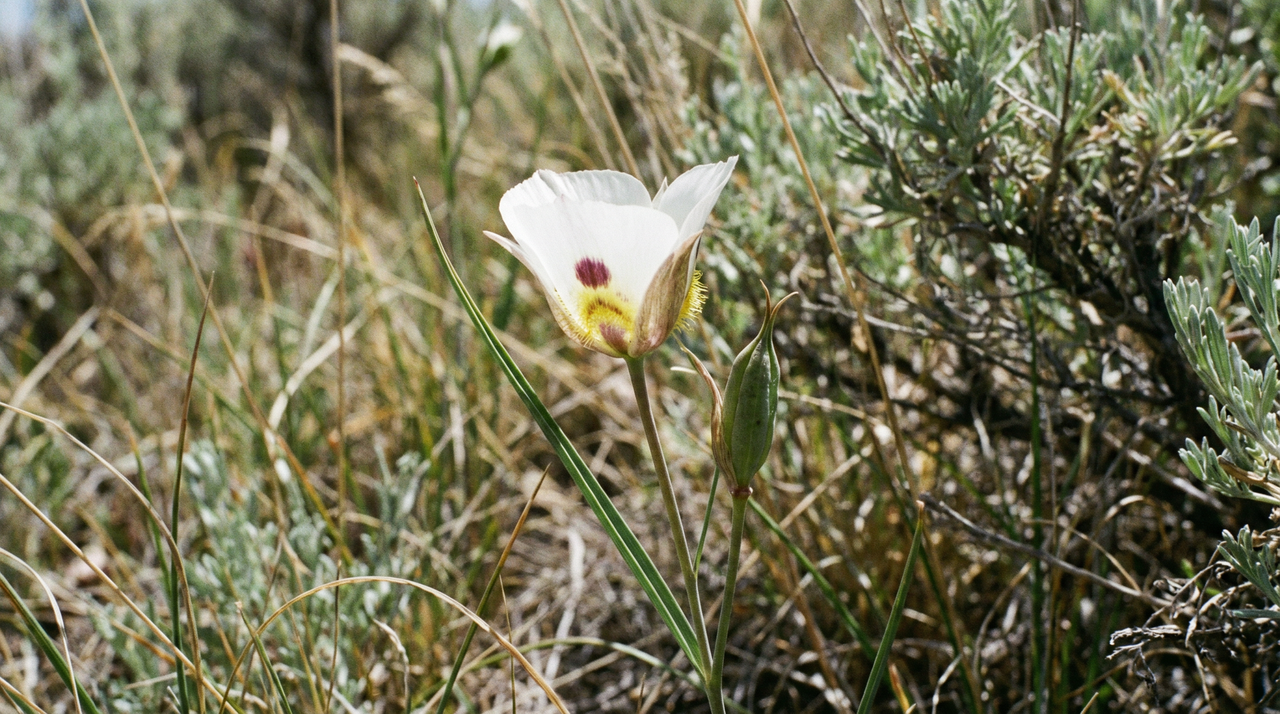
Most people walk right past a Mariposa Lily without knowing they're looking at a plant that once kept people alive. Not metaphorically alive, not spiritually nourished. Actually alive, through winter, through failed harvests, through the brutal calculus of survival in the high desert. The Paiute, Shoshone, and Ute peoples knew these small, carbohydrate-packed bulbs intimately, and when Mormon pioneers arrived in the Great Basin in the 1840s with their provisions nearly exhausted, it was the Sego lily that pulled them through.[1] Utah named it the state flower in 1911, officially, in ink, which strikes me as a quietly profound thing: honoring a plant not for its beauty but for what it gave.
And it is beautiful. Three tissue-paper petals, usually white or pale lavender with a painted eye of color at the base, perched on a stem so slender it seems impossible it's holding anything up. I've grown Calochortus nuttallii in a rocky slope planting in a high-desert garden and still felt a small shock each spring when it appeared. The genus name translates roughly to "beautiful grass," which undersells it, but the common name, Mariposa, Spanish for butterfly, gets closer to the feeling. What surprises most people is everything underneath that delicate appearance: a survival architecture refined over millennia for drought, fire, and seriously poor soil. This is not a fragile flower. It just looks like one.
Mariposa Lily Origin, History, and Botanical Background
Few wildflowers carry as much weight, ecologically and culturally, as the mariposa lily. The name itself comes from the Spanish word for butterfly, and once you've seen those luminous, bowl-shaped blooms trembling in a high desert breeze, you understand immediately why someone reached for that word. But there's far more to this plant than a pretty face on a rocky slope.
Botanical Characteristics and Native Range of Calochortus nuttallii
Calochortus nuttallii, known as both the Sego lily and Nuttall's mariposa lily, is a long-lived polycarpic perennial in the Liliaceae family that grows from a bulb and ranges across a sweeping arc of western North America, from British Columbia and Montana south through California, Nevada, Utah, Colorado, and New Mexico.[2][3][4][5] It thrives in sagebrush plains, grasslands, rocky slopes, mountain meadows, and open coniferous forests, typically between 1,000 and 3,000 meters in elevation, and established bulbs can persist for five to twenty years or more under the right conditions.[3][6][7]
I've worked with a handful of western native bulbs in xeriscapes and dryland food forests over the years, and the patience this one demands is real. From seed, you're looking at two to five years before you'll see a single flower, and the plant reproduces vegetatively via bulb offsets as well as by seed.[8][9] That slow reproductive pace, combined with pressure from overgrazing, habitat loss, and overcollection, has led to regulated wild harvesting in some areas.[3][6] My strong advice: source only from reputable native plant nurseries that propagate ethically. Wild populations can't absorb repeated digging, and I've seen enough stripped hillsides to feel strongly about this. Its cultural status as a celebrated regional symbol carries a certain irony if we don't also protect it in the ground.[2]
Visual Identification Features of the Sego Lily
The plant emerges as a basal rosette of narrow, grass-like leaves, typically 10 to 30 cm long and only 3 to 8 mm wide, on a slender unbranched stem that reaches 15 to 45 cm tall.[10][6] One detail I find useful for timing in the garden: those basal leaves often wither just as the stem is coming into its own, which signals that bloom is not far off.
The flowers themselves are the reason people fall for this plant. Bowl-shaped, 4 to 5 cm across, white to pale lavender or pinkish, each petal carries a yellow basal spot and reddish-brown markings or hairs at the center that give it that unmistakably painted, butterfly-wing quality.[11][12] Bloom runs from May through July, with one to five flowers carried in an umbellate cluster at the stem tip.[3] After flowering, the plant produces a distinctive three-angled capsule containing small, flattened, winged seeds suited for wind dispersal, all arising from a bulbous corm with fibrous roots below.[13]
What I find genuinely useful from a design standpoint is its morphological plasticity. Populations at higher elevations tend to be shorter and more compact, while plants in moister, lower-elevation sites grow taller and more slender; flower color shifts toward white in northern populations and more lavender in southern ones.[12] That variability is a reminder to match your source population to your microclimate, not just buy whatever's available at a big-box nursery. The seasonal rhythm wraps up cleanly: winter dormancy, spring leaf emergence, a brief spectacular bloom, then senescence by fall.[11]
Traditional and Cultural Significance of the Sego Lily
The Nez Perce, Paiute, Shoshone, and Ute peoples harvested the bulbs as a reliable carbohydrate staple, typically in late spring after flowering, then roasted them in pits with hot rocks, boiled them, or dried and ground them into flour for bread and porridge.[14][15] This wasn't supplemental foraging; it was foundational food in landscapes that demanded intimate plant knowledge to survive. Some tribes also turned to the plant medicinally, using it for stomach ailments, respiratory complaints, and as a poultice for wounds, and it carried ceremonial weight in songs, stories, and rituals as a symbol of resilience.[14][16]
Archaeological evidence confirms this wasn't a recent adaptation but a long relationship between people and plant.[6] When Mormon pioneers arrived in the Great Basin and faced famine, Paiute knowledge of the Sego lily's edible bulbs became quite literally life-saving. That survival story was honored when Utah designated it the state flower in 1911, explicitly citing its role as a famine food and embedding its peace symbolism into the official record.[2][16]
Learning this history changed how I approach incorporating culturally significant plants into permaculture designs. There's a responsibility that comes with growing a plant whose knowledge was held and shared by specific peoples for specific reasons, and I think that awareness belongs in every garden plan that includes it.
Mariposa Lily Varieties and Sourcing
Notable Varieties of Sego Lily (Calochortus nuttallii)
Calochortus nuttallii carries some cultural weight before you even get it in the ground. This perennial bulbous plant belongs to the Liliaceae family and is native to western North America.[2][17] Two botanical varieties exist, var. nuttallii and var. elatum, though taxonomists continue to debate whether they represent true varieties or just natural forms across an elevation gradient. In practice, what you're likely to encounter in cultivation are seed-grown plants selected for flower color rather than anything with a formal cultivar name, because the genus has almost no registered horticultural selections.[18][19]
The plant itself is compact and elegant. Stems reach 6 to 18 inches tall, rising from small tunicate bulbs roughly half an inch to an inch in diameter that gradually form loose clumps.[20][21] The bell-shaped flowers are classic: white to pale lavender with a yellow base, often with purple spots or blotches, and color intensity can shift notably by provenance, with northern populations occasionally showing reddish tones.[20][18] I've seen seed-grown batches from the same supplier produce noticeably different flowers side by side, which is part of what makes growing these from seed so genuinely interesting. If you're hunting a particular color form, white-flowered selections and yellow-throated types do come up through specialty nurseries, as do occasional pinkish hues.[18]
Culturally, the sego lily flower finds its strongest ornamental niche in xeriscaping, rock gardens, alpine settings, and native wildflower meadows.[2][18] It's hardy in USDA zones 5 through 9, wants full sun to partial shade, and is non-negotiable about drainage: sandy or gravelly soil that's neutral to slightly alkaline, never clay, never waterlogged.[20][21] A cold dormant period is essential for good bloom the following year. Flowers appear May through July depending on elevation, and the main disease threat is bulb rot in wet soils; in well-matched conditions it's remarkably unfussy about pests.[20]
Comparing Clubhair Mariposa Lily (Calochortus clavatus)
If the white mariposa lily is understated and cool, Calochortus clavatus runs warmer in every sense. Its trumpet-shaped flowers measure 2 to 3 inches across and range from pale yellow into deep orange or red, often with bronze or maroon spotting near the throat.[22] Where C. nuttallii blooms from May into July, the clubhair mariposa lily peaks in April and finishes by May, giving you an earlier show with an equally strict requirement for dry summer dormancy afterward.[23] In my experience growing dryland bulbs, the dry dormancy is where most gardeners lose them. Keeping soil moist through summer while the bulbs are resting underground is the fastest route to rot, and this is true across both species.
Two botanical forms exist within C. clavatus: var. clavatus, a narrower-petaled type from the northern and central range growing 15 to 25 cm tall in zones 7 to 9, and var. elongatus, a broader-petaled southern California form reaching 20 to 30 cm in zones 8 to 10.[24][25][26] No horticultural cultivars exist for this species either. Across the genus, selections come down to natural color variation rather than anything bred or named, which is actually part of the appeal if you're sourcing for a native plant palette.
Where to Buy Mariposa Lily Bulbs and Seeds
Wild collection of Calochortus nuttallii is restricted or outright prohibited in Utah, Nevada, and California, given its state flower status and conservation concerns.[27] I only ever purchase propagated material, and not just because of legal protections. Supporting nursery-grown stock is how we keep these plants available for gardens without depleting wild stands, and that aligns with how I approach any native bulb in my permaculture work. The plant's slow growth rate and reliance on specific mycorrhizal associations mean it's never going to show up at a big-box garden center anyway; specialty channels are your only real option.[2][28]
Bulbs come available in fall, typically priced at $5 to $15 each, with seed packets running $3 to $8 and potted plants in the $10 to $25 range.[29][30][31] Seeds are more consistently available than bulbs and a solid starting point if you're patient. I've ordered from Plant Delights Nursery and Brent and Becky's Bulbs multiple times with good results when I follow their cold stratification guidance carefully.[32][29] Native Ventures, High Country Gardens, and Plants of the Southwest are also reliable sources for propagated stock.[31][33] If you're in Utah specifically, the Utah Native Plant Society is a good resource for tracking down regionally appropriate material.[34]
Mariposa Lily Propagation and Planting (Calochortus nuttallii)
If you want a mariposa lily blooming in your garden in the next year or two, let me save you some frustration upfront: start with bulbs, not seeds. If you want the full experience of watching a wild native species unfold across years, with all the color and form variation that comes from a genetically diverse, largely self-incompatible plant, grow it from seed. Both paths are worth knowing. They just ask very different things of you.
Propagation Methods: Seed vs. Bulb Offsets
Calochortus nuttallii can be propagated by seed or by dividing bulb offsets, and the choice shapes everything downstream. Because the species has an outcrossing, largely self-incompatible breeding system, seed-grown plants are variable; no two will be exactly alike in flower color or patterning.[35][36] Offset division, by contrast, produces plants that are true to type and gets you to bloom years sooner.[37] I maintain both approaches in my own garden, but I'll be honest: when I'm designing a planting and need predictable, timely results, I reach for mariposa lily bulbs or divided offsets every time. The seed flats are a side project I keep going because the color variation is genuinely part of the joy.
Offsets are divided during late summer dormancy, once foliage has fully died back, and replanted immediately.[37][38] In the wild, seeds disperse primarily by gravity, with possible but unconfirmed limited ant dispersal via elaiosomes.[39] In the garden, you collect them yourself in late summer before the capsules split.
Seed Morphology, Storage, and Germination Requirements
Mariposa lily seeds are tiny; we're talking 1.5 to 2.2 mm long, 1 to 1.5 mm wide, roughly 0.5 to 1 mg, dark brown to black, with a reticulate surface and a small, underdeveloped embryo at dispersal.[12][40][41] They behave as orthodox seeds, which means storage conditions matter enormously. Kept dry (under 5% moisture content) at 3 to 5°C with 10 to 20% relative humidity in an airtight container with silica gel, viability holds at 70 to 90% after five years and can extend to 10 to 15 years under optimal conditions.[42][43] I store my surplus sego lily seed in a sealed jar with a silica gel packet in the back of the refrigerator, and I've gotten solid germination from five-year-old batches. For anyone interested in small-scale native seed banking, this species rewards the effort.
Fresh, unstratified seeds germinate poorly, often under 10%.[44] Cold moist stratification, four to eight weeks at 4 to 5°C followed by a shift to 15 to 20°C, breaks physiological dormancy and can push germination rates to 20 to 80%.[43][45] Collect seed in late summer, stratify through winter either in the refrigerator or by sowing in containers outdoors, and bring them into warmth in early spring.
Label every seed flat obsessively. First-year seedlings produce narrow, grass-like leaves that are nearly indistinguishable from weedy grasses or other native bulb seedlings. I've pulled my own mariposa lily seedlings thinking they were self-sown grasses. It's a humbling mistake you only make once. Container growing gives you the moisture control these young plants need, and I've found that occasional mycorrhizal inoculation seems helpful, though I wouldn't call it essential based on my own trials. What is non-negotiable is keeping the growing medium on the dry side and stopping water entirely once the leaves die back. Overwatering during establishment kills more young calochortus bulbs than anything else.[46][47][48]
Soil, Site Selection, and Planting Conditions
Understanding where this plant comes from makes the site requirements click into place immediately. Calochortus nuttallii grows wild in dry, rocky grasslands, open woodlands, and sagebrush country on calcareous and serpentine-influenced soils with exceptional drainage.[49][50] The species tolerates a pH range of 5.5 to 8.0, with best performance between 6.0 and 7.5.[51] I always test my beds before planting and add a little lime if the reading drops below 6.0; it's a small step that directly reflects where these bulbs thrive in nature.
Resist the instinct to enrich the soil. Rich organic amendments and compost retain moisture and invite exactly the rot that kills calochortus bulbs.[52][53] A lean, inorganic mix works far better: something like 50% coarse sand or perlite, 30% loam, and 20% grit gives the drainage these bulbs need, whether in the ground or in containers. Full sun is non-negotiable, minimum six to eight hours of direct light daily.[52][54] In hotter, more arid settings, a little afternoon shade prevents leaf scorch without sacrificing the drainage the site needs.
Water sparingly after planting, letting the soil dry out completely between waterings, and stop watering altogether once foliage begins to yellow.[55][36] In my experience, the single biggest mistake new growers make with Calochortus is keeping the bulbs moist once the foliage yellows. I lift and store mine completely dry in a mesh bag over summer now, and my rot losses have dropped to nearly zero. Container growing makes this easier to control, especially in climates where summer rains would otherwise reach dormant bulbs.
Spacing, Depth, and Planting Technique
Plant calochortus bulbs 4 to 6 inches deep (10 to 15 cm) and space them 4 to 12 inches apart within rows, with 12 to 18 inches between rows.[50][55] Those numbers are guidelines, not rigid rules. In heavier or borderline soils, err toward the wider end; the extra airflow between plants reduces fungal pressure and gives each clump room to expand slowly via offsets over the years.[20][56] In very lean, perfectly drained soil, closer spacing is acceptable. The wider you go, the more you're letting drainage and air do the disease-prevention work for you, which keeps the whole planting lower-maintenance over time.
Timeline from Propagation to First Bloom
After cold stratification, germination typically takes one to three months.[46] Then the waiting begins in earnest. Seed-grown plants spend their early years building a bulb, and they generally need to reach 1 to 2 cm in diameter before they'll put energy into flowering, which translates to 3 to 7 years from seed to first bloom.[50][41] That's not failure. That's just how the plant works. Mature mariposa lily bulbs or offsets planted in fall can flower in as little as one to four years depending on size, soil conditions, and how much winter chilling they receive.[46][37] Climate, elevation, and soil quality all shift these timelines considerably.
I now almost always start with purchased or divided sego lily bulbs when I need flowers within a reasonable window, but I keep seed-raised populations going on the side. Those grass-like first-year leaves are easy to confuse with weedy volunteers, so mark your flats clearly and revisit them before you weed. By year two or three, you'll start to see the distinct basal leaf that tells you something worth keeping is underneath.
Mariposa Lily Care Guide: Growing Calochortus nuttallii
Every time I've struggled with a Sego lily, I can trace it back to forgetting where this plant comes from. Picture the open sagebrush flats and rocky slopes of the Great Basin, the ponderosa pine edges of the Colorado Plateau, the exposed meadows of Montana and Oregon. Thin soil, blazing sun, cold winters, and summers so dry the ground cracks. That image is your care guide in miniature.
Soil, Site, and Sunlight Requirements
Mariposa lily demands full sun, and I mean a genuine 6 to 8 hours of direct light daily, in well-drained sandy, gravelly, or rocky soil with minimal organic matter.[39][49][20] Too little light and you'll get the same etiolated, pale, weak stems you'd see in a bearded iris shaded out by an encroaching shrub -- lots of leaf and no bloom.[57] Too much intense sun paired with bone-dry soil tips the other way into scorch: bleached petals, wilting, leaf damage.[21] The native habitat threads that needle naturally because the soil moisture is low but never zero during spring; in the garden, a light gravel mulch kept away from the bulb neck helps moderate both temperature and moisture without holding the wet conditions these plants hate.
Watering Needs and Drought Tolerance
Spring is the one season where water actually matters. During active growth, water deeply enough to wet the root zone 6 to 12 inches down, then let the surface dry before watering again.[58][59] Once the foliage starts yellowing, stop completely. No supplemental water during summer dormancy, full stop.[54] I used to mark my bulb locations with small flags in spring specifically so I wouldn't accidentally hit them with the hose in July. Overwatering is the single most reliable way to lose these bulbs; it causes the soft, mushy rot that shows up as yellowing leaves and fungal growth around a bulb that was perfectly healthy two weeks ago.[58][52] If you're growing in containers or working with seedlings, use excellent drainage and collect rainwater where you can; hard or heavily chlorinated tap water can degrade bulbs over time.[60]
Feeding and Soil Fertility
Do not apply supplemental fertilizer. These plants thrive in lean, neutral to slightly alkaline soil (pH 6.0 to 7.5) with low organic matter, precisely because that's what their rocky native slopes provide.[39][20] I've never fertilized my established Sego lilies and they bloom more reliably than the over-fed ones I've seen in demonstration gardens. Push too many nutrients into the soil and you get weak, floppy growth, reduced flowering, and a bulb that's suddenly prone to rot and disease.[39][61] If you're planting into genuinely impoverished, compacted fill soil and you feel you must do something, a single application of half-strength low-nitrogen fertilizer like a 5-10-10 in early spring after shoots emerge is the absolute ceiling.[61] Otherwise, resist the urge to be helpful.
Frost and Heat Tolerance
The bulbs themselves are hardy through USDA zones 5 to 9, tolerating soil temperatures down to around -20°F, so they're well-suited to mariposa lily Colorado and Montana gardens where winters are genuinely brutal.[20][51] The vulnerability is in the leaves and buds, which can show browning and necrosis below 23°F.[62] Applying 2 to 4 inches of mulch after the ground freezes solved the heaving problems I saw in my first attempts; the bulb stays at a stable temperature rather than cycling through freeze-thaw damage.[7] For late spring frosts that threaten emerging growth, row covers are quick insurance. At the summer heat end, these plants handle the hot, dry summers of the West comfortably through AHS zones 5 to 8, with sustained temperatures around 95°F manageable as long as nights cool into the 50s and 60s.[20] The danger window is during active spring growth, when temperatures above 86 to 90°F can cause flower abortion or stunt development.[63] In very hot mariposa lily Oregon gardens, a cooler north-facing slope or light afternoon shade solves this more elegantly than trying to fight the climate.
Seasonal Rhythm and Maintenance
The whole care story comes back to one cycle: emergence in March or April, flowering through May into July, seed set in late summer, then full dormancy from late summer through winter.[3][20] Your job is to support the first half and get completely out of the way during the second. Remove spent flower stalks after blooming, but let the foliage yellow and die back fully on its own before cutting anything; that slow senescence is the bulb pulling energy back underground for next year.[52] No water, no feeding, no intervention once dormancy begins. If a clump has been undisturbed for several years and you want to propagate offsets, divide after dormancy is complete, not before. Beyond that, there's genuinely not much to do. Plants that have been sited correctly and given their dry summer rest come back stronger each year, and clumps that I've left alone for a decade are among the most reliably blooming things in my dry garden. Patience, drainage, and restraint -- that's the whole formula.
How to Harvest Mariposa Lily (Calochortus nuttallii)
Everything about harvesting Mariposa Lily asks you to slow down and pay attention. The plant tells you when it's ready. You just have to learn its language.
When to Harvest Mariposa Lily Bulbs and Seeds
Calochortus nuttallii blooms from late spring into early summer, roughly May through July depending on your elevation, and that flowering window is where your timing begins.[7][54] At higher elevations, phenology can shift back by a month or two, so I'd encourage you to watch your local plants rather than trust any fixed calendar date. About 45 to 55 days after those blooms fade, the seed capsules will turn brown and begin splitting open -- that's your window for seed collection.[64][7]
For corms, the signal is full foliage senescence, typically late summer into early fall, July through September, in dry weather.[55][65] I think of it the same way I think about waiting on tulips or daffodils in a landscape design: once the foliage has gone completely yellow and papery, the plant has already done the work of pulling its energy back underground. Digging before that happens means cutting the process short and getting a less nutritious corm for your trouble. Patience really isn't optional here. Given that Mariposa Lily can take three to seven years from seed to reach flowering size, any population you're harvesting from represents years of slow accumulation. Take only what you genuinely need, leave most plants completely undisturbed, and be absolutely certain of your identification before you dig anything up.
Harvesting Technique and Flavor Profile
Dig carefully, ideally with a narrow trowel, working around the bulb rather than straight down through it. The corms sit several inches deep and bruise easily. Raw, they're crisp and starchy, a little like water chestnut, but they can be tough and noticeably bitter; they're not something you'd want to eat straight from the ground. Roasting is where things get genuinely interesting. Cooked corms develop a mild, sweetish flavor with potato-parsnip or nutty notes depending on method, boiling yields something softer and more potato-like, while roasting brings out a deeper nuttiness.[66] That transformation is consistent with what I've noticed across many wild starchy roots: the raw version gives you almost no reason to bother, and then heat does something remarkable. The Northern Paiute and Shoshone peoples understood this well, and their traditional preparation methods reflect knowledge accumulated over generations of working with this plant. That ethnobotanical context deserves real respect, which is exactly why sustainable harvesting isn't a suggestion -- it's the baseline.
Mariposa Lily Preparation and Uses
Culinary Uses and Traditional Food Preparation
The Nez Perce, Paiute, Shoshone, and Goshute peoples built genuine reliance on Mariposa lily corms, particularly during seasons when other food was scarce.[67][68] That wasn't incidental. Preparation was sophisticated: pit-roasting, boiling, drying for winter storage, grinding into flour for breads and porridge, even eating young shoots and the occasional petal.[67][68] I include Calochortus species in drought-tolerant native guilds partly because of this documented history; when I design a food forest for the Intermountain West, the ethnobotanical record matters as much as the plant's ecological function.
Cooking is not optional. Raw corms contain inulin and likely saponins that can cause real gastrointestinal distress, so eating them straight out of the ground is a bad idea.[7][69] Heat transforms everything: the inulin-heavy starch converts into something more digestible, and what was slightly bitter and mealy becomes nutty, mildly sweet, reminiscent of potato or chestnut or parsnip depending on the preparation.[70][71] The caloric payoff is genuine: roughly 300 to 350 kcal per 100 g dry weight, with moderate protein, potassium, phosphorus, and vitamin C.[71] This was a real survival food, not a novelty.
Before any of that, though, you need to be certain of what you're digging. After years teaching native plant identification, I tell every student the same thing: the petal hairs and the yellow-purple markings at the flower center are your lifeline. Death camas (Toxicoscordion venenosum) lacks those features entirely, and it will kill you.[7][72][73] Never gamble on a look-alike. And given that many wild populations are protected,[51] my honest recommendation is to grow your own from nursery-propagated stock rather than harvest from the land. Sustainable guidelines cap wild collection at 10 to 20 percent of any given patch,[74] and with a slow-reproducing species like this, I'd rather observe in the wild and cook from the garden.
Medicinal and Topical Applications
Traditional medicinal use was real, if secondary to the food role. Crushed bulb paste was applied as a poultice for wounds, sores, and insect bites, probably drawing on the corm's mucilaginous properties.[68][75] Some tribes prepared infusions from the bulb for stomach complaints, diarrhea, or as a mild diuretic, with less-documented uses extending to respiratory issues and mild pain relief.[68][76] The plant does contain alkaloids, flavonoids, saponins, and polysaccharides that suggest possible anti-inflammatory or antimicrobial activity in the lab, but there are no clinical trials validating any of it.[75] I grow native lilies for ecology and beauty; I treat their medicinal history as something worth studying and respecting, not self-prescribing. The raw-bulb cautions that apply in the kitchen apply here too, and the conservation math doesn't change just because the intended use is a poultice rather than dinner.[51]
Mariposa Lily Health Benefits and Medicinal Uses
The health story of mariposa lily is really an ethnobotanical story first and a pharmacological story almost not at all. That framing matters. As someone who cross-references indigenous plant knowledge with modern research for every plant I recommend in a design, the near-total absence of human studies on Calochortus nuttallii means I discuss its history with genuine appreciation while being honest that we're nowhere near calling it an herbal remedy.
Traditional Medicinal Applications of Mariposa Lily
The Paiute, Shoshone, and Ute peoples of the Great Basin valued these bulbs primarily as food, turning to them as a carbohydrate staple when other provisions were scarce.[77][68][78] Medicinal applications do appear in the ethnobotanical record, including bulb preparations used for skin irritations, wounds, gastrointestinal complaints, colds, and coughs, and occasionally as an emetic or purgative,[68] but the documentation is sparse compared to the rich food record.[68][75] That distinction is worth sitting with: these were peoples with intimate, generational knowledge of the plant, and they reached for it mainly when they were hungry, not when they were sick.
Modern pharmacology hasn't caught up enough to validate or refute those occasional medicinal uses. No clinical trials or human studies exist demonstrating analgesic, sedative, or diuretic effects,[79] and preliminary in vitro work suggesting antioxidant, anti-inflammatory, or antimicrobial activity from flavonoid content hasn't been translated into anything approaching clinical evidence.[80] Beyond the research gap, conservation concerns and the real risks of improper preparation mean contemporary medicinal use isn't something I'd recommend without expert guidance.[77][68] Treat the traditional record as cultural heritage worth respecting, not a recipe for your medicine cabinet.
Phytochemical Profile of Mariposa Lily
What the plant does contain chemically is genuinely interesting, even if the research stays at the in vitro stage. The bulbs carry steroidal alkaloids including calochrosin and hydroxycalochrosin, flavonoids like quercetin and kaempferol derivatives, phenolic acids (chlorogenic, caffeic, and ferulic), saponins, anthraquinones, and storage polysaccharides.[80][81][82] Genus-level in vitro studies suggest those compounds may contribute anti-inflammatory, antimicrobial, and antioxidant activity, though species-specific clinical evidence for C. nuttallii is absent.[83][84]
I find it useful to think of these compounds the way a landscape designer thinks about plant adaptation: they're the plant's chemical vocabulary, shaped by the dry grassland and sagebrush steppe habitats where these lilies evolved. Herbivory pressure has driven the development of defensive metabolites over time,[17] and the concentration shifts depending on what part of the plant you're looking at, what time of year it is, and even what soil it's growing in. Bulbs run higher in alkaloids and storage carbohydrates, the flowers express more phenolic pigments and anthocyanins, spring flowering peaks the metabolite profile, and alkaline soils push alkaloid production higher.[80][85] When I've watched these in bloom in the field, the jewel-toned petals make immediate sense as a pollinator signal, but those same pigment compounds are part of the plant's chemistry worth understanding. Reassuringly, there's no evidence of highly toxic alkaloids like colchicine at significant concentrations,[17] which aligns with the long history of human consumption when the bulbs are properly prepared.
Nutritional Value of Mariposa Lily Bulbs
The nutritional picture here is best described as honest rather than impressive. These bulbs functioned as a survival staple, not a superfood, and that framing holds up against the actual data. The carbohydrate content dominates, roughly 70-80% by dry weight based on analyses of similar species, with moderate fiber, around 5% protein, and minimal fat.[2][86] Trace amounts of vitamin C and potassium show up, but the quantitative data is thin and comes from ethnobotanical records and general bulb analyses rather than species-specific lab work.[2][87]
Critically, only the bulbs are edible, and only after proper preparation. Flowers and leaves can cause digestive upset,[2][87] and the bulbs themselves required leaching, drying, roasting, or boiling to reduce alkaloid content and the bitterness from calcium oxalate crystals before consumption.[88][89] That level of processing is a signal worth paying attention to. Traditional knowledge embedded those preparation steps for good reason, and skipping them is where problems start.
Safety Considerations for Mariposa Lily
Calochortus nuttallii is not considered toxic to humans or pets according to the ASPCA and USDA, and it's worth being explicit that this puts it in a completely different category from true lilies (Lilium spp.), which are highly toxic to cats and dogs.[90][91][7] The generations of indigenous use after cooking confirms that low-toxicity status in practice.[68][2]
That said, raw plant material is a different story. Calcium oxalate crystals in uncooked bulbs can cause nausea and vomiting, and handling fresh material can trigger contact dermatitis in sensitive individuals.[12][92] I think of it like rhubarb or raw spinach: the calcium oxalate issue is real but manageable with the right preparation, and it doesn't make the plant dangerous so much as demanding of respect. What I'd flag as the more serious concern is misidentification. Death camas (Zigadenus spp.) shares similar habitat and can be confused with mariposa lily before flowering, and that plant is genuinely dangerous. No pollen allergy specific to C. nuttallii has been documented,[7] but I've never foraged these myself, partly because positive identification in the field requires real expertise and partly because many populations are protected. The cultural record here is rich and worth honoring; depleting wild colonies to satisfy curiosity about a bulb with no clinical research behind it isn't a trade-off I'd make.
Mariposa Lily Pests and Diseases
Natural Pest Resistance and Common Garden Pests
In the wild, mariposa lily holds its own remarkably well. Calochortus nuttallii has evolved alongside the insects and browsers of the arid American West, developing alkaloids, secondary metabolites, and glandular hairs that make it a less appealing target than most ornamentals.[7][93] I've noticed those glandular hairs firsthand -- young leaves have a distinct tackiness that seems to trap and deter early-season aphids before they can establish. It's a subtle thing, but it's real, and it's the kind of detail that reminds you this plant was already solving its own pest problems long before we started growing it in beds.
Move it into a garden setting, though, and that resilience gets tested. Aphids (Macrosiphum species) can colonize stressed plants, causing distorted growth, honeydew buildup, and secondary sooty mold.[94][95] Spider mites (Tetranychus spp.) show up on plants that are dry-stressed, stippling the foliage and sapping vigor in a way I've also seen on nearby yuccas and agaves -- it's a familiar pattern with arid-adapted plants pushed into conditions that are either too wet or too dry.[94] Bulb flies, cutworms, thrips, and bulb mites round out the underground and foliar threats.[94] Slugs and snails become significant problems wherever moisture lingers or drainage is poor.[55][96]
Deer and rabbits are the most unpredictable threat. I lost a whole planting one spring before I took the fencing seriously -- beautiful foliage there one morning, nubs by evening.[97] Temporary wire cages or planting within an allium-based guild (alliums repel browsers and help suppress aphids too) are now standard in my approach.[96] For insect pressure, neem oil, insecticidal soap, diatomaceous earth around the base for slugs, and encouraging beneficial predators are the tools I reach for first.[98] There are no pest-resistant cultivars to fall back on; the available selections are bred for flower color, not resilience, so the straight species and good cultural practice are your only real defenses.[99]
Disease Susceptibility and Prevention
Mariposa lily's arid adaptation gives it genuine, built-in disease resistance.[100][101] Viral disease is rare in wild populations, and bacterial issues from Erwinia or Xanthomonas are occasional at best, usually only appearing in plants already wounded or seriously stressed. In practice, none of these should concern a gardener who's paying attention.
Fungal problems are the real story. Fusarium, Pythium, botrytis, and bulb rots all become genuine threats the moment soil stays wet too long.[100][102][20] The single best investment you can make for this plant is getting drainage sorted before anything goes in the ground.[103] Once I stopped trying to amend heavy clay and committed to raised beds with a generous gravel layer, my success rate improved dramatically. When you genuinely replicate the plant's rocky, lean native conditions, disease pressure nearly disappears on its own. No breeding program is working on resistant cultivars for this wild species, so mimicking habitat isn't just philosophical -- it's the only reliable prevention available.[96]
Mariposa Lily in Permaculture Design
If you've ever watched a bumblebee work a Mariposa Lily flower, you've seen something genuinely remarkable. The bee grips the bloom and vibrates its flight muscles at a specific frequency, essentially "buzzing" the poricidal anthers until they release a cloud of pollen through tiny pores.[7][104] Sonication pollination, as botanists call it, is the same trick bumblebees use on tomatoes and eggplants, and hearing that low-pitched buzz in a dry meadow planting is one of my favorite signs that a native bee community is genuinely healthy. It stops me in my tracks every time.
Ecosystem Functions and Guild Contributions
That buzz pollination relationship sits at the heart of why Mariposa Lily earns its place in a well-designed dryland guild. The primary pollinators are bumblebees and native solitary species like mining bees and mason bees, whose body size and behavior match the flower's structure almost perfectly.[105] Beetles, flies, and butterflies visit too, though less efficiently.[105] Those bowl-shaped, three-petaled flowers, typically white to pale lavender with a purple-spotted nectar gland ringed by yellow hairs, are essentially an evolved landing pad designed to reward exactly the right insect visitors.[2][12] And because bloom time runs from May through July depending on elevation, when soil temperatures nudge above 10°C,[106] this plant is providing nectar and pollen at a moment when many other dryland natives are still getting going.[7][39]
Below ground, the fibrous root system does quiet but important structural work, stabilizing sandy and rocky soils on slopes where erosion pressure is real.[7] The deeply buried corms also mean this plant shrugs off periodic fire disturbance and regenerates from underground storage after burns, a trait that makes it genuinely useful in fire-adapted restoration landscapes rather than just a pretty face in a meadow planting.[7] In restoration work I've been involved with in degraded chaparral and dry woodland margins, Mariposa Lily's return is a signal I pay attention to. It functions as a bioindicator species for healthy ecosystems, particularly sensitive to soil and environmental changes,[7] so when it starts self-seeding and spreading, I know the site is moving in the right direction long before other metrics confirm it.
Habitat fragmentation and declining native pollinator populations do suppress seed set and long-term viability,[107] which is worth knowing if you're working with isolated populations. Hand-transferring pollen between flowers with a small brush can meaningfully improve seed set in those situations.[108] Related species like Clubhair Mariposa Lily associate with arbuscular mycorrhizal fungi for phosphorus uptake and disperse seeds via both wind and ants,[109][110] suggesting that building myrmecochory pathways into your site design, keeping ant-friendly ground cover nearby, supports natural spread over time.
Climate Adaptation and Hardiness Zones
Mariposa Lily is rated hardy across USDA zones 5-9, tolerating winter temperatures down to roughly -20°F when conditions are right.[51][111] In its native habitat spanning sagebrush plains, pinyon-juniper woodlands, and mountain meadows from 1,000 to 3,000 meters elevation,[54] those deeply buried corms already handle brutal freeze-thaw swings and summer drought by simply going dormant and waiting. Mimicking that pattern is the whole strategy for gardeners outside the plant's native range.
In zone 5 and 6 equivalents, I've had good results covering planted corms with about 3 inches of dry leaf mulch after the ground cools in fall. That layer prevents the heaving that damages corms during hard freeze-thaw cycles without trapping the moisture that kills them.[20][55] The standard recommendation is 2 to 4 inches of organic mulch, and I lean toward the lighter end so air circulation stays reasonable. Success comes from respecting dormancy and drainage, not from extra protection or extra inputs.
Forest Layer Placement and Guild Design
Mariposa Lily belongs perfectly in the herbaceous ground layer. At 10 to 60 centimeters tall with narrow, grass-like basal leaves,[51][12] it occupies minimal lateral space and doesn't compete aggressively for resources, which is exactly what you want from a bulb slotted into an established guild. Its native habitats, open grasslands, rocky slopes, sagebrush flats, and the sun-drenched edges of pine woodlands,[106][112] tell you that it wants full sun and no canopy competition above it. Dense forest understory is not its world.
Soil preference is sandy, gravelly, or rocky with good drainage and a neutral to slightly alkaline pH around 6.5 to 7.5. Heavy clay or waterlogged ground will kill the corms through rot.[112][113] I've had the best results planting corms in fall into a gravelly mix with nearly no supplemental water after the first season. Once established, they go dormant through summer and essentially take care of themselves. Companions that share these low-water, low-fertility preferences, things like native yarrow, penstemon, or drought-tolerant bunchgrasses, integrate well because they won't crowd the bulbs or hold moisture against them during the dry rest period.
The edible corms add a food-forest dimension worth acknowledging. Native peoples including the Northern Shoshone relied on them as a starchy staple, roasted or boiled,[68] which means a well-established planting carries yield potential alongside its ecological functions. That combination of pollinator support, soil stabilization, fire resilience, bioindicator value, and modest food production is a tidy argument for including this native bulb in any dryland permaculture design.
The Plant That Taught Me to Wait
I've killed more Mariposa Lilies than I care to admit, mostly by loving them too much in August when they needed me to walk away. The ones I finally got right are still blooming in my food forest, seven years on, from bulbs I grew from seed I wasn't sure would ever amount to anything. Every spring when those three petals open, I think about the Paiute women who knew exactly where to find them and exactly when to stop.
Sources 113
- Utah State Symbols: State Flower | Utah State History ↩
- Calochortus nuttallii - Wikipedia ↩
- USDA PLANTS Database - Calochortus nuttallii ↩
- Kew: Plants of the World Online: Calochortus nuttallii ↩
- Flora of North America: Calochortus nuttallii ↩
- Calochortus nuttallii (Sego Lily) ↩
- Mariposa Lilies: Biology and Horticulture ↩
- Calochortus nuttallii Cultivation Guide ↩
- Germination of Native Bulbs: Mariposa Lilies ↩
- Calochortus nuttallii ↩
- Nuttall's Mariposa Lily (Calochortus nuttallii) ↩
- Calochortus nuttallii ↩
- Calochortus nuttallii Douglas ex Benth. ↩
- Native American Ethnobotany Database ↩
- Plants Used by the Great Basin Indians ↩
- Ute Indian Arts & Culture: Traditional Plant Use ↩
- Calochortus nuttallii ↩
- Calochortus nuttallii - Nuttall's Mariposa Lily ↩
- Calochortus Species in Cultivation ↩
- Calochortus nuttallii - Sego Lily ↩
- Calochortus nuttallii (Sego Lily) ↩
- Missouri Botanical Garden Plant Finder ↩
- Missouri Botanical Garden Plant Finder ↩
- Calochortus clavatus ↩
- Plants of the World Online, Royal Botanic Gardens Kew ↩
- USDA PLANTS Database - Calochortus clavatus ↩
- Sego Lily (Calochortus nuttallii) ↩
- Propagation of Mariposa Lilies (Calochortus spp.) ↩
- Calochortus nuttallii Bulbs ↩
- Sego Lily (Calochortus nuttallii) ↩
- Calochortus nuttallii - Native Bulbs and Seeds ↩
- Calochortus nuttallii - Sego Lily ↩
- Mariposa Lilies ↩
- Sego Lily (Calochortus nuttallii) ↩
- Breeding Systems in the Genus Calochortus ↩
- Calochortus nuttallii (Sego Lily, Mariposa Lily) ↩
- RHS Calochortus Propagation Guide ↩
- Growing Mariposa Lilies from Bulb Offsets ↩
- Calochortus nuttallii ↩
- Seed Morphology of Calochortus Species ↩
- Seed Biology of Calochortus nuttallii ↩
- Seed Storage of North American Native Plants ↩
- Germination Requirements of Calochortus nuttallii ↩
- Growing Calochortus from Seed ↩
- Seed Propagation of Native California Wildflowers ↩
- Calochortus Cultivation ↩
- Growing Mariposa Lilies from Seed ↩
- Propagation of Native Plants ↩
- Calochortus nuttallii - Flora of North America ↩
- Calochortus nuttallii Profile ↩
- Sego Lily Cultivation Guide ↩
- Growing Mariposa Lilies (Calochortus spp.) ↩
- California Native Plant Society - Growing Mariposa Lilies ↩
- Calochortus nuttallii ↩
- RHS Gardening - Calochortus ↩
- Planting Native Bulbs: Spacing and Care ↩
- Etiolation in Flowering Plants - University of California Agriculture ↩
- Calochortus nuttallii ↩
- Calochortus Cultivation ↩
- Growing Calochortus Species ↩
- Calochortus nuttallii ↩
- Frost Damage in Bulbous Plants ↩
- Nuttall's Mariposa Lily ↩
- Flora of North America - Calochortus nuttallii treatment ↩
- Harvesting Native Bulbs: Mariposa Lilies ↩
- Calochortus nuttallii - Plants For A Future ↩
- Plants Used by the Great Basin and Plateau Indians ↩
- Native American Ethnobotany Database ↩
- Toxicity of Wild Plants: A Guide for Foragers ↩
- Ethnobotany of the Western United States ↩
- Nutritional Evaluation of Native American Food Plants: Lily Bulbs ↩
- Toxicoscordion venenosum (Death Camas) ↩
- Mariposa Lilies of California ↩
- Sustainable Harvesting Guidelines for Wild Lilies ↩
- Mariposa Lilies: Traditional Uses by Indigenous Peoples ↩
- Ethnobotany of the Great Basin Native Americans ↩
- Ethnobotany of the Western Plateau ↩
- USDA Plants Database - Ethnobotany ↩
- Missouri Botanical Garden Plant Finder - Calochortus nuttallii ↩
- Phytochemical and Pharmacological Review of Calochortus Species ↩
- Steroidal Alkaloids in Liliaceae Family ↩
- Flavonoids and Phenolics in Calochortus Genus ↩
- Antimicrobial Activity of Saponins from Calochortus spp. ↩
- Phytochemical Constituents of Calochortus Species ↩
- Ecological Chemistry of Calochortus nuttallii ↩
- Edible Native Plants of the Rocky Mountains ↩
- Edible and Medicinal Plants of the West ↩
- USDA PLANTS Profile: Calochortus nuttallii ↩
- USDA Plants Database - Calochortus nuttallii ↩
- Toxic and Non-Toxic Plants ↩
- Sego Lily: Utah's State Flower ↩
- Calochortus ↩
- Chemical Defenses in the Liliaceae Family ↩
- Pests and Diseases of Bulbous Flowers ↩
- Aphids on Ornamental Plants ↩
- Integrated Pest Management for Bulbous Plants ↩
- Wildflower Pests in Western North America ↩
- Pest and Disease Management for Bulbous Plants ↩
- Calochortus: Mariposa Lilies ↩
- Diseases of Bulbous Ornamentals ↩
- Calochortus: Mariposa Lilies ↩
- Pests and Diseases of Bulb Plants ↩
- Native Plants of the Intermountain West ↩
- Pollination Ecology of the Genus Calochortus (Liliaceae) ↩
- Pollination Biology of Calochortus nuttallii ↩
- Calochortus nuttallii | USDA PLANTS Database ↩
- USDA PLANTS Database: Calochortus nuttallii ↩
- Pollination Biology of the Mariposa Lilies (Calochortus) ↩
- Calochortus clavatus - Calflora ↩
- Mariposa Lilies in California Native Gardens - CNPS ↩
- Calochortus nuttallii ↩
- Missouri Botanical Garden Plant Finder - Calochortus nuttallii ↩
- Lady Bird Johnson Wildflower Center - Sego Lily ↩