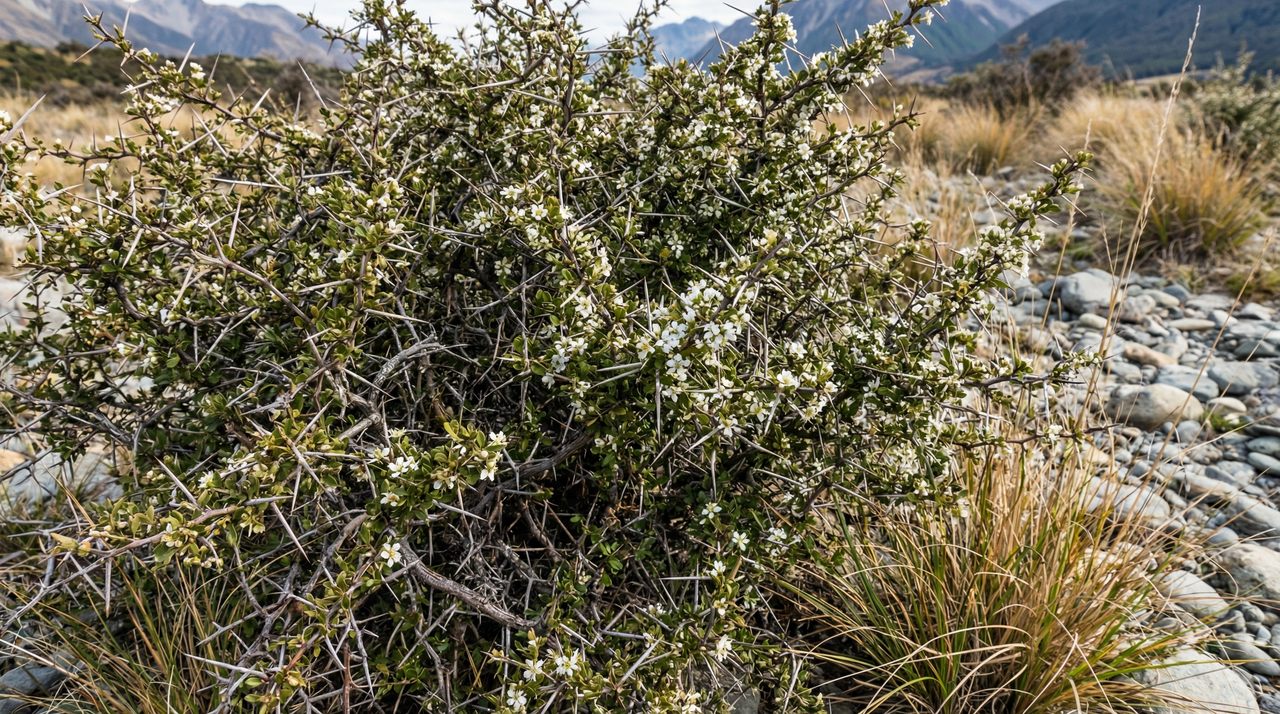
There's a plant in New Zealand that farmers have cursed for generations, that sheep won't touch, that has drawn blood from nearly every ecologist who's ever tried to take a cutting of it, and that Māori knew, long before any of that hostility was documented, as one of the toughest, most useful shrubs on both islands. Matagouri, Discaria toumatou, doesn't look like something you'd want in your garden. It looks like something that grew up angry: a dense, zigzagging tangle of grey stems ending in spines sharp enough to pierce leather, with leaves so small they barely register. The whole plant reads as inhospitable. That's exactly the point.
What stopped me cold when I first encountered it in restoration literature wasn't the spines or the divaricating habit; it was the nitrogen fixation. This ferociously armored, drought-tolerant, hard-as-nails scrub shrub is also quietly building soil, pulling atmospheric nitrogen into root nodules through a bacterial partnership that most gardeners associate with legumes. Matagouri isn't a legume. It's doing something rarer, and it's doing it on the most hostile sites it can find, turning cracked, infertile riverbeds and windswept tussock margins into productive, sheltered habitat for everything that comes after it. A plant this misunderstood deserves a proper look.
Matagouri Origin, History, and Cultural Significance
Botanical Background and Ecology of Discaria toumatou
Discaria toumatou, the matagouri bush, is a deciduous, spiny shrub endemic to New Zealand and a member of the Rhamnaceae family.[1][2] It's found naturally across both main islands, though it's genuinely uncommon in the North Island south of Waiuku. The real stronghold is east of the main divide in the South Island, where it colonizes tussock grasslands, riverbeds, hillslopes, and outwash plains from sea level all the way up to 1600 m, most densely between 300 and 1000 m.[1][3] The sites it favors are semi-arid, rocky, exposed, and often nutrient-poor; it's a colonizer of disturbed ground that most woody plants simply give up on.[4]
What makes matagouri genuinely special from a regenerative perspective is its actinorhizal symbiosis. It forms root nodules with Frankia bacteria, fixing atmospheric nitrogen and quietly enriching the infertile soils around it.[5] I've watched this play out in a small restoration plot over three seasons, with neighboring tussock grasses turning noticeably greener as established matagouri worked on the surrounding soil. It's the kind of slow, unspectacular improvement that doesn't photograph well but matters enormously in dryland restoration.
Reproductively, this plant has a few tricks. Seeds disperse ballistically from explosive capsules and travel further by water; plants reach maturity in three to five years, and if fire or grazing knocks them back, they resprout from a lignotuber or throw basal suckers.[1][6] Ecologically, individual plants are considered short- to moderately-lived, somewhere in the 20 to 50 year range, though browsing pressure from introduced deer, goats, and possums is the real limiter I see in restoration contexts, far more than any natural lifespan ceiling.[4] William Colenso first botanically recorded the species in the 1840s, and while it has since found its way into cultivation at botanical gardens including RHS Wisley, it remains a New Zealand endemic in the wild and holds a conservation status of Not Threatened.[7][4]
Visual Characteristics of Matagouri
The first thing anyone notices about matagouri is its architecture. The divaricate growth habit, that zigzag, interlacing tangle of rigidly branched stems, forms thickets up to 3 to 6 m tall that are genuinely impenetrable in any practical sense.[8][1] Woven through that tangle are spines that are technically modified lateral branchlets rather than true thorns, typically 2 to 5 cm long and occasionally reaching 10 cm.[2] I learned this the pointed way after planting one too close to a path. Those spines demand respect and genuinely generous spacing.
The leaves are small, leathery, and alternate, only 5 to 15 mm long with entire to slightly serrated margins, deliberately reduced to minimize water loss on exposed, dry sites.[1] Spring brings small, greenish-white flowers with modest ornamental appeal, followed by capsules containing winged seeds.[1] In winter, when the leaves drop, the plant's true visual character comes through: a stark, sculptural silhouette of bare, pale, bristling stems that looks more architectural than botanical. It's the dormant form, not the flowering one, that tends to stop people in their tracks.
Traditional Māori Uses and Cultural Importance
Although Colenso's 1840s collection marks the plant's entry into Western botanical records, Māori iwi had been in a deep, practical relationship with tūmatakuru long before any European taxonomist arrived. Every trait that frustrated later settlers, the vicious spines, the iron-hard wood, the impenetrable thickets, had already been understood and put to use. Spines served as fish hooks, eel and bird traps, and tattooing tools; the durable wood was fashioned into weapons, tools, and implements; and living stands formed natural boundary hedges and protective barriers.[9][10]
Bark infusions and decoctions treated wounds, skin ailments, and digestive complaints, and were used as a general tonic or purgative.[10] Roasted seeds were eaten occasionally, though sparingly given their bitterness.[11] For South Island iwi, particularly Ngāi Tahu and Waitaha, the matagouri meaning runs deeper still, appearing in cultural lore as a symbol of resilience and protection, with its soil-stabilizing and habitat roles explicitly recognized.[12]
I value this plant for hedging and habitat, but I'm careful to source from ethical nurseries and to learn from Māori-led restoration projects rather than appropriate traditional medicinal knowledge. The Wai 262 process has raised legitimate questions about how traditional plant knowledge gets commercialized, and that context matters when we talk about matagouri as anything beyond an ecological tool.[13]
Interesting Facts About Matagouri
The spines are where the story starts. Those modified lateral branches, up to 10 cm on a vigorous plant, aren't just botanical curiosities; they are the front line of a defense system refined over millions of years of browsing pressure.[1][4] I've grown matagouri from seed in a dry, windy bed and watched how quickly the divaricate branching and spine development emerges in young plants, making the seedlings almost immediately unpalatable to rabbits. It's a vivid, practical illustration of form following ecological function.
Beneath the ground, the Frankia symbiosis means matagouri is simultaneously building soil while standing in it, fixing nitrogen and turning a degraded patch into something richer for every plant growing nearby.[14][4] Above ground, its dense thickets create sheltered microclimates that support native birds like the New Zealand pipit and a range of insect pollinators, making the whole structure a small ecological refuge in an otherwise exposed landscape.[4] Hardy to around -10°C and formidably wind- and drought-tolerant once established, it's increasingly used in dryland restoration for exactly these reasons.[15] Compared to kanuka, another tough New Zealand native I grow, matagouri is slower to establish but ultimately more resilient on genuinely exposed, skeletal sites where almost nothing else sticks.
Matagouri Varieties and Sourcing
The Wild Form of Discaria toumatou
There are no named cultivars of matagouri. No improved selections, no compact garden forms, no thornless varieties bred for easier handling. What you grow is exactly what grows on the dry riverbeds and rocky slopes of New Zealand's interior, and I've come to think that's a genuine asset rather than a gap in the catalogue. The wild form retains its full genetic diversity and actinorhizal nitrogen-fixing capability, traits that tend to get quietly eroded through the selection process in domesticated garden varieties.
Discaria toumatou is an endemic member of the Rhamnaceae family found across New Zealand's North, South, and Stewart Islands, known variously as Wild Irishman or Cat Thorn.[1][16] Mature plants reach 3 to 6 metres tall and equally wide, forming dense, upright, bushy growth that can sprawl even further in open conditions.[1][17] The foliage is small, evergreen, and grey-green with a leathery texture that helps the plant shed water stress in arid conditions.[1][10] Those spine-tipped leaves, combined with reddish-brown stems bearing rigid straight spines up to 5 cm long, are the plant's most immediately recognisable feature.[1] I'll mention from experience that young plants can look enough like a cotoneaster to cause a double-take, but the reddish stems and the faint sweet, honey-like fragrance of the spring flowers quickly set them apart from anything else on the bench.
Spring brings small white flowers pollinated by native bees and other insects,[1][18] followed by small dry inflated pods that ripen through late summer.[1] That thicket-forming, spine-armoured, drought-tolerant character is precisely why it's never attracted serious horticultural breeding attention.[1][19] The traits that make it awkward in a garden setting are the same ones that make it irreplaceable in restoration work. After growing several batches from New Zealand-sourced seed, I've also noticed striking variability in spine density and length even within the same packet, a reminder that every plant is genuinely a wild individual.
How to Source Matagouri Plants and Seeds
Outside New Zealand, matagouri is not easy to find.[20][21] Within New Zealand, native-plant nurseries are your most reliable source, with seedlings typically running NZD 5 to 15 and seed packets around NZD 5 to 10; restoration buyers ordering 100 or more plants can sometimes negotiate a 5 to 15 percent bulk discount.[22][23] For gardeners in the US, a small number of specialty suppliers dealing in Australasian flora occasionally stock seed at USD 8 to 20 per packet.[24][25] Native plant societies and specialist botanic garden plant sales are worth contacting when commercial sources come up empty.
Importing live plants from New Zealand to the US requires a USDA PPQ permit and a phytosanitary certificate, and New Zealand restricts native-plant exports to research or approved restoration projects.[26][27] After dealing with the paperwork myself on small seed imports, I now work exclusively with already-permitted specialist suppliers. The regulatory friction is real, and seed is almost always the most practical acquisition route for gardeners outside New Zealand. Scarification and cold stratification are typically required before germination, but the propagation section covers that in full detail.
How to Propagate and Plant Matagouri (Discaria toumatou)
Matagouri rewards patience more than almost any other native I've worked with. It's not a plant you pick up at a garden center on a whim and shove into the ground. Every method of propagation asks something specific of you, and the plant's own biology is full of surprises that make the effort worthwhile once you understand what you're working with.
Propagation Methods for Matagouri
Start with the seed biology, because it's genuinely unusual. Matagouri exhibits polyembryony, specifically nucellar embryony, meaning each seed can contain both a sexual embryo and several clonal embryos derived from maternal tissue.[28][1][29] In practice this means a single seed lot can give you both genetically variable seedlings and some that are effectively clones of the mother plant, an elegant hedge against the unpredictable establishment windows of New Zealand's dry tussock country. Layer on top of that the fact that matagouri is hermaphroditic but self-incompatible, so open-pollinated seed won't come true to type regardless.[30] For restoration work that's perfectly fine. For selecting a specific form, you need vegetative methods.
The seeds themselves are small, 2-3 mm, broadly ovoid, dark brown to black, housed in a dry four-chambered dehiscent capsule.[1] They store beautifully under orthodox conditions: 5-10% moisture content, temperatures between -18°C and 5°C, and low relative humidity around 5-20% RH will hold viability above 70% for 10-15 years.[31][32] I routinely keep a small batch in a sealed jar in my domestic freezer and have seen only modest viability drop over five to seven years, which means you can bank a good collection year and use it across multiple planting seasons without panic. Fresh seed germinates at 50-70%, but if you put in the pretreatment work you can push that to around 80%.[1][32] That pretreatment mimics what fire and winter would do in the wild: scarify or use a brief acid soak to break the impermeable seed coat, follow with four to six weeks of cold stratification at 4°C, and consider a smoke treatment before moving to a germination temperature of 15-20°C.[1][33] Skip any of those steps and you'll get erratic, disappointing germination.
For faster results with less genetic variability, semi-hardwood cuttings taken in late summer (January to February in the Southern Hemisphere) are the practical alternative. With 3000 ppm IBA, bottom heat at 20-25°C, and high humidity over a perlite-peat or sand-peat mix, you can expect 60-80% rooting success.[1][34] Wear thick gloves. Even on two-year-old propagation stock, those spines are sharp enough to draw blood through light garden gloves, and that's not a lesson you want to learn mid-cutting session.
If you're serious about getting a productive plant within a reasonable timeframe, grafting onto compatible Rhamnaceae rootstocks such as Colletia, Rhamnus, or Ziziphus is worth learning. Done in spring under greenhouse conditions, you can achieve 50-70% success,[35][4] and in my experience the upper end of that range is achievable when you're meticulous about cambium alignment and keep greenhouse humidity consistent. The payoff is significant: grafted plants can fruit in 2-4 years versus the 5-10 years seed-grown plants typically demand.[1][4] Tissue culture on MS medium with 1 mg/L BAP and 0.1 mg/L NAA has also been used successfully for conservation of selected genotypes,[36] though that's firmly in specialist territory rather than something a home propagator needs to worry about.
Soil, Site Selection, and Planting Technique
If there's one thing that will kill a young matagouri plant faster than anything else, it's soggy soil. This species demands excellent drainage and simply will not tolerate waterlogged or clay-heavy substrates.[1][37] Its native ground is rocky slopes, alluvial fans, and dry tussock grasslands, and once you picture that, every other growing requirement falls into place. Sandy, gravelly, even skeletal soils at low fertility are not a problem, partly because its Frankia symbiosis fixes nitrogen from the atmosphere, effectively feeding itself where other shrubs would starve.[4][1] I lost several early batches of seedlings to damping-off in standard potting mixes and eventually traced it back to moisture retention. Now I use a much leaner medium, roughly 50% potting soil, 30% sand or gravel, and 20% perlite or pumice,[10] and seedling survival improved dramatically. Aim for a pH of 6.0-7.5, though the plant can tolerate up to 8.0 without major complaint.[1][38]
Full sun is non-negotiable. Matagouri needs six to eight or more hours of direct light; in shade it etiolates, chlorosis develops, leaves shrink, and growth becomes weak and floppy.[1][39] Those symptoms show up quickly enough to diagnose a poor site choice before you've invested too many seasons into a plant. Young specimens do benefit from temporary shelter from harsh wind and intense afternoon sun during the first season, and slugs and snails will target new growth, so keep an eye on things early.[1] Once the root system is established, its deep taproot handles compaction and drought with minimal fuss.[4]
Spacing, Growth Rate, and Establishment Timeline
Before you plant, picture the mature shrub: 2-6 m tall, 2-5 m wide, with spines reaching 5 cm and a strongly divaricate, thicket-forming structure that interlocks into an impenetrable mass over time.[8][1] Always wear gloves and eye protection when handling plants at any age. The spines are unforgiving even on young stock, and by the time a plant is two years old you'll understand why matagouri was used for centuries as a living fence.
Initial growth runs 20-30 cm per year,[40] which is slow compared to familiar nitrogen-fixing shrubs like broom or gorse. If you're used to those species charging away in their first season, matagouri will test your patience. Plan accordingly, and consider it an argument for grafting if time matters to you. For hedge or boundary planting, space plants 1-2 m apart within rows, with rows 2-3 m apart; for restoration or rapid barrier formation, you can push density to 0.5-1 m spacing, around one to two plants per square metre.[4][41] The divaricate habit means gaps will fill in on their own once plants hit their stride; close spacing just gets you there faster.
Seed-grown plants take 5-10 years to reach maturity and fruiting.[1] Grafted plants can be productive in 2-4 years.[4] Match your method to your goal: seed for large-scale restoration where genetics and scale matter more than speed, cuttings for mid-scale projects where you need reliable clones, and grafting when you want a specimen plant producing within a realistic planning window. Whichever route you take, the first year in the ground is the critical one. Get the drainage right, the sun exposure right, and protect from browsers, and matagouri will do the rest.
Matagouri Care Guide: Sunlight, Water, Soil, and Maintenance
If there's one thing I've learned from growing tough native shrubs in exposed, low-fertility sites, it's that the care requirements are mostly a list of things you don't need to do. Matagouri fits that pattern perfectly. It's a plant shaped by wind-scoured grasslands, rocky riverbeds, and subalpine cold, and once you understand that ecology, most of the guesswork disappears.
Sunlight Requirements for Healthy Growth
Matagouri wants full sun, and it means it. We're talking 6-8 hours of direct light daily for compact form, healthy flowering, and the kind of vigorous growth that makes it useful as a hedge or pioneer planting.[1][42][43] Site it in open ground, away from shade cast by buildings or larger trees. In dappled or partial shade, the divaricate branching loosens, growth becomes etiolated, and you lose the dense, impenetrable quality that makes the plant structurally interesting. If you notice leaf edges browning or yellowing alongside wilting during a hot, dry stretch, that's a stress signal worth reading carefully,[1][44] but before reaching for the hose, check drainage. In my experience with similar shrubs, those symptoms are nearly always drought or root stress rather than a sunlight problem.
Watering Needs and Drought Tolerance
In its native New Zealand habitat, matagouri grows in semi-arid tussock grasslands and riverbeds on 500-800 mm of annual rainfall, tolerating frequent dry spells with remarkable composure.[1][45] The plant manages this through stomatal closure, osmotic adjustment, and a genuinely impressive ability to bounce back after wilting once water returns.[45][46]
Young plants are the exception. For the first one to two years, water regularly and let the soil dry between sessions; the goal is root development, not constant moisture.[47][1] Once those roots are down, you can largely step away. Mature plants need only an occasional deep soak during prolonged dry spells and otherwise live on whatever the sky provides.[48][45] In humid climates, reduce watering further; the real enemy here isn't drought, it's waterlogging. Overwatering shows up as lower-leaf yellowing, mushy stems, and darkened roots, while underwatering in young plants causes wilting and browning that starts at the leaf tips.[1][4] I've found the two can look similar enough to confuse you, so always check soil moisture before deciding which problem you're dealing with.
Frost and Heat Tolerance
Matagouri is genuinely cold-hardy. The RHS rates it H5, with survival down to around -20°C, and it fits comfortably in USDA zones 7-9, with some sources extending that to zone 10.[49][1] In its native range, it climbs to 1500 m and endures 50 to 100+ frosty nights a year, with temperatures regularly hitting -10°C and occasionally -15°C in subalpine zones.[1] Being deciduous helps: it sheds leaves before the coldest weather, protecting roots and dormant buds from the worst damage.[1][50] Young growth in spring is the vulnerable period; if you're in a zone 7 garden with late frosts, mulch around new plants and consider a windbreak in their first season.
On the heat side, matagouri handles AHS Heat Zones 7-10 without much complaint, tolerating routine temperatures of 30-35°C and moderate spikes to 35-40°C.[51][52] Its small, thick, hairy leaves are built for exactly this, reducing transpiration and deflecting UV while dissipating heat.[53][43] Seedlings in hot, dry sites benefit from 30-50% shade cloth during establishment,[54] but once established, they rarely need intervention even in a scorching summer.
Feeding and Fertilization
Honestly, I've never needed to feed an established matagouri plant, and I wouldn't recommend it. The plant forms an actinorhizal symbiosis with Frankia bacteria, fixing its own atmospheric nitrogen and thriving in nutrient-lean soils where most shrubs would stall.[55][1] What I've seen in my own trials is that plants in lean, gravelly soil consistently outperform any I've tried to push with fertilizer. The research backs this up: excess nitrogen inhibits nodulation, disrupts the Frankia symbiosis, and can lead to weak, stress-prone growth.[4][56]
The only exception I'd make is for very young plants in desperately poor soils, where a single application of half-strength, low-nitrogen, low-phosphorus native fertilizer in spring can help them along.[4][57] If you're growing in alkaline soils, watch for signs of iron or molybdenum deficiency, both of which are critical for nitrogen fixation; a trace-element supplement targeting those specifically is the most targeted intervention you could make.[55]
Pruning, Maintenance, and Seasonal Rhythm
I learned about matagouri's attitude toward hard pruning the way most gardeners learn things: by making the mistake first. Heavy cuts into mature wood tend to cause dieback rather than rejuvenation, so these days I limit myself to light shaping after flowering or in late winter before growth resumes.[58][4] Thick gloves are non-negotiable. The divaricate, interlocking branches are unforgiving, and the spines will find any gap in your protection. I find selective thinning far less stressful, for both me and the plant, than attempting any kind of formal reshape.
Beyond pruning, maintenance is minimal. Mulch around young plants to retain moisture and keep weeds down, and check occasionally for aphids or scale, though established specimens are generally tough enough to shrug these off.[1][59] Planting in autumn or early spring gives roots time to settle before temperature extremes hit.[60]
Seasonal Growth Cycle of Matagouri
Active vegetative growth runs through spring and summer (September to March in New Zealand), with flowering in late spring around October and November, followed by fruiting through December and February.[5][1] That phenological rhythm is your cue for timing every intervention: prune after flowering wraps up, reduce irrigation as growth slows, and let leaf drop signal that the plant is ready to coast through winter on its own. In mild climates, the dormancy is shallow enough that you'll see some activity year-round, but the core rhythm holds. Work with it rather than imposing your own calendar on the plant.
Harvesting Matagouri Fruits
Patience isn't just a virtue with matagouri; it's a prerequisite. Seed-grown plants typically take 5-10 years to reach maturity and begin fruiting reliably.[61] I started my first plant from seed and waited the full seven or eight years before I ever saw a capsule worth collecting. That experience taught me more about this shrub's character than any field guide, and it's also why I now tell anyone who wants fruit in their lifetime to seriously consider grafted specimens, which can shorten that juvenile window to 2-4 years.[61]
When to Harvest Matagouri: Timing, Ripeness Cues, and the Long Wait to Fruiting
Once a plant is mature, it follows a clear annual rhythm. Flowering runs from September through November in New Zealand, earlier in the north, and fruits follow roughly 3-4 months later.[1][62] Your harvest window runs from January into March, sometimes stretching through April depending on where you are.[1] The fruits are small, dry, three-lobed capsules, 5-8 mm across, that shift from green to dark brown or nearly black as they ripen.[2][1] The tactile cue is surprisingly useful: ripe capsules feel lightweight and papery, and under gentle pressure they split with an audible little pop, releasing woolly white seeds that cling to everything. Catch them just before full dehiscence or the seeds disperse, which can continue into May.[1][43]
Matagouri Fruit Yield, Flavor, and Harvest Technique
Mature plants fruit annually, but the yield is genuinely modest. Don't expect abundance. The flavor tells a similarly honest story: mildly sweet, but often dry, mealy, and variable, with tannins that can push the aftertaste toward something resembling unripe persimmon or very strong black tea.[1][61] Māori consumed these fruits as a scarcity food, not a delicacy, and that framing matters. Some people find the astringency tolerable in small quantities; processing into jam can soften the edge, though I'd call that an experiment rather than an established practice.
Harvest carefully. Thick gloves are non-negotiable with matagouri's spines. Collect capsules by hand once they've darkened but before they split open fully. Keep quantities small; the high tannin load can cause digestive discomfort, and if a fruit tastes unpleasantly bitter, that's the plant telling you to stop. In my experience working with native species, these fruits are far more ecologically significant than gastronomically interesting, and there's real value in respecting that balance.
Matagouri Preparation and Uses
Culinary Uses and Cautionary Notes on Matagouri Berries
Matagouri is one of New Zealand's most recognizable shrubs, its zig-zag divaricate branches and paired spines making it immediately distinctive in open scrubland.[1][63] What it emphatically is not is a reliable food plant, and I want to be honest about that upfront. The ethnobotanical record is genuinely muddled here. Some sources note that Māori children nibbled the small fruits during scarcity; others state there's no documented food use at all.[64] I've gone through multiple foraging references and ethnobotanical databases looking for clarity, and it never quite arrives. That inconsistency alone should give any forager pause.
The fruits themselves are small three-lobed capsules around 5 mm across, ripening in summer from green to a reddish-brown.[1][2] Raw, they're dry, mealy, and range from mildly sweet-sour to outright astringent depending on ripeness, with tannins and phenolic compounds driving that puckering finish.[1][65] Processing them into jam would theoretically soften that texture and bitterness, but I'd consider that a theoretical exercise rather than a practical recommendation. Modern foraging guidance is clear: avoid consumption, citing contradictory safety information, poor palatability, and a complete absence of nutritional or toxicological studies.[66] On top of that, matagouri scrub is shared habitat with several look-alikes including juvenile Coprosma, Muehlenbeckia complexa, and even young gorse; positive identification requires checking spine pairs and branching structure carefully before touching anything, let alone tasting it.[67][68] The leaves are aromatic when crushed, almost piney, but far too tough and spine-adjacent to consider consuming.
Traditional Non-Food Uses of Matagouri by Māori
Where matagouri genuinely earns its cultural respect is in its wood and bark. The timber is extraordinarily hard and dense, and Māori used it to make digging sticks, spear points, clubs, and tool handles.[10][1] I once handled what was described as a traditional-style handle made from the wood, and the weight and tight grain really do explain why it was trusted for implements that needed to take force. If you come across fallen material in an area where harvesting is appropriate, it makes excellent durable stakes for a kitchen garden. The bark was used for dyeing, producing yellow and green tones often combined with tanekaha bark, and also prepared as medicinal infusions for skin conditions and digestive complaints.[10][69]
In my own restoration plantings, though, the honest answer is that matagouri's greatest use is simply staying in the ground. As a nitrogen-fixing pioneer that stabilizes poor soils, shelters native seedlings, and provides refuge for lizards and small birds, its ecological contribution outweighs anything you could extract from it. Sometimes knowing when not to harvest a plant is the most important thing a permaculture grower can learn.
Matagouri Health Benefits and Traditional Uses
Matagouri's reputation as a medicinal plant is grounded in rongoā Māori, the traditional healing knowledge of Māori iwi, rather than in clinical research. That distinction matters, and I want to be clear about it from the outset. The plant has documented traditional uses for wounds, skin rashes and sores, rheumatism, and gastrointestinal complaints including as a purgative, laxative, and emetic, with bark and leaves typically prepared as poultices or astringents.[70][71][72] These are not folk myths. They represent centuries of careful observation by practitioners who knew this plant intimately. They are also not, on their own, clinical evidence.
Traditional Rongoā Māori Uses of Matagouri
The in vitro science is, honestly, more promising than I expected when I first looked into it. Lab studies on matagouri leaf extracts show antimicrobial activity against Staphylococcus aureus and Escherichia coli, antioxidant capacity comparable to ascorbic acid in DPPH and FRAP assays, and anti-inflammatory effects including COX enzyme inhibition and reduced nitric oxide production in stimulated macrophages.[73][74] Those are meaningful results. They also represent the ceiling of what we currently know, because no clinical trials, human studies, or in vivo animal model research on Discaria toumatou have been published.[75] There are no standardized dosages, no documented side effects, no contraindications, no drug interaction data, and no formal toxicological profile for internal use anywhere in the scientific literature.[1][75]
I do not recommend experimenting with internal preparations of matagouri on your own; the research simply does not support it yet. Any contemporary medicinal use should happen under the guidance of a qualified rongoā practitioner.[76] Years of growing native species has reinforced one lesson for me: traditional knowledge and pharmacological validation are two different things, and pretending otherwise serves nobody well.
Phytochemical Profile and In Vitro Research
The chemistry of matagouri helps explain why the traditional uses make intuitive sense, even if the clinical confirmation is still missing. Phytochemical analysis has identified flavonoids including quercetin and kaempferol derivatives, rutin, and catechin; phenolic acids such as chlorogenic, gallic, and ellagic acids; both condensed and hydrolyzable tannins; saponins; and low concentrations of simple indole alkaloids.[77][52] Leaves are especially flavonoid-rich, while the bark carries particularly high tannin concentrations, around 15 to 20 percent dry weight, which aligns neatly with its traditional use as an astringent wound treatment.[78] Cyanogenic glycosides are also present and serve a chemical defense role against herbivores.[79]
Total phenolic content in leaf and fruit extracts ranges from 50 to 150 mg GAE per gram, and those levels rise further under drought stress and in low-nutrient, acidic soils.[80][81] I find that observation genuinely satisfying from a grower's perspective. Plants I have seen in hot, dry, nutrient-poor soils do tend to be noticeably more pungent and astringent to handle, which is exactly what you would expect if stress is ramping up secondary metabolite production. The chemistry and the observable garden reality line up neatly.[82][78]
Nutritional Value of the Edible Fruits
The ripe black fruits are edible and were consumed fresh by Māori, particularly during times of scarcity, or processed into preserves.[1][83] Nutritionally, they offer some vitamin C, minerals including potassium, calcium, magnesium and iron, dietary fiber around 5 g per 100 g, and modest antioxidant compounds consistent with the flavonoid and phenolic content documented in the leaves.[84][85][52] I should note that comprehensive fruit-specific data are thin, and some estimates draw on analyses of similar indigenous New Zealand fruits rather than matagouri itself.[84]
At a native plant workshop some years ago I tried the fruits once out of curiosity. The seedy texture was exactly as the literature describes, which is to say not particularly pleasant, and I haven't sought them out since. That tracks with modern consumption being uncommon; these were always supplementary food rather than a dietary staple, and the fruits are rarely eaten today outside of a foraging or cultural context.[1][86]
Safety Considerations and Handling Precautions
To answer the question people frequently ask: matagouri is not considered poisonous. It does not appear on New Zealand's poisonous plant lists, and there are no significant reports of chemical poisoning from ingestion in humans or livestock.[1][87][88] The foliage is not chemically toxic, and insect pollination keeps pollen allergy risk low.[87][89] The real hazard is entirely physical.
Those recurved spines reach up to 3 cm long and will absolutely end your afternoon if you underestimate them.[1][4] I have learned the hard way that even a light brush against a mature plant leaves a lasting reminder. These spines are no joke and they warrant the same healthy respect you would give gorse or a well-established barberry. Wear heavy gloves and long sleeves without exception. Livestock quickly learn the same lesson, though spines that deter browsing can also injure mouths and eyes if animals push through.[87][1] Trichomes may also cause minor skin redness on sensitive individuals.[90] And circling back to internal use: without toxicological data or established dosages,[1] the absence of confirmed toxicity is not the same as a safety clearance.
Matagouri Pests and Diseases
Natural Defenses and Overall Resistance
Matagouri is, in most respects, an exceptionally tough plant to bother. In its native dry habitats across New Zealand, it's generally considered disease and pest resistant, and a big part of that story comes down to architecture and chemistry.[1][91] Those vicious interlocking spines, tough leathery leaves, and glandular trichomes make it physically unpleasant for most insects to feed on, while a substantial arsenal of secondary metabolites, including tannins, flavonoids, phenolics, and possibly alkaloids, deters feeding at the chemical level too.[4][92] There's also an ecological bonus I find genuinely delightful: ant mutualism. Extrafloral nectaries attract ants that effectively patrol the plant, deterring insect herbivores without any intervention from the grower.[93] I've watched similar dynamics play out on young plants in restoration-style gardens, with ants moving steadily around new growth and aphid numbers staying remarkably low. Where matagouri does lose some of this resilience is in cultivation under wet or poorly drained conditions, which mismatch its drought-adapted physiology and open the door to disease pressure that simply doesn't exist on a well-drained hillside.[94][95]
Common Pests and Browsing Animals
The real threat to matagouri isn't insects. It's mammals. Sheep, goats, possums, and hares can devastate seedlings and severely limit natural regeneration, and this is the pressure that matters most in restoration contexts.[4][96] Once established and past the first year or two, a mature plant becomes nearly impenetrable; the spine density alone puts off most browsers. But seedlings haven't built that armor yet, and I learned the hard way in an early restoration planting that temporary guards or netting in the first one to two seasons aren't optional, they're essential.[8][97]
On the insect side, matagouri is generally resistant, but it's worth monitoring new growth for sap-sucking aphids, scale insects, psyllids, and the occasional leafroller or geometrid moth larva.[98][1] These are opportunistic rather than chronic problems, and healthy plants growing in full sun with good drainage rarely develop serious infestations.
Diseases and Fungal Issues
No major bacterial or viral diseases are widely reported for matagouri, which is consistent with its elevated antioxidant enzyme responses to foliar pathogens.[1][91] The problems that do emerge are almost always fungal, and almost always tied to poor drainage. Phytophthora root rot, including susceptibility to Phytophthora agathidicida, can cause dieback and root collapse when plants sit in wet soils, and Septoria leaf spots occasionally appear under persistently damp conditions.[94][99][100] My experience with similar drought-adapted Rhamnaceae relatives is that these diseases essentially don't appear when site selection is done right. Sharp drainage isn't just a preference for this plant; it's the primary disease-prevention tool. Fighting its native ecology by planting it in clay or over-irrigating is how fungal issues begin.
Prevention and Management Strategies
Integrated pest management for matagouri starts with mimicking the conditions it evolved in: full sun, lean and sharply draining soil, and minimal supplemental water once roots are established.[101][95] Get those fundamentals right and the defenses outlined above do most of the work. For insect pests like aphids, encouraging natural predators such as ladybirds is usually sufficient, since healthy plants under the right conditions don't develop infestations large enough to need intervention.[100] Think of it the way you'd approach a well-placed hawthorn hedge: the moment the plant has the conditions it needs, it looks after itself. The phase that actually demands active management is establishment, specifically protecting seedlings from browsing mammals with physical guards, monitoring new growth for sap-suckers, and resisting the temptation to water or fertilize past what the plant needs. Treat those first two years seriously, and you'll end up with a plant that's genuinely low-maintenance for decades.
Matagouri in Permaculture Design
There's a category of plant that earns its place in a design not through fruit production or dramatic flowers, but through sheer structural and ecological usefulness in the hardest corners of a site. Matagouri is one of those plants. Its dense, zigzagging, spine-armored form and its ability to fix atmospheric nitrogen through a symbiosis with soil bacteria make it a genuine workhorse for anyone designing in exposed, dry, or degraded conditions.
Climate and Growing Zones
Matagouri tolerates temperatures from -10°C to 35°C and fits within USDA hardiness zones 7-10, with the most reliable cultivation sitting in zones 7-9 and in Mediterranean-climate equivalents like parts of California.[102][103][1] That's a solid hardiness range on paper, but the climate profile goes deeper than zones. This is fundamentally a dry-country plant: it prefers low-humidity habitats, thrives with annual rainfall typically below 800 mm, and performs best in open, sunny, windy sites with sharp drainage and infertile stony or rocky soil.[1][104][1] Give it the conditions its New Zealand homeland provides and it asks for almost nothing else.
The caveats matter, though. Its native range rarely sees winters drop below -7°C, and prolonged hard frost can push it beyond its limits.[1][105] Hot, humid summers are equally problematic. I've watched similar Mediterranean-climate natives from the Southern Hemisphere struggle badly in muggy continental summers, and when I've trialed them in those conditions, reduced airflow and afternoon shade have helped. The same logic applies here: if your summers are heavy and humid, a ridge position or an aspect that catches prevailing winds will serve this plant far better than a sheltered pocket that traps moisture.
Ecosystem Functions and Guilds
The foundation of everything matagouri does in a permaculture system is its actinorhizal nitrogen fixation. Working with Frankia bacteria in root nodules, it fixes 50-100 kg of nitrogen per hectare per year, which means it can genuinely build soil fertility in nutrient-poor environments where most other shrubs simply sit there and struggle.[1][106][107] I've placed similar nitrogen-fixing shrubs at guild edges and watched the surrounding plants green up noticeably by the second or third season, even without any added fertilizer. That's the actinorhizal effect in action, and it's why pioneer species like this are so valuable at the start of a food forest or restoration sequence.
Beyond soil building, its physical structure does serious ecological work. Growing up to 6 m tall in dense, thorny, divaricating thickets, matagouri creates impenetrable habitat for native lizards, insects, and nesting birds while functioning as a formidable natural barrier against browsing animals.[108][1] Its role in erosion control and gully stabilization follows directly from that same toughness, with roots holding soil in riparian zones and disturbed sites where conventional plants fail to establish.[1][109]
Pollination biology is worth understanding before you plant for seed production or restoration. Matagouri is self-incompatible, so cross-pollination between separate plants is required for fruit set.[1][32] It uses a mixed wind and insect system, with native bees including Hylaeus, Lasioglossum, and bumblebees, along with syrphid flies, working the small white spring flowers.[32][1] I always make a point of watching those flowers in spring; the native bee activity is a quick read on how well your pollinator community is functioning. In degraded sites or where grazing has reduced pollinator access, hand-pollination with a soft brush can support seed set until the system recovers.[4] Plant at least two or three individuals from different sources for reliable pollination without hand-intervention.
Forest Layer and Companion Planting
In forest garden terms, matagouri belongs to the shrub layer and particularly to the edge, reaching 4-6 m at maturity and preferring full light, though it tolerates some shade.[1] Think of it as the plant that holds the windward face of your system together while the less armored species establish behind it. That's essentially what it does in the wild, where it grows in association with Coprosma, Kunzea, and Leptospermum as a pioneer that prepares the ground for later successional species.[4][110] Pair it in a guild with drought-tolerant understory perennials and a taller windbreak canopy species, and you get a system that establishes faster than one built on non-fixing shrubs because matagouri is actively enriching the soil the whole time.
Its black fruits feed birds, which in turn disperse seeds further into the landscape, and it spreads vegetatively through rhizomes to form clonal thickets that reinforce soil stabilization over time.[1][10] In restoration plantings, I've seen spiny thickets like this create protected pockets almost immediately, where more tender species that would otherwise be browsed or wind-blasted can quietly get established. It's a living fence that also feeds the soil, and in a well-designed system it can anchor a shelterbelt, suppress weeds, and provide a biodiversity function all from the same plant.[111][112] For anyone working in dry, exposed, or degraded sites outside New Zealand, it's a genuinely underused option wherever the climate aligns.
The Plant That Taught Me to Stop Fixing What Isn't Broken
I've worked with a lot of prickly plants, but Matagouri is the one that genuinely humbled me. I spent my first season trying to "manage" it, shaping it, second-guessing its placement, treating it like something that needed my help. It didn't. It just needed me to step back, stop watering it so much, and let it do what it's been doing in dry, broken landscapes for thousands of years. That's the lesson I keep coming back to.
Sources 112
- NZPCN - Discaria toumatou ↩
- Flora of New Zealand - Discaria toumatou ↩
- Discaria toumatou – Flora of New Zealand ↩
- Ecology of Matagouri ↩
- Flora of New Zealand - Discaria toumatou ↩
- Thorsen et al. 2009 - Seed dispersal systems in the NZ flora ↩
- Discaria toumatou - Trees and Shrubs Online (Bean's) ↩
- Discaria toumatou ↩
- Māori Plant Use Database ↩
- Matagouri - Discaria toumatou ↩
- Māori Medicinal Plants ↩
- Ngāi Tahu Resource Management ↩
- Wai 262: Protecting Māori Traditional Knowledge ↩
- Nitrogen Fixation in Actinorhizal Plants: The Case of Discaria toumatou ↩
- Discaria toumatou ↩
- Discaria toumatou ↩
- Discaria toumatou ↩
- Native Shrubs of New Zealand: Sensory Characteristics ↩
- Discaria toumatou ↩
- Royal Horticultural Society Plant Finder ↩
- USDA PLANTS Database ↩
- Matagouri (Discaria toumatou) - Plants for Sale ↩
- Department of Conservation New Zealand: Trig 205 Discaria Restoration Manual ↩
- Discaria toumatou Seeds ↩
- Australasian Plants in North American Nurseries ↩
- Importing Plants and Plant Products into the United States ↩
- Plants for Planting Manual ↩
- Polyembryony in Discaria toumatou (Rhamnaceae) ↩
- Discaria toumatou ↩
- Reproductive biology of Discaria toumatou (Rhamnaceae) - Primack 1979 ↩
- Seed Storage of New Zealand Native Plants ↩
- Germination Ecology of Matagouri (Discaria toumatou) ↩
- Propagation of Native Shrubs in New Zealand ↩
- Propagation of New Zealand Native Plants ↩
- Grafting Techniques in Rhamnaceae: A Review ↩
- Micropropagation of Discaria toumatou ↩
- Matagouri (Discaria toumatou): Ecology and Management ↩
- Discaria toumatou ↩
- Native Plants of New Zealand: Discaria toumatou ↩
- Matagouri ecology and habitat ↩
- Native Plant Restoration Guidelines: Hedgerow Planting ↩
- Growing Matagouri (Discaria toumatou) ↩
- Discaria toumatou - Ecology and Habitat ↩
- Photoinhibition of Photosynthesis in C3 Plants under Field Conditions ↩
- Drought Tolerance and Water Relations of Matagouri (Discaria toumatou) ↩
- Discaria toumatou - Landcare Research Manaaki Whenua ↩
- Discaria toumatou ↩
- Drought-Tolerant Native Plants: Matagouri ↩
- Royal Horticultural Society Plant Finder: Discaria toumatou ↩
- Flora of New Zealand: Discaria toumatou ↩
- Discaria toumatou (Matagouri) ↩
- Ecological Adaptations of Matagouri (Discaria toumatou) in New Zealand's Inland Regions ↩
- Leaf anatomy and ecophysiology of New Zealand divaricate shrubs ↩
- Heat Stress Responses in Native Shrub Seedlings: Implications for Climate Resilience ↩
- Discaria toumatou: Ecology and Symbiotic Nitrogen Fixation ↩
- Fertilization Guidelines for Rhamnaceae Shrubs ↩
- Fertiliser Recommendations for Native Shrubs ↩
- Discaria toumatou ↩
- Matagouri - Discaria toumatou ↩
- Discaria toumatou ↩
- Phenology of New Zealand Native Plants ↩
- Phenology of New Zealand Native Shrubs ↩
- Native Plants of New Zealand: Identification Guide ↩
- Traditional Māori Uses of Native Plants ↩
- Chemical Composition of Discaria Species ↩
- Edible and Poisonous Plants of New Zealand ↩
- Common Misidentifications in New Zealand Scrub ↩
- Flora of New Zealand: Rhamnaceae Family ↩
- Ethnobotany of New Zealand Indigenous Plants ↩
- Rongoa Maori - Traditional Healing - Te Ara ↩
- Maori Plant Use Database - Discaria toumatou ↩
- Rongoā Māori: Traditional Healing ↩
- Antimicrobial and Antioxidant Properties of Matagouri (Discaria toumatou) ↩
- In Vitro Anti-Inflammatory Activity of Indigenous New Zealand Plants Including Discaria toumatou ↩
- Ethnobotany of New Zealand Indigenous Medicinal Plants ↩
- Ethnobotany of New Zealand Indigenous Food Plants ↩
- Phytochemical Investigation of Selected New Zealand Native Plants ↩
- Secondary Metabolites in Rhamnaceae: A Review ↩
- Phytochemical Screening of Selected New Zealand Native Plants ↩
- Antioxidant activity and phenolic content of native New Zealand plants including matagouri ↩
- Flavonoids and Phenolics in Matagouri (Discaria toumatou) under Environmental Stress ↩
- Chemical Ecology of Discaria toumatou ↩
- Ethnobotany of New Zealand Indigenous Plants ↩
- Nutritional Composition of Indigenous New Zealand Fruits ↩
- Traditional Māori Foods and Their Nutritional Value ↩
- Discaria toumatou ↩
- Poisonous Plants of New Zealand ↩
- Poisonous Plants of New Zealand ↩
- New Zealand Plant Conservation Network: Discaria toumatou Profile ↩
- Royal Horticultural Society: Discaria Species Care Guide ↩
- Pests and Diseases of Native Plants in New Zealand ↩
- Plant Defense Mechanisms in Rhamnaceae: A Review ↩
- Ant-Plant Interactions in Australasian Flora ↩
- Phytophthora agathidicida: Host Range Survey ↩
- Discaria toumatou ↩
- Herbivory Impacts on New Zealand Shrublands ↩
- Browsing damage to native plants in New Zealand ↩
- Pests and Diseases of Native Plants in New Zealand ↩
- Discaria toumatou - Profile: Threats ↩
- Pests and Diseases of Native New Zealand Plants ↩
- Integrated Pest Management for Native Shrubs ↩
- Discaria toumatou - Matagouri ↩
- Growing New Zealand Natives in California ↩
- Discaria toumatou ↩
- Discaria toumatou - Matagouri ↩
- Actinorhizal plants: From soil beneficiators to industrial products ↩
- Nitrogen Fixation and Drought Stress in Actinorhizal Plants: The Case of Discaria toumatou ↩
- Matagouri (Discaria toumatou) ↩
- Matagouri (Discaria toumatou): Ecology and Management ↩
- Ecology of Nitrogen-Fixing Shrubs in Australasia ↩
- Agroforestry Potential of Native Shrubs ↩
- Nitrogen-fixing plants in New Zealand restoration ↩