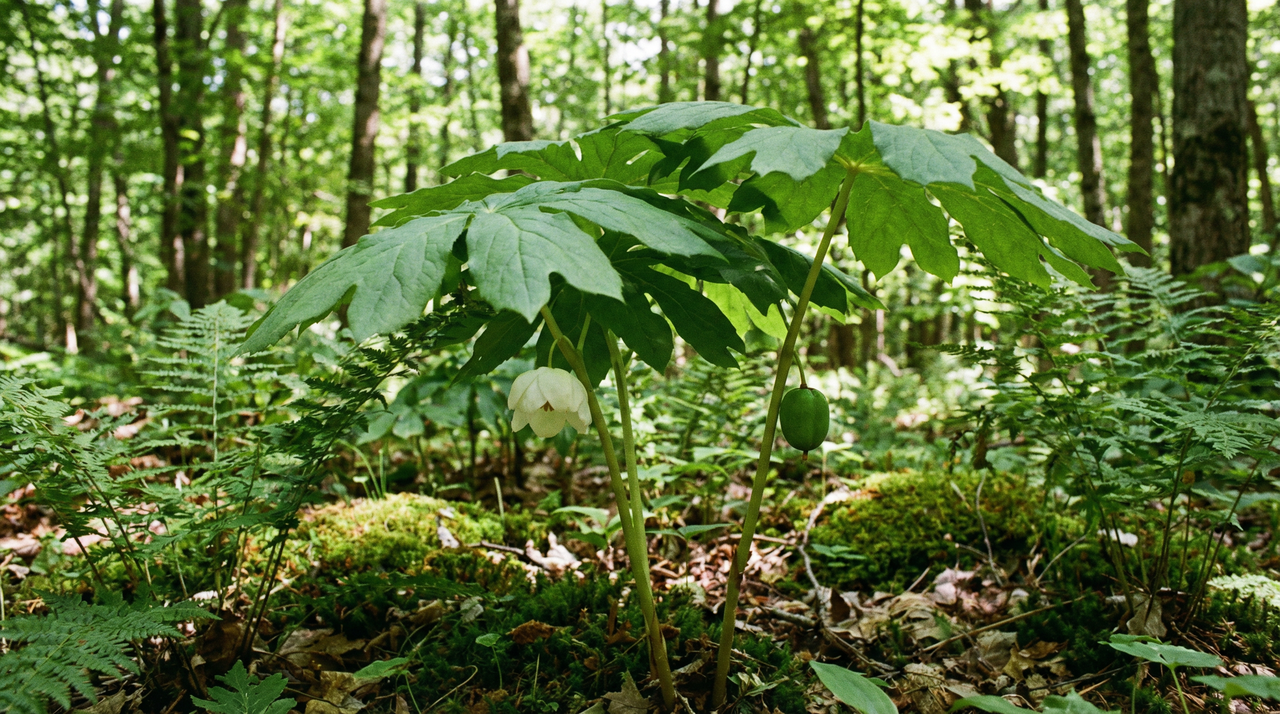
Every spring, I watch people walk right past mayapple without a second glance. I get it. It looks like a houseplant that escaped into the woods, those big pleated umbrellas rising out of the leaf litter in tidy colonies, nothing obviously edible or dramatic about it. What stops me every time is knowing what's actually inside it. The same plant that Native American healers used with extreme caution for centuries[1] eventually gave pharmaceutical chemists the compound they needed to develop etoposide, a chemotherapy drug still used today to treat testicular cancer, small cell lung cancer, and lymphoma.[2] That's not a footnote. That's the whole story of this plant compressed into one sentence.
Here's the contradiction that keeps drawing me back to it: mayapple produces exactly one edible thing, a small yellow fruit that smells faintly tropical and tastes like a cross between a fig and a lemon curd. Everything else, the roots, the leaves, the unripe fruit, is toxic enough to cause serious harm. So you've got a plant that helps cure cancer, can kill you if you handle it carelessly, and also makes a pretty decent jam. I've spent years growing it in shaded garden edges, and I still find that combination genuinely strange and worth paying attention to.
Mayapple Origin, History, and Traditional Uses
Botanical Background and Native Distribution
Few woodland plants command as much presence as the American mayapple (Podophyllum peltatum), and it earns that presence without drama. It simply shows up, reliably, across an enormous sweep of eastern North America spanning from Quebec and Nova Scotia south to Florida and west through Texas, Nebraska, and the Dakotas.[3][4] It settles into the understory of deciduous forests, oak-hickory woodlands, and mixed mesophytic communities, thriving where light filters through the canopy and soils stay moist, well-drained, and rich in organic matter.[5][6]
What most people don't immediately grasp is that a patch of mayapple is really one organism behaving like many. The plant spreads through long-creeping rhizomes, sending up individual shoots that live only a year or two, while the underground clone persists for decades, sometimes well over a hundred years.[7][8] Seedling recruitment is vanishingly rare; germination requires one to three years of cold stratification, and fewer than one percent of seedlings survive to maturity.[9][5] In practice, the colony is everything. I've established mayapple patches from small rhizome divisions that quietly expanded into dense, self-sustaining ground covers over five to seven years, with almost no intervention from me beyond keeping deer out. But I've also watched those same colonies vanish within two seasons when heavy deer browse hit them repeatedly or a spreading invasive moved in. The plant is resilient over geological time and surprisingly fragile at the human scale.[10]
Mayapple carries a conservation rating of G5, meaning it's globally secure, but overharvesting for commercial podophyllotoxin extraction has stressed wild populations, particularly in the Appalachians.[11] That tension between abundance and vulnerability is worth keeping in mind from the very start.
Visual and Ecological Characteristics
The first time a client asks me what plant is carpeting a shaded slope in April, it's almost always mayapple, and the reason is those leaves. Each smooth, erect stem rises 12 to 18 inches and unfurls a single peltate leaf up to 30 centimeters across, with the petiole attached at the center like a handle rather than at the margin, a configuration genuinely rare among North American woodland perennials.[12][13] The result is an umbrella, five to nine deep lobes radiating outward from that central attachment point, and when hundreds of them emerge together before the forest canopy wakes up, the effect is genuinely theatrical. I've photographed this emergence more times than I can count to show clients what "spring ephemeral" really means in a woodland design context.
Only mature two-leaved shoots flower. From the fork between those paired leaves hangs a single nodding white flower, two to three centimeters across, that develops by late summer into an oval, yellowish, fleshy berry holding 20 to 50 seeds.[5][14] The single-leaved shoots remain strictly vegetative. One safety fact belongs front and center here: every part of the plant except the ripe fruit pulp contains podophyllotoxin and is highly toxic, including the seeds.[5] That's not a footnote, it's the defining constraint around everything else this plant offers.
Traditional, Cultural, and Modern Uses
Carl Linnaeus formally described Podophyllum peltatum in Species Plantarum in 1753, and European botanists soon introduced it as an ornamental, where it naturalized in parts of the continent.[15][16] By the nineteenth century it appeared in American nursery catalogs for both ornamental and medicinal purposes.[17] But the plant's relationship with humans is far older and considerably more sophisticated than any European account suggests.
Cherokee, Iroquois, and Ojibwa healers used the rhizomes as a purgative, emetic, vermifuge, and treatment for conditions ranging from liver ailments and rheumatism to warts, convulsions, and toothaches.[18][19] That list sounds broad, but what it reflects is generations of careful, expert knowledge about preparation and dosage. Having studied the ethnobotanical record, I never recommend experimenting with the roots; the difference between a medicinal dose and a toxic one is razor-thin and best left to people with far more specialized training than most of us have.
That traditional observation of the rhizome's drastic biological activity eventually led researchers to isolate podophyllotoxin, the lignan responsible for both its toxicity and its pharmaceutical power. Today it serves as the precursor for topical treatments for genital warts and chemotherapy agents including etoposide and teniposide.[20][21] Understanding that pipeline reinforces something I apply whenever I'm designing medicinal guilds that include at-risk natives: wildcraft only the ripe fruit, leave the rhizomes entirely undisturbed, and let the plant do its quiet, long-term work underground.
Fun Facts and Folklore
The peltate leaf isn't just visually striking; it's botanically unusual in a way that makes mayapple immediately recognizable to anyone who's spent time in eastern woodlands.[22] And because the clone spreads outward while individual shoots come and go, a colony you stumble across in a forest hollow might represent a plant that has been occupying that ground since before your grandparents were born.
The ecological web around mayapple is quietly charming. Sweat bees, syrphid flies, and mining bees work those nodding flowers in early morning, which I've sat and watched myself more than once while setting up a site survey. The ripe fruit, with its lemon-scented, apple-like fragrance, gets dispersed by box turtles, opossums, songbirds, and small mammals.[23][24] Watching a box turtle work its way through a mayapple patch in late summer is one of those moments that makes regenerative landscape design feel worth every hour of planning.
The only edible part is that fully ripe, soft yellow fruit pulp, and the flavor genuinely delivers: sweet-tart, citrusy, a little tropical.[5][25] Some Native groups used it in preserves and pies; the seeds inside remain toxic regardless of ripeness.[5] The common names "ground lemon," "devil's apple," and mayapple itself reflect this split personality: a pleasant fruit carried by a plant with a potent, dangerous history that folktales linked to witchcraft and poison.[25] Seeing a large colony in full spring emergence still reminds me why careful observation, traditional ecological knowledge, and a genuine respect for what a plant is actually doing in its ecosystem matter as much in regenerative design as any planting diagram.
Mayapple Varieties and Where to Buy Them
If you're expecting a long list of cultivars to sift through, Mayapple will disappoint you in the best possible way. Podophyllum peltatum is essentially still the wild plant, growing more or less as it has across eastern North American deciduous woodlands for centuries, from Quebec and Ontario south to Florida and west to Texas and Oklahoma.[3] It's hardy from USDA zones 3 through 8, with the sweet spot for flowering and fruiting landing in zones 4 through 8.[26][3][27] I find that reassuring. A plant nobody has felt the need to "improve" through decades of breeding programs is usually a plant that already knows what it's doing.
Notable Varieties of Mayapple (Podophyllum peltatum)
There are no recognized subspecies or distinct wild varieties of the mayapple podophyllum peltatum species; what taxonomists call Podophyllum peltatum var. peltatum is simply the wild type itself.[28][4] The one cultivar worth knowing is 'Variegatum', which carries white marbling across the leaf surface that catches whatever filtered light reaches the forest floor.[29] I've specified it in deep-shade designs where clients want a little brightness without anything that reads as artificial. The straight species and 'Variegatum' differ in foliage appearance and in the uniformity and vigor you get from cultivated stock, but the core ecology stays identical.[14] No plant-breeders have tried to push this one into something it isn't, and honestly, I hope they leave it alone.
Sourcing Mayapple Plants and Seeds
Don't bother checking the big-box garden centers. Mayapple is rare to occasional in the commercial trade, and the nurseries that carry it tend to be specialists who actually understand what they're growing.[30][31] Prairie Moon Nursery, Ion Exchange, and Plant Delights Nursery are the three I come back to reliably.[32][33][34] Order early in spring because their stock moves fast. Potted plants typically run $10 to $25, with seed packets in the $3 to $10 range for retail buyers.[35]
Buy only from nurseries propagating their own material. Mayapple sits on the United Plant Savers At-Risk list, and several states including North Carolina and Tennessee regulate rhizome harvest because collectors chasing podophyllotoxin have wiped out colonies faster than they can recover.[36][37] I've seen it happen firsthand, which is why I won't source from anyone who can't tell me their plants came from cultivated stock. It's the same conversation I have when I'm sourcing trillium or bloodroot: if the provenance is unclear, the answer is no. The plants you do find from ethical growers establish reliably in a shaded, moist site and spread steadily into the colonies they were always meant to form.
Mayapple Propagation and Planting
If you ask me how to grow mayapple, my honest answer is: skip the seeds, at least to start. Rhizome division is the method I reach for every time, and the numbers back it up. Division achieves 80-90% success rates and can have your planting sites producing fruit within just 1-2 years.[38][39][26] Compare that to the seed pathway and it's not a close contest.
Rhizome Division: The Fastest Route to Fruiting Colonies
The best windows for dividing mayapple rhizomes are early spring just after the plants push up, or fall after the foliage has senesced and the plant has gone dormant for the season.[14][40] I've done it both ways in my own shade garden, and I've learned that each division absolutely needs at least one visible growth bud, that pinkish-white "eye" on the rhizome, to have any real chance of taking. Blind sections without a bud are mostly a waste of time.
Use sterile tools every time you cut. Mayapple rhizomes spread through shared soil and close quarters, so dirty blades can transmit fungal problems across an entire planting.[41] And please, source your divisions from garden stock or reputable native plant nurseries. I never dig from wild patches. These colonies are slow to recover, and mayapple is too ecologically significant to risk for the sake of a free transplant. The plant is already under pressure from habitat loss and overharvesting for pharmaceutical production; our gardens should be part of the solution, not adding to the problem.
Seed Propagation and Breaking Double Dormancy
Growing mayapple from seed is a genuine test of patience. The seeds exhibit complex morphophysiological dormancy, what's often called double dormancy, requiring either 90-120 days of cold moist stratification or two full cycles of warm then cold treatment before they'll germinate.[42][43][44] Even with perfect stratification, germination under natural conditions can take 1-2 years, and you're then looking at 3-7 years from seed to first fruit.[45][44] When I tell clients that timeline, most of them immediately ask for divisions instead, and I don't blame them.
If you do want to try seed propagation, use fresh seed. Viability drops fast without careful storage, and even with cold-moist storage at around 4°C the seed only keeps reliably for about a year.[46][47] Once stratification is complete, seeds germinate best at 68-77°F in well-drained, acidic soil.[44] It's a fascinating process, but for most gardeners starting out, division is the far more forgiving path to an established mayapple colony.
Soil, Site, and Planting Technique
Whether you're transplanting a mayapple division or setting out a mayapple seedling after years of patient seed work, the site requirements are the same. Mayapple wants moist, well-drained, humus-rich loamy soil with a pH between 5.5 and 7.0, with the sweet spot sitting around 6.0-6.5.[14][48][49] Above pH 7.0-7.5, iron chlorosis and nutrient lockup become real problems. I always test my woodland soil before planting and amend with leaf mold rather than commercial peat; it keeps the soil biology alive and tilts the pH in the right direction without oversimplifying the chemistry. Compaction, waterlogging, and prolonged drought are all dealbreakers.
For light, think deciduous woodland understory: partial to full shade, somewhere in the 50-70% shade range.[50][38] Mayapple is a spring ephemeral that evolved to capture early light before the canopy closes overhead, which is part of why it disappears by midsummer. I grow hostas in some of the same beds, and the contrast is a useful reminder: hostas are still pushing up when mayapple is already at peak, capitalizing on that window before the shade deepens. Full sun will scorch the leaves quickly.[3] Replicating forest-floor conditions, the moisture, the organic matter, the filtered light, is the single biggest determinant of whether your planting thrives or struggles.
Spacing and Establishment Tips
Plant rhizome divisions 12-18 inches apart to mimic the density of natural colonies, or space them out to 24-36 inches if you want better airflow and a lower disease risk in cultivated settings.[14][3] Set divisions 2-4 inches deep with the bud just below the surface. The plants will reach 12-18 inches tall and spread laterally over time as the rhizomes expand outward.[51]
Planting mayapple is best done in spring after the last frost or in fall, with consistent moisture and a layer of mulch to hold soil moisture and keep weeds down during establishment.[42][3] The plant is reliably hardy in USDA zones 3-8, so cold hardiness is rarely the limiting factor. What catches new growers off guard is the summer dormancy: once the foliage dies back, it's easy to forget where your divisions are and accidentally disturb them. I label every division I plant with a marker stake and keep a rough map of my shade beds, because there's nothing more frustrating than digging into a rhizome you spent two seasons establishing.
Mayapple Care Guide: Growing Podophyllum peltatum
Caring for Podophyllum peltatum is less about doing more and more about doing less wrong. This is a plant that has been thriving in eastern woodland understories for millennia without any gardener intervention, and the best thing you can do is study that native habitat and reproduce it as faithfully as possible. Get the site right, and mayapple will reward you with spreading colonies and almost zero maintenance. Get it wrong, and no amount of weekly attention will compensate.
Sunlight Requirements and Shade Tolerance
Mayapple prefers partial to full shade and can handle roughly 2 to 4 hours of direct sun daily without complaint, but push it past 6 hours and you'll see the edges of those big umbrella leaves start to scorch and bleach.[52][3] Too little light brings its own problems: etiolation, chlorosis, and a general spindliness that leaves the plant vulnerable.[53] The sweet spot is the dappled light beneath a deciduous canopy, which is exactly where it evolved. What I've noticed with my shadier woodland beds is that consistent soil moisture extends the plant's tolerance for brief sun exposure considerably; a well-hydrated colony handles morning light in a way a drought-stressed one simply won't.
Water Needs and Soil Moisture
Aim for about an inch of water per week during active growth and keep soil consistently moist but never waterlogged.[14][49] Mayapple is genuinely sensitive to both extremes. Let it dry out during a heat spell and you'll see premature yellowing and early dormancy. Let it sit in standing water and the rhizomes rot. A 3-inch layer of organic mulch does most of the hard work here, moderating soil temperature, slowing evaporation, and keeping that even moisture the plant wants without requiring you to hover over it with a hose.
Feeding and Fertility Needs
Mayapple is a light to moderate feeder that genuinely does not need supplemental fertilizer when planted in humus-rich woodland soil.[49][54] I used to over-tend my shade beds with fertilizer until I saw leggy growth and noticeably reduced fruit set; now I rely on an annual top-dressing of leaf mold or compost and let the woodland soil biology do the work. If your soil is genuinely poor, a soil test is the responsible first step, and if amendment is warranted, a balanced slow-release formula at half strength in early spring or some well-rotted compost works within the plant's preferred pH of 5.5 to 7.0.[14][5] High-nitrogen fertilizers push weak, floppy growth and reduce fruiting, and over-fertilizing in general risks leaf scorch and increased disease susceptibility.[49] Never fertilize during dormancy.
Frost Tolerance and Winter Protection
Established mayapple is remarkably cold hardy, tolerating temperatures down to around -40°F in USDA zones 3 through 8, with optimal performance in zones 4 to 7.[55][5] Its deciduous habit handles deep winter cold beautifully. The vulnerability window is spring, when those tender young shoots and large thin leaves push up and a late frost can cause wilting, blackened margins, and dieback that affects the whole season's vigor.[52] I lost a few young colonies early in my native-plant work before I started applying a 3-inch leaf-mold mulch in late fall and watching the April forecast closely. That mulch insulates the rhizomes, prevents frost heaving, and protects against the freeze-thaw cycles that damage newly establishing plants.[14]
Heat Tolerance and Summer Stress Management
Mayapple prefers daytime temperatures between 60 and 75°F and can handle brief spikes to 85°F only if shade, humidity, and moisture are all in good shape.[14][56] Prolonged heat above 80°F brings on wilting, yellowing, and reduced vigor, and the mayapple leaf responds to heat stress much like a large-leaved hosta does: curling, flagging, and generally looking miserable. Rated for AHS Heat Zones 4 through 9, it's most vulnerable during active vegetative growth,[57] and in the warmer end of its range, afternoon shade is non-negotiable. The triad of deep shade, consistent moisture, and mulch is really what makes this plant workable in zones 7 and 8; without all three, summer becomes a losing battle.
Pruning, Maintenance, and Seasonal Rhythm
Mayapple emerges from rhizomes in early spring, flowers in April and May, sets fruit that ripens by late summer, then goes fully dormant by midsummer as foliage yellows and dies back.[58] Once you internalize that rhythm, the maintenance picture becomes very simple. There's no pruning to speak of; the plant handles its own die-back, and the only task is clearing spent foliage in fall to reduce disease pressure.[14][49] Every 3 to 5 years, dividing the rhizomes keeps colonies from overcrowding and gives you propagation material.[14] My established patches disappear completely by July and reappear reliably the following April, year after year, with no intervention from me. That summer dormancy, which can feel alarming the first time you experience it, is actually what makes this plant so forgiving; the hard work is done by the time the heat arrives. Patience and proper siting at the outset matter far more than anything you'll do on a weekly basis.
Mayapple Harvesting Guide: Timing, Technique, and Safety
Mayapple fruit is a genuine woodland prize, but the harvest window is short and the stakes for getting it wrong are real. The rest of the plant contains podophyllotoxin at levels that can cause serious harm, so ripeness isn't a matter of preference here; it's the line between a wild treat and a medical emergency.
When and How to Harvest Safe, Ripe Mayapple Fruit
The fruit takes roughly 45 to 60 days to develop after flowering, ripening anywhere from May through June in the southern part of its range and stretching into July and August farther north.[59][14][5] A ripe mayapple shifts from firm and green to yellow or yellow-orange, softens noticeably to the touch, develops a sweet citrus aroma, and releases from the stem with almost no resistance.[60][5] That drop test matters. If you have to pull, wait.
I've learned to check my woodland patches every two or three days once color change starts, because the fruit often falls into leaf litter and disappears before you realize it peaked. Missing the window by a week means finding mush on the ground instead of fruit in your hand. Identifying that exact moment of full ripeness is genuinely the make-or-break skill with this plant.
Rhizome Harvest for Medicinal Use and Sustainability Considerations
For fruit, the technique is simple: pick what drops easily, then eat only the pulp. Discard the skin and seeds, which remain toxic even in fully ripe fruit.[5][55] Rhizomes are a different matter entirely. They're dug in fall after the foliage dies back, September through November, when the plant is fully dormant.[30][5] Sustainable wildcrafting guidance recommends taking no more than 20 to 30 percent of any colony and giving the patch several years before returning,[30][61] and gloves are non-negotiable given the skin-irritating compounds present.[5] After watching colonies in my own shaded garden edges, I've tightened that limit further; I won't touch more than a quarter of any patch I steward. Rhizome harvest is really work for serious medicinal or commercial applications, not casual foraging. The fruit is your target.
Flavor, Texture, Yield, and Culinary Notes
A ripe mayapple is juicy and pulpy, roughly one to two inches across, with a sweet citrus scent carrying lemon or pineapple notes.[62][5] Flavor comparisons run from strawberry-kiwi to banana-pineapple to fig; the tropical custard quality is real.[63][61] But there's an honest caveat: many people, myself included, notice a bitter or faintly medicinal finish. The first bite often surprises you with how good it is, and then something slightly musty lingers. I've found that finish fades faster in cooked preparations; jelly handles it better than eating the fruit straight off the forest floor.[55]
Yields are modest by design. This is a low-density woodland perennial, not a productive orchard crop,[64] and a few fruits per plant is a realistic expectation. Think small-batch jam or a jar of jelly, not pantry-stocking volume. That scarcity is part of what makes a ripe mayapple feel worth the patience.
Mayapple Preparation, Culinary Uses, and Medicinal Applications
Culinary Uses of Ripe Mayapple Fruit
My first rule for anyone interested in eating mayapple fruit is simple: if it doesn't practically fall into your hand, leave it alone. The fruit needs to be fully yellow-orange, soft to the touch, and detaching from the stem with almost no effort. That's the threshold. Everything else on the plant, the leaves, stems, roots, unripe fruit, is loaded with podophyllotoxin and absolutely off the table.[65][66] The margin for error here is not wide, and I treat it accordingly.
When the fruit is genuinely ready, though, it's a real reward. The flavor is tropical and sweet with citrusy, lemony notes and occasional hints of strawberry or kiwi, though there's sometimes a faint medicinal undertone in the background. That's where cooking earns its keep. I've made mayapple jelly and found that a touch of honey and a squeeze of lemon smooth out any bitterness beautifully. The fruit works well in jams, pies, preserves, and fruit leather, and the act of cooking helps mellow those lingering musty notes that can catch you off guard when eating it raw.[55][19] Eat it in moderation either way; the ripe pulp can still have a mild laxative effect in quantity.
Medicinal Preparation and Safety Considerations
The rhizome has a profound ethnobotanical legacy, and I've studied those traditional applications with genuine respect. But I would never attempt to prepare mayapple rhizomes at home, and I say that with full awareness of the research. Extracting podophyllotoxin requires solvent-based laboratory methods using ethanol or chloroform after pulverization under controlled conditions, the kind of setup that doesn't belong in any kitchen I know of. The toxicity risks are severe enough that home preparation simply cannot be justified.
Rhizomes intended for pharmaceutical processing are cleaned, dried at 35-50°C in well-ventilated, low-humidity conditions,[67][68] and then processed further in facilities equipped to handle the compound safely. That's where podophyllotoxin belongs: in the lab, eventually becoming pharmaceutical derivatives like etoposide under medical supervision. The rest of this plant belongs to the forest floor. When the fruit is ripe and the moment is right, it offers a genuinely special wild treat. Everything else about this plant deserves your respect, not your experimentation.
Mayapple Health Benefits and Medicinal Uses
Mayapple's relationship with human health is built on a genuine paradox. The same compound that makes nearly every part of this plant dangerous enough to require a poison control call has also given us chemotherapy drugs that save lives every day. That compound is podophyllotoxin, and understanding it is the only honest way to talk about what Podophyllum peltatum does and doesn't offer.
Podophyllotoxin and Its Pharmacological Actions
Podophyllotoxin is a cytotoxic lignan. It works by binding to tubulin, the protein subunit that forms the mitotic spindle. By inhibiting microtubule assembly, it arrests rapidly dividing cells in metaphase and triggers apoptosis.[69][70] That's precisely what makes it both medically valuable and genuinely lethal at the wrong dose. Chemists figured out how to work with this by creating semi-synthetic derivatives: etoposide and teniposide, which function as topoisomerase II inhibitors rather than direct tubulin binders. These drugs stabilize DNA cleavage complexes, induce double-strand breaks in cancer cell DNA, and are now standard chemotherapy agents for small-cell lung cancer and lymphomas, with response rates reaching up to 80% in some protocols.[69][71]
The FDA also recognizes podophyllum resin under the name Podocon-25 for topical treatment of genital warts. Applied as a 10-25% solution by a clinician, it achieves 30-80% clearance rates for HPV-caused warts by interfering with viral assembly and replication.[72][73] Beyond cancer and warts, laboratory research has found antioxidant activity (free-radical scavenging against DPPH radicals), anti-inflammatory effects via suppression of NF-κB and pro-inflammatory cytokines in animal models, and limited antimicrobial and antiviral activity in vitro against Staphylococcus aureus, Candida albicans, HSV, and Leishmania.[74][73] Promising findings, but nearly all of them are in vitro. The toxicity of the compound makes human clinical trials for anything beyond oncology and topical dermatology essentially a non-starter.
Traditional and Modern Medicinal Applications
Native American healers utilized the rhizome as a powerful traditional medicine long before anyone knew what podophyllotoxin was.[19][75] In retrospect, those uses align perfectly with the plant's cytotoxic and violently irritant chemistry. That's traditional ecological knowledge working from observable effects toward practical application, and it's genuinely impressive. I teach clients who are curious about native plant medicine to see these historical uses as a signpost to the plant's chemistry, not as a green light to reproduce them at home. As a horticulturist who designs woodland gardens with species like this regularly, I'm always clear: powerful plant compounds don't become safer just because Indigenous people used them skillfully. Sophisticated preparation and generational knowledge kept those uses grounded; stripping out that context and brewing a rhizome tea is a different thing entirely.
Nutritional Profile of the Ripe Fruit
Here's where things get very narrow very quickly. Only the fully ripe fruit pulp, yellow, soft, and practically falling from the stem on its own, is considered edible. The seeds, the skin, any green fruit, and every other part of the plant contain podophyllotoxin and must be avoided completely.[5][76] The fruit itself is small, typically 2-5 cm across and 10-20 g, and there's almost no rigorous nutritional data on it; there's no USDA FoodData Central entry. Estimates extrapolated from comparable wild fruits suggest roughly 15-25 mg vitamin C, some beta-carotene, modest potassium, and trace minerals per 100 g, but those are educated guesses, not lab-confirmed values.[77][78] In my experience foraging woodland plants, I've watched the transition from green to yellow happen surprisingly fast, sometimes within days. That narrow window, combined with the fact that under-ripe fruit is genuinely toxic, is exactly why most foraging authorities advise extreme caution or simply leaving the fruit alone.
Critical Safety Considerations and Toxicity
Rhizomes and roots carry the highest podophyllotoxin concentrations, somewhere between 0.2 and 2% of dry weight depending on plant age, season, and growing conditions. Leaves run lower but still significant, around 0.05-0.5%.[79][80] Ingesting any toxic part triggers severe GI symptoms within 2-12 hours: nausea, vomiting, abdominal pain, and diarrhea. From there, it can escalate to neurological effects including dizziness, confusion, and seizures, cardiovascular instability, and, critically, delayed bone-marrow suppression appearing 1-2 weeks after ingestion. That means leukopenia, thrombocytopenia, and anemia, the same class of damage caused by chemotherapy overdose. Children are especially vulnerable given their lower body weight.[81][82][83]
Podophyllotoxin and podophyllin resin are contraindicated in pregnancy (they're teratogenic and carry miscarriage risk), during breastfeeding, in children, and in anyone with compromised liver or kidney function. Skin contact with the sap can cause contact dermatitis, and the derivatives may increase bleeding risk in people on anticoagulants by suppressing platelet production.[84][85] I approach this the same way I approach foxglove and castor bean in landscape design: beautiful, ecologically valuable, and genuinely hazardous if handled carelessly. When I teach plant identification in woodland gardens, the distinctive peltate, palmately lobed leaves and the single white flower emerging from a forked stem are the visual cues I drill into clients, partly because confusion with less-toxic species like Trillium or Polygonatum is possible when plants are young or out of context.[86]
There's no antidote for mayapple poisoning. Treatment is supportive: activated charcoal for recent ingestion, fluids, electrolytes, and close hematologic monitoring for weeks afterward.[81][76] Raw plant material, teas, tinctures, or any unregulated home preparation should simply not be attempted.[87][88] Mayapple helped birth some genuinely important medicines. That's its pharmaceutical legacy. But that story belongs to laboratories, oncologists, and dermatologists, not to the medicine cabinet or the kitchen counter.
Mayapple Pests and Diseases
Pest Resistance and Common Insect Issues
The same podophyllotoxin compound you read about in the health benefits section does double duty as mayapple's chemical armor against herbivores, and concentrations actually ramp up when the plant senses damage.[89][90] Understanding that connection changed how I think about pest pressure in native woodland plantings entirely. It's not a passive defense; the plant actively dials it up.
In my shaded guild plantings, mayapple leaves consistently come through the season untouched while neighboring hostas look like deer appetizers. That real-world deer resistance is well documented, and the slugs and snails that can wreck young transplants largely leave established plants alone, though juveniles are genuinely more vulnerable during their first season or two.[91][92] Worth keeping an eye on new divisions in early spring for that reason.
The defenses aren't absolute. Specialist flea beetles in the genus Altica and other Chrysomelidae have evolved to tolerate the toxins and can skeletonize foliage; I've learned to scan for their small, shiny adults on young leaves in early spring before much damage accumulates. Aphids, spider mites, and caterpillars show up occasionally as opportunists.[93][94] Still, mayapple has a well-earned reputation as a low-maintenance, pest-resistant perennial in garden settings, and no cultivars have been bred specifically for enhanced insect resistance.[95][5] Most of what we know about resistance comes from horticultural observation rather than controlled trials, so cultural practices remain the sensible foundation.
Disease Profile and Management Strategies
Fungal diseases are the bigger practical challenge. Podophyllotoxin provides moderate natural resistance to some pathogens, but it doesn't make mayapple broadly disease-proof.[96] The usual suspects are powdery mildew, leaf spot from Septoria or Alternaria, anthracnose, and root rot in poorly drained sites.[97][14] Bacterial leaf spot from Pseudomonas pops up occasionally, and mosaic viruses are rare enough that they're poorly documented.[98]
Here's the environmental irony: mayapple thrives in the cool, humid, shaded conditions that also happen to favor fungal pathogens, and disease pressure is noticeably higher across the Midwest and Southeast where those conditions intensify.[97] I see something similar with powdery mildew on woodland phlox in my beds, and the fix is almost always the same: better airflow, not more product. Slug or deer damage on younger plants can compound the problem by opening entry points for pathogens.[14] The 'Variegatum' cultivar offers no documented disease resistance advantage over the straight species, so don't let its ornamental appeal factor into any disease-management decisions.[91]
Management is straightforward and low-intervention: maintain the 18-to-24-inch spacing from your planting plan to support air circulation, keep drainage sharp, remove infected leaves, and skip overhead irrigation entirely.[91][96] Fungicides like chlorothalonil are a last resort for severe outbreaks, but I've never needed them on well-sited plants.[99] Your local cooperative extension office is genuinely worth a call for regional timing and thresholds; I've found that advice far more useful than any generic guide, because disease pressure in a humid Carolina hollow is a different animal than what I deal with further south.
Mayapple in Permaculture Design
Mayapple doesn't show up in permaculture designs because it fixes nitrogen or pumps minerals up from deep subsoil layers. It earns its place by doing something quieter and, in its own way, more interesting: it holds the ecology of a temperate woodland floor together. If your design includes a shaded edge, a north-facing slope, or a maturing food forest with a hardwood canopy, mayapple belongs in that conversation. Just know going in that it's a plant shaped by very specific conditions, and pushing it outside those conditions is a losing proposition.
Climate Suitability and Growing Zones for Mayapple
Mayapple is comfortably hardy across USDA zones 3 through 8, tolerating minimum winter temperatures down to -40°F.[100][3] Its native sweet spot spans the humid continental and humid subtropical climates of eastern North America[101] -- places where summers are warm but not brutal, winters are cold enough to satisfy dormancy, and rainfall arrives reliably. The plant grows best when temperatures stay in the 60-75°F range during the growing season, and photosynthesis starts to suffer above 85-90°F.[5][102] Annual precipitation needs land between 30 and 60 inches, and it wants the 60-80% relative humidity that a forest understory naturally provides.[3][103]
Zone 9 is where I'd tell you to pause. In areas where summer heat consistently clears 85°F, mayapple shows real distress: leaf scorch, wilting, dieback.[104][105] Heavy shade, aggressive mulching, and supplemental water can sometimes help you limp a colony through a southern summer,[106] but it won't thrive the way it does in a Pennsylvania or Michigan woodland. I learned the humidity piece the hard way: my first planting in a dryish shade bed just sat there, looking sorry, until I buried it under several inches of leaf mulch and started treating the soil like the forest floor it had evolved on. After that, the colony took off within a single season. The moisture, shade, and organic-matter needs aren't separate boxes to check; they're one interconnected system.
Ecosystem Functions and Wildlife Support
The ecological payoff starts in April or May, when those nodding white flowers open for a day or two and the bumblebees find them. I've watched this happen in my own shaded borders for enough seasons now that I always make sure to be out there in the early morning when the bloom is fresh -- bumblebees, mining bees, sweat bees, mason bees, and syrphid flies all work the musty-scented flowers, with peak visitation right after dawn.[107][5][108] Because some populations show self-incompatibility and spatial separation between clonal patches, cross-pollination between separate colonies produces better fruit set[107][109] -- worth keeping in mind when you're siting multiple rhizome starts. I now add early-blooming companions nearby to extend the native bee forage window before and after the mayapple's brief flowering.
Beyond pollinators, the plant contributes steadily to the woodland ecology around it. The large umbrella leaves produce substantial litter biomass that breaks down and feeds the soil, and the dense clonal colonies create structural complexity that invertebrates and small mammals use for shelter and foraging habitat.[110][111] The rhizomatous mat also does real work on shaded slopes, binding soil and slowing erosion.[53] Ripe yellow fruits are eaten by opossums, box turtles, and birds, which disperse the seeds, though wildlife value beyond that narrow fruit window is limited because every other part of the plant is toxic.[112] Mayapple doesn't fix nitrogen and doesn't function as a dynamic accumulator -- its honest soil contribution is slow, steady organic matter from that decaying foliage, season after season. That's enough. Once a colony is established, I've watched it self-mulch so effectively that weed pressure underneath virtually disappears and soil moisture stays consistent even between rain events.
Forest Layer Placement and Guild Companions
Mayapple belongs in the herbaceous understory, full stop. It emerges early in spring to claim its 12-18 inches of vertical space[113][3] before the canopy closes, photosynthesizes hard through the cooler weeks of spring, then begins to fade as summer heat arrives. It wants rich, slightly acidic to neutral soil (pH 5.5-7.0), consistent moisture, and the dappled to deep shade of a hardwood canopy; direct sun bleaches and stresses it.[3][103] Its mycorrhizal partnerships improve phosphorus uptake in the lean soils that often characterize older woodland gardens, and its root exudates -- containing podophyllotoxin -- produce a mild allelopathic effect that helps the colony hold its ground without a gardener's constant intervention.[113] Think of it as a gentler version of what black walnut does: territorial, but not aggressively so, and perfectly calibrated to share space with plants adapted to the same forest-floor chemistry.
The natural guild companions read almost like a shade-garden wishlist: ferns, wild ginger (Asarum canadense), trilliums, bloodroot (Sanguinaria canadensis), and hostas all coexist beautifully with mayapple in a designed woodland planting.[14][38] In my experience, the umbrella-leaf canopy that mayapple creates in spring keeps the soil beneath it noticeably cooler and moister -- a microclimate that neighboring ferns and trilliums seem to genuinely benefit from.
I've grown mayapple for years specifically because of its ecological gifts, but I keep it well away from play areas or kitchen gardens because the podophyllotoxin in every part except the fully ripe fruit demands real respect.[114][115] This is a plant for woodland edges and naturalized understory plantings where ecology and low maintenance are the primary goals, not the cutting garden or the vegetable patch. Designed right, it's one of the most satisfying natives you can establish -- a living piece of the eastern forest floor that mostly takes care of itself once you've given it the right conditions.
The Spring I Finally Let Mayapple Do Its Job
I used to fuss over my mayapple colony the way you fuss over something you don't quite trust yet, checking on it, nudging it, second-guessing the shade. Then one April I left it alone for three weeks straight, came back, and found it had quietly colonized a bare slope I'd been fighting with for two years. It didn't need me. It needed me to get out of the way. That's the lesson mayapple keeps teaching, and I keep needing to relearn it.
Sources 115
- Missouri Botanical Garden: Podophyllum peltatum ↩
- National Cancer Institute: Etoposide ↩
- USDA Plants Profile for Podophyllum peltatum ↩
- Flora of North America - Podophyllum peltatum ↩
- Mayapple - Podophyllum peltatum ↩
- Podophyllum peltatum ↩
- Response of Mayapple to Forest Disturbance ↩
- Clonal Reproduction and Population Dynamics in Podophyllum peltatum ↩
- Reproductive Biology of Podophyllum peltatum ↩
- Demography of Podophyllum peltatum in Deciduous Forests ↩
- Conservation Status of Podophyllum peltatum - NatureServe ↩
- Missouri Botanical Garden PlantFinder - Podophyllum peltatum ↩
- USDA Plants Profile for Podophyllum peltatum (mayapple) ↩
- Mayapple (Podophyllum peltatum) Plant Profile ↩
- Species Plantarum ↩
- Introduction and Naturalization of North American Plants in Europe ↩
- A Catalogue of Fruit and Ornamental Trees and Shrubs ↩
- Native American Ethnobotany ↩
- Native American Ethnobotany Database ↩
- Podophyllotoxin: A Novel Potential Treatment for Cancer ↩
- Podophyllum peltatum ↩
- Missouri Botanical Garden PlantFinder - Podophyllum peltatum ↩
- Pollination Ecology of Podophyllum peltatum ↩
- Seed Dispersal by Vertebrates in Mayapple ↩
- Cherokee Plants and Their Uses -- A 400 Year History ↩
- Podophyllum peltatum (Mayapple) ↩
- Podophyllum peltatum ↩
- Podophyllum peltatum ↩
- Podophyllum peltatum 'Variegatum' ↩
- USDA PLANTS Database: Podophyllum peltatum ↩
- Plant Finder: Podophyllum peltatum ↩
- Podophyllum peltatum (Mayapple) Seeds ↩
- Mayapple Plants for Sale ↩
- Wild Mandrake (Mayapple) - Native Plants ↩
- Mayapple (Podophyllum peltatum) Seeds ↩
- United Plant Savers At-Risk List ↩
- State Regulations on Wild Harvesting ↩
- Mayapple ↩
- Vegetative Propagation Techniques for Woodland Perennials ↩
- Division of Perennial Vegetative Growth for Podophyllum peltatum ↩
- Propagation of Native Plants: Mayapple ↩
- Podophyllum peltatum (May Apple) ↩
- Podophyllum peltatum L. mayapple ↩
- Dormancy and Germination of Podophyllum peltatum Seeds ↩
- Podophyllum peltatum (Mayapple) ↩
- Seed Propagation of Native Plants: Podophyllum peltatum ↩
- Storage and Germination of Podophyllum Seeds ↩
- Podophyllum peltatum Plant Guide ↩
- North Carolina Extension Gardener Plant Toolbox - Mayapple ↩
- Shade Tolerance and Phenology of Podophyllum peltatum in Deciduous Forests ↩
- Plant Finder - Podophyllum peltatum (Mayapple/American Mandrake) ↩
- Podophyllum peltatum (Mayapple) ↩
- Podophyllum peltatum (Mayapple) Plant Profile ↩
- Podophyllum peltatum (Mayapple) ↩
- Podophyllum peltatum (Mayapple) ↩
- Growing Mayapples in the Home Garden ↩
- Podophyllum peltatum ↩
- Podophyllum peltatum ↩
- Podophyllum peltatum L. ↩
- Flora of North America ↩
- Mayapple - Missouri Department of Conservation ↩
- Missouri Botanical Garden Plant Finder ↩
- Edible and Medicinal Plants of the Midwest - University of Minnesota Extension ↩
- Kew Gardens Plant Factsheet ↩
- Missouri Botanical Garden Plant Finder: Podophyllum peltatum ↩
- Royal Horticultural Society Iconic Plants: Podophyllum peltatum ↩
- Processing and Drying of Medicinal Plant Roots and Rhizomes ↩
- Post-Harvest Handling of Podophyllum Rhizomes ↩
- Mechanism of Action of Podophyllotoxin and Its Derivatives ↩
- Pharmacology of Podophyllotoxin ↩
- Etoposide in small-cell lung cancer: a review ↩
- Podophyllin for genital warts ↩
- Antiviral and Antioxidant Activities of Podophyllum Species ↩
- Antioxidant and Anti-inflammatory Properties of Podophyllum peltatum ↩
- Ethnobotanical Uses of Podophyllum peltatum in Native American Cultures ↩
- Mayapple Toxicity and Edibility ↩
- Wild Edible Fruits and Their Nutritional Value ↩
- Podophyllum peltatum - Mayapple ↩
- Phytochemistry Reviews, 2009, 'Phytochemistry of podophyllotoxin-bearing plants' ↩
- Phytochemical Investigation of Podophyllum peltatum ↩
- Podophyllum Toxicity: A Comprehensive Review ↩
- Mayapple (Podophyllum peltatum) Poisoning: Case Report and Literature Review ↩
- Mayapple (Podophyllum peltatum) Toxicity ↩
- Podophyllotoxin: Pharmacology, Toxicity, and Clinical Applications ↩
- Drug Interactions with Podophyllotoxin Derivatives ↩
- Podophyllum peltatum ↩
- Podophyllotoxin: Uses, Interactions, Mechanism of Action ↩
- Podophyllin: Contraindications and Side Effects ↩
- Chemical Defenses of the Mayapple (Podophyllum peltatum L.) against Insect Herbivory ↩
- Induced accumulation of polyphenolics and lignans in Podophyllum peltatum upon herbivory ↩
- Mayapple in the Garden ↩
- Mayapple (Podophyllum peltatum) ↩
- University of Maryland Extension - Insect Pests on Mayapple ↩
- Mayapple (Podophyllum peltatum) Pest Management ↩
- Missouri Botanical Garden Plant Finder - Podophyllum peltatum ↩
- Mayapple (Podophyllum peltatum) Diseases and Pests ↩
- Fungal Pathogens of Mayapple ↩
- Diseases of Woody Ornamental and Trees ↩
- Diseases of Woody Ornamentals and Trees ↩
- Podophyllum peltatum ↩
- Updated World Map of the Köppen-Geiger Climate Classification ↩
- Temperature Tolerance in Native Perennials: Podophyllum peltatum ↩
- Mayapple (Podophyllum peltatum) ↩
- Heat Stress Responses in Podophyllum peltatum ↩
- Cultivating Mayapple in Southern Gardens ↩
- Growing Native Plants in Georgia ↩
- Pollination Ecology of Podophyllum peltatum ↩
- Pollination Ecology of Podophyllum peltatum ↩
- Mayapple (Podophyllum peltatum) Fact Sheet ↩
- Ecology of Podophyllum peltatum in Eastern Deciduous Forests ↩
- Understory Plants and Nutrient Cycling in Temperate Forests ↩
- Wildlife Interactions with Mayapple (Podophyllum peltatum) ↩
- Podophyllum peltatum - Missouri Botanical Garden ↩
- Podophyllum peltatum - Missouri Botanical Garden Plant Finder ↩
- Podophyllotoxin and Mayapple Uses - NCBI ↩