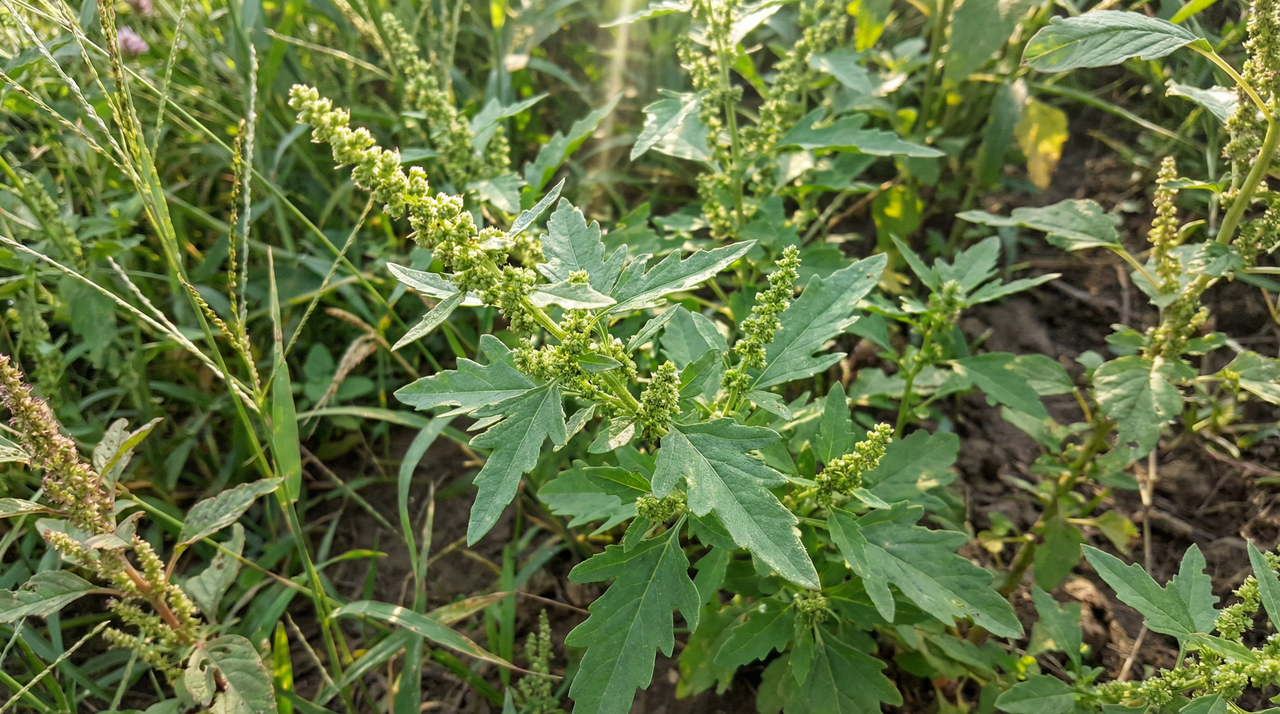
Every cook who's opened a can of black beans and wondered what's missing should meet epazote. Not because it "completes" the dish in some romantic sense, but because the first time you drop a few fresh sprigs into a simmering pot, the smell hits you and you genuinely can't decide if it's wonderful or alarming. Turpentine, citrus peel, something faintly medicinal and green and wild. I've described it to gardening students as what you'd get if a lemon and a petroleum refinery had a baby together, and they laugh until they taste the beans, and then they go quiet in that particular way people do when something works better than it has any right to.
What I find endlessly worth chewing on is how the same compound responsible for that smell, ascaridole, is the reason epazote has been used for centuries as a literal antiparasitic medicine[1] and is also the reason you shouldn't treat it like parsley and pile it on. One plant, doing two completely different jobs, with a chemical that's both the hero and the hazard. That tension is what makes this herb so interesting to grow, cook with, and understand. The Aztec and Maya peoples knew this plant intimately, and I think most modern gardeners don't even know they're missing it.
Mexican Tea Origin, History, and Botany
Botanical Background and Taxonomy of Mexican Tea
Mexican tea, known far more widely by its Nahuatl name epazote, is Dysphania ambrosioides, a member of the Amaranthaceae family with its center of origin in Mesoamerica, specifically the region we now call Mexico and Guatemala.[2][3] From there it has naturalized across the southwestern United States, the Caribbean, and eventually Africa, Asia, Europe, and Australia.[4][5] Older references will list it as Chenopodium ambrosioides, but molecular phylogenetic work reshuffled it into Dysphania, which is where it sits today.[6][4] If you're sourcing seed or looking it up in older texts, you'll encounter both names; they refer to the same plant.
One thing I love about epazote from a garden design perspective is how its ecological identity tells you everything you need to know about managing it. This is a pioneer species, built for disturbed roadsides, overgrazed fields, and the rubble edges of agricultural land, growing from sea level all the way up to around 3,000 meters elevation across arid, semi-arid, and subtropical conditions.[7][2] In temperate climates it behaves as an annual; in warmer regions it persists as a short-lived perennial.[2][8] It's monocarpic, meaning each plant flowers once and then dies, but before it goes, it drops thousands of seeds that can remain viable in the soil for five to ten years.[9][10] In my experience working with vigorous self-seeders in warm climates, that kind of seed bank is exactly what makes a plant feel like a permanent fixture in the garden whether you intended it or not.
Traditional and Cultural Uses of Epazote
Archaeological evidence points to domestication during the Early Formative period of Mesoamerica, and the plant was documented in colonial-era texts including the Badianus Manuscript, a sixteenth-century Aztec herbal.[5][11] Aztec and Maya peoples used it as an anthelmintic (its compound ascaridole is directly responsible for that antiparasitic action against intestinal roundworms), a carminative to ease the flatulence that comes with eating beans, and an emmenagogue to stimulate menstruation.[12][13] It also appeared in respiratory remedies for colds and asthma, and it held a firm ceremonial role: burned as incense, used in spiritual cleansing baths, and woven into protective rituals around events like childbirth and Dia de los Muertos.[14][15]
In the kitchen, its role has been just as enduring. Epazote has flavored black bean soups, quesadillas, and stews since pre-Columbian times, and its carminative chemistry is the reason traditional Mexican cooks have always tossed a sprig into the bean pot.[14][16] Spanish colonization carried it to the Caribbean and the Philippines; European traders brought it to Africa; global trade and cultivation spread it further from there.[5] The emmenagogue and antiparasitic uses are well-documented historically, but I always emphasize to clients who want to use herbs medicinally that the same research validating those traditional applications also flags clear risks at higher doses, including dizziness, vomiting, and potential organ damage.[17] Culinary use is a very different matter from medicinal dosing, and that line deserves respect.
Visual Characteristics of Mexican Tea
In warm climates, epazote grows as a bushy subshrub reaching two to four feet, though in truly favorable conditions it can push toward ten feet.[18][19] Stems are erect and branching, often flushed reddish, covered in fine glandular hairs, and the base becomes slightly woody with age. A deep taproot anchors the whole structure, which is part of why it handles dry or disturbed soils so well.[20] Leaves are alternate, ovate to lanceolate, mid- to dark green, two to seven centimeters long, with glandular dots visible on the surface.[21][4] The flowers are tiny and inconspicuous, greenish-yellow, arranged in dense spike-like panicles, blooming from late summer through fall.[22][19]
The most useful identification feature, at least in my experience, is the smell. Crush a leaf and you get something that sits somewhere between citrus, oregano, mint, and gasoline; it's unmistakable once you've encountered it once. I've used that scent test to quickly distinguish epazote from lambsquarters (Chenopodium album) and other goosefoot relatives that can look similar in a mixed planting.[23] The small black lentil-shaped seeds and the glandular hairs on the stems are secondary confirms, but your nose usually gets there first.
Fun Facts About Epazote
Epazote sits in the Amaranthaceae family alongside quinoa and amaranth, which gives you a sense of the company it keeps.[24] In non-native regions including parts of the United States, Australia, and Africa, it can spread aggressively through disturbed habitats via wind-, bird-, and animal-dispersed seeds.[25][26] That five-to-ten-year seed bank means you can pull every visible plant and still find seedlings returning for years. From a permaculture standpoint, I've found the smarter move is to harvest preemptively before the flower spikes mature rather than trying to eliminate the seed source after the fact. It converts what could be a management headache into a consistent harvest rhythm.
Modern pharmacological research has gone back and confirmed many of the traditional antiparasitic and digestive applications that Aztec and Maya practitioners worked out long ago, though the same studies consistently underscore the need for caution with higher doses.[17][12] There's something worth sitting with in that: a plant used for thousands of years, documented in a sixteenth-century manuscript, and still earning attention from researchers today.[11] Epazote rewards respect, not casualness.
Mexican Tea Varieties and Where to Buy
If you're used to browsing seed catalogs for basil cultivars or tomato varieties, Mexican tea is going to feel refreshingly uncomplicated and occasionally frustrating in equal measure. Dysphania ambrosioides has no widely recognized commercial cultivars, no "Genovese epazote" or "Italian Large Leaf" equivalent.[27][28] What you're actually buying, whether you realize it or not, is an open-pollinated landrace shaped by whatever region, farm, or backyard it came from.
Recognized Subspecies, Chemotypes, and Landraces
Taxonomically, two subspecies exist. Subsp. ambrosioides is the tall, vigorous, upright form most gardeners and cooks recognize, reaching up to 1.5 meters with broad, deeply lobed leaves and that signature sharp-camphor punch in the aroma. Subsp. pusilla stays much smaller, under 60 centimeters, with narrower leaves and a preference for drier, more arid conditions.[28][29] In my experience, plants sold for cooking are almost always the vigorous, upright subsp. ambrosioides type. I've grown both, and the difference in leaf size and aroma intensity is immediately obvious once you've handled them side by side.
Under the older Chenopodium ambrosioides classification, botanists recognized two varieties: var. ambrosioides, with higher ascaridole content, and var. anthelminticum, with lower or absent ascaridole.[27] That taxonomy is outdated now, but the chemical reality it was pointing to is very much still relevant. Ascaridole content varies significantly by population, with Mexican culinary landraces tending toward the highest concentrations.[30][31] That difference matters, because ascaridole is the compound behind both the plant's pungency in the kitchen and its medicinal potency. Seed from a Mexican culinary source will typically smell more assertive, almost medicinal-sharp, compared to milder variants from other regions. I've noticed this firsthand between packets from different suppliers, which is why I label my seed trays carefully every spring. Mix up your starts and you won't know what you have until the leaves unfurl and you get a good sniff. Plants typically grow somewhere between one and three feet tall with a spread of one to two feet.[27]
How to Source Mexican Tea Seeds and Plants
Demand for fresh epazote in Hispanic grocery markets is strong enough to sustain a small but reliable supply chain of seeds and starts in the US, sourced largely from Southwest growers and imports from Mexico.[32][33] You won't find it at most big-box garden centers, but online seed companies, specialty herb nurseries, and ethnic grocery stores are solid options.[34][32] Seed packets generally run $2.50 to $5.00, and live potted plants land somewhere between $8.00 and $15.00. I buy seed in early spring and have had consistently good germination from packets in that lower price range, particularly from organic or heirloom-focused vendors whose stock turns over quickly. The plant performs best in USDA zones 8 through 11, and spring-sown seed reaches harvestable size in about 60 to 90 days.[34]
One thing to settle before you order anything: confirm whether the dysphania ambrosioides plant is restricted in your area. Epazote is considered invasive in some regions, and I've watched it naturalize quickly in disturbed soil here in the Southeast.[35] Check with your county extension office before you click purchase. It's a genuinely useful herb, but it deserves the same respect you'd give any fast-seeding opportunist.
Mexican Tea Propagation and Planting Guide
Mexican tea is one of those plants that practically wants to grow. Once you understand what it's doing reproductively, the whole thing clicks into place, and starting it from seed feels less like a task and more like working with a system that's already stacked in your favor.
Seed Characteristics and Propagation Methods
The seeds of Dysphania ambrosioides are tiny. They are typically 0.7 to 1.5 mm long, jet black, and lenticular with a polished, almost glassy surface.[2][4] What makes them genuinely unusual is that the plant reproduces primarily through apomixis, a form of asexual seed production that bypasses meiosis and fertilization entirely.[36] Layer on top of that polyembryony, where individual seeds frequently carry multiple embryos derived from nucellus tissue,[37][38] and you end up with a breeding system that is overwhelmingly self-pollinating with very low genetic variation from seed to seed.[39] The plant is diploid at 2n=18 chromosomes,[40] which all adds up to this: the seedlings you get are remarkably uniform, almost clone-like, from one batch to the next. I noticed this the first spring I started it indoors alongside several other herbs. Everything else was variable. The epazote was eerily consistent.
That polyembryony does come with a catch I learned the hard way. A single sowing produces multiple seedlings per seed, and because the seeds are so small you tend to scatter more than you realize. I now thin ruthlessly within the first two weeks, otherwise a tray or a bed patch turns into a tangled mass before you've had a chance to think about it.
The seeds are orthodox, meaning they tolerate desiccation and low-temperature storage well.[41] For home saving, I harvest when the seed stalks are dry, shake them into a paper bag, and let everything air-dry further in the shade for a week or so. Then the seeds go into an airtight jar with a silica packet and straight into the refrigerator. At 4 to 10°C with humidity kept below 15%, viability holds for five to ten years.[42] In my own experience, seed saved this way germinates reliably into the third and fourth year, which is reassuring for anyone who finds themselves with a surplus after a good season.
Sowing is straightforward. No scarification, no stratification. Surface sow or cover very lightly, no more than an eighth of an inch, in well-drained soil and keep moisture consistent until germination.[43] Stem cuttings are possible if you want to propagate a particular plant: take 4 to 6 inch semi-hardwood pieces in spring or summer, keep humidity between 70 and 90 percent with bottom heat around 70 to 80°F, and they typically root in two to four weeks with or without hormone.[43] That said, seed is so easy and so reliable that I've never found a strong reason to bother with cuttings for this species. Tissue culture and grafting exist somewhere in the experimental literature but have no practical place in the home garden.
One planning note: because this species self-seeds so prolifically in frost-free regions, it can become genuinely invasive if left unchecked.[44][2] I'll get into my container strategy below, but keep this in mind from the start.
Soil, Site Selection, and Sun Requirements
Epazote's native range is the disturbed roadsides, waste areas, and open fields of tropical and subtropical Mexico and Central America.[2][24] Pioneer-species territory. That ecological context is the most useful single piece of information I can give you about site selection, because it tells you exactly what the plant expects: open sun, lean soil, and above all, drainage.
It prefers sandy loam or loamy soil with a loose, granular structure.[24] It tolerates sandy, gravelly, and moderately fertile ground without complaint. What it won't forgive is wet feet. My first attempt was in a section of my garden that had heavy clay, and within three weeks I had yellowing leaves, stunted stems, and that telltale mushy crown that signals root rot is already underway. I amended with coarse sand, moved subsequent plants to raised beds, and never had the problem again. If your native soil is heavy, don't fight it; amend aggressively or raise the bed.
The ideal soil pH sits between 6.0 and 7.5, though the plant tolerates a broader range of 5.5 to 8.0 without catastrophic failure.[24][2] It genuinely thrives in low-fertility soil with around 2 to 5 percent organic matter, so modest compost amendment is fine but heavy fertilizing is counterproductive.[24] For containers, a mix of roughly 50 percent garden soil, 30 percent compost, and 20 percent perlite or coarse sand works well. The taproot runs 12 to 24 inches deep, so pots should be at least 8 to 12 inches deep to avoid stunting the plant.[45]
Full sun, at least six hours daily, gives the best growth and flavor intensity. In hotter climates, some afternoon shade prevents leaf scorch without sacrificing much productivity.[24][46]
Spacing, Planting Technique, and Timeline to Harvest
Mature plants typically reach 20 to 36 inches tall with a spread of 12 to 24 inches, though under ideal conditions they'll push closer to five feet.[24][47] Give plants 12 to 18 inches between individuals and 24 to 36 inches between rows.[48] That spacing supports air circulation, which matters for disease prevention, and it accounts for the vigorous self-seeding that can fill gaps fast. In my early years I crowded them to save space, and the result was leggy, poorly branched plants that were harder to harvest and more prone to fungal trouble at the base.
In warmer climates, I now grow mexican tea in large pots on my patio rather than directly in garden beds. The self-seeding is enthusiastic enough in zone 9 and above that a single plant, if left to flower and set seed, can scatter progeny across a wide radius. Keeping it in a container gives me the herb where I want it without risking displacement of native plantings nearby.
Germination and Growth Expectations
Seeds germinate in 7 to 14 days when soil temperatures are between 70 and 85°F.[49] Direct sow after your last frost date or start indoors a few weeks earlier. The overall cycle to first usable leaves runs 40 to 60 days from sowing, when plants reach roughly 6 to 12 inches tall; the full 60 to 90 day window brings the plant to peak maturity with heavier leaf production.[49][50] Once flowering begins, seed maturity follows in another 30 to 45 days,[50] so the window for tender culinary leaves is relatively brief if you let the plant run its course unchecked.
That six-week mark in warm, sunny conditions is real and reliable in my experience. I always know the young plants are ready not just by height but by aroma: that sharp, almost gasoline-with-citrus smell that makes you simultaneously recoil and reach for the bean pot. When a 6-inch plant smells like that on a warm morning, it's ready. Parsley won't give you anything useful in six weeks. This one will.
The uniformity that comes from the plant's apomictic and polyembryonic reproduction means those germination and growth benchmarks are consistent across seedlings in a way that genuinely makes planning easier. Sow on a date, count forward six weeks, expect the harvest. It's refreshingly predictable.
Mexican Tea Care Guide
Mexican tea is fundamentally a plant of disturbed, sun-baked habitats, and its care requirements reflect exactly that origin. It doesn't want coddling. What it wants is a site that mimics the roadsides and dry hillsides of central Mexico where it evolved: plenty of light, fast-draining soil, and relatively little fuss. Get those basics right and it grows with an almost aggressive enthusiasm. Get them wrong and it tells you quickly.
Sunlight Requirements for Mexican Tea
Epazote performs best with at least 6-8 hours of direct sun daily.[51][47] Push it into a shadier corner and you'll notice the difference fast: spindly, etiolated stems, yellowing leaves, and noticeably smaller foliage.[52] The aromatic intensity fades along with the growth habit, which defeats the whole purpose of growing it. Intense afternoon sun in the deep South is its own problem. I've watched leaf edges brown and curl on plants sitting in unrelieved July heat here in Central Florida.[43] My solution was simple: drape 30% shade cloth over the afternoon side of the bed. Flavor stayed sharp, plants stayed productive.
Watering Needs and Drought Tolerance
Once established in well-drained, sandy or loamy soil, Mexican tea handles dry spells surprisingly well.[24][53] Young transplants and seedlings need consistent moisture until their roots settle, but mature plants are genuinely forgiving. I water deeply and infrequently, around 1-2 inches per week when the top inch or two of soil is dry to the touch.[24][53] The real danger isn't underwatering, it's the opposite. Root rot moves fast in poorly drained soils,[24] and I've seen container-grown plants decline within a week when sitting in soggy mix. Wilting, browning leaf edges, and stunted growth signal the other extreme.[54] Let the soil be your calendar, not the clock.
Feeding and Soil Fertility for Mexican Tea
This is a genuinely light feeder that evolved in poor, disturbed tropical soils[55] and behaves accordingly in the garden. I work a few inches of compost into the bed before planting and, in most seasons, that's the end of the fertility conversation.[56] Excess nitrogen is the specific thing to avoid: it promotes soft, leggy growth and visibly reduces the pungency of the leaves.[56][57] I noticed this directly when I over-fertilized a bed years ago: lush, tall plants with surprisingly flat aroma. Now I skip the supplemental feed entirely in established garden beds. If growth seems genuinely sluggish, a dilute balanced fertilizer every 4-6 weeks during active vegetative growth is plenty,[58] and the preferred soil pH sits between 6.0 and 7.5. Deficiency clues worth knowing: yellowing older leaves suggest nitrogen, purplish tints point to phosphorus, and the interveinal chlorosis I saw on older leaves last season cleared up quickly with a light magnesium foliar spray.[43]
Heat and Frost Tolerance of Mexican Tea
Few herbs handle genuine summer heat as gracefully as epazote. It thrives between 59 and 95°F, with the sweet spot around 68-86°F, and is rated for AHS Heat Zones 8-12.[59][60] Compared to basil, which melts in humid heat, or cilantro, which bolts at the first sign of summer, mexican tea just keeps going. Sustained temps above 35°C can push it toward wilting and leaf scorch,[61] but afternoon shade, consistent watering, and a mulched root zone address that reliably.[62] The cold end of the spectrum is where it gets tender fast. It's hardy as a short-lived perennial only in USDA zones 9-11; below zone 9, treat it as an annual.[63] Brief light frosts down to 28-30°F may be survivable,[63][24] but I once left a mature plant unprotected during an unexpected 26°F night in early spring; the top growth blackened within hours while the mulched roots survived and resprouted. Row covers are non-negotiable for me now in marginal conditions, and starting fresh from seed each spring is honestly easier than fighting to overwinter plants.[64]
Pruning, Maintenance, and Seasonal Rhythm
Mexican tea completes its full cycle from germination to seed production in roughly 3-6 months, with flowering beginning 8-12 weeks after germination.[24] Left alone it reaches 2-4 feet and gets leggy and rangy.[24] I pinch growing tips once plants hit 6-8 inches to encourage branching, and from that point frequent harvesting of young leaves does double duty as both food production and natural pruning. Once flowering begins, flavor turns bitter,[2] so the goal is to stay ahead of that transition with regular cuts. The self-seeding question is one every grower of this herb needs to have an honest answer for. A single plant allowed to flower and set seed can drop hundreds of viable seeds that germinate freely the following spring. I let a couple of plants go to seed each year deliberately, for my next season's supply, then pull the rest before the seed heads fully dry. Treating the mexican tea plant like a weed is a fair instinct in warm climates; managing it intentionally is how you keep it from becoming one.
Mexican Tea Harvesting Guide
Epazote is a fast mover from seed to kitchen. You can start snipping young leaves in as little as four to six weeks after germination, but the real sweet spot comes around two to three months in, when plants have reached six to twelve inches tall and are still in full vegetative mode before any flowering begins.[65][24] In temperate gardens, that lines up with the June through September window, peaking in July and August when temperatures sit in that comfortable 68 to 86°F range and the days are long.[66][67]
When to Harvest: Timing, Growth Stage, and Environmental Cues
The harvest window can close faster than you'd expect. Heat above 95°F, a stretch of drought, or even a surprise early frost can push the plant straight into flowering, and once that happens, leaf quality drops fast.[67][65] I grow epazote through Central Florida's brutal summers, and I've watched well-established plants bolt seemingly overnight after a heat spike. Your most reliable field cue isn't a calendar date; it's the smell. Rub a leaf between your fingers. If it hits you with that sharp citrus-gasoline punch, you're in the window. Stop harvesting for leaf production the moment you see flower buds forming.
Harvest Technique for Continuous Supply
Pinch or cut the top growth rather than stripping whole stems.[65] I learned early on that taking only the top third of a stem lets the plant rebound quickly and stay compact and bushy rather than going tall and leggy. Think of it less like harvesting and more like regular pruning that happens to feed you. Done consistently, this approach gives you repeated cuts all season from the same plant rather than one big haul and a long recovery.
Yield, Flavor, and Aroma at Peak Harvest
Young leaves, one to two inches long, bright green, and still tender, are what you're after.[27][4] The aroma is genuinely difficult to describe to someone who hasn't encountered it: citrus, anise, mint, oregano, and underneath all of that, an unmistakable petroleum note from ascaridole, limonene, and p-cymene.[68] I sometimes compare it to cilantro in the sense that it divides people sharply on first encounter, not unlike rue. Pre-flower leaves harvested in the morning after rain seem to carry the sharpest hit of those volatiles, which tracks with research showing that growing conditions heavily influence the final chemical profile. Drought and sun push the oil toward more pungent compounds, while nitrogen-rich or shaded growing produces softer, more anethole-like notes.[69] That's why the same plant can taste pleasantly herbal one week and almost medicinal the next. Aroma and flavor intensity peak before flowering and drop off as leaves mature and toughen.[65][4] If you're drying any of your harvest, keep the temperature at or below 40°C; I've tried both air-drying and low-heat oven methods, and the low-heat approach preserves that sharp, distinctive character far better than anything higher.[70] The pungency is self-regulating in the kitchen too; the flavor is intense enough that a little goes a long way, whether fresh or dried.[24]
Mexican Tea (Epazote) Preparation, Culinary Uses, and Medicinal Applications
Epazote has a dual identity that I think is worth respecting from the start: it's a kitchen herb first and a medicinal plant second. The leaves are the primary edible part, with seeds used occasionally as a condiment and stems sometimes steeped in infusions but not typically eaten.[71][72] Understanding that hierarchy makes the safety guidance that comes later feel natural rather than alarming.
Culinary Uses and Flavor in Mexican Cuisine
If you've ever eaten a well-made pot of black beans in Mexico or El Salvador, you've almost certainly tasted epazote without knowing it. The herb is traditional in beans, soups, stews, quesadillas, and pupusas, paired with meats, cheeses, onions, garlic, and chilies across the region.[73][74] When I crush a fresh leaf, the pungent aroma immediately makes it clear why traditional cooks intentionally use such a light hand. It's not subtle.
The traditional practice is to add a few fresh leaves during cooking and simmer for 10 to 20 minutes.[75] That simmer matters: it breaks down ascaridole, the compound responsible for both the pungent aroma and the plant's toxicity risks, making the dish far safer than eating the leaves raw.[24] I've grown epazote in my Central Florida garden for years, and I've learned to use only a sprig or two per pot. Any more overwhelms the dish completely, and then you understand immediately why traditional cooks say less is more. I always pull out the stems and larger leaves before serving; it improves texture and aligns with the sensible habit of keeping concentrated plant material out of the final bite.
Traditional Medicinal Preparations and Dosages
The most historically significant medicinal application of the mexican tea herb is as an anthelmintic, a traditional treatment for intestinal parasites documented across centuries of indigenous Mexican practice.[76][77] Beyond that, traditional herbalists have used it as a digestive aid for gas, cramping, and indigestion, and for respiratory complaints, menstrual disorders, and inflammation.[78][2]
For a simple mexican tea drink or infusion, the traditional preparation is 1 to 2 teaspoons of dried leaves per cup of hot water. Tincture use is typically 1 to 2 ml diluted, and essential oil preparations require extreme caution. General dosage guidance caps use at 2 to 3 fresh leaves per serving, under 5 grams of dried leaf per day, and limits any medicinal course to less than a week. I keep my own medicinal use very light and short-term, never more than a few days, and I'd always tell anyone with underlying health conditions to consult a professional before treating this plant as a remedy rather than a seasoning.
Safety Considerations and Non-Food Applications
Ascaridole is the thread that ties everything together here. It's the essential oil compound behind the plant's distinctive pungent smell, its biological activity as a digestive aid and anthelmintic, and its potential toxicity when overconsumed.[77][79] The same chemistry that makes this mexican tea plant medicinally interesting is the reason heat, moderation, and short-term use aren't optional suggestions.
Outside the kitchen and tea cup, epazote has a traditional role as an insect repellent and figures into various topical folk remedies, but all internal use warrants real care.[79][77] My honest take after years of growing it: treat epazote as a seasoning that moonlights as a remedy, not the other way around. Simmer it with your beans, pull the stems before serving, and if you're exploring its medicinal history, do so with a light hand and a short calendar.
Mexican Tea Health Benefits
Traditional and Folk Medicinal Uses
Long before anyone ran an in vitro assay on it, Mexican tea was earning its keep in kitchens and curandero practices across Mesoamerica. Traditional use of epazote spans intestinal parasite treatment, flatulence, colic, respiratory complaints, menstrual cramps, and applications as a diuretic and antispasmodic.[80][81][78] That's a wide range of uses, and when I look at the phytochemical research, much of it makes sense. The traditional pairing of epazote with beans, for instance, isn't just culinary habit; it's digestive medicine that generations of cooks arrived at empirically.
The antiparasitic tradition is where the strongest human data sits. A clinical trial in rural Mexico found roughly 70% efficacy against Ascaris lumbricoides using an oral decoction,[82][83] which is meaningful, though the trial was small. The traditional use of mexican tea for parasites has real support, but the evidence base is still primarily preclinical, and no large randomized controlled trials exist yet.[84][85] That's a common story with traditional herbs, and it doesn't invalidate centuries of use; it just means we should hold the claims proportionally.
Key Phytochemicals in Mexican Tea
Everything about this plant, every benefit and every risk, flows from one compound: ascaridole. The essential oil of Dysphania ambrosioides contains 30 to 70% ascaridole, a monoterpene peroxide that drives the anthelmintic, antimicrobial, and toxic effects all at once.[86][87] Seeds run even higher, between 60 and 75%, compared to leaves at 30 to 65%, and Mexican varieties tend toward the upper end of that range.[88] I've grown this plant in my Central Florida garden for years and I always harvest before full flowering, partly because the aroma intensity spikes noticeably as the plant matures and I want to keep potency moderate and predictable.
Supporting that ascaridole backbone is a cast of other monoterpenes: isoascaridole (up to 20%), p-cymene (5 to 15%), limonene (2 to 10%), estragole (5 to 30%), and trace-to-moderate levels of carvone, α-terpinene, and pulegone.[86][89][70] Composition shifts with plant part, growth stage, geography, and how it's dried, which is part of why batches from different seed sources can smell noticeably different from one another.
Beyond the volatile oils, epazote carries a solid roster of non-volatile phytochemicals: flavonoids including quercetin, rutin, kaempferol glycosides, and luteolin; phenolic acids like chlorogenic and caffeic acid; diterpenoids; triterpenoid saponins; and minor alkaloids.[90][91][92] Total phenolic content has been reported between 32.5 and 100 mg GAE per gram, which is a meaningful antioxidant load. These compounds are what make epazote something more than just a vehicle for ascaridole.
Pharmacological Research and Medicinal Actions
The preclinical research on mexican tea covers three main areas, and they align reassuringly well with what traditional healers were already doing. On the anti-inflammatory front, extracts show COX-2 inhibition, NF-κB pathway modulation, and reduced pro-inflammatory cytokines including TNF-α, IL-6, and IL-1β, with diterpenoids showing COX-2 inhibition comparable to celecoxib in some assays.[93][94] Antioxidant activity runs through Nrf2 activation, upregulation of SOD and CAT enzymes, and free-radical scavenging by the phenolics, with measurable reductions in liver oxidative stress markers in animal models.[95] That tracks directly with the traditional use of epazote for digestive complaints and general gut inflammation.
The antimicrobial picture is broad: the essential oil demonstrates activity against E. coli, S. aureus, Salmonella, Candida albicans, Aspergillus, and some viruses, with MIC values typically between 0.5 and 2 mg/mL, primarily through membrane disruption driven by ascaridole.[96][97] The anthelmintic mechanism works similarly: ascaridole generates oxidative stress and disrupts microtubules in helminths, causing paralysis and expulsion.[98] The same ROS-generating chemistry that makes it effective against worms is also what makes the concentrated oil genuinely dangerous, which is exactly why dose and preparation form matter so much here.
Nutritional Profile of Mexican Tea
The honest nutritional story for epazote is that it's an herb, not a supplement. Fresh leaves run 31 to 43 kcal per 100g with about 89% water, contributing modest protein (4 to 7.7g), fiber (3.7g), calcium (275mg), iron (8.1 to 21.8mg), vitamin C (3.5 to 23mg), and vitamin A (1600 IU).[99] The dried form concentrates those minerals significantly: 324 kcal per 100g, 31g protein, 1286mg calcium, nearly 22mg iron, 281mg magnesium, and 1614mg potassium.[100][101] But a typical serving is 2 to 10 fresh leaves, roughly 1 to 5 grams. At that scale, the nutritional contribution is real but modest, the way a small handful of fresh oregano adds something without defining your mineral intake.
Cooking reduces vitamin C by 30 to 50% while minerals including iron are better retained, losing only 10 to 20%.[102] Cooking also reduces ascaridole by 50 to 70%, which is the more consequential change for most people using epazote in bean pots rather than medicinal preparations.
Safety Considerations and Toxicity
Ascaridole's mechanism of action doesn't change depending on who or what it's targeting. It generates reactive oxygen species, triggering oxidative stress, lipid peroxidation, and cellular damage in parasites and in human tissue alike.[103] Toxicity thresholds begin at roughly 1 to 2 mL of essential oil or around 50 to 100g of fresh leaves, producing gastrointestinal distress, dizziness, neurotoxicity, or liver damage.[104][105] The essential oil is far more toxic than fresh or dried leaves used in cooking. It should never be taken internally as a home remedy.
Mexican tea is contraindicated during pregnancy because of its well-documented emmenagogue and abortifacient properties; it can induce uterine contractions and has been associated with miscarriage.[106][107][108] Children are more sensitive to ascaridole and should not receive medicinal preparations. Anyone with liver or kidney conditions should avoid therapeutic use entirely, and the same caution applies during breastfeeding. Seeds carry significantly higher ascaridole concentrations than leaves, and ascaridole content rises after the plant flowers, which is one more reason to harvest early.
For culinary use, 1 to 2 fresh leaves per pot of beans is the guideline I work within. I always remove the leaves before serving.[109][110] That approach has never caused any issue for my family over many years of cooking with it. If you're using dried leaves medicinally, the limit is 0.5 to 1g per day for no more than five days; beyond that, the risk-benefit math starts to shift. Skin contact can cause dermatitis in sensitive individuals, so harvesting with gloves isn't a bad idea. And if you're foraging, know that epazote can be confused with lamb's quarters (Chenopodium album), though its unmistakable sharp, pungent aroma makes the distinction obvious the moment you crush a leaf.[111] If it doesn't smell like gasoline mixed with citrus and anise, it's not epazote.
Mexican Tea Pests and Diseases
Natural Pest Resistance and Insecticidal Properties
There's a reason I almost always have mexican tea growing somewhere near my bean beds. The plant's glandular trichomes secrete essential oils loaded with ascaridole and other terpenoids that physically disrupt insect cell membranes and inhibit acetylcholinesterase,[112] giving it documented efficacy against aphids, whiteflies, mosquitoes, bean beetles, nematodes, and stored-product insects.[113][114][115] That's a broad-spectrum chemical defense coming from a plant you can toss into your bean pot afterward. In my beds, the rows nearest to epazote consistently show less aphid pressure on neighboring tomatoes, which lines up with what the research says about its use as a companion plant alongside beans and tomatoes to reduce pest pressure without any chemical intervention.[116][117]
That said, epazote isn't impervious to the insects it repels in others. Under drought stress or poor growing conditions, aphids, spider mites, whiteflies, and flea beetles can still move in.[118][48] A stressed plant produces less essential oil, and a less aromatic plant is a less defended one. My approach follows integrated pest management principles: start with cultural fixes (adequate moisture, good spacing, healthy soil), then bring in biological controls like ladybugs for aphids or predatory mites for spider mites before reaching for anything else.[119][120] There are no commercially bred cultivars with enhanced resistance to lean on here; most gardeners grow traditional landraces or open-pollinated selections, and genetic variability in wild populations suggests resistance improvements are possible through selection, but nobody has gotten there yet.[121] For now, keeping the plant healthy is your best defense.
Common Diseases and Prevention
Epazote's ascaridole-rich oils give it real antifungal properties, with lab studies confirming activity against Candida and Aspergillus species,[122] and those same oils help it resist a range of pathogens in the field.[123] In vitro results don't always translate cleanly to garden soil, though, and in humid conditions the plant's defenses have limits. Growing epazote through a Florida summer has taught me that firsthand.
The primary threats are fungal. Cercospora and Alternaria leaf spot diseases show up as circular lesions on foliage and thrive when leaves stay wet,[124][125] and I've watched powdery mildew (Erysiphe polygoni or Golovinomyces spp.) appear within days of a prolonged rainy stretch, coating leaves with that telltale white film and cutting into photosynthesis if left unchecked. Downy mildew from Peronospora farinosa is a similar story under persistently humid conditions.[124][126] Root rots caused by Phytophthora, Fusarium, or Pythium are the ones that kill plants outright, and in my experience nothing prevents them more reliably than raised beds or well-amended, fast-draining soil before heavy summer rains arrive.[127][128] Verticillium wilt and damping-off are possible under stress but less common.[129]
Bacterial issues like Xanthomonas leaf blight or Ralstonia wilt are possible, particularly in tropical regions, but they're not well-documented for this species and shouldn't be high on your worry list.[124][130] Within the Amaranthaceae, epazote actually shows stronger resistance to viral diseases than Amaranthus tricolor, though its susceptibility to root rot sits higher than some relatives.[130][131] No disease-resistant varieties exist because breeding efforts have focused on aroma, yield, and oil content rather than pathogen tolerance.[132] That makes cultural prevention your entire toolkit: avoid overhead watering, space plants for airflow, rotate beds seasonally, and keep the soil draining freely.[133][134] Get those conditions right and you'll rarely need to reach for anything else.
Mexican Tea in Permaculture Design
Epazote earns its place in a food forest, but it earns it the way a useful, slightly feral dog does: you want it around, you just need to know its limits. Before I get into where and how to use it, it helps to understand where it actually comes from, because that origin story explains almost everything about how it behaves in a designed system.
Climate Adaptation and USDA Hardiness Zones
Mexican tea is native to the tropical and subtropical regions of Mexico and Central America, and it has since naturalized across the warmer parts of the United States, from Texas and Arizona to California and Florida.[24][43] That naturalizing tells you something: this plant is comfortable, almost too comfortable, in hot, dry climates. It's best adapted to Köppen-Geiger classifications that describe hot desert, hot semi-arid, and hot Mediterranean conditions,[4] which means it was shaped by environments where water is unreliable and heat is persistent.
In USDA zones 9-11 it behaves as a true perennial, coming back year after year without intervention. Zone 8 gardeners can overwinter it with mulching or light protection, though results vary.[24][63] Cooler zones treat it as an annual, which is genuinely fine since it grows fast enough to produce usable harvests in a single season. Temperature-wise, it tolerates brief dips down to around 20-28°F with protection and flourishes between 70-85°F, shrugging off heat well past 95°F.[24] It wants dry to moderately wet conditions with good drainage; waterlogging is one of the few things that will genuinely trouble it.[135][63]
Here in zone 9B, I can tell you firsthand that "annual" is almost a joke. Once it establishes and sets seed, you will have mexican tea whether you planned for it or not. I pull volunteers from my bean beds every spring, which has a silver lining: free planting stock, already adapted to my soil.
Ecosystem Roles and Guild Contributions
Ecologically, epazote is a pioneer species, a ruderal that colonizes disturbed ground, roadsides, field margins, and open woodlands.[4] That instinct to rush in and stabilize bare soil is exactly what you want from a plant filling the edges of a developing food forest. Its small greenish flowers are wind-pollinated, producing light, buoyant pollen with occasional visits from flies and beetles, though it's primarily self-compatible.[4] Don't plant it expecting to feed pollinators; that's not its role here.
Its deeper contribution comes from below and from its chemistry. Epazote's taproot pulls up potassium and phosphorus, and chopped material breaks down into useful green manure, contributing to nitrogen cycling even though it doesn't fix nitrogen itself.[136] The "dynamic accumulator" label gets thrown around a lot in permaculture circles without hard data behind it. What I can say from my own beds is that beans grown near epazote consistently look healthier than beans grown alone. Whether that's pest suppression, mineral cycling from the taproot, or some combination, I've stopped doubting the effect even while I acknowledge the anecdotal nature of the evidence.
The pest-repelling capacity, though, has solid research behind it. Its aromatic oils drive off Mexican bean beetles, aphids, flea beetles, bean weevils, and carrot flies.[137][138] The Journal of Economic Entomology documented the insect-repellent properties specifically, which validated what I had already been watching in my own pole bean beds for years. The catch is that those same aromatic compounds, particularly ascaridole, also suppress weeds and can inhibit the germination and growth of nearby plants, especially lettuce and tomatoes.[139][140] Think of it like marigolds turned up to eleven: the chemistry is a tool, but only if you point it in the right direction. A little goes a long way.
Forest Layer Placement and Companion Planting
Growing 30-100 cm tall under typical conditions and occasionally reaching nearly two meters in ideal circumstances, epazote fits cleanly into the herbaceous or understory layer of a multi-strata food forest.[24] It wants full sun to light shade and performs worst in dense shade, which makes it a sun-edge plant in practice.[141][43] Its classic placement is exactly where its traditional use evolved: alongside beans, corn, and squash in a milpa or Three Sisters system, where its presence measurably reduces bean beetle pressure while its chopped biomass feeds the soil.[138][142] I run it through my own pole bean guilds every season for exactly this reason.
The caution is real, though, and I say this having learned it the hard way. In my early designs, I lost tomato seedlings to its chemical influence before I understood the allelopathic range; now I give epazote its own corner or keep it at least two feet from sensitive crops. In warmer climates it can outcompete natives and become genuinely invasive, so monitoring before it sets abundant seed is non-negotiable.[139][143] I often sink a large container into the guild to keep roots contained while still getting the aromatic benefits throughout the planting. That one adjustment turns a potentially rowdy weed into a reliable, manageable contributor.
The Bean Herb That Made Me a Better Gardener
I've pulled more epazote seedlings than I can count, cursed its wandering habits in July heat, and still tucked a fresh sprig into a pot of black beans the same afternoon. That tension is exactly why I keep it. It taught me that the most useful plants in a food forest aren't always the most obedient ones, and that managing something well is its own kind of intimacy with a place.
Sources 143
- Ethnopharmacological and biomedical studies of Dysphania ambrosioides ↩
- Dysphania ambrosioides (Epazote) Plant Profile ↩
- Dysphania ambrosioides L. ↩
- Dysphania ambrosioides (L.) Mosyakin & Clemants ↩
- Historical Dispersal of Culinary Herbs: Epazote (Dysphania ambrosioides) as a Case Study ↩
- Dysphania ambrosioides ↩
- Dysphania ambrosioides ↩
- Epazote ↩
- Germination and Seed Bank Dynamics of Epazote ↩
- Dysphania ambrosioides | Missouri Botanical Garden ↩
- The Badianus Manuscript: An Aztec Herbal ↩
- Pharmacological Review of Epazote ↩
- Ethnobotany of Epazote in Mesoamerica ↩
- Epazote: A Versatile Herb in Mexican Cuisine and Medicine ↩
- Aztec Herbalism: The Role of Epazote in Ceremonial Practices ↩
- Dysphania ambrosioides ↩
- Mexican Herbal Remedies: Epazote for Parasites ↩
- Plant Finder - Missouri Botanical Garden ↩
- Dysphania ambrosioides USDA PLANTS Profile ↩
- Plant Finder Detail for Dysphania ambrosioides ↩
- Tropicos (Dysphania ambrosioides) ↩
- Dysphania ambrosioides (Epazote) ↩
- USDA Plants Database - Dysphania ambrosioides ↩
- Dysphania ambrosioides ↩
- Invasive Plant Atlas: Dysphania ambrosioides ↩
- Seed Dispersal Mechanisms in Amaranthaceae s.l. ↩
- Dysphania ambrosioides ↩
- USDA PLANTS Profile: Dysphania ambrosioides (Epazote) ↩
- Plants of the World Online: Dysphania ambrosioides ↩
- Chemical Variation in the Essential Oil of Dysphania ambrosioides ↩
- Essential Oils of Epazote: Composition and Variation ↩
- Herbs in Hispanic Markets: Demand and Supply ↩
- Epazote: An Essential Herb in Mexican Cuisine ↩
- Growing Epazote ↩
- Dysphania ambrosioides (Epazote) Plant Profile ↩
- Apomixis in Dysphania ambrosioides (L.) Mosyakin & Clemants (Amaranthaceae) ↩
- Polyembryony in the Chenopodiaceae: A Review ↩
- Embryological Studies in Dysphania ambrosioides ↩
- Breeding Systems in Chenopodiaceae ↩
- Dysphania ambrosioides - Plant Detail - USDA PLANTS Database ↩
- Seed Information Database (SID) ↩
- Seed Storage of Horticultural Crops ↩
- Propagation of Epazote (Dysphania ambrosioides) ↩
- Dysphania ambrosioides ↩
- Epazote Cultivation Guide ↩
- Epazote Growing Guide ↩
- Epazote (Dysphania ambrosioides) ↩
- Epazote Production Guidelines ↩
- Growing Epazote: A Guide to Cultivation and Harvest ↩
- Epazote: Plant Guide ↩
- Missouri Botanical Garden - Dysphania ambrosioides ↩
- USDA Plants Database ↩
- Epazote (Dysphania ambrosioides) Production Guide ↩
- Dysphania ambrosioides Care Overview ↩
- USDA PLANTS Database - Dysphania ambrosioides ↩
- Missouri Botanical Garden Plant Finder: Epazote ↩
- Fertilization Practices for Culinary Herbs - University of Minnesota Extension ↩
- USDA Plants Database - Dysphania ambrosioides ↩
- Dysphania ambrosioides (Epazote) ↩
- AHS Heat Zone Map ↩
- Heat Tolerance in Aromatic Herbs: Epazote Cultivation Guidelines ↩
- Heat Stress in Herbs: Symptoms and Management ↩
- Dysphania ambrosioides - North Carolina Extension Gardener Plant Toolbox ↩
- Overwintering Tender Herbs - University of Minnesota Extension ↩
- Growing Epazote: A Guide to Cultivation and Harvest ↩
- USDA PLANTS Database Profile for Dysphania ambrosioides ↩
- Epazote (Dysphania ambrosioides) Growing Guide ↩
- Sensory Evaluation of Epazote (Dysphania ambrosioides) Essential Oil ↩
- Chemical Composition and Variability of Dysphania ambrosioides Essential Oil ↩
- Influence of Drying Temperature on Essential Oil of Dysphania ambrosioides ↩
- Missouri Botanical Garden Plant Finder ↩
- Royal Horticultural Society - Dysphania ambrosioides Profile ↩
- USDA PLANTS Database: Dysphania ambrosioides (syn. Chenopodium ambrosioides) ↩
- Epazote: The Secret Ingredient in Mexican Bean Dishes ↩
- Traditional Mexican Herbology: Epazote Preparation Guidelines ↩
- Anthelmintic Activity of Dysphania ambrosioides - PubMed Study ↩
- Ethnobotany of Dysphania ambrosioides - Various Sources ↩
- Traditional Uses of Epazote in Mexican Medicine ↩
- Dysphania ambrosioides - Missouri Botanical Garden ↩
- Traditional Medicinal Uses of Epazote ↩
- Ethnobotany of Epazote in Mexican Folk Medicine ↩
- Anthelmintic Clinical Trial of Dysphania ambrosioides in Humans ↩
- Essential oils of Chenopodium ambrosioides for giardiasis treatment: a small clinical study ↩
- Systematic review of herbal medicines for intestinal parasites ↩
- Chenopodium ambrosioides: An Overview of Its Medicinal Uses and Safety ↩
- Chemical Composition and Biological Activities of Dysphania ambrosioides Essential Oil ↩
- Variation in Ascaridole Content in Chenopodium ambrosioides (Syn. Dysphania ambrosioides) from Different Regions ↩
- Essential Oil Composition of Epazote (Dysphania ambrosioides) Leaves and Seeds ↩
- Essential Oil Composition of Dysphania ambrosioides from Different Regions ↩
- Phytochemical Composition of Dysphania ambrosioides ↩
- Secondary Metabolites of Chenopodium ambrosioides (Syn. Dysphania ambrosioides): A Review ↩
- Phenolic Compounds and Flavonoids in Epazote (Dysphania ambrosioides) ↩
- Anti-inflammatory and Antioxidant Activities of Dysphania ambrosioides ↩
- Hernández-Romero et al., 2016, Evidence-Based Complementary and Alternative Medicine ↩
- Salazar-Aguilar et al., 2019, Journal of Ethnopharmacology ↩
- Antimicrobial Activity of Dysphania ambrosioides Essential Oil ↩
- Mechanism of Action of Epazote Extracts Against Bacteria and Fungi ↩
- Ascaridole: A Bioactive Principle from Dysphania ambrosioides with Anthelmintic Activity ↩
- USDA FoodData Central - Epazote, raw ↩
- USDA FoodData Central - Epazote, dried ↩
- USDA FoodData Central - Spices, epazote, dried ↩
- Effect of Cooking on Nutrient Content of Vegetables ↩
- Toxicity of Ascaridole from Chenopodium ambrosioides ↩
- Epazote (Dysphania ambrosioides): Safety and Culinary Uses ↩
- Ascaridole Content in Epazote and Reduction by Cooking ↩
- PubMed: Toxicology of ascaridol ↩
- Fatal poisoning caused by oil of epazote (Chenopodium graveolens) - PubMed ↩
- Essential oils from Dysphania genus: toxicology and health effects - PMC ↩
- University of Arizona Cooperative Extension: Epazote Fact Sheet ↩
- Traditional herbal anthelmintic Chenopodium ambrosioides: ethnopharmacological evaluation and clinical field trials - PubMed ↩
- Chenopodium album - Lamb's Quarters - USDA Plants Database ↩
- Chemical Composition and Insecticidal Activity of Dysphania ambrosioides Essential Oil ↩
- Insecticidal Activity of Essential Oil from Dysphania ambrosioides against Stored-Product Insects ↩
- Ascaridole-Rich Essential Oil from Dysphania ambrosioides: Nematicidal and Aphid Repellent Properties ↩
- Repellent Effects of Epazote (Dysphania ambrosioides) Leaf Extracts on Mosquitoes ↩
- Epazote: A Traditional Herb with Pest-Repellent Properties ↩
- Companion Planting with Epazote for Pest Control ↩
- Epazote (Dysphania ambrosioides) in Home Gardens ↩
- Integrated Pest Management for Herbs ↩
- Pest Management in Home Vegetable Gardens ↩
- Essential Oils of Dysphania ambrosioides and Their Insecticidal Activity ↩
- Antifungal Activity of Chenopodium ambrosioides Essential Oil ↩
- Epazote Cultivation and Pest Management ↩
- Diseases of Herbaceous Ornamentals and Herbs ↩
- Fungal Diseases of Chenopodium Species ↩
- Powdery Mildew on Herbs ↩
- Diseases of Amaranth and its Relatives ↩
- Phytophthora Root Rot in Herb Crops ↩
- Missouri Botanical Garden Plant Finder (Dysphania ambrosioides) ↩
- Diseases of Chenopodium and Related Species ↩
- Pathogens of Amaranthaceae Family Review ↩
- Breeding for Disease Resistance in Aromatic Plants ↩
- Fungal Diseases of Herbs ↩
- Epazote (Dysphania ambrosioides) Growing Guide ↩
- Chenopodium ambrosioides L. - Epazote ↩
- Ecological Roles of Chenopodium ambrosioides in Tropical Agroecosystems ↩
- Insect Repellent Properties of Epazote - Journal of Economic Entomology ↩
- Companion Planting with Epazote ↩
- Invasive Potential and Allelopathic Effects of Epazote ↩
- Allelopathic Effects of Dysphania ambrosioides on Lactuca sativa ↩
- Epazote in Permaculture and Agroforestry ↩
- Companion Planting with Epazote: Pest Management in Traditional Mexican Agriculture ↩
- Intercropping Potential of Epazote in Multi-Strata Gardens ↩