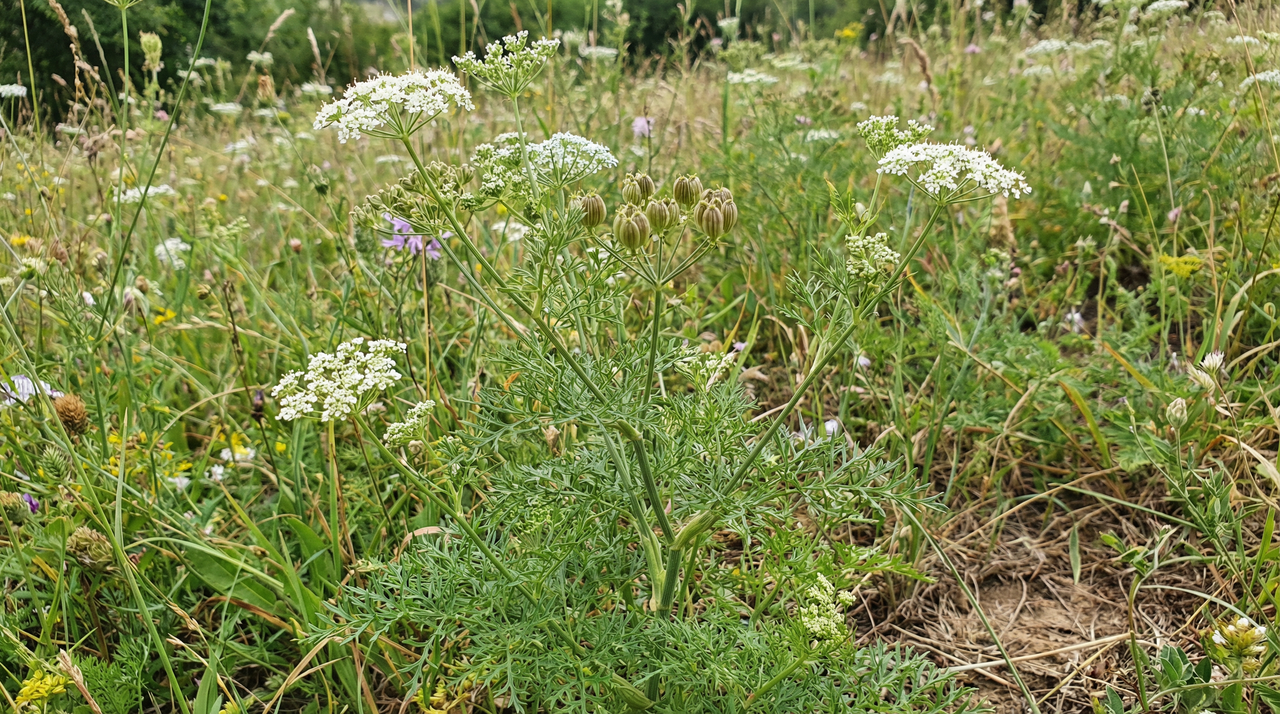
Here's the thing nobody tells you upfront about Milk Parsley: the name is doing a lot of heavy lifting for a plant that may not exist the way you think it does. I spent an embarrassing amount of time sourcing seeds under the name Selinum anisum before I finally traced the thread back far enough to realize I'd been chasing a ghost. That binomial is almost certainly a historical misnomer for common anise, Pimpinella anisum, and once you understand that, the whole story of this plant snaps into focus in a way that's actually more interesting, not less. The taxonomy here isn't just academic housekeeping; it shapes what you grow, how you grow it, and whether the licorice-scented seedlings you're nursing along will behave anything like what you expected.
True Selinum species are cool-climate perennials from montane meadows. Pimpinella anisum, the plant behind three thousand years of spice trade, liqueurs, and digestive remedies, is a heat-loving Mediterranean annual with a taproot that hates being moved and seeds that smell like a good Italian biscotti. They are not the same plant. Untangling that confusion is where this profile begins, and I'd argue it's also where growing this herb successfully begins.
So let's start there.
Origin and History of Milk Parsley (Selinum anisum)
Before anything else, let's clear up something that trips up even seasoned herb growers: Selinum anisum is not a currently recognized species. Major botanical authorities including Kew, the USDA, and the Missouri Botanical Garden treat it as a historical synonym or outright misidentification for Pimpinella anisum, the plant we know as anise.[1][2][3] I've double-checked labels on seed packets more times than I can count, because the feathery Apiaceae foliage on young seedlings is genuinely confusing, and getting the name right matters for understanding everything about how this plant grows and where it comes from.
Botanical Background and Taxonomy of Milk Parsley
Pimpinella anisum is an annual herb native to the eastern Mediterranean, from Greece and Egypt through the Levant and into Turkey, Syria, and Iran, where it colonizes calcareous soils in hot, sun-baked conditions.[2][4] It completes its entire life cycle in a single growing season, which partly explains how easily ancient traders could carry it across continents. True Selinum species, by contrast, are typically perennial herbs from cooler, moister habitats: alpine meadows and forest edges in the Himalayas, Central Asia, and Europe, often growing at elevations between 2,000 and 4,000 meters with annual rainfall of 600 to 1,000 mm.[5][6] Those two ecological profiles couldn't be more different, which is exactly why the naming confusion matters for anyone trying to grow either plant successfully.
Visual Characteristics of Milk Parsley and Related Selinum Species
Pimpinella anisum grows 0.5 to 1.5 meters tall from a taproot, with slender erect stems carrying alternately arranged, pinnately compound leaves that release an unmistakable licorice scent when brushed. The small white flowers appear in compound umbels from late spring into early summer, eventually producing those oval schizocarp fruits, 3 to 5 mm long, that we call anise seeds.[7][8] Anyone familiar with carrots, fennel, or dill will recognize the family resemblance immediately. True Selinum, represented by species like Selinum candollei, looks similar in broad strokes but behaves differently: a clumping perennial reaching 30 to 60 centimeters (occasionally taller), with ridged often-hollow stems, bi- or ternately pinnate triangular leaves 10 to 30 centimeters long, and the same white umbel flower heads.[9][6] Beautiful plants, genuinely, but a very different garden proposition.
Traditional and Cultural Uses of Anise Through the Ages
Anise has been in human hands for a very long time. Archaeological evidence places it in ancient Egypt around 2000 BCE, with seeds recovered from Tutankhamun's tomb and references appearing in the Ebers Papyrus for medicinal use, breath freshening, and ritual.[10] Ancient Greeks burned it as incense associated with Aphrodite and pressed it into service medicinally; Hippocrates and Dioscorides both prescribed it for digestive complaints, coughs, and flatulence.[11][12] Romans folded it into spiced wedding wines and fertility rites, with Pliny the Elder recording its virtues in detail.[13]
From there, anise traveled far. Trade routes carried it into Arabian medicine for respiratory and digestive disorders and into Ayurvedic practice as a warming digestive tea ingredient known as vilayati saunf.[14] Across all these cultures, the documented uses converge around the same core benefits: carminative, expectorant, galactagogue, and antimicrobial effects tied directly to its primary compound, trans-anethole.[15] When I source anise seed for the garden I look for certified organic or fair-trade options, because wild populations in Turkey and Egypt have been under real pressure from overharvesting, something worth considering for any permaculture gardener thinking about where their seed comes from.[16]
Fun Facts About Anise, Its History, and Chemistry
The potent licorice scent is no accident. Trans-anethole makes up 80 to 90 percent of anise's essential oil, which itself comprises 1 to 4 percent of the seed by weight, and it's the same compound responsible for the flavor of ouzo, sambuca, arak, and pastis.[17] I always think of those 3,000-year-old Egyptian tomb seeds when I crush a fresh anise leaf in my kitchen. The same chemical signature that made it worth preserving for eternity is still the reason people reach for it today. Anise has been under cultivation for over three millennia and remains a globally traded spice precisely because that one annual plant, thriving in hot dry summers with full sun and well-drained loamy soil, was so easy to seed, harvest, and carry.[11][18] True Selinum species, rooted in cool Himalayan meadows and needing far more moisture and shade, never had those same portable, sun-loving qualities. The name may have wandered between genera over the centuries, but the plant itself knew exactly where it wanted to grow.
Milk Parsley Varieties and Sourcing
When selecting varieties, note that "Selinum anisum" doesn't appear as a recognized species in any major botanical database, including USDA PLANTS, Kew's Plants of the World Online, Tropicos, or eFloras.[19][20][21][22] The name is almost certainly a historical or regional misidentification of Pimpinella anisum, the accepted binomial for common anise, the annual Apiaceae herb with the characteristic licorice-scented seeds.[23][3] So if you came here looking for cultivar guidance, you're getting it for the real plant: true anise.
Notable Cultivars of Anise (Pimpinella anisum)
Pimpinella anisum is a feathery-leaved annual that typically reaches 30 to 90 cm tall depending on the cultivar, topped with the small white umbel flowers familiar to anyone who has grown dill or fennel.[24] I've found the early seedlings easy to mistake for carrot or parsley, which is why I now label every Apiaceae row the moment seeds go in.
For cultivar selection, the choice really comes down to what you're growing for. 'Mammoth' is the workhorse: tall (60 to 90 cm), high-yielding, and consistently pushing above 3% essential oil in the seeds, making it the go-to for anyone after both biomass and flavor.[25][24] Think of it the way you'd think of a tall dill variety; it needs staking in wind but rewards you with a serious harvest. 'Gaya' pushes even harder on oil, reaching up to 5%, and is worth tracking down if anethole concentration is your priority.[25] For smaller raised beds, 'Mickie' tops out around 30 to 45 cm and fits neatly where 'Mammoth' would flop over the edge. Other named selections include:
- 'Giant Star'
- 'Goliath'
- 'Royal'
- 'Sicilian'
- 'French'
- 'Allstar'
- 'Noblesse'
Seed yield ranges from 500 to 1,500 kg/ha across cultivars,[28] and the full crop cycle runs 120 to 150 days from sowing to harvest, in a climate with hot summers and well-drained loamy soil at pH 6.0 to 7.5.[24][29] Gardeners in warm-temperate zones, roughly analogous to Turkey, Egypt, or Spain where most commercial anise originates, will find the Mediterranean-adapted cultivars like 'Goliath' perform particularly well.[27]
Where to Buy Milk Parsley / Anise Seeds and Plants
The good news here is that true anise (Pimpinella anisum) is genuinely easy to find. Seeds are stocked at most garden centers and widely available online, typically running $3 to $6 per packet of 100 to 500 seeds, with starter plants available for $5 to $12.[3][30] I've ordered from both Johnny's Selected Seeds and Baker Creek Heirloom Seeds across multiple seasons and found both consistently reliable for germination rates; always check for organic certification and recent reviews before committing to an unfamiliar vendor.
If you're sourcing internationally, plan ahead. Seeds imported into the US must be clean, dry, and pest-free, and a phytosanitary certificate is typically required; an import permit may also be necessary depending on the country of origin and current USDA APHIS pest risk assessments.[31][32][33] The APHIS website is more navigable than it looks once you know which form applies to your situation.
As for anything genuinely labeled "Selinum anisum," you won't find it in normal commerce because it doesn't exist as a recognized species.[21] True Selinum species, like S. wallichianum or S. tenuifolium, are cool-climate perennials from Himalayan habitats that bear no resemblance in flavor or garden role to anise; they're used in traditional medicine and belong in a shaded medicinal guild rather than a sunny culinary bed.[22] If you encounter a vendor selling "Selinum anisum" with confidence, treat that as a signal to verify very carefully what you're actually buying.
Milk Parsley Propagation and Planting Guides
Before you order seeds or start prepping beds, there's something worth sorting out. "Milk Parsley" sold under the name Selinum anisum doesn't appear as a distinct species in any current botanical database I've found. Standard sources from the RHS, USDA, and Kew all point to the same conclusion: Selinum anisum is almost certainly an older synonym or regional misnomer for Pimpinella anisum, the true anise.[34][3][35] When clients bring me seeds in an envelope labeled "Milk Parsley," the first thing I do is confirm the botanical name on the source, because the propagation advice I give them needs to match the actual plant they'll grow. Everything that follows in this section draws from anise literature, with a few notes on the broader Selinum genus where it's genuinely useful.
Understanding the Plant Identity: Selinum anisum vs. Pimpinella anisum
The Selinum genus does contain real, well-documented species, and one worth knowing is Selinum candollei, a perennial from Himalayan meadows with different dormancy requirements and a preference for cooler conditions than true anise. If you're working with actual Selinum seed, be aware that those seeds show physiological dormancy and typically need cold stratification at 4°C for four to eight weeks before germinating at 15-20°C.[36][37] That's a very different protocol from true anise. Getting the name right at the start saves you a season of confusion.
Seed Characteristics and Viability
Anise seeds are small, oval to kidney-shaped, measuring 3-4 mm long and 2-3 mm wide, greenish-brown when fully mature, with visible ridges along the surface.[35][38] I always label my seed trays the moment I sow them, because anise seedlings look almost identical to other Apiaceae at the first true leaf stage. Mix them up and you'll spend weeks second-guessing yourself.
The good news for seed savers is that anise is primarily self-pollinating, which means saved seed comes back true to type with minimal genetic variation.[39][40] Any variation you see between plants is more likely environmental than genetic drift. Seed also stores reliably: it's orthodox in behavior, tolerating desiccation down to 5-7% moisture and holding viability for two to four years under good conditions.[41][42] Store seeds at 4-10°C with relative humidity below 50%, and keep temperatures under 15°C to prevent deterioration.[43] I treat saved anise seed the same way I treat carrot or parsley seed: every other year I run a simple paper-towel germination test to confirm I'm still above 70% viability before I commit a whole bed to it.
Propagation Methods and Timeline
Direct seeding is the method I return to every time. Anise develops a taproot quickly, and any transplanting after that root establishes leads to forking, stress, and noticeably reduced vigor. I learned this the hard way in my first seasons with Apiaceae herbs, trying to move seedlings that had been in modules just a few days too long. Now I sow directly into the garden after the last frost, at around 6 mm (about 1/4 inch) depth, in a prepared bed with full sun and good drainage. Germination typically takes ten to twenty-one days at soil temperatures of 15-21°C.[44][45] Fresh seed germinates faster; a 24-hour soak in warm water beforehand can help with older stock.
If you want an earlier start, sow into deep modules indoors and transplant very carefully before the taproot anchors itself, usually within the first week or two.[34] Vegetative propagation by division or cuttings is essentially off the table; the taproot system makes it rarely successful.[45][46] Harvest seeds for future propagation when they mature in late summer, once they've turned that greenish-brown color and the umbels begin to dry.[34][45]
Soil, Site, and Spacing Requirements
Anise wants well-drained loamy or sandy loam soil with good organic matter, ideally in the 3-4% range, and full sun. The taproot can push 15-45 cm deep, so compacted or waterlogged ground is a real problem; saturated conditions invite Phytophthora and Pythium root rots that can wipe out a planting fast.[47][45] I always run a soil pH test before planting any anise relative, because I've watched iron chlorosis stop growth cold in slightly alkaline beds. Keep pH between 6.0 and 7.5; drop below 6.0 and you risk manganese toxicity showing up as leaf spotting, go above 7.5 and the chlorosis and stunting follow quickly.[48][49] A sulfur amendment caught early has saved me more than one bed.
For sunlight, four to six hours daily works, with partial shade appreciated in hotter climates where full afternoon sun pushes the plant toward premature bolting.[50] In containers, use a mix of roughly 50% potting soil, 30% perlite or coarse sand, and 20% compost, in a pot at least 30 cm deep to accommodate the root.[51]
Advanced Techniques: Greenhouse, Grafting, and Storage
Greenhouse propagation with bottom heat and sterile media is a solid option for growers who need consistent early stock, especially where damping-off from cool, wet soils is a recurring issue.[52] Spacing plants 30-45 cm apart within rows, with 45-90 cm between rows, gives the canopy room to breathe and reduces disease pressure noticeably.[53][54] Plants over 60 cm benefit from staking in exposed positions.
Grafting onto carrot or parsnip rootstocks is technically possible but experimental, with success rates sitting around 20-60% even under controlled conditions of 21-27°C and 80-90% humidity.[55][56] It's a fun experiment if you're into propagation trials, but for a kitchen garden or food forest, direct seeding into well-prepared ground will always be the more reliable path.
Milk Parsley Care Guide
When navigating practical care details, remember that Selinum anisum is not a recognized species in current botanical databases. When I cross-checked POWO and the RHS, it became clear that the name is almost certainly a historical synonym or outright misnomer for Pimpinella anisum, the common anise most of us know from the spice rack.[57][4] True Selinum species are cool-climate perennials from Himalayan montane habitats, which behave quite differently from anise in the garden. So the care guidance below reflects what we know about Pimpinella anisum, with notes where genuine Selinum traits might diverge.
Frost Tolerance and Temperature Needs
This is a tender plant. It's a Mediterranean annual at heart, and it performs reliably in USDA zones 8 through 11 where frosts are minimal or short-lived.[58][53] Mature plants can tolerate a brief dip to around 0°C (32°F), and may survive down to -2°C for a very short window, but seedlings are considerably more vulnerable.[59] I'd compare its cold hardiness to basil: you can push the shoulder season a little, but a hard frost will end things quickly. In temperate gardens, sow after your last frost date and plan to harvest before the first frost of autumn.
Sunlight Requirements
Full sun is the target, with at least six hours daily for strong stem development and good flowering. Below that threshold, plants get leggy and pale, and flowering becomes sparse.[60] I've seen this firsthand when I trialed anise under the dappled light of my food forest canopy: within a few weeks the stems were reaching and thin, and the umbels were small. I ended up doing some selective canopy pruning to open the light up rather than move the plants. In hotter climates, some afternoon shade protection is helpful, because too much intense direct sun causes leaf scorch and wilting.[61] The plants tell you what they need. Legginess means more light; brown leaf edges mean less afternoon exposure.
Watering Needs
Aim for roughly one inch of water per week, adjusted for rainfall and temperature, in well-drained soil, allowing the top inch to dry between waterings.[62][63] The root system runs 12 to 18 inches deep and shows moderate drought tolerance once established, surviving 7 to 10 days without water under normal conditions. During flowering and seed set, though, water stress directly reduces essential oil content and seed yield, so bump irrigation up to 1 to 2 inches per week during those stages.[64][65]
I always use drip irrigation with this plant and check the top inch of soil before watering, because I've lost young plants to overwatering during heavy summer rains. The signs of too much water are yellowing leaves starting at the base, wilting despite wet soil, and eventually root rot from pathogens like Pythium or Fusarium.[66][53] Drip also keeps foliage dry, which matters in humid climates. One more thing: this plant has low salinity tolerance, so if your irrigation water is high in dissolved salts, that's worth testing and addressing.[67]
Feeding and Fertility Requirements
Milk parsley is a moderate feeder that does best in loamy, well-drained soil with a pH between 6.0 and 7.5.[68][53] A balanced fertilizer applied at planting, with split nitrogen side-dressings around 30 to 40 days after sowing and again at flowering, covers most of its needs.[69] I'd strongly recommend a soil test before applying anything. I once pushed nitrogen too generously on an anise bed thinking lush growth meant more seeds, and I got exactly the opposite: beautiful foliage, poor flowering, and a disappointing harvest. Excess nitrogen delays flowering, promotes lodging, and cuts essential oil content.[70]
Watch your plants for deficiency signals: pale or yellowing leaves suggest nitrogen shortage, purplish leaf color points to phosphorus, and marginal scorch on leaves with weak stems indicates low potassium.[71] Organic growers can incorporate compost or well-rotted manure as a soil amendment alongside more targeted synthetic inputs if the soil test reveals specific gaps.[72]
Heat Tolerance and Stress Mitigation
Here's where gardeners in hotter regions need to pay close attention. Optimal growth happens between 60 and 75°F (15 to 24°C), and sustained temperatures above 75 to 80°F push the plant toward premature bolting, blossom drop, and reduced seed and oil production.[63][73] Brief spikes to 90°F are survivable if moisture is consistent and nights cool down for recovery, but heat stress beyond 7 days exceeds what the plant can adapt to.[74] In my Central Florida summers, I've watched seed yields drop significantly without intervention. Reflective mulch changed that for me.
The practical toolkit for hot climates: lay 2 to 4 inches of organic or reflective mulch to lower soil temperature by 4 to 6°C, run drip irrigation at 0.8 to 1 inch per week in the early morning, use 30 to 50% shade cloth during the hottest weeks, and space plants 6 to 8 inches apart in rows 18 to 24 inches wide for airflow.[75][76] A west-facing wall or taller companion planting that provides afternoon shade can also take the edge off peak heat without shading morning light.
Seasonal Rhythm and Growth Cycle
The growing season follows a clean arc: germination in spring after the last frost, steady vegetative growth through early summer, flowering in midsummer, and seed set by early to mid-autumn.[77][78] Harvest wraps up before the first frost. I find watching that progression genuinely satisfying, from the delicate ferny seedlings to the open white umbels that attract every hoverfly in the garden. Once you've grown it once, you read the season through the plant.
Pruning, Maintenance, and General Growing Tips
Selinum wallichianum care literature is thin on pruning specifics, and the same is true for Pimpinella anisum: it's not a plant you sculpt aggressively.[79] Light pinching can encourage branching in young plants, but the main maintenance work is preventive. Keep drainage good, ensure adequate airflow between plants, and avoid overhead watering. High temperatures, drought, compacted or waterlogged soil, and poor air circulation are the primary stressors that cascade into reduced yield and disease susceptibility.
What I've found most useful with any Apiaceae in humid climates is simply staying observant. Wilting when soil is moist, color changes in the lower leaves, or flower abortion all signal stress early enough to course-correct with shade, irrigation adjustment, or improved drainage before significant damage is done. The plant is a clear communicator if you're paying attention.
Harvesting Milk Parsley (Selinum anisum)
Before you cut a single umbel, you need to recalibrate your expectations around time. True Selinum species follow a slow, two-year rhythm that has nothing in common with the quick annual life cycle of true anise (Pimpinella anisum). The first year is almost entirely vegetative, roughly 6-8 months of feathery foliage and root development with no harvestable seeds.[80][81] I've lost count of how many times I've had to label slow-maturing Apiaceae rows in my food forest beds specifically so I don't weed them out in a moment of impatience. Do yourself the same favor here.
Timing and Maturity Cues for Seeds and Roots
Flowering arrives in year two, and from there, seed harvest is still 120-180 days away, with the full flowering-to-seed-set window stretching across 3-4 months.[80][81] Total time from sowing to harvestable seeds or roots: 18-24 months. That's the honest number. Because Selinum anisum-specific harvest data is thin, I borrow from general Apiaceae cues and the well-documented Pimpinella anisum literature with appropriate caution. For true anise, the signal to harvest is when 50-70% of the umbels have shifted from green to dull brown, the pods feel dry to the touch, and you can hear seeds rattle when you shake the stem.[82][83] I'd apply those same sensory cues here and trust your nose alongside your eyes: crush a seed and if it hits you with that warm, sweet anise aroma, you're in the right window.
Yield, Flavor Profile, and Texture
The seeds are the main event. They're technically dried schizocarp fruits from the umbel, and they deliver a potent licorice punch driven by trans-anethole, which can make up 70-90% of the essential oil, supported by estragole, fenchone, and limonene.[84][85] Flavor intensity peaks at full maturity, and in my experience, seeds harvested from plants that baked through a long hot summer carry a noticeably stronger aroma when crushed than anything rushed off an early or stressed plant. Raw seeds are hard, brittle, and crunchy; toast them briefly and that texture softens while the aroma blooms.[7][86] The aftertaste lingers for minutes, sometimes longer, because anethole is fat-soluble and volatile in just the right ratio to coat your palate and stay there.
While you're waiting on seeds, the leaves are worth harvesting fresh. They're milder and more herbaceous than the seeds, pleasant in salads or steeped into a light tea, and a reasonable consolation prize during that long first year.[87] Just don't over-strip the plant; those leaves are doing real photosynthetic work toward the seed harvest you're ultimately waiting for.
Milk Parsley (Selinum anisum) Preparation and Uses
Clarifying the Botanical Name and Edible Identity
By now you've probably noticed a pattern in this article: nearly everything practical about "Milk Parsley" as Selinum anisum actually traces back to true anise, Pimpinella anisum, because Selinum anisum isn't a currently accepted botanical name.[88][89] Selinum and Pimpinella are distinct genera, one producing cool-climate perennials, the other a feathery eastern Mediterranean annual growing 30 to 90 cm tall with white umbel flowers and ridged oval seeds.[90] I've grown true anise from seed for years and always double-label that bed, because young Apiaceae foliage can fool you fast. If you're ever uncertain in the field, crush a seed between your fingers: the unmistakable sweet anethole scent tells you immediately you have the right plant. That aroma comes from trans-anethole, which makes up 80 to 90 percent of the essential oil.[91] One serious caution before foraging any white-flowered umbellifer: poison hemlock and water hemlock share a strong family resemblance, and confident botanical identification is non-negotiable.[92]
Culinary Applications and Flavor Profile of Anise
The seeds are the primary edible harvest, but fresh young leaves work beautifully scattered over salads or used as a delicate garnish, and the stems are occasionally pressed into service too. Flavor peaks with fully mature brown seeds, and the nutrition packed into them is genuinely impressive: 337 kcal, 17.6 g protein, 15.9 g fat, and 12.6 g fiber per 100 g, alongside standout mineral density including 646 mg calcium and 37 mg iron.[93] For comparison, that iron load puts anise seed ahead of most kitchen spices, including cumin. The essential oil content can reach 5 percent of seed weight, carrying antioxidant flavonoids alongside anethole.[91]
Anise seeds travel across cuisines with remarkable ease: they flavor breads, biscotti, sausages, and stews across Mediterranean and Middle Eastern tables, perfume Indian spice blends, anchor Mexican atole, and give ouzo and absinthe their signature character.[94] Store whole seeds in a sealed jar away from light and they'll hold their potency for one to two years; grind them only as needed, because the volatiles dissipate quickly once the cell walls are broken.
Medicinal Preparations and Dosages
Traditional use of anise for digestion, coughs, and lactation support stretches back to ancient Greece and appears across Traditional Chinese Medicine and European folk herbalism.[95][96] Practical preparation guidelines suggest 1 to 3 g of dried seeds daily, 1 to 2 cups of seed decoction per day, or 1 to 2 ml of tincture up to three times daily.[97] I personally prefer lightly crushing seeds into a tea; it's gentle, flavorful, and keeps you well away from concentrated-oil territory. Speaking of which: the essential oil must be handled with real caution. I never use it internally without dilution, and I stay well below the 1 to 2 drop daily ceiling because the research on its estrogenic activity is unambiguous.[98] The plant is contraindicated in pregnancy for that same reason, and anyone with Apiaceae allergies should approach it carefully.[99] When in doubt, consult a qualified herbalist before moving beyond culinary amounts.
Non-Food and Ornamental Uses
Anise earns its place in herb borders even when you're not planning to cook with it. The lacy foliage, graceful upright habit, and clouds of white umbels read as genuinely ornamental, and the aromatic presence makes the whole bed pleasant to work around.[100] If you want that same structural elegance but need a true perennial, Selinum candollei is worth seeking out; it's a different plant entirely, suited to naturalistic and rock garden settings, and it brings similar height and spreading charm with wildlife-friendly flowers.[101] Getting clear on which plant you're growing is the first step either way, and once you do, both repay the attention generously.
Milk Parsley Health Benefits and Medicinal Uses
When researching Selinum anisum for medicinal uses, I quickly found that modern botanical databases don't really recognize it as a valid species.[102][103] It's most likely a historical synonym or outright misnomer for Pimpinella anisum, true anise, and that's where essentially all of the clinical research and traditional medicinal literature lives.[104] I went back and cross-checked POWO and USDA records before trusting any of the older sources, and I'd encourage you to do the same. What follows is the health story of that well-documented plant, with honest notes on where true Selinum species data is thinner.
Medicinal Properties and Traditional Uses of Milk Parsley
Anise has a genuinely long track record in traditional medicine, including Ayurvedic practice, as a remedy for digestive complaints: indigestion, flatulence, colic, abdominal cramping, and respiratory issues like bronchitis and cough.[105][106] That tradition has held up reasonably well under clinical scrutiny. A randomized trial on 180 infants showed significant colic symptom reduction compared to placebo, and a meta-analysis on cough reported a risk ratio of 0.65 (95% CI 0.52-0.81) in favor of anise preparations.[107][108] Those are real numbers, not just folk wisdom.
The lactation support angle is one I find fascinating, especially since I've grown both anise and fennel and always noticed how herbalists reach for both in the same conversation. Trials suggest that 1-3 g per day of anise seed powder can increase breast milk volume by 20-30% and raise prolactin levels.[109] Anise's mild estrogenic profile from anethole seems to drive this, though fennel works through a similar mechanism. Neither is something to self-prescribe in quantity without guidance. The mechanistic picture also includes anti-inflammatory activity via NF-κB inhibition and COX-2 suppression, antimicrobial effects through membrane disruption, and anxiolytic activity as a positive allosteric modulator of GABA-A receptors.[110][111] For narrower Selinum taxa like S. candollei, the picture is much thinner, with flavonoids, coumarins, and essential oils showing antimicrobial and antioxidant promise but no clinical trials to lean on.[112]
Key Phytochemicals in Milk Parsley and Anise
The essential oil from anise seeds is dominated by trans-anethole, typically running 75-90% of total composition, with estragole, fenchone, anisaldehyde, and sesquiterpenes like β-caryophyllene and germacrene D making up the rest.[113][114] Beyond the oil, the plant carries flavonoids (quercetin, apigenin, kaempferol, rutin, luteolin glycosides), phenolic acids including chlorogenic and ferulic acid, and coumarins like umbelliferone and scopoletin, all more concentrated in the leaves and roots than the seeds.[115][116]
One thing I've noticed growing aromatic Apiaceae in my hot, humid conditions is that seeds harvested later in the season tend to smell more intensely of anise, and the data backs that up: anethole concentration rises with seed maturation and shifts meaningfully with geography and climate, ranging from roughly 80% in some Turkish populations to over 93% in Egyptian material.[117][118] Total essential oil yield from seeds runs 1-5%. These compounds also pull ecological weight, drawing bees and hoverflies to the umbels while the anethole itself acts as an insect deterrent and antimicrobial agent in the plant's own defense system.[119]
Nutritional Profile of Milk Parsley Seeds
The seeds are nutritionally solid without being a standout superfood, which is exactly how I'd describe most culinary spices. A standard culinary serving is about 1-2 g (roughly half to one teaspoon), and per 100 g of dried seed, anise delivers 337 kcal, 17.6 g protein, 15.9 g fat, and 50.1 g carbohydrate with 14.6 g of fiber.[120] Mineral content is striking at those per-100-g figures: 647 mg calcium, nearly 37 mg iron, and 1,440 mg potassium, alongside vitamin C and B vitamins.[121] In practice, though, you're seasoning with a teaspoon, not eating seeds by the handful, so I treat this more as confirmation that the plant earns its place in a kitchen garden rather than a reason to call it a superfood. Related Selinum species like S. candollei offer edible young leaves and stems that likely carry vitamins A and C, potassium, and calcium based on Apiaceae family patterns, but there's no specific USDA data to cite there.[122]
Safety Considerations and Potential Side Effects
For culinary use, anise is GRAS-listed by the FDA and considered safe by EFSA in moderate amounts.[123][124] Push into high doses or concentrated essential oil territory and the picture changes: excessive anethole can cause nausea, vomiting, seizures, or hallucinations, and the plant is toxic to pets in quantity, causing gastrointestinal upset and nervous system effects.[125][126] I keep essential oil use minimal in my own preparations because the research on dose-dependent risks is clear, and the gap between "culinary" and "medicinal" dosing is narrower than most people assume.
Anyone with Apiaceae sensitivities should approach this plant carefully. Cross-reactivity with celery, fennel, and carrot relatives is well-documented, and birch pollen allergy can compound the reaction; contact dermatitis, oral allergy syndrome, and anaphylaxis are all possible.[127][128] The furocoumarin content means phytophotodermatitis is a real risk if plant sap contacts skin before sun exposure, something I remind anyone harvesting fresh Apiaceae in summer.[129] Pregnancy warrants caution at medicinal doses due to anethole's estrogenic activity, and the coumarin content may interact with anticoagulants or diabetes medications.[130] After years labeling my Apiaceae seedling trays meticulously because the early rosettes all look nearly identical, I can tell you that misidentification with poison hemlock in the wild is a genuinely serious risk, not a footnote.[131][132] For anything beyond cooking, consult a healthcare professional, especially since Selinum-specific safety data remains scarce and is largely inferred from Pimpinella and related species.[133]
Milk Parsley Pests and Diseases
Before we talk about what can go wrong with this plant, a quick clarification that matters for reading any pest or disease data you find online: Selinum anisum is not a recognized species in modern botanical databases.[134][135] The accepted name for the plant most people are growing under that label is Pimpinella anisum. I learned to double-check this the hard way after growing a mislabeled batch that never developed the anise scent I expected, so now I always verify the binomial on seed packets before I plant anything. Everything below comes from Pimpinella anisum literature, which is the honest and practical basis for what we know.
Common Pests of Milk Parsley and Anise
Anise carries some built-in defenses. The volatile compounds in its essential oils, particularly anethole, act as a natural repellent against aphids, thrips, beetles, ants, and other soft-bodied insects.[136][137] I think of it the same way I think about basil or rosemary in a guild: the scent itself is doing work. When I rub a leaf between my fingers during a garden walkthrough and get a strong, clean licorice hit, I take that as a sign the plant is expressing good chemistry and holding its own.
That said, seedlings are a different story. Cutworms are the threat I watch most closely at transplant time, and after losing several early plantings I now put physical collars around every seedling as standard practice and add beneficial nematodes to the soil before planting.[138][139] Aphids, flea beetles, leafminers, and spider mites can all show up too, especially in hot, dry spells. Root-knot nematodes are worth mentioning separately because they cause stunted growth with no obvious above-ground symptoms at first; in warmer climates, solarizing beds in late summer before a fall planting has made a real difference in my Apiaceae beds.[140] No cultivars with documented pest resistance exist, so there's no shortcut there.[135] Ladybugs, crop rotation, and physical barriers are your most reliable tools, with targeted interventions only when pest pressure genuinely warrants it.[138][141]
Diseases Affecting Milk Parsley and Management
Disease data specific to Selinum anisum is essentially nonexistent, so everything here is extrapolated from Pimpinella anisum research. The fungal threats are the ones worth knowing: Alternaria leaf blight, powdery mildew, Fusarium wilt, root rot from Rhizoctonia or Phytophthora, and various leaf spot diseases from Septoria and Cercospora can all occur.[142][143][144] Bacterial leaf spot and occasional mosaic viruses are documented but less common.[145] Powdery mildew is the one I see most often in humid conditions; improving airflow and avoiding overhead watering goes a long way.[146] Field-grown plants tend to show better resistance to Fusarium and Alternaria than greenhouse specimens, which tells you something about the value of good air circulation and open-sky conditions.[147] Crop rotation, improving drainage, and keeping the canopy open are the management practices that align with permaculture principles and actually work.[148] Healthy, well-spaced plants growing in a diverse polyculture rarely suffer catastrophic losses from any of these pathogens.
Milk Parsley in Permaculture Design
For permaculture design purposes, note that Selinum anisum is biologically identical to Pimpinella anisum, the anise most of us know from the spice rack.[149] That matters for design work because virtually all the climate, soil, and ecological data that follows comes from the Pimpinella anisum literature. Keep that in mind as you map it to your own site.
Climate Preferences and Suitable Zones for Milk Parsley
This is a Mediterranean plant at heart. It wants hot, dry summers, mild wet winters, annual precipitation in the 500-800 mm range arriving mostly in the cool season, and average temperatures hovering between 15 and 20°C.[18][150] Soils should be well-drained, fertile loam or sandy-loam with a pH of 6.0-7.5; waterlogging is essentially a death sentence for it.[18][150][151]
Germination is happiest when soil temperatures sit between 15 and 21°C, and growth peaks in the 18-24°C daytime range. It handles heat up to about 29°C reasonably well, but once you're consistently above 32°C, seed set drops off noticeably.[152][150] I've seen this firsthand in summer: when temperatures climb into the mid-30s, the plants just stall. Younger plants need consistent moisture while establishing, but mature plants can handle short dry spells; the sweet spot for humidity is roughly 40-60%.[18][153] I've found that mimicking that winter-dominant moisture pattern through targeted irrigation, rather than consistent summer watering, produces noticeably better seed set.
It's catalogued as hardy across USDA zones 4-9 and typically runs a 90-120 day annual cycle.[154][155][156] In milder zones 8-10 it can behave like a short-lived perennial, though I'd plan for it as an annual to avoid disappointment. The related Selinum tenuifolium is hardy in zones 5-9 for comparison, and it does behave as a true perennial.[157] Commercial cultivation tells you a lot about where true anise genuinely thrives: the Mediterranean, Ukraine, India, France, Bulgaria, and Russia's Kuban region, with secondary production in Canada, Australia, and Iran.[158][151] If you're gardening in humid subtropical or temperate areas outside that core range, excellent drainage and strategic shade from afternoon heat become non-negotiable.
Forest Layer Placement and Guild Roles
At 30-100 cm tall, anise slots naturally into the herb layer of a food forest or woodland edge planting.[159][100][160] Its native ecology is temperate mountain habitats: grasslands, rocky slopes, woodland edges, and alpine meadows at elevations ranging from 1,500 to 3,000 meters in Central Asia, the Caucasus, and parts of Europe. That origin tells you a lot about its temperament. It's adapted to some exposure, decent drainage, and fluctuating seasonal rhythms, which makes it a reasonable fit for the more open, sunlit edges of a food forest rather than deep shade.
In my herb spirals, I've tucked anise between lower thymes at the base and taller fennel above, and the feathery foliage genuinely fills that middle tier beautifully. It layers well. When you place it alongside other Apiaceae, you're also building fungal and microbial soil communities that benefit the broader guild, since these plants interact through shared pollinator networks and root exudates.[161][162]
Looking at the broader Selinum genus helps illustrate what this plant lineage can do ecologically. Selinum candollei, native to alpine and subalpine Himalayan regions between 2,500 and 5,000 meters, grows alongside grasses like Kobresia and Festuca and contributes to meadow ecosystems through soil stabilization, nutrient cycling, forage for mountain herbivores, and pollinator support.[163][164][165][166] Those are genus-wide ecological jobs, and they translate well to cultivated settings. If you're trialing anise in a food forest, start with a shaded moist microclimate at the canopy edge and see how it responds before committing to a larger planting.
Ecosystem Functions: Pollination, Soil Health, and Companion Benefits
Anise is native to the Mediterranean and hasn't shown meaningful invasive tendencies in the USA, so you can plant it without that concern.[3] Its roots stabilize soil and its decaying foliage feeds the microbial community below, contributing to nutrient cycling in the herb layer over its seasonal lifecycle.[167][166]
The flowers are where the real ecological action happens. Those small white compound umbels, 2-3 mm across and hermaphroditic, open from June through August and are primarily cross-pollinated by insects.[168][169] Honeybees, bumblebees, native solitary bees, hoverflies, butterflies, and various flies all work the umbels during those long summer days.[167][170] Hoverflies in particular are a regular presence in my gardens around the Apiaceae beds, and their larvae are voracious aphid predators, so that's a real functional benefit rather than just an aesthetic one.
Companion planting anise with lavender, dill, or marigolds amplifies this pollinator draw and may help suppress aphids, spider mites, and nematodes through the aromatic compounds each plant releases.[171][172] The nectar-rich flowers also draw predatory insects that go on to manage other pest populations across the broader guild. I avoid neonicotinoids entirely around my Apiaceae because the research shows they can cut bee foraging activity by up to 50%, and habitat fragmentation compounds that with a 20-40% reduction in pollination services.[173][174][175] Pollination efficiency also drops below 15°C or above 30°C, so in hotter climates you'll notice reduced insect activity during peak summer heat, which is exactly what I observe on the hottest afternoons. If you're growing in a low-pollinator microclimate, hand pollination with a soft brush is entirely feasible.
The Plant That Taught Me to Read the Label Twice
I'll be honest: I ordered this one under the wrong name, grew it under the wrong name, and loved it under the wrong name for longer than I'd like to admit. What finally made me sit down and untangle the taxonomy was a batch of seedlings that just didn't behave the way I expected, and that quiet mystery sent me down a rabbit hole I'm genuinely glad I fell into. Sometimes the most useful thing a plant can do is make you question what you think you know.
Sources 175
- Kew Science Plants of the World Online ↩
- Missouri Botanical Garden PlantFinder - Pimpinella anisum ↩
- USDA Plants Database - Pimpinella anisum ↩
- Pimpinella anisum - Wikipedia ↩
- Selinum - Plants of the World Online | Kew Science ↩
- Flora of China - Selinum ↩
- Anise - Wikipedia ↩
- RHS - Pimpinella anisum Fact Sheet ↩
- Royal Horticultural Society - Selinum candollei ↩
- Anise (Pimpinella anisum L.) fruits (seeds): Traditional uses, phytochemistry, processing, and future opportunities – A review ↩
- The Medicinal Spice Through the Ages: Anise ↩
- De Materia Medica by Pedanius Dioscorides ↩
- Natural History by Pliny the Elder ↩
- Anise: A Medicinal Plant with a Long Tradition ↩
- Pimpinella anisum L. (Anise): A Systematic Review on Its Traditional Uses, Phytochemical Constituents and Pharmacological Activities ↩
- Anise: Botany, Uses and Sustainability ↩
- Anise: Chemistry, Pharmacology, and Uses ↩
- Ecological Requirements of Anise ↩
- USDA PLANTS Database ↩
- Tropicos - Missouri Botanical Garden ↩
- Selinum Species Information ↩
- Selinum ↩
- International Plant Names Index - Pimpinella anisum ↩
- Anise (Pimpinella anisum L.) Production and Uses ↩
- Anise (Pimpinella anisum L.) Production and Research: A Review ↩
- Cultivars and Breeding of Anise ↩
- Breeding and Varieties of Pimpinella anisum ↩
- Cultivars of Anise for Seed and Oil Production ↩
- Agronomic Performance of Anise Varieties ↩
- Pimpinella anisum (Anise) ↩
- Importing Plants and Plant Products into the United States ↩
- Phytosanitary Certificates ↩
- Seeds Not Authorized Pending Pest Risk Analysis and Permit ↩
- Anise - Pimpinella anisum ↩
- Pimpinella anisum L. - Anise ↩
- Seed Dormancy in Apiaceae ↩
- Soil Seed Banks in Himalayan Meadows ↩
- Seed Morphology of Apiaceae Family ↩
- Propagation of Anise (Pimpinella anisum L.): Genetic Stability and Seedling Variability ↩
- Botanical Notes on Pimpinella anisum: Reproduction and Variation ↩
- Seed Storage Behaviour: A Compendium ↩
- Germination and storage of Apiaceae seeds ↩
- Genebank Standards ↩
- Propagation of Anise (Pimpinella anisum) ↩
- Anise in the Garden ↩
- Seed Propagation Techniques for Apiaceae Family Plants ↩
- Anise Cultivation Guide ↩
- Anise (Pimpinella anisum L.) Production Guide ↩
- Soil pH Effects on Vegetable Crops ↩
- Royal Horticultural Society (RHS) Plant Finder ↩
- Selinum Species in the Himalayas ↩
- Greenhouse Production of Culinary Herbs Including Anise ↩
- Anise Growing Guide ↩
- Herb Gardening: Spacing and Support for Umbellifers ↩
- Grafting Techniques for Apiaceae Crops ↩
- Interspecific Grafting in Umbelliferae Family ↩
- Selinum - Genus Description ↩
- Anise (Pimpinella anisum L.) ↩
- How to Grow Anise ↩
- Pimpinella anisum - Missouri Botanical Garden ↩
- Anise (Pimpinella anisum) - UC Master Gardener Program ↩
- Growing Herbs Home Garden ↩
- Anise (Pimpinella anisum) Plant Profile ↩
- Drought Tolerance in Anise (Pimpinella anisum L.) ↩
- Water Requirements for Anise Cultivation ↩
- Root Rot in Herbs: Identification and Prevention ↩
- Soil and Water Requirements for Apiaceae Plants ↩
- Anise Production Guide ↩
- Anise Cultivation Guide - FAO ↩
- Fertilizer Recommendations for Seed Crops ↩
- Nutrient Deficiencies in Herbs - Royal Horticultural Society ↩
- Organic Production of Anise - ATTRA Sustainable Agriculture ↩
- Pimpinella anisum Cultivation Guide ↩
- Effects of Heat Stress on Growth and Yield of Anise (Pimpinella anisum L.) ↩
- Aluminum Reflective Mulch Effects on Anise Yield ↩
- Anise (Growth & Care Advice) ↩
- Phenology of Apiaceae Family Plants ↩
- Anise and Related Herbs: Cultivation Guide ↩
- Cultivation of Temperate Herbs ↩
- Selinum in the World Flora Online ↩
- Medicinal Plants of the Himalaya - Selinum anisum ↩
- Anise Production ↩
- Anise (Pimpinella anisum L.) Production Guide ↩
- Pimpinella anisum Essential Oil Composition - PubMed ↩
- Anethole - PubChem ↩
- Anise Essential Oil Properties ↩
- Culinary Uses of Anise - Britannica ↩
- Selinum Genus - Plants of the World Online (Kew Science) ↩
- Pimpinella anisum | Missouri Botanical Garden ↩
- Pimpinella anisum | Royal Horticultural Society ↩
- PubMed - Phytochemical Composition of Anise (Pimpinella anisum L.) ↩
- Apiaceae Family - Look-alikes and Toxicity - USDA Forest Service ↩
- USDA FoodData Central - Spices, anise seed ↩
- FAO: Anise Production and Uses ↩
- American Herbal Pharmacopoeia: Anise Monograph ↩
- Anise in Traditional Chinese Medicine - NCBI ↩
- Herbal Preparations and Dosages: Anise ↩
- Toxicity and Safety of Anise Essential Oil - NCBI Bookshelf ↩
- PubMed - Pimpinella anisum L. fruit: Chemical composition and effect on rat model ↩
- Selinum anisum Plant Profile ↩
- Selinum candollei - Plant Profile ↩
- Plants of the World Online - Selinum ↩
- Synonyms and Taxonomy of Anise (Pimpinella anisum L.) ↩
- Anise (Pimpinella anisum L.) Fruits: A Comprehensive Review of Phytochemicals and Biological Activities ↩
- Medicinal properties of Pimpinella anisum: A review ↩
- Anise (Pimpinella anisum L.) fruits: Chemical composition, nutritional and therapeutic importance ↩
- Clinical Study on the Efficacy of Pimpinella anisum in Infantile Colic ↩
- Anise for Cough: A Systematic Review ↩
- Effect of Anise (Pimpinella anisum L.) on Breastfeeding ↩
- Anise (Pimpinella anisum L.) Fruits: Ethnopharmacology, Pharmacology, Phytochemistry, and Industrial Applications ↩
- Anethole and Its Role in the Anti-Inflammatory Activity of Anise ↩
- Phytochemical and Pharmacological Review of the Genus Selinum ↩
- Chemical Composition and Antioxidant Properties of Essential Oil of Pimpinella anisum L. Fruits ↩
- Essential Oil Composition of Anise Seeds and Other Organs ↩
- Chemical Composition and Biological Activities of Pimpinella anisum ↩
- Antioxidant Mechanisms of Flavonoids from Pimpinella anisum ↩
- Influence of Harvest Time on the Yield and Composition of the Essential Oil of Anise (Pimpinella anisum L.) ↩
- Geographic and Climatic Influences on Anise Essential Oil Variability ↩
- Ecological Role of Essential Oils in Apiaceae Plants ↩
- USDA FoodData Central - Spices, anise seed ↩
- USDA FoodData Central - Seeds, anise ↩
- Nutritional Composition of Apiaceae Family Plants ↩
- Anise - NCCIH ↩
- Anise Safety - EFSA ↩
- Toxicity of Anise Essential Oil - NCBI ↩
- Anise Toxicity - Pet Poison Helpline ↩
- Apiaceae Family Allergens and Cross-Reactivity ↩
- Allergic Reactions to Aniseed ↩
- Phototoxicity in Umbelliferae ↩
- Anise: Safety and Uses - WebMD ↩
- Poison Hemlock Identification ↩
- Apiaceae Family Look-Alikes ↩
- Anise (Pimpinella anisum) and Related Species - Medicinal Uses and Safety ↩
- Pimpinella anisum ↩
- Plants of the World Online (POWO) ↩
- Insect Repellent Activity of Essential Oils from Anise ↩
- Volatile Compounds in Apiaceae and Pest Resistance ↩
- Integrated Pest Management for Anise ↩
- Pests and Diseases of Anise ↩
- Management of Root-Knot Nematodes in Vegetables ↩
- Herb Production: Anise ↩
- Fungal Pathogens of Anise (Pimpinella anisum) ↩
- Fusarium Wilt in Umbelliferous Crops: Susceptibility of Anise ↩
- Root Rot Pathogens Affecting Anise in Field Conditions ↩
- Bacterial and Viral Diseases in Umbelliferous Crops ↩
- Powdery Mildew on Herbs ↩
- Powdery Mildew and Alternaria Blight on Anise in Greenhouse Trials ↩
- Diseases of Anise (Pimpinella anisum) and Management Strategies ↩
- Plants of the World Online - Pimpinella anisum ↩
- Anise (Pimpinella anisum) - Cultivation and Growing Guide ↩
- Anise Cultivation Guide ↩
- Pimpinella anisum: Temperature and Hardiness ↩
- Herb Growing Handbook: Anise ↩
- Pimpinella anisum (Anise) Plant Profile ↩
- Anise Plant Profile ↩
- USDA Plant Hardiness Zone Map ↩
- Selinum ↩
- FAO Statistical Yearbook: Global Spice Production ↩
- USDA PLANTS Database ↩
- Kew Science - Plants of the World Online ↩
- Flora of China - Selinum ↩
- Permaculture Research Institute - Apiaceae in Guilds ↩
- Flora of China - Selinum candollei ↩
- Selinum candollei - Wikipedia ↩
- Kew Royal Botanic Gardens - Selinum candollei Profile ↩
- Role of Perennial Herbs in Alpine Nutrient Cycling ↩
- Selinum anisum: Distribution and Ecology ↩
- Pimpinella anisum L. ↩
- Plant Profile: Anise (Pimpinella anisum) ↩
- Insect Pollinators of Anise (Pimpinella anisum) ↩
- Companion Planting for Pollinator Attraction ↩
- Pollinator Attraction in Herb Gardens ↩
- Effects of Climate Change on Pollinators ↩
- Pesticide Impacts on Crop Pollination ↩
- Habitat Loss and Plant-Pollinator Interactions ↩