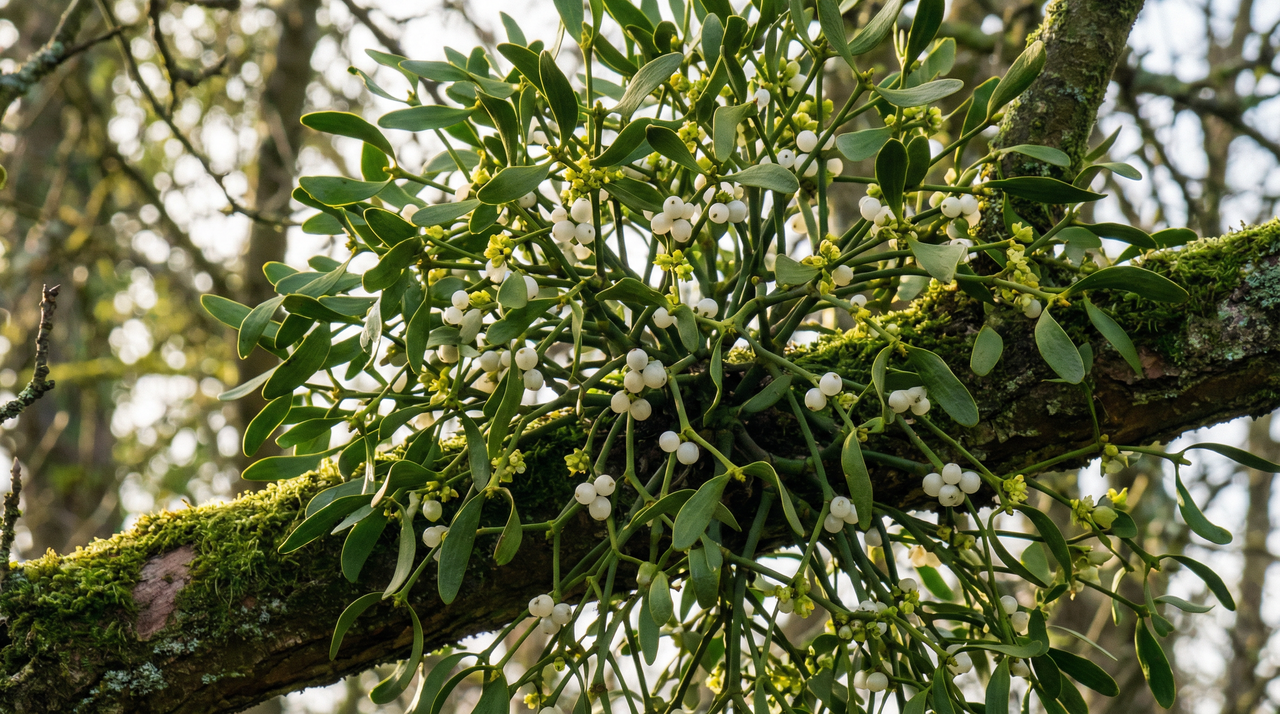
Most parasites don't get their own holiday tradition. Mistletoe does. Every December, people hang a toxic hemiparasite above their doorways and invite strangers to kiss beneath it, and almost nobody stops to think about how strange that is. I've stood in old English orchards in winter, looking up at those globe-shaped clumps suspended in bare apple branches like something the tree grew by accident, and even knowing the botany cold, there's still something about them that stops you. The berries are this luminous, waxy white, almost translucent in low light, and the whole plant sits there looking impervious while everything around it has gone dormant. It's not dead. It never looks dead. That's part of what unnerved people for thousands of years.
Here's the part that most gardeners don't expect: mistletoe photosynthesizes. It's not a full parasite; it makes its own sugars while stealing water and minerals from its host. That distinction sounds technical until you realize it's the whole reason this plant has a cultural history stretching back to the Druids, a modern clinical life in European oncology wards, and a genuine, complicated role in temperate forest ecology. It is not merely a curiosity. It is, by any honest accounting, one of the most ecologically consequential plants you'll never think to grow deliberately.
Origin, History, and Cultural Significance of Mistletoe
There's a plant that has fascinated botanists, healers, and mythmakers for millennia, and it doesn't even touch the ground. Viscum album, European mistletoe, is a perennial hemiparasitic evergreen shrub native to temperate Europe, western Asia, and northern Africa, ranging from the British Isles and southern Scandinavia through the Mediterranean all the way to Turkey, the Caucasus, and parts of Iran.[1][2] Its entire life unfolds suspended in the canopy of another tree's ambitions.
Botanical Background and Ecology of Viscum album
The word "hemiparasite" is doing a lot of heavy lifting here. Mistletoe isn't fully dependent on its host; it photosynthesizes on its own while using specialized root-like structures called haustoria to tap into the host's xylem for water and minerals, drawing roughly 30 to 50 percent of its nitrogen that way.[2][3] It colonizes apple, poplar, lime, oak, and certain pines most commonly, though its host range is impressively broad. Individual plants live 10 to 20 years, but colonies rooted in long-lived hosts can persist for a century or more, and from a bird-dispersed seed to first fruiting takes 4 to 7 years.[4][5] I always remind people that this is a patience game comparable to waiting for a pawpaw planting to come into bearing. If you're thinking about establishing mistletoe, the long game is the only game.
Ecologically, it gravitates toward sheltered, calcareous sites with consistent moisture, from sea level up to around 1,500 meters, and thrives in oceanic and humid subtropical climates.[6] It tolerates winter temperatures down to roughly minus 15 to 20 degrees Celsius but struggles in prolonged heat above 30 degrees or in arid conditions.[7] The Asian cousin Viscum coloratum follows a similar hemiparasitic playbook across Korean, Japanese, and Chinese temperate forests, which gives you a sense of how successful this strategy has been across a wide swath of the northern hemisphere.[8]
Visual Characteristics: Identifying European Mistletoe
In a winter orchard, mistletoe is unmistakable. It forms dense, spherical clumps, typically 60 centimeters to 1.5 meters across, of dichotomously branched, yellowish-green stems that gradually become woody and brownish at their base.[2][9] The leaves are opposite, leathery, elliptical, a deep persistent green, and they stay exactly that way through the entire dormant season while the host tree stands bare around them.[2][10] That evergreen defiance is precisely why ancient peoples found the plant so arresting. Every time I see mistletoe in an old apple orchard I'm reminded why our ancestors considered it sacred.
The berries are the real showstopper. They ripen from autumn into deep winter as translucent white, globose drupes, about 5 to 10 millimeters across, each containing a single sticky seed designed for bird dispersal.[2][11] Up close they look almost like porcelain beads against the dark green foliage, and the pulp is gelatinous and extraordinarily sticky, clinging to fingers exactly as it clings to a bird's beak and eventually to the branch where the next plant will germinate. The flowers, by contrast, are tiny, greenish-white, and inconspicuous, appearing in late winter to early spring before most of us are paying attention.[12]
Traditional and Cultural Uses Through the Ages
The written record goes back at least two thousand years. Dioscorides prescribed Viscum album in his De Materia Medica around 50 to 70 AD, and Pliny the Elder detailed its uses in his Naturalis Historia in 77 AD, recommending oak-grown mistletoe especially for epilepsy, spleen complaints, infertility, and as a poison antidote.[13][14] The Druids had their own relationship with it, ceremonially harvesting mistletoe from oak with a golden sickle on the sixth day of the moon at the winter solstice, catching it in a white cloth to prevent it touching the ground, and calling it "all-heal."[15][16] It's hard to read that ritual without seeing exactly how the plant earned it: a green, fruit-laden sphere flourishing in the crown of a leafless winter oak is a genuinely startling sight.
Medieval and early modern Europe never let go of that reverence. Ethnobotanical surveys from Russia, the Balkans, and the Baltic region record infusions of leaves and cautiously prepared berries used for hypertension, heart conditions, rheumatism, and menstrual disorders, a geographic spread that tells you how deeply woven into European healing tradition this plant was.[17][18] Anthroposophic medicine later developed standardized Viscum album extracts, most famously Iscador, for immune support and adjunct cancer care.[19] As a grower of many medicinal plants, I'll say plainly: this is one where the toxicity demands deep respect and professional guidance, full stop.
The kissing custom traces back to Roman Saturnalia and Celtic winter festivals before being absorbed into Christmas tradition,[14][20] while Germanic folklore carried it as an amulet against witchcraft, lightning, and poison, and a symbol of truce under which enemies could meet safely.[14] And then there's the Norse version of the story, where Loki fashions the only thing that can kill the invulnerable god Balder into a dart made of mistletoe.[14] I find that paradox genuinely fascinating: the same plant that embodied peace and fertility was also the universe's one lethal exception. A single species carrying both archetypes says something profound about how deeply humans have always entangled themselves with plants.
Fascinating Facts About Mistletoe
The largest recorded specimen of Viscum album measured over five meters in diameter on a 300-year-old poplar in France.[21] Picture a clump the width of a small car suspended in the crown of a centuries-old tree and you start to understand how these colonies, tied so intimately to long-lived hosts, can accumulate into genuine landmarks. Such specimens are rare, of course, and they depend entirely on an equally ancient and healthy host. I've seen mistletoe in old orchards carrying respectable loads for decades without obvious decline in the tree, but balance really is everything. The plant is neither villain nor cure-all; it's an organism that has always lived right at the intersection of life and myth, and that's exactly what has kept people fascinated for two thousand years.
Mistletoe Varieties and Where to Buy
Botanical Subspecies of European Mistletoe (Viscum album)
If you go looking for mistletoe "varieties" the way you'd browse a seed catalog, you'll come up empty. Viscum album isn't shaped by horticultural selection; it's shaped by ecology. The meaningful divisions are subspecies defined by host specificity and geographic range rather than anything a nursery bred for garden performance.[22][23] The main subspecies include album, abietis, austriacum, connatum, coloratum, laxum, and meridionale, each occupying a different ecological niche across Europe and Asia.[24] When I studied herbarium specimens in European collections, what struck me was how visually distinct the conifer forms look from the broadleaf ones: denser, smaller-leafed, the berries noticeably tighter and less plump.
Subsp. album is the classic, the one most people picture. It colonizes broadleaved trees like apple, hawthorn, lime, and poplar across western and central Europe, producing the yellowish-green foliage and glossy white berries that feel almost waxy when you handle them in winter.[25] It's hardy in USDA zones 6-8 and dioecious, meaning you need both sexes present for berry production. The conifer specialists are a different story: subsp. abietis and subsp. austriacum parasitize firs, spruces, and pines in central Europe and northern Asia, and the austriacum form (sometimes treated as its own species entirely) tends toward monoecious flowering, denser foliage, smaller berries, and slightly better cold tolerance, down into zones 5-7.[22][26] Subsp. connatum specializes on oaks in Mediterranean regions, while subsp. coloratum is adapted to warmer climates in Asia Minor and the Caucasus.[22][23]
Any breeding work happening with Viscum album is focused on improving the medicinal potency of lectins and viscotoxins for pharmaceutical purposes, not on producing garden-friendly cultivars.[27] As a permaculture designer, I evaluate plants by function and host compatibility. With mistletoe, the question isn't "which variety should I grow?" It's "which host tree do I have, and which subspecies is adapted to it?" That's the whole selection framework.
Sourcing and Purchasing Challenges in the US
Here's the hard reality for US readers: live European mistletoe is essentially impossible to source legally. The USDA prohibits importation of fresh plants, cuttings, and most plant parts to prevent introduction of foreign pests and diseases, and Viscum album is also listed as potentially invasive in states like California and Florida.[28][29][30] When I've worked with clients wanting to build medicinal guilds that include European mistletoe, navigating that regulatory maze almost always ends the same way: I steer them toward native North American options or strictly controlled research-grade extracts rather than attempting anything that could run afoul of federal import rules.
The practical alternative for most US gardeners is American mistletoe (Phoradendron serotinum), which is far more accessible from domestic retailers for landscaping or ceremonial use.[31] Specialized herbal suppliers do offer Viscum album extracts and supplements, but these carry no FDA-approved therapeutic claims, and pricing on any legitimately sourced live material, when it surfaces at all, tends to run roughly $10-25 for seed packets and $20-50 for young plants, with availability that fluctuates unpredictably.[32][33] Commercial nurseries avoid it for obvious reasons: the parasitic habit, slow establishment, and host specificity make it commercially unviable.
If you do work with wild European mistletoe in regions where it's legally accessible, sustainable harvesting means removing no more than 50% of growth from any single host, avoiding protected sites, and timing collection to late autumn or winter.[34][35] Personally, I apply a more conservative 30% limit on any parasitic species in my designs; the WHO guideline is a ceiling, not a target. In practice, most permaculture designers I know either propagate from legally sourced seed onto suitable hosts or work with native mistletoes entirely. Given how inseparable this plant is from its host's health, responsible stewardship matters far more here than any variety decision.
European Mistletoe Propagation and Planting Guide
Growing mistletoe from scratch is one of the more humbling projects a horticulturist can take on. This isn't a plant you sow in a pot and transplant out. It's a hemiparasite, and every single technique you use has to work around that biological reality. No host, no mistletoe. Full stop.
Reproductive Biology and Seed Characteristics
European mistletoe is primarily dioecious, meaning you need both male and female plants for sexual reproduction through cross-pollination. Some populations also exhibit facultative apomixis, a form of clonal seed production that bypasses fertilization entirely, which explains why certain wild stands look remarkably uniform despite growing across large areas.[36][37][38] Apomixis isn't universal, but it's worth knowing about if you're trying to understand genetic variation in the populations you're working with.
The seeds themselves are wrapped in viscin, a sticky mucilaginous coating inside the white berries that evolved specifically for bird dispersal, particularly by mistle thrushes.[39][40] The embryo has a radicle adapted for haustorium formation on host bark, not soil germination. There's no point trying to grow mistletoe in soil. The seed is simply not built for it.[41]
Storage is where many first-time growers trip up. Mistletoe seeds are recalcitrant, meaning they cannot be dried and stored like orthodox seeds.[42][43] They need to be kept moist (85-95% RH) at cool temperatures between 4-10°C, ideally packed in damp sand or vermiculite, and they'll hold viability for one to two years at most under those conditions.[44][45] Viability crashes fast if you let them dry out. I learned this lesson the hard way propagating other challenging native perennials: freshness is everything, and with mistletoe, "fresh" means using fully ripe berries as soon as you can get them.
Propagation Methods and Techniques
The most traditional method is direct seed inoculation, which is essentially mimicking what a thrush does. You rub or press fresh seeds onto lightly scarred bark on young, 1-2 year old twigs of a suitable host in late winter, roughly December through February, and keep conditions humid at 15-20°C.[46][47] Success rates honestly range from 20-50% under typical conditions, with optimal treatment pushing that toward 70%.[48][49] Fresh seeds help considerably, as does cold stratification of 4-6 weeks at around 4-5°C and removing the sticky aril before pressing the seed against the bark.[50][51][52]
If you want the most reliable results, grafting is the method to know. Whip-and-tongue or cleft grafting onto dormant host branches in late winter to early spring, under conditions of 15-20°C and high humidity, achieves 70-90% success rates.[53][54][55] Apple, poplar, lime, and hawthorn are the preferred hosts for grafting. Tissue culture is also possible for conservation or virus-free stock, with 40-80% success using cytokinins and auxins on nodal explants, though it's firmly in specialist territory.[56][57] Cuttings with IBA rooting hormone are much less successful, hovering at 10-30%, and even those must then be physically attached to a host to have any chance.[58] Select vigorous, disease-resistant deciduous hosts from the Rosaceae or Salicaceae families, and avoid conifers unless you're working specifically within their native range.[59][60]
Germination Timeline and Establishment
Here's the part that separates the patient from the impatient: from seed, mistletoe takes 4-7 years to reach reproductive maturity and produce its first berries.[2][61][62] The first 1-3 years after inoculation can look like almost nothing is happening, which is genuinely hard to sit with. I tell clients to treat this like establishing a rare slow-maturing woody perennial: label every inoculation site, photograph it at the start of each season, and resist the urge to declare failure too early. Grafted plants tend to move faster, averaging 4-5 years to berries, though the range stretches from 3-7 years depending on host species and conditions.[47]
One practical point worth keeping in mind: because mistletoe is dioecious, you'll need both male and female plants to get those iconic white berries. Plan for that from the start rather than discovering it after year five.
Soil, Site, and Host Requirements
Since mistletoe grows entirely on host branches via haustoria, it has no direct soil requirements of its own.[63] What matters is the soil your host tree is growing in. Apple, hawthorn, poplar, and lime all perform best in well-drained, loamy or sandy-loam, calcareous soils with a pH between 6.5-7.5 and decent organic matter content around 2-3%.[64][65] I've observed that healthy, unstressed hosts on well-drained calcareous ground produce noticeably more vigorous mistletoe clumps. A stressed or waterlogged host shows reduced mistletoe vigor within a season, which matches what we know about the haustorial relationship being entirely dependent on host vascular flow.[66]
Mistletoe prefers temperate sites with moderate to high humidity, annual rainfall above 500-600 mm, and dappled or partially shaded light conditions, roughly 50-70% shade or filtered canopy light for 2-6 hours daily.[67][68][69] Full sun is tolerable in cooler, more northerly climates, but scorching becomes a real risk in hotter conditions, and dense shade suppresses it entirely.[70]
Spacing, Technique, and Practical Considerations
When inoculating, spacing your sites 8-12 inches (20-30 cm) apart along a branch and keeping inoculations 3-6 feet (1-2 m) apart vertically or between branches avoids early competition between establishing plants.[51][71] I've found through trial that cramming too many inoculation sites onto one branch leads to weaker clumps across the board. Give each one room. In an orchard or woodland edge setting, host trees ideally sit 5-10 meters apart to ensure airflow and adequate light, and you want to keep total mistletoe density well below 5-10 clumps per tree; higher than that and host stress starts climbing significantly.[72]
Before you start, check the legal situation in your region. Mistletoe is protected under the EU Habitats Directive in parts of Europe and may require permits to propagate or collect.[73][74] Outside its native range, including much of North America, it's regulated or flagged as potentially invasive.[51] My strong advice is to source from licensed nurseries where they exist, do your homework on local regulations, and approach this as a multi-year ecological project rather than a quick ornamental fix. Establishment takes 2-5 or more years, the techniques require real attention to detail, and the margin for error is narrow. But for a patient permaculture designer willing to commit to it, there are few plants with a more culturally resonant, ecologically complex story to tell.
Mistletoe Care Guide: Growing Viscum album
Caring for mistletoe is unlike caring for any other plant in your garden, and that's not hyperbole. There's no soil to amend, no pot to water, no feeding schedule to track directly. Viscum album spends its entire life anchored to a host tree, drawing water and minerals through specialized root-like structures called haustoria. Every decision you make about light, water, temperature, and nutrition gets filtered through one primary question: how is the host doing? Get that right, and the mistletoe tends to follow.
Sunlight Requirements for Viscum album
In its natural habitat, mistletoe grows where the host canopy provides exactly the kind of dappled, shifting light you'd associate with a fern bed or a woodland understory. It performs best with around 2 to 6 hours of indirect or filtered light daily, at moderate intensities around 200 to 500 µmol m⁻² s⁻¹.[75][69] Push it past 4 to 6 hours of direct sun and you'll start seeing photoinhibition, leaf scorching, and bleaching, the same kind of stress response I notice when shade-grown ferns get left in an afternoon sun patch they weren't ready for.
Too little light creates a different set of problems. Prolonged shade produces etiolated growth, pale foliage, and poor berry production, and it leaves the plant more vulnerable to fungal pathogens.[76] What makes this trickier than managing a shade-tolerant ornamental is that the host's canopy is not static. A dense summer canopy that filters light beautifully becomes a bare winter skeleton, and the mistletoe's light exposure shifts dramatically across the year. Higher light intensity also modulates how aggressively mistletoe pulls nutrients through its haustorial connection, so this is a variable worth paying attention to beyond just foliage color.
Watering Needs and Host Dependency
You cannot water mistletoe directly. The plant has no functional roots. All water arrives via the host's xylem, drawn up through haustorial connections that tap directly into the tree's vascular system.[77] Asking how to water mistletoe is a bit like asking how to water a tick.
Once haustorial connection is established, usually within one to two years, your irrigation focus shifts entirely to the host tree. Keep soil moisture even, avoid waterlogging, and use slightly acidic to neutral water (pH 5.5 to 7.5) with low salinity.[78][79] Viscum album has moderate drought tolerance, surviving water stress for four to six weeks by closing stomata and relying on its thick, succulent leaves to conserve moisture,[80] but in practice I've seen even established mistletoe on healthy apple hosts show scorched leaf margins quickly once the tree itself starts struggling. The parasite and the host are one system. Brown-margined leaves and reduced berry set usually point to an underwatered host, while soft blackened stems and yellowing can signal waterlogged roots below.[81] During the very early seedling phase, a light misting around the attachment site can help before haustoria fully form, but that's a brief and minor intervention.
Feeding and Nutrient Management
Direct fertilization of mistletoe is pointless and potentially counterproductive. The plant acquires nitrogen, phosphorus, and potassium directly from host xylem sap via haustoria, with leaf tissues running roughly 2 to 4% N, 0.2 to 0.5% P, and 1 to 3% K.[82] In the process, it reduces host nutrient availability by around 20 to 30%.[83] Visible deficiency signs like interveinal yellowing, chlorosis, and leaf necrosis reflect what's happening in the host's nutrient pool, not a separate problem in the mistletoe itself.[6]
Feed the tree instead, with a balanced 10-10-10 applied in spring every four to six weeks through midsummer, or go the organic route with compost.[84] Here's the paradox I've learned the hard way: excess nitrogen can actually boost mistletoe proliferation and seed production on established hosts, while simultaneously suppressing establishment on young ones by pushing the host into overly vigorous growth that may resist haustorial penetration.[85] I had a young mistletoe colony on an apple I was feeding generously, and berry production lagged two full seasons longer than I expected. Once I dialed back the nitrogen, the plant settled into a more balanced rhythm. Moderate and consistent beats generous and variable. Soil pH should sit between 6.0 and 8.0, aligned with whichever host species you're working with.[86]
Frost and Cold Tolerance
Viscum album is hardy across USDA zones 6 to 9 (RHS H5), tolerating brief exposures down to around -10°C to -15°C (5°F to 14°F).[87][88] Young seedlings and new growth are the vulnerable points; established plants on vigorous hosts handle cold considerably better. If you're in the cooler end of its range, a fleece cover during sharp cold snaps can protect newly attached seedlings through their first winter or two.[89]
Cold tolerance is genuinely host-dependent. Apple, poplar, and lime are classic choices precisely because they're frost-hardy themselves and maintain enough vascular activity to support the mistletoe through cold periods.[10] Frost damage below -10°C shows up as leaf discoloration, wilting, and dieback,[90] which can look alarming but often resolves if the damage hasn't reached the haustorial connection point itself. The species is naturally more common in milder southern and western European climates, and that preference is worth honoring when you choose your planting site.
Heat Tolerance and Temperature Stress
Viscum album tolerates an impressively wide thermal range, roughly -20°C to 40°C, with optimal growth between 10°C and 25°C.[91] Once temperatures climb past 35°C, photosynthesis starts declining, chlorophyll takes damage, and the plant activates heat shock proteins to cope.[92] I've watched the leaf bronzing that appears above that threshold, and it looks remarkably similar to what I see on citrus in my zone 9b summers, that flat, slightly burnished quality that tells you the photosynthetic machinery is under strain.
Seedlings and flowering plants are most sensitive. Berry drop is usually the first thing I notice during a hot dry spell, before the foliage even shows much stress.[93] Warmer conditions can also advance the plant's phenology by two to five days per degree Celsius,[94] which can subtly desynchronize it from host flowering and pollinator activity. The practical levers here are shade, which can reduce leaf temperature by 5 to 10°C, targeted drip irrigation to the host root zone, and choosing heat-tolerant hosts like Quercus or apple in warmer regions.[95][96]
Pruning, Maintenance, and Seasonal Rhythm
Viscum album is evergreen, photosynthetically active year-round, and flowers from February through April before producing berries that ripen September to December.[6][97] That winter berry and flower timing is exactly why late February to March is the critical pruning window: you can remove growth before seeds disperse, limiting spread before the next cycle begins.[98] I've noticed in warmer years that flowering nudges earlier, which can compress the gap between berry ripening and the pruning window, so it's worth watching your specific plant's rhythm rather than relying on fixed calendar dates.
Pruning serves two different purposes depending on your goals. For deliberate cultivation on a specimen host, light maintenance every two to three years keeps the colony from outpacing the tree's ability to support it.[99] For control in orchards or landscapes, cut back to one to two meters into healthy wood beyond the visible infestation; anything less and the haustorial network below the surface will simply regrow.[100] Heavy infestations can reduce host fruit yield by 20 to 50% over time and contribute to gradual decline,[101] so monitoring host vigor is the real maintenance task. I always wear gloves and eye protection when pruning because the berries are extraordinarily sticky and the plant is toxic if ingested, a precaution that should be non-negotiable. For large or old trees, bring in a professional arborist; the pruning cuts need to be clean and correctly placed to avoid opening the host to further injury.[98] Think of this as a long-term partnership with a difficult tenant: manageable, even rewarding, as long as you stay attentive.
How to Harvest Mistletoe
Before anything else: mistletoe is toxic. The berries are not food, regardless of how inviting those translucent white clusters look against winter bark. Everything that follows here is about medicinal or decorative harvest, handled with gloves and full awareness that this plant contains lectins and viscotoxins that cause real harm if ingested. I wear nitrile gloves every time I handle it; even the sap is irritating enough that I stopped skipping that step after one too many itchy mornings.
Timing and Ripeness Cues for Mistletoe Berries
Mistletoe is a slow clock. It flowers in late winter to early spring, somewhere between February and April, and then takes six to nine months for those berries to mature fully.[102][103] I find it helpful to think of the timeline the way I think about persimmons: blossom in early spring, harvest in deep winter. Peak medicinal harvest falls between December and February, when berries reach full white opacity and that plump, slightly firm texture that tells you the seeds inside are properly formed.[104][6]
That winter window isn't arbitrary. Lectin and viscotoxin concentrations, the compounds that matter for standardized medicinal extracts like Iscador, peak during this period.[105] Host tree also matters here more than most people expect. Apple-host mistletoe tends to yield higher lectin activity than material from pine or poplar hosts,[106] which is why I started labeling my drying racks by host species and harvest date. Phytochemical potency varies enough that tracking it isn't obsessive; it's just good practice. Harvest before the birds beat you to it, too, since significant thrush and fieldfare activity signals that seed dispersal is already underway and the window is closing.[106]
Take only a portion of the stems from any single host. Stripping a stressed tree, especially one already under drought pressure, harms both the host and the mistletoe colony's long-term viability.[107][108] With parasitic species, I've found that patience and restraint almost always outperform efficiency.
Sensory Characteristics and Quality Factors
The berries taste bitter, briefly sweet, then metallic in a way that's distinctly unpleasant.[109] That progression exists as a deterrent, not an invitation. Fresh leaves carry a mild herbaceous, earthy smell that dries down to something more like musty hay.[109][110] The berry flesh is pulpy and slightly mealy under thin waxy skin, with volatile compounds including β-caryophyllene and α-pinene contributing woody and balsamic notes that shift noticeably depending on host tree.[111][110] I describe the bitterness to students the way I'd describe gentian root: pronounced, layered, and a clear signal that the chemistry here is doing something serious.
For dried mistletoe used in medicinal preparations, host species, plant maturity, and post-harvest drying conditions all influence the final phytochemical profile.[106] Younger plants tend to be more acrid; material from established colonies on mature apple or oak hosts is generally preferred for extract standardization. None of this sensory information points toward any culinary use. These are identifiers and quality markers for the harvester, nothing more.
Mistletoe Preparation and Uses
Culinary Uses and Toxicity Warning
There are none. I want to be direct about that before anything else. European mistletoe has no safe culinary application, and every part of the plant, including leaves, stems, and berries, is capable of causing serious poisoning in humans.[112][113] Ingestion triggers immediate and severe systemic toxicity that requires emergency medical intervention.[114] Children are especially at risk; as few as one or two berries can be lethal to a small child.[114][6]
The berries do contain up to 30-40% sugars and have a genuinely sweet, sticky, mucilaginous texture when crushed, which I can confirm from handling decorative sprigs for winter wreaths.[115] That sweetness is almost certainly why accidental ingestion happens. It does not make the berries safe, and Viscum album does not appear in any food composition database because it simply is not edible.[116] American mistletoe (Phoradendron serotinum) and dwarf mistletoe species carry the same risks, so correct identification changes nothing from a safety standpoint; all mistletoe species should be treated as toxic.[117][118] Any traditional folk recipes involving mistletoe, along with any curiosity about american mistletoe uses, should be set firmly aside. When I include mistletoe in a wildlife guild design, I always label it explicitly: the berries are for the birds, not for snacking or experimenting.
Medicinal Preparations and Standardized Extracts
The legitimate medicinal story is a different matter, though it is one that belongs almost entirely in clinical hands. Leaves and stems are the primary plant parts harvested for standardized pharmaceutical extracts such as Iscador and Helixor, used in anthroposophic and integrative cancer medicine across Europe.[119][120] The berries play almost no role in modern phytotherapy. Injectable preparations are administered subcutaneously under medical supervision, starting at doses as low as 0.01-0.1 mg and gradually titrating up to 10-20 mg per injection, given two to three times weekly.[121][122] That precision matters enormously because lectin concentrations vary significantly depending on host tree species, harvest season, and processing method; a home-prepared tincture cannot replicate that consistency.
Traditional references do include oral preparations, tinctures at 1-2 ml three times daily or infusions using 1-2 teaspoons of dried herb per cup of water, but these are broadly not recommended outside clinical settings because the cardioactive compounds remain active and unpredictable in home preparations.[121] Controlled fermentation, alcohol maceration, or drying can reduce some lectins and shift the flavor from harsh and bitter toward something more subdued, but none of these processes eliminate the toxicity risk for home use.[123] I grow dozens of medicinal perennials and I am comfortable experimenting, but viscum album tea is not something I would prepare at home or recommend anyone attempt without licensed clinical oversight.
Safety, Contraindications, and Side Effects
Mistletoe is contraindicated during pregnancy and breastfeeding. The potential for uterine stimulation and embryotoxic effects means the risk of miscarriage is real, not theoretical.[114][124] I would never recommend any form of mistletoe to a pregnant client or friend, regardless of the preparation or the source. People with autoimmune conditions should also avoid it; its immune-modulating properties can provoke flares rather than relief.[125]
Even under proper supervision, side effects in clinical use include flu-like symptoms, allergic reactions, hypotension, and local injection-site reactions, generally mild to moderate but worth anticipating.[124][126] Drug interactions add another layer of concern. Mistletoe can produce additive effects with cardiac medications like digoxin, and its immune-stimulating activity may work directly against immunosuppressant drugs, reducing their efficacy at exactly the moment a patient needs them to perform.[127][124] This plant demands respect at every stage, from berry to extract to injection site.
Mistletoe Health Benefits and Medicinal Uses
European mistletoe sits at an unusual intersection: it's simultaneously one of the more toxic plants you'll encounter in a temperate garden and a subject of serious oncology research in Europe. That tension isn't a paradox so much as a feature of its chemistry. The same compounds that make raw mistletoe dangerous are, when properly extracted and standardized, the basis for over a century of therapeutic investigation.
Key Phytochemicals in European Mistletoe
The two compound classes that define Viscum album pharmacologically are mistletoe lectins (designated ML-I, ML-II, and ML-III) and viscotoxins. The lectins are type 2 ribosome-inactivating proteins; the viscotoxins are small peptides from the thionin superfamily, each around 5 kDa, with membrane-disrupting activity. Together they account for both the plant's acute toxicity and its therapeutic potential in processed form.[128][129] Beyond those headline compounds, the plant contains flavonoids including quercetin, kaempferol, and rutin; phenolic acids such as chlorogenic and caffeic acid; triterpenoids including oleanolic and betulinic acid; and minor alkaloids like tyramine and octopamine, though the significance of those last few remains genuinely debated in the literature.[128][130]
One thing I find fascinating as a horticulturist is how dramatically variable these concentrations are. Leaves and berries carry the highest loads; stems are considerably lower. Host tree species, season, geography, and even extraction method all shift the profile.[131][132] I've noticed this in the field: mistletoe growing on apple trees in the same neighborhood as mistletoe on ornamental linden looks meaningfully different, with variation in berry size and leaf color that hints at the chemical differences underneath.[133] Viscotoxin levels peak in winter; Mediterranean populations show broader flavonoid diversity. None of this is uniform, which is precisely why standardized commercial extracts require such careful processing.
Medicinal Research and Clinical Evidence
The strongest evidence for mistletoe therapy centers on immunomodulation as an adjuvant to conventional cancer treatment. Standardized subcutaneous and intravenous preparations, most notably Iscador, activate natural killer cells, monocytes, and macrophages, increasing perforin and granzyme release. In patients with breast, lung, and colorectal cancers, systematic reviews and meta-analyses consistently find improved quality of life and reduced severity of chemotherapy side effects.[134][135][136] I find those QoL findings genuinely compelling; they hold up across multiple high-quality analyses including a Cochrane review. What the evidence does not yet show is a significant impact on overall survival, and I think it's important to say that plainly rather than let enthusiasm outpace the data.
At the cellular level, lectins and viscotoxins drive anti-proliferative and cytotoxic effects in cancer cell lines through apoptosis via mitochondrial pathways, caspase activation, and modulation of NF-κB signaling.[137][138] Preclinical studies also suggest antioxidant activity through scavenging free radicals and modulating superoxide dismutase and catalase, anti-inflammatory effects via inhibition of TNF-α, IL-6, and NF-κB, and antimicrobial activity against Gram-positive bacteria and Candida, largely attributed to viscotoxins.[139][140] Promising, but in-vitro and animal data are not clinical proof.
Traditional European herbalism used mistletoe for hypertension, epilepsy, anxiety, and infertility, and as a cardiac tonic.[140] Most of these uses lack robust clinical validation, and the cardiac-tonic claim is worth flagging directly: documented hypotensive effects make it contraindicated alongside antihypertensive medications, not synergistic with them.[141] Regulatory recognition is concentrated in Europe: Germany's Commission E approves standardized preparations and ESCOP recommends them for adjuvant cancer therapy by injection, while an EMA monograph exists for traditional use.[124][122] The FDA has not approved these preparations, citing mixed evidence.
Nutritional Profile
I'll keep this brief, because the nutritional data for mistletoe only exists in the context of toxicology research, not food science. No part of this plant is edible. Dried leaves contain roughly 12-15 g protein and 40-45 g carbohydrates per 100 g dry weight, with reasonable potassium (1,200-1,500 mg) and calcium (150-250 mg) levels.[142][143] These numbers vary widely by host tree and season and don't appear in any standard food database, because they were never meant to. Treat them as phytochemical context, not dietary information.
Safety Considerations and Contraindications
Every part of Viscum album is toxic when consumed raw: leaves, stems, berries, sap. Primary culprits include viscotoxins, the cyanogenic glycoside taxiphyllin, and viscumin (mistletoe lectin I), with highest concentrations in berries and young leaves.[144][145] Toxicity shifts by host, season, and geography; the white berries look beautiful against bare winter branches, but their visual appeal carries no information about edibility. Symptoms progress from gastrointestinal distress (nausea, vomiting, abdominal pain) to cardiovascular effects (hypotension, bradycardia, arrhythmias) and neurological symptoms including confusion and seizures; severe cases can lead to cardiovascular collapse.[146][147] A few berries can cause serious harm to a child or a pet. The plant is also toxic to livestock.
Standardized medicinal extracts are a different story: their safety profile is generally favorable, with mostly local reactions and flu-like symptoms following injection; severe events are rare, though anaphylaxis has been documented.[136][148] Raw plant material or improperly prepared home remedies carry none of those safeguards. Sap can cause contact dermatitis in sensitive individuals. Contraindications include pregnancy, breastfeeding, autoimmune disease (the immunostimulatory lectins can exacerbate symptoms), and concurrent use of antihypertensive medications due to additive hypotensive effects.[145][149] I never recommend clients experiment with homemade mistletoe preparations. The research is clear that even small amounts of raw plant material can cause serious harm, and any therapeutic application belongs firmly in the hands of a qualified integrative practitioner.
Mistletoe Pests and Diseases
For a plant with such an unusual lifestyle, mistletoe holds its own remarkably well against the things that try to eat or infect it. A lot of that comes down to chemistry. The same lectins, viscotoxins, phenolics, and terpenes that make mistletoe a subject of serious pharmacological interest also make it genuinely unpleasant to herbivores.[150][151] I've noticed this firsthand: even when neighboring plants in an orchard are getting hammered by generalist feeders, healthy mistletoe clumps often come through relatively untouched.
Common Insect Pests and Their Impact
Mistletoe does host a specialized insect community, just not a particularly devastating one. Aphids (Hyalopterus pruni, Myzus viscum), scale insects (Physokermes hemicryphus), the mistletoe weevil (Attelabus nitens), gall midges (Thecodiplosis visci), and several leaf miners round out the usual cast.[152][153] Aphids and scales pull sap, excrete honeydew that invites sooty mold, and can cause distorted growth; miners and midges reduce photosynthetic efficiency through tunneling and leaf deformation.[152] Weevils chew foliage and fruit, and their feeding wounds can double as fungal entry points later in the season.[154] Phytoplasma infections causing witches' broom have been linked to insect vectors like psyllids and leafhoppers, though they're a minor footnote rather than a routine problem.[155][156]
What I've watched happen with aphid flushes in late spring is reassuring. Populations spike, look alarming for a few weeks, then get knocked back hard by parasitic wasps and lady beetles moving in.[155] It's the kind of seasonal rhythm you can learn to anticipate rather than panic over. At the population level, insects simply aren't a major threat to mistletoe viability; the plant's chemical armor and its natural enemies keep things in check.[153][157]
Fungal Diseases and Other Pathogens
Fungi are where the real pressure lives. Leaf spot from Septoria visci, necrotic blight from Alternaria alternata and Cladosporium visci, anthracnose from Colletotrichum species, cankers tied to Nectria or Cytospora, and dieback from Botryosphaeria dothidea represent the most consistent disease threats.[158][154] Bacterial infections and viruses are poorly documented and rarely reported; no dominant viral pathogen has been confirmed in the literature, so don't lose sleep over them.[159][160]
Host health is the real moderating variable. Mistletoe on a drought-stressed tree, or one already dealing with poor air quality, shows noticeably more fungal spotting than the same species on a well-maintained, well-watered host.[161][162] Disease prevalence in surveyed populations generally stays below 10 percent, with higher rates turning up in urban or fragmented sites where trees are already under stress.[161] There are no disease-resistant cultivars to lean on; breeding programs for mistletoe simply don't exist at any meaningful scale.[163]
Resistance, Prevention, and Management
My approach here mirrors good IPM practice generally: start with cultural controls, rely on biology, and reach for chemistry only when the situation actually calls for it. Pruning out infested or infected branches, removing fallen debris, and keeping the host tree genuinely healthy will solve most problems before they escalate.[164] I've found that improving air circulation around the canopy often reduces fungal pressure more reliably than any spray. When fungicides are warranted, copper-based options like Bordeaux mixture or targeted systemics such as tebuconazole, applied early in disease development, are the reasonable tools.[164][165] I avoid broad-spectrum pesticides specifically because they disrupt the parasitic wasps and lady beetles that keep weevil and aphid numbers manageable without any input from me.[166] For most gardeners, attentive observation and basic sanitation are genuinely enough.
Mistletoe in Permaculture Design
Mistletoe is one of those plants that forces you to sit with complexity. It's not a straightforward guild member you slot in for nitrogen fixation or a ground cover you plant and forget. Integrating it intentionally means accepting a managed tension between genuine ecological value and real parasitic cost, and deciding whether that tradeoff makes sense for your system.
Climate and Hardiness Zones for Growing Mistletoe
Viscum album is generally suited to USDA zones 6 through 9, though microclimate and host tree vigor matter as much as the zone number itself.[167][168] It grows best at temperatures between 15 and 20°C during the growing season and tolerates winter lows down to around -15°C in sheltered conditions, but prolonged frost below -10°C or summer heat regularly exceeding 30°C will stress it.[66][169] Annual rainfall of 600 to 1200 mm and relative humidity around 60 to 80% represent the sweet spot; drop below that and both pollination and seed dispersal suffer.[169] For readers at the colder edge of that range, Korean mistletoe (Viscum coloratum) offers comparable cold tolerance down to approximately -15°C to -20°C and is worth investigating as an alternative.[170]
I've noticed that south-facing branches on well-established apple or hawthorn trees buffer the cold stress considerably, in much the same way we tuck tender perennials behind a warm wall. The host tree itself becomes the microclimate. For North American growers, cultivating Viscum album in the USA is genuinely difficult and rarely successful given its host specificity and climatic requirements.[171][172] Propagation details live in their own section; here, the key design point is that without the right host trees and a genuinely humid temperate climate, mistletoe simply won't establish.
Ecosystem Functions and Biodiversity Contributions
The hemiparasitic reality of mistletoe deserves to be stated plainly before we get to the good stuff. It attaches to host branches via haustoria, drawing water and nutrients while reducing host photosynthesis by 20 to 50%.[6] Heavy infestations can push mortality risk up by 10 to 30% in trees that are already stressed by drought, disease, or poor soil.[173] Light infestations on healthy hosts rarely cause serious harm, but I'd suggest keeping an eye on any "mistletoe broom" that starts approaching a meter across; that's when I've seen host vigor noticeably decline in the orchards I've worked with.
Now for why ecologists call it a keystone species. Its flowers are small, greenish-white, and inconspicuous, but they bloom in winter, typically December through February, when almost nothing else is offering nectar or pollen to insects.[174] Pollination is carried out by hoverflies, bees, flies, and beetles, not by wind.[175] The first time I watched hoverflies working those tiny flowers on a mild December morning, I genuinely paused. It was a seasonal niche I'd completely overlooked, and it changed how I think about winter forage in a food forest. Habitat fragmentation and pesticide use reduce that pollinator activity, so any mistletoe planting is really an argument for maintaining chemical-free woodland edges nearby.[176]
Successful pollination leads to clusters of sticky white berries that persist through winter and feed over 20 bird species, including mistle thrushes, blackcaps, and robins, who disperse seeds by wiping their beaks on branches or passing seeds through their digestive tracts.[177][178] Those dense spherical clumps also shelter over 500 associated invertebrate species, from beetles and weevils to parasitoid wasps, and support lichens and mosses that add further canopy complexity.[177][3] In a balanced system, that biodiversity dividend can genuinely outweigh the parasitic cost, but only if you're actively monitoring host health and managing spread.
Forest Layer Placement and Guild Considerations
Mistletoe lives in the canopy layer, typically in the upper third of tree crowns where light penetration runs at 20 to 50%.[179] Its preferred hosts include apple, hawthorn, poplar, lime, pear, and occasionally oak, which maps neatly onto the structural trees you'd already expect in a temperate food forest or agroforestry system.[2][180] That overlap is both the opportunity and the caution: the trees you might most want to protect are exactly the ones mistletoe will happily colonize.
Below the canopy, its influence on the system is real but indirect. Parasitic mistletoe alters nutrient cycling through its host interactions, increases localized soil organic matter, and benefits bryophytes, though heavy infestations can reduce understory plant diversity as host canopies thin and light patterns shift.[181][95] Pruning infested branches before they exceed one or two clusters per limb is the standard management approach, and it works well if you stay ahead of it.[182]
My honest recommendation is to use mistletoe only in conservation-focused or habitat-restoration plantings, not in production systems where every tree is doing essential work.[183][184] Choose a non-critical host, keep the population to one or two established clumps per tree, and treat it as an indicator of woodland maturity rather than a crop plant. It belongs in a mature, diverse system maintained by someone paying close attention, not as a beginner's first guild experiment.
The Plant That Taught Me to Sit with Ambiguity
I once stood in an old Normandy apple orchard in January, looking up at a dozen mistletoe globes hanging in bare branches, and felt something I couldn't immediately name. Not unease exactly, but a kind of respect for a plant that poisons and heals, weakens its host and feeds half the winter birds, and has been sacred to more cultures than almost anything else I grow. I still don't fully have it figured out, and honestly, I think that's the point.
Sources 184
- Viscum album - Plants of the World Online (Kew Science) ↩
- Viscum album ↩
- The Ecology of Mistletoe in European Forests ↩
- Longevity and Ecology of Viscum album ↩
- Biology of European Mistletoe (Viscum album L.) ↩
- Distribution and Ecology of Viscum album ↩
- Temperature Tolerance and Physiology of Mistletoe ↩
- Flora of China - Viscum coloratum ↩
- European Mistletoe (Viscum album) - Missouri Botanical Garden ↩
- Mistletoe (Viscum album) - Kew Gardens ↩
- Mistletoe (Viscum album) - Kew Science ↩
- Viscum album - USDA PLANTS Database ↩
- Natural History ↩
- Mistletoe - Britannica ↩
- Pliny the Elder: Natural History, Book XVI ↩
- Mistletoe: The Sacred Plant ↩
- Viscum album in Russian Traditional Medicine ↩
- Ethnobotany of Mistletoe in Eastern Europe ↩
- Traditional Uses of Viscum album in Anthroposophic Medicine ↩
- Mistletoe: Myths and Magic ↩
- Record Specimens of Mistletoe in Europe ↩
- Kew Gardens: Plants of the World Online - Viscum album ↩
- European Mistletoe Subspecies - Kew Science ↩
- Subspecies of Viscum album in Europe: Distribution and Ecology ↩
- Viscum album - Flora Europaea ↩
- Taxonomy of Viscum album - Flora Europaea ↩
- Subspecies and Breeding in Viscum album ↩
- Importation of Plants and Plant Products ↩
- International Trade: Prohibited Plants ↩
- USDA PLANTS Database: Viscum album ↩
- UC ANR: Mistletoes of California - A Complete Guide ↩
- Mistletoe Extracts ↩
- European Mistletoe ↩
- Sustainable Harvesting Guidelines for Medicinal Plants ↩
- Wildlife and Countryside Act 1981: Protected Plants ↩
- Apomixis in Viscum album: Implications for Genetic Diversity ↩
- Genetic Variation in Apomictic Seeds of Viscum album ↩
- Reproductive Biology and Pollination in European Mistletoe ↩
- Seed Morphology and Dispersal in Viscum album ↩
- Embryology and Anatomy of Mistletoe Seeds ↩
- Evolutionary Adaptations in Hemiparasitic Viscaceae ↩
- Seed Storage Behaviour of Viscum album ↩
- Recalcitrant Seeds in Parasitic Plants: A Review ↩
- Seed Storage of Mistletoe (Viscum album L.) ↩
- Germination and Storage Conditions for Viscum album Seeds ↩
- Propagation of European Mistletoe (Viscum album L.) ↩
- Mistletoe Cultivation and Propagation ↩
- European Mistletoe (Viscum album L.) - Cultivation and Propagation ↩
- Mistletoe (Viscum album): Cultivation and Propagation ↩
- Propagation of Mistletoe (Viscum album L.) ↩
- RHS Gardening: How to grow mistletoe ↩
- Physiology of Seed Dormancy and Germination in Viscum album ↩
- Propagation of European Mistletoe (Viscum album) by Grafting ↩
- Propagation of Viscum album: Methods and Challenges ↩
- Grafting Techniques for Parasitic Plants: A Case Study on Viscum album ↩
- In Vitro Propagation of European Mistletoe ↩
- Micropropagation of Mistletoe ↩
- Propagation of Viscum album by Cuttings: Effects of Auxins and Media ↩
- Host Preferences and Ecology of Viscum album ↩
- Viscum album (mistletoe) - CABI ↩
- Mistletoe Biology and Ecology ↩
- Viscum album: Biology and Ecology ↩
- Viscum album - European Mistletoe | Kew Science ↩
- Soil Properties in Habitats of Viscum album ↩
- Mistletoe (Viscum album L.)—A Literature Review on Botany, Host‑Parasite Interaction and Medicinal Application ↩
- European Mistletoe (Viscum album) Habitat and Ecology - Kew Royal Botanic Gardens ↩
- Mistletoe Habitat and Distribution ↩
- Ecological Requirements of Viscum album ↩
- Photosynthetic Performance of Viscum album under Varying Light Conditions ↩
- Royal Horticultural Society - Mistletoe (Viscum album) ↩
- Propagation of European Mistletoe (Viscum album) ↩
- European Mistletoe (Viscum album) Biology and Management ↩
- Conservation Status of Viscum album in Europe ↩
- Mistletoe Propagation Guide ↩
- Royal Horticultural Society - Growing Mistletoe ↩
- Viscum album (Mistletoe) Plant Profile ↩
- Water Relations of the Parasitic Plant Viscum album ↩
- Viscum album: Biology, Ecology, and Control ↩
- Royal Horticultural Society: Viscum album Care Sheet ↩
- Physiological Responses of Viscum album to Drought Stress ↩
- Viscum album plant profile ↩
- Nutrient Relations of Viscum album L. ↩
- Mistletoe-Host Nutrient Interactions ↩
- European Mistletoe (Viscum album L.) - Propagation and Cultivation ↩
- Nutrient Relations in the Plant-Parasite System Viscum album and Quercus petraea ↩
- Royal Horticultural Society - Growing Mistletoe ↩
- Viscum album - European Mistletoe ↩
- Mistletoe (Viscum album) Plant Profile ↩
- Royal Horticultural Society ↩
- Viscum album (European Mistletoe) ↩
- Temperature Responses of Photosynthesis in the Parasitic Plant Viscum album ↩
- Heat Stress Responses in Viscum album: Physiological Adaptations of a Hemiparasitic Plant ↩
- Heat Stress Effects on European Mistletoe (Viscum album L.) ↩
- Phenological responses of mistletoe to climate warming ↩
- Impacts of Climate Change on European Mistletoe (Viscum album) ↩
- Mitigation Strategies for Mistletoe in Mediterranean Climates ↩
- Phenology of Viscum album ↩
- Mistletoe Management - RHS Gardening ↩
- Mistletoe: Biology, Management, and Control ↩
- Control of Mistletoe in Trees - USDA Forest Service ↩
- Integrated Pest Management for Mistletoe - Research Paper ↩
- Viscum album L. (Mistletoe): A Literature Review on Botany, Phytochemistry, and Pharmacology ↩
- Phenology of Viscum album subsp. album in Central Europe ↩
- Viscum album Profile ↩
- Pharmacology of Mistletoe (Viscum album L.) Extracts ↩
- Influence of Host Tree and Harvest Date on Chemical Composition and Cytotoxic Activity ↩
- European Mistletoe (Viscum album L.) ↩
- Viscum album - European Mistletoe ↩
- European Mistletoe (Viscum album L.) ↩
- Chemical Composition and Biological Activities of Mistletoe (Viscum album L.) ↩
- Viscum album - European Mistletoe - Kew Science ↩
- Royal Horticultural Society - Mistletoe Toxicity ↩
- European Mistletoe Toxicity ↩
- Mistletoe Poisoning Symptoms ↩
- Phytochemical Composition of Viscum album L. Extracts ↩
- Nutritional and Bioactive Compounds in Mistletoe (Viscum album) ↩
- USDA PLANTS Database ↩
- USDA Forest Service ↩
- European Mistletoe (Viscum album L.) ↩
- Phytochemical and Pharmacological Aspects of Viscum album ↩
- ESCOP Monograph on Viscum album L. ↩
- German Commission E Monograph: Mistletoe ↩
- Phytochemistry of Viscum Album: Lectins, viscotoxins and other compounds ↩
- Assessment report on Viscum album L., folium and herba ↩
- Herbal Medicine: Biomolecular and Clinical Aspects - Mistletoe ↩
- Mistletoe therapy in cancer: Review of controlled trials ↩
- Interactions between mistletoe extracts and immunosuppressive drugs ↩
- Phytochemical Composition and Pharmacological Activities of Viscum album L. ↩
- Secondary Metabolites from Viscum album: A Review ↩
- Analysis of Flavonoids and Phenolic Acids in Mistletoe (Viscum album L.) ↩
- Geographic and Host Influence on Secondary Metabolites of Mistletoe ↩
- Seasonal Variation of Viscotoxins in Viscum album ↩
- Phytochemical and Pharmacological Importance of Viscum album L. ↩
- Mistletoe in Cancer Therapy: Clinical Trials ↩
- Mistletoe extracts (Viscum album) for cancer ↩
- Mistletoe therapy in cancer: systematic review and meta-analysis ↩
- Apoptotic Effects of Viscotoxin in Cancer Cells ↩
- Mistletoe Lectins: From Bench to Clinical Application ↩
- Antioxidant and Antimicrobial Properties of Mistletoe Extracts ↩
- Pharmacological Review of Viscum album ↩
- Historical Uses of Viscum album in European Folk Medicine ↩
- Phytochemical and Nutrient Composition of Viscum album L. ↩
- Nutritional Analysis of Mistletoe (Viscum album) Berries and Leaves ↩
- Toxicity of Mistletoe (Viscum album) ↩
- European Mistletoe ↩
- Mistletoe Poisoning ↩
- European Mistletoe (Viscum album L.) - Poison Control ↩
- Efficacy and safety of mistletoe in cancer patients: a systematic review ↩
- Assessment report on Viscum album L., herba ↩
- Chemical Defenses in Mistletoe (Viscum album): A Review ↩
- Lectins and Viscotoxins in Viscum album: Roles in Plant Defense ↩
- Insects Associated with European Mistletoe (Viscum album L.) ↩
- Insect Pests of Mistletoe (Viscum album) in Europe ↩
- Fungal Pathogens of European Mistletoe ↩
- Natural Enemies of European Mistletoe ↩
- Phytoplasma Diseases in Viscum album ↩
- Herbivory on Viscum album: Insect Damage and Plant Responses ↩
- Fungal Diseases of Mistletoe (Viscum album) ↩
- Phytophthora Infections in Parasitic Plants ↩
- Bacterial and Viral Infections in Parasitic Plants ↩
- Pathogen Susceptibility and Resistance in Viscum album Populations ↩
- Field Observations on Mistletoe Health in European Forests ↩
- Cultivars of Viscum album - Royal Horticultural Society ↩
- Management Strategies for Mistletoe Diseases ↩
- Diseases of Mistletoe (Viscum album L.) ↩
- Biocontrol of Viscum album Using Insects and Fungi ↩
- Missouri Botanical Garden Plant Finder ↩
- Royal Horticultural Society - Viscum album ↩
- Climate and Distribution of European Mistletoe (Viscum album L.) ↩
- Viscum coloratum - Wikipedia ↩
- Invasive Species Compendium - Viscum album ↩
- USDA PLANTS Database - Viscum album ↩
- Ecological requirements of Viscum album in temperate forests ↩
- Royal Horticultural Society: Viscum album Profile ↩
- Insect Pollinators of European Mistletoe ↩
- Effects of habitat fragmentation on mistletoe pollination ↩
- Mistletoe as a Biodiversity Hotspot in Woodland Ecosystems ↩
- Seed Dispersal by Birds in Viscum album ↩
- Mistletoe Ecology in European Forests - Journal of Ecology ↩
- Mistletoe in Agroforestry Systems ↩
- Mistletoe-host interactions and soil microbial communities ↩
- Management of Viscum album ↩
- Mistletoe Habitat and Pollinator Conservation ↩
- Ecological Role of Mistletoes in Forests ↩