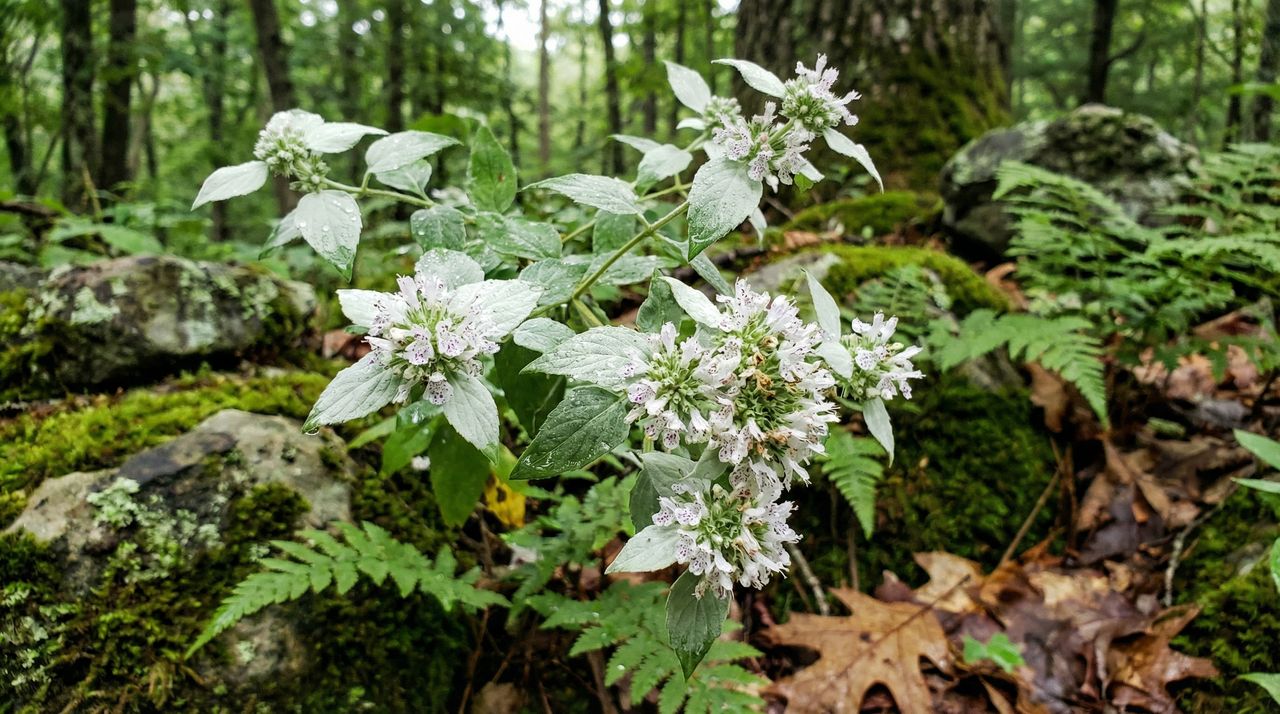
Every summer I watch it happen: a patch of mountain mint hits peak bloom, and within twenty minutes the plant is practically vibrating. Bumblebees, sweat bees, skippers, wasps, hoverflies, all of them packed onto those small white flower clusters like it's the only food left in the county. I've grown a lot of native perennials, and nothing I've put in the ground pulls that kind of crowd with that kind of consistency. But here's what gets me every time: most gardeners have never heard of it. They'll spend a season nursing along a temperamental echinacea or wrestling with a bee balm that sulks in the heat, and meanwhile Pycnanthemum incanum is sitting in some native plant nursery catalog, quietly doing everything they wanted that other plant to do.[1]
What surprises people most, once they finally grow it, is the smell. Rub a leaf between your fingers and it's not subtle, not polite, not the soft mint you'd expect from a garden herb. It's sharp, camphoraceous, almost medicinal, the kind of scent that clears your sinuses from six inches away. That's the essential oil talking, and it's the same chemistry that made this plant a staple in Cherokee medicine, a candidate for natural mosquito repellent research, and frankly one of the most underrated plants in the entire native perennial toolkit.
Mountain Mint Origin, History, and Traditional Uses
Botanical Background and Native Range
Pycnanthemum incanum, commonly called Hoary Mountain Mint or blunt mountainmint, is a perennial herbaceous plant in the Lamiaceae family with a native range that stretches across a surprisingly broad swath of eastern North America.[2][3] We're talking about 21 to 26 states, from New York and Pennsylvania south through Florida, west to Texas and Oklahoma, with confirmed populations in everything from New Jersey to Missouri to Louisiana.[3][4][5] In the wild, it favors open woodlands, meadows, rocky slopes, and bluffs, typically at elevations between 100 and 1,500 meters.[6]
The plant grows in upright clumps reaching two to four feet tall and spreads through rhizomes to form persistent colonies.[7][3] Individual plants typically live three to seven years, but those rhizomatous colonies can outlast any single stem by decades.[8] From a landscape design standpoint, that colonial habit is one of the things I find most useful about it. Once it's comfortable, it fills in naturally, creating a groundlayer presence that takes years to establish with a lot of other natives. Seedlings need one to two years before they're ready to flower.[9]
The Pycnanthemum genus is diverse, and it helps to know a few relatives when thinking about how Hoary Mountain Mint fits ecologically. Virginia Mountain Mint (Pycnanthemum virginianum) ranges even further north into Nova Scotia and Ontario and tolerates lower elevations and wetter conditions than its hoary cousin.[10][11] Slender Mountainmint (Pycnanthemum flexuosum) sticks closer to the southeastern coastal plain and Appalachian corridor.[12] Each species occupies its own niche; knowing the mountain mint scientific name of your specific plant matters if you're sourcing for a particular habitat or hardiness zone.
Visual Characteristics of Mountain Mint
The first thing most people notice about Hoary Mountain Mint is the color. Those erect, square stems are densely covered in short white hairs, giving the whole plant a silvery, grayish-white appearance that explains both the common name and the species epithet "incanum," which is Latin for hoary or gray.[2][4] The square stems are an instant mint-family giveaway; I've used that feature more than once to confidently ID a volunteer popping up in a client's meadow planting before anything else came into flower. The leaves are opposite and ovate to lanceolate, softly hairy on both surfaces, with toothed margins.[4]
Flowers appear from July through September in dense, button-like terminal clusters with showy silvery bracts that stay attractive even after bloom fades.[9][4] The individual flowers are small and two-lipped, white to pale lavender with purple spots on the lower lip, and they give way to tiny dark nutlets in autumn.[4] Those silvery bracts surrounding the flower heads create a textural contrast in late summer plantings that I find genuinely striking, especially compared to the smoother, more slender-leaved form of Pycnanthemum flexuosum, which has slightly smaller flowers and lacks that pronounced hoary coating.[13] Crush a leaf and you get an immediate hit of bold, minty fragrance, the kind that tells you immediately this plant means business.
Traditional and Cultural Uses by Native Americans
Long before this plant showed up in native-plant nurseries, Indigenous peoples of the eastern US had integrated it deeply into their material and medicinal lives. The Cherokee used mountain mint leaves and flowers to brew medicinal teas, and they applied it as a poultice for swellings, used it in sweat baths for rheumatism, and recognized its value as an insect repellent.[14][15][16] This is a plant with centuries of observed, practical application across multiple communities, and I think that record deserves real respect rather than casual mention.
Its culinary role is modest, mainly as a minty flavoring in herbal teas and occasionally as a seasoning,[17] but that's not really the point. The aromatic leaves have a presence and intensity that makes a simple foraged tea genuinely memorable. I've brewed it in the field and it tastes like something between spearmint and oregano, wilder and more resinous than anything from the grocery store herb section.
Fun Facts About Mountain Mint
One thing that often surprises people: Hoary Mountain Mint is globally secure, rated G5 by NatureServe, but it carries state rarity ranks of S2 or S3 in parts of its range, meaning local populations can be genuinely vulnerable even when the species overall is doing fine.[18] For me, that's a compelling argument for growing it at home from nursery-propagated stock rather than sourcing from wild populations, a small act of conservation that also happens to get you a fantastic garden plant.
The foliage's potent minty scent comes from an essential oil rich in pulegone.[17] I've crushed the leaves and rubbed them on my arms during summer site visits, and while I wouldn't skip sunscreen on that logic alone, there's clearly something going on there that the Cherokee figured out long before any laboratory did. As a pollinator plant, its bloom period draws a remarkable diversity of bees, butterflies, and other beneficial insects while also helping stabilize the soil beneath it.[19][2] Generally pest resistant and genuinely low-fuss once established, this is a plant that earns its keep without demanding much in return.[9]
Mountain Mint Varieties and Where to Buy Them
Notable Varieties of Hoary Mountain Mint and Related Species
Hoary Mountain Mint is one of those species where the cultivar catalog is essentially blank, and I've come to see that as a feature rather than a flaw. Pycnanthemum incanum has no widely recognized named cultivars; gardeners work primarily with seed-grown plants from wild or native stocks.[20][21] What exists instead are three recognized botanical varieties: var. incanum, var. oligophyllum (narrower leaves, sparser pubescence, better suited to drier sites), and var. atropurpureum.[3][22] In my experience designing pollinator gardens in the Southeast, starting with seed matched to your local botanical variety produces plants that handle humid summers far better than generic nursery stock sourced from unknown regions.
The one cultivated selection worth knowing about is 'Resistant,' a nursery development specifically improved for tolerance to Puccinia rust diseases.[23] Since I've seen rust flare up on related mints in crowded or humid plantings, I now routinely ask my native-plant suppliers whether they carry it. It's not a dramatic genetic departure from the species; it's just a practical hedge.
If you want more named-cultivar options, the close relatives deliver. Virginia Mountain Mint (pycnanthemum virginianum) has selections including 'Jedediah' for compact habit and dense silvery spikes, 'Blue Spike' for its striking blue-violet flower color, and 'Heat Wave' for extended bloom and better heat performance.[24][25] Slender Mountain Mint (Pycnanthemum flexuosum) rounds out the picture with var. coccineum, a Coastal Plain form that leans toward brighter pink and red flowers.[26] For most food forest and pollinator guild plantings, though, I keep coming back to the regional seed-grown P. incanum because no breeding program beats a few thousand years of local adaptation.
Sourcing Mountain Mint Plants and Seeds
Specialized native-plant nurseries have this species well covered. Prairie Moon Nursery, Native American Seed, Roundstone Native Seed Company, and Izel Native Plants all carry Hoary Mountain Mint as seeds or live plants.[27][28] Seeds run $3 to $6 for 100 to 200 seeds; live plants in one-gallon pots typically land between $8 and $20, averaging around $12 to $15. Seeds are considerably easier to source than potted plants, and in my projects I almost always start Hoary Mountain Mint from seed because a single $4 packet covers an entire guild edge, whereas one gallon pot costs nearly as much as a whole flat of smaller starts. (The propagation section covers germination specifics in detail.)
Stock fluctuates seasonally, so always confirm availability directly with vendors before planning around a specific quantity. For region-specific sourcing, local native plant societies and platforms like Izel can point you toward retailers with provenance-appropriate material.[1] I'd encourage everyone to stick with nursery-propagated stock; wild collection is restricted in some states, and ethical sourcing from cultivated plants is the straightforward way to protect wild populations while still getting the plant into your garden.[29] The nurseries doing this work are mission-driven outfits worth supporting, and the plants they sell are genuinely well-grown.
How to Propagate and Plant Mountain Mint
Mountain mint gives you three reliable entry points: seed, stem cuttings, and division.[3] Most home gardeners will want to start with division. It's fast, the results are predictable, and you skip the two-to-three year establishment runway that seed-grown plants require. Seeds make sense if you're establishing a large naturalized planting or want to work with the genetic diversity that comes from a genuinely outbreeding population.
Propagation Methods for Mountain Mint
Growing mountain mint from seed takes patience and a bit of prep work. The seeds themselves are tiny, only 1-2 mm long, dark brown to nearly black, with a distinctive reticulated surface of longitudinal ridges.[30][31] I sort saved seed each winter and that ridged texture actually helps me identify it quickly from other Lamiaceae seeds that end up in the same envelopes. Before germination can happen, they need 30-60 days of cold moist stratification at around 35-40°F to break physiological dormancy.[32] Surface-sow them or cover with no more than 1/8 inch of fine sand, because light is required for germination.[33] After stratification, expect germination in 10-21 days at 65-75°F.[9][34] Fresh seed viability often exceeds 80-90%, and if you're storing seed, refrigerate in an airtight container at around 4°C rather than freezing, which can cause cold injury in this species.[35] I lost my first batch to damping-off by keeping the starting mix too wet. Now I use sterile, well-drained media and bottom-water only, which makes that surface-sow requirement much less stressful.
For faster results, softwood stem cuttings taken in late spring to early summer root in 2-4 weeks with IBA rooting hormone and warm, humid conditions. Division of established clumps in spring or fall is even simpler and preserves exactly the traits you want. Seed-propagated plants outcross readily, with cross-pollination driving 70-90% seed set versus only 20-40% from self-pollination, so seedling populations will show real variation.[36] For a consistent stand, vegetative propagation is the more dependable path.
Soil, Site Selection, and Growing Conditions
The single most important thing to get right with mountain mint is drainage. In heavy clay or waterlogged conditions, you'll see yellowing leaves, wilting, and eventually root rot.[3][37] This makes sense when you look at where it actually grows natively: open woodlands, rocky slopes, limestone glades, and dry prairies across the eastern and central U.S.[4] Sandy, loamy, gravelly, or rocky soils with dry to medium moisture are what it's built for. pH flexibility is genuinely broad, from 5.5 to 8.0, with an optimal range around 6.0-7.5.[3] Lean soils are actually preferred; I've found that richer, more fertile ground tends to produce floppy, overcrowded growth.
For containers, use a well-draining mix with added perlite or coarse sand in a pot at least 12 inches deep.[38] Sun exposure should be at least 6 hours of direct light daily. Afternoon shade helps in hotter climates, but too much shade pushes plants toward leggy, reduced-flowering growth.[39] Once the root system establishes, this is a genuinely drought-tolerant plant with FACU status, meaning it's naturally suited to upland, non-wetland conditions.[40] Getting that first year right is the work; everything after is largely hands-off.
Planting Spacing, Technique, and Establishment
Mature plants reach 2-3 feet tall with a spread of 1-2 feet via slow rhizomatous clumping, so space them 18-24 inches apart for most situations.[41] In fertile soils or humid climates, push that spacing closer to 36 inches to keep air moving through the colony. For naturalized pollinator plantings, tighter groupings of 12-18 inches work well since the clustered blooms amplify the attractiveness to bees and wasps.[42] I mark my rows carefully because young mountain mint seedlings look enough like other mint-family plants to cause confusion at the edges of a busy garden bed.
Prepare the site by loosening soil to about 12 inches and adding modest compost if the ground is unusually compacted, but avoid rich amendments that invite the floppy growth mentioned above.[42] Water consistently during the first season, roughly 1 inch per week, to encourage deep root development. Think of it like getting a new lavender through its first summer: that first-year attention pays off in years of self-sufficiency. After establishment, shift to deep, infrequent watering and largely leave it alone.[43] Plan to thin clumps every 2-3 years and cut plants back to 4-6 inches in early spring to prevent woody bases and keep the colony from smothering itself.[44] The divisions you pull out can go straight back into the ground elsewhere or share them with a neighbor.
Germination Timeline and Maturity Expectations
Here's the honest timeline for seed-started plants: 30-60 days of cold stratification, then germination in 10-21 days once conditions are right.[9][34] Year one is almost entirely root and foliage development. You can take a cautious first harvest of a few leaves in year two once the plant has real presence. Full maturity, with robust flowering and reliable seed production, comes in years two to three.[45] If that timeline feels long, starting with nursery divisions or rooted cuttings cuts it significantly. Either way, the wait is genuinely worth it. Once those aromatic clumps fill in and the pollinators find them, you'll understand why experienced native plant growers keep coming back to this genus.
Mountain Mint Care Guide
If I had to summarize caring for mountain mint in one phrase, it's this: get it through year one, then mostly leave it alone. I've grown it alongside other tough native perennials like baptisia and threadleaf bluestar, and even in that company, established mountain mint is remarkably self-sufficient once its roots take hold.
Watering Needs for Mountain Mint
The first two years are where you'll actually need to pay attention. Young plants need consistent moisture, with soil kept evenly moist to support root development.[46][42] I water new transplants weekly through the first summer, sometimes twice a week in July heat. Once established, though, these plants can endure dry stretches of several weeks without supplemental irrigation.[46][9] The USDA classifies Pycnanthemum incanum as FACU (Facultative Upland), meaning it naturally prefers drier upland sites.[3] When you do water mature plants, do it deeply and infrequently to push roots downward.[42]
The one thing I'd flag firmly: never let these sit in waterlogged soil. Pycnanthemum incanum is intolerant of poorly drained conditions, and overwatering brings on root rot fast, with yellowing foliage, mushy roots, and that telltale sour soil smell.[47] If you're working with heavy clay, amend well before planting or choose a raised position. A 2-4 inch layer of organic mulch helps retain moisture during establishment and moderates soil temperature.[47] Soil pH between 6.0 and 7.5 suits it well, and its suitability for xeriscaping once mature makes it genuinely practical for low-water garden zones.[47][9]
Sunlight Requirements
Mountain mint prefers full sun to partial shade and needs at least six hours of direct sun daily.[46][48] In very hot climates, some afternoon shade is genuinely helpful and reduces moisture stress.[1] I've seen plants in too much shade get leggy and sparse, with noticeably reduced flowering, so if you're trying to maximize pollinator value, a sunny spot is where it earns its keep.
Feeding and Soil Fertility for Mountain Mint
This is where mountain mint care gets refreshingly simple. It's adapted to low-fertility, rocky, or sandy soils with minimal organic matter, and it's a genuinely light nutrient feeder.[49][47] I've never fertilized my established colonies in average garden soil, and they've been fine. Supplemental feeding is generally unnecessary and can actually promote the kind of weak, leggy growth that makes plants flop and flower less.[47] If your plants look genuinely pale and slow, run a soil test first. If deficiencies show up, a balanced low-nitrogen organic fertilizer applied at half rate in early spring is plenty, and high-nitrogen products should be avoided outright.[50] One thing I've seen in my heavier clay areas with high pH is yellowing from iron chlorosis, which can kick in above pH 7.5; working in some sulfur beforehand prevents that frustration entirely.[51] Like most natives, mountain mint thrives when soil microbial life is healthy rather than when it's being pushed with synthetic inputs.[1]
Heat and Frost Tolerance
Pycnanthemum incanum is rated for USDA hardiness zones 4-9 and AHS heat zones 4-8, handling summer temperatures up to 100°F through reduced transpiration, antioxidant production, and its naturally deep root system.[52][3] Young plants are more vulnerable than established ones; under serious heat stress you'll see wilting, leaf scorch, and stunted growth, which is why mulching and afternoon shade matter most in the first season.[9][48]
On the cold end, established plants tolerate temperatures down to -20°F to -30°F and recover well through basal regrowth even after stems blacken from frost.[53][3] Late-spring frosts are the bigger threat, particularly to new emerging growth, which can show wilting, browning, or blackened tips.[53][54] In zones 4-6, a 2-3 inch layer of organic mulch applied in late fall offers meaningful protection without smothering the crown.[54]
Pruning, Maintenance, and Seasonal Care
I used to tidy everything in November until I realized I was removing next year's bee nurseries. Now I leave the stems standing until March, and the difference in insect activity the following season is genuinely noticeable. Pruning mountain mint back to 6-12 inches from the ground in late winter, before new growth emerges, encourages bushy, compact plants and prevents legginess.[21] Through the growing season, deadheading spent flowers prolongs bloom and keeps self-seeding in check.[21] Division every 3-4 years in spring or fall keeps colonies vigorous and is the most effective way to manage spread by rhizomes.[42] I use the extra divisions to expand pollinator guilds or pass them on to neighbors, turning a routine maintenance task into something that builds regenerative abundance across multiple gardens. The aromatic foliage naturally deters deer, and serious pest problems are rare; occasional aphids, spider mites, or powdery mildew can appear in humid, crowded conditions, but good air circulation and avoiding overwatering usually prevents all of it.[42][55]
Seasonal Rhythm of Mountain Mint
Pycnanthemum incanum emerges in spring, flowers from June through September with peak bloom in July and August, then dies back completely to the ground in winter.[4][3] Virginia Mountain Mint follows a similar pattern, typically blooming July through September.[56][21] That midsummer to early fall bloom window is when the plant really delivers, with bees blanketing the flower clusters through the heat of August. The winter dieback is clean and complete, which makes it easy to read the garden and time your late-winter pruning without guesswork.
Harvesting Mountain Mint (Pycnanthemum incanum)
Timing and Visual Cues for Peak Potency
The window I watch for is July into August, right when the flower buds are forming but haven't fully opened yet. That's when volatile oil concentration in the foliage peaks, and the difference in aroma between a pre-bloom harvest and one taken two weeks later is genuinely noticeable.[57][58][59] Flowers can appear from July through September,[45][3] so there's a reasonable harvest window, but I've learned to trust the silvery-white sheen of the bracts and the budding clusters as my personal signal.[3][60] When that hoary, frosted look is at its most pronounced and the buds are swelling, I grab my basket.
Technique and Post-Harvest Handling
Morning harvests are non-negotiable for me. I wait until the dew has lifted but cut before the midday heat sets in, because harvesting in a hot Central Florida afternoon noticeably flattens those spicy-camphor notes by the time the stems reach my drying rack. Dry weather matters too; wet foliage dilutes what you're trying to capture. I cut the top third of each stem, snipping just above a leaf node, which encourages the plant to branch out rather than go lanky. That light prune after the first midsummer cut usually gives me a second, smaller harvest in late summer once the patch rebounds, which is worth the few extra minutes of attention. Earlier in the season, before flowering, the leaves are still excellent for culinary and medicinal use; the flower harvest just has an extra edge of intensity.
Flavor, Aroma, and Yield Characteristics
Fresh mountain mint leaves deliver something stronger and wilder than spearmint, with a minty core undercut by real peppery spice and subtle sweetness.[3][61] The aroma lands somewhere between peppermint and oregano, with camphoraceous edges that signal this is not your grocery-store mint.[43][62][63] That intensity comes from an essential-oil profile dominated by pulegone, alongside menthofuran, isomenthone, and piperitone, though exact ratios shift with the season and growing conditions.[62][63] In my experience, plants grown through a hot, dry summer push out a noticeably more pungent harvest than those in cooler, wetter years. Drying amplifies things further, concentrating the oils into something with warmer, almost hay-like undertones layered under that camphor punch.[64] Virginia Mountain Mint takes the genus's cooling quality even further, with a menthol-forward aftertaste that lingers on the palate for several minutes, like a strong peppermint tea that just keeps going.[19] Dried mountain mint is genuinely shelf-stable and potent; a little goes a long way.
Mountain Mint Preparation and Uses
Culinary Uses and Flavor Profile
The leaves and young flowering tops of mountain mint are edible and genuinely useful in the kitchen, though they demand respect.[48][65] The flavor is cooling and minty with peppery, thyme-like depth, noticeably more intense than spearmint from the grocery store.[65][66] That intensity comes from a pulegone-dominant essential oil, often making up 50-70% of the volatile fraction, alongside menthone, limonene, and thymol.[67] A single dried leaf in an afternoon cup leaves a cooling aftertaste that lingers for several minutes, well after a spearmint tea would have faded entirely. That's my honest experience after making this tea repeatedly, and it's the clearest reminder to use less than you think you need.
In culinary applications, the leaves pair beautifully with roasted meats, poultry, fish, beans, and summer squash, and they work particularly well in pestos and infused vinegars.[66] The flowers are milder and sweeter, worth scattering over salads when they open in midsummer.[68] For drying, I cut mid-morning once the dew clears, keep the temperature between 95 and 110°F, and store the crumbled leaves in a sealed jar for up to a year.[68][69] On safety: culinary amounts are considered generally safe, but pulegone at concentrated essential-oil levels is a different matter entirely.[70] I keep essential-oil use dilute and only for external or aromatic purposes; the research on concentrated pulegone is clear enough that I don't experiment with ingesting it undiluted. People with sensitivities to Lamiaceae plants should also take note of potential skin or respiratory reactions.[71]
Traditional and Medicinal Preparations
Cherokee and other Native American peoples used mountain mint extensively, brewing infusions of leaves and flowering tops for colds, respiratory complaints, headaches, digestive upset, and to encourage perspiration during fevers.[72][73] Poultices of crushed leaves went onto wounds and skin irritations; steam inhalation offered another route for respiratory relief.[74] A standard mountain mint tea recipe calls for one to two teaspoons of dried leaves per cup of boiling water, steeped ten to fifteen minutes, drunk one to three times daily.[74] I find it genuinely pleasant on a hot Florida afternoon, cooling in both aroma and effect. That said, this is traditional knowledge, not a substitute for medical advice, and clinical trials in humans remain limited.
Non-Food and Garden Applications
The same aromatic oils that flavor your tea also make mountain mint one of the more useful border plants in a permaculture design: it deters deer and many garden insects, attracts an impressive diversity of native bees and butterflies, and stabilizes slopes as part of prairie or meadow plantings.[75][65] It pairs naturally with Echinacea and Rudbeckia, plants that share its preference for lean, well-drained soil and reward it with complementary bloom times and habitat value.[76] Native Americans also used it historically as an insect repellent, in sweat baths for rheumatism, and burned it as ceremonial incense.[73][77] I keep a small jar of the dried leaves in my linen closet as a pantry moth deterrent and drawer freshener, which is about as practical a non-food use as I can imagine. One established clump has supplied both my kitchen and that jar for several seasons running, with very little effort on my part beyond the annual midsummer harvest.
Mountain Mint Health Benefits
That sharp, almost buzzing scent you get when you rub a mountain mint leaf between your fingers? That's not just a pleasant garden moment. It's a direct signal of what's happening chemically in that leaf, and it tells you a lot about why this plant has been valued medicinally for centuries.
Key Phytochemicals in Mountain Mint
The dominant compound in hoary mountain mint's essential oil is pulegone, which can make up 40 to 70% of the oil in some populations, alongside piperitenone oxide, menthofuran, isomenthone, and smaller amounts of limonene and γ-terpinene.[78][79] The aerial parts yield roughly 0.5 to 1.5% essential oil by weight, which is respectable for a native perennial.[80] Layered on top of that volatile fraction are flavonoids like quercetin, luteolin, and apigenin, plus phenolic acids including rosmarinic acid (up to 2-3% dry weight), caffeic acid, and chlorogenic acid.[81][82] Those phenolics drive a strong antioxidant capacity, with DPPH IC50 values of 20 to 50 µg/mL that are often comparable to BHT or ascorbic acid.[83]
I've noticed something consistent across my own harvests: plants growing in leaner, drier soils produce noticeably more pungent leaves. That observation lines up with the research showing that drought stress tends to push pulegone content higher, while plant part and season also shift the profile, with flowers carrying more sesquiterpenes like germacrene D and β-caryophyllene than the leaves.[84][85] Related species like Virginia mountain mint and slender mountain mint can run chemotypes dominated by carvacrol or thymol instead of pulegone, giving them a profile closer to oregano than mint.[86] In the lab, the oil shows real antimicrobial punch against Staphylococcus aureus and E. coli (MIC 0.5 to 2 mg/mL), and it's been evaluated as a mosquito repellent with pulegone as the key active agent.[87] Keep in mind these are in-vitro findings; they confirm why the plant has been useful, but they don't translate directly to dosing claims for humans.
Medicinal Research and Traditional Uses
Cherokee and Iroquois communities used hoary mountain mint for colds, fevers, headaches, sore throats, respiratory congestion, digestive complaints, and rheumatism, most often as teas, decoctions, or poultices.[72][88] That's a remarkably consistent list of uses, and the preclinical research gives us some chemical logic for it. Animal models show the extracts reduce carrageenan-induced paw edema at levels comparable to indomethacin and cut acetic acid-induced writhing in mice similarly to ibuprofen, suggesting real anti-inflammatory and analgesic potential.[89][90] The spasmolytic activity on smooth muscle demonstrated in guinea pig ileum models tracks neatly with traditional use for stomach upset and respiratory spasm.[91] Thymol and carvacrol, prominent in some related species, also show acetylcholinesterase inhibition, pointing toward possible cognitive angles that feel consistent with what we know from other aromatic Lamiaceae like rosemary.[92]
That said, no human clinical trials exist for Pycnanthemum incanum.[93] The evidence base is in-vitro, animal, and ethnobotanical. I think of it the way I think about other well-regarded native medicinals: the traditional record is long and geographically consistent, the chemistry gives us plausible mechanisms, and that's meaningful, but it's not a substitute for clinical evidence.
Nutrition Profile
Detailed nutritional data for mountain mint is thin. Because it's primarily a wild herb rather than a cultivated food crop, most estimates get extrapolated from related mint species, suggesting roughly 40 to 70 kcal per 100g fresh leaves with moderate fiber, about 20 to 30 mg vitamin C, and meaningful amounts of calcium (~250 mg), potassium (~500 mg), and magnesium (~80 mg) per 100g.[94][95] Nobody's growing this as a macro-nutrient crop, and those numbers reflect that. The real density is in the phytochemical fraction: phenolics ranging from 30 to 100 mg GAE per gram of extract deliver antioxidant capacity that outperforms its modest caloric contribution by a wide margin.[61] Plants in drier, sunnier conditions tend to be more bioactive-dense, while shade reduces phenolic accumulation. The most common preparation, a tea using 1 to 2 teaspoons of dried leaves per cup, concentrates some phenolics through drying but does lose a portion of the volatile oils.[96]
Safety and Side Effects
The straightforward answer to whether mountain mint is safe: yes, at culinary and weak-tea levels, and that's backed by ASPCA, USDA, and Missouri Botanical Garden, with no documented cases of severe poisoning at normal consumption amounts.[97][3][98] I drink mountain mint tea from my own garden regularly and have never had an issue. So, for people asking "is mountain mint toxic to dogs," the answer based on current data is no, not at typical exposures.
Where you need to be careful is with concentrated use. Pulegone is hepatotoxic in high doses (animal LD50 around 400 to 600 mg/kg), but the concentrations in Pycnanthemum incanum are meaningfully lower than in pennyroyal, which is the mint family member genuinely linked to poisoning cases.[99][100] Never ingest the undiluted essential oil. Topically, dilute before applying to skin. Excess use can cause GI upset, and individuals sensitive to the Lamiaceae family may experience contact dermatitis.[101] The plant has emmenagogue properties, so pregnancy and breastfeeding are firm contraindications.[102] If you're on blood thinners or sedatives, check with your doctor before moving beyond casual culinary use.[103] Traditional dosage runs 1 to 2 teaspoons of dried leaves per cup, up to three cups daily.[65] One practical note from someone who labels everything in the garden: mountain mint seedlings can be tricky to distinguish from other Pycnanthemum species early on, and positive identification before any medicinal use matters, even though the related look-alikes share a similar safety profile.[21]
Mountain Mint Pests and Diseases
Natural Pest Resistance and Management
Mountain mint is one of those plants I recommend partly because it takes care of itself. Those menthol-like volatile oils packed into every leaf make the foliage deeply unappealing to the browsers and insects that plague so many other garden perennials. Deer, rabbits, aphids, Japanese beetles, spider mites, and leaf miners all tend to leave it alone.[9][21][104] I planted a stand along a woodland edge in a design where deer pressure was relentless, and it was one of the few plants they walked right past every time.
Aphids can occasionally cluster on tender new growth, and flea beetles or spider mites show up once in a while, but in my experience this almost always traces back to stress: overcrowding, poor drainage, or soil that's too rich and pushing excessive soft growth.[105][48] Because I design gardens to support bees and butterflies, I never reach for broad-spectrum sprays on mountain mint. A strong blast of water or a gentle insecticidal soap solution has always been enough when a rare aphid colony appears.[106] Reaching for anything stronger would undermine the whole reason you're growing it. I've also planted it near tomatoes and noticed noticeably fewer flea beetles on those beds, which lines up with what we know about its aromatic deterrent effect and its ability to draw in hoverflies and other aphid predators.[107][108]
Disease Resistance and Prevention
The same chemistry that deters pests gives mountain mint a leg up against pathogens. Its volatile oils, vigorous native constitution, and those fuzzy silvery leaves all contribute to an inherent disease resistance that makes it far less fussy than the peppermint or spearmint I've grown alongside it, which seem to need constant watching for rust and mildew.[9][48][109] No specific pathogens are uniquely associated with Pycnanthemum incanum in any major horticultural database.[3][21]
Push it into the wrong conditions and you can see powdery mildew (white powdery patches, caused by Erysiphe spp.), rust (orange or brown pustules from Puccinia spp.), or occasional leaf spot, but these show up under poor drainage, high humidity, or serious overcrowding rather than as routine threats.[110][111][25] Prevention is almost entirely a matter of site selection and cultural discipline: full sun with good airflow, well-drained soil, and avoiding overhead irrigation.[48][111] Once established, I water mine very little, and that single shift eliminated the root-rot concerns I saw in my first over-watered plantings. In a well-drained, sunny spot with room to breathe, mountain mint stays virtually trouble-free year after year.
Mountain Mint in Permaculture Design
If you're building a native food forest or pollinator guild and you haven't made room for mountain mint, I'd argue you're leaving one of the easiest wins on the table. It's not a canopy tree, it's not a nitrogen fixer, and it won't produce a harvest you can sell at the farmers market. What it will do is quietly hold everything else together while running the most efficient pollinator operation of anything in your herbaceous layer.
Forest Layer and Guild Placement
Pycnanthemum incanum sits firmly in the herbaceous layer, topping out somewhere between one and four feet depending on how much sun, moisture, and soil depth it gets.[46][3] That size range is actually one of its more useful traits in design terms. Give it a sunny, lean spot and it stays compact and tidy enough to edge a path or tuck between shrubs. Push it into partial shade along a woodland edge and it stretches upward a bit, filling that transitional zone between canopy and ground cover without competing aggressively with anything around it.[9]
In the wild it gravitates toward dry open habitats: prairies, rocky slopes, woodland margins, disturbed areas where other plants haven't fully claimed the ground.[46][3] That ecological origin translates directly into design placement. I've used similar native mints to colonize newly shaped slopes that used to wash out with every summer storm, and the fibrous root network stitches into the soil surprisingly fast. Within a season or two, what was a maintenance headache becomes a low-care, fragrant feature that essentially looks after itself. Mountain mint reads those same cues. It'll knit a guild together gently, spreading to fill gaps without the aggressive rhizome behavior that makes common spearmint a nuisance.
Ecosystem Functions and Services
The pollinator story here is the one that keeps me recommending this plant to every designer I talk to. Those small, tubular, white-to-lavender flower clusters produce abundant nectar and sticky pollen, and the fragrance shifts subtly toward evening to catch moths alongside the daytime crowd.[7][9] The visitor list is extraordinary: more than twenty native bee species, bumblebees, honeybees, swallowtails, skippers, wasps, hoverflies, and even the occasional ruby-throated hummingbird.[112][113][114] What makes this especially valuable from a design standpoint is the timing: it blooms from June through September, peaking right through the late-summer gap when most other flowers have faded and pollinators are trying to stockpile resources before fall.[7][115] I've stood next to a patch in August and described it to clients as a bee highway. That's not an exaggeration.
Below ground, that fibrous root system does the quiet work of holding soil against erosion, which is why restoration ecologists reach for this genus on slopes and disturbed sites.[76][116] Above ground, the aromatic foliage handles its own pest management: deer won't touch it, and the pungent mint scent deters a range of insects that might otherwise browse neighboring plants.[9][75] My neighbors who grow roses and hostas fight deer constantly. My mint patch? Never touched. If you're in fire-adapted landscapes like the prairies of the eastern and central U.S., it's worth knowing the plant actually responds well to periodic burns, using them to enhance growth and seed germination rather than suffering from them.[117][118]
Mountain mint does not fix nitrogen.[9][75] It earns its guild slot through every other service it provides, but soil fertility building isn't among them. I pair it with clover groundcover or leadplant to cover that gap so the guild as a whole is actually building the soil profile over time. For companion plants, asters and goldenrod are natural partners; they extend the nectar season from both ends, and clustering them together increases pollinator visibility so the whole planting functions as a forage corridor rather than isolated patches.[119]
Climate and Growing Zones
Mountain mint is hardy across USDA zones 4 through 9, tolerating winter lows down to around -20°F to -30°F once it's established, with some zone 4 gardeners pushing that envelope further using mulch or sheltered microclimates.[3][120][9] You'll see some sources cite 4-8 and others 5-9; the honest answer is the conservative zone 5 floor is the safer planning assumption, with zone 4 possible in favorable conditions.
It performs best in the 50-85°F sweet spot that characterizes humid continental and humid subtropical climates across the eastern and central United States.[3][21] It prefers lean, well-drained sandy or loamy soils at dry to medium moisture levels, and genuinely thrives in low-fertility ground where richer-soil plants would outcompete it.[9][6] Once established, drought tolerance is excellent; the caveat is that first season, when it needs consistent moisture to root in properly.[9][48] On drier slopes, I'd pair it with deeper-rooted companions that can access subsoil moisture and moderate the microclimate during that establishment window. Related species like Pycnanthemum virginianum and P. flexuosum extend the genus's adaptability further north into cooler continental climates, which is useful to know if you're designing for clients in the upper Midwest.[56][121]
The Plant That Taught Me to Stop Overdesigning
I spent years trying to fill every guild with nitrogen fixers and dynamic accumulators, always chasing function on paper. Then I watched a patch of mountain mint in late August, absolutely humming with bees, and realized I'd been undervaluing the plants that simply show up and feed everything around them. I still think about that afternoon whenever I'm tempted to complicate a design that's already telling me what it needs.
Sources 121
- Lady Bird Johnson Wildflower Center: Pycnanthemum incanum ↩
- Pycnanthemum incanum - Missouri Botanical Garden ↩
- USDA PLANTS Database - Pycnanthemum incanum ↩
- Pycnanthemum incanum (L.) Michx. ↩
- Native Range of Pycnanthemum incanum ↩
- Flora of North America ↩
- Pycnanthemum incanum ↩
- Pycnanthemum incanum - Plants Database - USDA ↩
- Pycnanthemum incanum (Hoary Mountainmint) ↩
- USDA PLANTS Database - Pycnanthemum virginianum ↩
- Flora of North America - Pycnanthemum virginianum ↩
- USDA PLANTS Database - Pycnanthemum flexuosum ↩
- USDA PLANTS Database - Pycnanthemum flexuosum ↩
- Native American Ethnobotany Database ↩
- Native American Ethnobotany: A database of plants used as drugs, foods, or for other uses by Native People in North America ↩
- Ethnobotany of the Cherokee Indians ↩
- Mountain Mints (Pycnanthemum spp.) ↩
- NatureServe Explorer: Pycnanthemum incanum ↩
- Mountain Mint: Native Herbs for the Home Landscape ↩
- Pycnanthemum incanum (L.) Michx. hoary mountainmint ↩
- Pycnanthemum incanum ↩
- Flora of North America: Pycnanthemum ↩
- Rust-Resistant Mountain Mint ↩
- Mt. Cuba Center - Trial Results for Mountain Mints ↩
- North Carolina Extension Gardener - Virginia Mountainmint Cultivars ↩
- Pycnanthemum - Flora of North America ↩
- Hoary Mountain Mint (Pycnanthemum incanum) ↩
- Search for Pycnanthemum incanum ↩
- Ethical Sourcing of Native Plants ↩
- Plants of the World Online ↩
- Flora of North America ↩
- Dormancy and Germination in Pycnanthemum species ↩
- Native Plant Propagation Manual ↩
- Growing Mountain Mint from Seed ↩
- Seed Longevity and Storage Protocols for Native Prairie Plants ↩
- Propagation of Native Plants for Revegetation ↩
- Missouri Botanical Garden - Pycnanthemum incanum ↩
- Pycnanthemum incanum (Hoary Mountain Mint) ↩
- Pycnanthemum incanum (Hoary Mountainmint) ↩
- USDA PLANTS Database ↩
- Missouri Botanical Garden - Pycnanthemum incanum ↩
- Hoary Mountainmint (Pycnanthemum incanum) Plant Guide ↩
- Mountain Mint (Pycnanthemum spp.) ↩
- Missouri Botanical Garden Plant Finder: Pycnanthemum incanum ↩
- Pycnanthemum incanum (Hoary Mountainmint) Plant Guide ↩
- Missouri Botanical Garden Plant Finder - Pycnanthemum incanum ↩
- Pycnanthemum incanum (Hoary Mountainmint) ↩
- Mountain Mint Cultivation Guide ↩
- Missouri Botanical Garden Plant Finder - Pycnanthemum incanum ↩
- Fertilizing Native Perennials: Mountain Mint ↩
- Soil pH and Nutrient Requirements for Native Mints ↩
- Pycnanthemum incanum ↩
- Pycnanthemum incanum (Hoary Mountainmint) ↩
- Frost Damage in Native Plants: Prevention and Recovery ↩
- University of Florida IFAS Extension - Mountain Mint Pests and Diseases ↩
- USDA PLANTS Database - Pycnanthemum virginianum ↩
- Pycnanthemum incanum (Hoary Mountainmint) Plant Guide ↩
- Harvesting Herbs for Essential Oils ↩
- Essential Oil Yield in Mountain Mints ↩
- Essential Oil Production in Pycnanthemum Species ↩
- Aroma and Flavor Characteristics of Pycnanthemum flexuosum Essential Oil ↩
- Essential Oils of Pycnanthemum Species ↩
- Volatile Constituents of Pycnanthemum incanum ↩
- Missouri Botanical Garden - Pycnanthemum incanum ↩
- Hoary Mountainmint (Pycnanthemum incanum) ↩
- Mountain Mint: Edible and Medicinal Uses ↩
- Essential Oil Composition of Pycnanthemum Species ↩
- Virginia Mountain Mint - Eat The Weeds ↩
- Sustainable Harvesting Guidelines for Medicinal Plants - American Herbalists Guild ↩
- Pulegone Toxicity Overview - PubMed ↩
- Allergic Reactions to Lamiaceae Plants ↩
- Native American Ethnobotany: A database of foods, drugs, dyes and fibers of Native American peoples, derived from plants ↩
- Native American Medicinal Plants: An Ethnobotanical Dictionary ↩
- Mountain Mint (Pycnanthemum spp.) - Herbal Monograph ↩
- Native Plants for Permaculture: Mountain Mint ↩
- Restoration Uses of Pycnanthemum Species in Southeastern Ecosystems ↩
- Ethnobotany of the Mountain Mint Genus Pycnanthemum ↩
- Chemical Composition and Antimicrobial Activity of the Essential Oil of Pycnanthemum incanum from Serbia ↩
- Chemical Composition and Antioxidant Activity of the Essential Oil of Pycnanthemum incanum ↩
- Seasonal Variation in Essential Oil Yield and Composition of Mountain Mint (Pycnanthemum incanum) ↩
- Phytochemical Analysis of Flavonoids and Phenolics in Pycnanthemum species ↩
- Phenolic Compounds and Antioxidant Activity in Pycnanthemum incanum Leaves ↩
- Antimicrobial and Antioxidant Properties of Pycnanthemum Species ↩
- Chemical Composition and Variability of the Essential Oil of Pycnanthemum incanum from Different Provenances ↩
- Influence of Drought Stress on Essential Oil Yield in Mountain Mint Species ↩
- Chemical composition, antioxidant and antimicrobial activities of the essential oil of Pycnanthemum virginianum ↩
- Evaluation of Hoary Mountain Mint Essential Oil as a Natural Mosquito Repellent ↩
- Ethnobotany of the Mountain Mints ↩
- Anti-inflammatory and Antioxidant Properties of Pycnanthemum incanum Extracts ↩
- In Vivo Analgesic Effects of Pycnanthemum incanum Extract ↩
- Biological Activities of Mountain Mint Species: A Review ↩
- Thymol and Carvacrol: Molecular Targets and Pharmacological Mechanisms ↩
- ClinicalTrials.gov Search Results ↩
- Nutritional Composition of Some Lamiaceae Species - Research Review ↩
- USDA FoodData Central - Peppermint, fresh ↩
- Brunschwig et al. (2012). Journal of Essential Oil Research ↩
- ASPCA - Non-Toxic Plants List ↩
- Missouri Botanical Garden Plant Finder ↩
- Effects of drug metabolism modifiers on pulegone-induced hepatotoxicity ↩
- Pennyroyal Oil - LiverTox NCBI ↩
- Contact Dermatitis from Plants in the Lamiaceae Family ↩
- Safety of Botanical Medicines During Pregnancy ↩
- Mountain Mint Uses and Safety - Drugs.com Herbal Database ↩
- Deer-Resistant Plants: Hoary Mountain Mint ↩
- Pycnanthemum incanum ↩
- Mountain Mint: A Native Perennial for Pollinators ↩
- Companion Planting Guide: Using Mountain Mint ↩
- Mountain Mint: A Native Perennial for Pollinators ↩
- Fungal Diseases of Mint Family Plants ↩
- Powdery Mildew on Mountain Mint ↩
- Diseases of Mint ↩
- Plant Finder: Pycnanthemum incanum ↩
- Pollinator Attraction Study: Mountain Mints ↩
- Mountain Mint: A Pollinator Magnet ↩
- Pollinators of Native Plants: Mountain Mints ↩
- Mountain Mints for Pollinators and Erosion Control ↩
- Pycnanthemum incanum (Hoary Mountain Mint) ↩
- Mountain Mints (Pycnanthemum spp.) ↩
- Native Plants for Pollinators: Mountain Mints ↩
- Mountain Mints (Pycnanthemum spp.) ↩
- Missouri Botanical Garden Plant Finder - Pycnanthemum virginianum ↩