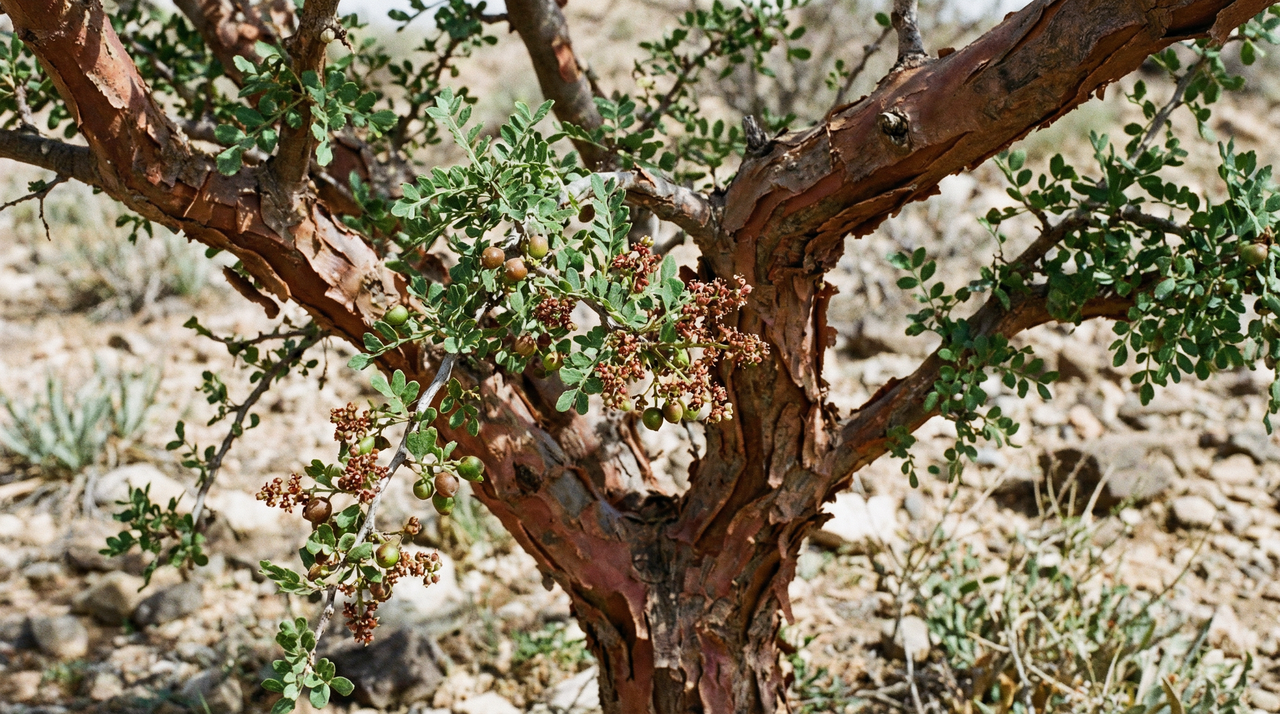
Myrrh has been traded, burned, and buried with the dead for longer than most civilizations have existed, yet almost nobody can tell you what the plant actually looks like. I've met herbalists who work with the resin daily and have never seen a photograph of Commiphora myrrha in the ground. That gap matters, because the plant itself is the story. It's a scraggly, spiny, largely leafless shrub clinging to sun-baked limestone slopes in the Horn of Africa, surviving on 100 to 250 millimeters of rain a year, looking for most of the season like something that already died.[1] And then you nick the bark, and this amber resin bleeds out, hardens into translucent tears, and fills the air with that unmistakable warm, bitter, balsamic smoke that ancient Egyptians considered worthy of the gods.
What I keep coming back to is the contradiction at the center of this plant: something so profoundly fragile in cultivation, so punishing of even small mistakes in soil moisture or temperature, somehow sustaining one of the longest unbroken commercial trades in human history. The Incense Route moved myrrh from the Somali coast to the Mediterranean for four millennia.[2] Today, overharvesting and habitat degradation are quietly unraveling that supply. Growing it, understanding it, sourcing it responsibly, these aren't separate concerns. They're the same conversation.
Myrrh Origin, History, and Botanical Background
Few plants have earned their place in human history as completely as myrrh. The resin has been burned in temples, sealed into tombs, carried across deserts by caravan, and pressed into the wounds of soldiers for at least four millennia. Behind all of that reverence is a scrubby, thorny shrub that most people would walk past without a second glance.
Botanical Background and Native Habitat
Commiphora myrrha, a member of the Burseraceae family, is native to the arid and semi-arid regions of the Horn of Africa, particularly Somalia, Ethiopia, Eritrea, and Djibouti, with populations also scattered across Yemen and Oman on the southern Arabian Peninsula.[3][4] It grows in rocky, gravelly, or sandy soils at elevations between 200 and 1,500 meters, where annual rainfall typically stays below 500 mm.[5] At maturity it reaches 2 to 5 meters tall, occasionally more, with the sparse, bottle-trunked silhouette that desert shrubs often develop when they're spending more energy on survival than on looking impressive.[6][7]
What I find genuinely fascinating about this genus, having worked with drought-adapted plants for years, is how every feature communicates the same survival priority. Deep taproots reach for groundwater while papery exfoliating bark reduces water loss. Thorny branches deter browsers. Succulent stems store moisture. And the resin itself seals any wound almost instantly, preventing desiccation and infection with the same mechanism that makes it so valuable to us.[8] C. myrrha can tolerate up to 12 months without meaningful rainfall.[9] When I show this to clients designing xeric landscapes, the whole strategy snaps into focus. The plant isn't struggling; it's engineered.
This is also a slow-lived organism. Growth runs at roughly 20 to 30 cm per year, reproductive maturity arrives after 10 to 15 years, and the lifespan typically spans 20 to 50 years.[10][11] Native population densities range from 50 to 200 individuals per hectare, and those populations are already fragmented by overharvesting, overgrazing, and habitat loss.[12][13] Related species like C. habessinica, C. kua, and C. gileadensis share much of the same ecology, with overlapping ranges and similar resin profiles, though their regional uses and conservation statuses differ.
Visual Characteristics of Myrrh
In the field, C. myrrha announces itself through its bark before anything else. The outer layer peels away in thin papery sheets to reveal a reddish-brown or pale yellowish inner layer underneath, and branches carry spines 1 to 2 cm long.[6][7] Nick a branch lightly and the resin begins to bead immediately, releasing a sweet, balsamic scent that's richer and heavier than frankincense, which some clients confuse it with on sight. The moment you smell it, there's no confusion anymore.
The leaves are alternate and trifoliate, with small obovate to elliptic leaflets 1 to 3 cm long that are glossy green above and paler below, and they drop during the dry season as a further water conservation strategy.[6][7] Flowers are tiny (3 to 4 mm), white to pale yellowish, and appear from late winter into early summer; fruits are small ovoid drupes that turn reddish-brown when ripe.[4] The resin itself exudes naturally from the bark or through deliberate incisions, and distinguishing C. myrrha from look-alikes like C. habessinica or Boswellia sacra comes down to resin chemistry, bark texture, and leaf morphology rather than anything obvious at a glance.[14]
Traditional and Cultural Uses Through History
The written record of myrrh stretches back to the Ebers Papyrus around 1550 BCE, where it appears in Egyptian formulas for embalming, wound treatment, perfumery, and digestive complaints.[15] In the Bible, it appears as an ingredient in the sacred anointing oil prescribed in Exodus 30:23, as one of the gifts carried by the Magi in Matthew 2:11, and in the Song of Solomon as a symbol of love and holiness.[16] The biblical meaning of myrrh, and its pairing with frankincense and gold, has been interpreted across centuries as a union of healing, sacredness, and material value. The symbolism of frankincense and myrrh together specifically evoked prayer and purification in Jewish and early Christian ceremony, a role that persists in Ethiopian Orthodox liturgy to this day.[17]
Greek and Roman physicians understood it as medicine rather than metaphor. Hippocrates used it for ulcers and digestive ailments, while Dioscorides and Pliny described its antiseptic and anti-inflammatory properties. Avicenna later incorporated it into Islamic medicine in the 11th century for respiratory and inflammatory conditions.[18] Ayurvedic practitioners knew it as Harabola or Bol, primarily for respiratory and skin conditions.[19]
Meanwhile, the trade in myrrh was enormous. The Incense Route connecting the Horn of Africa and Arabia to Egypt and the Mediterranean dates to at least 2000 BCE, and by the first century CE volumes reached hundreds of tons annually.[20][21] The communities doing the harvesting, Somali pastoralists, the Afar people, Omani and Bedouin tribes, weren't just suppliers. They were stewards. Traditional rotational tapping allowed 5 to 7 years of bark recovery between harvests, with resin prepared as tinctures, powders, or burned as incense at empirical doses of 1 to 4 grams per day.[22][23] That's a harvesting calendar developed across generations, and it's the opposite of what commercial extraction looks like today. Regenerative horticulture, in my view, starts by listening to the people who kept these trees alive for centuries before the global market found them.
Fun Facts and Conservation Status
There's genuine taxonomic complexity embedded in the word "myrrh." The biblical Balm of Gilead is most commonly identified with C. gileadensis, a related species with a distinct resin chemistry, while C. kua produces what's sometimes sold as Yemeni myrrh or opopanax, and the levels of key compounds like furanoeudesma-1,3-diene differ measurably between species.[24][25] Some names in the genus, including C. samharensis and C. holtziana, are now often treated as synonyms of C. myrrha itself.[4]
Most Commiphora species, including C. myrrha, are currently assessed as Least Concern by the IUCN.[26] But C. kua and C. gileadensis are both listed as Vulnerable,[27] and the pressures behind those listings, overexploitation, overgrazing, agricultural encroachment, and climate stress, are not absent from the Least Concern species, only less advanced. I think about this when sourcing material for landscape projects. Although these plants have been revered for millennia, their future now depends on growers, buyers, and designers choosing ethically sourced resin and treating every cultivated specimen as a small act of conservation. A Least Concern rating is not the same as abundant.
Myrrh Varieties and Sourcing
Taxonomic Clarity: No Modern Cultivars or Subspecies for Commiphora myrrha
Here's the short version: there are none. Commiphora myrrha has no formally recognized subspecies or botanical varieties in modern taxonomy.[28] No cultivars, no named selections, no horticultural lines bred for heavier resin yield or compact form. After years of looking, I've only ever grown the straight species, and that experience tracks with what the literature shows: commercial resin comes almost entirely from wild or semi-wild populations rather than from any kind of managed cultivar program.
A few relatives in the broader Commiphora genus do show limited intraspecific variation. Commiphora gileadensis carries two recognized subspecies (subsp. gileadensis and subsp. verrucosa), and Commiphora glandulosa has two varieties (var. glandulosa and var. rufescens).[29][30][31] But even those distinctions are botanical rather than horticultural; nobody is selling them as named garden selections. Species like C. kua, C. habessinica, C. samharensis, and C. holtziana have no widely recognized varieties or cultivars at all.[32][33][34][35] The genus as a whole simply hasn't attracted the kind of selective breeding attention that, say, fruiting trees or ornamental shrubs have. When you're buying myrrh, you're buying the species itself, full stop.
Finding Myrrh Plants and Seeds: Specialty Nurseries, Pricing, and Regulatory Requirements
Standard nurseries won't carry this. Your search for live Commiphora myrrha starts with specialty exotic plant vendors and succulent specialists: places like RarePlants.com, Mountain Crest Gardens, Steve's Leaves, and Etsy or eBay sellers who deal in arid exotics. For seed, Trade Winds Fruit, Sheffield's Seed Company, Strictly Medicinal Seeds, and Plant World Seeds occasionally carry small packets of 5 to 20 seeds. Expect to pay $5 to $20 per seed packet and anywhere from $50 to $200 for a live plant depending on size and maturity. I'll be honest: paying $80 to $150 for a small pot feels steep at first, but once you understand the import costs and the regulatory compliance baked into that price, it starts to make sense. Ethical sourcing from regulated trade is part of what you're paying for.
That regulatory reality is the part most vendor listings gloss over. Commiphora myrrha is listed under CITES Appendix II, meaning international import and export require permits through the U.S. Fish and Wildlife Service, and all plant and resin imports must also meet USDA APHIS biosecurity standards and be declared at customs.[36][37][38] I always double-check any listing against the current CITES appendices myself, because vendor information goes out of date fast. Most related Commiphora species aren't CITES-listed, though C. holtziana is an exception, and all imports regardless of CITES status still require APHIS compliance and phytosanitary certificates where applicable.[39][38][40] It's the same paperwork reality I've navigated sourcing frankincense trees from the Boswellia genus: the permit process is real, not theoretical.
If the specialty nursery route keeps coming up empty, succulent societies and botanical garden plant sales are worth pursuing. Leads on harder-to-find Commiphora material sometimes surface through those networks even when direct sales don't. Budget extra time, expect to wait for the right season or the right vendor, and treat the paperwork as part of the project rather than an obstacle. Patient growers do find material; it just rarely arrives on a convenient timeline.
How to Propagate and Plant Myrrh (Commiphora myrrha)
Myrrh has spent millennia perfecting its survival in some of the harshest terrain on earth, and those adaptations show up immediately when you try to grow it from scratch. Every practical challenge you'll encounter, from reluctant seeds to catastrophic root rot, traces directly back to what this plant evolved to handle: blistering heat, skeletal soils, months without rain. Understanding that context makes the propagation steps feel logical rather than arbitrary.
Seed Morphology, Dormancy, and Scarification
The seeds themselves are worth examining before you do anything else. Each one is oval to elliptical, roughly 5–8 mm long by 2–4 mm wide, enclosed in a hard, woody, reddish-brown to dark brown testa surrounding a thin oily endosperm and a straight axile embryo.[41][42][43] That hard coat is the problem. Myrrh seeds exhibit physical dormancy imposed by an impermeable testa, and water simply cannot penetrate it without intervention.[44][45] Scarification is not optional; it's biology.
The two standard approaches are mechanical nicking or filing, and concentrated sulfuric acid treatment for 10–30 minutes.[44][46] I strongly prefer a small triangular file for home use. The acid route is easy to overdo, and I've seen embryo damage in my own early trials and in batches from fellow resin-plant growers who left seeds in solution even a few minutes too long. A quick nick through the testa at the end opposite the embryo takes thirty seconds and carries far less risk of cooking what you're trying to germinate.
One thing worth flagging early: even perfect seed grown to maturity won't be a faithful copy of the parent. Myrrh is dioecious and primarily outcrossing, so seedlings show substantial genetic and morphological variation that can meaningfully affect resin quantity and composition.[47][48] I think of it like citrus: you never know exactly what you're going to get. When I find a mother plant with particularly aromatic resin, I take cuttings rather than seeds.
Storage, Viability, and Germination Timeline
If you're sourcing seeds rather than collecting fresh, check viability before you commit any effort to scarification. Tetrazolium chloride testing stains living tissue red and gives a realistic read on germination potential; fresh seeds test at 50–80% viable, but that number drops significantly after 12 months at room temperature.[44][49] For storage, keep them dry (5–10% moisture), cool (5–10 °C or lower), and sealed in an airtight container with desiccants.[50]
After scarification, sow into a well-drained sandy or sandy-perlite mix, keep temperatures at 25–30 °C with bottom heat, and maintain 70–80% humidity around the tray.[44][46] Germination is irregular; most treated seeds sprout in 2–4 weeks, but stragglers appear up to 8 weeks out, and success rates range from 20–70% depending on seed freshness and how cleanly the scarification was done.[51] I wait the full 8 weeks before writing off a flat. After losing several batches to damping-off in humid summers, I now start every tray on a heat mat with strict bottom watering only, and my germination consistency climbed from roughly 25% to over 60%.
Be clear-eyed about the timeline ahead. Seed-grown plants typically take 5–10 years to reach reproductive maturity and full resin production, with first flowering possible at 3–7 years under favorable conditions.[52][53][54] I label every pot with the scarification date and the estimated first-harvest year so I don't accidentally treat a three-year-old plant as ready for tapping, a mistake I made once early on.
Vegetative Propagation Methods
When clonal uniformity matters, cuttings are the practical choice. Semi-hardwood cuttings of 10–15 cm taken in late spring or summer, treated with IBA at 1,000–5,000 ppm, and inserted into a 1:1 sandy-perlite mix under high humidity and 24–30 °C bottom heat root in 4–8 weeks, with success rates of 20–50%.[55][56][9] Those rates aren't glamorous, but a cutting from a known high-resin mother plant is worth the effort. Air layering and grafting onto compatible Commiphora rootstocks are also practiced, though both are more technically demanding and the resinous latex complicates clean wound unions.[55] Grafted plants can reach commercial tapping readiness in 2–3 years rather than the decade-long wait from seed.[52][53]
Tissue culture using nodal explants on MS medium with cytokinins and auxins achieves 80–90% regeneration in research settings,[57][58] but this is a laboratory technique, not something you'll replicate in a home nursery. Whatever method you use, the nursery requirements are identical: sterile propagation medium, gradual acclimatization over four weeks under high humidity and filtered light, no direct sun on young plants, no frost exposure, and vigilance against overwatering.[46][59][60]
Soil, Site Selection, and Planting Technique
Myrrh is native to arid, rocky, limestone-rich or gypsum soils with low organic matter (0.5–2%) and a neutral to alkaline pH ranging from 6.0 to 8.5, with the sweet spot between 6.5 and 8.0.[52][59][61] In cultivation, replicate that with a sandy loam, gravelly mix, or a succulent blend: roughly 50% coarse sand or perlite, 30% cactus soil, 20% loam works well.[60] If a mix feels heavy in your hands, it probably is. I've never killed a myrrh by underwatering, but I've lost more than a few to root rot; if you're unsure whether to water, wait another week.
The taproot is the other soil reality to plan around. Myrrh develops a deep taproot that regularly exceeds 2 meters, accessing groundwater far below the surface.[9][62] That means your planting site needs a minimum of 1–2 meters of uncompacted, free-draining soil depth, and containers used in the nursery phase must be tall rather than wide. Heavy clay or waterlogged ground is fatal, full stop.
Spacing, Density, and Acclimatization
Mature trees reach 3–9 meters tall with a 3–5 meter spread, so spacing is not something to skimp on.[63][64] For home food forest planting, 4–6 meters between individuals gives adequate root room and air circulation. In commercial orchards designed for resin tapping, the standard opens to 5–7 meters within rows and 6–8 meters between rows to allow tapper access and reduce disease pressure, supporting densities of roughly 200–400 trees per hectare.[63][64] Tighter spacing only makes sense in genuinely poor soils where growth stays naturally compact; otherwise you'll be pruning for access within a few years.
Whatever the final spacing, the acclimatization phase demands the same patience as everything else about learning how to grow myrrh. Four weeks of high humidity and filtered light before hardening off, zero overwatering, and eyes open for early fungal issues while plants are still tender.[46][60] Proper spacing from day one also pays dividends here: good airflow around young transplants is one of the simplest disease-prevention tools available, and these trees give you no second chances once root rot takes hold.
Myrrh Care Guide: Growing Commiphora myrrha
Everything about caring for myrrh flows from a single truth: this is a plant that evolved to thrive in one of the harshest environments on earth. Where myrrh trees grow naturally, across the rocky slopes and arid scrublands of the Horn of Africa and the Arabian Peninsula, rainfall rarely exceeds 250 mm per year.[5] Replicate those conditions and you'll have a healthy plant. Deviate from them out of kindness, and you'll learn a hard lesson fast. I've grown Commiphora myrrha long enough to say with confidence that over-care kills these plants far more reliably than neglect does.
Sunlight Requirements for Healthy Growth and Resin Production
Myrrh wants full sun, and it's not negotiable. At least 6 to 8 hours of direct light daily keeps the growth compact, the branching dense, and the resin production where it should be.[5][65] Drop below that threshold and you'll see the same thing I've noticed with etiolated succulents: pale foliage, stretched stems, reduced branching, and eventually chlorosis.[66][67] What I find most telling is the resin drop. Plants grown in suboptimal light produce noticeably less aromatic resin, and the scent quality suffers. If you're growing myrrh partly for its resin, shade is not a minor inconvenience; it undermines the entire point. Related Commiphora species share this full-sun dependency, so the rule applies across the genus.
Watering Needs and Drought Tolerance
I have lost more myrrh to too much love than to drought. If you're used to watering plants on a regular schedule, these desert natives will punish that habit. Once established, Commiphora myrrha survives on less than 250 mm of annual rainfall in the wild, supported by swollen stems that store water, a deep taproot, and a drought-deciduous habit that lets it simply shut down during the driest months.[5][9]
In practice, that means deep watering every 2 to 4 weeks during the growing season, and once a month or less through winter dormancy, always allowing the soil to dry completely between sessions.[68][69] Young plants need a bit more attention, roughly every 7 to 10 days for the first year or two while the roots establish.[68] The symptom contrast is worth memorizing: overwatered plants show yellowing, mushy stems, foul-smelling soil, and wilting despite wet soil; underwatered plants curl their leaves, develop brown tips, and slow their resin output.[5][47] When in doubt, choose underwatering every time. Use well-draining sandy or rocky soil with a pH between 6.0 and 8.5, and if possible, water with low-TDS water under 500 ppm, rainwater, or dechlorinated water.[70][71]
Heat and Frost Tolerance
Myrrh trees grow best in temperatures between 25 and 35°C (77 to 95°F) and can handle brief spikes up to 45 to 50°C without permanent damage.[5][9] USDA zones 9b through 11 are the realistic growing range, with zones 10 and 11 being the safest bet.[72][73] One thing worth knowing: moderate heat stress actually nudges resin production upward, which is part of why these plants evolved such robust chemical defenses in the first place. Seedlings are more vulnerable than mature specimens, so I use 30 to 50% shade cloth for the first two to three years and mulch the root zone with 2 to 4 inches of gravel to regulate soil temperature.[47][74]
On the cold end, myrrh is frost-tender in a way that reminds me of Adenium or tender Euphorbia species. The RHS rates it H1c, meaning it needs frost-free protection, and damage begins at 0°C (32°F).[72] Brief exposure to around -4 to -7°C (20 to 25°F) with protection may be survivable, but prolonged freezing will kill the plant.[65] In zone 9b, growing in containers so you can move them indoors is genuinely the most practical strategy; the entire genus shares this low cold tolerance.[75][76]
Soil, Feeding, and Fertilization
Myrrh's native soils are nutrient-poor by almost any agricultural standard, and the plant's feeding requirements reflect that. Every commercial resin grower I've spoken with says the same thing: starve it a little. Heavy nitrogen especially drives weak, leggy growth, suppresses resin production, and invites pest problems.[77][78] If you do feed, use a balanced low-nitrogen formula like 5-10-10 at half strength, once or twice a year in spring, and always test your soil first to avoid salt buildup in the root zone.[77][47] In my experience, established plants in decent soil often need no supplemental fertilizer at all. Slow-release organics like bone meal, compost, or wood ash are gentler options, and myrrh's mycorrhizal associations help it scavenge phosphorus even in low-P soils, reducing fertilizer needs further.[79][80] In highly alkaline soils, foliar micronutrient sprays with iron, zinc, or boron can bypass pH-related uptake issues without risking root burn.[81]
Pruning, Maintenance, and Seasonal Rhythm
Myrrh is drought-deciduous, which means it drops its leaves during the hottest, driest months and flushes new growth after seasonal rains.[5][82] If you've never grown a drought-deciduous tree before, that bare dormant phase can look alarming. It isn't. It's the plant doing exactly what it's supposed to do. Prune lightly after resin harvest in late winter to early spring, removing only dead, diseased, or crossing branches, and never take more than 20 to 25% of the canopy in a single season.[65][83] Heavy pruning stresses the plant directly and lowers resin yields, which defeats the purpose.
Mulch with 2 to 4 inches of gravel or pebbles rather than organic material; organic mulches hold too much moisture against the stem base.[84] These are slow-growing plants, reaching 2 to 5 meters in cultivation and living 20 to 50 years or more.[5] The entire Commiphora genus follows this same low-input pattern: full sun, minimal pruning, near-zero fertilizer, excellent drainage, and container culture for frost protection in cooler climates.[85][86] There's something quietly remarkable about a plant that produces one of the world's oldest traded aromatics precisely because you leave it alone in difficult soil under a blazing sun.
Myrrh Harvesting
Before anything else, let me set expectations: harvesting myrrh resin is not a weekend project, and it's not something most home growers will reach quickly. I've grown several Commiphora species from seed and in containers, and I haven't yet hit full tapping maturity on my own trees. I rely on FAO and Kew guidelines alongside careful observation of young grafted specimens, and I'd encourage any reader to approach this section the same way: as a long-game commitment rather than a near-term harvest goal.
When to Harvest Myrrh: Timelines, Maturity Indicators, and Seasonal Cues
Seed-grown Commiphora myrrha typically needs 5-7 years before it will yield meaningful resin, and in suboptimal conditions that window stretches to 10 years or more.[87][88][89] Grafted trees can come into production in 2-3 years under ideal conditions, though I'd hedge on that timeline outside the native range.[87] Across the genus, timelines vary considerably: Commiphora habessinica can reach first harvest in 3-7 years, while C. kua, C. glandulosa, and C. holtziana tend to need 7-12 years from seed.[89][47]
The visual cues matter as much as the calendar. A tree ready for sustainable tapping will have deeply fissured, papery bark that peels in strips, and when conditions are right it will begin to exude a milky sap that hardens to a reddish-brown or yellowish resin on its own.[90][91] That papery, peeling bark combined with the first appearance of spontaneous milky sap in the late dry season has become my own readiness check, even on container specimens I haven't yet made production incisions on. Sustainable resin harvest is generally considered appropriate on trees between 7-15 years old.[84]
Timing within the year is equally critical. Optimum harvest falls in the dry season when the tree is dormant, roughly June through September in its native Horn of Africa range, though October through April applies in some regions.[84][92] Resin harvest generally starts 90-180 days after flowering.[93] For growers in humid subtropical climates where the dry-season window is compressed, artificial drought stress may be needed to trigger proper resin flow, which is something I touched on in the care guide.
How to Harvest and Process Myrrh Resin
The traditional method involves making shallow incisions, V-shaped or longitudinal cuts at roughly a 45-degree angle, just 1-2 cm deep into the trunk or main branches.[94][95] The resin exudes as a milky liquid and hardens into the characteristic "tears" over 2-4 weeks, though some sources cite 7-14 days.[94][96] Having worked with both myrrh and frankincense resins, I'd say myrrh's slower hardening and stricter incision limits make it considerably more demanding of patience than most Boswellia tapping work.
Sustainable limits are not negotiable. For C. myrrha, that means no more than 2-3 incisions per tree annually, covering roughly 10-20% of the trunk surface, with 1-2 years of recovery between tapping cycles.[95][97][98] Trees can handle 1-3 tapping rounds per year when properly rotated, but over-tapping brings reduced vigor, increased pest vulnerability, and declining myrrh gum output over time.[99] I only tap my own trees after allowing full recovery years, and I'd strongly recommend sourcing FairWild-certified myrrh resin rather than attempting large-scale tapping without formal training. The research on tree decline from over-tapping is unambiguous, and it's not a risk worth taking with a tree that took a decade to mature.
The same general incision approach applies across the genus, from C. habessinica to C. gileadensis, though phenological timing and exact cut limits shift by species and region.[100] After collection, tears should be sorted by color, size, and quality, cleaned of bark debris, and dried in shade for 1-2 weeks to prevent mold before moving to cool, dry storage.[84][101] Steady resin flow over 15-30 days without excessive bleeding is a good sign that technique and tree maturity are both sound; if a wound bleeds heavily and doesn't slow, that's a signal to back off.
Myrrh Yields and Flavor Qualities
After years of waiting and careful work, a mature C. myrrha will typically yield 1-3 kg of resin annually, with related species like C. habessinica, C. kua, and C. samharensis producing 0.5-2 kg, occasionally up to 5 kg under optimal conditions.[95][84] Treat those numbers as averages, not guarantees. Stress, poor drainage, or aggressive tapping all pull yields down sharply.
Quality is readable in the resin itself. High-grade myrrh gum shifts from pale yellow to deep orange-red or reddish-brown as it matures, becoming brittle and intensely aromatic, with essential oil yields typically exceeding 20-30%.[102][103] That warm, balsamic-pungent aroma is unmistakable once the tears have properly hardened and cured; there's really nothing else quite like it. If the resin is gummy, pale, or lacks that characteristic intensity, it likely hasn't cured long enough or the tree wasn't ready.
Myrrh Preparation and Uses
Before you do anything with myrrh resin, it helps to understand what you're actually handling. The resin of Commiphora myrrha is dominated by an intense, lingering bitterness with warm, balsamic, and camphoraceous undertones.[104][105] Chew a small piece and that pungent warmth will sit on your tongue for 5 to 15 minutes.[106] Fresh from a cool, dry store, the resin snaps cleanly when broken; warm it slightly and it softens to something gummy and workable.[107] None of this is incidental. These sensory properties explain every preparation choice that follows.
Culinary Uses and Flavor Profile of Myrrh Resin
Myrrh's culinary footprint is narrow by necessity. The resin is less than 1% soluble in water, dissolving readily only in alcohol or oils,[108] which rules out most aqueous cooking applications immediately. Middle Eastern and East African traditions do use it in herbal teas, spiced stews, and confections, but always in trace amounts chosen for aromatic depth rather than bulk flavor.[109][110] I think of it the way I think about mastic or copal: a resin with culinary history, not a kitchen staple.
The resin carries no meaningful macronutrients, vitamins, or minerals,[111] and it is not FDA GRAS-listed for food use, which confines modern applications to traditional or supervised supplemental contexts.[112] High doses cause gastrointestinal upset and should be avoided without professional guidance.[113] Worth knowing: related species like Commiphora habessinica and C. samharensis produce fruits eaten raw or dried as famine food across the Horn of Africa and Yemen,[85][114] but C. myrrha itself is resin-centric. If I'm ever blending a traditional Yemeni coffee or a medicinal tea that calls for myrrh, I weigh the resin on a jeweler's scale. A little really does go a very long way.
Medicinal Preparations and Traditional Dosages
The preparation method you choose determines which compounds you actually extract. Tinctures in 45% alcohol pull sesquiterpenes efficiently, making them the standard for internal use. Decoctions work for gastrointestinal applications, infusions for milder teas. Poultices and essential oils serve topical and aromatic work, and powdered myrrh blends into ointments and wound applications.[115] Low-heat extraction matters here because volatile furanosesquiterpenes degrade quickly above moderate temperatures.
Traditional guidelines, aligned with WHO monographs, suggest 2 to 4 grams of crude resin daily for internal use, or 2 to 4 mL of a 1:5 tincture three times daily. Topical preparations typically run 5 to 10% dilution in a carrier oil or ointment, applied one to three times daily. Essential oil should always be diluted to 1 to 2% with a patch test before broader skin application.[116][117] In my work I treat myrrh the same way I treat other potent resins: these are empirical ranges built from centuries of traditional practice, not clinical prescriptions, and I always advise clients to work with a qualified herbalist rather than self-experiment at higher levels. Properly dried and stored resin also makes a measurably stronger tincture; the quality that enters the jar matters.
Sustainable Harvesting, Post-Harvest Handling, and Non-Food Uses
Responsible preparation of myrrh begins before any processing, in the field. Sustainable tapping requires shallow bark incisions made during the dry season, with two to three years of rest between taps to allow the tree to recover fully. Community-based quotas in Somalia and Ethiopia formalize this practice at a regional scale.[118] When I source resin for sensory or medicinal garden installations, I specify certified material from those regions precisely because the tapping protocols are part of the quality story, not just an ethical footnote.
Post-harvest handling is where many batches fail. Collected resin should be cleaned of bark and debris, then shade-dried at 25 to 30°C for 7 to 14 days until moisture falls below 10%, followed by natural oxidative curing. Storage in airtight, moisture-proof containers at 15 to 20°C with relative humidity below 60% preserves volatile oils for two to five years.[59][119] I've experimented with small-batch curing of related aromatic resins and found that shade-drying at that temperature range for 10 to 12 days noticeably preserves the warm balsamic character compared with faster sun-drying, which flattens the aroma considerably. Improperly stored resin loses its depth within months. The same careful handling that protects medicinal bioactives also preserves the resin's performance in incense and perfumery, two of myrrh's most enduring non-food roles. A well-managed C. myrrha can produce resin sustainably for 10 to 20 years or more, with peak output from trees over a decade old,[59] which means how you harvest and store the resin directly shapes how long that tree remains productive.
Myrrh Health Benefits and Medicinal Uses
Commiphora myrrha is not a plant you eat for nutrition. It's a slow-growing, resin-producing tree from the arid Horn of Africa and Arabian Peninsula whose medicinal story lives almost entirely in the complex chemistry of that oleo-gum resin. The resin itself is a concentrated matrix of terpenoids, phenolics, and volatile oils, and it's this chemical density that has made myrrh a fixture in traditional medicine across Egyptian, Greek, Ayurvedic, and Islamic healing systems for millennia. What I find remarkable is how consistently the pharmacological research is now landing in the same territory those traditions already occupied: anti-inflammatory, antimicrobial, wound-healing, and expectorant actions are all well-documented uses.[120][121]
Traditional and Modern Medicinal Applications of Myrrh
The strongest modern pharmacological evidence centers on inflammation. Commiphora myrrha significantly inhibits the NF-κB signaling pathway, which is one of the central switches in the inflammatory response.[122][123] Antimicrobial activity is also well-supported, with demonstrated inhibition of Staphylococcus aureus and Candida albicans, two pathogens that show up repeatedly in oral and wound care contexts.[124][125] Clinical trial data specifically supports myrrh's value against oral pathogens,[126] which tracks with the WHO's formal recognition of myrrh for use in oral hygiene products and as an expectorant for catarrh.[116] I've used a diluted myrrh tincture as a mouth rinse myself, and the effect on inflamed gum tissue is noticeable within a few days; there's a reason herbalists have reached for this resin for gum complaints across every culture that could source it.
Beyond oral health, myrrh demonstrates wound-healing properties[127] and analgesic effects in animal models.[128] Preclinical in vitro work also points toward anticancer potential through apoptosis induction and cell cycle arrest, though that evidence is still very early-stage.[123][129] Antioxidant activity has been linked to activation of the Nrf2 pathway.[130] While the preclinical data on all of these fronts is genuinely compelling, I always want to be honest: most of this evidence comes from lab and animal models, and human clinical trials remain limited.[131] The research is catching up to traditional healers, but it hasn't lapped them yet. Use should stay conservative.
Key Phytochemical Compounds in Myrrh Resin
The resin itself typically breaks down to roughly 57-70% alcohol-soluble resins, 20-25% gum, and 3-8% volatile oil.[132] The essential oil fraction is dominated by sesquiterpene hydrocarbons, which can constitute up to 60% of the oil, alongside monoterpenes like alpha-pinene, limonene, and p-cymene.[133] The major secondary metabolite classes across the whole resin include terpenoids (sesquiterpenes and diterpenes), phenolic compounds, flavonoids, and tannins.[134]
Among the specific compounds researchers keep returning to, the furanosesquiterpenes are particularly bioactive. Furanoeudesma-1,3-diene, curzerene, lindestrene, and elemol derivatives are well-characterized in the resin, with furanoeudesma-1,3-diene reaching up to 40% in Somali varieties.[135] Myrrhenic acid, another furanosesquiterpenoid, shows significant anti-inflammatory, analgesic, and antimicrobial activity in its own right.[136] Geographic origin, tree age, soil conditions, altitude, and seasonal timing all meaningfully affect the composition and yield of both resin and essential oil.[137][138] When I'm sourcing resin for use rather than ornament, I look for tears from mature trees harvested in the dry season; the difference in aroma intensity and potency is noticeable, and it aligns with what the sesquiterpene concentration data would predict.
Nutritional Profile of Myrrh and Related Commiphora Species
Myrrh resin is not a food. It doesn't appear in the USDA FoodData Central database,[139] it has negligible vitamin content,[109] and it's used medicinally in small doses rather than eaten as part of a diet.[140] The resin does contain minerals, with ash analysis showing calcium, magnesium, iron, zinc, and potassium present, but these figures are largely academic given the doses involved.[131] The antioxidant value of phenolic fractions is real[141] but belongs in the medicinal conversation, not the nutritional one. I treat myrrh as a respected medicinal ally, not a pantry staple. The fruits of related species like Commiphora habessinica do offer modest vitamin C of around 10-20 mg per 100g and serve as a wild food source in parts of East Africa,[85] which is an interesting reminder that the Commiphora genus contains multitudes, but that's a very different story from the resin.
Safety, Contraindications, and Responsible Use
Myrrh exhibits moderate, dose-dependent toxicity, with the resin and essential oil being the primary concern. Symptoms of excess intake include nausea, vomiting, diarrhea, abdominal pain, headache, and dizziness.[120][142] Topical application can cause allergic contact dermatitis in sensitized individuals, so patch-testing before any skin use is sensible practice.[143][144]
I never recommend myrrh internally during pregnancy or when trying to conceive. Its traditional emmenagogue action is backed by enough pharmacological data on uterine stimulation and potential miscarriage risk that the risk simply isn't worth taking, and safety data during breastfeeding is insufficient to recommend it there either.[145][146] If you're on blood thinners or antiplatelet medications, myrrh is not for you; it can enhance those effects and raise bleeding risk. It may also lower blood glucose and interact with drugs metabolized through the CYP3A4 pathway, so the interaction picture is genuinely complex.[147] Established safe oral dosages run from 2 to 4 grams of resin per day in divided doses, per both European Medicines Agency and WHO guidelines; exceeding that range is where gastrointestinal irritation and more serious toxicity begin.[148][149] Short-term, small-dose use is generally considered safe, but long-term clinical safety data are still thin.[120] My practical advice: keep doses conservative, limit duration, and run any internal use by a qualified practitioner, particularly if you have existing health conditions or are taking prescription medications.
Myrrh Pests and Diseases
Natural Defenses and Disease Resistance
Myrrh carries its own pharmacy in its bark. The same sesquiterpenes and furanosesquiterpenes responsible for its medicinal value, compounds like furanoeudesma-1,3-diene and curzerene, give Commiphora myrrha genuine antimicrobial resistance against many of the fungal and bacterial pathogens common in arid zones.[150][151] That protection, though, is deeply conditional. Push the plant outside its native dry habitat, and the defenses that work beautifully in the Horn of Africa start to fail almost immediately.
The single biggest disease risk I've seen with drought-adapted resinous trees is root rot, and myrrh is no exception. Waterlogged soils invite Phytophthora, Fusarium, and Rhizoctonia, and once those soil-borne pathogens establish, the tree rarely recovers fully.[152][153] I learned this lesson growing rosemary in heavy clay, and myrrh is even less forgiving. If drainage isn't exceptional from day one, you're fighting a losing battle. Foliar problems follow a similar logic: leaf spot (Cercospora, Alternaria), anthracnose, powdery mildew, and gummosis from Lasiodiplodia theobromae all become significantly more common when humidity rises or irrigation is excessive.[154] Prevention here is genuinely easier than cure, which is why the watering and soil guidance in the care section isn't just housekeeping advice.
Common Insect Pests and Management
The glandular trichomes on myrrh's leaves and stems do a lot of quiet work, secreting resins and volatiles that physically trap and chemically deter pests like aphids and scale insects.[155][156] I've actually seen this under magnification while handling resinous branches, tiny insects stuck in the secretions before they ever get established. That said, sap-sucking insects including aphids, scale (particularly Aspidiotus spp.), mealybugs, whiteflies, and spider mites do still find their way onto stressed or cultivated trees, showing up as sticky honeydew, sooty mold, and yellowing leaves.[157] When I spot scale on a resinous stem, it usually announces itself as small brown or white bumps trailing that telltale stickiness.
Wood borers, particularly Cerambycid longhorn beetles and Scolytidae, are a more serious concern. They damage vascular tissue, disrupt resin flow, and can kill young trees outright, with pressure climbing during dry seasons when trees are already stressed.[47] In native dryland settings, termites (Macrotermes and Psammotermes among others) attack roots and stems, while locusts and lepidopteran larvae can cause enough defoliation to cut resin yield by up to 30% in production areas.[158] All of these pests become opportunistic entry points for the pathogens described above, which is why a borer infestation and a fungal problem often arrive together.
Pest pressure in native arid habitats across Ethiopia, Somalia, and Yemen stays relatively low because the whole system, sparse foliage, resin chemistry, dry air, is working in the tree's favor.[159] Move myrrh into humid cultivation in India or Australia, and that balance shifts noticeably. My approach with resin-producing plants is to keep intervention minimal and targeted: neem oil and beneficial insects (ladybugs, parasitic wasps, lacewings) are my first tools, partly because stronger chemical treatments can taint the aromatic resin you're trying to protect.[160][161] Traditional growers in the Horn of Africa have long relied on manual removal, neem-based sprays, and myrrh's own essential oils as repellents.[162] Good airflow, excellent drainage, and restraint with water do more preventive work than any spray program I've tried.
Myrrh in Permaculture Design
Most plants we design around have some tolerance for mistake-making. Myrrh does not. It is optimized for one of the harshest ecological templates on earth, and understanding that template is the entire foundation of using it well in permaculture. Get the conditions right and you have an almost indestructible, multi-functional shrub that earns its place in ways most xeriscape species can only hint at. Get them wrong and you have an expensive dead stick.
Climate Requirements and Hardiness Zones for Myrrh
In its native Acacia-Commiphora bushlands across the Horn of Africa and the Arabian Peninsula, Commiphora myrrha contends with annual rainfall as low as 100 mm, temperatures that swing from just above 10 °C at night to over 40 °C midday, and humidity that rarely climbs past 50%.[6][163][5] That's not a tough plant. That's a plant engineered by millions of years of selection pressure to survive conditions most horticultural subjects would find catastrophic.
In cultivation, myrrh is most reliably placed in USDA zones 10 and 11, with zone 9b possible only with deliberate protection. Tissue damage begins below about 4-5 °C (40 °F), and anything below 10 °C (50 °F) held for more than a few hours risks stem dieback.[164][73][52] I treat myrrh like a tender tropical and bring potted specimens indoors through our cooler months in Central Florida, or use heavy mulch combined with south-facing wall placement to buffer the roots. Anything below 40 °F for more than a short window and you're gambling with the plant.
Growers in coastal Southern California, coastal zones of southern Florida, and low-elevation Arizona have had success establishing plants outdoors, though resin yield and quality tend to fall noticeably below what native-range trees produce.[165][166] That's a realistic caveat rather than a reason to walk away. Related species like C. glandulosa and C. habessinica show the same genus-wide pattern: precipitation tolerance spanning 50-750 mm, heat tolerance pushing 45-50 °C, and frost sensitivity that keeps the entire group anchored to zones 9b-11 with careful management at the cooler edge.[167][168] The pattern is consistent enough that if you understand the rules for one species, you mostly understand them for the genus.
Ecosystem Functions and Ecological Roles of Myrrh
Myrrh is dioecious, which means you need both male and female plants if you want fruit set. Flowers are small, greenish-white to pale yellow, and bloom during the dry season in late winter to early spring, which always surprises people who assume the dry season is a quiet time.[52] Pollination is handled almost entirely by generalist insects, including small flies, beetles, bees, and thrips, drawn in by a mild resinous scent rather than showy color or abundant nectar.[169][170] I've watched small flies working the flowers on my specimens and found the whole interaction quietly fascinating. The plant essentially whispers rather than shouts to its pollinators, and in a well-designed xeriscape guild with other early-blooming scented companions nearby, that relationship holds up.
The resin's ecological role goes well beyond the medicinal uses most people associate with it. The antimicrobial sesquiterpenes and volatile compounds are the plant's primary defense against herbivores, insects, and pathogens.[131][9] I've noticed the resin scent intensifying noticeably on my plants during peak summer heat and extended dry spells, almost as if the chemistry ramps up in response to stress. That dynamic relationship between environmental pressure and chemical output is part of what makes the plant so compelling from a design standpoint: it's doing active ecological work.
Below ground, deep taproots reaching up to 5 m in related species anchor soil on rocky slopes, reduce erosion, and improve soil structure through leaf-litter decomposition and mineral accumulation.[171][9] Commiphora doesn't fix nitrogen, but it supports limited rhizosphere nitrogen-fixing bacteria and forms arbuscular mycorrhizal associations that boost phosphorus uptake.[172] Above ground, it shelters birds, small mammals, reptiles, and insects, and in its native range, hornbills and monkeys consume the fruit.[53] The plant's capacity to create microhabitats in harsh arid environments means it frequently acts as a nurse species, offering enough shade and shelter that other heat-sensitive seedlings can establish in its footprint.[173] Outside its native range, the genus shows low invasive potential precisely because its climate needs are so specific, which makes it a responsible choice in zones where it can survive.[174]
Forest Layer Placement and Guild Design with Myrrh
In native Acacia-Commiphora bushland, myrrh occupies the shrub to mid-stratum layer, typically reaching 2-7 m as a multi-stemmed deciduous shrub or small tree.[175][176] That positioning translates directly into dryland permaculture: it sits comfortably between canopy-level Acacia nitrogen-fixers above and drought-tolerant groundcover or perennial herbs below, contributing partial dappled shade without monopolizing surface moisture because its roots are already running deep.[177]
Mature plants want full sun for optimal resin production, though seedlings tolerate some partial shade while they establish.[178] In agroforestry systems in Ethiopia and similar climates, Commiphora integrates as live fencing, windbreaks, and nurse plants in guilds alongside sorghum or drought-hardy coffee cultivars where water competition is minimal.[179] For those of us growing it in subtropical US gardens, the practical guild companions are other deep-rooted xeric perennials and natives that don't compete at the surface, with Acacia species filling the canopy role above.
One thing I'd flag for anyone designing a guild around myrrh: the aromatic, slow-decomposing leaf litter may have allelopathic effects that suppress some understory germination.[9] I've started growing several Commiphora species from seed in my Central Florida trials, and careful observation of what volunteers under the canopy versus what struggles to emerge is something I track deliberately. Guild design here rewards patience and attention over any fixed planting template. And realistically, if you're gardening in zones 9b-10 rather than the native Horn of Africa, commercial resin tapping is unlikely to be your primary goal. The ornamental value, erosion control, pollinator support, and the sheer ecological grit of a plant that survives where little else will are more than sufficient reasons to make room for it in a thoughtfully designed low-water system.
The Plant That Taught Me to Stop Trying So Hard
I killed my first Commiphora myrrha with kindness; a little too much water through a cool, cloudy spell, and that was that. The second one I mostly ignored, tucked it into a rocky slope in full sun and walked away, and it rewarded me with the faintest amber tears along a wound I hadn't even made intentionally. That's the whole lesson, really. Some plants ask you to get out of their way, and myrrh is one of them.
Sources 179
- Commiphora myrrha: IUCN Red List Assessment ↩
- Land of Frankincense: UNESCO World Heritage Site ↩
- Commiphora myrrha - Flora of Somalia ↩
- Commiphora myrrha - Kew Science Plants of the World Online ↩
- Commiphora myrrha (Myrrh) ↩
- Commiphora myrrha - Wikipedia ↩
- Commiphora myrrha (Myrrh Tree) - PlantZAfrica ↩
- Adaptations of Commiphora myrrha to Arid Environments ↩
- Adaptations of Commiphora Species to Arid Environments ↩
- Growth and Longevity of Arid Zone Trees - Journal of Botany ↩
- Reproductive Biology of Commiphora Species ↩
- FAO - Non-Wood Forest Products: Myrrh and Frankincense ↩
- IUCN Red List - Commiphora myrrha ↩
- Identification of Myrrh and Similar Resins - Royal Botanic Gardens, Kew ↩
- The Papyrus Ebers: The Greatest Egyptian Medical Document ↩
- Myrrh in the Bible ↩
- Burseraceae: Bursera and Commiphora resins in religious rituals ↩
- The Genus Commiphora: A Review of Its Traditional Uses, Phytochemistry, and Pharmacology ↩
- Ethnobotanical study of medicinal plants used by Oromo people in Ethiopia ↩
- The Incense Trade of the Ancient Near East ↩
- The Incense Trade Routes of the Middle East ↩
- Sustainable Harvesting of Myrrh Resin: Ethnobotanical Observations from Somali Pastoralists ↩
- Sustainable Management of Myrrh and Frankincense in the Horn of Africa ↩
- The Genus Commiphora: Taxonomy and Distribution ↩
- The Biblical Balm of Gilead: A Botanical Perspective ↩
- IUCN Red List: Commiphora myrrha ↩
- IUCN Red List: Commiphora gileadensis ↩
- Plants of the World Online - Commiphora myrrha ↩
- Commiphora gileadensis - Wikipedia ↩
- Kew Science - Plants of the World Online: Commiphora gileadensis ↩
- Commiphora glandulosa Engl. ↩
- Plants of the World Online - Commiphora kua ↩
- Plants of the World Online ↩
- Kew's Plants of the World Online (POWO) - Commiphora samharensis ↩
- Plants of the World Online - Commiphora holtziana ↩
- Appendices I, II and III ↩
- CITES Implementation in the United States ↩
- Importing Plants and Plant Parts ↩
- CITES Species Database ↩
- Commiphora holtziana ↩
- Seed Morphology and Anatomy of Commiphora Species ↩
- Flora of Tropical East Africa: Burseraceae ↩
- Botanical Description of Commiphora myrrha ↩
- Seed Germination Studies on Commiphora myrrha ↩
- Seed Dormancy and Germination in Commiphora Species ↩
- Propagation of Commiphora Species ↩
- Propagation of Commiphora Species: Challenges and Opportunities ↩
- Genetic Variation in Commiphora Species: Implications for Conservation ↩
- Genebank Standards for Plant Genetic Resources for Food and Agriculture ↩
- Millennium Seed Bank Partnership: Storage Guidelines ↩
- Seed germination of Commiphora species in arid regions ↩
- Commiphora myrrha - Useful Tropical Plants Database ↩
- Myrrh Tree Cultivation and Propagation ↩
- Myrrh Trees: Cultivation and Biology - FAO ↩
- Propagation Techniques for Myrrh (Commiphora myrrha) ↩
- Myrrh Tree Propagation Techniques ↩
- In vitro propagation of Commiphora myrrha (Nees) Engl. – an endangered medicinal plant ↩
- Micropropagation of Myrrh (Commiphora myrrha) through Nodal Explants ↩
- Myrrh Tree Cultivation Guide ↩
- Cultivating Myrrh Trees in Subtropical Climates ↩
- Commiphora myrrha Plant Profile ↩
- Root System Architecture in Commiphora Species ↩
- Agroforestry Database 4.0 (Commiphora myrrha) ↩
- Cultivation of Myrrh (Commiphora myrrha Engl.) ↩
- Growing Myrrh Trees: Care Guide ↩
- Experimental Stress Physiology of Myrrh (Commiphora myrrha) ↩
- Myrrh Resin Production in Commiphora ↩
- Commiphora myrrha - Missouri Botanical Garden ↩
- Commiphora myrrha Care Guide ↩
- Drought Tolerance in Burseraceae - FAO Report ↩
- Commiphora myrrha - Plants of the World Online (Kew) ↩
- Commiphora myrrha - Royal Horticultural Society ↩
- USDA Plant Hardiness Zone Map ↩
- Cultivation of Myrrh (Commiphora myrrha) in Arid Regions ↩
- Frost Damage in Tropical Plants: Symptoms and Recovery ↩
- Cultivation of Myrrh Trees (Commiphora spp.) ↩
- Cultivation and Nutrient Management of Myrrh (Commiphora myrrha) in Arid Regions ↩
- Commiphora myrrha Growing Guide ↩
- Nutrient Management for Arid Zone Trees ↩
- Mycorrhizal Associations in Burseraceae and Implications for Arid Ecosystems ↩
- Growing Commiphora Species: Care Guide ↩
- Phenology of Woody Plants in Arid Regions of Africa ↩
- Pruning Guidelines for Arid Zone Trees ↩
- Cultivation of Myrrh (Commiphora myrrha) ↩
- Commiphora habessinica - Useful Tropical Plants ↩
- Royal Horticultural Society Genus Commiphora Growing Guide ↩
- Commiphora myrrha - Missouri Botanical Garden ↩
- Commiphora myrrha - Useful Tropical Plants ↩
- Production and Trade of Myrrh ↩
- Commiphora myrrha (Myrrh) ↩
- Commiphora myrrha - Missouri Botanical Garden Plant Finder ↩
- The Ecology and Harvesting of Myrrh in Northern Kenya ↩
- Commiphora myrrha: Botany, Harvesting, and Uses ↩
- Myrrh (Commiphora species): Botany, traditional uses and therapeutic potential ↩
- Resin Production in Frankincense and Myrrh Trees ↩
- Resin Tapping in Commiphora Species: Methods and Yields ↩
- Commiphora myrrha: Harvesting and Conservation ↩
- Sustainable Gum Resin Tapping Guidelines ↩
- Myrrh Production and Sustainability Challenges in Yemen and Somalia ↩
- Myrrh-producing Commiphora species in Arabia and Horn of Africa ↩
- Myrrh Production and Harvesting Techniques ↩
- Chemical Composition of Myrrh Resin from Commiphora myrrha ↩
- Commiphora Species: Resin Exudation and Collection ↩
- Review of chemical composition and pharmacological activities of Myrrh - PMC ↩
- Chemical Composition and Aroma Evaluation of Myrrh Resin - PubMed ↩
- Sensory Evaluation of Myrrh Resin in Traditional Medicine ↩
- Physical Properties of Natural Resins: Myrrh ↩
- Solubility and Extraction of Myrrh Resin ↩
- Myrrh - Wikipedia ↩
- Ethnobotany of Commiphora Species in East Africa - Journal of Ethnopharmacology ↩
- Botanic Gardens Conservation International (BGCI) - Commiphora myrrha ↩
- FDA GRAS Status for Spices ↩
- Myrrh: Chemistry, Pharmacology, and Uses ↩
- Ethnobotanical uses and nutritional potential of Burseraceae species in arid regions ↩
- Commiphora myrrha (Myrrh) in Traditional Medicine ↩
- WHO Monographs on Selected Medicinal Plants ↩
- Myrrh: Traditional Uses and Pharmacological Profile ↩
- Sustainable Harvesting of Frankincense and Myrrh ↩
- Post-Harvest Handling of Myrrh (Commiphora spp.) ↩
- Ethnobotany of Myrrh (Commiphora myrrha) in Traditional Medicine ↩
- Medicinal Properties of Myrrh ↩
- Anti-inflammatory effects of Commiphora myrrha on NF-κB pathway ↩
- Anti-inflammatory and Anticancer Activities of Myrrh ↩
- Antimicrobial properties and mechanisms of Commiphora myrrha ↩
- Antimicrobial Activity of Commiphora myrrha Against Oral Pathogens ↩
- Clinical trial on myrrh for oral health ↩
- Myrrh (Commiphora myrrha) as a Potential Therapeutic Agent: A Review of its Traditional Uses and Pharmacological Activities ↩
- Anti-inflammatory and Analgesic Properties of Myrrh Essential Oil ↩
- Systematic Review on the Therapeutic Potential of Myrrh in Cancer ↩
- Antioxidant mechanisms of myrrh via Nrf2 activation ↩
- Pharmacological Activities of Myrrh: A Review ↩
- Chemical composition and potential health effects of myrrh: A review ↩
- Myrrh (Commiphora myrrha) essential oil: Chemical composition and biological activities ↩
- Phytochemical Analysis of Myrrh (Commiphora myrrha) - Journal of Natural Products ↩
- Chemical Composition of Myrrh Resin by GC-MS - Phytochemistry ↩
- Pharmacological properties of myrrhenic acid from Commiphora myrrha ↩
- Variation in the Chemical Composition of Myrrh Oils from Different Geographical Sources ↩
- Seasonal Variation in Resin Yield and Composition of Commiphora myrrha ↩
- USDA FoodData Central Search Results ↩
- Myrrh: Overview, Uses, Side Effects, Precautions, Interactions, Dosing and Reviews ↩
- Antioxidant Activity of Myrrh Resin Extracts ↩
- Myrrh Toxicity - StatPearls - NCBI Bookshelf ↩
- Allergic contact dermatitis from myrrh ↩
- Contact allergy to myrrh (Commiphora myrrha) ↩
- Myrrh (Commiphora species): A review of its medicinal uses and safety ↩
- Myrrh - Drugs and Lactation Database (LactMed) ↩
- Interactions Between Herbal Medicines and Prescribed Drugs ↩
- European Medicines Agency (EMA) Assessment Report on Commiphora myrrha ↩
- WHO Monographs on Selected Medicinal Plants - Myrrh ↩
- Commiphora habessinica - Kew Science ↩
- Myrrh Genus Commiphora: Botanical Review ↩
- Commiphora habessinica - Missouri Botanical Garden ↩
- Fungal Pathogens of Commiphora Species ↩
- Diseases and Pests of Myrrh Trees (Commiphora spp.) in Ethiopia ↩
- Trichome Morphology and Glandular Secretions in Commiphora glandulosa ↩
- Chemical Defenses Against Herbivory in Resin-Producing Burseraceae ↩
- CABI Compendium: Commiphora myrrha ↩
- Pests and Diseases of Myrrh Trees in Somalia ↩
- Insect Pests of Commiphora Species in Arid Regions ↩
- FAO Manual on Non-Wood Forest Products: Myrrh and Frankincense ↩
- Pest Management in Aromatic and Medicinal Plants ↩
- Myrrh essential oil as a potential natural insecticide ↩
- FAO - Non-Wood Forest Products: Myrrh ↩
- Commiphora myrrha - North Carolina Extension Gardener Plant Toolbox ↩
- Missouri Botanical Garden Plant Finder - Commiphora myrrha ↩
- Desert Gardening with Commiphora Species - University of California Agriculture ↩
- Kew Science Plants of the World Online - Commiphora habessinica ↩
- Commiphora glandulosa - Useful Tropical Plants ↩
- Pollination Biology of the Burseraceae ↩
- Pollination Biology of Burseraceae in Arid Zones ↩
- Soil Stabilization by Woody Plants in Semi-Arid Ecosystems ↩
- Mycorrhizal Associations in Burseraceae ↩
- Ecological Adaptations of Commiphora Species in Arid Environments ↩
- Commiphora myrrha - IUCN Red List ↩
- Kew Science - Plants of the World Online: Commiphora habessinica ↩
- SANBI PlantZAfrica Profile ↩
- Myrrh Trees: Commiphora Species in East Africa ↩
- Agroforestry Potential of Commiphora Species in Ethiopia ↩
- Permaculture Applications of Drought-Tolerant Species: Commiphora spp. ↩