Myrtle has been pinned to wedding bouquets since ancient Greece, carried in the hands of every British royal bride since Queen Victoria, and traded across the Mediterranean as a symbol of love for roughly three thousand years. And somehow, in all that romantic mythology, nobody mentions that it smells faintly of eucalyptus. Crush a leaf between your fingers for the first time and you don't get roses; you get something camphor-sharp and green and almost medicinal. It stops people cold. I've handed a sprig to more than a few visitors in my garden who expected something floral and sweet, and watched them recalibrate entirely.
That gap between reputation and reality is actually the most useful thing to understand about this plant. Myrtle isn't fragile or fussy or purely ornamental, even if centuries of bridal symbolism might suggest otherwise. It's a tough, drought-hardened Mediterranean shrub that evolved in thin rocky soils under relentless summer heat, and those survival instincts are packed into every leaf, berry, and flower it produces. The same volatile oils that make it medically interesting, culinarily distinctive, and ecologically valuable are the ones that made ancient cultures reach for it again and again. There's a reason it outlasted empires.
Origin and History of Myrtle (Myrtus communis)
Botanical Background and Native Habitat
Myrtle has been solving the problem of Mediterranean survival for a very long time. Myrtus communis is native to the Mediterranean Basin, from southern Europe and North Africa through western Asia and out to the Macaronesian islands.[1][2] In the wild, you'll find it threading through maquis shrublands, coastal scrub, and rocky slopes on well-drained calcareous or sandy soils, from sea level up to around 800-1,000 meters, sometimes sitting right in the path of salt spray with apparent indifference.[3][4] What allows it to thrive where other shrubs struggle is a suite of adaptations that would impress any plant physiologist: thick waxy cuticles, sunken stomata, dense trichomes, and a palisade mesophyll built to minimize water loss. The aromatic essential oils, including myrtenol and cineole, do double duty as osmoprotectants against drought stress, and a deep fibrous root system pulls moisture from soils that would leave less specialized plants wilting.[5] When you understand that ecology, you understand immediately why it performs so well in dry, well-drained permaculture gardens.
Common myrtle is a polycarpic perennial, meaning it flowers and fruits repeatedly across its lifetime rather than dying after a single reproductive event. In cultivation, most plants live 20 to 50 years, but in optimal native habitat some Sardinian and southern Italian specimens have been documented at 300 to 400 years old.[6][7][8] It reaches reproductive maturity somewhere between two and five years, which means patience is genuinely required. Plants I established from seed in early landscape projects took three to four years before flowering, but once they hit their stride, they became some of the most reliable and beautiful anchors in those Mediterranean-style plantings, still going strong more than a decade later.
Visual Characteristics and Identification
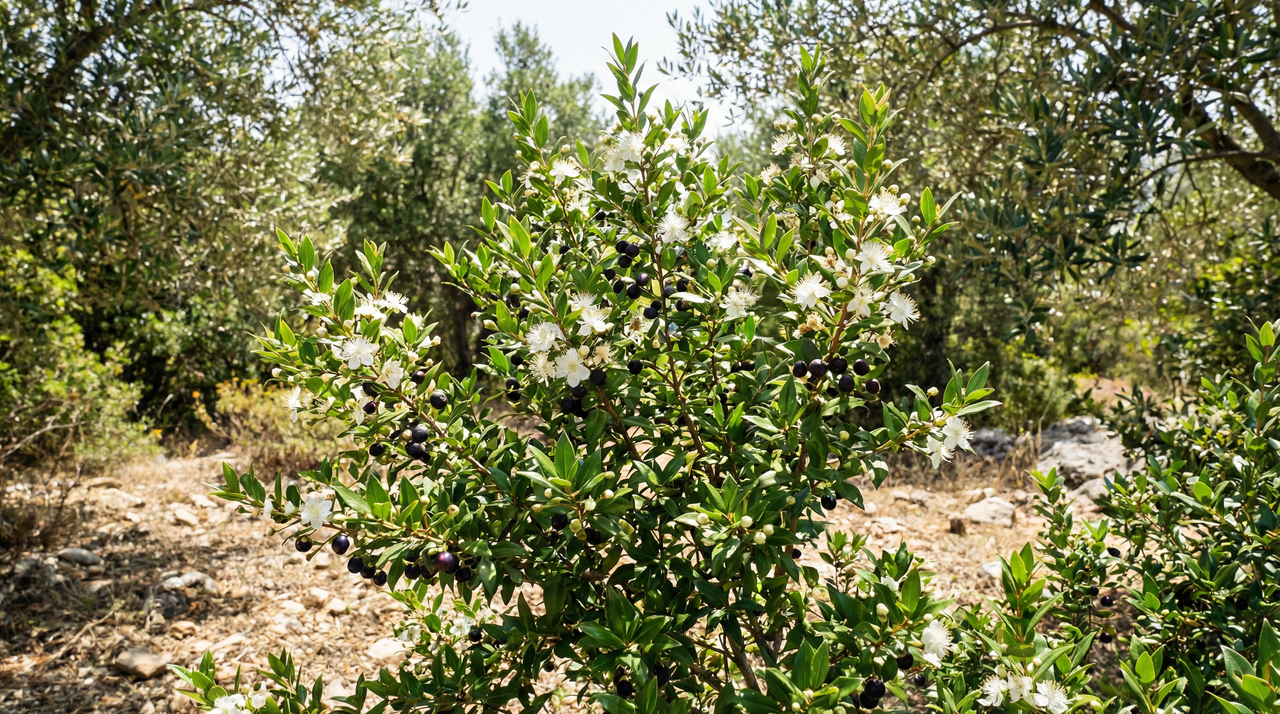
In the garden, common myrtle typically grows as a dense, upright to bushy evergreen shrub reaching 2 to 5 meters tall and wide at maturity, with smooth brownish-gray bark and branching that starts close to the base.[3][9] The leaves are the easiest identification marker: opposite, ovate to lanceolate, glossy dark green on top and paler beneath, with tiny translucent oil glands scattered across the surface.[10][4] Crush a leaf and you get an immediate hit of something between eucalyptus and spice, sweeter and more resinous than rosemary, less medicinal-sharp than bay. I think of it as the aromatic middle ground between those two kitchen staples, and it's usually the smell, not the look, that makes experienced gardeners stop mid-walk and reach for a leaf.
Flowers appear from June through September: white, star-shaped, about 1 to 1.5 centimeters across, with five petals and a prominent spray of stamens that gives each bloom a slightly firework-like appearance.[11][12] The berries that follow ripen from green to bluish-black or purple-black, roughly 1 to 1.5 centimeters across, packed with numerous small hard seeds.[13][14] The root system is fibrous and relatively shallow, concentrated in the top 30 to 60 centimeters of soil, which means younger plants transplant reasonably well if you catch them before they've had years to spread. Named cultivars extend the range considerably: 'Compacta' stays tight and low, 'Variegata' carries cream-edged foliage, and 'Aurea' pushes toward golden-green, giving designers real options for different scales and light conditions.
Traditional and Cultural Uses
Few plants carry as much human history per square meter of canopy. Archaeological evidence places Myrtus communis in Bronze Age Mediterranean sites around 2000 BCE, and by 700 to 300 BCE Greek writers including Hesiod and Theophrastus were documenting it in detail. Pliny the Elder's Natural History, written around 77 to 79 CE, covers cultivation, medicine, perfumery, and ceremonial use with a thoroughness that suggests myrtle was fully woven into Roman daily life.[15][16]
In Greek and Roman mythology, myrtle was sacred to Aphrodite and Venus, the goddesses of love and beauty. Brides wore myrtle wreaths; the plant adorned doorways and featured in both victory celebrations and funerary rites, holding the unusual distinction of signifying love, fertility, immortality, and mourning all at once.[17][18] The Biblical tradition reads differently but with equal weight: in Zechariah, Isaiah, and the Song of Solomon, myrtle appears as a symbol of peace, restoration, and divine blessing, and it remains one of the Four Species, known as hadassim, used during the Jewish Sukkot festival today.[19][20]
Those same aromatic properties that made it spiritually significant also made it practically indispensable. Leaves, flowers, and berries have been used across Mediterranean cultures for digestive and respiratory complaints, wound care, and perfumery since antiquity, and that tradition has never really broken.[21][22][23] Sardinian mirto liqueur, still produced from the berries and deeply embedded in island culture, is a living example. So is its continued role in folk medicine across Italy, Greece, Spain, and North Africa. Myrtle is classified as Least Concern by the IUCN, but wild populations face real pressure from overharvesting for essential oil production in parts of the Mediterranean.[24][25] I always recommend sourcing nursery-grown plants or named cultivars rather than wild-harvested material, both for ethical reasons and because selected garden forms tend to show better performance and more consistent oil chemistry.
Fun Facts About Myrtle
For growers in USDA zones 8 through 10, here's a reassuring note: myrtle is not considered a significant invasive species in the United States or Europe.[2][26] It can naturalize in mild coastal climates without causing major ecological disruption, though it's monitored in certain Australian woodlands and South African fynbos. That combination of resilience without aggression is genuinely rare, and it's one of the things I appreciate most about recommending it to clients who are nervous about introducing new species into their landscapes.
Those ancient Sardinian specimens, some estimated at 300 to 400 years old, put into perspective just how long a well-sited myrtle can endure. A plant that has outlived generations of humans in the rocky scrub of a Mediterranean hillside, carrying the mythology of Aphrodite and the culinary traditions of half a dozen cultures with it, is exactly the kind of resilient, multi-layered species that regenerative gardens are built around. The prestige it earned over millennia, it turns out, was entirely deserved.
Myrtle Varieties and Where to Buy Them
Notable Cultivars of Myrtus communis
The species gives you a lot to work with on its own, but the cultivars are where things get genuinely interesting for a designer. 'Tarentina' is the one I keep coming back to: a compact, densely branched form with glossy leaves, noticeably abundant flowers, and a higher essential oil yield that skews toward myrtenal and linalool rather than cineole.[27][28] It also tolerates harder pruning than most selections, which matters if you're shaping it as a hedge. I've found that 'Tarentina' over standard myrtle has made the difference in marginal zone 8 spots where I wasn't sure the plant would pull through winter. Think of it as the aromatic, far more rewarding cousin of boxwood for a low formal hedge.
For foliage interest, 'Variegata' carries cream-edged leaves that photograph beautifully, and 'Aurea' pushes that toward golden-yellow.[3] I've noticed 'Variegata' holds those cream margins sharpest in full sun; drop it into too much shade and the edges get muddy and indistinct. 'Flore Pleno' goes the other direction, offering double flowers on an upright frame for anyone who wants maximum ornamental flower effect.[28] At the smallest scale, 'Microphylla' and the dwarf 'Compacta' (sometimes sold as 'Nana') suit containers or tight spots, though both flower less prolifically and yield less harvestable material.[3][27] Worth knowing: North African-origin plants sometimes run higher in cineole, which noticeably shifts the aroma profile if you're growing myrtle for any kind of aromatic use.
Sourcing Myrtle Plants and Seeds
Once you've settled on a cultivar, finding plants in the US is genuinely straightforward. Monrovia, Plant Delights Nursery, One Green World, and Logee's Greenhouses all carry Myrtus communis reliably, and the Missouri Botanical Garden's plant sources database can point you toward verified regional suppliers.[29][30][31][32][33] Budget roughly $15 to $25 for a 1-gallon container, $25 to $50 for compact or dwarf selections, and $50 to $80 for a 3-to-5-gallon specimen.[30][34] I've learned to favor the smaller containers for mail order; a 1-gallon plant establishes faster than a larger one that's had its roots disturbed in shipping. Seeds run $5 to $10 a packet but require cold stratification and are harder to find, so potted plants are almost always the more practical path.[35]
There are no federal import restrictions or USDA APHIS quarantine concerns around myrtle, and while it has naturalized in parts of California, it's not regulated as invasive anywhere in the US as of 2023.[36][37] Stock peaks in spring and fall from California and Florida nurseries, so if you're after a specific cultivar like 'Tarentina' or myrtus communis variegata, call ahead rather than hoping the website reflects current inventory.
How to Propagate and Plant Myrtle (Myrtus communis)
Most of the myrtle I've put in the ground over the years started as a cutting, not a seed, and there's a good reason for that. Semi-ripe cuttings taken in late summer to early autumn root at 70-90% success rates when conditions are right, producing plants that are genetically identical to the parent.[38][39] That "true-to-type" quality matters more than it sounds, especially if you're building a hedge where consistent leaf size and fragrance are part of the design. The RHS, Missouri Botanical Garden, and Kew all point to vegetative propagation as the preferred route for exactly this reason.[38][39][14]
Propagation Methods: Cuttings, Seeds, Layering, and More
Take 10-15 cm (4-6 inch) non-flowering shoots from healthy stems in late summer, dip the cut end in IBA rooting hormone at around 2000 ppm, and set them in a 1:1 peat-perlite mix.[40][41] Bottom heat at 21-24°C (70-75°F) and 80-90% humidity are the variables that separate a 90% strike rate from a mediocre one in my experience. I learned this the hard way early on: I used a peat-heavy mix without adequate drainage and lost half a tray to damping-off. Switching to a true 1:1 blend and adding a heat mat changed everything. Under those conditions, cuttings typically root in 4-8 weeks under bright indirect light.[42] Once rooted, pot them into 4-6 inch containers and let them build a real root system before moving them to the garden.[43] I start mine in late summer so they're garden-ready the following spring.
Seeds are the slower, more variable path. Fresh seed sown on moist sandy compost at 18-21°C, after cold stratification at 4-10°C for 30-60 days or light scarification, will germinate at 50-70% within a few weeks.[38][14] The catch is that seedlings are slow and genetically variable. I once raised a batch from saved berries and got plants with noticeably different leaf gloss and berry size from the same parent. That kind of diversity is delightful in a naturalistic planting but a liability in a formal hedge line, which is why I stick to cuttings for anything where uniformity counts.
For large established specimens, layering offers an 80-95% success rate. Wound a stem, apply rooting hormone, wrap it, and wait 2-3 months.[38] Grafting onto Myrtus communis rootstock works at 50-80% under controlled conditions, and tissue culture is effective commercially, but neither is practical for most home growers.[44][45]
Soil, Site Selection, and Planting Technique
Myrtle evolved on rocky Mediterranean slopes with excellent drainage, and it has not forgotten that fact. It demands well-drained sandy loam, loamy, or gravelly soil with a pH of 6.0-7.5, and it is genuinely sensitive to waterlogging, which invites Phytophthora root rot fast.[3][46][14] My rule: if your soil stays wet for more than 48 hours after heavy rain, choose a different spot or build a raised bed. I've lost young myrtles to root rot and I don't risk it anymore.
I've grown Myrtus communis in slightly acidic beds and in amended calcareous containers, and what I can tell you is that vigorous foliage and abundant flowers track drainage far more closely than hitting a precise 6.5 pH. Amend clay soils with coarse sand, grit, or moderate compost; for containers, a mix of 50% potting soil, 30% sand or grit, and 20% perlite works reliably.[47][48] Test your soil before adding lime for acidic ground, and always prioritize drainage over chasing a number on a pH meter.
Site in full sun with at least 6 hours of direct light daily, in a sheltered position.[9] Young plants need about an inch of water per week through their first season, then back off as they establish drought tolerance.[49] Dig planting holes two to three times the width of the root ball and the same depth, never deeper, and avoid compacted soils with less than 12-18 inches of workable depth.[50] The species handles coastal saline spray well, a useful reminder that it's adapted to difficult sites as long as the water drains through.[6]
Germination and Establishment Timeline
If you're starting myrtle from seed, expect germination somewhere between 20 and 60 days at 65-75°F (18-24°C), typically landing in that 2-4 week window after stratification.[51][52] Sow indoors 6-8 weeks before the last frost date. The longer timeline is the first harvest: seed-grown plants can require 6-12 seasonal growth cycles before producing fruit.[51][53] In practice, strong cutting-grown stock from a reputable source often fruits in year 3-4, which is still a patience test but a more realistic one than the outer edge of that research range. Label your seedling trays carefully. First-year myrtle foliage looks remarkably similar to several other Mediterranean herbs, and a mix-up becomes obvious only once the plants are large enough to bruise a leaf and smell it.
Spacing Recommendations for Hedges, Specimens, and Containers
Myrtle grows at a moderate pace, adding 12-24 inches per year and eventually reaching 10-16 feet in height (though most gardeners keep it well under that with pruning) with a spread of 6-10 feet or more in ideal conditions.[54][3] That growth rate means spacing decisions have real long-term consequences for airflow and disease pressure, so I'd rather give plants room than try to fix an overcrowded hedge in year five.
For hedge or screen plantings, 3-5 feet (90-150 cm) apart gives dense growth without constant intervention.[38] Tighter spacing at 18-24 inches can work for a formal clipped hedge, but it commits you to more frequent pruning and, in humid climates, creates conditions where fungal leaf spot spreads quickly. I've watched overcrowded myrtles in Central Florida develop leaf spot problems that well-spaced plants in the same beds avoided entirely, so I now default to the wider end of the range for anything outside a formal garden context. For individual specimens allowed to develop their natural form, give them 6-10 feet from neighboring plants.[55] Spring after the last frost is ideal for planting in most regions; fall works well in mild Mediterranean-climate zones where winters stay above freezing.[3]
Myrtle Care Guide
Myrtle rewards gardeners who understand one fundamental truth about it: this is a plant shaped by lean, bright, well-drained Mediterranean hillsides, and the closer you can mimic those conditions, the better it performs. Over-care is genuinely the biggest mistake I see with it. That said, a few things do require real attention, and getting them right is the difference between a compact, fragrant, long-lived specimen and a straggly shrub that never quite thrives.
Sunlight Requirements for Myrtus communis
Myrtle wants full sun, and it's not being dramatic about that.[52][3] The aromatic oils that give the leaves their distinctive fragrance peak under strong summer sun, and flowering is directly tied to light exposure.[56] I've seen plants tucked into shaded corners of a garden and they tell you exactly how they feel about it: elongated stems, wider gaps between leaves, foliage that goes pale and yellowish, and almost no flowers.[57] They're not dead, just deeply uninspired.
The opposite problem shows up in hot, humid climates during brutal midsummer heat. If you're pushing past 95°F regularly, leaf margins can brown and dry out, working their way inward if the stress continues.[58] In those situations, dappled afternoon shade is a reasonable compromise, but I'd treat it as a mitigation strategy rather than a preference. Full sun from morning through early afternoon with some relief during peak heat keeps plants producing aromatic oils without the scorch.
Watering Needs
Young myrtle plants need consistent moisture while they're getting established, but once they're settled in, the whole water calculus shifts. Mature plants are genuinely drought-tolerant, needing roughly an inch of water per week during dry periods rather than constant irrigation.[14][59] I've grown mine from a small nursery plant into a six-foot specimen over a decade, and the biggest shift in leaf health came when I switched from frequent shallow watering to deep, infrequent soaking after the second year. The difference in leaf drop was immediate.
The one thing myrtle will not forgive is wet feet. Root rot in waterlogged soil is a real threat, and the plant will show drought stress symptoms, wilting, leaf drop, and browning, even in saturated conditions because the roots simply can't function.[3][14] Drainage is non-negotiable. A 2-3 inch layer of organic mulch around the base helps retain moisture, reduces how often you need to water, and buffers soil temperature, which becomes especially useful during heat spikes.[59]
Feeding and Fertilization
Myrtle is a moderate feeder, and I mean that in both senses: it doesn't need much, and it punishes excess. I used to fertilize mine the way I fertilized roses, and the result was soft, lush, aphid-prone growth that looked nothing like the compact, aromatic shrub I was aiming for. The fix was simple: a balanced slow-release fertilizer, something in the 10-10-10 or 20-20-20 range, applied at half the standard shrub rate in early spring.[60][61] A light second application in midsummer is reasonable if growth looks genuinely slow, but most established plants don't need it.
Heavy nitrogen is the specific thing to avoid. Excess nitrogen pushes soft, disease-prone shoots that contradict everything this plant's sclerophyllous character is built for.[62] If you're seeing interveinal yellowing on young leaves, that's usually iron deficiency in alkaline soils rather than a feeding problem.[63] Uniform yellowing of older leaves with stunted growth points more toward nitrogen deficiency.[64] Both are correctable, but they're far less common than the damage caused by over-enthusiasm with the fertilizer bag. Always water thoroughly after any application to avoid root burn.[60]
Frost Tolerance and Winter Protection
Myrtle is reliably hardy in USDA zones 8 through 11, rated H4 by the RHS for hardiness down to around -10°C (14°F).[65][2] Mature plants in well-drained soil can push through to about -12°C (10°F), but young plants or those sitting in wet ground start showing damage below -7°C (20°F).[38] Below -5°C (23°F), expect browning leaf tips, scorching, and dieback of soft young shoots.[66]
The best frost protection is actually a siting decision: a sheltered, south-facing location with good drainage cuts risk significantly.[14] I've found it behaves a lot like citrus in zone 9B in that respect; both plants benefit enormously from the same south-facing microclimate and organic mulch at the base for winter insulation. When hard freezes are forecast, horticultural fleece does the job. Where winters regularly dip into zone 8 territory, container growing with an indoor overwintering option is the practical move. The reassuring thing is that myrtle recovers well from light tip damage. Come spring, prune out the browned wood and the plant typically resprouts from old wood with real vigor.
Heat Tolerance
As a Mediterranean native rated for AHS Heat Zones 8 through 10, myrtle handles heat better than most shrubs you'd consider for a similar role.[3] Temperatures up to 40°C (104°F) fall well within its comfort zone, and short spikes to 45°C (113°F) are survivable with adequate soil moisture.[67] Where I watch for trouble is extended stretches above 35°C (95°F), which is when leaf margins start going papery at the edges.[3]
My most reliable tool in those situations is a 5-7 cm deep organic mulch layer, which keeps soil temperatures down and extends the interval before supplemental irrigation becomes necessary.[68] Deep watering every 7-10 days in summer, timed for early morning or evening, gets moisture down to 30-45 cm where the roots can actually use it.[60] If you're in a region with consistently brutal summers, cultivars like 'Tarentina' and 'Microphylla' handle intense heat and drought with somewhat better composure than the straight species.[60]
Pruning, Maintenance, and Seasonal Care
Timing is everything with myrtle pruning because the flowers form on old wood. Prune right after flowering finishes in late spring or early summer, and you'll keep the shape without sacrificing next season's display.[69] I learned the hard way not to cut after midsummer; I've lost the following year's flowers more than once by pruning too late in the season, and it's a frustrating mistake to wait twelve months to fully understand.
Myrtle responds beautifully to shaping, which is why it has such a long history as a topiary and formal hedge plant. Good air circulation through the canopy also matters for long-term plant health, so thinning cuts that open up the interior are worth making alongside any shaping work.[3] Its salt tolerance makes it genuinely useful in coastal gardens where other shrubs struggle.[70] Light pruning sessions also happen to coincide naturally with leaf harvest, so the two tasks can work together rather than compete.
Seasonal Rhythm
The myrtle year moves in a rhythm that makes intuitive sense once you've observed it for a few seasons. Flowers appear from late spring through summer, typically peaking from June through August in the Northern Hemisphere, and berries follow, ripening from late summer into autumn through November.[40] Aromatic oil production peaks during that same summer window of full sun exposure.[56] The plant is also fire-adapted in its native habitat, capable of resprouting vigorously after disturbance, which explains its remarkable resilience and why established specimens bounce back so well from frost dieback or hard pruning.[8] Once you start timing your pruning, feeding, and harvesting to align with this natural pulse rather than a rigid monthly calendar, the plant seems to reward you for the attention.
Myrtle Harvesting: Timing, Technique, Yield, and Flavor
Patience is the first skill myrtle teaches. I've grown Myrtus communis from both seed and cuttings, and the seed-grown plants routinely take 3-5 years before producing their first berries, while grafted specimens can shorten that to 2-4 years.[71][72] Knowing that going in changes how you relate to the plant. You stop asking "when will it fruit?" and start paying attention to the whole calendar of harvests it's already offering.
When to Harvest Myrtle Leaves, Flowers, and Berries
Myrtle runs on a long seasonal arc. Flowers open from late spring through early summer (roughly May through July in Mediterranean climates), and from there the berries need 120-180 days to develop fully, which puts the peak harvest window somewhere between September and November in the Northern Hemisphere.[73][74] In hotter summers I've noticed that timeline can compress slightly; local heat units matter more than the calendar date.
Leaves are best taken in late spring, just before or at the earliest stage of flowering, when essential oil content is at its highest.[75] Flowers can be gathered when fully open in early to midsummer. For berries, wait until the fruit has traveled the full color spectrum: green to reddish-purple to a deep, glossy blue-black. The ripe ones measure roughly 0.5-1 cm across and yield just slightly to gentle pressure.[76][77] Early in my growing life I picked some that looked dark enough but were still firm and vaguely green-tasting. The resinous sweetness that defines a properly ripe myrtus communis berry just isn't there yet.
How to Harvest and Handle Myrtle for Maximum Flavor and Essential Oil
The biggest post-harvest mistake I made in my early years was rinsing the leaves before drying. I lost several batches to mold before I understood why: residual moisture and the volatile oils do not get along. Now I harvest leaves dry, on a dry morning, and go straight to air-drying on screens or into the distillation setup the same day.[78][79] Skip washing entirely; the aromatic oils you're trying to preserve are exactly what you'd be washing away.
Expected Yields and Flavor Profiles of Myrtle Parts
A mature shrub produces roughly 1-2 kg of dry leaves annually, which is genuinely more than most households need.[78] I think of the surplus as trade goods. The leaves behave like a more resinous bay leaf in long-cooked dishes, contributing an eucalyptus-camphor lift with hints of anise and lemon that comes from their high 1,8-cineole content.[80] On hot sunny years, my plants smell noticeably sharper at harvest; you can feel the difference in your sinuses just while picking.
The berries are where myrtus communis fruit really surprises people. They're sweet-tart up front with a piney, balsamic finish, and that's exactly the profile that makes traditional Sardinian mirto liqueur so distinctive.[81] The flowers are mildly edible with a warm, spicy floral scent from phenylpropanoids like eugenol, though I use them mostly as garnish or steeped briefly in hot water.[82] All parts are considered safe in culinary quantities, but I keep my portions moderate; the resinous intensity can cause digestive upset in sensitive people if you overdo it.[22]
Myrtle Preparation and Uses
Culinary Uses of Myrtle Berries, Leaves, and Flowers
Every part of Myrtus communis brings something to the table. Ripe blue-black berries can be eaten fresh in moderation, but they really shine when cooked or infused: think jams, syrups, and the legendary Sardinian mirto liqueur, where berries macerate to produce something warming and deeply aromatic.[83][84] The flavor is genuinely its own thing: a spicy-sweet blend of juniper, allspice, and nutmeg, with just enough bitterness raw that heat or alcohol does you a favor.[85] I've used them to flavor game stews and charcuterie the same way I'd reach for juniper berries, and the results are good enough that myrtle has quietly replaced juniper in my spice drawer for this purpose.
Leaves work like a more resinous, camphor-forward bay leaf dropped into slow-cooked meats, soups, and sauces.[86][87] After experimenting with both fresh and dried, I find dried leaves store the pungency far better and hold up through a long braise in a way fresh doesn't quite manage. The flowers are the most delicate use, best added fresh to salads or floated as a garnish rather than cooked down.[86]
That distinctive aroma traces back to essential oil chemistry that varies by geography, harvest timing, and cultivar: leaf oils lean eucalyptus-like and cineole-forward, while berry oils are fruitier and more balsamic from myrtenyl acetate.[88][89] In practice, this means a plant grown in dry, hot conditions produces noticeably more resinous, assertive leaves than one grown cooler and wetter. The berries themselves are nutritionally solid: rich in carbohydrates and fiber, with meaningful amounts of vitamin C, vitamin E, potassium, and magnesium.[90] Leaf mucilage also contributes to the digestive comfort traditionally associated with myrtle teas and liqueurs.[91] Harvest sustainably: take no more than 20-30% of foliage per session and avoid harvesting during flowering, giving the plant room to rebound.[92] I cap myself at around 25% per shrub and the regrowth the following season is consistently vigorous.
Traditional Medicinal Preparations and Dosages
Mediterranean folk medicine has long prepared myrtle as leaf teas, berry tinctures, decoctions, poultices of crushed fresh leaves, and steam-distilled essential oil.[93][87] For internal use, both the European Medicines Agency and the WHO converge on 1.5-4.5 g of dried leaves daily, split into two or three doses as an infusion or decoction, for short-term use of up to 7-10 days.[94][95] Tinctures prepared by macerating dried material in alcohol for 2-4 weeks are typically dosed at 2.5-5 ml of a 1:5 tincture up to three times daily.[94] I keep my tinctures clearly labeled with date and dosage, and I don't exceed the short-term window; this is a potent plant and it deserves that respect.
The Myrtus communis essential oil is a different matter. It must be diluted to 1-2% in a carrier oil for any topical application and should never be ingested without professional supervision.[96][97] I always do a patch test before using any diluted myrtus communis essential oil on skin, full stop. The safety detail around pregnancy and drug interactions is covered fully in the health benefits section, but the short version here is: concentrated preparations require caution that the culinary uses simply don't.
Non-Food Uses: From Perfumery to Insect Repellent
The same volatile compounds that season a stew make myrtle genuinely useful well beyond the kitchen. The essential oil appears widely in perfumery, colognes, soaps, and skincare for its fresh, resinous, herbaceous character,[98][99] and both leaf and berry oils act as natural repellents against mosquitoes and flies.[100] Rubbing a single leaf between your fingers makes the mosquito-repelling property immediately obvious; the release of aroma is instant and sharp. I've started keeping a potted myrtle near the outdoor dining area purely for this reason.
Myrtle berries historically yielded a purple-black textile dye, and the plant itself earns its keep ornamentally year-round: evergreen foliage, white flowers in summer, and dark berries through autumn and winter.[3] As a hedge, it serves as habitat, scent, and a light insect barrier all at once. For a plant this generous across so many functions, the care it asks in return is genuinely modest.
Myrtle Health Benefits and Medicinal Uses
The Mediterranean basin has been prescribing myrtle for a very long time. Hippocrates reached for it; so did Arabic physicians and North African healers working centuries apart. What I find compelling, after spending years growing aromatic Mediterranean shrubs and digging into the underlying chemistry, is how coherently the traditional uses map onto what modern pharmacology is now confirming. The plant isn't a miracle, but it's no folk rumor either.
Phytochemical Profile of Myrtus communis
Myrtle's bioactivity runs through two interlocking chemical families. The essential oils, concentrated primarily in the leaves and flowers, are dominated by monoterpenes: leaves deliver 1,8-cineole at 20-60% of the oil, with α-pinene and myrcene rounding out the profile, while flower oil shifts toward linalool, geraniol, and nerol, and berry oil features myrtenyl acetate as a standout component.[101][102][103] The polyphenol fraction adds a second layer: gallic acid, rosmarinic acid, quercetin, myricetin, catechin, luteolin, ellagic acid, and a suite of glycosides including myricitrin and quercetin-3-O-glucuronide, with total essential oil content running 0.5-2% in leaves and flowers and polyphenolics peaking in the fruit.[103][104]
One thing to keep in mind: the chemistry moves around considerably depending on where the plant grew, when it was harvested, and how the material was processed. North African populations tend to run higher in α-pinene; Italian ones favor sabinene. Summer harvests, especially at flowering stage, push monoterpene yields up, while alkaline soils and drought stress amplify secondary metabolites overall.[105][106][107] I've noticed this in my own garden: leaves harvested at the height of summer smell noticeably sharper and more cineole-forward when crushed than the same plant in early spring. That sensory cue tracks with the documented seasonal shifts, and it's a practical way to gauge potency from the garden without any laboratory equipment.
These compounds aren't just interesting chemistry; they explain the pharmacology. Luteolin and quercetin target the NF-κB inflammatory pathway, while myricetin contributes substantial antioxidant capacity through free radical scavenging and metal chelation comparable to the synthetic antioxidant BHT. Antimicrobial activity against Staphylococcus aureus, E. coli, and Candida albicans comes from membrane disruption, with MIC values in the 0.5-2 mg/mL range.[108][109][110]
Medicinal Research and Clinical Evidence
Traditional healers from Greece to the Maghreb organized their myrtle use around the body systems the plant most reliably addressed: respiratory infections and coughs first, then gastrointestinal complaints like diarrhea and indigestion, urinary problems, and topical wound care. These applications reach back to Hippocrates and persist across Arabic and North African ethnobotanical records with consistent emphasis on myrtle as an astringent, expectorant, and antiseptic vulnerary.[111][22][112] Modern trials are now confirming many of those same uses, which I find genuinely satisfying to see.
Preclinical work shows a broad portfolio: anti-inflammatory action through suppression of TNF-α, IL-6, COX-2, iNOS, and NF-κB; antioxidant effects from the flavonoid fraction; broad-spectrum antimicrobial and analgesic activity; diuretic and antispasmodic properties; sedative and anxiolytic effects; antidiabetic actions including blood-glucose lowering and improved insulin sensitivity; and preliminary anticancer signals via apoptosis induction in breast and colon cancer cell lines.[113][114][115][116] The respiratory connection, particularly, makes sense given the 1,8-cineole dominance in leaf oil; it's the same mechanism that makes eucalyptus useful for bronchial complaints.
The strongest human evidence sits in three areas. A randomized controlled trial found myrtle extract significantly reduced ulcer size and improved healing rates in diabetic foot ulcers. A double-blind randomized trial demonstrated myrtle mouthwash measurably reduced halitosis and volatile sulfur compounds. And clinical work on chronic bronchitis and COPD found both leaf extract and essential oil preparations reduced inflammation and improved lung function.[117][118][119] I'd place its antimicrobial gentleness in the same general territory as calendula or chamomile: real, clinically useful, but best framed as supportive rather than primary treatment. Reviewers consistently flag that most human trials have been small-scale, and the field needs larger studies before stronger therapeutic conclusions can be drawn.[120][21]
Nutritional Composition of Myrtle Berries and Leaves
Myrtle berries have been eaten around the Mediterranean for millennia, and the nutritional picture supports their role as a modest functional food rather than a superfood standout. Fresh berries come in at roughly 57 kcal per 100g, with 14.2g carbohydrates (10.5g sugars, 2.1g fiber), 0.6g protein, and 0.3g fat. Mineral content is the more interesting story: 152mg potassium, 78mg calcium, 32mg magnesium, 1.2mg iron, and useful levels of vitamin C around 17-25mg per 100g.[103][121] The berries also contribute anthocyanins, ellagic acid, and polyphenols that connect back to the antioxidant profile covered above.
Leaves tell a different story: higher mineral density (ash content 6-8% dry weight), lower vitamin C than the fruit, but richer in the essential oils and flavonoids already discussed.[122][123] Myrtle doesn't appear in USDA FoodData Central, so these numbers come from targeted European studies and will naturally vary by cultivar and geography. In my kitchen, I use dried leaves in teas and occasionally in slow-cooked dishes; the tannins that make raw leaves quite astringent soften considerably with heat or infusion, which makes the experience much more pleasant while keeping the phytochemical benefits reasonably intact.
Safety Considerations and Contraindications for Myrtle
Let me be direct here, because this is where enthusiasm can cause real harm. Myrtus communis is mildly toxic when consumed in excess, with GI upset (nausea, vomiting, diarrhea) as the primary symptom. Berries in culinary quantities are fine and have been used safely in Mediterranean cooking for generations. Leaves are a different matter: their essential oil concentration (2-3%) is considerably higher than the fruit, and leaf preparations are more likely to cause irritation at larger doses.[124][125][126]
The essential oil deserves particular respect. Undiluted on skin it can cause contact dermatitis and sensitization via its monoterpene constituents, including compounds like estragole and methyleugenol.[111][127][128] The oral LD50 in rats exceeds 5000 mg/kg, meaning acute toxicity from normal use is very low, but that doesn't license casual internal use of concentrated oil. Having looked carefully at the sensitization data and the patch-test studies, I do not recommend applying undiluted myrtle essential oil to skin under any circumstances.
The pregnancy contraindication is firm. Myrtle has documented uterine-stimulant and emmenagogue effects that meaningfully raise miscarriage risk, and it should be avoided entirely during pregnancy.[129][124] Breastfeeding warrants medical supervision before any therapeutic use. For children under six, GI irritation and sensitization risk mean that medicinal doses and essential oil preparations should be left out entirely.
Two drug interactions are worth flagging clearly: myrtle potentiates anticoagulants via antiplatelet activity (raising bleeding risk), and it can enhance antidiabetic medications with an additive blood-glucose-lowering effect; both warrant monitoring if you're on those medications.[130][131][128] Safe general guidance: 1-2g of dried leaves as a daily infusion, and essential oil diluted to 1-5% for topical use only. For identification in the garden, crush a leaf; the spicy-sweet, slightly eucalyptus-like aroma is distinctive enough to confirm you have the right plant before using it for anything medicinal.
Myrtle Pests and Diseases
Myrtus communis arrives in your garden with its own chemical defense system already running. The same aromatic compounds that make the leaves smell extraordinary, primarily myrtol and 1,8-cineole, act as natural insect repellents and antifeedants, while those thick, waxy, leathery leaves create a physical barrier that most soft-bodied pests find discouraging.[103][132] In its native Mediterranean scrubland, this is a genuinely tough plant with moderate to high resistance to many common garden pests and diseases.[133] The problems start when we move it into conditions that don't suit it.
Natural Defenses and Disease Resistance
Overall disease resistance in myrtle is moderate, with susceptibility shifting noticeably depending on cultivar and, especially, environmental conditions.[134][135] The most common fungal problem I see is leaf spot, caused by pathogens like Septoria myrtifolia, Cercospora, or Pestalotia spp., showing up as dark or brown spots that spread when humid conditions or overhead watering keep foliage wet for extended periods.[134][136] Powdery mildew, usually Erysiphe myrtillina, presents as a white powdery coating on leaves and stems and loves poor air circulation even more than outright humidity.[137][138]
The disease I genuinely worry about, and the one that has killed more myrtle in my landscape projects than anything else, is Phytophthora root rot. Phytophthora cinnamomi thrives in waterlogged or poorly drained soil and moves fast, turning a healthy-looking shrub into a wilted, collapsing one in a surprisingly short time.[139][140] I've learned from hard experience that myrtle plants sited with excellent drainage and morning sun almost never develop this problem, even through humid summers. The drainage question matters far more than any spray program. Secondary fungal threats like Cylindrocladium, which causes stem cankers and root rot particularly in nursery settings, and Verticillium wilt are worth knowing about but tend to appear under significant stress rather than as routine visitors.[141][142] Bacterial diseases like Xanthomonas leaf spot or Ralstonia wilt are possible but uncommon outside humid tropical regions.[134] Viral infections are rare and not well-documented in this species.
If you're gardening in a humid climate and disease pressure is a real concern, cultivar selection gives you a genuine edge. 'Tarentina' and 'Microphylla' show improved tolerance to both root rot and powdery mildew compared to the straight species, though neither is fully immune.[143][144] I routinely specify 'Tarentina' for clients in wetter areas because I've seen it outperform the species consistently in those conditions. The honest summary is that stress is the real disease vector: overwatering, compacted soil, and poor air circulation are responsible for most of the Myrtus communis yellow leaves and decline cases I've encountered.[60][145]
Common Pests of Myrtle
In an open, well-sited garden, pests rarely become serious on myrtle. The aromatic oils do real work here.[103] Greenhouse and container-grown plants are a different story, as reduced airflow and the absence of natural predators shift the balance considerably.[146] The core pest list includes aphids (particularly Myzus persicae), spider mites (Tetranychus urticae), soft scale insects (Coccus hesperidum), whiteflies, and thrips.[147][148] Aphids and scale both produce honeydew, which then invites sooty mold onto the foliage. Spider mites I associate almost exclusively with drought-stressed plants or those with dusty leaves; the stippling and fine webbing show up fastest when the soil has been dry for too long. Leaf beetles can occasionally cause damage but are a secondary concern that usually signals an already-stressed plant.[149] Cultivar-specific pest resistance is not well-established; the moderate tolerance sometimes observed in 'Compacta' and 'Variegata' seems to reflect growth habit rather than any meaningful genetic defense.[150]
Integrated Pest and Disease Management
My default approach with myrtle is to treat good siting as the first and most important intervention. Proper drainage, full sun exposure, and enough spacing for airflow between plants will prevent the majority of problems before they start.[40] When I do routine pruning, I use it as an inspection opportunity, flipping leaves to check the undersides for scale crawlers or early aphid colonies while I'm already in the plant. Catching problems at that stage means the response stays simple.
For soft-bodied pests like aphids and mites, I reach for neem oil or insecticidal soap at the first sign of activity. Both are effective without disrupting the beneficial insects that help keep those populations in check long-term. Scale warrants horticultural oil applied when crawlers are active. Fungal leaf spot and mild powdery mildew often resolve when airflow improves, but a copper-based fungicide or sulfur spray can help if conditions stay unfavorable. Phytophthora, once established, is very difficult to reverse; prevention through drainage is the only reliable strategy. Systemic chemical options sit at the back of the toolbox, rarely needed by a gardener who has got the cultural fundamentals right. When grown in well-drained, sunny Mediterranean-style conditions, myrtle is genuinely one of the lower-maintenance evergreen shrubs you can put in a garden.[103][151]
Myrtle in Permaculture Design
If you've spent any time designing Mediterranean-style plantings, you already know that the shrub layer is where the real ecological work happens. Myrtle earns its place there. In the wild maquis of southern Europe and North Africa, Myrtus communis is a keystone of those dense, aromatic shrublands, contributing to biodiversity, soil stabilization, and erosion control through leaf litter decomposition and nutrient cycling.[152][153] Understanding that origin isn't just academic. It tells you exactly what this plant wants to do in your design, and how to let it.
Ecosystem Functions and Guild Roles
Myrtle's summer flowers are a reliable pollinator draw. Honeybees, bumblebees, hoverflies, and butterflies all visit the fragrant white blooms, which produce both nectar and abundant sticky pollen.[154][155] The USDA officially designates it a bee plant,[156] and in my experience that's an understatement. I've stood next to a flowering myrtle in midsummer and heard the hum before I saw the plant. When I added lavender nearby as a companion, overall pollinator visitation across the whole bed noticeably increased, which tracks with the research on pairing these Mediterranean species to enhance pollination success.[157]
Beyond the pollinators, the blue-black berries bring in thrushes and warblers as seed dispersers, so the plant actively recruits wildlife and moves its genetics around the landscape through birds rather than wind.[158][159] Underground, myrtle forms arbuscular mycorrhizal associations that improve nutrient uptake in lean soils,[160] and its leaf litter gradually enriches soil organic matter and microbial activity as it breaks down.[161] Even under water stress it maintains reasonable pollination rates, which matters in any drought-prone design.[161]
On allelopathy: the essential oils do have a mild inhibitory effect on some weeds,[162] but in my guilds I've seen rosemary and lavender thrive immediately beside it with no ill effects. The suppression is real but gentle. A bit of thoughtful spacing handles it.
Forest Layer and Companion Planting
Myrtle sits in the shrub or middle layer of a food forest, reaching 1.5 to 5 meters at maturity with a dense, evergreen habit that holds structure year-round.[3][163] In its native maquis it grows alongside kermes oak, lentisk, strawberry tree, and cistus,[164] and that plant community is a useful template for permaculture guilds in similar climates. Translate it into a design and you get myrtle filling the mid-layer with lavender and rosemary at its feet, the whole guild sharing a preference for well-drained, sunny conditions and relatively low fertility.[165]
I've used myrtle on gentle slopes where its root system and accumulating leaf litter help build soil structure without crowding out neighbors. Research backs what I've observed: it functions as a nurse plant, providing localized shade and improved soil moisture retention that benefits nearby drought-sensitive perennials.[166] Some of the drought-sensitive herbs in my guilds that sit in myrtle's partial shade have visibly outperformed the same plants in fully exposed positions. Its clonal growth potential and longevity also make it reliable for long-term habitat provision and soil stabilization on sites where you want low-maintenance permanence.[8] It doesn't fix nitrogen, but it pays its way through everything else.
Climate Preferences and Suitable Zones
Myrtle is native to the Mediterranean basin, adapted to hot, dry summers and mild, wet winters with annual rainfall anywhere from 400 to 1,000 mm.[167] Those same conditions exist in coastal California, parts of Australia, and South Africa, all of which have successful cultivated populations. USDA zones 8 through 10 are the reliable sweet spot, where winter lows stay above about 10 to 15°F.[49][2] Zone 7 is marginal but workable with the right setup. My approach there has been: plant against a south-facing wall, mulch heavily over the root zone going into fall (I use about four inches of wood chip), and drape fleece over the canopy during hard frosts. Young zone 8 plants need the same treatment until they're established.[168]
Full sun and excellent drainage are non-negotiable for the ecosystem services to fully express themselves. Myrtle handles heat up to 40°C with ease once established,[4] and in humid summers, good airflow around the canopy matters as much as drainage beneath the roots. Late-winter pruning encourages denser growth that also improves cold hardiness at the margins,[2] so it's a task that does double duty. For colder zone gardeners who still want to work with it, container growing with overwintering at 5 to 10°C is a genuinely viable path.[49] And for anyone worried about it escaping the garden: myrtle is not considered invasive or noxious in the US, though it can naturalize quietly in suitable Mediterranean-climate areas.[2]
The Plant That Taught Me to Stop Rushing the Garden
I'll be honest: I planted my first myrtle mostly for the scent, then spent two impatient years wondering if I'd made a mistake. It looked like nothing was happening. Then one August morning I walked past and the whole shrub was covered in bees, and the air smelled like something ancient and clean, and I understood that myrtle doesn't perform on our schedule. It performs on its own, and it was doing that long before any of us were here to notice.
Sources 168
- Myrtus communis - Kew Science ↩
- Myrtus communis - USDA PLANTS Database ↩
- Myrtus communis - Plant Finder ↩
- Myrtus communis - Kew Gardens ↩
- Anatomical Adaptations of Mediterranean Sclerophyllous Plants to Drought ↩
- Myrtus communis - Wikipedia ↩
- Longevity and ageing in Mediterranean shrubs ↩
- Ecological characteristics of Myrtus communis L. in Mediterranean ecosystems ↩
- Myrtus communis - Royal Horticultural Society ↩
- Myrtus communis - Missouri Botanical Garden Plant Finder ↩
- Myrtus communis - Missouri Botanical Garden ↩
- Myrtus communis - Royal Horticultural Society ↩
- Myrtus communis - Missouri Botanical Garden ↩
- Myrtus communis - Kew Royal Botanic Gardens ↩
- Archaeobotanical Evidence of Myrtus in the Aegean ↩
- Myrtus communis - Royal Horticultural Society ↩
- Myrtle in Greek Mythology and Ritual ↩
- Myrtle in Ancient Greek Religion and Mythology ↩
- Biblical Plants: Myrtle in Scripture and Tradition ↩
- The Myrtle in Jewish Tradition ↩
- Myrtus communis L. (Myrtle): A Natural and Safe Source of Bioactive Compounds with Multi-Action Potential in Human Health ↩
- ncbi.nlm.nih.gov ↩
- Myrtus communis L.: A Review of Its Traditional Uses, Phytochemistry and Pharmacology ↩
- Myrtus communis ↩
- Essential Oil Production from Wild vs. Cultivated Myrtle ↩
- Invasive Plant Atlas of the United States ↩
- Chemical Composition of Essential Oils from Myrtus communis Cultivars ↩
- Myrtus communis cultivars - RHS ↩
- Myrtus communis ↩
- Myrtus communis - Common Myrtle ↩
- Myrtle - Myrtus communis ↩
- Logee's Greenhouses Plant Catalog ↩
- Missouri Botanical Garden Plant Sources Database ↩
- Myrtus communis Plant Pricing Guide ↩
- Seeds and Cuttings for Myrtus communis ↩
- USDA PLANTS Database: Myrtus communis ↩
- California Department of Food and Agriculture: Noxious Weed Lists ↩
- Myrtus communis (Common Myrtle) ↩
- Myrtus communis ↩
- Myrtus communis Plant Profile ↩
- Propagation of Myrtus communis ↩
- Myrtus communis - RHS Gardening ↩
- Myrtus communis (Myrtle) - UC Master Gardener Program ↩
- Propagation Techniques for Mediterranean Ornamental Shrubs ↩
- Propagation of Myrtus communis by Tissue Culture ↩
- Myrtus communis / common myrtle ↩
- Myrtus communis - Missouri Botanical Garden ↩
- Royal Horticultural Society - Myrtus communis ↩
- Myrtus communis ↩
- Royal Horticultural Society - Myrtus communis ↩
- Propagation of Myrtle (Myrtus communis) ↩
- Myrtus communis - RHS Gardening ↩
- USDA PLANTS Database - Myrtus communis ↩
- Common Myrtle - University of Florida IFAS Extension ↩
- Myrtus communis - Royal Horticultural Society (RHS) ↩
- Ecological Role of Myrtus communis in Mediterranean Ecosystems - ScienceDirect ↩
- Myrtle - Myrtus communis - University of Florida IFAS ↩
- Missouri Botanical Garden ↩
- How to Grow Myrtle (Myrtus communis) ↩
- Royal Horticultural Society - Myrtus communis Growing Guide ↩
- University of Florida IFAS Extension: Myrtle ↩
- Royal Horticultural Society - Myrtus communis ↩
- Mineral Nutrition and Leaf Content in Myrtus communis ↩
- Nutrient Deficiency Symptoms in Myrtus communis L. ↩
- Myrtus communis - RHS Gardening ↩
- Frost Damage to Plants - University of Maryland Extension ↩
- Myrtus communis ↩
- Mediterranean Plants: Irrigation and Mulching Practices ↩
- RHS - Myrtus communis ↩
- Myrtus communis - Common Myrtle ↩
- Myrtus communis ↩
- Myrtus communis L. ↩
- Phenological Stages of Myrtus communis L. in the Mediterranean Basin ↩
- Fruit Development and Ripening in Myrtle (Myrtus communis L.) ↩
- Commercial Production of Myrtus communis ↩
- Myrtle (Myrtus communis) Cultivation and Harvest ↩
- Harvesting Myrtle Berries: Ripeness Indicators ↩
- Essential Oil Yield of Myrtle Leaves - Journal of Essential Oil Research ↩
- Harvesting and Storing Herbs ↩
- Myrtle (Myrtus communis L.): A Potential Source for Food and Pharmaceutical Applications ↩
- Culinary Uses of Myrtle Berries and Leaves ↩
- Phenylpropanoids in the Essential Oil of Myrtus communis Flowers ↩
- Myrtus communis (Mediterranean Myrtle, Greek Myrtle, Common Myrtle) | North Carolina Extension Gardener Plant Toolbox ↩
- Culinary Uses of Myrtle Berries - Slow Food Foundation ↩
- Myrtle (Myrtus communis) - Uses and Flavor Profile - The Spruce Eats ↩
- Myrtus communis - Plants For A Future ↩
- Myrtus communis in Mediterranean Cuisine ↩
- Chemical Composition and Antimicrobial Activity of the Essential Oil of Myrtus communis L. from Algeria ↩
- Comparative Study of Leaf and Fruit Essential Oils of Myrtus communis L. from Different Provenances ↩
- Nutritional Composition and Antioxidant Properties of Myrtus communis L. ↩
- Myrtus communis in Traditional Medicine and Cuisine ↩
- Sustainable Harvesting of Medicinal Plants ↩
- Myrtle (Myrtus communis): A Review of the Phytochemistry, Pharmacology and Clinical Uses ↩
- European Medicines Agency (EMA) - Assessment Report on Myrtus communis L., Folium ↩
- World Health Organization (WHO) - Monographs on Selected Medicinal Plants, Volume 4: Myrtus communis L. ↩
- Herbal Medicine: Biomolecular and Clinical Aspects (NCBI Bookshelf) - Myrtle ↩
- Essential Oils Safety: A Guide for Health Care Professionals ↩
- Myrtle Essential Oil in Modern Perfumery ↩
- Traditional Uses of Myrtus communis in Cosmetics ↩
- Myrtus communis as Pest Repellent ↩
- Myrtus communis L.: A Review of the Phytochemical, Pharmacological, and Toxicological Profiles ↩
- Essential Oils of Myrtus communis L.: Chemical Variability and Antibacterial Activity ↩
- Phytochemical Composition of Myrtus communis L. ↩
- Phenolic Compounds in Myrtus communis L. ↩
- Geographical Differences in Essential Oil Composition of Myrtle ↩
- Seasonal Variation of Secondary Metabolites in Myrtus communis ↩
- Environmental Factors Affecting Phytochemical Analysis of Myrtle ↩
- Chemical Composition and Biological Activities of Myrtus communis Essential Oil: A Review ↩
- Phytochemical Profile and Antioxidant Activity of Myrtus communis L. Leaves ↩
- Antimicrobial and Anti-inflammatory Properties of Myrtus communis Extracts ↩
- Ethnobotanical Survey of Myrtus communis in the Mediterranean Region ↩
- North African Ethnobotany of Myrtus communis for Wound Healing ↩
- Anti-inflammatory and analgesic activities of Myrtus communis L. ↩
- Anti-Inflammatory Effects of Myrtus communis ↩
- Antioxidant and free radical-scavenging activity of Myrtus communis extracts ↩
- Anti-Diabetic Properties of Myrtus communis ↩
- Effect of Myrtus communis extract on wound healing in diabetic foot ulcer: A randomized controlled trial ↩
- Myrtus communis L. as a promising new natural mouthwash in halitosis: A randomized, double-blind clinical trial ↩
- Efficacy of Myrtus communis L. leaves extract and essential oil in chronic bronchitis: A randomized, double-blind, placebo-controlled clinical trial ↩
- Pharmacological review of Myrtus communis L. with emphasis on clinical trials ↩
- Nutritional Composition, Phytochemicals and Antioxidant Activity of Myrtle (Myrtus communis L.) Fruits ↩
- Nutritional Composition of Myrtle Fruits ↩
- Chemical Composition and Antioxidant Properties of Myrtle (Myrtus communis L.) ↩
- Myrtus communis L. (Myrtle): A Review of Its Phytochemistry and Pharmacology ↩
- Myrtus communis - Toxicity ↩
- ASPCA Toxic and Non-Toxic Plants - Myrtle ↩
- Toxicity of Essential Oils from Myrtus communis ↩
- Assessment Report on Myrtus communis L., folium ↩
- Myrtle (Myrtus communis) - Drugs and Lactation Database (LactMed) ↩
- Pharmacological Activities of Myrtus communis L. ↩
- Herbal Medicine: Biomolecular and Clinical Aspects - Myrtle Safety ↩
- Journal of Chemical Ecology - Antifeedant Properties of Myrtle Essential Oil ↩
- Insect Resistance in Mediterranean Shrubs ↩
- Diseases of Myrtle (Myrtus communis) ↩
- Missouri Botanical Garden Plant Finder ↩
- Diseases of Myrtle (Myrtus communis) ↩
- Powdery Mildew on Myrtaceae ↩
- Powdery Mildew on Ornamental Plants ↩
- Phytophthora on Woody Ornamentals Including Myrtle ↩
- Phytophthora Root Rot in Ornamentals ↩
- Cylindrocladium Species on Woody Plants ↩
- Fungal Diseases of Myrtus communis ↩
- Myrtus communis: Cultivation and Diseases ↩
- Cultivar Profiles: Myrtle Varieties ↩
- University of California Agriculture and Natural Resources - Plant Problems Diagnostic Program ↩
- Pest Resistance in Myrtle: Greenhouse vs. Field Observations ↩
- Myrtle - Myrtus communis ↩
- Pests and Diseases of Myrtus communis ↩
- Pests and Diseases of Ornamental Plants: Myrtle ↩
- Cultivar Selection for Myrtle Shrubs ↩
- Common Myrtle Plant Profile - The Spruce ↩
- Ecological Role of Myrtus communis in Mediterranean Ecosystems ↩
- Biodiversity in Maquis Shrublands: The Case of Myrtus communis ↩
- Pollination ecology of Myrtus communis L. in a natural fragmented habitat ↩
- Floral Biology and Pollination in Myrtus communis L (Myrtaceae) in Sicily ↩
- USDA PLANTS Database ↩
- Myrtus communis Pollinators ↩
- Seed dispersal by birds in Mediterranean shrublands: The role of Myrtus communis ↩
- Pollinators and Seed Dispersal in Mediterranean Shrubs ↩
- Mycorrhizal associations of Myrtus communis L. in the maquis of southern France ↩
- Drought Effects on Reproduction in Mediterranean Shrubs Including Myrtus communis ↩
- Allelopathic Potential of Myrtle Essential Oils ↩
- Royal Horticultural Society - Myrtus communis ↩
- Mediterranean Maquis Vegetation - FAO ↩
- Permaculture Companion Plants for Mediterranean Shrubs ↩
- Plant-plant interactions in Mediterranean-type ecosystems: Facilitation and competition in maquis ↩
- Myrtus communis - Kew Science Plants of the World Online ↩
- Myrtus communis - RHS Gardening ↩