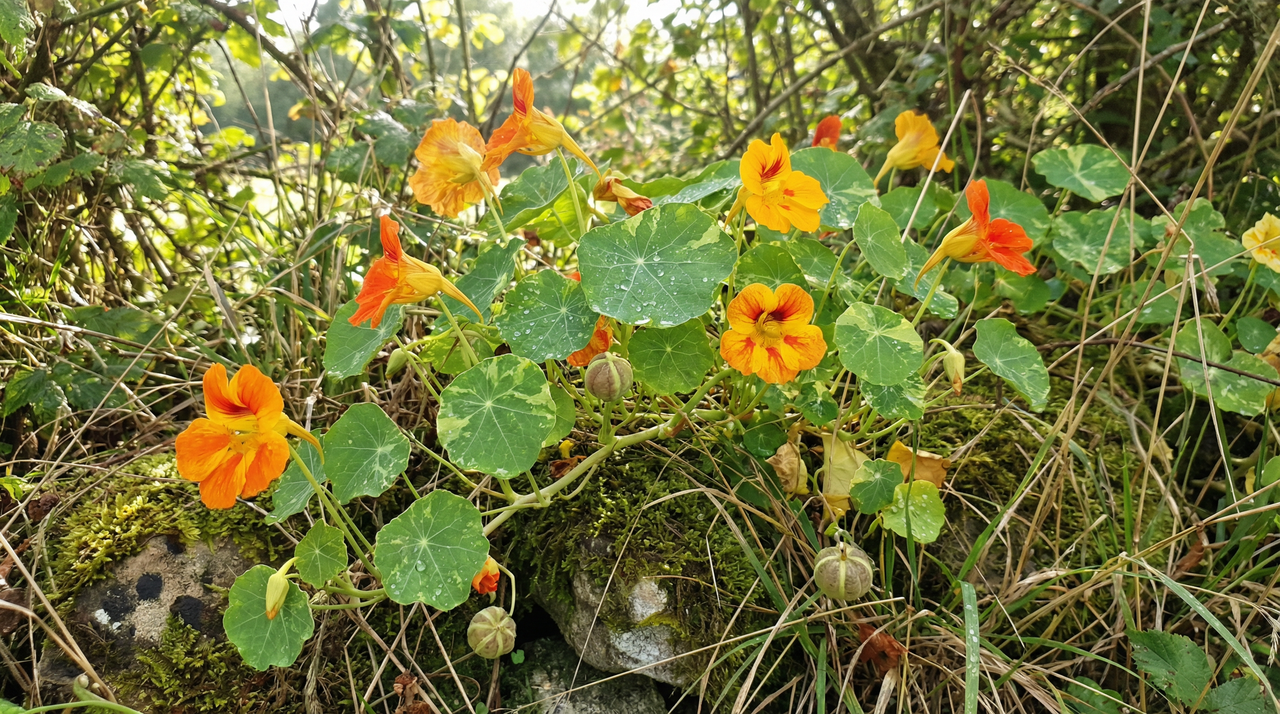
Every part of nasturtium is edible, and most gardeners know that. What they don't know, or at least what took me an embarrassingly long time to figure out, is that the plant flowers more when you treat it worse. Give it rich soil, generous fertilizer, regular watering, and you'll get a lush, sprawling mound of gorgeous round leaves and almost no blooms. Ignore it, plant it in poor dry dirt, and suddenly it's covered in orange and red flowers you can eat straight off the vine. I've watched beginner gardeners in my workshops blame themselves for "doing something wrong" when really they were just being too kind. Nasturtium rewards neglect in a way that feels almost like a philosophical statement.
That contradiction runs deeper than just soil fertility. This is a plant that evolved in the thin, cool air of the Peruvian Andes, then somehow became a staple of English cottage gardens, a permaculture trap crop, an antimicrobial remedy, and a chef's garnish, all without losing an ounce of its weedy, cheerful resilience. It's been quietly doing multiple jobs in gardens for centuries, and most people are still only using about a tenth of what it's capable of.
Nasturtium Origin, History, and Botany
Botanical Background and Andean Origins
Long before nasturtium became a staple of European cottage gardens, Tropaeolum majus was quietly thriving in the cool, moist montane zones of South America, clambering along stream banks and rocky forest edges from southern Colombia through Ecuador, Peru, Bolivia, and into the northern reaches of Chile and Argentina. It typically establishes between 1,000 and 3,000 meters elevation.[1][2][3] That high-altitude origin shaped everything: the fast lifecycle of 90 to 120 days, the vigorous trailing and climbing stems, the bright spurred flowers 2.5 to 6 cm wide that evolved to attract pollinators in a competitive mountain environment.[4][2] Seeds germinate in as little as seven days under the right conditions, and flowering follows within 35 to 60 days, a pace that made it irresistible to European growers the moment it arrived.[5]
The genus has more range than most gardeners realize. Canary Creeper (Tropaeolum peregrinum) comes from even higher elevations, sometimes reaching 5,000 meters in the Andean cloud forests and arid rocky ravines of Peru, Ecuador, and neighboring countries, with a climate profile noticeably drier and more extreme than where T. majus feels at home.[6] Both species share the same Andean foundation, but their specific adaptations are genuinely different. I always label my nasturtium starts carefully in the propagation tray because those early round peltate leaves can fool you until the first true leaf unfurls and the characteristic spur-bearing buds begin to form, a visual that becomes unmistakable with experience.[7]
Traditional and Cultural Uses
Indigenous Andean peoples, including pre-Columbian and Inca cultures, had already worked out what modern researchers are still confirming: the leaves and flowers are high in vitamin C, peppery enough to be genuinely useful in the kitchen, and medicinally active against infections, inflammation, and respiratory ailments.[8] Spanish explorers carried it back to Europe somewhere between 1567 and 1583, where it landed in botanical and monastic gardens almost immediately, prized simultaneously for its ornamental flash and its practical edge against scurvy and colds.[9][10] I eat the fresh leaves in salads for that same peppery zing, which feels like the most direct possible link between a 16th-century Andean hillside and my kitchen garden in zone 9B.
Carl Linnaeus formalized the scientific name in his 1753 Species Plantarum, deriving Tropaeolum from the Latin for "little trophy" because the round leaves resembled Roman shields and the spurred flowers called to mind soldiers' helmets hung on a victory post.[11] Modern research on glucosinolates, particularly glucotropaeolin, has since validated many of the antimicrobial and anti-inflammatory claims that traditional healers relied on for centuries.[12] The common name "Indian cress" still causes confusion worth addressing: it implies a North American origin that simply isn't accurate.[13] This is an Andean plant, full stop.
Fun Facts and Etymology
The "little trophy" etymology is one of my favorite naming stories in all of horticulture. Once you know it, you can't unsee it: the plant's distinctive structural shape perfectly mirrors that triumphant historical imagery.[11] In European folklore it entered as a symbol of victory and patriotism, which tracks perfectly with its visual drama.[14]
Cultivar size varies widely, from dwarf mounding forms under 12 inches to vigorous climbers sending vines 4 feet or more in a season, which means the plant fits a surprising range of garden situations.[15] The related Canary Creeper has naturalized and become potentially invasive in parts of Australia, the United States, and New Zealand, where its rapid growth can smother native plants, a useful reminder that even a beloved edible genus deserves thoughtful placement.[16] And while T. majus self-seeds prolifically enough in home gardens to feel almost inexhaustible, there are documented sustainability concerns around wild harvesting of Andean populations for the herbal supplement trade.[17] Growing your own from seed, which this plant practically begs you to do, sidesteps that concern entirely.
Nasturtium Varieties and Where to Source Them
Notable Cultivars of Tropaeolum majus
The first thing I tell anyone shopping for nasturtium seed is: growth habit drives everything. Tropaeolum majus cultivars fall into three camps: dwarf types that top out at 8-12 inches for borders and containers, trailing or climbing types that can reach 10 feet for fences and trellises, and double-flowered forms that add visual density to either habit.[18][19][20] Pick the wrong one for a window box and you'll spend the whole summer wrestling vines back into place. Pick a dwarf for a trellis and you'll wonder why nothing happened.
For reliable performers, I lean on the RHS Award of Garden Merit winners first. 'Whirlybird Mix' is a compact dwarf with upward-facing blooms that show beautifully without getting lost under the foliage, and the 'Gleam' series trails elegantly without the flopping problem you get from less refined trailing types.[18][20][19] 'Jewel Mixed' stays tidy and compact, which is why it's become my go-to as living mulch around brassicas and tomatoes. 'Alaska' gives you variegated foliage that earns its place in any ornamental edible bed, and 'Empress of India' with her deep crimson flowers against near-black foliage is frankly one of the most striking edible plants I grow. After trialing both 'Whirlybird' and trailing 'Gleam' for several seasons now, I still label every row at planting because the seedlings look nearly identical until the first true leaves develop.
For edible landscape beds where disease pressure is a concern, I specifically seek out the 'Phoenix' series and other cultivars flagged for improved disease resistance.[19][21] It's a small sourcing decision that pays dividends all season, especially in humid climates.
Related Species: Canary Creeper (Tropaeolum peregrinum)
If T. majus is the workhorse, Canary Creeper is the elegant cousin. Tropaeolum peregrinum climbs to 10-20 feet, producing small, bright yellow fringed flowers that genuinely do look like tiny canaries in flight, with palmately lobed leaves that contrast sharply with the rounded, shield-like foliage of the standard nasturtium.[22][23] It needs a sturdy obelisk or fence to reach that potential; I've seen them flop spectacularly on flimsy bamboo. Named selections like 'Flavum', 'Alba', and the variegated-leaf 'Variegata' exist, along with compact forms sold as 'Little Gold' or 'Goldilocks', though availability is spottier than for T. majus.[24][23] Treat it as a textural accent rather than a primary edible, and it earns its garden space easily.
Sourcing Nasturtium Seeds and Plants
Finding quality nasturtium seed is genuinely easy. Tropaeolum majus is carried by virtually every major seed catalog and garden center, and USDA data confirms it's cultivated across all 50 states.[2][25][26] University extension services consistently recommend buying from reputable suppliers to ensure clean, viable seed, and many specialty catalogues now offer certified organic and heirloom options.[19][27] Packets typically run $3-7 for 20-50 seeds, and live starts in 4-6 inch pots will cost you $6-10 if you'd rather skip the germination step.[28] I almost always start from seed because germination is so reliable, and it lets me trial three or four cultivars side by side in a single season without spending much.
One sourcing consideration I take seriously: nasturtium is not federally listed as invasive in the U.S., but it can outcompete native plants in parts of California, Oregon, and Hawaii.[26][29] If you're gardening in those regions, I'd monitor volunteers closely and pull them before they set seed. The research on their behavior in those ecosystems is clear enough that I don't think it's worth gambling on.
Nasturtium Propagation and Planting Guide
If you've ever grown nasturtium from seed, you know those seeds are genuinely satisfying to handle. They're kidney-shaped, roughly 8-12 mm long, dark brown with a rough, wrinkled testa that feels almost like a tiny walnut.[30][31] After years of fussing over tiny herb seeds that scatter everywhere and require tweezers to sow, dropping nasturtium seeds into a drill feels like a reward. That hard coat isn't just tactile pleasure, though. It reflects this plant's Andean heritage, protecting the embryo against desiccation and herbivory on rocky, wind-scoured montane slopes.[32]
Nasturtium Seed Characteristics and Propagation Methods
Seed is the primary and most reliable way to grow nasturtium, full stop.[33][34] Open-pollinated cultivars come reasonably true to type, and the seeds store well for two to five years in a paper envelope kept cool and dry.[35][36] That long viability means you can save seed from this year's garden and trust it will still perform in two seasons, which matters when you're building a permaculture planting on a budget.
Fresh seed sown directly into warm soil typically germinates without any fuss, but if you're working with older seed or sowing into cool spring soil, scarifying the coat with a nail file or soaking in warm water for 12-24 hours makes a real difference. Untreated germination sits around 60-70%; after scarification or soaking, that jumps to 85-95%.[34][37] I started doing this routinely after a disappointing spring where half my sowings simply sat dormant, and the improvement was immediate and consistent.
Softwood cuttings are technically possible, with 60-80% rooting success from late-spring growth using rooting hormone and bottom heat around 70°F,[38] but unless you're trying to clone a specific variegated cultivar or produce commercial quantities, there's no practical reason to bother. Grafting and division fail almost categorically because nasturtium's taproot is fragile and its stems heal poorly.[33][39] The plant simply isn't built for that kind of handling. Its Andean ecology relies on ballistic seed dispersal and chemical defenses rather than vegetative spread,[30] so direct sowing works with the plant's nature rather than against it.
One lesson I learned the hard way: mark your rows clearly after sowing, because the first true nasturtium leaves look surprisingly similar to other round-leaved seedlings you might have going nearby. I've accidentally thinned out a row of seedlings thinking they were weeds. Label, then leave them alone.
Germination Timeline and Growing Conditions
Under optimal soil temperatures of 60-70°F, nasturtium seeds germinate in 7-14 days.[4][5] From sowing to first flowers, expect 35-60 days depending on variety and conditions.[40] That's a fast, rewarding cycle, and it's a big reason nasturtium works so well for succession sowing every two to three weeks to keep edible flowers coming throughout the season. In my experience, warm moist spring soil consistently hits the short end of that window, while cool or dry conditions push it toward two weeks or beyond. Soaking older seeds, as mentioned above, genuinely tightens that spread and brings the batch into uniformity rather than staggered germination over three weeks.
Soil, Site Selection, and Spacing Requirements
The most common beginner mistake is over-enriching the soil. They prep a beautifully rich bed, add compost, and wonder why their nasturtiums produce magnificent foliage and almost no flowers. Rich soil is the enemy of nasturtium bloom. This plant evolved in low-fertility Andean volcanic sandy loams at elevation, where nutrient levels are naturally sparse.[3] In lean conditions, it flowers prolifically. In fat soil, it just grows leaves. I've experienced this personally after accidentally planting into a bed I'd over-amended the prior season; the canopy was gorgeous and the flower count was genuinely disappointing. Move them to a sandier spot the following year and they were covered in blooms within weeks.
Aim for well-drained sandy or loamy soil with pH between 6.0 and 7.5, with around 6.5 as the sweet spot.[41][19] Below 5.5, aluminum toxicity damages roots; above 7.5, iron becomes unavailable and you'll see interveinal chlorosis on young leaves, that telltale yellowing between green veins.[42][43] I test soil before amending rather than guessing, especially in my alkaline Florida beds. Sulfur or peat will pull pH down; lime raises it. Either way, allow several weeks for amendments to take effect before expecting dramatic improvement. If drainage is genuinely poor, raise beds or incorporate coarse material. For containers, a mix of roughly 50% potting soil, 30% compost, and 20% perlite or coarse sand gives the drainage and moderate fertility these plants prefer without waterlogging the shallow root zone, which only needs about 15-20 cm of depth.[44][45]
Planting Techniques and Spacing
Direct sow seeds half an inch to one inch deep after your last frost date.[19] For bush and trailing types, space plants 10-18 inches apart; climbing types can go 8-12 inches apart at the base of a trellis or support structure.[46][33] Row spacing of 24-36 inches gives you room to move around the plants and, more practically, keeps air circulating well enough to reduce powdery mildew pressure. In containers, one bush variety per 10-12 inch pot works well. Climbers need something bigger with a proper support.
For climbers, I think about them a bit like pole beans: get the support in early, space the base plants 8-12 inches apart, and let them find the structure before they start tangling sideways. Nasturtiums can reach 10 feet in a season with a good run,[47] and trying to redirect a mature vining plant is a frustrating exercise. Put the trellis in first.
In Zone 9, you can start seeds indoors four to six weeks before the last frost or direct sow once soil warms in late March to early April.[48] Because nasturtium dislikes having its taproot disturbed, if you do start indoors, use biodegradable pots you can plant whole and get them outside before they become rootbound. Succession sow every two to three weeks for continuous blooms and a steady supply of edible flowers and peppery leaves through the season.[46] With seeds this fast to germinate and flowers appearing within 35-60 days, there's real satisfaction in planning those repeat sowings rather than relying on a single planting to carry the whole growing season.
Nasturtium Care Guide: Sunlight, Water, Feeding, and Seasonal Needs
Nasturtium has a reputation as a foolproof plant, and honestly, that's mostly earned. But "easy" doesn't mean "clueless." I've seen plenty of gardeners end up with a sprawling mass of gorgeous round leaves and almost no flowers, and nine times out of ten the culprit is either too much shade, too much fertilizer, or too much heat. Get those three things right, and nasturtium practically takes care of itself.
Sunlight Requirements for Optimal Flowering
Nasturtium wants at least six hours of direct sun daily to flower well.[2] Cut that short, and you'll notice it quickly: stems stretch and reach, blooms shrink, and the whole plant takes on a pale, slightly anemic look instead of the dense, flower-covered mound you're after.[49] In hotter climates, though, unfiltered afternoon sun above 80°F becomes its own problem, so in zones 9 through 11 I position plants where they catch full morning sun and get some relief after about 2 p.m.[2][50] The heat mitigation specifics come up in a later subsection, but site selection starts here.
Watering Needs and Soil Moisture Management
Coming from the seasonally wet-dry Andean highlands, nasturtium wants moisture but absolutely hates sitting in it.[51] The working rule is roughly an inch of water per week, letting the top inch or two of soil dry out between waterings.[52] Seedlings need more attention (every two to three days until they're established), but once plants are flowering, they're surprisingly forgiving of a missed day.[33] Overwatering shows up as yellowing leaves and mushy stems; underwatering gives you wilted, crispy edges and bone-dry soil.[52] In my Florida summers, once plants are established and the afternoon rains kick in, I often don't touch the hose for weeks. Their roots are shallow (only six to twelve inches deep), so containers and dwarf varieties do need checking more frequently than in-ground plants.[53] If you're using tap water with high mineral content, rainwater is genuinely worth collecting; salt buildup stresses these plants more than most gardeners expect.[54]
Feeding and Soil Fertility
Here's the mistake I made my first few seasons: I treated nasturtium like a vegetable and fed it a balanced fertilizer. The plants looked incredible. Lush, huge, deep green leaves. Almost no flowers. Nasturtium genuinely thrives in poor to moderately fertile soil, and excess nitrogen pushes every bit of energy into foliage at the direct expense of blooms.[33][44] Now I plant mine into unfertilized beds and leave them alone. If your soil is genuinely depleted and you feel compelled to feed, wait until true leaves appear, run a soil test first, and use a half-strength low-nitrogen formula like a 5-10-10 or diluted fish emulsion every four to six weeks at most.[55] Soil pH should sit between 6.0 and 7.5 for best performance, and the plants are sensitive below 5.5.[56] If leaves are uniformly pale, that's a nitrogen signal; purplish leaves suggest phosphorus; scorched margins point to potassium.[57] But those deficiencies are rare in average garden soil. Lean is the goal.
Heat and Frost Tolerance
Nasturtium has a narrow comfort zone: 50 to 75°F is ideal, with heat stress beginning above 80°F and showing up as wilting, leaf scorch, and flowers dropping before they're even fully open.[46][2] I watched a whole flush of buds abort during a 90°F stretch last July; forty percent shade cloth plus a deep soak and two inches of mulch had them recovering within a week.[58][59] On the cold end, frost damage starts at 32°F, and while a brief dip to 28°F might not immediately kill a plant, prolonged freezing destroys those shallow roots fast.[46][60] Frost symptoms are unmistakable: rapid collapse, blackened tissue, mushiness within hours.[1] In zones 9 through 11, nasturtium can behave as a short-lived perennial with four to six inches of mulch protection over winter; everywhere else, treat it as an annual and sow fresh each season.[61][62] I've tried overwintering in marginal zone 9 conditions and found it unreliable enough that I don't bother anymore; I sow after last frost and let the plant live its natural season.
Pruning, Maintenance, and Seasonal Rhythm
The single most transformative thing you can do for a nasturtium is cut it back. Pinch growing tips at six to eight inches to encourage bushy rather than leggy growth, and deadhead spent flowers every few days once blooming begins.[63] In humid subtropical climates I've found that a hard mid-summer cut of leggy stems turns a tired, sprawling mess into a fresh flush of flowers within about two weeks. That's not an exaggeration. Climbing varieties need a six- to ten-foot trellis to realize their potential rather than pile up on the ground.[64] Succession sowing every two to three weeks through spring keeps fresh plants coming as older ones fatigue in summer heat. In most temperate climates, the first hard frost ends the show and that's fine; the lifecycle is four to six months and it's been a good run.[2][33] I let a few plants go to seed each fall, and the following spring I'm reliably rewarded with volunteer seedlings exactly where I want them. Nasturtium's whole philosophy seems to be: give me sun, leave me lean, and get out of the way.[2]
Harvesting Nasturtium: Leaves, Flowers, and Seed Pods
What I love about growing nasturtium is that you're rarely waiting long. Leaves are ready to pick in as little as 35-50 days, and flowers start appearing around that same window, continuing right through until frost takes the plant down.[65][4] For most gardeners that means a harvest window running from June through October, sometimes stretching into November in warmer zones.[66]
When to Harvest Nasturtium for Peak Flavor
I've learned through a few seasons of trial that leaf size is your clearest quality signal. Aim to pick them once they reach about 4-6 inches across, and don't wait. Leaves beyond that size start turning tough and genuinely bitter in a way that's hard to work around in the kitchen.[65][67] Flowers are more forgiving timing-wise; pick them fully open for salads or snag the buds closed if you're heading toward pickling.[4] Either way, picking regularly is the real strategy. In peak bloom I go out every morning with a small basket, and it's not just a ritual -- consistent harvesting visibly doubles the flower count on my plants within a week.
Morning is genuinely the best time to harvest nasturtium, not just because the dew has dried and the flowers are fresh. Essential oils are most concentrated earlier in the day, and the peppery punch you get from a morning-picked flower is noticeably brighter than one snipped in the afternoon heat.[55][68] Skip harvesting right after rain for the same reason -- you want the oils at full concentration, not diluted. Seed pods take longer, maturing around 60-90 days after flowering begins, and they'll tell you when they're ready: green fades to brown, the pod turns papery, and you can hear the seeds rattle inside.[69][70]
How to Harvest and Handle Nasturtium Edibles
Every part of this plant is worth harvesting for different reasons. Flowers bring a peppery, watercress-like bite; leaves have a sharper, mustardy heat; and the immature seed pods are the surprise of the group -- plump, tangy, and ready to be harvested green.[71][72] For leaves and flowers, clean scissors are all you need. Cut stems about an inch or two above the soil, rinse gently with cool water, and store them at near-freezing temperatures with high humidity -- they'll keep for up to 7-10 days that way.[66][73]
For seed pods you want to collect them for pickling while they're still green and swollen. For seed saving, hold off until they're fully dry and papery -- monitor them daily once they swell because the window between perfect and split-open can be surprisingly short.[74][75] I snip individual pods into a paper bag rather than grabbing handfuls, which keeps the dried ones from getting crushed. After that, spread them somewhere with good airflow for a week or two, then cure in a cool spot before sealing into airtight containers.[76][77] Seeds stored that way have given me viable germination three to four years out, which makes the patience of waiting for fully papery pods very much worth it.
Nasturtium Preparation and Uses
Culinary Uses and Flavor Profile of Nasturtium
Because the leaves, flowers, stems, seeds, and immature pods are all food sources, Tropaeolum majus is one of the most genuinely useful plants I grow.[44][30] The flavor that ties everything together comes from glucosinolates breaking down into isothiocyanates, producing that peppery, watercress-like bite the plant is known for.[78] Flowers are the mildest entry point, with a citrusy lift and subtle sweetness that makes them my favorite garnish for summer salads; I've noticed the nectar tastes noticeably sweeter in morning harvests before the sun intensifies the volatile compounds. Leaves hit harder, with a bold pungency that earns them their reputation as a radish-adjacent green.[79]
How you use each part really depends on age. Young leaves and flowers are crisp and mild enough to eat raw; toss them into salads or float them on cold soup.[80] Early in my growing years I made the mistake of loading a salad with mature leaves and couldn't taste anything else for the next ten minutes. Now I reserve them for nasturtium pesto, where a quick blitz with nuts and olive oil rounds out that fierce edge beautifully. Older stems and leaves also respond well to light steaming.[81] Immature seed pods are the sleeper hit: brine and pickle them as a caper substitute with real tang and spice.[82] Mature seeds can be soaked, dried, and ground into a peppery spice.[83] Drying leaves mellows them considerably, reducing volatile compounds into something earthy and suitable for teas or seasoning blends.[84]
Flavor intensity also shifts with how you grow the plant. Full sun and moderate water tend to produce the most balanced peppery taste, and I've consistently found that plants grown in leaner soil develop a sharper, more interesting bite than those given heavy fertilizer.[81] Variety matters too: the Alaska series runs mild and approachable, while heirlooms like Empress of India bring genuine heat.[84] A quick taste test in the garden before picking is always my first move.
Traditional and Modern Medicinal Preparations
Traditionally, infusions and decoctions made from nasturtium flowers and aerial parts have been used for respiratory support, and fresh-leaf poultices applied topically for minor skin conditions.[85] These preparations draw on the same antimicrobial and anti-inflammatory properties covered in the health benefits section.[86] For any medicinal preparation, I harvest fresh material at peak bloom when glucosinolate concentrations are highest; a wilted or heat-stressed plant isn't delivering the same chemistry. I'm straightforward with people about safety here: years of eating and growing nasturtium in normal culinary amounts have never caused me any concern, but I avoid large medicinal doses during pregnancy and recommend anyone with thyroid issues check with a doctor first given the glucosinolate data.
Non-Food Uses in the Garden and Home
Beyond the kitchen, nasturtium earns its garden space through its companion-planting role. As a trap crop, it draws aphids and other soft-bodied pests away from vegetables, and its rapid spreading habit doubles as living ground cover that reduces soil erosion between taller plantings. The permaculture design section goes deeper on guild placement, but the short version is: put it near your brassicas and beans and let it do its pest-decoy work. The flowers also yield yellow and orange natural dyes for fabric, which I find endlessly charming for a plant most people think of purely as salad decoration.[1]
On safety: nasturtium has no seriously toxic look-alikes among common garden plants, with any potential confusion mostly involving non-toxic brassica relatives like wild radish.[87] Eat it in reasonable culinary amounts and you're in good company with centuries of Andean and European cooks. Large doses are where caution applies, as they are for most potent edible plants.
Nasturtium Health Benefits and Medicinal Uses
People have been eating nasturtium for centuries, and the chemistry backs up what traditional herbalists already knew: this plant packs a genuinely interesting array of bioactive compounds. The peppery bite isn't just flavor. It's a signal that something real is happening at the molecular level.
Key Phytochemicals in Nasturtium: Glucosinolates, Flavonoids, and More
The headline compound in Tropaeolum majus is the glucosinolate glucotropaeolin, which breaks down via the enzyme myrosinase into benzyl isothiocyanate (BITC). That compound has demonstrated antimicrobial, anti-inflammatory, and antiproliferative properties in research settings, and it's the primary reason nasturtium has attracted serious scientific attention beyond its ornamental appeal.[88][89][90] The same glucosinolate profile appears across the genus, including in Canary Creeper (T. peregrinum), which suggests shared chemistry rather than an isolated trait of one species.
Supporting the glucosinolates is a solid cast of flavonoids: quercetin, kaempferol, and their glycosides, plus myricetin derivatives and anthocyanins like cyanidin glycosides concentrated in the flowers. These scavenge free radicals and activate the Nrf2-ARE cellular defense pathway.[91][92] Phenolic acids including chlorogenic, caffeic, and gallic acids add anti-inflammatory depth, while the essential oil brings terpenoids like limonene and sabinene, and the seed oil carries erucic, oleic, and linoleic fatty acids.[93][94]
After years of growing nasturtium in different spots around my garden, I've noticed that the leaves from plants growing in lean, sunny patches taste noticeably more peppery than those in rich, shaded beds. The science confirms what my palate was already picking up: soil sulfur drives glucosinolate synthesis, while higher light intensity and nitrogen-poor soils push phenolic and flavonoid concentrations up, sometimes two to three times higher than in pampered plants.[95][96] Glucosinolate levels also peak in summer and later in the day, so if you're harvesting for the strongest flavor or any therapeutic intent, timing actually matters.
Nutritional Profile of Nasturtium Leaves and Flowers
Raw nasturtium leaves are low in calories (around 25-29 kcal per 100g) but remarkably dense in vitamin C, ranging from 50 to 231 mg per 100g, which frequently surpasses citrus fruits.[97][98] A single cup of chopped leaves (about 15-20g) and a small handful of flowers deliver a meaningful nutritional hit for essentially zero garden effort. Minerals include potassium at up to 497 mg per 100g, calcium, iron up to 3.46 mg, plus manganese and magnesium.[99]
Those same glucosinolates and flavonoids that make the leaves taste like a spicier cousin of watercress also contribute to an ORAC antioxidant value of roughly 1,200-1,500 μmol TE per 100g.[100] Eating them raw preserves the most benefit, since cooking degrades vitamin C by 30-50% and can strip glucosinolates by up to 90%.[101] Pickling is a smarter option if you want to preserve that nutrition while creating something useful in the kitchen: immature seeds pickled in brine retain 70-90% of their vitamin C and develop a mustard-caper flavor I find genuinely addictive.[100] Oxalic acid is low at 20-50 mg per 100g, so unlike spinach or sorrel, you don't need to worry much about regular consumption affecting mineral absorption.[102]
Medicinal Research and Traditional Uses
Nasturtium's most established traditional applications are respiratory support (expectorant, antiseptic for coughs and bronchitis) and topical skin care (vulnerary poultices for wounds, cuts, and eczema).[103][104] Parallel uses appear in Andean ethnobotany for T. peregrinum, which is worth noting as a sign of genus-wide patterns, though that species has no dedicated clinical studies of its own.
The preclinical evidence remains genuinely encouraging in several distinct areas. BITC and the flavonoids we covered earlier inhibit NF-κB signaling and COX-2 expression, reducing inflammatory markers like TNF-α. Antimicrobial action is well-documented, with isothiocyanates disrupting bacterial membranes and inhibiting enzymes like β-lactamase, showing effectiveness against S. aureus and E. coli.[105][106] Preliminary animal studies show wound-healing acceleration, cytotoxic effects on cancer cell lines, and α-glucosidase inhibition suggesting potential anti-diabetic activity.[107][108] Limited human clinical data does hint at benefits for upper respiratory infections, but the honest assessment is that robust trials are still scarce.[109] I see the plant's vigor every season in my garden, and the lab findings show real promise, but I try to frame nasturtium as a flavorful, nutritious ally rather than a standalone medicine until we have stronger human evidence.
Safety Considerations for Nasturtium
Nasturtium is generally recognized as safe for culinary use in moderation, non-toxic to humans, dogs, cats, and horses per ASPCA and USDA listings, and no severe poisoning cases have been recorded at standard exposure levels.[87][110] A couple of handfuls of leaves and flowers per day, up to about 50g total for adults, sits comfortably in that safe range. I've used nasturtium regularly in salads and as garnishes for family meals for years with no issues.
The same glucosinolates that make it medicinally interesting create a few specific cautions. High doses or excessive seed consumption can cause gastrointestinal upset, nausea, or irritation. Prolonged high intake carries goitrogenic potential that could affect thyroid function, making it a plant to avoid in quantity if you have hypothyroidism.[111][112] Sap contact can cause dermatitis in sensitive individuals.[113] Nasturtium is contraindicated during pregnancy and breastfeeding due to possible uterine-stimulant effects, and it's not recommended for children under 12.[114] Those with sensitivities to other Brassicaceae family members should approach it with some care. Always source from pesticide-free areas, and if you're foraging rather than growing your own, confirm your identification carefully.[115] Pollen allergy risk is low given that nasturtium is insect-pollinated rather than wind-pollinated, so hay fever sufferers generally have nothing to worry about.
Nasturtium Pests and Diseases
Natural Defenses and Resistance
Crush a nasturtium leaf between your fingers and you'll notice that sharp, peppery bite immediately. That's glucotropaeolin releasing isothiocyanates, and insects notice it too.[116][107] Paired with glandular trichomes that physically trap smaller insects and a waxy cuticle that resists herbivory,[117] nasturtium enters the garden with its own defense system already running. It shows moderate tolerance to deer and rabbits for the same reasons,[118] and the isothiocyanates released from its tissues give it mild biofumigant properties in the surrounding soil.[3]
What I love about this chemistry is the double payoff in a food forest or vegetable garden. The plant protects itself moderately well, and as a trap crop alongside brassicas, tomatoes, and cucumbers, it actively draws pests away from your more valuable plants.[119][120] I've watched aphids cluster on nasturtium edging while the kale two feet away stayed perfectly clean. It doesn't always work that neatly, and efficacy does vary by environment and pest species, but as a low-cost permaculture strategy it earns its space every season.
Common Pests and Management
Aphids are the main event, particularly green peach aphids, and nasturtium is genuinely susceptible to them.[55][121] I check for curled leaves and sticky honeydew in early spring because catching a colony early makes everything easier. Whiteflies, leaf miners, caterpillars, flea beetles, and thrips round out the usual suspects,[122] and slugs and snails will go after seedlings given the chance.[123] Canary Creeper (Tropaeolum peregrinum) shares the same vulnerability list, adding spider mites to the mix.[124]
Pressure spikes under high humidity, temperatures above 25°C, and excessive nitrogen fertilization,[107] which is exactly the combination Florida summers serve up. In my experience, 'Jewel Mix' holds up better under that kind of pressure than older selections like 'Alaska.'[125]
For management, I lean hard on IPM: encourage ladybugs and lacewings, apply neem oil at dusk so you're not catching pollinators, use Bt for caterpillars, and release predatory mites if spider mites show up in a dry spell.[33][126] Mulching around the base discourages slugs. Honestly, a healthy nasturtium sited correctly needs very little of this.[126]
Diseases, Prevention, and Cultural Practices
Humidity above 70% is where trouble starts, especially in dense plantings where air barely moves.[33][2] Documented threats include: • Powdery mildew • Botrytis blight • Downy mildew • Leaf spots from Alternaria • Root rot • Cucumber mosaic virus.[127][128] That list sounds alarming, but nasturtium's glucosinolates give it genuine moderate-to-good resistance against powdery mildew and nematodes, and its pest-repelling chemistry reduces virus-spreading aphid loads indirectly.[129][130]
Prevention really is the whole game here. Spacing plants 12 to 18 inches apart, watering at the base in the morning only, and placing them in full sun with well-drained soil have virtually eliminated root rot and mildew problems in my gardens.[33][126] If powdery mildew does appear, potassium bicarbonate or sulfur-based sprays are effective and relatively gentle options.[131] For gardeners who want extra insurance, the 'Whirlybird' series and 'Cherry Rose Jewel' show improved tolerance to fungal diseases.[132] Give this plant sun, airflow, and lean well-drained soil and it tends to stay healthy with minimal fuss.
Nasturtium in Permaculture Design
Every design decision you make with nasturtium flows from one unavoidable reality: it's a cool-season plant from high Andean slopes, and it will tell you so, loudly, the moment conditions stop suiting it. Understanding that origin shapes how you deploy it.
Climate Adaptability and Hardiness Zones
Tropaeolum majus runs as an annual in USDA zones 2 through 8, but in zones 9 through 11 with mild winters it can linger as a short-lived perennial, which sounds appealing until you realize it still performs best where summers don't push past 85°F (29°C).[48][133] Its comfort zone sits between 50°F and 75°F; heat stress above 80°F causes wilting, suppresses flowering, and sends the plant into a kind of sulky dormancy, while frost below 32°F kills it outright, though it can survive a brief dip to 28°F (-2°C).[46][2] The RHS rates it H4, hardy to about -5°C (23°F) with shelter.[134]
In Central Florida, I've learned to treat nasturtium as a succession crop rather than a seasonal one. A single sowing bolts the moment daytime temperatures lock in above 85°F, so I sow every four to six weeks from late fall through spring, staggering the supply of edible flowers and trap-crop cover. One sowing I let go to seed as my source for the next round. That rhythm, more than anything else, is what makes it reliable in zone 9B.
The Andean mountain origin explains a lot about its moisture and humidity preferences too. It wants moderate annual rainfall, consistent moisture around an inch per week, and air circulation at 40 to 60% relative humidity.[48][30] High humidity, especially without airflow, invites powdery mildew, which I've seen sweep through dense plantings fast in Florida's wet summer months.[19][135] In warmer climates, afternoon shade and well-drained soil are non-negotiable; they're not a luxury tweak.
If you're drawn to the genus but live somewhere with high humidity and extreme heat, Canary Creeper (Tropaeolum peregrinum) is worth a look as a contrast. It's comfortable in USDA zones 9 through 11 and tolerates humidity up to around 70%, but it's even more heat-sensitive than T. majus above 85°F and is typically grown as an annual outside frost-free climates.[136][137] Same genus, subtly different tolerances, which tells you something useful about how to read both plants.
Ecosystem Functions and Biodiversity Support
The flowers are where the permaculture story gets genuinely interesting. Each blossom is zygomorphic and protandrous, with a nectar spur up to 5 cm long that's shaped for long-tongued visitors.[138][139] In its native Andes, hummingbirds and long-tongued bees are the main pollinators; in temperate gardens, bumblebees, carpenter bees, hoverflies, and butterflies take over that role.[140] I watch carpenter bees work my nasturtiums every morning, and they're efficient to a degree I find almost theatrical -- they trip the floral mechanism within seconds and move on, visiting half a dozen flowers in a row. That consistent foraging traffic spills over into neighboring vegetables in the guild, which is the whole point.
The trap-crop function is one I rely on heavily. Nasturtium draws aphids, whiteflies, squash bugs, flea beetles, and Colorado potato beetles away from cucumbers, squash, and brassicas, and it pulls in the beneficials (ladybugs, parasitic wasps, hoverflies) that manage those pests afterward.[141][142] The key is planting it close enough to act as a lure but not so close that a collapsing pest-covered nasturtium becomes a bridge back to your vegetables. Distance and airflow matter here as much as they do for disease prevention.
Its role as a dynamic accumulator is one I wish more gardeners knew about. Nasturtium pulls up phosphorus, potassium, and trace minerals from the soil profile, and when you chop it and drop it in place, that mineral content becomes available to surrounding plants as the biomass breaks down.[30] I compare it to comfrey for people who already use that plant: nasturtium is easier to establish each year and grows faster, but it needs more frequent cutting to deliver similar nutrient return because the individual plants are smaller and shorter-lived. Nasturtium does not fix nitrogen.[30] That's a common misconception, and it matters for guild planning.
Its rapid growth also provides living ground cover that suppresses weeds, reduces erosion, and stabilizes soil on slopes; the decomposing biomass at end of season builds organic matter.[143] In my mild-winter climate, I pull volunteer seedlings aggressively each spring. Left unchecked, they smother slower-establishing guild members, and nasturtium's efficient seed set means self-sowing can get away from you fast.[107] Managing that tendency is part of using it responsibly. Canary Creeper shares most of these ecological roles, including accumulation of potassium and phosphorus and trap-crop value for aphids, while adding shaded microclimates through its vigorous climbing habit.[144][2]
Forest Layer Placement and Guild Roles
Nasturtium occupies the ground cover and low herbaceous layers, and its flexibility is real: it works as a sprawling ground cover under taller guild members, a trailing plant along raised bed edges, a climber on a trellis or fence, or a border plant weaving between vegetables.[145][143] The annual lifecycle is actually an asset in permaculture: it fills gaps between perennial plantings quickly, does its ecological work over a single season, then cycles back into the soil as mulch. That makes it a reliable short-rotation filler rather than a permanent canopy member.
Early in my food forest work I made the mistake of letting nasturtium climb a young citrus tree for support. A heavy biomass load in high winds stressed the tree noticeably, and I had to cut it back hard to avoid structural damage. Now I keep climbing nasturtium on dedicated trellises or fence lines, separate from any young woody plants that are still establishing their form. Ground-cover use under mature trees is fine; climbing use needs a dedicated support structure.
Canary Creeper is worth distinguishing here. It climbs by twining its petioles around supports rather than the scrambling habit of T. majus, which makes it tidier on a vertical structure and well-suited to trellised guild edges.[146][147] In frost-free zones it can persist as a short-lived perennial, offering slightly more permanence than T. majus in the same layer. For most temperate and subtropical designers, though, both plants are best planned as annuals and managed with that expectation. Keep them supporting the guild, not competing with it, and they reward you reliably every season.
The Plant That Taught Me to Stop Fussing
I spent years overcomplicating my food forest, and nasturtium was the quiet correction I didn't know I needed. Scratch the seed into bare soil, step back, and it just goes. I still eat the flowers straight off the vine when I'm working out there, that bright peppery hit in the middle of a sweaty afternoon, and it reminds me that the most useful plants are rarely the most demanding ones.
Sources 147
- Tropaeolum majus - Wikipedia ↩
- Tropaeolum majus - Missouri Botanical Garden ↩
- Tropaeolum majus - Kew Gardens Fact Sheet ↩
- Tropaeolum majus ↩
- Growing Nasturtiums ↩
- Tropaeolum peregrinum - Plants of the World Online ↩
- Morphology and Taxonomy of Tropaeolum (Tropaeolaceae) ↩
- Nasturtium (Tropaeolum majus L.): Traditional Use and Ethnopharmacology ↩
- A History of the Nasturtium ↩
- Nasturtium in European Herbal Traditions ↩
- Species Plantarum ↩
- Nasturtium (Tropaeolum majus L.): Insights into Phytochemistry, Pharmacology, and Toxicology ↩
- Tropaeolum majus ↩
- European Herbal Folklore: Nasturtium Traditions ↩
- Missouri Botanical Garden Plant Finder - Tropaeolum majus ↩
- Invasive Species Compendium - Tropaeolum peregrinum ↩
- Sustainability and Overharvesting of Andean Flora ↩
- Tropaeolum majus - RHS Gardening ↩
- Growing Nasturtiums in the Home Garden ↩
- Missouri Botanical Garden - Tropaeolum majus ↩
- Cornell University Gardening - Nasturtiums ↩
- Missouri Botanical Garden - Tropaeolum peregrinum ↩
- Tropaeolum peregrinum - North Carolina Extension Gardener Plant Toolbox ↩
- Canary Creeper Varieties - RHS Gardening ↩
- Nasturtium Seeds ↩
- Tropaeolum majus ↩
- Organic Seed Certification Guidelines ↩
- Nasturtium (Tropaeolum majus) ↩
- Invasive Plants of California's Wildlands ↩
- Tropaeolum majus - Seed Morphology ↩
- Embryology of Tropaeolum majus ↩
- Morphology and Anatomy of Tropaeolum Seeds ↩
- Royal Horticultural Society: Nasturtium Grow Guide ↩
- University of California Master Gardener Program: Tropaeolum majus ↩
- The Encyclopedia of Seeds: Science, Technology and Uses ↩
- Seed Savers Exchange - Seed Storage Methods ↩
- Seed Savers Exchange: Nasturtium Propagation ↩
- Vegetative Propagation Techniques for Annual Flowers ↩
- University of Florida IFAS Extension: Tropical Flower Cultivation ↩
- Missouri Botanical Garden - Tropaeolum majus ↩
- Royal Horticultural Society Plant Care Guide for Tropaeolum majus ↩
- Soil pH and Nutrient Uptake for Annual Flowers ↩
- University of California IPM - Root Rot in Ornamentals ↩
- Missouri Botanical Garden - Tropaeolum majus ↩
- Royal Horticultural Society - How to grow nasturtiums ↩
- How to Grow Nasturtiums - The Old Farmer's Almanac ↩
- Missouri Botanical Garden - Tropaeolum majus ↩
- Missouri Botanical Garden - Tropaeolum majus ↩
- Nasturtium (Tropaeolum majus) - RHS Gardening ↩
- RHS Gardening: Tropaeolum majus ↩
- Nasturtium (Tropaeolum majus) Plant Profile ↩
- Missouri Botanical Garden Plant Finder: Tropaeolum majus ↩
- Tropaeolum majus ↩
- Nasturtium ↩
- Nasturtium Care - University of Minnesota Extension ↩
- Nasturtium Care Guide ↩
- Nutrient Deficiency Symptoms in Nasturtium ↩
- Growing Nasturtiums in Hot Climates ↩
- Heat Stress Management for Annual Flowers ↩
- RHS Gardening - Tropaeolum majus ↩
- Tropaeolum majus - Plant Finder ↩
- USDA Plant Hardiness Zone Map ↩
- Nasturtium (Tropaeolum majus) - RHS Gardening ↩
- How to Grow Nasturtiums ↩
- Nasturtium (Tropaeolum majus) ↩
- Growing Nasturtiums: A Complete Guide ↩
- Growing Nasturtiums ↩
- Edible Flowers: Nasturtium Harvest Guide ↩
- Growing Nasturtiums: From Seed to Harvest ↩
- Tropaeolum majus Phenology and Seed Production ↩
- Tropaeolum majus ↩
- Garden Nasturtium / Tropaeolum majus ↩
- Nasturtium Harvest Tips ↩
- Tropaeolum majus - Plant Finder ↩
- Tropaeolum majus - Royal Horticultural Society ↩
- Seed Storage of Horticultural Crops ↩
- Postharvest Handling of Flowers and Foliage ↩
- Volatile Compounds in Edible Flowers: A Review ↩
- Tropaeolum majus (Garden Nasturtium) ↩
- Edible Nasturtiums - University of California Agriculture ↩
- Glucosinolates in Nasturtium: Content and Variation ↩
- Nasturtium (Tropaeolum majus) - Flavor and Culinary Uses ↩
- Missouri Botanical Garden Plant Finder ↩
- Sensory Evaluation of Edible Flowers: Tropaeolum majus ↩
- European Medicines Agency Monograph on Tropaeolaceae ↩
- Antimicrobial Activity of Tropaeolum majus Extracts ↩
- Toxic and Non-Toxic Plants: Nasturtium - ASPCA ↩
- Phytochemical and Pharmacological Review on Tropaeolum majus ↩
- Glucosinolates in Tropaeolum majus: Distribution and Biosynthesis ↩
- Glucosinolates in the Tropaeolaceae: A Review ↩
- Flavonoid composition and antioxidant activity of Tropaeolum majus ↩
- Phytochemical Composition and Health Benefits of Tropaeolum majus ↩
- Antioxidant and Anti-inflammatory Activities of Tropaeolum majus Extracts ↩
- Chemical Composition of Essential Oil from Tropaeolum majus ↩
- Diurnal variation position on plant and bolting of glucosinolate concentration in garden nasturtium (Tropaeolum majus) ↩
- Secondary metabolites in Tropaeolum majus: A review of their distribution and biosynthesis ↩
- USDA FoodData Central - Nasturtium leaves, raw ↩
- Vitamin C Content in Edible Flowers including Tropaeolum majus ↩
- Mineral Composition of Edible Flowers: Tropaeolum majus ↩
- Nutritional Composition of Tropaeolum majus Leaves ↩
- Effect of processing on glucosinolates in Brassica vegetables (including analogs like Tropaeolum) ↩
- Oxalic acid content in common vegetables ↩
- Traditional and Medicinal Uses of Tropaeolum majus ↩
- Ethnobotany of Tropaeolum majus in South America ↩
- Anti-Inflammatory Effects of Tropaeolum majus L. Extracts: Inhibition of NF-κB and COX-2 ↩
- Antimicrobial Activity of Nasturtium (Tropaeolum majus L.) Extracts Against Bacteria of Clinical Importance ↩
- Antibacterial and Wound Healing Properties of Tropaeolum majus ↩
- Phytochemical and Pharmacological Properties of Tropaeolum majus ↩
- Clinical Trial of Nasturtium in Upper Respiratory Tract Infections ↩
- Evaluation of subchronic toxicity of Tropaeolum majus in Wistar rats ↩
- Nasturtium (Tropaeolum majus) - Drugs and Lactation Database (LactMed) ↩
- Glucosinolates in Nasturtium and Human Health Implications ↩
- Contact Dermatitis from Nasturtium Sap ↩
- Nasturtium - Drugs and Lactation Database (LactMed) ↩
- Safe Foraging Guidelines - University Extension ↩
- Glucosinolates in Tropaeolum majus and Pest Deterrence ↩
- Chemical Ecology of Nasturtium Defenses Against Herbivores ↩
- Missouri Botanical Garden Plant Finder ↩
- Entomological Study on Tropaeolum majus Insect Interactions ↩
- Companion Planting with Tropaeolum majus for Pest Management ↩
- Insect Pests of Nasturtium: Aphids and Management ↩
- Pests and Diseases of Nasturtium ↩
- Missouri Botanical Garden Plant Finder: Tropaeolum majus ↩
- Tropaeolum peregrinum - Canary Creeper ↩
- RHS Gardening: Tropaeolum majus ↩
- UC IPM: Nasturtium ↩
- Nasturtium Diseases and Pests ↩
- Diseases of Nasturtium - University of Minnesota Extension ↩
- Nasturtium in the Garden - Rutgers Cooperative Extension ↩
- Nematode Management in Annual Flowers ↩
- Pacific Northwest Cooperative Extension: Insect and Mite Pests of Nasturtium ↩
- RHS Gardening - Tropaeolum majus Cultivars ↩
- USDA PLANTS Database - Tropaeolum majus ↩
- RHS - Tropaeolum majus ↩
- Missouri Botanical Garden - Tropaeolum majus ↩
- USDA Plants Database - Tropaeolum peregrinum ↩
- Royal Horticultural Society - Tropaeolum peregrinum ↩
- Missouri Botanical Garden Plant Finder ↩
- Annals of Botany: Pollination ecology of ornamental flowering plants, 2017 ↩
- Pollination Biology of Tropaeolum majus ↩
- Companion Planting with Nasturtiums ↩
- UC IPM - Aphids Management Guidelines ↩
- Missouri Botanical Garden - Tropaeolum majus ↩
- Plants of the World Online (Kew Gardens) ↩
- Tropaeolum majus - RHS Plant Profile ↩
- Missouri Botanical Garden Plant Finder ↩
- Royal Horticultural Society Plant Profile ↩