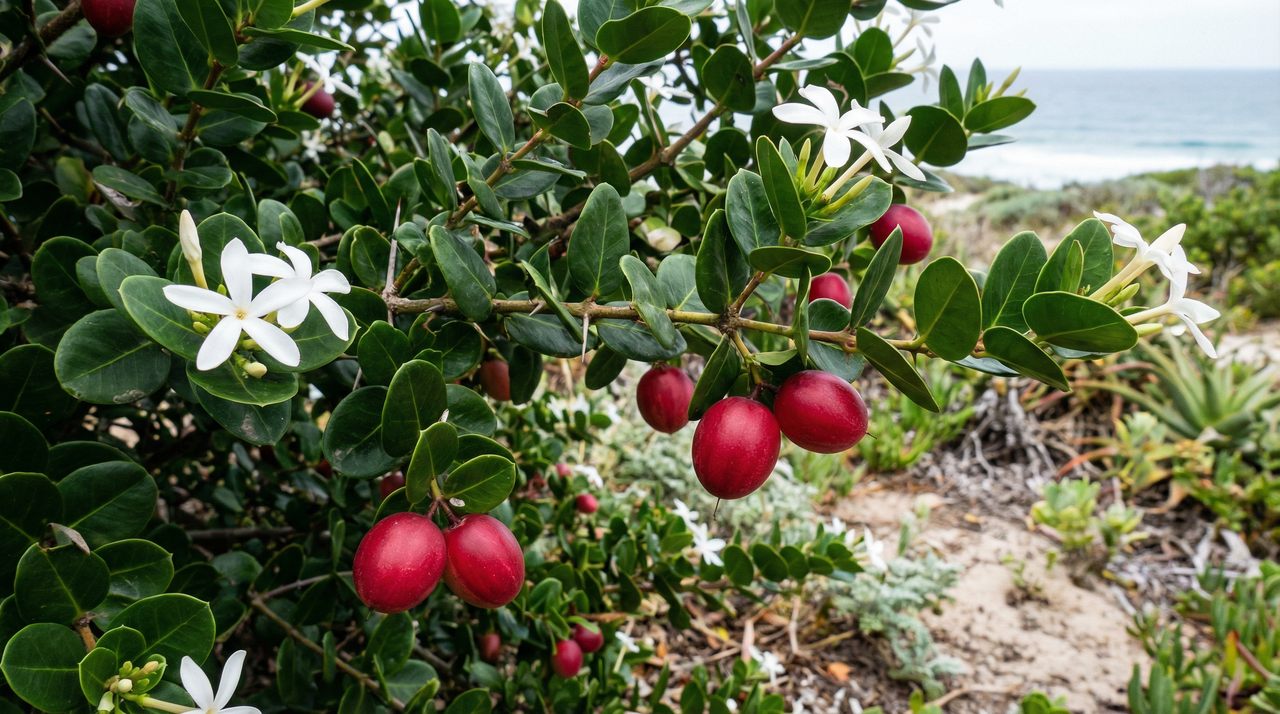
Every single person who has ever handed me a Natal Plum cutting has warned me about the thorns. Nobody warned me about the seeds. Ripe Carissa macrocarpa fruit looks like a small, glossy red plum, smells faintly of jasmine cut with ripe peach, and tastes like a cranberry that decided to be pleasant about things. It's genuinely good. But crack one of those seeds open and you're looking at cardiac glycosides, the same class of compounds that makes foxglove medically significant and potentially lethal.[1] The fruit pulp is edible. The seeds are not. That's a distinction most backyard foragers, and honestly most nursery tags, never bother to make.
I've grown Natal Plum in Central Florida for years, mostly as a security hedge along a fence line where I wanted something that would discourage both deer and uninvited guests. It does that job almost insultingly well. But somewhere along the way the fruit started coming in heavy enough that I had to actually think about it as food, which sent me down a research rabbit hole that changed how I understood this plant entirely. It's been circling the world as an ornamental for over a century, turning up in California suburbs and Hawaiian resort plantings and South Florida neighborhoods, and almost nobody outside of southern Africa is treating it as the edible it actually is.
Natal Plum Origin, History, and Traditional Uses
Botanical Background and Native Range
Carissa macrocarpa is a South African coastal native, found naturally from the Eastern Cape up through KwaZulu-Natal, generally hugging the shoreline below 100 meters elevation, where it colonizes rocky thickets, dune scrub, and forest margins with salty air and well-draining soils.[2][3][4] The broader genus Carissa extends that warm-climate story considerably: C. carandas (Karonda) is native to tropical and subtropical South Asia from India through Sri Lanka and into Southeast Asia, while C. opaca (Karanda) occupies the drier stretches of India, Pakistan, Afghanistan, and parts of southern Africa, and C. edulis spreads across tropical Africa and parts of South Asia.[5][6] What that geographic breadth tells you is that this genus as a whole is built for warmth, but C. macrocarpa specifically is a coastal humidity specialist.
The first formal botanical description came in 1821, when Christian Friedrich Ecklon placed it under the name Arduina macrocarpa; Alphonse de Candolle reclassified it into Carissa in 1844, where it's remained ever since.[7][8] Given the right conditions, this is a long-term investment: it's a polycarpic perennial evergreen with a lifespan reaching 20 to 50-plus years, bearing its first fruit around year two or three and hitting full maturity somewhere in years three to five.[6][9] I first noticed mine at a Central Florida nursery years ago, tucked between the bougainvilleas, and once I learned it was a South African coastal native, its love of our humid subtropical summers started making a lot more sense.
Visual Characteristics
The natal plum shrub is hard to miss once you know what you're looking at. It grows as a dense, rounded evergreen, typically reaching 10 to 15 feet in both height and spread, anchored by a deep taproot that can push one to two meters down with lateral roots spreading wide.[10][11] The paired thorns are what you notice first (usually because they've already found your forearm). They emerge at the leaf nodes, straight or slightly curved, running anywhere from one to five centimeters long. I learned to respect them after my first pruning session without thick gloves.
The foliage is simple, opposite, and unmistakably glossy, with leaves running two to seven centimeters long and a thick leathery cuticle that signals this plant's drought credentials clearly.[12][13] Flowers are white, star-shaped, five-petaled, and genuinely fragrant, showing up singly or in small clusters at branch tips; in warm climates they can appear nearly year-round rather than just spring through summer.[3] The fruit is the showstopper: an oval to round berry, two to five centimeters across, ripening from green to deep red or purple-red, with juicy sweet-tart pulp surrounding one to six flat, hard seeds.[11][14] The related Indian species C. opaca and C. carandas produce noticeably smaller, more acidic berries in the one to two and a half centimeter range; having tasted both, the natal plum plant is simply bigger, juicier, and more immediately enjoyable fresh off the branch.
Traditional and Cultural Uses
Zulu and Xhosa peoples have used this plant for generations, eating ripe fruit fresh, dried, or transformed into jams, jellies, preserves, and beverages, while the thorny branches were woven into living fences around homesteads as protection against animals and as cultural symbols of defense and fertility.[3][15] Medicinally, root and bark decoctions addressed stomach ailments, dysentery, constipation, chest pains, infertility, and menstrual disorders, while leaf and bark preparations went on wounds, skin conditions, toothaches, and snakebites.[16][15] The plant also carries ritual significance in some traditions, tied to prosperity and protection. I don't use it medicinally myself, but the ethnobotanical record from SANBI and peer-reviewed sources is consistent with patterns I've read across other Apocynaceae shrubs, and I try to approach that knowledge with genuine respect rather than casual curiosity.
Parallel traditions run through the genus: C. opaca and C. carandas both feature prominently in Ayurvedic, Unani, and tribal healing systems across India and Pakistan, where decoctions and poultices of roots, bark, and leaves treat digestive issues, fever, rheumatism, and wounds.[17][18] Wild populations of C. macrocarpa in KwaZulu-Natal face real pressure from overharvesting for both food and medicinal trade; while the species isn't currently IUCN-listed as threatened, that pressure is a genuine sustainability concern worth knowing about.[19]
Fun Facts and Ecological Notes
The natal plum's exceptional salt and drought tolerance, backed by its succulent leaf anatomy, is a big reason it traveled so successfully from South African dunes into warm-climate landscaping around the world, where it earns its keep as an ornamental, a security hedge, and a minor fruit crop.[20][21] That global spread comes with a warning, though. The species has naturalized and is considered invasive in Florida, Hawaii, and California, where it can push out native vegetation.[22][23] Living in zone 9B, I keep mine contained and scan regularly for volunteer seedlings, because birds and mammals (bulbuls, monkeys, rodents) eat the fruit enthusiastically and deposit seeds with some distance.[3][24] Responsible stewardship matters with this one.
Only the fully ripe pulp is safe to eat. The seeds contain cyanogenic compounds and are toxic if swallowed; all vegetative parts and the milky latex sap are equally hazardous. You'll notice this when cutting any part of the plant.[4][25] When I make jam, I harvest only berries that are fully crimson and give slightly under gentle pressure, and I remove every seed before the fruit goes anywhere near a pot. That habit isn't overcaution; it's just how you work with this plant safely.
Natal Plum Varieties and Cultivars
Notable Cultivars of Carissa macrocarpa
Unlike many edible plants where you'd flip through pages of named varieties optimized for flavor or yield, Carissa macrocarpa has no formally recognized botanical varieties at all.[26] What exists instead is a small handful of landscape cultivars selected almost entirely for hedge performance: size, thorniness, and looks. U.S. nurseries have largely treated this as an ornamental plant and bred it accordingly, which means fruit production has been an afterthought at best.
'Tuttle' is the one I encounter most often at Central Florida nurseries. It tops out around 3 to 5 feet, carries fewer thorns than the straight species, and fits comfortably into a zone 9-11 urban garden without swallowing the fence line.[27] It does fruit reasonably well in humid subtropical conditions, which makes it my default recommendation when someone wants both a security hedge and something edible. 'Boxwood Beauty' takes thornlessness further -- it's a low, tidy selection reaching 2 to 4 feet, suited to borders or containers, and it fruits reliably in warm climates without presenting much of a hazard to bare ankles.[28] I did once buy a mislabeled "Natal Plum" from a local garden center only to discover it was 'Variegata', the white-edged foliage form that requires vegetative propagation to hold its patterning.[29][30] Beautiful plant, but considerably more salt-sensitive than the green-leaved types -- not what I wanted for a coastal-exposure hedge.
Compare all of this to what Indian horticulturalists have done with the related Carissa carandas, and the contrast is striking. Karanda has received serious, fruit-focused breeding attention: recognized botanical varieties (var. carandas for smaller fruit, var. macrocarpa for larger), plus named cultivars like CO 1 from Tamil Nadu Agricultural University and Pant Sudarshan from G.B. Pant University, both selected for higher yields and regional performance. Under good management, improved lines can yield 10 to 25 tons per hectare.[31][32][33] Meanwhile Carissa opaca sits at the opposite end of the spectrum entirely -- no named cultivars, no recognized subspecies, just whatever natural variation growers find in wild populations.[34] The natal plum lands somewhere in between: not completely neglected, but not yet taken seriously as a food crop by Western nurseries.
Sourcing Natal Plum Plants and Seeds
Before you order anything, check where you garden. Florida and Hawaii both list Carissa macrocarpa as a Category I invasive species -- it naturalizes readily and can displace native vegetation -- so sale and transport are restricted in both states.[35][36] I'll be honest: I think the restriction makes sense. I've seen it escape hedgerows in South Florida, and I'd rather advocate for thoughtful use inside contained systems than pretend the risk doesn't exist. The plant is not federally noxious and carries no CITES restrictions, so for most of the continental U.S. it's a straightforward purchase.
Specialty nurseries are your most reliable route. Seed packets (typically 5 to 20 seeds) run $3 to $10; 1-gallon potted plants generally land in the $15 to $35 range, and 5-gallon specimens push $40 to $80.[37][38] Suppliers I've found consistently reliable include Logee's, Plant Delights Nursery, and Mountain Crest Gardens for potted stock, with Bakers Rare Seeds as a solid seed source.[39] Availability is seasonal and stock turns over quickly, so if you see it, don't wait. C. carandas and C. opaca are substantially harder to source in the U.S. and generally require digging through specialty tropical fruit or botanical suppliers.
Natal Plum Propagation and Planting Guide
Natal plum is genuinely easy to multiply once you understand what it's trying to do. The plant throws a few biological curveballs that can trip you up if you're not expecting them, but once you're in on the tricks, getting new plants going is straightforward work.
Propagation Methods for Natal Plum
The first time I grew natal plum from seed, I was puzzled to find three or four seedlings crowding up from a single planting hole. Turns out that's completely normal. Natal plum seeds are polyembryonic, each one often yielding two to five seedlings that are largely clonal copies of the mother plant through a process called nucellar embryony.[40][41] My practice now is to let them all emerge, then keep the strongest one or two and compost the runts. You get predictable genetics and free backup plants in a single go.
Using old, dried seed will absolutely defeat you. These seeds are recalcitrant, meaning they don't survive desiccation or cold storage well at all.[42] I've had bad luck with any seed that wasn't extracted fresh from a ripe fruit, and I've learned to sow within days of harvest. The seeds themselves are small oblong to kidney-shaped structures, four to eight millimeters long, dark brown to black at maturity, with a hard, shiny coat that creates physical dormancy.[43][44] Scarify them first, either with a gentle nick of sandpaper, a 30-minute hot water soak, or dilute sulfuric acid if you're comfortable with that. With scarification and fresh seed, germination runs 60 to 80 percent.[42] Sow in well-drained sandy loam, keep temps between 70 and 86°F, and maintain moisture without ever letting the medium stay soggy. You'll see sprouts in two to four weeks, and the seedlings are ready to transplant once they have four to six true leaves.[42] One observation I find useful in the nursery: young natal plum seedlings look surprisingly citrus-like at first, but those paired thorns show up early enough that mislabeling is hard to do if you're paying attention.
For most home growers who want fruit sooner and don't want to gamble on genetic variation, semi-hardwood cuttings are the method I'd reach for first. Natal plum, like related karonda, can also be started from seeds, air layers, grafts, or even tissue culture, but cuttings hit the sweet spot of accessible technique and reliable results.[42][45] Take stems around four to six inches long in late summer, dip the cut end in IBA rooting hormone at 1,000 to 3,000 ppm, and stick them in a sterile, fast-draining mix. Keep humidity around 70 to 80 percent and temperatures in the low 70s Fahrenheit, and you'll see roots in four to six weeks with success rates of 70 to 90 percent.[42][46] Air layering works well too, roughly 85 percent success in four to eight weeks using the standard girdling-plus-sphagnum-under-plastic setup.[42] Grafting onto compatible rootstocks like Carissa carandas or C. spinarum is the professional choice when early fruiting is the priority, with success rates of 50 to 80 percent and fruit coming in one to three years.[47] Tissue culture using shoot tips on Murashige-Skoog medium achieves impressive multiplication rates of four to six times per cycle but is really a commercial-scale tool, not something most gardeners will pursue at home.[48]
Soil, Site Selection, and Planting Guidelines
This plant evolved on coastal dunes in KwaZulu-Natal and the Eastern Cape, scraping by in low-nutrient sandy soils with salt wind and periodic drought.[49] That origin tells you everything about what it needs and, more critically, what it cannot tolerate. Natal plum wants well-drained sandy or loamy soil with two to five percent organic matter and a pH somewhere between 6.0 and 7.5, though it will manage in soils as acidic as 5.5 or as alkaline as 8.0.[42][3] Give it at least six hours of direct sun daily, and it will reward you. Part shade is tolerated, but fruit set suffers.
Drainage is genuinely non-negotiable. I've lost more than one hedge planting in heavy Florida clay before I learned to test drainage first and amend aggressively or build raised beds. Waterlogging triggers Phytophthora root rot fast, and by the time you notice the decline, the roots are already gone.[50] For containers, a 1:1:1 mix of potting soil, coarse sand or perlite, and peat or compost works well; in heavy garden soils, work in sand, grit, and compost before planting, or commit to a raised bed.[51] Related species like C. opaca share the same pH and drainage preferences, though they stay smaller and adapt to slightly more marginal conditions, which is useful to know if you're trialing the genus across varied spots in your landscape.[52]
Germination Timeline and Spacing Recommendations
Here's the decision that shapes your whole experience growing natal plum for fruit: seed-grown plants typically take three to four years to reach meaningful production, sometimes five.[50][40] Grafted plants can fruit in one to two years.[53] I made the mistake of starting my first plants from seed with an optimist's timeline in mind, and I waited. Now I buy grafted stock or graft my own, the same logic I apply with citrus. If you're patient and enjoy the propagation process, seed is fine. If you want fruit, buy or make a graft.
Spacing depends entirely on what you're asking the plant to do. For a dense security hedge, three to four feet between plants gets you that impenetrable barrier clients and homeowners actually want, and in my experience it's tight enough to knit together quickly while still admitting enough light for occasional fruit.[42][54] For dedicated fruit production where you want access to each plant and maximum yield, open the spacing to ten to fifteen feet. Mature specimens reach ten to fifteen feet tall with a spread of six to ten feet, so cramped planting eventually fights itself.[42] Plant in spring after the last frost threat has passed, into a well-prepared site with good airflow around the canopy. Airflow matters more than most people expect, and it directly supports the disease resistance that makes this shrub such a low-fuss edible landscape plant once it's settled in.
Natal Plum Care Guide
Most of what trips people up with natal plum comes down to over-managing a plant that evolved to look after itself. Its native habitat is coastal South African dune scrub, low nutrients, irregular rainfall, salt wind, and baking heat. Understanding that context is the key to not killing it with kindness.
Watering Needs for Natal Plum
Once established after the first year or two, natal plum is genuinely drought-tolerant.[6][43] Getting to that point requires patience. Young plants need about an inch of water per week, or a deep soak every seven to ten days during hot weather, keeping the soil moist but never soggy.[49] I stopped running on a watering schedule years ago and switched to the top-two-inches-dry test instead. Stick your finger in the soil; if the top inch or two is dry, water deeply. If it's still damp, walk away. That simple habit separates a lot of thriving plants from struggling ones.
Once mature, established plants in subtropical climates do well with a deep soak roughly every seven to ten days through the growing season, letting the top layer dry out between waterings.[6][55] In winter, back off significantly, just enough water to prevent the soil from going bone dry.[56] Overwatering tells on itself fast: yellowing leaves starting at the bottom of the plant, soft stems, and eventually root rot from Phytophthora in poorly drained soil.[6][55] Underwatering shows up first at the leaf tips and margins: browning, brittleness, and reduced fruit set.[20] For container-grown plants, water when the topsoil feels dry, confirm the pot has drainage holes, and never let it sit in standing water; deep watering encourages the root system to reach down rather than stay shallow.[6][55]
Sunlight and Light Requirements
Natal plum wants full sun, at least six hours of direct light daily, for reliable flowering and fruit production.[57] In the low-humidity heat of inland Arizona or during the brutal Florida afternoon sun of June and July, some filtered shade can prevent leaf scorch.[42] Heat stress shows as browning at the leaf margins and tips, yellowing, and sometimes bleached patches on the foliage.[58] Too little light produces the opposite problem: long, weak internodes, pale yellowing leaves, sparse blooms, and eventually poor fruiting.[6] I watch new leaf color and internode length as my primary light indicators rather than counting hours on a meter. If the new growth looks stretched or pale, the plant is telling you it wants more sun. When moving a plant from lower light to a sunnier spot, do it gradually over a few weeks to avoid shocking it.[59]
Heat Tolerance of Natal Plum
This is a plant built for heat. Natal plum fits comfortably in AHS Heat Zones 7 through 10, tolerating more than 90 days per year above 86°F.[6] Optimal growth happens between 60 and 85°F, and recovery from heat stress is noticeably faster on nights when temperatures drop below 70°F.[42] The flowering stage is the most vulnerable: extreme heat causes flower abortion and reduces pollinator activity, which directly hits fruit set.[60] If you're in Central Florida or coastal Southern California and you notice browning leaf margins, wilting, or sunscald patches on developing fruit during a heat spike, the response is straightforward: a 30 to 50 percent shade cloth over the plant through peak summer months, two to four inches of organic mulch at the base (kept a couple inches back from the trunk), and consistent but not excessive moisture.[61] The plant can handle temperatures up to around 104°F and thrives in the high humidity of subtropical coastal environments, which tracks with its origins.
Fertilizing Natal Plum
I've seen too many otherwise beautiful natal plum hedges turn into leafy, sprawling monsters that never set fruit because someone decided more fertilizer meant better performance. It does not. Natal plum is adapted to nutrient-poor sandy soils, so it's a moderate feeder at most.[62][42] It prefers well-drained sandy or loamy soil with a pH between 5.5 and 7.5, with the 6.0 to 7.5 range being optimal.[62]
The most common deficiency I've dealt with in Florida's slightly alkaline soils is iron chlorosis: young leaves turning yellow while the veins stay green, caused by the soil pH locking up iron above 7.5.[42] A soil test confirmed the issue on my plants, and a foliar chelated iron spray cleared it up within weeks. That's the kind of targeted response that actually works; blanket feeding usually doesn't. Over-fertilizing, especially with high-nitrogen formulas, drives vegetative growth at the direct expense of flowers and fruit, and the salt buildup from synthetic fertilizers shows as brown or blackened leaf margins, wilting, and stunted or misshapen fruit.[63][49] A balanced slow-release 10-10-10 applied in early spring and again in midsummer is sufficient for most established plants, with container-grown specimens getting half strength.[57] Stop fertilizing in fall entirely; pushing tender new growth before winter is asking for frost damage. Compost or well-rotted manure worked in around the drip line is a gentler organic option that also improves soil structure without the salt risk.[14]
Frost Tolerance and Cold Protection
Natal plum is hardy in USDA zones 9 through 11[6][11] and can shrug off brief dips down to 20 to 25°F without permanent damage.[6][64] Below 20°F, prolonged freezing causes real trouble: foliage browning or blackening, defoliation, stem dieback, and potential irreversible root damage.[65] Young plants are considerably more vulnerable than established specimens, and the roots are particularly sensitive to prolonged soil freezing.[42]
For zone 9b growers who occasionally push the edge, the practical toolkit is: four to six inches of organic mulch around the base (not touching the trunk), frost cloth draped over the shrub and supported by stakes, and burlap around the trunk on especially cold nights.[66][6] I've kept a couple of natal plums in large containers specifically so I can wheel them under cover when a hard freeze threatens. The effort is minor compared to losing an established in-ground shrub. Recovery pruning after light frost damage is straightforward once the plant resumes growth in spring.
Pruning, Maintenance, and Seasonal Care
Gloves are non-negotiable. The spines on natal plum are serious, and sharp sanitized tools are the other essential before you start.[67] The timing lesson I wish someone had drilled into me earlier: avoid heavy spring pruning. Cut aggressively in spring and you're removing the flowering wood, which means no fruit that year.[67] Bloom initiation is triggered by warming temperatures and lengthening days,[3] so the better window for any meaningful shaping is after fruit harvest in summer, cleaning up dead or crossing branches and encouraging a bushier form without sacrificing next season's flowers.
For natal plum hedge training, start clipping sides and tops two to three times per year from early on, working from the base upward to encourage lateral branching rather than leggy vertical growth. A formal, dense hedge is achievable in two to three years with consistent attention.[20] Remove suckers promptly or the plant will gradually spread into a thicket. Avoid pruning during wet seasons when open cuts invite fungal disease.[57] The post-harvest tidy-up in summer naturally sets the plant up for the cooler months ahead, and stopping fertilizer at the same time closes the loop on a year of sensible, low-intervention care.
Harvesting Natal Plum (Carissa macrocarpa)
When to Harvest: Ripeness Cues, Timing, and Regional Seasons
Color change is the obvious signal, but I've learned not to trust it alone. A natal plum that's gone deep red or purplish-black still needs a gentle squeeze. What you're looking for is a slight give, the same soft resistance you'd feel in a perfectly ripe plum. Then there's the smell. After several seasons growing these in Central Florida, I'll say the aroma is the most reliable cue I've found: when a fruit is truly ready, that intoxicating floral-peach fragrance is obvious from a few feet away, not just when you put it to your nose. The fruit takes roughly 8 to 10 weeks from flower to full maturity, and here in Florida that means the main harvest window runs August through November, though plants in optimal conditions will throw sporadic fruit year-round.[68][53] In South Africa the season runs December to March, following the southern hemisphere summer.[69] For context, related Karonda in India peaks February through May, a reminder of how the genus tracks warm seasons wherever it grows.[70] Younger plants won't give you a meaningful crop right away; reliable heavy production generally kicks in at 3 to 5 years old, so if you planted recently, patience is the first tool.[40]
How to Harvest Natal Plum
Pick in the dry morning hours. The latex in the skin is real, it will stain your clothes and can irritate sensitive skin if you're rough with it, so I always wear gloves and handle each fruit gently. A soft twist-and-pull usually detaches ripe fruit cleanly; for fruit deeper in the canopy, clean pruning shears let you cut without wrestling the thorns.[71] Don't strip more than a third of the fruit in a single pass, and in heavy-bearing years I'll thin small green fruits down to roughly four to six inches apart to push size and sweetness into what remains.[71] The thorns on a mature hedge are serious; long-handled pruners save your arms and protect fruiting wood you'd rather not accidentally snap.
Flavor, Texture, Yield, and Storage
Ripe natal plum fruit runs about two to three inches across, glossy-skinned, and juicy inside with a sweet-tart flavor that most people immediately clock as cranberry-adjacent, maybe cranberry-raspberry with a tropical floral edge.[72][73] The aroma up close is genuinely stunning: jasmine, peach, apricot, hints of orange blossom. It intensifies with every degree of ripeness, which is another reason to wait for full color and softening rather than harvesting early.[72] The seeds are hard, bitter, and need to come out; I strain them when cooking and spit them fresh. The cyanogenic compounds are dangerous if swallowed, and their genuine bitterness is the main reason under-ripe fruit tastes so harsh compared to fully ripened Karonda relatives I've tried.[74]
A mature plant can produce 50 to 200 fruits per season depending on size and growing conditions.[68] For storage, air-dry the harvested fruit for 24 hours and then refrigerate at 50 to 59°F with high humidity; handled this way, they'll hold one to two weeks.[75] Avoid colder temperatures since chilling injury sets in below that range and turns the texture mealy fast.[75]
Natal Plum Preparation and Uses
Only the fully ripe natal plum pulp is edible, and the seeds must come out.[11][42] I only use fruit that's gone fully deep red, nearly purple-black, and I discard every seed before cooking or eating fresh. The latex-rich skin is sticky when you cut into it, so I've learned to wear gloves during processing. It's a small habit that saves you a lot of frustration.
Culinary Uses and Flavor Profile
Think cranberry with a floral back note and a hint of something almost stone-fruity. That's the closest I've landed on when describing the natal plum fruit to someone who hasn't tasted it yet. That sweet-tart profile is what makes it such a natural fit for jams, jellies, chutneys, pies, sauces, and cordials.[76][77] Sugar and pectin do the heavy lifting with ripe fruit, mellowing any residual astringency into something genuinely pantry-worthy. A short cook with spices or vinegar handles the rest.[72][44]
Across the Carissa genus, you see the same logic applied differently depending on ripeness. Related species like Karonda are often pickled green, when they're too sour to eat fresh, while the ripe fruits go into murabbas, squashes, chutneys, and wines.[78][79] In African traditions, sun-drying and fermentation are standard post-harvest treatments for sweetening the fruit further before processing into beers or preserves.[80][81] The genus is far more embedded in Indian and African food traditions than most Western gardeners realize.[82]
Medicinal and Traditional Preparations
For safe kitchen use, boiling the pulp for five to ten minutes is a reasonable precaution that inactivates potential irritants, and it's my standard first step when I'm cooking down a batch for jam.[42][83] Roasting, fermenting, salting, and processing into syrups or preserves are all established methods across the genus for both flavor and safety.[84] Traditional medicinal preparations, including decoctions from roots and bark, carry real toxicity risks that go well beyond kitchen use; the health benefits section covers those in detail.
Non-Food Uses
I've grown natal plum as a security hedge for years, and once it fills in, it's genuinely impenetrable. The density and the paired thorns do work that a chain-link fence can't replicate aesthetically.[6][85] Beyond the living fence role, the hard wood finds use in tool handles, small implements, and fishing gear, and root extracts yield dye in some regional traditions.[43] A plant that feeds you, guards your property, and supplies raw materials from the same footprint is exactly what a permaculture system is built around.
Natal Plum Health Benefits and Medicinal Uses
I'll be honest: when I first planted Natal Plum in my Central Florida garden, I thought of it primarily as a security hedge with a bonus fruit. The more I dug into its traditional uses and the growing body of preclinical research, the more respect I developed for this thorny little shrub. The science is genuinely interesting. But it comes with some serious caveats that every grower needs to understand before reaching for anything other than the ripe fruit.
Traditional Medicinal Uses in African Communities
Long before any laboratory got involved, Zulu and Xhosa healers in southern Africa had worked out a fairly sophisticated plant pharmacy from Carissa macrocarpa. Roots were prepared for dysentery and other stomach complaints, and as an emetic; leaves were applied topically for wounds, sores, and inflammation; and ripe fruits were eaten both for nutrition and their mild laxative effect. The plant also found use as a traditional cardiac tonic, for rabies treatment, and for venereal disease.[86][87] What strikes me about that list is how well it maps onto the pharmacological activities researchers have since identified in the lab. These communities were working from generations of empirical observation, and the chemistry largely backs them up.
Key Phytochemicals and Their Roles
Its medicinal reputation stems directly from a remarkably diverse secondary metabolite profile. Flavonoids like quercetin and kaempferol[88][89] and phenolic acids including chlorogenic, caffeic, gallic, and ellagic acid[88][89] are largely responsible for the antioxidant activity. Terpenoids, including lupeol, beta-amyrin, and ursolic acid, add anti-inflammatory weight.[88][89] Saponins, tannins, and indole alkaloids round out the profile.[88][90] Then there are the cardiac glycosides, compounds like carissone and 3-epi-ouabigenin concentrated in the roots and stem bark, which explain both the traditional cardiac-tonic use and the plant's genuine toxicity risks.[91][92] Their mechanism is essentially the same as digitalis, inhibiting the Na+/K+-ATPase pump. That's why I never experiment with leaves or roots and why I advise clients to treat everything except the ripe fruit as strictly ornamental.
These compounds aren't static. Heat, drought, and salinity stress generally upregulate defensive secondary metabolites like phenolics and terpenoids.[93][94] In a Florida summer, that plant is working hard chemically, which is fascinating from a permaculture lens but also a good reminder that the non-edible parts deserve consistent respect regardless of season.
Scientific Research on Pharmacological Activities
The preclinical research on Natal Plum covers a lot of ground. Extracts have demonstrated anti-inflammatory activity through inhibition of TNF-alpha, IL-6, NF-kappaB, and COX-2 pathways in both cell models and animal studies.[88][95] Antioxidant activity is strong, with free-radical scavenging comparable to ascorbic acid and upregulation of endogenous antioxidant enzymes via the Nrf2 pathway.[96][97] Analgesic effects have shown up in multiple animal pain models, suggesting both peripheral and central mechanisms.[98][99] There's also antimicrobial activity against both gram-positive and gram-negative bacteria plus fungi[100][101], antidiabetic potential through alpha-glucosidase inhibition and improved insulin sensitivity[102], hepatoprotective effects in liver-damage models[99], and cytotoxic activity against certain cancer cell lines via apoptosis pathways.[97][101]
That's an impressive range of activity. But nearly all of it comes from in vitro assays and rodent studies. No large-scale human clinical trials exist, and the evidence base doesn't yet support therapeutic recommendations for any of these uses.[88][103] I find the anti-inflammatory and antidiabetic findings particularly exciting, but I've never used this plant medicinally beyond eating the occasional ripe fruit. The cardiac risks and the absence of human trials make it too uncertain to recommend to clients as an herbal remedy. These are research leads worth following, not treatments.
Nutritional Profile of the Fruit
The ripe fruit pulp is where things get practical and safe. A 100g serving delivers around 35 kcal with 7.1g of carbohydrates, 1.9g of fiber, and modest protein.[104][105] Vitamin C ranges from 17 to as high as 47 mg per 100g in fully ripe fruit[106][107], which puts it comfortably in the same ballpark as cranberries. I find that comparison useful when talking to clients because it grounds the numbers: this isn't a superfood headline, but it's a genuinely nutritious small fruit. Potassium comes in at 215 mg per 100g, alongside meaningful amounts of calcium, magnesium, and phosphorus.[108][109] The fruit's phenolic and flavonoid content is also notable, contributing to its antioxidant capacity.[108] One practical note: cooking reduces vitamin C by 20 to 30 percent[110], which is why I prefer eating fully ripe fruit fresh when I can get it. The seeds, though, are a different story entirely.
Safety Considerations and Toxicity
The safety picture for Natal Plum is really two separate stories depending on which part of the plant you're dealing with. Fully ripe fruit pulp, deep red, soft to the touch, with seeds removed, is safe to eat.[10][72] Everything else, including unripe fruit, seeds, leaves, stems, bark, roots, and that milky latex sap, contains cardiac glycosides, cyanogenic glycosides, alkaloids, saponins, and tannins at concentrations that pose real toxicity risks.[10][111] I always tell people: if you are not certain the fruit is fully ripe and you haven't removed every seed, don't eat it. The seeds specifically contain cyanogenic glycosides that can release cyanide if chewed.[112]
The sap deserves its own mention. Carissa latex can cause contact dermatitis, with redness, itching, and blistering, so gloves are non-negotiable when pruning or handling cut stems.[113][114] Pregnant women should avoid all parts of the plant; animal studies have shown embryotoxic effects and potential uterine stimulant activity.[115] Ingestion of toxic parts in humans causes gastrointestinal symptoms and potentially serious cardiac arrhythmias that can escalate to heart failure.[116] The plant is toxic to dogs, cats, and livestock as well.[117] Anyone on cardiac medications, antihypertensives, or diuretics should be aware of potential interactions from the glycoside content if they choose to use any part medicinally, and that use requires professional supervision without exception.[118]
In my landscape design work, I've seen homeowners confuse young Carissa with oleander, which shares the same milky sap and similarly toxic profile. Always check for the characteristic forked spines before assuming identification, and treat any uncertainty as a reason to keep children and pets well away until you're confident in what you're growing.[119][120]
Natal Plum Pests and Diseases
Natural Defenses and Overall Resistance
Natal plum comes to the landscape pre-armed in a way that most edible shrubs simply don't. The paired thorns and thick, waxy leaves make physical deterrence obvious, but the real secret is chemical: the plant's latex contains cardenolides, alkaloids like 3-acetylocarpaine, and a suite of other secondary metabolites that make most insects and browsing animals take one taste and move on.[40][121][122] I think about it like comparing this plant to citrus or hibiscus, which are essentially open buffets for pests. Carissa is more like a hedgehog that also happens to be poisonous. That resilience is inherent to the species, though; no cultivars have been specifically bred for enhanced pest resistance, so the tolerance you're getting is baked in rather than selected for.[123] One practical note that belongs here: those same chemical defenses mean all parts except the ripe fruit are toxic, and the thorns are serious enough that I keep a dedicated pair of thorn-proof gloves just for Carissa pruning.[124] Children and pets should know the ripe berries are the only safe part to touch. The ripeness and toxicity details are covered thoroughly in the health benefits section. Birds figure this out quickly and flock to the fruit, which is lovely for wildlife habitat but does mean some cleanup under the plant.[125]
Common Pests and Management
Stress is the common thread. A well-sited, well-watered natal plum will shrug off most insect pressure, but crowd it, drought it, or push it into zone 9's cold margins, and sucking insects find their opening. Aphids, scale, mealybugs, whiteflies, and spider mites are the usual suspects; scale infestations often lead to sooty mold coating the leaves, and spider mites tend to flare during hot, dry spells when the plant is already under heat stress.[126][127] In my Central Florida garden, the worst outbreaks I've seen have almost always followed a crowded planting where air can't move, or a dry stretch where I let irrigation slip. Fruit flies can damage the berries in some regions, though natal plum holds up better than its relative karonda (Carissa carandas), which is also more vulnerable to fruit borers, leafhoppers, and caterpillars.[128][129]
My IPM approach is straightforward: cultural prevention first, biological controls second, targeted sprays only when those two fail. Good spacing, occasional selective pruning for airflow, and drip irrigation rather than overhead watering eliminate most of the conditions pests need to establish.[42] Ladybugs and lacewings handle minor aphid pressure without any intervention from me. For scale or mealybugs that get ahead of the beneficials, neem oil or insecticidal soap applied in the cooler part of the day is usually enough. I rarely need anything stronger than that.[130] Systemic insecticides like imidacloprid are an option for severe outbreaks, but I'd exhaust every other avenue first given how much pollinator activity these flowers attract.
Disease Susceptibilities and Prevention
Natal plum's overall disease resistance is genuinely good, but it has one serious weakness: root and crown rot caused by Phytophthora and Pythium.[72][126] I've lost young plants to this, and it's the reason I now never put a natal plum in the ground without confirming the site drains sharply or mounding the planting area first. Soggy roots will kill this plant more reliably than almost any pest or pathogen combined. Fungicides like mefenoxam can treat confirmed outbreaks, but no spray fixes a drainage problem.[131]
Once drainage is sorted, the next concern is foliar. Leaf spot (Cercospora, Alternaria), anthracnose, and powdery mildew all flare when humidity climbs above 80%, air circulation is poor, or overhead irrigation keeps foliage wet.[132][133] If you're seeing dark spots or early defoliation and wondering about natal plum leaves turning red or discoloring, humidity and poor airflow are the first things to investigate before reaching for a copper spray. Root-knot nematodes (Meloidogyne spp.) are a moderate risk in sandy soils, showing up as stunting and reduced vigor; bacterial and viral diseases are uncommon and almost always stress-triggered.[134] The entire disease prevention strategy comes down to drainage, spacing, and soil moisture held around 50-60% field capacity.[131][135] Everything covered in the care guide about irrigation and airflow is doing double duty as disease prevention.
Natal Plum in Permaculture Design
What I keep coming back to with natal plum is that it solves multiple design problems simultaneously without requiring much in return. It's the kind of shrub that earns its space in a subtropical food forest before you've even harvested a single berry, purely on the strength of everything else it's doing around it.
Climate and Hardiness Zones for Natal Plum
Carissa macrocarpa is genuinely reliable in USDA zones 10b through 11, where winter lows stay comfortably above 30°F and fruit production becomes something you can count on season after season.[40][11] Winter temperatures must stay consistently above freezing to avoid plant loss, and fruiting requires winters that stay consistently above freezing.[49][6] Zone 9b is workable, but only if you're strategic about placement.[136]
I've grown natal plum both as a free-standing shrub and tucked against a south-facing masonry wall in marginal zone 9 conditions. The difference after a light frost event is striking: the wall-backed plants would flower and fruit without missing a beat, while the exposed ones needed heavy pruning to clear the damaged wood before they'd recover. If you're pushing the edges of the range, a thermal mass at your back is worth more than any amount of mulch.
The plant's coastal origins explain a lot about where it thrives. It performs best with 25 to 60 inches of annual rainfall and moderate humidity, and its salt tolerance is exceptional, genuinely one of the toughest edible shrubs you can plant near the ocean.[137][138] Move it inland and you're asking it to tolerate greater temperature swings and dry heat that don't suit it nearly as well.[139] It reminds me of pineapple guava in that way: both plants reward gardeners who can approximate their preferred humid, salt-touched coastal air far more than those trying to coax them through the baking summers of an inland suburb. Once established, it handles drought well enough, but vigor and fruit set noticeably improve when humidity stays on the moderate side.
The related Carissa carandas stretches this picture into drier territory, tolerating 20 to 50 inches of rainfall and withstanding heat up to 113°F, but it shares the same frost vulnerability threshold near 20°F.[140][82] Knowing that the whole Carissa genus sits in this warm-climate niche helps calibrate expectations: none of these are plants you're sneaking into zone 7.
Ecosystem Functions and Guild Placement
The ecological resume here is genuinely impressive. Those fragrant white star flowers attract bees, butterflies, and a range of other pollinators across much of the year, and the dense thorny structure gives birds excellent nesting cover and protection from predators.[43][3] Birds and mammals then disperse the seeds, so the plant is actively recruiting wildlife partnerships at multiple points in its life cycle.[141] This pattern holds across the whole genus: C. carandas, C. bispinosa, C. edulis all play similar roles as tough, thorny, bird-friendly mid-layer shrubs in their native savannas and dry forests.[15]
For slope stabilization and soil structure, the strong taproot and dense root system do real work.[3][85] I want to be clear, though: natal plum is in the Apocynaceae family and does not fix nitrogen. It's not a dynamic accumulator in any meaningful sense, so don't build your soil-fertility strategy around it. Place it for structure, wildlife support, and erosion control, and feed your system's nitrogen needs through legumes and other proven fixers nearby.
Because natal plum is self-incompatible, a single isolated plant tends to drop most of its flowers without setting fruit.[43] After watching exactly that frustration play out in a garden I was managing, I now always install at least two different seedlings or cultivars within 30 feet of each other. It's a small design decision that makes a big difference in yield. Where pollinators are scarce, hand-pollinating is also worth the effort.[15]
On the living fence side, natal plum has few rivals for sheer deterrent value: it forms impenetrable thorny hedgerows that work as windbreaks and security barriers while also feeding wildlife and producing fruit you can eat.[120][137] The one honest caveat, especially for Florida gardeners: it can naturalize beyond your intended planting area. I keep my plants contained to a hedge line and make sure fallen fruit doesn't get the chance to establish on untended ground. That kind of intentional siting isn't paranoia; it's just responsible stewardship of a plant that's genuinely good at spreading itself.[11]
Forest Layer and Companion Planting for Natal Plum
In a subtropical food forest, natal plum belongs solidly in the shrub layer. It typically reaches 10 to 15 feet tall, occasionally stretching to 20, and it tolerates up to 50 to 70 percent canopy shade, though flowering and fruiting are best in full sun to light shade.[49] That shade tolerance gives you real flexibility when siting it under a loose canopy of fruit trees, but if fruit production is your goal, don't bury it too deep in the shade.
In its native range across the coastal thickets, bushveld, and forest margins of South Africa, Mozambique, and Kenya, it occupies exactly this mid-layer niche.[142][3] Translating that into a designed guild means pairing it with taller canopy species that don't cast heavy shade, letting nitrogen-fixing plants handle soil fertility nearby, and using its thorny perimeter habit to define the edges of your productive space. The dense growth that creates ideal bird habitat also makes ripe fruit easy to spot at harvest time: once you know the deep red color you're hunting for, it pops right out of that glossy foliage.
To reiterate what I mentioned above, because it comes up often in permaculture forums: no Carissa species fix nitrogen.[143][144] The related karonda (C. carandas) shares the agroforestry value as a living fence and edible hedge, and it actually prefers more sun with less shade tolerance than macrocarpa.[145] If you're in a drier inland climate where macrocarpa struggles, karonda might fit your site better, but the soil-building role of either one relies on companions, not on the plant itself doing that work.
The Hedge That Fed Me by Surprise
I planted my first Natal Plum as a barrier, honestly, not a food source. It was a security decision, a thorny perimeter around a corner I didn't want foot traffic near. Then one August morning I reached in past those paired spines to pull a ripe berry, ate it standing in the heat, and thought: I've been sleeping on this plant. That single fruit tasted like a cranberry that had spent a summer near the ocean, and I've never looked at a "landscape shrub" the same way since.
Sources 145
- Phytochemistry and Pharmacological Properties of Carissa macrocarpa ↩
- Plants of the World Online - Carissa macrocarpa ↩
- Carissa macrocarpa (Natal Plum) ↩
- Natal Plum (Carissa macrocarpa) ↩
- Flora of India - Carissa opaca ↩
- Carissa carandas (Karonda) ↩
- Prodromus Systematis Naturalis Regni Vegetabilis ↩
- Plants of Southern Africa: Names and Distribution ↩
- Carissa macrocarpa (Natal Plum) ↩
- Carissa macrocarpa (Natal Plum) ↩
- USDA PLANTS Database - Carissa macrocarpa ↩
- Kew - Plants of the World Online (POWO) ↩
- Carissa macrocarpa - Natal Plum ↩
- Natal Plum - University of Florida IFAS Extension ↩
- Ethnobotany of the Num-Num (Carissa macrocarpa) in Southern Africa ↩
- Traditional Uses of Carissa macrocarpa in South African Folk Medicine ↩
- Carissa carandas L.: A plant with great therapeutic potential for metabolic diseases ↩
- Traditional Uses of Carissa opaca in India ↩
- Conservation Status and Ethnobotany of Natal Plum (Carissa macrocarpa) ↩
- Natal Plum -- Carissa macrocarpa ↩
- Salt Tolerance of Landscape Plants ↩
- Florida's Invasive Species ↩
- Invasive Plants of California ↩
- Seed Dispersal by Vertebrates in South African Coastal Forests ↩
- Edible and Poisonous Plants of South Africa ↩
- Plants of the World Online ↩
- Carissa macrocarpa 'Tuttle' ↩
- Carissa macrocarpa 'Boxwood Beauty' ↩
- Royal Horticultural Society Plant Finder ↩
- UF/IFAS Extension - Carissa macrocarpa ↩
- Carissa carandas: Cultivation and Varieties ↩
- Improved Cultivars of Karonda ↩
- Pant Sudarshan: A New Variety of Karonda ↩
- Carissa opaca ↩
- Carissa macrocarpa Plant Profile ↩
- Florida's Most Invasive Species ↩
- Carissa Macrocarpa - Natal Plum ↩
- Carissa Macrocarpa - Natal Plum ↩
- Natal Plum (Carissa macrocarpa) for Sale ↩
- Natal Plum: Carissa macrocarpa ↩
- Seed Biology of Carissa macrocarpa ↩
- Propagation of Natal Plum (Carissa macrocarpa) ↩
- Carissa macrocarpa ↩
- Seed Dormancy and Germination of Carissa macrocarpa ↩
- Propagation of Carissa Species: A Review ↩
- Home Propagation of Natal Plum ↩
- Propagation of Carissa Species by Grafting Techniques ↩
- Micropropagation of Carissa macrocarpa through Tissue Culture ↩
- Natal Plum (Carissa macrocarpa) Growing Guide ↩
- Carissa macrocarpa - Missouri Botanical Garden ↩
- Carissa macrocarpa Care Guide ↩
- Carissa opaca: A Review of Its Cultivation and Uses ↩
- Natal Plum Cultivation Guide ↩
- Natal Plum Care and Planting Guide ↩
- Natal Plum Care - University of Florida IFAS Extension ↩
- Carissa macrocarpa - RHS Gardening ↩
- Carissa macrocarpa - Missouri Botanical Garden ↩
- Missouri Botanical Garden Plant Finder - Carissa macrocarpa ↩
- Carissa carandas - Karonda ↩
- Carissa macrocarpa ↩
- Natal Plum: Carissa macrocarpa ↩
- Natal Plum - Carissa macrocarpa ↩
- Carissa macrocarpa Plant Profile ↩
- Frost Tolerance of Subtropical Fruits and Ornamentals ↩
- Frost Damage on Subtropical Plants ↩
- Frost Protection for Subtropical Plants ↩
- Pruning Natal Plum (Carissa macrocarpa) ↩
- Carissa macrocarpa - Natal Plum ↩
- Natal Plum Production ↩
- Karonda (Carissa carandas): A Potential Fruit Crop for Arid and Semi-Arid Regions ↩
- Carissa macrocarpa cultivation and uses - Peer-reviewed study (J. Ethnobiology & Ethnomedicine, 2019) ↩
- Natal Plum (Carissa macrocarpa) ↩
- Carissa macrocarpa Fruit Characteristics and Uses ↩
- Karonda (Carissa carandas): Nutritional and Medicinal Properties ↩
- Natal Plum (Carissa macrocarpa) Harvesting and Storage ↩
- Carissa macrocarpa - Natal Plum ↩
- Carissa macrocarpa - Ethnobotanical Uses ↩
- Fruits of India: Karonda ↩
- Edible Fruits of India ↩
- Ethnobotanical Uses of Carissa Species ↩
- Flora of Zimbabwe - Entry on Carissa edulis ↩
- Carissa carandas - Useful Tropical Plants Database ↩
- Culinary and Medicinal Uses of Karonda (Carissa carandas and Carissa opaca) ↩
- Carissa opaca - Useful Tropical Plants Database ↩
- Carissa macrocarpa - Natal Plum ↩
- Carissa macrocarpa (Ehrh.) R. Br.: Phytochemical and Pharmacological Review ↩
- Ethnobotanical Survey of Medicinal Plants Used by Zulu Traditional Healers ↩
- Phytochemical and Pharmacological Investigation of Carissa macrocarpa ↩
- Secondary Metabolites from Carissa species: A Review ↩
- Phytochemical and Pharmacological Review of Carissa Species ↩
- Cardiac glycosides from Carissa macrocarpa and Na+/K+-ATPase inhibition ↩
- Phytochemical and pharmacological review of Carissa species ↩
- Phytochemical Variation in Carissa Species Under Environmental Stress ↩
- Secondary Metabolites of Carissa opaca: Seasonal and Geographic Variations ↩
- Anti-inflammatory and antioxidant activities of Carissa macrocarpa leaf extracts ↩
- Antioxidant and Anti-inflammatory Properties of Natal Plum ↩
- Antioxidant and anti-inflammatory activities of Carissa macrocarpa leaf extracts ↩
- Analgesic and Phytochemical Analysis of Carissa Fruits ↩
- Hepatoprotective and analgesic effects of Carissa macrocarpa in animal models ↩
- Antimicrobial Screening of Carissa macrocarpa Extracts ↩
- Antimicrobial and anticancer properties of Carissa macrocarpa saponins ↩
- Antidiabetic effects of Carissa macrocarpa in streptozotocin-induced diabetic rats ↩
- Pharmacological potential of Carissa macrocarpa: A review ↩
- Nutritional Composition of Selected Underutilized Indigenous Fruits from Nkonkobe Municipality, South Africa ↩
- Nutrient Content of Carissa Fruits (Carissa macrocarpa) ↩
- Nutritional Evaluation of Carissa macrocarpa Fruits ↩
- Biochemical Composition of Natal Plum (Carissa macrocarpa) ↩
- Phytochemical Profiling and Antioxidant Activity of Carissa macrocarpa Fruits ↩
- Nutritional Composition and Bioactive Compounds in Natal Plum (Carissa macrocarpa) ↩
- Effect of Ripeness and Processing on Nutrients in Natal Plum ↩
- Cardiac Glycosides from Carissa sp. – A Review of Their Chemistry, Pharmacology, and Toxicology ↩
- Cyanogenic Glycosides in Carissa species: Toxicity and Biosynthesis ↩
- Plant Finder: Carissa macrocarpa ↩
- Contact Dermatitis from Plant Saps ↩
- Carissa edulis Vahl.: A review on its ethnomedicinal uses, phytochemistry, pharmacological and toxicological activities ↩
- Human Poisoning from Natal Plum ↩
- Toxic and Non-Toxic Plants ↩
- Phytochemistry, Pharmacology, and Nutraceutical Profile of Carissa Species: An Updated Review ↩
- Distinguishing Carissa macrocarpa and Carissa spinarum ↩
- Natal Plum (Carissa macrocarpa) ↩
- Chemical Defenses in Apocynaceae: Implications for Pest Resistance ↩
- Phytochemical investigation of Carissa macrocarpa leaves ↩
- Carissa carandas: Botany, Horticulture and Utilization ↩
- Toxic plants: Carissa species ↩
- Carissa macrocarpa - Missouri Botanical Garden ↩
- Pests and Disorders of Natal Plum ↩
- Natal-Plum – Gardening Solutions ↩
- Melon Infestation Impact on Carissa macrocarpa Fruit Production ↩
- Pests and Diseases of Karonda (Carissa carandas) ↩
- Pests and Diseases of Ornamental Plants ↩
- Diseases and Pests of Ornamental Plants: Carissa Species ↩
- Fungal Leaf Spots on Tropical Plants ↩
- Pests and Diseases of Natal Plum ↩
- Carissa macrocarpa - Invasive Plant Factsheet ↩
- Environmental Factors Affecting Plant Disease in Ornamentals ↩
- Missouri Botanical Garden – Plant Finder ↩
- Growing Natal Plum in the Home Landscape ↩
- Journal of Coastal Horticulture – Salt‑Spray Tolerance of Carissa macrocarpa (2021) ↩
- Carissa macrocarpa (Natal Plum) ↩
- Carissa carandas (karonda) ↩
- Pollination Ecology of Carissa macrocarpa ↩
- Plants of the World Online - Carissa macrocarpa ↩
- Agroforestry Uses of Natal Plum - FAO Agroforestry Guide ↩
- Carissa carandas: A multipurpose shrub ↩
- Karonda (Carissa carandas) Cultivation Guide ↩