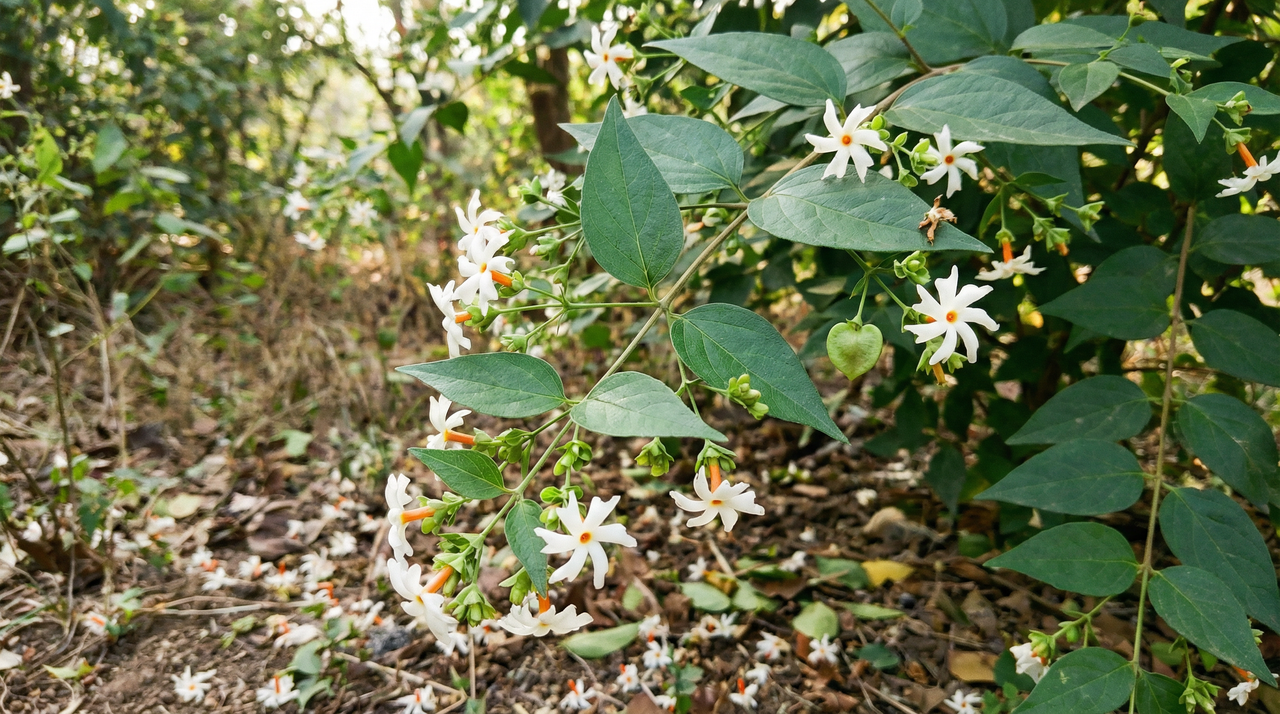
Every morning during flowering season, I'm outside before the birds get loud, crouching under the branches with a basket, picking up flowers off the ground. Not cutting them. Picking them up. Because night-flowering jasmine (Nyctanthes arbor-tristis) doesn't hold onto its blooms; it lets them go. The flowers open at dusk, fill the dark with something close to cardamom and tuberose, and by the time the sky starts to lighten, they've already fallen. The whole tree sheds its flowers nightly like it's completing a small, quiet transaction with the world, and if you're not there to receive them, you've missed it until tomorrow.
That habit is why its Sanskrit name translates, roughly, to "tree of sorrow," and why Hindu mythology wove it so deeply into stories of loss and longing. But here's what strikes me every time I grow it: a plant that carpets the ground in fragrant white flowers every single morning isn't expressing grief. It's being extraordinarily generous on its own terms. Understanding those terms, the nocturnal timing, the frost sensitivity, the very particular cultural and ecological role it fills, is exactly what separates a gardener who loses this plant in year one from one who builds a whole morning ritual around it.
Origin and History of Night-flowering Jasmine
Botanical Background and Native Habitat
Night-flowering jasmine (Nyctanthes arbor-tristis) is a child of monsoon country. Its native range spans the tropical and subtropical regions of South Asia, from India and Bangladesh to Nepal, Pakistan, and Sri Lanka, where it grows as a pioneer species in deciduous forests, scrublands, and woodland edges at elevations up to about 1500 to 2000 meters.[1][2][3] The annual rainfall rhythm it evolved under, 1000 to 2500 mm concentrated in the June-to-September monsoon, followed by a pronounced dry season, is the key to understanding how it behaves in cultivation anywhere else in the world. That boom-bust water cycle shaped everything about its timing and habit.
In its home landscape, this is a perennial deciduous shrub or small tree, typically reaching 2 to 10 meters tall, with a lifespan that can stretch 20 to 50 years or longer with good care.[1][4] It's polycarpic, meaning it flowers repeatedly across its life rather than dying after a single reproductive effort, and will typically begin blooming one to two years after planting, hitting its stride around year three to five.[5] Fruiting produces small bilobed capsules that mature between October and January and disperse by wind through the dry season. That's a plant playing a long, patient game, and I find that context genuinely useful when I'm managing a young specimen that seems slow to perform.
The two make-or-break factors I always come back to are drainage and frost tolerance. It wants well-drained, fertile loamy soil, a pH between 6.0 and 7.5, temperatures holding between 15 and 40°C, and full sun.[6] Below that temperature range it sulks; a hard frost can be lethal. I treat it the same way I treat a plumeria or a tender hibiscus: borderline survivors that reward thoughtful siting but don't forgive neglect in a cold snap.
Visual Characteristics
The flowers are the whole conversation with this plant. Small, maybe 1.5 to 2 inches across when fully open, each one carries a slender orange-red corolla tube contrasting against spreading white lobes.[7][2] They open at dusk and abscise by morning, a strictly nocturnal habit that sets it completely apart from the day-blooming Jasminum species most gardeners know.[8] Blooming peaks September to October during the late monsoon into early winter. I've noticed the fragrance is most intense on warm, humid evenings right after a daytime rain, when the air seems to carry the scent far beyond where you'd expect. By morning, the ground beneath can be carpeted in white and orange, and I look forward to that sight every autumn more than I expected to when I first planted one.
The rest of the plant is handsome without being showy. A mature specimen typically reaches 3 to 4.5 meters, occasionally stretching to 6 meters in good conditions, with rough greyish-brown bark on characteristically quadrangular, opposite-branching stems that are green and pubescent when young.[9][2] The leaves are opposite, ovate to cordate, 6 to 12 cm long, dark green and rough on top, paler and hairy beneath.[10] Crush a leaf and you'll notice only a mild herbaceous scent. The real reward truly only arrives after dark.
Traditional, Cultural, and Mythological Significance
The earliest records of Nyctanthes arbor-tristis appear in the ancient Ayurvedic text the Charaka Samhita, placing its medicinal recognition somewhere around 300 BCE to 200 CE.[1][11] Its mythological life runs even deeper. In the Vishnu Purana and Bhagavata Purana, it's known as Parijat, the celestial tree that Lord Krishna retrieved from Indra's heaven to please his wife Satyabhama, its divine origin explaining, in mythology at least, why such a beautiful tree must shed its flowers rather than keep them.[12] That nocturnal bloom and morning fall became a living metaphor for transient beauty, unfulfilled longing, and divine grace. Having grown this tree, I understand why its brief nightly flowers feel so naturally woven into Hindu thought on impermanence.
In practice, the fragrant flowers are offered to Lord Shiva and Krishna across festivals including Sharad Purnima, Shivratri, and Navratri, collected in the early morning hours before the heat of the day.[13][14] In Bengali culture, it's central to folklore, poetry, Durga Puja, and wedding rituals; the name Harsingar, meaning "ornament of happiness," sits beside the sadder epithet "Tree of Sorrow," both names holding truth simultaneously.[15] In Bengali, it's called shiuli or shephalika, names that carry the same emotional weight as the flowers themselves. Its medicinal reach extends across Ayurvedic, Unani, Siddha, and numerous folk traditions, used by communities as diverse as the Santal, Naga, Chakma, and Garo peoples to treat fever, arthritis, respiratory complaints, skin disorders, and more.[16][17]
That cultural and medicinal demand, layered over deforestation and habitat loss, has put real pressure on wild populations in northern India.[18] The IUCN lists it as Least Concern globally, but regional vulnerability is real, and conservation bodies now actively promote cultivation to reduce pressure on wild stands.[19] I always source my plants from reputable nurseries rather than wild-collected stock, both to protect those vulnerable populations and to honor the indigenous communities whose knowledge first revealed this plant's gifts.
Fun Facts About Night-flowering Jasmine
Nyctanthes arbor-tristis is the sole species in its genus. The genus Nyctanthes is entirely monotypic, placed in the family Oleaceae alongside true jasmines and olives, which I find a useful mental anchor when placing it in a design context.[20][21] It shares that family connection with the fragrant Jasminum species I've worked with extensively, but unlike those daytime bloomers, this one times everything to the circadian clock, with flowers opening at dusk and linked to pollination by moths.[22][23] That single ecological choice, flowering in the dark, explains its common names in virtually every language it's been adopted into, shaped its mythology, and made it an ornamental sensation well beyond its South Asian origins, now cultivated across tropical and subtropical Asia, Africa, and Pacific islands through a combination of trade, colonial-era botanic gardens, and religious dissemination.[16] Visitors to my garden who first encounter it often stand quietly for a moment, surprised that something so small and so brief can fill the evening air the way it does. That response never gets old.
Night-flowering Jasmine Varieties and Where to Buy
Notable Varieties and Wild Forms
If you're hunting for a named cultivar of Nyctanthes arbor-tristis, I'll save you the search: there aren't any. No formal cultivar list exists in major botanical databases like IPNI, and the plant is almost exclusively grown in its wild species form.[24] What you will find are subtle regional variations across its South and Southeast Asian native range, with minor differences in leaf shape, flower size, and growth habit depending on provenance. None of these are formally named, and for most gardeners the distinction won't matter. The fragrant nocturnal white flowers with their characteristic orange tubes, opening at dusk and dropping by dawn, are consistent across all of them. That's really the whole point of growing this plant.
Sourcing Night-flowering Jasmine Plants and Seeds
The practical reality of buying parijat night flowering jasmine in the United States starts with two facts that shape everything else. First, it's only reliably hardy in USDA zones 9 through 11, needing frost protection below 30°F and classified by the RHS as a tender shrub requiring greenhouse cultivation in cooler climates.[25][26] I garden in zone 9B and I still double-check hardiness tags against my actual first-frost dates, because this plant drops leaves and takes damage right around the same time as brugmansia. That's your real benchmark. Second, if you're in Florida specifically, know that Nyctanthes arbor-tristis is listed as a Category II invasive species there, which restricts commercial proliferation and requires containment measures under FDACS regulations.[27][28] That's not a reason to avoid it, but it is a reason to grow it in containers where you control the spread.
Don't expect to find the nyctanthes arbor plant at a big-box garden center. Your best options are specialty nurseries focused on tropical and exotic plants: Logee's Greenhouses, Woodlanders Nursery, and Strictly Medicinal Seeds are reliable starting points.[4][29][30][31] Mature plants typically run $15 to $50 depending on size, while seed packets are more like $5 to $15.[30][31] Seeds are cheaper, obviously, but given this plant's propagation challenges and frost sensitivity, a healthy established plant from a reputable source is often worth the premium. Stock typically shows up in spring and runs through fall in zones 10 and 11, so don't wait until October to start looking.[28]
If you're ordering from an overseas supplier, ask for the phytosanitary certificate upfront. I've learned to request that paperwork before the order ships rather than scrambling after the fact, because international plant shipments require certification from the exporting country's plant protection authority confirming freedom from regulated pests under IPPC standards.[32] There's also a real misidentification risk worth knowing about: synonymy issues between Nyctanthes arbor-tristis and the name Harshringar mean you should verify provenance and cross-check against botanical databases before you buy.[33] Once your plant arrives, inspect the leaf axils carefully for mealybugs. They hide there specifically to evade a quick visual check, and catching an infestation before it establishes is far easier than treating it later. Look for vigorous growth, clean foliage with no spots or lesions, and no signs of aphids or spider mites either.[34]
The high ornamental and cultural demand for this plant in India, where it holds deep medicinal and ritual significance, means supply and cultivation practices there are robust.[35] For temperate gardeners in zones below 9, container growing with a greenhouse or bright indoor space through winter is absolutely a viable path to enjoying those extraordinary nocturnal flowers.
How to Propagate and Plant Night-flowering Jasmine
Night-flowering Jasmine can be propagated by seeds, semi-hardwood cuttings, air layering, grafting, and tissue culture.[36] That's a generous menu, and the right choice depends entirely on what you're after. If you want dozens of plants fast and don't mind some variability, seeds are your friend. If you want a plant that smells exactly like the one you fell in love with, you need to go vegetative.
Propagation Methods for Nyctanthes arbor-tristis
The seeds themselves are genuinely delightful objects to handle. They're kidney-shaped, 6-8 mm across, and covered in fine multicellular trichomes that give them a velvety texture reminiscent of a miniature kiwi skin.[37][38] Each seed is polyembryonic, meaning it can carry 1-4 embryos, which is biologically fascinating but doesn't translate into proportionally better germination odds.[37] The bigger issue is that seed propagation produces genetically variable offspring with no guarantee of matching the parent's fragrance, height, or flower color.[39][40] I learned this firsthand my first season growing seedlings from a neighbor's tree. I labeled every pot, which was a good instinct, because the fragrance across siblings ranged from ethereal to nearly nothing. Nurseries favor seed propagation for scale and cost,[39] but for a home fragrance garden I recommend starting with one good air-layered cutting and going from there.
Seeds are orthodox in storage behavior, meaning they tolerate desiccation well and can be kept viable for 2-5 years at 4-10°C with moisture content around 3-7%.[41][42] One study showed 62% viability after four years at 5°C.[43] That said, fresh seed performs better, and seeds stored in high humidity deteriorate quickly.[44] Collect from bilobed capsules as they turn brown and split between October and December, shade-dry them immediately, and store in a cool, airtight container.[45]
For vegetative propagation, air layering is where I'd put my money. Success rates run 70-90%, and you get a true clone with a head start on root development.[39][46] Semi-hardwood cuttings of 4-6 inches with 2-3 nodes, treated with IBA rooting hormone at 1000-2000 ppm and kept under shade and humidity with a polythene wrap, root in 4-6 weeks with 40-70% success.[47] Florida's rainy season gives me monsoon-level humidity from June through September, which mimics the conditions that make cuttings take without a greenhouse. I've pulled consistent 60-70% strike rates just working under a shade cloth in the garden. Grafting onto Oleaceae rootstocks like Jasminum grandiflorum is also documented, though it's the least common approach for home growers.[48]
Germination Timeline and Seed Handling
If you go the seed route, manage your expectations around timing. With proper pretreatment, including scarification, a 30-minute soak in hot water around 50°C, or a gibberellic acid solution at 100-500 ppm, germination typically happens within 10-30 days at 25-30°C.[49][50] Skipping pretreatment isn't worth the gamble; dormancy is real in this species and it will drag germination rates down significantly. Sow in a 1:1:1 sand-soil-compost mix with good drainage and keep it warm and lightly humid.[4]
Then comes the part nobody warns you about: the wait. Seed-grown plants take 2-3 years to reach maturity and first flower under optimal tropical conditions, while grafted plants can bloom in 1-2 years.[51][52] My seedlings looked like slow-growing, unimpressive shrublets for their first full season. They hit their stride in year two, but the first heavy crop of fragrant blooms didn't come until almost exactly three years after I planted them out. Don't let the slow start fool you; once they settle in, they're worth every month of patience.
Soil, Site Selection, and Planting Technique
Night-flowering Jasmine wants fertile, well-drained loamy or sandy-loam soil with a pH between 6.0 and 7.5 and organic matter in the 3-6% range.[53][54] It tolerates sandy or clay soils in a pinch, but pH outside that window shows up fast. Above 7.5, you'll see classic interveinal chlorosis on new growth within weeks, that pale yellowing between the veins while the veins stay green.[55][4] In the slightly alkaline pockets of my yard I've seen it appear within weeks of planting. A sulfur amendment or chelated iron foliar spray corrects it quickly, but testing your soil before planting saves that whole cycle. Below 6.0, nutrient uptake just struggles across the board.[56]
Drainage is the non-negotiable. This plant evolved in seasonally dry forests, not waterlogged ground, and root rot from poor drainage is the most common mistake I see with tropical ornamental plantings. I now plant every new Parijat on a slight mound, especially in heavier clay areas. Amend generously with compost and coarse sand in tight soils, or build a raised bed. For containers, a 1:1:1 mix of garden soil, coarse sand, and compost gives good aeration.[57] Mulch 2-3 inches deep kept back from the stem, a sheltered spot with at least 6 hours of direct sun, and protection from strong wind and salt spray round out the site checklist.[53][58]
Spacing Requirements for Healthy Growth
Mature plants reach 3-10 meters tall with a 2-4 meter spread and put on a moderate 30-60 cm of growth per year,[1][59] so you have time to adjust before things get crowded. For general ornamental use, space plants 2-3 meters apart to allow air circulation and keep fungal issues down. Hedging calls for tighter spacing at 1-1.5 meters, while orchard or field rows benefit from 3-5 meters between plants.[60] In my experience, plants given a bit more elbow room than you think they need produce heavier flowering in their second and third years.
Dig your planting hole 45-60 cm deep and 2-3 times wider than the root ball, settling the top of the root ball level with the surrounding soil.[61] Stake young plants for the first 1-3 years until the root system anchors them properly, and time planting for spring after any frost risk has passed, or year-round if you're in a frost-free area with soil temperatures above 15°C.[62] If you've started seedlings indoors, harden them off gradually once they've developed 4-6 true leaves before moving them to their permanent spot.
Night-flowering Jasmine Care Guide
Understanding how to care for night-flowering jasmine starts with understanding where it comes from. This is a plant shaped by monsoon rhythms, alternating between seasonal floods and extended dry spells in South Asian dry deciduous forests. Once you internalize that pattern, most of its quirks start making sense.
Water Needs and Soil Requirements
In its native habitat, Nyctanthes arbor-tristis gets 40 to 60 inches of rainfall annually, but never in standing water.[63][64] It wants well-drained loamy to sandy-loam soil at pH 6.0 to 7.5 and has zero tolerance for waterlogging. I treat it like I treat most of my subtropical ornamentals in zone 9B: if the drainage is wrong, nothing else you do will save it. Once established, it handles 2 to 4 weeks without rain.[65] Young plants are less forgiving, so aim for 1 to 2 inches of water weekly with deep, infrequent sessions that encourage roots to push 12 to 24 inches down.[2] In summer I check the top inch or two of soil; if it's dry, I water. That usually works out to every 3 to 5 days in the heat.[64] Yellowing leaves starting at the bottom, soft brown roots, and unexpected leaf drop are your warning signs for overwatering; wilting with curling, browning leaf edges signals the opposite.[66][67] Back off watering significantly during winter dormancy or root rot becomes a real risk.
Sunlight Requirements
Night-flowering jasmine needs at least 4 to 6 hours of direct sun daily to flower well.[4] Shade it too much and you get leggy, pale, weakly structured growth with a fraction of the blooms you're hoping for. In Central Florida's brutal July and August, I give mine some afternoon protection to prevent leaf scorch, but I'm careful not to drop below that 4-hour threshold. Hit that minimum and the plant can support its flowering; fall below it and you'll be wondering why you're getting all foliage and no fragrance.
Heat Tolerance
The tolerance range is wide on paper, 50°F to 104°F (10 to 40°C), with the sweet spot for active growth sitting between 68°F and 95°F (20 to 35°C).[68] For those fragrant night blooms specifically, it wants nighttime temperatures in the 77°F to 86°F range (25 to 30°C), combined with that characteristic 5 to 10 degree overnight dip that triggers flowering. Once temperatures climb above 95°F (35°C) for sustained periods, you'll see leaf scorch, wilting, and stunted growth, especially if humidity drops simultaneously.[69] Seedlings are the most vulnerable; flowering-stage plants are a close second.
After several seasons with this plant, I'm convinced that a 4-inch layer of coarse organic mulch is the single highest-return intervention you can make in a hot climate. It keeps root zone temperatures down, holds moisture, and extends the window of active root function through summer heat spikes.[70] Pair that with 30 to 50% shade cloth during peak heat, deep watering every 3 to 5 days, and some airflow through the canopy.[71] The plant actually drops leaves naturally during extreme heat and dryness, which I'll say more about below. It's not dying; it's adapting.
Frost Tolerance and Winter Protection
This is the hard limit for most gardeners in the US. Night-flowering jasmine is reliably hardy in USDA zones 10 to 11, barely manageable in zone 9, and a gamble anywhere colder.[72][54] Sustained temperatures below 41°F (5°C) cause real damage: wilting, yellowing leaves progressing to blackening, dieback, and significant leaf drop. It can survive a brief dip to 25°F (-4°C) with protection in place, but it prefers minimums above 50°F (10°C).[73]
I lost young shoot tips the first winter I grew this plant, when temperatures dropped below 41°F faster than I expected. Now I keep at least one specimen in a container specifically so I can move it under cover if a cold front comes through. For in-ground plants, frost cloth or burlap draped 2 to 3 feet above the canopy, 4 to 6 inches of mulch over the root zone, and planting against a south-facing wall makes a real difference.[74] Keep the soil well-drained going into cold periods and ease off water; wet cold roots are far more vulnerable than dry ones. Mature plants handle brief cold snaps better than juveniles, so the first couple of winters are the highest-risk period.
Feeding and Fertilization
Night-flowering jasmine has moderate fertilizer needs. A balanced 10-10-10 at half strength every 4 to 6 weeks through the growing season (roughly March through September) keeps it healthy without pushing excessive vegetative growth.[75] Once flower buds start forming, I shift to something higher in phosphorus and potassium, around a 5-10-10 or 10-20-10 ratio, and I've seen noticeably heavier subsequent bloom flushes from that switch. Excess nitrogen is the most common mistake I see: it makes the plant lush and leafy while suppressing the flowering you actually want.[76] Stop fertilizing through winter dormancy entirely.
For soil fertility, compost, well-rotted manure, or compost tea are the permaculture-friendly options that maintain structure and support the pH range of 6.0 to 7.5 the plant needs.[77] Watch for nitrogen deficiency if lower leaves yellow uniformly, potassium deficiency if leaf margins scorch and go necrotic, and iron deficiency if young leaves show interveinal chlorosis, which often means soil pH has drifted high.[78]
Pruning, Maintenance, and Seasonal Rhythm
The timing of pruning matters with this plant. Do it in late winter or early spring before the growth flush, or wait until after the main flowering flush ends in November. Heavy summer pruning opens wounds during the highest-humidity period and invites fungal problems and pest pressure.[79] Focus cuts on crossing or crowded branches, remove suckers at the base, and pinch back young growth to encourage lateral branching. Deadhead spent flowers and keep 2 to 3 inches of organic mulch around the root zone year-round.
The phenological cycle of Nyctanthes arbor-tristis is one of its most reassuring features once you understand it. Leaves flush April through June, flowers come August through November with those characteristic nocturnal blooms dropping by morning, fruiting follows the monsoon, and the plant goes partially or fully dormant December through March.[1][4] Summer leaf drop is not disease or drought stress; it's the plant doing exactly what it evolved to do in a seasonally dry forest. I initially panicked the first time I saw mine shed leaves in the heat of August, before the flowers appeared. Once I understood the seasonal pattern, I could align all my other care decisions around it: feed before the growth flush, support the plant through the flowering window with P and K, reduce water through winter dormancy, then prune just as it wakes up again in late winter.
Harvesting Night-flowering Jasmine
Timing and Cues for Peak Potency
After a few seasons with this plant, I set an alarm. That's the honest truth. Night-flowering jasmine opens its blooms each evening with a fragrance that peaks somewhere in the dark hours, and by sunrise those same flowers have already released from the stem and drifted to the ground.[1][4] Wait an hour past sunrise and you'll notice it immediately: the white corollas go limp, the orange tubes lose their plump firmness, and the scent flattens. Dawn-to-sunrise collection isn't a preference; it's the whole game.
The productive window runs roughly August through November in subtropical and tropical climates, with July through October generally considered peak for medicinal potency.[80][81] If you've started your plant from seed or cuttings, plan on waiting through the first year without a real harvest; flowering typically begins in year two, which aligns with my own experience propagating multiple plants. That wait is worth it once a mature tree establishes this nightly ritual.
Harvesting Techniques and Sustainable Collection
The most respectful and practical approach is to let the plant do the work. Collect the naturally fallen flowers from the ground rather than pulling from the branches.[82][83] Gather by hand, loosely, and move quickly while they're still turgid. Unlike common jasmine where you can harvest at your leisure throughout the day, this plant demands you meet it on its own nocturnal schedule or you've missed the moment entirely.
For those pursuing a seed harvest, thin developing fruits down to two or three per cluster about two to four weeks after pollination to improve size and quality. Fruit maturity takes roughly three to four months after flowering, with fruits shifting from green to brown as they ripen.[84] Leaves can be gathered year-round but are considered most potent during the flowering season.[82]
Expected Yields, Flavor, and Safety Notes
A mature tree can yield five to ten kilograms of flowers over a season, with seeds adding roughly one to two kilograms on top of that. Expect real variability depending on age, climate, and how well the plant was sited and fed. The flowers themselves carry a mild sweet-floral scent with a faintly herbal, slightly bitter edge, most pronounced when you collect them at dawn. They've found traditional use in teas and desserts, but I want to be honest: this plant's cultural weight sits in Ayurvedic medicine far more than the kitchen.
Keep a clear mental separation between the flowers and everything else. The flowers are the part with gentle culinary precedent. Leaves, fruits, and seeds are primarily medicinal territory and should be approached accordingly. And on the subject of moderation: while the flowers make a lovely mild tea, I always err cautious and advise anyone who is pregnant or on medication to consult their practitioner first. The plant's traditional medicinal strength is real, and that deserves respect rather than casual experimentation.
Night-flowering Jasmine Preparation, Recipes, and Traditional Uses
Culinary Uses and Edibility of Night-flowering Jasmine
Let me be direct from the start: this is not a vegetable garden plant. Night-flowering jasmine is primarily a medicinal and sacred species, and its edibility has hard limits that every grower needs to understand before experimenting. The flowers offer the gentlest entry point into culinary territory, but even they contain cardiac and cyanogenic glycosides that require thorough detoxification through repeated boiling with multiple changes of water before any consumption.[83] Raw flower consumption is not recommended. I learned this the slightly uncomfortable way in my early experiments with night-harvested blooms in tea blends; a proper rolling boil with at least two water changes made a meaningful difference in both bitterness and the mildly astringent edge that can otherwise dominate.
When the flowers are carefully prepared, they carry a genuinely lovely profile: mildly sweet, musky-floral at the top, with slightly bitter and herbal undertones that linger.[85][86] That fragrance is noticeably more intense in flowers collected just before or just after dawn, when the volatile oils are at their fullest, compared to anything gathered mid-morning once the blooms have started collapsing. Traditional Indian kitchens use them in herbal teas, pulao, kheer, and sweets like sandesh and laddoos, or as delicate garnishes.[85] The leaves are a different matter entirely: bitter, leathery, and rarely eaten directly. The fruits and seeds are not considered edible and may cause gastrointestinal distress if ingested. For deeper guidance on toxicity and pregnancy contraindications, the health benefits section covers those details thoroughly.
Medicinal Preparations from Nyctanthes arbor-tristis
The real preparation tradition around this plant lives in Ayurvedic medicine. Leaf decoctions are the most common form, typically taken at 50 to 100 ml twice daily; powdered leaf preparations are used at around 3 to 6 grams daily, and tinctures generally fall in the 5 to 10 ml range.[87][88][89] These preparations target the plant's cooling, anti-inflammatory, antipyretic, and immunomodulatory properties, all of which are grounded in its iridoid glycoside and phenolic chemistry covered in the health benefits section. I always tell clients who come to me wanting to build medicinal gardens: start with a qualified Ayurvedic practitioner who understands both traditional dosing and your individual health profile before you treat these as home remedies. The preclinical research is genuinely promising, but clinical human data is still limited, and these are medicinal preparations, not everyday wellness drinks.
Non-Food and Cultural Applications
The orange flower tubes yield a warm saffron-colored natural dye used traditionally for textiles, clothing, and hair, while the leaves can produce a soft green.[90] I've used those flower-derived pigments on small batches of natural fiber in my design work and the depth of color from such modest, fragrant blooms is genuinely surprising. Beyond dye, the plant's cultural utility runs deep: the flowers are traditionally strung into ceremonial garlands and religious offerings, the wood fashioned into slow-burning ritual incense sticks, and the soft light timber carved into toys, combs, and agricultural tools.[91][92]
From a permaculture design perspective, its dense canopy has real agroforestry value as shade shelter for turmeric and ginger understory plantings, a pairing I've used in layered subtropical gardens where a mid-story species with multiple harvest streams earns its place. For any harvested material, air-dry flowers and leaves in the shade to preserve volatile oils, then store in cool, dark conditions. The nonfood dimensions of this plant are, honestly, where much of its daily utility lives for most growers.
Night-flowering Jasmine Health Benefits and Medicinal Uses
Most plants earn their place in traditional medicine gradually, through generations of careful observation. Night-flowering Jasmine, known in Ayurveda as Harsingar or Parijat, earned a particularly distinguished one. Every part of Nyctanthes arbor-tristis carries a specific therapeutic role in classical Indian medicine: leaves for fever, arthritis, and skin conditions; flowers for headaches and eye ailments; bark for respiratory complaints; seeds as laxatives and anthelmintics.[93] Decoctions of the leaves were applied to malaria and joint pain, the flowers prepared for cardiac and ophthalmological uses, and the whole plant elevated to rasayana status, meaning it was considered a rejuvenating tonic to restore vitality over time.[94] That's a remarkable scope of application for a single ornamental shrub, and it's what drew me to studying its chemistry more carefully.
Traditional Medicinal Uses in Ayurveda and Beyond
The Ayurvedic tradition uses this plant broadly for fever, arthritis, respiratory disorders, skin conditions, insomnia, eye ailments, and as a diuretic.[92][95] What I find remarkable is how part-specific the traditional knowledge is. This isn't a case of "boil the whole plant and drink the tea." Practitioners distinguished between what the leaf does versus what the bark does versus what the flower does, which suggests centuries of systematic clinical observation rather than broad folklore.
Key Phytochemicals: Iridoids, Flavonoids, and Phenolics
The chemical picture explains a lot. Nyctanthes arbor-tristis produces an impressive diversity of secondary metabolites: alkaloids like harmine, flavonoids including quercetin, kaempferol, astragalin, and rutin, iridoid glycosides like arbortristosides A, B, and C along with agnuside, phenolic compounds including verbascoside and forsythoside, triterpenoid saponins, tannins, and the coumarin scopoletin.[96][97] The flowers specifically yield essential oils rich in phenyl ethanol, linalool, and benzyl acetate,[98] while leaves concentrate triterpenoids like oleanolic and arjunolic acid alongside their flavonoid load.[99]
Harvest timing matters here. Phenolic and flavonoid content peaks during the flowering season, which in India falls during and just after the monsoon.[100] In my subtropical Florida garden, that maps almost directly onto our late summer and fall rainy season, which is when I've harvested flowers for tea and found the fragrance and apparent potency most pronounced. Standardized analysis puts nyctanthin content in medicinal parts at 0.2-0.8%,[101] which gives practitioners a benchmark, though harvesting at peak season is the practical lever most home growers can actually control.
Scientific Research on Pharmacological Properties
Preclinical research has validated several of the Ayurvedic claims with reasonable consistency. Anti-inflammatory activity is probably the most studied area, with extracts shown to inhibit pro-inflammatory cytokines including TNF-α and IL-6, and to suppress COX-2 and LOX enzymes, likely through NF-κB pathway modulation. In rat paw edema models, researchers observed reductions in the range of 60-70%.[102][103] Analgesic effects run in parallel, with pain relief in animal models comparable to aspirin, mediated through COX-2 inhibition and what appears to be an opioid-like mechanism, without significant toxicity in those studies.[103] This combination of anti-inflammatory and analgesic action gives the traditional use for arthritis and joint pain a credible mechanistic foundation.
Beyond that core, the research extends in several directions. Hepatoprotective effects have been demonstrated in liver injury models, with extracts reducing ALT and AST enzyme levels and enhancing antioxidant enzyme activity, apparently by stabilizing hepatocyte membranes and inducing phase II detoxifying enzymes.[104] Antioxidant capacity from the phenolic and flavonoid fraction is comparable to ascorbic acid in DPPH and FRAP assays, with leaf and flower extracts also upregulating endogenous enzymes like superoxide dismutase and catalase.[105][106] Antimicrobial activity against Staphylococcus aureus and E. coli has been observed at minimum inhibitory concentrations of 50-200 µg/mL, attributed to terpenoids and flavonoids disrupting microbial membranes.[107] Animal studies have also shown antidiabetic potential via α-glucosidase inhibition,[108] anticancer activity through apoptosis induction in breast and lung cancer cell lines,[109][110] neuroprotective effects including acetylcholinesterase inhibition and possible inhibition of amyloid-beta aggregation,[104] and sedative and adaptogenic activity in anxiety models.[111]
The honest caveat is that the clinical evidence base is thin. Most of this data comes from animal models and in vitro work. One small study on rheumatoid arthritis patients showed meaningful symptom relief, but no large-scale randomized controlled trials exist.[112] The traditional applications are culturally sophisticated and now have plausible biochemical explanations; whether those explanations translate cleanly to human clinical outcomes is still an open question.
Nutritional Profile and Limited Edible Uses
Night-flowering Jasmine isn't in the USDA nutrient database or the Indian Food Composition Tables, which tells you something immediately about its place in the food system.[113] Its traditional role is medicinal, not dietary, with flowers used in small amounts, around 5-10 grams at a time, in herbal teas or occasional culinary preparations.[88] I think of it the way I think about herbs like holy basil or andrographis: nutritionally present but not the point. Leaves do contain vitamin C at approximately 45-50 mg per 100g along with calcium, potassium, iron, and magnesium, and a reasonably high protein content around 12-15% on a dry weight basis.[114][115] But compared to something like moringa, which I grow right next to mine in zone 9B, the nutritional numbers are modest. The real value here is in those iridoids and phenolics, not the macronutrient profile. Seeds and fruits are not edible; seeds are emetic and purgative and should be treated accordingly.[116]
Safety Considerations and Contraindications
The overall toxicity profile is mild to moderate. Most adverse effects involve gastrointestinal upset, nausea, vomiting, or diarrhea, and no fatal human cases have been documented in the literature.[117] Animal studies show a high LD50 of over 2000 mg/kg, suggesting low acute risk at traditional dose levels.[118] Seeds carry the highest risk because they concentrate glycosides like arbortristosides A and B, and should never be treated as edible.[83]
Pregnancy is a firm contraindication. In my work helping clients incorporate medicinal plants into their gardens, this is one I'm direct about: skip it entirely during pregnancy. Animal studies have documented abortifacient effects and teratogenicity, and the potential for emmenagogue activity stimulating uterine contractions makes the risk unacceptable regardless of traditional precedent.[119] Direct contact with sap can cause allergic contact dermatitis, and pollen may trigger mild respiratory allergies in sensitive individuals.[120] Anyone on anticoagulants, diuretics, cardiac glycosides, or antihypertensives should consult a healthcare provider before use, given potential interactions.[88][121]
One identification issue I learned the hard way when sourcing plants: Nyctanthes arbor-tristis is sometimes confused with Cestrum nocturnum (night-blooming jasmine) and even occasionally with Nerium oleander. Both look-alikes are significantly more toxic. Cestrum nocturnum can cause seizures and coma in serious exposures;[122] oleander carries potent cardiac glycosides with a much narrower margin of safety. The easiest field distinction is leaf arrangement: Nyctanthes has opposite leaves; Cestrum has alternate.[4] Confirm identification before any medicinal use, and consult a qualified practitioner for guidance on appropriate preparations and doses.
Night-Flowering Jasmine Pests and Diseases
Night-flowering jasmine sits in an interesting middle ground. It's not a pushover, but it's not bulletproof either. The plant carries a genuine phytochemical arsenal, and mature specimens genuinely shrug off a lot of what subtropical gardens throw at them. Young plants, though, are a different story, and humid climates put pressure on the whole disease spectrum year-round.
Common Diseases of Night-Flowering Jasmine
The main fungal threats are anthracnose, powdery mildew, and root rot, and between them they cover a wide range of damage: anthracnose brings brown lesions, dieback, and premature leaf drop; powdery mildew shows up as that chalky white coating that distorts new growth; root rot silently kills plants from below, especially in poorly drained spots.[123][2] You'll also find bacterial leaf spot producing water-soaked lesions, leaf rust throwing up orange pustules, and Alternaria or Cercospora creating dark circular spots with surrounding yellowing.[123][58] Viral issues are uncommon but can cause mosaic patterns or stunted growth when they do appear.
I learned the powdery mildew lesson personally when I had cuttings sitting in a propagation tent with the humidity cranked up. Within two weeks, the white fuzz was everywhere. Adequate airflow matters even during rooting. Most of these fungal diseases spike under exactly the same conditions: high humidity, poor drainage, overcrowded planting, and overwatering.[124][125] Improving drainage has been the single biggest factor in keeping my Florida specimens healthy through summer rainy season. Get that right first. When cultural fixes aren't enough, copper-based sprays handle bacterial leaf spot well, and neem oil, mancozeb, or systemic fungicides can address the fungal issues.[123][125]
Pests Affecting Night-Flowering Jasmine
The usual subtropical suspects show up here: aphids, mealybugs, scale insects, spider mites, whiteflies, leafhoppers, leaf beetles, and fruit borers.[126][127] Damage ranges from curling, yellowing leaves and stippling to the sticky honeydew and sooty mold that follow aphid pressure fast in warm, wet summers. What I find genuinely remarkable is that the plant's own chemistry provides real resistance. The iridoid glycosides, essential oils, phenolics, and tannins in its tissues have documented insecticidal and repellent effects against mosquitoes and houseflies.[128][129] I've crushed fresh leaves and rubbed them on my skin while working nearby, and they do seem to discourage mosquitoes, which is satisfying when the plant is doing double duty.
My management approach follows the same IPM sequence for this as for other subtropical ornamentals: cultural controls first (proper spacing, pruning for airflow, balanced feeding), then neem oil or insecticidal soap, then ladybugs and other beneficials, and systemic insecticides only as a genuine last resort to protect the hawk moths and pollinators that make this plant worth growing.[130] Stress amplifies everything. Drought, waterlogged soil, and temperature swings all reduce the plant's defenses and invite opportunists.[131] Since there are no named cultivars with specific resistance traits, consistent observation is your primary tool.[132] Catch problems early and the plant recovers quickly. Miss them, and a humid Florida August will make up lost ground for the pests very efficiently.
Night-flowering Jasmine in Permaculture Design
Most of the subtropical shrubs I work with in Central Florida are evergreen, predictable, and pretty well understood in terms of guild dynamics. Night-flowering Jasmine breaks several of those patterns at once, which is exactly why it keeps earning space in my designs. It's deciduous, it flowers nocturnally, its pollinators fly after dark, and it carries a cultural gravity that most permaculture plants simply don't have. Getting the most out of it starts with an honest look at where it will actually survive.
Climate and Hardiness Zones for Night-flowering Jasmine
Night-flowering Jasmine is reliably hardy in USDA zones 9-11, with minimum temperature tolerance sitting somewhere between 25-32°F. Below 30°F, even brief exposure can cause dieback, and in zone 9 that's a real design consideration rather than a footnote.[4][54] I treat it the way I treat borderline citrus: site it on the south or southeast side of a thermal mass, keep frost cloth accessible in November through February, and don't plant it in a low spot where cold air pools. In containers, bring it in when temperatures threaten to drop below 50°F.[133]
What it really wants is the warm humid air of its native tropical savanna and humid subtropical climates: 50-80% relative humidity, temperatures between 68-95°F, and somewhere in the range of 800-2000mm of annual rainfall.[2][134] Southern Florida from zone 9b southward is a natural fit, and coastal Southern California and Hawaii can work with appropriate siting.[135] Those same warm, humid nights that favor the plant itself also happen to be exactly the conditions its hawk moth pollinators need to operate, so getting the climate right cascades through the entire ecological function of the planting.
Ecosystem Functions and Guild Roles
In its native dry deciduous forests, scrublands, and disturbed woodlands across India, Bangladesh, Nepal, and parts of Southeast Asia, night-flowering Jasmine evolved as an early- to mid-successional species adapted to seasonal stress.[136][137] That origin shapes its ecological niche in cultivation: it's not a canopy anchor or a nitrogen fixer, but it fills a nocturnal pollinator support role that very few plants in a subtropical food forest can match.
The flowers open at dusk, hit peak fragrance and nectar between 8 PM and midnight, and are spent by morning.[2][138] I remember the first time I watched this happen: I'd placed mine near the patio deliberately for the fragrance, and sometime around 9 PM I noticed hawk moths working the flowers in the dark, hovering with that characteristic high-frequency wingbeat. The primary pollinators are sphingid moths, including Macroglossum stellatarum and Daphnis nerii, drawn by both scent and nectar, and because the plant is self-incompatible it genuinely depends on cross-pollination to set fruit.[138][22] Optimal pollination requires 60-80% humidity and temperatures in that 68-95°F range, so siting near a pond or water feature isn't just aesthetically pleasing; it genuinely supports fruit set. In areas where urban fragmentation limits moth populations, hand-pollination with a soft brush can help.[138]
Beyond pollinator support, the plant contributes leaf litter that decomposes into useful organic matter, and its small bilobed fruit capsules are bird-dispersed, connecting it into a broader seed-dispersal network.[2] It belongs to the Oleaceae family and does not fix nitrogen, so don't rely on it for that function in a guild.[2] Its volatile leaf oils have traditional use as a mosquito repellent, which is a modest but real functional bonus in a Florida garden.[139]
Forest Layer Placement and Guild Companions
At 3-6 meters with a spreading, irregular, multi-stemmed form, night-flowering Jasmine occupies the shrub-to-small-tree layer in a subtropical food forest.[140] I think of it as filling a role similar to a serviceberry or dwarf pawpaw in a temperate system: it's not the canopy, it's the mid-story element that provides seasonal structure, wildlife value, and a defined ecological function within the guild. Its rough, flaky-barked stems and straggling habit mean it benefits from companion plants that fill gaps without competition.[141]
In its native habitat it grows alongside leguminous trees like Acacia and Ziziphus in early successional and disturbed settings, occupying understory and sub-canopy positions.[142] That association is a useful design cue: pairing it with nitrogen-fixing companions compensates for what it doesn't offer in that department. Its deciduous habit is genuinely useful in a layered planting because it lets light reach the understory during winter dormancy, benefiting shade-sensitive ground-layer crops below it during the cooler months when they're most productive in Florida.
In permaculture contexts it functions as an ornamental, a medicinal plant, a live hedge element, and a potential soil stabilizer.[4] There's anecdotal evidence it may accumulate potassium and calcium through deep roots, but I'd treat that as a hypothesis to observe rather than a guaranteed service. The more pressing guild consideration is its potential allelopathic effect: root exudates may inhibit nearby seedling germination, and research suggests this warrants caution.[143] After noticing slower germination in plants sited close to mine one season, I started giving it at least 8-10 feet of clearance from young fruit trees and direct-seeded beds. Established perennials seem unfazed; it's the seedling stage where I'd be cautious. Experiment with it, observe carefully, and let your own site tell you how competitive it gets in your guild context.
The Plant That Taught Me to Be Up Before Sunrise
I didn't plan on becoming someone who sets a 5am alarm for a garden plant, but here we are. There's something about kneeling in the dark, still-humid air to gather those fallen orange-tubed stars before the heat takes them that reorients your whole relationship with a garden. Night-flowering Jasmine doesn't wait for your schedule. You learn its rhythm, or you miss it entirely, and honestly, I think that's the point.
Sources 143
- Nyctanthes arbor-tristis - Wikipedia ↩
- Night-flowering Jasmine - Kew Royal Botanic Gardens ↩
- Nyctanthes arbor-tristis - Useful Tropical Plants Database ↩
- Nyctanthes arbor-tristis - Missouri Botanical Garden ↩
- Phenology of Nyctanthes arbor-tristis in Indian Subcontinent ↩
- Parijat Tree Cultivation Guide - ICAR ↩
- Missouri Botanical Garden - Nyctanthes arbor-tristis ↩
- Indian Journal of Traditional Knowledge - Phytochemical and Pharmacological Review on Nyctanthes arbor-tristis Linn. ↩
- Royal Horticultural Society - Nyctanthes arbor-tristis ↩
- Missouri Botanical Garden - Plant Finder ↩
- The Parijat Tree in Hindu Mythology and Rituals ↩
- Origins, Cultural and Medicinal Importance of Parijat ↩
- Chhath Puja: Rituals and Symbolic Flora ↩
- Nyctanthes arbor-tristis: A Comprehensive Review on Phytochemistry and Ethnopharmacology ↩
- Medicinal Uses of Harsingar in Bengali Folk Medicine ↩
- Nyctanthes arbor-tristis: A Comprehensive Review on Ethnopharmacological, Phytochemical and Pharmacological Studies ↩
- Ethnobotanical Uses of Nyctanthes arbor-tristis in Bangladesh ↩
- IUCN Red List: Nyctanthes arbor-tristis ↩
- People's Biodiversity Register - Jalgaon District, Maharashtra ↩
- Nyctanthes arbor-tristis ↩
- Nyctanthes ↩
- Pollination Biology of Night-flowering Jasmine ↩
- Flowering and Flower Drop in Nyctanthes arbor-tristis ↩
- Nyctanthes arbor-tristis - Plants of the World Online | Kew Science ↩
- Night Jasmine (Nyctanthes arbor-tristis) Cultivation Guide ↩
- USDA Hardiness Zone Map ↩
- FDACS Invasive Plants - Category II List ↩
- USDA PLANTS Database: Nyctanthes arbor-tristis ↩
- Growing Night-Flowering Jasmine ↩
- Night Blooming Jasmine - Nyctanthes Arbor-tristis ↩
- Night Jasmine Seeds (Nyctanthes arbor-tristis) ↩
- USDA PLANTS Database - Nyctanthes arbor-tristis ↩
- Kew Gardens - Novo Index of Plants (NOIP) ↩
- Royal Horticultural Society - Parijat Cultivation Guide ↩
- Commercial Production of Ornamental Plants in India: Case of Parijat ↩
- Nyctanthes arbor-tristis ↩
- Plants of the World Online - Nyctanthes arbor-tristis ↩
- Flora of India - Nyctanthes arbor-tristis ↩
- Propagation of Night Jasmine (Nyctanthes arbor-tristis) ↩
- Nyctanthes arbor-tristis ↩
- Desiccation Tolerance in Seeds of Nyctanthes arbor-tristis ↩
- Kew Millennium Seed Bank: Seed Information Database - Nyctanthes arbor-tristis ↩
- Seed Storage Behaviour of Selected Tropical Tree Species ↩
- Seed Storage of Nyctanthes arbor-tristis L.: An Important Medicinal Plant ↩
- Seed Storage Guidelines for Ornamental Plants ↩
- Propagation Techniques for Nyctanthes arbor-tristis ↩
- Propagation Techniques for Nyctanthes arbor-tristis ↩
- Grafting Methods in Ornamental Plants: Focus on Oleaceae ↩
- Seed Dormancy and Viability in Tropical Trees ↩
- Germination of Nyctanthes arbor-tristis Seeds ↩
- Propagation and Cultivation of Parijat (Nyctanthes arbor-tristis) ↩
- Harshringar (Nyctanthes arbor-tristis) Cultivation and Propagation ↩
- Soil Requirements for Harsingar Plant ↩
- Nyctanthes arbor-tristis - North Carolina Extension Gardener Plant Toolbox ↩
- Nutrient Deficiencies in Ornamental Plants: Chlorosis in Alkaline Soils ↩
- Nyctanthes arbor-tristis - Cultivation and Soil Requirements ↩
- Growing Parijat (Nyctanthes arbor-tristis) in Containers ↩
- Nyctanthes arbor-tristis ↩
- Nyctanthes arbor-tristis - Missouri Botanical Garden ↩
- Parijat Tree Planting Guide ↩
- Nyctanthes arbor-tristis - Cultivation and Care ↩
- Nyctanthes arbor-tristis - Kew Science ↩
- USDA PLANTS Database - Nyctanthes arbor-tristis ↩
- Royal Horticultural Society - Nyctanthes arbor-tristis ↩
- Missouri Botanical Garden - Night-blooming Jasmine ↩
- University of Maryland Extension - Overwatering Symptoms ↩
- University of Minnesota Extension - Drought Stress ↩
- Missouri Botanical Garden - Nyctanthes arbor-tristis ↩
- Response of Nyctanthes arbor-tristis Seedlings to Heat Stress ↩
- EDIS - Parijat Tree Care Guide ↩
- Heat Stress Management in Ornamental Plants ↩
- Royal Horticultural Society (RHS) Plant Finder ↩
- Missouri Botanical Garden Plant Profile ↩
- RHS Plant Experts - Frost Protection for Tropical Plants ↩
- Horticulture of Nyctanthes arbor-tristis ↩
- Nyctanthes arbor-tristis: Fertilizer and Soil Requirements ↩
- Nutrient Management in Ornamental Plants ↩
- Nutrient Deficiencies in Tropical Plants ↩
- Missouri Botanical Garden Plant Finder: Nyctanthes arbor-tristis ↩
- Nyctanthes arbor-tristis: Botany, Uses and Phytochemistry ↩
- Cultivation and Utilization of Parijat (Nyctanthes arbor-tristis) ↩
- Parijat (Nyctanthes arbor-tristis) - Cultivation and Uses ↩
- Parijat Tree: Harvesting and Uses in Ayurveda ↩
- Monitoring the growth of fruit and seed of Nyctanthes arbor-tristis L. under subtropical conditions ↩
- Traditional Uses of Harsingar (Parijat) in Indian Cuisine ↩
- Edible Flowers in Indian Traditional Dishes ↩
- Nyctanthes arbor-tristis in Traditional and Modern Medicine ↩
- Pharmacological Review of Nyctanthes arbor-tristis ↩
- Medicinal Properties of Nyctanthes arbor-tristis: A Review ↩
- Traditional use of Nyctanthes arbor-tristis for dye purpose ↩
- Monograph on Parijaat (Nyctanthes arbor-tristis Linn.) ↩
- Nyctanthes arbor-tristis: A Comprehensive Review on Its Phytochemistry and Pharmacological Activities ↩
- Nyctanthes arbor-tristis: A Review on Ethnopharmacology, Phytochemistry and Pharmacology ↩
- Nyctanthes arbor-tristis: Ethnopharmacological Uses ↩
- Traditional Ayurvedic Uses of Harsingar (Parijat) ↩
- Phytochemical and Pharmacological Profile of Nyctanthes arbor-tristis ↩
- Chemical Constituents of Nyctanthes arbor-tristis: A Review ↩
- Essential Oil Composition of Nyctanthes arbor-tristis Flowers ↩
- Research Society for Distribution of Indigenous Plants (RSSDI) ↩
- Seasonal Variation in Secondary Metabolites of Nyctanthes arbor-tristis Leaves ↩
- Phytochemical and pharmacological review of Nyctanthes arbor-tristis Linn. ↩
- Pharmacological Activities of Nyctanthes arbor-tristis: A Review ↩
- Anti-inflammatory and Analgesic Activities of Nyctanthes arbor-tristis ↩
- Hepatoprotective and Neuroprotective Studies on Nyctanthes arbor-tristis ↩
- Antioxidant and Anti-inflammatory Properties of Nyctanthes arbor-tristis ↩
- Antioxidant and Hepatoprotective Effects of N. arbor-tristis ↩
- Antimicrobial and Analgesic Studies on Leaf Extracts of Nyctanthes arbor-tristis ↩
- Anti-diabetic Potential of Nyctanthes arbor-tristis Leaves ↩
- Anticancer Activity via Apoptosis Induction ↩
- Iridoids from Nyctanthes arbor-tristis: Antioxidant and Anticancer Activities ↩
- Sedative and Adaptogenic Effects of Nyctanthes arbor-tristis in Animal Models ↩
- Clinical Trial on Nyctanthes arbor-tristis for Arthritis ↩
- Indian Food Composition Tables 2017 ↩
- Phytochemical and Pharmacological Profile of Nyctanthes arbor-tristis ↩
- Biochemical Composition of Nyctanthes arbor-tristis Leaves ↩
- Toxicity and Safety of Nyctanthes arbor-tristis in Traditional Medicine ↩
- Nyctanthes arbor-tristis - Useful Tropical Plants ↩
- Toxicity Profile of Nyctanthes arbor-tristis ↩
- Medicinal Plants in Pregnancy: Safety Concerns ↩
- Allergic Contact Dermatitis from Nyctanthes arbor-tristis ↩
- Journal of Ethnopharmacology: Pharmacological and toxicological aspects of Nyctanthes arbor-tristis ↩
- Night-Blooming Jasmine Toxicity - Poison Control ↩
- Diseases of Nyctanthes arbor-tristis ↩
- Management of Fungal Diseases in Ornamental Plants ↩
- Nyctanthes arbor-tristis: Pathology and Control ↩
- Pests and Diseases of Ornamental Plants - University of Florida IFAS Extension ↩
- Pests and Diseases of Nyctanthes arbor-tristis ↩
- Phytochemical and Pharmacological Importance of Nyctanthes arbor-tristis ↩
- Insecticidal Activity of Nyctanthes arbor-tristis Leaf Extracts ↩
- Integrated Pest Management for Ornamental Plants ↩
- Pest Management in Medicinal Plants of India (includes Nyctanthes arbor-tristis) ↩
- Cultivars of Harshringar Plant ↩
- USDA PLANTS Database - Nyctanthes arbor-tristis ↩
- Growing Night Jasmine in Florida - University of Florida IFAS Extension ↩
- Hawaiian Landscape Plants - Nyctanthes arbor-tristis ↩
- Nyctanthes arbor-tristis - Kew Plants of the World Online ↩
- Nyctanthes arbor-tristis - IUCN Red List ↩
- Journal of Pollination Ecology: Moth pollination biology of Nyctanthes arbor-tristis ↩
- Ecological Requirements of Parijat in Indian Subcontinent - Indian Journal of Forestry ↩
- Nyctanthes arbor-tristis - Missouri Botanical Garden ↩
- Nyctanthes arbor-tristis - Kew Science ↩
- Nyctanthes arbor-tristis Habitat and Ecology ↩
- Allelopathic Potential of Night Jasmine in Tropical Ecosystems ↩