A single mature white oak can produce somewhere between 10,000 and 20,000 acorns in a good mast year,[1] and then, just to keep every squirrel and beetle in the county from getting complacent, it produces almost none the following year. The tree is running a strategy, not just fruiting. That rhythm, that deliberate boom-and-bust, is the oak's way of overwhelming predators in the good years so that enough acorns survive to actually become trees. I've spent years designing food forests, and I still find that kind of long-game thinking genuinely humbling in a plant.
What most people carry around about oaks is roughly this: big tree, good shade, squirrels like the nuts. Which is true, and also barely scratches the surface. White oak in particular has fed people, built navies, aged bourbon, tanned leather, and held entire ecosystems together for longer than most of the crops we consider "ancient." The acorns are edible, the bark has a serious medicinal history, and the wood is so rot-resistant it was the material of choice for ship hulls that had to survive saltwater for decades. One species. One tree in your yard, if you have the patience for it.
Origin and History of White Oak (Quercus alba)
Every permaculture food forest needs an anchor, and few candidates in eastern North America come with credentials as deep as white oak. The scientific name for white oak is Quercus alba, and understanding it starts with knowing where it actually grows: native across a broad sweep of the continent from southern Maine and southern Ontario west to southeastern Minnesota, then south through eastern Texas and across to northern Georgia.[2][3] It prefers well-drained soils in mixed deciduous forests, typically between 1,000 and 3,900 feet in elevation.[4] When I'm siting one in a design, that preference for drainage is the first thing I think about — this is not a wet-feet tree.
Botanical Background and Native Range
White oak is deciduous, monoecious (meaning each tree carries both male and female flowers), and produces acorns that ripen in a single season and drop in autumn.[5] That single-season acorn maturation is ecologically huge — it means wildlife from squirrels and deer to turkeys and woodpeckers can count on a reliable autumn crop, unlike the two-year wait required by red oaks. Across the genus, oaks typically live 200 to 400 years under natural conditions, with some individuals exceeding 500 to 1,000 years in optimal settings.[6][7] Add in mast seeding — synchronized heavy acorn crops every two to ten years — and you have a tree that operates on timescales most plants can't touch.[8] Most oaks don't even begin producing acorns until they're 15 to 40 years old,[9] which is the kind of slow generosity that permaculture rewards.
Visual Characteristics and Identification
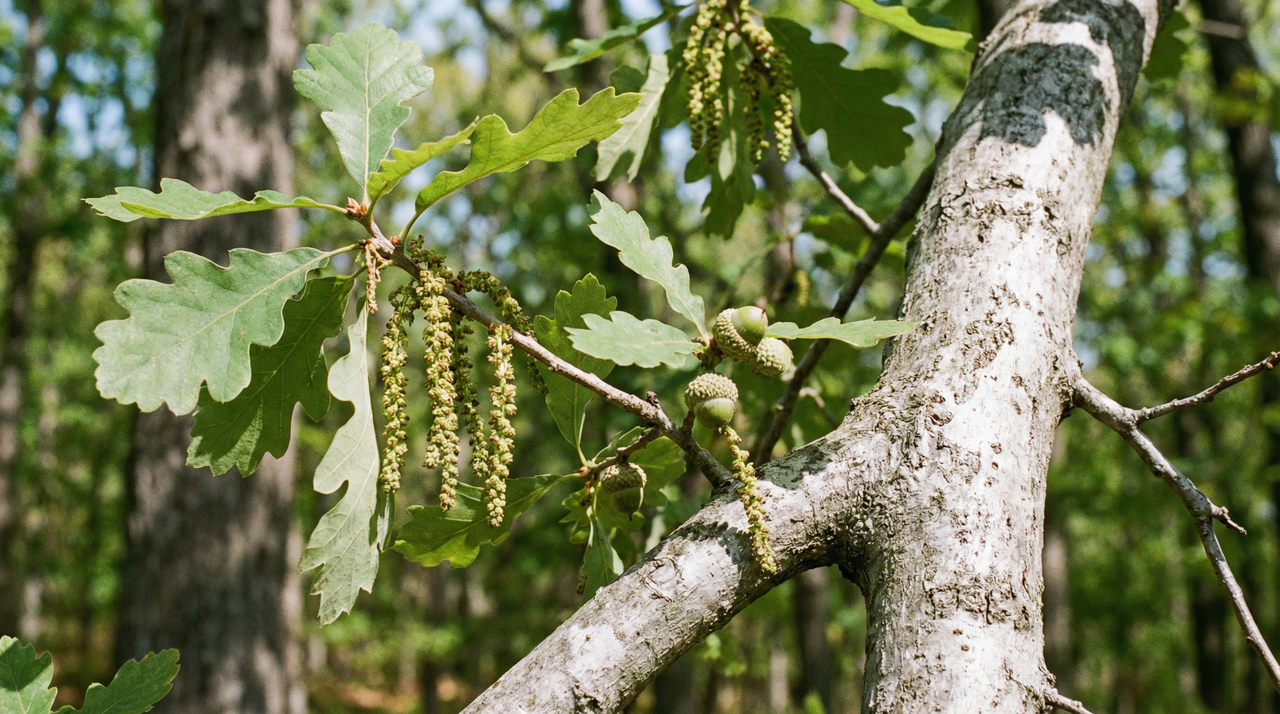
A mature white oak typically reaches 50 to 80 feet tall with a broad, rounded crown, though under favorable conditions specimens can exceed 100 feet, and trunk diameters of 2 to 4 feet are common in old growth.[3] The bark is distinctive: light gray to whitish, rough, and scaly, breaking into thin irregular plates that deepen into furrowed ridges with age.[5] Leaves run 4 to 8 inches long with 5 to 9 rounded lobes — no bristle tips, which is the quickest way to sort white oak group from red oak group in the field. I've found that when shade obscures a tree's overall form, checking the leaf axils for pale tufts of hair is a reliable backup ID — something I started doing after being fooled by an unusually shaded bur oak on a client's property.
The genus is remarkably diverse beyond that. Southern live oak (Quercus virginiana), relevant to anyone researching the history of live oak in Florida and coastal landscapes, is evergreen with leathery dark leaves that persist two to three years.[10] Northern red oak (Quercus rubra) brings 7 to 9 bristle-tipped lobes and brilliant scarlet fall color.[11] Bur oak (Quercus macrocarpa) produces some of the largest acorns in the genus, up to 2 inches, capped with a distinctively fringed, mossy cupule.[12] Each species has its own ecological niche, but white oak's rounded lobes and pale, scaly bark make it one of the most readable in the field once you know what you're looking for.
Traditional and Cultural Uses Across Time
Indigenous North American peoples worked with white oak for thousands of years. Acorns served as a staple food after tannins were leached out, processed into flours for breads and porridges; bark infusions treated diarrhea, dysentery, fevers, wounds, and mouth sores; wood became canoes, baskets, tools, and shelter.[13][14] The oak held deep spiritual meaning too, symbolizing strength, endurance, and community, with acorn gathering woven into ritual life.[15] Across the Atlantic, English oak (Quercus robur) and sessile oak (Quercus petraea) were sacred in Celtic, Druidic, and Norse traditions, associated with Thor, used in sacred groves and rituals, their galls harvested for ink and their bark for leather tanning.[16][17] The use of oak trees as symbols of strength and wisdom appears independently across cultures on multiple continents — that's not coincidence, it's a tree earning its reputation.
Colonial economies leaned on white oak and southern live oak heavily. Both species built ships, including USS Constitution, valued for rot-resistant wood that held up against salt water and cannon fire.[18] White oak barrels are legally required for aging bourbon, and the tight grain and natural compounds of the wood contribute those familiar vanilla and coconut notes to the spirit.[19] I make a point of telling every client who wants a white oak in their landscape that the bourbon industry, the timber industry, and American naval history all profited from a tree that Indigenous nations spent millennia stewarding. That history deserves to come first, not as a footnote. White oak is currently listed as Least Concern on the IUCN Red List[20] and serves as a state tree for Connecticut and others, though its future faces real pressure from habitat loss and climate shifts.
Fun Facts and Ecological Legacy
The Mingo Oak, the oldest documented white oak, reached 571 years before its death.[21] The current national champion measures 90 feet tall with a 105-foot crown spread.[22] I've stood next to 300-year-old white oaks on clients' properties and watched storms topple neighboring maples while the oak barely shrugged — those massive taproots and deeply furrowed bark aren't decorative, they're the product of centuries of selection for exactly this kind of resilience.
White oak is a keystone species in the truest sense: it supports over 500 insect species, many of them Lepidoptera, and provides critical mast for squirrels, deer, turkeys, bears, and wood ducks.[23] Its mycorrhizal associations enhance drought tolerance and nutrient cycling in ways that benefit neighboring plants,[24] and its thick bark gives it meaningful fire resistance — a trait that bur oak takes even further in prairie systems while thinner-barked species like pin oak fare worse in fire-prone conditions.[25] Climate change may push white oak's range northward, but fragmented landscapes limit how quickly that migration can happen,[26] and decades of fire suppression have already reduced regeneration opportunities across much of its native territory.[27] Planting white oaks now — with that long view in mind — is one of the most meaningful things a permaculture designer can do.
Oak Varieties and Sourcing
Notable Cultivars of White Oak and Related Species
White oak has fewer named horticultural cultivars than almost any other commonly planted Quercus species, and that's not an accident.[28][29] Propagating white oak vegetatively is genuinely difficult, and the tree grows slowly enough that producing saleable cultivars takes patience most commercial nurseries don't want to invest. The selections that do exist, though, are worth knowing. I've planted both standard white oak seedlings and the 'Heritage' cultivar side by side in the same landscape, and during a bad drought a few summers back, the 'Heritage' trees came through with noticeably less dieback. That cultivar, introduced by the U.S. National Arboretum, brings improved drought tolerance, slower and more manageable growth, and enhanced resistance to oak wilt, all within a cold-hardy range spanning USDA zones 3 through 8.[30][31] Other white oak selections include 'Cincinnati' for Ohio River Valley adaptability, the ornamental 'Tricolor' with white-and-green variegated leaves, and the weeping 'Pendula' if you want drama in a large garden setting, though availability on any of these varies considerably by region.[28][29]
What was once classified as Quercus alba var. macrocarpa is now recognized as its own species, bur oak (Quercus macrocarpa).[28][32] That matters because bur oak actually expands your design options significantly. It has two recognized varieties of its own: var. macrocarpa with larger acorns and an affinity for clay soils, and var. pyrenaica which is leaner, drier-adapted, and better suited to Great Plains conditions.[32][33] Cultivars like 'Prairie Fire' bring vibrant fall color, while the narrow 'Morissii' offers a columnar form useful in tighter sites.[32]
If fall color is a priority, northern red oak gives you more cultivar options than almost any other oak.[34] 'Sunset' and 'Splendens' push the autumn display into genuine scarlet territory, while 'Columnaris' and 'Fastigiata' deliver that narrow 10-to-15-foot-wide footprint ideal for urban food-forest corridors.[35][36] When I need a narrow vertical element in a guild and can't afford to prune a standard white oak into submission, a columnar red oak tree selection is usually my first call. Pin oak actually has the widest cultivar list of any of these species, with 'Green Pillar' and 'Princeton Sentry' offering tight columnar habits well-suited to street-side or constrained food-forest plantings, and 'Ruby Sunset' delivering reliable red fall color.[37][38] Just be aware that the species as a whole is highly susceptible to iron chlorosis on alkaline soils, so site selection matters more than cultivar choice there.[39]
Southern live oak rounds out the practical picture for warmer climates, with weeping forms like 'Elmore's Weeping' and urban-adapted selections like 'Streetsperson' offering salt and drought tolerance that standard specimens can't always deliver.[40][41] English and sessile oaks have their own ornamental cultivars (columnar, weeping, purple-leaved) that are well-loved in European parks, but they're rarely the right call for a North American permaculture planting where natives serve the ecology far better.[42][43] Across all these species, cultivar breeding has tended to prioritize form and provenance over pest resistance specifically, though some selections do carry incidental tolerance advantages.[44][33] My practical advice: choose your cultivar based on the site's actual constraints (space, soil chemistry, disease pressure) rather than chasing novelty.
Where to Buy Oak Trees: Sourcing and Availability
White oak is genuinely easy to source within the U.S. It's native to 33 states, holds a G5 secure conservation status, and turns up everywhere from regional native plant nurseries to online retailers like Nature Hills Nursery and FastGrowingTrees.com.[28][45] Prices run a wide range: acorns and seed packets start around $1 to $5, one- to two-year seedlings typically fall between $5 and $15, one-gallon containers land in the $10 to $30 range, and larger balled-and-burlapped specimens can reach several hundred dollars. I almost always source my white oaks from regional native-plant nurseries rather than big-box stores. In my experience the local genetic stock establishes faster, handles regional stress better, and comes with staff who actually know what they're selling. Appalachian Forest Nursery, Clarion Forestry, and nurseries affiliated with the Lady Bird Johnson Wildflower Center are all solid starting points.[46] Time your purchase for spring or fall availability, and if you're buying a balled specimen, dormant stock sourced between December and February transplants with the highest success rates.
Bur oak, northern red oak, and southern live oak are similarly straightforward to source through native plant suppliers like Prairie Moon Nursery, Ion Exchange, Ernst Conservation Seeds, and Sheffield's Seed Co.[47] Pin oak shows up at retail chains with regularity.[48] The one procurement issue that applies across all of these native species is oak wilt quarantine. Minnesota, Wisconsin, Texas, and parts of the broader Midwest have regulated movement zones, and moving oak material through those areas without certification is how the disease spreads.[49] I never move oak material between states without checking the current USDA and state extension maps first; sourcing from certified disease-free nurseries has kept me out of trouble more than once. If you're pursuing non-native species like English or sessile oak, specialty suppliers like Oikos Tree Crops can help, but expect USDA APHIS import permits, phytosanitary certificates, and additional scrutiny around pests like Phytophthora ramorum.[50][51] Wild-collected white oak timber moving internationally falls under CITES Appendix II permit requirements as well.[51] For most readers planting a food forest or restoration landscape, sticking with certified domestic nursery stock and verifying local regulations before purchase is all the due diligence you need.
White Oak Propagation and Planting
White oak is monoecious, meaning a single tree carries both male and female flowers and relies almost entirely on wind pollination to set seed.[52][53] That breeding strategy produces enormous genetic diversity, which means every seedling is heterozygous and none of them will be true-to-type. If you've grown a magnificent specimen with exceptional mast production or disease resistance and want to replicate it exactly, seeds won't get you there. That distinction shapes every propagation decision that follows.
White Oak Acorn Collection, Storage, and Germination
The acorns themselves are oval to rounded, 12-25 mm long, light brown to tan with a shallow saucer-shaped cap covering about a quarter to half of the nut.[28] More critical than their appearance is their physiology: white oak acorns are recalcitrant seeds. They cannot be dried or frozen like a packet of tomato seeds. Let them drop below 20-30% moisture content and you've lost them.[54][55] I learned this the hard way my first year, storing a bag of acorns in the garage over winter and finding nothing but shriveled husks in March.
Collect soon after natural drop to beat acorn weevils, then run a float test immediately: viable acorns sink, damaged or infested ones float.[56][57] Discard the floaters without hesitation. From there, pack your sinkers in moist peat or sand and refrigerate at 34-41°F with humidity around 30-50%; stored correctly, viability holds for up to six months.[56][57] A fungicide dusting during storage reduces mold losses significantly.
White oak acorns require 30-90 days of cold moist stratification at 34-41°F before germinating, though they can also be sown directly in fall and let the season do that work for you.[58][59] Sow at half an inch to two inches deep in well-drained soil; at 20-30°C you'll see germination in four to eight weeks.[58] If you want to clone a specific tree rather than gamble on genetic variation, grafting is your answer. Cleft or whip-and-tongue grafts onto compatible white-oak-group rootstocks succeed at 50-90%, while stem cuttings even with IBA hormone and mist systems only hit 10-30%.[60][61] Layering is possible at 40-70% on juvenile wood, but it's labor-intensive enough that most home growers are better off leaving both cuttings and layering to specialist nurseries.
Soil, Site Selection, and Planting Technique for White Oak
White oak prefers well-drained loamy or sandy-loam soil with a pH between 5.0 and 7.5, with the sweet spot sitting around 6.0-6.5.[28][10] It can manage clay if drainage is adequate, but compacted soils with bulk density above 1.4-1.6 g/cm³ will stunt root development and eventually kill a young tree.[28] Waterlogging is similarly problematic; this is not a riparian species. The tree forms ectomycorrhizal associations that dramatically improve nutrient uptake in low-fertility soils,[62] so avoid synthetic fertilizers that disrupt that relationship, especially at planting.
On higher-pH sites, iron chlorosis becomes a real issue above about pH 7.5, and aluminum toxicity can develop below pH 5.0.[62][63] I've found that laying down a 2-3 inch layer of pine-bark mulch year over year does more to gradually acidify and improve the soil environment than trying to amend a large planting hole before you put the tree in. For container-grown seedlings, a mix of 40% peat or coco coir, 30% perlite or vermiculite, 20% sand or pine bark, and 10% compost at pH 5.5-6.5 works well, and adding mycorrhizal inoculum at potting time is worth the small added cost.[64][65]
Spacing, Timing, and Establishment Tips
Mature white oaks reach 50-80 feet tall with a canopy spread to match, so landscape spacing should be 40-60 feet between trees.[66][67] Timber plantations use much tighter spacing of 8-12 feet within rows, thinning over time to final spacing,[66] but for food forest and permaculture settings the landscape figure is the one to use. White oaks can live 300 years or more, so the spacing you choose today will still matter a century from now. I always err on the side of giving them room.
Plant in early spring or fall; fall planting lets roots establish before the first hard winter.[58] I made the mistake early on of putting bare-root seedlings in the ground too late in spring, and the transplant shock set those trees back two full seasons. Dig the hole twice as wide as the root ball but no deeper than the root collar, backfill with native soil amended with an inch or two of compost, water thoroughly, and mulch 2-4 inches deep keeping mulch clear of the trunk.[58][68] Label your rows carefully, too. In my first attempts at propagating oaks from local acorns, the seedlings looked almost identical to carrot tops for the first three weeks, and losing track of which seedling came from which mother tree is a lesson you only need to learn once.
White Oak Germination Timeline and Viability
White oak acorns mature in a single season, running about 150-180 days from April-May flowering to fall drop.[66][56] This is a key contrast with red oak group species, which require two full growing seasons to ripen their acorns and can be stored longer in dry conditions. White oak's minimal dormancy is an advantage for fall direct-seeding but a liability for anyone who wants to stockpile seed; collect, test, and plant or refrigerate promptly.
After stratification and sowing, germination typically occurs in four to eight weeks under warm conditions.[58] Set realistic expectations for the long game: seed-grown white oaks generally take 20-30 years to produce their first acorns and don't hit full production until they're 50-80 years old.[66][69] Grafted trees begin bearing in five to ten years, which is why grafting is worth the extra effort if mast production from a proven parent tree is a design priority.[66][69] I've also noticed that acorns collected after a hot, dry summer tend to show stronger germination than those from cool, wet years, which aligns with what the research suggests about recalcitrant seed behavior and moisture stress during development.
White Oak Care Guide
White oak is hardy across USDA zones 3-9, tolerating minimum winter temperatures as low as -40°F, and once established it asks remarkably little of you.[62][28] The hard work is mostly front-loaded: those first three to five years when the tree is driving its taproot deep and figuring out your soil. Get that phase right, and you're largely done micromanaging.
Watering Needs for White Oak and Related Species
Young white oaks need 1-2 inches of water per week during their first one to three years, applied deeply and infrequently to push roots downward rather than keeping the surface perpetually damp.[62][28] For seedlings in their first growing season, watering every two to three days to maintain evenly moist soil is the right rhythm; after transplanting, a deep soak immediately and then roughly 5-10 gallons per week for the first year (adjusted for your rainfall and soil drainage) gives new roots the consistency they need.[70][71] Ramp up watering in spring and summer when new growth is pushing, dial back in fall, and keep things minimal through winter dormancy.
The payoff for all that early attention is a tree that eventually handles multi-week dry spells on its own. Mature white oaks typically endure four to six weeks of summer water stress in well-drained soils without supplemental irrigation, thanks to a deep taproot, stomatal regulation, and a waxy leaf cuticle that together make drought look like a minor inconvenience.[28][72] I've watched established white oaks in my landscape sail through the driest stretches of late summer without a drop of supplemental water once that taproot was in place. The flip side is overwatering in poorly drained soils, which invites Phytophthora root rot; yellowing leaves, wilting, and crown dieback are the warning signs worth catching early.[73][74]
Species selection matters here too. Southern live oak handles salt spray and moderate flooding that would stress a white oak; bur oak develops a similarly deep taproot and tolerates moderate salinity; pin oak and northern red oak prefer consistently moist, acidic soils and struggle with alkaline or salty conditions.[75][76][77] Match the species to your site's drainage and salt exposure before planting.
Sunlight Requirements
White oak wants full sun, at least six hours of direct light daily, and produces its best acorn crops under open skies.[34] Young trees have some shade tolerance that fades as they mature; push a sapling into too much shade and you'll see sparse foliage, pale leaves, and stunted growth that never really catches up.[78] On the other end, young trees in urban heat islands or on exposed sites can suffer leaf scorch, showing up as browning at the margins and tips, especially through hot afternoons.[78][79] I label my young oak rows carefully for exactly this reason: scorch symptoms in a stressed sapling look a lot like drought stress, and early oak leaves across species can be deceiving enough to cause misidentification and the wrong fix.
Proper siting, a deep mulch ring, and adequate soil moisture do more for a young oak under bright conditions than any shade cloth. Pin oak is particularly prone to winter sunscald on south- and west-facing bark, worth noting if you're planting in an exposed location.[10] Southern live oak, being evergreen, has relatively constant light needs year-round, which is one reason it thrives in open coastal landscapes where deciduous species cycle through leafless winters.[75]
Feeding and Fertilization
Oaks evolved in low-fertility forest soils, and white oak in a native or undisturbed setting almost never needs fertilizer once established.[28] The reason goes deeper than simple adaptation: oaks form ectomycorrhizal partnerships that efficiently deliver phosphorus and nitrogen from the soil, partnerships that excess fertilizer actively disrupts.[80] In my experience, over-applying nitrogen produces lush but structurally weak growth that becomes a beacon for pests; I now rely on a soil test every two to five years and compost rather than reaching for synthetic fertilizers out of habit.
When a soil test does flag a real deficiency, look for the specific symptom first. Interveinal chlorosis on young leaves usually points to iron or manganese deficiency, often triggered by alkaline soils above pH 7.0; uniform yellowing on older leaves suggests nitrogen; marginal leaf necrosis points to potassium.[81] If fertilization is warranted, a slow-release balanced formula applied at the drip line in early spring before bud break, or 2-4 inches of compost worked into the mulch layer annually, covers most situations without the risks of synthetic overload.[82][83] Never fertilize during drought or late summer, when uptake is poor and the salt load can cause more harm than the nutrients provide.[84]
Frost Tolerance
White oak's USDA zones 3-9 range and tolerance down to -40°F make it one of the more cold-hardy trees you can plant in a temperate landscape.[62] Bur oak and northern red oak share that extreme cold hardiness; southern live oak is a different story, showing damage on young trees below 10-15°F, which is why it belongs in zones 7-10 rather than anywhere a hard freeze is routine.[85][86] The vulnerability in cold-hardy species is the buds in spring: emerging growth is sensitive to temperatures at or below 28°F, and a late frost during bud break can set a young tree back noticeably.[87]
For seedlings and young trees, I treat the winter protection routine much like I would for other tender landscape plants: 3-4 inches of organic mulch kept a few inches away from the trunk to prevent frost heaving and rodent damage, and trunk wraps or burlap for the first couple of winters on exposed sites.[88][89] Waiting until after the reliable last frost date in your region before removing any protection has saved my young oaks from repeated bud damage. Long-term frost injury shows up as reduced acorn yields, pest susceptibility, and weakened structure, but white oak typically resprouts well from dormant buds with adequate moisture during recovery.[90]
Heat Tolerance
White oak photosynthesizes most efficiently between 68-86°F, with healthy growth continuing up to about 85-95°F before heat stress starts to show.[91] Above 95°F, expect leaf scorch, wilting, canopy thinning, and premature acorn drop; short spikes to 105°F are tolerable if nights cool below 60°F and soil moisture is adequate.[92] Seedlings and trees in active acorn maturation are most vulnerable, with combined heat and drought capable of reducing acorn yields by up to 50%.[93] Southern provenances show 20-30% higher heat tolerance than northern ones, which matters when sourcing trees for warming-climate gardens.[94] Southern live oak stands apart entirely, thriving in AHS zones 7-10 and tolerating sustained temperatures above 110°F that would devastate a white oak sapling.[10] Management through the hottest months is mostly the same as establishment care: deep mulch, consistent irrigation during heatwaves, and shade cloth on seedlings during extreme events.[95]
Pruning, Maintenance, and Seasonal Rhythm
The single most important pruning rule for any oak: do it during dormancy, from late fall through early spring before bud break, and avoid April through July entirely.[96] Oak wilt spreads through sap beetles attracted to fresh wounds during the growing season, and dormant pruning is your primary cultural defense (more on oak wilt in the pests and diseases section). I sterilize my tools with a 10% bleach solution between every cut on a cold, dry day; it sounds meticulous, but with a tree that may outlive your grandchildren, it's the right approach.
On young white oaks, focus structural pruning on building a strong central leader, selecting four to six well-spaced scaffold branches with wide crotch angles, and removing any competing leaders, crossing branches, watersprouts, or basal suckers.[97][98] Never remove more than 25% of the canopy in a single year, and avoid topping entirely; it causes decay, produces structurally weak regrowth, and creates problems for decades.[99] Mature white oaks, which can reach 50-80 feet tall and live 200-500 years, need almost nothing beyond periodic removal of dead or damaged wood.[59][62]
Maintain a 2-4 inch organic mulch ring around the base, kept a few inches from the trunk to prevent rot, and keep the area around saplings weed-free; reducing competition can improve young tree survival by 50-70%.[100][101]
Seasonal Care and Rhythm
White oak grows at a slow to moderate rate of roughly 12-24 inches per year once established, following a consistent phenological cycle: male catkins and new leaves emerge in mid-spring, acorns mature and drop in September through October, and dormancy sets in by late autumn.[102][76] Most oaks in the genus follow this same arc, with southern live oak as the notable exception, staying evergreen through mild winters and maintaining relatively constant activity year-round.
The practical calendar falls naturally from that rhythm: watch for late frost on emerging buds in spring and hold off fertilizing until just before bud break if soil tests say it's needed; increase irrigation and monitor for heat stress through summer; do any necessary pruning in late fall to winter dormancy; apply or refresh the mulch layer and add trunk protection for young trees heading into cold.[103][104] Reduce interventions in fall as the tree draws energy downward. After enough seasons watching this cycle, you start to feel how little the tree actually needs from you, and how much it gives back in acorns, canopy, and habitat for generations of wildlife that will arrive long before the tree reaches its prime.
Harvesting White Oak Acorns
Every fall I find myself checking the ground under my planted oaks starting in late September, because the window between "perfect" and "already claimed by squirrels" is shorter than most people expect. White oak acorns are ready to collect when the husk turns from green to brown, the cap loosens and begins to detach, and the nuts drop on their own.[28][105] The harvest window generally runs September through November across the genus, peaking in October for white oak, though northern or higher-elevation sites push that window later.[106][57] The first few days after a heavy drop are when you'll find the cleanest nuts; wait too long and the weevils and wildlife have done their work. One other reality to set expectations around: oaks don't produce uniformly every year. Northern red oak, for instance, follows irregular masting cycles with big crops only every two to five years,[107] and white oak behaves similarly. When a mast year hits, collect enthusiastically.
Collection Techniques and Quality Selection
The method is simple: hand-pick from the ground, or gently shake accessible branches. For taller trees, a long pole works fine.[108] Once you've got a collection, run a float test. Drop the acorns in a bucket of water and discard any that float; sinkers are your viable, dense nuts, while floaters are hollow, hollow-shelled, or already compromised.[55] The float test has saved me from processing many worthless nuts, and it cleans debris from the batch at the same time. Then inspect what's left for small exit holes or fine powdery frass, both signs of acorn weevil damage. Any nut with those marks goes in the compost.[56] It sounds like a lot of steps, but the whole workflow takes minutes and the quality difference is real.
Expected Yield, Flavor, and Storage
White oak acorns are small, typically half an inch to an inch long,[28] but the payoff in a good year is substantial. A mature tree can yield thousands of acorns. Southern live oak can exceed ten thousand in a productive season, while sessile oak trees in good conditions produce ten to thirty kilograms.[109][110] White oak's real advantage over its red-oak cousins is tannin load. After leaching, white oak acorns develop a mild, subtly sweet, nutty flavor with low residual bitterness; roasted, they take on a warm aroma that genuinely reminds me of toasted hazelnuts or chestnuts.[4][111] Red oak group species like northern red, pin, and sessile oak are considerably more astringent raw and need more intensive leaching to reach a comparable result.[112][113] The preparation and uses section covers leaching methods in full; tasting for residual bitterness is ultimately your best guide regardless of species. Properly dried, leached whole acorns keep up to a year in a cool, dark, airtight container, and acorn flour stays good for several months.[114]
White Oak Preparation and Uses
Preparing and Using White Oak Acorns as Food
White oak acorns are genuinely edible, but the word "after proper leaching" is doing a lot of work in that sentence.[23][115] Skip that step and you'll get bitter, astringent flour that will upset your stomach and teach you a lesson you won't forget.[116][117] I know this firsthand. My first batch looked perfect, smelled promising, and tasted like I'd licked a tea bag. The water I was changing hadn't run clear yet. I just hadn't been patient enough.
The workflow itself is straightforward: shell the acorns, grind them into meal or coarse flour, then run repeated hot or cold water changes until the water comes out clear rather than brown.[117][118] Done right, modern leaching can reduce tannin content by 80 to 95 percent.[116] White oak acorns have a significant advantage here. Because they naturally contain significantly fewer tannins than species in the red oak group, they require far fewer water changes to become palatable.[119] Bur oak sits at the mild end even within the white oak group. If you're new to acorn processing, white oak group species are where to start.
Once leached, the flavor is genuinely lovely: mild and nutty with earthy, slightly sweet undertones reminiscent of chestnut or hazelnut, and a fine-to-medium grainy texture close to cornmeal.[120][121] Roasting at 250 to 350°F deepens that nuttiness considerably through Maillard reactions, adding a popcorn-like aroma that makes the flour feel more like an ingredient and less like a survival food.[122] It's gluten-free, so I usually blend it 50/50 with wheat flour for baking; on its own it works well in porridge, soups, pancakes, and muffins, or as a coffee substitute.[121][123] It pairs particularly well with game meats, root vegetables, dried fruits, and maple syrup.[124]
One identification note I take seriously: horse chestnut seeds can superficially resemble acorns, but they're highly toxic, containing aesculin.[125] Always confirm your oak before you harvest. The acorn cap's scaly texture is a giveaway that horse chestnuts simply don't have, and the lobed leaf shape clinches it.[126] Also worth remembering: oak leaves and bark are not edible, no matter the species.[23]
Medicinal Preparations from Oak Bark and Leaves
The same tannins that make raw acorns inedible make oak bark and leaves medicinally significant. Traditional preparations use that astringency deliberately, as decoctions, tinctures, infusions, and poultices for diarrhea, wounds, inflammation, and skin ailments.[127][128] A standard bark decoction involves simmering 1 to 2 teaspoons of dried bark in one cup of water for 10 to 15 minutes; tinctures run about 1 to 2 ml taken three times daily; infusions use 1 to 2 grams of dried bark or leaves per cup, up to three cups daily.[127] For Quercus alba, EMA-aligned guidance generally points to 1 to 3 grams of dried bark per day, used short-term, meaning one to two weeks rather than as an ongoing supplement.[127][129] Young spring leaves can be harvested for tea, while bark is best collected from fallen branches in spring or fall when tannin content peaks.[127]
I've only ever harvested bark from naturally downed branches to avoid wounding living trees, and I treat these preparations as occasional tools rather than daily tonics. The tannin load is real, and the research makes me cautious rather than casual about dosing. If you're considering medicinal use, consult a qualified herbalist or healthcare provider, particularly with internal preparations.
Non-Food Applications of Oak
Beyond the kitchen and the medicine cabinet, those same tannins have driven oak's industrial history for centuries. Bark and galls from white oak and its relatives including Quercus robur are rich enough in astringent compounds to tan leather and produce deep brown and black natural dyes, uses that run as deep as the tree's own roots in European and North American craft traditions.[130][131] I find it genuinely elegant that the compound preserving wine in a barrel, closing a wound in a poultice, and curing a hide in a tannery is the same molecule doing different versions of the same job.
The wood itself is another story entirely. Dense, durable, and rot-resistant, oak has been the material of choice for shipbuilding, furniture, flooring, construction, and cooperage across cultures and centuries.[132][133] Southern live oak shaped the early American navy; red oak fills furniture workshops; bur and pin oak go into barrels and structural timber; and the wood across species burns hot and clean, making it a high-BTU firewood with minimal smoke.[134] In a permaculture system, even the biomass that doesn't become timber earns its place: acorns, leaves, and smaller wood make excellent mulch, fodder, or fuel, keeping the tree's productivity cycling back into the soil rather than leaving it as waste.[135][136]
White Oak Health Benefits and Medicinal Uses
The health story of white oak is, at its core, a tannins story. Nearly every documented medicinal use, every nutritional caution, and every ecological defense mechanism this tree deploys traces back to those bitter, astringent polyphenols concentrated most densely in its bark. Understanding them is what separates responsible use from a bad experience.
Medicinal Research on White Oak Bark and Leaves
Generations of Indigenous knowledge came first. Cherokee, Iroquois, Ojibwe, Meskwaki, and many other Native American peoples used Quercus alba bark decoctions for diarrhea, dysentery, wound care, burns, sore throats, hemorrhoids, fevers, and oral inflammation.[13][137] The logic was the same every time: that profound astringency contracts weeping tissues, inhibits pathogens, and dries what needs drying. Modern research is now beginning to explain exactly why it works.
Bark from white oak contains 7 to 20% tannins, primarily gallotannins and ellagitannins, alongside quercetin, ellagic acid, and proanthocyanidins, with bark consistently showing the highest concentrations across the entire genus.[138][139] In vitro and animal studies have shown anti-inflammatory activity through inhibition of the NF-κB pathway and reduction of pro-inflammatory cytokines including TNF-α and IL-6,[138] antioxidant effects via Nrf2 pathway activation and upregulation of glutathione and superoxide dismutase,[140] and antimicrobial activity against both Gram-positive and Gram-negative bacteria including Staphylococcus aureus and E. coli.[141] Preclinical work also suggests wound-healing support through collagen synthesis promotion, and related European species like Q. robur have been studied for gastrointestinal conditions and chronic venous insufficiency.[142][143]
I think of this as generations of practical observation that science is now starting to validate. Almost all the mechanistic data comes from in vitro and animal models, and rigorous human clinical trials remain limited.[144][140] Related European oaks are listed in the European Pharmacopoeia with a minimum 8% tannin requirement and approved for internal and topical herbal use,[145][146] which provides a legitimate regulatory framework, but I always recommend using oak bark preparations supportively and under professional guidance for anything beyond minor complaints.
Key Phytochemicals in White Oak
The bark's chemical complexity goes well beyond "tannins." White oak produces hydrolyzable tannins (the ellagitannins vescalagin and castalagin, plus gallotannins), condensed tannins (proanthocyanidins), phenolic acids including gallic and ellagic acids, flavonoids like quercetin and its glycosides and kaempferol, and minor triterpenoids such as friedelin and betulinic acid derivatives.[139][147] These same tannins that make a raw acorn almost inedibly bitter are what give oak bark its legendary astringency, and they're why the bark has always been the go-to part for medicinal preparations.
Concentrations shift depending on what the tree is responding to. Bark runs 7 to 20% tannins; leaves sit between 2 and 15%; acorns between 3 and 15%, with levels climbing under drought stress or herbivore pressure.[148][149] Across the genus there are meaningful differences: sessile oak (Q. petraea) often runs higher in vescalagin and castalagin than English oak, while northern red oak bark can reach 10 to 15% phenolic acids.[150] What I find genuinely fascinating about this chemistry is that it evolved as ecological armor: herbivore deterrence, antimicrobial defense, UV protection, induced stress response.[151] The plant wasn't making medicine for us. We just figured out how to work with what it made for itself.
Nutritional Value of White Oak Acorns
White oak acorns are a legitimate traditional food, but calling them ready-to-eat would be misleading. Properly leached, they're genuinely nourishing. Raw or under-processed, they're not. White oaks are easier to work with than the red oak group because their acorns typically run 3 to 10% tannins versus up to 15 to 20% in species like Q. rubra or Q. velutina.[121][152] That difference matters practically: fewer leaching cycles, less time, and a gentler final flavor.
Traditional Native American preparation involved shelling, grinding into meal, and leaching repeatedly in cold running water or hot soaks until the bitterness was gone and the water ran clear.[13] I've done this myself with white oak acorns collected from Central Florida landscapes, and I can tell you the resulting flour has a mild, slightly nutty flavor that works beautifully in gluten-free baking. Nothing about it tastes medicinal once it's properly processed.
The nutritional numbers are respectable. Per 100 g raw, acorns provide roughly 387 kcal, 6.2 g protein, 23.9 g fat (mostly unsaturated), 40.8 g carbohydrates, and 6.7 g fiber, with notable potassium, magnesium, phosphorus, and B vitamins.[153][154] Leaching does reduce some water-soluble vitamins and minerals by roughly 10 to 30%,[155] but beneficial phenolics including quercetin, ellagic acid, and phytosterols like β-sitosterol are retained, contributing antioxidant and potential anti-inflammatory activity even after processing.[156][157] Treat all these figures as approximations; values shift with growing conditions, harvest year, and how thoroughly you leach.[155]
Safety Considerations and Toxicity Risks
The same tannins responsible for the white oak benefits story are responsible for its risk profile, and I don't think those risks get enough direct attention. High tannin intake can cause gastrointestinal irritation, nausea, vomiting, constipation, and reduced iron absorption; chronic high-dose exposure carries potential for kidney and liver damage.[158][159] Raw or improperly processed acorns are the most common culprit. If you're on blood thinners, have kidney disease, iron-deficiency anemia, or are pregnant or breastfeeding, oak bark preparations are contraindicated; potential interactions with anticoagulants, iron supplements, and CYP450-metabolized drugs are a real concern.[160][161] Internal use is generally capped at under 3 g of bark daily.[160]
The livestock picture is even more serious. Oak parts, especially acorns, are toxic to dogs, cats, horses, and cattle. Ruminants are most vulnerable; ingesting as little as 1 to 2% of body weight can cause depression, bloody diarrhea, dehydration, and potentially fatal kidney failure, with fall drop season and drought years carrying the highest risk.[162][163] In the permaculture systems I design with oak guilds, I advise any client with horses or cattle to fence off heavy acorn-drop zones before September. It's not optional. Red oak group species carry slightly higher risk because of their elevated tannin levels,[164] but white oak is not safe for grazing animals regardless.
Oak pollen is another consideration often overlooked in planting decisions. Peak season in eastern North America runs April through May, producing significant hay fever and asthma symptoms, with cross-reactivity common in people who already react to birch.[165] In my experience, clients with known birch sensitivity should know what they're planting before the first spring rolls around.
For bark collection specifically: harvest only from storm-fallen branches or material pruned during dormancy. Stripping bark from live trees can kill them, and sustainable practice means leaving the vast majority of any wild stand untouched.[166] I collect only from storm damage on my own design sites. There's no medicinal preparation worth harming a centuries-old tree for.
Pests and Diseases of White Oak (Quercus alba)
Understanding White Oak Disease Resistance and Stress Factors
White oak has a genuinely impressive defense toolkit. High concentrations of tannins and phenolics deter herbivores and slow fungal colonization, thick leaf cuticles and surface pubescence act as physical barriers, and deep mycorrhizal partnerships improve both stress tolerance and disease signaling.[66][167][168] In my experience, a well-sited white oak in good, free-draining soil at pH 5.5–7.5 with adequate moisture simply shrugs off pressures that devastate its neighbors.[28][169] The moment drought, soil compaction, wounding, or poor drainage enter the picture, that resilience erodes fast. Almost every serious pest and disease story in this genus is, at its core, a stress story.
Major Diseases of White Oak and the Genus
Oak wilt (Bretziella fagacearum) is the disease I'd put at the top of any oak grower's watch list. White oak belongs to the white oak group, and that matters: its ring-porous wood limits how quickly the fungus can spread through vascular tissue, meaning trees often survive infection without the rapid mortality you see in Northern Red Oak or Pin Oak, which can collapse within weeks of showing symptoms.[170][171][172] If you see rapid wilting and vascular discoloration in a red oak nearby, assume the pathogen is present and trench immediately at least 100 feet from infected trees to sever root grafts. I've seen this protocol save neighboring white oaks that would otherwise have been lost. For high-value specimens, propiconazole root-flare injections offer one to two years of protection, and any wounding should be strictly avoided from April through July when beetle vectors are most active.[171][170][173]
Below oak wilt in severity, the fungal threats multiply but become progressively more manageable. Verticillium wilt (Verticillium dahliae) is a real concern for white oak specifically; unlike Pin Oak, which shows good resistance, Quercus alba can suffer significant damage from soil-borne infection.[174][175] Botryosphaeria canker enters through wounds and causes progressive dieback under stress conditions.[176][177] Armillaria root rot becomes a moderate-to-high risk on any white oak that has experienced drought or compaction stress.[178] Hypoxylon canker tends to strike weakened trees at low-to-moderate rates in white oak, though Bur Oak faces higher mortality risk from the same pathogen.[179] Sudden oak death (Phytophthora ramorum) poses a relatively low risk to white oak, which acts mainly as an incidental host; European species like Quercus robur and Quercus petraea are far more vulnerable to the bleeding cankers and root rots it causes.[180][181][182]
A handful of common fungal issues are more alarming to look at than they are dangerous. Anthracnose causes irregular brown leaf spots and sometimes heavy defoliation during cool, wet springs, but white oak recovers reliably.[183][184][185] Powdery mildew produces that familiar white coating on leaves in humid, shaded spots but rarely causes lasting harm.[175][186][187] Leaf blister (Taphrina caerulescens) raises yellowish patches on young leaves in spring and is purely cosmetic.[188] Worth knowing: few white oak, English oak, or Sessile oak cultivars have been bred with disease resistance in mind, so don't count on genetics to save a poorly sited tree.[189][190] In my own plantings, site selection and post-planting care have consistently mattered more than cultivar choice.
Common Pests of White Oak
Gypsy moth (Lymantria dispar) is probably the insect I've watched most closely over the years. White oak is a preferred host, and a bad outbreak will strip a tree bare.[191][192][193] What I've noticed is that mature trees with healthy root systems and adequate soil moisture refoliate the following season without much drama, while stressed neighbors show real decline after repeated defoliation. Leafrollers (Archips semiferanus and Tortrix viridana) cause similar visible damage in cycles but rarely threaten a vigorous tree.[192][194]
Borers are where I get genuinely worried. Two-lined chestnut borer and related Agrilus species target white oak that is already struggling, boring into sapwood and disrupting water movement in ways that compound whatever stress triggered the attack in the first place.[195][196] Oak lace bugs feed on leaf undersides and produce stippling and yellowing, with damage noticeably worse on drought-stressed trees.[10][197][194] Scale insects, particularly oak lecanium scale, produce honeydew and sooty mold and respond well to horticultural oil applications, especially on stressed trees.[198][194] Gall-forming cynipid wasps create those distinctive structures on leaves and twigs; they look alarming but cause mainly cosmetic effects or minor twig dieback.[192][199]
Integrated Pest and Disease Management for Oaks
After years of designing food forest guilds and ornamental plantings around white oaks, my clearest takeaway is this: pair your oaks with deep-rooted companions, maintain generous mulch rings to protect the root zone, and keep compaction away from the drip line. Those three habits alone reduce drought stress enough to keep borers, canker fungi, and most secondary infections from ever gaining a foothold.[200][201][202]
Beyond cultural prevention, biological controls handle the defoliators well: Bacillus thuringiensis (Bt) applied during early caterpillar stages is effective against gypsy moth and leafrollers without broad ecological disruption. For scale insects, horticultural oils timed to crawler emergence work reliably. Chemical intervention should be reserved for high-value trees facing confirmed, threshold-level pressure, and for oak wilt specifically, propiconazole injection combined with prompt removal of infected material and root-graft trenching remains the most effective management protocol available.[200][201] Regional pest pressure varies considerably, so connecting with your local USDA Extension office for current recommendations is always time well spent. The fundamental truth is that a white oak given the right site and basic care will spend most of its long life proving just how little it actually needs from you.
White Oak in Permaculture Design
There's a reason I keep coming back to White Oak as the first tree I want in the ground when I'm anchoring a new food forest. It's not the fastest grower, it's not the easiest to establish, and it won't feed you in year three. But nothing else I've worked with builds a system the way a mature oak does. It's infrastructure, not just a plant.
Climate Adaptation and Hardiness Zones
White Oak's native range sweeps from southeastern Canada down to northern Florida and east Texas. Its USDA hardiness spans zones 3 through 9, tolerating temperature extremes from -40°F to 100°F.[203][10] That's an impressively wide band on paper, but I'd call zones 5-8 its sweet spot. Outside that range, the tree survives with help rather than thriving on its own.
Early in my career I made a classic mistake: I planted a young oak in a low frost pocket on an otherwise favorable site, and watched it suffer repeated bud damage through two consecutive late frosts. Now site drainage and cold-air flow are the first things I check on any zone-edge planting. In colder margins (zone 3), protecting young trees with 3-4 inches of organic mulch kept away from the trunk, good drainage to prevent frost heaving, and a windbreak to stop winter desiccation gives them a fighting chance.[204][205] At the warm edge, afternoon shade and consistent moisture matter more than most people expect.[204] The tree prefers well-drained loamy or sandy loam soils with a pH of 5.0-7.5 and typically does best with 35-50 inches of annual precipitation, though it can handle a broader range.[206][10]
The genus doesn't stop there, and knowing your options expands what's possible on difficult sites. Southern Live Oak handles zones 7-10, coastal salt spray, and strong winds while keeping its leaves year-round.[207] Bur Oak brings an almost absurd toughness to zones 3-8, with a taproot that can reach 15-20 feet and enough fire and drought resilience to thrive on prairie edges.[12] Pin Oak is the one I reach for on wet, compacted, or periodically flooded sites in zones 4-8.[208] Think of them as a genus-level toolkit rather than a single species decision.
Ecosystem Functions and Services
Every oak in this genus is strictly wind-pollinated. There are no nectar rewards, no showy floral structures, no bees required. Pollen releases in spring between March and May, often right as leaves are emerging, with the best dispersal happening at temperatures of 50-85°F, low humidity below 60%, and light winds.[66][209] That's worth understanding because it directly shapes how you design for mast production.
Oaks mast, meaning they don't produce reliably every year but instead synchronize heavy acorn crops every 2-5 years.[210] Habitat fragmentation and genetic asynchrony between isolated trees can reduce seed set by up to 50 percent, which is exactly why I've consistently seen heavier acorn years in my plantings when I have at least five genetically diverse trees within 100 meters of each other, with open canopies in the 30-50% cover range.[211] Climate shifts may push oak phenology 2-5 days per decade, creating potential mismatches, so diverse genetic sourcing is good insurance.[210]
Mycorrhizal partnerships are central to how oaks function in the landscape. White Oak associates with ectomycorrhizal fungi including Pisolithus, Thelephora, Boletus, and Cenococcum, networks that dramatically improve nutrient uptake in poor soils.[212] I've noticed that trees sourced from local nurseries with intact native soil around the rootball establish noticeably faster than bare-root stock, and I now make mycorrhizal inoculation at planting a non-negotiable step. Deep taproots in youth, shifting to extensive lateral roots at maturity, reduce erosion by up to 80% on slopes and dramatically improve water infiltration over time.[213]
The above-ground contributions stack up just as impressively. Leaf litter releases up to 50 kg per hectare of nitrogen annually as it decomposes and builds soil organic matter season after season.[214] Mature trees sequester 20-40 kg of CO2 per year and accumulate 20-30 tons of carbon across their lifespan.[215] I sometimes compare that to fast-growing hybrid poplars when people ask why I'd plant something so slow; the oak's contribution compounds for centuries rather than peaking in a decade. White Oak supports more than 200 wildlife species through acorn production and hosts more than 500 species of Lepidoptera on its foliage alone.[216] Once my trees started producing acorns, the bird activity in those zones changed visibly. It's not subtle.
Forest Layer Placement and Guild Design
White Oak belongs in the canopy layer, full stop. It reaches 50-100 feet with a broad rounded crown, lives 200-600 years, and grows at a moderate pace of roughly 1-2 feet per year before slowing considerably after its first 50 years.[10][206] In food forest design, I use it as the overstory anchor in silvopasture systems, windbreaks, and multi-story guilds where its long-term canopy will eventually define the microclimate everything else grows within.
Guild companions should be chosen with the oak's litter dynamics in mind. The leaf fall is mildly allelopathic and gradually acidifies the soil beneath, which sounds problematic until you lean into it.[217] I pair oak with wild ginger and native ferns as ground covers because they thrive in that acidic, shaded duff while outcompeting weedy invasives that would otherwise colonize the drip zone. Nitrogen-fixers like black locust and red clover work well at the canopy and ground layers respectively, compensating for the oak's modest soil-fertility demands during its long establishment phase. Shade-tolerant understory choices like serviceberry and pawpaw slot naturally into the mid-story, benefiting from the oak's wind reduction and eventual nutrient cycling.[136]
Across the genus, each species fills a distinct design niche. Southern Live Oak holds year-round canopy structure in coastal guilds and supports epiphytes in warmer zones where White Oak struggles.[218] Bur Oak is what I'd reach for on fire-prone prairie edges or degraded sites where almost nothing else will anchor itself.[12] Pin Oak handles wet swales and rain garden margins where standard canopy species drown.[219] All of them benefit from mycorrhizal inoculation at planting and all of them eventually become low-input anchors that ask almost nothing while delivering habitat, carbon, fertility, and food for generations. That's the slow-solutions principle made literal. Plant them young, tend them carefully for the first few years, then step back and let the system build itself around them.
The Tree I Planted Knowing I'd Never See It Mature
There's a white oak seedling I put in the ground ten years ago that's maybe fifteen feet tall now, and sometimes I just stand next to it and do the math. I won't see what it becomes. Neither will my kids, probably. But I keep planting them anyway, because somewhere along the way I decided that was enough of a reason.
Sources 219
- Mast Production in Oaks - USDA Forest Service ↩
- Missouri Botanical Garden Plant Finder - Quercus alba ↩
- USDA PLANTS - Quercus alba ↩
- Flora of North America - Quercus alba ↩
- Quercus alba - Wikipedia ↩
- Quercus robur - Ecology, Distribution and Silviculture ↩
- The longevity of oak trees (Quercus petraea and Quercus robur) in Britain ↩
- Masting in Oaks: Patterns, Mechanisms and Evolutionary Implications ↩
- Oak Reproduction and Management - University of Minnesota Extension ↩
- Quercus virginiana - Missouri Botanical Garden ↩
- Quercus rubra L. Northern red oak - Plant Finder ↩
- Bur Oak - USDA Forest Service ↩
- Native American Ethnobotany Database - Acorn Uses ↩
- Acorns as Food: A History, Use, and Bibliography ↩
- The Traditional Uses of Oak in North America ↩
- Quercus robur ↩
- Quercus robur, Quercus petraea and Quercus sessilifolia: An ethnobotanical review ↩
- Live Oak: The Tree That Built the American Navy ↩
- Bourbon: A History of the American Spirit ↩
- IUCN Red List: Quercus alba ↩
- The Mingo Oak: Oldest White Oak in the U.S. ↩
- National Register of Big Trees - White Oak ↩
- White Oak (Quercus alba) ↩
- Mycorrhizal Associations in Oak Forests ↩
- White Oak (Quercus alba) ↩
- Climate Change Impacts on Eastern US Oak Forests ↩
- Fire Ecology of White Oak ↩
- Quercus alba (White Oak) ↩
- Quercus alba ↩
- U.S. National Arboretum - Quercus alba 'Heritage' ↩
- Missouri Botanical Garden Plant Finder - Quercus alba ↩
- Missouri Botanical Garden Plant Finder - Quercus macrocarpa ↩
- Bur Oak Cultivars - University of Minnesota Extension ↩
- Quercus rubra - Missouri Botanical Garden ↩
- Northern Red Oak Cultivars - USDA Forest Service ↩
- Oak Cultivars for Urban Landscapes - Morton Arboretum ↩
- Quercus palustris 'Green Pillar' ↩
- Pin Oak Cultivars ↩
- Pin Oak Cultivars ↩
- Live Oak Cultivars ↩
- Extension Gardener Plant Toolbox - Quercus virginiana ↩
- Cultivars of Quercus robur ↩
- Cultivars of Quercus petraea - Royal Horticultural Society ↩
- Resistance of Oak Cultivars to Oak Processionary Moth ↩
- White Oak Trees for Sale ↩
- Quercus alba Plant Profile ↩
- Bur Oak (Quercus macrocarpa) Plant Guide ↩
- Pin Oak (Quercus palustris) ↩
- Oak Wilt: Guidelines for Movement of Regulated Articles ↩
- Importation of Plants and Plant Products ↩
- CITES Appendix II - Quercus spp. ↩
- Reproductive Biology of Oaks ↩
- Pollen Dispersal and Genetic Structure in Quercus alba ↩
- Seed Storage of North American Tree Species ↩
- The Woody Plant Seed Manual ↩
- White Oak Acorn Collection and Propagation Guide ↩
- Acorn Production and Handling Guidelines ↩
- Germination of Oak Acorns ↩
- White Oak (Quercus alba) Plant Guide ↩
- Propagation of Oaks by Grafting ↩
- Vegetative Propagation of Quercus alba by Stem Cuttings ↩
- USDA PLANTS Database - Quercus alba ↩
- Iron Chlorosis in Trees and Shrubs ↩
- Growing White Oak from Seed ↩
- Container Media for Tree Production ↩
- Silvics of North America: Quercus alba ↩
- Planting Hardwood Trees in Missouri ↩
- White Oak (Quercus alba) Propagation Guide ↩
- Propagation of Oaks by Grafting ↩
- Missouri Botanical Garden Plant Finder ↩
- Establishing Trees in the Landscape ↩
- Quercus alba - Missouri Botanical Garden ↩
- White Oak (Quercus alba) Planting and Care ↩
- Phytophthora Root Rot in Landscape Plants ↩
- Southern Live Oak (Quercus virginiana) ↩
- Bur Oak (Quercus macrocarpa) ↩
- Pin Oak (Quercus palustris) ↩
- Leaf Scorch of Trees ↩
- Sunscald in Trees ↩
- Kew Gardens - Mycorrhizal Associations in Oaks ↩
- Nutrient Deficiencies in Trees - University of Missouri Extension ↩
- Oak Tree Care and Fertilization ↩
- Organic Fertilization for Woody Plants ↩
- Fertilizer Injury in Trees - University of Minnesota Extension ↩
- Quercus macrocarpa - Bur Oak ↩
- Quercus virginiana - Missouri Botanical Garden ↩
- Frost and Freeze Damage to Trees ↩
- Winter Protection for Young Trees in Cold Climates ↩
- Frost Injury to Trees ↩
- Live Oak (Quercus virginiana) in Central and South Florida Landscapes ↩
- Temperature Responses of Photosynthesis in Quercus Species ↩
- Heat Stress in Forest Trees: Implications for Oak Species ↩
- Provenance Variation in Heat Tolerance of Quercus alba ↩
- Physiological Responses of Quercus alba to Heat Stress ↩
- Heat and Drought Stress Management in Oak Seedlings ↩
- Oak Wilt Management Guidelines - USDA Forest Service ↩
- Training Young Trees - Penn State Extension ↩
- Oak Tree Care and Maintenance ↩
- Structural Pruning of Young Trees ↩
- Mulching Guidelines for Ornamental Trees ↩
- White Oak (Quercus alba) Plant Guide ↩
- English Oak (Quercus robur) Phenology ↩
- Oak Tree Care and Maintenance ↩
- Fertilizing Trees and Shrubs: Proper Techniques ↩
- Acorn Production and Use in the Eastern United States ↩
- White Oak Acorn Production and Collection ↩
- Acorn Production in Oaks: Ecology and Management ↩
- Acorn Identification and Processing Guide ↩
- Southern Live Oak: Quercus virginiana ↩
- Silva Fennica - Masting in Sessile Oak Across Europe ↩
- Volatile Compounds in Roasted Acorns: Aroma Profiling ↩
- Acorns as Food: A History and How-To ↩
- Processing Acorns for Food: Tannin Removal Methods ↩
- Modern Recipes with Acorn Flour ↩
- Plants for a Future - Quercus alba ↩
- Acorns as Food: A Review of Processing Techniques ↩
- University of Minnesota Extension - Acorn Processing ↩
- Processing Acorns for Food ↩
- Tannin Content in Acorns of Quercus Species ↩
- How to Make Acorn Flour and What It Tastes Like ↩
- Acorns as Food ↩
- Roasting Effects on Acorn Flour Quality ↩
- Acorn Flour: Nutritional Value and Processing Methods ↩
- Foraging Acorns: How to Process for Flour ↩
- Horse Chestnut Poisoning ↩
- Acorn vs Conker Identification ↩
- Assessment Report on Quercus robur and Quercus petraea ↩
- Medicinal Uses of Oak Bark and Leaves ↩
- Quercus robur FEIS Profile ↩
- Missouri Botanical Garden Plant Finder ↩
- Oak Galls in Traditional Phytotherapy ↩
- Wood Handbook - Wood as an Engineering Material ↩
- Oak Wood in Barrel Making ↩
- Quercus virginiana - USDA Forest Service ↩
- Role of Oaks in Agroforestry Systems ↩
- Oaks in Permaculture ↩
- Traditional Medicinal Uses of Oaks in North America ↩
- Pharmacological Activities of Tannins from Quercus Species ↩
- Phytochemical and Pharmacological Review of Quercus Species ↩
- Pharmacological Activities of Quercus Species ↩
- Antimicrobial Properties of Quercus Bark Extracts ↩
- Efficacy and safety of a herbal medicinal product containing oak bark extract in chronic venous insufficiency ↩
- Oak bark (Quercus robur/petraea) in the treatment of acute diarrhea ↩
- Pharmacology of oak bark extracts: A review ↩
- European Pharmacopoeia - Quercus Cortex ↩
- Oak Bark (Quercus robur) - European Medicines Agency ↩
- Secondary Metabolites in Quercus Species: A Review ↩
- Tannins in Quercus Species: A Review ↩
- Changes in white oak (Quercus alba) phytochemistry in response to periodical cicadas ↩
- Phenolic compounds and antioxidant activity of Quercus robur and Quercus rubra bark ↩
- Tannins in Quercus Species: Biosynthesis and Ecological Functions ↩
- Acorns: Nutritional Values and Bioactive Substances ↩
- USDA FoodData Central - Acorns, raw ↩
- Nutritional Composition of Acorns from Different Oak Species ↩
- Nutritional Composition of Acorns - Journal of Food Composition and Analysis ↩
- Phenolic Compounds and Antioxidant Properties of Acorns from Quercus Species ↩
- Nutritional Composition and Bioactive Compounds in White Oak (Quercus alba) Acorns ↩
- White Oak: Overview, Uses, Side Effects, Precautions ↩
- Tannins in Oak Bark: Medicinal Uses and Toxicity ↩
- Oak - Quercus spp. ↩
- Herbal Medicine: Biomolecular and Clinical Aspects - Oak Bark ↩
- ASPCA - Toxic and Non-Toxic Plants: Oak ↩
- Merck Veterinary Manual - Acorn Poisoning in Animals ↩
- Tannin Content and Leaching Methods for Quercus rubra Acorns ↩
- Bet v 1 Homologs in Fagaceae Pollen ↩
- Sustainable Harvesting of Medicinal Plants ↩
- Chemical Defense Mechanisms in Quercus Species ↩
- Mycorrhizal Fungi and Plant Defense in Oaks ↩
- Oak Decline and Environmental Stress ↩
- Oak Wilt: A Threat to Your Trees ↩
- Oak Wilt ↩
- Oak Wilt Management Guidelines ↩
- Fungicide Options for Oak Wilt Management ↩
- University of Illinois Extension, Tree Details - White Oak ↩
- Missouri Botanical Garden Plant Finder - Quercus alba ↩
- Botryosphaeria Canker - Virginia Tech Extension ↩
- Botryosphaeria Canker and Dieback of Trees ↩
- Armillaria Root Rot - Extension, Penn State ↩
- Hypoxylon Canker of Oaks - Texas A&M Forest Service ↩
- Sudden Oak Death - APHIS, USDA ↩
- Phytophthora ramorum (Sudden Oak Death) Host List - USDA Forest Service ↩
- Comparative susceptibility of European oaks to Phytophthora species ↩
- Anthracnose of Oak - Missouri Botanical Garden ↩
- Anthracnose and Other Oak Diseases - University of Minnesota Extension ↩
- Anthracnose of Shade Trees ↩
- Powdery Mildew on Trees and Shrubs - Penn State Extension ↩
- Powdery Mildew on Oak ↩
- Leaf Blister of Oak - Wisconsin Horticulture ↩
- Quercus robur Cultivars ↩
- Pin Oak Cultivars - Morton Arboretum ↩
- Insect and Disease Pests of Oaks ↩
- Forest Insects of the Eastern United States - USDA Forest Service ↩
- Gypsy Moth - USDA Forest Service ↩
- Insect Pests of Oaks in the South ↩
- Oak Pests - University of Missouri Extension ↩
- Bur Oak Borer ↩
- Oak Lace Bug Management ↩
- Scale Insects on Trees and Shrubs ↩
- Gall Wasps and Oak Cultivar Susceptibility ↩
- Integrated Pest Management for Woody Ornamentals ↩
- Integrated Pest Management for Oaks ↩
- White Oak (Quercus alba) Insect and Disease Management ↩
- USDA Plant Hardiness Zone Map ↩
- Protecting Trees from Frost and Heat Stress ↩
- Quercus alba (White Oak) Plant Guide ↩
- USDA Forest Service Silvics Manual: Quercus alba ↩
- Southern Live Oak ↩
- Pin Oak (Quercus palustris) ↩
- Pollination in Oaks - USDA Forest Service ↩
- The Evolutionary Ecology of Mast Seeding ↩
- Effects of Habitat Fragmentation on Oak Pollen Dispersal ↩
- Mycorrhizal Associations in Oaks ↩
- Root Systems and Soil Structure in Quercus Species ↩
- Leaf Litter Nutrient Cycling in Deciduous Forests ↩
- Biomass and Carbon Sequestration in Oaks ↩
- White Oak for Wildlife Habitat and Acorns ↩
- Permaculture Plants: White Oak ↩
- Southern Live Oak ↩
- Mycorrhizal Associations of Oaks - Forest Service Research ↩