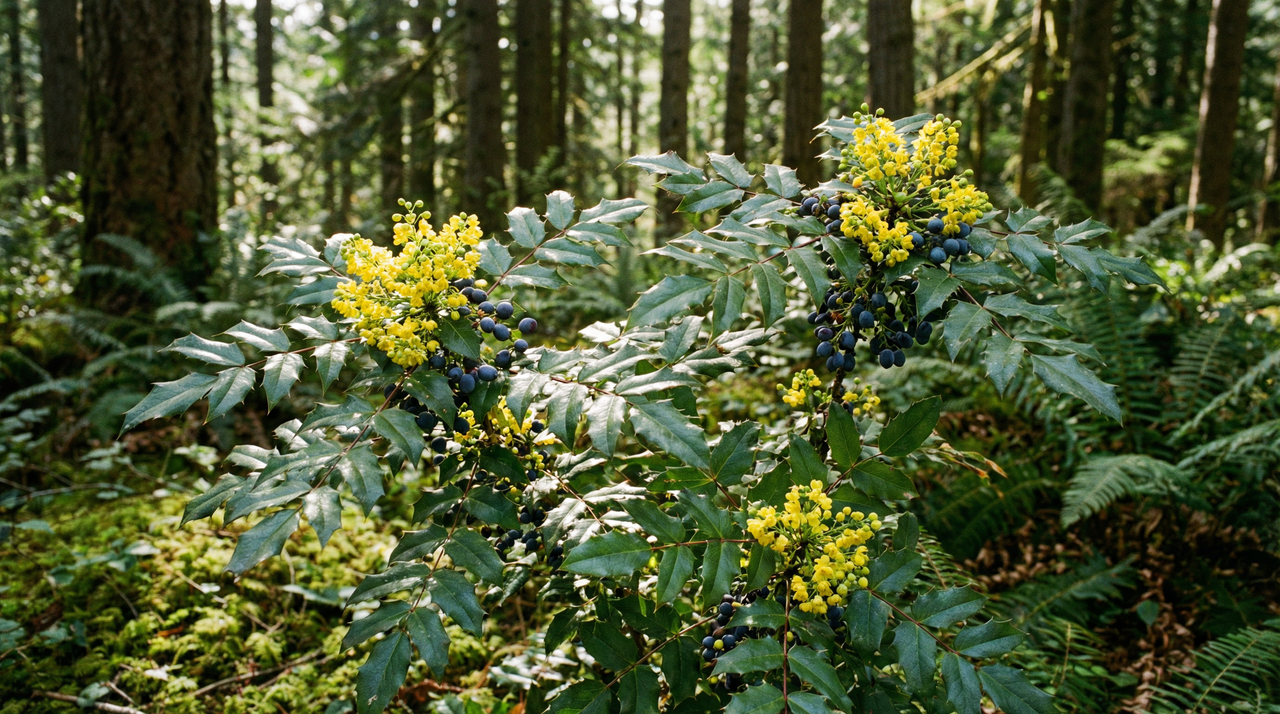
Nobody warned me that Oregon Grape roots stain like fury. The first time I cut into a mature root to show a workshop group the inner heartwood, that unmistakable chrome yellow bled onto my hands, my knife, my jeans, and somehow my jacket, and it didn't fully wash out for days. That pigment is berberine, the alkaloid that makes this plant such a genuinely complex thing to understand, because it's simultaneously the reason Indigenous peoples across the Pacific Northwest used it medicinally for centuries, the reason the berries taste so bracingly sour even when ripe, and the reason you'll find standardized extracts of it in pharmacies alongside clinical research on everything from psoriasis to antimicrobial activity.[1] One compound, woven through the whole story.
Most people know Oregon Grape, if they know it at all, as that spiky evergreen shrub growing in the shade beneath Pacific Northwest conifers, the one with leaves that look like they belong on a holly plant and dusty blue berries that the birds always seem to find before you do. What they don't realize is how much is actually going on beneath that tough, architectural exterior, and why a plant this ecologically loaded deserves far more than a spot at the back of a foundation bed.
Oregon Grape Origin, History, and Botanical Background
Botanical Background and Native Range
Oregon grape (Mahonia aquifolium) is a long-lived, polycarpic evergreen shrub that flowers and fruits repeatedly over a lifespan that commonly runs 20 to 30 years, with some specimens persisting 50 years or more under good conditions.[2][3] Its native range sweeps from southern British Columbia through the Pacific Northwest and into northern California, then arcs east to Idaho and Montana, spanning sea level up to roughly 1,800 meters in moist to dry coniferous forests, open woodlands, and rocky slopes.[4][5] That's a wide ecological envelope, and it explains a lot about the plant's adaptability in cultivated settings.
A quick note on naming: the genus Mahonia is sometimes folded into Berberis in modern taxonomic treatments, so you may see this plant listed as Berberis aquifolium in some references.[6] Its Asian relative, Leatherleaf Mahonia (Mahonia bealei), native to central and southeastern China, is a useful contrast: taller, more architecturally bold, prominent in Traditional Chinese Medicine, and now invasive across much of the southeastern United States.[7][8] Oregon grape has its own colonizing tendencies, but its home is firmly the Pacific Northwest understory, and in my landscape designs I lean into that origin by pairing it with sword ferns and native sedges to recreate the woodland guild it evolved in.
Visual Characteristics
At maturity, Oregon grape typically reaches 3 to 6 feet tall and wide, with woody stems showing grayish-brown bark and a distinctively bright yellow inner bark.[9][10] Think holly but with edible blue berries and rhizomatous roots that let it slowly colonize a slope. The pinnately compound leaves carry 5 to 9 glossy, spiny-toothed leaflets that are deep green above and paler below, flushing reddish-purple in cold weather.[11][12] From late winter into early spring, dense racemes of bright yellow tubular flowers emerge, followed by clusters of small, dusty blue-purple berries, 7 to 10 millimeters across, each containing 2 to 5 seeds.[13][5] If you want a more compact version for a smaller space, the cultivar 'Compacta' (sometimes sold as 'Winter Sun') stays around 3 to 4 feet and delivers an especially generous flush of fragrant yellow flowers.[14]
Traditional and Cultural Uses
Oregon grape was formally documented by botanist Frederick Pursh in his 1814 Flora Americae Septentrionalis, and reached European gardens through collections made by David Douglas and others from around 1823 onward.[15] But Indigenous peoples of the Pacific Northwest, including Salish and Chinook communities, had been working with this plant long before European botanists arrived. They ate the berries fresh and dried them into pemmican, used the roots and bark to treat skin infections and digestive complaints, prepared antiseptic poultices and medicinal teas, and extracted yellow dye from the bark.[16][17] Those medicinal effects trace largely to berberine, an alkaloid with documented antimicrobial and anti-inflammatory properties, which is precisely why the roots were so valued.[16] Oregon grape holds no place in Ayurvedic or Traditional Chinese Medicine, unlike its relative Mahonia bealei, so this is a distinctly North American ethnobotanical story.[18] Since its European introduction it has naturalized widely, and in some regions it has become invasive through bird-dispersed seeds and spreading rhizomes.[19]
Fun Facts and Ecological Notes
Oregon grape was designated Oregon's state flower in 1899, which always makes me smile a little since technically it's neither a single flower nor a grape.[20] Still, few plants carry regional identity as completely as this one does: those waxy spiny leaves, that sulfur-yellow bloom in late winter, the dusty clusters of berries against dark green foliage. It's a portrait of the Pacific Northwest written in plant form.
Ecologically, it earns that reputation. A thick waxy leaf cuticle limits water loss, rhizomatous roots hold slopes against erosion, and early-spring flowering before the forest canopy closes gives pollinators access when little else is blooming.[21] I've observed how quickly its rhizomes and bird-sown seedlings can fill an area, so I always site it intentionally and monitor spread, especially in gardens bordering naturalized land. Outside its native range, it can form dense thickets that displace native vegetation in parts of Europe and New Zealand.[22] That's not a reason to avoid it where it belongs; it's a reason to plant it thoughtfully, which is good advice for most plants worth growing anyway.
Oregon Grape Varieties and Cultivars
The species portrait comes first, because every cultivar is just a refinement of what Mahonia aquifolium already does well. You're starting with an evergreen shrub that typically grows 3 to 6 feet tall and wide, colonizes via suckers, and wears spiny, holly-like leaves that go purplish-bronze in winter.[23][24] In spring it throws fragrant, bright yellow flowers in upright clusters, followed by tart blue-black berries that really do look like tiny grapes.[23] The berries carry berberine and have a long history of medicinal use, the plant shrugs off deer browse, and it's generally tough.[24] That's the baseline every cultivar builds on.
Key Cultivars of Mahonia aquifolium
After designing with oregon grape in multiple woodland-edge guilds, I've landed on a simple question for choosing a cultivar: how much spread can this site actually absorb? The straight species earns its place on larger slopes and naturalized edges, but in tighter urban lots, it can colonize faster than clients expect. That's where 'Compacta' earns its keep. At 3 to 4 feet, it stays tidy and manageable without sacrificing the yellow spring flowers or the wildlife-friendly berries.[25]
For pure ornamental punch paired with practical resilience, 'Apollo' is my go-to recommendation. It flowers abundantly and comes with improved disease resistance, which matters in humid climates where leaf spot can creep in.[26] If a client wants color drama, 'Atropurpurea' deepens to a rich purple in winter, while 'Kings Ransom' pushes golden new growth that reads beautifully against dark conifers.[25][2] Coastal-grown selections tend to produce larger, less bitter fruit than inland forms, so if berry yield matters to you, provenance is worth asking about at the nursery.[26] All of this holds across USDA zones 5 through 8, with some selections reaching into zone 4.[23]
Where to Buy Oregon Grape Plants and Seeds
Container-grown plants from Monrovia, Nature Hills Nursery, or Plant Delights Nursery are widely available in the $18 to $45 range and establish faster than bare-root in my experience with broadleaf evergreens.[27][28][29] Seeds run $4 to $5 through suppliers like Sheffield's Seed Company if you want to grow from scratch and have patience to spare.[30]
I always check the Lady Bird Johnson Wildflower Center database before specifying plants for clients because it points toward regionally appropriate stock and local native-plant nurseries that carry genetically matched provenance.[31] Wild collection from public lands requires permits from the Forest Service or BLM, so don't skip that step.[32] One regulatory detail I always flag for clients ordering online: Mahonia aquifolium is a regulated host for Phytophthora ramorum, the pathogen behind sudden oak death, and California enforces active quarantine restrictions on shipments.[33][34] Verify your nursery's compliance with state rules before placing an order, especially if you're on the West Coast.
How to Propagate and Plant Oregon Grape (Mahonia aquifolium)
Oregon Grape seeds are quietly fascinating little things. Each one is small, just 3-5 mm long, orthodox in storage behavior, and occasionally polyembryonic, meaning two seedlings can emerge from a single seed.[35][36] I've only seen this happen a handful of times, but there's something genuinely delightful about lifting a tray and spotting two pale seedlings nudging each other out of what you carefully counted as a single seed. Bird-dispersed inside those blue-purple berries, the seeds arrive in the landscape already pre-packaged for stratification: a cold, wet winter does the work for free when the birds do the planting.
Seed Biology, Dormancy, and Germination
If you want to start this evergreen shrub from seed, you cannot skip cold moist stratification. The seeds require 90 to 120 days at 3-5°C to break physiological dormancy before germination can begin, and optimal sprouting happens at 15-20°C afterward, with success rates ranging from 30 to 70% using fresh, properly handled seed.[37][38][39] In my experience, shortening this window by even a few weeks collapses germination to nearly zero. The seeds simply aren't ready, and no amount of warmth or coaxing will change that.
Then there's the wait afterward. Even healthy seedlings take 3 to 5 years to produce their first berries under optimal conditions.[40][41] I grew a batch from stratified seed early in my career, watched them slowly bulk up through multiple seasons, and eventually harvested a modest handful of tart berries. The plants were beautiful, but the lesson was clear: if fruit is your goal, seed propagation is a long game. Vegetative propagation almost always makes more sense for a production or landscape context.
Propagation Methods from Cuttings to Tissue Culture
Semi-ripe cuttings taken in late summer are the method I reach for most often, and the research backs that preference up. July through September is the window, using 4-6 inch sections of stem after the new growth has just begun to firm up but hasn't gone fully woody.[42][43] I use a 1:1 perlite and peat mix, maintain humidity at 80-90% on a mist bench, and apply IBA rooting hormone at around 2,000 ppm. That combination consistently gets me roughly 70% strike rates. Dropping below 1,000 ppm IBA noticeably reduces success, so don't skip the hormone or go light on it.[44]
Softwood cuttings taken in late spring are another option, though I find them slightly more finicky about humidity.[42] Layering is wonderfully low-tech: bend a low branch to the ground in April or May, wound the underside lightly, apply rooting hormone, bury that section in moist soil, and leave it alone.[45] It's slow, but essentially foolproof. For the truly adventurous, grafting onto Mahonia repens or select Berberis rootstocks can shorten the time to fruiting compared to seedlings, and tissue culture on MS medium is possible for commercial propagators who need disease-free stock at scale.[46][47]
Whatever method you use, root rot is the enemy. Sterile media, genuine drainage, and good air circulation aren't optional extras; they're what stands between you and a Phytophthora problem that quietly kills a cutting before you realize anything is wrong.[48][49]
Soil, Site Selection, and pH Management
Oregon Grape wants well-drained, humus-rich loamy soil with meaningful organic matter, a rooting zone at least 12-18 inches deep, and absolutely no waterlogging.[2][9] I learned this the hard way early in my career, losing several young plants to Phytophthora root rot because I planted into spots with deceptively decent-looking soil that drained badly after heavy rain. Now I dig a hole, fill it with water, and watch how fast it empties before I commit a plant. If the water is still sitting there two hours later, I either amend heavily or choose a different spot entirely.[50]
Soil pH should sit between 5.0 and 7.5, with the sweet spot around 6.0-7.0.[51] Push above 7.5 and you'll see iron and manganese chlorosis; drop below 5.5 and aluminum toxicity starts damaging roots.[52] Test your soil before planting and adjust with elemental sulfur or peat to lower pH, or lime to raise it.[51] I've also found that working in 5-10% compost at planting time consistently produces faster, more robust establishment than planting into unamended native soil, even when drainage and pH are already adequate.
Planting Timing, Spacing, and Establishment Techniques
Early spring (March-April) and early fall (September-October) are both excellent planting windows across USDA zones 5-9, when mild temperatures and workable soil give transplants the best chance to settle in before heat or cold stress arrives.[53][54] Transplants establish far more reliably than direct-sown seed, which is another reason vegetative propagation usually wins as a practical strategy.
Spacing depends on what you're trying to accomplish. For a hedge, 3-4 feet between plants fills in efficiently. Mass plantings or border work calls for 4-6 feet, while groundcover applications can go tighter at 2-3 feet for quicker fill. Specimen plants deserve 6-8 feet of breathing room.[55][56] In humid climates especially, I err toward the wider end of whatever range applies, because tighter plantings restrict air movement and invite the fungal leaf spot issues that show up on stressed plants in warm, wet summers.
Plant with the root crown sitting level with the soil surface, not buried.[57] Oregon Grape grows at a moderate 12-24 inches per year once established and matures to roughly 3-6 feet tall by 3-5 feet wide, so the spacing choices you make at planting time shape the landscape for years.[55] Get the drainage right, choose the right window, give it room to breathe, and this is a plant that largely takes care of itself.
Oregon Grape Care Guide: Growing Mahonia aquifolium
Resist the urge to fuss when growing Oregon grape. I've watched gardeners kill perfectly healthy Mahonia aquifolium with kindness, heaping on fertilizer and irrigation until the plants yellowed and sulked. This is a woodland understory shrub adapted to lean soils, filtered light, and seasonal drought. Work with that nature and it will outlast most other plants in your garden.
Sunlight Requirements for Healthy Growth
Oregon grape thrives with around 4-6 hours of dappled or direct sunlight per day, though it tolerates everything from full sun to fairly deep shade.[2][51] After several seasons of trialing plants in various spots, I've found that 4-6 hours of dappled morning sun consistently produces the most compact growth and the heaviest flower and berry displays. The problems show up at the extremes. In deep shade, watch for chlorosis (that telltale yellowing between leaf veins), elongated leggy stems, and thin flower production.[51] In harsh afternoon sun without adequate moisture, the leaves scorch at the margins. Morning light, afternoon shade: that's the sweet spot almost everywhere outside the Pacific Northwest.
Watering Needs and Drought Tolerance
Once established, oregon grape is genuinely drought tolerant, thanks to a deep taproot system that mines moisture well below the surface.[40] During the growing season, aim for about an inch of water per week if rain isn't cooperating, watering deeply every 7-14 days and letting the top inch or two of soil dry before the next drink.[58] I usually water mine twice a week in spring when it's flowering and fruiting, then taper off significantly by midsummer once the berries have set.
Young plants are a different story. For the first year or two, keep the soil consistently moist with deep watering two to three times per week.[51] Overwatering at this stage is a real risk: yellowing leaves, wilting despite wet soil, and leaf drop all signal too much moisture around the roots.[59] Underwatering shows up as leaf curl, browning foliage, and brittle stems. Either way, the plant is telling you something. Once the root system is established, it becomes remarkably self-sufficient.
Feeding and Soil Fertility
Oregon grape evolved in nutrient-poor forest soils, and that heritage matters. It typically needs little to no supplemental fertilizer once established, especially when planted into soil amended with 2-4 inches of compost beforehand.[60][51] The plant also forms beneficial associations with arbuscular mycorrhizal fungi in native habitats, which helps it scavenge nutrients far beyond its immediate root zone.[61]
I learned the hard way not to push this one with nitrogen. A young plant I over-fed one spring threw out a flush of soft, leggy growth and produced almost no flowers. That mistake taught me to trust the "low feeder" reputation completely. If a plant genuinely looks slow or pale, a soil test first, then a light application of balanced slow-release fertilizer (something like 10-10-10, at roughly 1-2 pounds per 1000 square feet) in early spring is the most you should do.[62] Stop all feeding by late summer. Yellow leaves can mean nitrogen, iron, or magnesium deficiency, but they can also mean over-fertilization, where you'll often see scorched edges and brown tips alongside the yellowing.[51][63] Test, don't guess.
Frost and Cold Hardiness
Oregon grape is hardy in USDA zones 5-8, tolerating lows around -15°C to -20°C and surviving brief dips near -29°C (-20°F).[48][64] In practice, I mulch my established plants with 3-4 inches of pine bark every November after the ground cools, and I've never lost one to winter burn in zone 5-8 gardens. That said, young plants in exposed sites benefit from burlap wind protection in their first couple of winters.
Frost damage shows up as bronzing or browning of leaf edges and tips, with occasional dieback of younger shoots.[65] One thing I find reassuring about this plant: the leathery evergreen foliage rarely wilts even under stress, so you're more likely to see discoloration than the dramatic collapse you'd get from a tender perennial.[66] Well-drained soil and a sheltered microclimate do as much for winter survival as any mulch.
Heat Tolerance and Summer Care
Its origins in the cool, shaded understory of Pacific Northwest forests tell you everything about its heat preferences.[40] Oregon grape handles sustained temperatures to around 85°F comfortably with adequate moisture, but above 90°F, especially in full sun or low humidity, it starts to show stress.[5] The symptoms look a lot like what you'd see on a stressed Japanese maple or hosta in the same conditions: scorched leaf margins, premature drop, reduced flowering the following season.[48] Some leaves also turn a purplish-maroon in summer heat, which gardeners occasionally mistake for a disease problem rather than the normal oxidative response it is.
In zone 9 or hotter microclimates, afternoon shade becomes non-negotiable.[67] Pair that with consistent moisture, a generous mulch layer to cool the root zone, and a more heat-tolerant cultivar like 'Compacta', and the plant can succeed further south than its native range suggests.
Pruning, Maintenance, and Seasonal Rhythm
The seasonal rhythm of oregon grape is one of the things I genuinely love about it. Bright yellow flower clusters appear from March through May, the berries ripen blue-black through summer, and the glossy evergreen foliage holds structure year-round without full dormancy.[48] That unbroken presence in the garden is a quiet gift.
Pruning mahonia aquifolium is straightforward once you know the timing. Cut immediately after flowering in late winter or early spring to shape the plant and remove dead or damaged wood, and you won't sacrifice next season's flower buds.[68] The plant responds beautifully to having up to a third of the oldest stems removed at the base annually, which encourages fresh basal growth and keeps the shrub from getting leggy over time.[48] Oregon grape's ability to regenerate readily from basal sprouts and suckers after hard pruning or disturbance means you can renovate an overgrown specimen fairly aggressively if needed.
Because it suckers so freely, I routinely remove unwanted basal shoots in late spring to keep plants from spreading into a thicket. In a naturalized area that's a feature; in a more formal food-forest guild, it's worth staying on top of. Either way, this is a tough, long-lived shrub that rewards thoughtful placement far more than intensive care. Get the light, drainage, and siting right, and most of your work is done.
Harvesting Oregon Grape: Timing, Technique, Yield, and Flavor
Oregon Grape teaches patience on two levels. The first is the multi-year wait after planting before you see a meaningful fruit crop. The second is the seasonal arc from those bright spring racemes to ripe late-summer berries, which spans roughly three to four months before you're ready to harvest anything worth eating.[5][69]
When to Harvest Oregon Grape Berries
Flowers appear April through May, and berries typically ripen June through September, with peak harvest falling in August for most regions.[5][12] After years of watching these shrubs, I've learned the ripeness cues are what actually matter. You want deep blue to purple-black fruit with a visible waxy bloom, and the berries should detach with barely a tug, feel firm but give slightly under your thumb, and show fully darkened seeds inside when you split one open.[70][5] Harvesting too early is the most common mistake I see, and it's exactly why so many foragers come away describing these berries as unbearably astringent. Ripe fruit does develop higher sugar levels that soften some of the bitterness, though they stay tart regardless.[70] Plants in sunnier exposures tend to sweeten up slightly faster in my experience, so it's worth tasting across your site rather than harvesting all at once.
How to Harvest Oregon Grape Sustainably
Stick to cultivated plants and ripe fruit only. Wild root and bark harvesting without permits is illegal in states including Washington, and I'd never recommend it regardless of legality -- native populations are too valuable and too slow to recover.[71][72] If you're growing Oregon Grape specifically for medicinal root or bark and using your own cultivated plants, late fall or early spring dormancy is the right window for any root work.[73] For berries, I harvest in the morning after the dew has dried, strip clusters by hand into a bucket, and wash thoroughly once I'm inside.[74] Always leave a good portion of the clusters for birds. They rely on this fruit, and a well-fruiting shrub should feed both of you.
Oregon Grape Berry Yield, Flavor Profile, and Texture
A mature shrub typically yields around two to six pounds of berries per season, with vigorous established specimens occasionally reaching up to five kilograms.[71][75] Raw, they're a genuine pucker: tart and sour with a bitter, astringent finish from tannins and berberine. They are high in citric and malic acids, low in natural sugar, and seedy enough to make fresh eating a commitment rather than a snack.[76][77] Think cranberry crossed with unripe lemon, with a faint resinous note underneath. Cooking changes everything. Heat mellows the bitterness, softens the astringency, and readies the berries for processing into preserves.[78][79] I usually strain out the seeds through a fine-mesh jelly bag after the first simmer, which gives me a clean, jewel-colored liquid that makes exceptional jelly and syrup. The berries are high in vitamin C and antioxidants,[24] but even cooked preparations are best consumed in moderation given the berberine content they retain.
Oregon Grape Preparation and Uses
Native peoples of the Pacific Northwest have prepared Oregon Grape berries for generations, and their methods weren't arbitrary. These fruits need a little coaxing. Raw, they hit you with an intense tartness that I'd describe as an ultra-tart cranberry crossed with lemon verbena, backed by a gritty, seedy texture and a faintly resinous quality that makes your mouth pucker immediately.[78] Eating a handful straight off the shrub is not the move. Cooking them is.
Culinary Uses of Oregon Grape Berries
The traditional method is to boil the berries and discard that first water, which carries off a significant portion of the bitterness, astringency, and water-soluble alkaloids.[78][79] Heat mellows what was sharp, concentrates the fruity aromatics, and transforms something borderline unpalatable into something genuinely complex. Once cooked with honey or sugar, Oregon Grape develops a deep, almost grape-plum depth that surprises people every time I serve it. My wild-crafted jelly has converted more than a few skeptics at the dinner table.
The berries' naturally high pectin content means preserves set beautifully without commercial pectin.[12][75] I've noticed that freshly harvested berries feel slightly tacky between the fingers, a little cue I've come to read as a sign they'll set up well in a jelly. You will need added sweetener though; natural sugars are low, so don't be shy with it.[80] Beyond jam and jelly, the berries go into pies, syrups, sauces, and wines, and they're rich in vitamin C on top of everything else.[81] I only harvest from abundant patches, always leaving plenty for birds and for the plant to reseed. That's non-negotiable for me.
If you grow Leatherleaf Mahonia alongside the true Oregon Grape, its ripe blue-black berries behave similarly: tart, astringent raw, but responsive to cooking into jams, jellies, or wines with that same high-pectin advantage.[82][83] The flowers, by contrast, are edible raw and can be scattered in salads or steeped into a mild tea, a gentler introduction to the genus if you want something fresh and immediate.[24]
Medicinal Preparations from Oregon Grape
The root is a different matter entirely. It contains far higher berberine concentrations than the berries and is strictly medicinal, prepared as teas, tinctures, extracts, or topical creams for digestive complaints, skin conditions, and other ailments.[24][84][85] Traditional ranges for tinctures run around 2-4 ml of a 1:5 preparation three times daily; for decoctions, roughly 1-2 grams of dried root simmered in water for 10-15 minutes, two to three times per day. Commercial extracts are typically standardized to 5-10% berberine, targeting 10-20 mg per dose. I treat these as traditional guidelines, not clinical prescriptions, and I always tell students to consult a qualified herbalist or healthcare provider before working with root preparations.
The safety framework here is firm and I don't soften it. Oregon Grape root is contraindicated in pregnancy. Full stop. Berberine crosses the placenta and carries real risks. Drug interactions are also a genuine concern, particularly with medications processed by the liver. I use only root bark for tinctures, never raw root in excess, and I apply the same rules to everyone I teach. The plant offers something real medicinally, but it demands respect and restraint in equal measure.
Oregon Grape Health Benefits and Medicinal Uses
Traditional Indigenous Uses and Ethnobotany
Long before berberine appeared in any pharmacology journal, the tribes of the Pacific Northwest were already working with Oregon grape in sophisticated ways. The Salish brewed root teas for coughs, diarrhea, and stomach complaints; the Nlaka'pamux prepared bark decoctions for sore throats and respiratory trouble; the Blackfoot applied root poultices directly to wounds, skin eruptions, and eye infections.[86] Across the Okanagan-Colville and other peoples, the plant showed up consistently for skin ailments, digestive complaints, fevers, and infections, in the form of teas, decoctions, and poultices depending on what the situation called for.[87][88] What strikes me about this record is how precisely these applications map onto what researchers later identified as berberine's core activities: antimicrobial, anti-inflammatory, wound-healing. The knowledge came first; the chemistry just explained it.
Key Phytochemicals: Berberine and Supporting Compounds
The reason Oregon grape's roots behave so differently from its berries comes down to alkaloid distribution. Berberine, the primary bioactive compound, reaches concentrations of 5-7% in the root bark and 0.5-2.5% across the roots overall, dropping to 0.5-1.5% in stem bark, 0.1-0.7% in leaves, and less than 0.1% in the fruits and seeds.[87][89][90] That number tells you a lot. If you've ever bitten into a piece of fresh root and recoiled at the intensity of bitterness, you've directly experienced high alkaloid content; it's a useful field indicator. Berberine isn't the only isoquinoline alkaloid present either. Berbamine, palmatine, and jatrorrhizine follow similar concentration patterns and likely contribute synergistically to the plant's overall activity.[90][91]
Beyond the alkaloids, the leaves carry substantial flavonoids including quercetin, rutin, and kaempferol glycosides at up to 5-10% as phenolics, along with phenolic acids like chlorogenic and caffeic acid, condensed tannins, and minor coumarins and phytosterols.[92] These compounds help explain the leaves' antioxidant activity and UV-B protective properties. The fruits, as I'll cover below, are a different story chemically, with their berberine nearly absent and their value coming primarily from anthocyanins and organic acids.[93]
For growers and harvesters, the seasonal data matters practically. Leaf alkaloid content peaks in spring and early summer in young growth, then falls by roughly 30-50% by autumn.[94] After years of growing Oregon grape in my own landscape, I've noticed the roots taste noticeably more bitter in late summer harvests, which aligns with specific agronomic field studies demonstrating that root alkaloid concentrations peak during this exact lifecycle window. I use that bitterness as a rough guide for tincture timing. Soil phosphorus can push berberine production up by as much as 25%, while nitrogen deficiency and heavy shade reduce it.[95][96]
Pharmacological Research and Clinical Evidence
The clinical picture for Oregon grape is strongest where traditional knowledge pointed first: the skin. Randomized controlled trials using topical Mahonia aquifolium extracts on psoriasis patients have shown significant symptom improvement, with one study reporting 78% improvement in participants.[97][98] Topical preparations have also shown efficacy for eczema and acne, the latter partly through activity against Propionibacterium acnes.[99] I've personally used diluted extracts on minor skin irritations with good results, though I'm careful to frame that as complementary to clinical evidence rather than treatment of a medical condition.
The mechanisms behind this activity are well-characterized. Berberine exhibits broad-spectrum antimicrobial action against both Gram-positive and Gram-negative bacteria by disrupting cell membrane permeability, inhibiting DNA gyrase and RNA polymerase, and blocking efflux pumps.[100][101] Its anti-inflammatory work happens through suppression of NF-κB signaling and reduction of cytokines like TNF-α and IL-6, along with COX-2 inhibition.[90][102] Antioxidant properties come through free radical scavenging and upregulation of protective enzymes like SOD and catalase, with the leaf flavonoids providing synergistic support.[103][104]
Preclinical research points toward metabolic benefits as well. Berberine activates AMPK, improving glucose uptake via GLUT4 translocation and inhibiting gluconeogenesis, with hepatoprotective effects mediated through the Nrf2 pathway and some evidence for analgesic activity.[105][106] Anticancer research is largely preclinical, showing apoptosis induction, cell cycle arrest, and inhibition of angiogenesis via PI3K/Akt pathways.[107] These are promising directions, not established clinical applications. Oral root extracts are used medicinally at typical dosages of 500-1500 mg daily, though berberine's low oral bioavailability means some formulations require enhancement to achieve therapeutic levels.[108][109] Those of us growing our own plants should also know that overharvesting of wild populations is a real problem; cultivated material or ethically sourced roots are the responsible path.[110] Oregon grape is an excellent, sustainable alternative to goldenseal for this reason: both plants share berberine-driven properties, but Oregon grape is far more sustainable to cultivate locally in the Pacific Northwest.
Nutritional Profile of Oregon Grape Berries
The berries are a different conversation from the roots, and I think that distinction gets muddied in a lot of popular writing about this plant. Ripeness is everything. Fully ripe berries, the deep blue-black ones with a waxy bloom, are genuinely edible and worth foraging. I've made syrups and jellies with them many times, and properly ripe fruit is noticeably less bitter and much easier on the stomach than anything picked early. Unripe berries are sharper, more astringent, and higher in alkaloids; they're worth avoiding or at least approaching cautiously. A sensible serving size stays around 50-100g given the low but present berberine content and the tannins that can cause digestive effects in some people.[111][112]
Nutritionally, the berries deliver 20-50 mg of vitamin C per 100g fresh weight, covering roughly 16-22% of daily value, which explains their historical use against scurvy in Indigenous and early settler communities.[113][114] Their anthocyanin content (around 0.5-1%) contributes meaningful antioxidant capacity alongside flavonoids, phenolic compounds, vitamins A and E, potassium, calcium, and dietary fiber.[93][113] In caloric terms, they're modest, around 50-70 kcal per 100g with roughly 10-15% carbohydrates and 1-2% protein, high water content, and low fat.[112] Think of them as a nutritious wild food with real antioxidant value, not a miracle supplement, and you'll have the right frame for them.
Safety Considerations and Contraindications
Oregon grape is mildly to moderately toxic due to its isoquinoline alkaloids, and the dose-dependent nature of that toxicity is the key thing to understand.[115] Root bark concentrations of 4-6% berberine are not trivial. Even at therapeutic oral doses above 500 mg per day, common side effects include nausea, vomiting, diarrhea, and abdominal cramping.[116] Higher doses can cause neurological effects including lethargy and dizziness, and carry risks of liver or kidney stress.[117] Berberine can also reduce blood glucose by up to 20%, which matters for anyone managing diabetes or taking hypoglycemic medications.[118]
If you're pregnant, breastfeeding, or trying to conceive, skip medicinal root preparations entirely. Berberine can stimulate uterine contractions and carries a kernicterus risk for newborns.[119] Children and anyone with existing liver or kidney conditions should also avoid internal use. Drug interactions are a serious consideration because berberine inhibits CYP3A4 enzymes and can raise blood levels of statins, cyclosporine, warfarin, digoxin, calcium channel blockers, and macrolides to potentially dangerous levels.[120][121] If you're on any of those medications, this is a conversation to have with your doctor before using any berberine-containing supplement. Topical use, in contrast, has a solid safety record with only mild skin irritation and a moderate potential for contact dermatitis in sensitive individuals.[122][123]
For pet owners, the ASPCA lists Oregon grape as toxic to dogs and cats, causing vomiting, diarrhea, and depression.[115] I have dogs, and while they reliably avoid the bitter leaves, the ripe berries in fall are a different matter. I keep an eye on berry ingestion during harvest season, and I'd call poison control or a vet immediately if I noticed vomiting after any significant berry consumption. Traditional internal use was typically short-term, running four to six weeks, and precise long-term dosage limits haven't been well established in the research.[124][125] Respecting that traditional pattern, using medicinal preparations purposefully and cyclically rather than indefinitely, is probably the most sensible approach until more long-term safety data exists.
Oregon Grape Pests and Diseases
Oregon grape is one of those plants I tend to recommend to clients who've had bad luck with finicky ornamentals, partly because its pest and disease track record is genuinely reassuring. The spiny holly-like leaves are a physical deterrent on their own, but the real armor is chemical. Berberine, the same alkaloid that makes the roots so bitter to the human tongue, functions as an antifeedant that most insects find equally off-putting.[48][126] You can smell that bitterness when you crush a leaf between your fingers. It's not subtle, and apparently most insects agree.
Pest Resistance and Common Insect Problems
Established, healthy oregon grape rarely needs any intervention for pests. That said, stressed plants or tender new growth can attract aphids, scale, spider mites, leaf beetles, and leaf miners, especially where air circulation is poor.[127][128] I've honestly never needed to spray an established plant for aphids when it's sited in partial shade with decent airflow. Problems arise when plants are crammed together or left in full sun without enough moisture during establishment.
Cultivar selection makes a real difference here. 'Compacta' and 'Patriot' show noticeably better aphid resistance than 'Variegata', which tends to attract more trouble across the board.[129][2] In humid microclimates, I routinely steer clients toward 'Compacta' for exactly that reason. For any outbreak that does develop, the IPM approach holds: monitor early, encourage natural predators like predatory mites for spider mite issues, and only reach for a 1-2% horticultural oil if populations actually warrant it.[130][131]
Disease Profile and Management
The leathery foliage gives oregon grape solid baseline resistance to fungal diseases under good growing conditions.[132][133] The threat that actually kills plants is Phytophthora root and crown rot in poorly drained soil.[134] I've watched plants installed into unamended clay without drainage correction collapse within two seasons, every single time. No spray fixes it. Once Phytophthora takes hold in saturated soil, you're managing a slow decline, not a recovery. As covered in the care section, consistent drainage is non-negotiable.
Foliar problems like powdery mildew, leaf spot from Septoria or Alternaria, and occasional rust pustules do occur, but they're almost always a humidity and airflow story rather than a mahonia diseases story specifically.[135][136] Think of it the way you'd think about roses or hydrangeas: the disease isn't unique to the plant, the conditions invited it. Removing infected material, avoiding overhead watering, and spacing plants for airflow resolves most of these problems before they escalate.[137] For persistent mildew or rust, sulfur-based fungicides are an option, but I've rarely needed them on properly sited plants.[138]
'Compacta' holds up better to both powdery mildew and marginal drainage than 'Variegata', which is more susceptible to foliar disease generally.[139][140] Dieback from fungal cankers, Verticillium wilt, or drought stress can also appear on weakened specimens,[141] but the pattern I keep returning to is this: oregon grape planted in the right spot with good drainage rarely gives you much to worry about. The problems I've seen are almost always problems of placement.
Oregon Grape in Permaculture Design
Every time I'm laying out a new food forest or woodland edge planting, Oregon Grape ends up on the list. It's not just habit. This plant solves multiple design problems at once without demanding much in return, and in a well-considered guild, that kind of reliability is worth more than novelty.
Climate Zones and Hardiness for Oregon Grape
Oregon Grape is cold-hardy to around -20°F, which puts it comfortably in USDA zones 5 through 9.[2][71] That said, zones 6 and 7 are where it really performs, giving you reliable flowering and fruit set year after year.[142][143] Zone 5 plants may see reduced fruit set from late frosts, and in zones 8 and 9 the summer heat becomes the limiting factor rather than winter cold.
For those warmer sites, the fix is deliberate afternoon shade and consistent mulch during establishment. The plant can handle temperatures up to around 100°F if it has proper care and isn't baking in full western exposure.[144] In my designs for zone 8 clients, I always tuck Oregon Grape under the canopy of a fruit tree or tall shrub rather than planting it in the open, and I note in the care plan that the first two summers of supplemental watering are non-negotiable. Once established, it's remarkably adapted to a wide range of annual rainfall, performing well anywhere from 20 to 40 inches per year.[2][71] It's even salt-spray tolerant, which opens up coastal sites that would defeat most understory shrubs.[71]
Ecosystem Functions and Benefits
The yellow racemes open as early as February in mild climates, and I have watched mining bees and bumblebees work them in my region before almost anything else in the garden is blooming. That early-season forage value is exactly why I've written Oregon Grape into multiple pollinator guilds over the years. The flowering period stretches through May, and because the plant is self-incompatible, you need at least two individuals nearby for good fruit set.[145][146] The blue-black berries that follow persist well into winter, feeding more than 40 bird species including robins and cedar waxwings while the spiny evergreen foliage provides year-round cover and nesting structure for small birds and mammals.[2][147]
Underground, Oregon Grape forms arbuscular mycorrhizal associations that improve its phosphorus uptake and drought tolerance, and it may function as a modest dynamic accumulator of potassium and phosphorus over time.[148][149] Its fibrous roots knit into slopes and hold soil through heavy rain events. I've used it on steep, shaded banks where erosion was a recurring problem, and after a couple of growing seasons the difference was visible.[150] Dense growth also suppresses weeds effectively, reducing maintenance on difficult sites.[151]
Pay close attention to placement in tight guilds, as the berberine in the roots has allelopathic effects that can inhibit nearby plants and shift soil microbiology.[152] I had one food forest bed where I planted Oregon Grape too close to annual vegetable rows, and germination in that zone was notably patchy for two seasons before I figured out what was happening. Keep it away from annual beds and sensitive seedling areas, and be aware that outside its native range it can self-seed aggressively via those bird-dispersed berries.[153]
Forest Layer Placement and Guild Design
At 3 to 6 feet tall and 3 to 5 feet wide with a suckering, spreading habit, Oregon Grape belongs squarely in the shrub layer.[40][9] Its native range spans British Columbia down through northern California and east into the Rockies, where it occupies the understory of coniferous and mixed woodland.[5][9] Replicating that context in a food forest means placing it beneath a canopy layer of fruit or nut trees where it gets filtered light and protection from harsh afternoon sun.
For companions, comfrey and strawberries work well in the layers below it, and I've found that the suckering habit gradually fills in gaps to create a low, deer-proof hedge over time. That spiny evergreen structure is genuinely useful along property lines or any area where you want a living barrier that also feeds wildlife and produces medicinal berries.[154] If you're familiar with Leatherleaf Mahonia (Mahonia bealei), note that it grows considerably taller and spreads more aggressively; in a managed food forest the more restrained stature of Oregon Grape is usually an asset rather than a limitation. The suckering habit that could become a nuisance in a small ornamental border is exactly what makes it useful for slope stabilization and living hedge applications. Choose your site intentionally and this plant will reward you with evergreen structure, multi-season wildlife value, and that extraordinary pulse of early-spring pollinator energy that nothing else in my designs has matched.
The Shrub That Made Me Rethink "Ornamental"
I still have a jar of Oregon Grape jelly in my pantry from a batch I made three autumns ago, the color of a bruised plum, impossibly tart. Every time I see it I think about the plant it came from: holding a slope behind my clients' woodshed, feeding bees in February when nothing else was blooming, asking absolutely nothing from anyone. Some plants pull their weight quietly, and this one does it year after year without a single complaint.
Sources 154
- Berberine: Botanical Occurrence, Traditional Uses, Extraction Methods, and Relevance in Cardiovascular, Metabolic, Hepatic, and Renal Disorders ↩
- Oregon Grape (Mahonia aquifolium) ↩
- Berberis aquifolium (Oregon-grape) ↩
- USDA PLANTS Database - Mahonia aquifolium ↩
- Flora of North America: Mahonia aquifolium ↩
- Mahonia aquifolium - Plants of the World Online (Kew Science) ↩
- Flora of China - Mahonia bealei ↩
- Invasive Plant Atlas - Leatherleaf Mahonia ↩
- USDA Plants Database - Mahonia aquifolium ↩
- Mahonia aquifolium - Kew Gardens Plant Profile ↩
- Mahonia aquifolium - Missouri Botanical Garden ↩
- Oregon Grape (Mahonia aquifolium) Description ↩
- Missouri Botanical Garden Plant Finder ↩
- Mahonia aquifolium 'Winter Sun' - RHS ↩
- Flora Americae Septentrionalis ↩
- Mahonia aquifolium (Oregon Grape): Traditional Uses and Modern Research ↩
- Ethnobotany of Mahonia aquifolium (Oregon Grape): Traditional Uses and Phytochemical Properties ↩
- Mahonia bealei in Traditional Chinese Medicine ↩
- Distribution of Mahonia aquifolium in Europe ↩
- Oregon State Flower: Oregon Grape ↩
- Mahonia aquifolium (Oregon Grape): Morphological Adaptations to Pacific Northwest Forests ↩
- Invasive Potential of Mahonia aquifolium ↩
- Missouri Botanical Garden - Mahonia aquifolium ↩
- North Carolina Extension Gardener Plant Toolbox - Mahonia aquifolium ↩
- Royal Horticultural Society - Mahonia aquifolium ↩
- Royal Horticultural Society - Mahonia aquifolium Cultivars ↩
- Nature Hills Nursery - Mahonia aquifolium ↩
- Monrovia - Mahonia aquifolium ↩
- Plant Delights Nursery - Mahonia aquifolium ↩
- Sheffield's Seed - Mahonia aquifolium Seeds ↩
- Lady Bird Johnson Wildflower Center Native Plant Guide - Mahonia aquifolium ↩
- BLM - Plant Collection Permits on Public Lands ↩
- USDA Federal Noxious Weeds List ↩
- APHIS - Phytophthora ramorum Regulated Hosts ↩
- Mahonia aquifolium (Oregon-grape): Morphology and Propagation ↩
- Seed Storage Behaviour of Berberidaceae Species ↩
- Seed Dormancy and Germination in Berberidaceae ↩
- Oregon Grape: Biology and Cultivation ↩
- Germination of Mahonia aquifolium Seeds ↩
- Mahonia aquifolium Plant Profile ↩
- Growing Mahonia from Seed ↩
- Propagation of Mahonia aquifolium ↩
- Mahonia Propagation ↩
- Mahonia aquifolium - Plant Finder ↩
- Propagating Mahonia: Layering Techniques ↩
- Propagation of Mahonia by Grafting ↩
- Micropropagation of Mahonia aquifolium through axillary bud culture ↩
- Mahonia aquifolium ↩
- Mahonia aquifolium ↩
- Phytophthora Root Rot of Woody Ornamentals ↩
- Mahonia aquifolium Growing Guide ↩
- Oregon Grape (Oregon-grape) ↩
- Oregon State University Extension: Growing Mahonia ↩
- University of Minnesota Extension: Oregon Grape ↩
- Mahonia aquifolium Planting Guide ↩
- Mahonia aquifolium - Missouri Botanical Garden ↩
- Oregon Grape Holly Spacing for Hedges ↩
- Mahonia aquifolium ↩
- How to Grow and Care for Leatherleaf Mahonia ↩
- Mahonia aquifolium cultural information ↩
- Mahonia aquifolium care - Royal Horticultural Society ↩
- Fertilizing Mahonia Shrubs - Gardening Know How ↩
- Nutrient Deficiencies in Evergreen Shrubs ↩
- Mahonia aquifolium - Plant Finder ↩
- Mahonia aquifolium - Missouri Botanical Garden ↩
- Winter Protection for Broadleaf Evergreens ↩
- Mahonia for California Gardens ↩
- Mahonia aquifolium ↩
- Growing Mahonia: Flowering and Fruiting ↩
- Missouri Botanical Garden Plant Finder - Mahonia aquifolium ↩
- Oregon Grape (Mahonia aquifolium) ↩
- Oregon Grape is a Protected Plant Species ↩
- Berberine Extraction in Mahonia aquifolium ↩
- Mahonia aquifolium: General Information ↩
- Mahonia aquifolium: Culinary and Medicinal Uses ↩
- Oregon Grape (Mahonia aquifolium) - Wild Food Profile ↩
- Chemical Composition of Mahonia aquifolium Fruits ↩
- Flavor and Aroma Profile of Berries in the Mahonia Genus ↩
- Wildfoodplants.com Oregon Grape ↩
- Foraging Oregon Grape Berries: Taste and Uses ↩
- USDA Plants Database - Mahonia aquifolium ↩
- Mahonia bealei (Leatherleaf Mahonia) | North Carolina Extension Gardener Plant Toolbox ↩
- Leatherleaf Mahonia - Mahonia bealei ↩
- Berberine in Oregon Grape ↩
- Edible and Medicinal Plants of the West ↩
- Native American Ethnobotany Database - Mahonia aquifolium ↩
- Traditional and Modern Uses of Mahonia aquifolium ↩
- Ethnobotany of the Pacific Northwest Native Americans ↩
- Pharmacological Activities of Mahonia aquifolium: A Review ↩
- Phytochemical composition and biological activities of Mahonia aquifolium ↩
- Phytochemical Investigation of Mahonia aquifolium ↩
- Phytochemical Profile of Mahonia aquifolium ↩
- Secondary Metabolites of Oregon Grape Fruits ↩
- Seasonal Changes in Alkaloid Content of Mahonia aquifolium ↩
- Effects of Soil Nutrients on Berberine Production in Oregon Grape ↩
- Cultivation Practices and Metabolite Profiles in Mahonia Species ↩
- Clinical Trials of Mahonia aquifolium for Psoriasis and Other Conditions ↩
- Clinical Efficacy of Mahonia aquifolium in Psoriasis Treatment ↩
- Topical Treatment of Atopic Dermatitis with Mahonia Aquifolium Extract ↩
- Antimicrobial Mechanisms of Berberine from Mahonia aquifolium ↩
- Berberine: A Review of its Pharmacological Activity and Mechanisms ↩
- Anti-inflammatory and Antioxidant Effects of Mahonia aquifolium Extracts ↩
- Antioxidant and Anti-inflammatory Activities of Mahonia aquifolium ↩
- Antioxidant and Antimicrobial Properties of Mahonia aquifolium Extracts ↩
- Berberine in Diabetes: AMPK-Mediated Mechanisms ↩
- Hepatoprotective Effects of Mahonia aquifolium in Experimental Models ↩
- Anticancer Potential of Berberine and Mahonia Species ↩
- Berberine: Safety and Toxicity Review ↩
- Berberine: A Review of its Pharmacological Activity and Clinical Efficacy ↩
- Herbal Medicine: Biomolecular and Clinical Aspects - Oregon Grape ↩
- Oregon Grape (Mahonia aquifolium) - Plant Fact Sheet ↩
- Nutritional Composition of Mahonia aquifolium Fruits ↩
- Nutritional Composition of Oregon Grape Fruits ↩
- Vitamin C Content in Native North American Berries ↩
- Oregon Grape (Mahonia aquifolium) ↩
- Berberine Toxicity and Side Effects ↩
- Phytochemical and Pharmacological Evaluation of Mahonia aquifolium ↩
- Berberine: A Review of its Pharmacological Activity ↩
- Mahonia aquifolium - Drugs and Lactation Database (LactMed) ↩
- Berberine and Drug Interactions ↩
- Berberine: Safety Concerns and Interactions ↩
- Oregon Grape (Mahonia aquifolium) - Safety and Side Effects ↩
- Contact Dermatitis from Oregon Grape (Mahonia aquifolium) ↩
- Oregon Grape (Mahonia aquifolium) - Side Effects and Safety ↩
- Oregon Grape | Poison Control | University of Utah Health ↩
- Alkaloids of Mahonia aquifolium and Their Biological Activity ↩
- Pests and Diseases of Oregon Grape ↩
- Insect Pests of Mahonia Species ↩
- Mahonia aquifolium: Pest and Disease Management ↩
- Integrated Pest Management for Home Landscapes ↩
- Pest Management Guidelines for Ornamentals ↩
- Missouri Botanical Garden Plant Finder: Mahonia aquifolium ↩
- Royal Horticultural Society (RHS) Plant Selector: Mahonia aquifolium ↩
- Fungal Diseases of Woody Ornamentals ↩
- Powdery Mildew on Landscape Plants ↩
- Oregon Grape (Mahonia aquifolium) Diseases and Pests ↩
- Mahonia aquifolium (Oregon Grape) - Disease Management ↩
- Powdery Mildew on Ornamentals ↩
- Breeding for Disease Resistance in Mahonia spp. ↩
- Mahonia aquifolium Cultivars and Disease Management ↩
- Diseases of Woody Ornamentals: Mahonia ↩
- Mahonia aquifolium - Oregon State University Extension ↩
- Hardiness and Performance Trials - Chicago Botanic Garden ↩
- Mahonia aquifolium Plant Profile ↩
- Pollination Ecology of Mahonia aquifolium ↩
- Pollination of Native Plants in the Pacific Northwest ↩
- Native Shrubs for Wildlife Habitat ↩
- Mycorrhizal associations of Mahonia aquifolium ↩
- Dynamic Accumulators in Permaculture ↩
- Oregon Grape (Mahonia aquifolium) in Sustainable Landscaping ↩
- Landscape Ornamentals: Mahonia aquifolium ↩
- Allelopathy in Mahonia species ↩
- Mahonia aquifolium - Missouri Botanical Garden ↩
- Agroforestry integration of native shrubs ↩