Cut a piece of fresh Padauk and it bleeds. That's the only word for it. The heartwood of Pterocarpus macrocarpus runs a red so vivid and wet-looking that the first time I held a freshly milled board, I genuinely checked my hands. That color isn't just striking; it's the whole story of why humans have been obsessing over this genus for centuries, why temples in Myanmar are carved with it, why its relatives hold national-tree status in the Philippines, and why getting your hands on a legally sourced specimen today is a serious exercise in patience and paperwork. The same compounds that produce that spectacular pigment, a class of molecules called pterocarpans and isoflavonoids, turn out to be pharmacologically active in ways that researchers are still untangling.[1]
Here's the contradiction that drew me in: this is a nitrogen-fixing canopy legume with genuine food-forest credentials, the kind of multi-functional tree permaculture designers dream about, and yet almost nobody in the Western tropics grows it intentionally. Most people only encounter it as an expensive timber or a dust allergy waiting to happen in a woodshop. There's so much more to understand about this tree, and almost none of it is what you'd expect going in.
Padauk Origin, History, and Cultural Significance
Botanical Background and Distribution of the Pterocarpus Genus
To understand padauk, you really have to understand the whole genus it belongs to. Pterocarpus is a pantropical group of leguminous trees that has quietly shaped forests, economies, and cultures across three continents. The most celebrated member in Southeast Asia is Narra (Pterocarpus indicus), native to the Philippines, Indonesia, Papua New Guinea, Malaysia, Thailand, Myanmar, and stretching as far as northern Australia and Sri Lanka.[2][3] Padauk proper (Pterocarpus macrocarpus) occupies a somewhat tighter range across Myanmar, Thailand, Laos, Cambodia, Vietnam, eastern India, and parts of China and Indonesia, preferring mixed deciduous forests and savannas rather than the lowland rainforest zones where Narra thrives.[4][5] Farther afield, Andaman Redwood (Pterocarpus dalbergioides) is endemic to the Andaman and Nicobar Islands, while African Padauk or Oha (Pterocarpus mildbraedii) holds territory across the tropical woodlands and savannas of West and Central Africa.[6][7]
As a landscape designer, I find myself drawn to canopy emergents that earn their keep ecologically, and these trees are exactly that. Narra reaches the upper or emergent layer of lowland rainforests, growing to 30 to 40 meters tall.[8] Padauk fills a similar canopy position in drier, more seasonal forests alongside Indian Kino (Pterocarpus marsupium) in tropical deciduous forests of India and Sri Lanka, and Oha in African miombo woodlands up to around 800 meters elevation.[9] What all these species share is a polycarpic reproductive strategy, meaning they flower and set seed repeatedly across a long lifespan without dying after reproduction.[10][11] Narra typically reaches first flowering somewhere between seven and eight years from germination, while Padauk takes longer, usually ten to fifteen years.[12][13] These are not fast-reward trees, and that's worth sitting with before you decide to plant one.
Visual Characteristics and Growth Habits
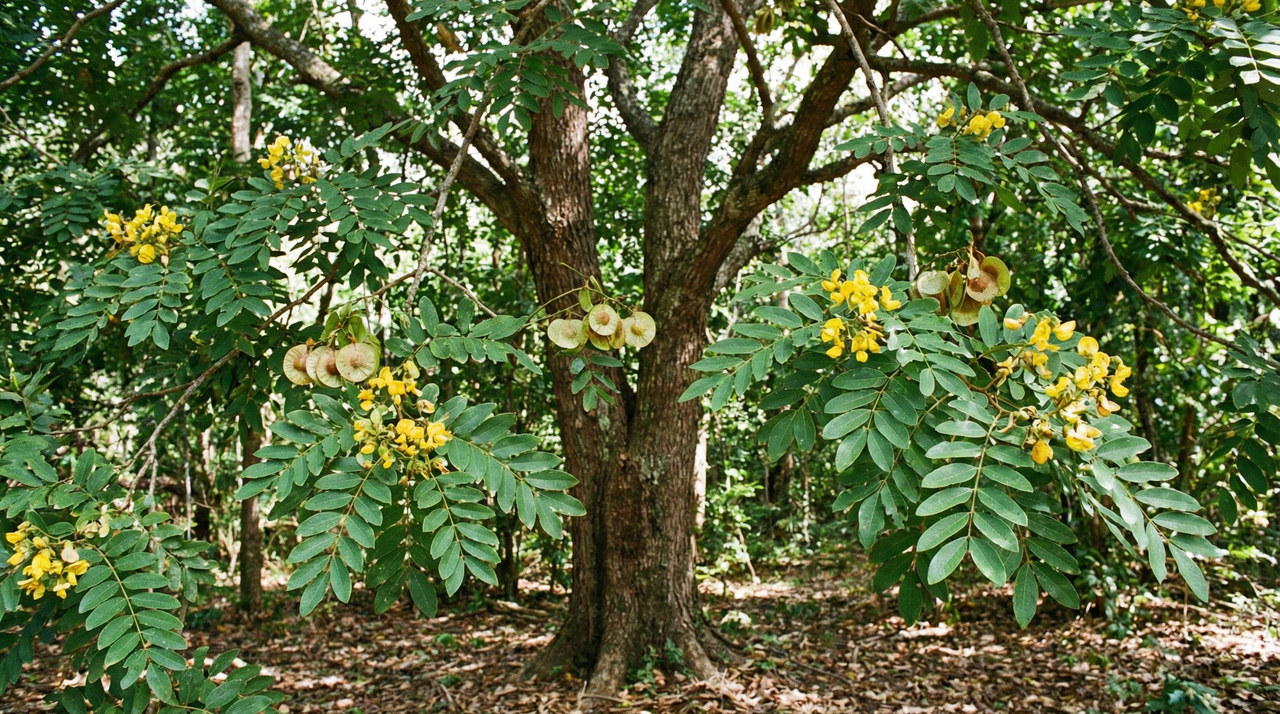
Narra is the kind of tree that stops you mid-trail. Under optimal conditions it can reach 30 to 40 meters with trunk diameters of one to two meters and prominent buttresses that flare dramatically at the base.[14] The canopy spreads 15 to 25 meters wide and casts deep, dense shade. Pinnately compound leaves carry 5 to 11 ovate leaflets, each 4 to 10 cm long, and the tree produces fragrant yellow flowers in large terminal panicles, typically from May through August.[15] The fruit is a flattened circular pod 4 to 7 cm across with a broad papery wing that carries one to two seeds on the wind. Smooth gray bark when young gives way to scaly, fissured texture with age, and the root system runs deep with wide lateral anchoring roots.[16]
Padauk (Pterocarpus macrocarpus) is slightly more modest, typically 20 to 30 meters tall with an open spreading crown, though exceptional specimens push to 40 meters.[3] What sets it apart visually are the deep orange-red to dull red flowers that appear during the dry season, before the leaves fully flush, and the grayish-brown bark that exudes a red gum when cut.[17] I saw this red kino weeping from a wounded Padauk trunk at a botanical collection years ago and immediately understood why people have used this resin for centuries as a dye and astringent. The tree announces its chemistry visually. Indian Kino similarly exudes a red astringent gum from dark, deeply fissured bark, and its cream-yellow flowers appear February through May.[18]
Traditional and Cultural Uses Across Asia and Africa
Narra is the national tree of the Philippines, declared so by President Ferdinand Marcos in 1977 through Proclamation No. 1601.[19] That official status carries genuine cultural weight. Indigenous groups including the Ifugao, Tagbanua, and Dayak peoples have long relied on Narra for construction, tools, and ritual artifacts, associating the tree with ancestral spirits and using its red sap as a dye for textiles and body adornment.[19] Across the archipelago, bark decoctions and leaf poultices have treated wounds, skin infections, fever, diarrhea, and respiratory conditions for generations.[20]
In Myanmar, padauk carries its own distinct symbolic weight. The tree is woven into the Thingyan New Year festival as a symbol of strength, prosperity, and renewal.[21] Karen and Shan communities use the wood for sacred carvings, Buddhist temple decorations, and animist rituals, and Padauk's dense timber lends itself to musical instruments including xylophones known locally as pat waing in Myanmar and ranat in Thailand.[22] In Laos, the tree appears in folklore as a protector associated with house construction and ceremonial masks.[23] Medicinally, Padauk bark decoctions addressed gastrointestinal disorders and fever, while leaf poultices treated rheumatism and wounds.[24] Communities that revere these trees in the way Karen or Ifugao communities do are practicing something that maps almost perfectly onto permaculture's people-care ethic: they protect what they depend on.
Conservation Status and Fun Facts
The conservation picture across this genus is sobering. Narra is classified as Near Threatened due to timber overexploitation and habitat loss, while Padauk sits at Vulnerable to Endangered, and Andaman Redwood has reached Critically Endangered status.[25][26] In Myanmar alone, over 50% habitat decline has occurred across three generations.[27] Padauk's listing on CITES Appendix II means international timber trade is regulated and requires documentation.[28] Having worked with threatened tropical species in landscape projects, I take this seriously. When I spec timber or source planting stock, CITES status is the first thing I check, not an afterthought.
The trees themselves deserve wonder alongside that concern. Mature Narra trunks can reach one to two meters in diameter, with those dramatic buttressed bases that look like something out of a Tolkien illustration.[29] Padauk flowers in the dry season before its leaves return, carpeting the forest floor in orange-red. Narra blooms May through August with fragrant yellow flowers that attract pollinators across a wide guild of insects.[30] These aren't incidental aesthetic details; they're the ecological gifts that make these trees worth protecting and, where climate permits, worth growing with care and intention.
Padauk Varieties and Sourcing
Botanical Varieties and Notable Species in the Pterocarpus Genus
If you go looking for named padauk cultivars the way you'd search for, say, a named jackfruit selection, you'll come up empty. There are essentially no widely marketed horticultural varieties in this genus.[10][31] Narra (Pterocarpus indicus) does carry two recognized botanical varieties: var. indicus, the typical Southeast Asian form, and var. cubica, found in Micronesia with distinct leaf structure and habitat preferences.[10][32] Beyond that, the meaningful diversity lives at the provenance level.
For a permaculture designer, that provenance question is actually where the decision-making happens. Indonesian populations of Pterocarpus indicus tend toward better drought resilience, while Philippine ecotypes perform best under consistently humid tropical conditions.[33][32] Myanmar populations of Burma padauk (Pterocarpus macrocarpus) are associated with denser, more intensely colored wood.[34] I've handled boards from several suppliers and the color variation is genuinely striking: Pterocarpus indicus heartwood runs reddish-brown at 0.65-0.80 g/cm³,[33][35] while Pterocarpus macrocarpus swings from golden yellow to deep purplish-red with a density of 750-850 kg/m³ and a Janka hardness around 2,200 lbf.[34] Andaman padauk (Pterocarpus dalbergioides) reaches Class 1 durability at 700-850 kg/m³.[36] Those density and color differences aren't cosmetic -- they explain why certain provenances command premium prices and why overexploitation follows wherever these trees grow.
Sourcing Padauk and Narra: Permits, Pricing, and Sustainable Options
Both Pterocarpus indicus and Pterocarpus macrocarpus sit on CITES Appendix II, meaning all international trade in logs, sawn wood, or veneer requires permits to prevent overexploitation.[28][37] For US buyers that means CITES documentation through USFWS plus Lacey Act compliance to verify legal sourcing at every step of the chain.[38][39] I've helped a couple of clients navigate this for legally sourced Narra specimens -- it's doable, but it requires planning and documentation from day one, not as an afterthought.
In the Philippines and broader Southeast Asia, Narra seedlings are relatively accessible through local nurseries at roughly 200-1,000 PHP per plant (~$3.50-18 USD), and seeds trade internationally in the $10-30 per 100-seed range.[40][41] In the US, African padauk and Burma padauk are a different story entirely: availability is largely limited to licensed importers, specialty exotic vendors, and botanical garden collections.[42] Lumber is more accessible through reputable hardwood suppliers at $20-50 per board foot, but every transaction still requires full CITES paperwork.[43][44]
My rule for any threatened timber species in a design is simple: certified nursery-grown stock only, ideally FSC-certified or sourced through government reforestation programs.[45] The Philippines has maintained strict domestic restrictions on commercial Narra logging and export since the 1990s for good reason,[46] and those protections exist because the value of the wood has historically outpaced any incentive to plant it. Prices and permit requirements shift, so verify current CITES and USFWS guidance before you start sourcing rather than assuming last year's process still applies.
Padauk Propagation and Planting Guide
Growing padauk from seed or cuttings is genuinely rewarding, but it punishes anyone who treats it casually. Narra (Pterocarpus indicus) is fast-growing enough to flower while still relatively young, yet it won't reach prime timber quality for 40 to 50 years.[47][48] That gap between start and finish is exactly why getting propagation right from the very beginning matters so much. Every shortcut at the nursery stage echoes across decades.
Seed Morphology, Pretreatment, and Germination
Narra seeds arrive enclosed in indehiscent winged pods, typically one to three seeds per pod, each protected by a hard, impermeable coat that imposes physical dormancy.[49][3] The dormancy is solvable; the clock is not. Fresh Narra seeds hold viable for only one to two weeks under ambient conditions, drop below 20% viability after two months, and are essentially worthless after three to six months.[50] I've learned this the hard way after growing Narra from imported seed over multiple seasons. Now I scarify and sow within days of receipt, because even a two-week delay produces noticeably patchy germination. I coordinate with a local botanical garden to source fresh pods each season rather than gambling on stored material.
The pretreatment itself is straightforward. Mechanical nicking or a hot-water soak at 80 to 90°C followed by overnight cooling both work; sulfuric-acid scarification is used in commercial nurseries for large batches. After treatment, germination typically runs 10 to 20 days at 24 to 30°C and hits 50 to 80% success when the seed is genuinely fresh.[49][13][51] Those are good numbers for a tropical hardwood, provided you respect the viability window. If you're working with Padauk (Pterocarpus macrocarpus) rather than Narra, the picture changes considerably: those seeds are orthodox, tolerate drying to 5 to 10% moisture, and can hold 50 to 95% viability for two to five years in cool, dry storage.[52][53] The genus, in other words, does not play by a single set of rules.
Vegetative Propagation Methods
Seed propagation is the simplest route for Narra when fresh material is available, but vegetative methods exist for good reason: superior growth rate, wood quality, and pest resistance don't reliably pass through seed.[49][54] Grafting onto compatible rootstocks such as Pterocarpus marsupium returns 70 to 90% success and is the professional's first choice for capturing elite clones; grafted trees fruit in 3 to 5 years versus the 10 to 15 years a seed-grown tree needs to reach first fruiting.[55][13] Semi-hardwood cuttings treated with 1000 to 3000 ppm IBA strike at only 20 to 40%, and air layering averages 30 to 50%, so both are viable but demand more patience and skill for a modest payoff. Tissue culture via somatic embryogenesis reaches 80 to 95% under laboratory conditions, though that's a specialist option rather than a backyard one.[56][57]
For nursery stock from seed, use a well-drained 1:1:1 sand-soil-compost mix or equal parts sand and peat/perlite, and move seedlings to growing beds once they reach 10 to 15 cm (roughly two to three months) after a light root prune to encourage fibrous development.[58] One thing I'd emphasize: if you're handling Narra specifically, never attempt long-term ambient storage of seeds hoping to sow later. Those recalcitrant seeds require 30 to 50% moisture content, 80 to 90% relative humidity, and 10 to 15°C to hold viability even under optimal conditions, and even then you're looking at a maximum of one to twelve months.[59][60] Sow fresh, or build a reliable fresh-pod supply chain.
Soil, Site Selection, and Planting Technique
Narra is native to alluvial lowlands and coastal valleys, which tells you a lot about its preferences. It performs best in well-drained sandy loam to clay loam soils with a pH of 5.5 to 7.5, at least 1 m of rooting depth, and 2 to 5% organic matter.[61][49] It tolerates poor fertility and some compaction once established, but waterlogging is a hard no; prolonged flooding triggers root rot quickly and can kill young trees before they get a foothold.[16] I always do a soil drainage test before planting: dig a 30 cm hole, fill it with water, and see how fast it drains. If it's still sitting there an hour later, you need to either amend aggressively or choose a different spot. I've watched a well-started Narra develop root rot in a single Florida wet season because the planting hole sat in a clay bowl.
The broader genus shows some flexibility here. Padauk (P. macrocarpus) handles limestone-derived, lateritic, and alluvial soils in dry deciduous forest, and Kiaat occupies infertile sandy or calcareous substrates in miombo woodlands, yet both still insist on excellent aeration.[62][63] On pH, stay within the 5.5 to 7.5 band. Go above 7.5 and you'll likely see interveinal chlorosis on young leaves from iron and manganese lockup; drop below 5.0 and aluminum toxicity can stunt root development noticeably.[64] Correcting a too-alkaline site with sulfur and chelated iron before planting (not after) is far easier than chasing chlorosis on a young tree. Incorporation of 20 to 30% compost, 5 to 10 cm of surface mulch, and a container mix of approximately 40% loam, 30% coarse sand, 20% compost, and 10% perlite all move the needle in the right direction.[65][66]
Spacing, Early Care, and Establishment
Mature Narra reaches 15 to 40 m tall with a canopy spread of 20 to 25 m, and even the narrower Padauk throws an 8 to 15 m crown.[16][67] Spacing decisions made at planting reverberate for the life of the tree, so think them through carefully. Timber plantations typically run 3 to 5 m apart (roughly 400 to 625 trees per hectare), with tighter initial spacing at 2.5 to 3 m acceptable if you commit to thinning once canopy closure hits 20 to 30% around year five to ten.[68][52] Agroforestry integrations need 8 to 10 m or wider to give the understory room to breathe. In my own landscape plantings I use 8 to 10 m to preserve the full dramatic crown, but in small timber trials I've run tighter 4 m grids and managed them with early selective thinning. Both approaches work, but they demand different management commitments from the start.
Plant at the onset of the rainy season into generously prepared holes, 1 m wide by 1 m deep, to give young roots room to establish without hitting compacted subsoil immediately.[69] Stake anything shorter than 2 m for the first one to two years so monsoon winds don't rock the root ball loose before anchorage develops. Then, in years three to five, prune lower branches to encourage a straight, clear bole; that formative pruning is what separates high-value timber from a multi-stemmed shade tree.[70] My first Narra trees developed low branching habits before I understood this, and I spent far more time correcting the form later than I would have if I'd pruned early and deliberately. The trees I manage from year three onward look like entirely different animals a decade in.
Padauk Care Guide
Padauk rewards attentive growers, but it's not a fussy tree once it finds its footing. The real work happens in the first couple of years, when you're essentially convincing a fast-growing tropical hardwood that your site is worth committing to. Get establishment right and you'll spend the next decade watching it take care of itself. Rush it, underwater it, or plant it somewhere that dips below 10°C in winter, and you'll learn the hard way what this genus does not tolerate.
Watering Needs for Padauk Trees
Young padauk needs consistent moisture during its first one to two years. I aim for about 1 to 2 inches of water per week, delivered in two or three deep sessions rather than daily shallow sprinkles, keeping the soil evenly moist but never waterlogged.[71][13] Once the tree is established, the calculus shifts considerably. Mature trees need deep watering (down to 12 to 24 inches) only during prolonged dry stretches, roughly every one to two weeks, with about 0.5 inches per week sufficient in most conditions.[72][71][73] Pterocarpus macrocarpus, the Burmese padauk, pushes this even further and can survive 10 to 14 weeks without irrigation in sandy loam before showing wilt.[74][75]
The practical diagnostic is simple: check the top 1 to 2 inches of soil before watering. Overwatering announces itself as yellowing leaves, root rot, and wilting despite wet soil; underwatering shows up as leaf curling, brown crispy edges, and general droopiness.[71][76] A good mulch layer (10 to 15 cm of organic material, kept 10 cm back from the trunk and spread to the drip line) retains moisture, moderates soil temperature, and meaningfully reduces how often you need to irrigate.[68][13] In humid subtropical conditions like mine in Central Florida, I've found mulch to be the single most effective way to cut watering chores in half during summer. The tree's native range gets 1,000 to 2,500 mm of annual rainfall with a pronounced dry season,[73][72] so lean irrigation during dry periods actually mirrors what the plant expects.
Sunlight, Heat, and Frost Tolerance
Mature padauk wants full sun, at least 6 to 8 hours of direct light daily, to drive its best growth and flowering.[49][13] Young plants can handle 50 to 70% shade but should be gradually acclimated to full sun over about six months. Push them into full exposure too fast without adequate water and you'll see leaf scorch; keep them too shaded and they etiolate, producing pale, leggy growth that never fully recovers its structure.[12][77]
The tree's optimum temperature range is 25 to 35°C, and it can handle short-term heat near 45°C when humidity is adequate.[13][78] During a prolonged 38°C spell I had one summer, I noticed early afternoon wilting and leaf-margin scorch on a young tree. Increasing mulch depth to 10 cm and improving airflow around the base resolved it within a week. When heat above 40°C combines with drought, expect 20 to 30% growth reduction, canopy thinning, and real photosynthetic stress, especially in seedlings.[78][79] For seedlings under heat pressure, 30 to 50% shade and regular deep irrigation (20 to 40 liters per mature tree weekly in dry heat) are your best tools.[80][13]
On the cold end, padauk has low frost tolerance. I treat it the same way I treat my mango and citrus: if the site drops below 10°C even briefly, mulch heavily and use frost cloth, full stop. Temperatures below 10°C cause leaf drop and growth inhibition; actual frost below 0°C produces blackened leaves, bark splitting, bud necrosis, and can kill young plants outright.[81][82] USDA zones 10 to 12 are the safe range; anything colder requires committed winter protection, and established trees handle brief cold snaps better than seedlings.[83][84]
Feeding and Soil Requirements
Because padauk is a nitrogen-fixing legume with symbiotic rhizobia in its root nodules, it handles its own nitrogen supply reasonably well.[85][12] The approach I take isn't "feed it more nitrogen" but rather "support the system that makes nitrogen feeding redundant." That means focusing on phosphorus to encourage nodulation and healthy root development, and potassium to build drought resistance and wood quality.[86][87]
The tree prefers well-drained, fertile loamy soil with a pH of 5.5 to 7.0. In alkaline or compacted soils, watch for iron and zinc deficiencies. Do a soil test before planting and repeat annually in variable tropical soils. At planting, a basal application of 100 to 200 g of balanced NPK (15:15:15) mixed into 5 to 10 kg of manure gives young trees a solid start; after that, 50 to 100 g of a low-nitrogen formulation like 10-20-10, split across rainy-season applications, covers annual needs, scaling to 500 to 1,000 g over three to five years.[68][70] Excess nitrogen disrupts nodulation, which undercuts one of the tree's core strengths, so resist the temptation to push it with high-N blends.[70] Integrating compost alongside inorganic fertilizers improves soil structure and microbial activity in ways that synthetic inputs alone cannot match.[13][88]
Pruning, Maintenance, and Seasonal Rhythm
Spring planting after the last frost, March through May in zone 10, gives seedlings the longest possible growing window.[49] Early growth runs fast, 1 to 2 meters per year in good conditions, before slowing after a decade as the tree settles into its long climb toward 20 to 30 meters at maturity.[49][68] I made the mistake on my first padauk of leaving lower branches in place through year two, thinking I'd prune later. The result was a lower clear trunk height that took two additional years to correct. The lesson: in years one through three, remove lower branches up to 2 to 3 meters during the dry season to establish a single straight central leader, and don't put it off.[68][89] In my experience, dry-season pruning also reduces disease risk because lower humidity means cuts heal faster with less fungal pressure.
On established trees, thin the interior canopy by 20 to 30% every two to three years to maintain light penetration and airflow, and never remove more than 25% of the canopy at once.[68][89] Safety or coppice pruning on mature trees happens on a longer cycle, every five to seven years.
The tree's seasonal rhythm makes scheduling intuitive once you're paying attention. Narra is semi-deciduous, shedding leaves through the dry season (roughly November to March) then flushing vigorously when rains return; flowering peaks February through April.[90][91] Burmese padauk follows the same deciduous pattern, its drought tolerance reinforced by deep roots that persist through the leafless period.[67][92] In Central Florida, where we get a similar wet/dry split, I use leaf drop as a prompt to prune and fertilize before the flush, and the new growth response every spring makes the logic of working with the tree's own timing obvious.
Harvesting Padauk (Pterocarpus indicus)
Padauk and its close relatives are not plants you grow because you're expecting a harvest in any conventional sense. There's no fruiting season to look forward to, no bushel of pods to weigh in autumn. What you're growing toward, if you're honest with yourself, is a decades-long investment in extraordinary timber, a nitrogen-fixing canopy tree that earns its place in the landscape long before a saw ever touches it.
When to Harvest: Timing, Maturity Cues, and Seasonal Windows
The timber rotation for padauk (Pterocarpus macrocarpus) sits between 30 and 60 years, with optimal quality realized between 40 and 60 years when the trunk reaches 40 to 60 cm diameter at breast height.[70][93] Narra (Pterocarpus indicus) matures somewhat faster, with Philippine guidelines recommending harvest after 30 years and best quality achieved at 40 to 50 years.[70][94] I've grown narra seedlings to the sapling stage myself, and one thing that surprises new growers is how quickly these trees put on early height while the trunk diameter creeps up barely half a centimeter to a centimeter per year.[95] The vertical speed is deceptive. The 30-plus-year wait isn't pessimism; it's just the physics of slow, dense wood formation.
If you're collecting seeds rather than felling timber, the timing window is much shorter and equally non-negotiable. Padauk pods mature 120 to 180 days after flowering, turning from green to brown as the seeds begin to rattle inside.[96][97] For padauk, that typically lands the collection window between May and June; for narra in the Philippines, fruiting runs March through June with pods best collected during the dry season.[13][98] Across all harvest activities, the dry season is the governing rule. Timber felling, bark collection, and seed gathering all benefit from dry conditions: fungal pressure drops, freshly cut wood dries more reliably, and wet soil compaction from heavy equipment is less of a concern.[99][100]
Harvesting Techniques for Timber, Bark, and Seeds
Short of full timber harvest, the most sustainable way to interact with a mature padauk is through careful bark or seed collection. Bark can be taken from trees older than 20 years, removing no more than 20 to 30 percent of the circumference per tree, with at least a 3 to 5 year recovery window before returning to the same individual.[99][101] Seeds come from healthy mature trees only, collected during dry-season windows.[96]
Commercial timber harvest operates under a stricter conservation frame. Padauk's listing on CITES Appendix II means any commercial movement requires documentation and oversight, and responsible operators pair harvest with reduced impact logging protocols and enrichment planting post-felling.[102][103] Given the documented overexploitation pressure on these species, I think those requirements aren't bureaucratic friction; they're the only reason any old-growth padauk still exists.
Post-Harvest Handling, Drying, and Storage
Padauk wood is dense, running 700 to 800 kg per cubic meter at 12 percent moisture content.[104] Green wood starts at 40 to 60 percent moisture, and rushing that number down is how you end up with checking, warping, or internal stress fractures that ruin planks you waited decades to mill. The correct sequence is initial air-drying for 3 to 12 months until moisture drops to around 20 to 25 percent, followed by kiln drying to a final 6 to 12 percent depending on the intended use.[105] For narra specifically, kiln schedules starting at 40 to 50°C over 4 to 6 weeks are recommended, targeting 10 to 12 percent final moisture.[106][107] Storage conditions matter too: 15 to 25°C at 50 to 65 percent relative humidity keeps dried timber stable.[106] Having worked with other dense tropical hardwoods, I can say the air-drying phase is the one growers most often want to skip. Don't. The kiln can't fix what impatience breaks.
Yield, Non-Food Value, and Limited Edible Uses
The honest summary here is that padauk and narra are timber, medicinal, and ornamental trees with almost no culinary role.[12][10] Young narra leaves are occasionally eaten as a vegetable in some Philippine traditional contexts, either raw or cooked, with a mild bitterness that softens with heat.[108] The flowers carry a sweet, jasmine-adjacent scent on warm, still mornings, and I've noticed it clearly while tending young trees; they're occasionally used in teas as a mild honey-flavored infusion.[109] I once tried a small amount of very young cooked narra leaf in a stir-fry and found the bitterness genuinely pleasant, though I quickly realized that stripping leaves from a young tree slows its growth noticeably. That caution alone is reason enough to leave the foliage alone until a tree is well established, and even then, sparingly.
Beyond those narrow exceptions, most of the tree is firmly off the table. Seeds and pods carry potential toxicity and digestive risk.[110] Bark and resin are used in traditional medicine for their astringent compounds, but the tannin load makes them bitter and unsuitable for cooking, and the kino gum stays medicinal rather than culinary.[111] The African relative kiaat (Pterocarpus angolensis) offers the unusual footnote that its seeds may be edible when thoroughly boiled or roasted, but they're recorded as a starchy, bland famine food rather than anything sought out by choice.[112] That pattern holds genus-wide: astringency, tannins, and potential toxicity run through most parts of most species. In my own practice, I treat these trees as non-food and focus on their ecological and timber contributions. The research on tannins and related compounds is clear enough that I don't experiment further.
Padauk (Pterocarpus indicus) Preparation and Uses
Culinary Uses and Edibility of Padauk
Padauk is not a kitchen plant. Despite belonging to the legume family, no part of the Pterocarpus genus is widely recognized as food in any standard culinary context.[10][12] There are historical records of young Narra leaves being boiled and eaten in parts of the Philippines, but the operative word is boiled; raw consumption isn't the goal and never has been.[10][24] These are famine-context preparations, not recipes. Seeds and pods carry isoflavonoids and antinutritional compounds that require boiling or roasting to reduce potential toxicity,[113][114] and the sap acts as an irritant rather than a food ingredient.[115] Contact with any plant part can cause gastrointestinal upset, allergic reactions, or contact dermatitis.[12] I would never recommend foraging any part of these trees for the table. Several species, including Pterocarpus macrocarpus (Vulnerable) and Pterocarpus dalbergioides (Endangered), are under IUCN protection,[116][117] so conservation ethics reinforce what plant chemistry already argues: leave these trees alone as food sources.
Traditional Medicinal Preparations from Narra
The same phytochemicals that make raw consumption inadvisable, specifically the tannins, isoflavonoids, and pterocarpans, are the foundation of a long tradition of therapeutic use across Southeast Asia.[118] Bark decoctions have been prepared for fever, diarrhea, dysentery, and inflammation; crushed leaf poultices go onto wounds and skin conditions; roots and bark enter preparations for rheumatism, coughs, and urinary complaints.[20][115][119] The preparation logic makes sense: prolonged boiling for internal decoctions, topical application only for poultices, never casual raw use. That said, most supporting evidence remains ethnobotanical and preclinical; there are no large human trials here. Overuse or individual sensitivity can bring on nausea, gastrointestinal distress, or contact dermatitis.[120] I always recommend consulting an ethnobotanist or clinical herbalist before attempting any traditional preparation from this genus.
Non-Food Uses: Timber, Dyes, and Cultural Applications
Where Padauk truly commands respect is as timber. Narra heartwood runs 600 to 750 kg/m³ with that distinctive reddish-brown color;[10] Burmese Padauk (P. macrocarpus) is denser still at 750 to 850 kg/m³ with a Janka hardness around 1,980 lbf, rated Class 1 for durability against fungal decay and naturally resistant to insects.[34][121] I've worked with similar Fabaceae timbers in garden structures and the color shift in padauk wood as the heartwood oxidizes from vivid orange-red toward amber-brown is genuinely unlike anything else in the family. That quality drives its use in high-end furniture, flooring, musical instruments, boatbuilding, and carved veneers.[122] Beyond the wood itself, heartwood yields red dye for textiles, and dry-season bark harvests supply tannins for traditional curing and anti-inflammatory preparations.[96] Culturally, Narra is the national tree of the Philippines and P. macrocarpus carries deep ceremonial significance in Myanmar, appearing in festivals, temple carvings, and ritual contexts.[10][123] When I place these trees in permaculture designs, it's for their nitrogen-fixing roots, their canopy structure, and their ecological generosity over decades. The timber is a legacy harvest, not a quick return, and that's exactly how it should be valued.
Padauk Health Benefits and Medicinal Uses
Narra[124] carries one of the most layered ethnomedicinal histories of any Southeast Asian tree. Bark decoctions drunk for wound healing, leaf infusions for fever and diarrhea, heartwood salves pressed against infected skin[125] -- these preparations weren't folk superstition. They were chemical intuition. And modern phytochemistry has started explaining why they worked.
Traditional and Scientific Medicinal Research on Padauk
Across the genus, a consistent pattern emerges. Pterocarpus macrocarpus bark treats fevers and inflammation in mainland Southeast Asian traditional medicine; its heartwood is applied for rheumatism.[126][127] In West and Central Africa, Pterocarpus mildbraedii bark and leaf preparations address malaria, gastrointestinal trouble, and wounds.[128] In southern Africa, Pterocarpus angolensis bark decoctions treat diarrhea and dysentery while leaf infusions go to fever and respiratory complaints.[129] Ayurvedic practitioners have long used Pterocarpus marsupium specifically for diabetes management.[130] Across three continents, independent traditions kept arriving at the same trees for the same problems. That kind of convergence deserves attention.
Preclinical research has started catching up. Pterocarpus indicus extracts inhibit pro-inflammatory cytokines (TNF-α and IL-6) and COX-2 pathways, reducing edema and pain in animal models.[127][131][132] Antioxidant activity registers strongly in DPPH and FRAP assays, with IC50 values comparable to ascorbic acid,[133] and antimicrobial action against Staphylococcus aureus and various fungi supports the traditional wound applications directly.[134] Animal models demonstrate promotion of collagen synthesis and epithelialization, the same biological pathway traditional healers were targeting with heartwood salves.[135] Antidiabetic potential follows through alpha-glucosidase inhibition and improved insulin sensitivity in animal models;[136][137] hepatoprotective effects show up in CCl4-induced liver damage models;[137] and early neuroprotective signals involve reduction of neuroinflammation and amyloid-beta aggregation in Alzheimer's and Parkinson's models.[138] Anticancer activity has also appeared in vitro, with induction of apoptosis and cell cycle arrest in HeLa and MCF-7 lines.[24]
I find this body of work genuinely exciting, and I also think it's important to be honest about what it is. All of this comes from animal studies and cell lines. No large-scale randomized controlled trials have been conducted on Pterocarpus indicus or its relatives.[139] These are promising leads, not proven therapies, and anyone representing them otherwise is getting ahead of the evidence.
Key Phytochemicals in Padauk
The heartwood is the richest source: pterocarpan-type isoflavonoids, including pterocarpin, phaseollidin, and alsupinin, concentrated there for what are essentially defensive reasons.[140][141] Narra's leaves skew flavonoid-dominant, particularly quercetin-3-O-glucoside and gallic acid, while the bark carries mixed phenolics including beta-sitosterol and ellagic acid.[141] The broader metabolite library includes formononetin, biochanin A, pterocarpusins A through D, chalcones, and lignans, each part of the tree running its own distinct chemical profile.[142][143]
Pterocarpus macrocarpus adds its own distinctive compounds: pterocarpol, pterostilbene, and the macrocarpals A through H with strong antimicrobial properties.[144] Pterocarpus angolensis heartwood can reach two to five percent dry-weight pterocarpan content, which is high by any comparison.[145] Pterocarpus erinaceus contributes liquiritigenin, isoliquiritigenin, maackiain, medicarpin, and stilbenoids to the genus-wide picture.[111]
What I've noticed growing medicinal trees generally is that growing conditions shift these profiles significantly. Wild-grown or mildly water-stressed trees tend to produce noticeably more aromatic foliage, which aligns with research showing that season, soil nutrients, tree age, and stress all influence compound concentrations, with higher defensive metabolites often found in wild or stressed specimens.[146] That first time I handled fresh Narra heartwood sawdust, the intensity of the scent made immediate sense once I'd read the pterocarpan numbers. Chemistry you can actually smell.
Nutritional Value of Padauk
Narra is valued for timber and medicine, not the kitchen, and treating it otherwise would misrepresent its role in any food forest design.[10] That said, the seeds can be roasted and eaten after proper preparation, delivering roughly 18 to 22 grams of protein, 8 to 12 grams of fat, and 55 to 65 grams of carbohydrates per 100 grams dry weight, and young leaves occasionally show up in salads or teas.[147] Pterocarpus mildbraedii (Oha) has a more established dietary role in West and Central Africa, where roasted seeds provide 18 to 30 percent protein alongside meaningful potassium, phosphorus, and iron, and boiled young leaves are eaten as a vegetable after processing to cut bitterness.[148]
I've roasted seeds from various legume trees in small test batches over the years, and the lesson is always the same: thorough cooking isn't optional. Seeds from this genus contain tannins and other antinutritional factors typical of legumes, and skipping proper processing produces bitter, potentially irritating results.[149] Pterocarpus macrocarpus is not considered edible for humans at all, with research focused on seed protein and oil chemistry rather than dietary application.[150] Nutritional data across the genus remains sparse and approximate; treat available values as orientation rather than precision.
Safety Considerations for Padauk
Pterocarpus indicus is not classified as toxic in major plant databases, and standard acute toxicity testing places LD50 above 2000 mg/kg in rodents.[151] Centuries of traditional supervised use across Southeast Asia support a reasonable general safety profile for bark and leaf preparations at conventional doses.[152] That said, there are genuine risks worth naming clearly.
The most common real-world hazard is the wood itself. Dust and sap from Pterocarpus species can cause contact dermatitis, occupational asthma, respiratory irritation, and hypersensitivity reactions, particularly in woodworkers with repeated exposure.[153][154] After seeing contact dermatitis develop on a fellow landscaper who was milling tropical hardwood without gloves, I've never worked with any Pterocarpus timber without a proper dust mask, gloves, and cross-ventilation. The scent is beautiful; the sensitization risk is real.
For internal use, large amounts may cause gastrointestinal upset due to tannin content, and potential interactions exist with antidiabetic and anticoagulant medications given the documented pharmacological activity.[155] On pregnancy: I'm unambiguous here. Traditional abortifacient use is documented, and given that history, I do not recommend any internal use of padauk or narra preparations during pregnancy or while trying to conceive. This is one area where traditional knowledge and caution point in exactly the same direction.[155] Anyone interested in medicinal applications should work with a qualified herbalist or physician, especially given how limited the human safety data remains.
Padauk Pests and Diseases
Padauk and its closest relatives in the Pterocarpus genus have a reputation for toughness that's mostly deserved, but "moderate disease resistance" can lull growers into complacency about the vulnerabilities that genuinely matter.[156][157] Nearly every serious problem I've seen with these trees traces back to site conditions rather than any inherent weakness in the tree itself. Get the drainage right, give them room, and they largely take care of themselves. Ignore those fundamentals, and no amount of fungicide will save you.
Common Diseases of Padauk and Related Pterocarpus Species
The two diseases I'd lose sleep over are Phytophthora root rot (Phytophthora cinnamomi) and Ganoderma root and butt rot (Ganoderma lucidum, G. applanatum). Both thrive in waterlogged or poorly drained soils, and in plantation settings they've been documented causing up to 30% mortality, with bracket fungi forming at the base as visible evidence of structural decay already well underway.[158][159][160] If your site stays wet after rain, Phytophthora will eventually find your Narra. I've lost trees to it before I fully appreciated how non-negotiable sharp drainage is for this genus. Raised planting positions and mounding, as covered in the care guide, are your first and best line of defense.
Foliar diseases are generally less catastrophic but still worth managing. Leaf spot complexes from Cercospora pterocarpi, Colletotrichum, Phoma, and Septoria species can cause defoliation and reduce photosynthesis when humidity stays above 80% for extended periods.[161][162] Anthracnose shows up too, and rust (Uredo pterocarpi) appears occasionally, though it tends to be cosmetic rather than threatening. In my landscape trials with Narra seedlings, poor airflow was the single biggest predictor of early leaf spot. Increasing spacing and doing some light formative pruning to open the canopy resolved the problem faster than any spray did. On stressed trees, vascular wilts from Fusarium solani and canker-forming Botryosphaeriaceae fungi like Lasiodiplodia theobromae can cause branch dieback through wounds.[127][163] These are almost always stress-facilitated; a healthy, well-sited tree rarely succumbs.
One practical aside: if you're planting on a site with alkaline soil, watch for iron chlorosis, the interveinal yellowing that shows up when pH climbs too high and locks out iron uptake.[164] I've seen similar issues with leucaena and other leguminous trees on limestone-influenced soils. A soil test before planting is cheap insurance, and it connects directly to the soil and site guidance covered in the permaculture design section. Risk across all disease types spikes under humidity above 80%, waterlogging, drought stress, and especially in monocultures, where the absence of plant diversity removes natural buffering against pathogen spread.[165][166] Well-designed polyculture guilds, as discussed in the permaculture design section, reduce that risk considerably.
Management is primarily preventive: choose well-drained, fertile loamy soil, maintain 10-15 m spacing for adequate air circulation, mulch, prune during dry periods, and remove infected material promptly.[167][168] Copper-based fungicides can address leaf spots if they persist, and phosphonates are an option for Phytophthora pressure, but in my experience a vigorous, properly sited tree rarely needs either.
Key Insect Pests and Natural Defenses
The pest roster for Pterocarpus species is long on paper but manageable in practice. Termites (Coptotermes, Macrotermes, Odontotermes) and wood borers including cerambycid beetles and Hypsipyla robusta shoot borers are the most damaging, particularly because their feeding creates the wound entry points that fungal pathogens exploit.[169][170] Defoliators from Lymantriidae and Noctuidae families, ambrosia beetles, sap-sucking aphids, scale insects, and leafhoppers round out the common pressures, with monoculture plantations and stressed trees bearing the heaviest loads.[66] Pest and disease problems really do reinforce each other here; with tropical legumes generally, keeping trees unstressed does more than any individual intervention against a specific pest.
Wood durability varies significantly across the genus. Narra heartwood rates as moderately durable with relatively low untreated termite resistance, while Pterocarpus macrocarpus heartwood earns a class 1-2 durability rating against both decay and termites.[171] The difference comes down to chemistry. Pterocarpus species produce an impressive suite of flavonoids, isoflavonoids, pterocarpans, tannins, and coumarins with documented insecticidal, antifeedant, and repellent properties.[172][173] When I'm pruning a Pterocarpus and catch that distinctive bitter, resinous scent from the freshly cut wood, I'm smelling those antifeedant compounds at work. The defense is real, but it performs best in native ranges and under optimal growing conditions; push the tree into drought stress or crowd it in a monoculture and the chemical armor becomes much less reliable.[174]
For IPM, cultural practices carry the load: optimal drainage, appropriate spacing, sanitation, pruning to remove borer-affected material, and avoiding any stress that would lower the tree's own defenses.[175][176] Biological controls, entomopathogenic fungi, and pheromone traps can supplement where pest pressure is persistent, with targeted neem applications as a last resort before reaching for stronger chemistry.[177] Selecting seed from vigorous local or Southeast Asian provenances has also given me noticeably more resilient trees than generic nursery stock, a point worth considering when sourcing planting material.
Padauk in Permaculture Design
Padauk is not the kind of tree you squeeze into a marginal climate and hope for the best. Every time I see someone try to push a Pterocarpus species into a zone 9 garden with wishful thinking and a frost cloth, I wince. These are tropical trees in the truest sense, and understanding that hard boundary is the first step to using them brilliantly.
Climate and Growing Zones for Padauk
Padauk (Pterocarpus macrocarpus) sits firmly in USDA zones 10-11, sharing the strict tropical requirements of its close relative Narra (Pterocarpus indicus), which spans zones 10-12.[178][16] Neither tolerates frost. Even a brief dip below 10-15°C can damage leaves and branches, and young trees are especially vulnerable; the optimal growing range sits between 20-35°C, with annual rainfall of 1,000-2,500 mm falling in a distinctly seasonal monsoon pattern.[16][82] The Köppen Aw and Am climates — think lowland Southeast Asia, tropical Queensland, South Florida — describe where these trees genuinely thrive.
Across the genus, the zone story stays consistent: Oha (Pterocarpus mildbraedii) reaches zones 10b-12 with some adult drought tolerance, while Andaman Redwood (Pterocarpus dalbergioides) suits zones 10b-11, needing 1,500-3,000 mm of rainfall and only possibly surviving a protected zone 9 site above 10°C.[179][180] In my work designing food forests in Central Florida, I treat anything below zone 10 as a non-starter for this genus. These trees want well-drained loamy soils at pH 5.5-7.0, humidity of 70-90% during the growing season, and elevations below 800-900 m where temperatures stay reliably warm.[16][181] Waterlogged coastal soils are a reliable way to lose a young tree quickly. Where winds are exposed, a windbreak on the north side buys real insurance.
Ecosystem Functions and Benefits
Once you've confirmed your site qualifies, padauk starts paying into the system in ways that rival any nitrogen-fixing legume I've grown. Like all Pterocarpus species, it forms symbiotic relationships with rhizobial bacteria in root nodules to fix atmospheric nitrogen, while its deep lateral roots stabilize soil, prevent erosion, and make it genuinely useful for land reclamation and slope work.[182] I often compare this to gliricidia or pigeon pea in terms of fertility function, but padauk's deep root architecture handles the dry spells between monsoons better than either of those shorter-lived options once it's established.
The pollination ecology here is genuinely worth paying attention to. Padauk's yellow-orange papilionaceous flowers open during the dry season, attracting primarily bees including Apis species, carpenter bees, and stingless bees, with butterflies and beetles playing secondary roles.[52][183] I've watched carpenter bees practically vibrate the keel structure open on Narra flowers; the buzz pollination mechanism is real and it's a delight to see. Because most species in this genus are self-incompatible, cross-pollination is required for good seed set, with natural rates ranging from 20-50% under adequate insect visitation.[184] Planting companion nectar plants like pentas or tropical milkweed nearby genuinely lifts that visitation rate and improves pod set in my experience.
Beyond nitrogen and pollinators, padauk adds carbon sequestration, habitat for birds, squirrels, and insects, and a leaf litter that I've come to time deliberately in my designs.[185] Those pinnate leaves break down fast in the rainy season, delivering a reliable nitrogen pulse to understory plantings. I've started scheduling my most nitrogen-hungry understory transplants to coincide with that decomposition window. Habitat loss and fragmentation across the genus have disrupted the flowering-pollinator synchrony that makes all of this work, which is part of why padauk is listed as Vulnerable on the IUCN Red List.[186][187] Companion planting of pollinator attractors and, where needed, hand-pollination are practical tools that can meaningfully improve reproductive success in restored stands.
Forest Layer, Guilds, and Agroforestry Uses
In a tropical food forest, I place padauk as an emergent or high canopy tree, where its eventual 15-30 m spreading crown shelters shade-tolerant crops like coffee or cacao below while its roots quietly improve soil fertility across a wide radius.[67] Narra reaches 15-40 m and can push to 50 m in optimal conditions, functioning as a pioneer that aids forest regeneration while its leaf litter suppresses weeds and builds soil structure over time.[10][73] Across the genus, all species deliver shade, windbreak function, wildlife habitat, and carbon storage, with mature trees preferring full sun and seedlings tolerating moderate shade; stands benefit from thinning at 5-7 years to maintain around 60-70% canopy cover.[188][13]
Early in my design career, I let a Narra planting dominate a small plot without enough understory competition, and watched it shade out the diversity I'd been cultivating below. Now I space generously and interplant with shade-tolerant herbs, nitrogen-demanding fruit trees, and flowering groundcovers that keep the system layered rather than flat.[188] The guild design needs to account for its competitive tendencies during establishment; this is not a tree that plays well in monoculture, and diverse companions actually improve outcomes for the whole system. For sourcing, I source only from reputable nurseries propagating from known local stock, never from wild harvest; both padauk and Narra carry IUCN Vulnerable or Endangered status in parts of their range, and that obligation belongs in every design decision.[189][10]
The Tree I Planted Knowing I'd Never See It Finished
I put a Narra seedling in the ground years ago with the full understanding that the timber it becomes isn't mine to harvest. That kind of planting changes something in you; it asks you to think beyond your own garden, your own lifetime, your own returns. Padauk taught me that permaculture isn't always about what you'll eat or sell. Sometimes it's about what you'll leave standing.
Sources 189
- Phytochemistry and Pharmacology of Pterocarpus species ↩
- Kew Science - Plants of the World Online ↩
- Missouri Botanical Garden Plant Finder ↩
- Pterocarpus macrocarpus - Kew Royal Botanic Gardens Fact Sheet ↩
- IUCN Red List - Pterocarpus macrocarpus ↩
- Plants of the World Online (Kew Science) ↩
- USDA GRIN Taxonomy for Plants ↩
- FAO - Pterocarpus indicus ↩
- FAO - Pterocarpus mildbraedii Distribution and Ecology ↩
- Pterocarpus indicus - Wikipedia ↩
- Kew Gardens Plants of the World Online ↩
- Pterocarpus indicus - Useful Tropical Plants Database ↩
- Silviculture and Management of Pterocarpus macrocarpus ↩
- Pterocarpus indicus - Plant Description ↩
- World Agroforestry Centre - Pterocarpus indicus ↩
- Tropical Plants Database, Ken Fern ↩
- Pterocarpus macrocarpus - Plants of the World Online (Kew Science) ↩
- Pterocarpus marsupium - Kew Royal Botanic Gardens ↩
- Narra (Pterocarpus indicus) ↩
- Traditional Uses of Pterocarpus indicus in Southeast Asia ↩
- Cultural Significance of Padauk in Burmese Traditions ↩
- Ethnobotany of Padauk in Southeast Asia ↩
- Cultural Significance of Pterocarpus macrocarpus in Laos and Thailand ↩
- Ethnobotanical Survey of Medicinal Plants in Myanmar ↩
- IUCN Red List - Pterocarpus indicus ↩
- IUCN Red List: Pterocarpus dalbergioides ↩
- Pterocarpus macrocarpus ↩
- CITES Appendix II listing for Pterocarpus spp. ↩
- Pterocarpus indicus - Plants of the World Online ↩
- Pterocarpus indicus ↩
- The Plant List - Pterocarpus indicus ↩
- Narra (Pterocarpus indicus) - Philippine Native Trees ↩
- Wood Properties of Pterocarpus indicus from Different Provenances ↩
- The Wood Database - Padauk (Pterocarpus macrocarpus) ↩
- FAO - Pterocarpus indicus in Tropical Forestry ↩
- Andaman Padauk: Pterocarpus dalbergioides - Wood Database ↩
- CITES Species+ Database - Pterocarpus indicus ↩
- US Fish and Wildlife Service - CITES Permits ↩
- Lacey Act ↩
- Narra Tree Seedlings for Sale ↩
- Pterocarpus indicus Seeds for Sale ↩
- Missouri Botanical Garden - Pterocarpus macrocarpus ↩
- Padauk Lumber ↩
- Burma Padauk ↩
- Philippine Mahogany: Market and Trade Overview ↩
- Pterocarpus indicus - Flora of the Philippines ↩
- WageningenUR - Pterocarpus indicus ↩
- ITTO - Pterocarpus indicus ↩
- Narra Tree - University of Florida IFAS Extension ↩
- Narra (Pterocarpus indicus) Cultivation Guide ↩
- Propagation and Nursery Management of Pterocarpus macrocarpus ↩
- Propagation and Silviculture of Pterocarpus macrocarpus ↩
- Seed Biology and Germination of Tropical Trees: Pterocarpus spp. ↩
- Propagation of Pterocarpus indicus Willd. by Seeds and Cuttings ↩
- Vegetative Propagation of Pterocarpus indicus by Grafting ↩
- Propagation of Tropical Trees: Pterocarpus indicus ↩
- Micropropagation of Pterocarpus indicus via Somatic Embryogenesis ↩
- Narra (Pterocarpus indicus) Propagation and Cultivation ↩
- Seed Storage Behaviour of Pterocarpus indicus ↩
- FAO - Manual of Forest Fruit and Seed Handling in Southeast Asia ↩
- Pterocarpus indicus - USDA Forest Service ↩
- Ecology of Pterocarpus macrocarpus in Dry Deciduous Forests, Thailand ↩
- Pterocarpus angolensis - Useful Tropical Plants ↩
- Soil Management for Tropical Hardwood Plantations ↩
- Growing Tropical Trees in Containers ↩
- Soil Requirements for Tropical Hardwoods - FAO ↩
- Pterocarpus macrocarpus - Useful Tropical Plants ↩
- Cultivation Practices for Narra Tree (Pterocarpus indicus) ↩
- Pterocarpus indicus Cultivation Guide ↩
- Pterocarpus indicus Cultivation Guidelines - FAO ↩
- Missouri Botanical Garden Plant Finder ↩
- USDA PLANTS Database ↩
- Kew Royal Botanic Gardens - Pterocarpus indicus ↩
- Missouri Botanical Garden Plant Finder ↩
- FAO Agroforestry Species Profiles: Pterocarpus macrocarpus ↩
- Drought Tolerance in Pterocarpus indicus: A Physiological Study ↩
- Missouri Botanical Garden Plant Finder ↩
- Physiological Responses of Narra (Pterocarpus indicus) to High Temperature and Drought ↩
- Heat Stress Responses in Southeast Asian Timber Trees ↩
- Pterocarpus indicus Cultivation Guide ↩
- Pterocarpus indicus - Missouri Botanical Garden ↩
- Cold Tolerance of Tropical Trees - University of Florida IFAS Extension ↩
- Royal Horticultural Society - Frost Protection for Trees ↩
- Frost Tolerance of Tropical Trees - USDA Forest Service ↩
- Nitrogen Fixation in Pterocarpus indicus - Journal of Tropical Ecology ↩
- Kew Science - Plants of the World Online: Pterocarpus indicus ↩
- Nutrient Requirements of Philippine Mahogany (Pterocarpus indicus) ↩
- Nutrient Management for Tropical Timber Plantations ↩
- Pruning Practices for Tropical Trees in Agroforestry ↩
- Pterocarpus indicus - Useful Tropical Plants Database ↩
- Plants of the World Online (Kew Science) ↩
- Drought Tolerance in Tropical Trees: Pterocarpus species ↩
- Pterocarpus macrocarpus: Silviculture and Management ↩
- Philippine Department of Environment and Natural Resources - Narra Harvesting Protocols ↩
- Guidelines for Sustainable Harvesting of Padauk Timber ↩
- Pterocarpus macrocarpus - Useful Tropical Plants ↩
- Reproductive phenology of Pterocarpus macrocarpus in Thailand ↩
- Phenology and reproductive biology of Pterocarpus macrocarpus ↩
- Sustainable Harvesting Guidelines for Narra (Pterocarpus indicus) ↩
- Tropical Timber Harvesting Best Practices ↩
- Seed Collection and Propagation of Pterocarpus indicus ↩
- CITES Guidelines for Rosewood Species ↩
- Reduced Impact Logging in Tropical Forests ↩
- Tropical Timbers of the World ↩
- Drying Tropical Hardwoods: Schedules and Practices ↩
- Wood Handbook: Wood as an Engineering Material ↩
- Timber Drying in the Philippines: Guidelines for Tropical Hardwoods ↩
- Ethnobotanical Uses of Pterocarpus indicus in the Philippines ↩
- Medicinal Plants of the Philippines - StuartXchange ↩
- Toxicity and Phytochemistry of Pterocarpus Species ↩
- Ethnobotanical Uses of Pterocarpus indicus in Traditional Medicine ↩
- FAO Species Description for Pterocarpus angolensis ↩
- Toxicity of Legume Seeds - General Reference ↩
- Toxicity of Legume Seeds: Pterocarpus Genus ↩
- Narra / Pterocarpus indicus / Burmese rosewood : Philippine Medicinal Herbs ↩
- Pterocarpus macrocarpus - IUCN Red List ↩
- IUCN Red List - Pterocarpus dalbergioides ↩
- Phytochemistry and Pharmacology of the Genus Pterocarpus ↩
- Medicinal Plants of Myanmar ↩
- Traditional Uses of Pterocarpus indicus in Indonesia ↩
- Burmese Padauk: Properties and Uses ↩
- Tropical Timbers of the World ↩
- Burmese Traditional Knowledge on Tree Uses ↩
- Narra: The Philippine National Tree - Cultural Significance ↩
- Ethnomedicinal Uses of Pterocarpus indicus in the Philippines ↩
- IUCN Red List - Pterocarpus macrocarpus ↩
- Ethnomedicinal Uses of Pterocarpus Species in Southeast Asia ↩
- Ethnobotanical Survey of Medicinal Plants Used by the Fang Ethnic Group in Equatorial Guinea ↩
- Traditional Uses and Phytochemistry of Pterocarpus angolensis in Southern Africa ↩
- Pterocarpus marsupium in Diabetes Management: A Review ↩
- Anti-inflammatory Flavonoids from Pterocarpus Species ↩
- Mechanisms of NF-κB and COX-2 Inhibition by Padauk Extracts ↩
- Antioxidant and Anti-inflammatory Activities of Pterocarpus indicus ↩
- Antimicrobial Pterocarpans from Pterocarpus indicus ↩
- Anti-inflammatory and analgesic activities of Pterocarpus indicus ↩
- Anti-diabetic Potential of Pterocarpus indicus Bark ↩
- Hepatoprotective and antidiabetic effects of Pterocarpus indicus in animal models ↩
- Neuroprotective properties of flavonoids from Pterocarpus indicus ↩
- ClinicalTrials.gov Search Results for Pterocarpus indicus ↩
- PubMed Study on Heartwood Compounds ↩
- Phytochemistry Research Article ↩
- Bioactive constituents from the heartwood of Pterocarpus indicus ↩
- Phytochemical and Pharmacological Properties of Pterocarpus indicus Willd.: A Review ↩
- Bioactive Flavonoids from Pterocarpus macrocarpus ↩
- Pterocarpans in Wood Extracts of African Pterocarpus Species ↩
- Phytochemistry of Philippine Mahogany (Pterocarpus indicus) and its Fitness to the Environment ↩
- Nutritional Potential of Underutilized Tree Seeds in the Philippines ↩
- Nutritional Composition of Underutilized Legumes in West Africa ↩
- Nutritional Composition of Some Underutilized Seeds in Nigeria ↩
- Pterocarpus macrocarpus ↩
- USDA PLANTS Database - Pterocarpus indicus ↩
- Ethnomedicinal Uses and Safety of Pterocarpus spp. in Southeast Asia ↩
- Allergic Reactions to Wood Dust ↩
- Wood Dust Exposure and Health Effects ↩
- Pterocarpus indicus Safety Profile - GlobinMed ↩
- Diseases and Pests of Narra Pterocarpus indicus in the Philippines ↩
- Diseases of Pterocarpus indicus ↩
- Phytophthora in Tropical Trees ↩
- Diseases and Pests of Pterocarpus indicus ↩
- Ganoderma Diseases of Tropical Hardwoods ↩
- Management of Narra Tree Diseases ↩
- Anthracnose Pathogen Interactions in Pterocarpus indicus Plantations ↩
- Botryosphaeria Species on Woody Plants ↩
- Cornell University CALS - Iron Chlorosis in Trees ↩
- Environmental Factors Affecting Disease Susceptibility in Narra Trees ↩
- Pterocarpus indicus (Narra) - Diseases and Pests ↩
- Cultivation Guide for Pterocarpus indicus in Southeast Asia ↩
- Integrated Pest Management for Tropical Hardwoods ↩
- Pests and Diseases of Pterocarpus indicus ↩
- Insect Pests of Narra (Pterocarpus indicus) in the Philippines ↩
- Termite Resistance in Tropical Hardwoods Including Pterocarpus indicus ↩
- Chemical constituents and biological activities of Pterocarpus indicus ↩
- Secondary Metabolites from Pterocarpus marsupium and Their Biological Activities ↩
- Genetic Improvement of Pterocarpus macrocarpus in Thailand ↩
- Integrated Pest Management for Narra Trees ↩
- Pest and Disease Management in Tropical Timbers ↩
- Integrated Pest Management in Forestry: Case Studies from Asia ↩
- Pterocarpus indicus - Missouri Botanical Garden Plant Finder ↩
- Pterocarpus macrocarpus - Missouri Botanical Garden Plant Finder ↩
- Pterocarpus dalbergioides - Plants of the World Online, Kew Science ↩
- Ecological Requirements of Pterocarpus indicus ↩
- Nitrogen Fixation in Tropical Legumes ↩
- Ecosystem Services of Tropical Legumes: Pterocarpus spp. ↩
- Reproductive biology of rosewood (Pterocarpus spp.) ↩
- World Agroforestry Centre - Pterocarpus macrocarpus ↩
- IUCN Red List: Pterocarpus macrocarpus ↩
- Impacts of Habitat Fragmentation on Rosewood Pollination ↩
- Narra Tree (Pterocarpus indicus) in Permaculture - Permaculture Plants ↩
- IUCN Red List: Pterocarpus macrocarpus ↩